

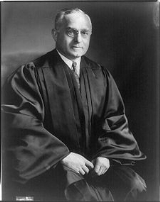
Felix Frankfurter

Encyclopedia
Felix Frankfurter was an Associate Justice
of the United States Supreme Court
.
, Austria, then part of the Austro-Hungarian Empire in Europe. He was the third of six children of Leopold and Emma (Winter) Frankfurter. His forebears had been rabbis for generations. In 1894, when he was twelve, his family immigrated to the United States, where he learned English growing up on New York City's Lower East Side
. Frankfurter attended P.S. 25 where he excelled at his studies and enjoyed chess and crap shooting
on the street. He spent many hours reading at The Cooper Union as well as attending political lectures, usually on subjects such as trade unionism, socialism, and communism.
After graduating from City College of New York
(where he was inducted into Phi Beta Kappa) in 1902, Frankfurter worked for the Tenement House Department of New York City in order to raise money for law school. He applied successfully to Harvard Law School
, where he excelled academically and socially. He became lifelong friends with Walter Lippmann
and Horace Kallen
, became an editor of the Harvard Law Review
, and graduated with one of the best academic records since Louis Brandeis
.
's book The Promise of American Life
, and became a supporter of New Nationalism
and Theodore Roosevelt
. In 1911, President William Howard Taft
appointed Stimson as his Secretary of War
, and Stimson appointed Frankfurter as law officer of the Bureau of Insular Affairs
, though Frankfurter in fact worked as Stimson's assistant and confidant. His government position restricted his ability to publicly voice his Progressive views, though he expressed his opinions clearly in private to friends such as Judge Learned Hand
. In 1912 Frankfurter supported the Bull Moose campaign
to return Roosevelt to the presidency and was bitterly disappointed when Woodrow Wilson
was elected. He became increasingly disillusioned with the established parties, and described himself as "politically homeless".
created a position for him there. He taught mainly administrative law
and occasionally criminal law
. With fellow professor James M. Landis
he advocated judicial restraint in dealing with government misdeeds, including greater freedom for administrative agencies from judicial oversight. He also served as counsel for the National Consumers League
arguing for Progressive causes such as minimum wage
and restricted work hours. He was involved in the early years of The New Republic
when it was founded by Herbert Croly
.
When the United States entered World War I in 1917 Frankfurter took a special leave from Harvard to serve as special assistant to the Secretary of War Newton D. Baker
. He was appointed Judge Advocate General
, supervising military courts-martial for the War Department. In September 1917, he was appointed counsel to a commission established by President Wilson to resolve major strikes threatening war production, the President's Mediation Committee. Among the disturbances he investigated were the 1916 Preparedness Day Bombing
in San Francisco, where he argued strongly that the radical leader Thomas Mooney
had been framed
and required a new trial. He also examined the copper industry in Arizona
, where industry bosses solved industrial relations problems by having more than 1,000 strikers forcibly deported to New Mexico. Overall, Frankfurter's work gave him an opportunity to learn firsthand about labor politics and extremism, including anarchism
, communism and revolutionary socialism
. He came to sympathize with labor issues, arguing that "unsatisfactory, remediable social conditions, if unattended, give rise to radical movements far transcending the original impulse." His activities led the public to view him as a radical lawyer and supporter of radical principles, and he was accused by former President Theodore Roosevelt
of being "engaged in excusing men precisely like the Bolsheviki in Russia."
.
Frankfurter was encouraged by Supreme Court Justice Louis Brandeis
to become more involved in Zionism
. With Brandeis he lobbied President Wilson to support the Balfour Declaration, a British government statement supporting the establishment of a Jewish homeland in Palestine. In 1918, he participated in the founding conference of the American Jewish Congress
in Philadelphia creating a national democratic organization of Jewish leaders from all over the US. In 1919, Frankfurter served as a Zionist
delegate to the Paris Peace Conference
.
In 1919, Frankfurter married Marion Denman, the daughter of a Congregational minister and a Smith College graduate. They married after a long and difficult courtship, and against the wishes of his mother, who was disturbed by the prospect of her son marrying outside the Jewish faith. Frankfurter himself was a non-practicing Jew, and regarded religion as "an accident of birth". Frankfurter was a dominating husband and Denman suffered from frail health, which resulted in frequent mental breakdowns. The couple had no children.
Frankfurter's activities continued to attract attention for their alleged radicalism. In November 1919, he chaired a meeting in support of American recognition of the newly created Soviet Union
. In 1920, Frankfurter helped to found the American Civil Liberties Union
. Following the arrest of suspected communist radicals in 1919 and 1920 during the Palmer raids
, Frankfurter, together with other prominent lawyers including Zechariah Chafee
, signed an ACLU report which condemned the "utterly illegal acts committed by those charged with the highest duty of enforcing the laws" including entrapment, police brutality, prolonged incommunicado detention, and violations of due process in court. Frankfurter and Chafee also submitted briefs to a habeas corpus
application to the Massachusetts Federal District Court
. Judge George Anderson
ordered the discharge of twenty aliens, and his denunciation of the raids effectively ended them.
In 1921, Frankfurter was given a chair at Harvard Law School, and continued progressive work on behalf of socialists and oppressed and religious minorities. When A. Lawrence Lowell, the President of Harvard University, proposed to limit the enrollment of Jewish students, Frankfurter worked with others to defeat the plan.
In the late 1920s, he came to public attention when he supported calls for a new trial for Sacco and Vanzetti
, two Italian immigrant anarchists who had been sentenced to death on robbery and murder charges. Frankfurter wrote an influential article for the Atlantic Monthly and subsequently a book, The Case of Sacco and Vanzetti: A Critical Analysis for Lawyers and Laymen. He critiqued the prosecution's case and the judge's handling of the trial and asserted that the convictions were the result of anti-immigrant prejudice and enduring anti-radical hysteria of the Red Scare
of 1919–20. His actions further isolated him from his Harvard colleagues and from Boston society.
in 1932, Frankfurter quickly became a trusted and loyal adviser to the new president. Frankfurter was considered to be liberal and advocated progressive legislation. However, he was also a firm believer in judicial restraint
. He argued against the extreme economic plans of Raymond Moley, Adolf Berle and Rex Tugwell, while clearly recognizing the need for major changes to deal with the inequalities of wealth distribution that had led to the devastating nature of the Depression.
Frankfurter successfully recommended many bright young lawyers toward public service with the New Deal
administration, so many indeed that they became known as "Felix's Happy Hot Dogs". Among the most notable of these were Thomas Corcoran
and Benjamin Cohen
. He moved to Washington, DC, commuting back to Harvard for classes, but as with previous experiences, was never fully accepted within government circles. He worked closely with Louis Brandeis
, lobbying for political activities suggested by Brandeis. He declined a seat on the Supreme Judicial Court of Massachusetts and, in 1933, the position of Solicitor General of the United States.
Long an anglophile, Frankfurter had studied in Oxford in 1920, and in 1933-4 he returned to act as visiting Eastman professor in the faculty of Law.
in July 1938, President Franklin D. Roosevelt
asked his old friend Frankfurter for recommendations of prospective candidates for the vacancy. Finding none on the list to suit his criteria, Roosevelt nominated Frankfurter himself, and he was confirmed without dissent. The Senate confirmation hearing on the nomination of Frankfurter is notable for being the first time that a nominee for the Supreme Court appeared in person before the Judiciary Committee
. He served from January 30, 1939 to August 28, 1962. He wrote 247 opinions for the Court, 132 concurring opinions, and 251 dissents.
Frankfurter became the court's most outspoken advocate of judicial restraint
, the view that courts should not interpret the fundamental law, the constitution
, in such a way as to impose sharp limits upon the authority of the legislative
and executive branches. He also usually refused to apply the federal Constitution to the states. In the case of Irvin v. Dowd
, Frankfurter would state what was for him a frequent theme: "The federal judiciary has no power to sit in judgment upon a determination of a state court... Something that thus goes to the very structure of our federal system in its distribution of power between the United States and the state is not a mere bit of red tape to be cut, on the assumption that this Court has general discretion to see justice done...".
In his judicial restraint
philosophy, Frankfurter was heavily influenced by his close friend and mentor Oliver Wendell Holmes, Jr.
, who had taken a firm stand during his tenure on the bench against the doctrine of "economic due process
". Frankfurter revered Justice Holmes, often citing Holmes in his opinions. In practice, this meant Frankfurter was generally willing to uphold the actions of those branches against constitutional challenges so long as they did not "shock the conscience." Frankfurter was particularly well known as a scholar of civil procedure
.
Frankfurter's adherence to the judicial restraint philosophy was shown in the 1940 opinion he wrote for the court in Minersville School District v. Gobitis
, a case involving Jehovah's Witnesses students who had been expelled from school due to their refusal to salute the flag and recite the Pledge of Allegiance
. He rejected claims that First Amendment rights
should be protected by law, and urged deference to the decisions of the elected school board officials. He stated that religious belief "does not relieve the citizen from the discharge of political responsibilities" and that exempting the children from the flag-saluting ceremony "might cast doubts in the minds of other children" and reduce their loyalty to the nation. Judge Harlan Fiske Stone
issued a lone dissent. The court's decision sparked hundreds of violent attacks on Jehovah's Witnesses throughout the country, and was subsequently overturned in March 1943 by the Supreme Court decision on West Virginia Board of Education v. Barnette. Former ally, Supreme Court justice Robert H. Jackson
wrote the majority opinion in this case, which also concerned Jehovah's Witnesses students expelled from school for refusing to salute the flag. Jackson's opinion, which contradicted Frankfurter's on most points, elicited an impassioned dissent from Frankfurter. In it he rejected the notion that as a Jew he ought "to particularly protect minorities." He reiterated his view that the role of the Court was not to give an opinion of the "wisdom or evil of a law" but only to determine "whether legislators could in reason have enacted such a law".
In the apportionment case of Baker v. Carr
, Frankfurter's position was that the federal courts did not have the right to tell sovereign state governments how to apportion their legislatures; he thought the Supreme Court should not get involved in political questions, whether federal or local. Frankfurter's view had won out in the 1946 case preceding Baker, Colegrove v. Green
– there, a 4–3 majority decided that the case was non-justiciable, and the federal courts had no right to become involved in state politics, no matter how unequal district populations had become. However, the Baker case would settle the matter – the drawing of state legislative districts was within the purview of federal judges, despite Frankfurter's warnings that the Court should avoid entering "the political thicket."
Frankfurter reaffirmed this view in a concurring opinion written for the 1951 Dennis v. United States
Supreme Court ruling. The decision affirmed, by a 6–2 margin, the conviction of eleven communist leaders for conspiring to overthrow the US government under the Smith Act
. In it, he once again argued that judges "are not legislators, that direct policy-making is not our province." He also recognized that curtailing the free speech of those who advocate the overthrow of government by force, also risked stifling criticism by those who did not, writing that "[it] is a sobering fact that in sustaining the convictions before us we can hardly escape restriction on the interchange of ideas."
A pivotal school desegregation case came before the court in Brown v. Board of Education. It was argued, and was set for reargument when Chief Justice Fred M. Vinson
died. It has been reported that Frankfurter remarked that Vinson's death was the first solid piece of evidence he had seen to prove the existence of God. It should be noted that this story was tied to a scheduled reargument in which Vinson's vote could be crucial (in Brown vs. Board of Education, where ostensibly Vinson was not disposed to overrule Plessy vs. Ferguson), and in any event, some believe the story to be "possibly apocryphal."
Frankfurter demanded that the opinion in 1955's Brown v. Board of Education II order desegregation with the phrase of "all deliberate speed". The phrase gave school boards across the country an excuse to defy the demands of the first Brown decision. For fifteen years, schools in the South remained segregated, until the Supreme Court's opinion in Alexander v. Holmes County Board of Education. There, the Court would write that "The obligation of every school district is to terminate dual school systems at once and to operate now and hereafter only unitary schools."
Frankfurter was hands-off in the area of business. In the 1956 government case against DuPont
, started because DuPont seemed to have maneuvered its way into a preferential relationship with GM
, Frankfurter refused to find a conspiracy, and said the Court had no right to interfere with the progress of business. Here again, Frankfurter opposed the views of Justices Warren, Black, Douglas, and Brennan (though Frankfurter lost 4–3).
Later in his career, Frankfurter's judicial restraint philosophy frequently put him on the dissenting side of ground-breaking decisions taken by the Warren Court
to end discrimination.
Frankfurter believed that the authority of the Supreme Court would be reduced if it went too strongly against public opinion: He sometimes went to great lengths to avoid unpopular decisions, including fighting to delay court decisions against racial intermarriage.
For the October 1948 Supreme Court Term, Frankfurter hired William Thaddeus Coleman as a law clerk, the first African American to serve as a Supreme Court law clerk.
, Burton
, Whittaker
, and Minton
. He generally attempted to influence any new justice coming in, though he managed to repel Justice Brennan
– who had voted with Frankfurter half the time in his first year, but then opposed him after Frankfurter's attempts at inculcation. Frankfurter turned against Brennan completely after the case of Irvin v. Dowd
. Other justices who received the Frankfurter treatment of flattery and instruction were Burton, Vinson
, and Harlan
. With Vinson, who became Chief Justice, Frankfurter feigned deference, though he sought influence.
Justice Frankfurter was in his time the leader of the conservative faction of the Supreme Court; he would for many years feud with liberals like Justices Black
and Douglas
. He often complained that they "started with a result" and that their work was "shoddy," "result-oriented," and "demagogic". Similarly, Frankfurter panned the work of Chief Justice Earl Warren
as "dishonest nonsense."
Frankfurter saw justices with ideas different from his own as part of a more liberal "Axis" – these opponents were chiefly Justices Black and Douglas, but would also include Murphy
and Rutledge
; the group would for years oppose Frankfurter's judicially restrained ideology. Douglas, Murphy, and then Rutledge were the first justices to agree with Hugo Black
's notion that the Fourteenth Amendment
incorporated the Bill of Rights
protection into it; this view would later mostly become law, during the period of the Warren Court. For his part, Frankfurter would assert that Black's incorporation theory would usurp state control over criminal justice by limiting states' development of new interpretations of criminal due process.
Frankfurter's argumentative style was not popular among his Supreme Court colleagues. "All Frankfurter does is talk, talk, talk," Chief Justice Earl Warren
complained. "He drives you crazy." Hugo Black
reported that "I thought Felix was going to hit me today, he got so mad." In the Court's biweekly conference sessions, traditionally a period for vote-counting, Frankfurter had the habit of lecturing his colleagues for forty-five minutes at a time or more with his book resting on a podium. Frankfurter's ideological opponents would leave the room or read their mail while he lectured.
Frankfurter was close friends with Justice Robert H. Jackson
. The two exchanged much correspondence over their mutual dislike for Justice William O. Douglas
. Frankfurter also had a strong influence over Jackson's opinions.
Frankfurter was universally praised for his work before coming to the Supreme Court, and was expected to influence it for decades past the death of FDR. However, Frankfurter's influence over other justices was limited by his failure to adapt to new surroundings, his style of personal relations (relying heavily on the use of flattery and ingratiation, which ultimately proved divisive), and his strict adherence to the ideology of judicial restraint
. Michael E. Parrish, professor at UCSD, said of Frankfurter: "History has not been kind to [him]... there is now almost a universal consensus that Frankfurter the justice was a failure, a judge who... became 'uncoupled from the locomotive of history' during the Second World War, and who thereafter left little in the way of an enduring jurisprudential legacy."
. He was awarded the Presidential Medal of Freedom
in 1963.
During World War II Frankfurter was presented with a historic opportunity to pursue a mission in the service of humanity.
In 1943, Jan Karski, an officer in the Polish underground, traveled to Washington as an emissary of the resistance to meet with Franklin Roosevelt and report to the President on the European conflict and specifically conditions in his own country, Poland. Roosevelt requested that Karski meet with Justice Frankfurter, as it would be of vital concern for Frankfurter, himself a Jew, to be apprised of the horrors befalling his fellow Jews in Poland. Frankfurter listened to Karski’s detailed accounts of the program of extermination of the Jewish people carried out by the Nazis. Karski provided his own eyewitness accounts of the liquidation of the Warsaw Ghetto and Belzec concentration camp.
Karski’s testimony of this conference with Frankfurter was recorded in an interview for the documentary film produced in 1978, by Claude Lanzmann ("Shoah
"), titled "The Karski Report.”
“Karski reproduces, for Lanzmann's camera with a theatrical fervor that embodies the shock he felt upon hearing” Frankfurter render his verdict on the atrocities he had just heard. “I do not believe you.” The oral testimony provided by Karksi addresses the moral challenge presented Frankfurter and the human inability to "conceive the unconceivable and to recognize what Karski calls ' the unprecedented.' "
Felix Frankfurter died from congestive heart failure
at the age of 82. His remains are interred in the Mount Auburn Cemetery
in Cambridge
, Massachusetts.
There are two extensive collections of Frankfurter's papers: one at the Manuscript Division of the Library of Congress
and the other at Harvard University. Both are fully open for research and have been distributed to other libraries on microfilm. A chapter of the international youth-led fraternal organization for Jewish teenagers Aleph Zadik Aleph
in Scottsdale, AZ is named in his honor.
Associate Justice of the Supreme Court of the United States
Associate Justices of the Supreme Court of the United States are the members of the Supreme Court of the United States other than the Chief Justice of the United States...
of the United States Supreme Court
Supreme Court of the United States
The Supreme Court of the United States is the highest court in the United States. It has ultimate appellate jurisdiction over all state and federal courts, and original jurisdiction over a small range of cases...
.
Early life
Frankfurter was born into a Jewish family on November 15, 1882, in ViennaVienna
Vienna is the capital and largest city of the Republic of Austria and one of the nine states of Austria. Vienna is Austria's primary city, with a population of about 1.723 million , and is by far the largest city in Austria, as well as its cultural, economic, and political centre...
, Austria, then part of the Austro-Hungarian Empire in Europe. He was the third of six children of Leopold and Emma (Winter) Frankfurter. His forebears had been rabbis for generations. In 1894, when he was twelve, his family immigrated to the United States, where he learned English growing up on New York City's Lower East Side
Lower East Side
The Lower East Side, LES, is a neighborhood in the southeastern part of the New York City borough of Manhattan. It is roughly bounded by Allen Street, East Houston Street, Essex Street, Canal Street, Eldridge Street, East Broadway, and Grand Street....
. Frankfurter attended P.S. 25 where he excelled at his studies and enjoyed chess and crap shooting
Craps
Craps is a dice game in which players place wagers on the outcome of the roll, or a series of rolls, of a pair of dice. Players may wager money against each other or a bank...
on the street. He spent many hours reading at The Cooper Union as well as attending political lectures, usually on subjects such as trade unionism, socialism, and communism.
After graduating from City College of New York
City College of New York
The City College of the City University of New York is a senior college of the City University of New York , in New York City. It is also the oldest of the City University's twenty-three institutions of higher learning...
(where he was inducted into Phi Beta Kappa) in 1902, Frankfurter worked for the Tenement House Department of New York City in order to raise money for law school. He applied successfully to Harvard Law School
Harvard Law School
Harvard Law School is one of the professional graduate schools of Harvard University. Located in Cambridge, Massachusetts, it is the oldest continually-operating law school in the United States and is home to the largest academic law library in the world. The school is routinely ranked by the U.S...
, where he excelled academically and socially. He became lifelong friends with Walter Lippmann
Walter Lippmann
Walter Lippmann was an American intellectual, writer, reporter, and political commentator famous for being among the first to introduce the concept of Cold War...
and Horace Kallen
Horace Kallen
-Biography:Born in the then German Bernstadt, Silesia to Jacob David Kallen and Esther Rebecca , an Orthodox rabbi and his wife, Kallen came to the United States as a child in 1887. He studied philosophy at Harvard University where he was a student of George Santayana, earning his B.A. in 1903...
, became an editor of the Harvard Law Review
Harvard Law Review
The Harvard Law Review is a journal of legal scholarship published by an independent student group at Harvard Law School.-Overview:According to the 2008 Journal Citation Reports, the Review is the most cited law review and has the second-highest impact factor in the category "law" after the...
, and graduated with one of the best academic records since Louis Brandeis
Louis Brandeis
Louis Dembitz Brandeis ; November 13, 1856 – October 5, 1941) was an Associate Justice on the Supreme Court of the United States from 1916 to 1939.He was born in Louisville, Kentucky, to Jewish immigrant parents who raised him in a secular mode...
.
Early career
Frankfurter's legal career began when he joined the New York law firm of Hornblower, Byrne, Miller & Potter in 1906. In the same year he became the assistant of Henry Stimson, the US attorney for the Southern District of New York. During this period, Frankfurter read Herbert CrolyHerbert Croly
Herbert David Croly was an intellectual leader of the Progressive Movement as an editor, and political philosopher and a co-founder of the magazine The New Republic in early twentieth-century America...
's book The Promise of American Life
The Promise of American Life
The Promises of American Life is a book published by Herbert Croly, founder of The New Republic, in 1909. This book opposed aggressive unionization and supported economic planning to raise general quality of life...
, and became a supporter of New Nationalism
New Nationalism
New Nationalism was Theodore Roosevelt's Progressive political philosophy during the 1912 election.-Overview:Roosevelt made the case for what he called the New Nationalism in a speech in Osawatomie, Kansas, on August 31, 1910...
and Theodore Roosevelt
Theodore Roosevelt
Theodore "Teddy" Roosevelt was the 26th President of the United States . He is noted for his exuberant personality, range of interests and achievements, and his leadership of the Progressive Movement, as well as his "cowboy" persona and robust masculinity...
. In 1911, President William Howard Taft
William Howard Taft
William Howard Taft was the 27th President of the United States and later the tenth Chief Justice of the United States...
appointed Stimson as his Secretary of War
United States Secretary of War
The Secretary of War was a member of the United States President's Cabinet, beginning with George Washington's administration. A similar position, called either "Secretary at War" or "Secretary of War," was appointed to serve the Congress of the Confederation under the Articles of Confederation...
, and Stimson appointed Frankfurter as law officer of the Bureau of Insular Affairs
Bureau of Insular Affairs
The Bureau of Insular Affairs was a division of the United States War Department that oversaw United States administration of certain territories from 1902 until 1939....
, though Frankfurter in fact worked as Stimson's assistant and confidant. His government position restricted his ability to publicly voice his Progressive views, though he expressed his opinions clearly in private to friends such as Judge Learned Hand
Learned Hand
Billings Learned Hand was a United States judge and judicial philosopher. He served on the United States District Court for the Southern District of New York and later the United States Court of Appeals for the Second Circuit...
. In 1912 Frankfurter supported the Bull Moose campaign
Progressive Party (United States, 1912)
The Progressive Party of 1912 was an American political party. It was formed after a split in the Republican Party between President William Howard Taft and former President Theodore Roosevelt....
to return Roosevelt to the presidency and was bitterly disappointed when Woodrow Wilson
Woodrow Wilson
Thomas Woodrow Wilson was the 28th President of the United States, from 1913 to 1921. A leader of the Progressive Movement, he served as President of Princeton University from 1902 to 1910, and then as the Governor of New Jersey from 1911 to 1913...
was elected. He became increasingly disillusioned with the established parties, and described himself as "politically homeless".
First World War
Frankfurter's work in Washington had impressed the faculty at Harvard Law School, and a donation from the financier Jacob SchiffJacob Schiff
Jacob Henry Schiff, born Jakob Heinrich Schiff was a German-born Jewish American banker and philanthropist, who helped finance, among many other things, the Japanese military efforts against Tsarist Russia in the Russo-Japanese War.From his base on Wall Street, he was the foremost Jewish leader...
created a position for him there. He taught mainly administrative law
Administrative law
Administrative law is the body of law that governs the activities of administrative agencies of government. Government agency action can include rulemaking, adjudication, or the enforcement of a specific regulatory agenda. Administrative law is considered a branch of public law...
and occasionally criminal law
Criminal law
Criminal law, is the body of law that relates to crime. It might be defined as the body of rules that defines conduct that is not allowed because it is held to threaten, harm or endanger the safety and welfare of people, and that sets out the punishment to be imposed on people who do not obey...
. With fellow professor James M. Landis
James M. Landis
James McCauley Landis was an American academic, government official and legal adviser.-Biography:Landis was born in Tokyo, Japan, where his parents were teachers at a missionary school...
he advocated judicial restraint in dealing with government misdeeds, including greater freedom for administrative agencies from judicial oversight. He also served as counsel for the National Consumers League
National Consumers League
The National Consumers League, founded in 1899, is an American consumer organization. The National Consumers League is a private, nonprofit advocacy group representing consumers on marketplace and workplace issues....
arguing for Progressive causes such as minimum wage
Minimum wage
A minimum wage is the lowest hourly, daily or monthly remuneration that employers may legally pay to workers. Equivalently, it is the lowest wage at which workers may sell their labour. Although minimum wage laws are in effect in a great many jurisdictions, there are differences of opinion about...
and restricted work hours. He was involved in the early years of The New Republic
The New Republic
The magazine has also published two articles concerning income inequality, largely criticizing conservative economists for their attempts to deny the existence or negative effect increasing income inequality is having on the United States...
when it was founded by Herbert Croly
Herbert Croly
Herbert David Croly was an intellectual leader of the Progressive Movement as an editor, and political philosopher and a co-founder of the magazine The New Republic in early twentieth-century America...
.
When the United States entered World War I in 1917 Frankfurter took a special leave from Harvard to serve as special assistant to the Secretary of War Newton D. Baker
Newton D. Baker
Newton Diehl Baker, Jr. was an American politician who belonged to the Democratic Party. He served as the 37th mayor of Cleveland, Ohio from 1912 to 1915 and as U.S. Secretary of War from 1916 to 1921.-Early years:...
. He was appointed Judge Advocate General
Judge Advocate General's Corps
Judge Advocate General's Corps, also known as JAG or JAG Corps, refers to the legal branch or specialty of the U.S. Air Force, Army, Coast Guard, and Navy. Officers serving in the JAG Corps are typically called Judge Advocates. The Marine Corps and Coast Guard do not maintain separate JAG Corps...
, supervising military courts-martial for the War Department. In September 1917, he was appointed counsel to a commission established by President Wilson to resolve major strikes threatening war production, the President's Mediation Committee. Among the disturbances he investigated were the 1916 Preparedness Day Bombing
Preparedness Day bombing
The Preparedness Day Bombing was a bombing in San Francisco, California on July 22, 1916, when the city held a parade in honor of Preparedness Day, in anticipation of the United States' imminent entry into World War I. During the parade a suitcase bomb was detonated, killing ten and wounding...
in San Francisco, where he argued strongly that the radical leader Thomas Mooney
Thomas Mooney
Thomas Joseph "Tom" Mooney was an American political activist and labor leader, who was convicted with Warren K. Billings of the San Francisco Preparedness Day Bombing of 1916...
had been framed
Frameup
A frame-up or setup is an American term referring to the act of framing someone, that is, providing false evidence or false testimony in order to falsely prove someone guilty of a crime....
and required a new trial. He also examined the copper industry in Arizona
Copper mining in Arizona
-Jerome:Native Americans used copper minerals of the Verde district at modern-day Jerome as pigment to decorate skin and textiles. The first European to visit the area is thought to be Spanish explorer Antonio de Espejo, who found silver at a location in central Arizona in 1583...
, where industry bosses solved industrial relations problems by having more than 1,000 strikers forcibly deported to New Mexico. Overall, Frankfurter's work gave him an opportunity to learn firsthand about labor politics and extremism, including anarchism
Anarchism
Anarchism is generally defined as the political philosophy which holds the state to be undesirable, unnecessary, and harmful, or alternatively as opposing authority in the conduct of human relations...
, communism and revolutionary socialism
Revolutionary socialism
The term revolutionary socialism refers to Socialist tendencies that advocate the need for fundamental social change through revolution by mass movements of the working class, as a strategy to achieve a socialist society...
. He came to sympathize with labor issues, arguing that "unsatisfactory, remediable social conditions, if unattended, give rise to radical movements far transcending the original impulse." His activities led the public to view him as a radical lawyer and supporter of radical principles, and he was accused by former President Theodore Roosevelt
Theodore Roosevelt
Theodore "Teddy" Roosevelt was the 26th President of the United States . He is noted for his exuberant personality, range of interests and achievements, and his leadership of the Progressive Movement, as well as his "cowboy" persona and robust masculinity...
of being "engaged in excusing men precisely like the Bolsheviki in Russia."
Postwar
As the war drew to a close, Frankfurter was among the nearly one hundred intellectuals who signed a statement of principles for the formation of the League of Free Nations Associations, which aimed to increase American participation in international affairsUnited States non-interventionism
Non-interventionism, the diplomatic policy whereby a nation seeks to avoid alliances with other nations in order to avoid being drawn into wars not related to direct territorial self-defense, has had a long history in the United States...
.
Frankfurter was encouraged by Supreme Court Justice Louis Brandeis
Louis Brandeis
Louis Dembitz Brandeis ; November 13, 1856 – October 5, 1941) was an Associate Justice on the Supreme Court of the United States from 1916 to 1939.He was born in Louisville, Kentucky, to Jewish immigrant parents who raised him in a secular mode...
to become more involved in Zionism
Zionism
Zionism is a Jewish political movement that, in its broadest sense, has supported the self-determination of the Jewish people in a sovereign Jewish national homeland. Since the establishment of the State of Israel, the Zionist movement continues primarily to advocate on behalf of the Jewish state...
. With Brandeis he lobbied President Wilson to support the Balfour Declaration, a British government statement supporting the establishment of a Jewish homeland in Palestine. In 1918, he participated in the founding conference of the American Jewish Congress
American Jewish Congress
The American Jewish Congress describes itself as an association of Jewish Americans organized to defend Jewish interests at home and abroad through public policy advocacy, using diplomacy, legislation, and the courts....
in Philadelphia creating a national democratic organization of Jewish leaders from all over the US. In 1919, Frankfurter served as a Zionist
Zionism
Zionism is a Jewish political movement that, in its broadest sense, has supported the self-determination of the Jewish people in a sovereign Jewish national homeland. Since the establishment of the State of Israel, the Zionist movement continues primarily to advocate on behalf of the Jewish state...
delegate to the Paris Peace Conference
Paris Peace Conference, 1919
The Paris Peace Conference was the meeting of the Allied victors following the end of World War I to set the peace terms for the defeated Central Powers following the armistices of 1918. It took place in Paris in 1919 and involved diplomats from more than 32 countries and nationalities...
.
In 1919, Frankfurter married Marion Denman, the daughter of a Congregational minister and a Smith College graduate. They married after a long and difficult courtship, and against the wishes of his mother, who was disturbed by the prospect of her son marrying outside the Jewish faith. Frankfurter himself was a non-practicing Jew, and regarded religion as "an accident of birth". Frankfurter was a dominating husband and Denman suffered from frail health, which resulted in frequent mental breakdowns. The couple had no children.
Frankfurter's activities continued to attract attention for their alleged radicalism. In November 1919, he chaired a meeting in support of American recognition of the newly created Soviet Union
Soviet Union
The Soviet Union , officially the Union of Soviet Socialist Republics , was a constitutionally socialist state that existed in Eurasia between 1922 and 1991....
. In 1920, Frankfurter helped to found the American Civil Liberties Union
American Civil Liberties Union
The American Civil Liberties Union is a U.S. non-profit organization whose stated mission is "to defend and preserve the individual rights and liberties guaranteed to every person in this country by the Constitution and laws of the United States." It works through litigation, legislation, and...
. Following the arrest of suspected communist radicals in 1919 and 1920 during the Palmer raids
Palmer Raids
The Palmer Raids were attempts by the United States Department of Justice to arrest and deport radical leftists, especially anarchists, from the United States. The raids and arrests occurred in November 1919 and January 1920 under the leadership of Attorney General A. Mitchell Palmer...
, Frankfurter, together with other prominent lawyers including Zechariah Chafee
Zechariah Chafee
Zechariah Chafee, Jr. was an American judicial philosopher and civil libertarian. An advocate for free speech, he was described by Senator Joseph McCarthy as "dangerous" to the United States...
, signed an ACLU report which condemned the "utterly illegal acts committed by those charged with the highest duty of enforcing the laws" including entrapment, police brutality, prolonged incommunicado detention, and violations of due process in court. Frankfurter and Chafee also submitted briefs to a habeas corpus
Habeas corpus
is a writ, or legal action, through which a prisoner can be released from unlawful detention. The remedy can be sought by the prisoner or by another person coming to his aid. Habeas corpus originated in the English legal system, but it is now available in many nations...
application to the Massachusetts Federal District Court
United States District Court for the District of Massachusetts
The United States District Court for the District of Massachusetts is the federal district court whose jurisdiction is the Commonwealth of Massachusetts, USA. The first court session was held in Boston in 1789. The second term was held in Salem in 1790 and until 1813 court session locations...
. Judge George Anderson
George Weston Anderson
George Weston Anderson was a judge of the United States Court of Appeals for the First Circuit.-Biography:...
ordered the discharge of twenty aliens, and his denunciation of the raids effectively ended them.
In 1921, Frankfurter was given a chair at Harvard Law School, and continued progressive work on behalf of socialists and oppressed and religious minorities. When A. Lawrence Lowell, the President of Harvard University, proposed to limit the enrollment of Jewish students, Frankfurter worked with others to defeat the plan.
In the late 1920s, he came to public attention when he supported calls for a new trial for Sacco and Vanzetti
Sacco and Vanzetti
Ferdinando Nicola Sacco and Bartolomeo Vanzetti were anarchists who were convicted of murdering two men during a 1920 armed robbery in South Braintree, Massachusetts, United States...
, two Italian immigrant anarchists who had been sentenced to death on robbery and murder charges. Frankfurter wrote an influential article for the Atlantic Monthly and subsequently a book, The Case of Sacco and Vanzetti: A Critical Analysis for Lawyers and Laymen. He critiqued the prosecution's case and the judge's handling of the trial and asserted that the convictions were the result of anti-immigrant prejudice and enduring anti-radical hysteria of the Red Scare
First Red Scare
In American history, the First Red Scare of 1919–1920 was marked by a widespread fear of Bolshevism and anarchism. Concerns over the effects of radical political agitation in American society and alleged spread in the American labor movement fueled the paranoia that defined the period.The First Red...
of 1919–20. His actions further isolated him from his Harvard colleagues and from Boston society.
New Deal years
Following the election of Franklin D. RooseveltFranklin D. Roosevelt
Franklin Delano Roosevelt , also known by his initials, FDR, was the 32nd President of the United States and a central figure in world events during the mid-20th century, leading the United States during a time of worldwide economic crisis and world war...
in 1932, Frankfurter quickly became a trusted and loyal adviser to the new president. Frankfurter was considered to be liberal and advocated progressive legislation. However, he was also a firm believer in judicial restraint
Judicial restraint
Judicial restraint is a theory of judicial interpretation that encourages judges to limit the exercise of their own power. It asserts that judges should hesitate to strike down laws unless they are obviously unconstitutional...
. He argued against the extreme economic plans of Raymond Moley, Adolf Berle and Rex Tugwell, while clearly recognizing the need for major changes to deal with the inequalities of wealth distribution that had led to the devastating nature of the Depression.
Frankfurter successfully recommended many bright young lawyers toward public service with the New Deal
New Deal
The New Deal was a series of economic programs implemented in the United States between 1933 and 1936. They were passed by the U.S. Congress during the first term of President Franklin D. Roosevelt. The programs were Roosevelt's responses to the Great Depression, and focused on what historians call...
administration, so many indeed that they became known as "Felix's Happy Hot Dogs". Among the most notable of these were Thomas Corcoran
Thomas Gardiner Corcoran
Thomas Gardiner Corcoran was one of several Irish American advisors in President Franklin D. Roosevelt's brain trust during the New Deal, and later, a close friend and advisor to President Lyndon B. Johnson....
and Benjamin Cohen
Benjamin Victor Cohen
Benjamin V. Cohen , a member of the administrations of Franklin D. Roosevelt and Harry S. Truman, had a public service career that spanned from the early New Deal through and beyond the Vietnam War era.-Early career:...
. He moved to Washington, DC, commuting back to Harvard for classes, but as with previous experiences, was never fully accepted within government circles. He worked closely with Louis Brandeis
Louis Brandeis
Louis Dembitz Brandeis ; November 13, 1856 – October 5, 1941) was an Associate Justice on the Supreme Court of the United States from 1916 to 1939.He was born in Louisville, Kentucky, to Jewish immigrant parents who raised him in a secular mode...
, lobbying for political activities suggested by Brandeis. He declined a seat on the Supreme Judicial Court of Massachusetts and, in 1933, the position of Solicitor General of the United States.
Long an anglophile, Frankfurter had studied in Oxford in 1920, and in 1933-4 he returned to act as visiting Eastman professor in the faculty of Law.
Supreme Court
Following the death of Supreme Court Justice Benjamin N. CardozoBenjamin N. Cardozo
Benjamin Nathan Cardozo was a well-known American lawyer and associate Supreme Court Justice. Cardozo is remembered for his significant influence on the development of American common law in the 20th century, in addition to his modesty, philosophy, and vivid prose style...
in July 1938, President Franklin D. Roosevelt
Franklin D. Roosevelt
Franklin Delano Roosevelt , also known by his initials, FDR, was the 32nd President of the United States and a central figure in world events during the mid-20th century, leading the United States during a time of worldwide economic crisis and world war...
asked his old friend Frankfurter for recommendations of prospective candidates for the vacancy. Finding none on the list to suit his criteria, Roosevelt nominated Frankfurter himself, and he was confirmed without dissent. The Senate confirmation hearing on the nomination of Frankfurter is notable for being the first time that a nominee for the Supreme Court appeared in person before the Judiciary Committee
United States Senate Committee on the Judiciary
The United States Senate Committee on the Judiciary is a standing committee of the United States Senate, of the United States Congress. The Judiciary Committee, with 18 members, is charged with conducting hearings prior to the Senate votes on confirmation of federal judges nominated by the...
. He served from January 30, 1939 to August 28, 1962. He wrote 247 opinions for the Court, 132 concurring opinions, and 251 dissents.
Frankfurter became the court's most outspoken advocate of judicial restraint
Judicial restraint
Judicial restraint is a theory of judicial interpretation that encourages judges to limit the exercise of their own power. It asserts that judges should hesitate to strike down laws unless they are obviously unconstitutional...
, the view that courts should not interpret the fundamental law, the constitution
United States Constitution
The Constitution of the United States is the supreme law of the United States of America. It is the framework for the organization of the United States government and for the relationship of the federal government with the states, citizens, and all people within the United States.The first three...
, in such a way as to impose sharp limits upon the authority of the legislative
Legislature
A legislature is a kind of deliberative assembly with the power to pass, amend, and repeal laws. The law created by a legislature is called legislation or statutory law. In addition to enacting laws, legislatures usually have exclusive authority to raise or lower taxes and adopt the budget and...
and executive branches. He also usually refused to apply the federal Constitution to the states. In the case of Irvin v. Dowd
Irvin v. Dowd
Irvin v. Dowd, 359 U.S. 394 , was a United States Supreme Court case. It involved an escaped convict's denial of appeal. The convict sought a federal writ of habeas corpus.Irvin v...
, Frankfurter would state what was for him a frequent theme: "The federal judiciary has no power to sit in judgment upon a determination of a state court... Something that thus goes to the very structure of our federal system in its distribution of power between the United States and the state is not a mere bit of red tape to be cut, on the assumption that this Court has general discretion to see justice done...".
In his judicial restraint
Judicial restraint
Judicial restraint is a theory of judicial interpretation that encourages judges to limit the exercise of their own power. It asserts that judges should hesitate to strike down laws unless they are obviously unconstitutional...
philosophy, Frankfurter was heavily influenced by his close friend and mentor Oliver Wendell Holmes, Jr.
Oliver Wendell Holmes, Jr.
Oliver Wendell Holmes, Jr. was an American jurist who served as an Associate Justice of the Supreme Court of the United States from 1902 to 1932...
, who had taken a firm stand during his tenure on the bench against the doctrine of "economic due process
Due process
Due process is the legal code that the state must venerate all of the legal rights that are owed to a person under the principle. Due process balances the power of the state law of the land and thus protects individual persons from it...
". Frankfurter revered Justice Holmes, often citing Holmes in his opinions. In practice, this meant Frankfurter was generally willing to uphold the actions of those branches against constitutional challenges so long as they did not "shock the conscience." Frankfurter was particularly well known as a scholar of civil procedure
Civil procedure
Civil procedure is the body of law that sets out the rules and standards that courts follow when adjudicating civil lawsuits...
.
Frankfurter's adherence to the judicial restraint philosophy was shown in the 1940 opinion he wrote for the court in Minersville School District v. Gobitis
Minersville School District v. Gobitis
Minersville School District v. Gobitis, , was a decision by the Supreme Court of the United States involving the religious rights of public school students under the First Amendment to the United States Constitution...
, a case involving Jehovah's Witnesses students who had been expelled from school due to their refusal to salute the flag and recite the Pledge of Allegiance
Pledge of Allegiance
The Pledge of Allegiance of the United States is an expression of loyalty to the federal flag and the republic of the United States of America, originally composed by Christian Socialist Francis Bellamy in 1892 and formally adopted by Congress as the pledge in 1942...
. He rejected claims that First Amendment rights
First Amendment to the United States Constitution
The First Amendment to the United States Constitution is part of the Bill of Rights. The amendment prohibits the making of any law respecting an establishment of religion, impeding the free exercise of religion, abridging the freedom of speech, infringing on the freedom of the press, interfering...
should be protected by law, and urged deference to the decisions of the elected school board officials. He stated that religious belief "does not relieve the citizen from the discharge of political responsibilities" and that exempting the children from the flag-saluting ceremony "might cast doubts in the minds of other children" and reduce their loyalty to the nation. Judge Harlan Fiske Stone
Harlan Fiske Stone
Harlan Fiske Stone was an American lawyer and jurist. A native of New Hampshire, he served as the dean of Columbia Law School, his alma mater, in the early 20th century. As a member of the Republican Party, he was appointed as the 52nd Attorney General of the United States before becoming an...
issued a lone dissent. The court's decision sparked hundreds of violent attacks on Jehovah's Witnesses throughout the country, and was subsequently overturned in March 1943 by the Supreme Court decision on West Virginia Board of Education v. Barnette. Former ally, Supreme Court justice Robert H. Jackson
Robert H. Jackson
Robert Houghwout Jackson was United States Attorney General and an Associate Justice of the United States Supreme Court . He was also the chief United States prosecutor at the Nuremberg Trials...
wrote the majority opinion in this case, which also concerned Jehovah's Witnesses students expelled from school for refusing to salute the flag. Jackson's opinion, which contradicted Frankfurter's on most points, elicited an impassioned dissent from Frankfurter. In it he rejected the notion that as a Jew he ought "to particularly protect minorities." He reiterated his view that the role of the Court was not to give an opinion of the "wisdom or evil of a law" but only to determine "whether legislators could in reason have enacted such a law".
In the apportionment case of Baker v. Carr
Baker v. Carr
Baker v. Carr, , was a landmark United States Supreme Court case that retreated from the Court's political question doctrine, deciding that redistricting issues present justiciable questions, thus enabling federal courts to intervene in and to decide reapportionment cases...
, Frankfurter's position was that the federal courts did not have the right to tell sovereign state governments how to apportion their legislatures; he thought the Supreme Court should not get involved in political questions, whether federal or local. Frankfurter's view had won out in the 1946 case preceding Baker, Colegrove v. Green
Colegrove v. Green
Colegrove v. Green, 328 U.S. 549 , was a United States Supreme Court case. Writing for a 4-3 plurality, Justice Felix Frankfurter held that the federal judiciary had no power to interfere with issues regarding apportionment of state legislatures. The Court held that Article I, section IV of the U.S...
– there, a 4–3 majority decided that the case was non-justiciable, and the federal courts had no right to become involved in state politics, no matter how unequal district populations had become. However, the Baker case would settle the matter – the drawing of state legislative districts was within the purview of federal judges, despite Frankfurter's warnings that the Court should avoid entering "the political thicket."
Frankfurter reaffirmed this view in a concurring opinion written for the 1951 Dennis v. United States
Dennis v. United States
Dennis v. United States, , was a United States Supreme Court case involving Eugene Dennis, general secretary of the Communist Party USA, which found that Dennis did not have a right under the First Amendment to the Constitution of the United States to exercise free speech, publication and assembly,...
Supreme Court ruling. The decision affirmed, by a 6–2 margin, the conviction of eleven communist leaders for conspiring to overthrow the US government under the Smith Act
Smith Act
The Alien Registration Act or Smith Act of 1940 is a United States federal statute that set criminal penalties for advocating the overthrow of the U.S...
. In it, he once again argued that judges "are not legislators, that direct policy-making is not our province." He also recognized that curtailing the free speech of those who advocate the overthrow of government by force, also risked stifling criticism by those who did not, writing that "[it] is a sobering fact that in sustaining the convictions before us we can hardly escape restriction on the interchange of ideas."
A pivotal school desegregation case came before the court in Brown v. Board of Education. It was argued, and was set for reargument when Chief Justice Fred M. Vinson
Fred M. Vinson
Frederick Moore Vinson served the United States in all three branches of government and was the most prominent member of the Vinson political family. In the legislative branch, he was an elected member of the United States House of Representatives from Louisa, Kentucky, for twelve years...
died. It has been reported that Frankfurter remarked that Vinson's death was the first solid piece of evidence he had seen to prove the existence of God. It should be noted that this story was tied to a scheduled reargument in which Vinson's vote could be crucial (in Brown vs. Board of Education, where ostensibly Vinson was not disposed to overrule Plessy vs. Ferguson), and in any event, some believe the story to be "possibly apocryphal."
Frankfurter demanded that the opinion in 1955's Brown v. Board of Education II order desegregation with the phrase of "all deliberate speed". The phrase gave school boards across the country an excuse to defy the demands of the first Brown decision. For fifteen years, schools in the South remained segregated, until the Supreme Court's opinion in Alexander v. Holmes County Board of Education. There, the Court would write that "The obligation of every school district is to terminate dual school systems at once and to operate now and hereafter only unitary schools."
Frankfurter was hands-off in the area of business. In the 1956 government case against DuPont
DuPont
E. I. du Pont de Nemours and Company , commonly referred to as DuPont, is an American chemical company that was founded in July 1802 as a gunpowder mill by Eleuthère Irénée du Pont. DuPont was the world's third largest chemical company based on market capitalization and ninth based on revenue in 2009...
, started because DuPont seemed to have maneuvered its way into a preferential relationship with GM
General Motors
General Motors Company , commonly known as GM, formerly incorporated as General Motors Corporation, is an American multinational automotive corporation headquartered in Detroit, Michigan and the world's second-largest automaker in 2010...
, Frankfurter refused to find a conspiracy, and said the Court had no right to interfere with the progress of business. Here again, Frankfurter opposed the views of Justices Warren, Black, Douglas, and Brennan (though Frankfurter lost 4–3).
Later in his career, Frankfurter's judicial restraint philosophy frequently put him on the dissenting side of ground-breaking decisions taken by the Warren Court
Warren Court
The Warren Court refers to the Supreme Court of the United States between 1953 and 1969, when Earl Warren served as Chief Justice. Warren led a liberal majority that used judicial power in dramatic fashion, to the consternation of conservative opponents...
to end discrimination.
Frankfurter believed that the authority of the Supreme Court would be reduced if it went too strongly against public opinion: He sometimes went to great lengths to avoid unpopular decisions, including fighting to delay court decisions against racial intermarriage.
For the October 1948 Supreme Court Term, Frankfurter hired William Thaddeus Coleman as a law clerk, the first African American to serve as a Supreme Court law clerk.
Personal relations on the Court
Throughout his career on the court, Frankfurter was a large influence on many justices, such as ClarkTom C. Clark
Thomas Campbell Clark was United States Attorney General from 1945 to 1949 and an Associate Justice of the Supreme Court of the United States .- Early life and career :...
, Burton
Harold Hitz Burton
Harold Hitz Burton was an American politician and lawyer.He served as the 45th mayor of Cleveland, Ohio, as a U.S. Senator from Ohio, and as an Associate Justice of the Supreme Court of the United States. He was known as a dispassionate jurist who prized equal justice under the law.-Biography:He...
, Whittaker
Charles Evans Whittaker
Charles Evans Whittaker was an Associate Justice of the United States Supreme Court from 1957 to 1962.-Early years:...
, and Minton
Sherman Minton
Sherman "Shay" Minton was a Democratic United States Senator from Indiana and an Associate Justice of the Supreme Court of the United States. He was the most educated justice during his time on the Supreme Court, having attended Indiana University, Yale and the Sorbonne...
. He generally attempted to influence any new justice coming in, though he managed to repel Justice Brennan
William J. Brennan, Jr.
William Joseph Brennan, Jr. was an American jurist who served as an Associate Justice of the United States Supreme Court from 1956 to 1990...
– who had voted with Frankfurter half the time in his first year, but then opposed him after Frankfurter's attempts at inculcation. Frankfurter turned against Brennan completely after the case of Irvin v. Dowd
Irvin v. Dowd
Irvin v. Dowd, 359 U.S. 394 , was a United States Supreme Court case. It involved an escaped convict's denial of appeal. The convict sought a federal writ of habeas corpus.Irvin v...
. Other justices who received the Frankfurter treatment of flattery and instruction were Burton, Vinson
Fred M. Vinson
Frederick Moore Vinson served the United States in all three branches of government and was the most prominent member of the Vinson political family. In the legislative branch, he was an elected member of the United States House of Representatives from Louisa, Kentucky, for twelve years...
, and Harlan
John Marshall Harlan II
John Marshall Harlan was an American jurist who served as an Associate Justice of the Supreme Court from 1955 to 1971. His namesake was his grandfather John Marshall Harlan, another associate justice who served from 1877 to 1911.Harlan was a student at Upper Canada College and Appleby College and...
. With Vinson, who became Chief Justice, Frankfurter feigned deference, though he sought influence.
Justice Frankfurter was in his time the leader of the conservative faction of the Supreme Court; he would for many years feud with liberals like Justices Black
Hugo Black
Hugo Lafayette Black was an American politician and jurist. A member of the Democratic Party, Black represented Alabama in the United States Senate from 1927 to 1937, and served as an Associate Justice of the Supreme Court of the United States from 1937 to 1971. Black was nominated to the Supreme...
and Douglas
William O. Douglas
William Orville Douglas was an Associate Justice of the United States Supreme Court. With a term lasting 36 years and 209 days, he is the longest-serving justice in the history of the Supreme Court...
. He often complained that they "started with a result" and that their work was "shoddy," "result-oriented," and "demagogic". Similarly, Frankfurter panned the work of Chief Justice Earl Warren
Earl Warren
Earl Warren was the 14th Chief Justice of the United States.He is known for the sweeping decisions of the Warren Court, which ended school segregation and transformed many areas of American law, especially regarding the rights of the accused, ending public-school-sponsored prayer, and requiring...
as "dishonest nonsense."
Frankfurter saw justices with ideas different from his own as part of a more liberal "Axis" – these opponents were chiefly Justices Black and Douglas, but would also include Murphy
Frank Murphy
William Francis Murphy was a politician and jurist from Michigan. He served as First Assistant U.S. District Attorney, Eastern Michigan District , Recorder's Court Judge, Detroit . Mayor of Detroit , the last Governor-General of the Philippines , U.S...
and Rutledge
Wiley Blount Rutledge
Wiley Blount Rutledge, Jr. was an American educator, lawyer, and justice of the Supreme Court of the United States.-Early life:...
; the group would for years oppose Frankfurter's judicially restrained ideology. Douglas, Murphy, and then Rutledge were the first justices to agree with Hugo Black
Hugo Black
Hugo Lafayette Black was an American politician and jurist. A member of the Democratic Party, Black represented Alabama in the United States Senate from 1927 to 1937, and served as an Associate Justice of the Supreme Court of the United States from 1937 to 1971. Black was nominated to the Supreme...
's notion that the Fourteenth Amendment
Fourteenth Amendment to the United States Constitution
The Fourteenth Amendment to the United States Constitution was adopted on July 9, 1868, as one of the Reconstruction Amendments.Its Citizenship Clause provides a broad definition of citizenship that overruled the Dred Scott v...
incorporated the Bill of Rights
United States Bill of Rights
The Bill of Rights is the collective name for the first ten amendments to the United States Constitution. These limitations serve to protect the natural rights of liberty and property. They guarantee a number of personal freedoms, limit the government's power in judicial and other proceedings, and...
protection into it; this view would later mostly become law, during the period of the Warren Court. For his part, Frankfurter would assert that Black's incorporation theory would usurp state control over criminal justice by limiting states' development of new interpretations of criminal due process.
Frankfurter's argumentative style was not popular among his Supreme Court colleagues. "All Frankfurter does is talk, talk, talk," Chief Justice Earl Warren
Earl Warren
Earl Warren was the 14th Chief Justice of the United States.He is known for the sweeping decisions of the Warren Court, which ended school segregation and transformed many areas of American law, especially regarding the rights of the accused, ending public-school-sponsored prayer, and requiring...
complained. "He drives you crazy." Hugo Black
Hugo Black
Hugo Lafayette Black was an American politician and jurist. A member of the Democratic Party, Black represented Alabama in the United States Senate from 1927 to 1937, and served as an Associate Justice of the Supreme Court of the United States from 1937 to 1971. Black was nominated to the Supreme...
reported that "I thought Felix was going to hit me today, he got so mad." In the Court's biweekly conference sessions, traditionally a period for vote-counting, Frankfurter had the habit of lecturing his colleagues for forty-five minutes at a time or more with his book resting on a podium. Frankfurter's ideological opponents would leave the room or read their mail while he lectured.
Frankfurter was close friends with Justice Robert H. Jackson
Robert H. Jackson
Robert Houghwout Jackson was United States Attorney General and an Associate Justice of the United States Supreme Court . He was also the chief United States prosecutor at the Nuremberg Trials...
. The two exchanged much correspondence over their mutual dislike for Justice William O. Douglas
William O. Douglas
William Orville Douglas was an Associate Justice of the United States Supreme Court. With a term lasting 36 years and 209 days, he is the longest-serving justice in the history of the Supreme Court...
. Frankfurter also had a strong influence over Jackson's opinions.
Frankfurter was universally praised for his work before coming to the Supreme Court, and was expected to influence it for decades past the death of FDR. However, Frankfurter's influence over other justices was limited by his failure to adapt to new surroundings, his style of personal relations (relying heavily on the use of flattery and ingratiation, which ultimately proved divisive), and his strict adherence to the ideology of judicial restraint
Judicial restraint
Judicial restraint is a theory of judicial interpretation that encourages judges to limit the exercise of their own power. It asserts that judges should hesitate to strike down laws unless they are obviously unconstitutional...
. Michael E. Parrish, professor at UCSD, said of Frankfurter: "History has not been kind to [him]... there is now almost a universal consensus that Frankfurter the justice was a failure, a judge who... became 'uncoupled from the locomotive of history' during the Second World War, and who thereafter left little in the way of an enduring jurisprudential legacy."
Retirement, death and legacy
Frankfurter retired in 1962 after suffering a stroke and was succeeded by Arthur GoldbergArthur Goldberg
Arthur Joseph Goldberg was an American statesman and jurist who served as the U.S. Secretary of Labor, Supreme Court Justice and Ambassador to the United Nations.-Early life:...
. He was awarded the Presidential Medal of Freedom
Presidential Medal of Freedom
The Presidential Medal of Freedom is an award bestowed by the President of the United States and is—along with thecomparable Congressional Gold Medal bestowed by an act of U.S. Congress—the highest civilian award in the United States...
in 1963.
During World War II Frankfurter was presented with a historic opportunity to pursue a mission in the service of humanity.
In 1943, Jan Karski, an officer in the Polish underground, traveled to Washington as an emissary of the resistance to meet with Franklin Roosevelt and report to the President on the European conflict and specifically conditions in his own country, Poland. Roosevelt requested that Karski meet with Justice Frankfurter, as it would be of vital concern for Frankfurter, himself a Jew, to be apprised of the horrors befalling his fellow Jews in Poland. Frankfurter listened to Karski’s detailed accounts of the program of extermination of the Jewish people carried out by the Nazis. Karski provided his own eyewitness accounts of the liquidation of the Warsaw Ghetto and Belzec concentration camp.
Karski’s testimony of this conference with Frankfurter was recorded in an interview for the documentary film produced in 1978, by Claude Lanzmann ("Shoah
Shoah (film)
This page is about the film by the name of Shoah. For other uses, see Shoah Shoah is a 1985 French documentary film directed by Claude Lanzmann about the Holocaust...
"), titled "The Karski Report.”
“Karski reproduces, for Lanzmann's camera with a theatrical fervor that embodies the shock he felt upon hearing” Frankfurter render his verdict on the atrocities he had just heard. “I do not believe you.” The oral testimony provided by Karksi addresses the moral challenge presented Frankfurter and the human inability to "conceive the unconceivable and to recognize what Karski calls ' the unprecedented.' "
Felix Frankfurter died from congestive heart failure
Congestive heart failure
Heart failure often called congestive heart failure is generally defined as the inability of the heart to supply sufficient blood flow to meet the needs of the body. Heart failure can cause a number of symptoms including shortness of breath, leg swelling, and exercise intolerance. The condition...
at the age of 82. His remains are interred in the Mount Auburn Cemetery
Mount Auburn Cemetery
Mount Auburn Cemetery was founded in 1831 as "America's first garden cemetery", or the first "rural cemetery", with classical monuments set in a rolling landscaped terrain...
in Cambridge
Cambridge, Massachusetts
Cambridge is a city in Middlesex County, Massachusetts, United States, in the Greater Boston area. It was named in honor of the University of Cambridge in England, an important center of the Puritan theology embraced by the town's founders. Cambridge is home to two of the world's most prominent...
, Massachusetts.
There are two extensive collections of Frankfurter's papers: one at the Manuscript Division of the Library of Congress
Library of Congress
The Library of Congress is the research library of the United States Congress, de facto national library of the United States, and the oldest federal cultural institution in the United States. Located in three buildings in Washington, D.C., it is the largest library in the world by shelf space and...
and the other at Harvard University. Both are fully open for research and have been distributed to other libraries on microfilm. A chapter of the international youth-led fraternal organization for Jewish teenagers Aleph Zadik Aleph
Aleph Zadik Aleph
The Grand Order of the Aleph Zadik Aleph is an international youth-led fraternal organization for Jewish teenagers, founded in 1924 and currently existing as the male wing of BBYO Inc., an independent non-profit organization...
in Scottsdale, AZ is named in his honor.
See also
- Demographics of the Supreme Court of the United StatesDemographics of the Supreme Court of the United StatesThe demographics of the Supreme Court of the United States encompass the gender, ethnic, religious, geographic, and economic backgrounds of the 112 justices appointed to the Supreme Court. Certain of these characteristics have been raised as an issue since the Court was established in 1789. For its...
- List of Justices of the Supreme Court of the United States
- List of law clerks of the Supreme Court of the United States
- List of U.S. Supreme Court Justices by time in office
- United States Supreme Court cases during the Hughes Court
- United States Supreme Court cases during the Stone Court
- United States Supreme Court cases during the Vinson Court
- United States Supreme Court cases during the Warren Court
Further reading
- Abraham, Henry J., Justices and Presidents: A Political History of Appointments to the Supreme Court. 3d. ed. (New York: Oxford University Press, 1992). ISBN 0-19-506557-3...
- Cushman, Clare, The Supreme Court Justices: Illustrated Biographies,1789–1995 (2nd ed.) (Supreme Court Historical Society), (Congressional Quarterly Books, 2001) ISBN 1-56802-126-7; ISBN 978-1-56802-126-3.....
- Frankfurter, Felix, Mr. Justice Cardozo and Public Law, Columbia Law ReviewColumbia Law ReviewThe Columbia Law Review is a law review edited and published by students at Columbia Law School. In addition to articles, the journal regularly publishes scholarly essays and student notes. It was founded in 1901 by Joseph E. Corrigan and John M. Woolsey, who served as the review's first...
39 (1939): 88–118, Harvard Law ReviewHarvard Law ReviewThe Harvard Law Review is a journal of legal scholarship published by an independent student group at Harvard Law School.-Overview:According to the 2008 Journal Citation Reports, the Review is the most cited law review and has the second-highest impact factor in the category "law" after the...
52 (1939): 440–470, Yale Law JournalYale Law JournalThe Yale Law Journal is a student-run law review affiliated with the Yale Law School. Published continuously since 1891, it is the most widely known of the eight law reviews published by students at Yale Law School...
48 (1939): 458–488....... - Martin, Fenton S. and Goehlert, Robert U., The U.S. Supreme Court: A Bibliography, (Congressional Quarterly Books, 1990). ISBN 0-87187-554-3.
- Murphy, Bruce AllenBruce Allen MurphyBruce Allen Murphy, Ph.D., is a judicial biographer and scholar of American Constitutional law and politics. He is the Fred Morgan Kirby Professor of Civil Rights at Lafayette College in Easton, Pennsylvania, a position he has held since 1998...
, The Brandeis/Frankfurter Connection: The Secret Political Activities of Two Supreme Court Justices, (New York: Oxford University PressOxford University PressOxford University Press is the largest university press in the world. It is a department of the University of Oxford and is governed by a group of 15 academics appointed by the Vice-Chancellor known as the Delegates of the Press. They are headed by the Secretary to the Delegates, who serves as...
, 1982). ISBN 0-19503-122-9... - Pritchett, C. Herman, Civil Liberties and the Vinson Court (The University of ChicagoUniversity of ChicagoThe University of Chicago is a private research university in Chicago, Illinois, USA. It was founded by the American Baptist Education Society with a donation from oil magnate and philanthropist John D. Rockefeller and incorporated in 1890...
Press, 1969) ISBN 978-0-226-68443-7; ISBN 0-226-68443-1.. - Urofsky, Melvin I., Conflict Among the Brethren: Felix Frankfurter, William O. Douglas and the Clash of Personalities and Philosophies on the United States Supreme Court, Duke Law JournalDuke Law JournalThe Duke Law Journal is a student-run law review published at Duke University School of Law. The journal publishes general-interest articles and student notes in eight issues each year.- Overview :...
(1988): 71–113. - Urofsky, Melvin I., Division and Discord: The Supreme Court under Stone and Vinson, 1941–1953 (University of South Carolina Press, 1997) ISBN 1-57003-120-7.
- Urofsky, Melvin I., The Supreme Court Justices: A Biographical Dictionary (New York: Garland Publishing 1994). 590 pp. ISBN 0-8153-1176-1; ISBN 978-0-8153-1176-8...
External links
- September 27, 2006 Epoch Times Editorial on Harry Wu (quotation referring to Jan KarskiJan KarskiJan Karski was a Polish World War II resistance movement fighter and later scholar at Georgetown University. In 1942 and 1943 Karski reported to the Polish government in exile and the Western Allies on the situation in German-occupied Poland, especially the destruction of the Warsaw Ghetto, and...
and Felix Frankfurter: When Jan Karski disclosed the message of Nazis' slaughtering of the Jews, the U.S. Supreme Court judge Felix Frankfurter's response to a Polish diplomat was, "Mr. Ambassador, I did not say this young man is lying. I said I am unable to believe him. There is a difference.") Harry Wu’s quote, is anecdotal and its accuracy is suspect. There is, however, no substantive difference between the two quotations, the one cited above and the filmed interview given by Karski himself in 1978.
- Felix Frankfurter's Gravesite at Find a GraveFind A GraveFind a Grave is a commercial website providing free access and input to an online database of cemetery records. It was founded in 1998 as a DBA and incorporated in 2000.-History:...
- Oyez: U.S. Supreme Court media on Felix Frankfurter
- Supreme Court Historical Society, Felix Frankfurther.