
All Topics  
Pledge of Allegiance

 
Pledge of Allegiance

   Email Print
   Bookmark   Link


Pledge of Allegiance


The Pledge of Allegiance to the United States flag is an oath of loyalty to the country.


Discussion
Ask a question about 'Pledge of Allegiance'
Start a new discussion about 'Pledge of Allegiance'
Answer questions from other users
Full Discussion Forum


Encyclopedia


Official versions (changes in bold italics)
1892
“I pledge allegiance to my flag and the republic for which it stands: one nation indivisible with liberty and justice for all.”
1892 to 1923
"I pledge allegiance to my flag and to the republic for which it stands: one nation indivisible with liberty and justice for all."
1923 to 1924
"I pledge allegiance to the flag of the United States and to the republic for which it stands: one nation indivisible with liberty and justice for all."
1924 to 1954
"I pledge allegiance to the flag of the United States of America, and to the republic for which it stands: one nation indivisible with liberty and justice for all."
1954 to Present
"I pledge allegiance to the flag of the United States of America and to the republic for which it stands: one nation under God, indivisible, with liberty and justice for all."


The Pledge of Allegiance to the United States flag is an oath of loyalty to the country. It is recited at many public events. US Congressional sessions open with the recitation of the Pledge.

The current Pledge of Allegiance reads as follows:
"I pledge allegiance to the flag of the United States of America, and to the Republic for which it stands: one Nation under God, indivisible, with Liberty and Justice for all."
It should be recited by standing at attention facing the flag with the right hand over the heart. When not in uniform, men should remove any non-religious headdress with their right hand and hold it at the left shoulder, the hand being over the heart. People in uniform should remain silent, face the flag, and render the military salute.

History

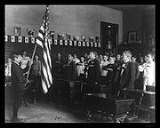
Pledgeofallegiance1899
The Pledge of Allegiance was written in 1892 by Francis Bellamy
Francis Bellamy

Francis Julius Bellamy was an United States Baptist minister and Christian Socialism who wrote the original Pledge of Allegiance in 1892. It was published in the Youth's_Companion , which was a nationally circulated family-oriented magazine, and by 1892 was the largest publication of any type in the United States, with a circulation around 5...
 (1855-1931), a Baptist minister, a Christian socialist
Christian socialism

Christian socialism generally refers to those on the Christian left whose politics are both Christian and socialist and who see these two philosophies as being interrelated....
, and the cousin of socialist utopian novelist Edward Bellamy
Edward Bellamy

Edward Bellamy was an United States author and socialist, most famous for his utopia novel, Looking Backward, set in the year 2000....
 (1850-1898). Bellamy's original "Pledge of Allegiance" was published in the September 8th issue of the popular children's magazine The Youth's Companion as part of the National Public-School Celebration of Columbus Day, a celebration of the 400th anniversary of Christopher Columbus
Christopher Columbus

Christopher Columbus was a Republic of Genoa navigator, colonialist and explorer whose voyages across the Atlantic Ocean?funded by Queen Isabella of Spain?led to general European awareness of the America in the Western Hemisphere....
's discovery of America, conceived by James B. Upham.

Bellamy's original Pledge read, "I Pledge Allegiance to my Flag and the Republic for which it stands, one nation indivisible with liberty and justice for all."

The pledge was supposed to be quick and to the point. Bellamy designed it to be stated in 15 seconds. He had initially also considered using the words equality and fraternity but decided they were too controversial since many people opposed equal rights for women and blacks.

After a proclamation by President Benjamin Harrison
Benjamin Harrison

Benjamin Harrison was the List of Presidents of the United States President of the United States, serving one term from 1889 to 1893. Harrison was born in North Bend, Ohio, and at age 21 moved to Indianapolis, Indiana, where he became a prominent state politician....
, the Pledge was first used in public schools on October 12, 1892 during Columbus Day
Columbus Day

Many countries in the New World and elsewhere celebrate the anniversary of Christopher Columbus's arrival in the Americas, which occurred on October 12, 1492 in the Julian calendar and October 21, 1492 in the modern Gregorian calendar, as an official holiday....
 observances. This date was also significant as it was the dedication day of the World's Columbian Exposition
World's Columbian Exposition

The World's Columbian Exposition , a World's Fair, was held in Chicago in 1893, to celebrate the 400th anniversary of Christopher Columbus's arrival in the New World....
 in Chicago, Illinois
Illinois

The State of Illinois is a U.S. state of the United States, the 21st to be admitted to the United States. Illinois is the most populous and demographically diverse Midwestern United States state and the fifth most populous state in the nation....
. Bellamy thought that the pledge itself and the involvement of children across the country would be a fine show of national solidarity.

In 1923 the National Flag Conference called for the words my Flag to be changed to the Flag of the United States. The reason given was to ensure that immigrants knew to which flag reference was being made. The words "of America" were added a year later. The U.S. Congress officially recognized the Pledge as the official national pledge on June 22, 1942.

In 1940 the Supreme Court
Supreme Court of the United States

The Supreme Court of the United States is the highest judicial body in the United States, and leads the federal United States federal courts. It consists of the Chief Justice of the United States and eight Associate Justice of the Supreme Court of the United States, who are nominated by the President of the United States and confirmed with th...
, in deciding the case of Minersville School District v. Gobitis
Minersville School District v. Gobitis

Minersville School District v. Gobitis, , was a decision by the Supreme Court of the United States involving the religious rights of public school students under the First Amendment to the United States Constitution....
, ruled that students in public schools could be compelled to recite the Pledge, even Jehovah's Witnesses
Jehovah's Witnesses

Jehovah's Witnesses is a restorationism, Millenarianism Christianity religious movement. Sociology of religion have classified the group as an Adventism sect....
 like the Gobitases, who considered the flag salute to be idolatry
Idolatry

Idolatry is usually defined as worship of any cult image, idea, or Object , as opposed to the worship of a monotheistic God. It is considered a major sin in the Abrahamic religions whereas in religions where such activity is not considered as sin, the term "idolatry" itself is absent....
. In the wake of this ruling, there was a rash of mob violence and intimidation against Jehovah's Witnesses. In 1943 the Supreme Court reversed its decision, ruling in West Virginia State Board of Education v. Barnette
West Virginia State Board of Education v. Barnette

West Virginia State Board of Education v. Barnette, Case citation , was a decision by the Supreme Court of the United States that held that the Free Speech Clause of the First Amendment to the United States Constitution protected students from being forced to salute the Flag of the United States and say the Pledge of Allegiance in school....
 that "compulsory unification of opinion" violated the First Amendment
First Amendment to the United States Constitution

The First Amendment to the United States Constitution is the part of the United States Bill of Rights that expressly prohibits the United States Congress from making laws "Establishment Clause of the First Amendment" or that prohibit the Free Exercise Clause of the First Amendment, laws that infringe the Freedom of speech in the United State...
.

Reciting of the pledge is accompanied by a salute
Salute

A salute is a gesture or other action used to display respect. Salutes are primarily associated with armed forces, but other organizations also use salutes....
. An early version of the salute, adopted in 1892, was known as the Bellamy salute
Bellamy salute

The Bellamy salute is the salute described by Francis Bellamy to accompany the American Pledge of Allegiance, which he had authored. The gesture was derived from the Roman salute....
. It ended with the arm outstretched and the palm upwards. Because of the similarity between the Bellamy salute and the Nazi salute
Hitler salute

The Hitler salute , also known in Germany during World War II as the Deutscher Gru? , or in English as the Nazi salute, is a variant of the Roman salute, adopted by the Nazi Party as its leader Adolf Hitler....
, President Franklin D. Roosevelt
Franklin D. Roosevelt

Franklin Delano Roosevelt , often referred to by his initials FDR, was the List of Presidents of the United States President of the United States....
 instituted the hand-over-the-heart gesture as the salute to be rendered by civilians during the Pledge of Allegiance
Pledge of Allegiance

The Pledge of Allegiance to the United States flag is an oath of loyalty to the country. It is recited at many public events. US Congressional sessions open with the recitation of the Pledge....
 and the national anthem
The Star-Spangled Banner

"The Star-Spangled Banner" is the national anthem of the United States of America. The lyrics come from a poem written in 1814 by then 35-year-old amateur poet Francis Scott Key who wrote "Defence of Fort McHenry" after seeing the bombardment of Fort McHenry at Baltimore, Maryland, Maryland, by Royal Navy ships in the Chesapeake Bay during th...
 in the United States, instead of the Bellamy salute. This was done when Congress
United States Congress

The United States Congress is the Bicameralism legislature of the Federal government of the United States of the United States of America, consisting of two houses, the United States Senate and the United States House of Representatives....
 officially adopted the Flag Code
United States Flag Code

The United States Flag Code establishes advisory rules for display and care of the flag of the United States. It is Section 1 of Title 4 of the United States Code ....
 on June 22, 1942.

Addition of the words "under God"

The Knights of Columbus
Knights of Columbus

The Knights of Columbus is the world's largest Roman Catholic Church Fraternal and service organizations. Founded in the United States in 1882, it is named in honor of Christopher Columbus and describes itself as being dedicated to the principles of Charity, Unity, Fraternity, and Patriotism....
, the world's largest Catholic
Roman Catholic Church

The Roman Catholic Church, officially known as the Catholic Church is the world's largest Christianity Ecclesia , representing over half of all Christians and one-sixth of the world population....
 fraternal service organization
Fraternal and service organizations

A "fraternal organization" or "fraternity," is a brotherhood, though the term usually connotes a distinct or formal organization. This list is for "general fraternities", please list college fraternities and sororities at List of fraternities and sororities....
, in New York City felt that the pledge was incomplete without any reference to a deity. Appealing to the authority of Abraham Lincoln
Abraham Lincoln

Abraham Lincoln was the List of Presidents of the United States President of the United States. He successfully led the country through its greatest internal crisis, the American Civil War, preserving the Union and ending slavery....
, the Knights felt that the words "under God" which were from Lincoln’s Gettysburg Address
Gettysburg Address

The Gettysburg Address was a speech by President of the United States Abraham Lincoln and one of the most quoted speeches in history of the United States....
 were most appropriate to add to the Pledge. In New York City on April 30, 1951, the Board of Directors of the Knights of Columbus adopted a resolution to amend their recitation of the Pledge of Allegiance at the opening of each of the meetings of the 800 Fourth Degree Assemblies of the Knights of Columbus by addition of the words "under God" after the words "one nation." In the following two years, the idea spread throughout Knights of Columbus organizations nationwide. On August 21, 1952, the Supreme Council of the Knights of Columbus at its annual meeting adopted a resolution urging that the change be made universal and copies of this resolution were sent to the President, the Vice President (as Presiding Officer of the Senate) and the Speaker of the House of Representatives. The National Fraternal Congress meeting in Boston on September 24, 1952, adopted a similar resolution upon the recommendation of its President, Supreme Knight Luke E. Hart. Several State Fraternal Congresses acted likewise almost immediately thereafter. This campaign led to several official attempts to prompt Congress to adopt the Knights of Columbus’ policy for the entire nation. These attempts failed.

In 1952, Holger Christian Langmack wrote a letter to President Truman suggesting the inclusion of "under God" in the Pledge of Allegiance. Mr. Langmack was a Danish Philosopher and Educator who came to America in 1911. He was one of the originators of the Prayer Breakfast, and a religious leader in Washington DC. President Truman responded to Mr.Langmack, and agreed to meet him along with several others to discuss the inclusion of "under God" and also "love" just before "Liberty and Justice". This meeting took place in 1952, and the seed was planted for the inclusion of "under God".

The Knights of Columbus tried repeatedly, but they were unsuccessful in their attempts to persuade the United States government to amend the pledge. Bills were introduced as early as 1953, when Representative Louis C. Rabaut
Louis C. Rabaut

Louis Charles Rabaut was politician from the U.S. state of Michigan. He was a Democratic Party congressman representing Michigan's 14th congressional district from 1935 to 1947, and from 1949 to 1961....
 of Michigan sponsored a resolution at the suggestion of a correspondent. It was a Presbyterian minister who made the difference in 1954 by preaching a sermon about Abraham Lincoln
Abraham Lincoln

Abraham Lincoln was the List of Presidents of the United States President of the United States. He successfully led the country through its greatest internal crisis, the American Civil War, preserving the Union and ending slavery....
's Gettysburg Address
Gettysburg Address

The Gettysburg Address was a speech by President of the United States Abraham Lincoln and one of the most quoted speeches in history of the United States....
. The minister was George MacPherson Docherty
George MacPherson Docherty

George MacPherson Docherty was a Scottish-born American Presbyterian minister and principal initiator of the addition of the words "under God" to the Pledge of Allegiance to the Flag of the United States....
, a native of Scotland who was called to succeed Peter Marshall
Peter Marshall (preacher)

The Reverend Dr. Peter Marshall was a Scottish-American preacher, and twice served as Chaplain of the United States Senate. He is remembered most popularly from the biography A Man Called Peter, and the film made from it....
 as pastor of the New York Avenue Presbyterian Church
New York Avenue Presbyterian Church

The New York Avenue Presbyterian Church in Washington, D.C., is a congregation of the Presbyterian Church . The church has played an important role in the history of the United States during many crucial junctures....
 near the White House
White House

The White House is the official residence and principal workplace of the President of the United States. Located at 1600 Pennsylvania Avenue in Washington, D.C., it was built between 1792 and 1800 of white-painted Aquia sandstone in the late Georgian architecture and has been the executive residence of every U.S....
, where, in 1863, the same year as the address, Lincoln attended and even rented a pew. After Lincoln’s death, the pew that he rented became something of a national monument. It became customary for later United States presidents to attend services at the church and sit in the Lincoln pew on the Sunday closest to Lincoln’s birthday (February 12) each year.

As Lincoln Sunday (February 7, 1954) approached, Rev. Docherty knew not only that President Dwight Eisenhower was to be in attendance, but that it was more than just an annual ritual for him. While raised a Jehovah's Witness
Jehovah's Witnesses

Jehovah's Witnesses is a restorationism, Millenarianism Christianity religious movement. Sociology of religion have classified the group as an Adventism sect....
, Eisenhower had been baptized a Presbyterian just a year earlier. Docherty's sermon focused on the Gettysburg Address, drawing its title from the address, "A New Birth of Freedom."

Docherty’s message began with a comparison of the United States to ancient Sparta
Sparta

Sparta was a city-state in ancient Greece, situated on the Eurotas River in the southern part of the Peloponnese. From circa 650 BC it rose to become the dominant military power in the region and as such was recognized as the overall leader of the combined Greek forces during the Greco-Persian Wars....
. Docherty noted that a traveler to ancient Sparta
Sparta

Sparta was a city-state in ancient Greece, situated on the Eurotas River in the southern part of the Peloponnese. From circa 650 BC it rose to become the dominant military power in the region and as such was recognized as the overall leader of the combined Greek forces during the Greco-Persian Wars....
 was amazed by the fact that the Spartans’ national might was not to be found in their walls, their shields, or their weapons, but in their spirit. Likewise, said Docherty, the might of the United States should not be thought of as emanating from their newly developed atomic weapons, but in their spirit, the "American way of life". In the remainder of the sermon Docherty sought to define as succinctly as possible the essence of the American spirit and way of life. To do so, Docherty appealed to those two words in Lincoln
Abraham Lincoln

Abraham Lincoln was the List of Presidents of the United States President of the United States. He successfully led the country through its greatest internal crisis, the American Civil War, preserving the Union and ending slavery....
’s Gettysburg Address
Gettysburg Address

The Gettysburg Address was a speech by President of the United States Abraham Lincoln and one of the most quoted speeches in history of the United States....
. According to Docherty, what has made the United States both unique and strong was her sense of being the nation that Lincoln described: a nation "under God." Docherty took the opportunity to tell a story of a conversation with his children about the Pledge of Allegiance. Docherty was troubled by the fact that it did not include any reference to the deity. Without such reference, Docherty insisted that the Pledge could apply to just about any nation. He felt that the pledge should reflect the American spirit and way of life as defined by Lincoln.

After the service concluded, Docherty had opportunity to converse with Eisenhower about the substance of the sermon. The President expressed his enthusiastic concurrence with Docherty’s view, and the very next day, Eisenhower had the wheels turning in Congress to incorporate Docherty’s suggestion into law. On February 8, 1954, Rep. Charles Oakman (R
Republican Party (United States)

The Republican Party is one of the two major party contemporary political parties in the United States, along with the Democratic Party . It is often called the Grand Old Party or the GOP....
-Mich.
Michigan

Michigan is a Midwestern United States U.S. state of the United States of America. It was named after Lake Michigan, whose name is a French adaptation of the Anishinaabe language term mishigama, meaning "large water" or "large lake"....
), introduced a bill to that effect. On Lincoln’s birthday, four days later, Oakman made the following speech on the floor of the House:

Last Sunday, the President of the United States and his family occupied the pew where Abraham Lincoln worshipped. The pastor, the Reverend George M. Docherty, suggested the change in our Pledge of Allegiance that I have offered [as a bill]. Dr. Docherty delivered a wise sermon. He said that as a native of Scotland come to these shores he could appreciate the pledge as something more than a hollow verse taught to children for memory. I would like to quote from his words. He said, 'there was something missing in the pledge, and that which was missing was the characteristic and definitive factor in the American way of life.' Mr. Speaker, I think Mr. Docherty hit the nail square on the head.


Senator Homer Ferguson, in his report to the Congress on March 10, 1954, said, "The introduction of this joint resolution was suggested to me by a sermon given recently by the Rev. George M. Docherty, of Washington, D.C., who is pastor of the church at which Lincoln worshipped." This time Congress concurred with the Oakman-Ferguson resolution, and Eisenhower opted to sign the bill into law on Flag Day (June 14, 1954). The fact that Eisenhower clearly had Docherty’s rationale in mind as he initiated and consummated this measure is apparent in a letter he wrote in August, 1954. Paraphrasing Docherty’s sermon, Eisenhower said

These words [“under God”] will remind Americans that despite our great physical strength we must remain humble. They will help us to keep constantly in our minds and hearts the spiritual and moral principles which alone give dignity to man, and upon which our way of life is founded.


Docherty’s sermon was published by Harper & Bros. in New York in 1958 and President Eisenhower took the opportunity to write to Dr. Docherty with gratitude for the opportunity to once again read the sermon.

Criticism of requiring or promoting the Pledge

Government requiring or promoting of the Pledge has drawn criticism and legal challenges on several grounds. Prominent legal challenges have been based on the contention that state-sponsored requiring or promoting of the Pledge is unconstitutional because it violates one or both of the religion clauses in the First Amendment
First Amendment to the United States Constitution

The First Amendment to the United States Constitution is the part of the United States Bill of Rights that expressly prohibits the United States Congress from making laws "Establishment Clause of the First Amendment" or that prohibit the Free Exercise Clause of the First Amendment, laws that infringe the Freedom of speech in the United State...
.

Central to challenges in the 1940s were Jehovah's Witnesses
Jehovah's Witnesses

Jehovah's Witnesses is a restorationism, Millenarianism Christianity religious movement. Sociology of religion have classified the group as an Adventism sect....
, a group whose beliefs preclude swearing loyalty to any power lesser than God
God

God is a deity in theism and deism religions and other belief systems, representing either the sole deity in monotheism, or a principal deity in polytheism....
, and who objected to policies in public schools requiring students to recite the Pledge. They objected on the grounds that their rights to freedom of religion
Freedom of religion

Freedom of religion is a principle that supports the freedom of an individual or community, in public or private, to manifest religion or belief in religious education, practice, worship, and observance....
 as guaranteed by the Free Exercise Clause of the First Amendment
Free Exercise Clause of the First Amendment

The Free Exercise Clause is the accompanying clause with the Establishment Clause of the First Amendment to the United States Constitution. The Establishment Clause and the Free Exercise Clause together read:...
 were being violated by such requirements.

Other objections have been raised since the addition of the phrase "under God" to the Pledge in 1954. Many critics contend that a government requiring or promoting this phrase violates protections against establishment of religion guaranteed in the Establishment Clause of the First Amendment
Establishment Clause of the First Amendment

The Establishment Clause of the First Amendment refers to the first of several pronouncements in the First Amendment to the United States Constitution, stating that "United States Congress shall make no law respecting an establishment of religion"....
.

In a 2002 case brought by atheist Michael Newdow
Michael Newdow

Michael Arthur Newdow is an United States attorney and emergency medicine physician. He is best known for his efforts to ban recitations of the current version of the Pledge of Allegiance in public schools#United States in the United States because of its inclusion of the phrase "under God"....
, whose daughter was being taught the Pledge in school, the Ninth Circuit Court of Appeals
United States Court of Appeals for the Ninth Circuit

The U.S. Court of Appeals for the Ninth Circuit is a United States federal court with appellate jurisdiction over the United States district court in the following United States federal judicial district:...
 ruled the phrase "under God" an unconstitutional endorsement of monotheism when the Pledge was promoted in public school. In 2004, the Supreme Court
Supreme Court of the United States

The Supreme Court of the United States is the highest judicial body in the United States, and leads the federal United States federal courts. It consists of the Chief Justice of the United States and eight Associate Justice of the Supreme Court of the United States, who are nominated by the President of the United States and confirmed with th...
 heard Elk Grove Unified School District v. Newdow
Elk Grove Unified School District v. Newdow

Newdow v. United States Congress, Elk Grove Unified School District, et al., Case citation , was a lawsuit originally filed in 2000 which led to a 2002 ruling by the United States Court of Appeals for the Ninth Circuit that the words "under God" in the Pledge of Allegiance are an endorsement of religion, and therefore violate the Establis...
, an appeal of the ruling, and rejected Newdow's claim on the grounds that he was not the custodial parent, and therefore lacked standing, thus avoiding ruling on the merits of whether the phrase was constitutional in a school-sponsored recitation. On January 3, 2005, a new suit was filed in the U.S. District Court for the Eastern District of California on behalf of three unnamed families. On September 14, 2005, District Court Judge Lawrence Karlton ruled in their favor. Citing the precedent of the 2002 ruling by the Ninth Circuit Court of Appeals, Judge Karlton issued an Order stating that, upon proper motion, he will enjoin the school district defendants from continuing their practices of leading children in pledging allegiance to "one Nation under God".

In 2004, linguist Geoffrey Nunberg
Geoffrey Nunberg

Geoffrey Nunberg is an United States linguistics and a professor at the UC Berkeley School of Information. As a linguist, he is best known for his work on lexical semantics, in particular on the phenomena of polysemy, deferred reference and indexicality....
 criticized the addition of "under God" for a different reason. The original supporters of the addition thought that they were simply quoting Lincoln's Gettysburg Address
Gettysburg Address

The Gettysburg Address was a speech by President of the United States Abraham Lincoln and one of the most quoted speeches in history of the United States....
. However, Nunberg said that to Lincoln and his contemporaries, "under God" meant "God willing" and they would have found its use in the Pledge of Allegiance grammatically incorrect.

A bill
Bill (proposed law)

A bill is a proposed new law introduced within a legislature that has not been ratification, adopted, or received royal assent. Once a bill has become law, it is thereafter an Statute; but in popular usage the two terms are often treated interchangeably....
 — H.R. 2389 — was introduced in Congress in 2005 which, if enacted into law, would have stripped the Supreme Court and most federal courts of the power to consider any legal challenges to government requiring or promoting of the Pledge of Allegiance. H.R. 2389 was passed by the House of Representatives in July 2006, but failed due to the Senate's not taking it up. Even if a similar bill is enacted, its practical effect may not be clear: proponents of the bill have argued that it is a valid exercise of Congress's power to regulate the jurisdiction of the federal courts under Article III, Section 2 of the Constitution, but opponents question whether Congress has the authority to prevent the Supreme Court from hearing claims based on the Bill of Rights (since amendments postdate the original text of the Constitution and may thus implicitly limit the scope of Article III, Section 2).

In 2006, in the Florida case Frazier v. Alexandre, No. 05-81142 (S.D. Fla. May 31, 2006) "A federal district court in Florida has ruled that a 1942 state law requiring students to stand and recite the Pledge of Allegiance violates the First and Fourteenth Amendments of the U.S. Constitution.

See also

  • American's Creed
    American's Creed

    The American's Creed is the official creed of the United States. It was written in 1917 by William Tyler Page as an entry into a patriotic contest....
  • Bellamy salute
    Bellamy salute

    The Bellamy salute is the salute described by Francis Bellamy to accompany the American Pledge of Allegiance, which he had authored. The gesture was derived from the Roman salute....
  • Eight Honors and Eight Disgraces
    Ba rong ba chi

    The Ba rong ba chi , officially the Core Value System or the Eight Honors and Disgraces, is a set of moral concepts developed by current President of the People's Republic of China Hu Jintao for the citizens of the People's Republic of China....
  • Oath of allegiance
    Oath of allegiance

    An oath of allegiance is an oath whereby a nationality or citizen acknowledges his/her duty of allegiance and swears loyalty to his/her monarch or country....
  • Oath of Allegiance (Canada)
    Oath of Allegiance (Canada)

    File:MacKay-Oath.jpgThe Canadian Oath of Allegiance is a promise or declaration of fealty to the Monarchy of Canada, taken, along with other specific Oath of office, by new occupants of various government positions, including federal and provincial viceroys, appointees to the Queen's Privy Council for Canada, Supreme Court of Canada justices...
  • Oath of Allegiance (Ireland)
    Oath of Allegiance (Ireland)

    The Irish Oath of Allegiance was a controversial provision in the Anglo-Irish Treaty of 1921, which Irish Teachta D?la and Senators were required to take, in order to take their seats in D?il ?ireann and Seanad ?ireann ....
  • Panunumpa ng Katapatan sa Watawat
    Panunumpa ng Katapatan sa Watawat

    The Pledge of Allegiance to the Philippine Flag is the pledge to the Flag of the Philippines of the Philippines. It is one of two national pledges, the other being the Patriotic Oath , which is the Philippine national pledge....
     (Philippines
    Philippines

    The Philippines, officially known as the Republic of the Philippines, is a country in Southeast Asia with Manila as its capital city. It comprises 7,107 islands in the western Pacific Ocean....
    )
  • Pledge Across America
    Pledge Across America

    The synchronized Pledge Across America is conducted each year on September 17th - Constitution Day. Pledge Across America is the nationally synchronized recitation of the Pledge of Allegiance in schools....
  • Pledge of Allegiance criticism
    Pledge of Allegiance criticism

    The criticism of the Pledge of Allegiance of the United States exists on several grounds. Its use in public schools has been the most controversial, as critics contend that a government-sanctioned endorsement of religion violates the Establishment Clause of the First Amendment to the U.S....
  • Religious Heritage of America
    Religious Heritage of America

    The Religious Heritage of America Foundation was founded by W. Clement Stone as a national interfaith organization in the U.S. It was instrumental in getting the phrase, "one nation, under God", added to the Pledge of Allegiance....


External links