
Home      Discussion      Topics      Dictionary      Almanac
Signup       Login
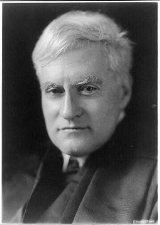
Benjamin N. Cardozo

Benjamin N. Cardozo

Overview
Benjamin Nathan Cardozo (May 24, 1870 – July 9, 1938) was a well-known American
United States
The United States of America is a federal constitutional republic comprising fifty states and a federal district...

 lawyer
Lawyer
A lawyer, according to Black's Law Dictionary, is "a person learned in the law; as an attorney, counsel or solicitor; a person who is practicing law." Law is the system of rules of conduct established by the sovereign government of a society to correct wrongs, maintain the stability of political...

 and associate Supreme Court Justice
Associate Justice of the Supreme Court of the United States
Associate Justices of the Supreme Court of the United States are the members of the Supreme Court of the United States other than the Chief Justice of the United States...

. Cardozo is remembered for his significant influence on the development of American common law in the 20th century, in addition to his modesty, philosophy, and vivid prose style. Cardozo served on the Supreme Court
Supreme Court of the United States
The Supreme Court of the United States is the highest court in the United States. It has ultimate appellate jurisdiction over all state and federal courts, and original jurisdiction over a small range of cases...

 only six years, from 1932 until his death in 1938, and the majority of his landmark decisions were delivered during his eighteen year tenure on the New York Court of Appeals
New York Court of Appeals
The New York Court of Appeals is the highest court in the U.S. state of New York. The Court of Appeals consists of seven judges: the Chief Judge and six associate judges who are appointed by the Governor to 14-year terms...

, the highest court of that state.
Discussion
Ask a question about 'Benjamin N. Cardozo'
Start a new discussion about 'Benjamin N. Cardozo'
Answer questions from other users
Full Discussion Forum
 
Unanswered Questions
Quotations

The law has outgrown its primitive stage of formalism when the precise word was the sovereign talisman, and every slip was fatal. It takes a broader view to-day. A promise may be lacking, and yet the whole writing may be "instinct with an obligation," imperfectly expressed. If that is so, there is a contract.

Wood v. Lucy, Lady Duff-Gordon|Wood v. Lucy, Lady Duff-Gordon, 222 N.Y. 88, 118 N.E. 214 (1917).

Justice is not to be taken by storm. She is to be wooed by slow advances. Substitute statute for decision, and you shift the center of authority, but add no quota of inspired wisdom.

Lecture at Yale University Law School (1923) as quoted in The American Journal of International Law Vol. 29 (1935), p. 32.

Danger invites rescue. ... The wrongdoer may not have foreseen the coming of a deliverer. He is accountable as if he had.

Wagner v. International Railway Co., 232 N.Y. 13 (1926), setting forth the Rescue doctrine|rescue doctrine which holds negligent parties liable not only for injury to the victim, but to those who attempt to rescue the victim.

Inaction without more is not tantamount to choice.

Richard v. Credit Suisse, 242 N.Y. 346, 351 (1926).

Not honesty alone, but the punctilio of an honor the most sensitive, is then the standard of behavior.

Meinhard v. Salmon|Meinhard v. Salmon, 249 N.Y. 458, 164 N.E. 545 (1928), describing the fiduciary duty|fiduciary duties inherent in a partnership.

With traps and obstacles and hazards confronting us on every hand, only blindness or indifference will fail to turn in all humility, for guidance or for warning, to the study of examples.

"Law and Literature" in Law and Literature and Other Essays and Addresses (1931), p. 9.

Method is much, technique is much, but inspiration is even more.

"The Game of the Law" In Law and Literature and Other Essays and Addresses (1931), p. 163.
Encyclopedia
Benjamin Nathan Cardozo (May 24, 1870 – July 9, 1938) was a well-known American
United States
The United States of America is a federal constitutional republic comprising fifty states and a federal district...

 lawyer
Lawyer
A lawyer, according to Black's Law Dictionary, is "a person learned in the law; as an attorney, counsel or solicitor; a person who is practicing law." Law is the system of rules of conduct established by the sovereign government of a society to correct wrongs, maintain the stability of political...

 and associate Supreme Court Justice
Associate Justice of the Supreme Court of the United States
Associate Justices of the Supreme Court of the United States are the members of the Supreme Court of the United States other than the Chief Justice of the United States...

. Cardozo is remembered for his significant influence on the development of American common law in the 20th century, in addition to his modesty, philosophy, and vivid prose style. Cardozo served on the Supreme Court
Supreme Court of the United States
The Supreme Court of the United States is the highest court in the United States. It has ultimate appellate jurisdiction over all state and federal courts, and original jurisdiction over a small range of cases...

 only six years, from 1932 until his death in 1938, and the majority of his landmark decisions were delivered during his eighteen year tenure on the New York Court of Appeals
New York Court of Appeals
The New York Court of Appeals is the highest court in the U.S. state of New York. The Court of Appeals consists of seven judges: the Chief Judge and six associate judges who are appointed by the Governor to 14-year terms...

, the highest court of that state.

Biography


Cardozo was born in New York City
New York City
New York is the most populous city in the United States and the center of the New York Metropolitan Area, one of the most populous metropolitan areas in the world. New York exerts a significant impact upon global commerce, finance, media, art, fashion, research, technology, education, and...

, the son of Rebecca Washington (née Nathan) and Albert Jacob Cardozo
Albert Cardozo
Albert Jacob Cardozo was an American jurist.Albert began practicing law in 1849, and became a justice of the Supreme Court of New York, that state's trial court...

. Both Cardozo's maternal grandparents, Sara Seixas and Isaac Mendes Seixas Nathan, and his paternal grandparents, Ellen Hart and Michael H. Cardozo, were Sephardi Jews
Sephardi Jews
Sephardi Jews is a general term referring to the descendants of the Jews who lived in the Iberian Peninsula before their expulsion in the Spanish Inquisition. It can also refer to those who use a Sephardic style of liturgy or would otherwise define themselves in terms of the Jewish customs and...

 of the Portuguese Jewish community affiliated with Manhattan
Manhattan
Manhattan is the oldest and the most densely populated of the five boroughs of New York City. Located primarily on the island of Manhattan at the mouth of the Hudson River, the boundaries of the borough are identical to those of New York County, an original county of the state of New York...

's Congregation Shearith Israel
Congregation Shearith Israel
Congregation Shearith Israel, often called The Spanish and Portuguese Synagogue, is the oldest Jewish congregation in the United States. It was established in 1654....

; their families emigrated from England
England
England is a country that is part of the United Kingdom. It shares land borders with Scotland to the north and Wales to the west; the Irish Sea is to the north west, the Celtic Sea to the south west, with the North Sea to the east and the English Channel to the south separating it from continental...

 before the American Revolution
American Revolution
The American Revolution was the political upheaval during the last half of the 18th century in which thirteen colonies in North America joined together to break free from the British Empire, combining to become the United States of America...

, and were descended from Jews who left the Iberian Peninsula
Iberian Peninsula
The Iberian Peninsula , sometimes called Iberia, is located in the extreme southwest of Europe and includes the modern-day sovereign states of Spain, Portugal and Andorra, as well as the British Overseas Territory of Gibraltar...

 for Holland during the Inquisition
Spanish Inquisition
The Tribunal of the Holy Office of the Inquisition , commonly known as the Spanish Inquisition , was a tribunal established in 1480 by Catholic Monarchs Ferdinand II of Aragon and Isabella I of Castile. It was intended to maintain Catholic orthodoxy in their kingdoms, and to replace the Medieval...

. Cardozo family tradition held that their ancestors were Marrano
Marrano
Marranos were Jews living in the Iberian peninsula who converted to Christianity rather than be expelled but continued to observe rabbinic Judaism in secret...

s from Portugal
Portugal
Portugal , officially the Portuguese Republic is a country situated in southwestern Europe on the Iberian Peninsula. Portugal is the westernmost country of Europe, and is bordered by the Atlantic Ocean to the West and South and by Spain to the North and East. The Atlantic archipelagos of the...

, although Cardozo's ancestry has not been firmly traced to Portugal. "Cardozo" (archaic spelling of Cardoso), "Seixas
Seixas
Seixas is a common Galician and Portuguese surname. It may refer to:*Carlos Seixas - Portuguese composer of the 18th century*Gershom Mendes Seixas - minister of Congregation Shearith Israel*Francisco Seixas da Costa - Portuguese diplomat and former politician...

" and "Mendes" are common Portuguese surnames.

Cardozo was a twin, with his sister Emily. He was a cousin of the poet Emma Lazarus
Emma Lazarus
Lazarus began to be more interested in her Jewish ancestry after reading the George Eliot novel, Daniel Deronda, and as she heard of the Russian pogroms in the early 1880s. This led Lazarus to write articles on the subject. She also began translating the works of Jewish poets into English...

. He was named for his uncle, Benjamin Nathan
Benjamin Nathan
Benjamin Nathan was an American investor and philanthropist. He was bludgeoned to death in his home in 1870, and the notorious murder case remains unsolved despite several trials in the years following his death....

, a vice president of the New York Stock Exchange
New York Stock Exchange
The New York Stock Exchange is a stock exchange located at 11 Wall Street in Lower Manhattan, New York City, USA. It is by far the world's largest stock exchange by market capitalization of its listed companies at 13.39 trillion as of Dec 2010...

 and the victim of a famous unsolved murder case in 1870.

Albert Cardozo was himself a judge on the Supreme Court of New York (the state's general trial court) until he was implicated in a judicial corruption scandal, sparked by the Erie Railway takeover wars, in 1868. The scandal led to the creation of the Association of the Bar of the City of New York
Association of the Bar of the City of New York
The New York City Bar Association , founded in 1870, is a voluntary association of lawyers and law students. Since 1896, the organization, formally known as the Association of the Bar of the City of New York, has been headquartered in a landmark building on 44th Street, between Fifth and Sixth...

 and Albert's resignation from the bench. After leaving the court, he practiced law until his death in 1885.

Early years


Rebecca Cardozo died in 1879 when Benjamin was quite young. He was raised during much of his childhood by his sister Nell, who was 11 years older. One of his tutors was Horatio Alger
Horatio Alger, Jr.
Horatio Alger, Jr. was a prolific 19th-century American author, best known for his many formulaic juvenile novels about impoverished boys and their rise from humble backgrounds to lives of middle-class security and comfort through hard work, determination, courage, and honesty...

. At age 15, Cardozo entered Columbia University
Columbia University
Columbia University in the City of New York is a private, Ivy League university in Manhattan, New York City. Columbia is the oldest institution of higher learning in the state of New York, the fifth oldest in the United States, and one of the country's nine Colonial Colleges founded before the...

 where he was elected to Phi Beta Kappa, and then went on to Columbia Law School
Columbia Law School
Columbia Law School, founded in 1858, is one of the oldest and most prestigious law schools in the United States. A member of the Ivy League, Columbia Law School is one of the professional graduate schools of Columbia University in New York City. It offers the J.D., LL.M., and J.S.D. degrees in...

 in 1889. Cardozo wanted to enter a profession that could materially aid himself and his siblings, but he also hoped to restore the family name, sullied by his father's actions as a judge. When Cardozo entered Columbia Law School, the program was only two years long; in the midst of his studies, however, the faculty voted to extend the program to three years. Cardozo declined to stay for an extra year, and thus left law school without a law degree. He passed the bar in 1891 and began practicing appellate law alongside his older brother. Benjamin Cardozo practiced law in New York City
New York City
New York is the most populous city in the United States and the center of the New York Metropolitan Area, one of the most populous metropolitan areas in the world. New York exerts a significant impact upon global commerce, finance, media, art, fashion, research, technology, education, and...

 until 1914. In November 1913, Cardozo was narrowly elected to a 14-year term on the New York Supreme Court
New York Supreme Court
The Supreme Court of the State of New York is the trial-level court of general jurisdiction in thestate court system of New York, United States. There is a supreme court in each of New York State's 62 counties, although some smaller counties share judges with neighboring counties...

, taking office on January 1, 1914.

New York Court of Appeals


In February 1914, Cardozo was designated to the New York Court of Appeals
New York Court of Appeals
The New York Court of Appeals is the highest court in the U.S. state of New York. The Court of Appeals consists of seven judges: the Chief Judge and six associate judges who are appointed by the Governor to 14-year terms...

 under the Amendment of 1899, and reportedly was the first Jew to serve on the Court of Appeals. In January 1917, he was appointed to a regular seat on the Court of Appeals to fill the vacancy caused by the resignation of Samuel Seabury
Samuel Seabury (judge)
Samuel Seabury was an American lawyer and politician from New York.-Life:He was the son of William Jones Seabury, professor of canon law and descendant of Bishop Samuel Seabury, and Alice Van Wyck Beare. He graduated from New York Law School in 1893, and was admitted to the bar in 1894...

, and in November 1917
New York state election, 1917
The 1917 New York state election was held on November 6, 1917, to elect the Attorney General and two judges of the New York Court of Appeals, as well as all members of the New York State Assembly.-History:...

, he was elected on the Democratic and Republican tickets to a 14-year term on the Court of Appeals. In 1926, he was elected, on both tickets again, to a 14-year term as Chief Judge
Chief Judge of the New York Court of Appeals
Chief Judge of the New York Court of Appeals refers to the position of chief judge on the New York Court of Appeals.The chief judge supervises the seven-judge Court of Appeals...

. He took office on January 1, 1927, and resigned on March 7, 1932 to accept an appointment to the United States Supreme Court.

His tenure was marked by a number of original rulings, in tort
Tort
A tort, in common law jurisdictions, is a wrong that involves a breach of a civil duty owed to someone else. It is differentiated from a crime, which involves a breach of a duty owed to society in general...

 and contract
Contract
A contract is an agreement entered into by two parties or more with the intention of creating a legal obligation, which may have elements in writing. Contracts can be made orally. The remedy for breach of contract can be "damages" or compensation of money. In equity, the remedy can be specific...

 law in particular. This is partly due to timing; rapid industrialization was forcing courts to look anew at old common law
Common law
Common law is law developed by judges through decisions of courts and similar tribunals rather than through legislative statutes or executive branch action...

 components to adapt to new settings. In 1921, Cardozo gave the Storrs Lectures at Yale University
Yale University
Yale University is a private, Ivy League university located in New Haven, Connecticut, United States. Founded in 1701 in the Colony of Connecticut, the university is the third-oldest institution of higher education in the United States...

, which were later published as The Nature of the Judicial Process
The Nature of the Judicial Process
The Nature of the Judicial Process was written by Associate Justice of the United States Supreme Court, and New York Court of Appeals Chief Justice Benjamin N. Cardozo in 1921. It was compiled from The Storrs Lectures delivered at Yale Law School....

(On line version), a book that remains valuable to judges today. Shortly thereafter, Cardozo became a member of the group that founded the American Law Institute
American Law Institute
The American Law Institute was established in 1923 to promote the clarification and simplification of American common law and its adaptation to changing social needs. The ALI drafts, approves, and publishes Restatements of the Law, Principles of the Law, model codes, and other proposals for law...

, which crafted a Restatement of the Law
Restatement of the Law
In American jurisprudence, the Restatements of the Law are a set of treatises on legal subjects that seek to inform judges and lawyers about general principles of common law...

 of Torts, Contracts, and a host of other private law subjects. He wrote three other books that also became standards in the legal world.

United States Supreme Court


In 1932, President Herbert Hoover
Herbert Hoover
Herbert Clark Hoover was the 31st President of the United States . Hoover was originally a professional mining engineer and author. As the United States Secretary of Commerce in the 1920s under Presidents Warren Harding and Calvin Coolidge, he promoted partnerships between government and business...

 appointed Cardozo to the Supreme Court of the United States
Supreme Court of the United States
The Supreme Court of the United States is the highest court in the United States. It has ultimate appellate jurisdiction over all state and federal courts, and original jurisdiction over a small range of cases...

 to succeed Justice Oliver Wendell Holmes
Oliver Wendell Holmes, Jr.
Oliver Wendell Holmes, Jr. was an American jurist who served as an Associate Justice of the Supreme Court of the United States from 1902 to 1932...

. The New York Times said of Cardozo's appointment that "seldom, if ever, in the history of the Court has an appointment been so universally commended." Democratic Cardozo's appointment by a Republican president has been referred to as one of the few Supreme Court appointments in history not motivated by partisanship or politics, but strictly based on the nominee's contribution to law.
However, Hoover was running for re-election, eventually against Franklin Roosevelt, so a larger political calculation may have been operating.

Cardozo was confirmed by a unanimous voice vote in the Senate on February 24. On a radio broadcast on March 1, 1932, the day of Cardozo's confirmation, Clarence C. Dill, Democratic Senator for Washington, called Hoover's appointment of Cardozo "the finest act of his career as President". The entire faculty of the University of Chicago Law School
University of Chicago Law School
The University of Chicago Law School was founded in 1902 as the graduate school of law at the University of Chicago and is among the most prestigious and selective law schools in the world. The U.S. News & World Report currently ranks it fifth among U.S...

 had urged Hoover to nominate him, as did the deans of the law schools at Harvard, Yale, and Columbia. Justice Harlan Fiske Stone
Harlan Fiske Stone
Harlan Fiske Stone was an American lawyer and jurist. A native of New Hampshire, he served as the dean of Columbia Law School, his alma mater, in the early 20th century. As a member of the Republican Party, he was appointed as the 52nd Attorney General of the United States before becoming an...

 strongly urged Hoover to name Cardozo, even offering to resign to make room for him if Hoover had his heart set on someone else (Stone had in fact suggested to Calvin Coolidge
Calvin Coolidge
John Calvin Coolidge, Jr. was the 30th President of the United States . A Republican lawyer from Vermont, Coolidge worked his way up the ladder of Massachusetts state politics, eventually becoming governor of that state...

 that he should nominate Cardozo rather than himself back in 1925). Hoover, however, originally demurred: there were already two justices from New York, and a Jew on the court; in addition, Justice James McReynolds
James Clark McReynolds
James Clark McReynolds was an American lawyer and judge who served as United States Attorney General under President Woodrow Wilson and as an Associate Justice of the United States Supreme Court...

 was a notorious anti-Semite. When the chairman of the Senate Foreign Relations Committee, William E. Borah
William Edgar Borah
William Edgar Borah was a prominent Republican attorney and longtime United States Senator from Idaho noted for his oratorical skills and isolationist views. One of his nicknames later in life was "The Lion of Idaho."...

 of Idaho, added his strong support for Cardozo, however, Hoover finally bowed to the pressure.

Cardozo was a member of the Three Musketeers along with Brandeis and Stone, which was considered to be the liberal faction of the Supreme Court. In his years as an Associate Justice
Associate Justice of the Supreme Court of the United States
Associate Justices of the Supreme Court of the United States are the members of the Supreme Court of the United States other than the Chief Justice of the United States...

, he handed down opinions that stressed the necessity for the tightest adherence to the tenth amendment
Tenth Amendment to the United States Constitution
The Tenth Amendment to the United States Constitution, which is part of the Bill of Rights, was ratified on December 15, 1791...

.

Death


In late 1937, Cardozo had a heart attack
Myocardial infarction
Myocardial infarction or acute myocardial infarction , commonly known as a heart attack, results from the interruption of blood supply to a part of the heart, causing heart cells to die...

, and in early 1938, he suffered a stroke
Stroke
A stroke, previously known medically as a cerebrovascular accident , is the rapidly developing loss of brain function due to disturbance in the blood supply to the brain. This can be due to ischemia caused by blockage , or a hemorrhage...

. He died on July 9, 1938, at the age of 68 and was buried in Beth-Olam Cemetery in Queens. His death came at a time of much transition for the court, as many of the other justices died or retired during the late 1930s and early 1940s.

Personal life


As an adult, Cardozo no longer practiced his faith (he identified himself as an "agnostic"), but remained proud of his Jewish heritage.

Of the six children born to Albert and Rebecca Cardozo, only Emily, his twin sister, married, and she and her husband did not have any children. As far as is known, Benjamin Cardozo led a celibate life. The fact that Cardozo was unmarried and was personally tutored by the writer Horatio Alger
Horatio Alger, Jr.
Horatio Alger, Jr. was a prolific 19th-century American author, best known for his many formulaic juvenile novels about impoverished boys and their rise from humble backgrounds to lives of middle-class security and comfort through hard work, determination, courage, and honesty...

 (who had been accused of inappropriate sexual relations with young boys) has led some of Cardozo's biographers to insinuate that Cardozo was homosexual, but no real evidence exists to corroborate this possibility. Constitutional law scholar Jeffrey Rosen
Jeffrey Rosen
Jeffrey Rosen is an American academic and commentator on legal affairs. Legal historian David Garrow has called him "the nation's most widely read and influential legal commentator."-Biography:...

 noted in a New York Times Book Review of Richard Polenberg's book on Cardozo:
Andrew Kaufman, a Harvard Law School
Harvard Law School
Harvard Law School is one of the professional graduate schools of Harvard University. Located in Cambridge, Massachusetts, it is the oldest continually-operating law school in the United States and is home to the largest academic law library in the world. The school is routinely ranked by the U.S...

 professor and Cardozo biographer, notes that "Although one cannot be absolutely certain, it seems highly likely that Cardozo lived a celibate life." Judge Learned Hand
Learned Hand
Billings Learned Hand was a United States judge and judicial philosopher. He served on the United States District Court for the Southern District of New York and later the United States Court of Appeals for the Second Circuit...

 is quoted in the book as saying about Cardozo: "He [had] no trace of homosexuality anyway."

The question of Cardozo's ethnicity


Cardozo was the second Jew, after Louis Brandeis
Louis Brandeis
Louis Dembitz Brandeis ; November 13, 1856 – October 5, 1941) was an Associate Justice on the Supreme Court of the United States from 1916 to 1939.He was born in Louisville, Kentucky, to Jewish immigrant parents who raised him in a secular mode...

, to be appointed to the Supreme Court.

Since Cardozo was a member of the Spanish and Portuguese Jewish community, there has been recent discussion as to whether he should be considered the 'first Hispanic justice,' a notion which is disputed. Cardozo biographer Kaufman, for example, questioned the usage of the term "Hispanic" in the justice's lifetime, stating: "Well, I think he regarded himself as a Sephardic Jew whose ancestors came from the Iberian Peninsula.”

It has also been asserted that Cardozo himself "confessed in 1937 that his family preserved neither the Spanish language nor Iberian cultural traditions".
Both the National Association of Latino Elected Officials and the Hispanic National Bar Association
Hispanic National Bar Association
The Hispanic National Bar Association is a non-profit, non-partisan organization representing Hispanics in the legal profession, including attorneys, judges, law professors, legal assistant and paralegals, and law students in the United States and its territories.The current National President and...

 consider Sonia Sotomayor
Sonia Sotomayor
Sonia Maria Sotomayor is an Associate Justice of the Supreme Court of the United States, serving since August 2009. Sotomayor is the Court's 111th justice, its first Hispanic justice, and its third female justice....

 to be the first unequivocally Hispanic justice.

Cases


New York Courts
  • Schloendorff v. Society of New York Hospital
    Schloendorff v. Society of New York Hospital
    Schloendorff v. Society of New York Hospital, 211 N.Y. 125, 105 N.E. 92 , was a decision issued by the New York Court of Appeals in 1914 which established principles of informed consent and respondeat superior in United States law.-Facts:...

    , 105 N.E. 92 (1914) it is necessary to get informed consent from a patient before operation, but a non-profit hospital was not vicariously liable (the latter aspect was reversed in 1957)
  • MacPherson v. Buick Motor Co.
    MacPherson v. Buick Motor Co.
    MacPherson v. Buick Motor Co., 217 N.Y. 382, 111 N.E. 1050 is a famous New York Court of Appeals opinion by Judge Benjamin N. Cardozo which removed the requirement of privity of contract for duty in negligence actions.-Facts:...

    , 111 N.E. 1050 (1916) ending privity as a source of duty in products liability, ruling that manufacturers of products could be held liable for injuries to consumers.
  • DeCicco v. Schweizer
    DeCicco v. Schweizer
    DeCicco v. Schweizer, 117 N.E. 807 is a notable US contract law case concerning privity of contract.-Facts:Articles of agreement were entered into by defendant and his wife with a person who was affianced to and was to be married to their daughter. In consideration of that fact, the father...

    , 117 N.E. 807 (1917) where Cardozo approached the issue of third party beneficiary
    Third party beneficiary
    A third party beneficiary, in the law of contracts, is a person who may have the right to sue on a contract, despite not having originally been an active party to the contract. This right, known as a ius quaesitum tertio, arises where the third party is the intended beneficiary of the contract,...

     law in a contract for marriage case.
  • Wood v. Lucy, Lady Duff-Gordon
    Wood v. Lucy, Lady Duff-Gordon
    Wood v. Lucy, Lady Duff-Gordon, 222 N.Y. 88, 118 N.E. 214 , is a New York state contract case in which the New York Court of Appeals held Lucy, Lady Duff-Gordon, to a contract that assigned the sole right to market her name to her advertising agent....

    , 118 N.E. 214 (1917) on a promise to maybe do something constituting consideration
    Consideration
    Consideration is the central concept in the common law of contracts and is required, in most cases, for a contract to be enforceable. Consideration is the price one pays for another's promise. It can take a number of forms: money, property, a promise, the doing of an act, or even refraining from...

     in a contract
    Contract
    A contract is an agreement entered into by two parties or more with the intention of creating a legal obligation, which may have elements in writing. Contracts can be made orally. The remedy for breach of contract can be "damages" or compensation of money. In equity, the remedy can be specific...

    .
  • Martin v. Herzog
    Martin v. Herzog
    Martin v. Herzog, Ct. of App. of N.Y., 228 N Y. 164, 126 N.E. 814 , was a New York Court of Appeals case.-Facts:Martin appealed the order of the Appellate Division that reversed a judgment entered after jury trial that found Herzog negligent and P blameless.Martin was driving his buggy on the...

    , 126 N.E. 814 (1920) breach of statutory duty establishes negligence, and the elements of the claim includes proof of causation
  • Jacob & Youngs v. Kent
    Jacob & Youngs v. Kent
    Jacob & Young, Inc. v. Kent, 230 N.Y. 239 is a famous contract law case with the majority opinion by Judge Cardozo. It dealt with the matters of material breach and substantial performance.-Facts:...

    , 230 N.Y. 239 (1921), substantial performance of a contract does not lead to a right to terminate, only damages.
  • Hynes v. New York Central Railroad Company, 131 N.E. 898 (1921), a railway owed a duty of care
    Duty of care
    In tort law, a duty of care is a legal obligation imposed on an individual requiring that they adhere to a standard of reasonable care while performing any acts that could foreseeably harm others. It is the first element that must be established to proceed with an action in negligence. The claimant...

     despite the victims being trespassers.
  • Berkey v. Third Avenue Railway
    Berkey v. Third Avenue Railway
    Berkey v. Third Avenue Railway Co 244 N.Y. 602 is a classic veil piercing case by Judge Benjamin N. Cardozo in corporation law.-Facts:...

    , 244 N.Y. 84 (1926), the corporate veil cannot be pierced, even in favor of a tort victim unless domination of a subsidiary by the parent is complete.
  • Wagner v. International Railway, 232 N.Y. 176 (1926) the rescue doctrine
    Rescue doctrine
    In the USA, the rescue doctrine of the law of torts holds that if a tortfeasor creates a circumstance that places the tort victim in danger, the tortfeasor is liable not only for the harm caused to the victim, but also the harm caused to any person injured in an effort to rescue that victim. This...

    . "Danger invites rescue. The cry of distress is the summons to relief [...] The emergency begets the man. The wrongdoer may not have foreseen the coming of a deliverer. He is accountable as if he had."
  • Meinhard v. Salmon
    Meinhard v. Salmon
    Meinhard v. Salmon, 164 N.E. 545 , is a widely cited case in which the New York Court of Appeals held that partners in a business owe fiduciary duties to one another where a business opportunities arises during the course of the partnership...

    , 164 N.E. 545 (1928) the fiduciary duty of business partners is, "Not honesty alone, but the punctilio of an honor the most sensitive."
  • Palsgraf v. Long Island Rail Road Co., 162 N.E. 99 (1928) the development of the concept of the proximate cause
    Proximate cause
    In the law, a proximate cause is an event sufficiently related to a legally recognizable injury to be held the cause of that injury. There are two types of causation in the law, cause-in-fact and proximate cause. Cause-in-fact is determined by the "but-for" test: but for the action, the result...

     in tort law.
  • Murphy v. Steeplechase Amusement Park, 166 N.E. 173 (1929) denied a right to recover for knee injury from riding "The Flopper" funride since the victim "assumed the risk."
  • Ultramares v. Touche, 174 N.E. 441 (1931) on the limitation of liability of auditors


US Supreme Court
  • Nixon v. Condon
    Nixon v. Condon
    Nixon v. Condon, 286 U.S. 73 , was a voting rights case decided by the United States Supreme Court, which found the all-white Democratic Party primary in Texas unconstitutional. This was one of four cases brought to challenge the Texas all-white Democratic Party primary...

    , 286 U.S. 73 (1932) all white Texas Democratic Party unconstitutional
  • Welch v. Helvering
    Welch v. Helvering
    Welch v. Helvering, 290 U.S. 111 , was decision by the United States Supreme Court on the difference between business and personal expenses, and the difference between ordinary business deductions and capital expenses. It is one of the most important income tax law cases.Thomas Welch and his father...

    , 290 U.S. 111 (1933) which concerns Internal Revenue Code Section 162 and the meaning of "ordinary" business deductions.
  • Panama Refining Co. v. Ryan
    Panama Refining Co. v. Ryan
    Panama Refining Co. v. Ryan, 293 U.S. 388 , also known as the Hot Oil case, was a case in which the United States Supreme Court ruled unconstitutional the Roosevelt Administration's prohibition of interstate and foreign trade in petroleum goods produced in excess of state quotas—the "hot oil"...

    , 293 U.S. 388 (1935) dissenting from a narrow interpretation of the Commerce Clause
    Commerce Clause
    The Commerce Clause is an enumerated power listed in the United States Constitution . The clause states that the United States Congress shall have power "To regulate Commerce with foreign Nations, and among the several States, and with the Indian Tribes." Courts and commentators have tended to...

    .
  • A.L.A. Schechter Poultry Corp. v. United States, 295 U.S. 495 (1935) invalidating poultry regulations as outside the commerce clause
    Commerce Clause
    The Commerce Clause is an enumerated power listed in the United States Constitution . The clause states that the United States Congress shall have power "To regulate Commerce with foreign Nations, and among the several States, and with the Indian Tribes." Courts and commentators have tended to...

     power.
  • Carter v. Carter Coal Company
    Carter v. Carter Coal Company
    Carter v. Carter Coal Company, 298 U.S. 238 , is a United States Supreme Court decision interpreting the Commerce Clause of the United States Constitution, which permits the United States Congress to "regulate Commerce.....

    , 298 U.S. 238 (1936) dissenting over the scope of the Commerce Clause.
  • Steward Machine Company v. Davis
    Steward Machine Company v. Davis
    Steward Machine Company v. Davis, 301 U.S. 548 , was a case in which the Supreme Court of the United States upheld the unemployment compensation provisions of the Social Security Act of 1935. The Act established a national taxing structure designed to induce states to adopt laws for funding and...

    , 301 U.S. 548 (1937) unemployment compensation and social security were constitutional
  • Helvering v. Davis
    Helvering v. Davis
    Helvering v. Davis, 301 U.S. 619 , was a decision by the United States Supreme Court, which held that Social Security was not a contributory insurance program. The Court defended the constitutionality of the Social Security Act of 1935, requiring only that welfare spending be for the common benefit...

    , 301 U.S. 619 (1937) social security not a contributory programme
  • Palko v. Connecticut
    Palko v. Connecticut
    Palko v. Connecticut, , was a United States Supreme Court case concerning the incorporation of the Fifth Amendment protection against double jeopardy.-Background:...

    , 302 U.S. 319 (1937) the due process clause incorporated those rights which were "implicit in the concept of ordered liberty."

In his own words


Cardozo's opinion of himself shows some of the same flair as his legal opinions:
In truth, I am nothing but a plodding mediocrity—please observe, a plodding mediocrity—for a mere mediocrity does not go very far, but a plodding one gets quite a distance. There is joy in that success, and a distinction can come from courage, fidelity and industry.

Schools, organizations, and buildings named after Cardozo

  • Benjamin N. Cardozo School of Law
    Benjamin N. Cardozo School of Law
    The Benjamin N. Cardozo School of Law is the law school of Yeshiva University, located in the New York City borough of Manhattan. The school is named for Supreme Court Justice Benjamin N. Cardozo. Cardozo's success as a young school has been remarkable, leading some to characterize Cardozo as a...

     at Yeshiva University
    Yeshiva University
    Yeshiva University is a private university in New York City, with six campuses in New York and one in Israel. Founded in 1886, it is a research university ranked as 45th in the US among national universities by U.S. News & World Report in 2012...

     in New York City
    New York City
    New York is the most populous city in the United States and the center of the New York Metropolitan Area, one of the most populous metropolitan areas in the world. New York exerts a significant impact upon global commerce, finance, media, art, fashion, research, technology, education, and...

  • Cardozo College, a dormitory building at the State University of New York at Stony Brook
    State University of New York at Stony Brook
    The State University of New York at Stony Brook, also known as Stony Brook University, is a public research university located in Stony Brook, New York, on the North Shore of Long Island, about east of Manhattan....

  • Benjamin N. Cardozo Lodge #163, Knights of Pythias
    Knights of Pythias
    The Knights of Pythias is a fraternal organization and secret society founded at Washington, DC, on 19 February 1864.The Knights of Pythias was the first fraternal organization to receive a charter under an act of the United States Congress. It was founded by Justus H. Rathbone, who had been...

  • Benjamin N. Cardozo High School in the borough of Queens
    Queens
    Queens is the easternmost of the five boroughs of New York City. The largest borough in area and the second-largest in population, it is coextensive with Queens County, an administrative division of New York state, in the United States....

     in New York City
    New York City
    New York is the most populous city in the United States and the center of the New York Metropolitan Area, one of the most populous metropolitan areas in the world. New York exerts a significant impact upon global commerce, finance, media, art, fashion, research, technology, education, and...


See also


Further reading


  • Cardozo, Benjamin N. (1957). An Introduction to Law. Cambridge: Harvard Law Review Association. (Chapters by eight distinguished American judges).
  • Cardozo, Benjamin N. [1870-1938]. Essays Dedicated to Mr. Justice Cardozo. [N.p.]: Published by Columbia Law Review
    Columbia Law Review
    The Columbia Law Review is a law review edited and published by students at Columbia Law School. In addition to articles, the journal regularly publishes scholarly essays and student notes. It was founded in 1901 by Joseph E. Corrigan and John M. Woolsey, who served as the review's first...

    , Harvard Law Review
    Harvard Law Review
    The Harvard Law Review is a journal of legal scholarship published by an independent student group at Harvard Law School.-Overview:According to the 2008 Journal Citation Reports, the Review is the most cited law review and has the second-highest impact factor in the category "law" after the...

    , Yale Law Journal
    Yale Law Journal
    The Yale Law Journal is a student-run law review affiliated with the Yale Law School. Published continuously since 1891, it is the most widely known of the eight law reviews published by students at Yale Law School...

    , 1939. [143] pp. Contributors: Harlan Fiske Stone
    Harlan Fiske Stone
    Harlan Fiske Stone was an American lawyer and jurist. A native of New Hampshire, he served as the dean of Columbia Law School, his alma mater, in the early 20th century. As a member of the Republican Party, he was appointed as the 52nd Attorney General of the United States before becoming an...

    , the Rt. Hon. Lord Maugham, Herbert Vere Evatt, Learned Hand
    Learned Hand
    Billings Learned Hand was a United States judge and judicial philosopher. He served on the United States District Court for the Southern District of New York and later the United States Court of Appeals for the Second Circuit...

    , Irving Lehman
    Irving Lehman
    Irving Lehman was an American lawyer and politician from New York. He was Chief Judge of the New York Court of Appeals from 1940 until his death in 1945.- Biography:...

    , Warren Seavey, Arthur L. Corbin, Felix Frankfurter
    Felix Frankfurter
    Felix Frankfurter was an Associate Justice of the United States Supreme Court.-Early life:Frankfurter was born into a Jewish family on November 15, 1882, in Vienna, Austria, then part of the Austro-Hungarian Empire in Europe. He was the third of six children of Leopold and Emma Frankfurter...

    . Also includes a reprint of Cardozo’s essay “Law And Literature” with a foreword by James M. Landis
    James M. Landis
    James McCauley Landis was an American academic, government official and legal adviser.-Biography:Landis was born in Tokyo, Japan, where his parents were teachers at a missionary school...

    .
  • Frankfurter, Felix
    Felix Frankfurter
    Felix Frankfurter was an Associate Justice of the United States Supreme Court.-Early life:Frankfurter was born into a Jewish family on November 15, 1882, in Vienna, Austria, then part of the Austro-Hungarian Empire in Europe. He was the third of six children of Leopold and Emma Frankfurter...

    , Mr. Justice Cardozo and Public Law, Columbia Law Review
    Columbia Law Review
    The Columbia Law Review is a law review edited and published by students at Columbia Law School. In addition to articles, the journal regularly publishes scholarly essays and student notes. It was founded in 1901 by Joseph E. Corrigan and John M. Woolsey, who served as the review's first...

     39 (1939): 88–118, Harvard Law Review
    Harvard Law Review
    The Harvard Law Review is a journal of legal scholarship published by an independent student group at Harvard Law School.-Overview:According to the 2008 Journal Citation Reports, the Review is the most cited law review and has the second-highest impact factor in the category "law" after the...

     52 (1939): 440–470, Yale Law Journal
    Yale Law Journal
    The Yale Law Journal is a student-run law review affiliated with the Yale Law School. Published continuously since 1891, it is the most widely known of the eight law reviews published by students at Yale Law School...

     48 (1939): 458–488.
  • Seavey, Warren A., Mr. Justice Cardozo and the Law of Torts, Columbia Law Review
    Columbia Law Review
    The Columbia Law Review is a law review edited and published by students at Columbia Law School. In addition to articles, the journal regularly publishes scholarly essays and student notes. It was founded in 1901 by Joseph E. Corrigan and John M. Woolsey, who served as the review's first...

     39 (1939): 20–55, Harvard Law Review
    Harvard Law Review
    The Harvard Law Review is a journal of legal scholarship published by an independent student group at Harvard Law School.-Overview:According to the 2008 Journal Citation Reports, the Review is the most cited law review and has the second-highest impact factor in the category "law" after the...

     52 (1939): 372–407, Yale Law Journal
    Yale Law Journal
    The Yale Law Journal is a student-run law review affiliated with the Yale Law School. Published continuously since 1891, it is the most widely known of the eight law reviews published by students at Yale Law School...

     48 (1939): 390–425


External links