

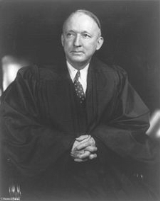
Hugo Black

Encyclopedia
Hugo Lafayette Black was an American politician and jurist. A member of the Democratic Party, Black represented Alabama
in the United States Senate
from 1927 to 1937, and served as an Associate Justice
of the Supreme Court of the United States
from 1937 to 1971. Black was nominated to the Supreme Court by President Franklin D. Roosevelt
and confirmed
by the Senate by a vote of 63 to 13. He was first of nine Roosevelt nominees to the Court, and outlasted all except for William O. Douglas
. Black is widely regarded as one of the most influential Supreme Court justices in the 20th century.
The fifth longest-serving justice in Supreme Court history, Black is noted for his advocacy of a textualist
reading of the United States Constitution
and of the position that the liberties guaranteed in the Bill of Rights
were imposed on the states ("incorporated") by the Fourteenth Amendment
. During his political career, Black was regarded as a staunch supporter of liberal policies and civil liberties. However, Black consistently opposed the doctrine of substantive due process
(the anti-New Deal
Supreme Court cited this concept in such a way as to make it impossible for the government to enact legislation that interfered with the freedom of business owners) and believed that there was no basis in the words of the Constitution for a right to privacy, voting against finding one in Griswold v. Connecticut
. Black endorsed Roosevelt in both the 1932 and 1936 US Presidential elections and was a staunch supporter of the New Deal.
, a poor, isolated rural Clay County
town in the Appalachian
foothills.
Because his brother Orlando had become a medical doctor, Hugo decided at first to follow in his footsteps. At age seventeen, he left school and enrolled at Birmingham Medical School. However, it was Orlando who suggested that Hugo should enroll at the University of Alabama School of Law
. After graduating in June 1906, he moved back to Ashland and established a legal practice. His legal practice was not a success, so Black moved to Birmingham in 1907 to continue his law practice, and came to specialize in labor law and personal injury cases.
Following his defense of an African American forced into a form of commercial slavery following incarceration, Black was befriended by A. O. Lane, a judge connected with the case. When Lane was elected to the Birmingham City Commission in 1911, he asked Black to serve as a police court judge, an experience that would be his only judicial experience prior to the Supreme Court. In 1912, Black resigned that seat in order to return to practicing law full-time. He was not done with public service; in 1914, he began a four-year term as the Jefferson County
Prosecuting Attorney
.
Three years later, during World War I
, Black resigned in order to join the United States Army, eventually reaching the rank of captain. He served in the 81st Field Artillery, but was not assigned to Europe. He joined the Birmingham Civitan Club during this time, eventually serving as president of the group. He remained an active member throughout his life, occasionally contributing articles to Civitan publications.
On February 23, 1921, he married Josephine Foster (1899–1951), with whom he would have three children: Hugo L. Black, II (b. 1922), an attorney; Sterling Foster (b. 1924), and Martha Josephine (b. 1933). Josephine died in 1951; in 1957, Black married Elizabeth Seay DeMeritte.
in the sensationalistic trial for the murder of a Catholic priest Fr. James E. Coyle. He joined the Ku Klux Klan
shortly after, thinking it necessary for his political career. Running for the Senate as the "people's" candidate, Black believed he needed the votes of Klan members. Black would near the end of his life admit that joining the Klan was a mistake, but said "I would have joined any group if it helped get me votes."
Scholars and biographers have recently examined Black's religious views. Ball finds regarding the Klan that Black "sympathized with the group's economic, nativist, and anti-Catholic beliefs." Newman says he "disliked the Catholic Church as an institution" and gave numerous anti-Catholic speeches in his 1926 election campaign to KKK meetings across Alabama.
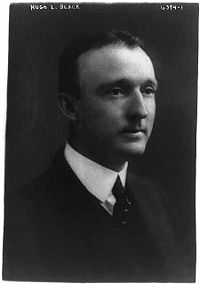 In 1926, Black sought election to the United States Senate
from Alabama, following the retirement of Senator Oscar Underwood
. Since the Democratic Party dominated Alabama politics at the time, he easily defeated his Republican opponent, E. H. Dryer, winning 80.9% of the vote. He was reelected in 1932, winning 86.3% of the vote against Republican J. Theodore Johnson.
Senator Black gained a reputation as a tenacious investigator. In 1934, for example, he chaired the committee that looked into the contracts awarded to air mail carriers under Postmaster General Walter Folger Brown
, an inquiry which led to the Air Mail scandal
. In order to correct what he termed abuses of "fraud and collusion" resulting from the Air Mail Act of 1930, he introduced the Black-McKellar Bill, later the Air Mail Act of 1934. The following year he participated in a Senate committee's investigation of lobbying
practices. He publicly denounced the "highpowered, deceptive, telegram-fixing, letterframing, Washington-visiting" lobbyists, and advocated legislation requiring them to publicly register their names and salaries.
In 1935, Black became chairman of the Senate Committee on Education and Labor, a position he would hold for the remainder of his Senate career. In 1937 he sponsored the Black-Connery Bill, which sought to establish a national minimum wage
and a maximum workweek of thirty hours. Although the bill was initially rejected in the House of Representatives, a weakened version passed in 1938 (after Black left the Senate), becoming the Fair Labor Standards Act
.
Black was an ardent supporter of President Franklin D. Roosevelt
and the New Deal
. In particular, he was an outspoken advocate of the Judiciary Reorganization Bill of 1937
, popularly known as the court-packing bill, FDR's unsuccessful plan to stack a hostile Supreme Court in his favor by adding more associate justices.
Black would throughout his career as a senator give speeches based on his belief in the ultimate power of the Constitution. He came to see the actions of the anti-New Deal Supreme Court as judicial excess; in his view, the Court was improperly overturning legislation passed by large majorities of Congress.
retired. Roosevelt wanted the replacement to be a "thumping, evangelical New Dealer" who was reasonably young, confirmable by the Senate, and from a region of the country unrepresented on the Court. The three final candidates were Solicitor General Stanley Reed
, Sherman Minton
, and Hugo Black. Roosevelt said Reed "had no fire," and Minton didn't want the appointment at the time. The position would go to Black - a candidate from the South who as a senator had voted for all twenty-four of Roosevelt's major New Deal programs. Roosevelt admired Black's use of the investigative role of the Senate to shape the American mind on reforms, his strong voting record, and his early support, which dated back to 1933.
On August 12, 1937, Roosevelt nominated Black to fill the vacancy. By tradition, a senator nominated for an executive or judicial office was confirmed immediately and without debate. However, when Black was nominated, the Senate departed from this tradition for the first time since 1853; instead of confirming him immediately, it referred the nomination to the Judiciary Committee
. Black was criticized for his presumed bigotry, his cultural roots, and later when it became public, his Klan membership.
The Judiciary Committee recommended Black's confirmation by a vote of 13–4 on August 16 of that year.
The next day the full Senate considered Black's nomination. Rumors relating to Black's involvement in the Ku Klux Klan surfaced among the senators, and two Democratic Senators tried defeating the nomination. However, no conclusive evidence of Black's involvement was available at the time, so after six hours of debate, the Senate voted 63-16 to confirm Black - ten Republicans and six Democrats voted against Black. Alabama Governor Bibb Graves
appointed his own wife, Dixie B. Graves
, to fill Black's vacated seat.
The next month, the Pittsburgh Post-Gazette
investigated Black's KKK past. Ray Sprigle
won a Pulitzer Prize
for his series of articles revealing Black's involvement in the Klan. However, the controversy soon subsided; the criticism was highly partisan and polls showed that the attacks had little effect on public opinion of Black. Black also addressed public concerns in person: "I did join the Klan. I later resigned. I never rejoined... Before becoming a Senator I dropped the Klan. I have had nothing to do with it since that time. I abandoned it. I completely discontinued any association with the organization. I have never resumed it and never expect to do so."
Black was close friends with Walter White
, the black executive secretary of the NAACP who would help assuage critics of the appointment. Black also had a Jewish law clerk and a Catholic secretary. Chambers v. Florida
(1940), an early case where Black ruled in favor of African American criminal defendants who experienced due process violations, helped put concerns to rest.
and worked to move the Court away from interposing itself in social and economic matters. Black vigorously defended the "plain meaning" of the Constitution, rooted in the ideas of its era, and emphasized the supremacy of the legislature; for Black, the role of the Supreme Court was limited and constitutionally prescribed.
During his early years on the Supreme Court, Black helped reverse several earlier court decisions taking a narrow interpretation of federal power. Many New Deal
laws that would have been struck down under earlier precedents were thus upheld. In 1939 Black was joined on the Supreme Court by Felix Frankfurter
and William O. Douglas
. Douglas voted alongside Black in several cases, especially those involving the First Amendment
, while Frankfurter soon became one of Black's ideological foes.
 In the mid-1940s, Justice Black became involved in a bitter dispute with Justice Robert H. Jackson
as a result of Jewell Ridge Coal Corp. v. Local 6167, United Mine Workers (1945). In this case the Court ruled 5–4 in favor of the UMW; Black voted with the majority, while Jackson dissented. However, the coal company requested the Court rehear the case on the grounds that Justice Black should have recused himself, as the mine workers were represented by Black's law partner of 20 years earlier. Under the Supreme Court's rules, each Justice was entitled to determine the propriety of disqualifying himself. Jackson agreed that the petition for rehearing should be denied, but refused to give approval to Black's participation in the case. Ultimately, when the Court unanimously denied the petition for rehearing, Justice Jackson released a short statement, in which Justice Frankfurter joined. The concurrence indicated that Jackson voted to deny the petition not because he approved of Black's participation in the case, but on the "limited grounds" that each Justice was entitled to determine for himself the propriety of recusal. At first the case attracted little public comment, however, after Chief Justice Harlan Stone died in 1946, rumors that President Harry S. Truman
would appoint Jackson as Stone's successor led several newspapers to investigate and report the Jewell Ridge controversy. Black and Douglas allegedly leaked to newspapers that they would resign if Jackson were appointed Chief. Truman ultimately chose Fred M. Vinson
for the position.
Black later clashed with fellow Justice Abe Fortas
during the 1960s. In 1968, a Warren clerk called their feud "one of the most basic animosities of the Court."
in the United States. In several cases the Supreme Court considered, and upheld, the validity of anticommunist laws passed during this era. For example, in American Communications Association v. Douds (1950), the Court upheld a law that required labor union
officials to forswear membership in the Communist Party
. Black dissented, claiming that the law violated the First Amendment
's free speech clause. Similarly, in Dennis v. United States
, , the Court upheld the Smith Act
, which made it a crime to "advocate, abet, advise, or teach the duty, necessity, desirability, or propriety of overthrowing the Government of the United States." The law was often used to prosecute individuals for joining the Communist Party. Black again dissented, writing:
Beginning in the late 1940s, Black wrote decisions relating to the establishment clause, where he insisted on the strict separation of church and state
. The most notable of these was Engel v. Vitale
(1962), which declared state-sanctioned prayer in public schools unconstitutional. This provoked considerable opposition, especially in conservative circles. Efforts to restore school prayer by constitutional amendment failed.
In 1953 Vinson died and was replaced by Earl Warren
. While all members of the Court were New Deal liberals, Black was part of the most liberal wing of the Court, together with Warren, Douglas, William Brennan
, and Arthur Goldberg
. They said the Court had a role beyond that of Congress. Yet while he often voted with them on the Warren Court, he occasionally took his own line on some key cases, most notably Griswold v. Connecticut
(1965), which established that the Constitution protected a right to privacy. In not finding such a right implicit in the Constitution, Black wrote in his dissent that "Many good and able men have eloquently spoken and written... about the duty of this Court to keep the Constitution in tune with the times. ... For myself, I must with all deference reject that philosophy."
Black's most prominent ideological opponent on the Warren Court was John Marshall Harlan II
, who replaced Justice Jackson in 1955. They disagreed on several issues, including the applicability of the Bill of Rights to the states, the scope of the due process clause, and the one man, one vote
principle.
 Black's jurisprudence
is among the most distinctive of any member of the Supreme Court in history and has been influential on justices as diverse as Earl Warren
, William Rehnquist, and Antonin Scalia
.
Black's jurisprudence had three essential components: history, literalism, and absolutism. Black's love of history was rooted in a lifelong love of books, which led him to the belief that historical study was necessary for one to prevent repeating society's past mistakes. Black wrote in 1968 that "power corrupts, and unrestricted power will tempt Supreme Court justices just as history tells us it has tempted other judges."
Second, Black's commitment to literalism involved using the words of the Constitution to restrict the roles of the judiciary - Black would have justices validate the supremacy of the country's legislature, unless the legislature itself was denying people their freedoms. Black wrote: "The Constitution is not deathless; it provides for changing or repealing by the amending process, not by judges but by the people and their chosen representatives." Black would often lecture his colleagues, liberal or conservative, on the Supreme Court about the importance of acting within the limits of the Constitution.
Third, Black's absolutism led him to enforce the rights of the Constitution, rather than attempting to define a meaning, scope, or extent to each right. Black expressed his view on the Bill of Rights in his opinion in the 1947 case, Adamson v. California
, which he saw as his "most significant opinion written:"
and reserved the power of making laws to the legislatures, often scolding his more liberal colleagues for what he saw as judicially-created legislation. Conservative justice John M. Harlan II would say of Black: "No Justice has worn his judicial robes with a keener sense of the limitations that go with them." Black advocated a narrow role of interpretation for justices, opposing a view of justices as social engineers or rewriters of the Constitution. Black opposed enlarging constitutional liberties beyond their literal or historic "plain" meaning, as he saw his more liberal colleagues do. However, he also condemned the actions of those to his right, such as the conservative Four Horsemen of the 1920s and 1930s, who struck down much of the New Deal's legislation.
approach to constitutional interpretation. He took a "literal" or absolutist reading of the provisions of the Bill of Rights and believed that the text of the Constitution is absolutely determinative on any question calling for judicial interpretation, leading to his reputation as a "textualist
" and as a "strict constructionist
". While the text of the constitution was an absolute limitation on the authority of judges in constitutional matters, within the confines of the text judges had a broad and unqualified mandate to enforce constitutional provisions, regardless of current public sentiment, or the feelings of the justices themselves.
Thus, Black refused to join in the efforts of the justices on the Court who sought to abolish capital punishment
in the United States, whose efforts succeeded (temporarily) in the term immediately following Black's death. He claimed that the Fifth and Fourteenth Amendment's reference to takings of "life" meant approval of the death penalty was implicit in the Bill of Rights. He also was not persuaded that a right of privacy was implicit in the Ninth
or Fourteenth amendments, and dissented from the Court's 1965 Griswold
decision which invalidated a conviction for the use of contraceptives. Black said "It belittles that [Fourth] Amendment to talk about it as though it protects nothing but 'privacy'... 'privacy' is a broad, abstract, and ambiguous concept... The constitutional right of privacy is not found in the Constitution."
Justice Black rejected reliance on what he called the "mysterious and uncertain" concept of natural law
. According to Black that theory was vague and arbitrary, and merely allowed judges to impose their personal views on the nation. Instead, he argued that courts should limit themselves to a strict analysis of the actual text of the Constitution. Black was, in addition, an opponent of the "living constitution
" theory. In his dissent to Griswold
(1965), he wrote:
Thus, some have seen Black as an originalist
. David Strauss, for example, hails him as "[t]he most influential originalist judge of the last hundred years." Black insisted that judges rely on the intent of the Framers as well as the "plain meaning" of the Constitution's words and phrases (drawing on the history of the period) when deciding a case. But, unlike modern rightist originalists, Black called for judicial restraint
not usually seen in Court decision-making. The justices of the Court would validate the supremacy of the legislature in public policy-making, unless the legislature was denying people constitutional freedoms. Black stated that the legislature "was fully clothed with the power to govern and to maintain order."
, , Wickard v. Filburn
, , Heart of Atlanta Motel v. United States
, , and Katzenbach v. McClung
, .
In several other federalism cases, however, Black ruled against the federal government. For instance, he partially dissented from South Carolina v. Katzenbach
, , in which the Court upheld the validity of the Voting Rights Act of 1965
. In an attempt to protect the voting rights of African American
s, the act required any state whose population was at least 5% African American to obtain federal approval before changing its voting laws. Black wrote that the law,
Similarly, in Oregon v. Mitchell
(1970), he delivered the opinion of the court holding that the federal government was not entitled to set the voting age
for state elections.
In the law of federal jurisdiction
, Black made a large contribution by authoring the majority opinion in Younger v. Harris
. This case, decided during Black's last year on the Court, has given rise to what is now known as Younger abstention
. According to this doctrine, an important principle of federalism called "comity"—that is, respect by federal courts for state courts—dictates that federal courts abstain from intervening in ongoing state proceedings, absent the most compelling circumstances. The case is also famous for its discussion of what Black calls "Our Federalism," a discussion in which Black expatiates on
Black was an early supporter of the "one man, one vote" standard for apportionment set by Baker v. Carr
. He dissented in support of this view in Baker's predecessor case, Colegrove v. Green
.
(1948), which invalidated the judicial enforcement of racially restrictive covenant
s. Similarly, he was part of the unanimous Brown v. Board of Education
(1954) Court that struck down racial segregation
in public schools. Black remained determined to desegregate the South and would call for the Supreme Court to adopt a position of "immediate desegregation" in 1969's Alexander v. Holmes County Board of Education.
Black wrote the court's majority opinion in Korematsu v. United States
, which validated Roosevelt's decision to intern Japanese Americans
on the West Coast
during World War II
. The decision is an example of Black's belief in the limited role of the judiciary; he validated the legislative and executive actions that led to internment, saying "it is unnecessary for us to appraise the possible reasons which might have prompted the order to be used in the form it was."
Black also tended to favor law and order over civil rights activism. This led him to read the Civil Rights Act narrowly. For example, he dissented in a case reversing convictions of sit-in protesters, arguing to limit the scope of the Civil Rights Act. In 1968 he said, “Unfortunately there are some who think that Negroes should have special privileges under the law.” Black felt that actions like protesting, singing, or marching for "good causes" one day could lead to supporting evil causes later on; his sister-in-law explained that Black was "mortally afraid" of protesters. Black opposed the actions of some civil rights and Vietnam War protesters and believed that legislatures first, and courts second, should be responsible for alleviating social wrongs. Black once said he was "vigorously opposed to efforts to extend the First Amendment's freedom of speech beyond speech," to conduct.
", "bad tendency
", "gravity of the evil," "reasonableness," or "balancing." Black would write that the First Amendment is "wholly 'beyond the reach' of federal power to abridge... I do not believe that any federal agencies, including Congress and the Court, have power or authority to subordinate speech and press to what they think are 'more important interests.'"
He believed that the First Amendment erected a metaphorical wall of separation
between church and state. During his career Black wrote several important opinions relating to church-state separation. He delivered the opinion of the court in Everson v. Board of Education
(1947), which held that the establishment clause was applicable not only to the federal government, but also to the states.
Black's majority opinion in McCollum v. Board of Education
(1948) held that the government could not provide religious instruction in public schools. In Torcaso v. Watkins
(1961), he delivered an opinion which affirmed that the states could not use religious tests as qualifications for public office. Similarly, he authored the majority opinion in Engel v. Vitale
(1962), which declared it unconstitutional for states to require the recitation of official prayers in public schools.
Justice Black is often regarded as a leading defender of First Amendment rights such as the freedom of speech and of the press. He refused to accept the doctrine that the freedom of speech could be curtailed on national security grounds. Thus, in New York Times Co. v. United States
(1971), he voted to allow newspapers to publish the Pentagon Papers
despite the Nixon Administration
's contention that publication would have security implications. In his concurring opinion, Black stated,
He rejected the idea that the government was entitled to punish "obscene" speech. Likewise, he argued that defamation
laws abridged the freedom of speech and were therefore unconstitutional. Most members of the Supreme Court rejected both of these views; Black's interpretation did attract the support of Justice Douglas.
However, he did not believe that individuals had the right to speak wherever they pleased. He delivered the majority opinion in Adderley v. Florida
(1966), controversially upholding a trespassing conviction for protestors who demonstrated on government property. He also dissented from Tinker v. Des Moines (1969), in which the Supreme Court ruled that students had the right to wear armbands (as a form of protest) in schools, writing,
Moreover, Black took a narrow view of what constituted "speech" under the First Amendment; for him, "conduct" did not deserve the same protections that "speech" did. For example, he did not believe that flag burning
was speech; in Street v. New York
(1969), he wrote: "It passes my belief that anything in the Federal Constitution bars a State from making the deliberate burning of the American flag an offense." Similarly, he dissented from Cohen v. California
(1971), in which the Court held that wearing a jacket emblazoned with the words "Fuck the Draft" was speech protected by the First Amendment. He agreed that this activity "was mainly conduct, and little speech."
As a Justice, Black held the view that the Court should literally enforce constitutional guarantees, especially the First Amendment free speech clause. He was often labeled an ‘activist’ because of his willingness to review legislation that arguably violated constitutional provisions. Black maintained that literalism was necessary to cabin judicial power."
In a 1968 public interview, reflecting on his most important contributions, Black put his dissent from Adamson v. California "at the top of the list, but then spoke with great eloquence from one of his earliest opinions in Chambers v. Florida (1940)."
than many of his colleagues on the Warren Court. He dissented from Katz v. United States
(1967), in which the Court held that warrantless wiretapping
violated the Fourth Amendment's guarantee against unreasonable search and seizure. He argued that the Fourth Amendment only protected tangible items from physical searches or seizures. Thus, he concluded that telephone conversations were not within the scope of the amendment, and that warrantless wiretapping was consequently permissible.
Justice Black originally believed that the Constitution did not require the exclusion of illegally seized evidence at trials. In his concurrence to Wolf v. Colorado
(1949), he claimed that the exclusionary rule
was "not a command of the Fourth Amendment but ... a judicially created rule of evidence." But he later changed his mind and joined the majority in Mapp v. Ohio
(1961), which applied it to state as well as federal criminal investigations. In his concurrence, he indicated that his support was based on the Fifth Amendment's guarantee of the right against self-incrimination, not on the Fourth Amendment's guarantee against unreasonable searches and seizures. He wrote, "I am still not persuaded that the Fourth Amendment, standing alone, would be enough to bar the introduction into evidence ... seized ... in violation of its commands."
In other instances Black took a fairly broad view of the rights of criminal defendants. He joined the Supreme Court's landmark decision in Miranda v. Arizona
(1966), which required law enforcement officers to warn suspects of their rights
prior to interrogations, and consistently voted to apply the guarantees of the Fourth, Fifth, Sixth
, and Eighth
Amendments at the state level.
Black was the author of the landmark case Gideon v. Wainwright
(1963), which ruled that the states must provide an attorney to an indigent criminal defendant who cannot afford one. Before Gideon, the Court had held that such a requirement applied only to the federal government.
(1833). According to Black, the Fourteenth Amendment, ratified in 1868, "incorporated" the Bill of Rights, or made it binding upon the states as well. In particular, he pointed to the Privileges or Immunities Clause
, "No State shall make or enforce any law which shall abridge the privileges or immunities of citizens of the United States." He proposed that the term "privileges or immunities" encompassed the rights mentioned in the first eight amendments to the Constitution.
Black first expounded this theory of incorporation when the Supreme Court ruled in Adamson v. California
(1947) that the Fifth Amendment
's guarantee against self-incrimination
did not apply to the states. It was during this period of time that Hugo Black became a disciple of John Lilburne
and his claim of ‘freeborn rights’. In an appendix to his dissenting opinion, Justice Black analyzed statements made by those who framed the Fourteenth Amendment, reaching the conclusion that "the Fourteenth Amendment, and particularly its privileges and immunities clause, was a plain application of the Bill of Rights to the states."
Black's theory attracted the support of Justices such as Frank Murphy and William O. Douglas. However, it never achieved the support of a majority of the Court. The most prominent opponents of Black's theory were Justices Felix Frankfurter
and John Marshall Harlan II
. Frankfurter and Harlan argued that the Fourteenth Amendment did not incorporate the Bill of Rights per se, but merely protected rights that are "implicit in the concept of ordered liberty," which was the standard Justice Cardozo had established earlier in Palko v. Connecticut
.
The Supreme Court never accepted the argument that the Fourteenth Amendment incorporated the entirety of the Bill of Rights. However, it did agree that some "fundamental" guarantees were made applicable to the states. For the most part, during the 1930s, 1940s, and 1950s, only First Amendment
rights (such as free exercise of religion and freedom of speech) were deemed sufficiently fundamental by the Supreme Court to be incorporated.
However, during the 1960s, the Court under Chief Justice Warren took the process much further, making almost all guarantees of the Bill of Rights binding upon the states. Thus, although the Court failed to accept Black's theory of total incorporation, the end result of its jurisprudence is very close to what Black advocated. Today, the only parts of the first eight amendments that have not been extended to the states are the Third
and Seventh
Amendments, the grand jury
clause of the Fifth Amendment
, the Eighth Amendment
's protection against excessive bail
, and the guarantee of the Sixth Amendment
, as interpreted, that criminal juries be composed of 12 members and be unanimous in their verdicts.
. Most Supreme Court Justices accepted the view that the due process clause encompassed not only procedural guarantees, but also "fundamental fairness" and fundamental rights. Thus, it was argued that due process included a "substantive" component in addition to its "procedural" component.
Black, however, believed that this interpretation of the due process clause was unjustifiably broad. In his dissent to Griswold
, he charged that the doctrine of substantive due process "takes away from Congress and States the power to make laws based on their own judgment of fairness and wisdom, and transfers that power to this Court for ultimate determination." Instead, Black advocated a much narrower interpretation of the clause. In his dissent to In re Winship
, he analyzed the history of the term "due process of law", and concluded: "For me, the only correct meaning of that phrase is that our Government must proceed according to the 'law of the land'—that is, according to written constitutional and statutory provisions as interpreted by court decisions."
Black's view on due process drew from his reading of British history; to him, due process meant all persons were to be tried in accordance with the Bill of Rights' procedural guarantees and in accordance with constitutionally pursuant laws. Black advocated equal treatment by the government for all persons, regardless of wealth, age, or race. Black's view of due process was restrictive in the sense that it was premised on equal procedures; it did not extend to substantive due process. This was in accordance with Black's literalist views. Black did not tie procedural due process exclusively to the Bill of Rights, but he did tie it exclusively to the Bill of Rights combined with other explicit provisions of the Constitution.
None of Black's colleagues shared his interpretation of the due process clause. His chief rival on the issue (and on many other issues) was Felix Frankfurter
, who advocated a substantive view of due process based on "natural law" - if a challenged action did not "shock the conscience" of the jurist, or violate British concepts of fairness, Frankfurter would find no violation of due process of law. John M. Harlan II largely agreed with Frankfurter, and was highly critical of Black's view, indicating his "continued bafflement at... Black's insistence that due process ... does not embody a concept of fundamental fairness" in his Winship concurrence. Since Black's death the Court has continued to apply the doctrine of substantive due process (most notably in Roe v. Wade
, which proclaimed that abortion was a constitutionally protected right).
" principle. He delivered the opinion of the court in Wesberry v. Sanders
(1964), holding that the Constitution required congressional districts in any state to be approximately equal in population. He concluded that the Constitution's command "that Representatives be chosen 'by the People of the several States' means that as nearly as is practicable one man's vote in a congressional election is to be worth as much as another's." Likewise, he voted in favor of Reynolds v. Sims
(1964), which extended the same requirement to state legislative districts on the basis of the equal protection clause.
At the same time, Black did not believe that the equal protection clause made poll tax
es unconstitutional. Thus, he dissented from the Court's ruling in Harper v. Virginia Board of Elections
(1966) invalidating the use of the poll tax as a qualification to vote. He criticized the Court for exceeding its "limited power to interpret the original meaning of the Equal Protection Clause" and for "giving that clause a new meaning which it believes represents a better governmental policy."
 Justice Black admitted himself to the National Naval Medical Center
in Bethesda, Maryland
, in August 1971, and subsequently retired from the Court on September 17. He suffered a stroke two days later and died on September 25.
Services were held at the National Cathedral, and over 1,000 persons attended. Pursuant to Justice Black’s wishes, the coffin was “simple and cheap” and was displayed at the service to show that the costs of burial are not reflective of the worth of the human whose remains were present.
His remains were interred at the Arlington National Cemetery
. He is one of twelve Supreme Court justices buried at Arlington. The others are Harry Andrew Blackmun, William J. Brennan, Arthur Joseph Goldberg, Thurgood Marshall
, Potter Stewart
, William O. Douglas
, Oliver Wendell Holmes, Jr.
, Chief Justice William Howard Taft
, Chief Justice Earl Warren
,Chief Justice Warren Burger, and Chief Justice William Rehnquist
. Justice Black is buried to the right of the main cemetery entrance, and up a hill, 200 yards behind the Taft monument. Black's headstone is "identical in size and shape to the tens of thousands of military headstones in Arlington." It says simply, "Hugo Lafayette Black, Captain, U. S. Army". Between the graves of Justice Black and his first wife there is a simple marble bench with the inscription: "Here Lies a Good Man."
President Richard Nixon
first considered nominating Hershel Friday
to fill the vacant seat, but changed his mind after the American Bar Association
found Friday unqualified. Nixon then nominated Lewis Powell
, who was confirmed by the Senate.
).
In 1986, Black appeared on the Great Americans series
postage stamp
issued by the United States Postal Service
. Along with Oliver Wendell Holmes, Jr.
he was one of only two Associate Justices to do so until the later inclusions of Thurgood Marshall
, Joseph Story
, Louis Brandeis
, Felix Frankfurter
, and William J. Brennan, Jr.
See, Justice Hugo L. Black 5¢ stamp. and http://www.google.com/imgres?imgurl=http://www.swapmeetdave.com/Stamps/FDC/Goldberg/2172gb10.jpg&imgrefurl=http://www.swapmeetdave.com/Stamps/FDC/Goldberg.htm&usg=__cE56HzCnQEyaWTeXVpYrzvEjAGc=&h=310&w=717&sz=74&hl=en&start=5&zoom=1&tbnid=m1duFUQG98JHhM:&tbnh=61&tbnw=140&prev=/images%3Fq%3DHugo%2BBlack%2BFirst%2Bday%2Bcover%2Bstamp%26hl%3Den%26sa%3DG%26biw%3D666%26bih%3D393%26gbv%3D2%26tbs%3Disch:1&itbs=1Hugo L. Black, First Day] Cover
. In 1987, Congress passed a law sponsored by Ben Erdreich
, H.R. 614, designating the new courthouse building for the U.S. District Court for the Northern District of Alabama in Birmingham
, as the "Hugo L. Black United States Courthouse."
An extensive collection of Black's personal, senatorial, and judicial papers is archived at the Manuscript Division of the Library of Congress
, where it is open for research.
Justice Black is honored in an exhibit in the Bounds Law Library at the University of Alabama School of Law
. A special Hugo Black collection is maintained by the library.
Black served on the Supreme Court for thirty-four years, making him the fifth longest-serving Justice in Supreme Court history. He was the senior (longest serving) justice on the court for an unprecedented twenty-five years, from the death of Chief Justice Stone on April 22, 1946 to his own retirement on September 17, 1971. As the longest-serving associate justice, he was acting Chief Justice on two occasions: from Stone's death until Vinson
took office on June 24, 1946; and from Vinson's death on September 8, 1953 until Warren
took office on October 5, 1953. There was no interregnum
between the Warren and Burger courts in 1969.
Alabama
Alabama is a state located in the southeastern region of the United States. It is bordered by Tennessee to the north, Georgia to the east, Florida and the Gulf of Mexico to the south, and Mississippi to the west. Alabama ranks 30th in total land area and ranks second in the size of its inland...
in the United States Senate
United States Senate
The United States Senate is the upper house of the bicameral legislature of the United States, and together with the United States House of Representatives comprises the United States Congress. The composition and powers of the Senate are established in Article One of the U.S. Constitution. Each...
from 1927 to 1937, and served as an Associate Justice
Associate Justice of the Supreme Court of the United States
Associate Justices of the Supreme Court of the United States are the members of the Supreme Court of the United States other than the Chief Justice of the United States...
of the Supreme Court of the United States
Supreme Court of the United States
The Supreme Court of the United States is the highest court in the United States. It has ultimate appellate jurisdiction over all state and federal courts, and original jurisdiction over a small range of cases...
from 1937 to 1971. Black was nominated to the Supreme Court by President Franklin D. Roosevelt
Franklin D. Roosevelt
Franklin Delano Roosevelt , also known by his initials, FDR, was the 32nd President of the United States and a central figure in world events during the mid-20th century, leading the United States during a time of worldwide economic crisis and world war...
and confirmed
Advice and consent
Advice and consent is an English phrase frequently used in enacting formulae of bills and in other legal or constitutional contexts, describing a situation in which the executive branch of a government enacts something previously approved of by the legislative branch.-General:The expression is...
by the Senate by a vote of 63 to 13. He was first of nine Roosevelt nominees to the Court, and outlasted all except for William O. Douglas
William O. Douglas
William Orville Douglas was an Associate Justice of the United States Supreme Court. With a term lasting 36 years and 209 days, he is the longest-serving justice in the history of the Supreme Court...
. Black is widely regarded as one of the most influential Supreme Court justices in the 20th century.
The fifth longest-serving justice in Supreme Court history, Black is noted for his advocacy of a textualist
Textualism
Textualism is a formalist theory of statutory interpretation, holding that a statute's ordinary meaning should govern its interpretation, as opposed to inquiries into non-textual sources such as the intention of the legislature in passing the law, the problem it was intended to remedy, or...
reading of the United States Constitution
United States Constitution
The Constitution of the United States is the supreme law of the United States of America. It is the framework for the organization of the United States government and for the relationship of the federal government with the states, citizens, and all people within the United States.The first three...
and of the position that the liberties guaranteed in the Bill of Rights
United States Bill of Rights
The Bill of Rights is the collective name for the first ten amendments to the United States Constitution. These limitations serve to protect the natural rights of liberty and property. They guarantee a number of personal freedoms, limit the government's power in judicial and other proceedings, and...
were imposed on the states ("incorporated") by the Fourteenth Amendment
Fourteenth Amendment to the United States Constitution
The Fourteenth Amendment to the United States Constitution was adopted on July 9, 1868, as one of the Reconstruction Amendments.Its Citizenship Clause provides a broad definition of citizenship that overruled the Dred Scott v...
. During his political career, Black was regarded as a staunch supporter of liberal policies and civil liberties. However, Black consistently opposed the doctrine of substantive due process
Substantive due process
Substantive due process is one of the theories of law through which courts enforce limits on legislative and executive powers and authority...
(the anti-New Deal
New Deal
The New Deal was a series of economic programs implemented in the United States between 1933 and 1936. They were passed by the U.S. Congress during the first term of President Franklin D. Roosevelt. The programs were Roosevelt's responses to the Great Depression, and focused on what historians call...
Supreme Court cited this concept in such a way as to make it impossible for the government to enact legislation that interfered with the freedom of business owners) and believed that there was no basis in the words of the Constitution for a right to privacy, voting against finding one in Griswold v. Connecticut
Griswold v. Connecticut
Griswold v. Connecticut, , was a landmark case in which the Supreme Court of the United States ruled that the Constitution protected a right to privacy. The case involved a Connecticut law that prohibited the use of contraceptives...
. Black endorsed Roosevelt in both the 1932 and 1936 US Presidential elections and was a staunch supporter of the New Deal.
Early years
Hugo LaFayette Black was the youngest of the eight children of William Lafayette Black and Martha Toland Black. He was born on February 27, 1886, in a small wooden farmhouse in Ashland, AlabamaAshland, Alabama
Ashland is a town in Clay County, Alabama, United States. The population was 1,965 at the 2000 census, at which time it was a city; according to 2005 Census Bureau estimates, the population was 1,885. The town is the county seat of Clay County.-History:...
, a poor, isolated rural Clay County
Clay County, Alabama
Clay County is a county of the US state of Alabama. Its name is in honor of Henry Clay, famous American statesman, member of the United States Senate from Kentucky and United States Secretary of State in the 19th century. As of 2010 the population was 13,932...
town in the Appalachian
Appalachian Mountains
The Appalachian Mountains #Whether the stressed vowel is or ,#Whether the "ch" is pronounced as a fricative or an affricate , and#Whether the final vowel is the monophthong or the diphthong .), often called the Appalachians, are a system of mountains in eastern North America. The Appalachians...
foothills.
Because his brother Orlando had become a medical doctor, Hugo decided at first to follow in his footsteps. At age seventeen, he left school and enrolled at Birmingham Medical School. However, it was Orlando who suggested that Hugo should enroll at the University of Alabama School of Law
University of Alabama School of Law
The University of Alabama School of Law located in Tuscaloosa, Alabama is a nationally ranked top-tier law school and the only public law school in the state. In total, it is one of five law schools in the state, and one of three that are ABA accredited.The diverse student body, of approximately...
. After graduating in June 1906, he moved back to Ashland and established a legal practice. His legal practice was not a success, so Black moved to Birmingham in 1907 to continue his law practice, and came to specialize in labor law and personal injury cases.
Following his defense of an African American forced into a form of commercial slavery following incarceration, Black was befriended by A. O. Lane, a judge connected with the case. When Lane was elected to the Birmingham City Commission in 1911, he asked Black to serve as a police court judge, an experience that would be his only judicial experience prior to the Supreme Court. In 1912, Black resigned that seat in order to return to practicing law full-time. He was not done with public service; in 1914, he began a four-year term as the Jefferson County
Jefferson County, Alabama
Jefferson County is the most populous county in the U.S. state of Alabama, with its county seat being located in Birmingham.As of the 2010 U.S. Census, the population of Jefferson County was 658,466...
Prosecuting Attorney
Prosecutor
The prosecutor is the chief legal representative of the prosecution in countries with either the common law adversarial system, or the civil law inquisitorial system...
.
Three years later, during World War I
World War I
World War I , which was predominantly called the World War or the Great War from its occurrence until 1939, and the First World War or World War I thereafter, was a major war centred in Europe that began on 28 July 1914 and lasted until 11 November 1918...
, Black resigned in order to join the United States Army, eventually reaching the rank of captain. He served in the 81st Field Artillery, but was not assigned to Europe. He joined the Birmingham Civitan Club during this time, eventually serving as president of the group. He remained an active member throughout his life, occasionally contributing articles to Civitan publications.
On February 23, 1921, he married Josephine Foster (1899–1951), with whom he would have three children: Hugo L. Black, II (b. 1922), an attorney; Sterling Foster (b. 1924), and Martha Josephine (b. 1933). Josephine died in 1951; in 1957, Black married Elizabeth Seay DeMeritte.
KKK and anti-Catholicism
In 1921, Black successfully defended E. R. StephensonE. R. Stephenson
Reverend Edwin R. Stephenson was a minister of the now extinct Methodist Episcopal Church, South and a member of the Ku Klux Klan. He shot and killed Catholic priest James Coyle in 1921 in Alabama, but was acquitted of the murder. His main lawyer was Hugo Black.Rev. Stephenson was a son of W. F....
in the sensationalistic trial for the murder of a Catholic priest Fr. James E. Coyle. He joined the Ku Klux Klan
Ku Klux Klan
Ku Klux Klan, often abbreviated KKK and informally known as the Klan, is the name of three distinct past and present far-right organizations in the United States, which have advocated extremist reactionary currents such as white supremacy, white nationalism, and anti-immigration, historically...
shortly after, thinking it necessary for his political career. Running for the Senate as the "people's" candidate, Black believed he needed the votes of Klan members. Black would near the end of his life admit that joining the Klan was a mistake, but said "I would have joined any group if it helped get me votes."
Scholars and biographers have recently examined Black's religious views. Ball finds regarding the Klan that Black "sympathized with the group's economic, nativist, and anti-Catholic beliefs." Newman says he "disliked the Catholic Church as an institution" and gave numerous anti-Catholic speeches in his 1926 election campaign to KKK meetings across Alabama.
Senate career
United States Senate
The United States Senate is the upper house of the bicameral legislature of the United States, and together with the United States House of Representatives comprises the United States Congress. The composition and powers of the Senate are established in Article One of the U.S. Constitution. Each...
from Alabama, following the retirement of Senator Oscar Underwood
Oscar Underwood
Oscar Wilder Underwood was an American politician.Underwood was born in Louisville, Kentucky, on May 6, 1862. He was the grandson of Joseph R. Underwood, a Kentucky Senator circa 1850. He attended the University of Virginia at Charlottesville...
. Since the Democratic Party dominated Alabama politics at the time, he easily defeated his Republican opponent, E. H. Dryer, winning 80.9% of the vote. He was reelected in 1932, winning 86.3% of the vote against Republican J. Theodore Johnson.
Senator Black gained a reputation as a tenacious investigator. In 1934, for example, he chaired the committee that looked into the contracts awarded to air mail carriers under Postmaster General Walter Folger Brown
Walter Folger Brown
Walter Folger Brown was Postmaster General of the United States from 1929 through 1933 under Herbert Hoover. He was best known for his involvement in the Air Mail scandal...
, an inquiry which led to the Air Mail scandal
Air Mail Scandal
The Air Mail scandal, also known as the Air Mail fiasco, is the name that the American press gave to the political scandal resulting from a congressional investigation of a 1930 meeting , between Postmaster General Walter Folger Brown and the executives of the top airlines, and to the disastrous...
. In order to correct what he termed abuses of "fraud and collusion" resulting from the Air Mail Act of 1930, he introduced the Black-McKellar Bill, later the Air Mail Act of 1934. The following year he participated in a Senate committee's investigation of lobbying
Lobbying
Lobbying is the act of attempting to influence decisions made by officials in the government, most often legislators or members of regulatory agencies. Lobbying is done by various people or groups, from private-sector individuals or corporations, fellow legislators or government officials, or...
practices. He publicly denounced the "highpowered, deceptive, telegram-fixing, letterframing, Washington-visiting" lobbyists, and advocated legislation requiring them to publicly register their names and salaries.
In 1935, Black became chairman of the Senate Committee on Education and Labor, a position he would hold for the remainder of his Senate career. In 1937 he sponsored the Black-Connery Bill, which sought to establish a national minimum wage
Minimum wage
A minimum wage is the lowest hourly, daily or monthly remuneration that employers may legally pay to workers. Equivalently, it is the lowest wage at which workers may sell their labour. Although minimum wage laws are in effect in a great many jurisdictions, there are differences of opinion about...
and a maximum workweek of thirty hours. Although the bill was initially rejected in the House of Representatives, a weakened version passed in 1938 (after Black left the Senate), becoming the Fair Labor Standards Act
Fair Labor Standards Act
The Fair Labor Standards Act of 1938 is a federal statute of the United States. The FLSA established a national minimum wage, guaranteed 'time-and-a-half' for overtime in certain jobs, and prohibited most employment of minors in "oppressive child labor," a term that is defined in the statute...
.
Black was an ardent supporter of President Franklin D. Roosevelt
Franklin D. Roosevelt
Franklin Delano Roosevelt , also known by his initials, FDR, was the 32nd President of the United States and a central figure in world events during the mid-20th century, leading the United States during a time of worldwide economic crisis and world war...
and the New Deal
New Deal
The New Deal was a series of economic programs implemented in the United States between 1933 and 1936. They were passed by the U.S. Congress during the first term of President Franklin D. Roosevelt. The programs were Roosevelt's responses to the Great Depression, and focused on what historians call...
. In particular, he was an outspoken advocate of the Judiciary Reorganization Bill of 1937
Judiciary Reorganization Bill of 1937
The Judicial Procedures Reform Bill of 1937, frequently called the court-packing plan, was a legislative initiative proposed by U.S. President Franklin Roosevelt to add more justices to the U.S. Supreme Court. Roosevelt's purpose was to obtain favorable rulings regarding New Deal legislation that...
, popularly known as the court-packing bill, FDR's unsuccessful plan to stack a hostile Supreme Court in his favor by adding more associate justices.
Black would throughout his career as a senator give speeches based on his belief in the ultimate power of the Constitution. He came to see the actions of the anti-New Deal Supreme Court as judicial excess; in his view, the Court was improperly overturning legislation passed by large majorities of Congress.
Appointment to the Supreme Court
Soon after the failure of the court-packing plan, President Roosevelt obtained his first opportunity to appoint a Supreme Court Justice when conservative Willis Van DevanterWillis Van Devanter
Willis Van Devanter was an Associate Justice of the United States Supreme Court, January 3, 1911 to June 2, 1937.- Early life and career :...
retired. Roosevelt wanted the replacement to be a "thumping, evangelical New Dealer" who was reasonably young, confirmable by the Senate, and from a region of the country unrepresented on the Court. The three final candidates were Solicitor General Stanley Reed
Stanley Forman Reed
Stanley Forman Reed was a noted American attorney who served as United States Solicitor General from 1935 to 1938 and as an Associate Justice of the U.S. Supreme Court from 1938 to 1957. He was the last Supreme Court Justice who did not graduate from law school Stanley Forman Reed (December 31,...
, Sherman Minton
Sherman Minton
Sherman "Shay" Minton was a Democratic United States Senator from Indiana and an Associate Justice of the Supreme Court of the United States. He was the most educated justice during his time on the Supreme Court, having attended Indiana University, Yale and the Sorbonne...
, and Hugo Black. Roosevelt said Reed "had no fire," and Minton didn't want the appointment at the time. The position would go to Black - a candidate from the South who as a senator had voted for all twenty-four of Roosevelt's major New Deal programs. Roosevelt admired Black's use of the investigative role of the Senate to shape the American mind on reforms, his strong voting record, and his early support, which dated back to 1933.
On August 12, 1937, Roosevelt nominated Black to fill the vacancy. By tradition, a senator nominated for an executive or judicial office was confirmed immediately and without debate. However, when Black was nominated, the Senate departed from this tradition for the first time since 1853; instead of confirming him immediately, it referred the nomination to the Judiciary Committee
United States Senate Committee on the Judiciary
The United States Senate Committee on the Judiciary is a standing committee of the United States Senate, of the United States Congress. The Judiciary Committee, with 18 members, is charged with conducting hearings prior to the Senate votes on confirmation of federal judges nominated by the...
. Black was criticized for his presumed bigotry, his cultural roots, and later when it became public, his Klan membership.
The Judiciary Committee recommended Black's confirmation by a vote of 13–4 on August 16 of that year.
The next day the full Senate considered Black's nomination. Rumors relating to Black's involvement in the Ku Klux Klan surfaced among the senators, and two Democratic Senators tried defeating the nomination. However, no conclusive evidence of Black's involvement was available at the time, so after six hours of debate, the Senate voted 63-16 to confirm Black - ten Republicans and six Democrats voted against Black. Alabama Governor Bibb Graves
Bibb Graves
David Bibb Graves was a Democratic politician and the 38th Governor of Alabama 1927-1931 and 1935–1939, the first Alabama governor to serve two four-year terms.-Early life:...
appointed his own wife, Dixie B. Graves
Dixie Bibb Graves
Dixie Bibb Graves was a United States Senator and former First Lady from the state of Alabama. The first woman Senator from Alabama, she was appointed to the Senate by her husband, then Governor Bibb Graves, to fill the vacancy caused by the resignation of Hugo L. Black...
, to fill Black's vacated seat.
The next month, the Pittsburgh Post-Gazette
Pittsburgh Post-Gazette
The Pittsburgh Post-Gazette, also known simply as the "PG," is the largest daily newspaper serving metropolitan Pittsburgh, Pennsylvania, USA.-Early history:...
investigated Black's KKK past. Ray Sprigle
Ray Sprigle
Ray Sprigle was a Pulitzer Prize winning journalist for the Pittsburgh Post-Gazette.Sprigle graduated from Ohio State University...
won a Pulitzer Prize
Pulitzer Prize
The Pulitzer Prize is a U.S. award for achievements in newspaper and online journalism, literature and musical composition. It was established by American publisher Joseph Pulitzer and is administered by Columbia University in New York City...
for his series of articles revealing Black's involvement in the Klan. However, the controversy soon subsided; the criticism was highly partisan and polls showed that the attacks had little effect on public opinion of Black. Black also addressed public concerns in person: "I did join the Klan. I later resigned. I never rejoined... Before becoming a Senator I dropped the Klan. I have had nothing to do with it since that time. I abandoned it. I completely discontinued any association with the organization. I have never resumed it and never expect to do so."
Black was close friends with Walter White
Walter Francis White
Walter Francis White was a civil rights activist who led the National Association for the Advancement of Colored People for almost a quarter of a century and directed a broad program of legal challenges to segregation and disfranchisement. He was also a journalist, novelist, and essayist...
, the black executive secretary of the NAACP who would help assuage critics of the appointment. Black also had a Jewish law clerk and a Catholic secretary. Chambers v. Florida
Chambers v. Florida
Chambers v. Florida, 309 U.S. 227 , was an important United States Supreme Court case that dealt with the extent that police pressure resulting in a criminal defendant's confession violates the Due Process clause.-Case:...
(1940), an early case where Black ruled in favor of African American criminal defendants who experienced due process violations, helped put concerns to rest.
Supreme Court career
As soon as Black started on the Court, he advocated judicial restraintJudicial restraint
Judicial restraint is a theory of judicial interpretation that encourages judges to limit the exercise of their own power. It asserts that judges should hesitate to strike down laws unless they are obviously unconstitutional...
and worked to move the Court away from interposing itself in social and economic matters. Black vigorously defended the "plain meaning" of the Constitution, rooted in the ideas of its era, and emphasized the supremacy of the legislature; for Black, the role of the Supreme Court was limited and constitutionally prescribed.
During his early years on the Supreme Court, Black helped reverse several earlier court decisions taking a narrow interpretation of federal power. Many New Deal
New Deal
The New Deal was a series of economic programs implemented in the United States between 1933 and 1936. They were passed by the U.S. Congress during the first term of President Franklin D. Roosevelt. The programs were Roosevelt's responses to the Great Depression, and focused on what historians call...
laws that would have been struck down under earlier precedents were thus upheld. In 1939 Black was joined on the Supreme Court by Felix Frankfurter
Felix Frankfurter
Felix Frankfurter was an Associate Justice of the United States Supreme Court.-Early life:Frankfurter was born into a Jewish family on November 15, 1882, in Vienna, Austria, then part of the Austro-Hungarian Empire in Europe. He was the third of six children of Leopold and Emma Frankfurter...
and William O. Douglas
William O. Douglas
William Orville Douglas was an Associate Justice of the United States Supreme Court. With a term lasting 36 years and 209 days, he is the longest-serving justice in the history of the Supreme Court...
. Douglas voted alongside Black in several cases, especially those involving the First Amendment
First Amendment to the United States Constitution
The First Amendment to the United States Constitution is part of the Bill of Rights. The amendment prohibits the making of any law respecting an establishment of religion, impeding the free exercise of religion, abridging the freedom of speech, infringing on the freedom of the press, interfering...
, while Frankfurter soon became one of Black's ideological foes.
Relationship with other justices
Robert H. Jackson
Robert Houghwout Jackson was United States Attorney General and an Associate Justice of the United States Supreme Court . He was also the chief United States prosecutor at the Nuremberg Trials...
as a result of Jewell Ridge Coal Corp. v. Local 6167, United Mine Workers (1945). In this case the Court ruled 5–4 in favor of the UMW; Black voted with the majority, while Jackson dissented. However, the coal company requested the Court rehear the case on the grounds that Justice Black should have recused himself, as the mine workers were represented by Black's law partner of 20 years earlier. Under the Supreme Court's rules, each Justice was entitled to determine the propriety of disqualifying himself. Jackson agreed that the petition for rehearing should be denied, but refused to give approval to Black's participation in the case. Ultimately, when the Court unanimously denied the petition for rehearing, Justice Jackson released a short statement, in which Justice Frankfurter joined. The concurrence indicated that Jackson voted to deny the petition not because he approved of Black's participation in the case, but on the "limited grounds" that each Justice was entitled to determine for himself the propriety of recusal. At first the case attracted little public comment, however, after Chief Justice Harlan Stone died in 1946, rumors that President Harry S. Truman
Harry S. Truman
Harry S. Truman was the 33rd President of the United States . As President Franklin D. Roosevelt's third vice president and the 34th Vice President of the United States , he succeeded to the presidency on April 12, 1945, when President Roosevelt died less than three months after beginning his...
would appoint Jackson as Stone's successor led several newspapers to investigate and report the Jewell Ridge controversy. Black and Douglas allegedly leaked to newspapers that they would resign if Jackson were appointed Chief. Truman ultimately chose Fred M. Vinson
Fred M. Vinson
Frederick Moore Vinson served the United States in all three branches of government and was the most prominent member of the Vinson political family. In the legislative branch, he was an elected member of the United States House of Representatives from Louisa, Kentucky, for twelve years...
for the position.
Black later clashed with fellow Justice Abe Fortas
Abe Fortas
Abraham Fortas was a U.S. Supreme Court associate justice from 1965 to 1969. Originally from Tennessee, Fortas became a law professor at Yale, and subsequently advised the Securities and Exchange Commission. He then worked at the Interior Department under Franklin D...
during the 1960s. In 1968, a Warren clerk called their feud "one of the most basic animosities of the Court."
1950s and beyond
Vinson's tenure as Chief Justice coincided with the Red Scare, a period of intense anti-communismAnti-communism
Anti-communism is opposition to communism. Organized anti-communism developed in reaction to the rise of communism, especially after the 1917 October Revolution in Russia and the beginning of the Cold War in 1947.-Objections to communist theory:...
in the United States. In several cases the Supreme Court considered, and upheld, the validity of anticommunist laws passed during this era. For example, in American Communications Association v. Douds (1950), the Court upheld a law that required labor union
Trade union
A trade union, trades union or labor union is an organization of workers that have banded together to achieve common goals such as better working conditions. The trade union, through its leadership, bargains with the employer on behalf of union members and negotiates labour contracts with...
officials to forswear membership in the Communist Party
Communist Party USA
The Communist Party USA is a Marxist political party in the United States, established in 1919. It has a long, complex history that is closely related to the histories of similar communist parties worldwide and the U.S. labor movement....
. Black dissented, claiming that the law violated the First Amendment
First Amendment to the United States Constitution
The First Amendment to the United States Constitution is part of the Bill of Rights. The amendment prohibits the making of any law respecting an establishment of religion, impeding the free exercise of religion, abridging the freedom of speech, infringing on the freedom of the press, interfering...
's free speech clause. Similarly, in Dennis v. United States
Dennis v. United States
Dennis v. United States, , was a United States Supreme Court case involving Eugene Dennis, general secretary of the Communist Party USA, which found that Dennis did not have a right under the First Amendment to the Constitution of the United States to exercise free speech, publication and assembly,...
, , the Court upheld the Smith Act
Smith Act
The Alien Registration Act or Smith Act of 1940 is a United States federal statute that set criminal penalties for advocating the overthrow of the U.S...
, which made it a crime to "advocate, abet, advise, or teach the duty, necessity, desirability, or propriety of overthrowing the Government of the United States." The law was often used to prosecute individuals for joining the Communist Party. Black again dissented, writing:
"Public opinion being what it now is, few will protest the conviction of these Communist petitioners. There is hope, however, that, in calmer times, when present pressures, passions and fears subside, this or some later Court will restore the First Amendment liberties to the high preferred place where they belong in a free society."
Beginning in the late 1940s, Black wrote decisions relating to the establishment clause, where he insisted on the strict separation of church and state
Separation of church and state
The concept of the separation of church and state refers to the distance in the relationship between organized religion and the nation state....
. The most notable of these was Engel v. Vitale
Engel v. Vitale
Engel v. Vitale, 370 U.S. 421 , was a landmark United States Supreme Court case that determined that it is unconstitutional for state officials to compose an official school prayer and require its recitation in public schools....
(1962), which declared state-sanctioned prayer in public schools unconstitutional. This provoked considerable opposition, especially in conservative circles. Efforts to restore school prayer by constitutional amendment failed.
In 1953 Vinson died and was replaced by Earl Warren
Earl Warren
Earl Warren was the 14th Chief Justice of the United States.He is known for the sweeping decisions of the Warren Court, which ended school segregation and transformed many areas of American law, especially regarding the rights of the accused, ending public-school-sponsored prayer, and requiring...
. While all members of the Court were New Deal liberals, Black was part of the most liberal wing of the Court, together with Warren, Douglas, William Brennan
William J. Brennan, Jr.
William Joseph Brennan, Jr. was an American jurist who served as an Associate Justice of the United States Supreme Court from 1956 to 1990...
, and Arthur Goldberg
Arthur Goldberg
Arthur Joseph Goldberg was an American statesman and jurist who served as the U.S. Secretary of Labor, Supreme Court Justice and Ambassador to the United Nations.-Early life:...
. They said the Court had a role beyond that of Congress. Yet while he often voted with them on the Warren Court, he occasionally took his own line on some key cases, most notably Griswold v. Connecticut
Griswold v. Connecticut
Griswold v. Connecticut, , was a landmark case in which the Supreme Court of the United States ruled that the Constitution protected a right to privacy. The case involved a Connecticut law that prohibited the use of contraceptives...
(1965), which established that the Constitution protected a right to privacy. In not finding such a right implicit in the Constitution, Black wrote in his dissent that "Many good and able men have eloquently spoken and written... about the duty of this Court to keep the Constitution in tune with the times. ... For myself, I must with all deference reject that philosophy."
Black's most prominent ideological opponent on the Warren Court was John Marshall Harlan II
John Marshall Harlan II
John Marshall Harlan was an American jurist who served as an Associate Justice of the Supreme Court from 1955 to 1971. His namesake was his grandfather John Marshall Harlan, another associate justice who served from 1877 to 1911.Harlan was a student at Upper Canada College and Appleby College and...
, who replaced Justice Jackson in 1955. They disagreed on several issues, including the applicability of the Bill of Rights to the states, the scope of the due process clause, and the one man, one vote
OMOV
"One man, one vote" is a slogan that has been used in many parts of the world where campaigns have arisen for universal suffrage. It became particularly prevalent in less developed countries, during the period of decolonisation and the struggles for national sovereignty from the late 1940s onwards...
principle.
Jurisprudence
Jurisprudence
Jurisprudence is the theory and philosophy of law. Scholars of jurisprudence, or legal theorists , hope to obtain a deeper understanding of the nature of law, of legal reasoning, legal systems and of legal institutions...
is among the most distinctive of any member of the Supreme Court in history and has been influential on justices as diverse as Earl Warren
Earl Warren
Earl Warren was the 14th Chief Justice of the United States.He is known for the sweeping decisions of the Warren Court, which ended school segregation and transformed many areas of American law, especially regarding the rights of the accused, ending public-school-sponsored prayer, and requiring...
, William Rehnquist, and Antonin Scalia
Antonin Scalia
Antonin Gregory Scalia is an American jurist who serves as an Associate Justice of the Supreme Court of the United States. As the longest-serving justice on the Court, Scalia is the Senior Associate Justice...
.
Black's jurisprudence had three essential components: history, literalism, and absolutism. Black's love of history was rooted in a lifelong love of books, which led him to the belief that historical study was necessary for one to prevent repeating society's past mistakes. Black wrote in 1968 that "power corrupts, and unrestricted power will tempt Supreme Court justices just as history tells us it has tempted other judges."
Second, Black's commitment to literalism involved using the words of the Constitution to restrict the roles of the judiciary - Black would have justices validate the supremacy of the country's legislature, unless the legislature itself was denying people their freedoms. Black wrote: "The Constitution is not deathless; it provides for changing or repealing by the amending process, not by judges but by the people and their chosen representatives." Black would often lecture his colleagues, liberal or conservative, on the Supreme Court about the importance of acting within the limits of the Constitution.
Third, Black's absolutism led him to enforce the rights of the Constitution, rather than attempting to define a meaning, scope, or extent to each right. Black expressed his view on the Bill of Rights in his opinion in the 1947 case, Adamson v. California
Adamson v. California
Adamson v. California, 332 U.S. 46 was a United States Supreme Court case regarding the incorporation of the Fifth Amendment of the Bill of Rights. Its decision is part of a long line of cases that eventually led to the Selective Incorporation Doctrine.-Background:In Adamson v...
, which he saw as his "most significant opinion written:"
"I cannot consider the Bill of Rights to be an outworn 18th century 'strait jacket.' ... Its provisions may be thought outdated abstractions by some. And it is true that they were designed to meet ancient evils. But they are the same kind of human evils that have emerged from century to century wherever excessive power is sought by the few at the expense of the many. In my judgment the people of no nation can lose their liberty so long as a Bill of Rights like ours survives and its basic purposes are conscientiously interpreted, enforced, and respected... I would follow what I believe was the original intention of the Fourteenth Amendment - to extend to all the people the complete protection of the Bill of Rights. To hold that this Court can determine what, if any, provisions of the Bill of Rights will be enforced, and if so to what degree, is to frustrate the great design of a written Constitution.
Judicial Restraint
Black intensely believed in judicial restraintJudicial restraint
Judicial restraint is a theory of judicial interpretation that encourages judges to limit the exercise of their own power. It asserts that judges should hesitate to strike down laws unless they are obviously unconstitutional...
and reserved the power of making laws to the legislatures, often scolding his more liberal colleagues for what he saw as judicially-created legislation. Conservative justice John M. Harlan II would say of Black: "No Justice has worn his judicial robes with a keener sense of the limitations that go with them." Black advocated a narrow role of interpretation for justices, opposing a view of justices as social engineers or rewriters of the Constitution. Black opposed enlarging constitutional liberties beyond their literal or historic "plain" meaning, as he saw his more liberal colleagues do. However, he also condemned the actions of those to his right, such as the conservative Four Horsemen of the 1920s and 1930s, who struck down much of the New Deal's legislation.
Textualism and Originalism
Black was noted for his advocacy of a textualistTextualism
Textualism is a formalist theory of statutory interpretation, holding that a statute's ordinary meaning should govern its interpretation, as opposed to inquiries into non-textual sources such as the intention of the legislature in passing the law, the problem it was intended to remedy, or...
approach to constitutional interpretation. He took a "literal" or absolutist reading of the provisions of the Bill of Rights and believed that the text of the Constitution is absolutely determinative on any question calling for judicial interpretation, leading to his reputation as a "textualist
Textualism
Textualism is a formalist theory of statutory interpretation, holding that a statute's ordinary meaning should govern its interpretation, as opposed to inquiries into non-textual sources such as the intention of the legislature in passing the law, the problem it was intended to remedy, or...
" and as a "strict constructionist
Strict constructionism
In the United States, Strict constructionism refers to a particular legal philosophy of judicial interpretation that limits or restricts judicial interpretation. The phrase is also commonly used more loosely as a generic term for conservatism among the judiciary.- Strict sense of the term :Strict...
". While the text of the constitution was an absolute limitation on the authority of judges in constitutional matters, within the confines of the text judges had a broad and unqualified mandate to enforce constitutional provisions, regardless of current public sentiment, or the feelings of the justices themselves.
Thus, Black refused to join in the efforts of the justices on the Court who sought to abolish capital punishment
Capital punishment
Capital punishment, the death penalty, or execution is the sentence of death upon a person by the state as a punishment for an offence. Crimes that can result in a death penalty are known as capital crimes or capital offences. The term capital originates from the Latin capitalis, literally...
in the United States, whose efforts succeeded (temporarily) in the term immediately following Black's death. He claimed that the Fifth and Fourteenth Amendment's reference to takings of "life" meant approval of the death penalty was implicit in the Bill of Rights. He also was not persuaded that a right of privacy was implicit in the Ninth
Ninth Amendment to the United States Constitution
The Ninth Amendment to the United States Constitution, which is part of the Bill of Rights, addresses rights of the people that are not specifically enumerated in the Constitution.-Text:-Adoption:When the U.S...
or Fourteenth amendments, and dissented from the Court's 1965 Griswold
Griswold v. Connecticut
Griswold v. Connecticut, , was a landmark case in which the Supreme Court of the United States ruled that the Constitution protected a right to privacy. The case involved a Connecticut law that prohibited the use of contraceptives...
decision which invalidated a conviction for the use of contraceptives. Black said "It belittles that [Fourth] Amendment to talk about it as though it protects nothing but 'privacy'... 'privacy' is a broad, abstract, and ambiguous concept... The constitutional right of privacy is not found in the Constitution."
Justice Black rejected reliance on what he called the "mysterious and uncertain" concept of natural law
Natural law
Natural law, or the law of nature , is any system of law which is purportedly determined by nature, and thus universal. Classically, natural law refers to the use of reason to analyze human nature and deduce binding rules of moral behavior. Natural law is contrasted with the positive law Natural...
. According to Black that theory was vague and arbitrary, and merely allowed judges to impose their personal views on the nation. Instead, he argued that courts should limit themselves to a strict analysis of the actual text of the Constitution. Black was, in addition, an opponent of the "living constitution
Living Constitution
The Living Constitution is a concept in America, also referred to as loose constructionism, constitutional interpretation which claims that the Constitution has a dynamic meaning or that it has the properties of a human in the sense that it changes...
" theory. In his dissent to Griswold
Griswold v. Connecticut
Griswold v. Connecticut, , was a landmark case in which the Supreme Court of the United States ruled that the Constitution protected a right to privacy. The case involved a Connecticut law that prohibited the use of contraceptives...
(1965), he wrote:
I realize that many good and able men have eloquently spoken and written, sometimes in rhapsodical strains, about the duty of this Court to keep the Constitution in tune with the times. The idea is that the Constitution must be changed from time to time, and that this Court is charged with a duty to make those changes. For myself, I must, with all deference, reject that philosophy. The Constitution makers knew the need for change, and provided for it. Amendments suggested by the people's elected representatives can be submitted to the people or their selected agents for ratification. That method of change was good for our Fathers, and, being somewhat old-fashioned, I must add it is good enough for me.
Thus, some have seen Black as an originalist
Originalism
In the context of United States constitutional interpretation, originalism is a principle of interpretation that tries to discover the original meaning or intent of the constitution. It is based on the principle that the judiciary is not supposed to create, amend or repeal laws but only to uphold...
. David Strauss, for example, hails him as "[t]he most influential originalist judge of the last hundred years." Black insisted that judges rely on the intent of the Framers as well as the "plain meaning" of the Constitution's words and phrases (drawing on the history of the period) when deciding a case. But, unlike modern rightist originalists, Black called for judicial restraint
Judicial restraint
Judicial restraint is a theory of judicial interpretation that encourages judges to limit the exercise of their own power. It asserts that judges should hesitate to strike down laws unless they are obviously unconstitutional...
not usually seen in Court decision-making. The justices of the Court would validate the supremacy of the legislature in public policy-making, unless the legislature was denying people constitutional freedoms. Black stated that the legislature "was fully clothed with the power to govern and to maintain order."
Federalism
Black held an expansive view of legislative power, whether that be state or federal, and would often vote against judicial review of state laws that could be struck down under the Commerce Clause. Previously, during the 1920s and 1930s, the Court had interpreted the commerce clause narrowly, often striking down laws on the grounds that Congress had overstepped its authority. After 1937, however, the Supreme Court overturned several precedents and affirmed a broader interpretation of the commerce clause. Black consistently voted with the majority in these decisions; for example, he joined Mulford v. Smith, , United States v. Darby Lumber Co.United States v. Darby Lumber Co.
United States v. Darby Lumber Co., 312 U.S. 100 , was a case in which the United States Supreme Court upheld the Fair Labor Standards Act of 1938, holding that the U.S. Congress had the power under the Commerce Clause to regulate employment conditions. The unanimous decision of the Court in this...
, , Wickard v. Filburn
Wickard v. Filburn
Wickard v. Filburn, 317 U.S. 111 , was a U.S. Supreme Court decision that recognized the power of the federal government to regulate economic activity. A farmer, Roscoe Filburn, was growing wheat for on-farm consumption. The U.S...
, , Heart of Atlanta Motel v. United States
Heart of Atlanta Motel v. United States
Heart of Atlanta Motel Inc. v. United States, 379 U.S. 241 , was a landmark United States Supreme Court case holding that the U.S. Congress could use the Constitution's Commerce Clause power to force private businesses to abide by the Civil Rights Act of 1964.- Background :This important case...
, , and Katzenbach v. McClung
Katzenbach v. McClung
Katzenbach v. McClung, 379 U.S. 294 , was a case in which the Supreme Court of the United States held that Congress acted within its power under the Commerce Clause of the United States Constitution in forbidding racial discrimination in restaurants as this was a burden to interstate commerce...
, .
In several other federalism cases, however, Black ruled against the federal government. For instance, he partially dissented from South Carolina v. Katzenbach
South Carolina v. Katzenbach
South Carolina v. Katzenbach, 383 U.S. 301 is a United States Supreme Court case in which the Court rejected a challenge by the state of South Carolina to the preclearance provisions of the Voting Rights Act of 1965, which required that some states submit changes in election districts to the...
, , in which the Court upheld the validity of the Voting Rights Act of 1965
Voting Rights Act
The Voting Rights Act of 1965 is a landmark piece of national legislation in the United States that outlawed discriminatory voting practices that had been responsible for the widespread disenfranchisement of African Americans in the U.S....
. In an attempt to protect the voting rights of African American
African American
African Americans are citizens or residents of the United States who have at least partial ancestry from any of the native populations of Sub-Saharan Africa and are the direct descendants of enslaved Africans within the boundaries of the present United States...
s, the act required any state whose population was at least 5% African American to obtain federal approval before changing its voting laws. Black wrote that the law,
... by providing that some of the States cannot pass state laws or adopt state constitutional amendments without first being compelled to beg federal authorities to approve their policies, so distorts our constitutional structure of government as to render any distinction drawn in the Constitution between state and federal power almost meaningless.
Similarly, in Oregon v. Mitchell
Oregon v. Mitchell
Oregon v. Mitchell, 400 U.S. 112 , was a case in the USA in which the Supreme Court of the United States held that states could set their own age limits for state elections....
(1970), he delivered the opinion of the court holding that the federal government was not entitled to set the voting age
Voting age
A voting age is a minimum age established by law that a person must attain to be eligible to vote in a public election.The vast majority of countries in the world have established a voting age. Most governments consider that those of any age lower than the chosen threshold lack the necessary...
for state elections.
In the law of federal jurisdiction
United States federal courts
The United States federal courts make up the judiciary branch of federal government of the United States organized under the United States Constitution and laws of the federal government.-Categories:...
, Black made a large contribution by authoring the majority opinion in Younger v. Harris
Younger v. Harris
Younger v. Harris, 401 U.S. 37 , was a case in which the United States Supreme Court held that United States federal courts were required to abstain from hearing any civil rights tort claims brought by a person who is currently being prosecuted for a matter arising from that claim.-Facts:A...
. This case, decided during Black's last year on the Court, has given rise to what is now known as Younger abstention
Abstention doctrine
An abstention doctrine is any of several doctrines that a court of law in the United States of America might apply to refuse to hear a case, when hearing the case would potentially intrude upon the powers of another court...
. According to this doctrine, an important principle of federalism called "comity"—that is, respect by federal courts for state courts—dictates that federal courts abstain from intervening in ongoing state proceedings, absent the most compelling circumstances. The case is also famous for its discussion of what Black calls "Our Federalism," a discussion in which Black expatiates on
proper respect for state functions, a recognition of the fact that the entire country is made up of a Union of separate state governments, and a continuance of the belief that the National Government will fare best if the States and their institutions are left free to perform their separate functions in their separate ways.
Black was an early supporter of the "one man, one vote" standard for apportionment set by Baker v. Carr
Baker v. Carr
Baker v. Carr, , was a landmark United States Supreme Court case that retreated from the Court's political question doctrine, deciding that redistricting issues present justiciable questions, thus enabling federal courts to intervene in and to decide reapportionment cases...
. He dissented in support of this view in Baker's predecessor case, Colegrove v. Green
Colegrove v. Green
Colegrove v. Green, 328 U.S. 549 , was a United States Supreme Court case. Writing for a 4-3 plurality, Justice Felix Frankfurter held that the federal judiciary had no power to interfere with issues regarding apportionment of state legislatures. The Court held that Article I, section IV of the U.S...
.
Civil rights
As a senator, Black filibustered an anti-lynching bill. But during his tenure on the bench, Black established a record more sympathetic to the civil rights movement. He joined the majority in Shelley v. KraemerShelley v. Kraemer
Shelley v. Kraemer, 334 U.S. 1 , is a United States Supreme Court case which held that courts could not enforce racial covenants on real estate.-Facts of the case:...
(1948), which invalidated the judicial enforcement of racially restrictive covenant
Restrictive covenant
A restrictive covenant is a type of real covenant, a legal obligation imposed in a deed by the seller upon the buyer of real estate to do or not to do something. Such restrictions frequently "run with the land" and are enforceable on subsequent buyers of the property...
s. Similarly, he was part of the unanimous Brown v. Board of Education
Brown v. Board of Education
Brown v. Board of Education of Topeka, 347 U.S. 483 , was a landmark decision of the United States Supreme Court that declared state laws establishing separate public schools for black and white students unconstitutional. The decision overturned the Plessy v. Ferguson decision of 1896 which...
(1954) Court that struck down racial segregation
Racial segregation
Racial segregation is the separation of humans into racial groups in daily life. It may apply to activities such as eating in a restaurant, drinking from a water fountain, using a public toilet, attending school, going to the movies, or in the rental or purchase of a home...
in public schools. Black remained determined to desegregate the South and would call for the Supreme Court to adopt a position of "immediate desegregation" in 1969's Alexander v. Holmes County Board of Education.
Black wrote the court's majority opinion in Korematsu v. United States
Korematsu v. United States
Korematsu v. United States, 323 U.S. 214 , was a landmark United States Supreme Court case concerning the constitutionality of Executive Order 9066, which ordered Japanese Americans into internment camps during World War II....
, which validated Roosevelt's decision to intern Japanese Americans
Japanese American internment
Japanese-American internment was the relocation and internment by the United States government in 1942 of approximately 110,000 Japanese Americans and Japanese who lived along the Pacific coast of the United States to camps called "War Relocation Camps," in the wake of Imperial Japan's attack on...
on the West Coast
West Coast of the United States
West Coast or Pacific Coast are terms for the westernmost coastal states of the United States. The term most often refers to the states of California, Oregon, and Washington. Although not part of the contiguous United States, Alaska and Hawaii do border the Pacific Ocean but can't be included in...
during World War II
World War II
World War II, or the Second World War , was a global conflict lasting from 1939 to 1945, involving most of the world's nations—including all of the great powers—eventually forming two opposing military alliances: the Allies and the Axis...
. The decision is an example of Black's belief in the limited role of the judiciary; he validated the legislative and executive actions that led to internment, saying "it is unnecessary for us to appraise the possible reasons which might have prompted the order to be used in the form it was."
Black also tended to favor law and order over civil rights activism. This led him to read the Civil Rights Act narrowly. For example, he dissented in a case reversing convictions of sit-in protesters, arguing to limit the scope of the Civil Rights Act. In 1968 he said, “Unfortunately there are some who think that Negroes should have special privileges under the law.” Black felt that actions like protesting, singing, or marching for "good causes" one day could lead to supporting evil causes later on; his sister-in-law explained that Black was "mortally afraid" of protesters. Black opposed the actions of some civil rights and Vietnam War protesters and believed that legislatures first, and courts second, should be responsible for alleviating social wrongs. Black once said he was "vigorously opposed to efforts to extend the First Amendment's freedom of speech beyond speech," to conduct.
First Amendment
Black took an absolutist approach to First Amendment jurisprudence, believing the first words of the Amendment that said "Congress shall make no law..." Black rejected the creation of judicial tests for free speech standards, such as the tests for "clear and present dangerClear and present danger
Clear and present danger was a term used by Justice Oliver Wendell Holmes, Jr. in the unanimous opinion for the case Schenck v. United States, concerning the ability of the government to regulate speech against the draft during World War I:...
", "bad tendency
Bad tendency (legal)
In U.S. law, the bad tendency principle is a test which permits restriction of freedom of speech by government if it is believed that a form of speech has a sole tendency to incite or cause illegal activity. The principle, formulated in Patterson v. Colorado, was seemingly overturned with the...
", "gravity of the evil," "reasonableness," or "balancing." Black would write that the First Amendment is "wholly 'beyond the reach' of federal power to abridge... I do not believe that any federal agencies, including Congress and the Court, have power or authority to subordinate speech and press to what they think are 'more important interests.'"
He believed that the First Amendment erected a metaphorical wall of separation
Separation of church and state in the United States
The phrase "separation of church and state" , attributed to Thomas Jefferson and others, and since quoted by the Supreme Court of the United States, expresses an understanding of the intent and function of the Establishment Clause of the First Amendment to the Constitution of the United States...
between church and state. During his career Black wrote several important opinions relating to church-state separation. He delivered the opinion of the court in Everson v. Board of Education
Everson v. Board of Education
Everson v. Board of Education, 330 U.S. 1 was a landmark decision of the United States Supreme Court which applied the religion clauses in the country's Bill of Rights to state as well as federal law...
(1947), which held that the establishment clause was applicable not only to the federal government, but also to the states.
Black's majority opinion in McCollum v. Board of Education
McCollum v. Board of Education
McCollum v. Board of Education, 333 U.S. 203 , was a landmark 1948 United States Supreme Court case related to the power of a state to use its tax-supported public school system in aid of religious instruction...
(1948) held that the government could not provide religious instruction in public schools. In Torcaso v. Watkins
Torcaso v. Watkins
Torcaso v. Watkins, was a United States Supreme Court case in which the court reaffirmed that the United States Constitution prohibits States and the Federal Government from requiring any kind of religious test for public office, in the specific case, as a notary public.-Background:In the early...
(1961), he delivered an opinion which affirmed that the states could not use religious tests as qualifications for public office. Similarly, he authored the majority opinion in Engel v. Vitale
Engel v. Vitale
Engel v. Vitale, 370 U.S. 421 , was a landmark United States Supreme Court case that determined that it is unconstitutional for state officials to compose an official school prayer and require its recitation in public schools....
(1962), which declared it unconstitutional for states to require the recitation of official prayers in public schools.
Justice Black is often regarded as a leading defender of First Amendment rights such as the freedom of speech and of the press. He refused to accept the doctrine that the freedom of speech could be curtailed on national security grounds. Thus, in New York Times Co. v. United States
New York Times Co. v. United States
New York Times Co. v. United States, 403 U.S. 713 , was a United States Supreme Court per curiam decision. The ruling made it possible for the New York Times and Washington Post newspapers to publish the then-classified Pentagon Papers without risk of government censure.President Richard Nixon had...
(1971), he voted to allow newspapers to publish the Pentagon Papers
Pentagon Papers
The Pentagon Papers, officially titled United States – Vietnam Relations, 1945–1967: A Study Prepared by the Department of Defense, is a United States Department of Defense history of the United States' political-military involvement in Vietnam from 1945 to 1967...
despite the Nixon Administration
Richard Nixon
Richard Milhous Nixon was the 37th President of the United States, serving from 1969 to 1974. The only president to resign the office, Nixon had previously served as a US representative and senator from California and as the 36th Vice President of the United States from 1953 to 1961 under...
's contention that publication would have security implications. In his concurring opinion, Black stated,
He rejected the idea that the government was entitled to punish "obscene" speech. Likewise, he argued that defamation
Slander and libel
Defamation—also called calumny, vilification, traducement, slander , and libel —is the communication of a statement that makes a claim, expressly stated or implied to be factual, that may give an individual, business, product, group, government, or nation a negative image...
laws abridged the freedom of speech and were therefore unconstitutional. Most members of the Supreme Court rejected both of these views; Black's interpretation did attract the support of Justice Douglas.
However, he did not believe that individuals had the right to speak wherever they pleased. He delivered the majority opinion in Adderley v. Florida
Adderley v. Florida
Adderley v. Florida, 385 U.S. 39 , was a case in the Supreme Court of the United States over whether arrests for protesting in front of a jail were constitutional.-Background:...
(1966), controversially upholding a trespassing conviction for protestors who demonstrated on government property. He also dissented from Tinker v. Des Moines (1969), in which the Supreme Court ruled that students had the right to wear armbands (as a form of protest) in schools, writing,
While I have always believed that under the First and Fourteenth Amendments neither the State nor the Federal Government has any authority to regulate or censor the content of speech, I have never believed that any person has a right to give speeches or engage in demonstrations where he pleases and when he pleases.
Moreover, Black took a narrow view of what constituted "speech" under the First Amendment; for him, "conduct" did not deserve the same protections that "speech" did. For example, he did not believe that flag burning
Flag desecration
Flag desecration is a term applied to various acts that intentionally destroy, damage or mutilate a flag in public, most often a national flag. Often, such action is intended to make a political point against a country or its policies...
was speech; in Street v. New York
Street v. New York
In Street v. New York, 394 U.S. 576 , the United States Supreme Court held that a New York state law making it a crime "publicly [to] mutilate, deface, defile, or defy, trample upon, or cast contempt upon either by words or act [any flag of the United States]" was, in part, unconstitutional because...
(1969), he wrote: "It passes my belief that anything in the Federal Constitution bars a State from making the deliberate burning of the American flag an offense." Similarly, he dissented from Cohen v. California
Cohen v. California
Cohen v. California, 403 U.S. 15 was a United States Supreme Court case dealing with freedom of speech. The Court overturned a disturbing the peace conviction of a man wearing a jacket decorated with profanity.-Background of the case:...
(1971), in which the Court held that wearing a jacket emblazoned with the words "Fuck the Draft" was speech protected by the First Amendment. He agreed that this activity "was mainly conduct, and little speech."
As a Justice, Black held the view that the Court should literally enforce constitutional guarantees, especially the First Amendment free speech clause. He was often labeled an ‘activist’ because of his willingness to review legislation that arguably violated constitutional provisions. Black maintained that literalism was necessary to cabin judicial power."
In a 1968 public interview, reflecting on his most important contributions, Black put his dissent from Adamson v. California "at the top of the list, but then spoke with great eloquence from one of his earliest opinions in Chambers v. Florida (1940)."
Criminal procedure
Black adopted a narrower interpretation of the Fourth AmendmentFourth Amendment to the United States Constitution
The Fourth Amendment to the United States Constitution is the part of the Bill of Rights which guards against unreasonable searches and seizures, along with requiring any warrant to be judicially sanctioned and supported by probable cause...
than many of his colleagues on the Warren Court. He dissented from Katz v. United States
Katz v. United States
Katz v. United States, , is a United States Supreme Court case discussing the nature of the "right to privacy" and the legal definition of a "search." The Court’s ruling adjusted previous interpretations of the unreasonable search and seizure clause of the Fourth Amendment to count immaterial...
(1967), in which the Court held that warrantless wiretapping
Telephone tapping
Telephone tapping is the monitoring of telephone and Internet conversations by a third party, often by covert means. The wire tap received its name because, historically, the monitoring connection was an actual electrical tap on the telephone line...
violated the Fourth Amendment's guarantee against unreasonable search and seizure. He argued that the Fourth Amendment only protected tangible items from physical searches or seizures. Thus, he concluded that telephone conversations were not within the scope of the amendment, and that warrantless wiretapping was consequently permissible.
Justice Black originally believed that the Constitution did not require the exclusion of illegally seized evidence at trials. In his concurrence to Wolf v. Colorado
Wolf v. Colorado
Wolf v. Colorado, 338 U.S. 25 was a United States Supreme Court case in which the Court held 6-3 that the Fourth Amendment was applicable to the States through the Due Process Clause of the Fourteenth Amendment, however, the exclusionary rule was not. The Court specified no redressive measures...
(1949), he claimed that the exclusionary rule
Exclusionary rule
The exclusionary rule is a legal principle in the United States, under constitutional law, which holds that evidence collected or analyzed in violation of the defendant's constitutional rights is sometimes inadmissible for a criminal prosecution in a court of law...
was "not a command of the Fourth Amendment but ... a judicially created rule of evidence." But he later changed his mind and joined the majority in Mapp v. Ohio
Mapp v. Ohio
Mapp v. Ohio, , was a landmark case in criminal procedure, in which the United States Supreme Court decided that evidence obtained in violation of the Fourth Amendment, which protects against "unreasonable searches and seizures," may not be used in criminal prosecutions in state courts, as well as...
(1961), which applied it to state as well as federal criminal investigations. In his concurrence, he indicated that his support was based on the Fifth Amendment's guarantee of the right against self-incrimination, not on the Fourth Amendment's guarantee against unreasonable searches and seizures. He wrote, "I am still not persuaded that the Fourth Amendment, standing alone, would be enough to bar the introduction into evidence ... seized ... in violation of its commands."
In other instances Black took a fairly broad view of the rights of criminal defendants. He joined the Supreme Court's landmark decision in Miranda v. Arizona
Miranda v. Arizona
Miranda v. Arizona, , was a landmark 5–4 decision of the United States Supreme Court. The Court held that both inculpatory and exculpatory statements made in response to interrogation by a defendant in police custody will be admissible at trial only if the prosecution can show that the defendant...
(1966), which required law enforcement officers to warn suspects of their rights
Miranda warning
The Miranda warning is a warning given by police in the United States to criminal suspects in police custody before they are interrogated to preserve the admissibility of their statements against them in criminal proceedings. In Miranda v...
prior to interrogations, and consistently voted to apply the guarantees of the Fourth, Fifth, Sixth
Sixth Amendment to the United States Constitution
The Sixth Amendment to the United States Constitution is the part of the United States Bill of Rights which sets forth rights related to criminal prosecutions...
, and Eighth
Eighth Amendment to the United States Constitution
The Eighth Amendment to the United States Constitution is the part of the United States Bill of Rights which prohibits the federal government from imposing excessive bail, excessive fines or cruel and unusual punishments. The U.S. Supreme Court has ruled that this amendment's Cruel and Unusual...
Amendments at the state level.
Black was the author of the landmark case Gideon v. Wainwright
Gideon v. Wainwright
Gideon v. Wainwright, , is a landmark case in United States Supreme Court history. In the case, the Supreme Court unanimously ruled that state courts are required under the Sixth Amendment of the Constitution to provide counsel in criminal cases for defendants who are unable to afford their own...
(1963), which ruled that the states must provide an attorney to an indigent criminal defendant who cannot afford one. Before Gideon, the Court had held that such a requirement applied only to the federal government.
Incorporation
One of the most notable aspects of Justice Black's jurisprudence was the view that the entirety of the federal Bill of Rights was applicable to the states. Originally, the Bill of Rights was binding only upon the federal government, as the Supreme Court ruled in Barron v. BaltimoreBarron v. Baltimore
Barron v. Mayor of Baltimore, 32 U.S. 243 established a precedent on whether the United States Bill of Rights could be applied to state governments.John Barron co-owned a profitable wharf in the Baltimore harbor...
(1833). According to Black, the Fourteenth Amendment, ratified in 1868, "incorporated" the Bill of Rights, or made it binding upon the states as well. In particular, he pointed to the Privileges or Immunities Clause
Privileges or Immunities Clause
The Privileges or Immunities Clause is Amendment XIV, Section 1, Clause 2 of the United States Constitution. It states:Along with the rest of the Fourteenth Amendment, this clause became part of the Constitution on July 9, 1868....
, "No State shall make or enforce any law which shall abridge the privileges or immunities of citizens of the United States." He proposed that the term "privileges or immunities" encompassed the rights mentioned in the first eight amendments to the Constitution.
Black first expounded this theory of incorporation when the Supreme Court ruled in Adamson v. California
Adamson v. California
Adamson v. California, 332 U.S. 46 was a United States Supreme Court case regarding the incorporation of the Fifth Amendment of the Bill of Rights. Its decision is part of a long line of cases that eventually led to the Selective Incorporation Doctrine.-Background:In Adamson v...
(1947) that the Fifth Amendment
Fifth Amendment to the United States Constitution
The Fifth Amendment to the United States Constitution, which is part of the Bill of Rights, protects against abuse of government authority in a legal procedure. Its guarantees stem from English common law which traces back to the Magna Carta in 1215...
's guarantee against self-incrimination
Right to silence
The right to remain silent is a legal right of any person. This right is recognized, explicitly or by convention, in many of the world's legal systems....
did not apply to the states. It was during this period of time that Hugo Black became a disciple of John Lilburne
John Lilburne
John Lilburne , also known as Freeborn John, was an English political Leveller before, during and after English Civil Wars 1642-1650. He coined the term "freeborn rights", defining them as rights with which every human being is born, as opposed to rights bestowed by government or human law...
and his claim of ‘freeborn rights’. In an appendix to his dissenting opinion, Justice Black analyzed statements made by those who framed the Fourteenth Amendment, reaching the conclusion that "the Fourteenth Amendment, and particularly its privileges and immunities clause, was a plain application of the Bill of Rights to the states."
Black's theory attracted the support of Justices such as Frank Murphy and William O. Douglas. However, it never achieved the support of a majority of the Court. The most prominent opponents of Black's theory were Justices Felix Frankfurter
Felix Frankfurter
Felix Frankfurter was an Associate Justice of the United States Supreme Court.-Early life:Frankfurter was born into a Jewish family on November 15, 1882, in Vienna, Austria, then part of the Austro-Hungarian Empire in Europe. He was the third of six children of Leopold and Emma Frankfurter...
and John Marshall Harlan II
John Marshall Harlan II
John Marshall Harlan was an American jurist who served as an Associate Justice of the Supreme Court from 1955 to 1971. His namesake was his grandfather John Marshall Harlan, another associate justice who served from 1877 to 1911.Harlan was a student at Upper Canada College and Appleby College and...
. Frankfurter and Harlan argued that the Fourteenth Amendment did not incorporate the Bill of Rights per se, but merely protected rights that are "implicit in the concept of ordered liberty," which was the standard Justice Cardozo had established earlier in Palko v. Connecticut
Palko v. Connecticut
Palko v. Connecticut, , was a United States Supreme Court case concerning the incorporation of the Fifth Amendment protection against double jeopardy.-Background:...
.
The Supreme Court never accepted the argument that the Fourteenth Amendment incorporated the entirety of the Bill of Rights. However, it did agree that some "fundamental" guarantees were made applicable to the states. For the most part, during the 1930s, 1940s, and 1950s, only First Amendment
First Amendment to the United States Constitution
The First Amendment to the United States Constitution is part of the Bill of Rights. The amendment prohibits the making of any law respecting an establishment of religion, impeding the free exercise of religion, abridging the freedom of speech, infringing on the freedom of the press, interfering...
rights (such as free exercise of religion and freedom of speech) were deemed sufficiently fundamental by the Supreme Court to be incorporated.
However, during the 1960s, the Court under Chief Justice Warren took the process much further, making almost all guarantees of the Bill of Rights binding upon the states. Thus, although the Court failed to accept Black's theory of total incorporation, the end result of its jurisprudence is very close to what Black advocated. Today, the only parts of the first eight amendments that have not been extended to the states are the Third
Third Amendment to the United States Constitution
The Third Amendment to the United States Constitution is a part of the United States Bill of Rights. It was introduced on September 5, 1789, and then three quarters of the states ratified this as well as 9 other amendments on December 15, 1791. It prohibits, in peacetime, the quartering of...
and Seventh
Seventh Amendment to the United States Constitution
The Seventh Amendment to the United States Constitution, which was ratified as part of the Bill of Rights, codifies the right to a jury trial in certain civil cases. However, in some civil cases, the Supreme Court has not incorporated the right to a jury trial to the states in the fashion which...
Amendments, the grand jury
Grand jury
A grand jury is a type of jury that determines whether a criminal indictment will issue. Currently, only the United States retains grand juries, although some other common law jurisdictions formerly employed them, and most other jurisdictions employ some other type of preliminary hearing...
clause of the Fifth Amendment
Fifth Amendment to the United States Constitution
The Fifth Amendment to the United States Constitution, which is part of the Bill of Rights, protects against abuse of government authority in a legal procedure. Its guarantees stem from English common law which traces back to the Magna Carta in 1215...
, the Eighth Amendment
Eighth Amendment to the United States Constitution
The Eighth Amendment to the United States Constitution is the part of the United States Bill of Rights which prohibits the federal government from imposing excessive bail, excessive fines or cruel and unusual punishments. The U.S. Supreme Court has ruled that this amendment's Cruel and Unusual...
's protection against excessive bail
Excessive bail
The Excessive Bail Clause of the Eighth Amendment to the United States Constitution prohibits excessive bail set in pre-trial detention.The Clause was drafted in response to the perceived excessiveness of bail in England. Excessive bail was also prohibited by the English Bill of Rights...
, and the guarantee of the Sixth Amendment
Sixth Amendment to the United States Constitution
The Sixth Amendment to the United States Constitution is the part of the United States Bill of Rights which sets forth rights related to criminal prosecutions...
, as interpreted, that criminal juries be composed of 12 members and be unanimous in their verdicts.
Due process clause
Justice Black was well-known for his rejection of the doctrine of substantive due processSubstantive due process
Substantive due process is one of the theories of law through which courts enforce limits on legislative and executive powers and authority...
. Most Supreme Court Justices accepted the view that the due process clause encompassed not only procedural guarantees, but also "fundamental fairness" and fundamental rights. Thus, it was argued that due process included a "substantive" component in addition to its "procedural" component.
Black, however, believed that this interpretation of the due process clause was unjustifiably broad. In his dissent to Griswold
Griswold v. Connecticut
Griswold v. Connecticut, , was a landmark case in which the Supreme Court of the United States ruled that the Constitution protected a right to privacy. The case involved a Connecticut law that prohibited the use of contraceptives...
, he charged that the doctrine of substantive due process "takes away from Congress and States the power to make laws based on their own judgment of fairness and wisdom, and transfers that power to this Court for ultimate determination." Instead, Black advocated a much narrower interpretation of the clause. In his dissent to In re Winship
In re Winship
In re Winship, 397 U.S. 358 , was a United States Supreme Court decision that held that when a juvenile is charged with an act which would be a crime if committed by an adult, every element of the offense must be proved beyond a reasonable doubt, changing the previous standard of preponderance of...
, he analyzed the history of the term "due process of law", and concluded: "For me, the only correct meaning of that phrase is that our Government must proceed according to the 'law of the land'—that is, according to written constitutional and statutory provisions as interpreted by court decisions."
Black's view on due process drew from his reading of British history; to him, due process meant all persons were to be tried in accordance with the Bill of Rights' procedural guarantees and in accordance with constitutionally pursuant laws. Black advocated equal treatment by the government for all persons, regardless of wealth, age, or race. Black's view of due process was restrictive in the sense that it was premised on equal procedures; it did not extend to substantive due process. This was in accordance with Black's literalist views. Black did not tie procedural due process exclusively to the Bill of Rights, but he did tie it exclusively to the Bill of Rights combined with other explicit provisions of the Constitution.
None of Black's colleagues shared his interpretation of the due process clause. His chief rival on the issue (and on many other issues) was Felix Frankfurter
Felix Frankfurter
Felix Frankfurter was an Associate Justice of the United States Supreme Court.-Early life:Frankfurter was born into a Jewish family on November 15, 1882, in Vienna, Austria, then part of the Austro-Hungarian Empire in Europe. He was the third of six children of Leopold and Emma Frankfurter...
, who advocated a substantive view of due process based on "natural law" - if a challenged action did not "shock the conscience" of the jurist, or violate British concepts of fairness, Frankfurter would find no violation of due process of law. John M. Harlan II largely agreed with Frankfurter, and was highly critical of Black's view, indicating his "continued bafflement at... Black's insistence that due process ... does not embody a concept of fundamental fairness" in his Winship concurrence. Since Black's death the Court has continued to apply the doctrine of substantive due process (most notably in Roe v. Wade
Roe v. Wade
Roe v. Wade, , was a controversial landmark decision by the United States Supreme Court on the issue of abortion. The Court decided that a right to privacy under the due process clause in the Fourteenth Amendment to the United States Constitution extends to a woman's decision to have an abortion,...
, which proclaimed that abortion was a constitutionally protected right).
Voting rights
Black was one of the Supreme Court's foremost defenders of the "one man, one voteOMOV
"One man, one vote" is a slogan that has been used in many parts of the world where campaigns have arisen for universal suffrage. It became particularly prevalent in less developed countries, during the period of decolonisation and the struggles for national sovereignty from the late 1940s onwards...
" principle. He delivered the opinion of the court in Wesberry v. Sanders
Wesberry v. Sanders
Wesberry v. Sanders, 376 U.S. 1 was a U.S. Supreme Court case involving U.S. Congressional districts in the state of Georgia. The Court issued its ruling on February 17, 1964. This decision requires each state to draw its U.S...
(1964), holding that the Constitution required congressional districts in any state to be approximately equal in population. He concluded that the Constitution's command "that Representatives be chosen 'by the People of the several States' means that as nearly as is practicable one man's vote in a congressional election is to be worth as much as another's." Likewise, he voted in favor of Reynolds v. Sims
Reynolds v. Sims
Reynolds v. Sims, 377 U.S. 533 was a United States Supreme Court case that ruled that state legislature districts had to be roughly equal in population.-Facts:...
(1964), which extended the same requirement to state legislative districts on the basis of the equal protection clause.
At the same time, Black did not believe that the equal protection clause made poll tax
Poll tax
A poll tax is a tax of a portioned, fixed amount per individual in accordance with the census . When a corvée is commuted for cash payment, in effect it becomes a poll tax...
es unconstitutional. Thus, he dissented from the Court's ruling in Harper v. Virginia Board of Elections
Harper v. Virginia Board of Elections
Harper v. Virginia Board of Elections, , was a case in which the U.S. Supreme Court found that Virginia's poll tax was unconstitutional under the equal protection clause of the 14th Amendment...
(1966) invalidating the use of the poll tax as a qualification to vote. He criticized the Court for exceeding its "limited power to interpret the original meaning of the Equal Protection Clause" and for "giving that clause a new meaning which it believes represents a better governmental policy."
Equal Protection Clause
By the late 1940s, Black believed that the Fourteenth Amendment's due process clause was a constitutional prohibition against any state governmental actions that discriminated on the basis of race in an invidious or capricious manner. Black saw only race and the characteristics of alienage as the "suspect" categories that were addressed and protected by equal protection. Black believed that the equal protection clause could not be introduced as a means to invalidate state action, unless that action involved civil rights or racial discrimination. Black would maintain this view to his death, saying that race discrimination litigation merited strict scrutiny, whereas all other state-action litigation did not. Black reserved the power to change the meaning and the scope of due process to the legislature.Retirement and death
National Naval Medical Center
The National Naval Medical Center in Bethesda, Maryland, USA — commonly known as the Bethesda Naval Hospital — was for decades the flagship of the United States Navy's system of medical centers. A federal institution, it conducted medical and dental research as well as providing health care for...
in Bethesda, Maryland
Bethesda, Maryland
Bethesda is a census designated place in southern Montgomery County, Maryland, United States, just northwest of Washington, D.C. It takes its name from a local church, the Bethesda Meeting House , which in turn took its name from Jerusalem's Pool of Bethesda...
, in August 1971, and subsequently retired from the Court on September 17. He suffered a stroke two days later and died on September 25.
Services were held at the National Cathedral, and over 1,000 persons attended. Pursuant to Justice Black’s wishes, the coffin was “simple and cheap” and was displayed at the service to show that the costs of burial are not reflective of the worth of the human whose remains were present.
His remains were interred at the Arlington National Cemetery
Arlington National Cemetery
Arlington National Cemetery in Arlington County, Virginia, is a military cemetery in the United States of America, established during the American Civil War on the grounds of Arlington House, formerly the estate of the family of Confederate general Robert E. Lee's wife Mary Anna Lee, a great...
. He is one of twelve Supreme Court justices buried at Arlington. The others are Harry Andrew Blackmun, William J. Brennan, Arthur Joseph Goldberg, Thurgood Marshall
Thurgood Marshall
Thurgood Marshall was an Associate Justice of the United States Supreme Court, serving from October 1967 until October 1991...
, Potter Stewart
Potter Stewart
Potter Stewart was an Associate Justice of the United States Supreme Court. During his tenure, he made, among other areas, major contributions to criminal justice reform, civil rights, access to the courts, and Fourth Amendment jurisprudence.-Education:Stewart was born in Jackson, Michigan,...
, William O. Douglas
William O. Douglas
William Orville Douglas was an Associate Justice of the United States Supreme Court. With a term lasting 36 years and 209 days, he is the longest-serving justice in the history of the Supreme Court...
, Oliver Wendell Holmes, Jr.
Oliver Wendell Holmes, Jr.
Oliver Wendell Holmes, Jr. was an American jurist who served as an Associate Justice of the Supreme Court of the United States from 1902 to 1932...
, Chief Justice William Howard Taft
William Howard Taft
William Howard Taft was the 27th President of the United States and later the tenth Chief Justice of the United States...
, Chief Justice Earl Warren
Earl Warren
Earl Warren was the 14th Chief Justice of the United States.He is known for the sweeping decisions of the Warren Court, which ended school segregation and transformed many areas of American law, especially regarding the rights of the accused, ending public-school-sponsored prayer, and requiring...
,Chief Justice Warren Burger, and Chief Justice William Rehnquist
William Rehnquist
William Hubbs Rehnquist was an American lawyer, jurist, and political figure who served as an Associate Justice on the Supreme Court of the United States and later as the 16th Chief Justice of the United States...
. Justice Black is buried to the right of the main cemetery entrance, and up a hill, 200 yards behind the Taft monument. Black's headstone is "identical in size and shape to the tens of thousands of military headstones in Arlington." It says simply, "Hugo Lafayette Black, Captain, U. S. Army". Between the graves of Justice Black and his first wife there is a simple marble bench with the inscription: "Here Lies a Good Man."
President Richard Nixon
Richard Nixon
Richard Milhous Nixon was the 37th President of the United States, serving from 1969 to 1974. The only president to resign the office, Nixon had previously served as a US representative and senator from California and as the 36th Vice President of the United States from 1953 to 1961 under...
first considered nominating Hershel Friday
Hershel Friday
Herschel H. Friday was an Arkansas bond lawyer whom President Richard Nixon considered appointing to the United States Supreme Court...
to fill the vacant seat, but changed his mind after the American Bar Association
American Bar Association
The American Bar Association , founded August 21, 1878, is a voluntary bar association of lawyers and law students, which is not specific to any jurisdiction in the United States. The ABA's most important stated activities are the setting of academic standards for law schools, and the formulation...
found Friday unqualified. Nixon then nominated Lewis Powell
Lewis Franklin Powell, Jr.
Lewis Franklin Powell, Jr. was an Associate Justice of the Supreme Court of the United States. He developed a reputation as a judicial moderate, and was known as a master of compromise and consensus-building. He was also widely well regarded by contemporaries due to his personal good manners and...
, who was confirmed by the Senate.
Legacy
Hugo Black was twice the subject of covers of Time Magazine: On October 26, 1935 as a United State Senator; and on October 9, 1964 as a Justice (art by Robert VickreyRobert Vickrey
Robert Remsen Vickrey was a Massachusetts-based artist and author who specialized in the ancient medium of egg tempera...
).
In 1986, Black appeared on the Great Americans series
Great Americans series
The Great Americans series is a set of definitive stamps issued by the United States Postal Service, starting on December 27, 1980 with the 19¢ stamp depicting Sequoyah, and continuing through 2002, the final stamp being the 78¢ Alice Paul self-adhesive stamp. The series, noted for its simplicity...
postage stamp
Postage stamp
A postage stamp is a small piece of paper that is purchased and displayed on an item of mail as evidence of payment of postage. Typically, stamps are made from special paper, with a national designation and denomination on the face, and a gum adhesive on the reverse side...
issued by the United States Postal Service
United States Postal Service
The United States Postal Service is an independent agency of the United States government responsible for providing postal service in the United States...
. Along with Oliver Wendell Holmes, Jr.
Oliver Wendell Holmes, Jr.
Oliver Wendell Holmes, Jr. was an American jurist who served as an Associate Justice of the Supreme Court of the United States from 1902 to 1932...
he was one of only two Associate Justices to do so until the later inclusions of Thurgood Marshall
Thurgood Marshall
Thurgood Marshall was an Associate Justice of the United States Supreme Court, serving from October 1967 until October 1991...
, Joseph Story
Joseph Story
Joseph Story was an American lawyer and jurist who served on the Supreme Court of the United States from 1811 to 1845. He is most remembered today for his opinions in Martin v. Hunter's Lessee and The Amistad, along with his magisterial Commentaries on the Constitution of the United States, first...
, Louis Brandeis
Louis Brandeis
Louis Dembitz Brandeis ; November 13, 1856 – October 5, 1941) was an Associate Justice on the Supreme Court of the United States from 1916 to 1939.He was born in Louisville, Kentucky, to Jewish immigrant parents who raised him in a secular mode...
, Felix Frankfurter
Felix Frankfurter
Felix Frankfurter was an Associate Justice of the United States Supreme Court.-Early life:Frankfurter was born into a Jewish family on November 15, 1882, in Vienna, Austria, then part of the Austro-Hungarian Empire in Europe. He was the third of six children of Leopold and Emma Frankfurter...
, and William J. Brennan, Jr.
William J. Brennan, Jr.
William Joseph Brennan, Jr. was an American jurist who served as an Associate Justice of the United States Supreme Court from 1956 to 1990...
See, Justice Hugo L. Black 5¢ stamp. and http://www.google.com/imgres?imgurl=http://www.swapmeetdave.com/Stamps/FDC/Goldberg/2172gb10.jpg&imgrefurl=http://www.swapmeetdave.com/Stamps/FDC/Goldberg.htm&usg=__cE56HzCnQEyaWTeXVpYrzvEjAGc=&h=310&w=717&sz=74&hl=en&start=5&zoom=1&tbnid=m1duFUQG98JHhM:&tbnh=61&tbnw=140&prev=/images%3Fq%3DHugo%2BBlack%2BFirst%2Bday%2Bcover%2Bstamp%26hl%3Den%26sa%3DG%26biw%3D666%26bih%3D393%26gbv%3D2%26tbs%3Disch:1&itbs=1Hugo L. Black, First Day] Cover

First day of issue
A First Day of Issue Cover or First Day Cover is a postage stamp on a cover, postal card or stamped envelope franked on the first day the issue is authorized for use within the country or territory of the stamp-issuing authority. Sometimes the issue is made from a temporary or permanent foreign or...
. In 1987, Congress passed a law sponsored by Ben Erdreich
Ben Erdreich
Benjamin Erdreich is a former United States congressman from Alabama.-Early life:Erdreich was born in Birmingham, Alabama to an upper-middle class family. He attended Yale University, graduating in 1960. He served as editor of the Alabama Law Review while attending the University of Alabama law...
, H.R. 614, designating the new courthouse building for the U.S. District Court for the Northern District of Alabama in Birmingham
Birmingham, Alabama
Birmingham is the largest city in Alabama. The city is the county seat of Jefferson County. According to the 2010 United States Census, Birmingham had a population of 212,237. The Birmingham-Hoover Metropolitan Area, in estimate by the U.S...
, as the "Hugo L. Black United States Courthouse."
An extensive collection of Black's personal, senatorial, and judicial papers is archived at the Manuscript Division of the Library of Congress
Library of Congress
The Library of Congress is the research library of the United States Congress, de facto national library of the United States, and the oldest federal cultural institution in the United States. Located in three buildings in Washington, D.C., it is the largest library in the world by shelf space and...
, where it is open for research.
Justice Black is honored in an exhibit in the Bounds Law Library at the University of Alabama School of Law
University of Alabama School of Law
The University of Alabama School of Law located in Tuscaloosa, Alabama is a nationally ranked top-tier law school and the only public law school in the state. In total, it is one of five law schools in the state, and one of three that are ABA accredited.The diverse student body, of approximately...
. A special Hugo Black collection is maintained by the library.
Black served on the Supreme Court for thirty-four years, making him the fifth longest-serving Justice in Supreme Court history. He was the senior (longest serving) justice on the court for an unprecedented twenty-five years, from the death of Chief Justice Stone on April 22, 1946 to his own retirement on September 17, 1971. As the longest-serving associate justice, he was acting Chief Justice on two occasions: from Stone's death until Vinson
Fred M. Vinson
Frederick Moore Vinson served the United States in all three branches of government and was the most prominent member of the Vinson political family. In the legislative branch, he was an elected member of the United States House of Representatives from Louisa, Kentucky, for twelve years...
took office on June 24, 1946; and from Vinson's death on September 8, 1953 until Warren
Earl Warren
Earl Warren was the 14th Chief Justice of the United States.He is known for the sweeping decisions of the Warren Court, which ended school segregation and transformed many areas of American law, especially regarding the rights of the accused, ending public-school-sponsored prayer, and requiring...
took office on October 5, 1953. There was no interregnum
Interregnum
An interregnum is a period of discontinuity or "gap" in a government, organization, or social order...
between the Warren and Burger courts in 1969.
See also
- List of Justices of the Supreme Court of the United States
- List of law clerks of the Supreme Court of the United States
- List of U.S. Supreme Court Justices by time in office
- List of United States Chief Justices by time in office
- United States Supreme Court cases during the Burger Court
- United States Supreme Court cases during the Hughes Court
- United States Supreme Court cases during the Stone Court
- United States Supreme Court cases during the Vinson Court
- United States Supreme Court cases during the Warren Court
Additional reading
- Abraham, Henry J., Justices and Presidents: A Political History of Appointments to the Supreme Court. 3d. ed. (Oxford Oxfordshire: Oxford University Press, 1992). ISBN 0-19-506557-3.
- Atkins, Burton M. and Terry Sloope. "The 'New' Hugo Black and the Warren Court," Polity, Apr 1986, Vol. 18#4 pp 621–637; argues that in the 1960s Black moved to the right on cases involving civil liberties, civil rights, and economic liberalism.
- Ball, Howard, and Phillip Cooper. "Fighting Justices: Hugo L. Black and William O. Douglas and Supreme Court Conflict," American Journal of Legal History, Jan 1994, Vol. 38#1 pp 1–37
- Ball, Howard. (1992). Of Power and Right : Hugo Black, William O. Douglas, and America's Constitutional Revolution. Oxford Oxfordshire: Oxford University Press. ISBN 978-0-19-504612-0; ISBN 0-19-504612-9.
- Ball, Howard. (1996). Hugo L. Black: Cold Steel Warrior. Oxford Oxfordshire: Oxford University Press. ISBN 0-19-507814-4; ISBN 0-19-507814-4.
- Ball, Howard and Phillip J. Cooper. (1992) . Of Power and Right: Hugo Black, William O. Douglas, and America's Constitutional Revolution. New York: Oxford University Press.
- Ball, Howard. (1975). The Vision and the Dream of Justice Hugo L. Black: An Examination of a Judicial Philosophy. University, AL: University of Alabama Press.
- Belknap, Michael, The Supreme Court Under Earl Warren, 1953-1969 (2005), 406pp excerpt and text search
- Cushman, Clare, The Supreme Court Justices: Illustrated Biographies,1789-1995 (2nd ed.) (Supreme Court Historical Society), (Congressional QuarterlyCongressional QuarterlyCongressional Quarterly, Inc., or CQ, is a privately owned publishing company that produces a number of publications reporting primarily on the United States Congress...
Books, 2001) ISBN 1-56802-126-7; ISBN 978-1-56802-126-3. - Dunne, Gerald T. (1977). Hugo Black and the Judicial Revolution. New York: Simon & SchusterSimon & SchusterSimon & Schuster, Inc., a division of CBS Corporation, is a publisher founded in New York City in 1924 by Richard L. Simon and M. Lincoln Schuster. It is one of the four largest English-language publishers, alongside Random House, Penguin and HarperCollins...
. - Frank, John Paul. (1949). Mr. Justice Black, the Man and His Opinions. New York: Alfred A. KnopfAlfred A. KnopfAlfred A. Knopf, Inc. is a New York publishing house, founded by Alfred A. Knopf, Sr. in 1915. It was acquired by Random House in 1960 and is now part of the Knopf Doubleday Publishing Group at Random House. The publishing house is known for its borzoi trademark , which was designed by co-founder...
. - Frank, John P., The Justices of the United States Supreme Court: Their Lives and Major Opinions (Leon Friedman and Fred L. Israel, editors) (Chelsea House Publishers: 1995) ISBN 0-7910-1377-4, ISBN 978-0-7910-1377-9.
- Freyer, Tony Allen. (1990). Hugo L. Black and the Dilemma of American Liberalism. Glenview, IL: Scott, Foresman. ISBN 978-0-8173-1194-0.
- Freyer, Tony Allan, ed. (1990). Justice Hugo Black and Modern America. Tuscaloosa, AL: University of Alabama Press. ISBN 0-8173-1194-7.
- Hall, Kermit L., ed. The Oxford Companion to the Supreme Court of the United States. Oxford Oxfordshire: Oxford University Press, 1992.,ISBN 0-19-505835-6
- Hamilton, Virginia Van der Veer. (1972). Hugo Black: The Alabama Years. Baton Rouge: Louisiana State University Press.
- Hockett, Jeffrey D. "Justices Frankfurter and Black: Social Theory and Constitutional Interpretation," Political Science Quarterly, Vol. 107#3 (1992), pp. 479–499 in JSTOR
- Hockett, Jeffrey D. (1996). New Deal Justice: The Constitutional Jurisprudence of Hugo L. Black, Felix Frankfurther, and Robert H. Jackson. Lanham, MD: Rowman & Littlefield Publishers. ISBN 0-8476-8210-2; ISBN 978-0-8476-8210-2.
- Magee, James J. (1980). Mr. Justice Black, Absolutist of the Court. Charlottesville: University Press of Virginia. ISBN 1-58838-144-7.
- Mendelson, Wallace. (1961). Justices Black and Frankfurter: Conflict in the Court. Chicago: University of Chicago PressUniversity of Chicago PressThe University of Chicago Press is the largest university press in the United States. It is operated by the University of Chicago and publishes a wide variety of academic titles, including The Chicago Manual of Style, dozens of academic journals, including Critical Inquiry, and a wide array of...
. - Newman, Roger K. (1994). Hugo Black: A Biography. New York: Pantheon Books. ISBN 0-8232-1786-8; ISBN 978-0-8232-1786-1; ISBN 0-679-43180-2.
- Pritchett, C. Herman , Civil Liberties and the Vinson Court. (The University of ChicagoUniversity of ChicagoThe University of Chicago is a private research university in Chicago, Illinois, USA. It was founded by the American Baptist Education Society with a donation from oil magnate and philanthropist John D. Rockefeller and incorporated in 1890...
Press, 1969) ISBN 978-0-226-68443-7; ISBN 0-226-68443-1. - Silverstein, Mark. (1984). Constitutional Faiths: Felix Frankfurter, Hugo Black, and the Process of Judicial Decision Making. Ithaca: Cornell University PressCornell University PressThe Cornell University Press, established in 1869 but inactive from 1884 to 1930, was the first university publishing enterprise in the United States.A division of Cornell University, it is housed in Sage House, the former residence of Henry William Sage....
. - Simon, James F. (1989). The Antagonists: Hugo Black, Felix Frankfurter, and Civil Liberties in America. New York: Simon & Schuster.
- Strickland, Stephen Parks, ed. (1967). Hugo Black and the Supreme Court: A Symposium. Indianapolis, Bobbs-Merrill.
- Suitts, Steve. (2005). Hugo Black of Alabama. Montgomery, AL: New South Books. ISBN 1-58838-144-7.
- Urofsky, Melvin I., Division and Discord: The Supreme Court under Stone and Vinson, 1941-1953 (University of South Carolina PressUniversity of South Carolina PressThe University of South Carolina Press , founded in 1944, is a university press that is part of the University of South Carolina.-External links:*...
, 1997) ISBN 1-57003-120-7. - Urofsky, Melvin I., The Supreme Court Justices: A Biographical Dictionary (New York: Garland Publishing 1994). 590 pp. ISBN 0-8153-1176-1; ISBN 978-0-8153-1176-8.
- Williams, Charlotte. (1950). Hugo L. Black: A Study in the Judicial Process. Baltimore, Johns Hopkins Press.
- Woodward, RobertBob WoodwardRobert Upshur Woodward is an American investigative journalist and non-fiction author. He has worked for The Washington Post since 1971 as a reporter, and is currently an associate editor of the Post....
and Armstrong, ScottScott Armstrong (journalist)Scott Armstrong is the current director of Information Trust, a former journalist for the Washington Post, and founder of the National Security Archive...
. The Brethren: Inside the Supreme Court (1979). ISBN 978-0-380-52183-8; ISBN 0-380-52183-0. ISBN 978-0-671-24110-0; ISBN 0-671-24110-9; ISBN 0-7432-7402-4; ISBN 978-0-7432-7402-9. - Yarbrough, Tinsley E. (1989). Mr. Justice Black and His Critics. Durham, NC: Duke University PressDuke University PressDuke University Press is an academic publisher of books and journals, and a unit of Duke University. It publishes approximately 120 books annually and more than 40 journals, as well as offering five electronic collections...
. - Yarbrough, Tinsley E. (1971). “Mr. Justice Black and Legal Positivism,” Virginia Law ReviewVirginia Law ReviewThe Virginia Law Review is a law review edited and published entirely by students at University of Virginia School of Law. It was founded on March 15, 1913, and permanently organized later that year...
57: 375.
Primary sources
- Black, Hugo L. (1968). A Constitutional Faith. New York, Knopf.
- Black, Hugo L and Elizabeth Black. (1985). Mr. Justice Black and Mrs. Black: The Memoirs of Hugo L. Black and Elizabeth Black. New York: Random HouseRandom HouseRandom House, Inc. is the largest general-interest trade book publisher in the world. It has been owned since 1998 by the German private media corporation Bertelsmann and has become the umbrella brand for Bertelsmann book publishing. Random House also has a movie production arm, Random House Films,...
. ISBN 9780394544328. - Black, Hugo L., Mr. Justice MurphyFrank MurphyWilliam Francis Murphy was a politician and jurist from Michigan. He served as First Assistant U.S. District Attorney, Eastern Michigan District , Recorder's Court Judge, Detroit . Mayor of Detroit , the last Governor-General of the Philippines , U.S...
. 48 Michigan Law ReviewMichigan Law ReviewThe Michigan Law Review is an American law reviews established in 1902, after Gustavus Ohlinger, a student in the Law Department of the University of Michigan, approached the Dean with a proposal for a law journal. The Michigan Law Review was originally intended as a forum in which the faculty of...
739 (1950). - Black, Hugo, Jr. (1975). My Father: A Remembrance. New York: Random House.
External links
- Ariens, Michael, Hugo Black
- Fox, John, Capitalism and Conflict, Biographies of the Robes, Hugo Black. Public Broadcasting ServicePublic Broadcasting ServiceThe Public Broadcasting Service is an American non-profit public broadcasting television network with 354 member TV stations in the United States which hold collective ownership. Its headquarters is in Arlington, Virginia....
. - Goldman, Jeremy. "Hugo L. Black." Oyez Project.
- Suitts, Steve, Hugo Black, Encyclopedia of AlabamaEncyclopedia of AlabamaThe Encyclopedia of Alabama is a comprehensive source of information on the state of Alabama's history, culture, geography, and natural environment. It is a state-wide collaboration that involves more than forty institutions from across Alabama that share their archives with the project...
. - Supreme Court Historical Society. "Hugo L. Black."
- Hugo Black of Alabama: How His Roots and Early Career Shaped the Great Champion of the Constitution. Library of CongressLibrary of CongressThe Library of Congress is the research library of the United States Congress, de facto national library of the United States, and the oldest federal cultural institution in the United States. Located in three buildings in Washington, D.C., it is the largest library in the world by shelf space and...
, John W. Kluge CenterJohn W. Kluge CenterThe John W. Kluge Center occupies study and meeting spaces within the Library of Congress' restored Thomas Jefferson Building. The Center brings together a group of 21 international scholars, the Kluge Scholars' Council, to stimulate, energize, and distill wisdom from the rich resources of the...
Video of Steve Suitts discussing his book "Hugo Black of Alabama" - Pesaresi, Josephine Black. ""Simple and Cheap" My Father Said" - preparations for her father's funeral.