

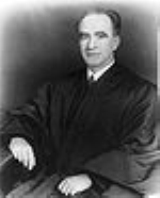
Frank Murphy

Encyclopedia
William Francis Murphy (April 13, 1890 July 19, 1949) was a politician and jurist
from Michigan
. He served as First Assistant U.S. District Attorney, Eastern Michigan District (1920–23), Recorder's Court
Judge, Detroit (1923–30). Mayor of Detroit (1930–33), the last Governor-General of the Philippines
(1933–35), U.S. High Commissioner of the Philippines (1935–36), the 35th Governor of Michigan
(1937–39), United States Attorney General
(1939–40), and United States Supreme Court Associate Justice
(1940–49).
, then known as "Sand Beach", in 1890. His Irish parents, John T. Murphy and Mary Brennan, raised him as a devout Catholic. He followed in his father’s footsteps by becoming a lawyer. He attended the University of Michigan
Law School
, and graduated with a BA in 1912 and LLB in 1914. He was a member of the Sigma Chi Fraternity and the senior society Michigamua
. Murphy was stricken with Diphtheria
in the winter of 1911 but was allowed to begin his course in the Law Department from which he received his LL.B. degree in 1914. He performed graduate work at Lincoln's Inn
in London and Trinity College, Dublin
, which was said to be formative for his judicial philosophy. He developed a need to decide cases based on his more holistic notions of justice, eschewing technical legal arguments. As one commentator wrote of his later supreme court service, he "tempered justice with Murphy."
He served in the U.S. Army during World War I, achieving the rank of Captain with the occupation Army in Germany before leaving the service in 1919.
Murphy opened a private law office in Detroit and soon became the Chief Assistant United States Attorney
for the Eastern District of Michigan. He opened the first civil rights section of a U.S. Attorney's office.
He taught at the University of Detroit for five years.
Murphy served as a Judge in the Detroit Recorder's Court
from 1923 to 1930, and made many administrative reforms in the operations of the court.
While on Recorder's Court, he established a reputation as a trial judge. He was a presiding judge in the famous murder trials of Dr. Ossian Sweet
and his brother, Henry Sweet in 1925 and 1926. Clarence Darrow
, then one of the most prominent trial lawyers in the country, was lead counsel for the defense. After an initial mistrial of all of the black
defendants, Henry Sweet – who admitted that he fired the weapon which killed a member of the mob surrounding Dr. Sweet's home and was retried separately – was acquitted
by an all-white
jury on grounds of the right of self-defense. The prosecution then elected to not prosecute
any of the remaining defendants. Murphy's rulings were material to the outcome of the case.
for the Eastern District of Michigan
on August 9, 1919. He was one of three assistant attorneys in the office.
When Murphy began his career as a federal attorney, the workload of the attorney's office was increasing at a rapid rate, mainly due to the advent of national prohibition
. The government's excellent record in winning convictions in the Eastern District was partially due to Murphy's record of winning all but one of the cases that he prosecuted. Murphy practiced law privately to a limited extent while he was still a federal attorney. He resigned his position as a United States attorney
on March 1, 1922. Murphy had several offers to join private practices but decided to go it alone and formed a partnership with Edward G. Kemp.
for the United States Congress
in 1920, when national and state Republicans
swept Michigan. He drew upon his legal reputation and growing political connections to win a seat on the Recorder's Court
, Detroit's criminal court. In 1923, Murphy was elected judge of the Recorder's Court on a non-partisan ticket by one of the largest majorities ever cast for a judge in Detroit. Murphy took office on January 1, 1924 and served seven years during the Prohibition Era
.
. He presided over an epidemic of urban unemployment, a crisis in which 100,000 people were unemployed in the summer of 1931. He named an unemployment committee of private citizens from businesses, churches, and labor and social service organizations to identify all residents who were unemployed and not receiving welfare benefits. The Mayor’s Unemployment Committee raised funds for its relief effort and worked to distribute food and clothing to the needy, and a Legal Aid Subcommittee volunteered to assist with the legal problems of needy clients. In 1933, Murphy convened in Detroit and organized the first convention of the United States Conference of Mayors
. They met and conferred with President Franklin D. Roosevelt
, and Murphy was elected its first president.
Murphy was an early and enthusiastic supporter of Roosevelt and the New Deal
, helping Roosevelt to become the first Democratic presidential candidate to win the state of Michigan.
Melvin G. Holli rated Murphy an exemplary mayor and highly effective leader.
of the Philippines
.
Murphy demonstrated sympathy for Filipino masses, especially for the land-hungry and oppressed tenant farmer
s, and emphasized the need for social justice.
until 1936. That year he served as a delegate from the Philippine Islands to the Democratic National Convention
.
High Commissioner to the Philippines was the title of the personal representative of the President of the United States to the Commonwealth of the Philippines
during the period 1935–1946. The office was created by the Tydings-McDuffie Act
of 1934, which provided for a period of transition from direct American rule to the complete independence of the islands on July 4, 1946.
incumbent Frank Fitzgerald
, and served one two-year term. During his two years in office, an unemployment compensation system was instituted and mental health programs were improved.
The United Automobile Workers engaged in an historic sit-down strike at the General Motors
' Flint
plant. The Flint Sit-Down Strike
was a turning point in national collective bargaining
and labor policy. After 27 people were injured in a battle between the workers and the police, including 13 strikers with gunshot wounds, Murphy sent the National Guard to protect the workers. The governor didn't follow a court's order requesting him to expel the strikers, and refused to order the guards troops to suppress the strike.
Murphy successfully mediated an agreement and end to the confrontation; G.M. recognized the U.A.W. as bargaining agent under the newly adopted National Labor Relations Act
. This had an effect upon organized labor. In the next year the UAW saw its membership grow from 30,000 to 500,000 members. As later noted by the British Broadcasting System, this strike was "the strike heard round the world."
In 1938, Murphy was defeated by his predecessor, Fitzgerald, who became the only governor from Michigan to succeed and precede the same person.
of the United States Department of Justice
. The section was designed to centralize enforcement responsibility for the Bill of Rights
and civil rights statutes.
. He was confirmed by the United States Senate on January 16 and was sworn in on January 18. The timing of the appointment put Murphy on the cusp of the Charles Evans Hughes
and the Harlan Fiske Stone
courts. Upon the death of Chief Justice
Stone, Murphy served in the court led by Frederick Moore Vinson, who was confirmed in 1946.
Murphy took an expansive view of individual liberties, and the limitations on government he found in the Bill of Rights
.
Murphy authored 199 opinions: 131 majority, 68 in dissent.
Opinions differ about him and his jurisprudential
philosophy. He has been acclaimed as a legal scholar and a champion of the common man. Justice Felix Frankfurter
disparagingly nicknamed Murphy "the Saint", criticizing his decisions as being rooted more in passion than reason. It has been said he was "Neither legal scholar nor craftsman" who was criticized "for relying on heart over head, results over legal reasoning, clerks over hard work, and emotional solos over team play."
Murphy's support of African-Americans, aliens, criminals, dissenters, Jehovah's Witnesses
, Native Americans
, women, workers, and other outsiders evoked a pun: “tempering justice with Murphy.” As he wrote in Falbo v. United States (1944), “The law knows no finer hour than when it cuts through formal concepts and transitory emotions to protect unpopular citizens against discrimination and persecution.” (p. 561)
According to Frankfurter, Murphy was part of the more liberal "Axis" of justices on the Court, along with Justices Rutledge, Douglas, and Black; the group would for years oppose Frankfurter's judicially-restrained ideology. Douglas, Murphy, and then Rutledge were the first justices to agree with Hugo Black
's notion that the Fourteenth Amendment incorporated the Bill of Rights protection into it; this view would later become law.
Murphy is perhaps most well known for his vehement dissent from the court's ruling in Korematsu v. United States
, which upheld the constitutionality of the government's internment of Japanese-Americans
during World War II. Murphy sharply criticized the majority ruling as "legalization of racism."
This was the first time that the word "racism" found its way into the lexicon of words used in Supreme Court opinion (he used it twice in a concurring opinion in Steele v. Louisville & Nashville R. Co. 323 U.S. 192
(1944) issued that same day). He would use that word in five separate opinions. However the word "racism" disappeared with Murphy and from the court for almost two decades, not reappearing until the landmark decision of Loving v. Virginia
, 388 U.S. 1
(1967) which struck down as unconstitutional the Virginia anti-miscegenation statute. See also Jim Crow laws
.
Though Murphy was serving on the Supreme Court during World War II, he still longed to be part of the war effort. Consequently, during recesses of the Court, he served in Fort Benning, Georgia as an infantry officer.
On January 30, 1944, almost exactly one year before Allied liberation of the Auschwitz death camp
on January 27, 1945, Justice Murphy unveiled the formation of the National Committee Against Nazi Persecution and Extermination of the Jews. Serving as committee chair, he stated it was created to combat Nazi propaganda
"breeding the germs of hatred against Jews." The announcement was made on the 11th anniversary of Adolf Hitler
becoming Chancellor
of Germany. The eleven committee members included U.S. Vice President Henry Wallace
, 1940 Republican presidential candidate Wendell Wilkie and Henry St. George Tucker
, Presiding Bishop
of the Protestant Episcopal Church
.
He acted as chairman of the National Committee against Nazi Persecution and Extermination of the Jews and of the Philippine War Relief Committee. The first committee was established in early 1944 to promote rescue of European Jews, and to combat antisemitism in the United States.
during his sleep at Henry Ford Hospital
in Detroit. Over 10,000 people attended his funeral in Detroit. He was engaged to be married in August to Joan Cuddihy.
His remains are interred at Our Lady of Lake Huron Cemetery of Harbor Beach, Michigan
.
The Frank Murphy Hall of Justice was home to Detroit's Recorder's Court
and now houses part of Michigan's Third Judicial Circuit Court
. There is a plaque in his honor on the first floor, which is recognized as a Michigan Legal Milestone.
Outside the Hall of Justice is Carl Milles
's statue "The Hand of God". This rendition was cast in honor of Murphy and financed by the United Automobile Workers. It features a nude figure emerging from the left hand of God. Although commissioned in 1949 and completed by 1953, the work, partly because of the male nudity involved, was kept in storage for a decade and a half. The work was chosen in tribute to Murphy by Walter P. Reuther and Ira W. Jayne
. It was placed on a pedestal in 1970 with the help of sculptor Marshall Fredericks
, who was a Milles student.
Murphy's personal and official files are archived at the Bentley Historical Library
of the University of Michigan
in Ann Arbor
and are open for research. This also includes an oral history project about Murphy. His correspondence and other official documents are deposited in libraries around the country.
In memory of Murphy, one of three University of Michigan Law School
alumni to become a U.S. Supreme Court justice, Washington D.C.-based attorney John H. Pickering
, who was a law clerk
for Murphy, donated a large sum of money to the law school as a remembrance, establishing the Frank Murphy Seminar Room.
Murphy was awarded an Honorary Doctorate of Law degree by the University of Michigan in 1939.
The University of Detroit has a Frank Murphy Honor Society.
The Sweet Trials: Malice Aforethought is a play written by Arthur Beer, based on the trials of Ossian and Henry Sweet, and derived from Kevin Boyle's Arc of Justice.
The Detroit Public Schools
named Frank Murphy Elementary in his honor.
Jurist
A jurist or jurisconsult is a professional who studies, develops, applies, or otherwise deals with the law. The term is widely used in American English, but in the United Kingdom and many Commonwealth countries it has only historical and specialist usage...
from Michigan
Michigan
Michigan is a U.S. state located in the Great Lakes Region of the United States of America. The name Michigan is the French form of the Ojibwa word mishigamaa, meaning "large water" or "large lake"....
. He served as First Assistant U.S. District Attorney, Eastern Michigan District (1920–23), Recorder's Court
Recorder's court
The Recorder's Court, in Detroit, Michigan was a state court of limited jurisdiction which had, for most of its history, exclusive jurisdiction over traffic and ordinance matters, and over all felony cases committed in the City of Detroit...
Judge, Detroit (1923–30). Mayor of Detroit (1930–33), the last Governor-General of the Philippines
Governor-General of the Philippines
The Governor-General of the Philippines was the title of the government executive during the colonial period of the Philippines, governed mainly by Spain and the United States, and briefly by Great Britain, from 1565 to 1935....
(1933–35), U.S. High Commissioner of the Philippines (1935–36), the 35th Governor of Michigan
Governor of Michigan
The Governor of Michigan is the chief executive of the U.S. State of Michigan. The current Governor is Rick Snyder, a member of the Republican Party.-Gubernatorial elections and term of office:...
(1937–39), United States Attorney General
United States Attorney General
The United States Attorney General is the head of the United States Department of Justice concerned with legal affairs and is the chief law enforcement officer of the United States government. The attorney general is considered to be the chief lawyer of the U.S. government...
(1939–40), and United States Supreme Court Associate Justice
Associate Justice of the Supreme Court of the United States
Associate Justices of the Supreme Court of the United States are the members of the Supreme Court of the United States other than the Chief Justice of the United States...
(1940–49).
Early life
Murphy was born in Harbor Beach, MichiganHarbor Beach, Michigan
Harbor Beach is a city in Huron County in the U.S. state of Michigan. The population was 1,837 at the 2000 census, with an estimated population of 1,587 in 2009.-Geography:...
, then known as "Sand Beach", in 1890. His Irish parents, John T. Murphy and Mary Brennan, raised him as a devout Catholic. He followed in his father’s footsteps by becoming a lawyer. He attended the University of Michigan
University of Michigan
The University of Michigan is a public research university located in Ann Arbor, Michigan in the United States. It is the state's oldest university and the flagship campus of the University of Michigan...
Law School
University of Michigan Law School
The University of Michigan Law School is the law school of the University of Michigan, in Ann Arbor. Founded in 1859, the school has an enrollment of about 1,200 students, most of whom are seeking Juris Doctor or Master of Laws degrees, although the school also offers a Doctor of Juridical...
, and graduated with a BA in 1912 and LLB in 1914. He was a member of the Sigma Chi Fraternity and the senior society Michigamua
Michigamua
The Order of Angell is a senior honor society at the University of Michigan. Known for a brief period as the Hot Air Club and subsequently known throughout the remainder of the twentieth century as Michigamua, the organization officially renamed itself the Order of Angell in 2007 in an effort to...
. Murphy was stricken with Diphtheria
Diphtheria
Diphtheria is an upper respiratory tract illness caused by Corynebacterium diphtheriae, a facultative anaerobic, Gram-positive bacterium. It is characterized by sore throat, low fever, and an adherent membrane on the tonsils, pharynx, and/or nasal cavity...
in the winter of 1911 but was allowed to begin his course in the Law Department from which he received his LL.B. degree in 1914. He performed graduate work at Lincoln's Inn
Lincoln's Inn
The Honourable Society of Lincoln's Inn is one of four Inns of Court in London to which barristers of England and Wales belong and where they are called to the Bar. The other three are Middle Temple, Inner Temple and Gray's Inn. Although Lincoln's Inn is able to trace its official records beyond...
in London and Trinity College, Dublin
Trinity College, Dublin
Trinity College, Dublin , formally known as the College of the Holy and Undivided Trinity of Queen Elizabeth near Dublin, was founded in 1592 by letters patent from Queen Elizabeth I as the "mother of a university", Extracts from Letters Patent of Elizabeth I, 1592: "...we...found and...
, which was said to be formative for his judicial philosophy. He developed a need to decide cases based on his more holistic notions of justice, eschewing technical legal arguments. As one commentator wrote of his later supreme court service, he "tempered justice with Murphy."
He served in the U.S. Army during World War I, achieving the rank of Captain with the occupation Army in Germany before leaving the service in 1919.
Murphy opened a private law office in Detroit and soon became the Chief Assistant United States Attorney
United States Attorney
United States Attorneys represent the United States federal government in United States district court and United States court of appeals. There are 93 U.S. Attorneys stationed throughout the United States, Puerto Rico, the U.S. Virgin Islands, Guam, and the Northern Mariana Islands...
for the Eastern District of Michigan. He opened the first civil rights section of a U.S. Attorney's office.
He taught at the University of Detroit for five years.
Murphy served as a Judge in the Detroit Recorder's Court
Recorder's court
The Recorder's Court, in Detroit, Michigan was a state court of limited jurisdiction which had, for most of its history, exclusive jurisdiction over traffic and ordinance matters, and over all felony cases committed in the City of Detroit...
from 1923 to 1930, and made many administrative reforms in the operations of the court.
While on Recorder's Court, he established a reputation as a trial judge. He was a presiding judge in the famous murder trials of Dr. Ossian Sweet
Ossian Sweet
Ossian Sweet was an American physician. He is most notable for his self defense in 1925 of his newly-purchased home in a predominantly white neighborhood against a mob attempting to force him out of the neighborhood in Detroit, Michigan, and the subsequent acquittal by an all-white jury of murder...
and his brother, Henry Sweet in 1925 and 1926. Clarence Darrow
Clarence Darrow
Clarence Seward Darrow was an American lawyer and leading member of the American Civil Liberties Union, best known for defending teenage thrill killers Leopold and Loeb in their trial for murdering 14-year-old Robert "Bobby" Franks and defending John T...
, then one of the most prominent trial lawyers in the country, was lead counsel for the defense. After an initial mistrial of all of the black
Black people
The term black people is used in systems of racial classification for humans of a dark skinned phenotype, relative to other racial groups.Different societies apply different criteria regarding who is classified as "black", and often social variables such as class, socio-economic status also plays a...
defendants, Henry Sweet – who admitted that he fired the weapon which killed a member of the mob surrounding Dr. Sweet's home and was retried separately – was acquitted
Acquittal
In the common law tradition, an acquittal formally certifies the accused is free from the charge of an offense, as far as the criminal law is concerned. This is so even where the prosecution is abandoned nolle prosequi...
by an all-white
White people
White people is a term which usually refers to human beings characterized, at least in part, by the light pigmentation of their skin...
jury on grounds of the right of self-defense. The prosecution then elected to not prosecute
Nolle prosequi
Nolle prosequi is legal term of art and a Latin legal phrase meaning "to be unwilling to pursue", a phrase amounting to "please do not prosecute". It is a phrase used in many common law criminal prosecution contexts to describe a prosecutor's decision to voluntarily discontinue criminal charges...
any of the remaining defendants. Murphy's rulings were material to the outcome of the case.
U.S. Attorney Eastern District of Michigan (1919–1922)
Murphy was appointed and took the oath of office as first assistant United States attorneyUnited States Attorney
United States Attorneys represent the United States federal government in United States district court and United States court of appeals. There are 93 U.S. Attorneys stationed throughout the United States, Puerto Rico, the U.S. Virgin Islands, Guam, and the Northern Mariana Islands...
for the Eastern District of Michigan
United States District Court for the Eastern District of Michigan
The United States District Court for the Eastern District of Michigan is the Federal district court with jurisdiction over of the eastern portion of the state of Michigan. The Court is based in Detroit, with courthouses also located in Ann Arbor, Bay City, Flint, and Port Huron...
on August 9, 1919. He was one of three assistant attorneys in the office.
When Murphy began his career as a federal attorney, the workload of the attorney's office was increasing at a rapid rate, mainly due to the advent of national prohibition
Prohibition
Prohibition of alcohol, often referred to simply as prohibition, is the practice of prohibiting the manufacture, transportation, import, export, sale, and consumption of alcohol and alcoholic beverages. The term can also apply to the periods in the histories of the countries during which the...
. The government's excellent record in winning convictions in the Eastern District was partially due to Murphy's record of winning all but one of the cases that he prosecuted. Murphy practiced law privately to a limited extent while he was still a federal attorney. He resigned his position as a United States attorney
United States Attorney
United States Attorneys represent the United States federal government in United States district court and United States court of appeals. There are 93 U.S. Attorneys stationed throughout the United States, Puerto Rico, the U.S. Virgin Islands, Guam, and the Northern Mariana Islands...
on March 1, 1922. Murphy had several offers to join private practices but decided to go it alone and formed a partnership with Edward G. Kemp.
Recorder's Court (1923–1930)
He ran unsuccessfully as a DemocratDemocratic Party (United States)
The Democratic Party is one of two major contemporary political parties in the United States, along with the Republican Party. The party's socially liberal and progressive platform is largely considered center-left in the U.S. political spectrum. The party has the lengthiest record of continuous...
for the United States Congress
United States Congress
The United States Congress is the bicameral legislature of the federal government of the United States, consisting of the Senate and the House of Representatives. The Congress meets in the United States Capitol in Washington, D.C....
in 1920, when national and state Republicans
Republican Party (United States)
The Republican Party is one of the two major contemporary political parties in the United States, along with the Democratic Party. Founded by anti-slavery expansion activists in 1854, it is often called the GOP . The party's platform generally reflects American conservatism in the U.S...
swept Michigan. He drew upon his legal reputation and growing political connections to win a seat on the Recorder's Court
Recorder's court
The Recorder's Court, in Detroit, Michigan was a state court of limited jurisdiction which had, for most of its history, exclusive jurisdiction over traffic and ordinance matters, and over all felony cases committed in the City of Detroit...
, Detroit's criminal court. In 1923, Murphy was elected judge of the Recorder's Court on a non-partisan ticket by one of the largest majorities ever cast for a judge in Detroit. Murphy took office on January 1, 1924 and served seven years during the Prohibition Era
Prohibition in the United States
Prohibition in the United States was a national ban on the sale, manufacture, and transportation of alcohol, in place from 1920 to 1933. The ban was mandated by the Eighteenth Amendment to the Constitution, and the Volstead Act set down the rules for enforcing the ban, as well as defining which...
.
Mayor of Detroit (1930–1933)
In 1930, Murphy ran as a Democrat and was elected Mayor of Detroit. He served from 1930 to 1933, during the first years of the Great DepressionGreat Depression
The Great Depression was a severe worldwide economic depression in the decade preceding World War II. The timing of the Great Depression varied across nations, but in most countries it started in about 1929 and lasted until the late 1930s or early 1940s...
. He presided over an epidemic of urban unemployment, a crisis in which 100,000 people were unemployed in the summer of 1931. He named an unemployment committee of private citizens from businesses, churches, and labor and social service organizations to identify all residents who were unemployed and not receiving welfare benefits. The Mayor’s Unemployment Committee raised funds for its relief effort and worked to distribute food and clothing to the needy, and a Legal Aid Subcommittee volunteered to assist with the legal problems of needy clients. In 1933, Murphy convened in Detroit and organized the first convention of the United States Conference of Mayors
United States Conference of Mayors
United States Conference of Mayors, sometimes referred to as the United States Council of Mayors, is the official non-partisan organization for cities with populations of 30,000 or more. The cities are each represented by their mayor or other chief elected official...
. They met and conferred with President Franklin D. Roosevelt
Franklin D. Roosevelt
Franklin Delano Roosevelt , also known by his initials, FDR, was the 32nd President of the United States and a central figure in world events during the mid-20th century, leading the United States during a time of worldwide economic crisis and world war...
, and Murphy was elected its first president.
Murphy was an early and enthusiastic supporter of Roosevelt and the New Deal
New Deal
The New Deal was a series of economic programs implemented in the United States between 1933 and 1936. They were passed by the U.S. Congress during the first term of President Franklin D. Roosevelt. The programs were Roosevelt's responses to the Great Depression, and focused on what historians call...
, helping Roosevelt to become the first Democratic presidential candidate to win the state of Michigan.
Melvin G. Holli rated Murphy an exemplary mayor and highly effective leader.
Governor-General of the Philippines (1933–1935)
By 1933, after Murphy’s second mayoral term, the reward of a big government job was waiting. Roosevelt appointed Murphy as Governor-GeneralGovernor-General
A Governor-General, is a vice-regal person of a monarch in an independent realm or a major colonial circonscription. Depending on the political arrangement of the territory, a Governor General can be a governor of high rank, or a principal governor ranking above "ordinary" governors.- Current uses...
of the Philippines
Philippines
The Philippines , officially known as the Republic of the Philippines , is a country in Southeast Asia in the western Pacific Ocean. To its north across the Luzon Strait lies Taiwan. West across the South China Sea sits Vietnam...
.
Murphy demonstrated sympathy for Filipino masses, especially for the land-hungry and oppressed tenant farmer
Tenant farmer
A tenant farmer is one who resides on and farms land owned by a landlord. Tenant farming is an agricultural production system in which landowners contribute their land and often a measure of operating capital and management; while tenant farmers contribute their labor along with at times varying...
s, and emphasized the need for social justice.
High Commissioner to the Philippines (1935–1936)
When his position as Governor-General was abolished in 1935, he stayed on as United States High CommissionerHigh Commissioner to the Philippines
High Commissioner to the Philippines was the title of the personal representative of the President of the United States to the Commonwealth of the Philippines during the period 1935-1946. The office was created by the Tydings-McDuffie Act of 1934, which provided for a period of transition from...
until 1936. That year he served as a delegate from the Philippine Islands to the Democratic National Convention
Democratic National Convention
The Democratic National Convention is a series of presidential nominating conventions held every four years since 1832 by the United States Democratic Party. They have been administered by the Democratic National Committee since the 1852 national convention...
.
High Commissioner to the Philippines was the title of the personal representative of the President of the United States to the Commonwealth of the Philippines
Commonwealth of the Philippines
The Commonwealth of the Philippines was a designation of the Philippines from 1935 to 1946 when the country was a commonwealth of the United States. The Commonwealth was created by the Tydings-McDuffie Act, which was passed by the U.S. Congress in 1934. When Manuel L...
during the period 1935–1946. The office was created by the Tydings-McDuffie Act
Tydings-McDuffie Act
The Tydings-McDuffie Act approved on March 24, 1934 was a United States federal law which provided for self-government of the Philippines and for Filipino independence after a period of ten years. It was authored by Maryland Senator Millard E...
of 1934, which provided for a period of transition from direct American rule to the complete independence of the islands on July 4, 1946.
Governor of Michigan (1937–1939)
Murphy was elected the 35th Governor of Michigan on November 3, 1936, defeating RepublicanRepublican Party (United States)
The Republican Party is one of the two major contemporary political parties in the United States, along with the Democratic Party. Founded by anti-slavery expansion activists in 1854, it is often called the GOP . The party's platform generally reflects American conservatism in the U.S...
incumbent Frank Fitzgerald
Frank Fitzgerald
Frank Dwight Fitzgerald was an American politician. He was elected as the 34th and 36th Governor of Michigan and was the only Michigan governor to die in office.-Early life:...
, and served one two-year term. During his two years in office, an unemployment compensation system was instituted and mental health programs were improved.
The United Automobile Workers engaged in an historic sit-down strike at the General Motors
General Motors
General Motors Company , commonly known as GM, formerly incorporated as General Motors Corporation, is an American multinational automotive corporation headquartered in Detroit, Michigan and the world's second-largest automaker in 2010...
' Flint
Flint, Michigan
Flint is a city in the U.S. state of Michigan and is located along the Flint River, northwest of Detroit. The U.S. Census Bureau reports the 2010 population to be placed at 102,434, making Flint the seventh largest city in Michigan. It is the county seat of Genesee County which lies in the...
plant. The Flint Sit-Down Strike
Flint Sit-Down Strike
The 1936–1937 Flint Sit-Down Strike changed the United Automobile Workers from a collection of isolated locals on the fringes of the industry into a major labor union and led to the unionization of the domestic United States automobile industry....
was a turning point in national collective bargaining
Collective bargaining
Collective bargaining is a process of negotiations between employers and the representatives of a unit of employees aimed at reaching agreements that regulate working conditions...
and labor policy. After 27 people were injured in a battle between the workers and the police, including 13 strikers with gunshot wounds, Murphy sent the National Guard to protect the workers. The governor didn't follow a court's order requesting him to expel the strikers, and refused to order the guards troops to suppress the strike.
Murphy successfully mediated an agreement and end to the confrontation; G.M. recognized the U.A.W. as bargaining agent under the newly adopted National Labor Relations Act
National Labor Relations Act
The National Labor Relations Act or Wagner Act , is a 1935 United States federal law that limits the means with which employers may react to workers in the private sector who create labor unions , engage in collective bargaining, and take part in strikes and other forms of concerted activity in...
. This had an effect upon organized labor. In the next year the UAW saw its membership grow from 30,000 to 500,000 members. As later noted by the British Broadcasting System, this strike was "the strike heard round the world."
In 1938, Murphy was defeated by his predecessor, Fitzgerald, who became the only governor from Michigan to succeed and precede the same person.
Attorney General of the United States (1939–1940)
In 1939, Roosevelt appointed Murphy the 56th Attorney General of the United States. Murphy established a Civil Liberties Section in the Criminal DivisionUnited States Department of Justice Criminal Division
The U.S. Department of Justice Criminal Division develops, enforces, and supervises the application of all federal criminal laws in the United States, except those specifically assigned to other divisions. Criminal Division attorneys prosecute many nationally significant cases and formulate and...
of the United States Department of Justice
United States Department of Justice
The United States Department of Justice , is the United States federal executive department responsible for the enforcement of the law and administration of justice, equivalent to the justice or interior ministries of other countries.The Department is led by the Attorney General, who is nominated...
. The section was designed to centralize enforcement responsibility for the Bill of Rights
Bill of rights
A bill of rights is a list of the most important rights of the citizens of a country. The purpose of these bills is to protect those rights against infringement. The term "bill of rights" originates from England, where it referred to the Bill of Rights 1689. Bills of rights may be entrenched or...
and civil rights statutes.
Supreme Court
After a year as Attorney General, on January 4, 1940, Murphy was nominated by Roosevelt to be an Associate Justice of the Supreme Court, filling a seat vacated by Pierce ButlerPierce Butler
Pierce Butler was a soldier, planter, and statesman, recognized as one of United States' Founding Fathers. He represented South Carolina in the Continental Congress, the 1787 Constitutional Convention, and the U.S. Senate...
. He was confirmed by the United States Senate on January 16 and was sworn in on January 18. The timing of the appointment put Murphy on the cusp of the Charles Evans Hughes
Charles Evans Hughes
Charles Evans Hughes, Sr. was an American statesman, lawyer and Republican politician from New York. He served as the 36th Governor of New York , Associate Justice of the Supreme Court of the United States , United States Secretary of State , a judge on the Court of International Justice , and...
and the Harlan Fiske Stone
Harlan Fiske Stone
Harlan Fiske Stone was an American lawyer and jurist. A native of New Hampshire, he served as the dean of Columbia Law School, his alma mater, in the early 20th century. As a member of the Republican Party, he was appointed as the 52nd Attorney General of the United States before becoming an...
courts. Upon the death of Chief Justice
Chief Justice
The Chief Justice in many countries is the name for the presiding member of a Supreme Court in Commonwealth or other countries with an Anglo-Saxon justice system based on English common law, such as the Supreme Court of Canada, the Constitutional Court of South Africa, the Court of Final Appeal of...
Stone, Murphy served in the court led by Frederick Moore Vinson, who was confirmed in 1946.
Murphy took an expansive view of individual liberties, and the limitations on government he found in the Bill of Rights
United States Bill of Rights
The Bill of Rights is the collective name for the first ten amendments to the United States Constitution. These limitations serve to protect the natural rights of liberty and property. They guarantee a number of personal freedoms, limit the government's power in judicial and other proceedings, and...
.
Murphy authored 199 opinions: 131 majority, 68 in dissent.
Opinions differ about him and his jurisprudential
Jurisprudence
Jurisprudence is the theory and philosophy of law. Scholars of jurisprudence, or legal theorists , hope to obtain a deeper understanding of the nature of law, of legal reasoning, legal systems and of legal institutions...
philosophy. He has been acclaimed as a legal scholar and a champion of the common man. Justice Felix Frankfurter
Felix Frankfurter
Felix Frankfurter was an Associate Justice of the United States Supreme Court.-Early life:Frankfurter was born into a Jewish family on November 15, 1882, in Vienna, Austria, then part of the Austro-Hungarian Empire in Europe. He was the third of six children of Leopold and Emma Frankfurter...
disparagingly nicknamed Murphy "the Saint", criticizing his decisions as being rooted more in passion than reason. It has been said he was "Neither legal scholar nor craftsman" who was criticized "for relying on heart over head, results over legal reasoning, clerks over hard work, and emotional solos over team play."
Murphy's support of African-Americans, aliens, criminals, dissenters, Jehovah's Witnesses
Jehovah's Witnesses
Jehovah's Witnesses is a millenarian restorationist Christian denomination with nontrinitarian beliefs distinct from mainstream Christianity. The religion reports worldwide membership of over 7 million adherents involved in evangelism, convention attendance of over 12 million, and annual...
, Native Americans
Indigenous peoples of the Americas
The indigenous peoples of the Americas are the pre-Columbian inhabitants of North and South America, their descendants and other ethnic groups who are identified with those peoples. Indigenous peoples are known in Canada as Aboriginal peoples, and in the United States as Native Americans...
, women, workers, and other outsiders evoked a pun: “tempering justice with Murphy.” As he wrote in Falbo v. United States (1944), “The law knows no finer hour than when it cuts through formal concepts and transitory emotions to protect unpopular citizens against discrimination and persecution.” (p. 561)
According to Frankfurter, Murphy was part of the more liberal "Axis" of justices on the Court, along with Justices Rutledge, Douglas, and Black; the group would for years oppose Frankfurter's judicially-restrained ideology. Douglas, Murphy, and then Rutledge were the first justices to agree with Hugo Black
Hugo Black
Hugo Lafayette Black was an American politician and jurist. A member of the Democratic Party, Black represented Alabama in the United States Senate from 1927 to 1937, and served as an Associate Justice of the Supreme Court of the United States from 1937 to 1971. Black was nominated to the Supreme...
's notion that the Fourteenth Amendment incorporated the Bill of Rights protection into it; this view would later become law.
Murphy is perhaps most well known for his vehement dissent from the court's ruling in Korematsu v. United States
Korematsu v. United States
Korematsu v. United States, 323 U.S. 214 , was a landmark United States Supreme Court case concerning the constitutionality of Executive Order 9066, which ordered Japanese Americans into internment camps during World War II....
, which upheld the constitutionality of the government's internment of Japanese-Americans
Japanese American internment
Japanese-American internment was the relocation and internment by the United States government in 1942 of approximately 110,000 Japanese Americans and Japanese who lived along the Pacific coast of the United States to camps called "War Relocation Camps," in the wake of Imperial Japan's attack on...
during World War II. Murphy sharply criticized the majority ruling as "legalization of racism."
This was the first time that the word "racism" found its way into the lexicon of words used in Supreme Court opinion (he used it twice in a concurring opinion in Steele v. Louisville & Nashville R. Co. 323 U.S. 192
Case citation
Case citation is the system used in many countries to identify the decisions in past court cases, either in special series of books called reporters or law reports, or in a 'neutral' form which will identify a decision wherever it was reported...
(1944) issued that same day). He would use that word in five separate opinions. However the word "racism" disappeared with Murphy and from the court for almost two decades, not reappearing until the landmark decision of Loving v. Virginia
Loving v. Virginia
Loving v. Virginia, , was a landmark civil rights case in which the United States Supreme Court, in a unanimous decision, declared Virginia's anti-miscegenation statute, the "Racial Integrity Act of 1924", unconstitutional, thereby overturning Pace v...
, 388 U.S. 1
Case citation
Case citation is the system used in many countries to identify the decisions in past court cases, either in special series of books called reporters or law reports, or in a 'neutral' form which will identify a decision wherever it was reported...
(1967) which struck down as unconstitutional the Virginia anti-miscegenation statute. See also Jim Crow laws
Jim Crow laws
The Jim Crow laws were state and local laws in the United States enacted between 1876 and 1965. They mandated de jure racial segregation in all public facilities, with a supposedly "separate but equal" status for black Americans...
.
Though Murphy was serving on the Supreme Court during World War II, he still longed to be part of the war effort. Consequently, during recesses of the Court, he served in Fort Benning, Georgia as an infantry officer.
On January 30, 1944, almost exactly one year before Allied liberation of the Auschwitz death camp
Auschwitz concentration camp
Concentration camp Auschwitz was a network of Nazi concentration and extermination camps built and operated by the Third Reich in Polish areas annexed by Nazi Germany during World War II...
on January 27, 1945, Justice Murphy unveiled the formation of the National Committee Against Nazi Persecution and Extermination of the Jews. Serving as committee chair, he stated it was created to combat Nazi propaganda
Nazi propaganda
Propaganda, the coordinated attempt to influence public opinion through the use of media, was skillfully used by the NSDAP in the years leading up to and during Adolf Hitler's leadership of Germany...
"breeding the germs of hatred against Jews." The announcement was made on the 11th anniversary of Adolf Hitler
Adolf Hitler
Adolf Hitler was an Austrian-born German politician and the leader of the National Socialist German Workers Party , commonly referred to as the Nazi Party). He was Chancellor of Germany from 1933 to 1945, and head of state from 1934 to 1945...
becoming Chancellor
Chancellor
Chancellor is the title of various official positions in the governments of many nations. The original chancellors were the Cancellarii of Roman courts of justice—ushers who sat at the cancelli or lattice work screens of a basilica or law court, which separated the judge and counsel from the...
of Germany. The eleven committee members included U.S. Vice President Henry Wallace
Henry A. Wallace
Henry Agard Wallace was the 33rd Vice President of the United States , the Secretary of Agriculture , and the Secretary of Commerce . In the 1948 presidential election, Wallace was the nominee of the Progressive Party.-Early life:Henry A...
, 1940 Republican presidential candidate Wendell Wilkie and Henry St. George Tucker
Henry St. George Tucker (bishop)
Henry St. George Tucker , the 19th Presiding Bishop of the Episcopal Church, was an Episcopal priest and bishop. His parents were Beverley Dandridge Tucker and Anna Maria Washington and is descended from St. George Tucker of Williamsburg. In the earlier part of his career, he went as a...
, Presiding Bishop
Presiding Bishop
The Presiding Bishop is an ecclesiastical position in some denominations of Christianity.- Evangelical Lutheran Church in America :The Presiding Bishop of the Evangelical Lutheran Church in America is the chief ecumenical officer of the church, and the leader and caretaker for the bishops of the...
of the Protestant Episcopal Church
Episcopal Church (United States)
The Episcopal Church is a mainline Anglican Christian church found mainly in the United States , but also in Honduras, Taiwan, Colombia, Ecuador, Haiti, the Dominican Republic, Venezuela, the British Virgin Islands and parts of Europe...
.
He acted as chairman of the National Committee against Nazi Persecution and Extermination of the Jews and of the Philippine War Relief Committee. The first committee was established in early 1944 to promote rescue of European Jews, and to combat antisemitism in the United States.
Death and legacy
Murphy died at fifty-nine of coronary thrombosisCoronary thrombosis
Coronary thrombosis is a form of thrombosis affecting the coronary circulation. It is associated with stenosis subsequent to clotting. The condition is considered as a type of ischaemic heart disease.It can lead to a myocardial infarction...
during his sleep at Henry Ford Hospital
Henry Ford Hospital
Henry Ford Hospital, the flagship facility for , is an 805-bed tertiary care hospital, education and research complex located in Detroit ....
in Detroit. Over 10,000 people attended his funeral in Detroit. He was engaged to be married in August to Joan Cuddihy.
His remains are interred at Our Lady of Lake Huron Cemetery of Harbor Beach, Michigan
Harbor Beach, Michigan
Harbor Beach is a city in Huron County in the U.S. state of Michigan. The population was 1,837 at the 2000 census, with an estimated population of 1,587 in 2009.-Geography:...
.
The Frank Murphy Hall of Justice was home to Detroit's Recorder's Court
Recorder's court
The Recorder's Court, in Detroit, Michigan was a state court of limited jurisdiction which had, for most of its history, exclusive jurisdiction over traffic and ordinance matters, and over all felony cases committed in the City of Detroit...
and now houses part of Michigan's Third Judicial Circuit Court
Circuit court
Circuit court is the name of court systems in several common law jurisdictions.-History:King Henry II instituted the custom of having judges ride around the countryside each year to hear appeals, rather than forcing everyone to bring their appeals to London...
. There is a plaque in his honor on the first floor, which is recognized as a Michigan Legal Milestone.
Outside the Hall of Justice is Carl Milles
Carl Milles
Carl Milles was a Swedish sculptor, best known for his fountains. He was married to artist Olga Milles and brother to Ruth Milles and half brother to the architect Evert Milles...
's statue "The Hand of God". This rendition was cast in honor of Murphy and financed by the United Automobile Workers. It features a nude figure emerging from the left hand of God. Although commissioned in 1949 and completed by 1953, the work, partly because of the male nudity involved, was kept in storage for a decade and a half. The work was chosen in tribute to Murphy by Walter P. Reuther and Ira W. Jayne
Ira W. Jayne
Ira Waite Jayne was elected to the Wayne County, Michigan Circuit Court bench in 1915 and served as Chief Judge for 27 years of his 37 years working for the court. He graduated from the University of Michigan in 1905. He was the attorney for The Society for Prevention of Cruelty to Children in...
. It was placed on a pedestal in 1970 with the help of sculptor Marshall Fredericks
Marshall Fredericks
Marshall Maynard Fredericks was an American sculptor.-Biography:Fredericks was born of Scandinavian heritage in Rock Island, Illinois on January 31, 1908. His family moved to Florida for a short time and then settled in Cleveland, Ohio, where he grew up...
, who was a Milles student.
Murphy's personal and official files are archived at the Bentley Historical Library
Bentley Historical Library
The Bentley Historical Library is a historical library located on the University of Michigan's North Campus in Ann Arbor. It was established in 1935 by the regents of the University of Michigan...
of the University of Michigan
University of Michigan
The University of Michigan is a public research university located in Ann Arbor, Michigan in the United States. It is the state's oldest university and the flagship campus of the University of Michigan...
in Ann Arbor
Ann Arbor, Michigan
Ann Arbor is a city in the U.S. state of Michigan and the county seat of Washtenaw County. The 2010 census places the population at 113,934, making it the sixth largest city in Michigan. The Ann Arbor Metropolitan Statistical Area had a population of 344,791 as of 2010...
and are open for research. This also includes an oral history project about Murphy. His correspondence and other official documents are deposited in libraries around the country.
In memory of Murphy, one of three University of Michigan Law School
University of Michigan Law School
The University of Michigan Law School is the law school of the University of Michigan, in Ann Arbor. Founded in 1859, the school has an enrollment of about 1,200 students, most of whom are seeking Juris Doctor or Master of Laws degrees, although the school also offers a Doctor of Juridical...
alumni to become a U.S. Supreme Court justice, Washington D.C.-based attorney John H. Pickering
John H. Pickering
John H. Pickering was a founding partner of Wilmer, Cutler & Pickering, which became one of Washington D.C.'s most prominent law firms. He was best known for his role as an appellate lawyer in cases with national significance...
, who was a law clerk
Law clerk
A law clerk or a judicial clerk is a person who provides assistance to a judge in researching issues before the court and in writing opinions. Law clerks are not court clerks or courtroom deputies, who are administrative staff for the court. Most law clerks are recent law school graduates who...
for Murphy, donated a large sum of money to the law school as a remembrance, establishing the Frank Murphy Seminar Room.
Murphy was awarded an Honorary Doctorate of Law degree by the University of Michigan in 1939.
The University of Detroit has a Frank Murphy Honor Society.
The Sweet Trials: Malice Aforethought is a play written by Arthur Beer, based on the trials of Ossian and Henry Sweet, and derived from Kevin Boyle's Arc of Justice.
The Detroit Public Schools
Detroit Public Schools
Detroit Public Schools is a school district that covers all of the city of Detroit, Michigan, United States. The student population of the Detroit Public Schools is about 65,971 , which is down about 9.7% from the previous school year. Detroit Public Charter Schools educate an additional 56,000...
named Frank Murphy Elementary in his honor.
General
This and a number of other books on Murphy by Fine are part of a list of 50 "essential" Michigan history books selected by noted historians.- Howard, J. Woodford, Mr. Justice Murphy: A Political Biography. (Princeton, N.J.: Princeton University Press, 1968).
Further reading
- Frank Murphy, American National BiographyAmerican National BiographyThe American National Biography is a 24 volume biographical encyclopedia set containing approximately 17,400 entries and 20 million words, first published in 1999 by Oxford University Press under the auspices of the American Council of Learned Societies. A 400-entry supplement appeared in 2002...
. - Ariens, Michael, Supreme Court Justices, Frank Murphy (1890–1949).
- Arnold, Thurman Wesley. "Mr. Justice Murphy." 63 Harvard Law ReviewHarvard Law ReviewThe Harvard Law Review is a journal of legal scholarship published by an independent student group at Harvard Law School.-Overview:According to the 2008 Journal Citation Reports, the Review is the most cited law review and has the second-highest impact factor in the category "law" after the...
289 (1949). - Bak, Richard, "(Frank) Murphy's Law", Hour Detroit, September 2008.
- Baulch, Vivian M. and Zacharias, Patricia, Rearview Mirror, The Historic 1936–37 Flint Auto Plant Strike, The Detroit NewsThe Detroit NewsThe Detroit News is one of the two major newspapers in the U.S. city of Detroit, Michigan. The paper began in 1873, when it rented space in the rival Free Press's building. The News absorbed the Detroit Tribune on February 1, 1919, the Detroit Journal on July 21, 1922, and on November 7, 1960,...
. - Barnet, Vincent M., Jr. "Mr. Justice Murphy, Civil LibertiesCivil libertiesCivil liberties are rights and freedoms that provide an individual specific rights such as the freedom from slavery and forced labour, freedom from torture and death, the right to liberty and security, right to a fair trial, the right to defend one's self, the right to own and bear arms, the right...
and the Holmes'Oliver Wendell Holmes, Jr.Oliver Wendell Holmes, Jr. was an American jurist who served as an Associate Justice of the Supreme Court of the United States from 1902 to 1932...
Tradition." 32 Cornell Law Quarterly 177 (1946). - Bibliography and Biography, William Francis "Frank" Murphy, 6th Circuit United States Court of AppealsUnited States court of appealsThe United States courts of appeals are the intermediate appellate courts of the United States federal court system...
. - Biographical Dictionary of the Federal Judiciary. Detroit: Gale Research, 1976.
- Black, Hugo L., "Mr. Justice Murphy." 48 Michigan Law ReviewMichigan Law ReviewThe Michigan Law Review is an American law reviews established in 1902, after Gustavus Ohlinger, a student in the Law Department of the University of Michigan, approached the Dean with a proposal for a law journal. The Michigan Law Review was originally intended as a forum in which the faculty of...
739 (1950). - "Frank Murphy, Dictionary of American BiographyDictionary of American BiographyThe Dictionary of American Biography was published in New York City by Charles Scribner's Sons under the auspices of the American Council of Learned Societies. The first edition was published in 20 volumes from 1928 to 1936. These 20 volumes contained 15,000 biographies...
. - Fine, SidneySidney Fine (historian)Sidney Fine was a professor of history at the University of Michigan. He authored many books on Frank Murphy, who served successively as mayor of Detroit, governor of Michigan, U.S. attorney general and associate justice of the U.S. Supreme Court. He was a Guggenheim Fellow and twice the winner...
, Frank Murphy, Michigan's 35th Governor, Archives of Michigan. - Fine, Sidney, Frank Murphy in World War I. (Ann Arbor: Michigan Historical Collections, 1968) Photos, 44 pp.
- Friend, Theodore, Between Two Empires: The Ordeal of the Philippines, 1929–1946 (1965).
- Hall, Kermit L. (2005) "Murphy, Frank." The Oxford Companion to the Supreme Court of the United States. Oxford Oxfordshire: Oxford University Press 1150 pp. ISBN 978-0-641-99779-2; ISBN 978-0-641-99779-2.
- Howard, J. Woodford, Jr., Mr. Justice Murphy: A Political Biography (Princeton, New Jersey: Princeton University PressPrinceton University Press-Further reading:* "". Artforum International, 2005.-External links:* * * * *...
: 1968). - Lopez, Ian F. Haney, A nation of minorities: race, ethnicity, and reactionary colorblindness, Stanford Law ReviewStanford Law ReviewThe Stanford Law Review is a legal journal produced independently by Stanford Law School students. The journal was established in 1948 with future U.S. Secretary of State Warren Christopher as its first president...
, February 1, 2007. - Lunt, Richard D., The High Ministry of Government: The Political Career of Frank Murphy (Detroit: Wayne State UniversityWayne State UniversityWayne State University is a public research university located in Detroit, Michigan, United States, in the city's Midtown Cultural Center Historic District. Founded in 1868, WSU consists of 13 schools and colleges offering more than 400 major subject areas to over 32,000 graduate and...
Press, 1965) (PhD diss. University of New Mexico). - Marshall, ThurgoodThurgood MarshallThurgood Marshall was an Associate Justice of the United States Supreme Court, serving from October 1967 until October 1991...
. "Mr. Justice Murphy and Civil RightsCivil rightsCivil and political rights are a class of rights that protect individuals' freedom from unwarranted infringement by governments and private organizations, and ensure one's ability to participate in the civil and political life of the state without discrimination or repression.Civil rights include...
." 48 Michigan Law ReviewMichigan Law ReviewThe Michigan Law Review is an American law reviews established in 1902, after Gustavus Ohlinger, a student in the Law Department of the University of Michigan, approached the Dean with a proposal for a law journal. The Michigan Law Review was originally intended as a forum in which the faculty of...
745 (1950). - Maveal, Gary, "Michigan Lawyers in History – Justice Frank Murphy, Michigan’s Leading Citizen," 79 Michigan Bar Journal 368 (March 2000).
- Nawrocki, Dennis Alan, Art in Detroit Public Places, (Detroit: Wayne State University PressWayne State University PressWayne State University Press , founded in 1941, is a university press that is part of Wayne State University. It publishes under its own name and also the imprints Painted Turtle and Great Lakes Books....
, 1980). pg. 63, biographical material on Frank Murphy. - Norris, Harold, Mr. Justice Murphy and the Bill of Rights. (Dobbs Ferry, NY: Oceana Publications, Inc., 1965).
- Ossian Sweet Murder Trial Scrapbook, 1925. Scrapbook and photocopy of the November 1925 murder trial of Ossian Sweet. Clarke Historical Library, Central Michigan UniversityCentral Michigan UniversityCentral Michigan University is a public research university located in Mount Pleasant in the U.S. state of Michigan...
. - Roche, John P. "Mr. Justice Murphy", Mr. Justice, Dunham, Allison and Kurland, Philip B., eds., 281–317. (Chicago: University of Chicago Press, 1956, rev. ed. 1964).
- St. Antoine, Theodore J.Theodore J. St. AntoineTheodore J. St. Antoine is an American lawyer and legal scholar. He has served on the faculty of the University of Michigan Law School since 1965 and is currently the James E. and Sarah A. Degan Professor Emeritus of Law at the school. St. Antoine served as dean of the Law School from 1971 to...
, Justice Frank Murphy and American labor law, Michigan Law ReviewMichigan Law ReviewThe Michigan Law Review is an American law reviews established in 1902, after Gustavus Ohlinger, a student in the Law Department of the University of Michigan, approached the Dean with a proposal for a law journal. The Michigan Law Review was originally intended as a forum in which the faculty of...
(100 MLR 1900, June 1, 2002). - Toms, Robert, Speech on the Sweet murder trials upon retirement of the prosecuting attorney in 1960, Clarke Historical Library, Central Michigan University...
External links
- Frank Murphy quotations a few at "Brainy Quote".
- Gubernatorial photographic portrait of Frank Murphy, Michigan archives.
- National Governors AssociationNational Governors AssociationThe National Governors Association , founded in 1908 as the National Governors' Conference, is funded primarily by state dues, federal grants and contracts and private contributions. NGA represents the governors of the fifty U.S. states and five U.S. territories The National Governors Association...
, Frank Murphy Biography. - Photograph, Franklin Roosevelt, Eleanor Roosevelt and Frank Murphy, Virtual Detroit, The Detroit NewsThe Detroit NewsThe Detroit News is one of the two major newspapers in the U.S. city of Detroit, Michigan. The paper began in 1873, when it rented space in the rival Free Press's building. The News absorbed the Detroit Tribune on February 1, 1919, the Detroit Journal on July 21, 1922, and on November 7, 1960,...
. - Political Graveyard, Frank Murphy.
- The Sweet Trials University of Detroit MercyUniversity of Detroit MercyUniversity of Detroit Mercy is a private, Roman Catholic co-educational university in Detroit, Michigan, United States, affiliated with the Society of Jesus and the Sisters of Mercy. Antoine M. Garibaldi is the president. With origins dating from 1877, it is the largest Roman Catholic university...
. - The Sweet Trials home page, Famous American Trials, University of MissouriUniversity of MissouriThe University of Missouri System is a state university system providing centralized administration for four universities, a health care system, an extension program, five research and technology parks, and a publishing press. More than 64,000 students are currently enrolled at its four campuses...
, Kansas City. - Time Magazine cover, Frank Murphy, August 28, 1939.
- United States Conference of MayorsUnited States Conference of MayorsUnited States Conference of Mayors, sometimes referred to as the United States Council of Mayors, is the official non-partisan organization for cities with populations of 30,000 or more. The cities are each represented by their mayor or other chief elected official...
on Frank Murphy - United States Department of JusticeUnited States Department of JusticeThe United States Department of Justice , is the United States federal executive department responsible for the enforcement of the law and administration of justice, equivalent to the justice or interior ministries of other countries.The Department is led by the Attorney General, who is nominated...
, Biographies of U.S. Attorneys General, Frank Murphy.