


Khorugv

Encyclopedia
Khorúgv is a religious banner used liturgically in the Eastern Catholic and Eastern Orthodox
Churches.
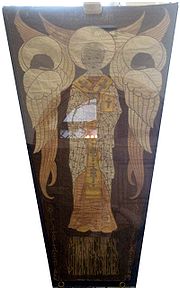
The khorugv or banner consists of an icon
of Christ, the Theotokos
or a saint
, either painted or embroidered on a rectangular piece of cloth. The cloth will often be pointed, swallow-tailed, or have several streamers coming down from it. The banner will often have two or three tails on it, each terminating in a tassel, and may be fringed around the edges. It is suspended from a crossbar which is attached horizontally to a long vertical pole (see the article Gonfalon for a picture). The finial
at the top of the pole will usually be a cross. More rarely, banners can also be made of metalwork, or carved out of wood.
Banners are carried in a religious procession
known as Holy Cross Processions (Russian
: крестный ход, krestny khod), and when not being carried are usually displayed in the church.
 The first ensign used by the Christian Church was the labarum
of the Roman Emperor Saint Constantine I
. In the year 312
, on the eve of the Battle of the Milvian Bridge, he saw a vision of the Cross of Christ appear in the sky, and beneath it the words, Έν τούτω νίκα
(En touto nika, "In this, be victorious"). Constantine ordered the symbol of the Cross to be placed on the imperial standards. He was victorious in the battle, and as a result legalized the practice of Christianity in the empire, and was himself baptized
before his death.
Constantine's victory was seen by Christians not only as a military victory, but as a victory of Christ over those who would persecute the new faith. After this point, we begin to see in Christian art the Greek letters IC (Jesus) XC (Christ) NIKA (Victory) added to depictions of the cross. The meaning is that, through the cross, Jesus Christ is victorious over sin and death. It was an ancient custom for emblems of victory to be placed in temples. Thus, after the legalization of Christianity, banners began to be placed in Christian churches.
 During the time of the Byzantine Empire
, embroidery
developed a great deal, thanks to contact with the orient and the introduction of silk
. Artists often copied from Persian models and enhanced their work with pearls and with gold and silver threads. In the Byzantine Empire and other Orthodox lands (Bulgaria
, Serbia
, Imperial Russia, etc.), fine needlework
studios developed, which produced exquisite banners, some of which today are displayed in museums around the world. Spain
and Italy
were equally influenced by Byzantine tastes, and by the Middle Ages
, the use of richly embroidered church banners is attested in both the East and the West.
 Since these banners are intended for religious use and not secular, they will normally be blessed when first brought into the church. The priest will say a prayer and sprinkle the banner with holy water
, after which the banner will be placed in its stand by the Iconostasis
.
To either side of the Iconostasis is a kliros
, from which the singers chant the service. A banner will usually be mounted at each kliros. The banner on the right (south) side will often have a mandylion on it; the one on the left (north), an icon of the Theotokos. There may be more banners as well: banners of Saint Nicholas
and the Patron Saint
of the church or monastery are very common. The two choirs (klirosi) symbolize the ranks of the Church Militant, and the banners represent the victorious triumph of Christ over the world, sin and the devil.
The banners are used in all church processions, except the procession on Great Saturday
, when the Epitaphios
is carried. The khorugv will usually come in line right after the Cross in processions, representing triumphant banners leading the faithful in their pilgrimage to the kingdom of heaven. On Good Friday
and Great Saturday, the khorugv will have black cloth tied around their borders, indicating mourning over the death of Christ. At Pascha
(Easter) these black borders are replaced by white ones bearing the triumphal words: "Christ is Risen!"
There is also a special paschal banner in the form of an icon of the Resurrection
mounted on a pole. Sometimes the background of the icon is cut away, and a wreath of flowers surrounds the whole.
Eastern Orthodox Church
The Orthodox Church, officially called the Orthodox Catholic Church and commonly referred to as the Eastern Orthodox Church, is the second largest Christian denomination in the world, with an estimated 300 million adherents mainly in the countries of Belarus, Bulgaria, Cyprus, Georgia, Greece,...
Churches.
The khorugv or banner consists of an icon
Icon
An icon is a religious work of art, most commonly a painting, from Eastern Christianity and in certain Eastern Catholic churches...
of Christ, the Theotokos
Theotokos
Theotokos is the Greek title of Mary, the mother of Jesus used especially in the Eastern Orthodox, Oriental Orthodox, and Eastern Catholic Churches. Its literal English translations include God-bearer and the one who gives birth to God. Less literal translations include Mother of God...
or a saint
Saint
A saint is a holy person. In various religions, saints are people who are believed to have exceptional holiness.In Christian usage, "saint" refers to any believer who is "in Christ", and in whom Christ dwells, whether in heaven or in earth...
, either painted or embroidered on a rectangular piece of cloth. The cloth will often be pointed, swallow-tailed, or have several streamers coming down from it. The banner will often have two or three tails on it, each terminating in a tassel, and may be fringed around the edges. It is suspended from a crossbar which is attached horizontally to a long vertical pole (see the article Gonfalon for a picture). The finial
Finial
The finial is an architectural device, typically carved in stone and employed decoratively to emphasize the apex of a gable or any of various distinctive ornaments at the top, end, or corner of a building or structure. Smaller finials can be used as a decorative ornament on the ends of curtain rods...
at the top of the pole will usually be a cross. More rarely, banners can also be made of metalwork, or carved out of wood.
Banners are carried in a religious procession
Procession
A procession is an organized body of people advancing in a formal or ceremonial manner.-Procession elements:...
known as Holy Cross Processions (Russian
Russian language
Russian is a Slavic language used primarily in Russia, Belarus, Uzbekistan, Kazakhstan, Tajikistan and Kyrgyzstan. It is an unofficial but widely spoken language in Ukraine, Moldova, Latvia, Turkmenistan and Estonia and, to a lesser extent, the other countries that were once constituent republics...
: крестный ход, krestny khod), and when not being carried are usually displayed in the church.
The use of banners in the Church
Labarum
The labarum was a vexillum that displayed the "Chi-Rho" symbol ☧, formed from the first two Greek letters of the word "Christ" — Chi and Rho . It was used by the Roman emperor Constantine I...
of the Roman Emperor Saint Constantine I
Constantine I
Constantine the Great , also known as Constantine I or Saint Constantine, was Roman Emperor from 306 to 337. Well known for being the first Roman emperor to convert to Christianity, Constantine and co-Emperor Licinius issued the Edict of Milan in 313, which proclaimed religious tolerance of all...
. In the year 312
312
Year 312 was a leap year starting on Tuesday of the Julian calendar. At the time, it was known as the Year of the Consulship of Constantinus and Licinianus...
, on the eve of the Battle of the Milvian Bridge, he saw a vision of the Cross of Christ appear in the sky, and beneath it the words, Έν τούτω νίκα
In hoc signo vinces
In hoc signo vinces is a Latin rendering of the Greek phrase "" en touto nika, and means "in this sign you will conquer"....
(En touto nika, "In this, be victorious"). Constantine ordered the symbol of the Cross to be placed on the imperial standards. He was victorious in the battle, and as a result legalized the practice of Christianity in the empire, and was himself baptized
Baptism
In Christianity, baptism is for the majority the rite of admission , almost invariably with the use of water, into the Christian Church generally and also membership of a particular church tradition...
before his death.
Constantine's victory was seen by Christians not only as a military victory, but as a victory of Christ over those who would persecute the new faith. After this point, we begin to see in Christian art the Greek letters IC (Jesus) XC (Christ) NIKA (Victory) added to depictions of the cross. The meaning is that, through the cross, Jesus Christ is victorious over sin and death. It was an ancient custom for emblems of victory to be placed in temples. Thus, after the legalization of Christianity, banners began to be placed in Christian churches.
Byzantine Empire
The Byzantine Empire was the Eastern Roman Empire during the periods of Late Antiquity and the Middle Ages, centred on the capital of Constantinople. Known simply as the Roman Empire or Romania to its inhabitants and neighbours, the Empire was the direct continuation of the Ancient Roman State...
, embroidery
Embroidery
Embroidery is the art or handicraft of decorating fabric or other materials with needle and thread or yarn. Embroidery may also incorporate other materials such as metal strips, pearls, beads, quills, and sequins....
developed a great deal, thanks to contact with the orient and the introduction of silk
Silk
Silk is a natural protein fiber, some forms of which can be woven into textiles. The best-known type of silk is obtained from the cocoons of the larvae of the mulberry silkworm Bombyx mori reared in captivity...
. Artists often copied from Persian models and enhanced their work with pearls and with gold and silver threads. In the Byzantine Empire and other Orthodox lands (Bulgaria
Bulgaria
Bulgaria , officially the Republic of Bulgaria , is a parliamentary democracy within a unitary constitutional republic in Southeast Europe. The country borders Romania to the north, Serbia and Macedonia to the west, Greece and Turkey to the south, as well as the Black Sea to the east...
, Serbia
Serbia
Serbia , officially the Republic of Serbia , is a landlocked country located at the crossroads of Central and Southeast Europe, covering the southern part of the Carpathian basin and the central part of the Balkans...
, Imperial Russia, etc.), fine needlework
Needlework
Needlework is a broad term for the handicrafts of decorative sewing and textile arts. Anything that uses a needle for construction can be called needlework...
studios developed, which produced exquisite banners, some of which today are displayed in museums around the world. Spain
Spain
Spain , officially the Kingdom of Spain languages]] under the European Charter for Regional or Minority Languages. In each of these, Spain's official name is as follows:;;;;;;), is a country and member state of the European Union located in southwestern Europe on the Iberian Peninsula...
and Italy
Italy
Italy , officially the Italian Republic languages]] under the European Charter for Regional or Minority Languages. In each of these, Italy's official name is as follows:;;;;;;;;), is a unitary parliamentary republic in South-Central Europe. To the north it borders France, Switzerland, Austria and...
were equally influenced by Byzantine tastes, and by the Middle Ages
Middle Ages
The Middle Ages is a periodization of European history from the 5th century to the 15th century. The Middle Ages follows the fall of the Western Roman Empire in 476 and precedes the Early Modern Era. It is the middle period of a three-period division of Western history: Classic, Medieval and Modern...
, the use of richly embroidered church banners is attested in both the East and the West.
Liturgical use
Holy water
Holy water is water that, in Catholicism, Anglicanism, Eastern Orthodoxy, Lutheranism, Oriental Orthodoxy, and some other churches, has been sanctified by a priest for the purpose of baptism, the blessing of persons, places, and objects; or as a means of repelling evil.The use for baptism and...
, after which the banner will be placed in its stand by the Iconostasis
Iconostasis
In Eastern Christianity an iconostasis is a wall of icons and religious paintings, separating the nave from the sanctuary in a church. Iconostasis also refers to a portable icon stand that can be placed anywhere within a church...
.
To either side of the Iconostasis is a kliros
Kliros
The kliros is the section of an Eastern Orthodox or Eastern Catholic church dedicated to the choir...
, from which the singers chant the service. A banner will usually be mounted at each kliros. The banner on the right (south) side will often have a mandylion on it; the one on the left (north), an icon of the Theotokos. There may be more banners as well: banners of Saint Nicholas
Saint Nicholas
Saint Nicholas , also called Nikolaos of Myra, was a historic 4th-century saint and Greek Bishop of Myra . Because of the many miracles attributed to his intercession, he is also known as Nikolaos the Wonderworker...
and the Patron Saint
Patron saint
A patron saint is a saint who is regarded as the intercessor and advocate in heaven of a nation, place, craft, activity, class, clan, family, or person...
of the church or monastery are very common. The two choirs (klirosi) symbolize the ranks of the Church Militant, and the banners represent the victorious triumph of Christ over the world, sin and the devil.
The banners are used in all church processions, except the procession on Great Saturday
Holy Saturday
Holy Saturday , sometimes known as Easter Eve or Black Saturday, is the day after Good Friday. It is the day before Easter and the last day of Holy Week in which Christians prepare for Easter...
, when the Epitaphios
Epitaphios
Epitaphios may refer to:* Funeral oration or epitaphios logos* Epitaphios or epitaphion, a cloth icon used during Holy Week in churches that follow the Byzantine rite...
is carried. The khorugv will usually come in line right after the Cross in processions, representing triumphant banners leading the faithful in their pilgrimage to the kingdom of heaven. On Good Friday
Good Friday
Good Friday , is a religious holiday observed primarily by Christians commemorating the crucifixion of Jesus Christ and his death at Calvary. The holiday is observed during Holy Week as part of the Paschal Triduum on the Friday preceding Easter Sunday, and may coincide with the Jewish observance of...
and Great Saturday, the khorugv will have black cloth tied around their borders, indicating mourning over the death of Christ. At Pascha
Easter
Easter is the central feast in the Christian liturgical year. According to the Canonical gospels, Jesus rose from the dead on the third day after his crucifixion. His resurrection is celebrated on Easter Day or Easter Sunday...
(Easter) these black borders are replaced by white ones bearing the triumphal words: "Christ is Risen!"
There is also a special paschal banner in the form of an icon of the Resurrection
Resurrection
Resurrection refers to the literal coming back to life of the biologically dead. It is used both with respect to particular individuals or the belief in a General Resurrection of the dead at the end of the world. The General Resurrection is featured prominently in Jewish, Christian, and Muslim...
mounted on a pole. Sometimes the background of the icon is cut away, and a wreath of flowers surrounds the whole.