
All Topics  
Patriarchal cross


   Email Print
   Bookmark   Link


Patriarchal cross


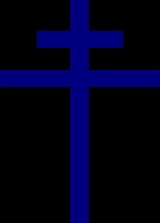
The Patriarchal cross is a variant of the Christian cross
Christian cross

The Christian cross is the best-known religious symbol of Christianity. It is a representation of the instrument of the crucifixion of Jesus Christ....
, the universal religious symbol of Christianity
Christianity

Christianity is a Monotheistic religion #Christian view religion centered on the life and teachings of Jesus as New Testament view on Jesus' life....
. Similar to the familiar Latin cross, the Patriarchal cross possesses a smaller crossbar placed above the main one, so that both crossbars are near the top.


Discussion
Ask a question about 'Patriarchal cross'
Start a new discussion about 'Patriarchal cross'
Answer questions from other users
Full Discussion Forum


Recent Posts


Encyclopedia


Patriarchscross
The Patriarchal cross is a variant of the Christian cross
Christian cross

The Christian cross is the best-known religious symbol of Christianity. It is a representation of the instrument of the crucifixion of Jesus Christ....
, the universal religious symbol of Christianity
Christianity

Christianity is a Monotheistic religion #Christian view religion centered on the life and teachings of Jesus as New Testament view on Jesus' life....
. Similar to the familiar Latin cross, the Patriarchal cross possesses a smaller crossbar placed above the main one, so that both crossbars are near the top. Sometimes the patriarchal cross has a short, slanted crosspiece near its foot. This slanted, lower crosspiece often appears in Byzantine Greek
Byzantine Greeks

Byzantine Greeks or Byzantines or Romaioi, is a conventional term used by modern historians to refer to the medieval Greeks or Hellenization citizens of the Byzantine Empire, centered mainly in Constantinople, the southern Balkans, the Greek islands, Asia Minor and the large urban centres of the Near East and Northern Egypt....
 and Eastern Europe
Eastern Europe

Eastern Europe is a term that applies to the geopolitical region encompassing the easternmost part of the Europe. Throughout history and to a lesser extent today, parts of Eastern Europe has been distinguishable from Western Europe and other regions due to cultural, religious, economic, and historical reasons, even though there i...
an iconography
Iconography

Iconography is the branch of art history which studies the identification, description, and the interpretation of the content of images. The word iconography literally means "image writing", and comes from the Ancient Greek e???? and ??afe?? ....
, as well as Eastern Orthodox churches.

The symbol, often referred to as the patriarchal cross, appeared in the Byzantine Empire
Byzantine Empire

Byzantine Empire and Eastern Roman Empire are conventional names used to describe the Roman Empire during the Middle Ages, centered on its capital of Constantinople....
 in large numbers in the 9th century. In the Byzantine Empire of the 9th century, the double cross was not a religious, but a political symbol used by Byzantine clerks and missionaries.

Imagery

Slavcross
Cardusan
The top beam represents the plaque bearing the inscription "Jesus
Jesus

Jesus of Nazareth , also known as Jesus Christ, is the central figure of Christianity and is revered by most Christian churches as the Son of God and the Incarnation ....
 of Nazareth, King of the Jews" (often abbreviated in the Latin
Latin

Latin is an Italic language, historically spoken in Latium and Ancient Rome. Through the Military history of the Roman Empire, Latin spread throughout the Mediterranean and a large part of Europe....
ate "INRI
INRI

INRI is an acronym of the Latin language inscription IESVS?NAZARENVS?REX?IVD?ORVM , which translates to English language as "Jesus Nazarene, King of the Jews." The Greek equivalent of this phrase appears in the New Testament of the Christian Bible in the Gospel of John ....
", and in the Greek as "INBI"). A popular view is that the slanted bottom beam is a foot rest, however there is no evidence of foot rests ever being used during crucifixion, and it has a deeper meaning. The bottom beam may represent a balance of justice. Some sources suggest that, as one of the thieves being crucified with Jesus repented of his sin and accepted Jesus as the Messiah and was thus lifted into Heaven
Heaven

Heaven may refer to the physical heavens, the atmosphere or the seemingly endless expanse of the universe beyond. This is the traditional literal meaning of the term in English, however since at least AD 1000, it is typically also used to refer to an afterlife plane of existence in various religions and spirituality philosophy, often descri...
, the other thief rejected and mocked Jesus and therefore descended into Hell
Hell

In many religious traditions, Hell is a place of suffering and punishment in the afterlife, often in the underworld. Religions with a linear Divinity history often depict Hell as endless ....
.

Many symbolic interpretations of the double cross have been put forth. One of them says that the first horizontal line symbolized the secular power and the other horizontal line the ecclesiastic power of Byzantine emperors. Also, that the first cross bar represents the death and the second cross the resurrection of Jesus Christ.

Other variations

Cross of the Russian Orthodox Church 01
The Eastern Orthodox cross (also known as Crux Orthodoxa, the Byzantine cross, the Eastern cross, and the "Russian" cross) can be considered a modified version of the Patriarchal cross, having two smaller crossbeams, one at the top and one near the bottom, in addition to the longer crossbeam. The lower crossbeam represents the footrest (suppendaneum) to which the feet of Jesus were nailed. In most earlier representations (and still currently in the Greek Church
Greek Orthodox Church

The term Greek Orthodox Church refers to several churches within the larger full communion of Eastern Orthodox Church Christianity sharing a common cultural tradition and whose liturgy is traditionally conducted in Koine Greek, the original language of the New Testament....
) the crossbar near the bottom is straight. In later Russian and other traditions, it came to be depicted as slanted, with the side to the viewer's left usually being higher. One tradition says that this comes from the idea that as Jesus
Jesus

Jesus of Nazareth , also known as Jesus Christ, is the central figure of Christianity and is revered by most Christian churches as the Son of God and the Incarnation ....
 took his last breath, the bar his feet were nailed to broke, thus slanting to the side. It is also said that the slanted bar represents the repentant thief
Saint Dismas

In Christian tradition, Saint Dismas , also known as the Good Thief or the Penitent Thief, is the "good thief" described in the Gospel of Luke....
 and the unrepentant thief
Gestas

Gestas, also spelled Gesmas, is the apocryphal name given to one of the two thieves who was crucified alongside Jesus. According to legend, Gestas taunted Jesus about not saving himself, while Dismas asked for mercy....
 that were crucified with Christ, the one to Jesus' right hand repenting and rising to be with God, and one on his left falling to Hell and separation from God. In this manner it also reminds the viewer of the Last Judgement. Another explanation of the slanted crossbar would suggest the Cross Saltire, as tradition holds that the Apostle St. Andrew introduced Christianity
Christianity

Christianity is a Monotheistic religion #Christian view religion centered on the life and teachings of Jesus as New Testament view on Jesus' life....
 to lands north and west of the Black Sea
Black Sea

The Black Sea is an inland sea sea bounded by southeastern Europe, the Caucasus and the Anatolia and is ultimately connected to the Atlantic Ocean via the Mediterranean Sea and Aegean Seas and various straits....
: today's Romania
Romania

Romania is a country located in Southeastern Europe Central Europe, North of the Balkan Peninsula, on the Lower Danube, within and outside the Carpathian Mountains, bordering on the Black Sea....
, Moldova
Moldova

Moldova , officially the Republic of Moldova is a landlocked country in Eastern Europe, located between Romania to the west and Ukraine to the north, east and south....
, Belarus
Belarus

Belarus is a landlocked country in Eastern Europe, bordered by Russia to the north and east, Ukraine to the south, Poland to the west, and Lithuania and Latvia to the north....
, Russia
Russia

Russia , or the Russian Federation , is a list of countries spanning more than one continent country extending over much of northern Eurasia....
, and Ukraine
Ukraine

Ukraine is a country in Eastern Europe. It is bordered by Russia to the east; Belarus to the north; Poland, Slovakia, and Hungary to the west; Romania and Moldova to the southwest; and the Black Sea and Sea of Azov to the south....
.

Arcbishoppallium
The Cross of Lorraine
Cross of Lorraine

The Cross of Lorraine is a heraldry cross. The "double cross" consists of a vertical line crossed by two smaller horizontal bars. The lower bar is as close to the bottom of the vertical as the upper bar is to the top....
 originally differed from the patriarchal cross: it had two horizontal bars of equal length placed with the lower bar located close to the bottom and the upper bar close to the top. On the patriarchal cross on the other hand, both bars are near the top and the upper is noticeably smaller than the other. In the twentieth century the cross of Lorraine began to be represented, as in the flag of the Free French Forces
Free French Forces

File:Croix de Lorraine2.svgThe Free French Forces were France fighters in World War II who decided to continue fighting against Axis powers of World War II forces after the Armistice with France and subsequent German occupation of France in World War II....
, as almost identical with the patriarchal cross, the only difference being that the two horizontal crossbars, of unequal length, were placed somewhat lower than is traditional in the patriarchal cross.

Though the two-barred cross is here called a patriarchal cross, Roman Catholic
Roman Catholic Church

The Roman Catholic Church, officially known as the Catholic Church is the world's largest Christianity Ecclesia , representing over half of all Christians and one-sixth of the world population....
 and some other archbishop
Archbishop

In Christianity, an archbishop is an elevated bishop. In the Roman Catholic Church, the Anglican Communion and others, this means that they lead a diocese of particular importance called an archdiocese, or in the Anglican Communion an Ecclesiastical Province, but this is not always the case....
s also use it as a symbol of their office. It distinguishes the coat-of-arms of Roman Catholic archbishops from that of bishops who do not have the rank of archbishop. The primatial staff (similar to a crozier) of the Presiding Bishop
Presiding Bishop

The Presiding Bishop is an ecclesiastical position in some Religious denomination of Christianity....
 of the Episcopal Church has the same design.

Typefaces


Unicode
Unicode

Unicode is a computing industry standard allowing computers to consistently represent and manipulate Character expressed in most of the world's writing systems....
 defines the "Orthodox Cross" in the Miscellaneous Symbols
Miscellaneous Symbols

The Miscellaneous Symbols plane of Unicode contains various glyphs representing things from a variety of categories: Astrological, Astronomical, Chess, Dice, Ideological symbols, Musical notation, Political symbols, Recycling, Religious symbols, Trigrams, Warning signs and Weather....
 range at codepoint U+2626.

See also

  • Cross of Lorraine
    Cross of Lorraine

    The Cross of Lorraine is a heraldry cross. The "double cross" consists of a vertical line crossed by two smaller horizontal bars. The lower bar is as close to the bottom of the vertical as the upper bar is to the top....
  • Coat of Arms of Hungary
    Coat of arms of Hungary

    The current coat of arms of Hungary was adopted on July 3, 1990, after the end of the Communist state regime.The arms have been used before, both with and without the Crown of Saint Stephen, sometimes as part of a larger, more complex coat of arms, and many of its elements date back to the Middle Ages....
     (since 1190)
  • Coat of Arms of Slovakia
    Coat of arms of Slovakia

    File:Slovakia 2 euro.pngFile:Slovakia 1 euro.pngThe coat of arms of Slovakia is composed of a silver Patriarchal cross, elevated on the middle peak of a dark blue mountain consisting of three peaks....
  • Pahonia
    Pahonia

    The Pahonia is a historical symbol of Belarus. The Pahonia was the official coat of arms of Belarus in 1918 and from 1991 to 1995....
     (historical symbol of Belarus
    Belarus

    Belarus is a landlocked country in Eastern Europe, bordered by Russia to the north and east, Ukraine to the south, Poland to the west, and Lithuania and Latvia to the north....
    )
  • Papal cross
    Papal Cross

    The papal cross or ferula is an emblem of the papal office. As a material cross, it was carried before the Roman pontiff in processions or was used by him as his Crosier....