

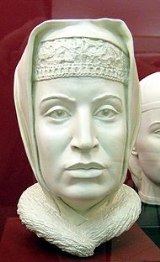
Sophia Paleologue

Encyclopedia
Zoe Palaiologina later changed her name to Sophia Palaiologina , Grand Duchess of Moscow
, was a niece of the last Byzantine emperor Constantine XI
and second wife of Ivan III of Russia
. She was also the grandmother of Ivan the Terrible.
. Together with her brothers, she was taken to Rome
after the conquest of Morea by Mehmed II
of the Ottoman Empire
in 1460. In Rome, her Greek name Zoe was changed to Sophia
. Born as an Orthodox, it is possible that she was raised as a Catholic in Rome.
In 1469, Pope Paul II
offered to marry her to the Russian monarch in order to unite the Orthodox
and Catholic
churches. She entered Russia with a grand entourage and was welcomed in the city of Pskov
, where she was officially celebrated — it was noticed that she thanked the public herself for the celebrations. The widowed Russian prince married Sophia at the Dormition Cathedral, Moscow on 12 November 1472. The cardinal Johannes Bessarion, sent by the Pope to Moscow, however, did not succeed in his mission.
Over the years, Sophia gained great influence in her husband's decision making. She was described as a "shrewd" character, and it was rumoured that her husband let himself be directed by her suggestions. In 1472, she was affected by the formal tributary gesture by which her spouse greeted the Mongolian representatives, and is believed to have convinced him to abandon the tributary relationship to the Mongols, which was completed in 1480. It is thought that she introduced grand Byzantine ceremonies and meticulous court etiquette in the Kremlin
, the idea of Moscow as a Third Rome
evidently pleasing her. Sophia was apparently not obliged to follow the custom of traditional isolation which was expected of other Russian noble and royal women at the time; it is noted that she was not confined to the women's quarters, but greeted foreign representatives from Europe similarly as the queens of Western Europe. Shortly before her death she persuaded her husband to pass the throne to her son Vasili
, rather than to Ivan's grandson Dmitry
, as had been planned earlier. Apart from Vasili III, only her fifth son, Andrey of Staritsa
, left issue. Her last known descendant, Maria of Staritsa, wife of Livonia's king Magnus, died in 1610.
Moscow
Moscow is the capital, the most populous city, and the most populous federal subject of Russia. The city is a major political, economic, cultural, scientific, religious, financial, educational, and transportation centre of Russia and the continent...
, was a niece of the last Byzantine emperor Constantine XI
Constantine XI
Constantine XI Palaiologos, latinized as Palaeologus , Kōnstantinos XI Dragasēs Palaiologos; February 8, 1404 – May 29, 1453) was the last reigning Byzantine Emperor from 1449 to his death as member of the Palaiologos dynasty...
and second wife of Ivan III of Russia
Ivan III of Russia
Ivan III Vasilyevich , also known as Ivan the Great, was a Grand Prince of Moscow and "Grand Prince of all Rus"...
. She was also the grandmother of Ivan the Terrible.
Biography
Her father was Thomas Palaeologus, the Despot of MoreaDespotate of Morea
The Despotate of the Morea or Despotate of Mystras was a province of the Byzantine Empire which existed between the mid-14th and mid-15th centuries. Its territory varied in size during its 100 years of existence but eventually grew to take in almost all the southern Greek peninsula, the...
. Together with her brothers, she was taken to Rome
Rome
Rome is the capital of Italy and the country's largest and most populated city and comune, with over 2.7 million residents in . The city is located in the central-western portion of the Italian Peninsula, on the Tiber River within the Lazio region of Italy.Rome's history spans two and a half...
after the conquest of Morea by Mehmed II
Mehmed II
Mehmed II , was Sultan of the Ottoman Empire for a short time from 1444 to September 1446, and later from...
of the Ottoman Empire
Ottoman Empire
The Ottoman EmpireIt was usually referred to as the "Ottoman Empire", the "Turkish Empire", the "Ottoman Caliphate" or more commonly "Turkey" by its contemporaries...
in 1460. In Rome, her Greek name Zoe was changed to Sophia
Sophia (name)
Sophia is a female name derived from σοφία, the Greek word for "Wisdom." Sophie is from the French form. Sophia has been a popular name throughout the western world...
. Born as an Orthodox, it is possible that she was raised as a Catholic in Rome.
In 1469, Pope Paul II
Pope Paul II
Pope Paul II , born Pietro Barbo, was pope from 1464 until his death in 1471.- Early life :He was born in Venice, and was a nephew of Pope Eugene IV , through his mother. His adoption of the spiritual career, after having been trained as a merchant, was prompted by his uncle's election as pope...
offered to marry her to the Russian monarch in order to unite the Orthodox
Eastern Orthodox Church
The Orthodox Church, officially called the Orthodox Catholic Church and commonly referred to as the Eastern Orthodox Church, is the second largest Christian denomination in the world, with an estimated 300 million adherents mainly in the countries of Belarus, Bulgaria, Cyprus, Georgia, Greece,...
and Catholic
Roman Catholic Church
The Catholic Church, also known as the Roman Catholic Church, is the world's largest Christian church, with over a billion members. Led by the Pope, it defines its mission as spreading the gospel of Jesus Christ, administering the sacraments and exercising charity...
churches. She entered Russia with a grand entourage and was welcomed in the city of Pskov
Pskov
Pskov is an ancient city and the administrative center of Pskov Oblast, Russia, located in the northwest of Russia about east from the Estonian border, on the Velikaya River. Population: -Early history:...
, where she was officially celebrated — it was noticed that she thanked the public herself for the celebrations. The widowed Russian prince married Sophia at the Dormition Cathedral, Moscow on 12 November 1472. The cardinal Johannes Bessarion, sent by the Pope to Moscow, however, did not succeed in his mission.
Over the years, Sophia gained great influence in her husband's decision making. She was described as a "shrewd" character, and it was rumoured that her husband let himself be directed by her suggestions. In 1472, she was affected by the formal tributary gesture by which her spouse greeted the Mongolian representatives, and is believed to have convinced him to abandon the tributary relationship to the Mongols, which was completed in 1480. It is thought that she introduced grand Byzantine ceremonies and meticulous court etiquette in the Kremlin
Moscow Kremlin
The Moscow Kremlin , sometimes referred to as simply The Kremlin, is a historic fortified complex at the heart of Moscow, overlooking the Moskva River , Saint Basil's Cathedral and Red Square and the Alexander Garden...
, the idea of Moscow as a Third Rome
Third Rome
The term Third Rome describes the idea that some European city, state, or country is the successor to the legacy of the Roman Empire and its successor state, the Byzantine Empire ....
evidently pleasing her. Sophia was apparently not obliged to follow the custom of traditional isolation which was expected of other Russian noble and royal women at the time; it is noted that she was not confined to the women's quarters, but greeted foreign representatives from Europe similarly as the queens of Western Europe. Shortly before her death she persuaded her husband to pass the throne to her son Vasili
Vasili III of Russia
Vasili III Ivanovich was the Grand Prince of Moscow from 1505 to 1533. He was the son of Ivan III Vasiliyevich and Sophia Paleologue and was christened with the name Gavriil...
, rather than to Ivan's grandson Dmitry
Dmitry Ivanovich (grandson of Ivan III)
Dmitry Ivanovich was Grand Prince of Moscow between 1498 and 1502.Dmitry's parents were Ivan the Young, crown heir of Moscow, and Elena, daughter of Stephen III of Moldavia. After his father's death in 1490 he became heir presumptive of Moscowy...
, as had been planned earlier. Apart from Vasili III, only her fifth son, Andrey of Staritsa
Andrey of Staritsa
Andrey Ivanovich was the youngest son of Ivan the Great by Sophia of Byzantium. Since 1519, his appanages included Volokolamsk and Staritsa....
, left issue. Her last known descendant, Maria of Staritsa, wife of Livonia's king Magnus, died in 1610.