

Chile under Pinochet

Encyclopedia
Chile was ruled by a military dictatorship
headed by Augusto Pinochet
from 1973 when Salvador Allende
was overthrown in a coup d'etat until 1990 when the Chilean transition to democracy
began. The authoritarian military government was characterized by systematic suppression of political parties and the persecution of dissidents to an extent that was unprecedented in the history of Chile. The military government of Chile is considered an example of a police state
by scholars.
After a highly controversial referendum in 1980 Pinochet who had been proclaimed president in 1974 was elected president and a new constitution
approved. In the 1980s the military government, under the influence of the Chicago boys
, took a neoliberal stance on economics which has been followed up by the democratic governments that succeeded the dictatorship. The military government of Chile lost power following a referendum in 1988
but the military continued to exercise a great influence on politics through deterrence
.
Before relinquishing power, an amnesty law was passed, which prevented most members of the military from being prosecuted by the subsequent regime. Another law was also enacted allowing Pinochet to serve as a Senator for life
and technically giving him immunity from prosecution without being expelled from the chamber first.
Many of the civilian allies of the military government continued to be influential in Chilean politics. Unión Demócrata Independiente (UDI) is Chile's largest party, and also the one that grouped most of the regime's supporters although the party has since distanced from it.
On August 22, 1973 the Chamber of Deputies of Chile
passed, by a vote of 81 to 47, a resolution calling for President Allende
to respect the constitution. The measure failed to obtain the two-thirds vote in the Senate
constitutionally required to convict the president of abuse of power, but represented a challenge to Allende's legitimacy.
Two weeks before the coup, public dissatisfaction with Allende's government had led to protests like at the Plaza de la Constitución which had been full of Chilean women venting their rage against the rising cost and increasing shortages of food, but which had been dispersed with tear gas. The military seized on such widespread discontent and on the Chamber of Deputies' resolution to then launch the September 11, 1973 coup d'état
(see 1973 coup in Chile) and install themselves in power as a Military Government Junta
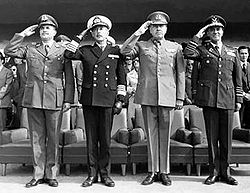
, composed of the heads of the Army, Navy, Air Force and Carabineros (police).
Once the Junta was in power, General Augusto Pinochet
soon consolidated his control over the government. Since he was the commander-in-chief of the oldest branch of the military forces (the Army), he was made the titular head of the junta
, and soon after President of Chile
.
formally banned the socialist, Marxist and other leftist
parties that had constituted former President Allende's Popular Unity
coalition. On September 13, the junta dissolved the Congress and outlawed or suspended all political activities in addition to suspending the constitution
. All political activity was declared "in recess".
Pinochet expressed contempt for the Christian Democratic Party's call for a quick return to civilian democracy. However, he did not ban the party. Eduardo Frei
, Allende's Christian Democratic predecessor as president, initially supported the coup along with other Christian Democratic leaders. Later, they assumed the role of a loyal opposition to the military rulers, but soon lost most of their influence.
Meanwhile, left-wing Christian Democratic leaders like Radomiro Tomic
were jailed or forced into exile. The Catholic Church, which at first expressed its gratitude to the armed forces for saving the country from the horrors of a "Marxist dictatorship" became, under the leadership of Cardinal Raúl Silva Henríquez, the most outspoken critic of the regime's social and economic policies. Nonetheless, even Pope John Paul II was criticized for his perceived leniency towards the Pinochet regime.
The military junta began to change during the late 1970s. Due to disagreements with General Pinochet, General Gustavo Leigh
was dismissed from the junta in 1978 and replaced by General Fernando Matthei
. In 1985 due to the Caso Degollados scandal ("case of the slit throats"), General César Mendoza
resigned and was replaced by General Rodolfo Stange
.
" (or "political genocide"). Steve J. Stern spoke of a politicide to describe "a systematic project to destroy an entire way of doing and understanding politics and governance."
The worst violence occurred in the first three months of the coup's aftermath, with the number of suspected leftists killed or "disappeared
" (desaparecidos) soon reaching into the thousands. In the days immediately following the coup, the Assistant Secretary of State for Inter-American Affairs informed Henry Kissinger
, that the National Stadium
was being used to hold 5,000 prisoners, and as late as 1975, the CIA was still reporting that up to 3,811 prisoners were still being held in the Stadium. Between the day of the military coup and November 1973, as much as 40,000 political prisoners were detained in the Stadium. 1,850 of them were killed, another 1,300 are missing since then. Some of the most famous cases of "desaparecidos" are Charles Horman
, a U.S. citizen who was killed during the coup itself, Chilean songwriter Víctor Jara
, and the October 1973 Caravan of Death
(Caravana de la Muerte) where at least 70 persons were killed. Other operations include Operation Colombo
during which hundreds of left-wing activists were murdered and Operation Condor
, carried out with the security services of other Latin American dictatorships.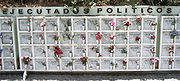 Following Pinochet's defeat in the 1988 plebiscite
, the 1991 Rettig Commission, a multipartisan effort from the Aylwin administration to discover the truth about the human-rights violations, listed a number of torture
and detention
centers (such as Colonia Dignidad
, the ship Esmeralda
or Víctor Jara Stadium), and found that at least 3,200 people were killed or disappeared by the regime.
A later report, the Valech Report
(published in November 2004), confirmed the figure of 3,200 deaths but reduced the estimated number of disappearances. It tells of some 28,000 arrests in which the majority of those detained were incarcerated and in a great many cases tortured. Some 30,000 Chileans were exiled and received abroad, in particular in Argentina
, as political refugees; however, they were followed in their exile by the DINA secret police, in the frame of Operation Condor
which linked South-American dictatorships together against political opponents. Some 20,000–40,000 Chilean exiles were holders of passports stamped with the letter "L" (which stood for lista nacional), identifyng them as persona non grata and had to seek permission before entering the country. According to a study in Latin American Perspectives
, at least 200,000 Chileans (about 2% of Chile's 1973 population) were forced to go into exile
, and hundreds of thousands more left the country due to economic crises after the military coup.
The cases of three persons who were falsely listed as killed or missing during the 1973–1990 military regime have raised some questions about the system of verification of dictatorship victims. In October 1979 the New York Times reported that Amnesty International had documented the disappearance of approximately 1,500 Chileans since 1973. Professor Clive Foss, in The Tyrants: 2500 years of Absolute Power and Corruption (Quercus Publishing 2006), estimates that 1,500 Chileans were killed or disappeared during the Pinochet regime.
The leftist guerrilla groups and their sympathizers were also hit hard during the military regime. The MIR commander, Andrés Pascal Allende
, has stated that the Marxist guerrillas lost 1,500–2,000 fighters killed or disappeared. Among the killed and disappeared during the military regime were at least 663 MIR guerrillas. The Manuel Rodríguez Patriotic Front admitted 49 FPMR guerrillas were killed and hundreds tortured. Many guerrillas confessed under torture and several hundred other young men and women, sympathetic to the guerrillas, were detained and tortured and often killed. Nearly 700 civilians disappeared in the 1974-1977 period, after being detained by the Chilean military and police.
According to the Latin American Institute on Mental Health and Human Rights (ILAS), situations of "extreme trauma" affected about 200,000 persons; this figure includes individuals executed, tortured (following the United Nations definition of torture), forcibly exiled, or having their immediate relatives put under detention. While more radical groups such as the Movement of the Revolutionary Left
(MIR) were staunch advocates of a Marxist revolution, the junta deliberately targeted nonviolent political opponents as well.
A court in Chile sentenced, on March 19, 2008, 24 former police officers in cases of kidnapping, torture and murder that happened just after a U.S.
-backed coup overthrew President Salvador Allende
, a Socialist
, on September 11, 1973.
was approved in a national plebiscite held on September 11, 1980. The constitution was approved by 66% of voters under a process which has been described as "highly irregular and undemocratic." The constitution came into force on March 11, 1981.
who had been educated in the United States at the University of Chicago
. Given financial and ideological support from Pinochet, the U.S., and international financial institutions, the Chicago Boys
advocated laissez-faire
, free-market
, neoliberal
, and fiscally conservative policies, in stark contrast to the extensive nationalization
and centrally-planned economic programs supported by Allende. Chile was drastically transformed from an economy isolated from the rest of the world, with strong government intervention, into a liberalized, world-integrated economy, where market forces were left free to guide most of the economy's decisions.
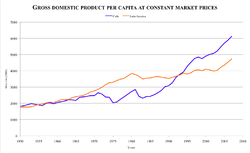 Many of these reforms have been continued to this day, and according to the 2009 Index of Economic Freedom, which ranks nations according to tax burden, state control and other factors, Chile is currently the 11th most economically free nation in the world and the most free in Latin America. The resulting effect of these policies on the economy is clear from the figure (below right) showing the growth of GDP per capita since the 1973 overthrow of Salvador Allende and his socialist government. Currently, Chile is the most economically prosperous nation in Latin America according to GDP per capita. Some economists, however, argue that the short-term effects of the change to a free market system in the mid 1970s proved incredibly harmful to the Chilean economy. Instead of a sharp drop in inflation that was expected by the Chicago school economists, inflation reached 375% by conservative estimates.
From an economic point of view, the era can be divided into two periods. The first, from 1973 to 1982, corresponds to the period when most of the reforms were implemented. The period ended with the international debt crisis and the collapse of the Chilean economy. At that point, unemployment was extremely high, above 20 percent, and a large proportion of the banking sector had become bankrupt. But this was a worldwide crisis, and as shown in the graph showing growth in GDP per capita did not have a long lasting effect on the Chilean economy. During that first period, an economic policy that emphasized export expansion and growth was implemented. However, some economists argue that the economic recovery of the second period, from 1982 to 1990, was due to an about-face turn around of Pinochet's free market policy and the fact that, in 1982, he nationalized many of the same industries that were nationalized under Allende and fired the Chicago Boys from their government posts.
Pinochet's policies were lauded internationally for transforming the Chilean economy and bringing about an "economic miracle
". British Prime Minister Margaret Thatcher
credited him with bringing about a thriving, free-enterprise economy, while at the same time downplaying the Junta's human rights record, condemning an "organised international Left who are bent on revenge." Pinochet certainly did achieve macroeconomic
success with his reforms, hindered somewhat by recession in the early 1980s. GDP growth remained steady, and Chile began a process of integration into the international economy. However, as discussed below, many social costs were paid by the lower strata of Chilean society during his experimentation with economic shock.
In 1990, the LOCE act on education initiated the dismantlement of public education
. According to economist Manuel Riesco:
The junta relied on the middle class
, the oligarchy, huge foreign corporations, and foreign loans to maintain itself.
Under Pinochet, funding of military and internal defence spending rose 120% from 1974 to 1979. Citation for both of these claims covered under Remmer, 1989-->
Due to the reduction in public spending, tens of thousands of employees were fired from other state-sector jobs.
The oligarchy recovered most of its lost industrial and agricultural holdings, for the junta sold to private buyers most of the industries expropriated by Allende's Popular Unity government.
Financial conglomerates became major beneficiaries of the liberalized economy and the flood of foreign bank loans. Large foreign banks reinstated the credit cycle, as the Junta saw that the basic state obligations, such as resuming payment of principal and interest installments, were honored. International lending organizations such as the World Bank
, the International Monetary Fund
, and the Inter-American Development Bank
lent vast sums anew.
Many foreign multinational corporations such as International Telephone and Telegraph (ITT), Dow Chemical, and Firestone
, all expropriated by Allende, returned to Chile.
set up an armed wing, which became in 1983 the FPMR (Frente Patriótico Manuel Rodríguez). The main guerrilla group, known as the MIR
(Movimiento de Izquierda Revolucionaria), suffered heavy casualties in the coup's immediate aftermath, and most of its members fled the country. Andreas Pascal Allende, a nephew of President Allende led the MIR from 1974–1976, then made his way to Cuba. Nevertheless, in the first three months of military rule, the Chilean forces recorded 162 military deaths. A total of 756 servicemen and police are reported to have been killed or wounded in clashes with guerrillas in the 1970s. Among the killed and disappeared during the military regime were at least 663 Marxist MIR
guerrillas. The MIR commander, Andrés Pascal Allende
, has admitted that the Marxist guerrillas lost 1,500-2,000 fighters killed or disappeared. Many guerrillas confessed under torture and several hundred other young men and women, sympathetic to the guerrillas, were detained and tortured and often killed. Nearly 700 civilians disappeared in the 1974-1977 period, after being detained by the Chilean military and police.
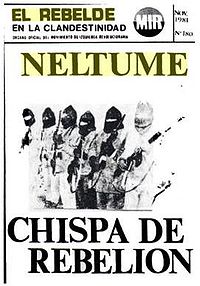 On February 19, 1975, four captured MIR commanders went on national television to urge their guerrillas to lay down their arms. According to them, the MIR leadership was in ruins: of the 52 commanders of the MIR, nine had been killed, 24 were prisoners, ten were in exile, one had been expulsed from the group, and eight were still at large. On 18 November 1975, MIR
guerrillas killed a 19-year-old army conscript (Private Hernán Patricio Salinas Calderón). On 24 February 1976, MIR
guerrillas in a gunbattle with Chilean secret police, shot and killed a 41-year-old carabinero sergeant (Tulio Pereira Pereira). The Chilean secret police on this occasion were met with a hail of automatic weapons fire, killing a carabinero and a girl. On 28 April 1976, MIR
guerrillas shot and killed a 29-year-old carabineros corporal (Bernardo Arturo Alcayaga Cerda) while he was walking home in the Santiago suburb of Pudahuel. On 16 October 1977, MIR guerrillas exploded 10 bombs in Santiago. In 1978 the MIR sought to reestablish a presence in Chile and launched "Operation Return" which involved clandestine entry, recruitment, bombings and bank robberies in Santiago that briefly shook the military regime. In February, 1979 MIR
guerrillas bombed the US-Chile Cultural Institute in Santiago, causing considerable damage. In 1979, about 40 bombings were blamed on MIR guerrillas.
In a message sent to Santiago press agencies in February 1981 the MIR
claimed to have carried out more than 100 attacks during 1980, among them the bombing of electricity pylons in Santiago and Valparaiso on November 11 which caused widespread blackouts, and bomb attacks on three banks in Santiago on December 30 in which one carabinero was killed and three people wounded. In November, 1981, MIR guerrillas killed three member of the Investigative Police as they stood in front of the home of the chief minister of the presidential staff. In sweeps carried out from June to November 1981, security forces destroyed two MIR bases in the mountains of Neltume
, seizing large caches of munitions and killing a number guerrillas.
MIR guerrillas retaliated and carried out twenty-six bomb attacks during March and April 1983.
Leftist guerrillas, waiting in a yellow pick-up truck, ambushed on August 30, 1983 the governor of Santiago, retired major-general Carol Urzua Ibáñez as he left his home, killing him and two of his bodyguards (army corporals Carlos Riveros Bequiarelli and José Domingo Aguayo Franco) in a hail of submachine-gun fire. In October and November 1983, MIR guerrillas bombed four US-associated targets. Guerrillas killed two policemen (carabinieri Francisco Javier Pérez Brito and sergeant Manuel Jesús Valenzuela Loyola) on December 28, 1983.
On March 31, 1984 a police bus in downtown Santiago was destroyed with a bomb, killing a carabinero and injuring at least 11. On 29 April 1984, MIR guerrillas exploded 11 bombs, derailing a subway train in Santiago and injuring 22 passengers, including seven children. On 5 September 1984, guerrillas shot and killed 27-year-old army lieutenant Julio Briones Rayo in Copiapó. On November 2, 1984 a bus carrying carabineros was attacked with a grenade during Chile's national cycling championship; four carabineros were killed. On November 4, 1984 five guerrillas riding in a van hurled bombs and fired automatic weapons at a suburban Santiago police station, killing two carabineros and wounded three more. A month later, another carabinero was killed in a similar attack. On 25 March 1985, MIR guerrillas planted a bomb in Hotel Araucano in Concepcion that killed marine sergeant René Osvaldo Lara Arriagada and army sergeant Alejandro del Carmen Avendaño Sánchez, who were attempting to defuse the bomb. On December 6, 1985 a carabinero was shot to death by four guerrillas who opened fire on him with submachine-guns as he walked home. The total number of documented terrorist actions during 1984 and 1985 was 866.
In February 1986 a car bomb destroyed a bus filled with riot police, mutilating 16 policemen. One carabinero later died of his wounds. The MIR claimed responsibility for the bombing. In May 1986 MIR guerrillas threw sulphuric acid into a bus, seriously injuring six people, including two children. On July 25, 1986 a bomb planted in a trash can exploded at a crowded bus stop a few yards from the presidential palace, wounding at least 24 people. On 6 August 1986, security forces discovered 80 tons of weapons at the tiny fishing harbor of Carrizal Bajo
, smuggled into the country by the Manuel Rodríguez Patriotic Front
(FPMR). The shipment of Carrizal Bajo included C-4 plastic explosive
s, 123 RPG-7
and 180 M72 LAW
rocket launchers as well as 3,383 M-16 rifles. On September 7, 1986, about 30 FPMR guerrillas attempted to kill Pinochet. Pinochet narrowly escaped the assassination attempt on his motorcade, but five army corporals were killed and eleven soldiers and carabineros were wounded in the ambush. This failed operation led to an internal crisis of the group, many of its leading members being arrested by the security forces. In October, 1986 MIR guerrillas attacked a police station in Limache with gunfire, seriously wounding five policemen. One carabinero later died of his wounds. On November 5, 1986 guerrillas threw an incendiary bomb into a bus in Viña del Mar, seriously injuring three women (Rosa Rivera Fierro, Sonia Ramírez Salinas and Marta Sepúlveda Contreras). Rosa Rivera Fierro, later died of her wounds. On 28 November 1986, MIR guerrillas after having been stopped by a police vehicles, shot and killed 31-year-old Carabinero Lieutenant Jaime Luis Sáenz Neira
On September 11, 1987 a police vehicle was completely destroyed in a bomb attack in Santiago, killing two carabineros. On January 20, 1988 a bomb planted by MIR guerrillas in the Capredena Medical Center in Valparaiso killed a 65-year-old female pensioner (Berta Rosa Pardo Muñoz) and wounded 15 others females. On January 26, MIR guerrillas planted a bomb in a house in La Cisterna that killed 42-year-old Major Julio Eladio Benimeli Ruz, commander of the carabineros special operations group. In June, 1988 MIR guerrillas conducted a series of bombings in Santiago, at various banks. FPMR guerrillas that month killed 43-year-old Lieutenant-Colonel Miguel Eduardo Rojas Lobos of the Chilean Army, after he had parked his car in the Santiago suburb of San Joaquín. On 10 July 1989, 26-year-old Carabineros corporal Patricio Rubén Canihuante Astudillo was shot in the head at point-blank range as he guarded a building in Viña del Mar.
's accession to power, leftist militants showed that they remained committed to armed struggle and were responsible for a number of terrorist incidents. On May 10, 1990, two guerrillas wearing school uniforms assassinated carabineros Colonel Luis Fontaine, a former head of the antiterrorist department of the carabineros, Chile's national police force. Two policemen were killed on August 10, 1990 in a working-class Santiago suburb and two more were injured in an attack on a bus. On November 14, 1990, gendarmes transferred Marco Ariel Antonioletti, a senior MJL leader from jail to hospital for treatment. MJL guerrillas fought their way into the Sótero del Río Hospital but were forced to withdraw, after having killed four gendarmes and one carabinero. Chile's Investigations Police later shot Antonioletti in the forehead, killing him. On January 24, 1991 MJL guerrillas ambushed and killed two carabineros. On February 28, 1991 a carabinero policeman died in a shoot-out in Santiago with leftist guerrillas of the Manuel Rodríguez Patriotic Front. On April 1, FPMR guerrillas assassinated right-wing senator Jaime Guzman, killing him as he left a university campus in Santiago. On September 9 three guerrillas kidnapped Cristian Edwards, whose family run El Mercurio newspaper. After his family paid $1 million in ransom, the FPMR freed him. On 22 January 1992, two FPMR guerrillas (Fabián López Luque and Alex Muñoz Hoffman)were killed trying to rob a Prosegur cash delivery armoured van at the Pontifical Catholic University in Santiago. On September 11, 1998 three police stations—La Pincoya, La Granja and La Victoria—were attacked with firearms, incendiary bombs and rocks and 36 were carabineros were wounded in violence related to the 25th anniversary commemorations of the military coup. In 2006, on the 33rd anniversary of the September 11, 1973 military coup, 79 carabineros were wounded in clashes with rioters. In September 2007, a carabinero policeman was killed after being shot in the face and around 40 were wounded during clashes with protesters marking the 34th anniversary of the military coup. The following month, MJL guerrillas killed carabineer Luis Moyano Farías during the robbery of Banco Security in Santiago. In clashes with protesters commemorating the 35th anniversary of the military coup, 29 carabineros were wounded in September 2008. In September 2009, 19 Carabineros were wounded in clashes with protestors marking the 36th anniversary of the coup. The murders, lootings, thefts and other forms of appropriation that took place in the aftermath of the devastating 2010 earthquake in Chile, were in part promoted and legitimated by the MIR movement.
growth, in contrast to the negative growth seen in the early years of his administration. The upper 20% of income earners ultimately benefited the most from such growth, receiving 85% of the increase. Foreign debt also grew substantially under Pinochet, rising 300% between 1974 and 1988.
Under these new policies, the rate of inflation grew to twice what it was at the peak of Allende's presidency.
, remained in government hands, with the 1980 Constitution declaring them "inalienable," but new mineral deposits were open to private investment. Capitalist involvement was increased, the Chilean pension system
and healthcare were privatized, and Superior Education
was also placed in private hands. One of the junta's economic moves was fixing the exchange rate in the early 1980s, leading to a boom in imports and a collapse of domestic industrial production; this together with a world recession caused a serious economic crisis in 1982, where GDP plummeted by 14%, and unemployment reached 33%. At the same time, a series of massive protests were organized, trying to cause the fall of the regime, which were efficiently repressed.
had plagued the Chilean economy for decades when Pinochet took power, and was threatening to become hyperinflation
. Between September 1973 and October 1975, the consumer price index
rose over 3,000%. In order to combat this persistent problem and pave the way for economic growth, the Chicago Boys
recommended dramatic cuts in social services. The junta put the group's recommendations into effect, and cumulative cuts in health funding totaled 60% between 1973 and 1988.
The cuts caused a significant rise in many preventable diseases and mental health problems. These included rises in typhoid (121 percent), viral hepatitis, and the frequency and seriousness of mental ailments among the unemployed.
Exchange rate depreciations and cutbacks in government spending produced a depression. Industrial and agricultural production declined. Massive unemployment, estimated at 25% in 1977 (it was only 3% in 1972), and continuing inflation eroded the living standard of workers and many members of the middle class to subsistence levels. The under-employed informal sector also mushroomed in size.
became Minister of Finance from 1985 to 1989. He allowed the peso to float and reinstated restrictions on the movement of capital in and out of the country. He introduced banking legislation, simplified and reduced the corporate tax. Chile pressed ahead with privatizations, including public utilities plus the re-privatization of companies that had returned to the government during the 1982–1983 crisis.
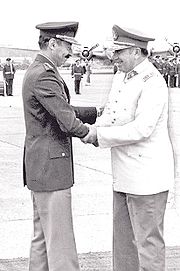 Having come to power with the self-proclaimed mission of fighting communism, Pinochet found common cause with the military dictatorships of Bolivia
, Brazil
, Paraguay
, Uruguay
, and later, Argentina
. The six countries eventually formulated a plan that became known as Operation Condor
, in which one country's security forces would target active Marxist subversives, guerrillas, and their alleged sympathizers in the allied countries. Pinochet's government received tacit approval and material support from the United States
. The exact nature and extent of this support is disputed. (See U.S. role in 1973 Coup, U.S. intervention in Chile and Operation Condor
for more details.) It is known, however, that the American Secretary of State at the time, Henry Kissinger
, practiced a policy of supporting coups in nations which the United States viewed as leaning toward Communism.
The new junta quickly broke off the diplomatic relations with Cuba
that had been established under the Allende government. Shortly after the junta came to power, several communist countries, including the Soviet Union
, North Korea
, North Vietnam
, East Germany, Poland
, Czechoslovakia
, Hungary
, Bulgaria, and Yugoslavia
, severed diplomatic relations with Chile (however, Romania
and the People's Republic of China
both continued to maintain diplomatic relations with Chile). The government broke diplomatic relations with Cambodia
in January 1974 and renewed ties with South Korea
in October 1973 and with South Vietnam
in March 1974. Pinochet attended the funeral of General Francisco Franco
, dictator of Spain from 1936–1975, in late 1975.
Chile was on the brink of being invaded by Argentina
(also ruled by a military government) as the Argentina Junta started the Operation Soberania
on 22 December 1978 because of the strategic Picton, Lennox and Nueva
islands at the southern tip of South America on the Beagle Canal. A full-scale war was prevented only by the call off of the operation by Argentina due to military and political reasons. But the relations remained tense as Argentina invaded the Falklands (Operation Rosario). Chile along with Colombia
, were the only countries in South America criticized the use of force by Argentina in its war with the U.K.
over the Falkland Islands
. Chile actually helped the United Kingdom during the war. The two countries (Chile and Argentina) finally agreed to papal mediation over the Beagle canal that finally ended in the Treaty of Peace and Friendship of 1984 between Chile and Argentina
(Tratado de Paz y Amistad). Chilean sovereignty over the islands and Argentinian east of the surrounding sea is now undisputed.
On 1980, Chile's relationship with the Philippines
, then a dictatorship under Ferdinand Marcos
became strained when that country, due to U.S. pressure rejected to allow Pinochet's plane to land in the country, even though Marcos have invited the General to visit the country. Marcos' move was under U.S. guidelines which sought to isolate Pinochet's regime.
Relations between the two countries were restored only on 1986 when Corazon Aquino
assumed the presidency of the Philippines after Marcos was ousted in a non-violent revolution, the People Power Revolution.
(CIA) in 2000, titled "CIA Activities in Chile", revealed that the CIA actively supported the military junta after the overthrow of Allende and that it made many of Pinochet's officers into paid contacts of the CIA or U.S. military, even though some were known to be involved in human rights abuses.
The U.S. was significantly friendlier with Pinochet than it had been with Allende, and continued to give the junta substantial economic support between the years 1973–1979, while simultaneously expressing opposition to the junta's repression in international forums such as the United Nations
. The U.S. went beyond verbal condemnation in 1976, after the murder of Orlando Letelier
in Washington D.C., when it placed an embargo on arms sales to Chile that remained in effect until the restoration of democracy in 1989. Presumably, with international concerns over Chilean internal repression and previous American hostility and intervention regarding the Allende government, the U.S. did not want to be seen as an accomplice in the junta's "security" activities. Prominent U.S. allies Britain
, France
, and West Germany
did not block arms sales to Pinochet, benefitting from the lack of American competition.
conflict, but the Chilean Westinghouse long range radar deployed in southern Chile gave the British task force early warning of Argentinian air attacks, which allowed British ships and troops in the war zone to take defensive action. Margaret Thatcher has said that the day the radar was taken out of service for overdue maintenance was the day Argentinian figher-bombers bombed the troopships Sir Galahad and Sir Tristram, leaving approximately 50 dead and 150 wounded. According to Chilean Junta and former Air Force commander Fernando Matthei, Chilean support included military intelligence gathering, radar surveillance, British aircraft operating with Chilean colours and the safe return of British special forces, among other things. In April and May 1982, a squadron of mothballed RAF Hawker Hunter fighter bombers departed for Chile, arriving on 22 May and allowing the Chilean Air Force to reform the No. 9 "Las Panteras Negras" Squadron. A further consignment of three frontier surveillance and shipping reconnaissance Canberras left for Chile in October. Some authors suggest that Argentina might have won the war had she been allowed to employ the VIth and VIIIth Mountain Brigades which remained sitting up in the Andes mountain chain. Pinochet subsequently visited Margaret Thatcher
for tea on more than one occasion. Pinochet's controversial relationship with Thatcher led Labour
Prime Minister Tony Blair
to mock Thatcher's Conservatives
as "the party of Pinochet" in 1999.
has shown how Valéry Giscard d'Estaing
's government secretly collaborated with Videla's junta
in Argentina and with Augusto Pinochet
's regime in Chile.
Green deputies Noël Mamère
, Martine Billard
and Yves Cochet
on September 10, 2003 requested a Parliamentary Commission on the "role of France in the support of military regimes in Latin America from 1973 to 1984" before the Foreign Affairs Commission of the National Assembly, presided by Edouard Balladur
. Apart of Le Monde
, newspapers remained silent about this request. However, deputy Roland Blum
, in charge of the Commission, refused to hear Marie-Monique Robin, and published in December 2003 a 12 pages report qualified by Robin as the summum of bad faith. It claimed that no agreement had been signed, despite the agreement found by Robin in the Quai d'Orsay
When then Minister of Foreign Affairs Dominique de Villepin
traveled to Chile in February 2004, he claimed that no cooperation between France and the military regimes had occurred.
$322.8 million in loans and credits in the year following the coup. There was considerable international condemnation of the military regime's human rights record, a matter that the United States expressed concern over as well after Orlando Letelier
's 1976 assassination in Washington DC.(Kennedy Amendment, later International Security Assistance and Arms Export Control Act of 1976).
In 1986, Chilean security forces discovered 80 tons of munitions, including more than three thousand M-16 rifles and more than two million rounds of ammunition, at the tiny fishing harbor of Carrizal Bajo, smuggled ashore from Cuban fishing trawlers off the coast of Chile. The operation was overseen by Cuban naval intelligence, and also involved the Soviet Union.
, a plebiscite was scheduled for October 5, 1988, to vote on a new eight-year presidential term for Pinochet. The Constitutional Tribunal ruled that the plebiscite should be carried out as stipulated by the Law of Elections. That included an "Electoral Space" during which all positions, in this case two, Sí (yes), and No, would have two free slots of equal and uninterrupted TV time, simultaneously broadcast by all TV channels, with no political advertising outside those spots. The allotment was scheduled in two off-prime time slots: one before the afternoon news and the other before the late-night news, from 22:45 to 23:15 each night (the evening news was from 20:30 to 21:30, and prime time from 21:30 to 22:30). The opposition No campaign, headed by Ricardo Lagos
, produced colorful, upbeat programs, telling the Chilean people to vote against the extension of the presidential term. Lagos, in a TV interview, pointed his index finger towards the camera and directly called on Pinochet to account for all the "disappeared" persons. The Sí campaign did not argue for the advantages of extension, but was instead negative, claiming that voting "no" was equivalent to voting for a return to the chaos of the UP government.
Pinochet lost the 1988 referendum, where 55% of the votes rejected the extension of the presidential term, against 43% for "Sí", and, following the constitutional provisions, he stayed as President for one more year. Open presidential elections were held on December 1989, at the same time as congressional elections that would have taken place in either case. Pinochet left the presidency on March 11, 1990 and transferred power to political opponent Patricio Aylwin
, the new democratically elected president. Due to the same transitional provisions of the constitution, Pinochet remained as Commander-in-Chief of the Army, until March 1998.
Pinochet's supporters claim that Pinochet saved Chile from turning to Communism, even going as far as to call him the country's second liberator. They also contend that the three successive administrations following him contributed to Chile's economic success by maintaining and continuing the reforms initiated by the junta Opponents have criticized the neoliberal
policies enacted by the junta, as well as its human rights abuses.
The "Chilean Variation" has been seen as a potential model for nations that fail to achieve significant economic growth.http://books.google.com/books?id=I7VgAAAAMAAJ&q=%22Chilean+Variation%22&dq=%22Chilean+Variation%22&ei=6tO3SpGiJKXEzgTG-pnxDg The latest is Russia
, for whom David Christian
warned in 1991 that "dictatorial government presiding over a transition to capitalism
seems one of the more plausible scenarios, even if it does so at a high cost in human rights violations."
On his 91st birthday in 2006, in a public statement to supporters, Pinochet for the first time claimed to accept "political responsibility" for what happened in Chile under his regime, though he still defended his 1973 coup
against Salvador Allende
. In a statement read by his wife Lucia Hiriart, he said, Today, near the end of my days, I want to say that I harbour no rancour against anybody, that I love my fatherland above all. ... I take political responsibility for everything that was done. Despite this statement, Pinochet always refused to be confronted to Chilean justice
, claiming that he was senile. He died in 2006 while indicted on human rights and corruption charges, but without having been sentenced.
for having instigated the coup d’état against elected Socialist President Salvador Allende
of Chile.
In The State as Terrorist: The Dynamics of Governmental Violence and Repression, Prof. Michael Stohl writes:
Prof. Gareau writes:
Thomas Wright identifies Chile as an example of open State Terrorism without a civilian governance façade. In State Terrorism and Latin America: Chile, Argentina, and International Human Rights, history professor Thomas Wright argues:
Prof. Gareau concludes:
Military dictatorship
A military dictatorship is a form of government where in the political power resides with the military. It is similar but not identical to a stratocracy, a state ruled directly by the military....
headed by Augusto Pinochet
Augusto Pinochet
Augusto José Ramón Pinochet Ugarte, more commonly known as Augusto Pinochet , was a Chilean army general and dictator who assumed power in a coup d'état on 11 September 1973...
from 1973 when Salvador Allende
Salvador Allende
Salvador Allende Gossens was a Chilean physician and politician who is generally considered the first democratically elected Marxist to become president of a country in Latin America....
was overthrown in a coup d'etat until 1990 when the Chilean transition to democracy
Chilean transition to democracy
The Chilean transition to democracy began when a Constitution establishing a transition itinerary was approved in a plebiscite. From March 11, 1981 to March 11, 1990, several organic constitutional laws were approved leading to the final restoration of democracy...
began. The authoritarian military government was characterized by systematic suppression of political parties and the persecution of dissidents to an extent that was unprecedented in the history of Chile. The military government of Chile is considered an example of a police state
Police state
A police state is one in which the government exercises rigid and repressive controls over the social, economic and political life of the population...
by scholars.
After a highly controversial referendum in 1980 Pinochet who had been proclaimed president in 1974 was elected president and a new constitution
Constitution of Chile
In its temporary dispositions, the document ordered the transition from the former military government, with Augusto Pinochet as President of the Republic, and the Legislative Power of the Military Junta , to a civil one, with a time frame of eight...
approved. In the 1980s the military government, under the influence of the Chicago boys
Chicago Boys
The Chicago Boys were a group of young Chilean economists most of whom trained at the University of Chicago under Milton Friedman and Arnold Harberger, or at its affiliate in the economics department at the Catholic University of Chile...
, took a neoliberal stance on economics which has been followed up by the democratic governments that succeeded the dictatorship. The military government of Chile lost power following a referendum in 1988
Chilean national plebiscite, 1988
The 1988 Chilean national plebiscite was a national referendum held to determine whether or not dictator Augusto Pinochet would extend his rule for another eight-year term in office. It was held on October 5, 1988...
but the military continued to exercise a great influence on politics through deterrence
Deterrence (psychological)
Deterrence is a theory from behavioral psychology about preventing or controlling actions or behavior through fear of punishment or retribution...
.
Before relinquishing power, an amnesty law was passed, which prevented most members of the military from being prosecuted by the subsequent regime. Another law was also enacted allowing Pinochet to serve as a Senator for life
Senator for life
A senator for life is a member of the senate or equivalent upper chamber of a legislature who has life tenure. , 7 Italian Senators out of 322, 4 out of the 47 Burundian Senators and all members of the British House of Lords have lifetime tenure...
and technically giving him immunity from prosecution without being expelled from the chamber first.
Many of the civilian allies of the military government continued to be influential in Chilean politics. Unión Demócrata Independiente (UDI) is Chile's largest party, and also the one that grouped most of the regime's supporters although the party has since distanced from it.
Rise to power
On August 22, 1973 the Chamber of Deputies of Chile
Chamber of Deputies of Chile
The Chamber of Deputies of the Republic of Chile is the lower house of Chile's bicameral Congress. Its organisation and its powers and duties are defined in articles 42 to 59 of Chile's current constitution....
passed, by a vote of 81 to 47, a resolution calling for President Allende
Salvador Allende
Salvador Allende Gossens was a Chilean physician and politician who is generally considered the first democratically elected Marxist to become president of a country in Latin America....
to respect the constitution. The measure failed to obtain the two-thirds vote in the Senate
Senate of Chile
The Senate of the Republic of Chile is the upper house of Chile's bicameral National Congress, as established in the current Constitution of Chile.-Composition:...
constitutionally required to convict the president of abuse of power, but represented a challenge to Allende's legitimacy.
Two weeks before the coup, public dissatisfaction with Allende's government had led to protests like at the Plaza de la Constitución which had been full of Chilean women venting their rage against the rising cost and increasing shortages of food, but which had been dispersed with tear gas. The military seized on such widespread discontent and on the Chamber of Deputies' resolution to then launch the September 11, 1973 coup d'état
Coup d'état
A coup d'état state, literally: strike/blow of state)—also known as a coup, putsch, and overthrow—is the sudden, extrajudicial deposition of a government, usually by a small group of the existing state establishment—typically the military—to replace the deposed government with another body; either...
(see 1973 coup in Chile) and install themselves in power as a Military Government Junta
Government Junta of Chile (1973)
Government Junta of Chile was the military junta established to rule Chile during the military dictatorship that followed the overthrow of President Salvador Allende in the 1973 Chilean coup d'état. It was the executive and legislative branch of government until December 17, 1974...
, composed of the heads of the Army, Navy, Air Force and Carabineros (police).
Once the Junta was in power, General Augusto Pinochet
Augusto Pinochet
Augusto José Ramón Pinochet Ugarte, more commonly known as Augusto Pinochet , was a Chilean army general and dictator who assumed power in a coup d'état on 11 September 1973...
soon consolidated his control over the government. Since he was the commander-in-chief of the oldest branch of the military forces (the Army), he was made the titular head of the junta
Military dictatorship
A military dictatorship is a form of government where in the political power resides with the military. It is similar but not identical to a stratocracy, a state ruled directly by the military....
, and soon after President of Chile
President of Chile
The President of the Republic of Chile is both the head of state and the head of government of the Republic of Chile. The President is responsible of the government and state administration...
.
Suppression of political activity
Following their takeover of power, the Government JuntaGovernment Junta of Chile (1973)
Government Junta of Chile was the military junta established to rule Chile during the military dictatorship that followed the overthrow of President Salvador Allende in the 1973 Chilean coup d'état. It was the executive and legislative branch of government until December 17, 1974...
formally banned the socialist, Marxist and other leftist
Left-wing politics
In politics, Left, left-wing and leftist generally refer to support for social change to create a more egalitarian society...
parties that had constituted former President Allende's Popular Unity
Popular Unity
Unidad Popular was a coalition of left wing, socialist and communist political parties in Chile that stood behind the successful candidacy of Salvador Allende for the 1970 Chilean presidential election....
coalition. On September 13, the junta dissolved the Congress and outlawed or suspended all political activities in addition to suspending the constitution
Chilean Constitution of 1925
The Constitution of 1925 was the constitution in force in Chile between 1925 and 1973 when the Government Junta suspended it. In the 1920s Chile suffered from a severe social and economic crisis that led to the loss of prestige for old ruling class, labeled oligarchy in Chilean historiography, and...
. All political activity was declared "in recess".
Pinochet expressed contempt for the Christian Democratic Party's call for a quick return to civilian democracy. However, he did not ban the party. Eduardo Frei
Eduardo Frei Montalva
Eduardo Frei Montalva was a Chilean political leader of world stature. In his long political career, he was Minister of Public Works, president of his Christian Democratic Party, senator, President of the Senate, and president of Chile from 1964 to 1970...
, Allende's Christian Democratic predecessor as president, initially supported the coup along with other Christian Democratic leaders. Later, they assumed the role of a loyal opposition to the military rulers, but soon lost most of their influence.
Meanwhile, left-wing Christian Democratic leaders like Radomiro Tomic
Radomiro Tomic
Radomiro Tomic Romero was a Chilean politician of Croatian origin. He was one of the most prominent leaders of that country's Christian Democrat Party....
were jailed or forced into exile. The Catholic Church, which at first expressed its gratitude to the armed forces for saving the country from the horrors of a "Marxist dictatorship" became, under the leadership of Cardinal Raúl Silva Henríquez, the most outspoken critic of the regime's social and economic policies. Nonetheless, even Pope John Paul II was criticized for his perceived leniency towards the Pinochet regime.
The military junta began to change during the late 1970s. Due to disagreements with General Pinochet, General Gustavo Leigh
Gustavo Leigh
Air General Gustavo Leigh Guzmán was a Chilean general, who represented the Air Force in the 1973 Chilean coup d'état and, for a time, in the ruling junta that followed. Leigh was forced out of the military government in 1978.-Biography:Leigh was born in Santiago, son of Hernán Leigh Bañados and...
was dismissed from the junta in 1978 and replaced by General Fernando Matthei
Fernando Matthei
Fernando Matthei Aubel is a retired Chilean Air Force General that was part of the military junta that ruled Chile from 1973 to 1990, after Gustavo Leigh was dismissed in 1978. Before he became a junta member, Matthei was Minister of Health of the military government...
. In 1985 due to the Caso Degollados scandal ("case of the slit throats"), General César Mendoza
César Mendoza
General César Leonidas Mendoza Durán was a member of the Government Junta which ruled Chile from 1973 to 1990, representing the country-wide police force, the Carabineros de Chile....
resigned and was replaced by General Rodolfo Stange
Rodolfo Stange
General Rodolfo Stange Oelckers is a Chilean politician and former senator. He was a member of the Government Junta that ruled Chile from 1973 to 1990, representing the police force . He was elected Senator in 1998, finishing his term in 2005.Stange was born in Puerto Montt, in the south of Chile...
.
Human rights violations
The military rule was characterized by systematic suppression of all political dissidence. Scholars later described this as a "politicidePoliticide
Politicide has three related but distinct meanings. It can mean a gradual but systematic attempt to cause the annihilation of an independent political and social entity. For example the destruction of the apartheid system in South Africa...
" (or "political genocide"). Steve J. Stern spoke of a politicide to describe "a systematic project to destroy an entire way of doing and understanding politics and governance."
The worst violence occurred in the first three months of the coup's aftermath, with the number of suspected leftists killed or "disappeared
Forced disappearance
In international human rights law, a forced disappearance occurs when a person is secretly abducted or imprisoned by a state or political organization or by a third party with the authorization, support, or acquiescence of a state or political organization, followed by a refusal to acknowledge the...
" (desaparecidos) soon reaching into the thousands. In the days immediately following the coup, the Assistant Secretary of State for Inter-American Affairs informed Henry Kissinger
Henry Kissinger
Heinz Alfred "Henry" Kissinger is a German-born American academic, political scientist, diplomat, and businessman. He is a recipient of the Nobel Peace Prize. He served as National Security Advisor and later concurrently as Secretary of State in the administrations of Presidents Richard Nixon and...
, that the National Stadium
Estadio Nacional de Chile
The Estadio Nacional Julio Martínez Prádanos is the national stadium of Chile, and is located in the Ñuñoa district of Santiago). It is the largest stadium in Chile with an official capacity of 47,000, and is part of a 62 ha sporting complex which also features tennis courts, an aquatics center, a...
was being used to hold 5,000 prisoners, and as late as 1975, the CIA was still reporting that up to 3,811 prisoners were still being held in the Stadium. Between the day of the military coup and November 1973, as much as 40,000 political prisoners were detained in the Stadium. 1,850 of them were killed, another 1,300 are missing since then. Some of the most famous cases of "desaparecidos" are Charles Horman
Charles Horman
Charles Horman was an American journalist and was one of the victims of the 1973 Chilean coup d'état led by General Augusto Pinochet, that deposed the socialist president, Salvador Allende, after bombing the Chilean presidential palace on September 11, 1973...
, a U.S. citizen who was killed during the coup itself, Chilean songwriter Víctor Jara
Víctor Jara
Víctor Lidio Jara Martínez was a Chilean teacher, theatre director, poet, singer-songwriter, political activist and member of the Communist Party of Chile...
, and the October 1973 Caravan of Death
Caravan of Death
The Caravan of Death was a Chilean Army death squad that, following the Chilean coup of 1973, flew by helicopters from south to north of Chile between September 30 and October 22, 1973. During this foray, members of the squad ordered or personally carried out the execution of at least 75...
(Caravana de la Muerte) where at least 70 persons were killed. Other operations include Operation Colombo
Operation Colombo
Operation Colombo was an operation undertaken by the DINA in 1975. The operation involved the disappearance of political dissidents. At least 119 people are alleged to have been abducted and later killed by state forces in the secret operation...
during which hundreds of left-wing activists were murdered and Operation Condor
Operation Condor
Operation Condor , was a campaign of political repression involving assassination and intelligence operations officially implemented in 1975 by the right-wing dictatorships of the Southern Cone of South America...
, carried out with the security services of other Latin American dictatorships.
Chilean national plebiscite, 1988
The 1988 Chilean national plebiscite was a national referendum held to determine whether or not dictator Augusto Pinochet would extend his rule for another eight-year term in office. It was held on October 5, 1988...
, the 1991 Rettig Commission, a multipartisan effort from the Aylwin administration to discover the truth about the human-rights violations, listed a number of torture
Torture
Torture is the act of inflicting severe pain as a means of punishment, revenge, forcing information or a confession, or simply as an act of cruelty. Throughout history, torture has often been used as a method of political re-education, interrogation, punishment, and coercion...
and detention
Detention (imprisonment)
Detention is the process when a state, government or citizen lawfully holds a person by removing their freedom of liberty at that time. This can be due to criminal charges being raised against the individual as part of a prosecution or to protect a person or property...
centers (such as Colonia Dignidad
Colonia Dignidad
Villa Baviera , formerly known as Colonia Dignidad is a hamlet in Parral Commune, Linares Province, Maule Region, Chile. Located in an isolated area of central Chile, it lies 35 km southeast of the city of Parral, on the north bank of the Perquilauquén River. It was founded by a group of German...
, the ship Esmeralda
Esmeralda (BE-43)
Esmeralda is a steel-hulled four-masted barquentine tall ship of the Chilean Navy, currently the second tallest and longest sailing ship in the world.- Construction :The ship is the sixth to carry the name Esmeralda...
or Víctor Jara Stadium), and found that at least 3,200 people were killed or disappeared by the regime.
A later report, the Valech Report
Valech Report
The Valech Report was a record of abuses committed in Chile between 1973 and 1990 by agents of Augusto Pinochet's military regime. The report was published on November 29, 2004 and detailed the results of a six-month investigation. A revised version was released on June 1, 2005...
(published in November 2004), confirmed the figure of 3,200 deaths but reduced the estimated number of disappearances. It tells of some 28,000 arrests in which the majority of those detained were incarcerated and in a great many cases tortured. Some 30,000 Chileans were exiled and received abroad, in particular in Argentina
Argentina
Argentina , officially the Argentine Republic , is the second largest country in South America by land area, after Brazil. It is constituted as a federation of 23 provinces and an autonomous city, Buenos Aires...
, as political refugees; however, they were followed in their exile by the DINA secret police, in the frame of Operation Condor
Operation Condor
Operation Condor , was a campaign of political repression involving assassination and intelligence operations officially implemented in 1975 by the right-wing dictatorships of the Southern Cone of South America...
which linked South-American dictatorships together against political opponents. Some 20,000–40,000 Chilean exiles were holders of passports stamped with the letter "L" (which stood for lista nacional), identifyng them as persona non grata and had to seek permission before entering the country. According to a study in Latin American Perspectives
Latin American Perspectives
Latin American Perspectives, A Journal on Capitalism and Socialism, is a peer-reviewed academic journal that publishes papers in the field of Latin American studies. The journal's editor-in-chief is Ronald Chilcote...
, at least 200,000 Chileans (about 2% of Chile's 1973 population) were forced to go into exile
Exile
Exile means to be away from one's home , while either being explicitly refused permission to return and/or being threatened with imprisonment or death upon return...
, and hundreds of thousands more left the country due to economic crises after the military coup.
The cases of three persons who were falsely listed as killed or missing during the 1973–1990 military regime have raised some questions about the system of verification of dictatorship victims. In October 1979 the New York Times reported that Amnesty International had documented the disappearance of approximately 1,500 Chileans since 1973. Professor Clive Foss, in The Tyrants: 2500 years of Absolute Power and Corruption (Quercus Publishing 2006), estimates that 1,500 Chileans were killed or disappeared during the Pinochet regime.
The leftist guerrilla groups and their sympathizers were also hit hard during the military regime. The MIR commander, Andrés Pascal Allende
Andrés Pascal Allende
Andrés Pascal Allende is a Chilean Marxist revolutionary and nephew of former President Salvador Allende. He is of Basque and Belgian descent.He was born in Santiago, the son of Gastón Pascal Lyon and of Laura Allende Gossens...
, has stated that the Marxist guerrillas lost 1,500–2,000 fighters killed or disappeared. Among the killed and disappeared during the military regime were at least 663 MIR guerrillas. The Manuel Rodríguez Patriotic Front admitted 49 FPMR guerrillas were killed and hundreds tortured. Many guerrillas confessed under torture and several hundred other young men and women, sympathetic to the guerrillas, were detained and tortured and often killed. Nearly 700 civilians disappeared in the 1974-1977 period, after being detained by the Chilean military and police.
According to the Latin American Institute on Mental Health and Human Rights (ILAS), situations of "extreme trauma" affected about 200,000 persons; this figure includes individuals executed, tortured (following the United Nations definition of torture), forcibly exiled, or having their immediate relatives put under detention. While more radical groups such as the Movement of the Revolutionary Left
Revolutionary Left Movement (Chile)
Revolutionary Left Movement is a Chilean political party and former left-wing guerrilla organization founded on October 12, 1965...
(MIR) were staunch advocates of a Marxist revolution, the junta deliberately targeted nonviolent political opponents as well.
A court in Chile sentenced, on March 19, 2008, 24 former police officers in cases of kidnapping, torture and murder that happened just after a U.S.
United States
The United States of America is a federal constitutional republic comprising fifty states and a federal district...
-backed coup overthrew President Salvador Allende
Salvador Allende
Salvador Allende Gossens was a Chilean physician and politician who is generally considered the first democratically elected Marxist to become president of a country in Latin America....
, a Socialist
Socialism
Socialism is an economic system characterized by social ownership of the means of production and cooperative management of the economy; or a political philosophy advocating such a system. "Social ownership" may refer to any one of, or a combination of, the following: cooperative enterprises,...
, on September 11, 1973.
Constitution of 1980
Chile's new constitutionConstitution of Chile
In its temporary dispositions, the document ordered the transition from the former military government, with Augusto Pinochet as President of the Republic, and the Legislative Power of the Military Junta , to a civil one, with a time frame of eight...
was approved in a national plebiscite held on September 11, 1980. The constitution was approved by 66% of voters under a process which has been described as "highly irregular and undemocratic." The constitution came into force on March 11, 1981.
Economy and free market reforms
After the military took over the government in 1973, a period of dramatic economic changes began. The Chilean economy was still faltering in the months following the coup. As the military junta itself was not particularly skilled in remedying the persistent economic difficulties, it appointed a group of Chilean economistsEconomics
Economics is the social science that analyzes the production, distribution, and consumption of goods and services. The term economics comes from the Ancient Greek from + , hence "rules of the house"...
who had been educated in the United States at the University of Chicago
University of Chicago
The University of Chicago is a private research university in Chicago, Illinois, USA. It was founded by the American Baptist Education Society with a donation from oil magnate and philanthropist John D. Rockefeller and incorporated in 1890...
. Given financial and ideological support from Pinochet, the U.S., and international financial institutions, the Chicago Boys
Chicago Boys
The Chicago Boys were a group of young Chilean economists most of whom trained at the University of Chicago under Milton Friedman and Arnold Harberger, or at its affiliate in the economics department at the Catholic University of Chile...
advocated laissez-faire
Laissez-faire
In economics, laissez-faire describes an environment in which transactions between private parties are free from state intervention, including restrictive regulations, taxes, tariffs and enforced monopolies....
, free-market
Free market
A free market is a competitive market where prices are determined by supply and demand. However, the term is also commonly used for markets in which economic intervention and regulation by the state is limited to tax collection, and enforcement of private ownership and contracts...
, neoliberal
Neoliberalism
Neoliberalism is a market-driven approach to economic and social policy based on neoclassical theories of economics that emphasizes the efficiency of private enterprise, liberalized trade and relatively open markets, and therefore seeks to maximize the role of the private sector in determining the...
, and fiscally conservative policies, in stark contrast to the extensive nationalization
Nationalization
Nationalisation, also spelled nationalization, is the process of taking an industry or assets into government ownership by a national government or state. Nationalization usually refers to private assets, but may also mean assets owned by lower levels of government, such as municipalities, being...
and centrally-planned economic programs supported by Allende. Chile was drastically transformed from an economy isolated from the rest of the world, with strong government intervention, into a liberalized, world-integrated economy, where market forces were left free to guide most of the economy's decisions.
From an economic point of view, the era can be divided into two periods. The first, from 1973 to 1982, corresponds to the period when most of the reforms were implemented. The period ended with the international debt crisis and the collapse of the Chilean economy. At that point, unemployment was extremely high, above 20 percent, and a large proportion of the banking sector had become bankrupt. But this was a worldwide crisis, and as shown in the graph showing growth in GDP per capita did not have a long lasting effect on the Chilean economy. During that first period, an economic policy that emphasized export expansion and growth was implemented. However, some economists argue that the economic recovery of the second period, from 1982 to 1990, was due to an about-face turn around of Pinochet's free market policy and the fact that, in 1982, he nationalized many of the same industries that were nationalized under Allende and fired the Chicago Boys from their government posts.
Pinochet's policies were lauded internationally for transforming the Chilean economy and bringing about an "economic miracle
Miracle of Chile
The "Miracle of Chile" was a term used by free market Nobel Prize winning economist Milton Friedman to describe liberal and free market reorientation of the economy of Chile in the 1980s, 1990s and the purported benefits of his style of economic liberalism...
". British Prime Minister Margaret Thatcher
Margaret Thatcher
Margaret Hilda Thatcher, Baroness Thatcher, was Prime Minister of the United Kingdom from 1979 to 1990...
credited him with bringing about a thriving, free-enterprise economy, while at the same time downplaying the Junta's human rights record, condemning an "organised international Left who are bent on revenge." Pinochet certainly did achieve macroeconomic
Macroeconomics
Macroeconomics is a branch of economics dealing with the performance, structure, behavior, and decision-making of the whole economy. This includes a national, regional, or global economy...
success with his reforms, hindered somewhat by recession in the early 1980s. GDP growth remained steady, and Chile began a process of integration into the international economy. However, as discussed below, many social costs were paid by the lower strata of Chilean society during his experimentation with economic shock.
Social consequences
The economic policies espoused by the Chicago Boys and implemented by the junta initially caused several economic indicators to decline for Chile's lower classes. Between 1970 and 1989 , there were large cuts to incomes and social services. Wages decreased by 8%. Family allowances in 1989 were 28% of what they had been in 1970 and the budgets for education, health and housing had dropped by over 20% on average. The massive increases in military spending and cuts in funding to public services coincided with falling wages and steady rises in unemployment, which averaged 26% during the worldwide economic slump of 1982–1985 and eventually peaked at 30%.In 1990, the LOCE act on education initiated the dismantlement of public education
Education in Chile
Education in Chile is divided in preschool, primary school, secondary school, and technical or higher education .- Levels of education :The levels of education in Chile are:...
. According to economist Manuel Riesco:
"Overall, the impact of neoliberal policies has reduced the total proportion of students in both public and private institutions in relation to the entire population, from 30 per cent in 1974 down to 25 per cent in 1990, and up only to 27 per cent today. If falling birth rates have made it possible today to attain full coverage at primary and secondary levels, the country has fallen seriously behind at tertiary level, where coverage, although now growing, is still only 32 per cent of the age group. The figure was twice as much in neighbouring ArgentinaEducation in ArgentinaEducation in Argentina is a responsibility shared by the national government, the provinces and federal district and private institutions, though basic guidelines have historically been set by the Ministry of Education...
and UruguayEducation in UruguayEducation in Uruguay is compulsory for a total of nine years, beginning at the primary level, and is free from the pre-primary through the university level. In 1996, the gross primary enrollment rate was 111.7 percent, and the net primary enrollment rate was 92.9 percent...
, and even higher in developed countries—South KoreaEducation in South KoreaEducation in South Korea is viewed as being crucial for success and competition is consequently very heated and fierce. A centralized administration oversees the process for the education of children from kindergarten to the third and final year of high school. Mathematics, science, Korean, social...
attaining a record 98 per cent coverage. Significantly, tertiary education for the upper-income fifth of the Chilean population, many of whom study in the new private universities, also reaches above 70 per cent."
The junta relied on the middle class
Middle class
The middle class is any class of people in the middle of a societal hierarchy. In Weberian socio-economic terms, the middle class is the broad group of people in contemporary society who fall socio-economically between the working class and upper class....
, the oligarchy, huge foreign corporations, and foreign loans to maintain itself.
Under Pinochet, funding of military and internal defence spending rose 120% from 1974 to 1979. Citation for both of these claims covered under Remmer, 1989-->
Due to the reduction in public spending, tens of thousands of employees were fired from other state-sector jobs.
The oligarchy recovered most of its lost industrial and agricultural holdings, for the junta sold to private buyers most of the industries expropriated by Allende's Popular Unity government.
Financial conglomerates became major beneficiaries of the liberalized economy and the flood of foreign bank loans. Large foreign banks reinstated the credit cycle, as the Junta saw that the basic state obligations, such as resuming payment of principal and interest installments, were honored. International lending organizations such as the World Bank
World Bank
The World Bank is an international financial institution that provides loans to developing countries for capital programmes.The World Bank's official goal is the reduction of poverty...
, the International Monetary Fund
International Monetary Fund
The International Monetary Fund is an organization of 187 countries, working to foster global monetary cooperation, secure financial stability, facilitate international trade, promote high employment and sustainable economic growth, and reduce poverty around the world...
, and the Inter-American Development Bank
Inter-American Development Bank
The Inter-American Development Bank is the largest source of development financing for Latin America and the Caribbean...
lent vast sums anew.
Many foreign multinational corporations such as International Telephone and Telegraph (ITT), Dow Chemical, and Firestone
Firestone Tire and Rubber Company
The Firestone Tire and Rubber Company is an American tire company founded by Harvey Firestone in 1900 to supply pneumatic tires for wagons, buggies, and other forms of wheeled transportation common in the era. Firestone soon saw the huge potential for marketing tires for automobiles. The company...
, all expropriated by Allende, returned to Chile.
Guerrilla resistance
After the coup, left-wing organizations tried to set up groups of resistance fighters against the regime. Some of them, known as the GAP (Grupo de Amigos Personales), had previously served as bodyguards of President Allende. Many activists created groups of resistance groups from refugees abroad. The Lautaro Youth Movement (MJL) was formed in December 1982 and the Communist Party of ChileCommunist Party of Chile
The Communist Party of Chile is a Chilean political party inspired by the thoughts of Karl Marx and Lenin. It was founded in 1922, as the continuation of the Socialist Workers Party, and in 1934 it established its youth wing, the Communist Youth of Chile .In the last legislative elections in Chile...
set up an armed wing, which became in 1983 the FPMR (Frente Patriótico Manuel Rodríguez). The main guerrilla group, known as the MIR
Mir
Mir was a space station operated in low Earth orbit from 1986 to 2001, at first by the Soviet Union and then by Russia. Assembled in orbit from 1986 to 1996, Mir was the first modular space station and had a greater mass than that of any previous spacecraft, holding the record for the...
(Movimiento de Izquierda Revolucionaria), suffered heavy casualties in the coup's immediate aftermath, and most of its members fled the country. Andreas Pascal Allende, a nephew of President Allende led the MIR from 1974–1976, then made his way to Cuba. Nevertheless, in the first three months of military rule, the Chilean forces recorded 162 military deaths. A total of 756 servicemen and police are reported to have been killed or wounded in clashes with guerrillas in the 1970s. Among the killed and disappeared during the military regime were at least 663 Marxist MIR
Revolutionary Left Movement (Chile)
Revolutionary Left Movement is a Chilean political party and former left-wing guerrilla organization founded on October 12, 1965...
guerrillas. The MIR commander, Andrés Pascal Allende
Andrés Pascal Allende
Andrés Pascal Allende is a Chilean Marxist revolutionary and nephew of former President Salvador Allende. He is of Basque and Belgian descent.He was born in Santiago, the son of Gastón Pascal Lyon and of Laura Allende Gossens...
, has admitted that the Marxist guerrillas lost 1,500-2,000 fighters killed or disappeared. Many guerrillas confessed under torture and several hundred other young men and women, sympathetic to the guerrillas, were detained and tortured and often killed. Nearly 700 civilians disappeared in the 1974-1977 period, after being detained by the Chilean military and police.
1970s
Mir
Mir was a space station operated in low Earth orbit from 1986 to 2001, at first by the Soviet Union and then by Russia. Assembled in orbit from 1986 to 1996, Mir was the first modular space station and had a greater mass than that of any previous spacecraft, holding the record for the...
guerrillas killed a 19-year-old army conscript (Private Hernán Patricio Salinas Calderón). On 24 February 1976, MIR
Mir
Mir was a space station operated in low Earth orbit from 1986 to 2001, at first by the Soviet Union and then by Russia. Assembled in orbit from 1986 to 1996, Mir was the first modular space station and had a greater mass than that of any previous spacecraft, holding the record for the...
guerrillas in a gunbattle with Chilean secret police, shot and killed a 41-year-old carabinero sergeant (Tulio Pereira Pereira). The Chilean secret police on this occasion were met with a hail of automatic weapons fire, killing a carabinero and a girl. On 28 April 1976, MIR
Mir
Mir was a space station operated in low Earth orbit from 1986 to 2001, at first by the Soviet Union and then by Russia. Assembled in orbit from 1986 to 1996, Mir was the first modular space station and had a greater mass than that of any previous spacecraft, holding the record for the...
guerrillas shot and killed a 29-year-old carabineros corporal (Bernardo Arturo Alcayaga Cerda) while he was walking home in the Santiago suburb of Pudahuel. On 16 October 1977, MIR guerrillas exploded 10 bombs in Santiago. In 1978 the MIR sought to reestablish a presence in Chile and launched "Operation Return" which involved clandestine entry, recruitment, bombings and bank robberies in Santiago that briefly shook the military regime. In February, 1979 MIR
Mir
Mir was a space station operated in low Earth orbit from 1986 to 2001, at first by the Soviet Union and then by Russia. Assembled in orbit from 1986 to 1996, Mir was the first modular space station and had a greater mass than that of any previous spacecraft, holding the record for the...
guerrillas bombed the US-Chile Cultural Institute in Santiago, causing considerable damage. In 1979, about 40 bombings were blamed on MIR guerrillas.
1980s
On July 15, 1980 three guerrillas in blue overalls and yellow hardhats ambushed the car of lieutenant-colonel Roger Vergara Campos, director of the Chilean Army Intelligence School, and killed him and wounded his driver in a barrage of bullets from automatic rifles.In a message sent to Santiago press agencies in February 1981 the MIR
Revolutionary Left Movement (Chile)
Revolutionary Left Movement is a Chilean political party and former left-wing guerrilla organization founded on October 12, 1965...
claimed to have carried out more than 100 attacks during 1980, among them the bombing of electricity pylons in Santiago and Valparaiso on November 11 which caused widespread blackouts, and bomb attacks on three banks in Santiago on December 30 in which one carabinero was killed and three people wounded. In November, 1981, MIR guerrillas killed three member of the Investigative Police as they stood in front of the home of the chief minister of the presidential staff. In sweeps carried out from June to November 1981, security forces destroyed two MIR bases in the mountains of Neltume
Neltume, Chile
Neltume is a Chilean town in Panguipulli commune, of Los Ríos Region. It lies along the 203-CH route to Huahum Pass into Argentina. The town's main economic activities are forestry and, more recently, tourism since the Huilo-Huilo Biological Reserve was created in 1999...
, seizing large caches of munitions and killing a number guerrillas.
MIR guerrillas retaliated and carried out twenty-six bomb attacks during March and April 1983.
Leftist guerrillas, waiting in a yellow pick-up truck, ambushed on August 30, 1983 the governor of Santiago, retired major-general Carol Urzua Ibáñez as he left his home, killing him and two of his bodyguards (army corporals Carlos Riveros Bequiarelli and José Domingo Aguayo Franco) in a hail of submachine-gun fire. In October and November 1983, MIR guerrillas bombed four US-associated targets. Guerrillas killed two policemen (carabinieri Francisco Javier Pérez Brito and sergeant Manuel Jesús Valenzuela Loyola) on December 28, 1983.
On March 31, 1984 a police bus in downtown Santiago was destroyed with a bomb, killing a carabinero and injuring at least 11. On 29 April 1984, MIR guerrillas exploded 11 bombs, derailing a subway train in Santiago and injuring 22 passengers, including seven children. On 5 September 1984, guerrillas shot and killed 27-year-old army lieutenant Julio Briones Rayo in Copiapó. On November 2, 1984 a bus carrying carabineros was attacked with a grenade during Chile's national cycling championship; four carabineros were killed. On November 4, 1984 five guerrillas riding in a van hurled bombs and fired automatic weapons at a suburban Santiago police station, killing two carabineros and wounded three more. A month later, another carabinero was killed in a similar attack. On 25 March 1985, MIR guerrillas planted a bomb in Hotel Araucano in Concepcion that killed marine sergeant René Osvaldo Lara Arriagada and army sergeant Alejandro del Carmen Avendaño Sánchez, who were attempting to defuse the bomb. On December 6, 1985 a carabinero was shot to death by four guerrillas who opened fire on him with submachine-guns as he walked home. The total number of documented terrorist actions during 1984 and 1985 was 866.
In February 1986 a car bomb destroyed a bus filled with riot police, mutilating 16 policemen. One carabinero later died of his wounds. The MIR claimed responsibility for the bombing. In May 1986 MIR guerrillas threw sulphuric acid into a bus, seriously injuring six people, including two children. On July 25, 1986 a bomb planted in a trash can exploded at a crowded bus stop a few yards from the presidential palace, wounding at least 24 people. On 6 August 1986, security forces discovered 80 tons of weapons at the tiny fishing harbor of Carrizal Bajo
Carrizal Bajo
Carrizal Bajo is a harbour and village in Atacama Region, Chile, located about 50 km north of the city of Huasco. Between May and August 1986 the Manuel Rodríguez Patriotic Front, the armed wing of the Communist Party of Chile, used the port to smuggle in weapons from Cuban ships anchored...
, smuggled into the country by the Manuel Rodríguez Patriotic Front
Manuel Rodríguez Patriotic Front
The Manuel Rodríguez Patriotic Front , also known as El Frente Patriótico, or simply El Frente, is a left-wing urban guerrilla movement in Chile, named for a figure in Chile's independence movement, Manuel Rodríguez. The group was founded on September 14, 1983 as an armed resistance against the...
(FPMR). The shipment of Carrizal Bajo included C-4 plastic explosive
Plastic explosive
Plastic explosive is a specialised form of explosive material. It is a soft and hand moldable solid material. Plastic explosives are properly known as putty explosives within the field of explosives engineering....
s, 123 RPG-7
RPG-7
The RPG-7 is a widely-produced, portable, unguided, shoulder-launched, anti-tank rocket-propelled grenade launcher. Originally the RPG-7 and its predecessor, the RPG-2, were designed by the Soviet Union, and now manufactured by the Bazalt company...
and 180 M72 LAW
M72 LAW
The M72 LAW is a portable one-shot 66 mm unguided anti-tank weapon, designed in the United States by Paul V. Choate, Charles B. Weeks, and Frank A. Spinale et al...
rocket launchers as well as 3,383 M-16 rifles. On September 7, 1986, about 30 FPMR guerrillas attempted to kill Pinochet. Pinochet narrowly escaped the assassination attempt on his motorcade, but five army corporals were killed and eleven soldiers and carabineros were wounded in the ambush. This failed operation led to an internal crisis of the group, many of its leading members being arrested by the security forces. In October, 1986 MIR guerrillas attacked a police station in Limache with gunfire, seriously wounding five policemen. One carabinero later died of his wounds. On November 5, 1986 guerrillas threw an incendiary bomb into a bus in Viña del Mar, seriously injuring three women (Rosa Rivera Fierro, Sonia Ramírez Salinas and Marta Sepúlveda Contreras). Rosa Rivera Fierro, later died of her wounds. On 28 November 1986, MIR guerrillas after having been stopped by a police vehicles, shot and killed 31-year-old Carabinero Lieutenant Jaime Luis Sáenz Neira
On September 11, 1987 a police vehicle was completely destroyed in a bomb attack in Santiago, killing two carabineros. On January 20, 1988 a bomb planted by MIR guerrillas in the Capredena Medical Center in Valparaiso killed a 65-year-old female pensioner (Berta Rosa Pardo Muñoz) and wounded 15 others females. On January 26, MIR guerrillas planted a bomb in a house in La Cisterna that killed 42-year-old Major Julio Eladio Benimeli Ruz, commander of the carabineros special operations group. In June, 1988 MIR guerrillas conducted a series of bombings in Santiago, at various banks. FPMR guerrillas that month killed 43-year-old Lieutenant-Colonel Miguel Eduardo Rojas Lobos of the Chilean Army, after he had parked his car in the Santiago suburb of San Joaquín. On 10 July 1989, 26-year-old Carabineros corporal Patricio Rubén Canihuante Astudillo was shot in the head at point-blank range as he guarded a building in Viña del Mar.
Post-Pinochet activity
The election of a civilian government in Chile did not end guerrilla activities. Within a few months after President Patricio AylwinPatricio Aylwin
Patricio Aylwin Azócar was the first president of Chile after its return to democratic rule in 1990, following the military dictatorship of General Augusto Pinochet.- Early life :...
's accession to power, leftist militants showed that they remained committed to armed struggle and were responsible for a number of terrorist incidents. On May 10, 1990, two guerrillas wearing school uniforms assassinated carabineros Colonel Luis Fontaine, a former head of the antiterrorist department of the carabineros, Chile's national police force. Two policemen were killed on August 10, 1990 in a working-class Santiago suburb and two more were injured in an attack on a bus. On November 14, 1990, gendarmes transferred Marco Ariel Antonioletti, a senior MJL leader from jail to hospital for treatment. MJL guerrillas fought their way into the Sótero del Río Hospital but were forced to withdraw, after having killed four gendarmes and one carabinero. Chile's Investigations Police later shot Antonioletti in the forehead, killing him. On January 24, 1991 MJL guerrillas ambushed and killed two carabineros. On February 28, 1991 a carabinero policeman died in a shoot-out in Santiago with leftist guerrillas of the Manuel Rodríguez Patriotic Front. On April 1, FPMR guerrillas assassinated right-wing senator Jaime Guzman, killing him as he left a university campus in Santiago. On September 9 three guerrillas kidnapped Cristian Edwards, whose family run El Mercurio newspaper. After his family paid $1 million in ransom, the FPMR freed him. On 22 January 1992, two FPMR guerrillas (Fabián López Luque and Alex Muñoz Hoffman)were killed trying to rob a Prosegur cash delivery armoured van at the Pontifical Catholic University in Santiago. On September 11, 1998 three police stations—La Pincoya, La Granja and La Victoria—were attacked with firearms, incendiary bombs and rocks and 36 were carabineros were wounded in violence related to the 25th anniversary commemorations of the military coup. In 2006, on the 33rd anniversary of the September 11, 1973 military coup, 79 carabineros were wounded in clashes with rioters. In September 2007, a carabinero policeman was killed after being shot in the face and around 40 were wounded during clashes with protesters marking the 34th anniversary of the military coup. The following month, MJL guerrillas killed carabineer Luis Moyano Farías during the robbery of Banco Security in Santiago. In clashes with protesters commemorating the 35th anniversary of the military coup, 29 carabineros were wounded in September 2008. In September 2009, 19 Carabineros were wounded in clashes with protestors marking the 36th anniversary of the coup. The murders, lootings, thefts and other forms of appropriation that took place in the aftermath of the devastating 2010 earthquake in Chile, were in part promoted and legitimated by the MIR movement.
Macroeconomics
Pinochet's policies eventually led to substantial GDPGross domestic product
Gross domestic product refers to the market value of all final goods and services produced within a country in a given period. GDP per capita is often considered an indicator of a country's standard of living....
growth, in contrast to the negative growth seen in the early years of his administration. The upper 20% of income earners ultimately benefited the most from such growth, receiving 85% of the increase. Foreign debt also grew substantially under Pinochet, rising 300% between 1974 and 1988.
Under these new policies, the rate of inflation grew to twice what it was at the peak of Allende's presidency.
1973-1982
Chile's main industry, copper miningChilean nationalization of copper
The nationalization of the Chilean copper industry commonly described as the Chilenización del cobre or "Chileanisation of copper," was the progressive process by which the Chilean government acquired control of the major foreign-owned section of the Chilean copper mining industry. It involved the...
, remained in government hands, with the 1980 Constitution declaring them "inalienable," but new mineral deposits were open to private investment. Capitalist involvement was increased, the Chilean pension system
Chile pension system
The Chile Pension system refers to old-age, disability and survivor pensions for workers in Chile. The pension system was changed by José Piñera, during Augusto Pinochets military government on November 4, 1980 from a PAYGO-system to a fully funded capitalization system run by private sector...
and healthcare were privatized, and Superior Education
Education in Chile
Education in Chile is divided in preschool, primary school, secondary school, and technical or higher education .- Levels of education :The levels of education in Chile are:...
was also placed in private hands. One of the junta's economic moves was fixing the exchange rate in the early 1980s, leading to a boom in imports and a collapse of domestic industrial production; this together with a world recession caused a serious economic crisis in 1982, where GDP plummeted by 14%, and unemployment reached 33%. At the same time, a series of massive protests were organized, trying to cause the fall of the regime, which were efficiently repressed.
Deflation policy
Chronic inflationChronic inflation
Chronic inflation occurs when a country experiences high inflation for a prolonged period of time due to undue expansion or increase of the money supply...
had plagued the Chilean economy for decades when Pinochet took power, and was threatening to become hyperinflation
Hyperinflation
In economics, hyperinflation is inflation that is very high or out of control. While the real values of the specific economic items generally stay the same in terms of relatively stable foreign currencies, in hyperinflationary conditions the general price level within a specific economy increases...
. Between September 1973 and October 1975, the consumer price index
Consumer price index
A consumer price index measures changes in the price level of consumer goods and services purchased by households. The CPI, in the United States is defined by the Bureau of Labor Statistics as "a measure of the average change over time in the prices paid by urban consumers for a market basket of...
rose over 3,000%. In order to combat this persistent problem and pave the way for economic growth, the Chicago Boys
Chicago Boys
The Chicago Boys were a group of young Chilean economists most of whom trained at the University of Chicago under Milton Friedman and Arnold Harberger, or at its affiliate in the economics department at the Catholic University of Chile...
recommended dramatic cuts in social services. The junta put the group's recommendations into effect, and cumulative cuts in health funding totaled 60% between 1973 and 1988.
The cuts caused a significant rise in many preventable diseases and mental health problems. These included rises in typhoid (121 percent), viral hepatitis, and the frequency and seriousness of mental ailments among the unemployed.
Exchange rate depreciations and cutbacks in government spending produced a depression. Industrial and agricultural production declined. Massive unemployment, estimated at 25% in 1977 (it was only 3% in 1972), and continuing inflation eroded the living standard of workers and many members of the middle class to subsistence levels. The under-employed informal sector also mushroomed in size.
1982-1990
After the economic crisis of 1982, Hernan BuchiHernán Büchi
Hernán Büchi Buc is a Chilean economist and politician. He served as Minister of the Treasury under the government of Augusto Pinochet between 1985 and 1989.After the recession of the early 1980s, Büchi's appointment as Finance Minister in 1985:...
became Minister of Finance from 1985 to 1989. He allowed the peso to float and reinstated restrictions on the movement of capital in and out of the country. He introduced banking legislation, simplified and reduced the corporate tax. Chile pressed ahead with privatizations, including public utilities plus the re-privatization of companies that had returned to the government during the 1982–1983 crisis.
Foreign relations
Bolivia
Bolivia officially known as Plurinational State of Bolivia , is a landlocked country in central South America. It is the poorest country in South America...
, Brazil
Brazil
Brazil , officially the Federative Republic of Brazil , is the largest country in South America. It is the world's fifth largest country, both by geographical area and by population with over 192 million people...
, Paraguay
Paraguay
Paraguay , officially the Republic of Paraguay , is a landlocked country in South America. It is bordered by Argentina to the south and southwest, Brazil to the east and northeast, and Bolivia to the northwest. Paraguay lies on both banks of the Paraguay River, which runs through the center of the...
, Uruguay
Uruguay
Uruguay ,officially the Oriental Republic of Uruguay,sometimes the Eastern Republic of Uruguay; ) is a country in the southeastern part of South America. It is home to some 3.5 million people, of whom 1.8 million live in the capital Montevideo and its metropolitan area...
, and later, Argentina
Argentina
Argentina , officially the Argentine Republic , is the second largest country in South America by land area, after Brazil. It is constituted as a federation of 23 provinces and an autonomous city, Buenos Aires...
. The six countries eventually formulated a plan that became known as Operation Condor
Operation Condor
Operation Condor , was a campaign of political repression involving assassination and intelligence operations officially implemented in 1975 by the right-wing dictatorships of the Southern Cone of South America...
, in which one country's security forces would target active Marxist subversives, guerrillas, and their alleged sympathizers in the allied countries. Pinochet's government received tacit approval and material support from the United States
United States
The United States of America is a federal constitutional republic comprising fifty states and a federal district...
. The exact nature and extent of this support is disputed. (See U.S. role in 1973 Coup, U.S. intervention in Chile and Operation Condor
Operation Condor
Operation Condor , was a campaign of political repression involving assassination and intelligence operations officially implemented in 1975 by the right-wing dictatorships of the Southern Cone of South America...
for more details.) It is known, however, that the American Secretary of State at the time, Henry Kissinger
Henry Kissinger
Heinz Alfred "Henry" Kissinger is a German-born American academic, political scientist, diplomat, and businessman. He is a recipient of the Nobel Peace Prize. He served as National Security Advisor and later concurrently as Secretary of State in the administrations of Presidents Richard Nixon and...
, practiced a policy of supporting coups in nations which the United States viewed as leaning toward Communism.
The new junta quickly broke off the diplomatic relations with Cuba
Cuba
The Republic of Cuba is an island nation in the Caribbean. The nation of Cuba consists of the main island of Cuba, the Isla de la Juventud, and several archipelagos. Havana is the largest city in Cuba and the country's capital. Santiago de Cuba is the second largest city...
that had been established under the Allende government. Shortly after the junta came to power, several communist countries, including the Soviet Union
Soviet Union
The Soviet Union , officially the Union of Soviet Socialist Republics , was a constitutionally socialist state that existed in Eurasia between 1922 and 1991....
, North Korea
North Korea
The Democratic People’s Republic of Korea , , is a country in East Asia, occupying the northern half of the Korean Peninsula. Its capital and largest city is Pyongyang. The Korean Demilitarized Zone serves as the buffer zone between North Korea and South Korea...
, North Vietnam
North Vietnam
The Democratic Republic of Vietnam , was a communist state that ruled the northern half of Vietnam from 1954 until 1976 following the Geneva Conference and laid claim to all of Vietnam from 1945 to 1954 during the First Indochina War, during which they controlled pockets of territory throughout...
, East Germany, Poland
People's Republic of Poland
The People's Republic of Poland was the official name of Poland from 1952 to 1990. Although the Soviet Union took control of the country immediately after the liberation from Nazi Germany in 1944, the name of the state was not changed until eight years later...
, Czechoslovakia
Czechoslovak Socialist Republic
The Czechoslovak Socialist Republic was the official name of Czechoslovakia from 1960 until end of 1989 , a Soviet satellite state of the Eastern Bloc....
, Hungary
People's Republic of Hungary
The People's Republic of Hungary or Hungarian People's Republic was the official state name of Hungary from 1949 to 1989 during its Communist period under the guidance of the Soviet Union. The state remained in existence until 1989 when opposition forces consolidated in forcing the regime to...
, Bulgaria, and Yugoslavia
Socialist Federal Republic of Yugoslavia
The Socialist Federal Republic of Yugoslavia was the Yugoslav state that existed from the abolition of the Yugoslav monarchy until it was dissolved in 1992 amid the Yugoslav Wars. It was a socialist state and a federation made up of six socialist republics: Bosnia and Herzegovina, Croatia,...
, severed diplomatic relations with Chile (however, Romania
Communist Romania
Communist Romania was the period in Romanian history when that country was a Soviet-aligned communist state in the Eastern Bloc, with the dominant role of Romanian Communist Party enshrined in its successive constitutions...
and the People's Republic of China
People's Republic of China
China , officially the People's Republic of China , is the most populous country in the world, with over 1.3 billion citizens. Located in East Asia, the country covers approximately 9.6 million square kilometres...
both continued to maintain diplomatic relations with Chile). The government broke diplomatic relations with Cambodia
Cambodia
Cambodia , officially known as the Kingdom of Cambodia, is a country located in the southern portion of the Indochina Peninsula in Southeast Asia...
in January 1974 and renewed ties with South Korea
South Korea
The Republic of Korea , , is a sovereign state in East Asia, located on the southern portion of the Korean Peninsula. It is neighbored by the People's Republic of China to the west, Japan to the east, North Korea to the north, and the East China Sea and Republic of China to the south...
in October 1973 and with South Vietnam
South Vietnam
South Vietnam was a state which governed southern Vietnam until 1975. It received international recognition in 1950 as the "State of Vietnam" and later as the "Republic of Vietnam" . Its capital was Saigon...
in March 1974. Pinochet attended the funeral of General Francisco Franco
Francisco Franco
Francisco Franco y Bahamonde was a Spanish general, dictator and head of state of Spain from October 1936 , and de facto regent of the nominally restored Kingdom of Spain from 1947 until his death in November, 1975...
, dictator of Spain from 1936–1975, in late 1975.
Chile was on the brink of being invaded by Argentina
Argentina
Argentina , officially the Argentine Republic , is the second largest country in South America by land area, after Brazil. It is constituted as a federation of 23 provinces and an autonomous city, Buenos Aires...
(also ruled by a military government) as the Argentina Junta started the Operation Soberania
Operation Soberanía
Operación Soberanía was the codename of a planned Argentine military invasion of Chile to be carried out on 22 December 1978 due to the Beagle conflict dispute. The invasion was halted at the last minute and did not take place....
on 22 December 1978 because of the strategic Picton, Lennox and Nueva
Beagle Channel cartography since 1881
The region of the Beagle Channel, explored by Robert FitzRoy eighteen-thirties, was one of the last ones to be colonized by Chile and Argentina. The cold weather, the long distances from other inhabited regions and the shortage of transport and subsistence kept it far from the governmental task.In...
islands at the southern tip of South America on the Beagle Canal. A full-scale war was prevented only by the call off of the operation by Argentina due to military and political reasons. But the relations remained tense as Argentina invaded the Falklands (Operation Rosario). Chile along with Colombia
Colombia
Colombia, officially the Republic of Colombia , is a unitary constitutional republic comprising thirty-two departments. The country is located in northwestern South America, bordered to the east by Venezuela and Brazil; to the south by Ecuador and Peru; to the north by the Caribbean Sea; to the...
, were the only countries in South America criticized the use of force by Argentina in its war with the U.K.
United Kingdom
The United Kingdom of Great Britain and Northern IrelandIn the United Kingdom and Dependencies, other languages have been officially recognised as legitimate autochthonous languages under the European Charter for Regional or Minority Languages...
over the Falkland Islands
Falkland Islands
The Falkland Islands are an archipelago in the South Atlantic Ocean, located about from the coast of mainland South America. The archipelago consists of East Falkland, West Falkland and 776 lesser islands. The capital, Stanley, is on East Falkland...
. Chile actually helped the United Kingdom during the war. The two countries (Chile and Argentina) finally agreed to papal mediation over the Beagle canal that finally ended in the Treaty of Peace and Friendship of 1984 between Chile and Argentina
Treaty of Peace and Friendship of 1984 between Chile and Argentina
The Treaty of Peace and Friendship of 1984 between Chile and Argentina was signed into agreement at the Vatican on 29 November 1984.It was ratified...
(Tratado de Paz y Amistad). Chilean sovereignty over the islands and Argentinian east of the surrounding sea is now undisputed.
On 1980, Chile's relationship with the Philippines
Philippines
The Philippines , officially known as the Republic of the Philippines , is a country in Southeast Asia in the western Pacific Ocean. To its north across the Luzon Strait lies Taiwan. West across the South China Sea sits Vietnam...
, then a dictatorship under Ferdinand Marcos
Ferdinand Marcos
Ferdinand Emmanuel Edralin Marcos, Sr. was a Filipino leader and an authoritarian President of the Philippines from 1965 to 1986. He was a lawyer, member of the Philippine House of Representatives and a member of the Philippine Senate...
became strained when that country, due to U.S. pressure rejected to allow Pinochet's plane to land in the country, even though Marcos have invited the General to visit the country. Marcos' move was under U.S. guidelines which sought to isolate Pinochet's regime.
Relations between the two countries were restored only on 1986 when Corazon Aquino
Corazon Aquino
Maria Corazon Sumulong Cojuangco-Aquino was the 11th President of the Philippines and the first woman to hold that office in Philippine history. She is best remembered for leading the 1986 People Power Revolution, which toppled Ferdinand Marcos and restored democracy in the Philippines...
assumed the presidency of the Philippines after Marcos was ousted in a non-violent revolution, the People Power Revolution.
Relationship with the U.S.
The U.S. provided material support to the military regime after the coup, although criticizing it in public. A document released by the U.S. Central Intelligence AgencyCentral Intelligence Agency
The Central Intelligence Agency is a civilian intelligence agency of the United States government. It is an executive agency and reports directly to the Director of National Intelligence, responsible for providing national security intelligence assessment to senior United States policymakers...
(CIA) in 2000, titled "CIA Activities in Chile", revealed that the CIA actively supported the military junta after the overthrow of Allende and that it made many of Pinochet's officers into paid contacts of the CIA or U.S. military, even though some were known to be involved in human rights abuses.
The U.S. was significantly friendlier with Pinochet than it had been with Allende, and continued to give the junta substantial economic support between the years 1973–1979, while simultaneously expressing opposition to the junta's repression in international forums such as the United Nations
United Nations
The United Nations is an international organization whose stated aims are facilitating cooperation in international law, international security, economic development, social progress, human rights, and achievement of world peace...
. The U.S. went beyond verbal condemnation in 1976, after the murder of Orlando Letelier
Letelier case
The Letelier case refers to the killing in Washington, D.C. of Orlando Letelier, a Chilean political figure and later United States-based activist, along with his American assistant, Ronni Moffitt...
in Washington D.C., when it placed an embargo on arms sales to Chile that remained in effect until the restoration of democracy in 1989. Presumably, with international concerns over Chilean internal repression and previous American hostility and intervention regarding the Allende government, the U.S. did not want to be seen as an accomplice in the junta's "security" activities. Prominent U.S. allies Britain
United Kingdom
The United Kingdom of Great Britain and Northern IrelandIn the United Kingdom and Dependencies, other languages have been officially recognised as legitimate autochthonous languages under the European Charter for Regional or Minority Languages...
, France
France
The French Republic , The French Republic , The French Republic , (commonly known as France , is a unitary semi-presidential republic in Western Europe with several overseas territories and islands located on other continents and in the Indian, Pacific, and Atlantic oceans. Metropolitan France...
, and West Germany
West Germany
West Germany is the common English, but not official, name for the Federal Republic of Germany or FRG in the period between its creation in May 1949 to German reunification on 3 October 1990....
did not block arms sales to Pinochet, benefitting from the lack of American competition.
Relationship with the U.K.
Chile was officially neutral during the Falkland IslandsFalkland Islands
The Falkland Islands are an archipelago in the South Atlantic Ocean, located about from the coast of mainland South America. The archipelago consists of East Falkland, West Falkland and 776 lesser islands. The capital, Stanley, is on East Falkland...
conflict, but the Chilean Westinghouse long range radar deployed in southern Chile gave the British task force early warning of Argentinian air attacks, which allowed British ships and troops in the war zone to take defensive action. Margaret Thatcher has said that the day the radar was taken out of service for overdue maintenance was the day Argentinian figher-bombers bombed the troopships Sir Galahad and Sir Tristram, leaving approximately 50 dead and 150 wounded. According to Chilean Junta and former Air Force commander Fernando Matthei, Chilean support included military intelligence gathering, radar surveillance, British aircraft operating with Chilean colours and the safe return of British special forces, among other things. In April and May 1982, a squadron of mothballed RAF Hawker Hunter fighter bombers departed for Chile, arriving on 22 May and allowing the Chilean Air Force to reform the No. 9 "Las Panteras Negras" Squadron. A further consignment of three frontier surveillance and shipping reconnaissance Canberras left for Chile in October. Some authors suggest that Argentina might have won the war had she been allowed to employ the VIth and VIIIth Mountain Brigades which remained sitting up in the Andes mountain chain. Pinochet subsequently visited Margaret Thatcher
Margaret Thatcher
Margaret Hilda Thatcher, Baroness Thatcher, was Prime Minister of the United Kingdom from 1979 to 1990...
for tea on more than one occasion. Pinochet's controversial relationship with Thatcher led Labour
Labour Party (UK)
The Labour Party is a centre-left democratic socialist party in the United Kingdom. It surpassed the Liberal Party in general elections during the early 1920s, forming minority governments under Ramsay MacDonald in 1924 and 1929-1931. The party was in a wartime coalition from 1940 to 1945, after...
Prime Minister Tony Blair
Tony Blair
Anthony Charles Lynton Blair is a former British Labour Party politician who served as the Prime Minister of the United Kingdom from 2 May 1997 to 27 June 2007. He was the Member of Parliament for Sedgefield from 1983 to 2007 and Leader of the Labour Party from 1994 to 2007...
to mock Thatcher's Conservatives
Conservative Party (UK)
The Conservative Party, formally the Conservative and Unionist Party, is a centre-right political party in the United Kingdom that adheres to the philosophies of conservatism and British unionism. It is the largest political party in the UK, and is currently the largest single party in the House...
as "the party of Pinochet" in 1999.
French support
Although France received many Chilean political refugees, it also secretly collaborated with Pinochet. French journalist Marie-Monique RobinMarie-Monique Robin
Marie-Monique Robin is an award-winning French journalist. She received the Albert Londres Prize in 1995 for Voleurs d'yeux, an expose about organ theft...
has shown how Valéry Giscard d'Estaing
Valéry Giscard d'Estaing
Valéry Marie René Georges Giscard d'Estaing is a French centre-right politician who was President of the French Republic from 1974 until 1981...
's government secretly collaborated with Videla's junta
National Reorganization Process
The National Reorganization Process was the name used by its leaders for the military government that ruled Argentina from 1976 to 1983. In Argentina it is often known simply as la última junta militar or la última dictadura , because several of them existed throughout its history.The Argentine...
in Argentina and with Augusto Pinochet
Augusto Pinochet
Augusto José Ramón Pinochet Ugarte, more commonly known as Augusto Pinochet , was a Chilean army general and dictator who assumed power in a coup d'état on 11 September 1973...
's regime in Chile.
Green deputies Noël Mamère
Noël Mamère
Noël Mamère is a French singer, cyclist and politician.He rose to fame in the 1980s as a TV entertainer, in particular on Antenne 2....
, Martine Billard
Martine Billard
Martine Billard is a French politician and députée, member of the Parti de Gauche.Martine Billard entered politics in May 1968 with the "comité d'action lycéen"...
and Yves Cochet
Yves Cochet
Yves Cochet is a French politician, member of The Greens. He was minister in the government of Lionel Jospin.He wrote Apocalypse pétrole which was published in 2005.-External links:*...
on September 10, 2003 requested a Parliamentary Commission on the "role of France in the support of military regimes in Latin America from 1973 to 1984" before the Foreign Affairs Commission of the National Assembly, presided by Edouard Balladur
Édouard Balladur
Édouard Balladur is a French politician who served as Prime Minister of France from 29 March 1993 to 10 May 1995.-Biography:Balladur was born in İzmir, Turkey, to an Armenian Catholic family with five children and long-standing ties to France...
. Apart of Le Monde
Le Monde
Le Monde is a French daily evening newspaper owned by La Vie-Le Monde Group and edited in Paris. It is one of two French newspapers of record, and has generally been well respected since its first edition under founder Hubert Beuve-Méry on 19 December 1944...
, newspapers remained silent about this request. However, deputy Roland Blum
Roland Blum
Roland Blum is a French conservative politician, member of the Union for a Popular Movement . Former student of the Institut d'études politiques d'Aix-en-Provence , he was elected deputy on 16 June 2002 in the Bouches-du-Rhône...
, in charge of the Commission, refused to hear Marie-Monique Robin, and published in December 2003 a 12 pages report qualified by Robin as the summum of bad faith. It claimed that no agreement had been signed, despite the agreement found by Robin in the Quai d'Orsay
Quai d'Orsay
The Quai d'Orsay is a quai in the VIIe arrondissement of Paris, part of the left bank of the Seine, and the name of the street along it. The Quai becomes the Quai Anatole France east of the Palais Bourbon, and the Quai de Branly west of the Pont de l'Alma.The French Ministry of Foreign Affairs is...
When then Minister of Foreign Affairs Dominique de Villepin
Dominique de Villepin
Dominique Marie François René Galouzeau de Villepin is a French politician who served as the Prime Minister of France from 31 May 2005 to 17 May 2007....
traveled to Chile in February 2004, he claimed that no cooperation between France and the military regimes had occurred.
Foreign aid
The previous drop in foreign aid during the Allende years was immediately reversed following Pinochet's ascension; Chile received USDUnited States dollar
The United States dollar , also referred to as the American dollar, is the official currency of the United States of America. It is divided into 100 smaller units called cents or pennies....
$322.8 million in loans and credits in the year following the coup. There was considerable international condemnation of the military regime's human rights record, a matter that the United States expressed concern over as well after Orlando Letelier
Orlando Letelier
Marcos Orlando Letelier del Solar was a Chilean economist, Socialist politician and diplomat during the presidency of Socialist President Salvador Allende...
's 1976 assassination in Washington DC.(Kennedy Amendment, later International Security Assistance and Arms Export Control Act of 1976).
Cuban involvement
After the Chilean military coup in 1973, Castro promised Chilean revolutionaries "all the aid in Cuba's power to provide." Throughout the 1970s, MIR guerrillas and several hundred Chilean exiles received military training in Cuba. Once their training was completed, Cuba helped the guerrillas return to Chile, providing false passports and false identification documents. Cuba's official newspaper, Granma, boasted in February 1981 that the "Chilean Resistance" had successfully conducted more than 100 "armed actions" throughout Chile in 1980. By late 1980, at least 100 highly trained MIR guerrillas had reentered Chile and the MIR began building a base for future guerrilla operations in Neltume, a mountainous forest region in the extreme south of Chile. In a massive operation spearheaded by Chilean Army Para-Commandos, security forces involving some 2,000 troops, were forced to deploy in the Neltume mountains from June to November 1981, where they destroyed two MIR bases, seizing large caches of munitions and killing a number of MIR commandos.In 1986, Chilean security forces discovered 80 tons of munitions, including more than three thousand M-16 rifles and more than two million rounds of ammunition, at the tiny fishing harbor of Carrizal Bajo, smuggled ashore from Cuban fishing trawlers off the coast of Chile. The operation was overseen by Cuban naval intelligence, and also involved the Soviet Union.
Plebiscite and return to civilian rule
According to the transitional provisions of the 1980 ConstitutionConstitution of Chile
In its temporary dispositions, the document ordered the transition from the former military government, with Augusto Pinochet as President of the Republic, and the Legislative Power of the Military Junta , to a civil one, with a time frame of eight...
, a plebiscite was scheduled for October 5, 1988, to vote on a new eight-year presidential term for Pinochet. The Constitutional Tribunal ruled that the plebiscite should be carried out as stipulated by the Law of Elections. That included an "Electoral Space" during which all positions, in this case two, Sí (yes), and No, would have two free slots of equal and uninterrupted TV time, simultaneously broadcast by all TV channels, with no political advertising outside those spots. The allotment was scheduled in two off-prime time slots: one before the afternoon news and the other before the late-night news, from 22:45 to 23:15 each night (the evening news was from 20:30 to 21:30, and prime time from 21:30 to 22:30). The opposition No campaign, headed by Ricardo Lagos
Ricardo Lagos
Ricardo Froilán Lagos Escobar is a lawyer, economist and social democrat politician, who served as president of Chile from 2000 to 2006. He won the 1999-2000 presidential election by a narrow margin in a runoff over Independent Democrat Union candidate Joaquín Lavín...
, produced colorful, upbeat programs, telling the Chilean people to vote against the extension of the presidential term. Lagos, in a TV interview, pointed his index finger towards the camera and directly called on Pinochet to account for all the "disappeared" persons. The Sí campaign did not argue for the advantages of extension, but was instead negative, claiming that voting "no" was equivalent to voting for a return to the chaos of the UP government.
Pinochet lost the 1988 referendum, where 55% of the votes rejected the extension of the presidential term, against 43% for "Sí", and, following the constitutional provisions, he stayed as President for one more year. Open presidential elections were held on December 1989, at the same time as congressional elections that would have taken place in either case. Pinochet left the presidency on March 11, 1990 and transferred power to political opponent Patricio Aylwin
Patricio Aylwin
Patricio Aylwin Azócar was the first president of Chile after its return to democratic rule in 1990, following the military dictatorship of General Augusto Pinochet.- Early life :...
, the new democratically elected president. Due to the same transitional provisions of the constitution, Pinochet remained as Commander-in-Chief of the Army, until March 1998.
Legacy
Following the restoration of Chilean democracy and during the successive administrations that followed Pinochet, the Chilean economy has prospered, and today the country is considered a Latin American success story. Unemployment stands at 7% as of 2007, with poverty estimated at 18.2% for the same year, both relatively low for the region. https://www.cia.gov/library/publications/the-world-factbook/geos/ci.html#EconPinochet's supporters claim that Pinochet saved Chile from turning to Communism, even going as far as to call him the country's second liberator. They also contend that the three successive administrations following him contributed to Chile's economic success by maintaining and continuing the reforms initiated by the junta Opponents have criticized the neoliberal
Neoliberalism
Neoliberalism is a market-driven approach to economic and social policy based on neoclassical theories of economics that emphasizes the efficiency of private enterprise, liberalized trade and relatively open markets, and therefore seeks to maximize the role of the private sector in determining the...
policies enacted by the junta, as well as its human rights abuses.
The "Chilean Variation" has been seen as a potential model for nations that fail to achieve significant economic growth.http://books.google.com/books?id=I7VgAAAAMAAJ&q=%22Chilean+Variation%22&dq=%22Chilean+Variation%22&ei=6tO3SpGiJKXEzgTG-pnxDg The latest is Russia
Russia
Russia or , officially known as both Russia and the Russian Federation , is a country in northern Eurasia. It is a federal semi-presidential republic, comprising 83 federal subjects...
, for whom David Christian
David Christian (historian)
Dr. David Gilbert Christian is an Anglo-American historian.Christian was born in Brooklyn, New York, to British and American parents. He grew up in Africa and in England, where he earned his B.A. and Ph.D. at Oxford University....
warned in 1991 that "dictatorial government presiding over a transition to capitalism
Capitalism
Capitalism is an economic system that became dominant in the Western world following the demise of feudalism. There is no consensus on the precise definition nor on how the term should be used as a historical category...
seems one of the more plausible scenarios, even if it does so at a high cost in human rights violations."
On his 91st birthday in 2006, in a public statement to supporters, Pinochet for the first time claimed to accept "political responsibility" for what happened in Chile under his regime, though he still defended his 1973 coup
Chilean coup of 1973
The 1973 Chilean coup d'état was a watershed event of the Cold War and the history of Chile. Following an extended period of political unrest between the conservative-dominated Congress of Chile and the socialist-leaning President Salvador Allende, discontent culminated in the latter's downfall in...
against Salvador Allende
Salvador Allende
Salvador Allende Gossens was a Chilean physician and politician who is generally considered the first democratically elected Marxist to become president of a country in Latin America....
. In a statement read by his wife Lucia Hiriart, he said, Today, near the end of my days, I want to say that I harbour no rancour against anybody, that I love my fatherland above all. ... I take political responsibility for everything that was done. Despite this statement, Pinochet always refused to be confronted to Chilean justice
Augusto Pinochet's arrest and trial
General Augusto Pinochet was indicted for human rights violations committed in his native Chile by Spanish magistrate Baltasar Garzón on 10 October 1998. He was arrested in London six days later and finally released by the British government in March 2000...
, claiming that he was senile. He died in 2006 while indicted on human rights and corruption charges, but without having been sentenced.
Allegations of State Terrorism
Prof. Michael Stohl, and Prof. George A. López have accused US of State TerrorismState terrorism
State terrorism may refer to acts of terrorism conducted by a state against a foreign state or people. It can also refer to acts of violence by a state against its own people.-Definition:...
for having instigated the coup d’état against elected Socialist President Salvador Allende
Salvador Allende
Salvador Allende Gossens was a Chilean physician and politician who is generally considered the first democratically elected Marxist to become president of a country in Latin America....
of Chile.
In The State as Terrorist: The Dynamics of Governmental Violence and Repression, Prof. Michael Stohl writes:
In addition to non-terroristic strategies . . . the United States embarked on a program to create economic and political chaos in Chile . . . After the failure to prevent Allende from taking office, efforts shifted to obtaining his removal. Money for the CIA's destabilization of Chilean society, included, financing and assisting opposition groups and right-wing terrorist paramilitary groups such as Patria y Libertad (Fatherland and Liberty)
Prof. Gareau writes:
Washington's training of thousands of military personnel from Chile, who later committed state terrorism, again makes Washington eligible for the charge of accessory before the fact to state terrorism. The CIA’s close relationship, during the height of the terror to ContrerasProf. Gareau argues that the fuller extent involved the U.S. co-ordinating counterinsurgency warfare among all Latin American countries:Contreras-People:*Pedro de Alvarado , Spanish conquistador*Carlos Contreras, Mexican NASCAR driver*Carlos Alberto Contreras, Colombian road cyclist*Eleazar López Contreras, Venezuelan politician and former president...
, Chile's chief terrorist (with the possible exception of Pinochet himself), lays Washington open to the charge of accessory during the fact
Washington's service as the overall co-ordinator of state terrorism in Latin America demonstrates the enthusiasm with which Washington played its role as an accomplice to state terrorism in the region. It was not a reluctant player. Rather it not only trained Latin American governments in terrorism and financed the means to commit terrorism; it also encouraged them to apply the lessons learned to put down what it called “the communist threat”. Its enthusiasm extended to co-ordinating efforts to apprehend those wanted by terrorist states who had fled to other countries in the region . . . The evidence available leads to the conclusion that Washington’s influence over the decision to commit these acts was considerable. Given that they knew about the terrorism of this régime, what did the élites in Washington during the Nixon and Ford administrations do about it? The élites in Washington reacted by increasing U.S. military assistance and sales to the state terrorists, by covering up their terrorism, by urging U.S. diplomats to do so also, and by assuring the terrorists of their support, thereby becoming accessories to state terrorism before, during, and after the fact
Thomas Wright identifies Chile as an example of open State Terrorism without a civilian governance façade. In State Terrorism and Latin America: Chile, Argentina, and International Human Rights, history professor Thomas Wright argues:
Unlike their Brazilian counterparts, they did not embrace state terrorism as a last recourse; they launched a wave of terrorism on the day of the coup. In contrast to the Brazilians and Uruguayans, the Chileans were very public about their objectives and their methods; there was nothing subtle about rounding up thousands of prisoners, the extensive use of torture, executions following sham court-marshal, and shootings in cold blood. After the initial wave of open terrorism, the Chilean armed forces constructed a sophisticated apparatus for the secret application of state terrorism that lasted until the dictatorship’s end . . . The impact of the Chilean coup reached far beyond the country’s borders. Through their aid in the overthrow of Allende and their support of the Pinochet dictatorship, President Richard Nixon and his national security adviser, Henry Kissinger, sent a clear signal to all of Latin America that anti-revolutionary régimes employing repression, even state terrorism, could count on the support of the United States. The U.S. government, in effect, gave a green light to Latin America’s right wing and its armed forces to eradicate the Left, and use repression to erase the advances that workers — and in some countries, campesinos — had made through decades of struggle. This ‘September 11 effect’ was soon felt around the hemisphere
Prof. Gareau concludes:
The message for the populations of Latin American nations, and particularly the Left opposition, was clear: the United States would not permit the continuation of a Socialist government, even if it came to power in a democratic election and continued to uphold the basic democratic structure of that society
See also
- 1973 Chilean coup d'état
- Government JuntaGovernment Junta of Chile (1973)Government Junta of Chile was the military junta established to rule Chile during the military dictatorship that followed the overthrow of President Salvador Allende in the 1973 Chilean coup d'état. It was the executive and legislative branch of government until December 17, 1974...
- History of ChileHistory of ChileThe territory of Chile has been populated since at least 2,000 BC. By the 16th century, Spanish conquistadors began to subdue and colonize the region of present-day Chile, and the territory became a colony from 1540 to 1818, when it gained independence from Spain...
- Military dictatorshipMilitary dictatorshipA military dictatorship is a form of government where in the political power resides with the military. It is similar but not identical to a stratocracy, a state ruled directly by the military....
- Miracle of ChileMiracle of ChileThe "Miracle of Chile" was a term used by free market Nobel Prize winning economist Milton Friedman to describe liberal and free market reorientation of the economy of Chile in the 1980s, 1990s and the purported benefits of his style of economic liberalism...
- Caravan of DeathCaravan of DeathThe Caravan of Death was a Chilean Army death squad that, following the Chilean coup of 1973, flew by helicopters from south to north of Chile between September 30 and October 22, 1973. During this foray, members of the squad ordered or personally carried out the execution of at least 75...
- Chilean political scandalsChilean political scandalsA political scandal is a kind of political corruption that is exposed and becomes a scandal, in which politicians or government officials are accused of engaging in various illegal, corrupt, or unethical practices...
- Rettig ReportRettig ReportThe Rettig Report, officially The National Commission for Truth and Reconciliation Report, is a 1991 report by a commission designated by then President Patricio Aylwin encompassing human rights abuses resulting in death or disappearance that occurred in Chile during the years of military rule...
- Valech ReportValech ReportThe Valech Report was a record of abuses committed in Chile between 1973 and 1990 by agents of Augusto Pinochet's military regime. The report was published on November 29, 2004 and detailed the results of a six-month investigation. A revised version was released on June 1, 2005...
- Operation CondorOperation CondorOperation Condor , was a campaign of political repression involving assassination and intelligence operations officially implemented in 1975 by the right-wing dictatorships of the Southern Cone of South America...