

Czechoslovak Socialist Republic

Encyclopedia
The Czechoslovak Socialist Republic (Československá socialistická republika in Czech
and Slovak
) was the official name of Czechoslovakia
from 1960 until end of 1989 (i.e., shortly after the Velvet Revolution
), a Soviet
satellite state
of the Eastern Bloc
.
Following the coup d'état of February 1948
, when the Communist Party of Czechoslovakia
seized power with the backing of the Soviet Union, the country was declared a people's republic
after the Ninth-of-May Constitution
became effective. The traditional name Československá republika (Czechoslovak Republic) was changed on 11 July 1960 following implementation of the 1960 Constitution of Czechoslovakia
as a symbol of the "final victory of socialism" in the country, and remained so until the Velvet Revolution in Czechoslovakia. Several other state symbols were changed in 1960.
agreed to Soviet leader Joseph Stalin
's demands for unconditional agreement with Soviet foreign policy and the Beneš decrees
. While Beneš was not a Moscow cadre and several domestic reforms of other Eastern Bloc
countries were not part Beneš' plan, Stalin did not object because the plan included property expropriation and he was satisfied with the relative strength of communists in Czechoslovakia compared to other Eastern Bloc countries.
In April 1945, the Third Republic was formed, led by a National Front
of six parties. Because of the Communist Party of Czechoslovakia
's strength (they held 114 of 300 seats) and Beneš' loyalty, unlike in other Eastern Bloc
countries, the Kremlin did not require Bloc politics or "reliable" cadres in Czechoslovakian power positions, and the executive and legislative branches retained their traditional structures. The Communists were the big winners in the 1946 elections
--one of only two free elections ever held in the Soviet bloc. Klement Gottwald
, leader of the KSČ, became Prime Minister of Czechoslovakia.
However, thereafter, the Soviet Union was disappointed that the government failed to eliminate "bourgeois" influence in the army, expropriate industrialists and large landowners and eliminate parties outside of the "National Front". Hope in Moscow was waning for a communist victory in the 1948 elections following a May 1947 Kremlin report concluded that "reactionary elements" praising western democracy had strengthened.
Following Czechoslovakia's brief consideration of taking Marshall Plan
funds, and the subsequent scolding of communist parties by the Cominform
at Szklarska Poręba
in September 1947, Rudolf Slánský
returned to Prague
with a plan for the final seizure of power, including the StB
's elimination of party enemies and purging of dissidents. Thereafter, Soviet Ambassador Valerian Zorin
arranged the Czechoslovak coup d'état
, followed by the occupation of non-Communist ministers' ministries, while the army was confined to barracks.
On 25 February 1948, Beneš, fearful of civil war and Soviet intervention, capitulated and appointed a Communist-dominated government who was sworn in two days later. Although members of the other National Front parties still nominally figured, this was, for all intents and purposes, the start of out-and-out Communist rule in the country. The only non-Communist to hold an important office, Jan Masaryk
, was found dead two weeks later. On 30 May, a single list of candidates from the National Front--now a broad patriotic organization dominated by the Communists--was elected to the National Assembly.
After passage of the Ninth-of-May Constitution
on 9 June 1948, the country became a People's Republic
until 1960. Although it was not a completely Communist document, it was close enough to the Soviet model that Beneš refused to sign it. He'd resigned a week before it was finally ratified, and died in September. The Ninth-of-May Constitution confirmed that the KSČ possessed absolute power, as other Communist parties had in the Eastern Bloc
. On 11 July 1960, the 1960 Constitution of Czechoslovakia
was promulgated, changing the name of the country from the "Czechoslovak Republic" to the "Czechoslovak Socialist Republic".
 Except for a short period in the late 1960s (the Prague Spring
) the country was characterized by the absence of democracy and competitiveness with the Western European nations as part of the Cold War
. In the religious sphere, atheism
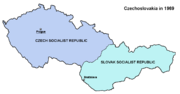
was officially promoted and taught. In 1969, Czechoslovakia was turned into a federation of the Czech Socialist Republic
and Slovak Socialist Republic
.
Under the federation, social and economic inequities between the Czech and Slovak halves of the state were largely eliminated. A number of ministries, such as Education, were formally transferred to the two republics. However, the centralized political control by the Communist Party severely limited the effects of federalization.
The 1970s saw the rise of the dissident
movement in Czechoslovakia, represented (among others) by Václav Havel
. The movement sought greater political participation and expression in the face of official disapproval, making itself felt by limits on work activities (up to a ban on any professional employment and refusal of higher education to the dissident's children), police harassment and even prison time.
In late 1989, the country became a democratic country again through the Velvet Revolution
. In 1992, the federal parliament decided to dissolve
the country into the Czech Republic
and Slovakia
, as of 1 January 1993.
and East Germany, People's Republic of Poland
, Soviet Union
, People's Republic of Hungary
, and Austria
.
(KSČ) led initially by First Secretary Klement Gottwald
, held a monopoly on politics,. Following the 1948 Tito-Stalin split
and Berlin Blockade
, increased party purges occurred throughout the Eastern Bloc
, including a purge of 550,000 party members of the KSČ, which comprised 30% of its members. Approximately 130,000 people were sent to prisons, labor camps and mines.
The evolution of the resulting harshness of purges in Czechoslovakia, like much of its history after 1948, was a function of the late takeover by the communists, with many of the purges focusing on the sizable numbers of party members with prior memberships in other parties. The purges accompanied various show trials, including those of Rudolf Slánský
, Vladimír Clementis
, Ladislav Novomeský and Gustáv Husák
(Clementis was later executed). Slánský and eleven others were convicted together of being "Trotskyist-zionist-titoist-bourgeois-nationalist traitors" in one series of show trials, after which they were executed and their ashes were mixed with material being used to fill roads on the outskirts of Prague.
Antonín Novotny
served as First Secretary
of the KSČ from 1953 to 1968. Gustáv Husák
was elected first secretary of KSČ in 1969 (changed to general secretary in 1971) and president of Czechoslovakia in 1975. Other parties and organizations existed but functioned in subordinate roles to KSČ. All political parties, as well as numerous mass organizations, were grouped under the umbrella of National Front of the Czechoslovak Socialist Republic. Human rights activists and religious activists were severely repressed.
In terms of political positions, the KSČ maintained the cadre and the nomenklatura
lists, with the latter containing every post in each country that was important to the smooth application of party policy, including military posts, administrative positions, directors of local enterprises, social organization administrators, newspapers, etc. The KSČ's nomenklatura lists were thought to contain 100,000 post listings. The names of those that the party considered to be trustworthy enough to secure a nomenklatura post were compiled on the cadre list.
command economy with links controlled by the communist party, similar to the Soviet Union
. It had a large metallurgical industry, but was dependent on imports for iron and nonferrous ores. Like the rest of the Eastern Bloc, producer goods were favored over consumer goods, causing consumer goods to be lacking in quantity and quality. This resulted in shortage economies. Economic growth rates lagged well behind Czechoslovakia's western European counterparts. Investments made in industry did not yield the results expected, and consumption of energy and raw materials was excessive. Czechoslovak leaders themselves decried the economy's failure to modernize with sufficient speed.
was suppressed.
In the 1980s the most popular way to emigrate to the West was to travel to Yugoslavia
by automobile and, once there, take a detour to Greece
, Austria, or Italy
(Yugoslav border restrictions were not as strict as those of the Warsaw Pact nations). Only a small percentage of those who applied to emigrate legally could do so. The exact details of the process have never been published, but a reasonably clear picture can be gleaned from those who have succeeded. It is a lengthy and costly process. Those applicants allowed to even consider emigration have been required to repay the state for their education, depending on their level of education and salary, at a rate ranging from 4,000 Kčs to 10,000 Kčs. (The average yearly wage was about Kčs33,600 in 1984.) The applicant was likely to lose his job and be socially ostracized.
Technically, at least, such emigres would be allowed to return for visits. Those who had been politically active, such as Charter 77 signatories found it somewhat easier to emigrate, but they have not been allowed to return and reportedly have had to pay the state exorbitant fees—Kčs23,000 to as much as Kčs80,000—if they had graduated from a university. Old-age pensioners had no problem visiting or emigrating to the West. The reasons for this were purely economic; if they decided to stay in the West, the state no longer had to pay their pension.
There is (and always was) a huge discrepancy between "official statistics" (i.e., numbers issued by communist regime) on how many people emigrated from Czechoslovakia
and refugee statistics published by UNHCR, which was collecting data on "illegal refugees". This discrepancy was not specific to Czechoslovakia only; a similar situation applied for all Eastern Bloc
countries, as their totalitarian regimes preferred to downplay and suppress real numbers.
Official statistics for the early 1980s show that, on the average, 3,500 people emigrated legally each year. From 1965 to 1983, a total of 33,000 people emigrated legally. This figure undoubtedly included a large number of ethnic Germans resettled in East Germany. The largest émigré communities are located in Austria
, West Germany
, the United States, Canada, and Australia.
Unofficial figures are much larger. It is estimated that between 1948 and 1989 close to 1 million people left communist Czechoslovakia
. The largest exoduses occurred following the communist takeover in February 1948 and following the Warsaw pact occupation of Czechoslovakia
in 1968, with around 200 000 people leaving in each wave. A very similar 200 000-strong refugee wave left Hungary in 1956 after their failed anti-communist revolution. In the fifties, when the regime was at its harshest and the "Iron Curtain
" was close to impenetrable, emigration was very low. It increased between 1969 and 1989, when close to 40 000 people were leaving the country each year. All of them were sentenced to imprisonment in absentia by the communist regime for leaving the country illegally.
and Slovakia
(KSČ). Private ownership of any publication or agency of the mass media was generally forbidden, although churches and other organizations published small periodicals and newspapers. Even with this informational monopoly in the hands of organizations under KSČ control, all publications were reviewed
by the government's Office for Press and Information.
), Warsaw Pact
, UN and its specialized agencies, and Non-Aligned Movement
; signatory of conference on Security and Cooperation in Europe
Czech language
Czech is a West Slavic language with about 12 million native speakers; it is the majority language in the Czech Republic and spoken by Czechs worldwide. The language was known as Bohemian in English until the late 19th century...
and Slovak
Slovak language
Slovak , is an Indo-European language that belongs to the West Slavic languages .Slovak is the official language of Slovakia, where it is spoken by 5 million people...
) was the official name of Czechoslovakia
Czechoslovakia
Czechoslovakia or Czecho-Slovakia was a sovereign state in Central Europe which existed from October 1918, when it declared its independence from the Austro-Hungarian Empire, until 1992...
from 1960 until end of 1989 (i.e., shortly after the Velvet Revolution
Velvet Revolution
The Velvet Revolution or Gentle Revolution was a non-violent revolution in Czechoslovakia that took place from November 17 – December 29, 1989...
), a Soviet
Soviet Union
The Soviet Union , officially the Union of Soviet Socialist Republics , was a constitutionally socialist state that existed in Eurasia between 1922 and 1991....
satellite state
Satellite state
A satellite state is a political term that refers to a country that is formally independent, but under heavy political and economic influence or control by another country...
of the Eastern Bloc
Eastern bloc
The term Eastern Bloc or Communist Bloc refers to the former communist states of Eastern and Central Europe, generally the Soviet Union and the countries of the Warsaw Pact...
.
Following the coup d'état of February 1948
Czechoslovak coup d'état of 1948
The Czechoslovak coup d'état of 1948 – in Communist historiography known as "Victorious February" – was an event late that February in which the Communist Party of Czechoslovakia, with Soviet backing, assumed undisputed control over the government of Czechoslovakia, ushering in over four decades...
, when the Communist Party of Czechoslovakia
Communist Party of Czechoslovakia
The Communist Party of Czechoslovakia, in Czech and in Slovak: Komunistická strana Československa was a Communist and Marxist-Leninist political party in Czechoslovakia that existed between 1921 and 1992....
seized power with the backing of the Soviet Union, the country was declared a people's republic
People's Republic
People's Republic is a title that has often been used by Marxist-Leninist governments to describe their state. The motivation for using this term lies in the claim that Marxist-Leninists govern in accordance with the interests of the vast majority of the people, and, as such, a Marxist-Leninist...
after the Ninth-of-May Constitution
Ninth-of-May Constitution
The Ninth-of-May Constitution was a constitution of Czechoslovakia in force from 1948 to 1960. It came into force on May 9, shortly after the communist seizure of power in the country on 25 February 1948. It replaced the 1920 Constitution...
became effective. The traditional name Československá republika (Czechoslovak Republic) was changed on 11 July 1960 following implementation of the 1960 Constitution of Czechoslovakia
1960 Constitution of Czechoslovakia
The Constitution of the Czechoslovak Socialist Republic , promulgated on 11 July 1960 as the constitutional law 100/1960 Sb., codified the Communist regime in Czechoslovakia...
as a symbol of the "final victory of socialism" in the country, and remained so until the Velvet Revolution in Czechoslovakia. Several other state symbols were changed in 1960.
Formation
Before the Soviet invasion of Czechoslovakia, in 1943, Czechoslovakian leader in exile Edvard BenešEdvard Beneš
Edvard Beneš was a leader of the Czechoslovak independence movement, Minister of Foreign Affairs and the second President of Czechoslovakia. He was known to be a skilled diplomat.- Youth :...
agreed to Soviet leader Joseph Stalin
Joseph Stalin
Joseph Vissarionovich Stalin was the Premier of the Soviet Union from 6 May 1941 to 5 March 1953. He was among the Bolshevik revolutionaries who brought about the October Revolution and had held the position of first General Secretary of the Communist Party of the Soviet Union's Central Committee...
's demands for unconditional agreement with Soviet foreign policy and the Beneš decrees
Beneš decrees
Decrees of the President of the Republic , more commonly known as the Beneš decrees, were a series of laws that were drafted by the Czechoslovak Government-in-Exile in the absence of the Czechoslovak parliament during the German occupation of Czechoslovakia in World War II and issued by President...
. While Beneš was not a Moscow cadre and several domestic reforms of other Eastern Bloc
Eastern bloc
The term Eastern Bloc or Communist Bloc refers to the former communist states of Eastern and Central Europe, generally the Soviet Union and the countries of the Warsaw Pact...
countries were not part Beneš' plan, Stalin did not object because the plan included property expropriation and he was satisfied with the relative strength of communists in Czechoslovakia compared to other Eastern Bloc countries.
In April 1945, the Third Republic was formed, led by a National Front
National Front (Czechoslovakia)
The National Front was the coalition of parties which headed the re-established Czechoslovakian government from 1945 to 1948. During the Communist era in Czechoslovakia it was the vehicle for control of all political and social activity by the Communist Party of Czechoslovakia...
of six parties. Because of the Communist Party of Czechoslovakia
Communist Party of Czechoslovakia
The Communist Party of Czechoslovakia, in Czech and in Slovak: Komunistická strana Československa was a Communist and Marxist-Leninist political party in Czechoslovakia that existed between 1921 and 1992....
's strength (they held 114 of 300 seats) and Beneš' loyalty, unlike in other Eastern Bloc
Eastern bloc
The term Eastern Bloc or Communist Bloc refers to the former communist states of Eastern and Central Europe, generally the Soviet Union and the countries of the Warsaw Pact...
countries, the Kremlin did not require Bloc politics or "reliable" cadres in Czechoslovakian power positions, and the executive and legislative branches retained their traditional structures. The Communists were the big winners in the 1946 elections
Czechoslovak parliamentary election, 1946
Parliamentary elections were held in Czechoslovakia on 26 May 1946. The result was a victory for the Communist Party of Czechoslovakia, which won 93 of the 300 seats. Voter turnout was 93.9%.-Background:...
--one of only two free elections ever held in the Soviet bloc. Klement Gottwald
Klement Gottwald
Klement Gottwald was a Czechoslovakian Communist politician, longtime leader of the Communist Party of Czechoslovakia , prime minister and president of Czechoslovakia.-Early life:...
, leader of the KSČ, became Prime Minister of Czechoslovakia.
However, thereafter, the Soviet Union was disappointed that the government failed to eliminate "bourgeois" influence in the army, expropriate industrialists and large landowners and eliminate parties outside of the "National Front". Hope in Moscow was waning for a communist victory in the 1948 elections following a May 1947 Kremlin report concluded that "reactionary elements" praising western democracy had strengthened.
Following Czechoslovakia's brief consideration of taking Marshall Plan
Marshall Plan
The Marshall Plan was the large-scale American program to aid Europe where the United States gave monetary support to help rebuild European economies after the end of World War II in order to combat the spread of Soviet communism. The plan was in operation for four years beginning in April 1948...
funds, and the subsequent scolding of communist parties by the Cominform
Cominform
Founded in 1947, Cominform is the common name for what was officially referred to as the Information Bureau of the Communist and Workers' Parties...
at Szklarska Poręba
Szklarska Poreba
Szklarska Poręba is a town in Jelenia Góra County, Lower Silesian Voivodeship, in south-western Poland. The town has a population of around 7,000...
in September 1947, Rudolf Slánský
Rudolf Slánský
Rudolf Slánský was a Czech Communist politician. Holding the post of the party's General Secretary after World War II, he was one of the leading creators and organizers of Communist rule in Czechoslovakia...
returned to Prague
Prague
Prague is the capital and largest city of the Czech Republic. Situated in the north-west of the country on the Vltava river, the city is home to about 1.3 million people, while its metropolitan area is estimated to have a population of over 2.3 million...
with a plan for the final seizure of power, including the StB
STB
STB is an acronym that can mean:* Sacrae Theologiae Baccalaureus – Bachelor of Sacred Theology* Set-top box – a television device that converts signals to viewable images* Simpson Thacher & Bartlett LLP -- a law firm...
's elimination of party enemies and purging of dissidents. Thereafter, Soviet Ambassador Valerian Zorin
Valerian Zorin
Valerian Alexandrovich Zorin was a Soviet diplomat and statesman.-Biography:After joining the Soviet Communist Party in 1922, Zorin held a managerial position in a Moscow City Committee and the Central Committee of the Komsomol until 1932...
arranged the Czechoslovak coup d'état
Czechoslovak coup d'état of 1948
The Czechoslovak coup d'état of 1948 – in Communist historiography known as "Victorious February" – was an event late that February in which the Communist Party of Czechoslovakia, with Soviet backing, assumed undisputed control over the government of Czechoslovakia, ushering in over four decades...
, followed by the occupation of non-Communist ministers' ministries, while the army was confined to barracks.
On 25 February 1948, Beneš, fearful of civil war and Soviet intervention, capitulated and appointed a Communist-dominated government who was sworn in two days later. Although members of the other National Front parties still nominally figured, this was, for all intents and purposes, the start of out-and-out Communist rule in the country. The only non-Communist to hold an important office, Jan Masaryk
Jan Masaryk
Jan Garrigue Masaryk was a Czech diplomat and politician and Foreign Minister of Czechoslovakia from 1940 to 1948.- Early life :...
, was found dead two weeks later. On 30 May, a single list of candidates from the National Front--now a broad patriotic organization dominated by the Communists--was elected to the National Assembly.
After passage of the Ninth-of-May Constitution
Ninth-of-May Constitution
The Ninth-of-May Constitution was a constitution of Czechoslovakia in force from 1948 to 1960. It came into force on May 9, shortly after the communist seizure of power in the country on 25 February 1948. It replaced the 1920 Constitution...
on 9 June 1948, the country became a People's Republic
People's Republic
People's Republic is a title that has often been used by Marxist-Leninist governments to describe their state. The motivation for using this term lies in the claim that Marxist-Leninists govern in accordance with the interests of the vast majority of the people, and, as such, a Marxist-Leninist...
until 1960. Although it was not a completely Communist document, it was close enough to the Soviet model that Beneš refused to sign it. He'd resigned a week before it was finally ratified, and died in September. The Ninth-of-May Constitution confirmed that the KSČ possessed absolute power, as other Communist parties had in the Eastern Bloc
Eastern bloc
The term Eastern Bloc or Communist Bloc refers to the former communist states of Eastern and Central Europe, generally the Soviet Union and the countries of the Warsaw Pact...
. On 11 July 1960, the 1960 Constitution of Czechoslovakia
1960 Constitution of Czechoslovakia
The Constitution of the Czechoslovak Socialist Republic , promulgated on 11 July 1960 as the constitutional law 100/1960 Sb., codified the Communist regime in Czechoslovakia...
was promulgated, changing the name of the country from the "Czechoslovak Republic" to the "Czechoslovak Socialist Republic".
History
- Main articles: History of CzechoslovakiaHistory of CzechoslovakiaWith the collapse of the Habsburg monarchy at the end of World War I, the independent country of Czechoslovakia was formed, encouraged by, among others, U.S. President Woodrow Wilson...
, 1948–1989 and 1989–1992
Prague Spring
The Prague Spring was a period of political liberalization in Czechoslovakia during the era of its domination by the Soviet Union after World War II...
) the country was characterized by the absence of democracy and competitiveness with the Western European nations as part of the Cold War
Cold War
The Cold War was the continuing state from roughly 1946 to 1991 of political conflict, military tension, proxy wars, and economic competition between the Communist World—primarily the Soviet Union and its satellite states and allies—and the powers of the Western world, primarily the United States...
. In the religious sphere, atheism
Atheism
Atheism is, in a broad sense, the rejection of belief in the existence of deities. In a narrower sense, atheism is specifically the position that there are no deities...
was officially promoted and taught. In 1969, Czechoslovakia was turned into a federation of the Czech Socialist Republic
Czech Socialist Republic
From 1969 to 1990, the Czech Socialist Republic was the official name of that part of Czechoslovakia that is the Czech Republic today. The name was used from 1 January 1969 to March 1990....
and Slovak Socialist Republic
Slovak Socialist Republic
From 1969 to 1990, the Slovak Socialist Republic was the official name of that part of Czechoslovakia that is Slovakia today. The name was used from 1 January 1969 until March 1990....
.
Under the federation, social and economic inequities between the Czech and Slovak halves of the state were largely eliminated. A number of ministries, such as Education, were formally transferred to the two republics. However, the centralized political control by the Communist Party severely limited the effects of federalization.
The 1970s saw the rise of the dissident
Dissident
A dissident, broadly defined, is a person who actively challenges an established doctrine, policy, or institution. When dissidents unite for a common cause they often effect a dissident movement....
movement in Czechoslovakia, represented (among others) by Václav Havel
Václav Havel
Václav Havel is a Czech playwright, essayist, poet, dissident and politician. He was the tenth and last President of Czechoslovakia and the first President of the Czech Republic . He has written over twenty plays and numerous non-fiction works, translated internationally...
. The movement sought greater political participation and expression in the face of official disapproval, making itself felt by limits on work activities (up to a ban on any professional employment and refusal of higher education to the dissident's children), police harassment and even prison time.
In late 1989, the country became a democratic country again through the Velvet Revolution
Velvet Revolution
The Velvet Revolution or Gentle Revolution was a non-violent revolution in Czechoslovakia that took place from November 17 – December 29, 1989...
. In 1992, the federal parliament decided to dissolve
Dissolution of Czechoslovakia
The dissolution of Czechoslovakia, which took effect on 1 January 1993, was an event that saw the self-determined separation of the federal state of Czechoslovakia. The Czech Republic and Slovakia, entities which had arisen in 1969 within the framework of Czechoslovak federalisation, became...
the country into the Czech Republic
Czech Republic
The Czech Republic is a landlocked country in Central Europe. The country is bordered by Poland to the northeast, Slovakia to the east, Austria to the south, and Germany to the west and northwest....
and Slovakia
Slovakia
The Slovak Republic is a landlocked state in Central Europe. It has a population of over five million and an area of about . Slovakia is bordered by the Czech Republic and Austria to the west, Poland to the north, Ukraine to the east and Hungary to the south...
, as of 1 January 1993.
Geography
Neighbour states were: West GermanyWest Germany
West Germany is the common English, but not official, name for the Federal Republic of Germany or FRG in the period between its creation in May 1949 to German reunification on 3 October 1990....
and East Germany, People's Republic of Poland
People's Republic of Poland
The People's Republic of Poland was the official name of Poland from 1952 to 1990. Although the Soviet Union took control of the country immediately after the liberation from Nazi Germany in 1944, the name of the state was not changed until eight years later...
, Soviet Union
Soviet Union
The Soviet Union , officially the Union of Soviet Socialist Republics , was a constitutionally socialist state that existed in Eurasia between 1922 and 1991....
, People's Republic of Hungary
People's Republic of Hungary
The People's Republic of Hungary or Hungarian People's Republic was the official state name of Hungary from 1949 to 1989 during its Communist period under the guidance of the Soviet Union. The state remained in existence until 1989 when opposition forces consolidated in forcing the regime to...
, and Austria
Austria
Austria , officially the Republic of Austria , is a landlocked country of roughly 8.4 million people in Central Europe. It is bordered by the Czech Republic and Germany to the north, Slovakia and Hungary to the east, Slovenia and Italy to the south, and Switzerland and Liechtenstein to the...
.
Administrative divisions
- 1960–1992: 10 regions [kraje], PraguePraguePrague is the capital and largest city of the Czech Republic. Situated in the north-west of the country on the Vltava river, the city is home to about 1.3 million people, while its metropolitan area is estimated to have a population of over 2.3 million...
, and (since 1970) BratislavaBratislavaBratislava is the capital of Slovakia and, with a population of about 431,000, also the country's largest city. Bratislava is in southwestern Slovakia on both banks of the Danube River. Bordering Austria and Hungary, it is the only national capital that borders two independent countries.Bratislava...
; divided in 109–114 districts [okresy]; the kraje were abolished temporarily in Slovakia in 1969–1970 and for many functions since 1991 in Czechoslovakia; in addition, the two republics Czech Socialist Republic and Slovak Socialist Republic were established in 1969.
Politics
The Communist Party of CzechoslovakiaCommunist Party of Czechoslovakia
The Communist Party of Czechoslovakia, in Czech and in Slovak: Komunistická strana Československa was a Communist and Marxist-Leninist political party in Czechoslovakia that existed between 1921 and 1992....
(KSČ) led initially by First Secretary Klement Gottwald
Klement Gottwald
Klement Gottwald was a Czechoslovakian Communist politician, longtime leader of the Communist Party of Czechoslovakia , prime minister and president of Czechoslovakia.-Early life:...
, held a monopoly on politics,. Following the 1948 Tito-Stalin split
Tito-Stalin Split
The Tito–Stalin Split was a conflict between the leaders of Socialist Federal Republic of Yugoslavia and the Union of Soviet Socialist Republics, which resulted in Yugoslavia's expulsion from the Communist Information Bureau in 1948...
and Berlin Blockade
Berlin Blockade
The Berlin Blockade was one of the first major international crises of the Cold War and the first resulting in casualties. During the multinational occupation of post-World War II Germany, the Soviet Union blocked the Western Allies' railway and road access to the sectors of Berlin under Allied...
, increased party purges occurred throughout the Eastern Bloc
Eastern bloc
The term Eastern Bloc or Communist Bloc refers to the former communist states of Eastern and Central Europe, generally the Soviet Union and the countries of the Warsaw Pact...
, including a purge of 550,000 party members of the KSČ, which comprised 30% of its members. Approximately 130,000 people were sent to prisons, labor camps and mines.
The evolution of the resulting harshness of purges in Czechoslovakia, like much of its history after 1948, was a function of the late takeover by the communists, with many of the purges focusing on the sizable numbers of party members with prior memberships in other parties. The purges accompanied various show trials, including those of Rudolf Slánský
Rudolf Slánský
Rudolf Slánský was a Czech Communist politician. Holding the post of the party's General Secretary after World War II, he was one of the leading creators and organizers of Communist rule in Czechoslovakia...
, Vladimír Clementis
Vladimír Clementis
Vladimír "Vlado" Clementis was a Slovak minister, politician, lawyer, publicist, literary critic, author and a prominent member of the Czechoslovak Communist Party. He married Lída Pátková, a daughter of a branch director of Czech Hypothec Bank in Bratislava, in March 1933. He became a Communist...
, Ladislav Novomeský and Gustáv Husák
Gustáv Husák
Gustáv Husák was a Slovak politician, president of Czechoslovakia and a long-term Communist leader of Czechoslovakia and of the Communist Party of Czechoslovakia...
(Clementis was later executed). Slánský and eleven others were convicted together of being "Trotskyist-zionist-titoist-bourgeois-nationalist traitors" in one series of show trials, after which they were executed and their ashes were mixed with material being used to fill roads on the outskirts of Prague.
Antonín Novotny
Antonín Novotný
Antonín Novotný was General Secretary of the Communist Party of Czechoslovakia from 1953 to 1968, and also held the post of President of Czechoslovakia from 1957 to 1968. He was born in Letňany, now part of Prague....
served as First Secretary
General Secretary
The office of general secretary is staffed by the chief officer of:*The General Secretariat for Macedonia and Thrace, a government agency for the Greek regions of Macedonia and Thrace...
of the KSČ from 1953 to 1968. Gustáv Husák
Gustáv Husák
Gustáv Husák was a Slovak politician, president of Czechoslovakia and a long-term Communist leader of Czechoslovakia and of the Communist Party of Czechoslovakia...
was elected first secretary of KSČ in 1969 (changed to general secretary in 1971) and president of Czechoslovakia in 1975. Other parties and organizations existed but functioned in subordinate roles to KSČ. All political parties, as well as numerous mass organizations, were grouped under the umbrella of National Front of the Czechoslovak Socialist Republic. Human rights activists and religious activists were severely repressed.
In terms of political positions, the KSČ maintained the cadre and the nomenklatura
Nomenklatura
The nomenklatura were a category of people within the Soviet Union and other Eastern Bloc countries who held various key administrative positions in all spheres of those countries' activity: government, industry, agriculture, education, etc., whose positions were granted only with approval by the...
lists, with the latter containing every post in each country that was important to the smooth application of party policy, including military posts, administrative positions, directors of local enterprises, social organization administrators, newspapers, etc. The KSČ's nomenklatura lists were thought to contain 100,000 post listings. The names of those that the party considered to be trustworthy enough to secure a nomenklatura post were compiled on the cadre list.
Economy
The Czechoslovakian economy was a centrally plannedPlanned economy
A planned economy is an economic system in which decisions regarding production and investment are embodied in a plan formulated by a central authority, usually by a government agency...
command economy with links controlled by the communist party, similar to the Soviet Union
Soviet Union
The Soviet Union , officially the Union of Soviet Socialist Republics , was a constitutionally socialist state that existed in Eurasia between 1922 and 1991....
. It had a large metallurgical industry, but was dependent on imports for iron and nonferrous ores. Like the rest of the Eastern Bloc, producer goods were favored over consumer goods, causing consumer goods to be lacking in quantity and quality. This resulted in shortage economies. Economic growth rates lagged well behind Czechoslovakia's western European counterparts. Investments made in industry did not yield the results expected, and consumption of energy and raw materials was excessive. Czechoslovak leaders themselves decried the economy's failure to modernize with sufficient speed.
- Industry: Extractive and manufacturing industries dominated sector. Major branches included machinery, chemicals, food processing, metallurgy, and textiles. Industry was wasteful of energy, materials, and labor and slow to upgrade technology, but was a source of high-quality machinery and arms for other communist countries.
- Agriculture: Minor sector but supplied bulk of food needs. Dependent on large imports of grains (mainly for livestock feed) in years of adverse weather. Meat production constrained by shortage of feed, but high per capita consumption of meat.
- Foreign Trade: Exports estimated at US$17.8 billion in 1985, of which 55% was machinery, 14% fuels and materials, and 16% manufactured consumer goods. Imports at estimated US$17.9 billion in 1985, of which 41% was fuels and materials, 33% machinery, and 12% agricultural and forestry products. In 1986, about 80% of foreign trade was with communist countries.
- Exchange Rate: Official, or commercial, rate Kcs 5.4 per US$1 in 1987; tourist, or noncommercial, rate Kcs 10.5 per US$1. Neither rate reflected purchasing power. The exchange rate on the black market was around Kcs 30 per US$1, and this rate became the official one once the currency became convertible in the early 1990s.
- Fiscal Year: Calendar year.
- Fiscal Policy: State almost exclusive owner of means of production. Revenues from state enterprises primary source of revenues followed by turnover taxTurnover taxA turnover tax is similar to a sales tax or a VAT, with the difference that it taxes intermediate and possibly capital goods. It is an indirect tax, typically on an ad valorem basis, applicable to a production process or stage. For example, when manufacturing activity is completed, a tax may be...
. Large budget expenditures on social programs, subsidies, and investments. Budget usually balanced or small surplus.
Resource base
After World War II, the country was short on energy, relying on imported crude oil and natural gas from the Soviet Union, domestic brown coal, and nuclear and hydroelectric energy. Energy constraints were a major factor in 1980s.Emigration
Historically, emigration has always been an option for Czechs and Slovaks dissatisfied with the situation at home. Each wave of emigration had its own impetus. In the nineteenth century, the reasons were primarily economic. In the twentieth century, emigration has largely been prompted by political turmoil, though economic factors still play a role. The first major wave of emigration in the 20th century came after the communists came to power, and the next wave began after the Prague SpringPrague Spring
The Prague Spring was a period of political liberalization in Czechoslovakia during the era of its domination by the Soviet Union after World War II...
was suppressed.
In the 1980s the most popular way to emigrate to the West was to travel to Yugoslavia
Yugoslavia
Yugoslavia refers to three political entities that existed successively on the western part of the Balkans during most of the 20th century....
by automobile and, once there, take a detour to Greece
Greece
Greece , officially the Hellenic Republic , and historically Hellas or the Republic of Greece in English, is a country in southeastern Europe....
, Austria, or Italy
Italy
Italy , officially the Italian Republic languages]] under the European Charter for Regional or Minority Languages. In each of these, Italy's official name is as follows:;;;;;;;;), is a unitary parliamentary republic in South-Central Europe. To the north it borders France, Switzerland, Austria and...
(Yugoslav border restrictions were not as strict as those of the Warsaw Pact nations). Only a small percentage of those who applied to emigrate legally could do so. The exact details of the process have never been published, but a reasonably clear picture can be gleaned from those who have succeeded. It is a lengthy and costly process. Those applicants allowed to even consider emigration have been required to repay the state for their education, depending on their level of education and salary, at a rate ranging from 4,000 Kčs to 10,000 Kčs. (The average yearly wage was about Kčs33,600 in 1984.) The applicant was likely to lose his job and be socially ostracized.
Technically, at least, such emigres would be allowed to return for visits. Those who had been politically active, such as Charter 77 signatories found it somewhat easier to emigrate, but they have not been allowed to return and reportedly have had to pay the state exorbitant fees—Kčs23,000 to as much as Kčs80,000—if they had graduated from a university. Old-age pensioners had no problem visiting or emigrating to the West. The reasons for this were purely economic; if they decided to stay in the West, the state no longer had to pay their pension.
There is (and always was) a huge discrepancy between "official statistics" (i.e., numbers issued by communist regime) on how many people emigrated from Czechoslovakia
Czechoslovakia
Czechoslovakia or Czecho-Slovakia was a sovereign state in Central Europe which existed from October 1918, when it declared its independence from the Austro-Hungarian Empire, until 1992...
and refugee statistics published by UNHCR, which was collecting data on "illegal refugees". This discrepancy was not specific to Czechoslovakia only; a similar situation applied for all Eastern Bloc
Eastern bloc
The term Eastern Bloc or Communist Bloc refers to the former communist states of Eastern and Central Europe, generally the Soviet Union and the countries of the Warsaw Pact...
countries, as their totalitarian regimes preferred to downplay and suppress real numbers.
Official statistics for the early 1980s show that, on the average, 3,500 people emigrated legally each year. From 1965 to 1983, a total of 33,000 people emigrated legally. This figure undoubtedly included a large number of ethnic Germans resettled in East Germany. The largest émigré communities are located in Austria
Austria
Austria , officially the Republic of Austria , is a landlocked country of roughly 8.4 million people in Central Europe. It is bordered by the Czech Republic and Germany to the north, Slovakia and Hungary to the east, Slovenia and Italy to the south, and Switzerland and Liechtenstein to the...
, West Germany
West Germany
West Germany is the common English, but not official, name for the Federal Republic of Germany or FRG in the period between its creation in May 1949 to German reunification on 3 October 1990....
, the United States, Canada, and Australia.
Unofficial figures are much larger. It is estimated that between 1948 and 1989 close to 1 million people left communist Czechoslovakia
Czechoslovakia
Czechoslovakia or Czecho-Slovakia was a sovereign state in Central Europe which existed from October 1918, when it declared its independence from the Austro-Hungarian Empire, until 1992...
. The largest exoduses occurred following the communist takeover in February 1948 and following the Warsaw pact occupation of Czechoslovakia
Prague Spring
The Prague Spring was a period of political liberalization in Czechoslovakia during the era of its domination by the Soviet Union after World War II...
in 1968, with around 200 000 people leaving in each wave. A very similar 200 000-strong refugee wave left Hungary in 1956 after their failed anti-communist revolution. In the fifties, when the regime was at its harshest and the "Iron Curtain
Iron Curtain
The concept of the Iron Curtain symbolized the ideological fighting and physical boundary dividing Europe into two separate areas from the end of World War II in 1945 until the end of the Cold War in 1989...
" was close to impenetrable, emigration was very low. It increased between 1969 and 1989, when close to 40 000 people were leaving the country each year. All of them were sentenced to imprisonment in absentia by the communist regime for leaving the country illegally.
Religion
In 1991: Roman Catholics 46.4%, Evangelic Lutheran 5.3%, Atheist 29.5%, n/a 16.7%, but there were huge differences between the 2 constituent republics – see Czech RepublicCzech Republic
The Czech Republic is a landlocked country in Central Europe. The country is bordered by Poland to the northeast, Slovakia to the east, Austria to the south, and Germany to the west and northwest....
and Slovakia
Slovakia
The Slovak Republic is a landlocked state in Central Europe. It has a population of over five million and an area of about . Slovakia is bordered by the Czech Republic and Austria to the west, Poland to the north, Ukraine to the east and Hungary to the south...
Health, social welfare and housing
After World War II, free health care was available to all citizens. National health planning emphasized preventive medicine; factory and local health-care centers supplemented hospitals and other inpatient institutions. Substantial improvement in rural health care in 1960s and 1970s.Mass media
The mass media in Czechoslovakia was controlled by the Communist Party of CzechoslovakiaCommunist Party of Czechoslovakia
The Communist Party of Czechoslovakia, in Czech and in Slovak: Komunistická strana Československa was a Communist and Marxist-Leninist political party in Czechoslovakia that existed between 1921 and 1992....
(KSČ). Private ownership of any publication or agency of the mass media was generally forbidden, although churches and other organizations published small periodicals and newspapers. Even with this informational monopoly in the hands of organizations under KSČ control, all publications were reviewed
Censorship
thumb|[[Book burning]] following the [[1973 Chilean coup d'état|1973 coup]] that installed the [[Military government of Chile |Pinochet regime]] in Chile...
by the government's Office for Press and Information.
Heads of state and government
International agreements and membership
Active participant in Council for Mutual Economic Assistance (ComeconComecon
The Council for Mutual Economic Assistance , 1949–1991, was an economic organisation under hegemony of Soviet Union comprising the countries of the Eastern Bloc along with a number of communist states elsewhere in the world...
), Warsaw Pact
Warsaw Pact
The Warsaw Treaty Organization of Friendship, Cooperation, and Mutual Assistance , or more commonly referred to as the Warsaw Pact, was a mutual defense treaty subscribed to by eight communist states in Eastern Europe...
, UN and its specialized agencies, and Non-Aligned Movement
Non-Aligned Movement
The Non-Aligned Movement is a group of states considering themselves not aligned formally with or against any major power bloc. As of 2011, the movement had 120 members and 17 observer countries...
; signatory of conference on Security and Cooperation in Europe
See also
- Government structure of Communist CzechoslovakiaGovernment structure of Communist CzechoslovakiaThe government of Czechoslovakia under communism was in theory a democratic one directed by the proletariat. In practice, it was a one-party dictatorship run by the Communist Party of Czechoslovakia, the KSC....
- Economy of Communist CzechoslovakiaEconomy of Communist CzechoslovakiaIn the mid-1980s, Czechoslovakia was the most prosperous country in the Eastern Bloc. Although levels of consumption were well below those common in Western Europe, inhabitants of Czechoslovakia enjoyed a standard of living generally higher than that found in most other East European countries...
- Resource base of Communist CzechoslovakiaResource base of Communist Czechoslovakia- Minerals and Mining:Czechoslovakia had significant quantities of coal and lignite.*Hard coal suitable for extraction was present in the Ostrava coalfields and near Kladno, Plzeň , Košice, and Trutnov....
- Transportation in Czechoslovakia
- Population and Ethnic Groups of Czechoslovakia
- Society of Communist CzechoslovakiaSociety of Communist CzechoslovakiaCzechoslovakia, of all the East European countries, entered the postwar era with a relatively balanced social structure and an equitable distribution of resources. Despite some poverty, overall it was a country of relatively well-off workers, small-scale producers, farmers, and a substantial middle...
- Education in CzechoslovakiaEducation in Czechoslovakia-Before the Communist Era:Czechoslovakia had a tradition of academic and scholarly endeavor in the mainstream of European thought and a history of higher education dating from the Middle Ages...
- Religion in Communist Czechoslovakia
- Health and Social Welfare in Communist CzechoslovakiaHealth and social welfare in Communist Czechoslovakia- Characteristics :In the 1980s, Czechoslovakia had a comprehensive and universal system of social security under which everyone was entitled to free medical care and medicine, in theory at least. National health planning emphasized preventive medicine...
- Mass media in Communist CzechoslovakiaMass media in Communist CzechoslovakiaThe mass media in Communist Czechoslovakia was controlled by the Communist Party of Czechoslovakia . Private ownership of any publication or agency of the mass media was generally forbidden, although churches and other organizations published small periodicals and newspapers...
External links
- RFE/RL Czechoslovak Unit Open Society Archives, Budapest