

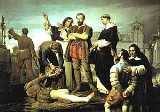
Castilian War of the Communities

Encyclopedia
The Revolt of the Comuneros was an uprising by citizens of Castile
against the rule of Charles V
and his administration between 1520 and 1521. At its height, the rebels controlled the heart of Castile, ruling the cities of Valladolid
, Tordesillas
, and Toledo
.
The revolt occurred in the wake of political instability in the Crown of Castile
after the death of Queen Isabella I
in 1504. Joanna the Mad
, Ferdinand
and Isabella's second daughter, inherited the throne with her Burgundian husband King Philip I
. However, Philip died two years into his reign, and their son Charles was only six years old. Due to his youth and Joanna's mental instability, Castile was ruled by the nobles and Ferdinand of Aragon as a regency. After Ferdinand's death in 1516, the sixteen-year-old Charles was proclaimed King Charles I of both Castile and Aragon
. Charles had been raised in the Netherlands
with little knowledge of Castilian Spanish
. He arrived in Spain in October 1517 accompanied by a large retinue of Flemish nobles and clerics. These factors resulted in mistrust between the new king and the Castilian social elites, who could see the threat to their power and status.
In 1519, Charles was elected Holy Roman Emperor
. He departed for Germany in 1520, leaving the Dutch cardinal Adrian of Utrecht to rule Castile in his absence. Soon, a series of anti-government riots broke out in the cities, and local city councils (Comunidades) took power. The rebels chose Charles' own mother, Queen Joanna, as an alternative ruler, hoping they could control her madness. The rebel movement took on a radical anti-feudal
dimension, supporting peasant rebellions against the landed nobility. On April 23, 1521, after nearly a year of rebellion, the reorganized supporters of the emperor struck a crippling blow to the comuneros at the Battle of Villalar
. The following day, rebel leaders Juan de Padilla
, Juan Bravo, and Francisco Maldonado
were beheaded. The army of the comuneros fell apart. Only the city of Toledo kept alive the rebellion, until its surrender in October 1521.
The character of the revolution is a matter of historiographical debate. According to some scholars, the revolt was one of the first modern revolutions, notably because of the anti-noble sentiment against social injustice and its basis on ideals of democracy and freedom. Others consider it a more typical rebellion against high taxes and perceived foreign control. From the 19th century onwards, the revolt has been mythologized by various Spaniards, generally liberals who drew political inspiration from it. Conservative intellectuals have traditionally adopted more pro-Imperial stances toward the revolt, and have been critical of both the motives and the government of the comuneros. With the end of Franco's dictatorship
and the establishment of the autonomous community
of Castile and León
, positive commemoration of the Comunidades has grown. April 23 is now celebrated as Castile and León Day
, and the incident is often referred to in Castilian nationalism
.
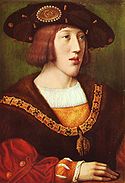 Discontent had been brewing for years before the Revolt of the Comuneros. The second half of the 15th century saw profound political, economic, and social changes in Spain. Economic growth created new urban industries and offered a route to power and wealth not tied to the aristocracy. Support from these urban elites was critical to Ferdinand and Isabella's
centralization of power, and they acted as a counterweight to the landed aristocracy and the clergy.
However, with Queen Isabella I
's death in 1504, this alliance between the national government and the budding middle class faltered. The Castilian government decayed with each successive administration, becoming rife with corruption. King Philip I
ruled for a mere two years; he was replaced by Archbishop Cisneros as regent for a short time, and then by Isabella's widower Ferdinand
who ruled from Aragon. Ferdinand's claim to continue ruling Castile as regent was somewhat tenuous after Isabella's death, but no plausible alternatives existed as the sovereign, their widowed daughter Joanna
, was mentally unfit to reign on her own. The landed nobility of Castile took advantage of the weak and corrupt Royal Council
to illegally expand their territory and domain with private armies while the government did nothing. In response, the towns signed mutual defense pacts, relying on each other rather than the national government.
The budgets of both Castile and Aragon had been in poor condition for some time. The government had expelled the Jews
in 1492 and the Muslims of Granada
in 1502, moves that undercut lucrative trades and businesses. Ferdinand and Isabella had been forced to borrow money to pay troops during and after the Reconquista, and Spanish military obligations had only increased since then. A large number of troops were required to maintain stability in recently conquered Granada
, threatened by revolt from the maltreated morisco
s (former Muslims who had converted to Christianity) and frequent naval raids from Muslim nations along the Mediterranean. Additionally, Ferdinand had invaded and occupied the Iberian part of Navarre
in 1512, and forces were required to garrison it against Navarrese revolts and French armies. Very little money was left to pay for the royal army in Castile proper, let alone service foreign debts. The corruption in the government since Isabella's death only made the budget shortfalls worse.
, who became King Charles I of both Castile
and Aragon
in co-regency
with his mother Joanna. Charles was brought up in Flanders
, the homeland of his father Philip, and barely knew Castilian Spanish
. The people greeted him with skepticism, but also hoped he would restore stability. With the arrival of the new king in late 1517, his Flemish court took positions of power in Castile; young Charles only trusted people he knew from the Netherlands
. Among the most scandalous of these was the appointment of the twenty-year-old William de Croÿ
as Archbishop of Toledo. The Archbishopric was an important position; it had been held by Archbishop Cisneros, the former regent of the country. Six months into his rule, discontent openly simmered among rich and poor alike. Even some monks began to agitate, denouncing the opulence of the royal court, the Flemish, and the nobility in their sermons. One of the first public protests involved placards posted in churches, which read:
With the unrest growing, Charles' paternal grandfather Holy Roman Emperor Maximilian I
died in 1519. A new election had to be held to choose the next emperor. Charles campaigned aggressively for the post, vying with King Francis I of France
to bribe the most prince-elector
s. Charles I won the election, becoming Emperor Charles V and cementing the power of the House of Habsburg. He prepared to head to Germany to take possession of his new domains in the Holy Roman Empire.
. Charles ensured the Cortes would only have limited power, and further attempted to stack the Cortes with pliable representatives he could bribe. Support for the opposition only increased in response, and the representatives demanded that their grievances be heard first before any new tax was granted. A group of clerics soon circulated a statement in protest of the king. It argued three points: any new taxes should be rejected; Castile should be embraced and the foreign Empire rejected; and if the king did not take into account his subjects, the Comunidades themselves should defend the interests of the kingdom. It was the first occasion in which the word comunidades (communities, communes) was used to signify the independent populace, and the name would stick to the councils later formed. At this point, most of the members of the Cortes in Santiago intended to vote against the king's requested duties and taxes, even with the Cortes stacked with royalists. In response, Charles decided to suspend the Cortes on April 4. He convened it again in Corunna
on April 22, this time getting his program passed. On May 20, he embarked for Germany, and left as regent of his Spanish possessions his former tutor, Adrian of Utrecht (better known as the future Pope Adrian VI).
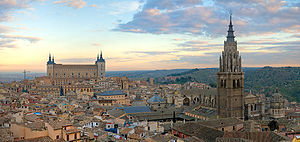
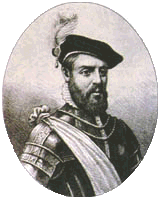 In April 1520, Toledo
was already unstable. The city council had been at the forefront of protests against Charles' bid to become Holy Roman Emperor. They decried the short-term expenses that would be borne by Castile
and questioned the role of Castile in this new political framework, given the possibility that the land would become a mere imperial province. The situation erupted when the royal government summoned the most radical of the city councilors away from the city, intending to send back more easily controllable replacements on a royal salary. The order came on April 15; one day later, as the councilors prepared to leave, a large crowd opposed to the departure rioted and drove out the royal administrators instead. A citizen's committee was elected under the leadership of Juan López de Padilla
and Pero Laso de la Vega, naming themselves a Comunidad. On April 21, the remaining administrators were driven from the fortifications of the Alcázar of Toledo
.
Following Charles' departure to Germany, the riots multiplied in the cities of central Castile, especially after the arrival of legislators who had voted "yes" to the taxes Charles had asked for. Segovia
had some of the earliest and most violent incidents; on May 30, a mob of woolworkers murdered two administrators and the city's legislator who had voted in favor. Incidents of a similar size occurred in cities such as Burgos
and Guadalajara
, while others, such as León
, Ávila, and Zamora
, suffered minor altercations.
These claims, especially the first two, spread quickly through society. Ideas began to circulate of replacing the king; Toledo's leaders floated the possibility of turning the cities of Castile into independent free cities
, similar to Genoa
and other Italian republics
. Competing proposals suggested keeping the monarchy, but dethroning Charles. They proposed that he be replaced by either his mother Queen Joanna or his Castilian-born brother Ferdinand
. With these ideas, the revolt shifted from a simple protest against taxes to a broader revolution. Many cities, while not quite in outright revolt, stopped sending taxes to the Royal Council and began to self-govern.
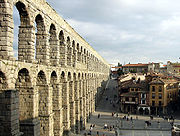 The situation moved closer to armed conflict on June 10. Rodrigo Ronquillo had been sent to Segovia by the Royal Council
to investigate the recent murder of Segovia's legislator, but Segovia refused him entry. Unable to besiege a city of 30,000 with only a small force, Ronquillo instead set out to blockade foodstuffs and other supplies from entering Segovia. The people of Segovia, led by militia leader and noble Juan Bravo, rallied around the Comunidad. Segovia requested aid against Ronquillo's army from the Comunidades of Toledo and Madrid. The cities responded by sending their militias, captained by Juan de Padilla
and Juan Zapata, who won in the first major confrontation between the forces of the king and the rebels.
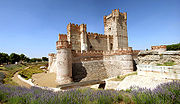 Faced with the situation in Segovia, Regent and Cardinal Adrian of Utrecht decided to use the royal artillery, located in nearby Medina del Campo
, to take Segovia and defeat Padilla. Adrian ordered his commander Antonio de Fonseca to seize the artillery. Fonseca arrived on August 21 in Medina, but encountered heavy resistance from the townspeople, as the city had strong trade links to Segovia. Fonseca ordered the setting of a fire to distract the resistance, but it grew out of control. Much of the town was destroyed, including a Franciscan
monastery and a trade warehouse containing goods valued at more than 400,000 ducat
s. Fonseca had to withdraw his troops, and the event was a public relations disaster for the government. Uprisings throughout Castile occurred, even in cities that previously had been neutral such as Castile's capital, Valladolid
. The establishment of the Comunidad of Valladolid caused the most important core of the Iberian plateau to declare for the rebels, upending the stability of the government. New members now joined the Junta of Ávila and the Royal Council looked discredited; Adrian had to flee to Medina de Rioseco
as Valladolid fell. The royal army, with many of its soldiers unpaid for months, started to disintegrate.
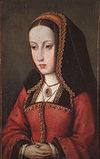 The comunero army now properly organized itself, integrating the militias of Toledo, Madrid, and Segovia. Once told of Fonseca's attack, the comunero forces went to Medina del Campo and took possession of the artillery that had just been denied to Fonseca's troops. On August 29, the comuneros' army arrived at Tordesillas
with the goal of declaring Queen Joanna
the sole sovereign. The Junta moved from Ávila to Tordesillas at the Queen's request and invited cities that had not yet sent representatives to do so. A total of thirteen cities were represented in the Junta of Tordesillas: Burgos
, Soria
, Segovia
, Ávila, Valladolid
, León
, Salamanca
, Zamora
, Toro
, Toledo
, Cuenca
, Guadalajara
, and Madrid
. The only invited cities that failed to attend were the four Andalusian cities: Seville
, Granada
, Cordova
, and Jaén
. Since most of the kingdom was represented at Tordesillas, the Junta renamed itself the ("General Assembly of the Kingdom"). On September 24, 1520, the mad Queen, for the first and only time, presided over the Cortes.
The legislators met with Queen Joanna and explained the purpose of the Cortes: to proclaim her sovereignty and restore lost stability to the kingdom. The next day, September 25, the Cortes issued a declaration pledging to use arms if necessary and for the whole to aid any one city that was threatened. On September 26, the Cortes of Tordesillas declared itself the new legitimate government and denounced the Royal Council. Oaths of self-defense were taken by all the cities represented over the week, finishing by September 30. The revolutionary government now had structure and a free hand to act, with the Royal Council still ineffective and confused.
. The rebels sought to propound their revolutionary ideas to the rest of the kingdom, but without much success. There were few attempts at rebellion elsewhere, such as in Galicia to the northwest or in Andalusia
to the south. Comunidades in the south were set up in Jaén
, Úbeda
, and Baeza
, unique in Andalusia, but with time they were drawn back into the royalists. Murcia stayed with the rebel cause, but did not coordinate much with the Junta, and the rebellion there had a character closer to the nearby Revolt of the Brotherhoods in Valencia
in Aragon
. In Extremadura
to the southwest, the city of Plasencia
joined the Comunidades, but this was undermined by the close proximity of other royalist cities such as Ciudad Rodrigo
and Cáceres
. A close correlation can be drawn between poor economic fortunes over the previous twenty years and the rebellion; central Castile suffered from agricultural failure and other setbacks under the Royal Council, while Andalusia was relatively prosperous with its maritime trade. Andalusia's leadership also feared that in the instability of a civil war, the Moriscos of Granada would likely revolt.

, the Count of Buendía's vassals revolted against him on September 1, 1520, encouraged by rebel monks. This uprising was followed by others of a similar anti-feudal nature. The leadership of the comuneros was forced to take a stance on these new rebellions; reluctant to openly endorse them, the Junta initially denounced them but did nothing to oppose them. The dynamics of the uprising thus changed profoundly, as it could now jeopardize the status of the entire manorial system
. The nobles had previously been somewhat sympathetic to the cause due to their loss of privileges to the central government. However, these new developments lead to a dramatic drop in support for the comuneros from aristocrats, who were frightened by the more radical elements of the revolution.
Once he realized that a full-fledged revolution was underway, Charles responded vigorously. Through Cardinal Adrian, he undertook new policy initiatives, such as canceling the taxes granted in the Cortes of Corunna. Most important was the appointment of two new Castilian co-regents: the Constable of Castile
, Íñigo Fernández, and the Admiral of Castile
, Fadrique Enríquez
. This negated two of the most salient complaints of the rebels. In addition, Adrian approached the nobles to convince them that their best interests lay with the king. The Royal Council was re-established in the fief of Admiral Enríquez, Medina de Rioseco
, which enabled the Council to be nearer to the revolting cities and reassure skeptical supporters. While the royal army was still in tatters, many high nobles maintained their own well-trained mercenary armies—armies that with the revolt's recent radicalization would now fight for the king.
. The wavering position of Burgos was soon known to the royalists, and the Constable of Castile negotiated with Burgos's government. The Royal Council granted a number of significant concessions to Burgos in exchange for them leaving the Junta.
Following this incident, the Royal Council hoped that other cities would imitate Burgos and leave the comuneros peacefully. Valladolid, the former seat of royal power, was considered especially likely to turn, but too many supporters of the king had left city politics and lost their influence. It remained rebel-controlled. The Admiral of Castile continued his campaign to try to convince the comuneros to return to the royal government and thereby avoid a violent suppression. This attitude concealed a great shortage of funds on the royal side.
During October and November 1520, both sides accepted that a military conclusion would soon be necessary and actively devoted themselves to fundraising, recruiting soldiers, and training their troops. The comuneros organized their militias in the major cities and levied new taxes on the countryside; they also took measures aimed at eliminating waste, routinely auditing their treasurers and dismissing those thought to be corrupt. The royal government, which had lost much of its revenue due to the revolt, sought loans from Portugal
and from conservative Castilian bankers, who saw reassuring signs in the switch of the allegiance of Burgos.
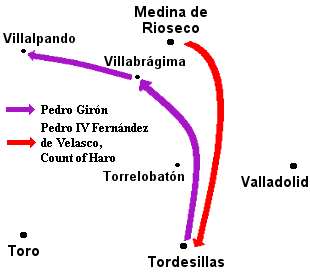 Gradually, both the city of Toledo and its leader Juan de Padilla
lost influence within the Junta, though Padilla retained popularity and prestige among the commoners. Two new figures emerged within the Comunidades, Pedro Girón and Antonio Osorio de Acuña
. Girón was one of the most powerful nobles who supported the comuneros; his rebellion is thought to originate from Charles' refusal to grant Girón the prestigious Duchy of Medina-Sidonia
a year prior to the war. Antonio de Acuña was the Bishop of Zamora. Acuña was also the head of the Comunidad in Zamora and the leader of its army, which included more than 300 priests.
On the royalist side, the nobles could not agree on what tactics to use. Some preferred to directly challenge the rebels in combat, while others such as the Constable of Castile favored continued waiting and the building of defensive fortifications. The Admiral of Castile preferred negotiations and exhausting all the possible peaceful options first. Patience, however, began to run thin; armies were expensive to maintain once assembled. In late November 1520, both armies took positions between Medina de Rioseco and Tordesillas, and a confrontation was inevitable.
, following the orders of the Junta. Girón established his headquarters in Villabrágima
, a town merely 8 kilometres (5 mi) from the royalist army. The royalists occupied nearby villages to cut communication lines back to other comuneros.
This situation continued until December 2, when Girón, apparently thinking the royal army would remain entrenched, moved his forces west to the small town of Villalpando
. The town surrendered the next day without resistance, and the troops began looting the estates in the area. However, with this movement, the comuneros left the path to Tordesillas completely unprotected. The royal army took advantage of the blunder, marching by night on December 4 and occupying Tordesillas the next day. The small rebel garrison was overwhelmed.
Seizure of Tordesillas marked a serious defeat for the comuneros, who lost Queen Joanna
and with her their claim to legitimacy. In addition, thirteen representatives of the Junta were imprisoned, though others fled and escaped. Morale fell among the rebels, and much angry criticism was directed towards Pedro Girón for his maneuvering of the troops out of position and for his failure to attempt to retake Tordesillas or capture Medina de Rioseco. Girón was obliged to resign from his post and withdrew from the war.
. The Junta reconvened on December 15, but with only eleven cities represented, down from a height of fourteen. Soria and Guadalajara's representatives did not return, and Burgos had left earlier. Valladolid would be the third capital of the rebels, after Ávila and Tordesillas.
The situation was somewhat worse for the army, with a large number of desertions in Valladolid and Villalpando. This forced the rebels to intensify their recruitment drives, especially in Toledo, Salamanca, and Valladolid itself. With these new recruits and the arrival of Juan de Padilla to Valladolid, the rebel military apparatus was rebuilt and morale bolstered. At the beginning of 1521, the comuneros prepared for an all-out war, despite disagreements within the movement. Some suggested seeking a peaceful resolution, while others favored continuing the war. Those who favored war were divided between two tactics: occupy Simancas
and Torrelobatón
, a less ambitious proposal defended by Pero Laso de la Vega; or lay siege to Burgos, a tactic favored by Padilla.
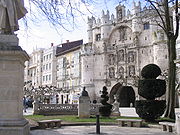 In the far north of Castile, the rebel army began a series of operations conducted by Antonio de Acuña
, bishop of Zamora. They received orders from the Junta on December 23 to try and raise a rebellion in Palencia
. They were tasked with expelling royalists, collecting taxes on behalf of the Junta, and creating an administration sympathetic to the comuneros cause. Acuña's army made a series of raids into the area around Dueñas
, raising more than 4,000 ducats and inspiring the peasantry. He returned to Valladolid in early 1521, then came back to Dueñas on January 10 to begin a major offensive against the nobles of Tierra de Campos
. The nobles' land and holdings were completely devastated.
In mid-January, Pedro de Ayala, Count of Salvatierra, joined the comuneros and organized an army of about two thousand men who set about raiding the north of Castile. Nearby, Burgos awaited the fulfillment of the pledges made by Cardinal Adrian after they had joined the royalist cause two months prior. The slow response led to dissatisfaction and uncertainty in the city. Ayala and Acuña, aware of this situation, decided to besiege Burgos, Ayala from its north and Acuña from its south. They also sought to undermine the defenses by encouraging a revolt of the inhabitants of Burgos.
), which condemned 249 prominent Comunidad members. For secular rebels, the punishment was death; clergy were to receive lighter penalties. Similarly, the edict also declared that those who supported the Comunidades were traitors, disloyal, rebels, and infidels.
The Royal Council's next move was the occupation of Ampudia
in Palencia, a town loyal to the Count of Salvatierra. The Junta sent Padilla to meet Acuña; their combined force besieged the royal army at the castle of Mormojón
. The royal army slipped away by nightfall, and Mormojón was forced to pay tribute to avoid being pillaged. Ampudia was recovered by the rebels the next day, January 16.
Meanwhile, the rebellion in Burgos scheduled for January 23 was a failure due to poor coordination with the besieging army; it started two days early and was easily crushed. The comuneros of Burgos had to surrender, and this was the last rebellion to be seen in Castile.
.jpg) After abandoning the siege of Burgos due to the failure of its revolt, Padilla decided to return to Valladolid, while Acuña opted to resume his skirmishing and harassment of noble properties around Tierra de Campos. With this series of actions, Acuña intended to destroy or occupy the homes of the prominent nobles. The rebels now set themselves completely against the manorial system
After abandoning the siege of Burgos due to the failure of its revolt, Padilla decided to return to Valladolid, while Acuña opted to resume his skirmishing and harassment of noble properties around Tierra de Campos. With this series of actions, Acuña intended to destroy or occupy the homes of the prominent nobles. The rebels now set themselves completely against the manorial system
. This would be one of the strongest features of the second phase of the rebellion.
After the recent setbacks suffered by the comuneros, Padilla realized that they needed a victory to raise morale. He decided to take Torrelobatón
and its castle. Torrelobatón was a stronghold halfway between Tordesillas and Medina de Rioseco, and was very close to Valladolid. Taking it would grant the rebels an excellent fortress for launching military operations and remove a threat on Valladolid.
all of the inhabitants, at which point the castle surrendered. The defenders did secure an agreement to spare half of the goods inside the castle, thus avoiding further looting.
The victory in Torrelobatón lifted the spirits of the rebel camp while worrying the royalists about the rebel advance, exactly as Padilla hoped. The faith of the nobles in Cardinal Adrian was once again shaken, as he was accused of having done nothing to avoid losing Torrelobatón. The Constable of Castile began to send troops to the Tordesillas area to contain the rebels and prevent any further advances.
Despite the renewed enthusiasm among the rebels, a decision was made to remain in their positions near Valladolid without pressing their advantage or launching a new attack. This caused many of the soldiers to return to their home communities, tired of waiting for salaries and new orders. This was a problem the comunero forces had throughout the war; they possessed only a small number of full-time soldiers, and their militias were constantly "dissolving and recruiting." A serious attempt to negotiate a peaceful end to the war was tried again by the moderates, but was undercut by extremists of both sides.
In the north, after the failure of the siege of Burgos in January, the Count of Salvatierra resumed his campaign. He set off to cause an uprising in Merindades
, the homeland of the Constable of Castile, and besieged Medina de Pomar
and Frías.
.jpg) William de Croÿ
William de Croÿ
, the young Flemish Archbishop of Toledo appointed by Charles, died in January 1521 in Worms, Germany
. In Valladolid, the Junta proposed to Antonio de Acuña that he submit himself as a candidate for the seat.
Acuña departed for Toledo in February with a small force under his command. He traveled south, declaring his impending claim on the archdiocese to every village as he passed. This raised enthusiasm among the commoners, who received him with cheers, but aroused suspicion in the aristocracy. They feared Acuña might attack their holdings as he did in Tierra de Campos
. The Marquis of Villena and Duke of Infantado contacted Acuña and persuaded him to sign a pact of mutual neutrality.
Acuña soon had to confront Antonio de Zúñiga
, who had been appointed commander of the royalist army in the Toledo area. Zúñiga was a prior
in the Knights of St. John, who maintained a base in Castile at the time. Acuña received information that Zúñiga was in the area of Corral de Almaguer
, and pursued battle with him near Tembleque
. Zúñiga drove the rebel forces off, and then launched a counterattack of his own between Lillo and El Romeral
, inflicting a crushing defeat on Acuña. Acuña, a relentless self-promoter, tried to minimize the loss and even claimed that he had emerged victorious from the confrontation.
Undaunted, Acuña continued into Toledo. He appeared at the Zocodover Plaza in the heart of the city on March 29, 1521, Good Friday
. The crowd gathered around him and took him directly to the cathedral, claiming the archbishop's chair for him. The next day he met with María Pacheco, wife of Juan de Padilla and de facto leader of the Toledo Comunidad in her husband's absence. A brief rivalry emerged between the two, but it was resolved after mutual attempts at reconciliation.
Once settled in the archdiocese of Toledo
, Acuña began to recruit any men he could find, enlisting soldiers from fifteen to sixty years old. After royalist troops burned the town of Mora
on April 12, Acuña returned to the countryside with roughly 1,500 men under his command. He moved into Yepes
, and from there conducted raids and operations against royalist-controlled rural areas. He first attacked and pillaged Villaseca de la Sagra
, then faced Zúñiga again in an inconclusive battle near the Tagus river in Illescas
. Light skirmishing near Toledo would continue until news of Villalar ended the war.
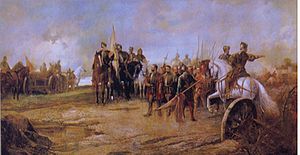 In early April 1521, the royalist side moved to combine their armies and threaten Torrelobatón. The Constable of Castile
moved his troops (including soldiers recently transferred from the defense of Navarre) southwest from Burgos to meet with the Admiral
's forces near Tordesillas. Meanwhile, the comuneros reinforced their troops at Torrelobatón, which was far less secure than the comuneros preferred. Their forces were suffering from desertions, and the presence of royalist artillery would make Torrelobatón's castle vulnerable. Juan de Padilla
considered withdrawing to Toro to seek reinforcements in early April, but wavered. He delayed his decision until the early hours of April 23, losing considerable time and allowing the royalists to unite their forces in Peñaflor
.
The combined royalist army pursued the comuneros. Once again, the royalists had a strong advantage in cavalry, with their army consisting of 6,000 infantry and 2,400 cavalry against Padilla's 7,000 infantry and 400 cavalry. Heavy rain slowed Padilla's infantry more than the royalist cavalry and rendered the primitive firearms of the rebels' 1,000 arquebusiers nearly useless. Padilla hoped to reach the relative safety of Toro and the heights of Vega de Valdetronco
, but his infantry was too slow. He gave battle with the harrying royalist cavalry at the town of Villalar. The cavalry charges scattered the rebel ranks, and the battle became a slaughter. There were an estimated 500–1,000 rebel casualties and many desertions.
The three most important leaders of the rebellion were captured: Juan de Padilla
, Juan Bravo, and Francisco Maldonado
. They were beheaded the next morning in the Plaza of Villalar, with a large portion of the royalist nobility present. The remains of the rebel army at Villalar fragmented, with some attempting to join Acuña's army near Toledo and others deserting. The rebellion had been struck a crippling blow.
soon succumbed to the king's troops, with all its cities returning their allegiance to the king by early May. Only Madrid and Toledo kept their Comunidades alive.
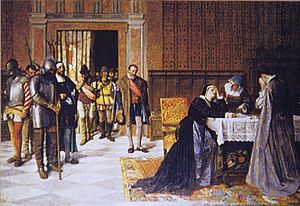 The first news of Villalar arrived in Toledo on April 26, but was largely ignored by the local Comunidad. The magnitude of the defeat became apparent in a few days, after the first survivors began arriving in the city and confirmed the fact that the three rebel leaders had been executed. Toledo was declared in mourning over the death of Juan de Padilla.
After the death of Padilla, Bishop Acuña lost popularity in favour of María Pacheco, Padilla's widow. People began to suggest negotiating with the royalists, seeking to avoid further suffering in the city. The situation looked even worse after the surrender of Madrid on May 11. The fall of Toledo seemed only to be a matter of time.
However, one ray of hope remained for the rebels. Castile had withdrawn some of its troops from occupied Navarre
to fight the comuneros, and King Francis I of France
used the opportunity to invade with support from the Navarrese. The royalist army was forced to march on Navarre to respond rather than besiege Toledo. Acuña left Toledo to travel to Navarre, but he was recognized and caught. It is disputed whether he was seeking to join the French and continue fighting, or was simply fleeing.
María Pacheco took control of the city and the remains of the rebel army, living in the Alcázar
, collecting taxes, and strengthening defenses. She requested the intervention of her uncle, the respected Marquis of Villena, to negotiate with the Royal Council, hoping he would be able to obtain better concessions. The Marquis eventually abandoned the negotiations, and María Pacheco took on personal negotiations with Prior Zúñiga
, the commander of the besieging forces. Her demands, though somewhat galling to honor, were ultimately minor, such as guaranteeing the property and reputation of her children.
Still concerned about the French, the royal government gave in. With the support of all parties, the surrender of Toledo was orchestrated on October 25, 1521. Thus, on October 31 the comuneros left the Alcázar of Toledo and new officials were appointed to run the city. The truce guaranteed the freedom and property of all the comuneros.
Back in Valladolid, Charles declared a general pardon
on November 1. The pardon gave amnesty to everyone involved in the revolt with the exception of 293 comuneros, a small figure given the huge number of rebels. Both Pacheco and Bishop Acuña were among the 293 excluded from the pardon. More pardons were issued later, after pressure from the Cortes; by 1527, the repression was completely at end. Of the 293, 23 were executed, 20 died in prison, 50 purchased amnesty, and 100 were pardoned later. The fates of the rest are unknown.
was locked in Tordesillas by her son. She would remain there for thirty-five years, the rest of her life.
Emperor Charles V
would go on to rule one of the largest and most sprawling empires in European history. As a consequence, Charles was nearly constantly at war, fighting France, England
, the Papal States
, the Ottoman Turks, the Aztecs, the Incas
, and the Protestant Schmalkaldic League
during his reign. Spain would provide the bulk of the Habsburgs' armies and financial resources over this period. Charles placed Castilians in high governmental positions in both Castile and the Empire at large, and generally left the administration of Castile in Castilian hands. In that sense, the revolt could be considered successful.
Some of the reforms of Isabella I
which reduced noble power were reversed as a price for luring the nobility to the royalist side. However, Charles understood that noble encroachment of power had helped cause the revolt, and embarked upon a new reform program. Unpopular, corrupt, and ineffective officials were replaced; judicial functions of the Royal Council
were limited; and local courts were revitalized. Charles also adjusted the membership of the Royal Council; its hated president was replaced, the aristocracy's role reduced, and more gentry were added to it. Realizing that the urban elite needed to have a stake in the royal government once more, Charles gave many of them positions, privileges, and government salaries. The Cortes, while not as important as the comuneros had hoped, nevertheless maintained its power; it was still required to approve new taxes and could advise the king. Charles also discouraged his officials from using overly coercive methods, after seeing his heavy-handed treatment of the Cortes of Corunna backfire. If anything, the co-option of the middle class worked too well; when Charles' successor King Phillip II
demanded a ruinously large tax increase in the 1580s, the Cortes was too dependent on the Crown for money to effectively resist policies that would wreck the economy.
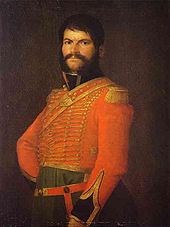 The revolt, fresh in the memory of Spain, is referenced in several literary works during Spain's Golden Age
. Don Quixote references the rebellion in a conversation with Sancho
, and Francisco de Quevedo
uses the word "comunero" as a synonym for "rebel" in his works.
In the 18th century, the comuneros were not held in high regard by the Spanish Empire
. The government was not amenable to encouraging rebellions, and only used the term to condemn opposition. In the Revolt of the Comuneros in Paraguay
, the rebels did not take the name willingly; it was only meant to disparage them as traitors. Another Revolt of the Comuneros in New Granada
(modern Colombia) was similarly unrelated to the original except in name.
At the beginning of the 19th century, the image of the comuneros began to be rehabilitated by scholars such as Manuel Quintana as precursors of freedom and martyrs against absolutism
. The decline of Castilian liberty was linked to the later decline of Spain. The first major commemorative event came in 1821, the third centenary of the Battle of Villalar
. Juan Martín Díez
, a nationalistic liberal military leader who had fought in the resistance against Napoleon, led an expedition to find and exhume the remains of the three leaders executed in 1521. Díez praised the comuneros on behalf of the liberal government in power at the time, likely the first positive governmental recognition for their cause. This view was challenged by conservatives who viewed a centralized state as modern and progressive, especially after the anarchy and fragmentation of the 1868 Revolution in Spain
. Manuel Danvila, a conservative government minister, published the six-volume Historia critica y documentada de las Comunidades de Castilla from 1897–1900, one of the most important works of scholarship on the revolt. Drawing on collected original sources, Danvila emphasized the fiscal demands of the comuneros, and cast them as traditionalist, reactionary, medieval, and feudal. Though a liberal, intellectual Gregorio Marañón
shared the dim view of the comuneros that once again prevailed in Spain; he cast the conflict as one between a modern, progressive state open to beneficent foreign influence against a conservative, reactionary, and xenophobic Spain hypersensitive to religious and cultural deviance with an insistence on spurious racial purity.
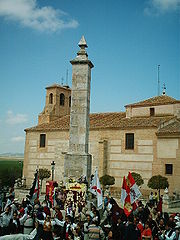 General Franco
's government from 1939–1975 also encouraged an unfavorable interpretation of the comuneros. According to approved historians such as José María Pemán
, the revolt was fundamentally an issue of petty Spanish regionalism, something which Franco did his best to discourage. Additionally, the comuneros did not properly appreciate Spain's "imperial destiny."
Since the mid-twentieth century, others have sought more materialist reasons for the revolt. Historians such as José Antonio Maravall
and Joseph Pérez
portray the developing revolt as alliances of different social coalitions around shifting economic interests, with the "industrial bourgeoisie" of artisans and woolworkers combining with the intellectuals and the low nobility against the aristocrats and the merchants. Maravall, who views the revolt as one of the first modern revolutions, especially stresses the ideological conflict and intellectual nature of the revolt, with features such as the first proposed written constitution of Castile.
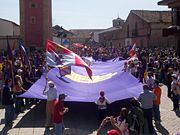 With Spain's transition to democracy
following Franco's death, celebration of the comuneros started to become permissible again. On April 23, 1976, a small ceremony was held clandestinely in Villalar; only two years later, in 1978, the event had become a huge demonstration of 200,000 in support of Castilian autonomy. The autonomous community
of Castile and León
was created in response to public demand in 1983, and it recognized April 23 as an official holiday
in 1986. Similarly, each February 3 since 1988 has been celebrated by the Castilian nationalist
party Tierra Comunera
in Toledo. The celebration highlights the roles of Juan de Padilla
and María Pacheco, and is done in memory of the rebellion in 1522, the last event of the war.
Crown of Castile
The Crown of Castile was a medieval and modern state in the Iberian Peninsula that formed in 1230 as a result of the third and definitive union of the crowns and parliaments of the kingdoms of Castile and León upon the accession of the then King Ferdinand III of Castile to the vacant Leonese throne...
against the rule of Charles V
Charles V, Holy Roman Emperor
Charles V was ruler of the Holy Roman Empire from 1519 and, as Charles I, of the Spanish Empire from 1516 until his voluntary retirement and abdication in favor of his younger brother Ferdinand I and his son Philip II in 1556.As...
and his administration between 1520 and 1521. At its height, the rebels controlled the heart of Castile, ruling the cities of Valladolid
Valladolid
Valladolid is a historic city and municipality in north-central Spain, situated at the confluence of the Pisuerga and Esgueva rivers, and located within three wine-making regions: Ribera del Duero, Rueda and Cigales...
, Tordesillas
Tordesillas
Tordesillas is a town and municipality in the province of Valladolid, Castile and León, central Spain.It is located 25 km southwest of the provincial capital, Valladolid at an elevation of 704 meters. The population was c. 9,000 in 2009....
, and Toledo
Toledo, Spain
Toledo's Alcázar became renowned in the 19th and 20th centuries as a military academy. At the outbreak of the Spanish Civil War in 1936 its garrison was famously besieged by Republican forces.-Economy:...
.
The revolt occurred in the wake of political instability in the Crown of Castile
Crown of Castile
The Crown of Castile was a medieval and modern state in the Iberian Peninsula that formed in 1230 as a result of the third and definitive union of the crowns and parliaments of the kingdoms of Castile and León upon the accession of the then King Ferdinand III of Castile to the vacant Leonese throne...
after the death of Queen Isabella I
Isabella I of Castile
Isabella I was Queen of Castile and León. She and her husband Ferdinand II of Aragon brought stability to both kingdoms that became the basis for the unification of Spain. Later the two laid the foundations for the political unification of Spain under their grandson, Charles V, Holy Roman Emperor...
in 1504. Joanna the Mad
Joanna of Castile
Joanna , nicknamed Joanna the Mad , was the first queen regnant to reign over both the Crown of Castile and the Crown of Aragon , a union which evolved into modern Spain...
, Ferdinand
Ferdinand II of Aragon
Ferdinand the Catholic was King of Aragon , Sicily , Naples , Valencia, Sardinia, and Navarre, Count of Barcelona, jure uxoris King of Castile and then regent of that country also from 1508 to his death, in the name of...
and Isabella's second daughter, inherited the throne with her Burgundian husband King Philip I
Philip I of Castile
Philip I , known as Philip the Handsome or the Fair, was the first Habsburg King of Castile...
. However, Philip died two years into his reign, and their son Charles was only six years old. Due to his youth and Joanna's mental instability, Castile was ruled by the nobles and Ferdinand of Aragon as a regency. After Ferdinand's death in 1516, the sixteen-year-old Charles was proclaimed King Charles I of both Castile and Aragon
Kingdom of Aragon
The Kingdom of Aragon was a medieval and early modern kingdom in the Iberian Peninsula, corresponding to the modern-day autonomous community of Aragon, in Spain...
. Charles had been raised in the Netherlands
Burgundian Netherlands
In the history of the Low Countries, the Burgundian Netherlands refers to a number of Imperial and French fiefs ruled in personal union by the House of Valois-Burgundy and their Habsburg heirs in the period from 1384 to 1482...
with little knowledge of Castilian Spanish
Castilian Spanish
Castilian Spanish is a term related to the Spanish language, but its exact meaning can vary even in that language. In English Castilian Spanish usually refers to the variety of European Spanish spoken in north and central Spain or as the language standard for radio and TV speakers...
. He arrived in Spain in October 1517 accompanied by a large retinue of Flemish nobles and clerics. These factors resulted in mistrust between the new king and the Castilian social elites, who could see the threat to their power and status.
In 1519, Charles was elected Holy Roman Emperor
Holy Roman Emperor
The Holy Roman Emperor is a term used by historians to denote a medieval ruler who, as German King, had also received the title of "Emperor of the Romans" from the Pope...
. He departed for Germany in 1520, leaving the Dutch cardinal Adrian of Utrecht to rule Castile in his absence. Soon, a series of anti-government riots broke out in the cities, and local city councils (Comunidades) took power. The rebels chose Charles' own mother, Queen Joanna, as an alternative ruler, hoping they could control her madness. The rebel movement took on a radical anti-feudal
Manorialism
Manorialism, an essential element of feudal society, was the organizing principle of rural economy that originated in the villa system of the Late Roman Empire, was widely practiced in medieval western and parts of central Europe, and was slowly replaced by the advent of a money-based market...
dimension, supporting peasant rebellions against the landed nobility. On April 23, 1521, after nearly a year of rebellion, the reorganized supporters of the emperor struck a crippling blow to the comuneros at the Battle of Villalar
Battle of Villalar
The Battle of Villalar was a battle in the Revolt of the Comuneros fought on April 23, 1521 near the town of Villalar in Valladolid province, Spain. The royalist supporters of King Charles I won a crushing victory over the comuneros rebels. Three of the most important rebel leaders were...
. The following day, rebel leaders Juan de Padilla
Juan Lopez de Padilla
Juan López de Padilla was an insurrectionary leader in the Castilian War of the Communities, where the people of Castile made a stand against policies of the Holy Roman Emperor Charles V and his Flemish ministers.Padilla was the eldest son of the commendator of Castile...
, Juan Bravo, and Francisco Maldonado
Francisco Maldonado
Francisco Maldonado was a leader of the rebel Comuneros from Salamanca in the Revolt of the Comuneros.He was captured at the Battle of Villalar, and beheaded the following day....
were beheaded. The army of the comuneros fell apart. Only the city of Toledo kept alive the rebellion, until its surrender in October 1521.
The character of the revolution is a matter of historiographical debate. According to some scholars, the revolt was one of the first modern revolutions, notably because of the anti-noble sentiment against social injustice and its basis on ideals of democracy and freedom. Others consider it a more typical rebellion against high taxes and perceived foreign control. From the 19th century onwards, the revolt has been mythologized by various Spaniards, generally liberals who drew political inspiration from it. Conservative intellectuals have traditionally adopted more pro-Imperial stances toward the revolt, and have been critical of both the motives and the government of the comuneros. With the end of Franco's dictatorship
Spanish transition to democracy
The Spanish transition to democracy was the era when Spain moved from the dictatorship of Francisco Franco to a liberal democratic state. The transition is usually said to have begun with Franco’s death on 20 November 1975, while its completion has been variously said to be marked by the Spanish...
and the establishment of the autonomous community
Autonomous communities of Spain
An autonomous community In other languages of Spain:*Catalan/Valencian .*Galician .*Basque . The second article of the constitution recognizes the rights of "nationalities and regions" to self-government and declares the "indissoluble unity of the Spanish nation".Political power in Spain is...
of Castile and León
Castile and León
Castile and León is an autonomous community in north-western Spain. It was so constituted in 1983 and it comprises the historical regions of León and Old Castile...
, positive commemoration of the Comunidades has grown. April 23 is now celebrated as Castile and León Day
Castile and León Day
Castile and León Day is a holiday celebrated on April 23 in the autonomous community of Castile and León, a subdivision of Spain. The date is the anniversary of the Battle of Villalar, in which Castilian rebels were dealt a crushing defeat by the forces of King Charles I in the Revolt of the...
, and the incident is often referred to in Castilian nationalism
Castilian nationalism
Castilian nationalism, or Castilianism, is a political movement that advocates for the national recognition of Castile, and in some cases, its independence....
.
Origins
Catholic Monarchs
The Catholic Monarchs is the collective title used in history for Queen Isabella I of Castile and King Ferdinand II of Aragon. They were both from the House of Trastámara and were second cousins, being both descended from John I of Castile; they were given a papal dispensation to deal with...
centralization of power, and they acted as a counterweight to the landed aristocracy and the clergy.
However, with Queen Isabella I
Isabella I of Castile
Isabella I was Queen of Castile and León. She and her husband Ferdinand II of Aragon brought stability to both kingdoms that became the basis for the unification of Spain. Later the two laid the foundations for the political unification of Spain under their grandson, Charles V, Holy Roman Emperor...
's death in 1504, this alliance between the national government and the budding middle class faltered. The Castilian government decayed with each successive administration, becoming rife with corruption. King Philip I
Philip I of Castile
Philip I , known as Philip the Handsome or the Fair, was the first Habsburg King of Castile...
ruled for a mere two years; he was replaced by Archbishop Cisneros as regent for a short time, and then by Isabella's widower Ferdinand
Ferdinand II of Aragon
Ferdinand the Catholic was King of Aragon , Sicily , Naples , Valencia, Sardinia, and Navarre, Count of Barcelona, jure uxoris King of Castile and then regent of that country also from 1508 to his death, in the name of...
who ruled from Aragon. Ferdinand's claim to continue ruling Castile as regent was somewhat tenuous after Isabella's death, but no plausible alternatives existed as the sovereign, their widowed daughter Joanna
Joanna of Castile
Joanna , nicknamed Joanna the Mad , was the first queen regnant to reign over both the Crown of Castile and the Crown of Aragon , a union which evolved into modern Spain...
, was mentally unfit to reign on her own. The landed nobility of Castile took advantage of the weak and corrupt Royal Council
Council of Castile
The Council of Castile , known earlier as the Royal Council , was a ruling body and key part of the domestic government of the Crown of Castile, second only to the monarch himself. It was established under Queen Isabella I in 1480 as the chief body dealing with administrative and judicial matters...
to illegally expand their territory and domain with private armies while the government did nothing. In response, the towns signed mutual defense pacts, relying on each other rather than the national government.
The budgets of both Castile and Aragon had been in poor condition for some time. The government had expelled the Jews
Alhambra decree
The Alhambra Decree was an edict issued on 31 March 1492 by the joint Catholic Monarchs of Spain ordering the expulsion of Jews from the Kingdom of Spain and its territories and possessions by 31 July of that year.The edict was formally revoked on 16 December 1968, following the Second...
in 1492 and the Muslims of Granada
Morisco
Moriscos or Mouriscos , meaning "Moorish", were the converted Christian inhabitants of Spain and Portugal of Muslim heritage. Over time the term was used in a pejorative sense applied to those nominal Catholics who were suspected of secretly practicing Islam.-Demographics:By the beginning of the...
in 1502, moves that undercut lucrative trades and businesses. Ferdinand and Isabella had been forced to borrow money to pay troops during and after the Reconquista, and Spanish military obligations had only increased since then. A large number of troops were required to maintain stability in recently conquered Granada
Emirate of Granada
The Emirate of Granada , also known as the Nasrid Kingdom of Granada , was an emirate established in 1238 following the defeat of Muhammad an-Nasir of the Almohad dynasty by an alliance of Christian kingdoms at the Battle of Las Navas de Tolosa in 1212...
, threatened by revolt from the maltreated morisco
Morisco
Moriscos or Mouriscos , meaning "Moorish", were the converted Christian inhabitants of Spain and Portugal of Muslim heritage. Over time the term was used in a pejorative sense applied to those nominal Catholics who were suspected of secretly practicing Islam.-Demographics:By the beginning of the...
s (former Muslims who had converted to Christianity) and frequent naval raids from Muslim nations along the Mediterranean. Additionally, Ferdinand had invaded and occupied the Iberian part of Navarre
Spanish conquest of Iberian Navarre
A series of wars between 1512–1524 led to the Spanish conquest of the Iberian part of Navarre. Ferdinand of Aragon was in 1512 both King of Aragon and Regent of Castile. When Pope Julius II declared a Holy League against France, Navarre tried to remain neutral...
in 1512, and forces were required to garrison it against Navarrese revolts and French armies. Very little money was left to pay for the royal army in Castile proper, let alone service foreign debts. The corruption in the government since Isabella's death only made the budget shortfalls worse.
Succession of Charles
In 1516, Ferdinand died. The remaining heir was Ferdinand and Isabella's grandson CharlesCharles V, Holy Roman Emperor
Charles V was ruler of the Holy Roman Empire from 1519 and, as Charles I, of the Spanish Empire from 1516 until his voluntary retirement and abdication in favor of his younger brother Ferdinand I and his son Philip II in 1556.As...
, who became King Charles I of both Castile
Crown of Castile
The Crown of Castile was a medieval and modern state in the Iberian Peninsula that formed in 1230 as a result of the third and definitive union of the crowns and parliaments of the kingdoms of Castile and León upon the accession of the then King Ferdinand III of Castile to the vacant Leonese throne...
and Aragon
Kingdom of Aragon
The Kingdom of Aragon was a medieval and early modern kingdom in the Iberian Peninsula, corresponding to the modern-day autonomous community of Aragon, in Spain...
in co-regency
Co-regency
A coregency is the situation where a monarchical position , normally held by only a single person, is held by two....
with his mother Joanna. Charles was brought up in Flanders
Flanders
Flanders is the community of the Flemings but also one of the institutions in Belgium, and a geographical region located in parts of present-day Belgium, France and the Netherlands. "Flanders" can also refer to the northern part of Belgium that contains Brussels, Bruges, Ghent and Antwerp...
, the homeland of his father Philip, and barely knew Castilian Spanish
Castilian Spanish
Castilian Spanish is a term related to the Spanish language, but its exact meaning can vary even in that language. In English Castilian Spanish usually refers to the variety of European Spanish spoken in north and central Spain or as the language standard for radio and TV speakers...
. The people greeted him with skepticism, but also hoped he would restore stability. With the arrival of the new king in late 1517, his Flemish court took positions of power in Castile; young Charles only trusted people he knew from the Netherlands
Burgundian Netherlands
In the history of the Low Countries, the Burgundian Netherlands refers to a number of Imperial and French fiefs ruled in personal union by the House of Valois-Burgundy and their Habsburg heirs in the period from 1384 to 1482...
. Among the most scandalous of these was the appointment of the twenty-year-old William de Croÿ
William de Croÿ (archbishop)
William de Croÿ was Archbishop of Toledo from 1517–1521...
as Archbishop of Toledo. The Archbishopric was an important position; it had been held by Archbishop Cisneros, the former regent of the country. Six months into his rule, discontent openly simmered among rich and poor alike. Even some monks began to agitate, denouncing the opulence of the royal court, the Flemish, and the nobility in their sermons. One of the first public protests involved placards posted in churches, which read:
With the unrest growing, Charles' paternal grandfather Holy Roman Emperor Maximilian I
Maximilian I, Holy Roman Emperor
Maximilian I , the son of Frederick III, Holy Roman Emperor and Eleanor of Portugal, was King of the Romans from 1486 and Holy Roman Emperor from 1493 until his death, though he was never in fact crowned by the Pope, the journey to Rome always being too risky...
died in 1519. A new election had to be held to choose the next emperor. Charles campaigned aggressively for the post, vying with King Francis I of France
Francis I of France
Francis I was King of France from 1515 until his death. During his reign, huge cultural changes took place in France and he has been called France's original Renaissance monarch...
to bribe the most prince-elector
Prince-elector
The Prince-electors of the Holy Roman Empire were the members of the electoral college of the Holy Roman Empire, having the function of electing the Roman king or, from the middle of the 16th century onwards, directly the Holy Roman Emperor.The heir-apparent to a prince-elector was known as an...
s. Charles I won the election, becoming Emperor Charles V and cementing the power of the House of Habsburg. He prepared to head to Germany to take possession of his new domains in the Holy Roman Empire.
New taxes: The Cortes of Santiago and Corunna
Charles had already stressed the treasury to its limit with his extravagant Flemish court, and over 1 million gold florins were spent in bribes for the election. Taxes had to be raised to cover the debt, but a Cortes (the Spanish parliamentary body) was required to approve new taxes. Thus, in late March 1520, Charles convened the Cortes in Santiago de CompostelaSantiago de Compostela
Santiago de Compostela is the capital of the autonomous community of Galicia, Spain.The city's Cathedral is the destination today, as it has been throughout history, of the important 9th century medieval pilgrimage route, the Way of St. James...
. Charles ensured the Cortes would only have limited power, and further attempted to stack the Cortes with pliable representatives he could bribe. Support for the opposition only increased in response, and the representatives demanded that their grievances be heard first before any new tax was granted. A group of clerics soon circulated a statement in protest of the king. It argued three points: any new taxes should be rejected; Castile should be embraced and the foreign Empire rejected; and if the king did not take into account his subjects, the Comunidades themselves should defend the interests of the kingdom. It was the first occasion in which the word comunidades (communities, communes) was used to signify the independent populace, and the name would stick to the councils later formed. At this point, most of the members of the Cortes in Santiago intended to vote against the king's requested duties and taxes, even with the Cortes stacked with royalists. In response, Charles decided to suspend the Cortes on April 4. He convened it again in Corunna
A Coruña
A Coruña or La Coruña is a city and municipality of Galicia, Spain. It is the second-largest city in the autonomous community and seventeenth overall in the country...
on April 22, this time getting his program passed. On May 20, he embarked for Germany, and left as regent of his Spanish possessions his former tutor, Adrian of Utrecht (better known as the future Pope Adrian VI).
Rebelliousness in Toledo
Toledo, Spain
Toledo's Alcázar became renowned in the 19th and 20th centuries as a military academy. At the outbreak of the Spanish Civil War in 1936 its garrison was famously besieged by Republican forces.-Economy:...
was already unstable. The city council had been at the forefront of protests against Charles' bid to become Holy Roman Emperor. They decried the short-term expenses that would be borne by Castile
Crown of Castile
The Crown of Castile was a medieval and modern state in the Iberian Peninsula that formed in 1230 as a result of the third and definitive union of the crowns and parliaments of the kingdoms of Castile and León upon the accession of the then King Ferdinand III of Castile to the vacant Leonese throne...
and questioned the role of Castile in this new political framework, given the possibility that the land would become a mere imperial province. The situation erupted when the royal government summoned the most radical of the city councilors away from the city, intending to send back more easily controllable replacements on a royal salary. The order came on April 15; one day later, as the councilors prepared to leave, a large crowd opposed to the departure rioted and drove out the royal administrators instead. A citizen's committee was elected under the leadership of Juan López de Padilla
Juan Lopez de Padilla
Juan López de Padilla was an insurrectionary leader in the Castilian War of the Communities, where the people of Castile made a stand against policies of the Holy Roman Emperor Charles V and his Flemish ministers.Padilla was the eldest son of the commendator of Castile...
and Pero Laso de la Vega, naming themselves a Comunidad. On April 21, the remaining administrators were driven from the fortifications of the Alcázar of Toledo
Alcázar of Toledo
The Alcázar of Toledo is a stone fortification located in the highest part of Toledo, Spain. Once used as a Roman palace in the 3rd century, it was restored under Charles I and Philip II of Spain in the 1540's...
.
Following Charles' departure to Germany, the riots multiplied in the cities of central Castile, especially after the arrival of legislators who had voted "yes" to the taxes Charles had asked for. Segovia
Segovia
Segovia is a city in Spain, the capital of Segovia Province in the autonomous community of Castile and León. It is situated north of Madrid, 30 minutes by high speed train. The municipality counts some 55,500 inhabitants.-Etymology:...
had some of the earliest and most violent incidents; on May 30, a mob of woolworkers murdered two administrators and the city's legislator who had voted in favor. Incidents of a similar size occurred in cities such as Burgos
Burgos
Burgos is a city of northern Spain, historic capital of Castile. It is situated at the edge of the central plateau, with about 178,966 inhabitants in the city proper and another 20,000 in its suburbs. It is the capital of the province of Burgos, in the autonomous community of Castile and León...
and Guadalajara
Guadalajara, Spain
Guadalajara is a city and municipality in the autonomous community of Castile-La Mancha, Spain, and in the natural region of La Alcarria. It is the capital of the province of Guadalajara. It is located roughly 60 km northeast of Madrid on the Henares River, and has a population of 83,789...
, while others, such as León
León, Spain
León is the capital of the province of León in the autonomous community of Castile and León, situated in the northwest of Spain. Its city population of 136,985 makes it the largest municipality in the province, accounting for more than one quarter of the province's population...
, Ávila, and Zamora
Zamora, Spain
Zamora is a city in Castile and León, Spain, the capital of the province of Zamora. It lies on a rocky hill in the northwest, near the frontier with Portugal and crossed by the Duero river, which is some 50 km downstream as it reaches the Portuguese frontier...
, suffered minor altercations.
Proposals to other cities
With widespread discontent circulating, on June 8 Toledo's council suggested to cities with a vote in the Cortes to hold an emergency meeting. They proffered five goals:- Cancel the taxes voted in the Cortes of Corunna.
- A return to the local-controlled encabezamiento system of taxation.
- Reserve official positions and church beneficeBeneficeA benefice is a reward received in exchange for services rendered and as a retainer for future services. The term is now almost obsolete.-Church of England:...
s for Castilians. - Prohibit money from leaving the kingdom to fund foreign affairs.
- Designate a Castilian to lead the kingdom in the absence of the king.
These claims, especially the first two, spread quickly through society. Ideas began to circulate of replacing the king; Toledo's leaders floated the possibility of turning the cities of Castile into independent free cities
City-state
A city-state is an independent or autonomous entity whose territory consists of a city which is not administered as a part of another local government.-Historical city-states:...
, similar to Genoa
Republic of Genoa
The Most Serene Republic of Genoa |Ligurian]]: Repúbrica de Zêna) was an independent state from 1005 to 1797 in Liguria on the northwestern Italian coast, as well as Corsica from 1347 to 1768, and numerous other territories throughout the Mediterranean....
and other Italian republics
Repubbliche Marinare
The maritime republics were a number of city-states which flourished in Italy in the Middle Ages. The best known are the Amalfi, Pisa, Genoa and Venice. These states competed with each other both militarily and commercially...
. Competing proposals suggested keeping the monarchy, but dethroning Charles. They proposed that he be replaced by either his mother Queen Joanna or his Castilian-born brother Ferdinand
Ferdinand I, Holy Roman Emperor
Ferdinand I was Holy Roman Emperor from 1558 and king of Bohemia and Hungary from 1526 until his death. Before his accession, he ruled the Austrian hereditary lands of the Habsburgs in the name of his elder brother, Charles V, Holy Roman Emperor.The key events during his reign were the contest...
. With these ideas, the revolt shifted from a simple protest against taxes to a broader revolution. Many cities, while not quite in outright revolt, stopped sending taxes to the Royal Council and began to self-govern.
Blockade of Segovia
Council of Castile
The Council of Castile , known earlier as the Royal Council , was a ruling body and key part of the domestic government of the Crown of Castile, second only to the monarch himself. It was established under Queen Isabella I in 1480 as the chief body dealing with administrative and judicial matters...
to investigate the recent murder of Segovia's legislator, but Segovia refused him entry. Unable to besiege a city of 30,000 with only a small force, Ronquillo instead set out to blockade foodstuffs and other supplies from entering Segovia. The people of Segovia, led by militia leader and noble Juan Bravo, rallied around the Comunidad. Segovia requested aid against Ronquillo's army from the Comunidades of Toledo and Madrid. The cities responded by sending their militias, captained by Juan de Padilla
Juan Lopez de Padilla
Juan López de Padilla was an insurrectionary leader in the Castilian War of the Communities, where the people of Castile made a stand against policies of the Holy Roman Emperor Charles V and his Flemish ministers.Padilla was the eldest son of the commendator of Castile...
and Juan Zapata, who won in the first major confrontation between the forces of the king and the rebels.
The Junta of Ávila
Other cities now followed the lead of Toledo and Segovia, deposing their governments. A revolutionary Cortes, ("Holy Assembly of the Communities"), held its first session in Ávila and declared itself the legitimate government deposing the Royal Council. Padilla was named Captain-General, and troops were assembled. Still, only four cities sent representatives at first: Toledo, Segovia, Salamanca, and Toro.Burning of Medina del Campo
Medina del Campo
Medina del Campo is a town located in the middle of the Spanish Meseta Central, in the province of Valladolid, Castile-Leon autonomous region, 45 km from Valladolid. It is the capital of a farming area, far away from the great economic centres.-History:...
, to take Segovia and defeat Padilla. Adrian ordered his commander Antonio de Fonseca to seize the artillery. Fonseca arrived on August 21 in Medina, but encountered heavy resistance from the townspeople, as the city had strong trade links to Segovia. Fonseca ordered the setting of a fire to distract the resistance, but it grew out of control. Much of the town was destroyed, including a Franciscan
Franciscan
Most Franciscans are members of Roman Catholic religious orders founded by Saint Francis of Assisi. Besides Roman Catholic communities, there are also Old Catholic, Anglican, Lutheran, ecumenical and Non-denominational Franciscan communities....
monastery and a trade warehouse containing goods valued at more than 400,000 ducat
Ducat
The ducat is a gold coin that was used as a trade coin throughout Europe before World War I. Its weight is 3.4909 grams of .986 gold, which is 0.1107 troy ounce, actual gold weight...
s. Fonseca had to withdraw his troops, and the event was a public relations disaster for the government. Uprisings throughout Castile occurred, even in cities that previously had been neutral such as Castile's capital, Valladolid
Valladolid
Valladolid is a historic city and municipality in north-central Spain, situated at the confluence of the Pisuerga and Esgueva rivers, and located within three wine-making regions: Ribera del Duero, Rueda and Cigales...
. The establishment of the Comunidad of Valladolid caused the most important core of the Iberian plateau to declare for the rebels, upending the stability of the government. New members now joined the Junta of Ávila and the Royal Council looked discredited; Adrian had to flee to Medina de Rioseco
Medina de Rioseco
Medina de Rioseco is a municipality located in the province of Valladolid, Castile and León, Spain. According to the 2004 census , the municipality has a population of 5,037 inhabitants. During the Peninsular War, it was here that the Battle of Medina del Rioseco took place on July 14,...
as Valladolid fell. The royal army, with many of its soldiers unpaid for months, started to disintegrate.
The Junta of Tordesillas
Tordesillas
Tordesillas is a town and municipality in the province of Valladolid, Castile and León, central Spain.It is located 25 km southwest of the provincial capital, Valladolid at an elevation of 704 meters. The population was c. 9,000 in 2009....
with the goal of declaring Queen Joanna
Joanna of Castile
Joanna , nicknamed Joanna the Mad , was the first queen regnant to reign over both the Crown of Castile and the Crown of Aragon , a union which evolved into modern Spain...
the sole sovereign. The Junta moved from Ávila to Tordesillas at the Queen's request and invited cities that had not yet sent representatives to do so. A total of thirteen cities were represented in the Junta of Tordesillas: Burgos
Burgos
Burgos is a city of northern Spain, historic capital of Castile. It is situated at the edge of the central plateau, with about 178,966 inhabitants in the city proper and another 20,000 in its suburbs. It is the capital of the province of Burgos, in the autonomous community of Castile and León...
, Soria
Soria
Soria is a city in north-central Spain, the capital of the province of Soria in the autonomous community of Castile and León. , the municipality has a population of c. 39,500 inhabitants, nearly 40% of the population of the province...
, Segovia
Segovia
Segovia is a city in Spain, the capital of Segovia Province in the autonomous community of Castile and León. It is situated north of Madrid, 30 minutes by high speed train. The municipality counts some 55,500 inhabitants.-Etymology:...
, Ávila, Valladolid
Valladolid
Valladolid is a historic city and municipality in north-central Spain, situated at the confluence of the Pisuerga and Esgueva rivers, and located within three wine-making regions: Ribera del Duero, Rueda and Cigales...
, León
León, Spain
León is the capital of the province of León in the autonomous community of Castile and León, situated in the northwest of Spain. Its city population of 136,985 makes it the largest municipality in the province, accounting for more than one quarter of the province's population...
, Salamanca
Salamanca
Salamanca is a city in western Spain, in the community of Castile and León. Because it is known for its beautiful buildings and urban environment, the Old City was declared a UNESCO World Heritage Site in 1988. It is the most important university city in Spain and is known for its contributions to...
, Zamora
Zamora, Spain
Zamora is a city in Castile and León, Spain, the capital of the province of Zamora. It lies on a rocky hill in the northwest, near the frontier with Portugal and crossed by the Duero river, which is some 50 km downstream as it reaches the Portuguese frontier...
, Toro
Toro, Zamora
Toro is a town and municipality in the province of Zamora, part of the autonomous community of Castile and León, Spain. It is located on a fertile high plain, northwest of Madrid at an elevation of 740 meters....
, Toledo
Toledo, Spain
Toledo's Alcázar became renowned in the 19th and 20th centuries as a military academy. At the outbreak of the Spanish Civil War in 1936 its garrison was famously besieged by Republican forces.-Economy:...
, Cuenca
Cuenca, Spain
-History:When the Iberian peninsula was part of the Roman Empire there were several important settlements in the province, such as Segóbriga, Ercávica and Gran Valeria...
, Guadalajara
Guadalajara, Spain
Guadalajara is a city and municipality in the autonomous community of Castile-La Mancha, Spain, and in the natural region of La Alcarria. It is the capital of the province of Guadalajara. It is located roughly 60 km northeast of Madrid on the Henares River, and has a population of 83,789...
, and Madrid
Madrid
Madrid is the capital and largest city of Spain. The population of the city is roughly 3.3 million and the entire population of the Madrid metropolitan area is calculated to be 6.271 million. It is the third largest city in the European Union, after London and Berlin, and its metropolitan...
. The only invited cities that failed to attend were the four Andalusian cities: Seville
Seville
Seville is the artistic, historic, cultural, and financial capital of southern Spain. It is the capital of the autonomous community of Andalusia and of the province of Seville. It is situated on the plain of the River Guadalquivir, with an average elevation of above sea level...
, Granada
Granada
Granada is a city and the capital of the province of Granada, in the autonomous community of Andalusia, Spain. Granada is located at the foot of the Sierra Nevada mountains, at the confluence of three rivers, the Beiro, the Darro and the Genil. It sits at an elevation of 738 metres above sea...
, Cordova
Córdoba, Spain
-History:The first trace of human presence in the area are remains of a Neanderthal Man, dating to c. 32,000 BC. In the 8th century BC, during the ancient Tartessos period, a pre-urban settlement existed. The population gradually learned copper and silver metallurgy...
, and Jaén
Jaén, Spain
Jaén is a city in south-central Spain, the name is derived from the Arabic word Jayyan, . It is the capital of the province of Jaén. It is located in the autonomous community of Andalusia....
. Since most of the kingdom was represented at Tordesillas, the Junta renamed itself the ("General Assembly of the Kingdom"). On September 24, 1520, the mad Queen, for the first and only time, presided over the Cortes.
The legislators met with Queen Joanna and explained the purpose of the Cortes: to proclaim her sovereignty and restore lost stability to the kingdom. The next day, September 25, the Cortes issued a declaration pledging to use arms if necessary and for the whole to aid any one city that was threatened. On September 26, the Cortes of Tordesillas declared itself the new legitimate government and denounced the Royal Council. Oaths of self-defense were taken by all the cities represented over the week, finishing by September 30. The revolutionary government now had structure and a free hand to act, with the Royal Council still ineffective and confused.
Scope of the rebellion
The comuneros were strong in the central plateau of the Iberian Peninsula, as well as scattered other places such as MurciaMurcia
-History:It is widely believed that Murcia's name is derived from the Latin words of Myrtea or Murtea, meaning land of Myrtle , although it may also be a derivation of the word Murtia, which would mean Murtius Village...
. The rebels sought to propound their revolutionary ideas to the rest of the kingdom, but without much success. There were few attempts at rebellion elsewhere, such as in Galicia to the northwest or in Andalusia
Andalusia
Andalusia is the most populous and the second largest in area of the autonomous communities of Spain. The Andalusian autonomous community is officially recognised as a nationality of Spain. The territory is divided into eight provinces: Huelva, Seville, Cádiz, Córdoba, Málaga, Jaén, Granada and...
to the south. Comunidades in the south were set up in Jaén
Jaén, Spain
Jaén is a city in south-central Spain, the name is derived from the Arabic word Jayyan, . It is the capital of the province of Jaén. It is located in the autonomous community of Andalusia....
, Úbeda
Úbeda
Úbeda is a town in the province of Jaén in Spain's autonomous community of Andalusia, with some 35,600 inhabitants. Both this city and the neighboring city of Baeza benefited from extensive patronage in the early 16th century resulting in the construction of a series of Renaissance style palaces...
, and Baeza
Baeza
Baeza is a town of approximately 16,200 inhabitants in Andalusia, Spain, in the province of Jaén, perched on a cliff in the Loma de Baeza, a mountain range between the river Guadalquivir on the south and its tributary the Guadalimar on the north. It is chiefly known today as having many of the...
, unique in Andalusia, but with time they were drawn back into the royalists. Murcia stayed with the rebel cause, but did not coordinate much with the Junta, and the rebellion there had a character closer to the nearby Revolt of the Brotherhoods in Valencia
Kingdom of Valencia
The Kingdom of Valencia , located in the eastern shore of the Iberian Peninsula, was one of the component realms of the Crown of Aragon. When the Crown of Aragon merged by dynastic union with the Crown of Castile to form the Kingdom of Spain, the Kingdom of Valencia became a component realm of the...
in Aragon
Crown of Aragon
The Crown of Aragon Corona d'Aragón Corona d'Aragó Corona Aragonum controlling a large portion of the present-day eastern Spain and southeastern France, as well as some of the major islands and mainland possessions stretching across the Mediterranean as far as Greece...
. In Extremadura
Extremadura
Extremadura is an autonomous community of western Spain whose capital city is Mérida. Its component provinces are Cáceres and Badajoz. It is bordered by Portugal to the west...
to the southwest, the city of Plasencia
Plasencia
Plasencia is a walled market city in the province of Cáceres, Extremadura, Western Spain. , it had a population of 41,447.Situated on the bank of the Jerte River, Plasencia has a historic quarter that is a consequence of the city's strategic location along the Silver Route, or Ruta de la Plata...
joined the Comunidades, but this was undermined by the close proximity of other royalist cities such as Ciudad Rodrigo
Ciudad Rodrigo
Ciudad Rodrigo is a small cathedral city in the province of Salamanca, in western Spain, with a population of about 14,000. It is the seat of a judicial district as well....
and Cáceres
Cáceres, Spain
Cáceres is the capital of the same name province, in the autonomous community of Extremadura, Spain. , its population was 91,131 inhabitants. The municipio has a land area of 1,750.33 km², and is the largest in geographical extension in Spain....
. A close correlation can be drawn between poor economic fortunes over the previous twenty years and the rebellion; central Castile suffered from agricultural failure and other setbacks under the Royal Council, while Andalusia was relatively prosperous with its maritime trade. Andalusia's leadership also feared that in the instability of a civil war, the Moriscos of Granada would likely revolt.
Popular and governmental response
Turning of the nobles
The growing success of the comuneros emboldened people to accuse members of the old government of complicity with royal abuses. The protests attacked the landed nobility as well, many of whom had illegally taken property during the reign of the regents and weak kings after Isabella's death. In DueñasDueñas, Palencia
Dueñas is a municipality located in the province of Palencia, Castile and León, Spain....
, the Count of Buendía's vassals revolted against him on September 1, 1520, encouraged by rebel monks. This uprising was followed by others of a similar anti-feudal nature. The leadership of the comuneros was forced to take a stance on these new rebellions; reluctant to openly endorse them, the Junta initially denounced them but did nothing to oppose them. The dynamics of the uprising thus changed profoundly, as it could now jeopardize the status of the entire manorial system
Manorialism
Manorialism, an essential element of feudal society, was the organizing principle of rural economy that originated in the villa system of the Late Roman Empire, was widely practiced in medieval western and parts of central Europe, and was slowly replaced by the advent of a money-based market...
. The nobles had previously been somewhat sympathetic to the cause due to their loss of privileges to the central government. However, these new developments lead to a dramatic drop in support for the comuneros from aristocrats, who were frightened by the more radical elements of the revolution.
Response of Charles V
At first, Charles seemed not to grasp the magnitude of the revolt. He continued to demand payments from Castile; with the government of Castile still in arrears, Cardinal Adrian found it impossible to secure any new loans. A letter from Cardinal Adrian on August 25 warned Charles of the severity of the situation:Once he realized that a full-fledged revolution was underway, Charles responded vigorously. Through Cardinal Adrian, he undertook new policy initiatives, such as canceling the taxes granted in the Cortes of Corunna. Most important was the appointment of two new Castilian co-regents: the Constable of Castile
Constable of Castile
Constable of Castile was a title created by John I, King of Castile in 1382, to substitute the title Alférez Mayor del Reino. The constable was the second person in power in the kingdom, after the King, and his responsibility was to command the military in the absence of the ruler.In 1473 Henry IV...
, Íñigo Fernández, and the Admiral of Castile
Admiral of Castile
Admiral of Castile was a post with a long and important history in Spain. One famous holder was Fadrique Enríquez.Another was Admiral Don Bernardo de Sarrià, Baron of Polop and nobleman in the service of King James II of Aragon....
, Fadrique Enríquez
Fadrique Enríquez
Fadrique Enríquez was the 4th Admiral of Castile and played an important role in defeating the Revolt of the Comuneros.Fadrique Enríquez was the son of Alonso Enríquez and María de Velasco. He inherited his father's possessions in Palencia and the castle of Medina de Rioseco. On february 14...
. This negated two of the most salient complaints of the rebels. In addition, Adrian approached the nobles to convince them that their best interests lay with the king. The Royal Council was re-established in the fief of Admiral Enríquez, Medina de Rioseco
Medina de Rioseco
Medina de Rioseco is a municipality located in the province of Valladolid, Castile and León, Spain. According to the 2004 census , the municipality has a population of 5,037 inhabitants. During the Peninsular War, it was here that the Battle of Medina del Rioseco took place on July 14,...
, which enabled the Council to be nearer to the revolting cities and reassure skeptical supporters. While the royal army was still in tatters, many high nobles maintained their own well-trained mercenary armies—armies that with the revolt's recent radicalization would now fight for the king.
Organization, funding, and diplomacy
The first political defeats of the comuneros came in October 1520. The comuneros' attempt to use Queen Joanna for legitimacy did not bear fruit, as she blocked their initiatives and refused to sign any edicts. In turn, dissenting voices inside the comuneros now began to be heard, especially in BurgosBurgos
Burgos is a city of northern Spain, historic capital of Castile. It is situated at the edge of the central plateau, with about 178,966 inhabitants in the city proper and another 20,000 in its suburbs. It is the capital of the province of Burgos, in the autonomous community of Castile and León...
. The wavering position of Burgos was soon known to the royalists, and the Constable of Castile negotiated with Burgos's government. The Royal Council granted a number of significant concessions to Burgos in exchange for them leaving the Junta.
Following this incident, the Royal Council hoped that other cities would imitate Burgos and leave the comuneros peacefully. Valladolid, the former seat of royal power, was considered especially likely to turn, but too many supporters of the king had left city politics and lost their influence. It remained rebel-controlled. The Admiral of Castile continued his campaign to try to convince the comuneros to return to the royal government and thereby avoid a violent suppression. This attitude concealed a great shortage of funds on the royal side.
During October and November 1520, both sides accepted that a military conclusion would soon be necessary and actively devoted themselves to fundraising, recruiting soldiers, and training their troops. The comuneros organized their militias in the major cities and levied new taxes on the countryside; they also took measures aimed at eliminating waste, routinely auditing their treasurers and dismissing those thought to be corrupt. The royal government, which had lost much of its revenue due to the revolt, sought loans from Portugal
Portugal
Portugal , officially the Portuguese Republic is a country situated in southwestern Europe on the Iberian Peninsula. Portugal is the westernmost country of Europe, and is bordered by the Atlantic Ocean to the West and South and by Spain to the North and East. The Atlantic archipelagos of the...
and from conservative Castilian bankers, who saw reassuring signs in the switch of the allegiance of Burgos.
Battle of Tordesillas
Leadership disputes
Juan Lopez de Padilla
Juan López de Padilla was an insurrectionary leader in the Castilian War of the Communities, where the people of Castile made a stand against policies of the Holy Roman Emperor Charles V and his Flemish ministers.Padilla was the eldest son of the commendator of Castile...
lost influence within the Junta, though Padilla retained popularity and prestige among the commoners. Two new figures emerged within the Comunidades, Pedro Girón and Antonio Osorio de Acuña
Antonio Osorio de Acuña
Don Antonio Osorio de Acuña was a Spanish bishop of Zamora, appointed 4 January 1507, during the reigns of Ferdinand II and Charles V. He filled that see in 1519, when the civil war broke out in Spain. Instead of espousing the interests of the throne, he joined the insurgent comuneros...
. Girón was one of the most powerful nobles who supported the comuneros; his rebellion is thought to originate from Charles' refusal to grant Girón the prestigious Duchy of Medina-Sidonia
Dukes of Medina Sidonia
The dukes of Medina Sidonia are grandees of Spain, holding the oldest dukedom extant in the kingdom, first awarded by King John II of Castile in 1455...
a year prior to the war. Antonio de Acuña was the Bishop of Zamora. Acuña was also the head of the Comunidad in Zamora and the leader of its army, which included more than 300 priests.
On the royalist side, the nobles could not agree on what tactics to use. Some preferred to directly challenge the rebels in combat, while others such as the Constable of Castile favored continued waiting and the building of defensive fortifications. The Admiral of Castile preferred negotiations and exhausting all the possible peaceful options first. Patience, however, began to run thin; armies were expensive to maintain once assembled. In late November 1520, both armies took positions between Medina de Rioseco and Tordesillas, and a confrontation was inevitable.
Royal capture
With Pedro Girón in command, the army of the comuneros advanced on Medina de RiosecoMedina de Rioseco
Medina de Rioseco is a municipality located in the province of Valladolid, Castile and León, Spain. According to the 2004 census , the municipality has a population of 5,037 inhabitants. During the Peninsular War, it was here that the Battle of Medina del Rioseco took place on July 14,...
, following the orders of the Junta. Girón established his headquarters in Villabrágima
Villabrágima
Villabrágima is a municipality located in the province of Valladolid, Castile and León, Spain. According to the 2004 census , the municipality has a population of 1,173 inhabitants....
, a town merely 8 kilometres (5 mi) from the royalist army. The royalists occupied nearby villages to cut communication lines back to other comuneros.
This situation continued until December 2, when Girón, apparently thinking the royal army would remain entrenched, moved his forces west to the small town of Villalpando
Villalpando
Villalpando is a municipality located in the province of Zamora, Castile and León, Spain. According to the 2004 census , the municipality has a population of 1,624 inhabitants. Formerly the town was reputed for its saltpans, the Salinas de Villapando....
. The town surrendered the next day without resistance, and the troops began looting the estates in the area. However, with this movement, the comuneros left the path to Tordesillas completely unprotected. The royal army took advantage of the blunder, marching by night on December 4 and occupying Tordesillas the next day. The small rebel garrison was overwhelmed.
Seizure of Tordesillas marked a serious defeat for the comuneros, who lost Queen Joanna
Joanna of Castile
Joanna , nicknamed Joanna the Mad , was the first queen regnant to reign over both the Crown of Castile and the Crown of Aragon , a union which evolved into modern Spain...
and with her their claim to legitimacy. In addition, thirteen representatives of the Junta were imprisoned, though others fled and escaped. Morale fell among the rebels, and much angry criticism was directed towards Pedro Girón for his maneuvering of the troops out of position and for his failure to attempt to retake Tordesillas or capture Medina de Rioseco. Girón was obliged to resign from his post and withdrew from the war.
Reorganization of the comuneros
Following the loss of Tordesillas, the comuneros regrouped in ValladolidValladolid
Valladolid is a historic city and municipality in north-central Spain, situated at the confluence of the Pisuerga and Esgueva rivers, and located within three wine-making regions: Ribera del Duero, Rueda and Cigales...
. The Junta reconvened on December 15, but with only eleven cities represented, down from a height of fourteen. Soria and Guadalajara's representatives did not return, and Burgos had left earlier. Valladolid would be the third capital of the rebels, after Ávila and Tordesillas.
The situation was somewhat worse for the army, with a large number of desertions in Valladolid and Villalpando. This forced the rebels to intensify their recruitment drives, especially in Toledo, Salamanca, and Valladolid itself. With these new recruits and the arrival of Juan de Padilla to Valladolid, the rebel military apparatus was rebuilt and morale bolstered. At the beginning of 1521, the comuneros prepared for an all-out war, despite disagreements within the movement. Some suggested seeking a peaceful resolution, while others favored continuing the war. Those who favored war were divided between two tactics: occupy Simancas
Simancas
Simancas is a town and municipality of central Spain, located in the province of Valladolid, part of the autonomous community of Castile and León...
and Torrelobatón
Torrelobatón
Torrelobatón is a municipality located in the province of Valladolid, Castile and León, Spain. According to the 2004 census , the municipality has a population of 577 inhabitants....
, a less ambitious proposal defended by Pero Laso de la Vega; or lay siege to Burgos, a tactic favored by Padilla.
Military initiatives in Palencia and Burgos
Antonio Osorio de Acuña
Don Antonio Osorio de Acuña was a Spanish bishop of Zamora, appointed 4 January 1507, during the reigns of Ferdinand II and Charles V. He filled that see in 1519, when the civil war broke out in Spain. Instead of espousing the interests of the throne, he joined the insurgent comuneros...
, bishop of Zamora. They received orders from the Junta on December 23 to try and raise a rebellion in Palencia
Palencia (province)
Palencia is a province of northern Spain, in the northern part of the autonomous community of Castile and León. It is bordered by the provinces of León, Cantabria, Burgos, and Valladolid....
. They were tasked with expelling royalists, collecting taxes on behalf of the Junta, and creating an administration sympathetic to the comuneros cause. Acuña's army made a series of raids into the area around Dueñas
Dueñas, Palencia
Dueñas is a municipality located in the province of Palencia, Castile and León, Spain....
, raising more than 4,000 ducats and inspiring the peasantry. He returned to Valladolid in early 1521, then came back to Dueñas on January 10 to begin a major offensive against the nobles of Tierra de Campos
Tierra de Campos
Tierra de Campos is a large historical region or greater comarca that straddles the provinces of León, Zamora, Valladolid and Palencia, in Castile and León, Spain...
. The nobles' land and holdings were completely devastated.
In mid-January, Pedro de Ayala, Count of Salvatierra, joined the comuneros and organized an army of about two thousand men who set about raiding the north of Castile. Nearby, Burgos awaited the fulfillment of the pledges made by Cardinal Adrian after they had joined the royalist cause two months prior. The slow response led to dissatisfaction and uncertainty in the city. Ayala and Acuña, aware of this situation, decided to besiege Burgos, Ayala from its north and Acuña from its south. They also sought to undermine the defenses by encouraging a revolt of the inhabitants of Burgos.
Royalist response
Still in Germany, Charles V issued the Edict of Worms on December 17, 1520 (not to be confused with the Edict of Worms of May 25, 1521, against Martin LutherMartin Luther
Martin Luther was a German priest, professor of theology and iconic figure of the Protestant Reformation. He strongly disputed the claim that freedom from God's punishment for sin could be purchased with money. He confronted indulgence salesman Johann Tetzel with his Ninety-Five Theses in 1517...
), which condemned 249 prominent Comunidad members. For secular rebels, the punishment was death; clergy were to receive lighter penalties. Similarly, the edict also declared that those who supported the Comunidades were traitors, disloyal, rebels, and infidels.
The Royal Council's next move was the occupation of Ampudia
Ampudia
Ampudia is a municipality located in the province of Palencia, Castile and León, Spain. According to the 2004 census , the municipality has a population of 677 inhabitants.-External links:*...
in Palencia, a town loyal to the Count of Salvatierra. The Junta sent Padilla to meet Acuña; their combined force besieged the royal army at the castle of Mormojón
Torremormojón
Torremormojón is a municipality located in the province of Palencia, Castile and León, Spain. According to the 2004 census , the municipality has a population of 78 inhabitants.-Geography:...
. The royal army slipped away by nightfall, and Mormojón was forced to pay tribute to avoid being pillaged. Ampudia was recovered by the rebels the next day, January 16.
Meanwhile, the rebellion in Burgos scheduled for January 23 was a failure due to poor coordination with the besieging army; it started two days early and was easily crushed. The comuneros of Burgos had to surrender, and this was the last rebellion to be seen in Castile.
Padilla's decision on the rebels' next move
Manorialism
Manorialism, an essential element of feudal society, was the organizing principle of rural economy that originated in the villa system of the Late Roman Empire, was widely practiced in medieval western and parts of central Europe, and was slowly replaced by the advent of a money-based market...
. This would be one of the strongest features of the second phase of the rebellion.
After the recent setbacks suffered by the comuneros, Padilla realized that they needed a victory to raise morale. He decided to take Torrelobatón
Torrelobatón
Torrelobatón is a municipality located in the province of Valladolid, Castile and León, Spain. According to the 2004 census , the municipality has a population of 577 inhabitants....
and its castle. Torrelobatón was a stronghold halfway between Tordesillas and Medina de Rioseco, and was very close to Valladolid. Taking it would grant the rebels an excellent fortress for launching military operations and remove a threat on Valladolid.
Battle of Torrelobatón
On February 21, 1521, the siege of Torrelobatón began. Outnumbered, the town nevertheless resisted for four days, thanks to its walls. On February 25, the comuneros entered the town and subjected it to a massive looting spree as a reward to the troops. Only churches were spared. The castle resisted for another two days. The comuneros then threatened to hangHanging
Hanging is the lethal suspension of a person by a ligature. The Oxford English Dictionary states that hanging in this sense is "specifically to put to death by suspension by the neck", though it formerly also referred to crucifixion and death by impalement in which the body would remain...
all of the inhabitants, at which point the castle surrendered. The defenders did secure an agreement to spare half of the goods inside the castle, thus avoiding further looting.
The victory in Torrelobatón lifted the spirits of the rebel camp while worrying the royalists about the rebel advance, exactly as Padilla hoped. The faith of the nobles in Cardinal Adrian was once again shaken, as he was accused of having done nothing to avoid losing Torrelobatón. The Constable of Castile began to send troops to the Tordesillas area to contain the rebels and prevent any further advances.
Despite the renewed enthusiasm among the rebels, a decision was made to remain in their positions near Valladolid without pressing their advantage or launching a new attack. This caused many of the soldiers to return to their home communities, tired of waiting for salaries and new orders. This was a problem the comunero forces had throughout the war; they possessed only a small number of full-time soldiers, and their militias were constantly "dissolving and recruiting." A serious attempt to negotiate a peaceful end to the war was tried again by the moderates, but was undercut by extremists of both sides.
In the north, after the failure of the siege of Burgos in January, the Count of Salvatierra resumed his campaign. He set off to cause an uprising in Merindades
Merindades
Located in the north of the province of Burgos, the Merindades are the birth place of the name "Castilla". Most of the villages of the Merindades were quoted in the "Becerro de Behetrias" at the moment of the creation of the subdivision Merindad by Pedro of Castile.-See also:* Province of Burgos*...
, the homeland of the Constable of Castile, and besieged Medina de Pomar
Medina de Pomar
Medina de Pomar is a municipality located in the province of Burgos, Castile and León, Spain. It is situated 77 km from Bilbao, and 88 km from Burgos, the capital of the province, 8 kilometres from Villarcayo and about 20 km from Espinosa de los Monteros, which are the most important towns in the...
and Frías.
Acuña's southern campaign
William de Croÿ (archbishop)
William de Croÿ was Archbishop of Toledo from 1517–1521...
, the young Flemish Archbishop of Toledo appointed by Charles, died in January 1521 in Worms, Germany
Worms, Germany
Worms is a city in Rhineland-Palatinate, Germany, on the Rhine River. At the end of 2004, it had 85,829 inhabitants.Established by the Celts, who called it Borbetomagus, Worms today remains embattled with the cities Trier and Cologne over the title of "Oldest City in Germany." Worms is the only...
. In Valladolid, the Junta proposed to Antonio de Acuña that he submit himself as a candidate for the seat.
Acuña departed for Toledo in February with a small force under his command. He traveled south, declaring his impending claim on the archdiocese to every village as he passed. This raised enthusiasm among the commoners, who received him with cheers, but aroused suspicion in the aristocracy. They feared Acuña might attack their holdings as he did in Tierra de Campos
Tierra de Campos
Tierra de Campos is a large historical region or greater comarca that straddles the provinces of León, Zamora, Valladolid and Palencia, in Castile and León, Spain...
. The Marquis of Villena and Duke of Infantado contacted Acuña and persuaded him to sign a pact of mutual neutrality.
Acuña soon had to confront Antonio de Zúñiga
Antonio de Zúñiga
Antonio de Zuñiga y Guzman,, Prior of Castile, Order of Saint John of Jerusalem, Plasencia, Spain, general of the Royal Army against the Revolt of the Comuneros and a Viceroy of Catalonia from 1523 - 1525.-Family background:...
, who had been appointed commander of the royalist army in the Toledo area. Zúñiga was a prior
Prior
Prior is an ecclesiastical title, derived from the Latin adjective for 'earlier, first', with several notable uses.-Monastic superiors:A Prior is a monastic superior, usually lower in rank than an Abbot. In the Rule of St...
in the Knights of St. John, who maintained a base in Castile at the time. Acuña received information that Zúñiga was in the area of Corral de Almaguer
Corral de Almaguer
Corral de Almaguer is a Spanish municipality of Toledo province, in the autonomous community of Castile-La Mancha. Its population is 5.549 and its surface is 329 km², with a density of 16.9 people/km²....
, and pursued battle with him near Tembleque
Tembleque
Tembleque is also a coconut dessert pudding from Puerto Rico.Tembleque is made by cooking coconut milk or coconut cream with milk, salt, cornstarch, and sugar with spices such as cloves, cinnamon, vanilla, and nutmeg...
. Zúñiga drove the rebel forces off, and then launched a counterattack of his own between Lillo and El Romeral
El Romeral
El Romeral is a municipality located in the province of Toledo, Castile-La Mancha, Spain. According to the 2006 census , the municipality has a population of 807 inhabitants....
, inflicting a crushing defeat on Acuña. Acuña, a relentless self-promoter, tried to minimize the loss and even claimed that he had emerged victorious from the confrontation.
Undaunted, Acuña continued into Toledo. He appeared at the Zocodover Plaza in the heart of the city on March 29, 1521, Good Friday
Good Friday
Good Friday , is a religious holiday observed primarily by Christians commemorating the crucifixion of Jesus Christ and his death at Calvary. The holiday is observed during Holy Week as part of the Paschal Triduum on the Friday preceding Easter Sunday, and may coincide with the Jewish observance of...
. The crowd gathered around him and took him directly to the cathedral, claiming the archbishop's chair for him. The next day he met with María Pacheco, wife of Juan de Padilla and de facto leader of the Toledo Comunidad in her husband's absence. A brief rivalry emerged between the two, but it was resolved after mutual attempts at reconciliation.
Once settled in the archdiocese of Toledo
Archdiocese of Toledo
This is a list of Bishops and Archbishops of Toledo . They are also the Primates of Spain. It was, according to tradition established in the 1st century by St. James the Great and was elevated to an archdiocese in 313 after the Edict of Milan. The incumbent Archbishop also bears the title Primate...
, Acuña began to recruit any men he could find, enlisting soldiers from fifteen to sixty years old. After royalist troops burned the town of Mora
Mora, Spain
Mora is a town and municipality in Toledo province, in the autonomous community of Castile-La Mancha, Spain. The area is most famous for the abandoned ruins of the San Marcos de Yegros monastery of the Order of Santiago, located northeast of the town of Mora about 10 km on the Calle de los...
on April 12, Acuña returned to the countryside with roughly 1,500 men under his command. He moved into Yepes
Yepes
Yepes is a villa in the northern region of the province of Toledo, in the autonomous community of Castile-La Mancha, Spain.- Population :...
, and from there conducted raids and operations against royalist-controlled rural areas. He first attacked and pillaged Villaseca de la Sagra
Villaseca de la Sagra
Villaseca de la Sagra is a municipality located in the province of Toledo, Castile-La Mancha, Spain. According to the 2006 census , the municipality has a population of 1,581 inhabitants....
, then faced Zúñiga again in an inconclusive battle near the Tagus river in Illescas
Illescas, Toledo
Illescas is a municipality located in the province of Toledo, Castile-La Mancha, Spain. According to the 2006 census , the municipality has a population of 15830 inhabitants.- History :...
. Light skirmishing near Toledo would continue until news of Villalar ended the war.
Battle of Villalar
Constable of Castile
Constable of Castile was a title created by John I, King of Castile in 1382, to substitute the title Alférez Mayor del Reino. The constable was the second person in power in the kingdom, after the King, and his responsibility was to command the military in the absence of the ruler.In 1473 Henry IV...
moved his troops (including soldiers recently transferred from the defense of Navarre) southwest from Burgos to meet with the Admiral
Fadrique Enríquez
Fadrique Enríquez was the 4th Admiral of Castile and played an important role in defeating the Revolt of the Comuneros.Fadrique Enríquez was the son of Alonso Enríquez and María de Velasco. He inherited his father's possessions in Palencia and the castle of Medina de Rioseco. On february 14...
's forces near Tordesillas. Meanwhile, the comuneros reinforced their troops at Torrelobatón, which was far less secure than the comuneros preferred. Their forces were suffering from desertions, and the presence of royalist artillery would make Torrelobatón's castle vulnerable. Juan de Padilla
Juan Lopez de Padilla
Juan López de Padilla was an insurrectionary leader in the Castilian War of the Communities, where the people of Castile made a stand against policies of the Holy Roman Emperor Charles V and his Flemish ministers.Padilla was the eldest son of the commendator of Castile...
considered withdrawing to Toro to seek reinforcements in early April, but wavered. He delayed his decision until the early hours of April 23, losing considerable time and allowing the royalists to unite their forces in Peñaflor
Peñaflor de Hornija
Peñaflor de Hornija is a municipality located in the province of Valladolid, Castile and León, Spain. According to the 2004 census , the municipality has a population of 415 inhabitants....
.
The combined royalist army pursued the comuneros. Once again, the royalists had a strong advantage in cavalry, with their army consisting of 6,000 infantry and 2,400 cavalry against Padilla's 7,000 infantry and 400 cavalry. Heavy rain slowed Padilla's infantry more than the royalist cavalry and rendered the primitive firearms of the rebels' 1,000 arquebusiers nearly useless. Padilla hoped to reach the relative safety of Toro and the heights of Vega de Valdetronco
Vega de Valdetronco
Vega de Valdetronco is a municipality located in the province of Valladolid, Castile and León, Spain. According to the 2004 census , the municipality has a population of 162 inhabitants....
, but his infantry was too slow. He gave battle with the harrying royalist cavalry at the town of Villalar. The cavalry charges scattered the rebel ranks, and the battle became a slaughter. There were an estimated 500–1,000 rebel casualties and many desertions.
The three most important leaders of the rebellion were captured: Juan de Padilla
Juan Lopez de Padilla
Juan López de Padilla was an insurrectionary leader in the Castilian War of the Communities, where the people of Castile made a stand against policies of the Holy Roman Emperor Charles V and his Flemish ministers.Padilla was the eldest son of the commendator of Castile...
, Juan Bravo, and Francisco Maldonado
Francisco Maldonado
Francisco Maldonado was a leader of the rebel Comuneros from Salamanca in the Revolt of the Comuneros.He was captured at the Battle of Villalar, and beheaded the following day....
. They were beheaded the next morning in the Plaza of Villalar, with a large portion of the royalist nobility present. The remains of the rebel army at Villalar fragmented, with some attempting to join Acuña's army near Toledo and others deserting. The rebellion had been struck a crippling blow.
End of the war
After the Battle of Villalar, the towns of northern CastileOld Castile
Old Castile is a historic region of Spain, which included territory that later corresponded to the provinces of Santander , Burgos, Logroño , Soria, Segovia, Ávila, Valladolid, Palencia....
soon succumbed to the king's troops, with all its cities returning their allegiance to the king by early May. Only Madrid and Toledo kept their Comunidades alive.
Resistance of Toledo
After the death of Padilla, Bishop Acuña lost popularity in favour of María Pacheco, Padilla's widow. People began to suggest negotiating with the royalists, seeking to avoid further suffering in the city. The situation looked even worse after the surrender of Madrid on May 11. The fall of Toledo seemed only to be a matter of time.
However, one ray of hope remained for the rebels. Castile had withdrawn some of its troops from occupied Navarre
Kingdom of Navarre
The Kingdom of Navarre , originally the Kingdom of Pamplona, was a European kingdom which occupied lands on either side of the Pyrenees alongside the Atlantic Ocean....
to fight the comuneros, and King Francis I of France
Francis I of France
Francis I was King of France from 1515 until his death. During his reign, huge cultural changes took place in France and he has been called France's original Renaissance monarch...
used the opportunity to invade with support from the Navarrese. The royalist army was forced to march on Navarre to respond rather than besiege Toledo. Acuña left Toledo to travel to Navarre, but he was recognized and caught. It is disputed whether he was seeking to join the French and continue fighting, or was simply fleeing.
María Pacheco took control of the city and the remains of the rebel army, living in the Alcázar
Alcázar of Toledo
The Alcázar of Toledo is a stone fortification located in the highest part of Toledo, Spain. Once used as a Roman palace in the 3rd century, it was restored under Charles I and Philip II of Spain in the 1540's...
, collecting taxes, and strengthening defenses. She requested the intervention of her uncle, the respected Marquis of Villena, to negotiate with the Royal Council, hoping he would be able to obtain better concessions. The Marquis eventually abandoned the negotiations, and María Pacheco took on personal negotiations with Prior Zúñiga
Antonio de Zúñiga
Antonio de Zuñiga y Guzman,, Prior of Castile, Order of Saint John of Jerusalem, Plasencia, Spain, general of the Royal Army against the Revolt of the Comuneros and a Viceroy of Catalonia from 1523 - 1525.-Family background:...
, the commander of the besieging forces. Her demands, though somewhat galling to honor, were ultimately minor, such as guaranteeing the property and reputation of her children.
Still concerned about the French, the royal government gave in. With the support of all parties, the surrender of Toledo was orchestrated on October 25, 1521. Thus, on October 31 the comuneros left the Alcázar of Toledo and new officials were appointed to run the city. The truce guaranteed the freedom and property of all the comuneros.
Revolt of February 1522
The new administrator of Toledo restored order and brought the city back under royal control. However, he also provoked former comuneros. María Pacheco continued her presence in the city and refused to hand over all the hidden weapons until Charles V personally signed the agreements reached with the Order of St. John. This unstable situation came to an end on February 3, 1522, when the generous terms of the surrender were annulled. Royal soldiers filled the city and the administrator ordered Pacheco's execution. Riots broke out in protest. The incident was temporarily remedied thanks to the intervention of María de Mendoza, the sister of María Pacheco. Another truce was granted, and while the former comuneros were defeated, the distraction was exploited by María Pacheco to escape to Portugal disguised as a farmer.Pardon of 1522
Charles V returned to Spain on July 16, 1522. Acts of repression and retaliation against former comuneros did occur, but only sporadically. Embarrassingly large numbers of important people had supported the comuneros, or at least were suspiciously slow to declare allegiance to the king, and Charles thought it unwise to press the issue too much.Back in Valladolid, Charles declared a general pardon
Pardon
Clemency means the forgiveness of a crime or the cancellation of the penalty associated with it. It is a general concept that encompasses several related procedures: pardoning, commutation, remission and reprieves...
on November 1. The pardon gave amnesty to everyone involved in the revolt with the exception of 293 comuneros, a small figure given the huge number of rebels. Both Pacheco and Bishop Acuña were among the 293 excluded from the pardon. More pardons were issued later, after pressure from the Cortes; by 1527, the repression was completely at end. Of the 293, 23 were executed, 20 died in prison, 50 purchased amnesty, and 100 were pardoned later. The fates of the rest are unknown.
Aftermath
María Pacheco successfully escaped to Portugal, where she lived in exile the remaining ten years of her life. Bishop Acuña, captured in Navarre, was stripped of his ecclesiastical standing and executed after he killed a guard while trying to escape. Pedro Girón received a pardon conditional on him going into exile to Oran in North Africa, where he served as a commander against the Moors. Queen JoannaJoanna of Castile
Joanna , nicknamed Joanna the Mad , was the first queen regnant to reign over both the Crown of Castile and the Crown of Aragon , a union which evolved into modern Spain...
was locked in Tordesillas by her son. She would remain there for thirty-five years, the rest of her life.
Emperor Charles V
Charles V, Holy Roman Emperor
Charles V was ruler of the Holy Roman Empire from 1519 and, as Charles I, of the Spanish Empire from 1516 until his voluntary retirement and abdication in favor of his younger brother Ferdinand I and his son Philip II in 1556.As...
would go on to rule one of the largest and most sprawling empires in European history. As a consequence, Charles was nearly constantly at war, fighting France, England
War of the League of Cognac
The War of the League of Cognac was fought between the Habsburg dominions of Charles V—primarily Spain and the Holy Roman Empire—and the League of Cognac, an alliance including France, Pope Clement VII, the Republic of Venice, England, the Duchy of Milan and Republic of Florence.- Prelude :Shocked...
, the Papal States
Sack of Rome (1527)
The Sack of Rome on 6 May 1527 was a military event carried out by the mutinous troops of Charles V, Holy Roman Emperor in Rome, then part of the Papal States...
, the Ottoman Turks, the Aztecs, the Incas
Spanish conquest of the Inca Empire
The Spanish conquest of the Inca Empire was one of the most important campaigns in the Spanish colonization of the Americas. This historic process of military conquest was made by Spanish conquistadores and their native allies....
, and the Protestant Schmalkaldic League
Schmalkaldic War
The Schmalkaldic War refers to the short period of violence from 1546 until 1547 between the forces of Emperor Charles I of Spain and V of the Holy Roman Empire, commanded by Don Fernando Álvarez de Toledo, Duke of Alba, and the Lutheran Schmalkaldic League within the domains of the Holy Roman...
during his reign. Spain would provide the bulk of the Habsburgs' armies and financial resources over this period. Charles placed Castilians in high governmental positions in both Castile and the Empire at large, and generally left the administration of Castile in Castilian hands. In that sense, the revolt could be considered successful.
Some of the reforms of Isabella I
Isabella I of Castile
Isabella I was Queen of Castile and León. She and her husband Ferdinand II of Aragon brought stability to both kingdoms that became the basis for the unification of Spain. Later the two laid the foundations for the political unification of Spain under their grandson, Charles V, Holy Roman Emperor...
which reduced noble power were reversed as a price for luring the nobility to the royalist side. However, Charles understood that noble encroachment of power had helped cause the revolt, and embarked upon a new reform program. Unpopular, corrupt, and ineffective officials were replaced; judicial functions of the Royal Council
Council of Castile
The Council of Castile , known earlier as the Royal Council , was a ruling body and key part of the domestic government of the Crown of Castile, second only to the monarch himself. It was established under Queen Isabella I in 1480 as the chief body dealing with administrative and judicial matters...
were limited; and local courts were revitalized. Charles also adjusted the membership of the Royal Council; its hated president was replaced, the aristocracy's role reduced, and more gentry were added to it. Realizing that the urban elite needed to have a stake in the royal government once more, Charles gave many of them positions, privileges, and government salaries. The Cortes, while not as important as the comuneros had hoped, nevertheless maintained its power; it was still required to approve new taxes and could advise the king. Charles also discouraged his officials from using overly coercive methods, after seeing his heavy-handed treatment of the Cortes of Corunna backfire. If anything, the co-option of the middle class worked too well; when Charles' successor King Phillip II
Philip II of Spain
Philip II was King of Spain, Portugal, Naples, Sicily, and, while married to Mary I, King of England and Ireland. He was lord of the Seventeen Provinces from 1556 until 1581, holding various titles for the individual territories such as duke or count....
demanded a ruinously large tax increase in the 1580s, the Cortes was too dependent on the Crown for money to effectively resist policies that would wreck the economy.
Later influence
Spanish Golden Age
The Spanish Golden Age is a period of flourishing in arts and literature in Spain, coinciding with the political rise and decline of the Spanish Habsburg dynasty. El Siglo de Oro does not imply precise dates and is usually considered to have lasted longer than an actual century...
. Don Quixote references the rebellion in a conversation with Sancho
Sancho Panza
Sancho Panza is a fictional character in the novel Don Quixote written by Spanish author Don Miguel de Cervantes Saavedra in 1605. Sancho acts as squire to Don Quixote, and provides comments throughout the novel, known as sanchismos, that are a combination of broad humour, ironic Spanish proverbs,...
, and Francisco de Quevedo
Francisco de Quevedo
Francisco Gómez de Quevedo y Santibáñez Villegas was a Spanish nobleman, politician and writer of the Baroque era. Along with his lifelong rival, Luis de Góngora, Quevedo was one of the most prominent Spanish poets of the age. His style is characterized by what was called conceptismo...
uses the word "comunero" as a synonym for "rebel" in his works.
In the 18th century, the comuneros were not held in high regard by the Spanish Empire
Spanish Empire
The Spanish Empire comprised territories and colonies administered directly by Spain in Europe, in America, Africa, Asia and Oceania. It originated during the Age of Exploration and was therefore one of the first global empires. At the time of Habsburgs, Spain reached the peak of its world power....
. The government was not amenable to encouraging rebellions, and only used the term to condemn opposition. In the Revolt of the Comuneros in Paraguay
Revolt of the Comuneros (Paraguay)
The Revolt of the Comuneros is a series of uprisings by settlers in Paraguay against the Spanish authorities lasting from 1721 to 1732. Underlying causes were economic, but there were also issues of freedom and self-government...
, the rebels did not take the name willingly; it was only meant to disparage them as traitors. Another Revolt of the Comuneros in New Granada
Revolt of the Comuneros (New Granada)
The Revolt of the Comuneros was an uprising by the inhabitants of the Viceroyalty of New Granada against the Spanish authorities in 1781. While underlying causes may have been economic, ideas of freedom and self-government were expressed...
(modern Colombia) was similarly unrelated to the original except in name.
At the beginning of the 19th century, the image of the comuneros began to be rehabilitated by scholars such as Manuel Quintana as precursors of freedom and martyrs against absolutism
Absolutism (European history)
Absolutism or The Age of Absolutism is a historiographical term used to describe a form of monarchical power that is unrestrained by all other institutions, such as churches, legislatures, or social elites...
. The decline of Castilian liberty was linked to the later decline of Spain. The first major commemorative event came in 1821, the third centenary of the Battle of Villalar
Battle of Villalar
The Battle of Villalar was a battle in the Revolt of the Comuneros fought on April 23, 1521 near the town of Villalar in Valladolid province, Spain. The royalist supporters of King Charles I won a crushing victory over the comuneros rebels. Three of the most important rebel leaders were...
. Juan Martín Díez
Juan Martín Díez
Juan Martín Díez, nicknamed El Empecinado , was a historic Spaniard famous for his contributions to the Peninsular War.-Early life:Díez was born in Castrillo de Duero on September 5, 1775. He was a farmer and his house still exists in its original location...
, a nationalistic liberal military leader who had fought in the resistance against Napoleon, led an expedition to find and exhume the remains of the three leaders executed in 1521. Díez praised the comuneros on behalf of the liberal government in power at the time, likely the first positive governmental recognition for their cause. This view was challenged by conservatives who viewed a centralized state as modern and progressive, especially after the anarchy and fragmentation of the 1868 Revolution in Spain
Glorious Revolution (Spain)
The Glorious Revolution took place in Spain in 1868, resulting in the deposition of Queen Isabella II.An 1866 rebellion led by General Juan Prim and a revolt of the sergeants at San Gil barracks, in Madrid, sent a signal to Spanish liberals and republicans that there was serious unrest with the...
. Manuel Danvila, a conservative government minister, published the six-volume Historia critica y documentada de las Comunidades de Castilla from 1897–1900, one of the most important works of scholarship on the revolt. Drawing on collected original sources, Danvila emphasized the fiscal demands of the comuneros, and cast them as traditionalist, reactionary, medieval, and feudal. Though a liberal, intellectual Gregorio Marañón
Gregorio Marañón
Gregorio Marañón y Posadillo was a Spanish physician, scientist, historian, writer and philosopher. He married Dolores Moya in 1911, they had four children ....
shared the dim view of the comuneros that once again prevailed in Spain; he cast the conflict as one between a modern, progressive state open to beneficent foreign influence against a conservative, reactionary, and xenophobic Spain hypersensitive to religious and cultural deviance with an insistence on spurious racial purity.
Francisco Franco
Francisco Franco y Bahamonde was a Spanish general, dictator and head of state of Spain from October 1936 , and de facto regent of the nominally restored Kingdom of Spain from 1947 until his death in November, 1975...
's government from 1939–1975 also encouraged an unfavorable interpretation of the comuneros. According to approved historians such as José María Pemán
José María Pemán
José María Pemán y Pemartín, KOGF was a Spanish journalist, poet, novelist, essayist, and right-wing intellectual....
, the revolt was fundamentally an issue of petty Spanish regionalism, something which Franco did his best to discourage. Additionally, the comuneros did not properly appreciate Spain's "imperial destiny."
Since the mid-twentieth century, others have sought more materialist reasons for the revolt. Historians such as José Antonio Maravall
José Antonio Maravall
José Antonio Maravall Casesnoves was a Spanish historian and essayist.-Biography:Maravall studied philosophy and law at the University of Murcia, where he completed his final degree in political science and economics at the Central University, where he was a student of Jose Ortega y Gasset. He...
and Joseph Pérez
Joseph Perez
Joseph Perez is a French historian specializing in Spanish history. Perez has specialized in the births of the modern Spanish state and the Latin American nations...
portray the developing revolt as alliances of different social coalitions around shifting economic interests, with the "industrial bourgeoisie" of artisans and woolworkers combining with the intellectuals and the low nobility against the aristocrats and the merchants. Maravall, who views the revolt as one of the first modern revolutions, especially stresses the ideological conflict and intellectual nature of the revolt, with features such as the first proposed written constitution of Castile.
Spanish transition to democracy
The Spanish transition to democracy was the era when Spain moved from the dictatorship of Francisco Franco to a liberal democratic state. The transition is usually said to have begun with Franco’s death on 20 November 1975, while its completion has been variously said to be marked by the Spanish...
following Franco's death, celebration of the comuneros started to become permissible again. On April 23, 1976, a small ceremony was held clandestinely in Villalar; only two years later, in 1978, the event had become a huge demonstration of 200,000 in support of Castilian autonomy. The autonomous community
Autonomous communities of Spain
An autonomous community In other languages of Spain:*Catalan/Valencian .*Galician .*Basque . The second article of the constitution recognizes the rights of "nationalities and regions" to self-government and declares the "indissoluble unity of the Spanish nation".Political power in Spain is...
of Castile and León
Castile and León
Castile and León is an autonomous community in north-western Spain. It was so constituted in 1983 and it comprises the historical regions of León and Old Castile...
was created in response to public demand in 1983, and it recognized April 23 as an official holiday
Castile and León Day
Castile and León Day is a holiday celebrated on April 23 in the autonomous community of Castile and León, a subdivision of Spain. The date is the anniversary of the Battle of Villalar, in which Castilian rebels were dealt a crushing defeat by the forces of King Charles I in the Revolt of the...
in 1986. Similarly, each February 3 since 1988 has been celebrated by the Castilian nationalist
Castilian nationalism
Castilian nationalism, or Castilianism, is a political movement that advocates for the national recognition of Castile, and in some cases, its independence....
party Tierra Comunera
Tierra Comunera
Tierra Comunera is a nationalist political party in the Spanish historical region of Castile. It is modelled after the Basque and Catalan nationalist parties but does not advocate full independence for Castile, instead favoring cooperation or unification among what they call the five Castilian...
in Toledo. The celebration highlights the roles of Juan de Padilla
Juan Lopez de Padilla
Juan López de Padilla was an insurrectionary leader in the Castilian War of the Communities, where the people of Castile made a stand against policies of the Holy Roman Emperor Charles V and his Flemish ministers.Padilla was the eldest son of the commendator of Castile...
and María Pacheco, and is done in memory of the rebellion in 1522, the last event of the war.
See also
- List of people associated with the Revolt of the Comuneros
- Military history of the Revolt of the ComunerosMilitary history of the Revolt of the ComunerosMilitary conflict in the Revolt of the Comuneros spanned from 1520 to 1521. The Revolt began with mobs of urban workers attacking government officials, grew to low-level combat between small militias, and eventually saw massed armies fighting battles and sieges...
- Revolt of the Brotherhoods
- Spanish conquest of Iberian NavarreSpanish conquest of Iberian NavarreA series of wars between 1512–1524 led to the Spanish conquest of the Iberian part of Navarre. Ferdinand of Aragon was in 1512 both King of Aragon and Regent of Castile. When Pope Julius II declared a Holy League against France, Navarre tried to remain neutral...
- Italian War of 1521–1526