


Santiago de Compostela

Encyclopedia
Santiago de Compostela is the capital of the autonomous community
of Galicia, Spain
.
The city's Cathedral
is the destination today, as it has been throughout history, of the important 9th century medieval pilgrimage route
, the Way of St. James
. In 1985 the city's Old Town was designated a UNESCO
World Heritage Site
.
Sanctu Iacobu "Saint James". As for Compostela, folk etymology presumes it proceeds from the Latin Campus Stellae (i.e. "Field of the Star"), but it is unlikely that such form could yield the modern Compostela under normal evolution from Latin to Galician-Portuguese
. More probable etymologies relate the word with Latin compositum, and local Vulgar Latin
Composita Tella meaning "burial ground" as a euphemism
, or simply with the hypocoristic
compositellam, "the well composed" . Other sites in Galicia share this toponym, akin to Compostilla in León
province. Compostela de Santiago or Santiago de Compostela are the same.
 The cathedral
borders the main plaza of the old and well-preserved city. Legend has it that the remains of the apostle James were brought to Galicia for burial. In 813, according to medieval legend, the light of a bright star guided a shepherd who was watching his flock at night to the burial site in Santiago de Compostela. The shepherd quickly reported his discovery to the bishop of Iria, Bishop Teodomiro. The bishop declared that the remains were those of the apostle James and immediately notified King Alfonso II in Oviedo. To honor St. James, the cathedral was built on the spot where his remains were said to have been found. The legend
, which included numerous miraculous events, enabled the Catholic faithful to not only maintain their stronghold in northern Spain during the Christian crusades against the Moors, but also led to the growth and development of the city.
Across the square is the Pazo de Raxoi (Raxoi's Palace), the town hall and seat of the Galician Xunta, and on the right from the cathedral steps is the Hostal dos Reis Católicos, founded in 1492 by the Catholic Monarchs
, Isabella of Castille and Ferdinand II of Aragon
, as a pilgrim's hospice (now a parador
). The Obradoiro façade of the cathedral, the best known, is depicted on the Spanish euro coins
of 1 cent, 2 cents, and 5 cents (€
0.01, €0.02, and €0.05).
Santiago is the site of the University of Santiago de Compostela
, established in the early 16th century. The main campus can be seen best from an alcove in the large municipal park in the centre of the city.
Within the old town there are many narrow winding streets full of historic buildings. The new town all around it has less character though some of the older parts of the new town have some big apartments in them.
Santiago de Compostela has a substantial nightlife. Divided between the new town (a zona nova in Galician
, la zona nueva in Spanish
or ensanche) and the old town (a zona vella in Galician or la zona vieja in Spanish
, trade-branded as zona monumental), a mix of middle-aged residents and younger students running throughout the city until the early hours of the morning can often be found. Radiating from the center of the city, the historic cathedral is surrounded by paved granite streets, tucked away in the old town, and separated from the newer part of the city by the largest of many parks throughout the city, Parque da Alameda. Whether in the old town or the new town, party-goers will often find themselves following their tapas
by dancing the night away.
Santiago gives its name to one of the four military orders of Spain: Santiago
, Calatrava
, Alcantara
and Montesa
.
One of the most important economic centers in Galicia, Santiago is the seat for organizations like Association for Equal and Fair Trade Pangaea
.
, Santiago de Compostela has a humid oceanic
(Cfb) climate, with dryer summers, so sometimes being classified as a Csb climate, similar to that of the coastal strips of Oregon
, Washington and Vancouver
, in the western coast of North America. The prevailing winds from the Atlantic
and the surrounding mountains combine to give Santiago some of Spain’s highest rainfall: about 1545 millimetres (60.8 in) annually. The climate is mild: frosts are just common in December, January and February, with an average of just 8 days per year, while snow is rare; temperatures over 35 °C (95 °F) are exceptional.
In 2010 there were 4,111 foreigners living in the city, representing a 4,3% of the total population. The main nationalities are Brazilians (11%), Portuguese
(8%) and Colombians
(7%).
By language, according to 2008 data, 21% of the population speak always in Galician, 15% speak always in Spanish and the rest use both interchangeably. Santiago is the Galician city with most monolingual population in Galician language
.
 The area of Santiago de Compostela was a Roman cemetery by the 4th century, being occupied by the Suebi
in the early 400s, during the initial collapse of the Roman Empire
when they settled in Galicia and Portugal. The area was later attributed to the bishopric of Iria Flavia
in the 6th century, in the partition usually known as Parochiale Suevorum, ordered by king Theodemar
. In 585 the whole settlement together with the rest of Suebi Kingdom was annexed by Leovigild
into the Visigothic kingdom of Spain
as the sixth province of the realm.
Maybe raided from 711 to 739 by the Arabs, the bishopric of Iria was incorporated into the Kingdom of Asturias
c. 750; some tens of years later, at some point between 818 and 842, bishop Theodemar of Iria
(d. 847), found some remains which were attributed to Saint James the Greater, during the reign of Alfonso II of Asturias
. Allegedly, the Pope
and Charlemagne
—who anyway was dead by 814— would have had an important role in the discovery and acceptance of this find. Around the place of the discovery emerged a new settlement and center of pilgrimage, which was already known by Usuard in 865, and that was called Compostella at least from the 10th century.
From this same 10th century on, Compostela became a politically relevant site, and several kings of Galicia and of León were acclaimed by the Galician noblemen and crowned and anointed by the local bishop at the cathedral, among them Ordoño IV
in 958, Bermudo II
in 982, and Alfonso VII
in 1111, so Compostela becoming capital of the Kingdom of Galicia
. Later kings were also sepulchered in the cathedral, namely Fernando II and Alfonso IX, last of the Kings of León and Galicia before both kingdoms were united with the Kingdom of Castile
.
In the 11th and 12th century the site became a pan-European place of peregrination, second only to Rome
and Jerusalem. In 999 it was assaulted and partially destroyed by the Muslims under the command of Al Mansur, and assaulted by Viking riders in several occasions in the next century. As a result, bishop Cresconio fortified the place, building a wall and defensive towers. In the 12th century, under the impulse of bishop Diego Gelmírez
, Compostela became an archbishopric, attracting a large and multinational population. Under the rule of this prelate, the townspeople rebelled, headed by the local council, beginning a secular tradition of confrontation of the people of the city —who fought for self-government— with the local bishop, the secular and jurisdictional lord of the city and of its fief, the semi-independent Terra de Santiago ('Land of Saint James'). The peak of this confrontation was reached in the 14th century, when the new prelate, the Frenchman Bérenger de Landore, treacherously executed the counselors of the city in his castle of A Rocha Forte ('The Strong Rock/Castle'), after attracting them for talks.
Santiago de Compostela was captured and sacked by the French during the Napoleonic Wars
; as a result, the remains attributed to the apostle were lost for near a century, hidden inside a cist
in the crypts of the cathedral of the city.
The excavations conducted in the cathedral during the 19th and 20th centuries uncovered a Roman cella memoriae or martyrium
, around which grew a small cemetery in Roman and Suevi times which was later abandoned. This martyrium, which proves the existence of an old Christian holy place, have been sometimes attributed to Priscillian
, although without further proof.
), and telecommunications and electronics (Blusens and Televés). Banco Gallego, a banking institution owned by Novacaixagalicia
, has its headquarters in downtown rúa do Hórreo.
Tourism is very important thanks to the Way of St. James
, particularly in Holy Compostelan Years (when July 25 falls on a Sunday). Following the Xunta's considerable investment and hugely successful advertising campaign for the Holy Year of 1993, the number of pilgrims completing the route has been steadily rising. Following the Holy Year of 2010, the next Holy Year will not be for another 11 years. More than 272,000 pilgrims made the trip during the course of 2010.
Editorial Compostela owns daily newspaper El Correo Gallego, a local TV, and a radio station
. Galician language online news portal Galicia Hoxe is also based in the city. Televisión de Galicia, the public broadcaster corporation of Galicia, has its headquarters in Santiago.
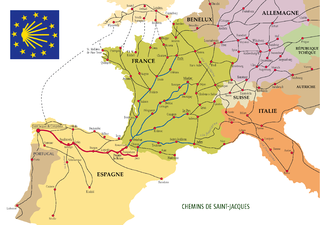 The legend that St James found his way to the Iberian peninsula
, and had preached there is one of a number of early traditions concerning the missionary activities and final resting places of the apostles of Jesus
. Although the 1884 Bull
of Pope Leo XIII
Omnipotens Deus accepted the authenticity of the relics at Compostela, the Vatican
remains uncommitted as to whether the relics are those of Saint James the Greater, while continuing to promote the more general benefits of pilgrimage to the site.
, Saint James decided to return to Holy Land
after preaching in Galicia. There he was beheaded, but his disciples managed to get his body to Jaffa
, where they found a marvelous stone ship
, which miraculously conduced the apostle's body and the disciples to Iria Flavia
, back in Galicia. There, the disciples asked for permission to earthen the body to the local pagan queen, Lupa ('She-wolf'); she, annoyed with the newcomers, decided to the deceive them, sending them to pick a pair of oxes she allegedly had by the Pico Sacro, a local sacred mountain where a dragon
dwelt, hoping that the dragon would kill the Christians. But at the sing of the cross, the dragon exploded. Them, the disciples marched to pick the oxes, which were really raging bulls which the queen used to punish her enemies; but at the sign of the cross the bulls calmed down, and subjected to a yoke, carried the apostle's body to what now is Compostela. The legend was again referred in the 15th century by the Czech traveler Jaroslav Lev of Rožmitál.
The relics were said to have been later rediscovered in the 9th century by a hermit named Pelagius, who after observing strange lights in a local forest, went for help after the local bishop, Theodemar of Iria Flavia, in the west of Galicia. Theodemar was them guided to the spot by a star, the legend affirmed, drawing upon a familiar myth-element, hence "Compostela" was given an etymology
as a corruption of Campus Stellae, "Field of Stars."
In the 15th century still it was preserved in the Cathedral of Santiago de Compostela the banner which guided the Galician armies to battle, red, in the centre Saint James riding a white horse and wearing a white cloak, sword in hand. The legend of the miraculous armed intervention of Saint James, disguised as a white knight to help the Christians when battling the Muslims, was a recurrent myth during the High Middle Ages.
 As suggested already, it is probably impossible to know whose bones were actually found, and precisely when and how. Perhaps it does not matter. What the history of the pilgrimage
requires, but what the meagre sources fail to reveal, is how the local Galician cult associated with the saint was transformed into an international cult drawing pilgrims from distant parts of the world.
The 1000 year old pilgrimage to the shrine of St. James
in the Cathedral of Santiago de Compostela is known in English as the Way of St. James
and in Spanish as the Camino de Santiago. Over 100,000 pilgrims travel to the city each year from points all over Europe and other parts of the world. The pilgrimage has been the subject of many books and television programmes, notably Brian Sewell
's The Naked Pilgrim
produced for UK's Five. The pilgrimage has also been the subject of several paintings by the artist Brian Whelan
.
origin made it the place where the souls of the dead gathered to follow the sun across the sea. Those unworthy of going to the Land of the Dead haunted Galicia as the Santa Compaña
or Estadea.
and rail service
. There are also plans to provide access to Santiago de Compostela by the Spanish High Speed Railway Network
, a project under construction.
, Brazil
Coimbra
, Portugal
, since 1994 Santiago do Cacém
, Portugal
, since 1980s Mashhad
, Iran
Buenos Aires
, Argentina
, since 1980s Qom
, Iran
Santiago de Querétaro
, México
(2005) Santiago de los Caballeros
, Dominican Republic
(2004) Assisi
, Italy
(2008) Pisa
, Italy
(2010) Santiago de Cuba
, founded by Diego Velázquez de Cuéllar
(1514)
Autonomous communities of Spain
An autonomous community In other languages of Spain:*Catalan/Valencian .*Galician .*Basque . The second article of the constitution recognizes the rights of "nationalities and regions" to self-government and declares the "indissoluble unity of the Spanish nation".Political power in Spain is...
of Galicia, Spain
Spain
Spain , officially the Kingdom of Spain languages]] under the European Charter for Regional or Minority Languages. In each of these, Spain's official name is as follows:;;;;;;), is a country and member state of the European Union located in southwestern Europe on the Iberian Peninsula...
.
The city's Cathedral
Cathedral of Santiago de Compostela
Santiago de Compostela Cathedral is a Roman Catholic cathedral of the archdiocese of Santiago de Compostela in Galicia, Spain. The cathedral is the reputed burial-place of Saint James the Greater, one of the apostles of Jesus Christ. It is the destination of the Way of St...
is the destination today, as it has been throughout history, of the important 9th century medieval pilgrimage route
Codex Calixtinus
The Codex Calixtinus is a 12th-century illuminated manuscript formerly attributed to Pope Callixtus II, though now believed to have been arranged by the French scholar Aymeric Picaud. The principal author is actually given as 'Scriptor I'....
, the Way of St. James
Way of St. James
The Way of St. James or St. James' Way is the pilgrimage route to the Cathedral of Santiago de Compostela in Galicia in northwestern Spain, where tradition has it that the remains of the apostle Saint James are buried....
. In 1985 the city's Old Town was designated a UNESCO
UNESCO
The United Nations Educational, Scientific and Cultural Organization is a specialized agency of the United Nations...
World Heritage Site
World Heritage Site
A UNESCO World Heritage Site is a place that is listed by the UNESCO as of special cultural or physical significance...
.
Toponym
Santiago is the local Galician evolution of Vulgar LatinVulgar Latin
Vulgar Latin is any of the nonstandard forms of Latin from which the Romance languages developed. Because of its nonstandard nature, it had no official orthography. All written works used Classical Latin, with very few exceptions...
Sanctu Iacobu "Saint James". As for Compostela, folk etymology presumes it proceeds from the Latin Campus Stellae (i.e. "Field of the Star"), but it is unlikely that such form could yield the modern Compostela under normal evolution from Latin to Galician-Portuguese
Galician-Portuguese
Galician-Portuguese or Old Portuguese was a West Iberian Romance language spoken in the Middle Ages, in the northwest area of the Iberian Peninsula. It was first spoken in the area bounded in the north and west by the Atlantic Ocean and the Douro River in the south but it was later extended south...
. More probable etymologies relate the word with Latin compositum, and local Vulgar Latin
Vulgar Latin
Vulgar Latin is any of the nonstandard forms of Latin from which the Romance languages developed. Because of its nonstandard nature, it had no official orthography. All written works used Classical Latin, with very few exceptions...
Composita Tella meaning "burial ground" as a euphemism
Euphemism
A euphemism is the substitution of a mild, inoffensive, relatively uncontroversial phrase for another more frank expression that might offend or otherwise suggest something unpleasant to the audience...
, or simply with the hypocoristic
Hypocoristic
A hypocorism is a shorter form of a word or given name, for example, when used in more intimate situations as a nickname or term of endearment.- Derivation :Hypocorisms are often generated as:...
compositellam, "the well composed" . Other sites in Galicia share this toponym, akin to Compostilla in León
León (province)
León is a province of northwestern Spain, in the northwestern part of the autonomous community of Castile and León.About one quarter of its population of 500,200 lives in the capital, León. The weather is cold and dry during the winter....
province. Compostela de Santiago or Santiago de Compostela are the same.
The city
Cathedral of Santiago de Compostela
Santiago de Compostela Cathedral is a Roman Catholic cathedral of the archdiocese of Santiago de Compostela in Galicia, Spain. The cathedral is the reputed burial-place of Saint James the Greater, one of the apostles of Jesus Christ. It is the destination of the Way of St...
borders the main plaza of the old and well-preserved city. Legend has it that the remains of the apostle James were brought to Galicia for burial. In 813, according to medieval legend, the light of a bright star guided a shepherd who was watching his flock at night to the burial site in Santiago de Compostela. The shepherd quickly reported his discovery to the bishop of Iria, Bishop Teodomiro. The bishop declared that the remains were those of the apostle James and immediately notified King Alfonso II in Oviedo. To honor St. James, the cathedral was built on the spot where his remains were said to have been found. The legend
Legend
A legend is a narrative of human actions that are perceived both by teller and listeners to take place within human history and to possess certain qualities that give the tale verisimilitude...
, which included numerous miraculous events, enabled the Catholic faithful to not only maintain their stronghold in northern Spain during the Christian crusades against the Moors, but also led to the growth and development of the city.
Across the square is the Pazo de Raxoi (Raxoi's Palace), the town hall and seat of the Galician Xunta, and on the right from the cathedral steps is the Hostal dos Reis Católicos, founded in 1492 by the Catholic Monarchs
Catholic Monarchs
The Catholic Monarchs is the collective title used in history for Queen Isabella I of Castile and King Ferdinand II of Aragon. They were both from the House of Trastámara and were second cousins, being both descended from John I of Castile; they were given a papal dispensation to deal with...
, Isabella of Castille and Ferdinand II of Aragon
Ferdinand II of Aragon
Ferdinand the Catholic was King of Aragon , Sicily , Naples , Valencia, Sardinia, and Navarre, Count of Barcelona, jure uxoris King of Castile and then regent of that country also from 1508 to his death, in the name of...
, as a pilgrim's hospice (now a parador
Parador
A parador , in Spain and other Spanish-speaking countries, is a kind of luxury hotel, usually located in a historic building such as a monastery or castle. Parar means to stop, halt or stay.- Paradores de Turismo de España :...
). The Obradoiro façade of the cathedral, the best known, is depicted on the Spanish euro coins
Spanish euro coins
Spanish euro coins feature three different designs for each of the three series of coins. The minor series of 1, 2 and 5 cent coins were designed by Garcilaso Rollán, the middle series of 10, 20, and 50 cent coins by Begoña Castellanos and the two major coins feature the portrait or effigy of King...
of 1 cent, 2 cents, and 5 cents (€
Euro
The euro is the official currency of the eurozone: 17 of the 27 member states of the European Union. It is also the currency used by the Institutions of the European Union. The eurozone consists of Austria, Belgium, Cyprus, Estonia, Finland, France, Germany, Greece, Ireland, Italy, Luxembourg,...
0.01, €0.02, and €0.05).
Santiago is the site of the University of Santiago de Compostela
University of Santiago de Compostela
The Royal University of Santiago de Compostela - USC is a public university located in the city of Santiago de Compostela, Galicia, Spain. A second campus is located in Lugo, Galicia....
, established in the early 16th century. The main campus can be seen best from an alcove in the large municipal park in the centre of the city.
Within the old town there are many narrow winding streets full of historic buildings. The new town all around it has less character though some of the older parts of the new town have some big apartments in them.
Santiago de Compostela has a substantial nightlife. Divided between the new town (a zona nova in Galician
Galician language
Galician is a language of the Western Ibero-Romance branch, spoken in Galicia, an autonomous community located in northwestern Spain, where it is co-official with Castilian Spanish, as well as in border zones of the neighbouring territories of Asturias and Castile and León.Modern Galician and...
, la zona nueva in Spanish
Spanish language
Spanish , also known as Castilian , is a Romance language in the Ibero-Romance group that evolved from several languages and dialects in central-northern Iberia around the 9th century and gradually spread with the expansion of the Kingdom of Castile into central and southern Iberia during the...
or ensanche) and the old town (a zona vella in Galician or la zona vieja in Spanish
Spanish language
Spanish , also known as Castilian , is a Romance language in the Ibero-Romance group that evolved from several languages and dialects in central-northern Iberia around the 9th century and gradually spread with the expansion of the Kingdom of Castile into central and southern Iberia during the...
, trade-branded as zona monumental), a mix of middle-aged residents and younger students running throughout the city until the early hours of the morning can often be found. Radiating from the center of the city, the historic cathedral is surrounded by paved granite streets, tucked away in the old town, and separated from the newer part of the city by the largest of many parks throughout the city, Parque da Alameda. Whether in the old town or the new town, party-goers will often find themselves following their tapas
Tapas
Tapas are a wide variety of appetizers, or snacks, in Spanish cuisine. They may be cold or warm ....
by dancing the night away.
Santiago gives its name to one of the four military orders of Spain: Santiago
Order of Santiago
The Order of Santiago was founded in the 12th century, and owes its name to the national patron of Galicia and Spain, Santiago , under whose banner the Christians of Galicia and Asturias began in the 9th century to combat and drive back the Muslims of the Iberian Peninsula.-History:Santiago de...
, Calatrava
Order of Calatrava
The Order of Calatrava was the first military order founded in Castile, but the second to receive papal approval. The papal bull confirming the Order of Calatrava as a Militia was given by Pope Alexander III on September 26, 1164.-Origins and Foundation:...
, Alcantara
Order of Alcántara
The Order of Alcántara , also called the Knights of St. Julian, was originally a military order of León, founded in 1166 and confirmed by Pope Alexander III in 1177.-Alcántara:...
and Montesa
Order of Montesa
The Order of Montesa is a Christian military order, territorially limited to the Kingdom of Aragon.-Templar background:The Templars had been received with enthusiasm in Aragon from their foundation in 1128...
.
One of the most important economic centers in Galicia, Santiago is the seat for organizations like Association for Equal and Fair Trade Pangaea
Association for Equal and Fair Trade Pangaea
The Association for Equal and Fair Trade Pangaea is a secular human development non-governmental organization best known for its work on fair trade and Food sovereignty....
.
Climate
Under the Köppen climate classificationKöppen climate classification
The Köppen climate classification is one of the most widely used climate classification systems. It was first published by Crimea German climatologist Wladimir Köppen in 1884, with several later modifications by Köppen himself, notably in 1918 and 1936...
, Santiago de Compostela has a humid oceanic
Oceanic climate
An oceanic climate, also called marine west coast climate, maritime climate, Cascadian climate and British climate for Köppen climate classification Cfb and subtropical highland for Köppen Cfb or Cwb, is a type of climate typically found along the west coasts at the middle latitudes of some of the...
(Cfb) climate, with dryer summers, so sometimes being classified as a Csb climate, similar to that of the coastal strips of Oregon
Oregon
Oregon is a state in the Pacific Northwest region of the United States. It is located on the Pacific coast, with Washington to the north, California to the south, Nevada on the southeast and Idaho to the east. The Columbia and Snake rivers delineate much of Oregon's northern and eastern...
, Washington and Vancouver
Vancouver
Vancouver is a coastal seaport city on the mainland of British Columbia, Canada. It is the hub of Greater Vancouver, which, with over 2.3 million residents, is the third most populous metropolitan area in the country,...
, in the western coast of North America. The prevailing winds from the Atlantic
Atlantic Ocean
The Atlantic Ocean is the second-largest of the world's oceanic divisions. With a total area of about , it covers approximately 20% of the Earth's surface and about 26% of its water surface area...
and the surrounding mountains combine to give Santiago some of Spain’s highest rainfall: about 1545 millimetres (60.8 in) annually. The climate is mild: frosts are just common in December, January and February, with an average of just 8 days per year, while snow is rare; temperatures over 35 °C (95 °F) are exceptional.
Population
The population of the city in 2010 was 94,824 inhabitants, while the metropolitan area reaches 150,000.In 2010 there were 4,111 foreigners living in the city, representing a 4,3% of the total population. The main nationalities are Brazilians (11%), Portuguese
Portuguese people
The Portuguese are a nation and ethnic group native to the country of Portugal, in the west of the Iberian peninsula of south-west Europe. Their language is Portuguese, and Roman Catholicism is the predominant religion....
(8%) and Colombians
Colombians
Colombians may refer to:* Citizens of Colombia, a country in South America.* Ethnic Colombians** Colombian people, persons from Colombia or of Colombian ancestry...
(7%).
By language, according to 2008 data, 21% of the population speak always in Galician, 15% speak always in Spanish and the rest use both interchangeably. Santiago is the Galician city with most monolingual population in Galician language
Galician language
Galician is a language of the Western Ibero-Romance branch, spoken in Galicia, an autonomous community located in northwestern Spain, where it is co-official with Castilian Spanish, as well as in border zones of the neighbouring territories of Asturias and Castile and León.Modern Galician and...
.
History
Suebi
The Suebi or Suevi were a group of Germanic peoples who were first mentioned by Julius Caesar in connection with Ariovistus' campaign, c...
in the early 400s, during the initial collapse of the Roman Empire
Migration Period
The Migration Period, also called the Barbarian Invasions , was a period of intensified human migration in Europe that occurred from c. 400 to 800 CE. This period marked the transition from Late Antiquity to the Early Middle Ages...
when they settled in Galicia and Portugal. The area was later attributed to the bishopric of Iria Flavia
Iria Flavia
Iria Flavia or simply Iria in Galicia, northwestern Spain, was a Celtiberian port, the main seat of the Caporos, on the road between Braga and Astorga. The Romans rebuilt the road as via XVIII or Via Nova and refounded the Celtiberian port as Iria Flavia to complement Vespasian...
in the 6th century, in the partition usually known as Parochiale Suevorum, ordered by king Theodemar
Theodemar
Theodemir or Theodemar was one of the last Suevic kings of Galicia and one of the first Catholics. He succeeded Ariamir sometime between the end of May 561 and the year 566 and ruled until his death....
. In 585 the whole settlement together with the rest of Suebi Kingdom was annexed by Leovigild
Liuvigild
Liuvigild, Leuvigild, Leovigild, or Leogild was a Visigothic King of Hispania and Septimania from 569 to April 21, 586. From 585 he was also king of Galicia. Known for his Codex Revisus or Code of Leovigild, a unifying law allowing equal rights between the Visigothic and Hispano-Roman population,...
into the Visigothic kingdom of Spain
Visigothic Kingdom
The Visigothic Kingdom was a kingdom which occupied southwestern France and the Iberian Peninsula from the 5th to 8th century AD. One of the Germanic successor states to the Western Roman Empire, it was originally created by the settlement of the Visigoths under King Wallia in the province of...
as the sixth province of the realm.
Maybe raided from 711 to 739 by the Arabs, the bishopric of Iria was incorporated into the Kingdom of Asturias
Kingdom of Asturias
The Kingdom of Asturias was a Kingdom in the Iberian peninsula founded in 718 by Visigothic nobles under the leadership of Pelagius of Asturias. It was the first Christian political entity established following the collapse of the Visigothic kingdom after Islamic conquest of Hispania...
c. 750; some tens of years later, at some point between 818 and 842, bishop Theodemar of Iria
Theodemar of Iria
Theodemar or Theodemir , was a bishop of Iria, in Galicia. He was the discoverer of the alleged tomb of Saint James the Great, in what's now Santiago de Compostela, at some point between year 818, when his predecessor bishop Quendulf was still alive, and 842 when king Alfonso II of Asturias died....
(d. 847), found some remains which were attributed to Saint James the Greater, during the reign of Alfonso II of Asturias
Alfonso II of Asturias
Alfonso II , called the Chaste, was the king of Asturias from 791 to his death, the son of Fruela I and the Basque Munia.He was born in Oviedo in 759 or 760. He was put under the guardianship of his aunt Adosinda after his father's death, but one tradition relates his being put in the monastery of...
. Allegedly, the Pope
Pope
The Pope is the Bishop of Rome, a position that makes him the leader of the worldwide Catholic Church . In the Catholic Church, the Pope is regarded as the successor of Saint Peter, the Apostle...
and Charlemagne
Charlemagne
Charlemagne was King of the Franks from 768 and Emperor of the Romans from 800 to his death in 814. He expanded the Frankish kingdom into an empire that incorporated much of Western and Central Europe. During his reign, he conquered Italy and was crowned by Pope Leo III on 25 December 800...
—who anyway was dead by 814— would have had an important role in the discovery and acceptance of this find. Around the place of the discovery emerged a new settlement and center of pilgrimage, which was already known by Usuard in 865, and that was called Compostella at least from the 10th century.
From this same 10th century on, Compostela became a politically relevant site, and several kings of Galicia and of León were acclaimed by the Galician noblemen and crowned and anointed by the local bishop at the cathedral, among them Ordoño IV
Ordoño IV of León
Ordoño IV, called the Wicked or the Bad , son of Alfonso IV of León and nephew of Ramiro II, was the king of León from 958 until 960, interrupting the reign of Sancho the Fat for a two year period...
in 958, Bermudo II
Bermudo II of León
Bermudo II , called the Gouty , was the King of Galicia and León . His reign is summed up by Justo Pérez de Urbel's description of him as "el pobre rey atormentado en la vida por la espada de Almanzor y en muerte por la pluma vengadora de un obispo" Bermudo (or Vermudo) II (956–999), called the...
in 982, and Alfonso VII
Alfonso VII of León
Alfonso VII , born Alfonso Raimúndez, called the Emperor , became the King of Galicia in 1111 and King of León and Castile in 1126. Alfonso first used the title Emperor of All Spain, alongside his mother Urraca, once his mother vested him with the direct rule of Toledo in 1116...
in 1111, so Compostela becoming capital of the Kingdom of Galicia
Kingdom of Galicia
The Kingdom of Galicia was a political entity located in southwestern Europe, which at its territorial zenith occupied the entire northwest of the Iberian Peninsula. Founded by Suebic king Hermeric in the year 409, the Galician capital was established in Braga, being the first kingdom which...
. Later kings were also sepulchered in the cathedral, namely Fernando II and Alfonso IX, last of the Kings of León and Galicia before both kingdoms were united with the Kingdom of Castile
Kingdom of Castile
Kingdom of Castile was one of the medieval kingdoms of the Iberian Peninsula. It emerged as a political autonomous entity in the 9th century. It was called County of Castile and was held in vassalage from the Kingdom of León. Its name comes from the host of castles constructed in the region...
.
In the 11th and 12th century the site became a pan-European place of peregrination, second only to Rome
Rome
Rome is the capital of Italy and the country's largest and most populated city and comune, with over 2.7 million residents in . The city is located in the central-western portion of the Italian Peninsula, on the Tiber River within the Lazio region of Italy.Rome's history spans two and a half...
and Jerusalem. In 999 it was assaulted and partially destroyed by the Muslims under the command of Al Mansur, and assaulted by Viking riders in several occasions in the next century. As a result, bishop Cresconio fortified the place, building a wall and defensive towers. In the 12th century, under the impulse of bishop Diego Gelmírez
Diego Gelmírez
Diego Gelmírez was the second bishop and first archbishop of the Roman Catholic Archdiocese of Santiago de Compostela in Galicia, Spain. He is a prominent figure in the history of Galicia and an important historiographer of the Spain of his day...
, Compostela became an archbishopric, attracting a large and multinational population. Under the rule of this prelate, the townspeople rebelled, headed by the local council, beginning a secular tradition of confrontation of the people of the city —who fought for self-government— with the local bishop, the secular and jurisdictional lord of the city and of its fief, the semi-independent Terra de Santiago ('Land of Saint James'). The peak of this confrontation was reached in the 14th century, when the new prelate, the Frenchman Bérenger de Landore, treacherously executed the counselors of the city in his castle of A Rocha Forte ('The Strong Rock/Castle'), after attracting them for talks.
Santiago de Compostela was captured and sacked by the French during the Napoleonic Wars
Napoleonic Wars
The Napoleonic Wars were a series of wars declared against Napoleon's French Empire by opposing coalitions that ran from 1803 to 1815. As a continuation of the wars sparked by the French Revolution of 1789, they revolutionised European armies and played out on an unprecedented scale, mainly due to...
; as a result, the remains attributed to the apostle were lost for near a century, hidden inside a cist
Cist
A cist from ) is a small stone-built coffin-like box or ossuary used to hold the bodies of the dead. Examples can be found across Europe and in the Middle East....
in the crypts of the cathedral of the city.
The excavations conducted in the cathedral during the 19th and 20th centuries uncovered a Roman cella memoriae or martyrium
Martyrium (architecture)
A martyrium is a structure built at "a site which bears witness to the Christian faith, either by referring to an event in Christ's life or Passion, or by sheltering the grave of a martyr"....
, around which grew a small cemetery in Roman and Suevi times which was later abandoned. This martyrium, which proves the existence of an old Christian holy place, have been sometimes attributed to Priscillian
Priscillian
Priscillian was bishop of Ávila and a theologian from Roman Gallaecia , the first person in the history of Christianity to be executed for heresy . He founded an ascetic group that, in spite of persecution, continued to subsist in Hispania and Gaul until the later 6th century...
, although without further proof.
Economy
Santiago's economy, although still heavily dependent in public administration (headquarters of the autonomous government of Galicia), cultural tourism and industry, an in its university, is becoming diversified in various sectors, most notably timber transformation (FINSA), automotive industry (UROVESAUro (trucks)
Uro is a Galician brand of all-wheel-drive and military trucks, based in Santiago de Compostela.The Uro parent company, Urovesa, was started in 1981 by a group of ex-IPV employees....
), and telecommunications and electronics (Blusens and Televés). Banco Gallego, a banking institution owned by Novacaixagalicia
Novacaixagalicia
Novacaixagalicia is the trading name of Caixa de Aforros de Galicia, Vigo, Ourense e Pontevedra a Spanish savings bank based in Galicia...
, has its headquarters in downtown rúa do Hórreo.
Tourism is very important thanks to the Way of St. James
Way of St. James
The Way of St. James or St. James' Way is the pilgrimage route to the Cathedral of Santiago de Compostela in Galicia in northwestern Spain, where tradition has it that the remains of the apostle Saint James are buried....
, particularly in Holy Compostelan Years (when July 25 falls on a Sunday). Following the Xunta's considerable investment and hugely successful advertising campaign for the Holy Year of 1993, the number of pilgrims completing the route has been steadily rising. Following the Holy Year of 2010, the next Holy Year will not be for another 11 years. More than 272,000 pilgrims made the trip during the course of 2010.
Editorial Compostela owns daily newspaper El Correo Gallego, a local TV, and a radio station
Radio station
Radio broadcasting is a one-way wireless transmission over radio waves intended to reach a wide audience. Stations can be linked in radio networks to broadcast a common radio format, either in broadcast syndication or simulcast or both...
. Galician language online news portal Galicia Hoxe is also based in the city. Televisión de Galicia, the public broadcaster corporation of Galicia, has its headquarters in Santiago.
Way of St. James
Iberian Peninsula
The Iberian Peninsula , sometimes called Iberia, is located in the extreme southwest of Europe and includes the modern-day sovereign states of Spain, Portugal and Andorra, as well as the British Overseas Territory of Gibraltar...
, and had preached there is one of a number of early traditions concerning the missionary activities and final resting places of the apostles of Jesus
Jesus
Jesus of Nazareth , commonly referred to as Jesus Christ or simply as Jesus or Christ, is the central figure of Christianity...
. Although the 1884 Bull
Papal bull
A Papal bull is a particular type of letters patent or charter issued by a Pope of the Catholic Church. It is named after the bulla that was appended to the end in order to authenticate it....
of Pope Leo XIII
Pope Leo XIII
Pope Leo XIII , born Vincenzo Gioacchino Raffaele Luigi Pecci to an Italian comital family, was the 256th Pope of the Roman Catholic Church, reigning from 1878 to 1903...
Omnipotens Deus accepted the authenticity of the relics at Compostela, the Vatican
Holy See
The Holy See is the episcopal jurisdiction of the Catholic Church in Rome, in which its Bishop is commonly known as the Pope. It is the preeminent episcopal see of the Catholic Church, forming the central government of the Church. As such, diplomatically, and in other spheres the Holy See acts and...
remains uncommitted as to whether the relics are those of Saint James the Greater, while continuing to promote the more general benefits of pilgrimage to the site.
The legends
According to a tradition that can be traced back at least to the 12th century, when it was recorded in the recently stolen Codex CalixtinusCodex Calixtinus
The Codex Calixtinus is a 12th-century illuminated manuscript formerly attributed to Pope Callixtus II, though now believed to have been arranged by the French scholar Aymeric Picaud. The principal author is actually given as 'Scriptor I'....
, Saint James decided to return to Holy Land
Holy Land
The Holy Land is a term which in Judaism refers to the Kingdom of Israel as defined in the Tanakh. For Jews, the Land's identifiction of being Holy is defined in Judaism by its differentiation from other lands by virtue of the practice of Judaism often possible only in the Land of Israel...
after preaching in Galicia. There he was beheaded, but his disciples managed to get his body to Jaffa
Jaffa
Jaffa is an ancient port city believed to be one of the oldest in the world. Jaffa was incorporated with Tel Aviv creating the city of Tel Aviv-Yafo, Israel. Jaffa is famous for its association with the biblical story of the prophet Jonah.-Etymology:...
, where they found a marvelous stone ship
Stone ship
The Stone ship or ship setting was an early Germanic burial custom, characteristically Scandinavian but also found in Germany and the Baltic states. The grave or cremation burial is surrounded by tightly or loosely fit slabs or stones in the outline of a ship...
, which miraculously conduced the apostle's body and the disciples to Iria Flavia
Iria Flavia
Iria Flavia or simply Iria in Galicia, northwestern Spain, was a Celtiberian port, the main seat of the Caporos, on the road between Braga and Astorga. The Romans rebuilt the road as via XVIII or Via Nova and refounded the Celtiberian port as Iria Flavia to complement Vespasian...
, back in Galicia. There, the disciples asked for permission to earthen the body to the local pagan queen, Lupa ('She-wolf'); she, annoyed with the newcomers, decided to the deceive them, sending them to pick a pair of oxes she allegedly had by the Pico Sacro, a local sacred mountain where a dragon
Dragon
A dragon is a legendary creature, typically with serpentine or reptilian traits, that feature in the myths of many cultures. There are two distinct cultural traditions of dragons: the European dragon, derived from European folk traditions and ultimately related to Greek and Middle Eastern...
dwelt, hoping that the dragon would kill the Christians. But at the sing of the cross, the dragon exploded. Them, the disciples marched to pick the oxes, which were really raging bulls which the queen used to punish her enemies; but at the sign of the cross the bulls calmed down, and subjected to a yoke, carried the apostle's body to what now is Compostela. The legend was again referred in the 15th century by the Czech traveler Jaroslav Lev of Rožmitál.
The relics were said to have been later rediscovered in the 9th century by a hermit named Pelagius, who after observing strange lights in a local forest, went for help after the local bishop, Theodemar of Iria Flavia, in the west of Galicia. Theodemar was them guided to the spot by a star, the legend affirmed, drawing upon a familiar myth-element, hence "Compostela" was given an etymology
Etymology
Etymology is the study of the history of words, their origins, and how their form and meaning have changed over time.For languages with a long written history, etymologists make use of texts in these languages and texts about the languages to gather knowledge about how words were used during...
as a corruption of Campus Stellae, "Field of Stars."
In the 15th century still it was preserved in the Cathedral of Santiago de Compostela the banner which guided the Galician armies to battle, red, in the centre Saint James riding a white horse and wearing a white cloak, sword in hand. The legend of the miraculous armed intervention of Saint James, disguised as a white knight to help the Christians when battling the Muslims, was a recurrent myth during the High Middle Ages.
The establishment of the shrine
Pilgrimage
A pilgrimage is a journey or search of great moral or spiritual significance. Typically, it is a journey to a shrine or other location of importance to a person's beliefs and faith...
requires, but what the meagre sources fail to reveal, is how the local Galician cult associated with the saint was transformed into an international cult drawing pilgrims from distant parts of the world.
The 1000 year old pilgrimage to the shrine of St. James
Saint James the Great
James, son of Zebedee was one of the Twelve Apostles of Jesus. He was a son of Zebedee and Salome, and brother of John the Apostle...
in the Cathedral of Santiago de Compostela is known in English as the Way of St. James
Way of St. James
The Way of St. James or St. James' Way is the pilgrimage route to the Cathedral of Santiago de Compostela in Galicia in northwestern Spain, where tradition has it that the remains of the apostle Saint James are buried....
and in Spanish as the Camino de Santiago. Over 100,000 pilgrims travel to the city each year from points all over Europe and other parts of the world. The pilgrimage has been the subject of many books and television programmes, notably Brian Sewell
Brian Sewell
Brian Sewell is an English art critic and media personality. He writes for the London Evening Standard and is noted for artistic conservatism and his acerbic view of the Turner Prize and conceptual art...
's The Naked Pilgrim
The Naked Pilgrim
The Naked Pilgrim is documentary series produced by British broadcaster Five and presented by art critic Brian Sewell. First broadcast in 2003, the series follows Sewell on the Catholic pilgrimage to Santiago de Compostela....
produced for UK's Five. The pilgrimage has also been the subject of several paintings by the artist Brian Whelan
Brian Whelan
Brian Whelan is a noted London-Irish painter, author and occasional film maker.-Family life:Brian Francis Whelan was born 3 May 1957 in Ealing, London, of Irish Catholic parents. His father came from Dublin and his mother from Kilkenny...
.
Pre-Christian legends
As the lowest-lying land on that stretch of coast, the city's site took on added significance. Legends supposed of CelticCeltic mythology
Celtic mythology is the mythology of Celtic polytheism, apparently the religion of the Iron Age Celts. Like other Iron Age Europeans, the early Celts maintained a polytheistic mythology and religious structure...
origin made it the place where the souls of the dead gathered to follow the sun across the sea. Those unworthy of going to the Land of the Dead haunted Galicia as the Santa Compaña
Santa Compaña
The Santa Compaña is probably one of the most deep-rooted mythical beliefs in rural Galicia, and also in Asturias, where it is called Güestia...
or Estadea.
Main sights
- 16th century BaroqueBaroque architectureBaroque architecture is a term used to describe the building style of the Baroque era, begun in late sixteenth century Italy, that took the Roman vocabulary of Renaissance architecture and used it in a new rhetorical and theatrical fashion, often to express the triumph of the Catholic Church and...
Abbey of San Martín PinarioMonasterio de San Martín PinarioThe monastery of San Martín Pinario is a Benedictine monastery in the city of Santiago de Compostela, Galicia, Spain.-External links:... - Cathedral of Santiago de CompostelaCathedral of Santiago de CompostelaSantiago de Compostela Cathedral is a Roman Catholic cathedral of the archdiocese of Santiago de Compostela in Galicia, Spain. The cathedral is the reputed burial-place of Saint James the Greater, one of the apostles of Jesus Christ. It is the destination of the Way of St...
- University of Santiago de CompostelaUniversity of Santiago de CompostelaThe Royal University of Santiago de Compostela - USC is a public university located in the city of Santiago de Compostela, Galicia, Spain. A second campus is located in Lugo, Galicia....
- City of Culture of GaliciaCity of Culture of GaliciaCity of Culture of Galicia is a complex of cultural buildings in Santiago de Compostela, A Coruña, Galicia, Spain, designed by architect Peter Eisenman and office. The buildings are an extreme challenge to construct as the design of them makes them look like rolling hills with high degree contours...
(will be completed in 2012)
Transportation
Santiago de Compostela is served by Santiago de Compostela AirportSantiago de Compostela Airport
Santiago de Compostela Airport - Lavacolla is one of the three international airports in Galicia, Spain. It is located in Lavacolla, a town in the outskirts of Galicia's capital city, Santiago de Compostela. In 2010, 2,172,869 passengers passed through it....
and rail service
RENFE
Renfe Operadora is the state-owned company which operates freight and passenger trains on the 1668-mm "Iberian gauge" and 1435-mm "European gauge" networks of the Spanish national railway infrastructure company ADIF .- History :The name RENFE is derived from that of the former Spanish National...
. There are also plans to provide access to Santiago de Compostela by the Spanish High Speed Railway Network
AVE
Alta Velocidad Española is a service of high-speed rail in Spain operated by Renfe, the Spanish national railway company, at speeds of up to . The name is literally translated from Spanish as "Spanish High Speed", but also a play on the word , meaning "bird".AVE trains run on a network of...
, a project under construction.
Sister cities
Santiago de Compostela is twinned with: São PauloSão Paulo
São Paulo is the largest city in Brazil, the largest city in the southern hemisphere and South America, and the world's seventh largest city by population. The metropolis is anchor to the São Paulo metropolitan area, ranked as the second-most populous metropolitan area in the Americas and among...
, Brazil
Brazil
Brazil , officially the Federative Republic of Brazil , is the largest country in South America. It is the world's fifth largest country, both by geographical area and by population with over 192 million people...
Coimbra
Coimbra
Coimbra is a city in the municipality of Coimbra in Portugal. Although it served as the nation's capital during the High Middle Ages, it is better-known for its university, the University of Coimbra, which is one of the oldest in Europe and the oldest academic institution in the...
, Portugal
Portugal
Portugal , officially the Portuguese Republic is a country situated in southwestern Europe on the Iberian Peninsula. Portugal is the westernmost country of Europe, and is bordered by the Atlantic Ocean to the West and South and by Spain to the North and East. The Atlantic archipelagos of the...
, since 1994 Santiago do Cacém
Santiago do Cacém
Santiago do Cacém is a municipality in Portugal with a total area of 1060.0 km² and a total population of 30,305 inhabitants.The municipality is composed of 11 parishes, and is located in Setúbal District....
, Portugal
Portugal
Portugal , officially the Portuguese Republic is a country situated in southwestern Europe on the Iberian Peninsula. Portugal is the westernmost country of Europe, and is bordered by the Atlantic Ocean to the West and South and by Spain to the North and East. The Atlantic archipelagos of the...
, since 1980s Mashhad
Mashhad
Mashhad , is the second largest city in Iran and one of the holiest cities in the Shia Muslim world. It is also the only major Iranian city with an Arabic name. It is located east of Tehran, at the center of the Razavi Khorasan Province close to the borders of Afghanistan and Turkmenistan. Its...
, Iran
Iran
Iran , officially the Islamic Republic of Iran , is a country in Southern and Western Asia. The name "Iran" has been in use natively since the Sassanian era and came into use internationally in 1935, before which the country was known to the Western world as Persia...
Buenos Aires
Buenos Aires
Buenos Aires is the capital and largest city of Argentina, and the second-largest metropolitan area in South America, after São Paulo. It is located on the western shore of the estuary of the Río de la Plata, on the southeastern coast of the South American continent...
, Argentina
Argentina
Argentina , officially the Argentine Republic , is the second largest country in South America by land area, after Brazil. It is constituted as a federation of 23 provinces and an autonomous city, Buenos Aires...
, since 1980s Qom
Qom
Qom is a city in Iran. It lies by road southwest of Tehran and is the capital of Qom Province. At the 2006 census, its population was 957,496, in 241,827 families. It is situated on the banks of the Qom River....
, Iran
Iran
Iran , officially the Islamic Republic of Iran , is a country in Southern and Western Asia. The name "Iran" has been in use natively since the Sassanian era and came into use internationally in 1935, before which the country was known to the Western world as Persia...
Santiago de Querétaro
Santiago de Querétaro
Santiago de Querétaro is the capital and largest city of the state of Querétaro, located in central Mexico. It is located 213 km northwest of Mexico City, 96 km southeast of San Miguel de Allende and 200 km south of San Luis Potosí...
, México
Mexico
The United Mexican States , commonly known as Mexico , is a federal constitutional republic in North America. It is bordered on the north by the United States; on the south and west by the Pacific Ocean; on the southeast by Guatemala, Belize, and the Caribbean Sea; and on the east by the Gulf of...
(2005) Santiago de los Caballeros
Santiago de los Caballeros
Santiago de los Caballeros is a city in the Dominican Republic. Founded in 1495 during the first wave of European colonization of the New World, today Santiago is the second largest metropolis in the Dominican Republic, located in the north-central region of the Republic known as Cibao valley...
, Dominican Republic
Dominican Republic
The Dominican Republic is a nation on the island of La Hispaniola, part of the Greater Antilles archipelago in the Caribbean region. The western third of the island is occupied by the nation of Haiti, making Hispaniola one of two Caribbean islands that are shared by two countries...
(2004) Assisi
Assisi
- Churches :* The Basilica of San Francesco d'Assisi is a World Heritage Site. The Franciscan monastery, il Sacro Convento, and the lower and upper church of St Francis were begun immediately after his canonization in 1228, and completed in 1253...
, Italy
Italy
Italy , officially the Italian Republic languages]] under the European Charter for Regional or Minority Languages. In each of these, Italy's official name is as follows:;;;;;;;;), is a unitary parliamentary republic in South-Central Europe. To the north it borders France, Switzerland, Austria and...
(2008) Pisa
Pisa
Pisa is a city in Tuscany, Central Italy, on the right bank of the mouth of the River Arno on the Tyrrhenian Sea. It is the capital city of the Province of Pisa...
, Italy
Italy
Italy , officially the Italian Republic languages]] under the European Charter for Regional or Minority Languages. In each of these, Italy's official name is as follows:;;;;;;;;), is a unitary parliamentary republic in South-Central Europe. To the north it borders France, Switzerland, Austria and...
(2010) Santiago de Cuba
Santiago de Cuba
Santiago de Cuba is the second largest city of Cuba and capital city of Santiago de Cuba Province in the south-eastern area of the island, some south-east of the Cuban capital of Havana....
, founded by Diego Velázquez de Cuéllar
Diego Velázquez de Cuéllar
Diego Velázquez de Cuéllar was a Spanish conquistador. He conquered and governed Cuba on behalf of Spain.-Early life:...
(1514)
See also
- Order of SantiagoOrder of SantiagoThe Order of Santiago was founded in the 12th century, and owes its name to the national patron of Galicia and Spain, Santiago , under whose banner the Christians of Galicia and Asturias began in the 9th century to combat and drive back the Muslims of the Iberian Peninsula.-History:Santiago de...
- Música en CompostelaMúsica en CompostelaMúsica en Compostela is an annual summer course in music performance and composition held in Santiago de Compostela, Spain. It was founded by the Spanish guitarist Andrés Segovia and the diplomat José Miguel Ruiz Morales in 1958...
- Cathedral of Santiago de CompostelaCathedral of Santiago de CompostelaSantiago de Compostela Cathedral is a Roman Catholic cathedral of the archdiocese of Santiago de Compostela in Galicia, Spain. The cathedral is the reputed burial-place of Saint James the Greater, one of the apostles of Jesus Christ. It is the destination of the Way of St...
- Auditorio Monte do GozoAuditorio Monte do GozoAuditorio Monte do Gozo is an outdoor concert venue in Santiago de Compostela, Galicia, Spain. It is an amphitheatre-like setting, with a stage, an open area, and then rows of concrete bench seating arranged in a semicircle...