


Thermobaric weapon

Encyclopedia
A thermobaric weapon, which includes the type known as a "fuel-air bomb", is an explosive weapon that produces a blast wave of a significantly longer duration than those produced by condensed explosives. This is useful in military applications where its longer duration increases the numbers of casualties and causes more damage to structures. There are many different variants of thermobaric weapons rounds that can be fitted to hand held launchers such as RPGs and antitank weapons. .
Thermobaric explosives rely on oxygen from the surrounding air, whereas most conventional explosives consist of a fuel-oxidizer premix (for instance, gunpowder
contains 25% fuel and 75% oxidizer). Thus, on a weight-for-weight basis they are significantly more energetic than normal condensed explosives. Their reliance on atmospheric oxygen makes them unsuitable for use underwater, at high altitude or in adverse weather. However, they have significant advantages when deployed inside confined environments such as tunnels, caves, and bunkers.
words for "heat
" and "pressure
": thermobarikos (θερμοβαρικός), from thermos (θερμός), hot + baros (βάρος), weight, pressure + suffix -ikos (-ικός), suffix -ic.
Other terms used for this family of weapons are high-impulse thermobaric weapons (HITs), heat and pressure weapons, vacuum bombs, or fuel-air explosives (FAE or FAX).
Thermobaric explosives apply the principles underlying accidental unconfined vapor cloud explosions (UVCE), which include those from dispersions of flammable dusts and droplets. In previous times they were most often encountered in flour mills and their storage containers, and later in coal mines, but now most commonly in discharged oil tankers and refineries, the most recent being at Buncefield in the UK where the blast wave woke people 150 kilometres (93.2 mi) from its centre.
A typical weapon consists of a container packed with a fuel substance, in the center of which is a small conventional-explosive "scatter charge". Fuels are chosen on the basis of the exothermicity of their oxidation, ranging from powdered metals such as aluminium or magnesium, or organic materials, possibly with a self-contained partial oxidant. The most recent development involves the use of nanofuels.
A thermobaric bomb's effective yield requires the most appropriate combination of a number of factors; among these are how well the fuel is dispersed, how rapidly it mixes with the surrounding atmosphere and the initiation of the igniter and its position relative to the container of fuel. In some cases separate charges are used to disperse and ignite the fuel. In other designs stronger cases allow the fuel to be contained long enough for the fuel to heat to well above its auto-ignition temperature, so that, even its cooling during expansion from the container, results in rapid ignition once the mixture is within conventional flammability limits.
It is important to note that conventional upper and lower limits of flammability apply to such weapons. Close in, blast from the dispersal charge, compressing and heating the surrounding atmosphere, will have some influence on the lower limit. The upper limit has been demonstrated strongly to influence the ignition of fogs above pools of oil. This weakness may be eliminated by designs where the fuel is preheated well above its ignition temperature, so that its cooling during its dispersion still results in a minimal ignition delay on mixing.
In confinement, a series of reflective shock waves are generated, which maintain the fireball and can extend its duration to between 10 and 50 msec as exothermic recombination reactions occur. Further damage can result as the gases cool and pressure drops sharply, leading to a partial vacuum, powerful enough to cause physical damage to people and structures. This effect has given rise to the misnomer "vacuum bomb". Piston-type afterburning is also believed to occur in such structures, as flame-fronts accelerate through it.
The overpressure
within the detonation can reach 430 pound per square inches (3 MPa) and the temperature can be 4500 to 5400 °F (2,482.2 to 2,982.2 C). Outside the cloud the blast wave travels at over 2 mi/s.
According to a separate U.S. Central Intelligence Agency study, “the effect of an FAE explosion within confined spaces is immense. Those near the ignition point are obliterated. Those at the fringe are likely to suffer many internal, and thus invisible injuries, including burst eardrums and crushed inner ear organs, severe concussions, ruptured lungs and internal organs, and possibly blindness.”Another Defense Intelligence Agency document speculates that because the “shock and pressure waves cause minimal damage to brain tissue…it is possible that victims of FAEs are not rendered unconscious by the blast, but instead suffer for several seconds or minutes while they suffocate.”
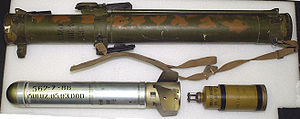 The Soviet
armed forces extensively developed FAE weapons, such as the RPO-A, and are known to have used them in Chechnya
.
The Russian armed forces have developed thermobaric ammunition variants for several of their weapons, such as the TGB-7V thermobaric grenade with a lethality radius of 10 metres (32.8 ft), which can be launched from a RPG-7
. The GM-94 is a 43 mm pump-action grenade launcher which is designed mainly to fire thermobaric grenades for close quarters combat. With the grenade weighing 250 grams (8.8 oz) and holding a 160 grams (5.6 oz) explosive mixture, its lethality radius is 3 metres (9.8 ft). The RPO-A and upgraded RPO-M are infantry-portable RPG
s designed to fire thermobaric rockets. The RPO-M for instance, has a thermobaric warhead with similar destructive capabilities as a 152 mm High explosive fragmentation artillery shell. The RSgH-1
and the RSgH-2
are thermobaric variants of the RPG-27 and RPG-26 respectively. Of the two, the RSgH-1 is the more powerful variant, with its warhead having a 10 metres (32.8 ft) lethality radius and producing the same effects of about 6 kg (13.2 lb) of TNT. The RMG is a further derivative of the RPG-26 that uses a tandem-charge
warhead, whereby the pre-cursor HEAT
warhead blasts an opening for the main thermobaric charge to enter and detonate inside.
The other examples include the SACLOS
or millimeter wave radar
-guided thermobaric variants of the 9M123 Khrizantema, the 9M133F-1 thermobaric warhead variant of the 9M133 Kornet
and the 9M131F thermobaric warhead variant of the 9K115-2 Metis-M
, all of which are anti-tank missiles. The 300 mm 9N174 thermobaric cluster warhead rocket was built to be fired from the BM-30 Smerch MLRS. A dedicated carrier of thermobaric weapons is the purpose-built TOS-1
, a 30-tube MLRS designed to fire thermobaric rockets.
Many Russian Air Force
munitions also have thermobaric variants. The 80 mm S-8 rocket
has the S-8DM and S-8DF thermobaric variants. The S-8's larger 122 mm brother, the S-13 rocket
has the S-13D and S-13DF thermobaric variants. The S-13DF's warhead weighs only 32 kg (70.5 lb) but its power is equivalent to 40 kg (88.2 lb) of TNT. The KAB-500-OD variant of the KAB-500KR
has a 250 kg (551.2 lb) thermobaric warhead. The ODAB-500PM and ODAB-500PMV unguided bombs carry a 190 kg (418.9 lb) fuel-air explosive each. The KAB-1500S GLONASS
/GPS guided 1500 kg (3,306.9 lb) bomb also has a thermobaric variant. Accordingly, its fireball will cover over a 150 metres (492.1 ft) radius and its lethality zone is a 500 metres (1,640.4 ft) radius. The 9M120 Ataka-V
and the 9K114 Shturm ATGMs both have thermobaric variants.
In September 2007 Russia successfully exploded the largest thermobaric weapon ever made. The weapon's yield was reportedly greater than that of the smallest dial-a-yield nuclear weapons at their lowest settings. Russia named this particular ordnance the "Father of All Bombs" in response to the United States developed "Massive Ordnance Air Blast
" (MOAB) bomb whose backronym
is the "Mother of All Bombs", and which previously held the accolade of the most powerful non-nuclear weapon in history. The bomb contains a 14000 pounds (6,350.3 kg) charge of a liquid fuel such as ethylene oxide
, mixed with an energetic nanoparticle
such as aluminium
, surrounding a high explosive burster. See film here.
The XM1060 40-mm grenade is a small-arms thermobaric device, which was delivered to U.S. forces in April 2003. Since the 2003 Invasion of Iraq
, the US Marine Corps has introduced a thermobaric 'Novel Explosive' (SMAW-NE) round for the Mk 153 SMAW
rocket launcher. One team of Marines reported that they had destroyed a large one-story masonry type building with one round from 100 yards (91.4 m).
The 106 pounds (48.1 kg) AGM-114N Hellfire
Metal Augmented Charge introduced in 2003 in Iraq contains a thermobaric explosive fill, using fluoridated
aluminium
layered between the charge casing and a PBXN-112 explosive mixture. When the PBXN-112 detonates, the aluminium mixture is dispersed and rapidly burns. The resultant sustained high pressure is extremely effective against people and structures.
system was test fired in Panjshir valley
during Soviet war in Afghanistan
in the early 1980's
Unconfirmed reports suggest Russian military forces used ground delivered thermobaric weapons in the Battle for Grozny
(first
and second
Chechen wars) to attack dug in Chechen fighters. The Use of both TOS-1
heavy MLRS and "RPO-A Shmel" shoulder-fired rocket system in the Chechen wars is reported to have occurred.
During the 2004 Beslan school hostage crisis, it is theorized that a multitude of hand-held thermobaric weapons were used by the Russian Armed Forces in their efforts to retake the school. The RPO-A and either the TGB-7V thermobaric rocket from the RPG-7 or rockets from either the RShG-1
or the RShG-2
is claimed to have been used by the Spetsnaz
during the initial storming of the school. At least 3 and as many as 9 RPO-A casings were later found at the positions of the Spetsnaz
. The Russian Government later admitted to the use of the RPO-A during the crisis.
According to UK Ministry of Defence
, British military forces have also used thermobaric weapons in their AGM-114N Hellfire missiles (carried by Apache helicopters and UAVs) against the Taliban in the War in Afghanistan
.
The US military also used thermobaric weapons in Afghanistan. On 03 March 2002, a single 2000 lb (907.2 kg) laser guided thermobaric bomb was used by the US army against cave complexes in which Al-Qaeda
and Taliban fighters had taken refuge in the Gardez region of Afghanistan. The SMAW-NE
was used by the US Marines during the First Battle of Fallujah and Second Battle of Fallujah.
since the 1983 Beirut barracks bombing
in Lebanon which used a gas-enhanced explosive mechanism, probably propane, butane or acetylene. The explosive used by the bombers in the 1993 World Trade Center bombing
incorporated the FAE principle, using three tanks of bottled hydrogen
gas to enhance the blast. Jemaah Islamiyah
bombers used a shock-dispersed solid fuel charge, based on the thermobaric principle, to attack the Sari nightclub in the 2002 Bali bombings.
Thermobaric explosives rely on oxygen from the surrounding air, whereas most conventional explosives consist of a fuel-oxidizer premix (for instance, gunpowder
Gunpowder
Gunpowder, also known since in the late 19th century as black powder, was the first chemical explosive and the only one known until the mid 1800s. It is a mixture of sulfur, charcoal, and potassium nitrate - with the sulfur and charcoal acting as fuels, while the saltpeter works as an oxidizer...
contains 25% fuel and 75% oxidizer). Thus, on a weight-for-weight basis they are significantly more energetic than normal condensed explosives. Their reliance on atmospheric oxygen makes them unsuitable for use underwater, at high altitude or in adverse weather. However, they have significant advantages when deployed inside confined environments such as tunnels, caves, and bunkers.
Terminology
The term thermobaric is derived from the GreekAncient Greek
Ancient Greek is the stage of the Greek language in the periods spanning the times c. 9th–6th centuries BC, , c. 5th–4th centuries BC , and the c. 3rd century BC – 6th century AD of ancient Greece and the ancient world; being predated in the 2nd millennium BC by Mycenaean Greek...
words for "heat
Heat
In physics and thermodynamics, heat is energy transferred from one body, region, or thermodynamic system to another due to thermal contact or thermal radiation when the systems are at different temperatures. It is often described as one of the fundamental processes of energy transfer between...
" and "pressure
Pressure
Pressure is the force per unit area applied in a direction perpendicular to the surface of an object. Gauge pressure is the pressure relative to the local atmospheric or ambient pressure.- Definition :...
": thermobarikos (θερμοβαρικός), from thermos (θερμός), hot + baros (βάρος), weight, pressure + suffix -ikos (-ικός), suffix -ic.
Other terms used for this family of weapons are high-impulse thermobaric weapons (HITs), heat and pressure weapons, vacuum bombs, or fuel-air explosives (FAE or FAX).
Mechanism
In contrast to condensed explosive where oxidation in a confined region produces a blast front from essentially a point source, here a flame front accelerates to a large volume producing pressure fronts both within the mixture of fuel and oxidant and then in the surrounding air.Thermobaric explosives apply the principles underlying accidental unconfined vapor cloud explosions (UVCE), which include those from dispersions of flammable dusts and droplets. In previous times they were most often encountered in flour mills and their storage containers, and later in coal mines, but now most commonly in discharged oil tankers and refineries, the most recent being at Buncefield in the UK where the blast wave woke people 150 kilometres (93.2 mi) from its centre.
A typical weapon consists of a container packed with a fuel substance, in the center of which is a small conventional-explosive "scatter charge". Fuels are chosen on the basis of the exothermicity of their oxidation, ranging from powdered metals such as aluminium or magnesium, or organic materials, possibly with a self-contained partial oxidant. The most recent development involves the use of nanofuels.
A thermobaric bomb's effective yield requires the most appropriate combination of a number of factors; among these are how well the fuel is dispersed, how rapidly it mixes with the surrounding atmosphere and the initiation of the igniter and its position relative to the container of fuel. In some cases separate charges are used to disperse and ignite the fuel. In other designs stronger cases allow the fuel to be contained long enough for the fuel to heat to well above its auto-ignition temperature, so that, even its cooling during expansion from the container, results in rapid ignition once the mixture is within conventional flammability limits.
It is important to note that conventional upper and lower limits of flammability apply to such weapons. Close in, blast from the dispersal charge, compressing and heating the surrounding atmosphere, will have some influence on the lower limit. The upper limit has been demonstrated strongly to influence the ignition of fogs above pools of oil. This weakness may be eliminated by designs where the fuel is preheated well above its ignition temperature, so that its cooling during its dispersion still results in a minimal ignition delay on mixing.
In confinement, a series of reflective shock waves are generated, which maintain the fireball and can extend its duration to between 10 and 50 msec as exothermic recombination reactions occur. Further damage can result as the gases cool and pressure drops sharply, leading to a partial vacuum, powerful enough to cause physical damage to people and structures. This effect has given rise to the misnomer "vacuum bomb". Piston-type afterburning is also believed to occur in such structures, as flame-fronts accelerate through it.
The overpressure
Overpressure
The term Overpressure is applied to a pressure difference, relative to a "normal" or "ambient" pressure, in various circumstances:* In engineering: the pressure difference over the wall thickness of a pressure vessel...
within the detonation can reach 430 pound per square inches (3 MPa) and the temperature can be 4500 to 5400 °F (2,482.2 to 2,982.2 C). Outside the cloud the blast wave travels at over 2 mi/s.
Effect
A Human Rights Watch report of 1st February 2000 quotes a study made by the US Defense Intelligence Agency:According to a separate U.S. Central Intelligence Agency study, “the effect of an FAE explosion within confined spaces is immense. Those near the ignition point are obliterated. Those at the fringe are likely to suffer many internal, and thus invisible injuries, including burst eardrums and crushed inner ear organs, severe concussions, ruptured lungs and internal organs, and possibly blindness.”Another Defense Intelligence Agency document speculates that because the “shock and pressure waves cause minimal damage to brain tissue…it is possible that victims of FAEs are not rendered unconscious by the blast, but instead suffer for several seconds or minutes while they suffocate.”
Russian developments
Soviet Union
The Soviet Union , officially the Union of Soviet Socialist Republics , was a constitutionally socialist state that existed in Eurasia between 1922 and 1991....
armed forces extensively developed FAE weapons, such as the RPO-A, and are known to have used them in Chechnya
Chechnya
The Chechen Republic , commonly referred to as Chechnya , also spelled Chechnia or Chechenia, sometimes referred to as Ichkeria , is a federal subject of Russia . It is located in the southeastern part of Europe in the Northern Caucasus mountains. The capital of the republic is the city of Grozny...
.
The Russian armed forces have developed thermobaric ammunition variants for several of their weapons, such as the TGB-7V thermobaric grenade with a lethality radius of 10 metres (32.8 ft), which can be launched from a RPG-7
RPG-7
The RPG-7 is a widely-produced, portable, unguided, shoulder-launched, anti-tank rocket-propelled grenade launcher. Originally the RPG-7 and its predecessor, the RPG-2, were designed by the Soviet Union, and now manufactured by the Bazalt company...
. The GM-94 is a 43 mm pump-action grenade launcher which is designed mainly to fire thermobaric grenades for close quarters combat. With the grenade weighing 250 grams (8.8 oz) and holding a 160 grams (5.6 oz) explosive mixture, its lethality radius is 3 metres (9.8 ft). The RPO-A and upgraded RPO-M are infantry-portable RPG
Rocket propelled grenade
A rocket-propelled grenade is a shoulder-fired, anti-tank weapon system which fires rockets equipped with an explosive warhead. These warheads are affixed to a rocket motor and stabilized in flight with fins. Some types of RPG are reloadable while others are single-use. RPGs, with the exception of...
s designed to fire thermobaric rockets. The RPO-M for instance, has a thermobaric warhead with similar destructive capabilities as a 152 mm High explosive fragmentation artillery shell. The RSgH-1
RPG-27
The RPG-27 is a Soviet disposable rocket launcher.-History:The RPG-27 Tavolga was developed by the State Research and Production Enterprise, Bazalt as a modern anti-tank grenade launcher designed to defeat modern and future tanks with advanced reactive and composite armor as well as fortified...
and the RSgH-2
RPG-26
The RPG-26 Aglen is a disposable anti-tank rocket launcher developed by the Soviet Union. It fires a single-stage rocket with jack-knife fins, which unfold after launch...
are thermobaric variants of the RPG-27 and RPG-26 respectively. Of the two, the RSgH-1 is the more powerful variant, with its warhead having a 10 metres (32.8 ft) lethality radius and producing the same effects of about 6 kg (13.2 lb) of TNT. The RMG is a further derivative of the RPG-26 that uses a tandem-charge
Tandem-charge
A tandem-charge weapon is an explosive device or projectile that has two or more stages of detonation. It is effective against cage armor, which is designed to protect an armored vehicle against anti-tank munitions. The first stage of the weapon triggers the reactive armor of the target, limiting...
warhead, whereby the pre-cursor HEAT
Heat
In physics and thermodynamics, heat is energy transferred from one body, region, or thermodynamic system to another due to thermal contact or thermal radiation when the systems are at different temperatures. It is often described as one of the fundamental processes of energy transfer between...
warhead blasts an opening for the main thermobaric charge to enter and detonate inside.
The other examples include the SACLOS
SACLOS
SACLOS is an acronym for Semi-Automatic Command to Line of Sight, a second-generation method of missile guidance. In SACLOS, the operator has to continually point a sighting device at the target while the missile is in flight...
or millimeter wave radar
Active radar homing
Active radar homing is a missile guidance method in which a guided missile contains a radar transceiver and the electronics necessary for it to find and track its target autonomously...
-guided thermobaric variants of the 9M123 Khrizantema, the 9M133F-1 thermobaric warhead variant of the 9M133 Kornet
9M133 Kornet
The Kornet is a Russian anti-tank missile . It is a second generation ATGM intended to deal with main battle tanks and to engage slow and low flying helicopters, but is not intended to fully replace previous systems, due to the cost...
and the 9M131F thermobaric warhead variant of the 9K115-2 Metis-M
9K115-2 Metis-M
The 9K115-2 Metis-M is a Russian anti-tank missile system. "9K115-2" is the GRAU designation of the missile. Its NATO reporting name is AT-13 Saxhorn-2.The system is designed to augment the combat power of company-levelmotorized units....
, all of which are anti-tank missiles. The 300 mm 9N174 thermobaric cluster warhead rocket was built to be fired from the BM-30 Smerch MLRS. A dedicated carrier of thermobaric weapons is the purpose-built TOS-1
TOS-1
TOS-1 is a Soviet 30-barrel or 24-barrel multiple rocket launcher and thermobaric weapon mounted on a T-72 tank chassis. TOS-1 was designed for defeating enemy personnel in fortifications, in open country, and in lightly armoured vehicles and transport...
, a 30-tube MLRS designed to fire thermobaric rockets.
Many Russian Air Force
Russian Air Force
The Russian Air Force is the air force of Russian Military. It is currently under the command of Colonel General Aleksandr Zelin. The Russian Navy has its own air arm, the Russian Naval Aviation, which is the former Soviet Aviatsiya Voyenno Morskogo Flota , or AV-MF).The Air Force was formed from...
munitions also have thermobaric variants. The 80 mm S-8 rocket
S-8 rocket
The S-8 is a rocket weapon developed by the Soviet Air Force for use by military aircraft. It remains in service with the Russian Air Force and various export customers....
has the S-8DM and S-8DF thermobaric variants. The S-8's larger 122 mm brother, the S-13 rocket
S-13 rocket
The S-13 is a 122 mm calibre unguided rocket weapon developed by the Soviet Air Force for use by military aircraft. It remains in service with the Russian Air Force and some other countries....
has the S-13D and S-13DF thermobaric variants. The S-13DF's warhead weighs only 32 kg (70.5 lb) but its power is equivalent to 40 kg (88.2 lb) of TNT. The KAB-500-OD variant of the KAB-500KR
KAB-500KR
The KAB-500KR is an electro-optical TV-guided fire and forget bomb developed by the Soviet Air Force in the 1980s. It remains in service with the CIS and various export customers.The KAB-500KR is analogous to the American GBU-15 weapon...
has a 250 kg (551.2 lb) thermobaric warhead. The ODAB-500PM and ODAB-500PMV unguided bombs carry a 190 kg (418.9 lb) fuel-air explosive each. The KAB-1500S GLONASS
GLONASS
GLONASS , acronym for Globalnaya navigatsionnaya sputnikovaya sistema or Global Navigation Satellite System, is a radio-based satellite navigation system operated for the Russian government by the Russian Space Forces...
/GPS guided 1500 kg (3,306.9 lb) bomb also has a thermobaric variant. Accordingly, its fireball will cover over a 150 metres (492.1 ft) radius and its lethality zone is a 500 metres (1,640.4 ft) radius. The 9M120 Ataka-V
9M120 Ataka-V
The AT-9 Spiral-2 is the NATO reporting name for the 9M120 Ataka-V SACLOS radio guided anti-tank missile system of the Soviet Union. It is the next major generation in the 9K114 Shturm family...
and the 9K114 Shturm ATGMs both have thermobaric variants.
In September 2007 Russia successfully exploded the largest thermobaric weapon ever made. The weapon's yield was reportedly greater than that of the smallest dial-a-yield nuclear weapons at their lowest settings. Russia named this particular ordnance the "Father of All Bombs" in response to the United States developed "Massive Ordnance Air Blast
GBU-43/B Massive Ordnance Air Blast bomb
The GBU-43/B Massive Ordnance Air Blast bomb is a large-yield conventional bomb developed for the United States military by Albert L. Weimorts, Jr. At the time of development, it was touted as the most powerful non-nuclear weapon ever designed...
" (MOAB) bomb whose backronym
Backronym
A backronym or bacronym is a phrase constructed purposely, such that an acronym can be formed to a specific desired word. Backronyms may be invented with serious or humorous intent, or may be a type of false or folk etymology....
is the "Mother of All Bombs", and which previously held the accolade of the most powerful non-nuclear weapon in history. The bomb contains a 14000 pounds (6,350.3 kg) charge of a liquid fuel such as ethylene oxide
Ethylene oxide
Ethylene oxide, also called oxirane, is the organic compound with the formula . It is a cyclic ether. This means that it is composed of two alkyl groups attached to an oxygen atom in a cyclic shape . This colorless flammable gas with a faintly sweet odor is the simplest epoxide, a three-membered...
, mixed with an energetic nanoparticle
Nanoparticle
In nanotechnology, a particle is defined as a small object that behaves as a whole unit in terms of its transport and properties. Particles are further classified according to size : in terms of diameter, coarse particles cover a range between 10,000 and 2,500 nanometers. Fine particles are sized...
such as aluminium
Aluminium
Aluminium or aluminum is a silvery white member of the boron group of chemical elements. It has the symbol Al, and its atomic number is 13. It is not soluble in water under normal circumstances....
, surrounding a high explosive burster. See film here.
USA developments
Current US FAE munitions include:- BLU-73 FAE I
- BLU-95 500-lb (FAE-II)
- BLU-96 2,000-lb (FAE-II)
- BLU-118. Claimed to have been used in October 2011 at Bani Walid, Libya. The lethal area was 2 km2.
- CBU-55CBU-55The CBU-55 was a cluster bomb Fuel Air Explosive that was developed during the Vietnam War, by the United States Army, and was used only once in warfare. Unlike most incendiaries, which contained napalm or phosphorus, the 750 pound CBU-55 was fueled primarily by propane. Described as a "the most...
FAE I - CBU-72CBU-72The CBU-72 was a 550-pound American fuel-air cluster bomb used by the United States Military until 1996. It was very effective against armored vehicles, aircraft parked in the open, bunkers, and minefields.-Design:...
FAE I
The XM1060 40-mm grenade is a small-arms thermobaric device, which was delivered to U.S. forces in April 2003. Since the 2003 Invasion of Iraq
2003 invasion of Iraq
The 2003 invasion of Iraq , was the start of the conflict known as the Iraq War, or Operation Iraqi Freedom, in which a combined force of troops from the United States, the United Kingdom, Australia and Poland invaded Iraq and toppled the regime of Saddam Hussein in 21 days of major combat operations...
, the US Marine Corps has introduced a thermobaric 'Novel Explosive' (SMAW-NE) round for the Mk 153 SMAW
Shoulder-Launched Multipurpose Assault Weapon
The Shoulder-Launched Multipurpose Assault Weapon is a shoulder-launched rocket weapon, based on the Israeli B-300, with the primary function of being a portable assault weapon and a secondary anti-armor rocket launcher. It was introduced to the United States armed forces in 1984...
rocket launcher. One team of Marines reported that they had destroyed a large one-story masonry type building with one round from 100 yards (91.4 m).
The 106 pounds (48.1 kg) AGM-114N Hellfire
AGM-114 Hellfire
The AGM-114 Hellfire is an air-to-surface missile developed primarily for anti-armor use. It has multi-mission, multi-target precision-strike capability, and can be launched from multiple air, sea, and ground platforms. The Hellfire missile is the primary 100 lb-class air-to-ground precision...
Metal Augmented Charge introduced in 2003 in Iraq contains a thermobaric explosive fill, using fluoridated
Fluorine
Fluorine is the chemical element with atomic number 9, represented by the symbol F. It is the lightest element of the halogen column of the periodic table and has a single stable isotope, fluorine-19. At standard pressure and temperature, fluorine is a pale yellow gas composed of diatomic...
aluminium
Aluminium
Aluminium or aluminum is a silvery white member of the boron group of chemical elements. It has the symbol Al, and its atomic number is 13. It is not soluble in water under normal circumstances....
layered between the charge casing and a PBXN-112 explosive mixture. When the PBXN-112 detonates, the aluminium mixture is dispersed and rapidly burns. The resultant sustained high pressure is extremely effective against people and structures.
Military use
The TOS-1TOS-1
TOS-1 is a Soviet 30-barrel or 24-barrel multiple rocket launcher and thermobaric weapon mounted on a T-72 tank chassis. TOS-1 was designed for defeating enemy personnel in fortifications, in open country, and in lightly armoured vehicles and transport...
system was test fired in Panjshir valley
Panjshir Valley
The Panjshir Province is a valley in north-central Afghanistan, 150 km north of Kabul, near the Hindu Kush mountain range. Located in the Panjshir Province it is divided by the Panjshir River...
during Soviet war in Afghanistan
Soviet war in Afghanistan
The Soviet war in Afghanistan was a nine-year conflict involving the Soviet Union, supporting the Marxist-Leninist government of the Democratic Republic of Afghanistan against the Afghan Mujahideen and foreign "Arab–Afghan" volunteers...
in the early 1980's
Unconfirmed reports suggest Russian military forces used ground delivered thermobaric weapons in the Battle for Grozny
Battle of Grozny (1999–2000)
The 1999–2000 battle of Grozny was the siege and assault of the Chechen capital Grozny by Russian forces, lasting from late 1999 to early 2000. The siege and fighting left the capital devastated...
(first
First Chechen War
The First Chechen War, also known as the War in Chechnya, was a conflict between the Russian Federation and the Chechen Republic of Ichkeria, fought from December 1994 to August 1996...
and second
Second Chechen War
The Second Chechen War, in a later phase better known as the War in the North Caucasus, was launched by the Russian Federation starting 26 August 1999, in response to the Invasion of Dagestan by the Islamic International Peacekeeping Brigade ....
Chechen wars) to attack dug in Chechen fighters. The Use of both TOS-1
TOS-1
TOS-1 is a Soviet 30-barrel or 24-barrel multiple rocket launcher and thermobaric weapon mounted on a T-72 tank chassis. TOS-1 was designed for defeating enemy personnel in fortifications, in open country, and in lightly armoured vehicles and transport...
heavy MLRS and "RPO-A Shmel" shoulder-fired rocket system in the Chechen wars is reported to have occurred.
During the 2004 Beslan school hostage crisis, it is theorized that a multitude of hand-held thermobaric weapons were used by the Russian Armed Forces in their efforts to retake the school. The RPO-A and either the TGB-7V thermobaric rocket from the RPG-7 or rockets from either the RShG-1
RPG-27
The RPG-27 is a Soviet disposable rocket launcher.-History:The RPG-27 Tavolga was developed by the State Research and Production Enterprise, Bazalt as a modern anti-tank grenade launcher designed to defeat modern and future tanks with advanced reactive and composite armor as well as fortified...
or the RShG-2
RPG-26
The RPG-26 Aglen is a disposable anti-tank rocket launcher developed by the Soviet Union. It fires a single-stage rocket with jack-knife fins, which unfold after launch...
is claimed to have been used by the Spetsnaz
Spetsnaz
Spetsnaz, Specnaz tr: Voyska specialnogo naznacheniya; ) is an umbrella term for any special forces in Russian, literally "force of special purpose"...
during the initial storming of the school. At least 3 and as many as 9 RPO-A casings were later found at the positions of the Spetsnaz
Spetsnaz
Spetsnaz, Specnaz tr: Voyska specialnogo naznacheniya; ) is an umbrella term for any special forces in Russian, literally "force of special purpose"...
. The Russian Government later admitted to the use of the RPO-A during the crisis.
According to UK Ministry of Defence
Ministry of Defence (United Kingdom)
The Ministry of Defence is the United Kingdom government department responsible for implementation of government defence policy and is the headquarters of the British Armed Forces....
, British military forces have also used thermobaric weapons in their AGM-114N Hellfire missiles (carried by Apache helicopters and UAVs) against the Taliban in the War in Afghanistan
War in Afghanistan (2001–present)
The War in Afghanistan began on October 7, 2001, as the armed forces of the United States of America, the United Kingdom, Australia, and the Afghan United Front launched Operation Enduring Freedom...
.
The US military also used thermobaric weapons in Afghanistan. On 03 March 2002, a single 2000 lb (907.2 kg) laser guided thermobaric bomb was used by the US army against cave complexes in which Al-Qaeda
Al-Qaeda
Al-Qaeda is a global broad-based militant Islamist terrorist organization founded by Osama bin Laden sometime between August 1988 and late 1989. It operates as a network comprising both a multinational, stateless army and a radical Sunni Muslim movement calling for global Jihad...
and Taliban fighters had taken refuge in the Gardez region of Afghanistan. The SMAW-NE
Shoulder-Launched Multipurpose Assault Weapon
The Shoulder-Launched Multipurpose Assault Weapon is a shoulder-launched rocket weapon, based on the Israeli B-300, with the primary function of being a portable assault weapon and a secondary anti-armor rocket launcher. It was introduced to the United States armed forces in 1984...
was used by the US Marines during the First Battle of Fallujah and Second Battle of Fallujah.
Non-military use
Thermobaric and fuel-air explosives have been used in guerrilla warfareGuerrilla warfare
Guerrilla warfare is a form of irregular warfare and refers to conflicts in which a small group of combatants including, but not limited to, armed civilians use military tactics, such as ambushes, sabotage, raids, the element of surprise, and extraordinary mobility to harass a larger and...
since the 1983 Beirut barracks bombing
1983 Beirut barracks bombing
The Beirut Barracks Bombing occurred during the Lebanese Civil War, when two truck bombs struck separate buildings housing United States and French military forces—members of the Multinational Force in Lebanon—killing 299 American and French servicemen...
in Lebanon which used a gas-enhanced explosive mechanism, probably propane, butane or acetylene. The explosive used by the bombers in the 1993 World Trade Center bombing
1993 World Trade Center bombing
The 1993 World Trade Center bombing occurred on February 26, 1993, when a truck bomb was detonated below the North Tower of the World Trade Center in New York City. The 1,336 lb urea nitrate–hydrogen gas enhanced device was intended to knock the North Tower into the South Tower , bringing...
incorporated the FAE principle, using three tanks of bottled hydrogen
Hydrogen
Hydrogen is the chemical element with atomic number 1. It is represented by the symbol H. With an average atomic weight of , hydrogen is the lightest and most abundant chemical element, constituting roughly 75% of the Universe's chemical elemental mass. Stars in the main sequence are mainly...
gas to enhance the blast. Jemaah Islamiyah
Jemaah Islamiyah
Jemaah Islamiah , is a Southeast Asian militant Islamic organization dedicated to the establishment of a Daulah Islamiyah in Southeast Asia incorporating Indonesia, Malaysia, the southern Philippines, Singapore and Brunei...
bombers used a shock-dispersed solid fuel charge, based on the thermobaric principle, to attack the Sari nightclub in the 2002 Bali bombings.
See also
- Dust explosionDust explosionA dust explosion is the fast combustion of dust particles suspended in the air in an enclosed location. Coal dust explosions are a frequent hazard in underground coal mines, but dust explosions can occur where any powdered combustible material is present in an enclosed atmosphere.- Conditions for...
- FOAB
- Flame fougasseFlame fougasseA flame fougasse is a weapon. It is a type of mine which uses an explosive charge to project burning liquid onto a target. The flame fougasse was developed by the Petroleum Warfare Department in Britain as an anti-tank weapon during the invasion crisis of 1940...
- MOABMoabMoab is the historical name for a mountainous strip of land in Jordan. The land lies alongside much of the eastern shore of the Dead Sea. The existence of the Kingdom of Moab is attested to by numerous archeological findings, most notably the Mesha Stele, which describes the Moabite victory over...
- RPO-A
- SMAWShoulder-Launched Multipurpose Assault WeaponThe Shoulder-Launched Multipurpose Assault Weapon is a shoulder-launched rocket weapon, based on the Israeli B-300, with the primary function of being a portable assault weapon and a secondary anti-armor rocket launcher. It was introduced to the United States armed forces in 1984...
- Wax burningWax burningWax burning , also known as wax boiling, is the heating of candle wax to high temperatures in a container as a form of entertainment.Most of the time, it refers to a local tradition of Hong Kong youths during the Mid-Autumn Festival period in public parks or other such areas...
- Bunker BusterBunker busterA bunker buster is a bomb designed to penetrate hardened targets or targets buried deep underground.-Germany:Röchling shells were bunker-busting artillery shells, developed by German engineer August Cönders, based on the theory of increasing sectional density to improve penetration.They were tested...
External links
- Fuel/Air Explosive (FAE)
- Thermobaric Explosive (Global Security)
- Aspects of thermobaric weaponry (PDF) – Dr. Anna E Wildegger-Gaissmaier, Australian Defence Force Health
- Thermobaric warhead for RPG-7
- Defense Update: Fuel-Air Explosive Mine Clearing System
- Foreign Military Studies Office – A 'Crushing' Victory: Fuel-Air Explosives and Grozny 2000
- TOS-1 "Buratino" 220 mm Multiple Rocket Launcher (Global Security)
- XM1060 40 mm Thermobaric Grenade (Global Security)
- Soon to make a comeback in Afghanistan
- animation
- Russia claims to have tested the most powerful "Vacuum" weapon
- "Dad of all Bombs" – Russia's new super-weapon.INFOgraphics