


Dust explosion

Encyclopedia
A dust explosion is the fast combustion
of dust particles suspended in the air in an enclosed location. Coal dust
explosions are a frequent hazard in underground coal
mines, but dust explosions can occur where any powdered combustible material is present in an enclosed atmosphere.
:
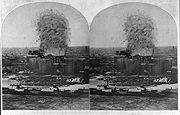 Many materials which are commonly known to oxidise can generate a dust explosion, such as coal
, sawdust
, and magnesium
. However, many otherwise mundane materials can also lead to a dangerous dust cloud such as grain
, flour
, sugar
, powdered milk
and pollen
. Many powdered metal
s (such as aluminium
and titanium
) can form explosive suspensions in air.
The dust can arise from activities such as transporting grain and indeed grain silos do regularly have explosions. Mining of coal leads to coal dust
and flour mills likewise have large amounts of flour dust as a result of milling. A gigantic explosion of flour dust destroyed a mill in Minnesota on May 2, 1878, killing 18 workers at the Washburn A Mill. A similar problem occurs in saw mills and other places dedicated to carpentry. Thermobaric weapon
s, depending upon their fuel, are also a potential and intentional source of dust.
To support combustion, the dust must also consist of very small particles with a high surface area to volume ratio, thereby making the collective or combined surface area of all the particles very large in comparison to a dust of larger particles. Dust
is defined as powders
with particles less than about 500 micrometres in diameter, but finer dust will present a much greater hazard than coarse particles by virtue of the larger total surface area of all the particles.
However it is often difficult to determine the exact source of ignition post-explosion. When a source cannot be found, it will often be cited as static electricity
. Static charges can occur by friction at the surfaces of particles as they move against one another, and build up to levels leading to a sudden discharge to earth.
particles) it would have a surface area of 1600 m² This greatly increased surface area allows the material to burn much faster, and the extremely small mass of each particle allows it to catch on fire with much less energy than the bulk material, as there is no heat loss to conduction within the material. When this mixture of fuel and air is ignited, especially in a confined space such as a warehouse or silo, a significant increase in pressure is created, often more than sufficient to demolish the structure. Even materials that are traditionally thought of as non-flammable, such as aluminum or iron
, or slow burning, such as wood, can produce a powerful explosion when finely divided, and can be ignited by even a small spark. Such metal powders are widely used in fireworks
for their dramatic effects.
 Much research has been carried out in Europe and elsewhere to understand how to control these dangers, but explosion
s still occur. The alternatives for making processes and plants safer depend on the industry. In the coal mining
industry, a methane explosion can initiate a coal dust
explosion, which can then engulf an entire pit working. Stone dust is spread along mine roadways, or suspended from trays in the roof, so as to dilute the coal dust raised ahead of the combustion
zone by the shock wave
, to the point where it cannot burn. Mines may also be sprayed with water to inhibit ignition. Some industries exclude air from dust-raising processes, known as "inerting". Typically this uses nitrogen
, carbon dioxide
or argon
, which are incombustible gases and so inhibit combustion. The same method is also used in large storage tanks where inflammable vapours can accumulate. Usage of oxygen-free gases however brings a risk of asphyxiation of the workers.
Good housekeeping practices, namely eliminating the build-up of deposits of combustible dust that may be disturbed and lead to a secondary explosion, also help mitigating the problem.
Best engineering control measures which can be found in the National Fire Protection Association
(NFPA) Combustible Dust Standards include:
For information on how to protect a process plants and grain handling facilities from the risk of dust hazard explosions, see
Combustion
Combustion or burning is the sequence of exothermic chemical reactions between a fuel and an oxidant accompanied by the production of heat and conversion of chemical species. The release of heat can result in the production of light in the form of either glowing or a flame...
of dust particles suspended in the air in an enclosed location. Coal dust
Coal dust
Coal dust is a fine powdered form of coal, which is created by the crushing, grinding, or pulverizing of coal. Because of the brittle nature of coal, coal dust can be created during mining, transportation, or by mechanically handling coal.-Explosions:...
explosions are a frequent hazard in underground coal
Coal
Coal is a combustible black or brownish-black sedimentary rock usually occurring in rock strata in layers or veins called coal beds or coal seams. The harder forms, such as anthracite coal, can be regarded as metamorphic rock because of later exposure to elevated temperature and pressure...
mines, but dust explosions can occur where any powdered combustible material is present in an enclosed atmosphere.
Conditions for dust explosion
There are four necessary conditions for a dust explosion or deflagrationDeflagration
Deflagration is a term describing subsonic combustion that usually propagates through thermal conductivity; hot burning material heats the next layer of cold material and ignites it. Most "fire" found in daily life, from flames to explosions, is deflagration...
:
- A combustible dustDustDust consists of particles in the atmosphere that arise from various sources such as soil dust lifted up by wind , volcanic eruptions, and pollution...
- The dust is suspended in the air at a high concentrationConcentrationIn chemistry, concentration is defined as the abundance of a constituent divided by the total volume of a mixture. Four types can be distinguished: mass concentration, molar concentration, number concentration, and volume concentration...
- There is an oxidant (typically atmospheric oxygen)
- There is an ignition source
Sources of dust
Coal
Coal is a combustible black or brownish-black sedimentary rock usually occurring in rock strata in layers or veins called coal beds or coal seams. The harder forms, such as anthracite coal, can be regarded as metamorphic rock because of later exposure to elevated temperature and pressure...
, sawdust
Sawdust
Sawdust is a by-product of cutting lumber with a saw, composed of fine particles of wood. It can present a hazard in manufacturing industries, especially in terms of its flammability....
, and magnesium
Magnesium
Magnesium is a chemical element with the symbol Mg, atomic number 12, and common oxidation number +2. It is an alkaline earth metal and the eighth most abundant element in the Earth's crust and ninth in the known universe as a whole...
. However, many otherwise mundane materials can also lead to a dangerous dust cloud such as grain
GRAIN
GRAIN is a small international non-profit organisation that works to support small farmers and social movements in their struggles for community-controlled and biodiversity-based food systems. Our support takes the form of independent research and analysis, networking at local, regional and...
, flour
Flour
Flour is a powder which is made by grinding cereal grains, other seeds or roots . It is the main ingredient of bread, which is a staple food for many cultures, making the availability of adequate supplies of flour a major economic and political issue at various times throughout history...
, sugar
Sugar
Sugar is a class of edible crystalline carbohydrates, mainly sucrose, lactose, and fructose, characterized by a sweet flavor.Sucrose in its refined form primarily comes from sugar cane and sugar beet...
, powdered milk
Powdered milk
Powdered milk is a manufactured dairy product made by evaporating milk to dryness. One purpose of drying milk is to preserve it; milk powder has a far longer shelf life than liquid milk and does not need to be refrigerated, due to its low moisture content. Another purpose is to reduce its bulk for...
and pollen
Pollen
Pollen is a fine to coarse powder containing the microgametophytes of seed plants, which produce the male gametes . Pollen grains have a hard coat that protects the sperm cells during the process of their movement from the stamens to the pistil of flowering plants or from the male cone to the...
. Many powdered metal
Metal
A metal , is an element, compound, or alloy that is a good conductor of both electricity and heat. Metals are usually malleable and shiny, that is they reflect most of incident light...
s (such as aluminium
Aluminium
Aluminium or aluminum is a silvery white member of the boron group of chemical elements. It has the symbol Al, and its atomic number is 13. It is not soluble in water under normal circumstances....
and titanium
Titanium
Titanium is a chemical element with the symbol Ti and atomic number 22. It has a low density and is a strong, lustrous, corrosion-resistant transition metal with a silver color....
) can form explosive suspensions in air.
The dust can arise from activities such as transporting grain and indeed grain silos do regularly have explosions. Mining of coal leads to coal dust
Coal dust
Coal dust is a fine powdered form of coal, which is created by the crushing, grinding, or pulverizing of coal. Because of the brittle nature of coal, coal dust can be created during mining, transportation, or by mechanically handling coal.-Explosions:...
and flour mills likewise have large amounts of flour dust as a result of milling. A gigantic explosion of flour dust destroyed a mill in Minnesota on May 2, 1878, killing 18 workers at the Washburn A Mill. A similar problem occurs in saw mills and other places dedicated to carpentry. Thermobaric weapon
Thermobaric weapon
A thermobaric weapon, which includes the type known as a "fuel-air bomb", is an explosive weapon that produces a blast wave of a significantly longer duration than those produced by condensed explosives. This is useful in military applications where its longer duration increases the numbers of...
s, depending upon their fuel, are also a potential and intentional source of dust.
To support combustion, the dust must also consist of very small particles with a high surface area to volume ratio, thereby making the collective or combined surface area of all the particles very large in comparison to a dust of larger particles. Dust
Dust
Dust consists of particles in the atmosphere that arise from various sources such as soil dust lifted up by wind , volcanic eruptions, and pollution...
is defined as powders
Powder (substance)
A powder is a dry,thick bulk solid composed of a large number of very fine particles that may flow freely when shaken or tilted. Powders are a special sub-class of granular materials, although the terms powder and granular are sometimes used to distinguish separate classes of material...
with particles less than about 500 micrometres in diameter, but finer dust will present a much greater hazard than coarse particles by virtue of the larger total surface area of all the particles.
Sources of ignition
There are many sources of ignition and a naked flame need not be the only one: over one half of the dust explosions in Germany in 2005 were from non-flame sources. Common sources of ignition include- electrostatic dischargeElectrostatic dischargeElectrostatic discharge is a serious issue in solid state electronics, such as integrated circuits. Integrated circuits are made from semiconductor materials such as silicon and insulating materials such as silicon dioxide...
- frictionFrictionFriction is the force resisting the relative motion of solid surfaces, fluid layers, and/or material elements sliding against each other. There are several types of friction:...
- arcing from machinery or other equipment;
- hot surfaces, including e.g. overheated bearingBearing (mechanical)A bearing is a device to allow constrained relative motion between two or more parts, typically rotation or linear movement. Bearings may be classified broadly according to the motions they allow and according to their principle of operation as well as by the directions of applied loads they can...
s - fireFireFire is the rapid oxidation of a material in the chemical process of combustion, releasing heat, light, and various reaction products. Slower oxidative processes like rusting or digestion are not included by this definition....
However it is often difficult to determine the exact source of ignition post-explosion. When a source cannot be found, it will often be cited as static electricity
Static electricity
Static electricity refers to the build-up of electric charge on the surface of objects. The static charges remain on an object until they either bleed off to ground or are quickly neutralized by a discharge. Static electricity can be contrasted with current electricity, which can be delivered...
. Static charges can occur by friction at the surfaces of particles as they move against one another, and build up to levels leading to a sudden discharge to earth.
Concentration
Below a certain value, the lower explosive limit (LEL), there is simply insufficient dust to support the combustion at the rate required for an explosion. A figure 20% lower than the LEL is considered safe. Similarly, if the fuel/air ratio increases above the upper explosive limit there is insufficient oxidant to permit combustion to continue at the necessary rate.Mechanism of dust explosions
Dusts have a very large surface area compared to their mass. Since burning can only occur at the surface of a solid or liquid, where it can react with oxygen, this causes dusts to be much more flammable than bulk materials. For example, a 1 kg sphere of a material with a density of 1g/cm3 would be about 27 cm across and have a surface area of 0.3 m2. However, if it was broken up into spherical dust particles 50µm in diameter (about the size of flourFlour
Flour is a powder which is made by grinding cereal grains, other seeds or roots . It is the main ingredient of bread, which is a staple food for many cultures, making the availability of adequate supplies of flour a major economic and political issue at various times throughout history...
particles) it would have a surface area of 1600 m² This greatly increased surface area allows the material to burn much faster, and the extremely small mass of each particle allows it to catch on fire with much less energy than the bulk material, as there is no heat loss to conduction within the material. When this mixture of fuel and air is ignited, especially in a confined space such as a warehouse or silo, a significant increase in pressure is created, often more than sufficient to demolish the structure. Even materials that are traditionally thought of as non-flammable, such as aluminum or iron
Iron
Iron is a chemical element with the symbol Fe and atomic number 26. It is a metal in the first transition series. It is the most common element forming the planet Earth as a whole, forming much of Earth's outer and inner core. It is the fourth most common element in the Earth's crust...
, or slow burning, such as wood, can produce a powerful explosion when finely divided, and can be ignited by even a small spark. Such metal powders are widely used in fireworks
Fireworks
Fireworks are a class of explosive pyrotechnic devices used for aesthetic and entertainment purposes. The most common use of a firework is as part of a fireworks display. A fireworks event is a display of the effects produced by firework devices...
for their dramatic effects.
Terminology
Dust explosions may be classified as being either primary or secondary in nature. Primary dust explosions occur inside process plant or similar enclosures and are generally controlled by pressure relief through purpose-built ducting to atmosphere. Secondary dust explosions are the result of dust accumulation inside the factory being disturbed and ignited by the primary explosion, resulting in a much more dangerous uncontrolled explosion inside the workplace. Historically, fatalities from dust explosions have largely been the result of secondary dust explosions.Protection and Mitigation from dust explosions
Explosion
An explosion is a rapid increase in volume and release of energy in an extreme manner, usually with the generation of high temperatures and the release of gases. An explosion creates a shock wave. If the shock wave is a supersonic detonation, then the source of the blast is called a "high explosive"...
s still occur. The alternatives for making processes and plants safer depend on the industry. In the coal mining
Coal mining
The goal of coal mining is to obtain coal from the ground. Coal is valued for its energy content, and since the 1880s has been widely used to generate electricity. Steel and cement industries use coal as a fuel for extraction of iron from iron ore and for cement production. In the United States,...
industry, a methane explosion can initiate a coal dust
Coal dust
Coal dust is a fine powdered form of coal, which is created by the crushing, grinding, or pulverizing of coal. Because of the brittle nature of coal, coal dust can be created during mining, transportation, or by mechanically handling coal.-Explosions:...
explosion, which can then engulf an entire pit working. Stone dust is spread along mine roadways, or suspended from trays in the roof, so as to dilute the coal dust raised ahead of the combustion
Combustion
Combustion or burning is the sequence of exothermic chemical reactions between a fuel and an oxidant accompanied by the production of heat and conversion of chemical species. The release of heat can result in the production of light in the form of either glowing or a flame...
zone by the shock wave
Shock wave
A shock wave is a type of propagating disturbance. Like an ordinary wave, it carries energy and can propagate through a medium or in some cases in the absence of a material medium, through a field such as the electromagnetic field...
, to the point where it cannot burn. Mines may also be sprayed with water to inhibit ignition. Some industries exclude air from dust-raising processes, known as "inerting". Typically this uses nitrogen
Nitrogen
Nitrogen is a chemical element that has the symbol N, atomic number of 7 and atomic mass 14.00674 u. Elemental nitrogen is a colorless, odorless, tasteless, and mostly inert diatomic gas at standard conditions, constituting 78.08% by volume of Earth's atmosphere...
, carbon dioxide
Carbon dioxide
Carbon dioxide is a naturally occurring chemical compound composed of two oxygen atoms covalently bonded to a single carbon atom...
or argon
Argon
Argon is a chemical element represented by the symbol Ar. Argon has atomic number 18 and is the third element in group 18 of the periodic table . Argon is the third most common gas in the Earth's atmosphere, at 0.93%, making it more common than carbon dioxide...
, which are incombustible gases and so inhibit combustion. The same method is also used in large storage tanks where inflammable vapours can accumulate. Usage of oxygen-free gases however brings a risk of asphyxiation of the workers.
Good housekeeping practices, namely eliminating the build-up of deposits of combustible dust that may be disturbed and lead to a secondary explosion, also help mitigating the problem.
Best engineering control measures which can be found in the National Fire Protection Association
National Fire Protection Association
The National Fire Protection Association is a United States trade association that creates and maintains private, copywrited, standards and codes for usage and adoption by local governments...
(NFPA) Combustible Dust Standards include:
- Oxidant Concentration Reduction
- Deflagration venting
- Deflagration pressure containment
- Deflagration suppression
- Deflagration venting through a dust retention and flame-arresting device
See also
- Air to fuel ratio
- Coal dustCoal dustCoal dust is a fine powdered form of coal, which is created by the crushing, grinding, or pulverizing of coal. Because of the brittle nature of coal, coal dust can be created during mining, transportation, or by mechanically handling coal.-Explosions:...
- CombustionCombustionCombustion or burning is the sequence of exothermic chemical reactions between a fuel and an oxidant accompanied by the production of heat and conversion of chemical species. The release of heat can result in the production of light in the form of either glowing or a flame...
- Flour bombFlour bombThere are two types of flour bomb:* The relatively innocuous use of flour in a fragile container, thrown at a person or object to produce an inconvenient stain....
- Explosion ventExplosion ventAn explosion vent is a safety device to protect equipment or buildings against excessive internal, explosion-incurred pressures, by means of pressure relief. An explosion vent will relieve pressure from the instant its opening pressure pstat has been exceeded.Several explosion vent panels can be...
- PyrotechnicsPyrotechnicsPyrotechnics is the science of using materials capable of undergoing self-contained and self-sustained exothermic chemical reactions for the production of heat, light, gas, smoke and/or sound...
External links
For stories about incidents in France and the USA see- csb.gov various completed investigations from the Chemical Safety Board
- OSHA case studies of dust explosions
For information on how to protect a process plants and grain handling facilities from the risk of dust hazard explosions, see