

St. Lawrence Iroquoians

Encyclopedia
The St. Lawrence Iroquoians were a prehistoric First Nations
/Native American
indigenous people who lived from the 14th century until about 1580 CE
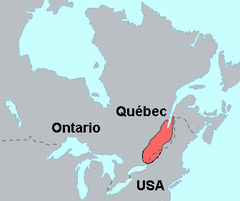
along the shores of the St. Lawrence River in present-day Quebec
and Ontario
, Canada
, and New York State, United States
. They spoke Laurentian
languages, a branch of the Iroquoian family. It is likely they disappeared because of late 16th century warfare by the Mohawk
nation of the Haudenosaunee, who wanted to control fur trade in the valley.
Knowledge about the St. Lawrence Iroquoians has been constructed from the studies of surviving oral accounts
of the historical past from the current Native people, writings of the French explorer Jacques Cartier
, earlier histories, and anthropologists' and other scholars' work with archeological and linguistic
studies since the 1950s. Archeological evidence has established this was a people distinct from the Five Nations of the Haudenosaunee and the Huron (Wyandot). Recent archeological finds suggest there may have been distinctly separate groups among the St. Lawrence Iroquoians as well.
 For years historians and other scholars debated the identity of the Iroquoian cultural group in the St. Lawrence valley, which Jacques Cartier
and his crew encountered in 1535-1536 at Stadacona
and Hochelaga
. An increasing amount of archeological evidence since the 1950s has settled some of the debate. Since the 1950s, anthropologists and some historians have used definitive linguistic and archeological studies to reach consensus that the St. Lawrence Iroquoians were a people distinct from nations of the Iroquois Confederacy or the Huron.
Before this, some argued that the people were the ancestors or direct relations of historic Iroquoian groups in the region, such as the Huron or Mohawk
, Onondaga or Oneida
of the Five Nations
of the Haudenosaunee encountered by later explorer Samuel de Champlain
. Since the 18th century, several theories have been proposed for their identity. The issue is important not only for historical understanding but because of Iroquois and other indigenous land claims.
In 1998 James F. Pendergast summarized the four major theories with an overview of evidence:
Several historians combined data from early French reports, vocabulary lists and oral histories of accounts by Native tribes to theorize the early inhabitants were Iroquoian-speaking Huron or Mohawk, two well-known tribes in later history. There has not been sufficient documentation to support this conclusion according to 20th-century standards. In addition, archeological finds and linguistic studies since the 1950s have discredited this theory.
Based in part on material from the 18th century, some historians developed a theory that Mohawk
(in some cases, they also postulated Onondaga and Oneida) had migrated and settled in the St. Lawrence River valley before relocating to their historic territory of present-day New York. Pendergast summarizes archeological studies to say:
Since the 1950s, then, anthropologists and some historians have used definitive linguistic and archeological studies to reach consensus that the St. Lawrence Iroquoians were a people distinct from nations of the Iroquois Confederacy or the Huron. Pendergast notes that while Iroquoians and topical academics have mostly reached consensus on this theory, some historians have continued to publish other theories and ignore the archeological evidence. The St. Lawrence Iroquoians did share many cultural, historical, and linguistic aspects with other Iroquoian groups; for example, their Laurentian
languages were in the Iroquoian family. The St. Lawrence Iroquoians appear to have disappeared from the St. Lawrence valley some time prior to 1580. Champlain reported no evidence of Native habitation in the valley. By then the Iroquois nations used it as a hunting ground and avenue for war parties.
As historian James F. Pendergast argues, the determination of identity for the St. Lawrence Iroquoians is important because, "our understanding of relations between Europeans and Iroquoians during the contact era throughout Iroquoia hinges largely upon the tribe or confederacy to which Stadacona and Hochelaga are attributed."
culture in the North East region, many Iroquoian-speaking communities around the Great Lakes
began to switch from nomad
ic life to more permanent settlements. The richness of the soil in the St. Lawrence valley, along with the abundance of fisheries nearby and of forests rich in game
animals, provided a good place for northeastern Iroquoian settlements. By approximately 1300, their settlement patterns began to resemble the large fortified villages which Cartier described as characteristic of the St. Lawrence Iroquoians.
observed several Iroquoian villages north of Île d'Orléans
(near present-day Quebec), including the villages of Stadacona
on the site of modern-day Quebec City
, as well as Hochelaga in the vicinity of modern-day Montreal
. Archeologists in the 20th century have unearthed similar villages further southwest, near the eastern end of Lake Ontario
and are finding evidence of additional discrete groups of St. Lawrence Iroquoians.
The people lived in villages that were usually located a few kilometres inland from the Saint-Lawrence River, outside the immediate floodplain. The settlements were often enclosed by a wooden palisade
for defense. Up to 2000 persons lived in the larger villages. Although Cartier mentioned the longhouses
in Hochelaga, he left no further description of Stadacona or the other nearby villages.
arrived and founded Quebec in 1608, no trace remained of the St. Lawrence Iroquoians and settlements visited by Cartier some 75 years earlier. Historians and other scholars have developed several theories about their disappearance: devastating wars with the Iroquois
tribes to the South or with the Hurons to the West, the impact of epidemics of Old World diseases, or their migration westward toward the shores of the Great Lakes
.
Archeological
evidence and the historical context of the time point most strongly to wars with the neighbouring Iroquois tribes, particularly the Mohawk
. They had the most to gain in war against the St. Lawrence Irqouians, as they had the least advantageous territorial position in the area in relation to hunting and the fur trade
along the river. French trading was then based at Tadoussac, downstream at the mouth of the Saguenay River
, within the territory of the Montagnais. The Mohawk wanted to get more control of the trade routes connecting to the Europeans. At the same time, Champlain reported that the Algonquians were fearful of the powerful Iroquois. Historian Bruce G. Trigger believes the political dynamics were such that the Huron were unlikely to enter Iroquois territory to carry out an attack against the St. Lawrence people to the north. In the mid- to late-16th century, the St. Lawrence Valley was likely an area of open conflict among tribes closer to the area. Because nothing remained of their settlements, the St. Lawrence Iroquoians appeared to have been overwhelmed by other groups. Some St. Lawrence Iroquoian survivors may have joined the neighbouring Mohawk
and Algonquin tribes, by force or by mutual agreement.
By the time Champlain arrived, Algonquins and Mohawks were both using the Saint-Lawrence Valley for hunting
grounds, as well as a route for war parties and raiding. Neither nation had any permanent settlements upriver above Tadoussac, the trading post in the lower St. Lawrence Valley which had been important for years in the fur trade.
The origins of the word canada
, from which the nation derived its name, offers an example of the changes in historical understanding required by new evidence. By canada, the St. Lawrence Iroquoians of Stadacona meant "village" in their language. Cartier wrote, "[I]lz (sic) appellent une ville Canada (they call a village 'Canada')". Cartier applied the word to both the region near Stadacona and the St. Lawrence River that flows nearby.
Both the Canadian Encyclopedia (1985) and various publications of the Government of Canada, such as "The Origin of the Name Canada" published by the Department of Canadian Heritage
, suggest instead the former theory that the word "Canada" stems from a Huron-Iroquois word, kanata. It also meant "village" or settlement.
Historians now know that Cartier could not have encountered either the Iroquois or Huron, as neither group lived in the St. Lawrence valley in the 16th century. The account of Canada's name origin reflects theories first advanced in the 18th and 19th centuries. General texts have not kept up with the discrediting of such earlier theories by the linguistic comparative studies of the later 20th century. For instance, the "Huron-Iroquois theory" of word origin appeared in the article on "Canada" in the Encyclopædia Britannica
of 1996.
The earlier mystery of annedda
also shows how historical understanding has been changed by recent research. When Cartier's crew suffered scurvy
during their first winter in Canada, the St. Lawrence Iroquoians provided them with a remedy, an herbal infusion
made of the annedda. The French recorded this as the St. Lawrence Iroquoian name of the white cedar
of the region. Cartier noted the word in his journal. On a later expedition when Champlain asked for the same remedy, the natives he met did not know the word annedda. This fact confused many historians. Given new evidence, it appears that Champlain met Haudenosaunee Iroquois who, although related, did not speak the same language as the St. Lawrence Iroquoians. Thus, they did not know the word annedda and its reference.
Archeologists have not determined the exact location of Hochelaga. In the early 20th century historians debated this vigorously and the reasons for its disappearance, but changing interests in the field led in other directions. In the late 20th century, First Nations activism
, as well as increased interest in history of indigenous peoples renewed attention to the early St. Lawrence Iroquoian villages.
studies indicate that the St. Lawrence Iroquoians probably spoke several distinct dialects of their language, often referred to as Laurentian
. It is one of several languages of the Iroquoian language family
, which includes Mohawk
, Huron-Wyandot
and Cherokee
. Jacques Cartier made only sparse records during his voyage in 1535-1536. He compiled two vocabulary lists totaling about 200 words. The St. Lawrence Iroquoians may have spoken two or more distinct languages in a territory stretching over 600 km, from Lake Ontario to East of Île d'Orléans.
First Nations
First Nations is a term that collectively refers to various Aboriginal peoples in Canada who are neither Inuit nor Métis. There are currently over 630 recognised First Nations governments or bands spread across Canada, roughly half of which are in the provinces of Ontario and British Columbia. The...
/Native American
Indigenous peoples of the Americas
The indigenous peoples of the Americas are the pre-Columbian inhabitants of North and South America, their descendants and other ethnic groups who are identified with those peoples. Indigenous peoples are known in Canada as Aboriginal peoples, and in the United States as Native Americans...
indigenous people who lived from the 14th century until about 1580 CE
Common Era
Common Era ,abbreviated as CE, is an alternative designation for the calendar era originally introduced by Dionysius Exiguus in the 6th century, traditionally identified with Anno Domini .Dates before the year 1 CE are indicated by the usage of BCE, short for Before the Common Era Common Era...
along the shores of the St. Lawrence River in present-day Quebec
Quebec
Quebec or is a province in east-central Canada. It is the only Canadian province with a predominantly French-speaking population and the only one whose sole official language is French at the provincial level....
and Ontario
Ontario
Ontario is a province of Canada, located in east-central Canada. It is Canada's most populous province and second largest in total area. It is home to the nation's most populous city, Toronto, and the nation's capital, Ottawa....
, Canada
Canada
Canada is a North American country consisting of ten provinces and three territories. Located in the northern part of the continent, it extends from the Atlantic Ocean in the east to the Pacific Ocean in the west, and northward into the Arctic Ocean...
, and New York State, United States
United States
The United States of America is a federal constitutional republic comprising fifty states and a federal district...
. They spoke Laurentian
Laurentian language
Laurentian, or St. Lawrence Iroquoian, was an Iroquoian language spoken until the late 16th century along the shores of the Saint Lawrence River in present-day Quebec and Ontario, Canada. It is believed to have disappeared with the extinction of the St...
languages, a branch of the Iroquoian family. It is likely they disappeared because of late 16th century warfare by the Mohawk
Mohawk nation
Mohawk are the most easterly tribe of the Iroquois confederation. They call themselves Kanien'gehaga, people of the place of the flint...
nation of the Haudenosaunee, who wanted to control fur trade in the valley.
Knowledge about the St. Lawrence Iroquoians has been constructed from the studies of surviving oral accounts
Oral history
Oral history is the collection and study of historical information about individuals, families, important events, or everyday life using audiotapes, videotapes, or transcriptions of planned interviews...
of the historical past from the current Native people, writings of the French explorer Jacques Cartier
Jacques Cartier
Jacques Cartier was a French explorer of Breton origin who claimed what is now Canada for France. He was the first European to describe and map the Gulf of Saint Lawrence and the shores of the Saint Lawrence River, which he named "The Country of Canadas", after the Iroquois names for the two big...
, earlier histories, and anthropologists' and other scholars' work with archeological and linguistic
Linguistics
Linguistics is the scientific study of human language. Linguistics can be broadly broken into three categories or subfields of study: language form, language meaning, and language in context....
studies since the 1950s. Archeological evidence has established this was a people distinct from the Five Nations of the Haudenosaunee and the Huron (Wyandot). Recent archeological finds suggest there may have been distinctly separate groups among the St. Lawrence Iroquoians as well.
Historical issues
Jacques Cartier
Jacques Cartier was a French explorer of Breton origin who claimed what is now Canada for France. He was the first European to describe and map the Gulf of Saint Lawrence and the shores of the Saint Lawrence River, which he named "The Country of Canadas", after the Iroquois names for the two big...
and his crew encountered in 1535-1536 at Stadacona
Stadacona
Stadacona was a 16th century St. Lawrence Iroquoian village near present-day Quebec City.French explorer and navigator Jacques Cartier, travelling and charting the Saint Lawrence River, reached it on 7 September 1535. He returned to Stadacona to spend the winter there with his group of 110 men...
and Hochelaga
Hochelaga
Hochelaga may refer to:Hochelaga* Hochelaga , a 16th century village on the Island of Montreal* Hochelaga Archipelago, Montreal and surrounding islands...
. An increasing amount of archeological evidence since the 1950s has settled some of the debate. Since the 1950s, anthropologists and some historians have used definitive linguistic and archeological studies to reach consensus that the St. Lawrence Iroquoians were a people distinct from nations of the Iroquois Confederacy or the Huron.
Before this, some argued that the people were the ancestors or direct relations of historic Iroquoian groups in the region, such as the Huron or Mohawk
Mohawk nation
Mohawk are the most easterly tribe of the Iroquois confederation. They call themselves Kanien'gehaga, people of the place of the flint...
, Onondaga or Oneida
Oneida tribe
The Oneida are a Native American/First Nations people and are one of the five founding nations of the Iroquois Confederacy in the area of upstate New York...
of the Five Nations
Five Nations
Five Nations can refer to:* The original five nations of the Iroquois Confederacy, a union of Native Americans* The Five Nations Championship in rugby union, now the Rugby Union Six Nations Championship...
of the Haudenosaunee encountered by later explorer Samuel de Champlain
Samuel de Champlain
Samuel de Champlain , "The Father of New France", was a French navigator, cartographer, draughtsman, soldier, explorer, geographer, ethnologist, diplomat, and chronicler. He founded New France and Quebec City on July 3, 1608....
. Since the 18th century, several theories have been proposed for their identity. The issue is important not only for historical understanding but because of Iroquois and other indigenous land claims.
In 1998 James F. Pendergast summarized the four major theories with an overview of evidence:
- Huron-Mohawk Option:
Several historians combined data from early French reports, vocabulary lists and oral histories of accounts by Native tribes to theorize the early inhabitants were Iroquoian-speaking Huron or Mohawk, two well-known tribes in later history. There has not been sufficient documentation to support this conclusion according to 20th-century standards. In addition, archeological finds and linguistic studies since the 1950s have discredited this theory.
- Mohawk Identity Option:
Based in part on material from the 18th century, some historians developed a theory that Mohawk
Mohawk nation
Mohawk are the most easterly tribe of the Iroquois confederation. They call themselves Kanien'gehaga, people of the place of the flint...
(in some cases, they also postulated Onondaga and Oneida) had migrated and settled in the St. Lawrence River valley before relocating to their historic territory of present-day New York. Pendergast summarizes archeological studies to say:
"Not one of the identities claiming Stadacona or Hochelaga to be Mohawk, Onondaga or Oneida is borne out by the archaeological data. Since the 1950s a vast accumulation of archaeological material from Ontario, Quebec, VermontVermontVermont is a state in the New England region of the northeastern United States of America. The state ranks 43rd in land area, , and 45th in total area. Its population according to the 2010 census, 630,337, is the second smallest in the country, larger only than Wyoming. It is the only New England...
, PennsylvaniaPennsylvaniaThe Commonwealth of Pennsylvania is a U.S. state that is located in the Northeastern and Mid-Atlantic regions of the United States. The state borders Delaware and Maryland to the south, West Virginia to the southwest, Ohio to the west, New York and Ontario, Canada, to the north, and New Jersey to...
and New York State consistently has provided compelling evidence to demonstrate that neither the Mohawk, the Onondaga, nor the Oneida homelands originated in the St Lawrence Valley."
- Laurentian Iroquoian and Laurentian Iroquois Identity: based on language studies, with material added since 1940; and
- St. Lawrence Iroquoian and St. Lawrence Iroquois Identity:
"...anthropologists, particularly archaeologists, have introduced post-1950 archaeological, linguistic and ethnohistorical conclusions into their deliberations. These sources deny the earlier Huron-Iroquois, Mohawk and Laurentian Iroquois identities in favour of the perception that a wholly indigenous and discreteDiscreteDiscrete in science is the opposite of continuous: something that is separate; distinct; individual.Discrete may refer to:*Discrete particle or quantum in physics, for example in quantum theory...
Iroquoian people were present in the St Lawrence Valley when Cartier arrived. The current anthropological convention is to designate these people St Lawrence Iroquoians, all the while being keenly aware that on-going archaeological research indicates that several discrete Iroquoian political entities were present in a number of widely dispersed geographical regions on the St Lawrence River axis."
Since the 1950s, then, anthropologists and some historians have used definitive linguistic and archeological studies to reach consensus that the St. Lawrence Iroquoians were a people distinct from nations of the Iroquois Confederacy or the Huron. Pendergast notes that while Iroquoians and topical academics have mostly reached consensus on this theory, some historians have continued to publish other theories and ignore the archeological evidence. The St. Lawrence Iroquoians did share many cultural, historical, and linguistic aspects with other Iroquoian groups; for example, their Laurentian
Laurentian
Laurentian may refer to:*Anything related to Saint Lawrence or the Saint Lawrence River*Laurentia, the craton at the heart of the North American continent...
languages were in the Iroquoian family. The St. Lawrence Iroquoians appear to have disappeared from the St. Lawrence valley some time prior to 1580. Champlain reported no evidence of Native habitation in the valley. By then the Iroquois nations used it as a hunting ground and avenue for war parties.
As historian James F. Pendergast argues, the determination of identity for the St. Lawrence Iroquoians is important because, "our understanding of relations between Europeans and Iroquoians during the contact era throughout Iroquoia hinges largely upon the tribe or confederacy to which Stadacona and Hochelaga are attributed."
Migration into the St. Lawrence valley
Near 1000 C.E., with the introduction of the maizeMaize
Maize known in many English-speaking countries as corn or mielie/mealie, is a grain domesticated by indigenous peoples in Mesoamerica in prehistoric times. The leafy stalk produces ears which contain seeds called kernels. Though technically a grain, maize kernels are used in cooking as a vegetable...
culture in the North East region, many Iroquoian-speaking communities around the Great Lakes
Great Lakes
The Great Lakes are a collection of freshwater lakes located in northeastern North America, on the Canada – United States border. Consisting of Lakes Superior, Michigan, Huron, Erie, and Ontario, they form the largest group of freshwater lakes on Earth by total surface, coming in second by volume...
began to switch from nomad
Nomad
Nomadic people , commonly known as itinerants in modern-day contexts, are communities of people who move from one place to another, rather than settling permanently in one location. There are an estimated 30-40 million nomads in the world. Many cultures have traditionally been nomadic, but...
ic life to more permanent settlements. The richness of the soil in the St. Lawrence valley, along with the abundance of fisheries nearby and of forests rich in game
Game
A game is structured playing, usually undertaken for enjoyment and sometimes used as an educational tool. Games are distinct from work, which is usually carried out for remuneration, and from art, which is more often an expression of aesthetic or ideological elements...
animals, provided a good place for northeastern Iroquoian settlements. By approximately 1300, their settlement patterns began to resemble the large fortified villages which Cartier described as characteristic of the St. Lawrence Iroquoians.
The visit of Jacques Cartier
In his expedition of 1535 and 1536, the explorer Jacques CartierJacques Cartier
Jacques Cartier was a French explorer of Breton origin who claimed what is now Canada for France. He was the first European to describe and map the Gulf of Saint Lawrence and the shores of the Saint Lawrence River, which he named "The Country of Canadas", after the Iroquois names for the two big...
observed several Iroquoian villages north of Île d'Orléans
Île d'Orléans
Île d'Orléans is located in the Saint Lawrence River about east of downtown Quebec City, Quebec, Canada. The island was one of the first parts of the province to be colonized by the French, and a large percentage of French Canadians can trace ancestry to early residents of the island...
(near present-day Quebec), including the villages of Stadacona
Stadacona
Stadacona was a 16th century St. Lawrence Iroquoian village near present-day Quebec City.French explorer and navigator Jacques Cartier, travelling and charting the Saint Lawrence River, reached it on 7 September 1535. He returned to Stadacona to spend the winter there with his group of 110 men...
on the site of modern-day Quebec City
Quebec City
Quebec , also Québec, Quebec City or Québec City is the capital of the Canadian province of Quebec and is located within the Capitale-Nationale region. It is the second most populous city in Quebec after Montreal, which is about to the southwest...
, as well as Hochelaga in the vicinity of modern-day Montreal
Montreal
Montreal is a city in Canada. It is the largest city in the province of Quebec, the second-largest city in Canada and the seventh largest in North America...
. Archeologists in the 20th century have unearthed similar villages further southwest, near the eastern end of Lake Ontario
Lake Ontario
Lake Ontario is one of the five Great Lakes of North America. It is bounded on the north and southwest by the Canadian province of Ontario, and on the south by the American state of New York. Ontario, Canada's most populous province, was named for the lake. In the Wyandot language, ontarío means...
and are finding evidence of additional discrete groups of St. Lawrence Iroquoians.
The people lived in villages that were usually located a few kilometres inland from the Saint-Lawrence River, outside the immediate floodplain. The settlements were often enclosed by a wooden palisade
Palisade
A palisade is a steel or wooden fence or wall of variable height, usually used as a defensive structure.- Typical construction :Typical construction consisted of small or mid sized tree trunks aligned vertically, with no spacing in between. The trunks were sharpened or pointed at the top, and were...
for defense. Up to 2000 persons lived in the larger villages. Although Cartier mentioned the longhouses
Long house
A longhouse or long house is a type of long, proportionately narrow, single-room building built by peoples in various parts of the world including Asia, Europe and North America....
in Hochelaga, he left no further description of Stadacona or the other nearby villages.
The demise of the St. Lawrence Iroquoians
By the time explorer Samuel de ChamplainSamuel de Champlain
Samuel de Champlain , "The Father of New France", was a French navigator, cartographer, draughtsman, soldier, explorer, geographer, ethnologist, diplomat, and chronicler. He founded New France and Quebec City on July 3, 1608....
arrived and founded Quebec in 1608, no trace remained of the St. Lawrence Iroquoians and settlements visited by Cartier some 75 years earlier. Historians and other scholars have developed several theories about their disappearance: devastating wars with the Iroquois
Iroquois
The Iroquois , also known as the Haudenosaunee or the "People of the Longhouse", are an association of several tribes of indigenous people of North America...
tribes to the South or with the Hurons to the West, the impact of epidemics of Old World diseases, or their migration westward toward the shores of the Great Lakes
Great Lakes
The Great Lakes are a collection of freshwater lakes located in northeastern North America, on the Canada – United States border. Consisting of Lakes Superior, Michigan, Huron, Erie, and Ontario, they form the largest group of freshwater lakes on Earth by total surface, coming in second by volume...
.
Archeological
Archaeology
Archaeology, or archeology , is the study of human society, primarily through the recovery and analysis of the material culture and environmental data that they have left behind, which includes artifacts, architecture, biofacts and cultural landscapes...
evidence and the historical context of the time point most strongly to wars with the neighbouring Iroquois tribes, particularly the Mohawk
Mohawk nation
Mohawk are the most easterly tribe of the Iroquois confederation. They call themselves Kanien'gehaga, people of the place of the flint...
. They had the most to gain in war against the St. Lawrence Irqouians, as they had the least advantageous territorial position in the area in relation to hunting and the fur trade
Fur trade
The fur trade is a worldwide industry dealing in the acquisition and sale of animal fur. Since the establishment of world market for in the early modern period furs of boreal, polar and cold temperate mammalian animals have been the most valued...
along the river. French trading was then based at Tadoussac, downstream at the mouth of the Saguenay River
Saguenay River
The Saguenay River is a major river of Quebec, Canada.It drains Lac Saint-Jean in the Laurentian Highlands, leaving at Alma and running east, and passes the city of Saguenay. It drains into the Saint Lawrence River at Tadoussac....
, within the territory of the Montagnais. The Mohawk wanted to get more control of the trade routes connecting to the Europeans. At the same time, Champlain reported that the Algonquians were fearful of the powerful Iroquois. Historian Bruce G. Trigger believes the political dynamics were such that the Huron were unlikely to enter Iroquois territory to carry out an attack against the St. Lawrence people to the north. In the mid- to late-16th century, the St. Lawrence Valley was likely an area of open conflict among tribes closer to the area. Because nothing remained of their settlements, the St. Lawrence Iroquoians appeared to have been overwhelmed by other groups. Some St. Lawrence Iroquoian survivors may have joined the neighbouring Mohawk
Mohawk nation
Mohawk are the most easterly tribe of the Iroquois confederation. They call themselves Kanien'gehaga, people of the place of the flint...
and Algonquin tribes, by force or by mutual agreement.
By the time Champlain arrived, Algonquins and Mohawks were both using the Saint-Lawrence Valley for hunting
Hunting
Hunting is the practice of pursuing any living thing, usually wildlife, for food, recreation, or trade. In present-day use, the term refers to lawful hunting, as distinguished from poaching, which is the killing, trapping or capture of the hunted species contrary to applicable law...
grounds, as well as a route for war parties and raiding. Neither nation had any permanent settlements upriver above Tadoussac, the trading post in the lower St. Lawrence Valley which had been important for years in the fur trade.
Historical debates
Although historians and other scholars have been studying the St. Lawrence Iroquoians for some time, such knowledge has been slower to be part of common historical understanding. The hypothesis about the St. Lawrence Iroquoians helps explain apparent contradictions in the historical record about French encounters with natives in this area.The origins of the word canada
Canada's name
The name of Canada has been in use since the earliest European settlement in Canada, with the name originating from a First Nations word for "settlement", "village", or "land". Today, Canada is pronounced in English and in French...
, from which the nation derived its name, offers an example of the changes in historical understanding required by new evidence. By canada, the St. Lawrence Iroquoians of Stadacona meant "village" in their language. Cartier wrote, "[I]lz (sic) appellent une ville Canada (they call a village 'Canada')". Cartier applied the word to both the region near Stadacona and the St. Lawrence River that flows nearby.
Both the Canadian Encyclopedia (1985) and various publications of the Government of Canada, such as "The Origin of the Name Canada" published by the Department of Canadian Heritage
Department of Canadian Heritage
The Department of Canadian Heritage, or simply Canadian Heritage |department]] of the Government of Canada with responsibility for policies and programs regarding the arts, culture, media, communications networks, official languages , status of women, sports , and multiculturalism...
, suggest instead the former theory that the word "Canada" stems from a Huron-Iroquois word, kanata. It also meant "village" or settlement.
Historians now know that Cartier could not have encountered either the Iroquois or Huron, as neither group lived in the St. Lawrence valley in the 16th century. The account of Canada's name origin reflects theories first advanced in the 18th and 19th centuries. General texts have not kept up with the discrediting of such earlier theories by the linguistic comparative studies of the later 20th century. For instance, the "Huron-Iroquois theory" of word origin appeared in the article on "Canada" in the Encyclopædia Britannica
Encyclopædia Britannica
The Encyclopædia Britannica , published by Encyclopædia Britannica, Inc., is a general knowledge English-language encyclopaedia that is available in print, as a DVD, and on the Internet. It is written and continuously updated by about 100 full-time editors and more than 4,000 expert...
of 1996.
The earlier mystery of annedda
Aneda
The evergreen aneda was used by Jacques Cartier and his men as a remedy against scurvy in the winter of 1535–1536. It is generally believed to have been Thuja occidentalis, a common tree in Quebec also known as Arborvitae...
also shows how historical understanding has been changed by recent research. When Cartier's crew suffered scurvy
Scurvy
Scurvy is a disease resulting from a deficiency of vitamin C, which is required for the synthesis of collagen in humans. The chemical name for vitamin C, ascorbic acid, is derived from the Latin name of scurvy, scorbutus, which also provides the adjective scorbutic...
during their first winter in Canada, the St. Lawrence Iroquoians provided them with a remedy, an herbal infusion
Infusion
An infusion is the outcome of steeping plants with desired chemical compounds or flavors in water or oil.-History:The first recorded use of essential oils was in the 10th or 11th century by the Persian polymath Avicenna, possibly in The Canon of Medicine.-Preparation techniques:An infusion is very...
made of the annedda. The French recorded this as the St. Lawrence Iroquoian name of the white cedar
Thuja occidentalis
Thuja occidentalis is an evergreen coniferous tree, in the cypress family Cupressaceae, which is widely cultivated for use as an ornamental plant known as American Arbor Vitae. The endemic occurrence of this species is a northeastern distribution in North America...
of the region. Cartier noted the word in his journal. On a later expedition when Champlain asked for the same remedy, the natives he met did not know the word annedda. This fact confused many historians. Given new evidence, it appears that Champlain met Haudenosaunee Iroquois who, although related, did not speak the same language as the St. Lawrence Iroquoians. Thus, they did not know the word annedda and its reference.
Archeologists have not determined the exact location of Hochelaga. In the early 20th century historians debated this vigorously and the reasons for its disappearance, but changing interests in the field led in other directions. In the late 20th century, First Nations activism
Activism
Activism consists of intentional efforts to bring about social, political, economic, or environmental change. Activism can take a wide range of forms from writing letters to newspapers or politicians, political campaigning, economic activism such as boycotts or preferentially patronizing...
, as well as increased interest in history of indigenous peoples renewed attention to the early St. Lawrence Iroquoian villages.
Language
LinguisticHistorical linguistics
Historical linguistics is the study of language change. It has five main concerns:* to describe and account for observed changes in particular languages...
studies indicate that the St. Lawrence Iroquoians probably spoke several distinct dialects of their language, often referred to as Laurentian
Laurentian language
Laurentian, or St. Lawrence Iroquoian, was an Iroquoian language spoken until the late 16th century along the shores of the Saint Lawrence River in present-day Quebec and Ontario, Canada. It is believed to have disappeared with the extinction of the St...
. It is one of several languages of the Iroquoian language family
Iroquoian languages
The Iroquoian languages are a First Nation and Native American language family.-Family division:*Ruttenber, Edward Manning. 1992 [1872]. History of the Indian tribes of Hudson's River. Hope Farm Press....
, which includes Mohawk
Mohawk language
Mohawk is an Iroquoian language spoken by around 2,000 people of the Mohawk nation in the United States and Canada . Mohawk has the largest number of speakers of the Northern Iroquoian languages; today it is the only one with greater than a thousand remaining...
, Huron-Wyandot
Wyandot language
Wyandot is the Iroquoian language traditionally spoken by the people known variously as Wyandot, Wyandotte, Wendat, or Huron. It was last spoken primarily in Oklahoma and Quebec...
and Cherokee
Cherokee language
Cherokee is an Iroquoian language spoken by the Cherokee people which uses a unique syllabary writing system. It is the only Southern Iroquoian language that remains spoken. Cherokee is a polysynthetic language.-North American etymology:...
. Jacques Cartier made only sparse records during his voyage in 1535-1536. He compiled two vocabulary lists totaling about 200 words. The St. Lawrence Iroquoians may have spoken two or more distinct languages in a territory stretching over 600 km, from Lake Ontario to East of Île d'Orléans.
Further reading
- Junker-Andersen, Christen. Faunal Resource Exploitation Among the St. Lawrence Iroquoians: the Zooarcheology of the Steward (BfFt-2) Site, Morrisburg, Ontario. Toronto: University of Toronto, 1984.
- Pendergast, James F., Claude Chapdelaine, and J. V. Wright. "Essays in St. Lawrence Iroquoian Archaeology", Occasional papers in northeastern archaeology, no. 8. Dundas, Ont: Copetown Press, 1993. ISBN 1895087074
- Pendergast, James F., "The Significance of a Huron Archaeological Presence in Jefferson County, New York," a paper read at McMaster University, 20 February 1982, vide Trigger (1985) 351.
- Trigger, Bruce G., Native and Newcomers: Canada's "Heroic Age" Reconsidered (Kingston and Montreal: McGill-Queen's University Press, 1985) 144-8, 351
- Wonderley, Anthony. 2005. "Effigy Pipes, Diplomacy, and Myth: Exploring Interaction between St. Lawrence Iroquoians and Eastern Iroquois in New York State", American Antiquity. 70, no. 2: 211.