Australian 9th Division

Encyclopedia
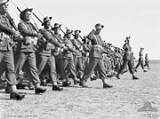
The 9th Division was a division of the Australian Army
that served during World War II
. It was the fourth division of the Second Australian Imperial Force
and was formed in the United Kingdom in late 1940 from infantry brigades and support units which had been previously raised in Australia and sent there to defend against a possible invasion following the Fall of France. It is considered to be one of the most decorated Australian divisions and has the distinction of spending more time in combat than any other. In common with both the 6th and 7th Divisions, the 9th Division was one of only a few Allied
army units to serve with distinction in the Middle East
and the South West Pacific Area
. During the course of its service, the 9th Division took part in the Siege of Tobruk
and fought during both battles of El Alamein
before being brought back to Australia in 1943 to take part in campaigns in New Guinea
and Borneo
. Following the end of the war, the division was disbanded in early 1946.
s which had been formed in Australia and dispatched to the UK in order to defend against a possible invasion following the Fall of France—the 18th
and 25th Brigades
—under the command of Major General Henry Wynter
. Later, the 24th Brigade
was also assigned to the division.
In January 1941 Wynter became ill and was replaced as divisional commander by Leslie Morshead
. By February 1941, 9th Division headquarters had been relocated to the Middle East
. Around this time the divisions of the AIF underwent a reorganisation as the decision was made to send the more established brigades to Greece
; as a result both the 18th and 25th Brigades were transferred from the 9th to the 7th Division. They were replaced by the 20th
and 26th Brigades
, both of which were considered to be less experienced and therefore less ready for action.
in Libya
in early March 1941 to complete their training and equipping as part of the garrison of this region. Short of equipment such as machine gun
s, mortar
s, anti-tank guns and carriers
, most the division's artillery and cavalry units did not accompany the infantry brigades to Cyrenaica at this time. The 20th Brigade was the first unit from the division to move, departing on 27 February, although it was joined shortly by the other two brigades and it was during this time that the division suffered its first casualties when German bombers attacked the transport column in which the 2/13th Battalion was travelling, killing two Australians and wounding one other. By 9 March the 20th Brigade relieved the 17th Brigade from the 6th Division, along the Cyrenaican frontier.
By late March, it became clear that German-led Axis
forces planned to launch and offensive in Cyrenaica and as a result, the 9th Division commander, Leslie Morshead, ordered the 20th Brigade to withdraw from the frontier, moving 160 miles (257.5 km) back towards Benghazi
. The offensive began on 24 March, quickly forcing the British units along the frontier back as it drove towards Benghazi. Two days later the 26th Brigade took up positions in the west near the coast to support the 20th Brigade which was holding the pass at Er Regima. At this stage, the division's anti-tank troops were issued with captured Italian guns in order to make up the shortfall in British weapons.
As the Axis advance continued with German victories at Marsa Brega and Agedabia which threatened to outflank the units cut off in Benghazi, the 9th Division ordered to fall back from their positions along the coast to the east to Derna. Lacking their own transport, they had to rely on that provided by other units and thus the withdrawal had to be undertaken in stages. In order to achieve this, the 2/13th Battalion was used as a rear guard
and late in the afternoon of 4 April it undertook the division's first action of the war when the Germans attacked their positions in the Er Regima Pass. Supported by British artillery, the battalion, spread out across a 11 kilometres (6.8 mi) managed to delay a German force of about 3,000 men mounted in lorries and accompanied by armoured cars and tanks. Only lightly armed, however, they were unable to prevent the Germans from outflanking them and gradually they were forced to pull back before, at 2200 hours, their transport arrived and they were able to withdraw just as they were faced with encirclement. In this action the 2/13th Battalion suffered five killed and 93 wounded or captured.
Two days after the action at Er Regima Pass, the 9th Division was ordered to fall back along the coast road towards Tobruk
and what was later called the "Benghazi Handicap". Due to the speed of the Axis advance and the division's lack of transport, confusion reigned and part of the 2/15th Battalion, including most of its headquarters and its commanding officer, were captured.
.jpg)
Covered by rear guard actions at Er Regima and Mechili, the 9th Division reached Tobruk on 9 April 1941. The 7th Division's 18th Brigade had arrived two days earlier and together with a number of British artillery and armoured regiments and an Indian cavalry regiment, they were placed under the command of Major General John Lavarack
and ordered to hold the port for at least two months while a relieving force from Egypt was organised.
The first engagement came on 10 April when an Axis force approached the port from the west but was repelled. The following day, Tobruk was effectively placed under siege when German forces cut the supply road to its east, encircling the Allied garrison. On 13 April the first major attack came when the German commander, Erwin Rommel
, launched an attack against the 20th Brigade west of the El Adem road. This attack was beaten off, although that night a force of Germans with mortars and machine guns managed to break in to the defences only to be counterattacked by a small group of Australians, including John Edmondson
, armed with bayonets and grenades. For his part in the attack Edmondson was posthumously awarded the Victoria Cross
, the first of seven which were bestowed upon members of the 9th Division during the war.
Over the course of the next six months the 9th Division and the rest of the garrison repelled repeated attempts by Rommel's forces to capture the port. The Australian defence of Tobruk was anchored on three factors: the use of the pre-existing Italian fortifications around the port, aggressive patrolling and raiding of Axis positions and the firepower of the garrison's artillery. Fighting from fixed positions, the Australian infantry successfully contained and defeated repeated German armoured and infantry attacks on the fortress. After the failure of the British attempts to relieve the fortress in May and June 1941 the 9th Division was successful in gradually improving Tobruk's defences through aggressively raiding Axis positions.
Upon the request of the Australian War Cabinet, the bulk of the 9th Division was withdrawn from Tobruk in September and October 1941, and handed over to the British 70th Division with only the 2/13th Battalion remaining in the fortress at the time the garrison was finally relieved in December. The defence of Tobruk cost the 9th Division 3,164 casualties including 650 killed, 1,597 wounded and 917 captured.
After its withdrawal from Tobruk the 9th Division enjoyed only a brief period of rest in Palestine before being redeployed to northern Syria
where, as part of the British Ninth Army
, it was responsible for guarding the Turkish–Syrian frontier. Here they were rejoined by the 9th Division Cavalry Regiment
, which had been detached in June 1941 to take part in the Syria–Lebanon campaign
. This deployment was the first time all the elements of the Division had been concentrated in the one area, albeit an area that stretched 1200 square mile. In addition to its garrison duties, the 9th Division also conducted some much needed training in mobile warfare during its stay in Syria.
In early 1942 the Australian I Corps
, including the 6th
and 7th
Divisions, was withdrawn to Australia in early 1942 in response to Japan
's entry into the war. The Australian government, however, agreed to British requests to retain the 9th Division in the Middle East in exchange for an additional American division being sent to Australia.
First Battle of El Alamein
During early 1942 the Axis forces advanced steadily through north west Egypt. It was decided that the Eighth Army should make a stand just over 100 kilometres (62.1 mi) west of Alexandria, at the railway siding of El Alamein
, where the coastal plain narrowed between the Mediterranean Sea
and the inhospitable Qattara Depression
. On 26 June 1942 the 9th Division was ordered to begin moving from northern Syria to El Alamein. On 1 July, Rommel's forces made a major attack, hoping to dislodge the Allies from the area, take Alexandria, and open the way to Cairo
and the Suez Canal
. However, the Eighth Army had regrouped sufficiently to repel the Axis forces and launch counterattacks. On 6 July, the lead elements of the 9th Division arrived at Tel el Shammama 22 miles (35.4 km) from the front, from where they would be committed to the fighting in the northern sector.
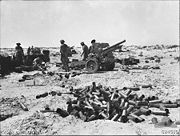 Before dawn on 10 July, as Rommel focused his efforts on the southern flank of the battlefield, the 9th Division attacked the north flank of the enemy positions and captured the strategic high ground around Tel el Eisa. In the days following, Rommel redirected his forces against them, in a series of intense counterattacks, but was unable to dislodge the Australians. On 22 July, the 24th and 26th Brigades attacked German positions on the ridges south of Tel el Esia, suffering heavy casualties taking positions on Tel el Eisa Ridge and Makh Khad Ridge.
The final phase of the First Battle of El Alamein was a disaster for the Allies and the 2/28th Battalion in particular: an attempt to capture Sanyet el Miteiriya, known as "Ruin Ridge", on 27 July. The operation was part of a complex series of night attacks. The 2/28th suffered significant casualties and vehicle losses in its advance, but achieved its objective. However, the battalion was soon surrounded by German infantry. A planned advance by British tanks failed and German tanks arrived. The 2/28th's positions came under a prolonged and methodical attack by the Axis forces. By the time they surrendered, 65 Australians had been killed. Although the vast majority of the 2/28th had become prisoners of war, 93 members of the battalion remained behind Allied lines and it was subsequently rebuilt.
Second Battle of El Alamein
Following the fighting in July, the 9th Division remained in front-line positions around El Alamein, but were engaged in mainly static defensive duties for the next three months. Nevertheless patrols were maintained and some raiding was undertaken, including a raid on 1 September undertaken by the 2/15th Battalion to seize a point 3 kilometres (1.9 mi) south-west of Tel el Eisa in which 150 Germans were killed and another 140 taken prisoner, against which the Australians lost 39 killed, 109 wounded and another 25 missing.
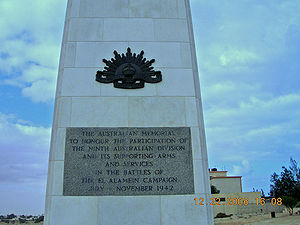 By late October 1942, Allies decided to launch their own offensive in the Western Desert, amassing a force of some 220,000 men supported by 1,100 tanks and 900 artillery pieces. The 9th Division was positioned in the northern sector of the 8th Army's front at El Alamein, nearest the coast, as part of the XXX Corps. This sector was to effect the main thrust of the Allied attack. While XIII
and most of XXX Corps failed to meet their objectives on 25 October, the 9th Division gained considerable momentum, attacking both frontally and executing a wide "left hook" from their original positions, in their sector, with one Axis outpost after another falling to them. Together with the 51st (Highland) Division, and the 2nd New Zealand Division, they had mauled the Italian Trento Division and the German 164th Division. By the following day the 9th Division had managed to further slice through the German 164th Division and trap the greater part of it against the sea. This caused the Axis to rush reinforcements to their sector, predominantly in the form of the 21st Panzer and, later, the Ariete divisions.
As events unfolded, it was on the 9th that Montgomery
pinned his hopes on a breakthrough. They were later referred to by him as his secret weapon. Before this breakthrough was attempted, however, the 9th Division was subjected to numerous counter-attacks by German forces and many of the division's units suffered so many casualties that they were described as "mere skeletons". By the night of 31 October/1 November Moreshead decided to relieve his forward brigade, the 24th Brigade, with the relatively fresh 26th Brigade, however, the following day two German divisions attacked the brigade.
On 2 November, Operation Supercharge—as the breakout was named—began and the final phase of the battle began. The British armoured formations suffered heavily in the initial stages, before on the second day the 51st Division managed to force a gap through the Axis lines, creating a gap of over 6 miles (9.7 km) through which the armour was redirected. The result of this was that the pressure was taken off the 9th Division as the focus of the fighting shifted to the south of Tel el Eisa. After this the 9th Division ceased offensive action, although they continued patrolling operations until 4 November when Rommel ordered a general withdrawal.
The four months that the 9th Division had been involved in the fighting around El Alamein cost them 1,225 killed, 3,638 wounded and 946 captured, for a total of 5,809 casualties.
and the American president Franklin Roosevelt
advised against this, the Australian prime minister John Curtin
insisted and by mid December the decision to bring the division back to Australia was confirmed. In late December the division concentrated around Gaza
, where a divisional parade was held before preparations for embarkation began.
The 9th Division began embarking for its return to Australia on 24 January 1943. Transported on four troopships—the Queen Mary
, Ile de France
, Nieuw Amsterdam and Aquitania
—the division arrived at Fremantle
in Western Australia on 18 February whereupon all members of the division were granted three weeks leave. Welcome-home parades were held in every Australian capital city, after which the 9th Division began reforming in April 1943 in the semi-tropical Atherton Tablelands region of Far North Queensland
where it began re-organising and re-training for jungle warfare. As part of the conversion to a Jungle Division
many of the division’s units were either separated from the division, reorganised into new roles or disbanded. Of note, the division's cavalry unit, the 9th Division Cavalry Regiment, gave up its vehicles and was converted to the commando
role, becoming the 2/9th Cavalry Commando Regiment
. After completing amphibious training near Cairns the 9th Division, now under Major General George Wootten
who had taken command of the division in March, departed for Milne Bay
in New Guinea
in late July and early August 1943.
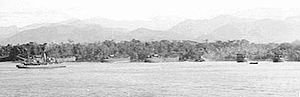 The 9th Division's first task in New Guinea was to liberate the town of Lae
in a joint operation with the 7th Division
. The 9th Division would carry out an amphibious landing to the east
of the town—the first large scale seaborne landing by an Australian formation since the Gallipoli campaign in 1915—while the 7th Division would be flown into the recently secured Nadzab airfield
, to the west of Lae
. The 20th Brigade, now under Brigadier Victor Windeyer
, was chosen as the lead assault unit and on 1 September it began embarking at Milne Bay. Departing the following day, they were transported to the Buna–Morobe area where it linked up with the 57 landing craft that had been assigned to the operation. On the night of 3/4 September they began the 80 miles (128.7 km) run to the landing beaches, arriving just before dawn.
At 0630 hours on 4 September the 20th Brigade launched the initial assault under the cover of naval bombardment. Two battalions were landed on the main beach, codenamed Red Beach, while one more was landed 3 miles (4.8 km) west at Yellow Beach. Experiencing no opposition on the beaches, patrols were sent out to effect a link up along the beachhead
. 35 minutes later as the 26th Brigade came ashore, they were attacked by a nine Japanese aircraft which inflicted a number of casualties on the Australians in the LCIs
, with eight men being killed, including the commanding officer of the 2/23rd Battalion, while another 20 men being wounded. The following day, the 26th Brigade passed through the perimeter that had been set up by the 20th Brigade and began to advance along the coast towards Lae, crossing the Buso river before nightfall on 5 September. That night, the 24th Brigade, which had been held back as the divisional reserve, landed at the beachhead.
After establishing their supply bases the two Australian divisions raced each other to Lae. The 7th Division entered the town several hours ahead of the 9th Division on 16 September. The 9th Division's advance had been held up by Japanese resistance and difficulties with crossing the rivers between the landing beaches and Lae.
Huon Peninsula campaign
The capture of Lae ahead of schedule meant that the focus of Allied operations could then be shifted upon an advance up the Huon Peninsula, which was strategically important to the Allies as it would allow them to establish air and naval bases for future operations. On 22 September 1943, only six days after the fall of Lae, the 20th Brigade made an amphibious landing at Scarlet Beach
, 10 kilometres (6.2 mi) north of Finschhafen
. Because of the haste with which the operation had been put together, there had been no time for rehearsals and this, coupled with faulty maps and the fact that the landing took place in darkness, resulted in the majority of the brigade being landed on the wrong beach. Allied intelligence estimates of Japanese strength around Finschhafen were also faulty, with an expected force of between 500 to 2,100, although in actuality the Japanese had around 5,000 men in the area.
Nevertheless, after a week of heavy fighting against well-entrenched Japanese troops, the Australians captured the town and airfield of Finschhafen, declaring it liberated on 2 October.
However, most of the Japanese that had been around Finschhafen managed to retreat to a 1000 metres (3,280.8 ft) high mountain around Sattelberg. On 16 October they launched a counterattack from there
. In response to this, the 26th Brigade was brought up to relieve the 20th and by 25 October the Japanese counterattack was beaten off. The 9th Division then went on the offensive against Sattelberg on 7 November. With intermittent and sometimes heavy air support, the Australian troops worked to uproot the Japanese from the strategically important peak. It fell to the 9th Division on 25 November 1943, after the 2/48th Battalion
reached the summit. It was during this final assault that Sergeant Tom Derrick carried out the actions that led to him receiving the Victoria Cross.
and progressively over the following two months they were brought back to Australia. After a period of leave the division once again re-formed on the Atherton Tablelands. Due to high personnel turnover in this period as men were discharged or transferred to other units, many of the division's units had to be virtually rebuilt from scratch. Indeed, in order to bring the division's infantry units an entire Militia battalion—nearly 400 men—from the 62nd Battalion
was broken up to provide reinforcements.
Due to rapid developments in the war and strategic uncertainty over the role of Australian forces in the Pacific, the 9th Division remained in Australia for over a year before seeing action once more. While the Australian I Corps
(of which the 9th Division was part) had originally been intended to participate in the liberation of the Philippines, these plans were dropped, and the Corps was instead tasked with the liberation of Borneo
. This would be the division's final involvement in the war and its participation in the campaign was broken up into two primary operations: a landing on Tarakan
and another on Brunei
and Labuan
.
Tarakan
The 26th Brigade group was assigned the task of capturing Tarakan Island
and destroying the Japanese garrison. Japanese forces on the island were estimated at around 2,000 men along with around 250 civilians working in the oil plants. On 30 April 1945 a small force of commandos from the 2/4th Commando Squadron landed along with battery
of 25-pounder field guns
from the 2/7th Field Regiment was landed on Sadau Island off the coast of Tarakan, from where they would provide indirect fire support during the landing. The following day, 1 May, at 0640 the battery on Sadau opened the preliminary bombardment along with two cruiser
s and six destroyer
s stationed offshore. At 0656 hours the main assault began as the LCIs carrying the two battalions that would lead the attack—the 2/23rd and 2/48th—crossed the line of departure
and headed towards the landing beach at Lingkas.
Although initially Japanese opposition to the landing was light, as the Australians advanced inland from the landing beach, the resistance grew in its intensity and it was mid June by the time that the main Japanese force was broken up and mopping up operations began. These operations continued throughout July until starvation forced the majority of those remaining to surrender. The Australians lost 250 killed and 670 wounded in this operation, while the Japanese lost around 1,500 men killed and another 250 men captured trying to defend the island.
Brunei and Labuan
The remainder of the 9th Division landed in the Labuan and Brunei area on 10 June 1945. Tasked with securing Brunei Bay in order to establish a naval base and secure vital oil and rubber production facilities, 14,079 men from the division took part, just under half of the 30,000 men in total that were assigned to the operation. Following a preliminary naval and aerial bombardment, the 24th Brigade landed at the southern end of Labuan island, which situated as it was at the entrance of Brunei Bay, commanded the approach to northern Borneo. At the same time, the 20th Brigade landed near Brooketon, on a small peninsula in the southern end of the bay. A third, albeit smaller, landing was made by one of the 20th Brigade's battalions—the 2/15th—on the small island of Muara. The island had not been garrisoned by the Japanese and all the Australian landings went in unopposed.
The 20th Brigade rapidly secured Brunei town against relatively light opposition, suffering only 40 casualties in this campaign. The 24th Brigade, however, encountered greater opposition in taking the island of Labuan, where the defenders withdrew to an inland stronghold where they held out along dense jungle covered ridges and muddy swamps. In order to subdue the Japanese resistance an intense naval and artillery bombardment was laid down over the course of a week before an assault was put in by two companies of infantry supported by tanks and flamethrower
s.
After securing Labuan, the 24th Brigade was landed on the northern shore of Brunei Bay
on 16 June, while the 20th Brigade continued to consolidate the southern lodgement by advanced south-west along the coast towards Kuching and securing the hinterland as well. The 2/32nd Battalion landed at Padas Bay and seized the town of Weston, before sending out patrols towards Beaufort, 23 kilometres (14.3 mi) inland. Held by 800–1,000 Japanese, on 27 June an attack was carried out there by the 2/43rd Battalion
. Amid a torrential downpour and encountering difficult terrain, the 2/32nd Battalion secured the south bank of the Padas River, while one company from the 2/43rd was sent to take the town and another marched to the flanks, to take up ambush positions along the route that the Japanese were expected to withdraw along. The 2/28th Battalion secured the lines of communication north of the river. On the night of 27/28 June the Japanese launched six counterattacks which devolved into hand to hand combat. Amid appalling conditions, one company became isolated and the next morning another was sent to its aid to attack the Japanese from the rear. Fighting its way through numerous Japanese positions, the company killed at least 100 Japanese and one of its members, Leslie Thomas Starcevich
, was later awarded the Victoria Cross for his efforts.
Following this, the Japanese began to withdraw from Beaufort and the Australians began a slow, cautious advance using indirect fire to limit casualties. By 12 July they occupied Papar, and from there sent out patrols to the north and along the river until the cessation of hostilities. By August the fighting came to an end. The division's total casualties in this operation were 114 killed and 221 wounded, while the Japanese lost at least 1,234 men.
in January 1946. The 9th Division began gradually demobilising
on 1 October 1945 with soldiers with dependants or long service being the first to be discharged. The division's headquarters was disbanded on 10 February 1946 and the last unit of the division was disbanded in May 1946.
.jpg) The 9th Division suffered a total of 2,732 killed in action, 7,501 wounded and 1,863 captured. These 12,096 casualties represent approximately one quarter of the men who served with the division.
The 9th Division suffered a total of 2,732 killed in action, 7,501 wounded and 1,863 captured. These 12,096 casualties represent approximately one quarter of the men who served with the division.
Other decorations awarded to members of the 9th Division included: 41 DSOs
, 9 OBEs
, 29 MBEs, 119 MCs
, 57 DCMs
, 212 MMs
, 9 BEMs
and 611 MIDs.
Australian Army
The Australian Army is Australia's military land force. It is part of the Australian Defence Force along with the Royal Australian Navy and the Royal Australian Air Force. While the Chief of Defence commands the Australian Defence Force , the Army is commanded by the Chief of Army...
that served during World War II
World War II
World War II, or the Second World War , was a global conflict lasting from 1939 to 1945, involving most of the world's nations—including all of the great powers—eventually forming two opposing military alliances: the Allies and the Axis...
. It was the fourth division of the Second Australian Imperial Force
Second Australian Imperial Force
The Second Australian Imperial Force was the name given to the volunteer personnel of the Australian Army in World War II. Under the Defence Act , neither the part-time Militia nor the full-time Permanent Military Force could serve outside Australia or its territories unless they volunteered to...
and was formed in the United Kingdom in late 1940 from infantry brigades and support units which had been previously raised in Australia and sent there to defend against a possible invasion following the Fall of France. It is considered to be one of the most decorated Australian divisions and has the distinction of spending more time in combat than any other. In common with both the 6th and 7th Divisions, the 9th Division was one of only a few Allied
Allies of World War II
The Allies of World War II were the countries that opposed the Axis powers during the Second World War . Former Axis states contributing to the Allied victory are not considered Allied states...
army units to serve with distinction in the Middle East
Middle East
The Middle East is a region that encompasses Western Asia and Northern Africa. It is often used as a synonym for Near East, in opposition to Far East...
and the South West Pacific Area
South West Pacific Area
South West Pacific Area was the name given to the Allied supreme military command in the South West Pacific Theatre of World War II. It was one of four major Allied commands in the Pacific theatres of World War II, during 1942–45...
. During the course of its service, the 9th Division took part in the Siege of Tobruk
Siege of Tobruk
The siege of Tobruk was a confrontation that lasted 240 days between Axis and Allied forces in North Africa during the Western Desert Campaign of the Second World War...
and fought during both battles of El Alamein
El Alamein
El Alamein is a town in the northern Matrouh Governorate of Egypt. Located on the Mediterranean Sea, it lies west of Alexandria and northwest of Cairo. As of 2007, it has a local population of 7,397 inhabitants.- Climate :...
before being brought back to Australia in 1943 to take part in campaigns in New Guinea
New Guinea
New Guinea is the world's second largest island, after Greenland, covering a land area of 786,000 km2. Located in the southwest Pacific Ocean, it lies geographically to the east of the Malay Archipelago, with which it is sometimes included as part of a greater Indo-Australian Archipelago...
and Borneo
Borneo
Borneo is the third largest island in the world and is located north of Java Island, Indonesia, at the geographic centre of Maritime Southeast Asia....
. Following the end of the war, the division was disbanded in early 1946.
Formation
The 9th Division was the fourth AIF division raised, being formed in the United Kingdom in late 1940. Initially it consisted of only two infantry brigadeBrigade
A brigade is a major tactical military formation that is typically composed of two to five battalions, plus supporting elements depending on the era and nationality of a given army and could be perceived as an enlarged/reinforced regiment...
s which had been formed in Australia and dispatched to the UK in order to defend against a possible invasion following the Fall of France—the 18th
18th Brigade (Australia)
The 18th Brigade was an infantry brigade of the Australian Army, which served during the Second World War. The brigade was raised on 13 October 1939 and was one of the first three infantry brigades of the Second Australian Imperial Force to be formed. Initially commanded by Brigadier Leslie...
and 25th Brigades
25th Brigade (Australia)
The 25th Brigade was a brigade-sized infantry unit of the Australian Army that served during the Second World War. Raised in July 1940 and consisting of three infantry battalions, the 25th Brigade served in the United Kingdom, the Middle East, New Guinea and Borneo before being disbanded in...
—under the command of Major General Henry Wynter
Henry Wynter
Lieutenant General Henry Douglas Wynter, CB, CMG, DSO was a regular Australian Army officer who rose to the rank of lieutenant general during World War II...
. Later, the 24th Brigade
24th Brigade (Australia)
The 24th Brigade was a brigade-sized infantry unit of the Australian Army. Formed on 1 July 1940 as part of the Second Australian Imperial Force, the unit was raised for service during World War II. Originally formed as part of the 8th Division the brigade was subsequently transferred to the newly...
was also assigned to the division.
In January 1941 Wynter became ill and was replaced as divisional commander by Leslie Morshead
Leslie Morshead
Lieutenant General Sir Leslie James Morshead KCB, KBE, CMG, DSO, ED was an Australian soldier, teacher, businessman, and farmer, with a distinguished military career that spanned both world wars...
. By February 1941, 9th Division headquarters had been relocated to the Middle East
Middle East
The Middle East is a region that encompasses Western Asia and Northern Africa. It is often used as a synonym for Near East, in opposition to Far East...
. Around this time the divisions of the AIF underwent a reorganisation as the decision was made to send the more established brigades to Greece
Battle of Greece
The Battle of Greece is the common name for the invasion and conquest of Greece by Nazi Germany in April 1941. Greece was supported by British Commonwealth forces, while the Germans' Axis allies Italy and Bulgaria played secondary roles...
; as a result both the 18th and 25th Brigades were transferred from the 9th to the 7th Division. They were replaced by the 20th
20th Brigade (Australia)
The 20th Brigade was a brigade-sized infantry unit of the Australian Army. The brigade was raised for service during the World War II on 7 May 1940 as part of the 7th Division. The brigade was transferred to the 9th Division in 1941...
and 26th Brigades
26th Brigade (Australia)
The Australian 26th Brigade was an Australian Army infantry brigade of World War II. The 26th Brigade was raised in 1940 and formed part of the 9th Division throughout the war. The 26th Brigade saw action in North Africa, New Guinea and Tarakan Island...
, both of which were considered to be less experienced and therefore less ready for action.
Cyrenaica
After completing its initial training in Australia, the UK and Palestine, the units of the 9th Division were sent to CyrenaicaCyrenaica
Cyrenaica is the eastern coastal region of Libya.Also known as Pentapolis in antiquity, it was part of the Creta et Cyrenaica province during the Roman period, later divided in Libia Pentapolis and Libia Sicca...
in Libya
Libya
Libya is an African country in the Maghreb region of North Africa bordered by the Mediterranean Sea to the north, Egypt to the east, Sudan to the southeast, Chad and Niger to the south, and Algeria and Tunisia to the west....
in early March 1941 to complete their training and equipping as part of the garrison of this region. Short of equipment such as machine gun
Machine gun
A machine gun is a fully automatic mounted or portable firearm, usually designed to fire rounds in quick succession from an ammunition belt or large-capacity magazine, typically at a rate of several hundred rounds per minute....
s, mortar
Mortar (weapon)
A mortar is an indirect fire weapon that fires explosive projectiles known as bombs at low velocities, short ranges, and high-arcing ballistic trajectories. It is typically muzzle-loading and has a barrel length less than 15 times its caliber....
s, anti-tank guns and carriers
Universal Carrier
The Universal Carrier, also known as the Bren Gun Carrier is a common name describing a family of light armoured tracked vehicles built by Vickers-Armstrong. Produced between 1934 and 1960, the vehicle was used widely by British Commonwealth forces during the Second World War...
, most the division's artillery and cavalry units did not accompany the infantry brigades to Cyrenaica at this time. The 20th Brigade was the first unit from the division to move, departing on 27 February, although it was joined shortly by the other two brigades and it was during this time that the division suffered its first casualties when German bombers attacked the transport column in which the 2/13th Battalion was travelling, killing two Australians and wounding one other. By 9 March the 20th Brigade relieved the 17th Brigade from the 6th Division, along the Cyrenaican frontier.
By late March, it became clear that German-led Axis
Axis Powers
The Axis powers , also known as the Axis alliance, Axis nations, Axis countries, or just the Axis, was an alignment of great powers during the mid-20th century that fought World War II against the Allies. It began in 1936 with treaties of friendship between Germany and Italy and between Germany and...
forces planned to launch and offensive in Cyrenaica and as a result, the 9th Division commander, Leslie Morshead, ordered the 20th Brigade to withdraw from the frontier, moving 160 miles (257.5 km) back towards Benghazi
Benghazi
Benghazi is the second largest city in Libya, the main city of the Cyrenaica region , and the former provisional capital of the National Transitional Council. The wider metropolitan area is also a district of Libya...
. The offensive began on 24 March, quickly forcing the British units along the frontier back as it drove towards Benghazi. Two days later the 26th Brigade took up positions in the west near the coast to support the 20th Brigade which was holding the pass at Er Regima. At this stage, the division's anti-tank troops were issued with captured Italian guns in order to make up the shortfall in British weapons.
As the Axis advance continued with German victories at Marsa Brega and Agedabia which threatened to outflank the units cut off in Benghazi, the 9th Division ordered to fall back from their positions along the coast to the east to Derna. Lacking their own transport, they had to rely on that provided by other units and thus the withdrawal had to be undertaken in stages. In order to achieve this, the 2/13th Battalion was used as a rear guard
Rear guard
A rear guard or rearguard is that part of a military force that protects it from attack from the rear, either during an advance or withdrawal...
and late in the afternoon of 4 April it undertook the division's first action of the war when the Germans attacked their positions in the Er Regima Pass. Supported by British artillery, the battalion, spread out across a 11 kilometres (6.8 mi) managed to delay a German force of about 3,000 men mounted in lorries and accompanied by armoured cars and tanks. Only lightly armed, however, they were unable to prevent the Germans from outflanking them and gradually they were forced to pull back before, at 2200 hours, their transport arrived and they were able to withdraw just as they were faced with encirclement. In this action the 2/13th Battalion suffered five killed and 93 wounded or captured.
Two days after the action at Er Regima Pass, the 9th Division was ordered to fall back along the coast road towards Tobruk
Tobruk
Tobruk or Tubruq is a city, seaport, and peninsula on Libya's eastern Mediterranean coast, near the border with Egypt. It is the capital of the Butnan District and has a population of 120,000 ....
and what was later called the "Benghazi Handicap". Due to the speed of the Axis advance and the division's lack of transport, confusion reigned and part of the 2/15th Battalion, including most of its headquarters and its commanding officer, were captured.
Siege of Tobruk
Covered by rear guard actions at Er Regima and Mechili, the 9th Division reached Tobruk on 9 April 1941. The 7th Division's 18th Brigade had arrived two days earlier and together with a number of British artillery and armoured regiments and an Indian cavalry regiment, they were placed under the command of Major General John Lavarack
John Lavarack
Lieutenant General Sir John Dudley Lavarack KCMG, KCVO, KBE, CB, DSO was an Australian soldier who was Governor of Queensland from 1 October 1946 to 4 December 1957, the first Australian-born governor of that state....
and ordered to hold the port for at least two months while a relieving force from Egypt was organised.
The first engagement came on 10 April when an Axis force approached the port from the west but was repelled. The following day, Tobruk was effectively placed under siege when German forces cut the supply road to its east, encircling the Allied garrison. On 13 April the first major attack came when the German commander, Erwin Rommel
Erwin Rommel
Erwin Johannes Eugen Rommel , popularly known as the Desert Fox , was a German Field Marshal of World War II. He won the respect of both his own troops and the enemies he fought....
, launched an attack against the 20th Brigade west of the El Adem road. This attack was beaten off, although that night a force of Germans with mortars and machine guns managed to break in to the defences only to be counterattacked by a small group of Australians, including John Edmondson
John Hurst Edmondson
John Hurst Edmondson VC was an Australian recipient of the Victoria Cross, the highest and most prestigious award for gallantry in the face of the enemy that can be awarded to British and Commonwealth forces.-Early life:...
, armed with bayonets and grenades. For his part in the attack Edmondson was posthumously awarded the Victoria Cross
Victoria Cross
The Victoria Cross is the highest military decoration awarded for valour "in the face of the enemy" to members of the armed forces of various Commonwealth countries, and previous British Empire territories....
, the first of seven which were bestowed upon members of the 9th Division during the war.
Over the course of the next six months the 9th Division and the rest of the garrison repelled repeated attempts by Rommel's forces to capture the port. The Australian defence of Tobruk was anchored on three factors: the use of the pre-existing Italian fortifications around the port, aggressive patrolling and raiding of Axis positions and the firepower of the garrison's artillery. Fighting from fixed positions, the Australian infantry successfully contained and defeated repeated German armoured and infantry attacks on the fortress. After the failure of the British attempts to relieve the fortress in May and June 1941 the 9th Division was successful in gradually improving Tobruk's defences through aggressively raiding Axis positions.
Upon the request of the Australian War Cabinet, the bulk of the 9th Division was withdrawn from Tobruk in September and October 1941, and handed over to the British 70th Division with only the 2/13th Battalion remaining in the fortress at the time the garrison was finally relieved in December. The defence of Tobruk cost the 9th Division 3,164 casualties including 650 killed, 1,597 wounded and 917 captured.
El Alamein
Syrian interludeAfter its withdrawal from Tobruk the 9th Division enjoyed only a brief period of rest in Palestine before being redeployed to northern Syria
Syria
Syria , officially the Syrian Arab Republic , is a country in Western Asia, bordering Lebanon and the Mediterranean Sea to the West, Turkey to the north, Iraq to the east, Jordan to the south, and Israel to the southwest....
where, as part of the British Ninth Army
Ninth Army (United Kingdom)
The Ninth Army was a formation of the British Army during World War II, formed on 1 November 1941 by the re designation of Headquarters, British Troops Palestine and Transjordan...
, it was responsible for guarding the Turkish–Syrian frontier. Here they were rejoined by the 9th Division Cavalry Regiment
2/9th Cavalry Commando Regiment (Australia)
The 2/9th Cavalry Regiment was one of three commando regiments raised by the Australian Army for service during World War II. It was originally raised in 1940 as an armoured cavalry unit as part of the 8th Division, before being transferred to the 9th Division. Between 1941 and 1942 the regiment...
, which had been detached in June 1941 to take part in the Syria–Lebanon campaign
Syria-Lebanon campaign
The Syria–Lebanon campaign, also known as Operation Exporter, was the Allied invasion of Vichy French-controlled Syria and Lebanon, in June–July 1941, during World War II. Time Magazine referred to the fighting as a "mixed show" while it was taking place and the campaign remains little known, even...
. This deployment was the first time all the elements of the Division had been concentrated in the one area, albeit an area that stretched 1200 square mile. In addition to its garrison duties, the 9th Division also conducted some much needed training in mobile warfare during its stay in Syria.
In early 1942 the Australian I Corps
Australian I Corps
I Corps of the Australian Army was its main frontline corps during World War II. Various Australian and other Allied divisions came under its control at different times. In 1940–42, the corps was based in the Mediterranean Theatre...
, including the 6th
Australian 6th Division
The 6th Division of the Australian Army was a unit in the Second Australian Imperial Force during World War II. It served in the North African campaign, the Greek campaign and the New Guinea campaign, including the crucial battles of the Kokoda Track, among others...
and 7th
Australian 7th Division
The 7th Division was an infantry division of the Australian Army. It was formed in February 1940 to serve in World War II, as part of the Second Australian Imperial Force...
Divisions, was withdrawn to Australia in early 1942 in response to Japan
Empire of Japan
The Empire of Japan is the name of the state of Japan that existed from the Meiji Restoration on 3 January 1868 to the enactment of the post-World War II Constitution of...
's entry into the war. The Australian government, however, agreed to British requests to retain the 9th Division in the Middle East in exchange for an additional American division being sent to Australia.
First Battle of El Alamein
During early 1942 the Axis forces advanced steadily through north west Egypt. It was decided that the Eighth Army should make a stand just over 100 kilometres (62.1 mi) west of Alexandria, at the railway siding of El Alamein
El Alamein
El Alamein is a town in the northern Matrouh Governorate of Egypt. Located on the Mediterranean Sea, it lies west of Alexandria and northwest of Cairo. As of 2007, it has a local population of 7,397 inhabitants.- Climate :...
, where the coastal plain narrowed between the Mediterranean Sea
Mediterranean Sea
The Mediterranean Sea is a sea connected to the Atlantic Ocean surrounded by the Mediterranean region and almost completely enclosed by land: on the north by Anatolia and Europe, on the south by North Africa, and on the east by the Levant...
and the inhospitable Qattara Depression
Qattara Depression
The Qattara Depression is a depression in the north west of Egypt in the Matruh Governorate and is part of the Libyan Desert. It lies below sea level and is covered with salt pans, sand dunes and salt marshes. The region extends between latitudes of 28°35' and 30°25' North and longitudes of 26°20'...
. On 26 June 1942 the 9th Division was ordered to begin moving from northern Syria to El Alamein. On 1 July, Rommel's forces made a major attack, hoping to dislodge the Allies from the area, take Alexandria, and open the way to Cairo
Cairo
Cairo , is the capital of Egypt and the largest city in the Arab world and Africa, and the 16th largest metropolitan area in the world. Nicknamed "The City of a Thousand Minarets" for its preponderance of Islamic architecture, Cairo has long been a centre of the region's political and cultural life...
and the Suez Canal
Suez Canal
The Suez Canal , also known by the nickname "The Highway to India", is an artificial sea-level waterway in Egypt, connecting the Mediterranean Sea and the Red Sea. Opened in November 1869 after 10 years of construction work, it allows water transportation between Europe and Asia without navigation...
. However, the Eighth Army had regrouped sufficiently to repel the Axis forces and launch counterattacks. On 6 July, the lead elements of the 9th Division arrived at Tel el Shammama 22 miles (35.4 km) from the front, from where they would be committed to the fighting in the northern sector.
The final phase of the First Battle of El Alamein was a disaster for the Allies and the 2/28th Battalion in particular: an attempt to capture Sanyet el Miteiriya, known as "Ruin Ridge", on 27 July. The operation was part of a complex series of night attacks. The 2/28th suffered significant casualties and vehicle losses in its advance, but achieved its objective. However, the battalion was soon surrounded by German infantry. A planned advance by British tanks failed and German tanks arrived. The 2/28th's positions came under a prolonged and methodical attack by the Axis forces. By the time they surrendered, 65 Australians had been killed. Although the vast majority of the 2/28th had become prisoners of war, 93 members of the battalion remained behind Allied lines and it was subsequently rebuilt.
Second Battle of El Alamein
Following the fighting in July, the 9th Division remained in front-line positions around El Alamein, but were engaged in mainly static defensive duties for the next three months. Nevertheless patrols were maintained and some raiding was undertaken, including a raid on 1 September undertaken by the 2/15th Battalion to seize a point 3 kilometres (1.9 mi) south-west of Tel el Eisa in which 150 Germans were killed and another 140 taken prisoner, against which the Australians lost 39 killed, 109 wounded and another 25 missing.
XIII Corps (United Kingdom)
XIII Corps was a British infantry corps during World War I and World War II.-World War I:XIII Corps was formed in France on 15 November 1915 under Lieutenant-General Walter Congreve to be part of Fourth Army. It was first seriously engaged during the Battle of the Somme in 1916. On the First day on...
and most of XXX Corps failed to meet their objectives on 25 October, the 9th Division gained considerable momentum, attacking both frontally and executing a wide "left hook" from their original positions, in their sector, with one Axis outpost after another falling to them. Together with the 51st (Highland) Division, and the 2nd New Zealand Division, they had mauled the Italian Trento Division and the German 164th Division. By the following day the 9th Division had managed to further slice through the German 164th Division and trap the greater part of it against the sea. This caused the Axis to rush reinforcements to their sector, predominantly in the form of the 21st Panzer and, later, the Ariete divisions.
As events unfolded, it was on the 9th that Montgomery
Bernard Montgomery, 1st Viscount Montgomery of Alamein
Field Marshal Bernard Law Montgomery, 1st Viscount Montgomery of Alamein, KG, GCB, DSO, PC , nicknamed "Monty" and the "Spartan General" was a British Army officer. He saw action in the First World War, when he was seriously wounded, and during the Second World War he commanded the 8th Army from...
pinned his hopes on a breakthrough. They were later referred to by him as his secret weapon. Before this breakthrough was attempted, however, the 9th Division was subjected to numerous counter-attacks by German forces and many of the division's units suffered so many casualties that they were described as "mere skeletons". By the night of 31 October/1 November Moreshead decided to relieve his forward brigade, the 24th Brigade, with the relatively fresh 26th Brigade, however, the following day two German divisions attacked the brigade.
On 2 November, Operation Supercharge—as the breakout was named—began and the final phase of the battle began. The British armoured formations suffered heavily in the initial stages, before on the second day the 51st Division managed to force a gap through the Axis lines, creating a gap of over 6 miles (9.7 km) through which the armour was redirected. The result of this was that the pressure was taken off the 9th Division as the focus of the fighting shifted to the south of Tel el Eisa. After this the 9th Division ceased offensive action, although they continued patrolling operations until 4 November when Rommel ordered a general withdrawal.
The four months that the 9th Division had been involved in the fighting around El Alamein cost them 1,225 killed, 3,638 wounded and 946 captured, for a total of 5,809 casualties.
South West Pacific
In October 1942 the Australian government requested that the 9th Division be released from service in the Middle East and returned to Australia to be utilised against the Japanese in the Pacific. Although both the British prime minister, Winston ChurchillWinston Churchill
Sir Winston Leonard Spencer-Churchill, was a predominantly Conservative British politician and statesman known for his leadership of the United Kingdom during the Second World War. He is widely regarded as one of the greatest wartime leaders of the century and served as Prime Minister twice...
and the American president Franklin Roosevelt
Franklin D. Roosevelt
Franklin Delano Roosevelt , also known by his initials, FDR, was the 32nd President of the United States and a central figure in world events during the mid-20th century, leading the United States during a time of worldwide economic crisis and world war...
advised against this, the Australian prime minister John Curtin
John Curtin
John Joseph Curtin , Australian politician, served as the 14th Prime Minister of Australia. Labor under Curtin formed a minority government in 1941 after the crossbench consisting of two independent MPs crossed the floor in the House of Representatives, bringing down the Coalition minority...
insisted and by mid December the decision to bring the division back to Australia was confirmed. In late December the division concentrated around Gaza
Gaza
Gaza , also referred to as Gaza City, is a Palestinian city in the Gaza Strip, with a population of about 450,000, making it the largest city in the Palestinian territories.Inhabited since at least the 15th century BC,...
, where a divisional parade was held before preparations for embarkation began.
The 9th Division began embarking for its return to Australia on 24 January 1943. Transported on four troopships—the Queen Mary
RMS Queen Mary
RMS Queen Mary is a retired ocean liner that sailed primarily in the North Atlantic Ocean from 1936 to 1967 for the Cunard Line...
, Ile de France
SS Ile de France
The SS Ile de France was a French ocean liner built in Saint-Nazaire, France for the Compagnie Générale Transatlantique. The ship was the first major ocean liner built after the conclusion of World War I and was the first liner ever to be decorated entirely with designs associated with the Art Deco...
, Nieuw Amsterdam and Aquitania
RMS Aquitania
RMS Aquitania was a Cunard Line ocean liner designed by Leonard Peskett and built by John Brown & Company in Clydebank, Scotland. She was launched on 21 April 1913 and sailed on her maiden voyage to New York on 30 May 1914...
—the division arrived at Fremantle
Fremantle, Western Australia
Fremantle is a city in Western Australia, located at the mouth of the Swan River. Fremantle Harbour serves as the port of Perth, the state capital. Fremantle was the first area settled by the Swan River colonists in 1829...
in Western Australia on 18 February whereupon all members of the division were granted three weeks leave. Welcome-home parades were held in every Australian capital city, after which the 9th Division began reforming in April 1943 in the semi-tropical Atherton Tablelands region of Far North Queensland
Far North Queensland
Far North Queensland, or FNQ, is the northernmost part of the Australian state of Queensland. The region, which contains a large section of the Tropical North Queensland area, stretches from the city of Cairns north to the Torres Strait...
where it began re-organising and re-training for jungle warfare. As part of the conversion to a Jungle Division
Jungle Division
The Jungle Division was a military organisation adopted in 1943 by the Australian Army during the Second World War. This organisation was a much lighter version of the standard British-pattern infantry division used during previous campaigns in the deserts of North Africa and was optimised to meet...
many of the division’s units were either separated from the division, reorganised into new roles or disbanded. Of note, the division's cavalry unit, the 9th Division Cavalry Regiment, gave up its vehicles and was converted to the commando
Australian commandos
The name commando has been applied to a variety of Australian special forces and light infantry units that have been formed since 1941–42. The first Australian "commando" units were formed during the Second World War, where they mainly performed reconnaissance and long-range patrol roles during...
role, becoming the 2/9th Cavalry Commando Regiment
2/9th Cavalry Commando Regiment (Australia)
The 2/9th Cavalry Regiment was one of three commando regiments raised by the Australian Army for service during World War II. It was originally raised in 1940 as an armoured cavalry unit as part of the 8th Division, before being transferred to the 9th Division. Between 1941 and 1942 the regiment...
. After completing amphibious training near Cairns the 9th Division, now under Major General George Wootten
George Wootten
Major General Sir George Frederick Wootten KBE, CB, DSO & Bar, ED , was an Australian soldier, public servant, right wing political activist and solicitor. He rose to the rank of temporary Major General during World War II....
who had taken command of the division in March, departed for Milne Bay
Milne Bay
Milne Bay is a large bay in Milne Bay Province, southeastern Papua New Guinea. The bay is named after Sir Alexander Milne.The area was a site of the Battle of Milne Bay in 1942....
in New Guinea
New Guinea
New Guinea is the world's second largest island, after Greenland, covering a land area of 786,000 km2. Located in the southwest Pacific Ocean, it lies geographically to the east of the Malay Archipelago, with which it is sometimes included as part of a greater Indo-Australian Archipelago...
in late July and early August 1943.
New Guinea
LaeSalamaua-Lae campaign
The Salamaua–Lae campaign was a series of actions in the New Guinea campaign of World War II. Australian and United States forces sought to capture two major Japanese bases, one in the town of Lae, and another one at Salamaua. The campaign to take the Salamaua and Lae area began with the Australian...
in a joint operation with the 7th Division
Australian 7th Division
The 7th Division was an infantry division of the Australian Army. It was formed in February 1940 to serve in World War II, as part of the Second Australian Imperial Force...
. The 9th Division would carry out an amphibious landing to the east
Landing at Lae
The Landing at Lae was an amphibous landing, as part of ', to the east of Lae in the Salamaua-Lae campaign of World War II between 4–6 September 1943....
of the town—the first large scale seaborne landing by an Australian formation since the Gallipoli campaign in 1915—while the 7th Division would be flown into the recently secured Nadzab airfield
Landing at Nadzab
The Landing at Nadzab was an airborne landing on 5 September 1943 during the New Guinea campaign of World War II that began with a parachute drop at Nadzab in conjunction with the Landing at Lae....
, to the west of Lae
Lae
Lae, the capital of Morobe Province, is the second-largest city in Papua New Guinea. It is located at the start of the Highlands Highway which is the main land transport corridor from the Highlands region to the coast...
. The 20th Brigade, now under Brigadier Victor Windeyer
Victor Windeyer
Major General Sir William John Victor Windeyer KBE CB DSO and Bar PC KC Australian judge, soldier and educator, was a Justice of the High Court of Australia....
, was chosen as the lead assault unit and on 1 September it began embarking at Milne Bay. Departing the following day, they were transported to the Buna–Morobe area where it linked up with the 57 landing craft that had been assigned to the operation. On the night of 3/4 September they began the 80 miles (128.7 km) run to the landing beaches, arriving just before dawn.
At 0630 hours on 4 September the 20th Brigade launched the initial assault under the cover of naval bombardment. Two battalions were landed on the main beach, codenamed Red Beach, while one more was landed 3 miles (4.8 km) west at Yellow Beach. Experiencing no opposition on the beaches, patrols were sent out to effect a link up along the beachhead
Beachhead
Beachhead is a military term used to describe the line created when a unit reaches a beach, and begins to defend that area of beach, while other reinforcements help out, until a unit large enough to begin advancing has arrived. It is sometimes used interchangeably with Bridgehead and Lodgement...
. 35 minutes later as the 26th Brigade came ashore, they were attacked by a nine Japanese aircraft which inflicted a number of casualties on the Australians in the LCIs
Landing Craft Infantry
The Landing craft, Infantry or LCI were several classes of sea-going amphibious assault ships of the Second World War utilized to land large numbers of infantry directly onto beaches. They were developed in response to a British request for a vessel capable of carrying and landing substantially...
, with eight men being killed, including the commanding officer of the 2/23rd Battalion, while another 20 men being wounded. The following day, the 26th Brigade passed through the perimeter that had been set up by the 20th Brigade and began to advance along the coast towards Lae, crossing the Buso river before nightfall on 5 September. That night, the 24th Brigade, which had been held back as the divisional reserve, landed at the beachhead.
After establishing their supply bases the two Australian divisions raced each other to Lae. The 7th Division entered the town several hours ahead of the 9th Division on 16 September. The 9th Division's advance had been held up by Japanese resistance and difficulties with crossing the rivers between the landing beaches and Lae.
Huon Peninsula campaign
The capture of Lae ahead of schedule meant that the focus of Allied operations could then be shifted upon an advance up the Huon Peninsula, which was strategically important to the Allies as it would allow them to establish air and naval bases for future operations. On 22 September 1943, only six days after the fall of Lae, the 20th Brigade made an amphibious landing at Scarlet Beach
Battle of Scarlet Beach
The Battle of Scarlet Beach took place during the Huon Peninsula campaign of the Second World War. Involving forces from Australia, the United States and Japan, Allied forces landed at Scarlet Beach, north of Siki Cove and south of the Song River, to the east of Katika and about 10 kilometres to...
, 10 kilometres (6.2 mi) north of Finschhafen
Finschhafen
Finschhafen is a district on the northeast coast of the Morobe province of Papua New Guinea. It is named after the port of the same name.The port was discovered in 1884 by the German researcher Otto Finsch. In 1885 the German colony of German New Guinea created a town on the site and named it...
. Because of the haste with which the operation had been put together, there had been no time for rehearsals and this, coupled with faulty maps and the fact that the landing took place in darkness, resulted in the majority of the brigade being landed on the wrong beach. Allied intelligence estimates of Japanese strength around Finschhafen were also faulty, with an expected force of between 500 to 2,100, although in actuality the Japanese had around 5,000 men in the area.
Nevertheless, after a week of heavy fighting against well-entrenched Japanese troops, the Australians captured the town and airfield of Finschhafen, declaring it liberated on 2 October.
However, most of the Japanese that had been around Finschhafen managed to retreat to a 1000 metres (3,280.8 ft) high mountain around Sattelberg. On 16 October they launched a counterattack from there
Battle of Sattelberg
The Battle of Sattelberg took place during the Huon Peninsula campaign of the Second World War. Involving forces from Australia, the United States and Japan, the fighting centred around the Sattelberg mission station which was situated atop a hill about above sea level, approximately inland from...
. In response to this, the 26th Brigade was brought up to relieve the 20th and by 25 October the Japanese counterattack was beaten off. The 9th Division then went on the offensive against Sattelberg on 7 November. With intermittent and sometimes heavy air support, the Australian troops worked to uproot the Japanese from the strategically important peak. It fell to the 9th Division on 25 November 1943, after the 2/48th Battalion
2/48th Battalion (Australia)
The 2/48th Battalion was an infantry battalion of the Australian Army which served during the Second World War. Raised in Adelaide in South Australia in August 1940, the battalion formed part of the 26th Brigade and was initially assigned to the 7th Division, although it was later transferred to...
reached the summit. It was during this final assault that Sergeant Tom Derrick carried out the actions that led to him receiving the Victoria Cross.
Borneo
In January 1944 the 9th Division was relieved by the 5th Division around SioSio
Sio may refer to:*Sió -artificial channel in Hungary*Sio, Mali*Sio, Papua New Guinea...
and progressively over the following two months they were brought back to Australia. After a period of leave the division once again re-formed on the Atherton Tablelands. Due to high personnel turnover in this period as men were discharged or transferred to other units, many of the division's units had to be virtually rebuilt from scratch. Indeed, in order to bring the division's infantry units an entire Militia battalion—nearly 400 men—from the 62nd Battalion
62nd Battalion (Australia)
The 62nd Battalion was an infantry battalion of the Australian Army. It was first raised in 1917 during World War I but was disbanded before seeing active service. During World War II the battalion was re-raised in 1942 as a unit of the Militia and was tasked with undertaking garrison duty in Dutch...
was broken up to provide reinforcements.
Due to rapid developments in the war and strategic uncertainty over the role of Australian forces in the Pacific, the 9th Division remained in Australia for over a year before seeing action once more. While the Australian I Corps
Australian I Corps
I Corps of the Australian Army was its main frontline corps during World War II. Various Australian and other Allied divisions came under its control at different times. In 1940–42, the corps was based in the Mediterranean Theatre...
(of which the 9th Division was part) had originally been intended to participate in the liberation of the Philippines, these plans were dropped, and the Corps was instead tasked with the liberation of Borneo
Borneo campaign (1945)
The Borneo Campaign of 1945 was the last major Allied campaign in the South West Pacific Area, during World War II. In a series of amphibious assaults between 1 May and 21 July, the Australian I Corps, under General Leslie Morshead, attacked Japanese forces occupying the island. Allied naval and...
. This would be the division's final involvement in the war and its participation in the campaign was broken up into two primary operations: a landing on Tarakan
Tarakan
Tarakan volcano is located in Indonesia's Halmahera islands, near the shore of Galela Bay north east of Dukono volcano. Tarakan consists of two large cinder cones, namely Tarakan Lamo and Tarakan Itji ....
and another on Brunei
Brunei
Brunei , officially the State of Brunei Darussalam or the Nation of Brunei, the Abode of Peace , is a sovereign state located on the north coast of the island of Borneo, in Southeast Asia...
and Labuan
Labuan
Labuan is a federal territory in East Malaysia. It is an island off the coast of the state of Sabah. Labuan's capital is Victoria and is best known as an offshore financial centre offering international financial and business services via Labuan IBFC since 1990 as well as being an offshore support...
.
Tarakan
The 26th Brigade group was assigned the task of capturing Tarakan Island
Tarakan Island
Tarakan is an island off the coast of East Kalimantan, Indonesia. It is a marshy island situated in the eastern Celebes Sea, off the northeastern coast of Borneo. The island occupies an area of .-Petroleum:...
and destroying the Japanese garrison. Japanese forces on the island were estimated at around 2,000 men along with around 250 civilians working in the oil plants. On 30 April 1945 a small force of commandos from the 2/4th Commando Squadron landed along with battery
Artillery battery
In military organizations, an artillery battery is a unit of guns, mortars, rockets or missiles so grouped in order to facilitate better battlefield communication and command and control, as well as to provide dispersion for its constituent gunnery crews and their systems...
of 25-pounder field guns
Ordnance QF 25 pounder
The Ordnance QF 25 pounder, or more simply, 25-pounder or 25-pdr, was introduced into service just before World War II, during which it served as the major British field gun/howitzer. It was considered by many to be the best field artillery piece of the war, combining high rates of fire with a...
from the 2/7th Field Regiment was landed on Sadau Island off the coast of Tarakan, from where they would provide indirect fire support during the landing. The following day, 1 May, at 0640 the battery on Sadau opened the preliminary bombardment along with two cruiser
Cruiser
A cruiser is a type of warship. The term has been in use for several hundreds of years, and has had different meanings throughout this period...
s and six destroyer
Destroyer
In naval terminology, a destroyer is a fast and maneuverable yet long-endurance warship intended to escort larger vessels in a fleet, convoy or battle group and defend them against smaller, powerful, short-range attackers. Destroyers, originally called torpedo-boat destroyers in 1892, evolved from...
s stationed offshore. At 0656 hours the main assault began as the LCIs carrying the two battalions that would lead the attack—the 2/23rd and 2/48th—crossed the line of departure
Line of Departure
Line of Departure is a military term used to denote the starting position for an attack on enemy positions. During the Second World War, the term in use in the British, Canadian and American militaries was Start Line...
and headed towards the landing beach at Lingkas.
Although initially Japanese opposition to the landing was light, as the Australians advanced inland from the landing beach, the resistance grew in its intensity and it was mid June by the time that the main Japanese force was broken up and mopping up operations began. These operations continued throughout July until starvation forced the majority of those remaining to surrender. The Australians lost 250 killed and 670 wounded in this operation, while the Japanese lost around 1,500 men killed and another 250 men captured trying to defend the island.
Brunei and Labuan
The remainder of the 9th Division landed in the Labuan and Brunei area on 10 June 1945. Tasked with securing Brunei Bay in order to establish a naval base and secure vital oil and rubber production facilities, 14,079 men from the division took part, just under half of the 30,000 men in total that were assigned to the operation. Following a preliminary naval and aerial bombardment, the 24th Brigade landed at the southern end of Labuan island, which situated as it was at the entrance of Brunei Bay, commanded the approach to northern Borneo. At the same time, the 20th Brigade landed near Brooketon, on a small peninsula in the southern end of the bay. A third, albeit smaller, landing was made by one of the 20th Brigade's battalions—the 2/15th—on the small island of Muara. The island had not been garrisoned by the Japanese and all the Australian landings went in unopposed.
The 20th Brigade rapidly secured Brunei town against relatively light opposition, suffering only 40 casualties in this campaign. The 24th Brigade, however, encountered greater opposition in taking the island of Labuan, where the defenders withdrew to an inland stronghold where they held out along dense jungle covered ridges and muddy swamps. In order to subdue the Japanese resistance an intense naval and artillery bombardment was laid down over the course of a week before an assault was put in by two companies of infantry supported by tanks and flamethrower
Flamethrower
A flamethrower is a mechanical device designed to project a long controllable stream of fire.Some flamethrowers project a stream of ignited flammable liquid; some project a long gas flame. Most military flamethrowers use liquids, but commercial flamethrowers tend to use high-pressure propane and...
s.
After securing Labuan, the 24th Brigade was landed on the northern shore of Brunei Bay
Battle of North Borneo
The Battle of North Borneo took place during the Second World War between Allied and Japanese forces. Part of the wider Borneo campaign of the Pacific War, it was fought between 10 June and 15 August 1945 in North Borneo...
on 16 June, while the 20th Brigade continued to consolidate the southern lodgement by advanced south-west along the coast towards Kuching and securing the hinterland as well. The 2/32nd Battalion landed at Padas Bay and seized the town of Weston, before sending out patrols towards Beaufort, 23 kilometres (14.3 mi) inland. Held by 800–1,000 Japanese, on 27 June an attack was carried out there by the 2/43rd Battalion
2/43rd Battalion (Australia)
The 2/43rd Battalion was an infantry battalion of the Australian Army. Raised in July 1940 in South Australia as part of the 24th Brigade, the unit saw service in the Middle East in 1941–42, taking part in the fighting at Tobruk and El Alamein before returning to Australia early in 1943. In 1943–44...
. Amid a torrential downpour and encountering difficult terrain, the 2/32nd Battalion secured the south bank of the Padas River, while one company from the 2/43rd was sent to take the town and another marched to the flanks, to take up ambush positions along the route that the Japanese were expected to withdraw along. The 2/28th Battalion secured the lines of communication north of the river. On the night of 27/28 June the Japanese launched six counterattacks which devolved into hand to hand combat. Amid appalling conditions, one company became isolated and the next morning another was sent to its aid to attack the Japanese from the rear. Fighting its way through numerous Japanese positions, the company killed at least 100 Japanese and one of its members, Leslie Thomas Starcevich
Leslie Thomas Starcevich
Leslie Thomas "Tom" Starcevich VC was an Australian recipient of the Victoria Cross, the highest decoration for gallantry "in the face of the enemy" that can be awarded to members of the British and Commonwealth armed forces.-Details:Starcevich grew up and later lived at Grass Patch, north of...
, was later awarded the Victoria Cross for his efforts.
Following this, the Japanese began to withdraw from Beaufort and the Australians began a slow, cautious advance using indirect fire to limit casualties. By 12 July they occupied Papar, and from there sent out patrols to the north and along the river until the cessation of hostilities. By August the fighting came to an end. The division's total casualties in this operation were 114 killed and 221 wounded, while the Japanese lost at least 1,234 men.
Disbandment
Following the end of the war the 9th Division remained in Borneo and performed emergency relief and occupation duties until the arrival of Indian troopsBritish Indian Army
The British Indian Army, officially simply the Indian Army, was the principal army of the British Raj in India before the partition of India in 1947...
in January 1946. The 9th Division began gradually demobilising
Demobilisation of the Australian military after World War II
The demobilisation of the Australian military after World War II involved discharging almost 600,000 men and women from the military, supporting their transition to civilian life and reducing the three armed services to peacetime strengths...
on 1 October 1945 with soldiers with dependants or long service being the first to be discharged. The division's headquarters was disbanded on 10 February 1946 and the last unit of the division was disbanded in May 1946.
Casualties
Decorations
The 9th Division was the most highly decorated of the four AIF divisions raised during the war. Seven of its members received the Victoria Cross, the nation's highest award for gallantry, these were (in alphabetical order by surname):- Tom DerrickDerrick's VC was not awarded posthumously, although he was killed later in the war.
- John Hurst EdmondsonJohn Hurst EdmondsonJohn Hurst Edmondson VC was an Australian recipient of the Victoria Cross, the highest and most prestigious award for gallantry in the face of the enemy that can be awarded to British and Commonwealth forces.-Early life:...
(posthumous) - Percival Eric GratwickPercival Eric GratwickPercival Eric Gratwick VC was an Australian recipient of the Victoria Cross, the highest and most prestigious award for gallantry in the face of the enemy that can be awarded to British and Commonwealth forces....
(posthumous) - Arthur Stanley GurneyArthur Stanley GurneyArthur Stanley "Stan" Gurney VC was an Australian recipient of the Victoria Cross, the highest and most prestigious award for gallantry in the face of the enemy that can be awarded to British and Commonwealth forces....
(posthumous) - William Henry KibbyWilliam Henry KibbyWilliam Henry Kibby VC was a British-born Australian recipient of the Victoria Cross, the highest and most prestigious award for gallantry in the face of the enemy that can be awarded to Commonwealth forces....
(posthumous) - John Bernard MackeyJohn Bernard MacKeyJohn Bernard "Jack" Mackey VC was an Australian recipient of the Victoria Cross, the highest and most prestigious award for gallantry in the face of the enemy that can be awarded to British Commonwealth soldiers, sailors, airmen, and Marines.Born in Leichhardt, New South Wales, Mackey was the only...
(posthumous) - Leslie Thomas StarcevichLeslie Thomas StarcevichLeslie Thomas "Tom" Starcevich VC was an Australian recipient of the Victoria Cross, the highest decoration for gallantry "in the face of the enemy" that can be awarded to members of the British and Commonwealth armed forces.-Details:Starcevich grew up and later lived at Grass Patch, north of...
Other decorations awarded to members of the 9th Division included: 41 DSOs
Distinguished Service Order
The Distinguished Service Order is a military decoration of the United Kingdom, and formerly of other parts of the British Commonwealth and Empire, awarded for meritorious or distinguished service by officers of the armed forces during wartime, typically in actual combat.Instituted on 6 September...
, 9 OBEs
Order of the British Empire
The Most Excellent Order of the British Empire is an order of chivalry established on 4 June 1917 by George V of the United Kingdom. The Order comprises five classes in civil and military divisions...
, 29 MBEs, 119 MCs
Military Cross
The Military Cross is the third-level military decoration awarded to officers and other ranks of the British Armed Forces; and formerly also to officers of other Commonwealth countries....
, 57 DCMs
Distinguished Conduct Medal
The Distinguished Conduct Medal was an extremely high level award for bravery. It was a second level military decoration awarded to other ranks of the British Army and formerly also to non-commissioned personnel of other Commonwealth countries.The medal was instituted in 1854, during the Crimean...
, 212 MMs
Military Medal
The Military Medal was a military decoration awarded to personnel of the British Army and other services, and formerly also to personnel of other Commonwealth countries, below commissioned rank, for bravery in battle on land....
, 9 BEMs
British Empire Medal
The Medal of the Order of the British Empire for Meritorious Service, usually known as the British Empire Medal , is a British medal awarded for meritorious civil or military service worthy of recognition by the Crown...
and 611 MIDs.
Structure
The 9th Division's structure was as follows:- Infantry units
- 18th Brigade18th Brigade (Australia)The 18th Brigade was an infantry brigade of the Australian Army, which served during the Second World War. The brigade was raised on 13 October 1939 and was one of the first three infantry brigades of the Second Australian Imperial Force to be formed. Initially commanded by Brigadier Leslie...
– to 7th Division, 1941 - 20th Brigade20th Brigade (Australia)The 20th Brigade was a brigade-sized infantry unit of the Australian Army. The brigade was raised for service during the World War II on 7 May 1940 as part of the 7th Division. The brigade was transferred to the 9th Division in 1941...
– from 7th DivisionAustralian 7th DivisionThe 7th Division was an infantry division of the Australian Army. It was formed in February 1940 to serve in World War II, as part of the Second Australian Imperial Force...
, 1941.- 2/13th Australian Infantry Battalion, New South WalesNew South WalesNew South Wales is a state of :Australia, located in the east of the country. It is bordered by Queensland, Victoria and South Australia to the north, south and west respectively. To the east, the state is bordered by the Tasman Sea, which forms part of the Pacific Ocean. New South Wales...
(NSW) - 2/15th Australian Infantry Battalion, Queensland (Qld)
- 2/17th Australian Infantry Battalion2/17th Battalion (Australia)The 2/17th Battalion was an infantry battalion of the Australian Army. Raised in April 1940 in New South Wales, the unit saw service in the Middle East in 1941–42, taking part in the fighting at Tobruk and El Alamein before returning to Australia early in 1943. In 1943–44 the battalion fought in...
, NSW
- 2/13th Australian Infantry Battalion, New South Wales
- 24th Brigade24th Brigade (Australia)The 24th Brigade was a brigade-sized infantry unit of the Australian Army. Formed on 1 July 1940 as part of the Second Australian Imperial Force, the unit was raised for service during World War II. Originally formed as part of the 8th Division the brigade was subsequently transferred to the newly...
– from 8th DivisionAustralian 8th DivisionThe 8th Division of the Australian Army was formed to serve in World War II, as part of the Second Australian Imperial Force, who were in turn, part of the Allies of World War II. The 8th Division was raised from regular army units and new, all-volunteer infantry brigades, from July 1940 onwards...
, 1940- 2/25th Australian Infantry Battalion, Qld (to 25th Infantry Brigade, 1940)
- 2/28th Australian Infantry Battalion, Western AustraliaWestern AustraliaWestern Australia is a state of Australia, occupying the entire western third of the Australian continent. It is bounded by the Indian Ocean to the north and west, the Great Australian Bight and Indian Ocean to the south, the Northern Territory to the north-east and South Australia to the south-east...
(WA) - 2/32nd Australian Infantry Battalion, VictoriaVictoria (Australia)Victoria is the second most populous state in Australia. Geographically the smallest mainland state, Victoria is bordered by New South Wales, South Australia, and Tasmania on Boundary Islet to the north, west and south respectively....
(Vic.) - 2/43rd Australian Infantry Battalion2/43rd Battalion (Australia)The 2/43rd Battalion was an infantry battalion of the Australian Army. Raised in July 1940 in South Australia as part of the 24th Brigade, the unit saw service in the Middle East in 1941–42, taking part in the fighting at Tobruk and El Alamein before returning to Australia early in 1943. In 1943–44...
, South AustraliaSouth AustraliaSouth Australia is a state of Australia in the southern central part of the country. It covers some of the most arid parts of the continent; with a total land area of , it is the fourth largest of Australia's six states and two territories.South Australia shares borders with all of the mainland...
(SA)
- 25th Brigade25th Brigade (Australia)The 25th Brigade was a brigade-sized infantry unit of the Australian Army that served during the Second World War. Raised in July 1940 and consisting of three infantry battalions, the 25th Brigade served in the United Kingdom, the Middle East, New Guinea and Borneo before being disbanded in...
– to 7th Division, 1941 - 26th Brigade26th Brigade (Australia)The Australian 26th Brigade was an Australian Army infantry brigade of World War II. The 26th Brigade was raised in 1940 and formed part of the 9th Division throughout the war. The 26th Brigade saw action in North Africa, New Guinea and Tarakan Island...
- 2/23rd Australian Infantry Battalion, Vic.
- 2/24th Australian Infantry Battalion, Vic.
- 2/32nd Australian Infantry Battalion, Vic. (to 24th Brigade, 1940)
- 2/48th Australian Infantry Battalion2/48th Battalion (Australia)The 2/48th Battalion was an infantry battalion of the Australian Army which served during the Second World War. Raised in Adelaide in South Australia in August 1940, the battalion formed part of the 26th Brigade and was initially assigned to the 7th Division, although it was later transferred to...
, SA
- 18th Brigade
- Artillery regiments
- 2/7th Field Regiment, Royal Australian Artillery
- 2/8th Field Regiment, RAA
- 2/12th Field Regiment, RAA (ex 2/2nd Medium Reg., Corps Artillery)
- 2/3rd Anti-Tank Regiment, RAA (from 8th Div., 194?)
- Engineer companies
- 2/3rd Field Company, Royal Australian Engineers, TasmaniaTasmaniaTasmania is an Australian island and state. It is south of the continent, separated by Bass Strait. The state includes the island of Tasmania—the 26th largest island in the world—and the surrounding islands. The state has a population of 507,626 , of whom almost half reside in the greater Hobart...
/WA/SA (from 6th Div., 194?) - 2/13th Field Company, RAE, Qld (ex 2/1st Field Park Company)
- 2/7th Field Company, RAE, Qld (ex Corps Troops)
- 2/4th Field Park Company, RAE, WA (ex 8th Division)
- 2/3rd Field Company, Royal Australian Engineers, Tasmania
- Other units
- 2/3rd Australian Machine-Gun Regiment (Vic.)
- 2/3rd Australian Pioneer Battalion2/3rd Pioneer Battalion (Australia)The 2/3rd Pioneer Battalion was an assault pioneer battalion of the Australian Army, which served during World War II. Formed in 1940, the battalion served in the Middle East before where it served in Syria and Palestine before taking part in the fighting around El Alamein...
(from 7th Division, 1942) - 2/4th Australian Pioneer Battalion
- 9th Australian Divisional Cavalry2/9th Cavalry Commando Regiment (Australia)The 2/9th Cavalry Regiment was one of three commando regiments raised by the Australian Army for service during World War II. It was originally raised in 1940 as an armoured cavalry unit as part of the 8th Division, before being transferred to the 9th Division. Between 1941 and 1942 the regiment...
(from 8th Division, 1941)
Commanders
- Major General Henry WynterHenry WynterLieutenant General Henry Douglas Wynter, CB, CMG, DSO was a regular Australian Army officer who rose to the rank of lieutenant general during World War II...
(October 1940 – February 1941) - Major General Leslie MorsheadLeslie MorsheadLieutenant General Sir Leslie James Morshead KCB, KBE, CMG, DSO, ED was an Australian soldier, teacher, businessman, and farmer, with a distinguished military career that spanned both world wars...
(February 1941 – March 1943) - Major General George WoottenGeorge WoottenMajor General Sir George Frederick Wootten KBE, CB, DSO & Bar, ED , was an Australian soldier, public servant, right wing political activist and solicitor. He rose to the rank of temporary Major General during World War II....
(March 1943 – October 1945).
Quotes
- [A] batch of some 50 or 60 Australian prisoners were marched off close behind us—immensely big and powerful men, who without question represented an elite formation of the British Empire, a fact that was also evident in battle.
—Lieutenant General Erwin RommelErwin RommelErwin Johannes Eugen Rommel , popularly known as the Desert Fox , was a German Field Marshal of World War II. He won the respect of both his own troops and the enemies he fought....
, Commander, German Afrika KorpsAfrika KorpsThe German Africa Corps , or the Afrika Korps as it was popularly called, was the German expeditionary force in Libya and Tunisia during the North African Campaign of World War II...
, Battle of Tobruk, 1941.
- My God, I wish we had [the] 9th Australian Division with us this morning.
—Major General Freddie de GuingandFreddie de GuingandMajor-General Sir Francis Wilfred de Guingand KBE, CB, DSO , better known as Freddie de Guingand, was a British Army officer who served with Montgomery from El Alamein to the surrender of the Wehrmacht in the West...
, Chief of Staff, Allied Land-force Headquarters Europe, D-Day, 1944.
- We could not have won the battle (El AlameinEl AlameinEl Alamein is a town in the northern Matrouh Governorate of Egypt. Located on the Mediterranean Sea, it lies west of Alexandria and northwest of Cairo. As of 2007, it has a local population of 7,397 inhabitants.- Climate :...
) in twelve days without the magnificent 9th Australian Division.
—Montgomery, writing about the Allied breakthrough in North Africa