

Labuan

Encyclopedia
Labuan is a federal territory in East Malaysia
. It is an island off the coast of the state of Sabah
. Labuan's capital is Victoria
and is best known as an offshore financial centre
offering international financial and business services via Labuan IBFC
since 1990 as well as being an offshore support hub for deepwater oil and gas activities in the region. It is also a tourist destination for nearby Brunei
ans and scuba divers
. The name Labuan derives from the Malay word labuhan meaning anchorage.
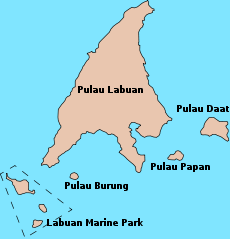
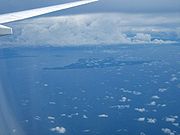 The Federal Territory of Labuan comprises Labuan Island (75 km²) and six other smaller islands (Pulau Burung, Pulau Daat, Pulau Kuraman
, Pulau Papan, Pulau Rusukan Kecil, and Pulau Rusukan Besar), which have a combined total area of 91 km². The islands lie 8 km off the coast of Borneo
, adjacent to the Malaysian state
of Sabah
and the independent state of Brunei Darussalam
, on the northern edge of Brunei Bay
facing the South China Sea
. Labuan Island is mainly flat and undulating and the highest point is only 85 meters. Over 70% of the island is still covered with vegetation. Victoria
, also Bandar Labuan in Malay, is the major town and faces Brunei Bay; access is via ferry service to Brunei and Kota Kinabalu, as well as Labuan Airport
 Labuan was a part of the Sultanate of Brunei.
In the 1840s the previously-uninhabited island was proposed as a base for British operations against piracy
in the South China Sea. In 1846, Brunei
was attacked and captured by the British and Sultan Omar Ali Saifuddin II
was forced to sign a treaty and ceded Labuan to Britain in the same year. The island became a Crown Colony
in 1848. The first White Rajah of Sarawak
, James Brooke
was appointed first commander-in-chief and Governor of the territory. In 1849 the Eastern Archipelago Company
became the first of many companies trying to exploit its coal deposits and establish it as a coaling station for the China trade. It later became a station for the submarine communications cable
between Singapore
and Hong Kong.
In 1890, Labuan came to be administered by the British North Borneo Chartered Company. It was reverted back to British government rule in 1904, then on 30 October 1906 joined to the Straits Settlements
and been administered from Singapore
.
During World War II, Labuan was occupied by Japan
from December 1941 to June 1945 and governed as part of the Northern Borneo military unit by the Japanese 37th Army. Labuan was renamed Maida Island (Pulau Maida, 前田島 [Maeda-shima]) after Marquis
Toshinari Maeda
, the first commander of Japanese forces in northern Borneo. The liberation of Borneo began on 10th June 1945 when the Allied Forces under the command of General McArthur landed at Labuan with a convoy of 100 ships. The 9th Australian Division launched an attack supported by massive air and sea bombardments that resulted in the surrender of the Japanese. On 9 September 1945, General Masao Baba, commander of Japanese military, surrendered at the Layang-layang beach before Major General George F. Wooten, commander of Australian 9th Division Army. Labuan assumed its former name and was under British military administration along with the rest of the Straits Settlements
, then joined to British North Borneo
, on 15 July 1946, which in turn became a part of Malaysia as the state of Sabah in 1963.
In 1984, Labuan was ceded by Sabah to the federal government and made a federal territory. In 1990, it was declared an international offshore financial centre and free trade zone
.
The Labuan International Business and Financial Centre (Labuan IBFC) was created as Malaysia’s only offshore financial hub on October 1990 and was operating under the name of Labuan International Offshore Financial Centre (IOFC). At the time it was established to strengthen the contribution of financial services to the Gross National Product (GNP) of Malaysia as well as to develop the island and its surrounding vicinity. The jurisdiction, supervised by the Labuan Offshore Financial Services Authority or LOFSA, offers benefits such as 3% tax on net audited results or a flat rate of Malaysian Ringgit (MYR) 20,000 to trading companies; low operational costs; liberal exchange controls; and a host of other advantages including readily available, experienced and professional service providers. In 2010 the notion "offshore" was excluded from all the statutes of Labuan due to world pressure on the tax havens and offshores.
Since its inception, the jurisdiction has expanded to become a base for more than 6,500 offshore companies and more than 300 licensed financial institutions including world leading banks. Labuan IBFC is embarking on an aggressive growth strategy to become the premier international business and financial centre in the Asia Pacific region.
Labuan's business focus is on five core areas: offshore holding companies, captive insurance, Shariah-compliant Islamic Finance structures, public and private funds and wealth management. Labuan IBFC’s position is further enhanced by the launch of the Malaysian International Islamic Finance Centre initiative in August 2006.
, which was elected during 12th General Election of Malaysia. Datuk Yussof Mahal won by 10471 votes, beating Lau Seng Kiat, an Independent, and Matusin Abdul Rahman by 1106. He is the Member of Parliament of Labuan, thus by tradition, also been appointed as Chairman of Labuan Corporation. The island also has a Senator, Datuk Yunus Kurus that also serves as Chairman of Labuan Corporation Advisory Council.
mainly Brunei Malay and Kedayan
(30,300), Ethnic Chinese
(10,800), Kadazan Dusun (5,500), Bajau (4,800), Murut (700), other races (13,300) and foreigner (18,600).
Coaling station, including 'the chimney', a well known local landmark. There is also a Labuan Maritime Museum.
Labuan is also the base for diving on four popular wreck dives: the Cement wreck, the American wreck, (the first USS Salute
), the Australian wreck and the Blue Water wreck.
Labuan has many schools. However, it has only one international school, Labuan International School. Other places of interest include the Labuan International Sea Sport Complex. Newly proposed is the Marina centre and Labuan Square project which are expected to be completed in next two years from 2008.
Labuan's own institution of higher education is Universiti Malaysia Sabah Labuan International Campus, a branch of Universiti Malaysia Sabah in Sepanggar Bay, Kota Kinabalu
. Labuan also has a matriculation college, Kolej Matrikulasi Labuan
, the only matriculation college in East Malaysia. Thus, all pre-university students from Sabah
, Sarawak
and Labuan will take their courses here.
 A post office
was operating in Labuan by 1864, and used a circular date stamp as postmark
. The postage stamp
s of India
and Hong Kong were used on some mail, but they were probably carried there by individuals, instead of being on sale in Labuan. Mail was routed through Singapore. From 1867 Labuan officially used the postage stamp
s of the Straits Settlements, then issued its own beginning in May 1879.
The first stamps of Labuan depict the usual profile of Queen Victoria
, but are unusual for being inscribed in Arabic and Chinese scripts in addition to "LABUAN POSTAGE". Perennial shortages necessitated a variety of surcharge
s in between the several reprints and colour changes of the 1880s. The original stamps were engraved, but the last of the design, in April 1894, were done by lithography
.
Beginning in May 1894, the designs of North Borneo were printed in different colours, with "LABUAN" either engraved into the vignette or overprinted. On 24 September 1896, the 50th anniversary of the cession was marked by overprinting "1846 / JUBILEE / 1896" on the overprinted North Borneo designs. Additional overprints appeared through the 1890s. In 1899 many types were surcharged with a value of 4 cents.
A last Labuan-only design came out in 1902, depicting a crown and inscribed "LABUAN COLONY". After incorporation into the Straits Settlements in 1906, Labuan ceased issuing its own stamps, although they remained valid for some time. Many of the remainders were Cancelled-to-order
for sale to collectors, and are now worth only pennies; genuine postal uses are worth much more.
East Malaysia
East Malaysia, also known as Malaysian Borneo, is the part of Malaysia located on the island of Borneo. It consists of the Malaysian states of Sabah and Sarawak, and the Federal Territory of Labuan. It lies to the east from Peninsular Malaysia , which is located on the Malay Peninsula. The two are...
. It is an island off the coast of the state of Sabah
Sabah
Sabah is one of 13 member states of Malaysia. It is located on the northern portion of the island of Borneo. It is the second largest state in the country after Sarawak, which it borders on its southwest. It also shares a border with the province of East Kalimantan of Indonesia in the south...
. Labuan's capital is Victoria
Victoria, Labuan
Victoria is the capital of the Malaysian Federal Territory of Labuan, an island off the north coast of Borneo. Though the term Bandar Labuan is more prominently used than the former. The Financial Park along Jalan Merdeka houses the international offshore banks, insurance and trust companies...
and is best known as an offshore financial centre
Offshore financial centre
An offshore financial centre , though not precisely defined, is usually a small, low-tax jurisdiction specializing in providing corporate and commercial services to non-resident offshore companies, and for the investment of offshore funds....
offering international financial and business services via Labuan IBFC
Labuan IBFC
The Labuan International Business and Financial Centre was created as an offshore financial hub on October 1990 and was operating under the name of Labuan International Offshore Financial Centre...
since 1990 as well as being an offshore support hub for deepwater oil and gas activities in the region. It is also a tourist destination for nearby Brunei
Brunei
Brunei , officially the State of Brunei Darussalam or the Nation of Brunei, the Abode of Peace , is a sovereign state located on the north coast of the island of Borneo, in Southeast Asia...
ans and scuba divers
Scuba diving
Scuba diving is a form of underwater diving in which a diver uses a scuba set to breathe underwater....
. The name Labuan derives from the Malay word labuhan meaning anchorage.
Geography
Kuraman island
Kuraman Island , is a small tropical island belonging to Malaysia in the South China Sea located off the coast of Federal Territory of Labuan. It is sparsely populated and is popular with expatriates, divers and those who travel between Labuan and Brunei...
, Pulau Papan, Pulau Rusukan Kecil, and Pulau Rusukan Besar), which have a combined total area of 91 km². The islands lie 8 km off the coast of Borneo
Borneo
Borneo is the third largest island in the world and is located north of Java Island, Indonesia, at the geographic centre of Maritime Southeast Asia....
, adjacent to the Malaysian state
States of Malaysia
Malaysia is a federation which consists of thirteen states and three federal territories . Eleven states and two federal territories are located on the Malay Peninsula while the remaining two states and one federal territory are on the island of Borneo.-The states and federal territories:Malaysia...
of Sabah
Sabah
Sabah is one of 13 member states of Malaysia. It is located on the northern portion of the island of Borneo. It is the second largest state in the country after Sarawak, which it borders on its southwest. It also shares a border with the province of East Kalimantan of Indonesia in the south...
and the independent state of Brunei Darussalam
Brunei
Brunei , officially the State of Brunei Darussalam or the Nation of Brunei, the Abode of Peace , is a sovereign state located on the north coast of the island of Borneo, in Southeast Asia...
, on the northern edge of Brunei Bay
Brunei Bay
Brunei Bay is the gateway to Brunei and Borneo. It is located 4°45'-5°02'N, 114°58'-115°10'E; east of Bandar Seri Begawan. The Brunei portion of the bay is in two sections separated by a finger of Sarawak about 6km wide at the coast...
facing the South China Sea
South China Sea
The South China Sea is a marginal sea that is part of the Pacific Ocean, encompassing an area from the Singapore and Malacca Straits to the Strait of Taiwan of around...
. Labuan Island is mainly flat and undulating and the highest point is only 85 meters. Over 70% of the island is still covered with vegetation. Victoria
Victoria, Labuan
Victoria is the capital of the Malaysian Federal Territory of Labuan, an island off the north coast of Borneo. Though the term Bandar Labuan is more prominently used than the former. The Financial Park along Jalan Merdeka houses the international offshore banks, insurance and trust companies...
, also Bandar Labuan in Malay, is the major town and faces Brunei Bay; access is via ferry service to Brunei and Kota Kinabalu, as well as Labuan Airport
Labuan Airport
"RAF Labuan/RMAF Labuan" & "Labuan Airbase/Airfield" redirects here.Labuan Airport is an airport that serves the federal territory of Labuan in Malaysia. The airport is 8 km from Victoria...
Subdivision
The territory of Labuan is subdivided into administrative districts:- Kampung Tanjung Aru
- Batu Arang
- Batu Manikar
- VictoriaVictoria, LabuanVictoria is the capital of the Malaysian Federal Territory of Labuan, an island off the north coast of Borneo. Though the term Bandar Labuan is more prominently used than the former. The Financial Park along Jalan Merdeka houses the international offshore banks, insurance and trust companies...
(Bandar Labuan) - Layang-Layangan
- Lubok Temiang
- Rancha-Rancha
- Kampung Tanjong Kubong
- Kampung Bukit Kalam
- Kampung Patau-Patau I & II
- Kampung Pohon Batu
- Kiamsam
- Kampung Sungai Bedaun
- Kampung Sungai Pagar
- Kampung Sungai Labu
- Kampung Durian Tunjung
- Kampung Ganggarak
- Kampung Muslim
- Kampung Bebuloh Darat & Laut
History
In the 1840s the previously-uninhabited island was proposed as a base for British operations against piracy
Piracy
Piracy is an act of robbery or criminal violence at sea. The term can include acts committed on land, in the air, or in other major bodies of water or on a shore. It does not normally include crimes committed against persons traveling on the same vessel as the perpetrator...
in the South China Sea. In 1846, Brunei
Brunei
Brunei , officially the State of Brunei Darussalam or the Nation of Brunei, the Abode of Peace , is a sovereign state located on the north coast of the island of Borneo, in Southeast Asia...
was attacked and captured by the British and Sultan Omar Ali Saifuddin II
Omar Ali Saifuddin II
Pengiran Muda Omar Ali Saifuddin was the son of Sultan Muhammad Jamalul Alam I and Raja Isteri Nor Alam. When his father died in 1804, he was still a minor. Therefore, his grandfather, Paduka Seri Begawan Muhammad Tajuddin ascended the throne for the second time...
was forced to sign a treaty and ceded Labuan to Britain in the same year. The island became a Crown Colony
Crown colony
A Crown colony, also known in the 17th century as royal colony, was a type of colonial administration of the English and later British Empire....
in 1848. The first White Rajah of Sarawak
Sarawak
Sarawak is one of two Malaysian states on the island of Borneo. Known as Bumi Kenyalang , Sarawak is situated on the north-west of the island. It is the largest state in Malaysia followed by Sabah, the second largest state located to the North- East.The administrative capital is Kuching, which...
, James Brooke
James Brooke
James, Rajah of Sarawak, KCB was the first White Rajah of Sarawak. His father, Thomas Brooke, was an English Judge Court of Appeal at Bareilly, British India; his mother, Anna Maria, born in Hertfordshire, was the illegitimate daughter of Scottish peer Colonel William Stuart, 9th Lord Blantyre,...
was appointed first commander-in-chief and Governor of the territory. In 1849 the Eastern Archipelago Company
Eastern Archipelago Company
The Eastern Archipelago Company was an incorporated company with a royal charter active in the island of Labuan from its creation in 1847 to its dissolution in 1858....
became the first of many companies trying to exploit its coal deposits and establish it as a coaling station for the China trade. It later became a station for the submarine communications cable
Submarine communications cable
A submarine communications cable is a cable laid on the sea bed between land-based stations to carry telecommunication signals across stretches of ocean....
between Singapore
Singapore
Singapore , officially the Republic of Singapore, is a Southeast Asian city-state off the southern tip of the Malay Peninsula, north of the equator. An island country made up of 63 islands, it is separated from Malaysia by the Straits of Johor to its north and from Indonesia's Riau Islands by the...
and Hong Kong.
In 1890, Labuan came to be administered by the British North Borneo Chartered Company. It was reverted back to British government rule in 1904, then on 30 October 1906 joined to the Straits Settlements
Straits Settlements
The Straits Settlements were a group of British territories located in Southeast Asia.Originally established in 1826 as part of the territories controlled by the British East India Company, the Straits Settlements came under direct British control as a crown colony on 1 April 1867...
and been administered from Singapore
Singapore
Singapore , officially the Republic of Singapore, is a Southeast Asian city-state off the southern tip of the Malay Peninsula, north of the equator. An island country made up of 63 islands, it is separated from Malaysia by the Straits of Johor to its north and from Indonesia's Riau Islands by the...
.
During World War II, Labuan was occupied by Japan
Empire of Japan
The Empire of Japan is the name of the state of Japan that existed from the Meiji Restoration on 3 January 1868 to the enactment of the post-World War II Constitution of...
from December 1941 to June 1945 and governed as part of the Northern Borneo military unit by the Japanese 37th Army. Labuan was renamed Maida Island (Pulau Maida, 前田島 [Maeda-shima]) after Marquis
Marquess
A marquess or marquis is a nobleman of hereditary rank in various European peerages and in those of some of their former colonies. The term is also used to translate equivalent oriental styles, as in imperial China, Japan, and Vietnam...
Toshinari Maeda
Toshinari Maeda
- Notes :...
, the first commander of Japanese forces in northern Borneo. The liberation of Borneo began on 10th June 1945 when the Allied Forces under the command of General McArthur landed at Labuan with a convoy of 100 ships. The 9th Australian Division launched an attack supported by massive air and sea bombardments that resulted in the surrender of the Japanese. On 9 September 1945, General Masao Baba, commander of Japanese military, surrendered at the Layang-layang beach before Major General George F. Wooten, commander of Australian 9th Division Army. Labuan assumed its former name and was under British military administration along with the rest of the Straits Settlements
Straits Settlements
The Straits Settlements were a group of British territories located in Southeast Asia.Originally established in 1826 as part of the territories controlled by the British East India Company, the Straits Settlements came under direct British control as a crown colony on 1 April 1867...
, then joined to British North Borneo
North Borneo
North Borneo was a British protectorate under the sovereign North Borneo Chartered Company from 1882 to 1946. After the war it became a crown colony of Great Britain from 1946 to 1963, known in this time as British North Borneo. It is located on the northeastern end of the island of Borneo. It is...
, on 15 July 1946, which in turn became a part of Malaysia as the state of Sabah in 1963.
In 1984, Labuan was ceded by Sabah to the federal government and made a federal territory. In 1990, it was declared an international offshore financial centre and free trade zone
Free trade zone
A free trade zone or export processing zone , also called foreign-trade zone, formerly free port is an area within which goods may be landed, handled, manufactured or reconfigured, and reexported without the intervention of the customs authorities...
.
The Labuan International Business and Financial Centre (Labuan IBFC) was created as Malaysia’s only offshore financial hub on October 1990 and was operating under the name of Labuan International Offshore Financial Centre (IOFC). At the time it was established to strengthen the contribution of financial services to the Gross National Product (GNP) of Malaysia as well as to develop the island and its surrounding vicinity. The jurisdiction, supervised by the Labuan Offshore Financial Services Authority or LOFSA, offers benefits such as 3% tax on net audited results or a flat rate of Malaysian Ringgit (MYR) 20,000 to trading companies; low operational costs; liberal exchange controls; and a host of other advantages including readily available, experienced and professional service providers. In 2010 the notion "offshore" was excluded from all the statutes of Labuan due to world pressure on the tax havens and offshores.
Since its inception, the jurisdiction has expanded to become a base for more than 6,500 offshore companies and more than 300 licensed financial institutions including world leading banks. Labuan IBFC is embarking on an aggressive growth strategy to become the premier international business and financial centre in the Asia Pacific region.
Labuan's business focus is on five core areas: offshore holding companies, captive insurance, Shariah-compliant Islamic Finance structures, public and private funds and wealth management. Labuan IBFC’s position is further enhanced by the launch of the Malaysian International Islamic Finance Centre initiative in August 2006.
Politics
This island is governed by Datuk Yussof Haji Mahal from Barisan NasionalBarisan Nasional
Barisan Nasional is a major political coalition in Malaysia, formed in 1973 as the successor to the Alliance . Along with its predecessor, it has been Malaysia's federal ruling political force since independence...
, which was elected during 12th General Election of Malaysia. Datuk Yussof Mahal won by 10471 votes, beating Lau Seng Kiat, an Independent, and Matusin Abdul Rahman by 1106. He is the Member of Parliament of Labuan, thus by tradition, also been appointed as Chairman of Labuan Corporation. The island also has a Senator, Datuk Yunus Kurus that also serves as Chairman of Labuan Corporation Advisory Council.
Defence
Defence is the responsibility of the federal government, with naval patrol vessels, a garrison and an air detachment based on the island. The vigilance of the local Coast Guard and Customs and Excise contribute to the maintenance of Labuan's reputation and status as an international offshore financial centre and free trade zone.Population
According to Labuan Corporation, ethnic composition in 2005 in Labuan was: MalayMalay people
Malays are an ethnic group of Austronesian people predominantly inhabiting the Malay Peninsula, including the southernmost parts of Thailand, the east coast of Sumatra, the coast of Borneo, and the smaller islands which lie between these locations...
mainly Brunei Malay and Kedayan
Kedayan
The Kedayan are an ethnic group residing in Brunei, Labuan, Sabah, and parts of Sarawak on the island of Borneo. They are also known as Kadayan, Kadaian or simply badly spelled as Kadyan by British. The Kedayan language is the de facto national language of Brunei...
(30,300), Ethnic Chinese
Malaysian Chinese
Malaysian Chinese is a Malaysian of Chinese origin. Most are descendants of Chinese who arrived between the fifteenth and the mid-twentieth centuries. Within Malaysia, they are usually simply referred to as "Chinese" in all languages. The term Chinese Malaysian is also sometimes used to refer to...
(10,800), Kadazan Dusun (5,500), Bajau (4,800), Murut (700), other races (13,300) and foreigner (18,600).
Attractions and places of interest
There are several attractions and places of interest on Labuan. The military cemetery contains various war graves and memorials to the fallen of World War II. This includes British, Australian, Indian, Sarawakian, Bruneian, North Borneo and Empire troops. There is also a memorial celebrating the surrender of the Japanese to the Australian Forces in 1945. There are also remnants of Labuan's history as a Royal NavyRoyal Navy
The Royal Navy is the naval warfare service branch of the British Armed Forces. Founded in the 16th century, it is the oldest service branch and is known as the Senior Service...
Coaling station, including 'the chimney', a well known local landmark. There is also a Labuan Maritime Museum.
Labuan is also the base for diving on four popular wreck dives: the Cement wreck, the American wreck, (the first USS Salute
USS Salute
USS Salute may refer to: was laid down on 11 November 1942 by Winslow Marine Railway and Shipbuilding Co., Seattle, Washington was laid down on 17 March 1953 by the Luders Marine Construction Co., Stamford, Connecticut...
), the Australian wreck and the Blue Water wreck.
Labuan has many schools. However, it has only one international school, Labuan International School. Other places of interest include the Labuan International Sea Sport Complex. Newly proposed is the Marina centre and Labuan Square project which are expected to be completed in next two years from 2008.
Labuan's own institution of higher education is Universiti Malaysia Sabah Labuan International Campus, a branch of Universiti Malaysia Sabah in Sepanggar Bay, Kota Kinabalu
Kota Kinabalu
Kota Kinabalu , formerly known as Jesselton, is the capital of Sabah state in East Malaysia. It is also the capital of the West Coast Division of Sabah. The city is located on the northwest coast of Borneo facing the South China Sea. The Tunku Abdul Rahman National Park lies on one side and Mount...
. Labuan also has a matriculation college, Kolej Matrikulasi Labuan
Kolej Matrikulasi Labuan
-Introduction:Labuan Matriculation College is a pre-university college located on the Federal Territory of Labuan...
, the only matriculation college in East Malaysia. Thus, all pre-university students from Sabah
Sabah
Sabah is one of 13 member states of Malaysia. It is located on the northern portion of the island of Borneo. It is the second largest state in the country after Sarawak, which it borders on its southwest. It also shares a border with the province of East Kalimantan of Indonesia in the south...
, Sarawak
Sarawak
Sarawak is one of two Malaysian states on the island of Borneo. Known as Bumi Kenyalang , Sarawak is situated on the north-west of the island. It is the largest state in Malaysia followed by Sabah, the second largest state located to the North- East.The administrative capital is Kuching, which...
and Labuan will take their courses here.
Postage stamps and postal history
Post office
A post office is a facility forming part of a postal system for the posting, receipt, sorting, handling, transmission or delivery of mail.Post offices offer mail-related services such as post office boxes, postage and packaging supplies...
was operating in Labuan by 1864, and used a circular date stamp as postmark
Postmark
thumb|USS TexasA postmark is a postal marking made on a letter, package, postcard or the like indicating the date and time that the item was delivered into the care of the postal service...
. The postage stamp
Postage stamp
A postage stamp is a small piece of paper that is purchased and displayed on an item of mail as evidence of payment of postage. Typically, stamps are made from special paper, with a national designation and denomination on the face, and a gum adhesive on the reverse side...
s of India
India
India , officially the Republic of India , is a country in South Asia. It is the seventh-largest country by geographical area, the second-most populous country with over 1.2 billion people, and the most populous democracy in the world...
and Hong Kong were used on some mail, but they were probably carried there by individuals, instead of being on sale in Labuan. Mail was routed through Singapore. From 1867 Labuan officially used the postage stamp
Postage stamp
A postage stamp is a small piece of paper that is purchased and displayed on an item of mail as evidence of payment of postage. Typically, stamps are made from special paper, with a national designation and denomination on the face, and a gum adhesive on the reverse side...
s of the Straits Settlements, then issued its own beginning in May 1879.
The first stamps of Labuan depict the usual profile of Queen Victoria
Victoria of the United Kingdom
Victoria was the monarch of the United Kingdom of Great Britain and Ireland from 20 June 1837 until her death. From 1 May 1876, she used the additional title of Empress of India....
, but are unusual for being inscribed in Arabic and Chinese scripts in addition to "LABUAN POSTAGE". Perennial shortages necessitated a variety of surcharge
Surcharge
A surcharge may mean:*an extra fee added onto another fee or charge** Fuel surcharge, sky freight charges which represents additions due to jet fuel prices.** Bunker adjustment factor, sea freight charges which represents additions due to oil prices....
s in between the several reprints and colour changes of the 1880s. The original stamps were engraved, but the last of the design, in April 1894, were done by lithography
Lithography
Lithography is a method for printing using a stone or a metal plate with a completely smooth surface...
.
Beginning in May 1894, the designs of North Borneo were printed in different colours, with "LABUAN" either engraved into the vignette or overprinted. On 24 September 1896, the 50th anniversary of the cession was marked by overprinting "1846 / JUBILEE / 1896" on the overprinted North Borneo designs. Additional overprints appeared through the 1890s. In 1899 many types were surcharged with a value of 4 cents.
A last Labuan-only design came out in 1902, depicting a crown and inscribed "LABUAN COLONY". After incorporation into the Straits Settlements in 1906, Labuan ceased issuing its own stamps, although they remained valid for some time. Many of the remainders were Cancelled-to-order
Cancelled-to-order
A cancelled to order postage stamp is a stamp the issuing postal service has cancelled , but has not traveled through the post, but instead get handed back to a stamp collector or dealer. They can come from withdrawn stocks of stamps cancelled in sheets and sold as remainders or from new sheets...
for sale to collectors, and are now worth only pennies; genuine postal uses are worth much more.
Reading
- Labuan Story: Memoirs of a Small Island near the Coast of North Borneo (1958) Maxwell Hall Jesselton, North Borneo: Chung Nam.
- The history of Labuan Island (Victoria Island) (1996) Stephen R. EvansStephen R. EvansDatuk Stephen Robert Evans, SPDK, is a politician, public administrator and author from Sabah, Borneo, Malaysia.Evans was born in Kampong Bariawa Laut, a small village in Keningau District, North Borneo . His father was Richard F...
, Abdul Rahman Zainal and Rod Wong Khet Ngee. Singapore: Calendar Print - Chai Foh Chin (2007) Early Picture Postcards of North Borneo and Labuan
- Stephen R. EvansStephen R. EvansDatuk Stephen Robert Evans, SPDK, is a politician, public administrator and author from Sabah, Borneo, Malaysia.Evans was born in Kampong Bariawa Laut, a small village in Keningau District, North Borneo . His father was Richard F...
, Abdul Rahman Zainal and Rod Wong Khet Ngee (Reprint 2007) The History of Labuan (Victoria Island)