
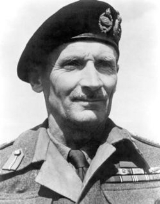
Field MarshalField Marshal is the highest military rank of the United Kingdom, a five-star rank. It ranks immediately above the rank of General and is the British Army equivalent to an Admiral of the Fleet and Marshal of the Royal Air Force....
Bernard Law Montgomery, 1st Viscount Montgomery of Alamein,
KGThe Most Noble Order of the Garter is an order of chivalry, or knighthood, originating in medieval England, and presently bestowed on recipients in the United Kingdom and other Commonwealth realms; it is the pinnacle of the honours system in the United Kingdom...
,
GCBThe Most Honourable Order of the Bath is a British order of chivalry founded by George I on 18 May 1725. The name derives from the medieval ceremony for creating a knight, which involved bathing as one of its elements. The knights so created were known as Knights of the Bath...
,
DSOThe Distinguished Service Order is a military decoration of the United Kingdom, and formerly of other Commonwealth countries, awarded for meritorious or distinguished service by officers of the armed forces during wartime, typically in actual combat.The DSO was instituted on 6 September 1886 by...
, PC , often referred to as "Monty", was an
Anglo-IrishAnglo-Irish was a term used historically to describe a privileged social class in Ireland, whose members were the descendants and successors of the Protestant Ascendancy, mostly belonging to the Anglican Church of Ireland, which was the established church of Ireland until 1871, or to a lesser...
British ArmyThe British Army is the land armed forces branch of the British Armed Forces. It came into being with the unification of the Kingdoms of England and Scotland into the Kingdom of Great Britain in 1707. The new British Army incorporated Regiments that had already existed in England and Scotland and...
officer. He successfully commanded Allied forces at the
Battle of El AlameinThe Second Battle of El Alamein marked a major turning point in the Western Desert Campaign of World War II. The battle lasted from 23 October to 5 November 1942. The First Battle of El Alamein had stalled the Axis advance...
, a major turning point in the
Western Desert CampaignThe Western Desert Campaign, also known as the Desert War was the initial stage of the North African Campaign of The Second World War.-Background:From the start, the Western Desert Campaign was a continuous back-and-forth struggle...
during
World War IIWorld War II, or the Second World War , was a global military conflict which involved a majority of the world's nations, including all great powers, organized into two opposing military alliances: the Allies and the Axis...
, and troops under his command played a major role in the expulsion of
AxisThe Axis powers comprised the countries that were opposed to the Allies during World War II. The three major Axis powers—Germany, Italy, and Japan—were part of a military alliance on the signing of the Tripartite Pact in September 1940, which officially founded the Axis powers...
forces from North Africa. He was later a prominent commander in
ItalyItaly , officially the Italian Republic , is a country located on the Italian Peninsula in Southern Europe and on the two largest islands in the Mediterranean Sea, Sicily and Sardinia. Italy shares its northern, Alpine boundary with France, Switzerland, Austria and Slovenia...
and North-West Europe, where he was in command of all Allied ground forces during
Operation OverlordOperation Overlord was the code name for the invasion of western Europe during World War II by Allied forces. The operation began on 6 June 1944 with the Normandy Landings when an airborne assault preceded an amphibious assault...
until after the Battle of Normandy.
Early life
Montgomery was born in
KenningtonKennington is an area of South London, England, in the London Borough of Lambeth. It is a mixed class residential area, and is the location of the The Oval, the well-known cricket stadium....
,
London[]London is the capital of England and the United Kingdom. It has been a major settlement for two millennia, and the history of London goes back to its founding by the Romans, when it was named Londinium. London's core, the ancient City of London, the 'square mile', retains its medieval boundaries...
in 1887, the fourth child of nine, to an
Anglo-IrishAnglo-Irish was a term used historically to describe a privileged social class in Ireland, whose members were the descendants and successors of the Protestant Ascendancy, mostly belonging to the Anglican Church of Ireland, which was the established church of Ireland until 1871, or to a lesser...
AnglicanAnglicanism is a tradition within Christianity comprising churches with historical connections to the Church of England or similar beliefs, worship and church structures...
priestA priest or priestess is a person having the authority or power to administer religious rites; in particular, rites of sacrifice to, and propitiation of, a deity or deities. Their office or position is the priesthood, a term which may also apply to such persons collectively.Priests and priestesses...
, the Reverend
Henry Hutchinson MontgomeryHenry Hutchinson Montgomery KCMG was an Anglican bishop and author in the last part of the 19th century and the very start of the 20th....
and Maud Montgomery (née Farrar). Henry Montgomery, at the time the
VicarIn the broadest sense, a vicar is a representative, anyone acting "in the person of" or agent for a superior . In this sense, the title is comparable to lieutenant, literally the "place-holder"...
of St Mark's, Kennington, was the second son of the noted Indian administrator, Sir Robert Montgomery, who died a month after Bernard's birth. Bernard's mother Maud was the daughter of the well-known preacher
Frederic William FarrarFrederic William Farrar , often known as Dean Farrar, was a theological writer.Farrar was born in Bombay, India and educated at King William's College in the Isle of Man, King's College London and Trinity College, Cambridge. At Cambridge he won the Chancellor's Gold Medal for poetry in 1852...
, and was eighteen years younger than her husband. After the death of Robert Montgomery, Henry inherited the Montgomery ancestral estate of New Park at
MovilleMoville is a town in County Donegal close to the northern tip of Ireland.-Location:The town enjoys a scenic location on the western shore of Lough Foyle, about 30 km from Derry, which lies across the border in Northern Ireland...
,
County DonegalCounty Donegal is one of the traditional counties of Ireland. It is located within the Province of Ulster and is part of the Republic of Ireland. It was named after the town of Donegal ....
.
However, there was still £13,000 to pay on the
mortgageA mortgage is the transfer of an interest in property to a lender as a security for a debt - usually a loan of money. While a mortgage in itself is not a debt, it is the lender's security for a debt...
, a large amount of money in the 1880s, and Henry was at the time still only a parish priest. Despite selling off farms at Ballynally,
"there was barely enough to keep up New Park and pay for the summer holiday" (i.e., at New Park). It was a financial relief that in 1889 Henry was made
BishopA bishop is an ordained or consecrated member of the Christian clergy who is generally entrusted with a position of authority and oversight. Within the Roman Catholic, Eastern Orthodox, Oriental Orthodox Churches, in the Assyrian Church of the East, in the Independent Catholic Churches, and in the...
of
TasmaniaTasmania is an Australian island and state. It is located south of the eastern side of the continent, from which it is separated by Bass Strait. The state includes the island of Tasmania – the 26th largest island in the world – and the surrounding islands. The state has a population of 500,000 ,...
, then still a colony. He considered it his duty to spend as much time as possible in the outlying country of Tasmania and was away six months at a time. While he was away his wife, still in her mid twenties gave her children "constant" beatings, then ignored them most of the time as she performed the public duties of the bishop's wife. Of his siblings, Sibyl would die prematurely in Tasmania, and Harold, Donald and Una would all emigrate. In the absence of her husband, Maud Montgomery took little active interest in the education of her young children other than to have them taught by tutors brought across from England. The loveless environment made Bernard something of a bully, as he himself later recalled
"I was a dreadful little boy. I don't suppose anybody would put up with my sort of behaviour these days."
Later in life Montgomery refused to allow his son David to have anything to do with his grandmother and he refused to attend her funeral in 1949.
The family returned home once for the Lambeth Conference in 1897, and Bernard and his brother Harold were educated for a term at
The King's School, CanterburyThe King's School is an British independent school situated in Canterbury, Kent. It is a member of the Headmasters' and Headmistresses' Conference and the Eton Group. The school is co-educational and has boarding and day pupils.-History:...
. In 1901, Bishop Montgomery became secretary of the Society for the Propagation of the Gospel, and the family returned to London. Montgomery went to St Paul's School and then the Royal Military Academy, Sandhurst, from which he was almost expelled for setting fire to a fellow cadet during a fight with pokers. He joined the 1st Battalion,
The Royal Warwickshire RegimentThe Royal Warwickshire Fusiliers, previously titled the 6th Regiment of Foot and The Royal Warwickshire Regiment, was an infantry regiment of the British Army.-History:...
in 1908, first seeing service in
IndiaThe British Raj was the British colonial rule in the Indian subcontinent between 1858 and 1947; it can also refer to the period of dominion, and even the region under the rule...
until 1913.
First World War
The First World War began in August 1914 and Montgomery moved to France with his regiment that month. He saw service during the retreat from
MonsThe Battle of Mons was the first major action of the British Expeditionary Force in World War I.-Prelude:Following the surrender of the Liège forts by the Belgian Army on 16 August 1914, the Germans continued advancing towards Paris in accordance with the Schlieffen Plan...
, during which half his battalion was destroyed. At
Méteren Méteren is a commune in the Nord department in northern France.-References:*...
, near the Belgian border at
BailleulBailleul is a commune in the Nord department in northern France.It is located in French Flanders near Lille.-Media:Bailleul is the birthplace of French filmmaker Bruno Dumont and served as the setting for his first two feature films...
on 13 October 1914, during an Allied counter-offensive, he was shot through the right
lungThe lung or pulmonary system is the essential respiration organ in air-breathing animals, including most tetrapods, a few fish and a few snails. In mammals and the more complex life forms, the two lungs are located in the chest on either side of the heart...
by a sniper and was injured seriously enough for his grave to be dug in preparation for his death. A
PlatoonA platoon is a military unit typically composed of two to four sections or squads and containing about 30 to 50 soldiers. Platoons are organised into a company, which typically consists of three, four or five platoons. A platoon is typically the smallest military unit led by a commissioned officer...
sergeantSergeant is a rank used in some form by most militaries, police forces, and other uniformed organizations around the world. Its origins are the Latin serviens, "one who serves", through the French term Sergent....
came to assist him but was killed. He fell on Montgomery. The German sniper fired at him until
sun setThe Sun Set is a box set of various Klaatu rarities, outtakes, demos, and other recordings. It was launched at the "KlaatuKon" convention in Toronto, Canada, receiving high praise from Klaatu fans around the world....
. The body of the sergeant protected Montgomery and took most of the enemy fire. Montgomery was hit once more though, in the knee. He was awarded the
Distinguished Service OrderThe Distinguished Service Order is a military decoration of the United Kingdom, and formerly of other Commonwealth countries, awarded for meritorious or distinguished service by officers of the armed forces during wartime, typically in actual combat.The DSO was instituted on 6 September 1886 by...
for gallant leadership.
After recovering in early 1915, he was appointed to be brigade-major training
Kitchener's New ArmyThe New Army, often referred to as Kitchener's Army or, disparagingly, Kitchener's Mob , was an all-volunteer army formed in the United Kingdom following the outbreak of hostilities in World War I...
and returned to the Western Front in early 1916 as an operations staff officer during the battles of
the SommeOn the Western Front, French forces under General Joseph Joffre had born the brunt of the 1914 German offensive into Belgium and France, only managing to halt the wheeling advance well inside French territory...
,
Arras• United Kingdom
• Canada
• Australia
• New Zealand
• |combatant2= German Empire
• Prussia
• Bavaria|combatant3=|commander1= Douglas Haig,
Edmund Allenby,
Hubert Gough,
Henry Horne...
, and Passchendaele. During this time he came under IX Corps, part of General Sir Herbert Plumer's Second Army. Through his training, rehearsal, and integration of the infantry with artillery and engineers, the troops of Plumer's Second Army were able to achieve their objectives efficiently and without unnecessary casualties.
Montgomery served at the battles of
the Lys| style="float: right; clear: right; background-color: transparent"|The Battle of the Lys was part of the 1918 German offensive in Flanders during the World War I , originally planned by...
and
Chemin-des-DamesThe Third Battle of the Aisne was a battle of the German Spring Offensive during World War I that focused on capturing the Chemin des Dames Ridge before the American Expeditionary Force could arrive in France...
before finishing the war as General Staff Officer 1 and effectively chief of staff of the 47th (2nd London) Division, with the temporary rank of lieutenant-colonel. A photograph from October 1918 shows the then unknown Lt.-Col. Montgomery standing in front of
Winston ChurchillSir Winston Leonard Spencer Churchill KG, OM, CH, TD, FRS, PC was a British politician known chiefly for his leadership of the United Kingdom during World War II. He served as Prime Minister from 1940 to 1945 and again from 1951 to 1955. A noted statesman and orator, Churchill was also an officer...
(Minister of Munitions) at the victory parade at Lille.
Between the wars
After the First World War Montgomery commanded a battalion in the
British Army of the RhineThere have been two formations named British Army of the Rhine . Both were originally occupation forces in Germany, one after World War I, and the other after World War II....
, before reverting to his substantive rank of captain. He wrote up his experiences in a series of training pamphlets and manuals. He then attended the army's
Staff College, Camberley-Origins:In 1799 Colonel John Gaspard Le Marchant, 7th Hussars, submitted a proposal to the Commander-in-Chief of the British Army for a Royal Military College in three departments...
, before being appointed
Brigade MajorIn the British Army, a Brigade Major was the Chief of Staff of a brigade, the title is no longer used except in the Household Division. In 1913 Staff Captains of Artillery in the British Army were re-styled as Brigade Majors to bring them into line with Cavalry and Infantry practice...
in the 17th Infantry Brigade at the end of 1920. The brigade was stationed in
County CorkCounty Cork is one of the traditional counties of Ireland. It is located within the province of Munster, and was named after the city of Cork...
during the
Irish War of IndependenceThe Irish War of Independence was a guerrilla war mounted against the British government in Ireland by the Irish Republican Army . It began in January 1919, following the Irish Republic's declaration of independence, and ended with a truce in July 1921...
. A cousin of Montgomery's, Lt Col.
Hugh MontgomeryLieutenant Colonel Hugh Ferguson Montgomery CMG, DSO was a British first-class cricketer and Royal Marine Light Infantry officer....
, had been assassinated by the IRA in 1920 (see the
Cairo GangThe Cairo Gang was a group of British Intelligence agents who were sent to Dublin during the Anglo-Irish War to conduct intelligence operations against prominent members of the Irish Republican Army...
). IRA officer
Tom BarryThomas Barry was one of the most prominent guerrilla leaders in the Irish Republican Army during the Irish War of Independence.-Early life:...
said that he "behaved with great correctness". Montgomery came to the conclusion that the conflict could not be won without harsh measures, and that self-government was the only feasible solution; in 1923, after the establishment of the
Irish Free StateThe Irish Free State was the state established as a Dominion on 6 December 1922 under the Anglo-Irish Treaty, signed by the British government and Irish representatives exactly twelve months beforehand....
and during the
Irish Civil WarThe Irish Civil War was a conflict that accompanied the establishment of the Irish Free State as an entity independent from the United Kingdom within the British Empire....
, Montgomery wrote to
PercivalLieutenant General Arthur Ernest Percival CB, DSO and Bar, OBE, MC, OStJ, DL, was a British Army officer and World War I veteran...
of the Essex Regiment: "Personally, my whole attention was given to defeating the rebels but it never bothered me a bit how many houses were burnt. I think I regarded all civilians as 'Shinners' and I never had any dealings with any of them. My own view is that to win a war of this sort, you must be ruthless.
Oliver CromwellOliver Cromwell was an English military and political leader best known for his involvement in making England into a republican Commonwealth and for his later role as Lord Protector of England, Scotland, and Ireland.He was one of the commanders of the New Model Army which defeated the royalists in...
, or the Germans, would have settled it in a very short time. Nowadays public opinion precludes such methods, the nation would never allow it, and the politicians would lose their jobs if they sanctioned it. That being so, I consider that Lloyd George was right in what he did, if we had gone on we could probably have squashed the rebellion as a temporary measure, but it would have broken out again like an ulcer the moment we removed the troops. I think the rebels would probably [have] refused battles, and hidden their arms etc. until we had gone."
In 1923, Montgomery was posted to the Territorial
49th DivisionThis military division was formed on April 1, 1908 as the West Riding Division in the Territorial Force of the British Army.- First World War :In 1915, it was designated the 49th Division and given the White Rose of York as its insignia...
, eschewing the usual amounts of drill for tactical training. He returned to the 1st Royal Warwickshires in 1925 as a company commander and captain, before becoming an instructor at the
Staff College, Camberley-Origins:In 1799 Colonel John Gaspard Le Marchant, 7th Hussars, submitted a proposal to the Commander-in-Chief of the British Army for a Royal Military College in three departments...
and a major (
brevetIn many of the world's military establishments, brevet referred to a warrant authorizing a commissioned officer to hold a higher rank temporarily, but usually without receiving the pay of that higher rank. An officer so promoted may be referred to as being brevetted...
lieutenant-colonel).
In 1927, he met and married
Elizabeth CarverElizabeth Carver, born Elizabeth Hobart was the wife of Bernard Montgomery, who later became Field Marshal Bernard Law Montgomery, 1st Viscount Montgomery of Alamein.-Early life and marriage:...
, widow of
Oswald CarverOswald Armitage Carver was a British rower who competed in the 1908 Summer Olympics and died of injuries at Gallipoli....
, Olympic rowing medalist who was killed in the First World War. Their son,
DavidDavid Bernard Montgomery, 2nd Viscount Montgomery of Alamein CMG, CBE is a British politician, businessman, and promoter of good relations with South America. He is the son of the famous World War II field marshal, Bernard Law Montgomery....
, was born in August 1928. Elizabeth Carver was the sister of
WWIIWorld War II, or the Second World War , was a global military conflict which involved a majority of the world's nations, including all great powers, organized into two opposing military alliances: the Allies and the Axis...
commander
Percy HobartMajor-General Sir Percy Cleghorn Stanley Hobart KBE CB DSO MC , also known as "Hobo", was a British military engineer, noted for his command of the 79th Armoured Division during World War II...
.
Montgomery became lieutenant-colonel of the 1st Battalion of The Royal Warwickshire Regiment in 1931, and saw service in Palestine,
EgyptEgypt , officially the Arab Republic of Egypt, is a country mainly in North Africa, with the Sinai Peninsula forming a land bridge in Western Asia...
, and
IndiaIndia, officially the Republic of India , is a country in South Asia. It is the seventh-largest country by geographical area, the second-most populous country, and the most populous democracy in the world. Bounded by the Indian Ocean on the south, the Arabian Sea on the west, and the Bay of Bengal...
. He was promoted to full colonel and became an instructor at the
Indian ArmyThe Indian Army , now sometimes called the British Indian Army to distinguish it from the modern army of the Republic of India, was the principal army of the British Raj in India during the last half-century before the partition of India in 1947.The Indian Army served both in India and,...
Staff CollegeThe Command and Staff College was established in 1907 at Quetta, Balochistan, India, now in Pakistan, and is the oldest and the most prestigious institution of the Pakistan Army. It was established in 1905 in Deolali and moved to its present location at Quetta in 1907 under the name of Quetta Cadet...
in
Quetta) is the largest city and the provincial capital of the Balochistan Province of Pakistan. It is known as the "Fruit Garden of Pakistan", due to its diversity in plant and animals wildlife. The city has been a major stronghold along the western frontier of the country. It is situated at an average...
,
IndiaIndia, officially the Republic of India , is a country in South Asia. It is the seventh-largest country by geographical area, the second-most populous country, and the most populous democracy in the world. Bounded by the Indian Ocean on the south, the Arabian Sea on the west, and the Bay of Bengal...
. As was usual, Montgomery maintained links with the Royal Warwickshires, taking up the honorary position of Colonel-of-the-Regiment in 1947. Montgomery stirred up the resentment of his superiors for his arrogance and dictatorial ways, and also for his disregard of convention when it obstructed military effectiveness. For example, he set up a battalion
brothelA brothel, also known as a bordello, cathouse, whorehouse, sporting house and various other euphemisms, is an establishment specifically dedicated to prostitution, providing the prostitutes a place to meet and to have sexual intercourse with clients.-Legality:Today, brothels are illegal in the vast...
in
TripoliTripoli is the largest and capital city of Libya.Tripoli has a population of 1.69 million...
,
LibyaLibya , officially the Great Socialist People's Libyan Arab Jamahiriya , is a country located in North Africa...
during World War II, regularly inspected by the medical officer, for the 'horizontal refreshment' of his soldiers rather than forcing them to take chances in unregulated establishments. He was quoted as saying that his men "deserved it".
He became commanding officer of the 9th Infantry Brigade in 1937, with the rank of
brigadierBrigadier is a military rank, the meaning of which has a considerable variation.-Officer rank:In many countries, especially those formerly part of the former British Empire, a Brigadier is either the highest field rank or most junior General appointment, nominally commanding a brigade...
, but that year also saw tragedy for him; his wife was bitten by an insect while on holiday in
Burnham-on-SeaBurnham-on-Sea is a town in Somerset, England, at the mouth of the River Parrett and Bridgwater Bay. Burnham remained a small village until the late 18th century, but is now a popular seaside resort. It forms part of the parish of Burnham-on-Sea and Highbridge...
. The bite became infected, and his wife died in his arms from septicaemia following an
amputationAmputation is the removal of a body extremity by trauma or surgery. As a surgical measure, it is used to control pain or a disease process in the affected limb, such as malignancy or gangrene. In some cases, it is carried out on individuals as a preventative surgery for such problems...
. The loss devastated Montgomery, but he insisted on throwing himself back into his work immediately after the funeral. In 1938, he organised an amphibious combined operations landing exercise that impressed the new
commander-in-chiefA commander-in-chief is the commander of a nation's military forces or significant element of those forces. In the latter case, the force element may be defined as those forces within a particular region or those forces which are associated by function. As a practical term it refers to the...
,
Southern CommandSouthern Command can refer to a number of military commands:*Southern Command *Southern Command *Southern Command *Southern Command *United States Southern Command*Southern Command ...
, General
WavellField Marshal Archibald Percival Wavell, 1st Earl Wavell GCB, GCSI, GCIE, CMG, MC, PC was a British field marshal and the commander of British Army forces in the Middle East during World War II. He led British forces to victory over the Italians, only to be defeated by the German army...
. He was promoted to major-general and took command of the 8th Infantry Division in Palestine. There he quashed an Arab revolt before returning in July 1939 to Britain, suffering a serious illness on the way, to command the
3rd (Iron) Infantry DivisionThe British 3rd Infantry Division, known at various times as the Iron Division, 3rd Division or as Iron Sides, was originally formed in 1809 by Arthur Wellesley, 1st Duke of Wellington for service in the Peninsular War, and was known as the "Fighting 3rd" under Sir Thomas Picton during the...
. On hearing of the rebel defeat in April 1939, Montgomery said,
"I shall be sorry to leave Palestine in many ways, as I have enjoyed the war out here".
Second World War
Britain declared war on
GermanyGermany , officially the Federal Republic of Germany , is a country in Central Europe. It is bordered to the north by the North Sea, Denmark, and the Baltic Sea; to the east by Poland and the Czech Republic; to the south by Austria and Switzerland; and to the west by France, Luxembourg, Belgium,...
on 3 September 1939. The 3rd Division was deployed to Belgium as part of the
British Expeditionary ForceThe British Expeditionary Force was the name given to the British Forces in Europe from 1939–1940 during The Second World War.-History:...
(BEF). Montgomery predicted a disaster similar to that in 1914, and so spent the
Phony WarThe Phoney War, also called the Twilight War by Winston Churchill, der Sitzkrieg in German , the Bore War and la drôle de guerre was a phase in early World War II – in the months following the German invasion of Poland in September 1939 and preceding the Battle of...
training his troops for tactical retreat rather than offensive operations. During this time, Montgomery faced serious trouble from his superiors for his attitude regarding the sexual health of his soldiers. He outraged the clergy by stating openly in a memo that in his opinion
"when a man wanted a woman, he should have one". However, he was defended from dismissal by his superior
Alan BrookeField Marshal Alan Francis Brooke, 1st Viscount Alanbrooke KG, GCB, OM, GCVO, DSO & Bar was a senior commander in the British Army. He was the Chief of the Imperial General Staff during the Second World War, and was promoted Field Marshal in 1944...
, commander of
II CorpsII Corps was an army corps of the British Army formed in both the First World War and the Second World War. There had also been a short-lived II Corps during the Waterloo Campaign.-Napoleonic precursor:...
. Montgomery's training paid off when the Germans began their invasion of the
Low CountriesThe Low Countries, the historical region of de Nederlanden, are the countries on low-lying land around the delta of the Rhine, Scheldt, and Meuse rivers...
on 10 May 1940 and the 3rd Division advanced to the River
DijleDyle or Dijle is a river in central Belgium, left tributary of the Rupel. It is 86 km long. It flows through the Belgian provinces Walloon Brabant, Flemish Brabant and Antwerp. Its source is in Houtain-le-Val, near Nivelles....
and then withdrew to Dunkirk with great professionalism, returning to Britain intact with minimal casualties. During
Operation DynamoThe Dunkirk evacuation, codenamed Operation Dynamo by the British, was the evacuation of Allied soldiers from the beaches and harbour of Dunkirk, France, between 26 May and 4 June 1940, when British, French, and Canadian troops were cut off by the German army during the Battle of Dunkirk in the...
—the evacuation of 330,000 BEF and French troops to Britain—Montgomery had assumed command of the
II CorpsII Corps was an army corps of the British Army formed in both the First World War and the Second World War. There had also been a short-lived II Corps during the Waterloo Campaign.-Napoleonic precursor:...
after
Alan BrookeField Marshal Alan Francis Brooke, 1st Viscount Alanbrooke KG, GCB, OM, GCVO, DSO & Bar was a senior commander in the British Army. He was the Chief of the Imperial General Staff during the Second World War, and was promoted Field Marshal in 1944...
had taken acting command of the whole BEF.
On his return Montgomery antagonised the
War OfficeThe War Office was a department of the British Government, responsible for the administration of the British Army between the 17th century and 1963, when its functions were transferred to the Ministry of Defence...
with trenchant criticisms of the command of the BEF and was briefly relegated to divisional command. He was however made a Companion of the Order of the Bath. In July 1940, he was promoted to acting lieutenant-general, placed in command of
V CorpsV Corps was an army corps of the British Army in both World War I and World War II. The first formation of V Corps was during World War I as part of the Third Army and was composed of the 17th Division and the 38th Division as its major units...
and started a long-running feud with the new commander-in-chief, Southern Command,
Claude AuchinleckField Marshal Sir Claude John Eyre Auchinleck, GCB, GCIE, CSI, DSO, OBE , nicknamed The Auk, was a British army commander during World War II...
. In April 1941, he became commander of
XII CorpsXII Corps was an army corps of the British Army in World War I and World War II. In World War I it formed part of the British Salonika Force on the Macedonian front In World War II it formed part of Second Army during the Normandy and North-West Europe campaigns of 1944-45.-World War I:XII Corps...
and in December 1941 South-Eastern Command which he renamed the South-Eastern Army to promote offensive spirit. During this time he developed and rehearsed his ideas and trained his soldiers, culminating in
Exercise TigerExercise Tiger was the code name for two military exercises held in the United Kingdom during the Second World War:*The first, conducted in 1942, was an Army-level exercise by Commonwealth forces and the largest ever held in the UK up to then....
in May 1942, a combined forces
exerciseA military exercise is the employment of military resources in training for military operations, either exploring the effects of warfare or testing strategies without actual combat...
involving 100,000 troops.
Montgomery's early command
In 1942, a new field commander was required in the Middle East, where
AuchinleckField Marshal Sir Claude John Eyre Auchinleck, GCB, GCIE, CSI, DSO, OBE , nicknamed The Auk, was a British army commander during World War II...
was fulfilling both the role of commander-in-chief
Middle East CommandThe Middle East Command was a British Army Command established prior to the Second World War in Egypt. Its primary role was to command British land forces and co-ordinate with the relevant naval and air commands to defend British interests in the Middle East and eastern Mediterranean region.The...
and commander
Eighth ArmyThe Eighth Army was one of the best-known formations of the British Army during World War II, fighting in the North African and Italian campaigns....
. He had stabilised the Allied position at
El AlameinEl Alamein is a town in northern Egypt on the Mediterranean Sea coast in Matruh Governorate. It is west of Alexandria and northwest of Cairo...
, but after a visit in August 1942, the Prime Minister,
Winston ChurchillSir Winston Leonard Spencer Churchill KG, OM, CH, TD, FRS, PC was a British politician known chiefly for his leadership of the United Kingdom during World War II. He served as Prime Minister from 1940 to 1945 and again from 1951 to 1955. A noted statesman and orator, Churchill was also an officer...
, replaced him as C-in-C with
AlexanderField Marshal Harold Rupert Leofric George Alexander, 1st Earl Alexander of Tunis was a British military commander and field marshal of Anglo-Irish descent who served with distinction in both world wars, and between 1946 and 1952 served as the Governor General of Canada...
and
William GottLieutenant-General William Henry Ewart "Strafer" Gott CB, CBE, DSO and bar, MC was a British Army officer during both the First and Second World Wars, reaching the rank of lieutenant-general when serving in the British Eighth Army.An officer in the King's Royal Rifle Corps , Gott served with...
as commander of the Eighth Army in the
Western DesertThe Western Desert Campaign, also known as the Desert War was the initial stage of the North African Campaign of The Second World War.-Background:From the start, the Western Desert Campaign was a continuous back-and-forth struggle...
. After Gott was killed flying back to
CairoCairo is the capital of Egypt and the largest city in the Arab World. Nicknamed "The City of a Thousand Minarets" for its preponderance of Islamic architecture, Cairo has long been a center of the region's political and cultural life...
Churchill was persuaded by
Alan BrookeField Marshal Alan Francis Brooke, 1st Viscount Alanbrooke KG, GCB, OM, GCVO, DSO & Bar was a senior commander in the British Army. He was the Chief of the Imperial General Staff during the Second World War, and was promoted Field Marshal in 1944...
to appoint Montgomery, who had only just been nominated to command the British ground forces for
Operation TorchOperation Torch was the British-American invasion of French North Africa in World War II during the North African Campaign, started 8 November 1942....
.
A story, probably apocryphal but popular at the time, is that the appointment caused Montgomery to remark that "After having an easy war, things have now got much more difficult." A colleague is supposed to have told him to cheer up - at which point Montgomery is supposed to have said "I'm not talking about me, I'm talking about Rommel"
Montgomery's assumption of command transformed the fighting spirit and abilities of the Eighth Army. Taking command on 13 August 1942, he immediately became a whirlwind of activity. He ordered the creation of a mobile British armoured corps—similar to a German Panzer Corps—to reinforce the long front line at El Alamein, something that would take two months to accomplish. He asked his commander, Gen. Alexander, to send him two new British divisions (51st Highland and 44th) that were then arriving in Egypt and were scheduled to be deployed in defense of the Nile Delta. He moved his field HQ to a new location close to the Air Force command post in order to better coordinate combined operations. Montgomery was determined that the Army, Navy and Air Forces should fight their battles in a unified, focused manner according to a detailed plan. He ordered immediate reinforcement of the vital heights of Alam Halfa, just behind his own lines, expecting the German commander,
Erwin RommelErwin Johannes Eugen Rommel , was perhaps the most famous German Field Marshal of World War II....
, to attack with the heights as his objective, something that Rommel soon did. Montgomery ordered all contingency plans for retreat to be destroyed.
"I have cancelled the plan for withdrawal", he told his officers at the first meeting he held with them in the desert.
"If we are attacked, then there will be no retreat. If we cannot stay here alive, then we will stay here dead."
Montgomery made a great effort to appear before troops as often as possible, frequently visiting various units and making himself known to the men, often arranging for cigarettes to be distributed. Although he still wore a standard British officer's cap on arrival in the desert, he briefly wore an Australian broad-brimmed hat before switching to wearing the black beret (with the badge of the Royal Tank Regiment next to the British General Officer's badge) for which he became famous. The black beret had been offered to him by a soldier upon climbing into a tank to get a closer look at the front lines. Both Brooke and Alexander were astonished by the transformation in atmosphere when they visited on 19 August, less than a week after Montgomery had taken command.
First battles with Rommel
Rommel attempted to turn the left flank of the Eighth Army at the
Battle of Alam HalfaThe Battle of Alam el Halfa took place between August 30 and September 5, 1942 south of El Alamein during the Western Desert Campaign of World War II. Panzer Army Africa, a German-Italian force commanded by Erwin Rommel , attempted an envelopment of the British Eighth Army, commanded by Bernard...
from 31 August 1942. The German/Italian armoured infantry attack was stopped in very heavy fighting. Rommel's forces had to withdraw urgently lest their retreat through the British minefields be cut off. Montgomery was criticised for not counter-attacking the retreating forces immediately, but he felt strongly that his methodical build-up of British forces was not yet ready. A hasty counter-attack risked ruining his strategy for an offensive on his own terms in October, planning for which had begun soon after he took command.
The conquest of Libya was essential for airfields to support
MaltaMalta , officially the Republic of Malta , is a densely populated developed European country in the European Union. The Southern European island nation is an archipelago that includes the inhabited islands of Malta, Gozo and Comino, along with a number of smaller, uninhabited islands...
and to threaten the rear of Axis forces opposing
Operation TorchOperation Torch was the British-American invasion of French North Africa in World War II during the North African Campaign, started 8 November 1942....
. Montgomery prepared meticulously for the new offensive after convincing Churchill that the time was not being wasted. (Churchill sent a telegram to Alexander on 23 September 1942 which began, "We are in your hands and of course a victorious battle makes amends for much delay.) He was determined not to fight until he thought there had been sufficient preparation for a decisive victory, and put into action his beliefs with the gathering of resources, detailed planning, the training of troops—especially in night fighting—and in the use of over 300 of the latest American-built Sherman tanks, 90
M7 PriestThe 105 mm Howitzer Motor Carriage M7 was an American self-propelled artillery vehicle produced during World War II. It was given the official name Priest in British service, due to the pulpit-like machine gun ring and following on from the Bishop self propelled gun, the full designation when...
s, and making a personal visit to every unit involved in the offensive. By the time the offensive was ready in late October, Allied forces numbered nearly 200,000 men including British, Australian, South African, Indian, Greek and Free French units.
El Alamein
The
Battle of El AlameinThe Second Battle of El Alamein marked a major turning point in the Western Desert Campaign of World War II. The battle lasted from 23 October to 5 November 1942. The First Battle of El Alamein had stalled the Axis advance...
began on 23 October 1942, and ended twelve days later with the first large-scale, decisive Allied land victory of the war. Montgomery correctly predicted both the length of the battle and the number of casualties (13,500). He has been criticised for failing to capitalise immediately on his victory at El Alamein. However, soon after British armoured units and infantry broke through the German and Italian lines and were pursuing the enemy forces at speed along the coast road, a violent, unseasonable rainstorm burst over the region making rapid pursuit impossible, the tanks and support trucks bogged down in the desert mud. Montgomery had to call off the chase. Standing before his officers at headquarters, he was close to tears, but the Battle of El Alamein had been a great success. Over 30,000 prisoners were taken including the German second in command, General von Thoma (Rommel, who had been in a hospital in Germany at the start of the battle had been forced to return on 25 September 42 after his replacement as German commander, Stumme died of a heart attack in the early hours of the battle.), and eight other general officers.
Tunisia
Montgomery was
knightedThe Most Honourable Order of the Bath is a British order of chivalry founded by George I on 18 May 1725. The name derives from the medieval ceremony for creating a knight, which involved bathing as one of its elements. The knights so created were known as Knights of the Bath...
and promoted to full
generalGeneral is currently the highest peace-time rank in the British Army and Royal Marines. It is the equivalent of a 4 star rank, and is subordinate to the Army rank of Field Marshal and the Royal Marines rank of Captain General Royal Marines....
. The Eighth Army's subsequent advance as the Germans retreated hundreds of miles towards their bases in
TunisiaTunisia , officially the Tunisian Republic , is a country located in North Africa. It is bordered by Algeria to the west and Libya to the southeast. Tunisia is located southwest of the island of Sicily and south of Sardinia. Its size is almost 165,000 km² with an estimated population of just...
used the logistical and firepower advantages of the British Army while avoiding unnecessary risks. It also gave the Allies an indication that the tide of war had genuinely turned in North Africa. Montgomery kept the initiative, applying superior strength when it suited him, forcing Rommel out of each successive defensive position. On 6 March 1943, Rommel's attack on the over-extended Eighth Army at
MedenineMedenine is the major town in southeastern Tunisia, south of the Oasis town of Gabès and the Island of Djerba, on the main route to Libya. It is located at around...
(
Operation CapriOperation Capri was a Nazi German counter-attack at Medenine, Tunisia, intended to disrupt and delay the 8th Army's attack on the Mareth Line. The German attack started on 6 March 1943, failed to make much impression and was abandoned at dusk on the same day...
) with the largest concentration of German armour in North Africa was successfully repulsed. At the
Mareth LineThe Mareth Line was a system of fortifications built by the French between the towns of Medenine and Gabès in southern Tunisia, prior to World War II...
, 20 March to 27 March, when Montgomery encountered fiercer frontal opposition than he had anticipated, he switched his major effort into an outflanking inland pincer, backed by low-flying
RAFThe Royal Air Force is the United Kingdom's air force, the oldest independent air force in the world. Formed on 1 April 1918, the RAF has taken a significant role in British military history ever since, playing a large part in World War II and in more recent conflicts.The RAF operates almost 1,109...
fighter-bomber support.
This campaign demonstrated the battle-winning ingredients of morale (sickness and absenteeism were virtually eliminated in the Eighth Army), co-operation of all arms including the air forces, first-class logistical back-up and clear-cut orders. For his role in North Africa he was awarded the
Legion of MeritThe Legion of Merit is a military decoration of the United States armed forces that is awarded for exceptionally meritorious conduct in the performance of outstanding services and achievements. The decoration is issued both to United States military personnel and to military and political figures...
by the United States government in the rank of Chief Commander.
Sicily
The next major Allied attack was the
Allied invasion of SicilyThe Allied invasion of Sicily, codenamed Operation Husky, was a major World War II campaign, in which the Allies took Sicily from the Axis . It was a large scale amphibious and airborne operation, followed by six weeks of land combat. It launched the Italian Campaign.Husky began on the night of...
(Operation Husky). It was in Sicily that Montgomery's famous tensions with US commanders really began. Montgomery managed to recast plans for the Allied invasion, having Patton's Seventh US Army land in the Gulf of Gela (on the left flank of Eighth Army, which landed around Syracuse in the south-east of Sicily) rather than at Palermo in the west of Sicily as Patton had wished. Inter-Allied tensions grew as the American commanders
PattonGeorge Smith Patton, Jr. was a United States Army officer most famous for his leadership commanding corps and armies as a general in World War II...
and
BradleyGeneral of the Army Omar Nelson Bradley was one of the main U.S. Army field commanders in North Africa and Europe during World War II and a General of the Army in the United States Army...
(then commanding II US Corps under Patton), took umbrage at what they perceived as Montgomery's attitudes and boastfulness. They resented him, while accepting his skills as a general.
Italian Campaign
During the autumn of 1943, Montgomery continued to command Eighth Army during the
landings on the mainland of Italy itselfThe Allied invasion of Italy, was the Allied landing on mainland Italy on September 3, 1943, by General Harold Alexander's 15th Army Group during World War II. The operation followed the successful invasion of Sicily during the Italian Campaign...
. In conjunction with the Anglo-American landings at Salerno (near Naples) by
Mark ClarkMark Wayne Clark was an American general during World War II and the Korean War and was the youngest lieutenant general in the U.S. Army...
's Fifth Army and seaborne landings by British paratroops in the heel of Italy (including the key port of Taranto, where they disembarked without resistance directly into the port), Montgomery led Eighth Army up the toe of Italy. Some criticism was made of the slowness of Montgomery's advance. The Eighth Army, responsible for the eastern side of the Allied front, from the central
Apennine mountain spineThe Apennines or Apennine Mountains is a mountain range stretching c. 1,200 km from the north to the south of Italy along its east coast, traversing the entire peninsula, and forming the backbone of the country...
to the
Adriatic coastThe Adriatic Sea is a body of water separating the Italian Peninsula from the Balkan peninsula, and the system of the Apennine Mountains from that of the Dinaric Alps and adjacent ranges. The Adriatic Sea is a part of the Mediterranean Sea...
, fought a succession of engagements alternating between opposed crossings of the rivers running across their line of advance and attacks against the cleverly constructed defensive positions the Germans had fashioned on the ridges in between. Eighth Army crossed the Sangro river in mid-November and penetrated the German's strongest position at the Gustav Line but as the winter weather deteriorated the advance ground to a halt as transport bogged down and air support operations became impossible. Montgomery abhorred the lack of coordination, the dispersion of effort, and the strategic muddle and opportunism he perceived in the Allied effort in Italy and was glad to leave the "
dog's breakfast" on 23 December.
Normandy
Montgomery returned to Britain to take command of the
21st Army GroupThe 21st Army Group was a British headquarters formation comprising primarily of British and Canadian forces. The Army Group was an important Allied force in the European Theatre of World War II. It was established in London during July 1943 under the command of Supreme Headquarters Allied...
which consisted of all Allied ground forces that would take part in
Operation OverlordOperation Overlord was the code name for the invasion of western Europe during World War II by Allied forces. The operation began on 6 June 1944 with the Normandy Landings when an airborne assault preceded an amphibious assault...
, the invasion of
NormandyNormandy is a geographical region corresponding to the former Duchy of Normandy. It is situated along the English Channel coast of Northern France between Brittany and Picardy and comprises territory in northern France and the Channel Islands.Normandy is divided between French and British...
. Preliminary planning for the invasion had been taking place for two years, most recently by
COSSACSupreme Headquarters Allied Expeditionary Force , was the headquarters of the Commander of Allied forces in north west Europe, from late 1943 until the end of World War II. General Dwight D. Eisenhower was in command of SHAEF throughout its existence...
staff (Chief of Staff to the Supreme Allied Commander). Montgomery quickly concluded that the COSSAC plan was too limited, and strongly advocated expanding the plan from a three-division to a five-division assault. As with his takeover of the Eighth Army, Montgomery travelled frequently to his units, raising morale and ensuring training was progressing. At St Paul's School on 7 April and 15 May he presented his strategy for the invasion. He envisaged a ninety day battle, ending when all the forces reached the
SeineThe Seine is a slow-flowing major river and commercial waterway within the regions of Île-de-France and Haute-Normandie in France and famous as a romantic backdrop in photographs of Paris, France. It is also a tourist attraction, with excursion boats offering sightseeing tours of the Rive Droite...
, pivoting on an Allied-held
CaenCaen is a commune in north-western France. It is the prefecture of the Calvados department and the capital of the Basse-Normandie region...
, with British and Canadian armies forming a shoulder and the US armies wheeling on the right.
During the hard fought two and a half month Battle of Normandy that followed, the impact of a series of unfavourable autumnal weather conditions disrupted the Normandy landing areas and seriously hampered the tactical delivery of planned transportation of personnel and supplies which were being carried across the English Channel. Consequently, Montgomery argues in his literary account (WIP) that he was unable to follow his pre-battle plan precisely to the timescales planned outside of battle. It should be noted that the extension of the battle plan by one month was the cause of significant retrospective criticisms of Montgomery by some of his American peers, including the much respected Bradley and equally controversial Patton.
Montgomery's initial plan was, most likely, for an immediate breakout toward
CaenCaen is a commune in north-western France. It is the prefecture of the Calvados department and the capital of the Basse-Normandie region...
. Unable to do so, as the British did not get enough forces ashore to exploit the successful landing, Montgomery's advance was checked. When it appeared unlikely that the British Second Army would breakout, Montgomery's contingency was designed to attract German forces to the British sector to ease the passing of United States Army through German defences to the west, during
Operation CobraOperation Cobra was the codename for an offensive launched by the First United States Army eight weeks after the D-Day landings, during the Normandy Campaign of World War II...
. This series of battle plans by the British, Canadian and American armies trapped and defeated the German forces in Normandy in the
Falaise pocketThe battle of the Falaise Pocket, fought during the Second World War from 12–21 August 1944, was the decisive engagement of the Battle of Normandy...
. The campaign that Montgomery fought was essentially
attritionAttrition may refer to:*Physical wear*Loss of personnel by Withdrawal *Attrition , the loss of participants during an experiment*Attrition , the loss of tooth structure by mechanical forces from opposing teeth...
al until the middle of July with the occupation of the
Cotentin PeninsulaThe Cotentin Peninsula, also known as the Cherbourg Peninsula, is a peninsula in Normandy, forming part of the north-western coast of France...
and a series of offensives in the east, which secured Caen and attracted the bulk of German armour there. An American breakout was achieved with Operation Cobra and the encirclement of German forces in the
Falaise pocketThe battle of the Falaise Pocket, fought during the Second World War from 12–21 August 1944, was the decisive engagement of the Battle of Normandy...
at the cost of British sacrifice with the diversionary
Operation GoodwoodOperation Goodwood was an attack launched on 18 July 1944, during the Second World War, by the British army to the east of the city of Caen...
.
Advance to the Rhine
The increasing preponderance of American troops in the European theatre (from five out of ten divisions at D-Day to 72 out of 85 in 1945) made it a political impossibility for the Ground Forces Commander to be British. After the end of the Normandy campaign,
General EisenhowerDwight David "Ike" Eisenhower was a five-star general in the United States Army and the 34th President of the United States, from 1953 until 1961. During the Second World War, he served as Supreme Commander of the Allied forces in Europe, with responsibility for planning and supervising the...
himself took over Ground Forces Command while continuing as Supreme Commander, with Montgomery continuing to command the 21st Army Group, now consisting mainly of British and Canadian units. Montgomery bitterly resented this change, although it had been agreed before the D-Day invasion.
Winston ChurchillSir Winston Leonard Spencer Churchill KG, OM, CH, TD, FRS, PC was a British politician known chiefly for his leadership of the United Kingdom during World War II. He served as Prime Minister from 1940 to 1945 and again from 1951 to 1955. A noted statesman and orator, Churchill was also an officer...
had Montgomery promoted to
field marshalField Marshal is a military officer rank. Today, it is the highest rank in the armies in which it is used, one step above a general or colonel-general.-Usage and hierarchical position:...
by way of compensation.
Montgomery was able to persuade Eisenhower to adopt his strategy of a single thrust to the
RuhrThe Ruhr is an urban area in North Rhine-Westphalia, Germany. With 4435 km² and a population of some 5.3 million, it is the largest urban agglomeration in Germany...
with
Operation Market GardenOperation Market Garden was an Allied military operation, fought in the Netherlands and Germany in World War II...
in September 1944. It was uncharacteristic of Montgomery's battles: the offensive was strategically bold, but poorly planned. Montgomery either didn't receive or ignored
ULTRAUltra was the name used by the British for intelligence resulting from decryption of encrypted German radio communications in World War II. The term eventually became the standard designation in both Britain and the United States for all intelligence from high-level cryptanalytic sources...
intelligence which warned of the presence of German armoured units near the site of the attack. As a result, the operation ended in an unmitigated disaster with the destruction of the
British 1st Airborne DivisionThe 1st Airborne Division was a military formation that was raised and fought during World War II. It suffered terrible casualties throughout the operations it undertook, especially during the Battle of Arnhem, the operation which made the division famous for its defence of Arnhem Bridge...
at the
Battle of ArnhemThe Battle of Arnhem was a famous Second World War military engagement fought in and around the Dutch towns of Arnhem, Oosterbeek, Wolfheze, Driel and the surrounding countryside from the 17–26 September 1944....
and the loss of any hopes of invading Germany by the end of 1944. Montgomery's preoccupation with the push to the Ruhr had also distracted him from the essential task of clearing the
ScheldtThe Scheldt is a 350 km long river in northern France, western Belgium and the southwestern part of the Netherlands...
during the capture of
Antwerp||-||-||-||}Antwerp is a city and municipality in Belgium and the capital of the Antwerp province in Flanders, one of Belgium's three regions. Antwerp's total population is 472,071 and its total area is , giving a population density of 2,308 inhabitants per km²...
; and so, after Arnhem, Montgomery's group was instructed to concentrate on
doing thisThe Battle of the Scheldt was a series of military operations of the First Canadian Army, led by Lieutenant General Guy Simonds. The battle took place in northern Belgium and southwestern Netherlands during World War II from October 2, 1944 to November 8, 1944By September, 1944, it had become...
so that the port of
Antwerp||-||-||-||}Antwerp is a city and municipality in Belgium and the capital of the Antwerp province in Flanders, one of Belgium's three regions. Antwerp's total population is 472,071 and its total area is , giving a population density of 2,308 inhabitants per km²...
could be opened.
When the surprise attack on the Ardennes took place on 16 December 1944, starting the
Battle of the BulgeThe Ardennes Offensive was a major German offensive , launched towards the end of World War II through the forested Ardennes Mountains region of Belgium , France and Luxembourg on the Western Front...
, the front of the
U.S. 12th Army GroupThe Twelfth United States Army Group was the largest and most powerful American military formation ever to take to the field. It controlled the majority of American forces on the Western Front in 1944 and 1945...
was split, with the bulk of the
U.S. First ArmyThe First United States Army is a field army of the United States Army. It now serves a mobilization, readiness and training command.- Establishment and World War I :...
being on the northern shoulder of the German 'bulge'. The Army Group commander, General
Omar BradleyGeneral of the Army Omar Nelson Bradley was one of the main U.S. Army field commanders in North Africa and Europe during World War II and a General of the Army in the United States Army...
, was located south of the penetration at
LuxembourgLuxembourg , officially the Grand Duchy of Luxembourg , is a small, landlocked country in western Europe, bordered by Belgium, France, and Germany...
and command of the U.S. First Army became problematic. Montgomery was the nearest commander on the ground and on 20 December, Eisenhower (who was in
VersaillesVersailles , a city renowned for its château, the Palace of Versailles, was the de facto capital of the kingdom of France for over a century, from 1682 to 1789. It is now a wealthy suburb of Paris and remains an important administrative and judicial center...
) transferred
Courtney HodgesGeneral Courtney Hicks Hodges was an American military officer, most prominent for his role in World War II, in which he commanded the First United States Army in Northwest Europe.-Early life and military career:...
' U.S. First Army and
William SimpsonGeneral William Hood Simpson was a distinguished U.S. Army officer who commanded the U.S. Ninth Army in northern Europe, during World War II, among other roles....
's
U.S. Ninth ArmyThe Ninth United States Army was one of the main U.S. Army combat commands used during the campaign in Northwest Europe in 1944 and 1945. It was commanded from its inception by Lieutenant General William Simpson...
to his 21st Army Group, despite Bradley's vehement objections on national grounds. Montgomery grasped the situation quickly, visiting all divisional, corps, and army field commanders himself and instituting his 'Phantom' network of liaison officers. He grouped the
British XXX CorpsXXX Corps , was a British Army Corps during the Second World War.- North Africa Campaign :It played a major role in the Western Desert Campaign, where it was initially formed for the British armoured units in North Africa in preparation for Operation Crusader, the last British attempt to relieve...
as a strategic reserve behind the Meuse and reorganised the US defence of the northern shoulder, shortening and strengthening the line and ordering the evacuation of
St VithSt. Vith is a municipality located in the Belgian province of Liège, and in the German speaking community in Belgium. It was named after Saint Vitus....
. The German commander of the 5th Panzer Army,
Hasso von ManteuffelHasso-Eccard Freiherr von Manteuffel was a German soldier and liberal politician of the 20th century.He served in both world wars, and during World War II, he was a distinguished general...
said:
The operations of the American 1st Army had developed into a series of individual holding actions. Montgomery's contribution to restoring the situation was that he turned a series of isolated actions into a coherent battle fought according to a clear and definite plan. It was his refusal to engage in premature and piecemeal counter-attacks which enabled the Americans to gather their reserves and frustrate the German attempts to extend their breakthrough.

Eisenhower had then wanted Montgomery to go on the offensive on 1 January to meet Patton's army that had started advancing from the south on 19 December and in doing so, trap the Germans. However, Montgomery refused to commit infantry he considered underprepared into a snowstorm and for a strategically unimportant piece of land. He did not launch the attack until 3 January, by which point the German forces had been able to escape. A large part of American military opinion thought that he should not have held back, though it was characteristic of him to use drawn-out preparations for his attack. After the battle the U.S. First Army was restored to the 12th Army Group; the U.S. Ninth Army remained under 21st Army Group until it crossed the Rhine.
Montgomery's 21st Army Group advanced to the Rhine with operations
VeritableOperation Veritable was a Second World War pincer movement conducted by Field Marshal Bernard Montgomery's 21st Army Group to clear and occupy the land between the Rhine and Maas rivers. It took place between 8 February and 11 March, 1945. It was a part of General Dwight Eisenhower's "broad front"...
and
GrenadeDuring World War II, Operation Grenade was the plan for the U.S. Ninth Army to cross the Roer river in February 1945.On February 9 the U.S...
in February 1945. A meticulously-planned
Rhine crossingCommencing on the night of 23 March, 1945 during World War II, Operation Plunder was the crossing of the Rhine river at Rees, Wesel, and south of the Lippe River by the British Second Army, under Lieutenant-General Sir Miles Dempsey , and the U.S...
occurred on 24 March. While successful it was weeks after the Ameicans had unexpected captured the
Ludendorff BridgeThe Ludendorff Bridge was a railway bridge across the Rhine in Germany, connecting the villages of Remagen and Erpel between two ridge lines of hills flanking the river...
and crossed the river. Montgomery's river crossing was followed by the
encirclementThe Ruhr Pocket was a battle of encirclement that took place in late March and early April 1945, near the end of World War II, in the Ruhr Area of Germany. It was, for all intents and purposes, the final dagger in Nazi Germany's war effort, as more than 300,000 troops were taken prisoner.In March...
of the German
Army Group BArmy Group B was the name of three different German Army Groups that saw action during World War II.-Battle for France:The first was involved in the Western Campaign in 1940 in Belgium and the Netherlands which was to be aimed to conquer the Maas bridges after the German airborne actions in Rotterdam...
in the
RuhrThe Ruhr is a medium-size river in western Germany , a right tributary of the Rhine.-Description:The source of the Ruhr is at an elevation of approximately 2,200 feet , near the town of Winterberg in the mountainous Sauerland region, and it flows into the lower Rhine river at an elevation of only...
. Initially Montgomery's role was to guard the flank of the American advance. This was altered, however, to forestall any chance of a
Red ArmyThe Red Army The Red Army The Red Army was the Soviet government’s revolutionary militia beginning in the Russian Civil War of 1918-1922. It grew into the national army of the USSR. Since 1946, after the Second World War, it was called the Soviet Army.The 'Red...
advance into Denmark, and the 21st Army Group occupied
HamburgHamburg is the second-largest city in Germany and the sixth-largest city in the European Union...
and
RostockRostock is the largest city in the north German state Mecklenburg-Vorpommern. Rostock is located on the Warnow river; the quarter of Warnemünde 12 km north of the city centre lies directly on the coast of the Baltic Sea.-Geography:Rostock is located nearly centrally on...
and sealed off the
DanishDenmark is a Scandinavian country in Northern Europe and the senior member of the Kingdom of Denmark. It is the southernmost of the Nordic countries; southwest of Sweden and south of Norway, and it is bordered to the south by Germany. Denmark borders both the Baltic and the North Sea...
peninsula.
On 4 May 1945, on
Lüneburg HeathThe Lüneburg Heath is a large area of heath, geest and woodland in northeastern part of the state of Lower Saxony in northern Germany. It forms part of the hinterland for the cities of Hamburg, Hanover, and Bremen and is named after the town of Lüneburg. Most of the area is a nature reserve...
, Montgomery accepted the surrender of German forces in northern Germany, Denmark and the
NetherlandsThe Netherlands is a country in Northwestern Europe, constituting the major portion of the Kingdom of the Netherlands. It is a parliamentary democratic constitutional monarchy. The Netherlands borders the North Sea to the north and west, Belgium to the south, and Germany to the east...
. This was done plainly in a tent without any ceremony. In the same year he was awarded the
Order of the ElephantThe Order of the Elephant is the highest order of Denmark. A Danish religious confraternity called the Fellowship of the Mother of God with a badge of the Virgin Mary holding her Son within a crescent moon and surrounded with the rays of the sun, which hung from a collar of links in the form of...
, the highest order in Denmark. On 26 October 1945 he was made a
FreemanFreedom of the City is an honour bestowed by some municipalities in Australia, Canada, Ireland, France, Italy, New Zealand, South Africa, the United Kingdom, and Zimbabwe to esteemed members of its community or to organisations that have given the community heroic service; the term applies to two...
of
Huddersfield Huddersfield is a large market town within the Metropolitan Borough of Kirklees, in West Yorkshire, England, north of London, and south of Bradford, the nearest city.Huddersfield is near the confluence of the River Colne and the River Holme...
.
Later life
After the war, Montgomery was created 1st
Viscount Montgomery of AlameinViscount Montgomery of Alamein, of Hindhead in the County of Surrey, is a title in the Peerage of the United Kingdom. It was created in 1946 for the military commander Field Marshal Sir Bernard Montgomery, commemorating his crucial victory in the Second Battle of El Alamein in the Egyptian town of...
in 1946. He was
Chief of the Imperial General StaffChief of the Imperial General Staff was the title of the professional commander of the British Army from 1908 until 1964.From the Restoration of the monarchy in 1660, the Sovereign was able to wrest considerable control of the armed forces from Parliament with the appointment of a "General in...
from 1946 until 1948, but was largely a failure as it required strategic and political skills he did not possess. He clashed particularly with his old rival Arthur Tedder, who as Deputy Supreme Commander had intrigued for Montgomery's dismissal during the Battle of Normandy, and who was by now Chief of the Air Staff. When Montgomery's term of office expired, the Prime Minister
Clement AttleeClement Richard Attlee, 1st Earl Attlee, KG, OM, CH, PC, FRS was a British Labour politician who served as Prime Minister of the United Kingdom from 1945 to 1951, and as Leader of the Labour Party from 1935 to 1955...
appointed General (later Field-Marshal) William Slim as his successor; when Montgomery protested that he had already promised the job to his protegé General Crocker, a former corps commander from the 1944-5 campaign, Attlee is said to have given the memorable retort "Untell him".
Montgomery was then Chairman of the
Western European UnionThe Western European Union is a largely dormant intergovernmental defence and security organisation, established on the basis of the Treaty of Brussels of 1948, with the accession of West Germany and Italy in 1954. The WEU headquarters are in Brussels...
's commanders-in-chief committee. Volume 3 of Nigel Hamilton's
Life of Montgomery of Alamein gives a good account of the bickering between Montgomery and his land forces chief, a French general, which created splits through the Union headquarters. He was thus pleased to become Eisenhower's deputy in creating the North Atlantic Treaty Organisation's
EuropeanSupreme Headquarters Allied Powers Europe is the central command of NATO military forces. It is located at Casteau, north of the Belgian city of Mons...
forces in 1951. He was an effective inspector-general and mounted good exercises, but out of his depth politically, and his exacting manner and emphasis on efficiency created ill-feeling. He continued to serve under Eisenhower's successors,
Matthew RidgwayMatthew Bunker Ridgway was a United States Army General. He held several major commands and was most famous for resurrecting the United Nations war effort during the Korean War. Several historians have credited Ridgway for turning around the war in favor of the UN side...
and
Al GruentherAlfred Maximilian Gruenther was the youngest World War II Major General and after the war, as a four-star General, served as the Supreme Allied Commander in Europe from 1953 to 1956.-Biography:...
, until his retirement, aged 71, in 1958. His mother died in 1949; Montgomery did not attend the funeral, claiming he was
"too busy". He was chairman of the governing body of St John's School,
LeatherheadLeatherhead is a town in the County of Surrey, England, on the River Mole, part of Mole Valley district. It is thought to be of Saxon origin....
,
SurreySurrey is a county in the South East of England and is one of the Home Counties. The county borders Greater London, Kent, East Sussex, West Sussex, Hampshire, and Berkshire. The historic county town is Guildford...
from 1951 to 1966 and a generous supporter.
In 1953, the Hamilton Board of Education in
Hamilton, OntarioHamilton is a port city in the Canadian province of Ontario. Conceived by George Hamilton when he purchased the Durand farm shortly after the War of 1812, Hamilton has become the centre of a densely populated and industrialized region at the west end of Lake Ontario known as the Golden Horseshoe...
, Canada, wrote to Montgomery and asked permission to name a new school in the city's east end after him. Viscount Montgomery Elementary was billed as "the most modern school in North America" and the largest single-storey school in Hamilton, when the sod was turned on 14 March 1951. The school officially opened on 18 April 1953, with Montgomery in attendance among almost 10,000 well-wishers. At the opening, he gave the motto "Gardez Bien" from his own family's
coat of armsA coat of arms, more properly called an armorial achievement, armorial bearings or often just arms for short, in European tradition, is a design belonging to a particular person and used by them in a wide variety of ways. Historically, they were used by knights to identify them apart from enemy...
.
Montgomery referred to the school as his "beloved school" and visited on five separate occasions, the last being in 1960. On his last visit, he said to "his" students:
Let's make Viscount Montgomery School the best in Hamilton, the best in Ontario, the best in Canada. I don't associate myself with anything that is not good. It is up to you to see that everything about this school is good. It is up to the students to not only be their best in school but in their behaviour outside of Viscount. Education is not just something that will help you pass your exams and get you a job, it is to develop your brain to teach you to marshal facts and do things.
Before retirement, Montgomery's outspoken views on some subjects, such as race, were often officially suppressed. After retirement these outspoken views became public and his reputation suffered. He supported apartheid (although such views were more common in the 1960s than subsequently) and Chinese communism under
Mao ZedongMao Zedong was a Chinese revolutionary, political theorist and Communist leader. He led the People's Republic of China from its establishment in 1949 until his death in 1976...
, and spoke against the legalisation of
homosexualityHomosexuality is the romantic or sexual attraction or behavior among members of the same sex, situationally or as an enduring disposition. As a sexual orientation, homosexuality is considered to lie within the heterosexual-homosexual continuum of human sexuality, and refers to an individual’s...
in the
United KingdomThe United Kingdom of Great Britain and Northern Ireland is a sovereign state located off the northwestern coast of continental Europe. It is an island country, spanning an archipelago including Great Britain, the northeastern part of Ireland, and many small islands...
, arguing that the
Sexual Offences Act 1967The Sexual Offences Act 1967 is an Act of Parliament in the United Kingdom . It partially decriminalised homosexual acts in private between two men, both of whom must have attained the age of 21...
was a "
charter for buggery" and that "
this sort of thing may be tolerated by the French, but we're British — thank God." However, several of Montgomery's biographers, including Chalfont (who found something "disturbingly equivocal" in "his relations with boys and young men" ) and Nigel Hamilton (2002) have suggested that he may himself have been a repressed homosexual; in the late 1940s he conducted an affectionate friendship with a 12-year-old Swiss boy.
Montgomery's memoirs (1958) criticised many of his wartime comrades in harsh terms, including Eisenhower, whom he accused, among other things, of prolonging the war by a year through poor leadership—allegations which ended their friendship, not least as Eisenhower was still US President at the time. He was stripped of his honorary citizenship of
Montgomery, AlabamaMontgomery is the capital, second most populous city, and the fourth most populous metropolitan area in the Southern U.S. state of Alabama, and is the county seat of Montgomery County. It is located southeast of the center of the state, in the Gulf Coastal Plain. The city population was 201,568...
, and was challenged to a duel by an Italian officer. He was threatened with legal action by Field-Marshal Auchinleck for suggesting that Auchinleck had intended to retreat from the Alamein position if attacked again, and had to give a radio broadcast (20 November 1958) expressing his gratitude to Auchinleck for having stabilised the front at the First Battle of Alamein. The 1960 edition of his memoirs contains a publisher's note (opposite page 15) drawing attention to that broadcast, and stating that in the publisher's view the reader might assume from Montgomery's text that Auchinleck had been planning to retreat and pointing out that this was in fact not the case.
Montgomery was never raised to an earldom, although unlike his wartime contemporaries Harold Alexander, Louis Mountbatten and even Archibald Wavell, he had never been a Theatre Supreme Commander or held high political office. An official task he insisted on performing in his later years was bearing the
Sword of StateA sword of state is a sword, used as part of the regalia, symbolizing the power of a monarch to use the might of the state against its enemies, and their duty to preserve thus right and peace.It is known to be used in following monarchies:...
during the
State Opening of ParliamentIn the United Kingdom, the State Opening of Parliament is an annual event that marks the commencement of a session of the Parliament of the United Kingdom. It is held in the House of Lords Chamber, usually in November or December, or in a General Election year, when the new Parliament first assembles...
. His increasing frailty, however, raised concerns about his ability to stand for long periods while carrying the heavy weapon. Ultimately, those fears were borne out when he collapsed in mid-ceremony in 1968 and did not perform this function again. A favourite pastime of the British press during these years was to photograph Montgomery cashing his old age pension cheque at the local social security office. Due to his eminence, many assumed Montgomery was wealthy and did not need the money. In fact, he had always been a man of modest means and it caused him great anguish that many believed he was taking taxpayer money he did not need. Another blow was a break-in at his home. Despite making a televised appeal for the return of his possessions, the items were never recovered.
Death
Montgomery died in 1976 at his home Isington Mill,
IsingtonIsington is a hamlet in the East Hampshire district of Hampshire, England. It is 1.4 miles southwest of the village of Bentley, and 3.9 miles northeast of Alton, just south of the A31 road....
near
Alton, HampshireAlton is a small market town in Hampshire, England, to the southwest of Farnham. It had a population of 16,584 at the 1991 census, and is administered by East Hampshire district council. It also is home to Treloar College, the National Specialist college for Young Disabled People...
, aged 88. After a funeral ceremony at St George's Chapel, Windsor, he was interred in the Holy Cross Churchyard,
BinstedBinsted is a village and civil parish in the East Hampshire district of Hampshire, England. The village is about four miles east of Alton.The churchyard of the parish church, the Holy Cross, contains the grave of Bernard Law Montgomery, 1st Viscount Montgomery of Alamein who spent his retirement in...
.
Legacy
His portrait (by
Frank O. SalisburyFrancis Owen Salisbury was a Methodist artist from Harpenden in Hertfordshire who specialised in portraits, large canvases of historical and ceremonial events, stained glass and book illustration. In his heyday he made a fortune on both sides of the Atlantic and was known as “Britain’s Painter...
, 1945) hangs in the National Portrait Gallery.
A statue of Viscount Montgomery can be found outside the Defence Ministry in
WhitehallWhitehall is a road in Westminster in London, England. It is the main artery running north from Parliament Square, towards traditional Charing Cross, now at the southern end of Trafalgar Square and marked by the statue of Charles I, which is often regarded as the heart of London...
, alongside those of William Slim and
Alan BrookeField Marshal Alan Francis Brooke, 1st Viscount Alanbrooke KG, GCB, OM, GCVO, DSO & Bar was a senior commander in the British Army. He was the Chief of the Imperial General Staff during the Second World War, and was promoted Field Marshal in 1944...
. Another statue of Viscount Montgomery can be found in
BrusselsBrussels , officially the Brussels Region or Brussels-Capital Region , is the de facto capital city of the European Union and the largest urban area in Belgium...
,
BelgiumThe Kingdom of Belgium is a country in northwest Europe. It is a founding member of the European Union and hosts its headquarters, as well as those of other major international organizations, including NATO...
, watching a Montgomery Square.
Montgomery gave his name to the French
communeThe commune is the lowest level of administrative division in the French Republic. The French word commune appeared in the 12th century, from Medieval Latin communia, meaning a small gathering of people sharing a common life; from Latin communis, things held in common.French communes are roughly...
Colleville-MontgomeryColleville-Montgomery is a commune in the Calvados department in the Basse-Normandie region in northern France.-Monuments:* The Church...
, Normandy.
The
Imperial War MuseumThe Imperial War Museum is a British national museum organisation with branches at five locations in England, three of which are in London. The museum was founded during the First World War in 1917 and intended as a record of the war effort and sacrifice of Britain and her Empire...
holds a variety of material relating to Montgomery in its collections. These include Montgomery's
GrantThe Medium Tank M3 was an American tank used during World War II. In Britain the tank was called "General Lee", named after General Robert E. Lee, and its modified version built to British specification, with a new turret, was called "General Grant", named after General Ulysses S...
command tank (on display in the atrium at the Museum's London branch), his command caravans as used in North West Europe (on display at IWM Duxford), and his papers are held by the Museum's Department of Documents. The Museum maintains a permanent exhibition about Montgomery, entitled
Monty: Master of the Battlefield
Popular Culture
Prior to
D-DayD-Day is a term often used in military parlance to denote the day on which a combat attack or operation is to be initiated. "D-Day" often represents a variable, designating the day upon which some significant event will occur or has occurred; see Military designation of days and hours for similar...
, M.E. Clifton James, an actor who bore a resemblance to Montgomery, was used by the British Army to impersonate the field marshal. His book and the later movie,
I was Monty's DoubleI Was Monty's Double is a book by M. E. Clifton James, first published in London in 1954. It was made into a film in 1958, directed by John Guillermin, from a screenplay adapted by Bryan Forbes...
, recount this work.
Montgomery appears in the 1970 movie
PattonPatton is a biographical war film about U.S. General George S. Patton during World War II. It stars George C. Scott, Karl Malden, Michael Bates, and Karl Michael Vogler. It was directed by Franklin J. Schaffner from a script by Francis Ford Coppola and Edmund H...
as a rigid and unpleasant character whom the title's American general out maneuvers in Sicily. His service in France and Germany is never mentioned.
Character and controversy
In stark contrast to Fourteenth Army commander in East Asia, William Slim, Montgomery rarely if ever admitted to making a single mistake during the Second World War. Slim was far more candid about his own mistakes, even in his wartime memoirs, than Montgomery.
Often it was Montgomery's statements about battles, as much as his actual conduct of them, that formed the basis of controversy. In his career, Montgomery's orders to his subordinates were clear and complete, yet with his superiors his communications would be opaque and incomplete. In
NormandyNormandy is a geographical region corresponding to the former Duchy of Normandy. It is situated along the English Channel coast of Northern France between Brittany and Picardy and comprises territory in northern France and the Channel Islands.Normandy is divided between French and British...
, he gave the impression to Eisenhower and others that he was attempting a breakout, while playing down this possibility in his actual orders to his subordinates. For example, shortly before
Operation GoodwoodOperation Goodwood was an attack launched on 18 July 1944, during the Second World War, by the British army to the east of the city of Caen...
he removed Falaise as an objective, but did not forward these new orders to SHAEF. Throughout his career, he enraged his superiors and colleagues, partly because he would not allow convention to disrupt military effectiveness, partly because of a contempt for authority and an unwillingness to be in a situation where he was not in control, and partly because he could be quite a strange person.
Walter Bedell SmithGeneral Walter Bedell "Beetle" Smith GBE KCB was Dwight D. Eisenhower's Chief of Staff during Eisenhower's tenure at SHAEF and Director of the CIA from 1950 to 1953. He also served as U.S. Ambassador to the Soviet Union from 1946 to 1948.-Early career:Smith at age 16 enlisted in as a private in...
once said to him "
You may be great to serve under, difficult to serve alongside, but you sure are hell to serve over!". He also found it difficult to publicly admit his operations had not gone to plan, irrespective of whether they were ultimately successful (Normandy) or unsuccessful (Market Garden, where he claimed that it had been a 90% success).
In the United Kingdom, Montgomery is remembered particularly for his victorious campaign in North Africa, which, with the
Battle of StalingradThe Battle of Stalingrad was a battle of World War II between Nazi Germany and its allies and the Soviet Union for control of the city of Stalingrad in southwestern Russia. The battle took place between 17 July 1942 and 2 February 1943....
, was very much seen as the turning point of
World War IIWorld War II, or the Second World War , was a global military conflict which involved a majority of the world's nations, including all great powers, organized into two opposing military alliances: the Allies and the Axis...
. The different nature of the war for the
United StatesThe United States of America is a federal constitutional republic comprising fifty states and a federal district...
means that his reputation there is very much coloured by the controversies in the later stages of the war in Europe, especially around the
Battle of the BulgeThe Ardennes Offensive was a major German offensive , launched towards the end of World War II through the forested Ardennes Mountains region of Belgium , France and Luxembourg on the Western Front...
. At the end of 1944, there was tension between the Allies owing to a campaign by the British press for Eisenhower to appoint a deputy and for Montgomery to be made the overall Allied ground commander. Immediately after the Battle of the Bulge, on 7 January 1945, Montgomery held a press conference in which he downplayed the role of the American generals, especially Patton, in the Allied victory at the Battle of the Bulge and focused on his own generalship. Many of his comments were ill-judged, particularly his statement that when the situation "began to deteriorate", Eisenhower had placed him in command in the north, and they were inflammatory to Patton, implying that he needed to be rescued by Montgomery "
with a bang". In the press conference Montgomery said that he thought the counter-offensive had gone very well and did not explain his delayed attack on 3 January. According to Churchill, the attack from the south under Patton was steady but slow and involved heavy losses, and Montgomery claimed to be trying to avoid this situation. Montgomery also gave the impression that substantial British forces had been involved in the fighting that repelled the German attack (an impression explicitly corrected by Churchill in the House of Commons). A slanted version inserted by Germany within an Allied radio broadcast added to American resentment.
In a memo to Eisenhower, Montgomery proposed that he should again be made Commander Ground Forces and implicitly criticised recent conduct of the war while American confidence had been shaken and nerves were raw. Eisenhower, encouraged by the Deputy Supreme Commander, Air Marshal
TedderMarshal of the Royal Air Force Arthur William Tedder, 1st Baron Tedder, GCB was a senior British air force commander. During World War I, he was a pilot and squadron commander in the Royal Flying Corps and he went on to serve as a senior officer in the Royal Air Force during the inter-war years...
(another person with a long running feud with Montgomery), was on the point of dismissing Montgomery, when Bedell Smith and Montgomery's chief-of-staff, Major-General
Freddie de GuingandMajor-General Sir Francis Wilfred de Guingand KBE, CB, DSO , better known as Freddie de Guingand, was a British Army officer who served with Montgomery from El Alamein to the surrender of the Wehrmacht in the West...
, pointed that it would be both politically unwise and difficult to justify removing a general who had just won a battle, over generals who had come so close to losing one. De Guingand was able to convince Montgomery of the impact of his words (of which he was apparently unaware) and Montgomery wrote an apology to Eisenhower. The moment passed. Eisenhower commented in his memoirs: "
I doubt if Montgomery ever came to realise how resentful some American commanders were. They believed he had belittled them — and they were not slow to voice reciprocal scorn and contempt".
Alan Brooke said of Montgomery:
Assessment of Montgomery as a military commander
Any assessment of Montgomery is immediately entangled in his sometimes difficult, boastful personality, harshness towards those he felt did not measure up, and issues of Anglo-American national pride. Nevertheless this section attempts a balanced summing up of his general leadership from a military perspective. Was he primarily a ponderous set-piece general or was he indeed one of the most brilliant commanders of recent history, a true heir to
MarlboroughJohn Churchill, 1st Duke of Marlborough was a prominent English soldier and statesman whose career spanned the reigns of five monarchs throughout the late 17th and early 18th centuries...
, at least from the British perspective? The truth lies somewhere in between. It is helpful to analyse Montgomery's generalship by looking at some central aspects of his successes and failures.
As a trainer of men and mentor of subordinates
Montgomery deserves his due as an outstanding trainer of men. His record in Palestine, North Africa, Sicily and Northern Europe shows this. His meticulous preparation of his troops, ranging from the usual physical necessities, to painstaking explanation of his vision and plans down to relatively low levels, to well articulated exercises and drills, to his insistence that formations like divisions "should fight as divisions" (i.e. gain proficiency in "big picture" coordination and integration) show the mind and skill of a keen organiser. None of this is earth-shattering for any competent military commander (though many of his contemporaries, including many remembered better by history, showed great deficiencies in this regard), but Montgomery demonstrated a great level of proficiency and made it one of his special trademarks.
Montgomery was a keen advocate of physical fitness and hard training: in the desert he had all ranks from
brigadierBrigadier is a military rank, the meaning of which has a considerable variation.-Officer rank:In many countries, especially those formerly part of the former British Empire, a Brigadier is either the highest field rank or most junior General appointment, nominally commanding a brigade...
down doing daily physical training; any man, no matter what rank, was expected to be fit to fight, and if any officer could not keep up on daily runs, he was sent home—Montgomery once observed that if a middle-aged officer was going to have a heart attack, better for it to happen on a training run than in action. Montgomery was also a critic of
Battle DrillAn Infantry battle drill describes how platoons and squads apply fire and maneuver to commonly encountered situations. They require leaders to make decisions rapidly and to issue brief oral orders quickly....
Training, which he felt was a crutch used by unit commanders. His personal view, put into action during the
Phony WarThe Phoney War, also called the Twilight War by Winston Churchill, der Sitzkrieg in German , the Bore War and la drôle de guerre was a phase in early World War II – in the months following the German invasion of Poland in September 1939 and preceding the Battle of...
and afterwards, was that company and battalion training in the phases of war—relief in place, passage of obstacles, hasty attack, etc.—was ignored in favour of simple drilling at the section and platoon level.
Montgomery had a deep technical understanding of how the Army operated, at all levels from the infantry company to the Army Group. He helped to shape the Canadian army through assisting the formation of the fledgling
First Canadian ArmyThe First Canadian Army was the senior Canadian operational formation in Europe during the Second World War.The Army was formed in early 1942, replacing the existing unnumbered Canadian Corps, as the growing number of Canadian forces in the United Kingdom necessitated an expansion to two corps...
while they were under his command in South-Eastern Army. Montgomery personally visited most Canadian units, down to the battalion level, and assisted Canadian Army commander
Harry CrerarGeneral Henry Duncan Graham "Harry" Crerar CH, CB, DSO, KStJ, CD, PC was a Canadian general and the country's "leading field commander" in World War II.-Early years:...
in weeding out poor officers, giving direct criticism of battalion commanders, company commanders, and even regimental sergeants-major. Montgomery indirectly shaped the Canadian Army that saw action in Italy and NW Europe.
As a strategist and tactician
Montgomery's hallmark as a strategist was a detailed analysis of his enemy and development of a clear vision as to how that enemy was to be fought and defeated. Two words sum up the approach of the British commander: clarity and organisation. These were put into practice through careful preparation of what he termed a "master plan", to which all subsequent effort was to be subordinated. The "master plan" embodied the vision, and the strategic and tactical approaches that would be used. Montgomery held that, far from being rigid, the flexibility or "balance" was one of the keys to his overarching structure. Indeed, one recent scholar has described his approach as using "
massive set-piece battles, based on concentration of force, massed artillery fire power... and [the] integrated use of tactical air power", designed to pummel the enemy with alternate thrusts until they lost their own sense of "balance" and "cracks" began to form in their defences. Montgomery regarded the German Army as one of hard-core professionalism, and held that wishful thinking and foggy concepts against such an opponent was a recipe for dismal failure.
Montgomery sought changes along these lines in the plan for the
Allied invasion of SicilyThe Allied invasion of Sicily, codenamed Operation Husky, was a major World War II campaign, in which the Allies took Sicily from the Axis . It was a large scale amphibious and airborne operation, followed by six weeks of land combat. It launched the Italian Campaign.Husky began on the night of...
. His influence however was more limited and his own less-than-spectacular gains in the difficult terrain, were unfavourably compared by some to the thrusting mobility of US General George Patton—a foreshadowing of controversies to come. Operation Husky was a success, but the Germans were able to extract tens of thousands of troops from Sicily to fight elsewhere, indicating that Montgomery's concerns about concepts, planning and execution were not totally off the mark.
His approach can be seen in his insistence on recasting or adjusting the invasion plans of Normandy, generally strengthening initial shock forces and insisting on a clear vision and method of how subsequent battles were to be fought. The success of the D-Day landings owed a great debt to Montgomery's planning. After the war, Eisenhower and his chief of staff, Lieutenant-General
Walter Bedell SmithGeneral Walter Bedell "Beetle" Smith GBE KCB was Dwight D. Eisenhower's Chief of Staff during Eisenhower's tenure at SHAEF and Director of the CIA from 1950 to 1953. He also served as U.S. Ambassador to the Soviet Union from 1946 to 1948.-Early career:Smith at age 16 enlisted in as a private in...
told the American military correspondent, Drew Middleton that "
No one else could have got us across the Channel and into Normandy... Whatever they say about him, he got us there".
Montgomery felt his approach vindicated at the Second Battle of El Alamein. His strategic vision ushered in much needed clarity, and his defensive preparations (drawing in part on the prior work of his predecessor Auchinleck) also envisioned a decisive counterattack. During the most critical point of the battle his concept of "balance" or flexibility within the confines of a master plan held, and the British were able to shift forces to see off Rommel's thrust, and mount their own riposte that shattered the back of the Axis formations.
The Battle of Normandy saw similar success. He insisted on more forces for the initial landing and a clear vision for the further campaign against some planners who were primarily concerned with just getting on the beach. Despite the failure of all but the Canadians to gain the ambitious targets on D-Day, and the subsequent improvisations, his strategy of attritional battle on the left drawing in German forces and allowing a breakthrough on the right was successful. This approach could not be broadcast on the nightly news and the public perception of the struggle was typically one that saw both Allies equally attempting to break out of the beachhead, with progress being "slow". Montgomery however persisted, and deflecting pressure from his superiors (who remained in England) for quicker results, retained mastery of the developing battle. Overall, he achieved victory well within the originally planned ninety days. Normandy and El Alamein cement Montgomery's place as one of the greatest of the modern British generals in the view of some historians, and vindicate his concept of "balance" within the overall structure of a dominant "master plan".
As a builder of morale
Montgomery also deserves credit as a builder of morale, both that of his soldiers and that of the general public. A large part of his reputation has been sustained by the people who served under him. After his experiences in the First World War he had determined not to waste soldiers' lives: as
HaigField Marshal Douglas Haig, 1st Earl Haig,
KT,
GCB,
OM,
GCVO,
KCIE,
ADC was a British soldier and senior commander during World War I. He commanded the British Expeditionary Force from 1915 to the end of...
persisted in attritional battles, Montgomery wrote to his brother Donald, on seeing Canadians sent to assault
PasschendaeleThe Battle of Passchendaele, or Third Battle of Ypres The Battle of Passchendaele, or Third Battle of Ypres The Battle of Passchendaele, or Third Battle of Ypres (also known as the Second Battle of Flanders was one of the major battles of World War I. The battle consisted of a series of...
Ridge that they were 'magnificent', but 'they forget that the whole art of war is to gain your objective with as little loss as possible', which was a doctrine that Montgomery subsequently lived by.
He displayed a genuine concern for the welfare of the men serving under him: for example, at one time he jeopardised his career by illegally hiring out land to a fair to raise welfare funds; he arranged for female nurses at forward casualty clearing centres in the desert war in 1943; he took a very pragmatic view towards sexual health; directly after the Battle of Medenine he was lobbying Brooke to allow long-serving soldiers to return to England. Coupled with this was his belief that soldiers must actually understand why they were fighting, and that they deserve to have things properly explained to them. Montgomery thought that one of the most important roles for a military commander was to motivate his men to fight, that military command is "a great human problem". In addition, Montgomery's experiences in the First World War led him to despise generals who led from the rear, well away from any fighting, and so was visible in his campaigns.
The early years of World War II saw a series of humiliating defeats and military reverses for Britain. Montgomery was not the first to unequivocally reverse. His experiences in Ireland had shown him the importance of public support in a war. Montgomery was sometimes ungracious, but he was able to painstakingly articulate a vision for victory and couple with it a good sense for publicity (the use of his distinctive black beret with two badges, for example). He continued these same methods in England prior to the invasion, insisting on a clear concept of battle beyond the beaches, all united under a powerful master plan. Later on, Montgomery was not the only leader who struck a distinctive chord for morale prior to the great invasion, but he was certainly one of the most influential, ensuring not only the troops that stepped ashore on 6 June were thus men confident in their leaders, their plans, their equipment and their cause, but so were the public. His speaking tour of British munitions factories before D-Day had made Churchill worry that he would be
"filling The Mall" with adoring crowds if he was allowed to receive his field marshal's baton at
Buckingham PalaceBuckingham Palace is the official London residence of the British monarch. Located in the City of Westminster, the palace is a setting for state occasions and royal hospitality...
.
Criticisms of Montgomery's generalship
Montgomery's record has also been extensively criticised. The criticism of his actions tends to be bound up with his difficult personality and relationships with superiors (see "Character and controversy" above) but generally two areas in particular can be separated out, which are summarised here.
Slowness and over-caution
Montgomery was often accused of being slow and overcautious. Examples cited include before El Alamein, afterwards in the pursuit of Rommel, the Battle of Normandy, and in the counter-offensive in the Ardennes. In North Africa, prior to Montgomery taking command, the history of the campaign in North Africa had see-sawed as each offensive outran its supply lines: both sides won battles but neither gained a decisive advantage.
Similarly, during the Battle of Normandy, the fear of stalemate made the supreme command in Britain pressure Montgomery to push harder. At one point in July 1944, it was thought that Churchill was flying to France to personally sack Montgomery at Eisenhower's request. Air Marshal
TedderMarshal of the Royal Air Force Arthur William Tedder, 1st Baron Tedder, GCB was a senior British air force commander. During World War I, he was a pilot and squadron commander in the Royal Flying Corps and he went on to serve as a senior officer in the Royal Air Force during the inter-war years...
complained that Montgomery had not captured suitable airfields from which to operate. Much is made of the fact that many of Montgomery's initial targets were not met, especially the failure to capture
CaenCaen is a commune in north-western France. It is the prefecture of the Calvados department and the capital of the Basse-Normandie region...
on the first day or even for weeks after D-Day (criticism that was compounded after the war when Montgomery insisted that all elements had gone "according to plan", which clearly was not the case, although it should be noted in fairness that the bulk of the German panzer divisions, including SS units, were stationed on the Caen sector). However his predictions, the so called "phase lines" on the maps, were never intended to be a rigid guarantee but a guide, as would be clear from previous opposed landings at Salerno and
AnzioOperation Shingle , during the Italian Campaign of World War II, was an Allied amphibious landing against Axis forces in the area of Anzio and Nettuno, Italy. The operation was commanded by Major General John P. Lucas and was intended to outflank German forces of the Winter Line and enable an...
. Much of the criticism resulted from Montgomery giving his superiors and the press the impression that he was trying to achieve large-scale breakouts while actually fighting an attritional campaign. However, in the end Montgomery's success was achieved in less time than planned.
Montgomery was not a dashing general, and deliberately methodical, usually not willing to sacrifice military effectiveness for other people's agendas. The realities of wartime Britain must also be remembered. It had seen severe early defeats, an economy almost crippled, shortages caused by constant German U-boat attacks, and dwindling supplies of manpower to fight on fronts ranging from the Far East to the Mediterranean. There simply were no more big armies to commit wholesale in Normandy or elsewhere. Montgomery thus carefully husbanded the troops he had left. Furthermore, much of his apparent caution sprang from his regard for human life and a desire not to throw the lives of his troops away in the manner of the generals of the
First World WarWorld War I , also known as the First World War, the Great War, and the War to End All Wars, was a global military conflict which involved most of the world's great powers, assembled in two opposing alliances: the Triple Entente and the Triple Alliance...
. Therefore, for El Alamein, Normandy and the Ardennes, he was not prepared to go into an offensive until there was complete readiness of both men, equipment, and logistics. This approach sometimes exasperated his superiors, but it generally brought success, and ensured his popularity with his men.
The criticism of slowness and caution has been taken further with Montgomery being called primarily a "general of
matériel": one who emerged at the right time and place to take advantage of the massive outpouring of American and British war production, ensuring the Allies local material superiority against their opponents. But this charge is hard to maintain in a war during which material weight counted above almost all factors. It was a mass production war in every theatre, and the same "
matériel" criticism of Montgomery must then need to apply to the great Russian commanders of the Eastern Front like
ZhukovMarshal of the Soviet Union Georgy Konstantinovich Zhukov, honorary GCB was a Russian career officer in the Red Army who, in the course of World War II, played an important role in leading the Red Army through much of Eastern Europe to liberate the Soviet Union and other nations from the Axis...
or
KonevIvan Stepanovich Konev , was a Soviet military commander, who led Red Army forces on the Eastern Front during World War II, liberated much of Eastern Europe from occupation by the Axis Powers, and helped in the capture of Germany's capital, Berlin...
, as well as to the American effort. Equally, it ignores the successful improvised actions in North Africa, Normandy, and the Ardennes, and yet as stated above, Montgomery did not have the manpower or equipment to achieve those scale victories; so in essence one could say he was doing more with what he had, than any other general in Europe.
The Montgomery cocktail is a martini mixed at a ratio of 15:1, facetiously named that because Montgomery supposedly refused to go into battle unless his numerical advantage was at least that high. Montgomery himself never smoked or drank.
Market Garden and the Scheldt estuaries
A second great area of criticism centres around Montgomery's only defeat of the Second World War, the failure of
Operation Market GardenOperation Market Garden was an Allied military operation, fought in the Netherlands and Germany in World War II...
at Arnhem. Three broad areas of concern have been raised in relation to Montgomery's performance as a commander in this operation.
Some historians have criticised the level of risk that Montgomery was prepared to accept in the operation. In comparison to many of Montgomery's battles, Operation Market Garden was uncharacteristically bold. One writer has put it that:
The conception of such a plan was impossible for a man of Montgomery's innate caution... In fact, Montgomery's decision to mount the operation aimed at the Zuider ZeeThe Zuiderzee was a shallow inlet of the North Sea in the northwest of the Netherlands, extending about 100 km inland and at most 50 km wide, with an overall depth of about 4 to 5 meters and a coastline of about 300 km. It covered 5,000 km²...
was as startling as it would have been for an elderly and saintly bishopA bishop is an ordained or consecrated member of the Christian clergy who is generally entrusted with a position of authority and oversight. Within the Roman Catholic, Eastern Orthodox, Oriental Orthodox Churches, in the Assyrian Church of the East, in the Independent Catholic Churches, and in the...
suddenly to take up safe-cracking and begin on the Bank of EnglandThe Bank of England is, despite its name, the central bank of the whole of the United Kingdom and is the model on which most modern, large central banks have been based. It was established in 1694 to act as the English Government's banker, and to this day it still acts as the banker for the UK...
.
While one of his military contemporaries noted that upon hearing the details of the plan:
Had the pious, teetotalling Montgomery wobbled in SHAEF with a hangover, I could not have been more astonished...
The motivation for Montgomery's willingness to take increased risk in this instance has been put by some down to interpersonal friction and competition with the American generals, as well as other personality traits Others, more sympathetically, have argued that against the intelligence backdrop before the operation, and the wider political requirement to regain time and space following the delayed breakout from Normandy, Montgomery and Eisenhower's decision to pursue Market-Garden at risk appears more reasonable.
While the tactical shortcomings of the airborne landings at Arnhem may not be directly attributable to Montgomery, his operational level approach to the use of airborne forces during this part of the campaign has been questioned. Montgomery was not a natural supporter of the airborne; he had suffered some bad experiences in Sicily, and had spoken out against the somewhat risky proposal to drop the 81st Airborne into Rome. Some contemporaries in the Allied Airborne headquarters criticised Montgomery's unwillingness to concentrate airborne forces in sufficient numbers, and his willingness to retain them in the line after drops, leading one to complain to Eisenhower of his "
evident misconception of the use of airborne forces". Nonetheless, as some writers have highlighted, there was a powerful political driver, particularly in Washington, for the use of the expensive airborne in just this sort of operation.
Another area of criticism focuses on the opportunity cost of Market Garden. As a result of the concentration on Market Garden, the Scheldt estuary, which surrounded the vital port of Antwerp was not cleared. In the autumn of 1944 the Allies required a port to shorten their supply lines and allow supplies to be brought in for the advance into Germany. It also meant that the Germans could reinforce their defensive lines in Holland, blocking one main axis of advance into their homeland. Montgomery pleaded the difficulties of continual fighting in prior weeks and logistical problems, but one side effect of the of Market Garden was the escape of the German 15th Army and lengthy operations to clear the Scheldt. Critics have termed it "
Montgomery's most agonising failure", although other writers have concurred with Montgomery's own estimate that by late 1944, Eisenhower's "broad front" policy was already unravelling in the face of changing circumstances and that bolder initiatives like Market Garden were inevitable. Nonetheless, even Montgomery himself later noted that this was "
a bad mistake—I underestimated the difficulty of opening up the approaches to Antwerp ... I reckoned that the Canadian Army could do it while we were going for the Ruhr. I was wrong."
Weakness as a strategist
In
Eisenhower's Lieutenants, historian Russell F. Weigley offers this criticism of Montgomery as a strategist:
Field Marshal Montgomery almost never paid so much as lip service to the dictum that the destruction of the enemy forces is the object of military strategy. ... Montgomery's aggressiveness was that of the energetic fencer, not that of the general who annihilates enemy armies, of Napoleon, of GrantUlysses S. Grant was general-in-chief of the Union Army from 1864 to 1869 during the American Civil War and the 18th President of the United States from 1869 to 1877....
, or of MoltkeHelmuth Karl Bernhard Graf von Moltke was a German Generalfeldmarschall. The chief of staff of the Prussian Army for thirty years, he is regarded as one of the great strategists of the latter 1800s, and the creator of a new, more modern method of directing armies in the field...
.
A 1984 Encyclopedia Britannica article sums up Montgomery's generalship in ambiguous terms, reflecting both the perception of his 'over-cautious' approach, but also his reputation for leadership and popularity as a 'soldier's general':
A cautious, thorough strategist, Montgomery largely eschewed military innovation. Instead he insisted on complete readiness of both men and material before attempting a strike, a policy that exasperated his superiors, but produced several successes in battle, and his ensured popularity with the men.
Quotation
- "The US has broken the second rule of war. That is, don't go fighting with your land army on the mainland of Asia. Rule One is don't march on Moscow. I developed these two rules myself."
Quoted in Chalfont's
Montgomery of Alamein.
- "Well, now I must go to meet God and try to explain all those men I killed at Alamein."
- "We could not have won the battle (El Alamein
El Alamein is a town in northern Egypt on the Mediterranean Sea coast in Matruh Governorate. It is west of Alexandria and northwest of Cairo...
) in twelve days without the magnificent 9th Australian Division."
See also
- Afrika Korps
The German Afrika Korps was the German expeditionary force in Libya and Tunisia during the North African Campaign of World War II...
- M. E. Clifton James
Meyrick Edward Clifton James was an actor and soldier, notable for his resemblance to Field Marshal Bernard Montgomery.Clifton James was born in Perth, Australia, the youngest son of notable Australian public servant John Charles Horsey James, and his wife Rebecca Catherine Clifton...
(Montgomery's double during the war)
- Famous military commanders
- Irish military diaspora
The Irish military diaspora refers to the many people either of Irish birth or extraction , who have served in non-Irish military forces, regardless of rank, duration of service, or success.-Austria:* Laval Nugent von Westmeath...
- Night fighter
A night fighter is a fighter aircraft adapted for use at night or in other times of bad visibility.Night fighters came into their own during World War II, made possible with the advent of airborne radar. Prior to that, the main components of air defence at night were searchlights and anti-aircraft...
- North African Campaign
During the Second World War, the North African Campaign took place in North Africa from 10 June 1940 to 16 May 1943. It included campaigns fought in the Libyan and Egyptian deserts and in Morocco and Algeria and Tunisia .The campaign was fought between the Allies and Axis powers...
- Panzer Army Africa
As the number of German armed forces committed to the North Africa Campaign of World War II grew from the initial commitment of a small corps the Germans developed a more elaborate command structure and placed the now larger Afrika Korps, with Italian units under this new German command structure,...
- Western Desert Campaign
The Western Desert Campaign, also known as the Desert War was the initial stage of the North African Campaign of The Second World War.-Background:From the start, the Western Desert Campaign was a continuous back-and-forth struggle...
External links
Retrieved on 2009-03-04