

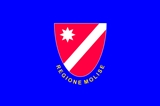
Molise

Encyclopedia
Molise (Molisano
: Mulise) is a region
of Southern Italy, the second smallest of the regions. It was formerly (until 1963) part of the region of Abruzzi e Molise
(with Abruzzo
) and now a separate entity. The region covers 4,438 km² and has a population of about 300,000.
Molise is the newest Italian region, since it was established in 1963, when the region Abruzzi e Molise was split in two. It became effective only in 1970.
plant (Termoli
), the industrial sector is dominated by the building industry with small and medium-sized farms spread widely throughout the region. Another important industry is food processing: pasta, meat, milk products, oil and wine are the traditional products of the region. In the services sector the most important industries are distribution, hotels and catering, followed by transport and communications, banking and insurance. With few exceptions, in all sectors firms are small, and this explains the difficulties encountered when marketing products on a national scale.
After the earthquake of 2002
some of the communities in Molise became tt policy which contributed state money to individuals willing to make their homes more resistant to seismic activity. Larino, near Termoli, was a particular beneficiary of this policy and the town, already one of the most beautiful in the province, has been transformed. It was policy to return the houses to their historical colours and, based on careful research, the structures were painted in a range of soft pastel tones. As a result Larino has become an important centre for tourism and scores of expatriates from all over the world are returning to live in the revived centro storico (antique centre).
International tourism is becoming more evident largely as a result of the international flights from other European states, Great Britain, and North America which enter Pescara not far to the north in Abruzzo. The tourists are attracted by large expanses of unspoiled beaches, a relative lack of congestion, and the gentle pace of life.
In the period 1951-71, large-scale emigration to other countries of the European Union, to other parts of Italy and overseas led to a significant decline in the population of Molise. Negative net migration persisted until 1981. Large-scale emigration has caused many of the smaller towns and villages to lose over 60% of their population, while only a small number of larger towns have recorded significant gains. From 1982 to 1994, net migration has been positive, then followed by a negative trend until 2001. Between 1991 (330,900 inhabitants) and 2001 (320,601 inhabitants), the population of the region decreased by 3.1%; since 2001 the population remained stable.
In the region there are two ethnic minorities: the Molisan Croats
(5,000 people who speak an old Dalmatian dialect of the Croatian language) and the Molisan Albanians (who speak a divergent variety of Albanian, Arbëresh
, very different from the Albanian spoken on the other side of the Adriatic Sea). Molisan Albanians are generally of the Byzantine Catholic religion, while Molise Croats are generally Catholics.
, Molise gave 50.5% of its votes to Romano Prodi
of the centre-to-left Olive Tree party. Nonetheless, in November of the same year, Michele Iorio (centre-right
candidate), won the regional election with over 54% of votes.
with:
Nowy Sącz
, Poland
Neapolitan language
Neapolitan is the language of the city and region of Naples , and Campania. On October 14, 2008 a law by the Region of Campania stated that the Neapolitan language had to be protected....
: Mulise) is a region
Regions of Italy
The regions of Italy are the first-level administrative divisions of the state, constituting its first NUTS administrative level. There are twenty regions, of which five are constitutionally given a broader amount of autonomy granted by special statutes....
of Southern Italy, the second smallest of the regions. It was formerly (until 1963) part of the region of Abruzzi e Molise
Abruzzi e Molise
Abruzzi e Molise was formerly one of the regions of Italy encompassing a total of 16,600 km2 and including Abruzzo, Molise and Circondario di Cittaducale ....
(with Abruzzo
Abruzzo
Abruzzo is a region in Italy, its western border lying less than due east of Rome. Abruzzo borders the region of Marche to the north, Lazio to the west and south-west, Molise to the south-east, and the Adriatic Sea to the east...
) and now a separate entity. The region covers 4,438 km² and has a population of about 300,000.
Molise is the newest Italian region, since it was established in 1963, when the region Abruzzi e Molise was split in two. It became effective only in 1970.
Economy
Though there is a large FiatFiat
FIAT, an acronym for Fabbrica Italiana Automobili Torino , is an Italian automobile manufacturer, engine manufacturer, financial, and industrial group based in Turin in the Italian region of Piedmont. Fiat was founded in 1899 by a group of investors including Giovanni Agnelli...
plant (Termoli
Termoli
Termoli is a town and comune on the Adriatic coast of Italy, in the province of Campobasso, region of Molise. It has a population of around 32,000, having expanded quickly after World War II, and it is a local resort town known for its beaches and old fortifications...
), the industrial sector is dominated by the building industry with small and medium-sized farms spread widely throughout the region. Another important industry is food processing: pasta, meat, milk products, oil and wine are the traditional products of the region. In the services sector the most important industries are distribution, hotels and catering, followed by transport and communications, banking and insurance. With few exceptions, in all sectors firms are small, and this explains the difficulties encountered when marketing products on a national scale.
After the earthquake of 2002
2002 Molise earthquake
The 2002 Molise earthquake was a magnitude 5.9 earthquake that hit the Italian regions of Molise and Puglia on October 31, 2002 at 10:32:58 . The depth of the earthquake was ....
some of the communities in Molise became tt policy which contributed state money to individuals willing to make their homes more resistant to seismic activity. Larino, near Termoli, was a particular beneficiary of this policy and the town, already one of the most beautiful in the province, has been transformed. It was policy to return the houses to their historical colours and, based on careful research, the structures were painted in a range of soft pastel tones. As a result Larino has become an important centre for tourism and scores of expatriates from all over the world are returning to live in the revived centro storico (antique centre).
International tourism is becoming more evident largely as a result of the international flights from other European states, Great Britain, and North America which enter Pescara not far to the north in Abruzzo. The tourists are attracted by large expanses of unspoiled beaches, a relative lack of congestion, and the gentle pace of life.
Demographics
The density of the population in Molise is well below the national average. In 2008, Molise registered 72.3 inhabitants per km2, compared to a national figure of 198.8. The region is subdivided into two provinces: Campobasso and Isernia, covering together 1.5% of the Italian territory and less than 1% of its population. The larger province in terms of surface area is Campobasso (2,909 km2) and the smaller is Isernia (1,529 km2). The province of Campobasso is the more densely populated of the two provinces, with 79.4 inhabitants per km2, whereas Isernia registered 58.9 inhabitants per km2. At the end of 2008 the most populous towns were Campobasso (51,247 inhabitants), Termoli (32,420) and Isernia (21,811).In the period 1951-71, large-scale emigration to other countries of the European Union, to other parts of Italy and overseas led to a significant decline in the population of Molise. Negative net migration persisted until 1981. Large-scale emigration has caused many of the smaller towns and villages to lose over 60% of their population, while only a small number of larger towns have recorded significant gains. From 1982 to 1994, net migration has been positive, then followed by a negative trend until 2001. Between 1991 (330,900 inhabitants) and 2001 (320,601 inhabitants), the population of the region decreased by 3.1%; since 2001 the population remained stable.
In the region there are two ethnic minorities: the Molisan Croats
Molise Croats
Molise Croats live in the Molise region of Italy in the villages Acquaviva Collecroce , San Felice del Molise , Montemitro and elsewhere. In these three villages they are a majority. There are about 5,000 speakers of the Molise Croatian dialect...
(5,000 people who speak an old Dalmatian dialect of the Croatian language) and the Molisan Albanians (who speak a divergent variety of Albanian, Arbëresh
Arbëresh language
Arbëreshë, also known as Arbërisht, is an ethnolect spoken by the Arbëreshë, the group of Albanian-speaking minorities in Italy.-Classification:...
, very different from the Albanian spoken on the other side of the Adriatic Sea). Molisan Albanians are generally of the Byzantine Catholic religion, while Molise Croats are generally Catholics.
Government and politics
Although the region has a center-right local government, at the April 2006 electionsItalian general election, 2006
In the Italian general election, 2006 for the renewal of the two Chambers of the Parliament of Italy held on April 9 and April 10, 2006 the incumbent prime minister Silvio Berlusconi, leader of the center-right House of Freedoms, was narrowly defeated by Romano Prodi, leader of the center-left The...
, Molise gave 50.5% of its votes to Romano Prodi
Romano Prodi
Romano Prodi is an Italian politician and statesman. He served as the Prime Minister of Italy, from 17 May 1996 to 21 October 1998 and from 17 May 2006 to 8 May 2008...
of the centre-to-left Olive Tree party. Nonetheless, in November of the same year, Michele Iorio (centre-right
Centre-right
The centre-right or center-right is a political term commonly used to describe or denote individuals, political parties, or organizations whose views stretch from the centre to the right on the left-right spectrum, excluding far right stances. Centre-right can also describe a coalition of centrist...
candidate), won the regional election with over 54% of votes.
Administrative divisions
Molise comprises two provinces:| Province | Area (km²) | Population | Density (inh./km²) |
|---|---|---|---|
| Province of Campobasso Province of Campobasso The Province of Campobasso is a province in the Molise region of Italy. Its capital is the city of Campobasso.It has an area of 2,909 km², and a total population of 230,692... |
2,909 | 231,921 | 79.7 |
| Province of Isernia Province of Isernia The Province of Isernia is a province in the Molise region of Italy. Its capital is the city of Isernia.... |
1,529 | 88,931 | 58.2 |
Twin towns — Sister cities
Molise is twinnedTown twinning
Twin towns and sister cities are two of many terms used to describe the cooperative agreements between towns, cities, and even counties in geographically and politically distinct areas to promote cultural and commercial ties.- Terminology :...
with:
Nowy Sącz
Nowy Sacz
Nowy Sącz is a town in the Lesser Poland Voivodeship in southern Poland. It is the district capital of Nowy Sącz County, but is not included within the powiat.-Names:...
, Poland
Poland
Poland , officially the Republic of Poland , is a country in Central Europe bordered by Germany to the west; the Czech Republic and Slovakia to the south; Ukraine, Belarus and Lithuania to the east; and the Baltic Sea and Kaliningrad Oblast, a Russian exclave, to the north...
See also
- 2002 Molise earthquake2002 Molise earthquakeThe 2002 Molise earthquake was a magnitude 5.9 earthquake that hit the Italian regions of Molise and Puglia on October 31, 2002 at 10:32:58 . The depth of the earthquake was ....
- NdocciataNdocciataNdocciata is an ancient Christmas festival celebrated in Molise, Italy, specifically in the city of Agnone. On the evening of December 24 the “Ndocciata” of Agnone is a parade of a great number of “‘ndocce” , structures with a typical fanwise shape, made of silver fir pinewood pallets. They may be...
, a torchlight parade traditionally held in Molise on Christmas Eve - Molise Croatian dialectMolise Croatian dialectMolise Croatian dialect is a Croatian dialect spoken in the province of Campobasso, in the Molise Region of southern Italy, in the villages of Montemitro , Acquaviva Collecroce and San Felice del Molise...