


Apples and oranges

Encyclopedia
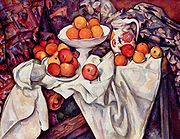
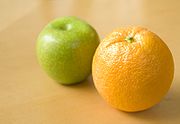
The idiom
Idiom
Idiom is an expression, word, or phrase that has a figurative meaning that is comprehended in regard to a common use of that expression that is separate from the literal meaning or definition of the words of which it is made...
, comparing apples and oranges, refers to the apparent differences between items which are popularly thought to be incomparable or incommensurable, such as apple
Apple
The apple is the pomaceous fruit of the apple tree, species Malus domestica in the rose family . It is one of the most widely cultivated tree fruits, and the most widely known of the many members of genus Malus that are used by humans. Apple grow on small, deciduous trees that blossom in the spring...
s and orange
Orange (fruit)
An orange—specifically, the sweet orange—is the citrus Citrus × sinensis and its fruit. It is the most commonly grown tree fruit in the world....
s. The idiom may also be used to indicate that a false analogy
False analogy
-The Argument from Analogy:The process of analogical inference involves noting the shared properties of two or more things, and from this basis infering that they also share some further property...
has been made between two items, such as where an apple is faulted for not being a good orange.
Variants

Quebec French
Quebec French , or Québécois French, is the predominant variety of the French language in Canada, in its formal and informal registers. Quebec French is used in everyday communication, as well as in education, the media, and government....
, it may take the form comparer des pommes avec des oranges (to compare apples and oranges), while in European French the idiom says comparer des pommes et des poires (to compare apples and pears). In Latin America
Latin America
Latin America is a region of the Americas where Romance languages – particularly Spanish and Portuguese, and variably French – are primarily spoken. Latin America has an area of approximately 21,069,500 km² , almost 3.9% of the Earth's surface or 14.1% of its land surface area...
n Spanish
Spanish language
Spanish , also known as Castilian , is a Romance language in the Ibero-Romance group that evolved from several languages and dialects in central-northern Iberia around the 9th century and gradually spread with the expansion of the Kingdom of Castile into central and southern Iberia during the...
, it is usually comparar papas y boniatos (comparing potatoes and sweet potatoes) or comparar peras con manzanas (comparing pears and apples). In some other languages the term for orange derives from apple, suggesting not only that a direct comparison between the two is possible, but that it is implicitly present in their names. Fruit other than apples and oranges can also be compared; for example, apples and pear
Pear
The pear is any of several tree species of genus Pyrus and also the name of the pomaceous fruit of these trees. Several species of pear are valued by humans for their edible fruit, but the fruit of other species is small, hard, and astringent....
s are compared in Danish
Danish language
Danish is a North Germanic language spoken by around six million people, principally in the country of Denmark. It is also spoken by 50,000 Germans of Danish ethnicity in the northern parts of Schleswig-Holstein, Germany, where it holds the status of minority language...
, Dutch
Dutch language
Dutch is a West Germanic language and the native language of the majority of the population of the Netherlands, Belgium, and Suriname, the three member states of the Dutch Language Union. Most speakers live in the European Union, where it is a first language for about 23 million and a second...
, German
German language
German is a West Germanic language, related to and classified alongside English and Dutch. With an estimated 90 – 98 million native speakers, German is one of the world's major languages and is the most widely-spoken first language in the European Union....
, Spanish
Spanish language
Spanish , also known as Castilian , is a Romance language in the Ibero-Romance group that evolved from several languages and dialects in central-northern Iberia around the 9th century and gradually spread with the expansion of the Kingdom of Castile into central and southern Iberia during the...
, Swedish
Swedish language
Swedish is a North Germanic language, spoken by approximately 10 million people, predominantly in Sweden and parts of Finland, especially along its coast and on the Åland islands. It is largely mutually intelligible with Norwegian and Danish...
, Croatian
Croatian language
Croatian is the collective name for the standard language and dialects spoken by Croats, principally in Croatia, Bosnia and Herzegovina, the Serbian province of Vojvodina and other neighbouring countries...
, Czech
Czech language
Czech is a West Slavic language with about 12 million native speakers; it is the majority language in the Czech Republic and spoken by Czechs worldwide. The language was known as Bohemian in English until the late 19th century...
, Romanian
Romanian language
Romanian Romanian Romanian (or Daco-Romanian; obsolete spellings Rumanian, Roumanian; self-designation: română, limba română ("the Romanian language") or românește (lit. "in Romanian") is a Romance language spoken by around 24 to 28 million people, primarily in Romania and Moldova...
, Hungarian
Hungarian language
Hungarian is a Uralic language, part of the Ugric group. With some 14 million speakers, it is one of the most widely spoken non-Indo-European languages in Europe....
, Italian
Italian language
Italian is a Romance language spoken mainly in Europe: Italy, Switzerland, San Marino, Vatican City, by minorities in Malta, Monaco, Croatia, Slovenia, France, Libya, Eritrea, and Somalia, and by immigrant communities in the Americas and Australia...
, Slovene, Luxembourgish
Luxembourgish language
Luxembourgish is a High German language spoken mainly in Luxembourg. About 320,000 people worldwide speak Luxembourgish.-Language family:...
, Bosnian
Bosnian language
Bosnian is a South Slavic language, spoken by Bosniaks. As a standardized form of the Shtokavian dialect, it is one of the three official languages of Bosnia and Herzegovina....
, and Turkish
Turkish language
Turkish is a language spoken as a native language by over 83 million people worldwide, making it the most commonly spoken of the Turkic languages. Its speakers are located predominantly in Turkey and Northern Cyprus with smaller groups in Iraq, Greece, Bulgaria, the Republic of Macedonia, Kosovo,...
. However, apples are actually more closely related to pears (both are rosaceae
Rosaceae
Rosaceae are a medium-sized family of flowering plants, including about 2830 species in 95 genera. The name is derived from the type genus Rosa. Among the largest genera are Alchemilla , Sorbus , Crataegus , Cotoneaster , and Rubus...
) than to oranges. In fact, in the Spanish-speaking world, a common idiom is sumar peras con manzanas, that is, to add pears and apples. The same thing applies in Romanian where a popular idiom is a aduna merele cu perele, that is again, to add apples and pears.
Some languages use completely different items, such as the Serbian
Serbian language
Serbian is a form of Serbo-Croatian, a South Slavic language, spoken by Serbs in Serbia, Bosnia and Herzegovina, Montenegro, Croatia and neighbouring countries....
Поредити бабе и жабе (comparing grandmothers and toads), or the Romanian
Romanian language
Romanian Romanian Romanian (or Daco-Romanian; obsolete spellings Rumanian, Roumanian; self-designation: română, limba română ("the Romanian language") or românește (lit. "in Romanian") is a Romance language spoken by around 24 to 28 million people, primarily in Romania and Moldova...
baba şi mitraliera (the grandmother and the machine gun); vaca şi izmenele (the cow and the longjohns); or țiganul şi carioca (the gypsy and the marker), or the Welsh
Welsh language
Welsh is a member of the Brythonic branch of the Celtic languages spoken natively in Wales, by some along the Welsh border in England, and in Y Wladfa...
mor wahanol â mêl a menyn (as different as honey and butter), while some languages compare dissimilar properties of dissimilar items. For example, an equivalent Danish
Danish language
Danish is a North Germanic language spoken by around six million people, principally in the country of Denmark. It is also spoken by 50,000 Germans of Danish ethnicity in the northern parts of Schleswig-Holstein, Germany, where it holds the status of minority language...
idiom, Hvad er højest, Rundetårn
Rundetårn
The Rundetårn is a 17th-century tower located in central Copenhagen, Denmark. One of the many architectural projects of Christian IV, it was built as an astronomical observatory...
eller et tordenskrald? translates literally as What is highest, the Round Tower or a thunderclap? In Russian
Russian language
Russian is a Slavic language used primarily in Russia, Belarus, Uzbekistan, Kazakhstan, Tajikistan and Kyrgyzstan. It is an unofficial but widely spoken language in Ukraine, Moldova, Latvia, Turkmenistan and Estonia and, to a lesser extent, the other countries that were once constituent republics...
, the phrase сравнивать тёплое с мягким (to compare warm and soft) is used. In British English
British English
British English, or English , is the broad term used to distinguish the forms of the English language used in the United Kingdom from forms used elsewhere...
, the phrase chalk and cheese means the same thing as apples and oranges. In Argentina
Argentina
Argentina , officially the Argentine Republic , is the second largest country in South America by land area, after Brazil. It is constituted as a federation of 23 provinces and an autonomous city, Buenos Aires...
, a common question is ¿En qué se parecen el amor y el ojo del hacha? which translates into What do love and the eye of an axe have in common? and emphasizes dissimilarity between two subjects; in Colombia
Colombia
Colombia, officially the Republic of Colombia , is a unitary constitutional republic comprising thirty-two departments. The country is located in northwestern South America, bordered to the east by Venezuela and Brazil; to the south by Ecuador and Peru; to the north by the Caribbean Sea; to the...
, a similar (though more rude) version is common: confundir la mierda con la pomada, literally, to confuse shit with apple salve. In Polish, the expression co ma piernik do wiatraka? is used, meaning What has (is) gingerbread to a windmill?.
A number of more exaggerated comparisons are sometimes made, in cases in which the speaker believes the two objects being compared are radically different beyond reproach. For example "oranges with orangutans", "apples with dishwashers", and so on. In English, different fruits, such as pears, plums, or lemons are sometimes substituted for oranges in this context.
Sometimes the two words sound similar. This is true for the Romanian merele cu perele (apples and pears) and the Hungarian szezont a fazonnal (the season with the fashion).
A Hungarian expression with a somewhat modified meaning and construction is ízlések és pofonok (smacks and slaps). It refers to the fact that you cannot decide which one is better from things that depend only on the different tastes/preferences of people, just as you cannot compare two slaps in the face if they are received by separate people.
Further, the phrase "apples-with-apples comparison" is used when an attempt is made to make sure that the comparison is fair; for example, adjusting for inflation during a discussion of wages.
Criticism of the idiom
Various scholars have questioned the premise of the incomparable nature of apples and oranges, both in serious publications and in weblogs and spoofParody
A parody , in current usage, is an imitative work created to mock, comment on, or trivialise an original work, its subject, author, style, or some other target, by means of humorous, satiric or ironic imitation...
s (see below). These criticisms of the idiom, however, tend to assume that you cannot compare apples and oranges is a descriptive statement capable of logical or scientific counter-example, without addressing the possibility of interpreting the idiom as a normative statement (meaning something such as it's not fair to judge apples and oranges by the same criteria).
Legal and mathematical
Law professor Eugene VolokhEugene Volokh
Eugene Volokh is an American legal commentator and the Gary T. Schwartz Professor of Law at the UCLA School of Law...
argues that the idiom
Idiom
Idiom is an expression, word, or phrase that has a figurative meaning that is comprehended in regard to a common use of that expression that is separate from the literal meaning or definition of the words of which it is made...
is inappropriate, because "we compare apple
Apple
The apple is the pomaceous fruit of the apple tree, species Malus domestica in the rose family . It is one of the most widely cultivated tree fruits, and the most widely known of the many members of genus Malus that are used by humans. Apple grow on small, deciduous trees that blossom in the spring...
s and orange
Orange (fruit)
An orange—specifically, the sweet orange—is the citrus Citrus × sinensis and its fruit. It is the most commonly grown tree fruit in the world....
s all the time! We compare them by price, by how much we like the taste, by likely sweetness and ripeness, by how well they'll go in a tasty fruit cocktail, and so on. In fact, every time we go to the store and buy apples rather than oranges, or vice versa, we are necessarily (if implicitly) comparing apples and oranges". He suggested that a better idiom would involve "two items that really are radically dissimilar" like "apples and democracy
Democracy
Democracy is generally defined as a form of government in which all adult citizens have an equal say in the decisions that affect their lives. Ideally, this includes equal participation in the proposal, development and passage of legislation into law...
" or "oranges and the multiplication table
Multiplication table
In mathematics, a multiplication table is a mathematical table used to define a multiplication operation for an algebraic system....
". He believes that such "comparisons really would be hard to conduct". One of Volokh's readers noted that even such radically dissimilar nouns as apples and the multiplication table can be compared fairly easily, as when one compares the number of syllable
Syllable
A syllable is a unit of organization for a sequence of speech sounds. For example, the word water is composed of two syllables: wa and ter. A syllable is typically made up of a syllable nucleus with optional initial and final margins .Syllables are often considered the phonological "building...
s in each word or the relative age at which children learn each concept; another reader noted that the idiom was still relevant in situations where someone criticized oranges for not being good apples. Alexander "Sasha" Volokh argued that mathematically, only the properties of apples and oranges can be compared; the fruits themselves cannot be. Mathematically astute bloggers and readers forced him to partially retract his analysis, however. Also, in his blog, Volokh admitted that his argument "was a joke".
Scientific
Tongue-in-cheek
Tongue-in-cheek is a phrase used as a figure of speech to imply that a statement or other production is humorously intended and it should not be taken at face value. The facial expression typically indicates that one is joking or making a mental effort. In the past, it may also have indicated...
scientific studies have been conducted on the subject, each of which concluded that apples can be compared with oranges fairly easily and on a low budget and the two fruits are quite similar. The first study, conducted by Scott A. Sandford of the NASA Ames Research Center
NASA Ames Research Center
The Ames Research Center , is one of the United States of America's National Aeronautics and Space Administration 10 major field centers.The centre is located in Moffett Field in California's Silicon Valley, near the high-tech companies, entrepreneurial ventures, universities, and other...
, used spectrometry to analyze both apples and oranges. The study, which was published in the Annals of Improbable Research
Annals of Improbable Research
The Annals of Improbable Research is a bi-monthly magazine devoted to scientific humor, in the form of a satirical take on the standard academic journal...
, concluded: "[...] the comparing apples and oranges defense should no longer be considered valid. This is a somewhat startling revelation. It can be anticipated to have a dramatic effect on the strategies used in arguments and discussions in the future."
A second study, written by Stamford Hospital
Stamford Hospital
Stamford Hospital is a private, nonprofit, community and teaching hospital in Stamford, Connecticut, with 440 affiliated doctors.The hospital has 305 inpatient beds in medicine, surgery, obstetrics/gynecology, psychiatry, and medical and surgical critical care units.As of 2005, Stamford Hospital...
's surgeon
Surgeon
In medicine, a surgeon is a specialist in surgery. Surgery is a broad category of invasive medical treatment that involves the cutting of a body, whether human or animal, for a specific reason such as the removal of diseased tissue or to repair a tear or breakage...
-in-chief James Barone and published in the British Medical Journal
British Medical Journal
BMJ is a partially open-access peer-reviewed medical journal. Originally called the British Medical Journal, the title was officially shortened to BMJ in 1988. The journal is published by the BMJ Group, a wholly owned subsidiary of the British Medical Association...
, noted that the phrase apples and oranges was appearing with increasing frequency in the medical literature, with some notable articles comparing "Desflurane
Desflurane
Desflurane is a highly fluorinated methyl ethyl ether used for maintenance of general anesthesia. Like halothane, enflurane and isoflurane, it is a racemic mixture of and optical isomers...
and propofol
Propofol
Propofol is a short-acting, intravenously administered hypnotic agent. Its uses include the induction and maintenance of general anesthesia, sedation for mechanically ventilated adults, and procedural sedation. Propofol is also commonly used in veterinary medicine...
" and "Salmeterol
Salmeterol
Salmeterol is a long-acting beta2-adrenergic receptor agonist drug that is currently prescribed for the treatment of asthma and chronic obstructive pulmonary disease. It is currently available as a dry powder inhaler that releases a powdered form of the drug...
and ipratropium
Ipratropium
Ipratropium bromide is an anticholinergic drug used for the treatment of chronic obstructive pulmonary disease and acute asthma. It blocks the muscarinic acetylcholine receptors in the smooth muscles of the bronchi in the lungs, opening the bronchi...
" with "apples and oranges". The study also found that both apples and oranges were sweet, similar in size, weight, and shape, that both are grown in orchard
Orchard
An orchard is an intentional planting of trees or shrubs that is maintained for food production. Orchards comprise fruit or nut-producing trees which are grown for commercial production. Orchards are also sometimes a feature of large gardens, where they serve an aesthetic as well as a productive...
s, and both may be eaten, juiced, and so on. The only significant differences found were in terms of seed
Seed
A seed is a small embryonic plant enclosed in a covering called the seed coat, usually with some stored food. It is the product of the ripened ovule of gymnosperm and angiosperm plants which occurs after fertilization and some growth within the mother plant...
s (the study used seedless oranges), the involvement of Johnny Appleseed
Johnny Appleseed
Johnny Appleseed , born John Chapman, was an American pioneer nurseryman who introduced apple trees to large parts of Ohio, Indiana, and Illinois...
, and color.
The Annals rejoined that its "earlier investigation was done with more depth, more rigour, and, most importantly, more expensive equipment" than the British Medical Journal study.
Apples and oranges in teaching the use of units

Rhetorical device
In rhetoric, a rhetorical device or resource of language is a technique that an author or speaker uses to convey to the listener or reader a meaning with the goal of persuading him or her towards considering a topic from a different perspective. While rhetorical devices may be used to evoke an...
, references to adding apples and oranges are made in the case of teaching students the proper uses of units
Units of measurement
A unit of measurement is a definite magnitude of a physical quantity, defined and adopted by convention and/or by law, that is used as a standard for measurement of the same physical quantity. Any other value of the physical quantity can be expressed as a simple multiple of the unit of...
. Here, the admonition not to "add apples and oranges" refers to the requirement that two quantities with different units may not be combined by addition, although may always be combined by multiplication
Dimensional analysis
In physics and all science, dimensional analysis is a tool to find or check relations among physical quantities by using their dimensions. The dimension of a physical quantity is the combination of the basic physical dimensions which describe it; for example, speed has the dimension length per...
, so that multiplying apples and oranges is allowed. Similarly, the concept of this distinction is often used metaphor
Metaphor
A metaphor is a literary figure of speech that uses an image, story or tangible thing to represent a less tangible thing or some intangible quality or idea; e.g., "Her eyes were glistening jewels." Metaphor may also be used for any rhetorical figures of speech that achieve their effects via...
ically in elementary algebra
Elementary algebra
Elementary algebra is a fundamental and relatively basic form of algebra taught to students who are presumed to have little or no formal knowledge of mathematics beyond arithmetic. It is typically taught in secondary school under the term algebra. The major difference between algebra and...
.
The admonition is really more of a mnemonic
Mnemonic
A mnemonic , or mnemonic device, is any learning technique that aids memory. To improve long term memory, mnemonic systems are used to make memorization easier. Commonly encountered mnemonics are often verbal, such as a very short poem or a special word used to help a person remember something,...
, since in general counts of objects have no intrinsic unit and, for example, a number count of apples may be dimensionless or have dimension fruit; in either of these two cases, apples and oranges may indeed be added.
Oranges as a type of apple
In many languages, oranges are, implicitly or explicitly, referred to as a type of apple, specifically a golden appleGolden apple
The golden apple is an element that appears in various national and ethnic folk legends or fairy tales. Recurring themes depict a hero retrieving the golden apples hidden or stolen by a monstrous antagonist...
or a Chinese apple. For example, the Greek
Greek language
Greek is an independent branch of the Indo-European family of languages. Native to the southern Balkans, it has the longest documented history of any Indo-European language, spanning 34 centuries of written records. Its writing system has been the Greek alphabet for the majority of its history;...
χρυσόμηλον (chrysomelon) and Latin
Latin
Latin is an Italic language originally spoken in Latium and Ancient Rome. It, along with most European languages, is a descendant of the ancient Proto-Indo-European language. Although it is considered a dead language, a number of scholars and members of the Christian clergy speak it fluently, and...
pomum aurantium both literally describe oranges as golden apples. In other languages like German
German language
German is a West Germanic language, related to and classified alongside English and Dutch. With an estimated 90 – 98 million native speakers, German is one of the world's major languages and is the most widely-spoken first language in the European Union....
, Finnish
Finnish language
Finnish is the language spoken by the majority of the population in Finland Primarily for use by restaurant menus and by ethnic Finns outside Finland. It is one of the two official languages of Finland and an official minority language in Sweden. In Sweden, both standard Finnish and Meänkieli, a...
, Polish
Polish language
Polish is a language of the Lechitic subgroup of West Slavic languages, used throughout Poland and by Polish minorities in other countries...
, or Russian
Russian language
Russian is a Slavic language used primarily in Russia, Belarus, Uzbekistan, Kazakhstan, Tajikistan and Kyrgyzstan. It is an unofficial but widely spoken language in Ukraine, Moldova, Latvia, Turkmenistan and Estonia and, to a lesser extent, the other countries that were once constituent republics...
the terms for the bitter orange
Bitter orange
The name "bitter orange", also known as Seville orange, sour orange, bigarade orange, and marmalade orange, refers to a citrus tree and its fruit. Many varieties of bitter orange are used for their essential oil, which is used in perfume and as a flavoring...
(a related species) are derived from Latin pomum aurantium. Additionally, the Hebrew
Hebrew language
Hebrew is a Semitic language of the Afroasiatic language family. Culturally, is it considered by Jews and other religious groups as the language of the Jewish people, though other Jewish languages had originated among diaspora Jews, and the Hebrew language is also used by non-Jewish groups, such...
word תפוז (tapuz) is a shortened form of תפוח זהב (tapuakh zahav), or golden apple.
In Dutch
Dutch language
Dutch is a West Germanic language and the native language of the majority of the population of the Netherlands, Belgium, and Suriname, the three member states of the Dutch Language Union. Most speakers live in the European Union, where it is a first language for about 23 million and a second...
, sweet oranges are called sinaasappel, which is derived from China's apple. The Latvian
Latvian language
Latvian is the official state language of Latvia. It is also sometimes referred to as Lettish. There are about 1.4 million native Latvian speakers in Latvia and about 150,000 abroad. The Latvian language has a relatively large number of non-native speakers, atypical for a small language...
apelsīns, Icelandic
Icelandic language
Icelandic is a North Germanic language, the main language of Iceland. Its closest relative is Faroese.Icelandic is an Indo-European language belonging to the North Germanic or Nordic branch of the Germanic languages. Historically, it was the westernmost of the Indo-European languages prior to the...
appelsína, Swedish
Swedish language
Swedish is a North Germanic language, spoken by approximately 10 million people, predominantly in Sweden and parts of Finland, especially along its coast and on the Åland islands. It is largely mutually intelligible with Norwegian and Danish...
apelsin, Finnish
Finnish language
Finnish is the language spoken by the majority of the population in Finland Primarily for use by restaurant menus and by ethnic Finns outside Finland. It is one of the two official languages of Finland and an official minority language in Sweden. In Sweden, both standard Finnish and Meänkieli, a...
appelsiini, Russian апельсин (apelsin) and German Apfelsine share similar etymology
Etymology
Etymology is the study of the history of words, their origins, and how their form and meaning have changed over time.For languages with a long written history, etymologists make use of texts in these languages and texts about the languages to gather knowledge about how words were used during...
.
See also
- Apples to ApplesApples to ApplesApples to Apples is a party game originally published by Out of the Box Publishing, and now published by Mattel. It is designed for four to ten players and played for 30–60 minutes....
, a game - Genetic fallacyGenetic fallacyThe genetic fallacy is a fallacy of irrelevance where a conclusion is suggested based solely on something or someone's origin rather than its current meaning or context. This overlooks any difference to be found in the present situation, typically transferring the positive or negative esteem from...
- Nix v. HeddenNix v. HeddenNix v. Hedden, , was a decision by the Supreme Court of the United States that affirmed the lower court ruling that the tomato should be classified under customs regulations as a vegetable rather than a fruit...
, a U.S. Supreme Court case that partially defined "fruit" in the context of import tariffTariffA tariff may be either tax on imports or exports , or a list or schedule of prices for such things as rail service, bus routes, and electrical usage ....
s. - Semantic differentialSemantic differentialSemantic differential is a type of a rating scale designed to measure the connotative meaning of objects, events, and concepts. The connotations are used to derive the attitude towards the given object, event or concept.-Semantic differential:...
- Rhetorical deviceRhetorical deviceIn rhetoric, a rhetorical device or resource of language is a technique that an author or speaker uses to convey to the listener or reader a meaning with the goal of persuading him or her towards considering a topic from a different perspective. While rhetorical devices may be used to evoke an...
- Law of IdentityLaw of identityIn logic, the law of identity is the first of the so-called three classic laws of thought. It states that an object is the same as itself: A → A ; While this can also be listed as A ≡ A this is redundant Any reflexive relation upholds the law of identity...