

Golden apple

Encyclopedia
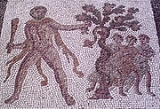
The golden apple is an element that appears in various national and ethnic folk legends or fairy tales. Recurring themes depict a hero (e.g., Hercules
or Făt-Frumos
) retrieving the golden apple
s hidden or stolen by a monstrous antagonist
. Alternatively, they are depicted as divine food and the source of immortality in Norse mythology
.
:
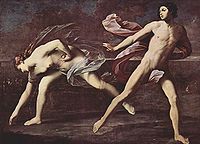
who raced against a suitor named Hippomenes
. Hippomenes used golden apples to distract Atalanta so that he could win the race:
Eventually they had a son Parthenopaios
, who was one of the Seven against Thebes
. Zeus
(or Cybele
, or Rhea
) turned Atalanta and Melanion into lions after they made love together in one of his temples. Other accounts say that Aphrodite changed them into lions because they did not give her proper honor. She filled Melanion with lust and he stripped Atalanta in the temple. They were cursed by the priests after seeing Melanion stroking her large breasts as if they were Aphrodite's own (thus suggesting that her naked form was as beautiful as the goddess's). The belief at the time was that lions could not mate with their own species, only with leopards; thus Atalanta and Hippomenes would never be able to remain with one another.
_11.jpg) The Garden of the Hesperides
The Garden of the Hesperides
, Atlas' daughters, was Hera
's orchard in the far western corner of the world, where either a single tree or a grove of trees bearing immortality-giving golden apples grew. Hera placed in the garden a never-sleeping, hundred-headed, dragon
, named Ladon
, as an additional safeguard. The 12th labor Labor of Hercules was to steal the golden apples from the garden. He stole the apples by asking Atlas to steal the apples and in return he would hold up the sky for him. After Atlas picked the apples, Hercules asked Atlas to hold up the sky for him while he made a pad of the lion skin. He never took back his job of holding up the sky and ran away.
Zeus
held a banquet in celebration of the marriage of Peleus
and Thetis
. Left off the guest list was Eris
(goddess of discord), and upon turning up uninvited, she threw or rolled a golden apple into the ceremony, with an inscription that read: καλλίστῃ or, "to the fairest." Three goddesses claimed the apple: Hera
, Athena
, and Aphrodite
. Zeus remembered Paris of Troy as being the most beautiful of mortal men and was aware of the bull-judging contest which was soon to come, in which Paris would be judge. So Zeus sent Ares, who disguised himself as a bull, which was one of his symbols. Ares accepted this duty given by Zeus humorously. Being a god, he appeared perfect in all respects and therefore was awarded the Golden Laurels. Zeus named Paris as the judge as he knew that Paris would be a fair and equal judge.
He gave the apple to Hermes
and told him to deliver it to Paris and tell him that the goddesses would accept his decision without argument, and so the goddesses appeared. Each of the goddesses offered Paris a gift as a bribe in return for the apple. First came Hera, who offered to make him a famous, powerful king; next came Athena, who offered to make him wise, above even some of the gods; and last of all came Aphrodite, who said she would give him the most beautiful woman in the world as his wife, Helen, at that time of Sparta (later to be titled Helen of Troy). Paris chose Aphrodite, a decision that ultimately led to the start of the Trojan war. Paris soon went to celebrate the marriage of Helen and Menelaus with his brother. They spent the night there, and Menelaus was called to Agamemnon, and thus Helen and Paris were left alone. In this time they made love, and Helen left Menelaus and sailed to Troy with Paris, thus initiating the Trojan War
.
 In Norse mythology
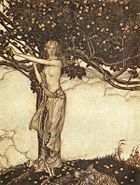
, the golden apples are the source of the gods' immortality and perpetual youth; comparable to the role of ambrosia
in Greek mythology
. They are cultivated by—and most often associated with—the goddess Iðunn
.
, Iðunn is mentioned in its first chapter (numbered as 55) as one of eight ásynjur
(goddesses) sitting in their thrones at a banquet in Asgard
for Ægir
. In chapter 56, Bragi
tells Ægir about Iðunn's abduction by the jötunn Þjazi. Bragi says that after hitting an eagle (Þjazi in disguise) with a pole, Loki
finds himself stuck to the bird, and being pulled further and further into the sky, his feet banging against stones, gravel, and trees, and he felt his arms might be pulled out from his shoulders. Loki shouted and begged the eagle for a truce, and the eagle responds that Loki would be free unless he made a solemn vow to have Iðunn come outside of Asgard with her apples. Loki accepts and returns to his friends Odin
and Hœnir
. At the time the Þjazi and Loki agreed on, Loki lures Iðunn out of Asgard into "a certain forest", telling her that he had discovered some apples that she would find worth keeping, and told Iðunn that she ought to bring her apples with her so that she may compare them with the apples Loki discovered. Þjazi arrives in eagle shape, snatches Iðunn, flies away with her, and takes her to his home, Þrymheimr.
The Æsir begin to grow grey and old at the disappearance of Iðunn. The Æsir hold a thing
, where they ask one another when Iðunn had been seen last. The Æsir realize that the last time that Iðunn was seen was when she was going outside of Asgard with Loki, and so they have Loki arrested and brought to the thing, where he is threatened with death and torture. Terrified, Loki says that he will search for Iðunn in the land of Jötunheimr
if the goddess Freyja will lend him her "falcon
shape". Freyja lends the falcon shape to Loki, and with it he flies north to Jötunheimr, and arrives a day later at Þjazi's home. Loki finds that Þjazi is out in a boat at sea, and that Iðunn is home alone. Loki turns her into a nut
, holds her in his claws, and flies away with her as fast as possible.
Upon Þjazi's arrival home, he finds that Iðunn is gone. Þjazi gets "his eagle shape", and chases Loki, causing a storm wind. The Æsir see a falcon flying with a nut, as well as the pursuing eagle, so they went out beneath Asgard, brought out loads of wood shavings. The falcon flies over the fortification, and drops down by the wall. The eagle is unable to stop when he misses the falcon, the feathers of the eagle catch fire, and he falls. The Æsir, close by, kill the jötunn Þjazi within the gates of Asgard, "and this killing is greatly renowned."
's Der Ring des Nibelungen
, the golden apples have their own leitmotif
. It is first sung by Fafner
, when he explains to his brother Fasolt why they must take Freia away from the gods.
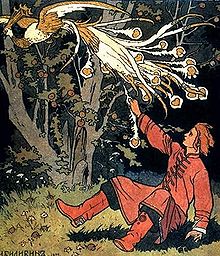 Many European fairy tales begin when golden apples are stolen from a king, usually by a bird:
poem The Song of the Wandering Aengus, has the lines:
The Augusta, Lady Gregory
play called The Golden Apple: A Play for Kiltartan Children is a fable in the invented Kiltartan
dialect based on Irish mythology and folklore.
draws upon the Golden Apple of the goddess Eris, also known as the "Apple of Discord" which was used by this goddess to set off the conflict among the goddesses of Olympus that lead to the Trojan War as a result of Eris not being invited to a party (the so-called "Original Snub"). Emblazoned upon the apple is the word "Kallisti" meaning "to the fairest". The golden apple can be seen as a metaphor for a practical joke meant to cause cognitive dissonance
in the target.
are "golden apple". For example, the Greek
χρυσομηλιά, and Latin
pomum aurantium both literally describe oranges as "golden apples". Other languages, like German
, Finnish
, Hebrew
, and Russian
, have more complex etymologies for the word "orange" that can be traced back to the same idea.
, a fruit originating in the Middle East
. The tomato
, unknown to the ancient world of the Greeks, is known as the pomodoro in Italian
, meaning "golden apple" (from pomo d'oro). One reason that oranges might be considered to be "magical" in so many stories is because they bear flowers and fruit at the same time unlike other fruit.
Hercules
Hercules is the Roman name for Greek demigod Heracles, son of Zeus , and the mortal Alcmene...
or Făt-Frumos
Fat-Frumos
Făt-Frumos is a knight hero in Romanian folklore, usually present in fairy tales....
) retrieving the golden apple
Apple (symbolism)
Apples appear in many religious traditions, often as a mystical or forbidden fruit. One of the problems identifying apples in religion, mythology and folktales is that as late as the 17th century, the word "apple" was used as a generic term for all fruit other than berries, but including nuts...
s hidden or stolen by a monstrous antagonist
Antagonist
An antagonist is a character, group of characters, or institution, that represents the opposition against which the protagonist must contend...
. Alternatively, they are depicted as divine food and the source of immortality in Norse mythology
Norse mythology
Norse mythology, a subset of Germanic mythology, is the overall term for the myths, legends and beliefs about supernatural beings of Norse pagans. It flourished prior to the Christianization of Scandinavia, during the Early Middle Ages, and passed into Nordic folklore, with some aspects surviving...
.
Greek mythology
Three instances of golden apples were featured in Greek mythologyGreek mythology
Greek mythology is the body of myths and legends belonging to the ancient Greeks, concerning their gods and heroes, the nature of the world, and the origins and significance of their own cult and ritual practices. They were a part of religion in ancient Greece...
:
Atalanta
The first case concerns a hunter named AtalantaAtalanta
Atalanta is a character in Greek mythology.-Legend:Atalanta was the daughter of Iasus , a Boeotian or an Arcadian princess . She is often described as a goddess. Apollodorus is the only one who gives an account of Atalanta’s birth and upbringing...
who raced against a suitor named Hippomenes
Hippomenes
In Greek mythology, Hippomenes , also known as Melanion, was the husband of Atalanta.- Overview :When men who were struck by Atalanta's beauty watched her run through the forest, she became angry and told them "I will race anyone who wants to marry me! Whoever is so swift that he can outrun me will...
. Hippomenes used golden apples to distract Atalanta so that he could win the race:
- "After Atalanta participated in the hunt and received the pelt, her father claimed her as his offspring and wanted her to get married. Although a very beautiful maiden, Atalanta did not particularly want to marry after an oracleOracleIn Classical Antiquity, an oracle was a person or agency considered to be a source of wise counsel or prophetic predictions or precognition of the future, inspired by the gods. As such it is a form of divination....
told her that she will gain bad luckBad LuckBad Luck may refer to:* Harmful or negative luck* Bad Luck , a 1960 film directed by Andrzej Munk* "Bad Luck" * "Bad Luck" * Bad Luck, an album by Trophy Scars...
if she marries. In order to get her a husband, her father made a deal with Atalanta that she would marry anybody who could beat her in a foot race. Atalanta happily agreed, as she could run extremely fast. - She outran many suitors. The one that finally became her husband accomplished this through brains, not speed. Hippomenes (also known as Melanion) knew that he could not win a fair race with Atalanta, so he prayed to AphroditeAphroditeAphrodite is the Greek goddess of love, beauty, pleasure, and procreation.Her Roman equivalent is the goddess .Historically, her cult in Greece was imported from, or influenced by, the cult of Astarte in Phoenicia....
for help. The goddess gave him three golden appleAppleThe apple is the pomaceous fruit of the apple tree, species Malus domestica in the rose family . It is one of the most widely cultivated tree fruits, and the most widely known of the many members of genus Malus that are used by humans. Apple grow on small, deciduous trees that blossom in the spring...
s (sometimes the fruit was quinceQuinceThe quince , or Cydonia oblonga, is the sole member of the genus Cydonia and native to warm-temperate southwest Asia in the Caucasus region...
instead) and told him to drop them one at a time to distract Atalanta. Sure enough, she quit running long enough to retrieve each golden apple. It took all three apples and all of his speed, but Hippomenes finally succeeded, winning the race and Atalanta's hand."
Eventually they had a son Parthenopaios
Parthenopeus
For the hero of mediaeval romance, see Partonopeus de BloisIn Greek mythology, Parthenopeus was one of the Seven Against Thebes and the son of Atalanta and Hippomenes, Meleager, or Ares, or perhaps the son of Talaus. Promachus was his son...
, who was one of the Seven against Thebes
Seven Against Thebes
The Seven against Thebes is the third play in an Oedipus-themed trilogy produced by Aeschylus in 467 BC. The trilogy is sometimes referred to as the Oedipodea. It concerns the battle between an Argive army led by Polynices and the army of Thebes led by Eteocles and his supporters. The trilogy won...
. Zeus
Zeus
In the ancient Greek religion, Zeus was the "Father of Gods and men" who ruled the Olympians of Mount Olympus as a father ruled the family. He was the god of sky and thunder in Greek mythology. His Roman counterpart is Jupiter and his Etruscan counterpart is Tinia.Zeus was the child of Cronus...
(or Cybele
Cybele
Cybele , was a Phrygian form of the Earth Mother or Great Mother. As with Greek Gaia , her Minoan equivalent Rhea and some aspects of Demeter, Cybele embodies the fertile Earth...
, or Rhea
Rhea (mythology)
Rhea was the Titaness daughter of Uranus, the sky, and Gaia, the earth, in Greek mythology. She was known as "the mother of gods". In earlier traditions, she was strongly associated with Gaia and Cybele, the Great Goddess, and was later seen by the classical Greeks as the mother of the Olympian...
) turned Atalanta and Melanion into lions after they made love together in one of his temples. Other accounts say that Aphrodite changed them into lions because they did not give her proper honor. She filled Melanion with lust and he stripped Atalanta in the temple. They were cursed by the priests after seeing Melanion stroking her large breasts as if they were Aphrodite's own (thus suggesting that her naked form was as beautiful as the goddess's). The belief at the time was that lions could not mate with their own species, only with leopards; thus Atalanta and Hippomenes would never be able to remain with one another.
The Garden of the Hesperides
Hesperides
In Greek mythology, the Hesperides are nymphs who tend a blissful garden in a far western corner of the world, located near the Atlas mountains in North Africa at the edge of the encircling Oceanus, the world-ocean....
, Atlas' daughters, was Hera
Hera
Hera was the wife and one of three sisters of Zeus in the Olympian pantheon of Greek mythology and religion. Her chief function was as the goddess of women and marriage. Her counterpart in the religion of ancient Rome was Juno. The cow and the peacock were sacred to her...
's orchard in the far western corner of the world, where either a single tree or a grove of trees bearing immortality-giving golden apples grew. Hera placed in the garden a never-sleeping, hundred-headed, dragon
Dragon
A dragon is a legendary creature, typically with serpentine or reptilian traits, that feature in the myths of many cultures. There are two distinct cultural traditions of dragons: the European dragon, derived from European folk traditions and ultimately related to Greek and Middle Eastern...
, named Ladon
Ladon (mythology)
Ladon was the serpent-like dragon that twined and twisted around the tree in the Garden of the Hesperides and guarded the golden apples. He was overcome by Heracles...
, as an additional safeguard. The 12th labor Labor of Hercules was to steal the golden apples from the garden. He stole the apples by asking Atlas to steal the apples and in return he would hold up the sky for him. After Atlas picked the apples, Hercules asked Atlas to hold up the sky for him while he made a pad of the lion skin. He never took back his job of holding up the sky and ran away.
The Judgment of Paris
- Main articles: Judgement of ParisJudgement of Paristhumb |right |460px |[[The Judgment of Paris |The Judgment of Paris]], [[Peter Paul Rubens]], ca 1636...
, Apple of DiscordApple of DiscordAn apple of discord is a reference to the Golden Apple of Discord which, according to Greek mythology, the goddess Eris said that she would give "to the fairest" at the wedding of Peleus and Thetis, sparking a vanity-fueled dispute between Hera, Athena and Aphrodite that eventually led to the...
Zeus
Zeus
In the ancient Greek religion, Zeus was the "Father of Gods and men" who ruled the Olympians of Mount Olympus as a father ruled the family. He was the god of sky and thunder in Greek mythology. His Roman counterpart is Jupiter and his Etruscan counterpart is Tinia.Zeus was the child of Cronus...
held a banquet in celebration of the marriage of Peleus
Peleus
In Greek mythology, Pēleus was a hero whose myth was already known to the hearers of Homer in the late 8th century BCE. Peleus was the son of Aeacus, king of the island of Aegina, and Endeïs, the oread of Mount Pelion in Thessaly; he was the father of Achilles...
and Thetis
Thetis
Silver-footed Thetis , disposer or "placer" , is encountered in Greek mythology mostly as a sea nymph or known as the goddess of water, one of the fifty Nereids, daughters of the ancient one of the seas with shape-shifting abilities who survives in the historical vestiges of most later Greek myths...
. Left off the guest list was Eris
Eris (mythology)
Eris is the Greek goddess of strife and discord, her name being translated into Latin as Discordia. Her Greek opposite is Harmonia, whose Latin counterpart is Concordia. Homer equated her with the war-goddess Enyo, whose Roman counterpart is Bellona...
(goddess of discord), and upon turning up uninvited, she threw or rolled a golden apple into the ceremony, with an inscription that read: καλλίστῃ or, "to the fairest." Three goddesses claimed the apple: Hera
Hera
Hera was the wife and one of three sisters of Zeus in the Olympian pantheon of Greek mythology and religion. Her chief function was as the goddess of women and marriage. Her counterpart in the religion of ancient Rome was Juno. The cow and the peacock were sacred to her...
, Athena
Athena
In Greek mythology, Athena, Athenê, or Athene , also referred to as Pallas Athena/Athene , is the goddess of wisdom, courage, inspiration, civilization, warfare, strength, strategy, the arts, crafts, justice, and skill. Minerva, Athena's Roman incarnation, embodies similar attributes. Athena is...
, and Aphrodite
Aphrodite
Aphrodite is the Greek goddess of love, beauty, pleasure, and procreation.Her Roman equivalent is the goddess .Historically, her cult in Greece was imported from, or influenced by, the cult of Astarte in Phoenicia....
. Zeus remembered Paris of Troy as being the most beautiful of mortal men and was aware of the bull-judging contest which was soon to come, in which Paris would be judge. So Zeus sent Ares, who disguised himself as a bull, which was one of his symbols. Ares accepted this duty given by Zeus humorously. Being a god, he appeared perfect in all respects and therefore was awarded the Golden Laurels. Zeus named Paris as the judge as he knew that Paris would be a fair and equal judge.
He gave the apple to Hermes
Hermes
Hermes is the great messenger of the gods in Greek mythology and a guide to the Underworld. Hermes was born on Mount Kyllini in Arcadia. An Olympian god, he is also the patron of boundaries and of the travelers who cross them, of shepherds and cowherds, of the cunning of thieves, of orators and...
and told him to deliver it to Paris and tell him that the goddesses would accept his decision without argument, and so the goddesses appeared. Each of the goddesses offered Paris a gift as a bribe in return for the apple. First came Hera, who offered to make him a famous, powerful king; next came Athena, who offered to make him wise, above even some of the gods; and last of all came Aphrodite, who said she would give him the most beautiful woman in the world as his wife, Helen, at that time of Sparta (later to be titled Helen of Troy). Paris chose Aphrodite, a decision that ultimately led to the start of the Trojan war. Paris soon went to celebrate the marriage of Helen and Menelaus with his brother. They spent the night there, and Menelaus was called to Agamemnon, and thus Helen and Paris were left alone. In this time they made love, and Helen left Menelaus and sailed to Troy with Paris, thus initiating the Trojan War
Trojan War
In Greek mythology, the Trojan War was waged against the city of Troy by the Achaeans after Paris of Troy took Helen from her husband Menelaus, the king of Sparta. The war is among the most important events in Greek mythology and was narrated in many works of Greek literature, including the Iliad...
.
Norse mythology
Norse mythology
Norse mythology, a subset of Germanic mythology, is the overall term for the myths, legends and beliefs about supernatural beings of Norse pagans. It flourished prior to the Christianization of Scandinavia, during the Early Middle Ages, and passed into Nordic folklore, with some aspects surviving...
, the golden apples are the source of the gods' immortality and perpetual youth; comparable to the role of ambrosia
Ambrosia
In ancient Greek mythology, ambrosia is sometimes the food or drink of the Greek gods , often depicted as conferring ageless immortality upon whoever consumes it...
in Greek mythology
Greek mythology
Greek mythology is the body of myths and legends belonging to the ancient Greeks, concerning their gods and heroes, the nature of the world, and the origins and significance of their own cult and ritual practices. They were a part of religion in ancient Greece...
. They are cultivated by—and most often associated with—the goddess Iðunn
Iðunn
In Norse mythology, Iðunn is a goddess associated with apples and youth. Iðunn is attested in the Poetic Edda, compiled in the 13th century from earlier traditional sources, and the Prose Edda, written in the 13th century by Snorri Sturluson...
.
In myth
In the book SkáldskaparmálSkáldskaparmál
The second part of Snorri Sturluson's Prose Edda the Skáldskaparmál or "language of poetry" is effectively a dialogue between the Norse god of the sea, Ægir and Bragi, the god of poetry, in which both Norse mythology and discourse on the nature of poetry are intertwined...
, Iðunn is mentioned in its first chapter (numbered as 55) as one of eight ásynjur
Æsir
In Old Norse, áss is the term denoting a member of the principal pantheon in Norse paganism. This pantheon includes Odin, Frigg, Thor, Baldr and Tyr. The second pantheon comprises the Vanir...
(goddesses) sitting in their thrones at a banquet in Asgard
Asgard
In Norse religion, Asgard is one of the Nine Worlds and is the country or capital city of the Norse Gods surrounded by an incomplete wall attributed to a Hrimthurs riding the stallion Svadilfari, according to Gylfaginning. Valhalla is located within Asgard...
for Ægir
Ægir
Ægir is a sea giant, god of the ocean and king of the sea creatures in Norse mythology. He is also known for hosting elaborate parties for the gods.Ægir's servants are Fimafeng and Eldir.- Description :...
. In chapter 56, Bragi
Bragi
Bragi is the skaldic god of poetry in Norse mythology.-Etymology:Bragi is generally associated with bragr, the Norse word for poetry. The name of the god may have been derived from bragr, or the term bragr may have been formed to describe 'what Bragi does'...
tells Ægir about Iðunn's abduction by the jötunn Þjazi. Bragi says that after hitting an eagle (Þjazi in disguise) with a pole, Loki
Loki
In Norse mythology, Loki or Loke is a god or jötunn . Loki is the son of Fárbauti and Laufey, and the brother of Helblindi and Býleistr. By the jötunn Angrboða, Loki is the father of Hel, the wolf Fenrir, and the world serpent Jörmungandr. By his wife Sigyn, Loki is the father of Nari or Narfi...
finds himself stuck to the bird, and being pulled further and further into the sky, his feet banging against stones, gravel, and trees, and he felt his arms might be pulled out from his shoulders. Loki shouted and begged the eagle for a truce, and the eagle responds that Loki would be free unless he made a solemn vow to have Iðunn come outside of Asgard with her apples. Loki accepts and returns to his friends Odin
Odin
Odin is a major god in Norse mythology and the ruler of Asgard. Homologous with the Anglo-Saxon "Wōden" and the Old High German "Wotan", the name is descended from Proto-Germanic "*Wodanaz" or "*Wōđanaz"....
and Hœnir
Hœnir
In Norse mythology, Hœnir is one of the Æsir. He is mentioned as the one who helped Odin to create humans.- Attestations :In Ynglinga saga, along with Mímir, he went to the Vanir as a hostage to seal a truce after the Æsir-Vanir War...
. At the time the Þjazi and Loki agreed on, Loki lures Iðunn out of Asgard into "a certain forest", telling her that he had discovered some apples that she would find worth keeping, and told Iðunn that she ought to bring her apples with her so that she may compare them with the apples Loki discovered. Þjazi arrives in eagle shape, snatches Iðunn, flies away with her, and takes her to his home, Þrymheimr.
The Æsir begin to grow grey and old at the disappearance of Iðunn. The Æsir hold a thing
Thing (assembly)
A thing was the governing assembly in Germanic and introduced into some Celtic societies, made up of the free people of the community and presided by lawspeakers, meeting in a place called a thingstead...
, where they ask one another when Iðunn had been seen last. The Æsir realize that the last time that Iðunn was seen was when she was going outside of Asgard with Loki, and so they have Loki arrested and brought to the thing, where he is threatened with death and torture. Terrified, Loki says that he will search for Iðunn in the land of Jötunheimr
Jötunheimr
Jötunheimr is one of the Nine Worlds and the homeland of the Giants of Norse Mythology — Rock Giants and Frost Giants.-Legend:...
if the goddess Freyja will lend him her "falcon
Falcon
A falcon is any species of raptor in the genus Falco. The genus contains 37 species, widely distributed throughout Europe, Asia, and North America....
shape". Freyja lends the falcon shape to Loki, and with it he flies north to Jötunheimr, and arrives a day later at Þjazi's home. Loki finds that Þjazi is out in a boat at sea, and that Iðunn is home alone. Loki turns her into a nut
Nut (fruit)
A nut is a hard-shelled fruit of some plants having an indehiscent seed. While a wide variety of dried seeds and fruits are called nuts in English, only a certain number of them are considered by biologists to be true nuts...
, holds her in his claws, and flies away with her as fast as possible.
Upon Þjazi's arrival home, he finds that Iðunn is gone. Þjazi gets "his eagle shape", and chases Loki, causing a storm wind. The Æsir see a falcon flying with a nut, as well as the pursuing eagle, so they went out beneath Asgard, brought out loads of wood shavings. The falcon flies over the fortification, and drops down by the wall. The eagle is unable to stop when he misses the falcon, the feathers of the eagle catch fire, and he falls. The Æsir, close by, kill the jötunn Þjazi within the gates of Asgard, "and this killing is greatly renowned."
In Der Ring des Nibelungen
In the Richard WagnerRichard Wagner
Wilhelm Richard Wagner was a German composer, conductor, theatre director, philosopher, music theorist, poet, essayist and writer primarily known for his operas...
's Der Ring des Nibelungen
Der Ring des Nibelungen
Der Ring des Nibelungen is a cycle of four epic operas by the German composer Richard Wagner . The works are based loosely on characters from the Norse sagas and the Nibelungenlied...
, the golden apples have their own leitmotif
Leitmotif
A leitmotif , sometimes written leit-motif, is a musical term , referring to a recurring theme, associated with a particular person, place, or idea. It is closely related to the musical idea of idée fixe...
. It is first sung by Fafner
Fafnir
In Norse mythology, Fáfnir or Frænir was a son of the dwarf king Hreidmar and brother of Regin and Ótr. In the Volsunga saga, Fáfnir was a dwarf gifted with a powerful arm and fearless soul. He guarded his father's house of glittering gold and flashing gems...
, when he explains to his brother Fasolt why they must take Freia away from the gods.
Fairy tales
- Tsarevitch Ivan, the Fire Bird and the Gray WolfTsarevitch Ivan, the Fire Bird and the Gray WolfTsarevitch Ivan, the Fire Bird and the Gray Wolf is a Russian fairy tale collected by Alexander Afanasyev in Narodnye russkie skazki.It is Aarne-Thompson type 550, the quest for the golden bird/firebird...
, Russian - The Golden BirdThe Golden Bird"The Golden Bird" is a Brothers Grimm fairy tale, number 57, about the pursuit of a golden bird by a king's three sons.A French version, collected by Paul Sébillot, is called The Golden Blackbird. Andrew Lang included that variant in The Green Fairy Book.It is Aarne-Thompson folktale type 550,...
, German - The Golden MermaidThe Golden MermaidThe Golden Mermaid is a German fairy tale. Andrew Lang included it in The Green Fairy Book, attributing it to the Brothers Grimm, but there are noticeable differences between it and the common Grimm version of The Golden Bird.-Synopsis:...
, German - The Nine Peahens and the Golden ApplesThe Nine Peahens and the Golden ApplesThe Nine Peahens and the Golden Apples is a Serbian epic poetry. It was published for the first time as a fairy tale by Vuk Stefanović Karadžić in 1853. Later on it was published as a Bulgarian fairy tale by A. H...
, Serbian/Bulgarian - Prâslea the Brave and the Golden ApplesPrâslea the Brave and the Golden ApplesPrâslea the Brave and the Golden Apples is a Romanian fairy tale collected by Petre Ispirescu in Legende sau basmele românilor.-Synopsis:...
, Romanian, where the thief is not a bird but a zmeuZmeuThe Zmeu is a fantastic creature of Romanian folklore and Romanian mythology. Sometimes compared to other fantastic creatures, such as the balaur or the vârcolac, the zmeu is nevertheless distinct, because it usually has clear anthropomorphic traits: it is humanoid and has legs, arms, the ability... - The Three Brothers and the Golden Apple, Bulgarian, where the thief is not a bird but a zmey
Modern literature
The William Butler YeatsWilliam Butler Yeats
William Butler Yeats was an Irish poet and playwright, and one of the foremost figures of 20th century literature. A pillar of both the Irish and British literary establishments, in his later years he served as an Irish Senator for two terms...
poem The Song of the Wandering Aengus, has the lines:
- I will find out where she has gone
- And kiss her lips and take her hands;
- And walk among the dappled grass,
- And pluck till time and times are done
- The silver apples of the moon,
- The golden apples of the sun.
The Augusta, Lady Gregory
Augusta, Lady Gregory
Isabella Augusta, Lady Gregory , born Isabella Augusta Persse, was an Irish dramatist and folklorist. With William Butler Yeats and Edward Martyn, she co-founded the Irish Literary Theatre and the Abbey Theatre, and wrote numerous short works for both companies. Lady Gregory produced a number of...
play called The Golden Apple: A Play for Kiltartan Children is a fable in the invented Kiltartan
Kiltartan
Kiltartan is a barony in County Galway, Ireland. It was formerly known as Cenél Áeda na hEchtge. It was the home of Lady Gregory, Edward Martyn, and a regular residence of W.B. Yeats.It is alluded to in Yeats's poem An Irish Airman Foresees His Death....
dialect based on Irish mythology and folklore.
Discordianism
The contemporary religion DiscordianismDiscordianism
Discordianism is a religion based on the worship of Eris , the Greco-Roman goddess of strife. It was founded circa 1958–1959 after the publication of its holy book the Principia Discordia, written by Malaclypse the Younger and Omar Khayyam Ravenhurst after a series of shared hallucinations at a...
draws upon the Golden Apple of the goddess Eris, also known as the "Apple of Discord" which was used by this goddess to set off the conflict among the goddesses of Olympus that lead to the Trojan War as a result of Eris not being invited to a party (the so-called "Original Snub"). Emblazoned upon the apple is the word "Kallisti" meaning "to the fairest". The golden apple can be seen as a metaphor for a practical joke meant to cause cognitive dissonance
Cognitive dissonance
Cognitive dissonance is a discomfort caused by holding conflicting ideas simultaneously. The theory of cognitive dissonance proposes that people have a motivational drive to reduce dissonance. They do this by changing their attitudes, beliefs, and actions. Dissonance is also reduced by justifying,...
in the target.
Golden apples in other languages
In many languages, orangesOrange (fruit)
An orange—specifically, the sweet orange—is the citrus Citrus × sinensis and its fruit. It is the most commonly grown tree fruit in the world....
are "golden apple". For example, the Greek
Greek language
Greek is an independent branch of the Indo-European family of languages. Native to the southern Balkans, it has the longest documented history of any Indo-European language, spanning 34 centuries of written records. Its writing system has been the Greek alphabet for the majority of its history;...
χρυσομηλιά, and Latin
Latin
Latin is an Italic language originally spoken in Latium and Ancient Rome. It, along with most European languages, is a descendant of the ancient Proto-Indo-European language. Although it is considered a dead language, a number of scholars and members of the Christian clergy speak it fluently, and...
pomum aurantium both literally describe oranges as "golden apples". Other languages, like German
German language
German is a West Germanic language, related to and classified alongside English and Dutch. With an estimated 90 – 98 million native speakers, German is one of the world's major languages and is the most widely-spoken first language in the European Union....
, Finnish
Finnish language
Finnish is the language spoken by the majority of the population in Finland Primarily for use by restaurant menus and by ethnic Finns outside Finland. It is one of the two official languages of Finland and an official minority language in Sweden. In Sweden, both standard Finnish and Meänkieli, a...
, Hebrew
Hebrew language
Hebrew is a Semitic language of the Afroasiatic language family. Culturally, is it considered by Jews and other religious groups as the language of the Jewish people, though other Jewish languages had originated among diaspora Jews, and the Hebrew language is also used by non-Jewish groups, such...
, and Russian
Russian language
Russian is a Slavic language used primarily in Russia, Belarus, Uzbekistan, Kazakhstan, Tajikistan and Kyrgyzstan. It is an unofficial but widely spoken language in Ukraine, Moldova, Latvia, Turkmenistan and Estonia and, to a lesser extent, the other countries that were once constituent republics...
, have more complex etymologies for the word "orange" that can be traced back to the same idea.
Identity
Frequently, the term "golden apple" is used to refer to the quinceQuince
The quince , or Cydonia oblonga, is the sole member of the genus Cydonia and native to warm-temperate southwest Asia in the Caucasus region...
, a fruit originating in the Middle East
Middle East
The Middle East is a region that encompasses Western Asia and Northern Africa. It is often used as a synonym for Near East, in opposition to Far East...
. The tomato
Tomato
The word "tomato" may refer to the plant or the edible, typically red, fruit which it bears. Originating in South America, the tomato was spread around the world following the Spanish colonization of the Americas, and its many varieties are now widely grown, often in greenhouses in cooler...
, unknown to the ancient world of the Greeks, is known as the pomodoro in Italian
Italian language
Italian is a Romance language spoken mainly in Europe: Italy, Switzerland, San Marino, Vatican City, by minorities in Malta, Monaco, Croatia, Slovenia, France, Libya, Eritrea, and Somalia, and by immigrant communities in the Americas and Australia...
, meaning "golden apple" (from pomo d'oro). One reason that oranges might be considered to be "magical" in so many stories is because they bear flowers and fruit at the same time unlike other fruit.
See also
- Apples and orangesApples and orangesA comparison of apples and oranges occurs when two items or groups of items are compared that cannot be validly compared.The idiom, comparing apples and oranges, refers to the apparent differences between items which are popularly thought to be incomparable or incommensurable, such as apples and...
- German Apple FrontFront Deutscher ÄpfelThe Front Deutscher Äpfel , also called Apfelfront is a satirical organisation, founded in Leipzig in 2004. It satirizes right extremist parties, especially the Nationaldemokratische Partei Deutschlands...
- The Golden Apples of the SunThe Golden Apples of the SunThe Golden Apples of the Sun is an anthology of 22 short stories by Ray Bradbury; it was first published in 1953.The book's namesake is one of the short stories in the collection. Bradbury drew the title for the story from the last line of the final stanza to W. B...