

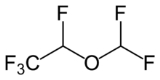
Desflurane

Encyclopedia
Desflurane is a highly fluorinated methyl ethyl ether
used for maintenance of general anesthesia. Like halothane, enflurane and isoflurane, it is a racemic mixture of (R) and (S) optical isomers (enantiomers). Together with sevoflurane
, it is gradually replacing isoflurane
for human use, except in the third world, where its high cost precludes its use. It has the most rapid onset and offset of the volatile anesthetic drugs used for general anesthesia due to its low solubility in blood.
Some drawbacks of desflurane are its low potency, its pungency and its high cost. It may cause tachycardia
and airway irritability when administered at concentrations greater than 10 vol%. Due to this airway irritability, desflurane is infrequently used to induce anesthesia via inhalation techniques.
Additionally, desflurane is a greenhouse gas
. Anesthesia gases used globally contribute the equivalent of 1 million cars to global warming
. Desflurane has a global warming potential
of 3714. One tonne of desflurane emitted is equivalent to 3714 tonnes of carbon dioxide
in the atmosphere, much higher than sevoflurane
or isoflurane
. Taking into account the different amounts typically used in 1 hour of anesthesia (1 minimal alveolar concentration-hour), desflurane causes 26.8 times the global warming of sevoflurane
.
Though it vaporises very readily, it is a liquid at room temperature. Anaesthetic machine
s are fitted with a specialized anaesthetic vaporiser
unit that heats liquid desflurane to a constant temperature. This enables the agent to be available at a constant vapor pressure, negating the effects fluctuating ambient temperatures would otherwise have on its concentration imparted into the fresh gas flow of the anesthesia machine.
Desflurane, along with enflurane
and to a lesser extent isoflurane
, has been shown to react with the carbon dioxide
absorbent in anesthesia circuits to produce detectable levels of carbon monoxide
through degradation of the anesthetic agent. The CO2 absorbent, Baralyme, when dried, is most culpable for the production of carbon monoxide from desflurane degradation, although it is also seen with soda lime
absorbent as well. Dry conditions in the carbon dioxide absorbent are conducive to this phenomenon, such as those resulting from high fresh gas flows.
Halogenated ether
A halogenated ether is a subcategory of a larger group of chemicals known as ethers. An ether is an organic chemical that contains an ether group — an oxygen atom connected to two alkyl groups...
used for maintenance of general anesthesia. Like halothane, enflurane and isoflurane, it is a racemic mixture of (R) and (S) optical isomers (enantiomers). Together with sevoflurane
Sevoflurane
Sevoflurane , also called fluoromethyl hexafluoroisopropyl ether, is a sweet-smelling, nonflammable, highly fluorinated methyl isopropyl ether used for induction and maintenance of general anesthesia. Together with desflurane, it is replacing isoflurane and halothane in modern anesthesiology...
, it is gradually replacing isoflurane
Isoflurane
Isoflurane is a halogenated ether used for inhalational anesthesia. Together with enflurane and halothane, it replaced the flammable ethers used in the pioneer days of surgery. Its name comes from being a structural isomer of enflurane, hence they have the same empirical formula...
for human use, except in the third world, where its high cost precludes its use. It has the most rapid onset and offset of the volatile anesthetic drugs used for general anesthesia due to its low solubility in blood.
Some drawbacks of desflurane are its low potency, its pungency and its high cost. It may cause tachycardia
Tachycardia
Tachycardia comes from the Greek words tachys and kardia . Tachycardia typically refers to a heart rate that exceeds the normal range for a resting heart rate...
and airway irritability when administered at concentrations greater than 10 vol%. Due to this airway irritability, desflurane is infrequently used to induce anesthesia via inhalation techniques.
Additionally, desflurane is a greenhouse gas
Greenhouse gas
A greenhouse gas is a gas in an atmosphere that absorbs and emits radiation within the thermal infrared range. This process is the fundamental cause of the greenhouse effect. The primary greenhouse gases in the Earth's atmosphere are water vapor, carbon dioxide, methane, nitrous oxide, and ozone...
. Anesthesia gases used globally contribute the equivalent of 1 million cars to global warming
Global warming
Global warming refers to the rising average temperature of Earth's atmosphere and oceans and its projected continuation. In the last 100 years, Earth's average surface temperature increased by about with about two thirds of the increase occurring over just the last three decades...
. Desflurane has a global warming potential
Global warming potential
Global-warming potential is a relative measure of how much heat a greenhouse gas traps in the atmosphere. It compares the amount of heat trapped by a certain mass of the gas in question to the amount of heat trapped by a similar mass of carbon dioxide. A GWP is calculated over a specific time...
of 3714. One tonne of desflurane emitted is equivalent to 3714 tonnes of carbon dioxide
Carbon dioxide
Carbon dioxide is a naturally occurring chemical compound composed of two oxygen atoms covalently bonded to a single carbon atom...
in the atmosphere, much higher than sevoflurane
Sevoflurane
Sevoflurane , also called fluoromethyl hexafluoroisopropyl ether, is a sweet-smelling, nonflammable, highly fluorinated methyl isopropyl ether used for induction and maintenance of general anesthesia. Together with desflurane, it is replacing isoflurane and halothane in modern anesthesiology...
or isoflurane
Isoflurane
Isoflurane is a halogenated ether used for inhalational anesthesia. Together with enflurane and halothane, it replaced the flammable ethers used in the pioneer days of surgery. Its name comes from being a structural isomer of enflurane, hence they have the same empirical formula...
. Taking into account the different amounts typically used in 1 hour of anesthesia (1 minimal alveolar concentration-hour), desflurane causes 26.8 times the global warming of sevoflurane
Sevoflurane
Sevoflurane , also called fluoromethyl hexafluoroisopropyl ether, is a sweet-smelling, nonflammable, highly fluorinated methyl isopropyl ether used for induction and maintenance of general anesthesia. Together with desflurane, it is replacing isoflurane and halothane in modern anesthesiology...
.
Though it vaporises very readily, it is a liquid at room temperature. Anaesthetic machine
Anaesthetic machine
The anaesthetic machine is used by anaesthesiologists and nurse anaesthetists to support the administration of anaesthesia...
s are fitted with a specialized anaesthetic vaporiser
Anaesthetic vaporiser
An anaesthetic vaporiser is a device generally attached to an anaesthetic machine which delivers a given concentration of a volatile anaesthetic agent.The design of these devices takes account of varying*ambient temperature*fresh gas flow...
unit that heats liquid desflurane to a constant temperature. This enables the agent to be available at a constant vapor pressure, negating the effects fluctuating ambient temperatures would otherwise have on its concentration imparted into the fresh gas flow of the anesthesia machine.
Desflurane, along with enflurane
Enflurane
Enflurane is a halogenated ether that was commonly used for inhalational anesthesia during the 1970s and 1980s. Developed by Ross Terrell in 1963, it was first used clinically in 1966....
and to a lesser extent isoflurane
Isoflurane
Isoflurane is a halogenated ether used for inhalational anesthesia. Together with enflurane and halothane, it replaced the flammable ethers used in the pioneer days of surgery. Its name comes from being a structural isomer of enflurane, hence they have the same empirical formula...
, has been shown to react with the carbon dioxide
Carbon dioxide
Carbon dioxide is a naturally occurring chemical compound composed of two oxygen atoms covalently bonded to a single carbon atom...
absorbent in anesthesia circuits to produce detectable levels of carbon monoxide
Carbon monoxide
Carbon monoxide , also called carbonous oxide, is a colorless, odorless, and tasteless gas that is slightly lighter than air. It is highly toxic to humans and animals in higher quantities, although it is also produced in normal animal metabolism in low quantities, and is thought to have some normal...
through degradation of the anesthetic agent. The CO2 absorbent, Baralyme, when dried, is most culpable for the production of carbon monoxide from desflurane degradation, although it is also seen with soda lime
Soda lime
Soda lime is a mixture of chemicals, used in granular form in closed breathing environments, such as general anaesthesia, submarines, rebreathers and recompression chambers, to remove carbon dioxide from breathing gases to prevent CO2 retention and carbon dioxide poisoning.It is made by treating...
absorbent as well. Dry conditions in the carbon dioxide absorbent are conducive to this phenomenon, such as those resulting from high fresh gas flows.
Physical properties
| Boiling point Boiling point The boiling point of an element or a substance is the temperature at which the vapor pressure of the liquid equals the environmental pressure surrounding the liquid.... : |
23.5 °C | (at 1 atm Atmosphere (unit) The standard atmosphere is an international reference pressure defined as 101325 Pa and formerly used as unit of pressure. For practical purposes it has been replaced by the bar which is 105 Pa... ) |
|
| Density Density The mass density or density of a material is defined as its mass per unit volume. The symbol most often used for density is ρ . In some cases , density is also defined as its weight per unit volume; although, this quantity is more properly called specific weight... : |
1.465 g/cm³ | (at 20 °C) | |
| Molecular Weight : | 168 | ||
| Vapor pressure Vapor pressure Vapor pressure or equilibrium vapor pressure is the pressure of a vapor in thermodynamic equilibrium with its condensed phases in a closed system. All liquids have a tendency to evaporate, and some solids can sublimate into a gaseous form... : |
88.5 kPa | 672 mmHg | (at 20 °C) |
| 107 kPa | 804 mmHg | (at 24 °C) | |
| Blood:Gas partition coefficient : | 0.42 | ||
| Oil:Gas partition coefficient : | 19 | ||
| MAC Minimum alveolar concentration Minimum alveolar concentration or MAC is a concept used to compare the strengths, or potency, of anaesthetic vapours; in simple terms, it is defined as the concentration of the vapour in the lungs that is needed to prevent movement in 50% of subjects in response to surgical stimulus... : |
6 vol % | ||
Global-warming potential
The twenty-year global-warming potential, GWP(20), for desflurane is 3714.Book references and Additional Reading
- Eger, Eisenkraft, Weiskopf. The Pharmacology of Inhaled Anesthetics. 2003.
- Rang, Dale, Ritter, Moore. Pharmacology 5th Edition. 2003.
- Martin Bellgardt: Evaluation der Sedierungstiefe und der Aufwachzeiten frisch operierter Patienten mit neurophysiologischem Monitoring im Rahmen der Studie: Desfluran versus Propofol zur Sedierung beatmeter Patienten. Bochum, Dissertation, 2005 (pdf)
- Susanne Lohmann: Verträglichkeit, Nebenwirkungen und Hämodynamik der inhalativen Sedierung mit Desfluran im Rahmen der Studie: Desfluran versus Propofol zur Sedierung beatmeter Patienten. Bochum, Dissertation, 2006 (pdf)
- Patel SS, Goa KL. (1995) "Desflurane. A review of its pharmacodynamic and pharmacokinetic properties and its efficacy in general anaesthesia." Drugs Oct;50(4):742-67. PMID: 8536556.