

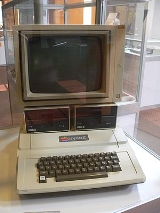
Apple II series

Encyclopedia
The Apple II series (trademark
ed with brackets as "Apple ][") is a set of 8-bit
home computer
s, one of the first highly successful mass-produced microcomputer
products, designed primarily by Steve Wozniak
, manufactured by Apple Computer (now Apple Inc.) and introduced in 1977 with the original Apple II
. In terms of ease of use, features and expandability the Apple II was a major technological advancement over its predecessor, the Apple I
, a limited-production bare circuit board computer for electronics hobbyists that pioneered many features that made the Apple II a commercial success. Introduced at the West Coast Computer Faire
in 1977, the Apple II was among the first successful personal computers; it launched the Apple company into a successful business (and allowed several related companies to start). Throughout the years, a number of models were sold, with the most popular model remaining relatively little changed into the 1990s. By the end of production in 1993, somewhere between five and six million Apple II series computers (including about 1.25 million Apple IIGS models) had been produced.
The Apple II became one of the most recognizable and successful computers during the 1980s and early 1990s. It was aggressively marketed through volume discounts and manufacturing arrangements to educational institutions which made it the first computer in widespread use in American secondary schools. The effort to develop educational and business software for the Apple II, including the 1979 release of the popular VisiCalc
spreadsheet
, made the computer especially popular with business users and families.
The original Apple II operating system
was contained in ROM
along with Integer BASIC
. Programs were entered, then saved and loaded on cassette tape. When the Disk II
was implemented in 1978 by Steve Wozniak, a Disk Operating System or DOS was commissioned. The final and most popular version of this software was Apple DOS
3.3. Some commercial Apple II software booted directly and did not use standard DOS formats. This discouraged the copying or modifying of the software on the disks and improved loading speed. Apple DOS was superseded by ProDOS, which supported a hierarchical filesystem and larger storage devices. With an optional third-party Z80
-based expansion card
the Apple II could boot into the CP/M
operating system and run WordStar
, dBase II, and other CP/M software. At the height of its evolution, towards the late 1980s, the platform had the graphical look of a hybrid of the Apple II and Macintosh
with the introduction of the Apple IIGS. By 1992, the platform had 16-bit
processing capabilities, a mouse-driven Graphical User Interface
, and graphics and sound capabilities far beyond the original.
Despite the introduction of the Motorola 68000-based Apple Lisa
system in 1983, and its more successful cousin the Macintosh
in 1984, the relatively unsophisticated Apple II series was Apple's primary revenue source for most of the following decade. At its peak, it was a billion-dollar-a-year industry with its associated community of third-party developers and retailers. The Apple IIGS was sold until the end of 1992; the last II-series Apple in production, the IIe, was discontinued on October 15, 1993.
than a piece of electronic equipment. The lid popped off the beige plastic case without the use of tools, allowing access to the computer's internals, including the motherboard
(logic board in Apple lingo) with eight expansion slots, and an array of random access memory (RAM) sockets that could hold up to 48 kilobyte
s worth of memory chips.
The Apple II had color and high-resolution graphics modes
, sound capabilities and one of two built-in BASIC
programming languages (initially Integer BASIC
, later Applesoft BASIC
). The Apple II was targeted for the masses rather than just hobbyists and engineers; it also influenced most of the microcomputers that followed it. Unlike preceding home microcomputers, it was sold as a finished consumer appliance rather than as a kit (unassembled or preassembled). VanLOVEs Apple Handbook and The Apple Educators Guide by Gerald VanDiver and Rolland Love reviewed more than 1,500 software programs that the Apple II series could use. The Apple dealer network used this book to emphasize the growing software developer base in education and personal use.
The Apple II series had a keyboard built into the motherboard shell, with the exception of the Apple IIGS
which featured an external keyboard. An upgrade kit was sold later to house the motherboard of an Apple IIGS in an Apple IIe
case.
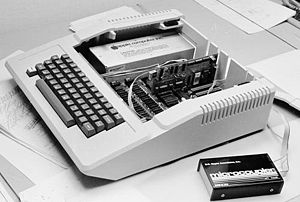 The first Apple II computers went on sale on June 5, 1977 with a MOS Technology
6502
microprocessor running at 1 MHz
, 4 KB of RAM
, an audio cassette interface for loading programs and storing data, and the Integer BASIC
programming language built into the ROMs
. The video controller displayed 24 lines by 40 columns of monochrome, upper-case-only (the original character set matches ASCII characters 0x20 to 0x5F) text on the screen, with NTSC composite video
output suitable for display on a TV monitor, or on a regular TV set by way of a separate RF modulator
. The original retail price of the computer was US$1298 (with 4 kB of RAM) and US$2638 (with the maximum 48 kB of RAM). To reflect the computer's character cell color graphics
capability, the Apple logo on the casing was represented using rainbow stripes, which remained a part of Apple's corporate logo until early 1998. The earliest Apple II's were assembled in Silicon Valley
, and later in Texas; printed circuit board
s were manufactured in Ireland and Singapore
.
An external 5¼-inch floppy disk
drive, the Disk II
, attached via a controller card that plugged into one of the computer's expansion slots (usually slot 6), was used for data storage and retrieval to replace cassettes. The Disk II interface, created by Steve Wozniak
, was regarded as an engineering masterpiece for its economy of electronic components. While other controllers had dozens of chips for synchronizing data I/O with disk rotation, seeking the head to the appropriate track, and encoding the data into magnetic pulses, Wozniak's controller card had few chips; instead, the Apple DOS
used software to perform these functions. The Group Code Recording
used by the controller was simpler and easier to implement in software than the more common MFM
. In the end, the low chip count of the controller helped make Apple's Disk II the first affordable floppy drive for personal computers. As a side effect, Wozniak's scheme made it easy for proprietary software
developers to copy-protect
the media on which their software shipped by changing the low-level sector format or stepping the drive's head between the tracks; inevitably, other companies eventually sold software to foil this protection. Another Wozniak optimization allowed him to omit Shugart's Track-0 sensor. When the Operating System wants to go to track 0, the controller simply moves 40 times toward the next-lower-numbered track, relying on the mechanical stop to prevent it going any further down than track 0. This process, called "recalibration", made a loud buzzing (rapid mechanical chattering) sound that often frightened Apple novices.
The approach taken in the Disk II controller was typical of Wozniak's design sensibility. The Apple II used several engineering shortcuts to save hardware and reduce costs. For example, taking advantage of the way that 6502 instructions only access memory every other clock cycle, the video generation circuitry's memory access on the otherwise unused cycles avoided memory contention issues and also eliminated the need for a separate refresh circuit for the DRAM chips. Rather than use a complex analog-to-digital circuit to read the outputs of the game controller, Wozniak used a simple timer circuit whose period was proportional to the resistance of the game controller, and used a software loop to measure the timer.
The text and graphics screens had a complex arrangement (the scanlines were not stored in sequential areas of memory) which was reputedly due to Wozniak's realization that doing it that way would save a chip; it was less expensive to have software calculate or look up the address of the required scanline than to include the extra hardware. Similarly, in the high-resolution graphics mode, color was determined by pixel position and could thus be implemented in software, saving Wozniak the chips needed to convert bit patterns to colors. This also allowed for sub-pixel font
rendering since orange and blue pixels appeared half a pixel-width further to the right on the screen than green and purple pixels.
Color on the Apple II series took advantage of a quirk of the NTSC television signal standard, which made color display relatively easy and inexpensive to implement. The original NTSC television signal specification was black-and-white. Color was tacked on later by adding a 3.58-MHz subcarrier signal that was partially ignored by B&W TV sets. Color is encoded based on the phase
of this signal in relation to a reference color burst signal. The result is that the position, size, and intensity of a series of pulses define color information. These pulses can translate into pixel
s on the computer screen.
The Apple II display provided two pixels per subcarrier cycle. When the color burst reference signal was turned on and the computer attached to a color display, it could display green by showing one alternating pattern of pixels, magenta with an opposite pattern of alternating pixels, and white by placing two pixels next to each other. Later, blue and orange became available by tweaking the offset of the pixels by half a pixel-width in relation to the colorburst signal. The high-resolution display offered more colors simply by compressing more, narrower pixels into each subcarrier cycle. The coarse, low-resolution graphics display mode worked differently, as it could output a short burst of high-frequency signal per pixel to offer more color options.
The epitome of the Apple II design philosophy was the Apple II sound circuitry. Rather than having a dedicated sound-synthesis chip, the Apple II had a toggle circuit that could only emit a click through a built-in speaker or a line out jack; all other sounds (including two, three and, eventually, four-voice music and playback of audio samples and speech synthesis) were generated entirely by software that clicked the speaker at just the right times. Not for nearly a decade would an Apple II be released with a dedicated sound chip (though with six expansion slots, users could add sound functionality via a soundcard like the Mockingboard
). Similar techniques were used for cassette storage: the cassette output worked the same as the speaker, and the input was a simple zero-crossing detector
that served as a relatively crude (1-bit) audio digitizer. Routines in the ROM were used to encode and decode data in frequency-shift keying
for the cassette.
Wozniak's open design and the Apple II's multiple expansion slots permitted a wide variety of third-party devices, including Apple II peripheral cards
such as Serial controllers
, display controllers, memory boards, hard disks, and networking components. There were plug-in expansion card
s – such as the Z80-card – that permitted the Apple to use the Z80
processor and run a multitude of programs developed under the CP/M
operating system, including the dBase II
database and the WordStar
word processor. There was also a third-party 6809
card that would allow OS-9
Level One to be run. The Mockingboard
sound card greatly improved audio capabilities, allowing simple music synthesis and text-to-speech functions. Eventually, Apple II accelerator cards
were created to double or quadruple the computer's speed.
The Apple II Plus, introduced in June 1979, included the Applesoft BASIC
programming language in ROM
. This Microsoft
-authored dialect of BASIC, which was previously available as an upgrade, supported floating-point arithmetic, and became the standard BASIC dialect on the Apple II series (though it ran at a noticeably slower speed than Steve Wozniak's Integer BASIC).
The Apple II Plus was otherwise identical to the original Apple II. The smaller memory sizes were no longer available, so the II Plus always had a total of 48 kB of RAM, expandable to 64 kB by means of the "language card", a 16 kB RAM expansion card that could be installed in the computer's slot 0. The Apple's 6502 microprocessor could support up to 64 kB of memory, and a machine with 48 kB RAM reached this limit because of the additional 12 kB of read-only memory and 4 kB of I/O addresses. For this reason, the extra RAM in the language card was bank-switched over the machine's built-in ROM, allowing code loaded into the additional memory to be used as if it actually were ROM. Users could thus load Integer BASIC into the language card from disk and switch between the Integer and Applesoft dialects of BASIC with DOS 3.3's INT and FP commands just as if they had the BASIC ROM expansion card. The language card was also required to use the UCSD Pascal
and FORTRAN 77
compilers, which were released by Apple at about the same time. These ran under the UCSD p-System
operating system, which had its own disk format and emitted code for a "virtual machine" rather than the actual 6502 processor.
The UCSD P-system had a curious approach to memory management
, which became even more curious on the Apple III
.
A TEMPEST
approved version of the Apple II Plus called the Microfix was developed in 1980 by the Georgia Tech Research Institute
for U.S. Army FORSCOM. Fielded in 1982, the Microfix system was the first tactical system using video disk (Laserdisk) map technology providing zoom and scroll over map imagery coupled with a point database of intelligence data such as order of battle
, airfields, roadways, and bridges.
changes in order to comply to standards outside of the U.S. The power supply
was modified to accept the local voltage, and in the European and Australian model the video output signal was changed from color NTSC to monochrome PAL – an extra video card was needed for color PAL graphics, since the simple tricks Wozniak had used to generate a pseudo-NTSC signal with minimal hardware did not carry over to the more complex PAL system. In the Japanese version of the international Apple, the keyboard layout was changed to allow for Katakana
writing (full Kanji
support was clearly beyond the capabilities of the machine), but in most other countries the international Apple was sold with an unmodified American keyboard; thus the German model still lacked the umlauts
, for example. For the most part, the Apple II Europlus and J-Plus were identical to the Apple II Plus. Production of the Europlus ended in 1983.
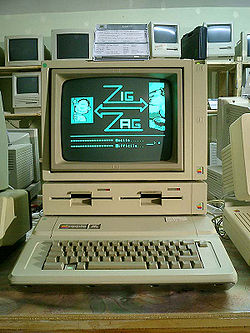 The Apple II Plus was followed in 1983 by the Apple IIe
, a cost-reduced yet more powerful machine that used newer chips to reduce the component count and add new features, such as the display of upper and lowercase letters and a standard 64 kB of RAM.
The IIe RAM was configured as if it were a 48 kB Apple II Plus with a language card; the machine had no slot 0, but instead had an auxiliary slot that for most practical purposes took the place of slot 3, the most commonly used slot for 80-column cards in the II Plus.
The auxiliary slot could accept a 1 kB memory card to enable the 80-column display. This card contained only RAM; the hardware and firmware for the 80-column display was built into the Apple IIe, remaining fairly compatible with the older Videx-style cards, even though the low-level details were very different. An "extended 80-column card" with more memory expanded the machine's RAM to 128 kB.
As with the language card, the memory in the 80-column card was bank-switched over the machine's main RAM; this made the memory better suited to data storage than to running software, and in fact the ProDOS operating system, which was introduced with the Apple IIe, would automatically configure this memory as a RAM disk
upon booting.
Third-party aux-slot memory cards later allowed expansion up to 1 MB
. The 80-column card also enabled one new graphics mode, Double Lo-Res (80×48 pixels). The extended 80-column card enabled two, Double Lo-Res and Double Hi-Res (560×192 pixels). Both modes doubled the horizontal resolution in comparison to the standard Lo-Res (40×48) and Hi-Res (280×192) Modes; in the case of Double Hi-Res, the number of available colors was increased as well, from 6 to 15. Apple IIe's from the very first production run cannot use Double Hi-Res. Neither of these modes was directly supported by the built-in BASIC, however, so the user had to resort to the use of lots of POKE and CALL commands in BASIC, or assembly language programming, or one of a number of software Toolkits to exploit these modes.
While it was possible for software to switch out the 80-column firmware, making the firmware of a card in slot 3 available with a card in the auxiliary slot, it was not a common thing to do. However, even with the 80-column firmware enabled, slot 3's I/O memory range was still usable, giving it approximately the capability of slot 0 on a II or II plus. This meant that it actually was possible to use slot 3 for things, such as coprocessor cards and language cards, that did not use slot firmware space.
Introduced with the IIe was the DuoDisk, essentially two Disk II 5.25-inch drives in a single enclosure designed to stack between the computer and the monitor, and a new controller card to run it. This controller was (by design) functionally identical to the original Disk II controller but used a different connector, allowing a single cable to control both drives in the DuoDisk. The DuoDisk was plagued by reliability problems, however, and did not catch on as well as the Apple IIe itself.
The Apple IIe was the most popular Apple II ever built and was widely considered the "workhorse" of the line. It also has the distinction of being the longest-lived Apple computer of all time – it was manufactured and sold with only minor changes for nearly 11 years. In that time, following the original, two important variations were introduced known as the Enhanced IIe (four new replacement chips to give it some of the features of the later model Apple IIc
, including an upgraded processor called the 65C02) and the Platinum IIe (a modernized new look for the case color to match other Apple products of the era, along with the addition of a built-in numeric keypad). An Enhanced IIe with 128 kB of RAM can be considered the minimum requirement for running most Apple II software released after about 1988.
Two and a half years before the Apple IIe, Apple had produced and marketed a computer called the Apple III
for business users. This product was not a success, and Steve Wozniak has been quoted as saying that the Apple III had a 100% failure rate – every single machine manufactured had some kind of fault (a famous Apple technical bulletin recommended dropping the machine vertically onto a table to re-seat the DIP chips in their loose sockets). Still, many of its features were carried over in the design of the Apple IIe, without the manufacturing flaws that led to failures in the Apple III. Among them was the ProDOS operating system, which was based on Apple III's Sophisticated Operating System (SOS).
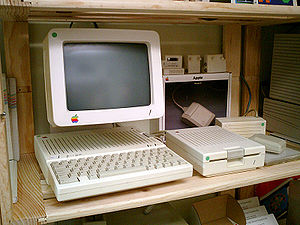 Apple released the Apple IIc
in April 1984, billing it as a portable Apple II, because it could be easily carried, though unlike modern portables
it lacked a built-in display and battery. The IIc even sported a carrying handle that folded down to prop the machine up into a typing position. It was the first of three Apple II models to be made in the Snow White design language
, and the only one that used its unique creamy off-white color. (The other Snow White computers from the Apple II series, the IIGS and the IIc Plus, were light gray, called "Platinum" by Apple.)
The Apple IIc was the first Apple II to use the 65C02
low-power variant of the 6502 processor, and featured a built-in 5.25-inch floppy drive and 128 kB RAM, with a built-in disk controller that could control external drives, composite video (NTSC or PAL), serial interfaces for modem and printer, and a port usable by either a joystick or mouse. Unlike previous Apple II models, the IIc had no internal expansion slots at all, this being the means by which its compact size was attained. Third parties did eventually figure out how to wedge up to 1 MB of additional memory and a real-time clock into the machine, and a later revision of the motherboard provided an expansion slot that could accept an Apple memory card bearing up to 1 MB of RAM. The disk port, originally intended for a second 5.25-inch floppy drive, eventually was able to interface to 3½-inch disk drives and (via third parties) even hard disks.
To play up the portability, two different monochrome LCD displays were sold for use with the IIc's video expansion port, although both were short-lived due to high cost and poor legibility. (An Apple IIc with the smaller of these displays appeared briefly in the film 2010.) The IIc had an external power supply that converted AC power to 12 V DC, allowing third parties to offer battery packs and automobile power adapters that connected in place of the supplied AC adapter.
The Apple IIc (in its American version) was the first microcomputer to include support for the Dvorak Simplified Keyboard
, which was activated using a switch above the keyboard. This feature was also later found in late-model American Apple IIe computers (though the switch was inside the computer) and in the Apple IIGS (accessible via the built-in control panel). The international models used the same mechanism to switch between the localized and the American keyboard layouts, but did not offer Dvorak.
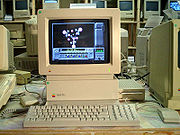 The next member of the line was the Apple IIGS
computer, released on September 15, 1986. A radical departure from the existing Apple II line, the IIGS featured a true 16-bit
microprocessor, the 65C816
, operating at with 24-bit addressing, allowing expansion up to 8 MB of RAM without the bank-switching hassles of the earlier machines (RAM cards with more than 4 MB were never directly supported by Apple). It introduced two completely new graphic modes sporting higher resolutions and a palette of 4,096 colors; however, only 4 (at 640×200 resolution) or 16 (at 320×200 resolution) colors could be used on a single line at a time, although a technique known as dither
ing was often employed in software to increase the number of perceived colors.
In a departure from earlier Apple II graphics modes, the new modes laid out the scanlines sequentially in memory. However, programmers in search of a graphics challenge could always turn to 3200-color mode, which involved precisely swapping in a different 16-color palette for each of the screen's 200 scanlines as the monitor's electron beam traced the screen line by line. This exotic technique did not leave many CPU cycles available for other processing, so this "mode" was best suited to displaying static images.
The Apple IIGS stood out from any previous (or future) Apple II models, evolving and advancing the platform into the next generation of computing while still maintaining near-complete backward compatibility. The secret of the Apple IIGS's compatibility was a single chip called the Mega II
, which contained the functional equivalent of an entire Apple IIe computer (sans processor). This, combined with the flawless 65C02 emulation mode of the 65C816 processor, provided full support for legacy software.
The computer also included a 32-voice Ensoniq
5503, 'wavetable'
sample-based music synthesizer
chip with 64 kB dedicated RAM, 256 kB of standard RAM, built-in peripheral ports (switchable between IIe-style card slots and IIc-style onboard controllers for disk drives, mouse, RGB video, and serial devices), built-in AppleTalk
networking, and a ROM toolbox that supported a graphical user interface derived from the Macintosh toolbox. The computer could run existing 8-bit Apple II software (including software written for the very first Apple II in Integer BASIC), but also supported 16-bit software running under a new OS first called ProDOS 16 and later called GS/OS. The new OS eventually included a Finder that could be used for managing disks and files and opening documents and applications, along with desk accessories – just like the Macintosh. The 16-bit operating system would automatically switch to the text display and downshift to 8-bit mode to run legacy software, while offering a consistent, Macintosh-like graphical interface for native 16-bit applications. Eventually, the IIGS gained the ability to read and write Macintosh disks and, through third-party software, even multitasking (both cooperative and preemptive, the latter in the form of a Unix-type shell), outline TrueType font support, and in one case, even real-time 3D gaming using texture mapping.
The first 50,000 Apple IIGS computers came with Steve Wozniak's "Woz" signature silkscreened on the front and were referred to as the "Woz Limited Edition". These machines are not functionally different from machines from the same time period without the signature.
.jpg) The final Apple II model was the Apple IIc Plus
The final Apple II model was the Apple IIc Plus
introduced in 1988. It was the same size and shape as the IIc that came before it, but the 5.25-inch floppy drive had been replaced with a 3½-inch drive, the power supply was moved inside (gone was the IIc's "brick on a leash" power supply), and the processor was a fast 65C02 processor that actually ran 8-bit Apple II software faster than the IIGS. (Third-party accelerators for other models could, however, go as fast as , and IIGS accelerators would eventually reach .) The IIc Plus's accelerator was derived from a design licensed from Zip Technologies, a third-party maker of accelerators for the Apple II, though Apple used separate chips instead of combining the processor, cache, and supporting logic on a multi-chip module as did Zip. Like later models of the original Apple IIc, the IIc Plus included a memory expansion slot that would accept a daughter-card carrying up to a megabyte
of RAM. The IIc Plus also featured a new keyboard layout that matched the Platinum IIe and IIGS. Unlike the IIe, IIc and IIGS, the IIc Plus came only in one version (American) and was not officially sold anywhere outside the USA.
Many perceived the IIc Plus as Apple's attempt to compete with the Laser 128EX/2
, a popular third party Apple-compatible machine that also had an accelerated processor and a built-in 3.5-inch drive. There were few other rational explanations for Apple expending resources on the continued development of a new 8-bit Apple II model rather than furthering the 16-bit Apple IIGS. However, with its 3.5-inch drive and speedy processor, it was an excellent, compact machine for running the AppleWorks
integrated productivity package, especially with the 1 MB memory upgrade.
, an expansion card for the LC
line of Macintosh
computers, was released. Essentially a miniaturized Apple IIe computer on a card (using the Mega II chip from the Apple IIGS), it allowed the Macintosh to run 8-bit Apple IIe software through hardware emulation
(although video was emulated in software and was slower at times than a IIe). Many of the LC's built-in Macintosh peripherals could be "borrowed" by the card when in Apple II mode (i.e. extra RAM, 3.5-inch floppy, AppleTalk networking, hard disk). The IIe card could not, however, run software intended for the 16-bit Apple IIGS. The Macintosh LC with IIe Card was intended to replace the Apple IIGS in schools and homes and was presumably the reason a new model Apple IIGS that was confirmed by insiders to be in development at one point was cancelled and never released.
product line finally eclipsed the Apple II in the early 1990s. Even after the Macintosh's introduction, the Apple II had remained the company's primary revenue source for years. The computer was the first to attract a loyal user community and many outspoken Apple II fans were bitter that the company had invested its Apple II profits into the Macintosh rather than using them to further the Apple II series.
Apple continued to sell Apple II systems alongside the Macintosh until terminating the IIGS in December, 1992 and the IIe in November, 1993.
, a retired Intel salesman who provided early critical funding for Apple Computer, was keen on marketing. From 1977–1981, Apple used the Regis McKenna
agency for its advertisements and marketing. In 1981, Chiat-Day acquired Regis McKenna's advertising operations and Apple used Chiat-Day. At Regis McKenna Advertising, the team assigned to launch the Apple II consisted of Rob Janoff
, art director, Chip Schafer, copywriter and Bill Kelley, account executive. Janoff came up with the Apple logo with a bite out of it. The design was originally an olive green with matching company logotype all in lower case. Steve Jobs insisted on promoting the color capability of the Apple II by putting rainbow stripes on the Apple logo. In its letterhead and business card implementation, the rounded "a" of the logotype echoed the "bite" in the logo. This logo was developed simultaneously with an advertisement and a brochure; the latter being produced for distribution initially at the first West Coast Computer Faire
. Ever since the original Apple II, Apple has paid high attention to its quality of packaging, partly because of Steve Jobs
' personal preferences and opinions on packaging and final product appearance. All of Apple's packaging for the Apple II series looked similar, featuring lots of clean white space and showing the Apple rainbow logo prominently. For several years up until the late 1980s, Apple used the Motter Tekkura font for packaging, until changing to the Apple Garamond font.
Apple ran the first advertisement for the Apple II in the July 1977 edition of Byte
– a two-page spread ad titled "Introducing the Apple II" and followed by a third page that was an order form. The first brochure, was entitled "Simplicity" and the copy in both the ad and brochure pioneered "demystifying" language intended to make the new idea of a home computer more "personal." The Apple II introduction ad was later run in the September 1977 issue of Scientific American
.
For the Apple IIc, Apple wanted an advertisement to demonstrate the power of the machine despite its small size; they ran a memorable television commercial featuring a high-rise office building in which they claimed with words and images that the IIc had all the power necessary to run a large building, suggesting that it had more than enough power for the home user. (This ad, along with the 1984 Macintosh ad, was featured in a Marketing telecourse run on PBS.)
Apple later aired eight television commercials for the Apple IIGS, emphasizing its benefits to education and students, along with some print ads.
Towards the end of 1982, art director Brent Thomas and Steve Hayden came up with the idea of doing an advertising campaign
based on the timely tagline "Why 1984 will not be like 1984". Chiat-Day shopped it around to a number of clients, including Apple, where it was proposed to be used for a print ad in the Wall Street Journal
promoting the Apple II. However, Apple did not go for it, and the idea was filed away until the spring of 1983, when they met with the Macintosh marketing team to start working on the launch, which was scheduled for January 1984. The idea eventually became the famous 1984 commercial which aired during the third quarter at Super Bowl XVIII
.
 The Apple II was frequently cloned, both in the United States and abroad – similar cloning of the IBM PC later occurred. According to some sources (see below), more than 190 different models of Apple II clones were manufactured. Many of these had "fruit" names (for example, "Pineapple"and "Pearcom") to indicate to the initiated that they were Apple II clones. Well known in the Soviet Bloc were the Agat
, an oversized Russian Apple II clone with a Cyrillic
character set, and Bulgaria
n Pravetz series 8
, a close Apple II replica with Cyrillic support.
Basis, a German company, created the Basis 108, a clone for the Apple II that included both a 6502 processor and the Zilog Z80, allowing it to run the CP/M
operating system as well as most Apple II software. This machine was unusual in that it was housed in a heavy cast aluminum chassis. The Basis 108 was equipped with built-in Centronics
(parallel) and RS232c (serial) ports, as well as the standard six Apple II compatible slots. Unlike the Apple II it came with a detached full-stroke keyboard (AZERTY/QWERTY) of 100 keys plus 15 functions keys and separate numeric and editing keypads.
Another European Apple II Clone was the Pearcom Pear II, which was quite a bit larger as the original as it sported not eight but fourteen expansion slots. It also had a numerical keypad. Pearcom initially used a pear shaped rainbow logo, but stopped using the logo after Apple threatened to sue.
A Bosnian
(at the time part of Yugoslavia
) company named IRIS Computers (sub company of biggest electric company in Bosnia and Herzegovina
and Yugoslavia ENERGOINVEST) has produced Apple II clones since the early 1980s. Their official brand name was IRIS 8. They were very expensive and hard to obtain and were produced primarily for usage in early computerized digital telephone systems and for education. Their usage in offices of the state companies, R&D labs and in the Yugoslav army was also reported. IRIS 8 had looks of early IBM PCs – separate central unit with cooling system and two 5.25-inch disks, monitor and keyboard. Compatibility with original Apple II was complete. Elite high schools in Yugoslavia and especially Bosnia and Herzegovina were equipped with clusters of 8, 16 or 32 IRIS 8 computers connected in local network administrated by IRIS 16 PC clone. The number of IRIS 8's produced could be as many as a couple of tens of thousands.
An Australian-produced clone of the Apple II was the Medfly, named after the Mediterranean fruit fly that attacks apples. The Medfly computer featured a faster processor, more memory, detached keyboard, lower and upper case characters and a built-in disk controller.
Unitron, a Brazilian company, produced another clone, named ApII. Unitron used a copy of the Apple's ROM translated to Portuguese. The operating system was Apple's DOS 3.3 translated to Portuguese. During this period, it was illegal to import microcomputers in Brazil, and buying those (illegal) clones was the only way to have a microcomputer. Unitron stopped manufacturing the ApII a few years after the introduction of IBM PC clones in Brazil.
The Ace clones from Franklin Computer Corporation are the best known and had the most lasting impact, as Franklin copied Apple's ROMs and software and freely admitted to doing so. Franklin's argument: a computer's ROM was simply a pattern of switches locked into a fixed position, and one cannot copyright a pattern of switches. Apple fought Franklin in court for about five years to get its clones off the market, and was ultimately successful when a court ruled that software stored in ROM was in fact copyrightable in the U.S. (See Apple Computer, Inc. v. Franklin Computer Corp.
) Franklin later released non-infringing but less-compatible clones; these could run ProDOS and AppleWorks and had an Applesoft-like BASIC, but compatibility with other software was hit-or-miss.
Apple also challenged VTech
's Laser 128
, an enhanced clone of the Apple IIc first released in 1984, in court. This suit proved less fruitful for Apple, because VTech had reverse-engineered
the Monitor ROM rather than copying it and had licensed Applesoft BASIC from its creator, Microsoft
. Apple had neglected to obtain exclusive rights to the Applesoft dialect of BASIC from Microsoft; VTech was the first cloner to license it. The Laser 128 proved popular and remained on the market for many years, both in its original form and in accelerated versions that ran faster than . Although it was not 100% compatible with the Apple II, it was close, and its popularity ensured that most major developers tested their software on a Laser as well as on genuine Apple machines. Because it was frequently sold via mail order and mass-market retailers such as Sears, the Laser 128 may have cut into the sales of low-cost competitors such as Commodore Business Machines as much as it did Apple's.
While the first Apple II clones were generally exact copies of their Apple counterparts that competed mainly on price, many clones had extra capabilities too. A Franklin model, the Ace 1000, sported a numeric keypad and lower-case long before these features were added to the Apple II line. The Laser 128 series is sometimes credited with spurring Apple to release the Apple IIc Plus; the built-in 3½-inch drive and accelerated processor were features Laser had pioneered. The Laser 128 also had a IIe-style expansion slot on the side that could be used to add peripheral cards.
Bell & Howell
, an audiovisual equipment manufacturer whose products (particularly film projectors) were ubiquitous in American schools, offered what appeared at first glance to be an Apple II Plus clone in a distinctive black plastic case. However, these were in fact real Apple II Plus units manufactured by Apple for B&H for a brief period of time. Many schools had a few of these Black Apple or Black "Darth Vader" Apples in their labs.
ITT
made the ITT 2020, a licensed Apple ][ Plus clone, in the UK. It has the same shape as the Apple ][ but is matte silver (it was sometimes known as the "silver Apple") and is not an exact copy functionally. The ITT2020 produced a PAL
video signal for the European market, where the domestic US market used NTSC
. Software using the BIOS worked correctly on both the Apple and ITT, but software written to access the Apple's display hardware directly, bypassing the BIOS, displayed with vertical stripes on the ITT 2020. The Apple itself was later introduced in the UK, and both the Apple ][ and ITT 2020 were sold for a time, the ITT at a lower price.
Syscom 2 Inc (from Carson City, NV) created the Syscom 2 Apple ][+ clone. The case looked nearly identical. They had 48 k RAM and the normal expansion capabilities. These clones also supported lower case characters, toggled with a ^O keystroke.
An unknown company produced a clone called the RX-8800. One new feature it had was a numeric keypad.
Although not technically a clone, Quadram produced an add-in ISA
card, called the Quadlink, that provided hardware emulation of an Apple II+ for the IBM PC
. The card had its own 6502 CPU and dedicated 80 K RAM (64 K for applications, plus 16 K to hold a reverse-engineered Apple ROM image, loaded at boot-time), and installed "between" the PC and its floppy drive(s), color display, and speaker, in a pass-through configuration. This allowed the PC to operate in a dual-boot fashion: when booted through the Quadlink, the PC could run the majority of II software, and read and write Apple-formatted floppies through the standard PC floppy drive. Because it had a dedicated processor, rather than any form of software emulation, this system ran at nearly the same speed as an equivalent Apple machine. Another company, Diamond Computer Systems, produced a similar card called the Trackstar, that had both a 6502 and a Z80, allowing use of software for both Apple DOS and Apple CP/M. The Trackstar also had a connector allowing use of an actual Apple floppy drive, which enhanced its compatibility with software that took advantage of Apple hardware for copy-protection.
The Disk II single-sided floppy drive used 5.25-inch floppy disk
s; double-sided disks could be used, one side at a time, by turning them over. The first disk operating system
s for the Apple II were DOS 3.1
and DOS 3.2, which stored 113.75 kB on each disk, organized into 35 tracks of 13 256-byte sectors each. After about two years, DOS 3.3 was introduced, storing 140 kB thanks to a minor firmware change on the disk controller that allowed it to store 16 sectors per track. (This upgrade was user-installable on older controllers.) After the release of DOS 3.3, the user community discontinued use of DOS 3.2 except for running legacy software. Programs that required DOS 3.2 were fairly rare; however, as DOS 3.3 was not a major architectural change aside from the number of sectors per track, a program called MUFFIN was provided with DOS 3.3 to allow users to copy files from DOS 3.2 disks to DOS 3.3 disks.
Later, double-sided drives, with heads to read both sides of the disk, became available.
On a DOS 3.x disk, tracks 0, 1, and most of track 2 were reserved to store the operating system. (It was possible, with a special utility, to reclaim most of this space for data if a disk did not need to be bootable.) A short ROM program on the disk controller had the ability to seek to track zero – which it did without regard for the read/write head's current position, resulting in the characteristic "chattering" sound of a Disk II boot, which was the read/write head hitting the rubber stop block at the end of the rail – and read and execute code from sector 0. The code contained in there would then pull in the rest of the operating system. DOS stored the disk's directory on track 17, smack in the middle of the 35-track disks, in order to reduce the average seek time to the frequently-used directory track. The directory was fixed in size and could hold a maximum of 105 files. Subdirectories were not supported.
Most game publishers did not include DOS on their floppy disks, since they needed the memory it occupied more than its capabilities; instead, they often wrote their own boot loaders and read-only file systems. This also served to discourage "crackers" from snooping around in the game's copy-protection code, since the data on the disk was not in files that could be accessed easily.
Some third-party manufacturers produced floppy drives that could write 40 tracks to most 5.25-inch disks, yielding 160 kB of storage per disk, but the format did not catch on widely, and no known software was published on 40-track media. Most drives, even Disk IIs, could write 36 tracks; simple modifications to DOS for formatting the extra track were common.
The Apple Disk II stored 140 kB on single-sided, "single-density" floppy disks, but it was very common for Apple II users to extend the capacity of a single-sided floppy disk to 280 kB by cutting out a second write-protect notch on the side of the disk using a "disk notcher" or hole puncher and inserting the disk flipped over. Double-sided disks, with notches on both sides, were available at a higher price, but in practice the magnetic coating on the reverse of nominally single-sided disks was usually of good enough quality to be used (both sides were coated in the same way to prevent warping, although only one side was certified for use). Early on, diskette manufacturers routinely warned that this technique would damage the read/write head of the drives or wear out the disk faster, and these warnings were frequently repeated in magazines of the day. In practice, however, this method was an inexpensive way to store twice as much data for no extra cost, and was widely used for commercially released floppies as well.
Later, Apple IIs were able to use 3.5-inch disks with a total capacity of 800 kB and hard disks. DOS 3.3 did not support these drives natively; third-party software was required, and disks larger than about 400 kB had to be split up into multiple "virtual disk volumes." ProDOS, a 1983 descendent of the Apple ///'s SOS, became the Apple II operating system of choice for users with these larger disks thanks to its native support of volumes up to 32 MB in size and the fact that AppleWorks required it.
][ and ][ plus . The IIGS and IIc Plus were rendered in small caps
. The Apple III
, IIc, and IIe models used slashes: ///, //c and //e. There have been some errors in the Apple II's name due to the numerous variations and forms on the "II".
, Linux
, Microsoft Windows
, homebrew enabled Nintendo DS
and other operating systems. Numerous disk image
s of Apple II software are available free over the Internet for use with these emulators. AppleWin
and MESS are among the best emulators compatible with most Apple II images. The MESS emulator supports recording and playing back of Apple II emulation sessions. The Home Action Replay Page (aka HARP) allows Apple II users to archive their favorite play sessions of the Apple II system and its games. However, many emulators cannot run software on copy-protected media, or can run only software employing fairly simple protection schemes, unless it is "cracked
" (copy restrictions removed). Breaking protection on software was widely popular in the Apple II's heyday; even Apple itself apparently engaged in the practice Commercial cracking software such as the popular Copy II+ program were sold in stores with the purpose of creating legitimate back-ups of protected software. Although creating back-ups was legitimate under copyright law of the time, the use of such software today is of questionable legality in the U.S. (see DMCA
). For those who prefer to obtain their old software legally, the Lost Classics Project has the goal of convincing copyright holders of classic Apple II software to officially allow unrestricted free distribution of their software and has "freed" a number of programs.
In addition, an active retrocomputing
community of vintage Apple II collectors and users, continue to restore, maintain and develop hardware and software for daily use of these original computers. Numerous websites and support groups exist for these enthusiasts who engage in the trade and purchase for their collections, increasingly rare parts and systems. Hardly a dead platform, the Apple II has a worldwide network of kindred spirits actively engaged in preserving this otherwise outdated technology and indeed regularly attracts, new younger members who continue to keep the platform alive long after it was discontinued by Apple. There is still a small annual convention, KansasFest
, dedicated to the platform.
helped make the Apple II popular in schools. By the end of 1980 Apple had already sold over 100,000 Apple IIs. Its popularity bootstrapped the computer game
and educational software
markets and began the boom in the word processor
and computer printer
markets. The first microcomputer "killer app" for business was VisiCalc
, the earliest spreadsheet
, and it ran first on the Apple II. Many businesses bought Apple II's just to run VisiCalc. Apple's success in the home market inspired competitive home computer
s such as the VIC-20
(1980) and Commodore 64
(1982, with estimated sales between 17 and 25 million units). Through their significantly lower price point, these models introduced the computer to several tens of millions more home users.
The success of the Apple II in business spurred IBM
to create the IBM PC
, which was then purchased by middle managers in all lines of business to run spreadsheet and word processing software, at first ported from Apple II versions; later, whole new application software dynasties would be founded on the PC. The popularity of these PCs and their clones
then transformed business again with LAN
applications such as e-mail and later Internet applications such as Usenet
and the WWW
.
The first Apple II's shipped with an Apple II Reference Manual containing a complete schematic of the entire computer's circuitry and a complete source listing of the "Monitor" ROM firmware that served as the machine's BIOS
(later this guide had to be purchased separately, and in the case of the Apple IIGS, the full technical documentation ran to several volumes). The Apple II's slots, allowing any peripheral card to take control of the bus and directly access memory, enabled an independent industry of card manufacturers who together created a flood of hardware products that let users build systems that were far more powerful and useful (at a lower cost) than any competing system, most of which were not nearly as expandable and were universally proprietary. Even the game port was unusually powerful and could be used for digital and analog input and output; one hacker (Don Lancaster
) used it to drive a LaserWriter
printer.
External links
Trademark
A trademark, trade mark, or trade-mark is a distinctive sign or indicator used by an individual, business organization, or other legal entity to identify that the products or services to consumers with which the trademark appears originate from a unique source, and to distinguish its products or...
ed with brackets as "Apple ][") is a set of 8-bit
8-bit
The first widely adopted 8-bit microprocessor was the Intel 8080, being used in many hobbyist computers of the late 1970s and early 1980s, often running the CP/M operating system. The Zilog Z80 and the Motorola 6800 were also used in similar computers...
home computer
Home computer
Home computers were a class of microcomputers entering the market in 1977, and becoming increasingly common during the 1980s. They were marketed to consumers as affordable and accessible computers that, for the first time, were intended for the use of a single nontechnical user...
s, one of the first highly successful mass-produced microcomputer
Microcomputer
A microcomputer is a computer with a microprocessor as its central processing unit. They are physically small compared to mainframe and minicomputers...
products, designed primarily by Steve Wozniak
Steve Wozniak
Stephen Gary "Woz" Wozniak is an American computer engineer and programmer who founded Apple Computer, Co. with Steve Jobs and Ronald Wayne...
, manufactured by Apple Computer (now Apple Inc.) and introduced in 1977 with the original Apple II
Apple II
The Apple II is an 8-bit home computer, one of the first highly successful mass-produced microcomputer products, designed primarily by Steve Wozniak, manufactured by Apple Computer and introduced in 1977...
. In terms of ease of use, features and expandability the Apple II was a major technological advancement over its predecessor, the Apple I
Apple I
The original Apple Computer, also known retroactively as the Apple I, or Apple-1, is a personal computer released by the Apple Computer Company in 1976. They were designed and hand-built by Steve Wozniak. Wozniak's friend Steve Jobs had the idea of selling the computer...
, a limited-production bare circuit board computer for electronics hobbyists that pioneered many features that made the Apple II a commercial success. Introduced at the West Coast Computer Faire
West Coast Computer Faire
The West Coast Computer Faire was an annual computer industry conference and exposition most often associated with San Francisco, its first and most frequent venue. The first fair was held in 1977 and was organized by Jim Warren and Bob Reiling. At the time it was the biggest computer show in the...
in 1977, the Apple II was among the first successful personal computers; it launched the Apple company into a successful business (and allowed several related companies to start). Throughout the years, a number of models were sold, with the most popular model remaining relatively little changed into the 1990s. By the end of production in 1993, somewhere between five and six million Apple II series computers (including about 1.25 million Apple IIGS models) had been produced.
The Apple II became one of the most recognizable and successful computers during the 1980s and early 1990s. It was aggressively marketed through volume discounts and manufacturing arrangements to educational institutions which made it the first computer in widespread use in American secondary schools. The effort to develop educational and business software for the Apple II, including the 1979 release of the popular VisiCalc
VisiCalc
VisiCalc was the first spreadsheet program available for personal computers. It is often considered the application that turned the microcomputer from a hobby for computer enthusiasts into a serious business tool...
spreadsheet
Spreadsheet
A spreadsheet is a computer application that simulates a paper accounting worksheet. It displays multiple cells usually in a two-dimensional matrix or grid consisting of rows and columns. Each cell contains alphanumeric text, numeric values or formulas...
, made the computer especially popular with business users and families.
The original Apple II operating system
Operating system
An operating system is a set of programs that manage computer hardware resources and provide common services for application software. The operating system is the most important type of system software in a computer system...
was contained in ROM
Read-only memory
Read-only memory is a class of storage medium used in computers and other electronic devices. Data stored in ROM cannot be modified, or can be modified only slowly or with difficulty, so it is mainly used to distribute firmware .In its strictest sense, ROM refers only...
along with Integer BASIC
Integer BASIC
Integer BASIC, written by Steve Wozniak, was the BASIC interpreter of the Apple I and original Apple II computers. Originally available on cassette, then included in ROM on the original Apple II computer at release in 1977, it was the first version of BASIC used by many early home computer owners...
. Programs were entered, then saved and loaded on cassette tape. When the Disk II
Disk II
The Disk II Floppy Disk Subsystem was a 5¼-inch floppy disk drive designed by Steve Wozniak and manufactured by Apple Computer. It was first introduced in 1978 at a retail price of US$495 for pre-order; it was later sold for $595 including the controller card and cable...
was implemented in 1978 by Steve Wozniak, a Disk Operating System or DOS was commissioned. The final and most popular version of this software was Apple DOS
Apple DOS
Apple DOS refers to operating systems for the Apple II series of microcomputers from late 1978 through early 1983. Apple DOS had three major releases: DOS 3.1, DOS 3.2, and DOS 3.3; each one of these three releases was followed by a second, minor "bug-fix" release, but only in the case of Apple DOS...
3.3. Some commercial Apple II software booted directly and did not use standard DOS formats. This discouraged the copying or modifying of the software on the disks and improved loading speed. Apple DOS was superseded by ProDOS, which supported a hierarchical filesystem and larger storage devices. With an optional third-party Z80
Zilog Z80
The Zilog Z80 is an 8-bit microprocessor designed by Zilog and sold from July 1976 onwards. It was widely used both in desktop and embedded computer designs as well as for military purposes...
-based expansion card
Expansion card
The expansion card in computing is a printed circuit board that can be inserted into an expansion slot of a computer motherboard or backplane to add functionality to a computer system via the expansion bus.One edge of the expansion card holds the contacts that fit exactly into the slot...
the Apple II could boot into the CP/M
CP/M
CP/M was a mass-market operating system created for Intel 8080/85 based microcomputers by Gary Kildall of Digital Research, Inc...
operating system and run WordStar
WordStar
WordStar is a word processor application, published by MicroPro International, originally written for the CP/M operating system but later ported to DOS, that enjoyed a dominant market share during the early to mid-1980s. Although Seymour I...
, dBase II, and other CP/M software. At the height of its evolution, towards the late 1980s, the platform had the graphical look of a hybrid of the Apple II and Macintosh
Macintosh
The Macintosh , or Mac, is a series of several lines of personal computers designed, developed, and marketed by Apple Inc. The first Macintosh was introduced by Apple's then-chairman Steve Jobs on January 24, 1984; it was the first commercially successful personal computer to feature a mouse and a...
with the introduction of the Apple IIGS. By 1992, the platform had 16-bit
16-bit
-16-bit architecture:The HP BPC, introduced in 1975, was the world's first 16-bit microprocessor. Prominent 16-bit processors include the PDP-11, Intel 8086, Intel 80286 and the WDC 65C816. The Intel 8088 was program-compatible with the Intel 8086, and was 16-bit in that its registers were 16...
processing capabilities, a mouse-driven Graphical User Interface
Graphical user interface
In computing, a graphical user interface is a type of user interface that allows users to interact with electronic devices with images rather than text commands. GUIs can be used in computers, hand-held devices such as MP3 players, portable media players or gaming devices, household appliances and...
, and graphics and sound capabilities far beyond the original.
Despite the introduction of the Motorola 68000-based Apple Lisa
Apple Lisa
The Apple Lisa—also known as the Lisa—is a :personal computer designed by Apple Computer, Inc. during the early 1980s....
system in 1983, and its more successful cousin the Macintosh
Macintosh
The Macintosh , or Mac, is a series of several lines of personal computers designed, developed, and marketed by Apple Inc. The first Macintosh was introduced by Apple's then-chairman Steve Jobs on January 24, 1984; it was the first commercially successful personal computer to feature a mouse and a...
in 1984, the relatively unsophisticated Apple II series was Apple's primary revenue source for most of the following decade. At its peak, it was a billion-dollar-a-year industry with its associated community of third-party developers and retailers. The Apple IIGS was sold until the end of 1992; the last II-series Apple in production, the IIe, was discontinued on October 15, 1993.
Design
The Apple II was designed to look more like a home applianceSmall appliance
Small appliance refers to a class of home appliances that are portable or semi-portable or which are used on tabletops, countertops, or other platforms in the United States of America...
than a piece of electronic equipment. The lid popped off the beige plastic case without the use of tools, allowing access to the computer's internals, including the motherboard
Motherboard
In personal computers, a motherboard is the central printed circuit board in many modern computers and holds many of the crucial components of the system, providing connectors for other peripherals. The motherboard is sometimes alternatively known as the mainboard, system board, or, on Apple...
(logic board in Apple lingo) with eight expansion slots, and an array of random access memory (RAM) sockets that could hold up to 48 kilobyte
Kilobyte
The kilobyte is a multiple of the unit byte for digital information. Although the prefix kilo- means 1000, the term kilobyte and symbol KB have historically been used to refer to either 1024 bytes or 1000 bytes, dependent upon context, in the fields of computer science and information...
s worth of memory chips.
The Apple II had color and high-resolution graphics modes
Apple II graphics
The Apple II graphics were composed of idiosyncratic modes and settings that could be exploited. This graphics system debuted on the original Apple II, continued with the Apple II Plus and was carried forward and expanded with the Apple IIe, Enhanced IIe, IIc, IIc Plus and IIGS.- Peculiarity of...
, sound capabilities and one of two built-in BASIC
BASIC
BASIC is a family of general-purpose, high-level programming languages whose design philosophy emphasizes ease of use - the name is an acronym from Beginner's All-purpose Symbolic Instruction Code....
programming languages (initially Integer BASIC
Integer BASIC
Integer BASIC, written by Steve Wozniak, was the BASIC interpreter of the Apple I and original Apple II computers. Originally available on cassette, then included in ROM on the original Apple II computer at release in 1977, it was the first version of BASIC used by many early home computer owners...
, later Applesoft BASIC
Applesoft BASIC
Applesoft BASIC was a dialect of Microsoft BASIC supplied with the Apple II series of computers. It superseded Integer BASIC and was the BASIC in ROM in all Apple II series computers after the original Apple II model. It was also referred to as FP because of the command used to invoke it instead...
). The Apple II was targeted for the masses rather than just hobbyists and engineers; it also influenced most of the microcomputers that followed it. Unlike preceding home microcomputers, it was sold as a finished consumer appliance rather than as a kit (unassembled or preassembled). VanLOVEs Apple Handbook and The Apple Educators Guide by Gerald VanDiver and Rolland Love reviewed more than 1,500 software programs that the Apple II series could use. The Apple dealer network used this book to emphasize the growing software developer base in education and personal use.
The Apple II series had a keyboard built into the motherboard shell, with the exception of the Apple IIGS
Apple IIGS
The Apple , the fifth and most powerful model in the Apple II series of personal computers produced by Apple Computer. The "GS" in the name stands for Graphics and Sound, referring to its enhanced graphics and sound capabilities, both of which greatly surpassed previous models of the line...
which featured an external keyboard. An upgrade kit was sold later to house the motherboard of an Apple IIGS in an Apple IIe
Apple IIe
The Apple IIe is the third model in the Apple II series of personal computers produced by Apple Computer. The e in the name stands for enhanced, referring to the fact that several popular features were now built-in that were only available as upgrades and add-ons in earlier models...
case.
Models
Early II-series models were usually designated "Apple ]["; later models "Apple //", plus a letter suffix.Apple II
MOS Technology
MOS Technology, Inc., also known as CSG , was a semiconductor design and fabrication company based in Norristown, Pennsylvania, in the United States. It is most famous for its 6502 microprocessor, and various designs for Commodore International's range of home computers.-History:MOS Technology, Inc...
6502
MOS Technology 6502
The MOS Technology 6502 is an 8-bit microprocessor that was designed by Chuck Peddle and Bill Mensch for MOS Technology in 1975. When it was introduced, it was the least expensive full-featured microprocessor on the market by a considerable margin, costing less than one-sixth the price of...
microprocessor running at 1 MHz
Hertz
The hertz is the SI unit of frequency defined as the number of cycles per second of a periodic phenomenon. One of its most common uses is the description of the sine wave, particularly those used in radio and audio applications....
, 4 KB of RAM
Random-access memory
Random access memory is a form of computer data storage. Today, it takes the form of integrated circuits that allow stored data to be accessed in any order with a worst case performance of constant time. Strictly speaking, modern types of DRAM are therefore not random access, as data is read in...
, an audio cassette interface for loading programs and storing data, and the Integer BASIC
Integer BASIC
Integer BASIC, written by Steve Wozniak, was the BASIC interpreter of the Apple I and original Apple II computers. Originally available on cassette, then included in ROM on the original Apple II computer at release in 1977, it was the first version of BASIC used by many early home computer owners...
programming language built into the ROMs
Read-only memory
Read-only memory is a class of storage medium used in computers and other electronic devices. Data stored in ROM cannot be modified, or can be modified only slowly or with difficulty, so it is mainly used to distribute firmware .In its strictest sense, ROM refers only...
. The video controller displayed 24 lines by 40 columns of monochrome, upper-case-only (the original character set matches ASCII characters 0x20 to 0x5F) text on the screen, with NTSC composite video
Composite video
Composite video is the format of an analog television signal before it is combined with a sound signal and modulated onto an RF carrier. In contrast to component video it contains all required video information, including colors in a single line-level signal...
output suitable for display on a TV monitor, or on a regular TV set by way of a separate RF modulator
RF modulator
An RF modulator is a device that takes a baseband input signal and outputs a radio frequency-modulated signal....
. The original retail price of the computer was US$1298 (with 4 kB of RAM) and US$2638 (with the maximum 48 kB of RAM). To reflect the computer's character cell color graphics
Apple II graphics
The Apple II graphics were composed of idiosyncratic modes and settings that could be exploited. This graphics system debuted on the original Apple II, continued with the Apple II Plus and was carried forward and expanded with the Apple IIe, Enhanced IIe, IIc, IIc Plus and IIGS.- Peculiarity of...
capability, the Apple logo on the casing was represented using rainbow stripes, which remained a part of Apple's corporate logo until early 1998. The earliest Apple II's were assembled in Silicon Valley
Silicon Valley
Silicon Valley is a term which refers to the southern part of the San Francisco Bay Area in Northern California in the United States. The region is home to many of the world's largest technology corporations...
, and later in Texas; printed circuit board
Printed circuit board
A printed circuit board, or PCB, is used to mechanically support and electrically connect electronic components using conductive pathways, tracks or signal traces etched from copper sheets laminated onto a non-conductive substrate. It is also referred to as printed wiring board or etched wiring...
s were manufactured in Ireland and Singapore
Singapore
Singapore , officially the Republic of Singapore, is a Southeast Asian city-state off the southern tip of the Malay Peninsula, north of the equator. An island country made up of 63 islands, it is separated from Malaysia by the Straits of Johor to its north and from Indonesia's Riau Islands by the...
.
An external 5¼-inch floppy disk
Floppy disk
A floppy disk is a disk storage medium composed of a disk of thin and flexible magnetic storage medium, sealed in a rectangular plastic carrier lined with fabric that removes dust particles...
drive, the Disk II
Disk II
The Disk II Floppy Disk Subsystem was a 5¼-inch floppy disk drive designed by Steve Wozniak and manufactured by Apple Computer. It was first introduced in 1978 at a retail price of US$495 for pre-order; it was later sold for $595 including the controller card and cable...
, attached via a controller card that plugged into one of the computer's expansion slots (usually slot 6), was used for data storage and retrieval to replace cassettes. The Disk II interface, created by Steve Wozniak
Steve Wozniak
Stephen Gary "Woz" Wozniak is an American computer engineer and programmer who founded Apple Computer, Co. with Steve Jobs and Ronald Wayne...
, was regarded as an engineering masterpiece for its economy of electronic components. While other controllers had dozens of chips for synchronizing data I/O with disk rotation, seeking the head to the appropriate track, and encoding the data into magnetic pulses, Wozniak's controller card had few chips; instead, the Apple DOS
Apple DOS
Apple DOS refers to operating systems for the Apple II series of microcomputers from late 1978 through early 1983. Apple DOS had three major releases: DOS 3.1, DOS 3.2, and DOS 3.3; each one of these three releases was followed by a second, minor "bug-fix" release, but only in the case of Apple DOS...
used software to perform these functions. The Group Code Recording
Group Code Recording
In computer science, group code recording refers to several distinct but related encoding methods for magnetic media. The first, used in 6250 cpi magnetic tape, is an error-correcting code combined with a run length limited encoding scheme...
used by the controller was simpler and easier to implement in software than the more common MFM
Modified Frequency Modulation
Modified Frequency Modulation, commonly MFM, is a line coding scheme used to encode the actual data-bits on most floppy disk formats, hardware examples include Amiga, most CP/M machines as well as IBM PC compatibles. Early hard disk drives also used this coding.MFM is a modification to the original...
. In the end, the low chip count of the controller helped make Apple's Disk II the first affordable floppy drive for personal computers. As a side effect, Wozniak's scheme made it easy for proprietary software
Proprietary software
Proprietary software is computer software licensed under exclusive legal right of the copyright holder. The licensee is given the right to use the software under certain conditions, while restricted from other uses, such as modification, further distribution, or reverse engineering.Complementary...
developers to copy-protect
Copy protection
Copy protection, also known as content protection, copy obstruction, copy prevention and copy restriction, refer to techniques used for preventing the reproduction of software, films, music, and other media, usually for copyright reasons.- Terminology :Media corporations have always used the term...
the media on which their software shipped by changing the low-level sector format or stepping the drive's head between the tracks; inevitably, other companies eventually sold software to foil this protection. Another Wozniak optimization allowed him to omit Shugart's Track-0 sensor. When the Operating System wants to go to track 0, the controller simply moves 40 times toward the next-lower-numbered track, relying on the mechanical stop to prevent it going any further down than track 0. This process, called "recalibration", made a loud buzzing (rapid mechanical chattering) sound that often frightened Apple novices.
The approach taken in the Disk II controller was typical of Wozniak's design sensibility. The Apple II used several engineering shortcuts to save hardware and reduce costs. For example, taking advantage of the way that 6502 instructions only access memory every other clock cycle, the video generation circuitry's memory access on the otherwise unused cycles avoided memory contention issues and also eliminated the need for a separate refresh circuit for the DRAM chips. Rather than use a complex analog-to-digital circuit to read the outputs of the game controller, Wozniak used a simple timer circuit whose period was proportional to the resistance of the game controller, and used a software loop to measure the timer.
The text and graphics screens had a complex arrangement (the scanlines were not stored in sequential areas of memory) which was reputedly due to Wozniak's realization that doing it that way would save a chip; it was less expensive to have software calculate or look up the address of the required scanline than to include the extra hardware. Similarly, in the high-resolution graphics mode, color was determined by pixel position and could thus be implemented in software, saving Wozniak the chips needed to convert bit patterns to colors. This also allowed for sub-pixel font
Font
In typography, a font is traditionally defined as a quantity of sorts composing a complete character set of a single size and style of a particular typeface...
rendering since orange and blue pixels appeared half a pixel-width further to the right on the screen than green and purple pixels.
Color on the Apple II series took advantage of a quirk of the NTSC television signal standard, which made color display relatively easy and inexpensive to implement. The original NTSC television signal specification was black-and-white. Color was tacked on later by adding a 3.58-MHz subcarrier signal that was partially ignored by B&W TV sets. Color is encoded based on the phase
Phase (waves)
Phase in waves is the fraction of a wave cycle which has elapsed relative to an arbitrary point.-Formula:The phase of an oscillation or wave refers to a sinusoidal function such as the following:...
of this signal in relation to a reference color burst signal. The result is that the position, size, and intensity of a series of pulses define color information. These pulses can translate into pixel
Pixel
In digital imaging, a pixel, or pel, is a single point in a raster image, or the smallest addressable screen element in a display device; it is the smallest unit of picture that can be represented or controlled....
s on the computer screen.
The Apple II display provided two pixels per subcarrier cycle. When the color burst reference signal was turned on and the computer attached to a color display, it could display green by showing one alternating pattern of pixels, magenta with an opposite pattern of alternating pixels, and white by placing two pixels next to each other. Later, blue and orange became available by tweaking the offset of the pixels by half a pixel-width in relation to the colorburst signal. The high-resolution display offered more colors simply by compressing more, narrower pixels into each subcarrier cycle. The coarse, low-resolution graphics display mode worked differently, as it could output a short burst of high-frequency signal per pixel to offer more color options.
The epitome of the Apple II design philosophy was the Apple II sound circuitry. Rather than having a dedicated sound-synthesis chip, the Apple II had a toggle circuit that could only emit a click through a built-in speaker or a line out jack; all other sounds (including two, three and, eventually, four-voice music and playback of audio samples and speech synthesis) were generated entirely by software that clicked the speaker at just the right times. Not for nearly a decade would an Apple II be released with a dedicated sound chip (though with six expansion slots, users could add sound functionality via a soundcard like the Mockingboard
Mockingboard
The Mockingboard is a sound card for the Apple II family of microcomputers built by Sweet Micro Systems. The standard Apple II machines never had particularly good sound, especially when compared to competitors like the SID chip-enabled Commodore 64...
). Similar techniques were used for cassette storage: the cassette output worked the same as the speaker, and the input was a simple zero-crossing detector
Zero crossing threshold detector
200px|thumb|right|Circuit DiagramA zero crossing detector is used for detecting the zero crossings of AC signals. A typical AC signal is the sine wave which goes up and down the zero level. Many electronic systems need to know 'when' the signal crossed the zero level...
that served as a relatively crude (1-bit) audio digitizer. Routines in the ROM were used to encode and decode data in frequency-shift keying
Frequency-shift keying
Frequency-shift keying is a frequency modulation scheme in which digital information is transmitted through discrete frequency changes of a carrier wave. The simplest FSK is binary FSK . BFSK uses a pair of discrete frequencies to transmit binary information. With this scheme, the "1" is called...
for the cassette.
Wozniak's open design and the Apple II's multiple expansion slots permitted a wide variety of third-party devices, including Apple II peripheral cards
Apple II peripheral cards
The Apple II line of computers supported a number of Apple II peripheral cards, expansion cards which plugged into slots on the motherboard, and added to and extended the functionality of the base system....
such as Serial controllers
Apple II serial cards
Apple II serial cards primarily used the serial RS-232 protocol. They most often were used for communicating with printers, Modems, and less often for computer to computer data transfer. They could be programmed to interface with any number of external devices which were RS-232 compatible...
, display controllers, memory boards, hard disks, and networking components. There were plug-in expansion card
Expansion card
The expansion card in computing is a printed circuit board that can be inserted into an expansion slot of a computer motherboard or backplane to add functionality to a computer system via the expansion bus.One edge of the expansion card holds the contacts that fit exactly into the slot...
s – such as the Z80-card – that permitted the Apple to use the Z80
Zilog Z80
The Zilog Z80 is an 8-bit microprocessor designed by Zilog and sold from July 1976 onwards. It was widely used both in desktop and embedded computer designs as well as for military purposes...
processor and run a multitude of programs developed under the CP/M
CP/M
CP/M was a mass-market operating system created for Intel 8080/85 based microcomputers by Gary Kildall of Digital Research, Inc...
operating system, including the dBase II
DBASE
dBase II was the first widely used database management system for microcomputers. It was originally published by Ashton-Tate for CP/M, and later on ported to the Apple II and IBM PC under DOS...
database and the WordStar
WordStar
WordStar is a word processor application, published by MicroPro International, originally written for the CP/M operating system but later ported to DOS, that enjoyed a dominant market share during the early to mid-1980s. Although Seymour I...
word processor. There was also a third-party 6809
Motorola 6809
The Motorola 6809 is an 8-bit microprocessor CPU from Motorola, designed by Terry Ritter and Joel Boney and introduced 1978...
card that would allow OS-9
OS-9
OS-9 is a family of real-time, process-based, multitasking, multi-user, Unix-like operating systems, developed in the 1980s, originally by Microware Systems Corporation for the Motorola 6809 microprocessor. It is currently owned by RadiSys Corporation....
Level One to be run. The Mockingboard
Mockingboard
The Mockingboard is a sound card for the Apple II family of microcomputers built by Sweet Micro Systems. The standard Apple II machines never had particularly good sound, especially when compared to competitors like the SID chip-enabled Commodore 64...
sound card greatly improved audio capabilities, allowing simple music synthesis and text-to-speech functions. Eventually, Apple II accelerator cards
Apple II accelerators
Apple II accelerators are computer hardware devices which enable an Apple II computer to operate faster than their intended clock rate.Starting in 1977, most Apple II computers operated at a speed of 1 megahertz . That precedent was finally broken 10 years later in 1987 with the introduction of...
were created to double or quadruple the computer's speed.
Apple II Plus
The Apple II Plus, introduced in June 1979, included the Applesoft BASIC
Applesoft BASIC
Applesoft BASIC was a dialect of Microsoft BASIC supplied with the Apple II series of computers. It superseded Integer BASIC and was the BASIC in ROM in all Apple II series computers after the original Apple II model. It was also referred to as FP because of the command used to invoke it instead...
programming language in ROM
Read-only memory
Read-only memory is a class of storage medium used in computers and other electronic devices. Data stored in ROM cannot be modified, or can be modified only slowly or with difficulty, so it is mainly used to distribute firmware .In its strictest sense, ROM refers only...
. This Microsoft
Microsoft
Microsoft Corporation is an American public multinational corporation headquartered in Redmond, Washington, USA that develops, manufactures, licenses, and supports a wide range of products and services predominantly related to computing through its various product divisions...
-authored dialect of BASIC, which was previously available as an upgrade, supported floating-point arithmetic, and became the standard BASIC dialect on the Apple II series (though it ran at a noticeably slower speed than Steve Wozniak's Integer BASIC).
The Apple II Plus was otherwise identical to the original Apple II. The smaller memory sizes were no longer available, so the II Plus always had a total of 48 kB of RAM, expandable to 64 kB by means of the "language card", a 16 kB RAM expansion card that could be installed in the computer's slot 0. The Apple's 6502 microprocessor could support up to 64 kB of memory, and a machine with 48 kB RAM reached this limit because of the additional 12 kB of read-only memory and 4 kB of I/O addresses. For this reason, the extra RAM in the language card was bank-switched over the machine's built-in ROM, allowing code loaded into the additional memory to be used as if it actually were ROM. Users could thus load Integer BASIC into the language card from disk and switch between the Integer and Applesoft dialects of BASIC with DOS 3.3's INT and FP commands just as if they had the BASIC ROM expansion card. The language card was also required to use the UCSD Pascal
UCSD Pascal
UCSD Pascal was a Pascal programming language system that ran on the UCSD p-System, a portable, highly machine-independent operating system. UCSD Pascal was first released in 1978...
and FORTRAN 77
Fortran
Fortran is a general-purpose, procedural, imperative programming language that is especially suited to numeric computation and scientific computing...
compilers, which were released by Apple at about the same time. These ran under the UCSD p-System
UCSD Pascal
UCSD Pascal was a Pascal programming language system that ran on the UCSD p-System, a portable, highly machine-independent operating system. UCSD Pascal was first released in 1978...
operating system, which had its own disk format and emitted code for a "virtual machine" rather than the actual 6502 processor.
The UCSD P-system had a curious approach to memory management
Memory management
Memory management is the act of managing computer memory. The essential requirement of memory management is to provide ways to dynamically allocate portions of memory to programs at their request, and freeing it for reuse when no longer needed. This is critical to the computer system.Several...
, which became even more curious on the Apple III
Apple III
The Apple III is a business-oriented personal computer produced and released by Apple Computer that was intended as the successor to the Apple II series, but largely considered a failure in the market. Development work on the Apple III started in late 1978 under the guidance of Dr. Wendell Sander...
.
A TEMPEST
TEMPEST
TEMPEST is a codename referring to investigations and studies of compromising emission . Compromising emanations are defined as unintentional intelligence-bearing signals which, if intercepted and analyzed, may disclose the information transmitted, received, handled, or otherwise processed by any...
approved version of the Apple II Plus called the Microfix was developed in 1980 by the Georgia Tech Research Institute
Georgia Tech Research Institute
The Georgia Tech Research Institute is the nonprofit applied research arm of the Georgia Institute of Technology in Atlanta, Georgia, United States...
for U.S. Army FORSCOM. Fielded in 1982, the Microfix system was the first tactical system using video disk (Laserdisk) map technology providing zoom and scroll over map imagery coupled with a point database of intelligence data such as order of battle
Order of battle
In modern use, the order of battle is the identification, command structure, strength, and disposition of personnel, equipment, and units of an armed force participating in field operations. Various abbreviations are in use, including OOB, O/B, or OB, while ORBAT remains the most common in the...
, airfields, roadways, and bridges.
Apple II Europlus and J-Plus
After the success of the first Apple II in the United States, Apple expanded its market to include Europe, Australia and the Far East in 1978, with the Apple II Europlus (Europe, Australia) and the Apple II J-Plus (Japan). In these models, Apple made the necessary hardware, software and firmwareFirmware
In electronic systems and computing, firmware is a term often used to denote the fixed, usually rather small, programs and/or data structures that internally control various electronic devices...
changes in order to comply to standards outside of the U.S. The power supply
Power supply
A power supply is a device that supplies electrical energy to one or more electric loads. The term is most commonly applied to devices that convert one form of electrical energy to another, though it may also refer to devices that convert another form of energy to electrical energy...
was modified to accept the local voltage, and in the European and Australian model the video output signal was changed from color NTSC to monochrome PAL – an extra video card was needed for color PAL graphics, since the simple tricks Wozniak had used to generate a pseudo-NTSC signal with minimal hardware did not carry over to the more complex PAL system. In the Japanese version of the international Apple, the keyboard layout was changed to allow for Katakana
Katakana
is a Japanese syllabary, one component of the Japanese writing system along with hiragana, kanji, and in some cases the Latin alphabet . The word katakana means "fragmentary kana", as the katakana scripts are derived from components of more complex kanji. Each kana represents one mora...
writing (full Kanji
Kanji
Kanji are the adopted logographic Chinese characters hanzi that are used in the modern Japanese writing system along with hiragana , katakana , Indo Arabic numerals, and the occasional use of the Latin alphabet...
support was clearly beyond the capabilities of the machine), but in most other countries the international Apple was sold with an unmodified American keyboard; thus the German model still lacked the umlauts
Umlaut (diacritic)
The diaeresis and the umlaut are diacritics that consist of two dots placed over a letter, most commonly a vowel. When that letter is an i or a j, the diacritic replaces the tittle: ï....
, for example. For the most part, the Apple II Europlus and J-Plus were identical to the Apple II Plus. Production of the Europlus ended in 1983.
Apple IIe
Apple IIe
The Apple IIe is the third model in the Apple II series of personal computers produced by Apple Computer. The e in the name stands for enhanced, referring to the fact that several popular features were now built-in that were only available as upgrades and add-ons in earlier models...
, a cost-reduced yet more powerful machine that used newer chips to reduce the component count and add new features, such as the display of upper and lowercase letters and a standard 64 kB of RAM.
The IIe RAM was configured as if it were a 48 kB Apple II Plus with a language card; the machine had no slot 0, but instead had an auxiliary slot that for most practical purposes took the place of slot 3, the most commonly used slot for 80-column cards in the II Plus.
The auxiliary slot could accept a 1 kB memory card to enable the 80-column display. This card contained only RAM; the hardware and firmware for the 80-column display was built into the Apple IIe, remaining fairly compatible with the older Videx-style cards, even though the low-level details were very different. An "extended 80-column card" with more memory expanded the machine's RAM to 128 kB.
As with the language card, the memory in the 80-column card was bank-switched over the machine's main RAM; this made the memory better suited to data storage than to running software, and in fact the ProDOS operating system, which was introduced with the Apple IIe, would automatically configure this memory as a RAM disk
RAM disk
A RAM disk or RAM drive is a block of RAM that a computer's software is treating as if the memory were a disk drive...
upon booting.
Third-party aux-slot memory cards later allowed expansion up to 1 MB
Megabyte
The megabyte is a multiple of the unit byte for digital information storage or transmission with two different values depending on context: bytes generally for computer memory; and one million bytes generally for computer storage. The IEEE Standards Board has decided that "Mega will mean 1 000...
. The 80-column card also enabled one new graphics mode, Double Lo-Res (80×48 pixels). The extended 80-column card enabled two, Double Lo-Res and Double Hi-Res (560×192 pixels). Both modes doubled the horizontal resolution in comparison to the standard Lo-Res (40×48) and Hi-Res (280×192) Modes; in the case of Double Hi-Res, the number of available colors was increased as well, from 6 to 15. Apple IIe's from the very first production run cannot use Double Hi-Res. Neither of these modes was directly supported by the built-in BASIC, however, so the user had to resort to the use of lots of POKE and CALL commands in BASIC, or assembly language programming, or one of a number of software Toolkits to exploit these modes.
While it was possible for software to switch out the 80-column firmware, making the firmware of a card in slot 3 available with a card in the auxiliary slot, it was not a common thing to do. However, even with the 80-column firmware enabled, slot 3's I/O memory range was still usable, giving it approximately the capability of slot 0 on a II or II plus. This meant that it actually was possible to use slot 3 for things, such as coprocessor cards and language cards, that did not use slot firmware space.
Introduced with the IIe was the DuoDisk, essentially two Disk II 5.25-inch drives in a single enclosure designed to stack between the computer and the monitor, and a new controller card to run it. This controller was (by design) functionally identical to the original Disk II controller but used a different connector, allowing a single cable to control both drives in the DuoDisk. The DuoDisk was plagued by reliability problems, however, and did not catch on as well as the Apple IIe itself.
The Apple IIe was the most popular Apple II ever built and was widely considered the "workhorse" of the line. It also has the distinction of being the longest-lived Apple computer of all time – it was manufactured and sold with only minor changes for nearly 11 years. In that time, following the original, two important variations were introduced known as the Enhanced IIe (four new replacement chips to give it some of the features of the later model Apple IIc
Apple IIc
The Apple IIc, the fourth model in the Apple II series of personal computers, was Apple Computer’s first endeavor to produce a portable computer. The end result was a notebook-sized version of the Apple II that could be transported from place to place...
, including an upgraded processor called the 65C02) and the Platinum IIe (a modernized new look for the case color to match other Apple products of the era, along with the addition of a built-in numeric keypad). An Enhanced IIe with 128 kB of RAM can be considered the minimum requirement for running most Apple II software released after about 1988.
Two and a half years before the Apple IIe, Apple had produced and marketed a computer called the Apple III
Apple III
The Apple III is a business-oriented personal computer produced and released by Apple Computer that was intended as the successor to the Apple II series, but largely considered a failure in the market. Development work on the Apple III started in late 1978 under the guidance of Dr. Wendell Sander...
for business users. This product was not a success, and Steve Wozniak has been quoted as saying that the Apple III had a 100% failure rate – every single machine manufactured had some kind of fault (a famous Apple technical bulletin recommended dropping the machine vertically onto a table to re-seat the DIP chips in their loose sockets). Still, many of its features were carried over in the design of the Apple IIe, without the manufacturing flaws that led to failures in the Apple III. Among them was the ProDOS operating system, which was based on Apple III's Sophisticated Operating System (SOS).
Apple IIc
Apple IIc
The Apple IIc, the fourth model in the Apple II series of personal computers, was Apple Computer’s first endeavor to produce a portable computer. The end result was a notebook-sized version of the Apple II that could be transported from place to place...
in April 1984, billing it as a portable Apple II, because it could be easily carried, though unlike modern portables
Portable computer
A portable computer is a computer that is designed to be moved from one place to another and includes a display and keyboard. Portable computers, by their nature, are generally microcomputers. Portable computers, because of their size, are also commonly known as 'Lunchbox' or 'Luggable' computers...
it lacked a built-in display and battery. The IIc even sported a carrying handle that folded down to prop the machine up into a typing position. It was the first of three Apple II models to be made in the Snow White design language
Snow White design language
The Snow White design language was an industrial design language developed by Hartmut Esslinger's Frog Design. Used by Apple Computer from 1984 to 1990, the scheme has vertical and horizontal stripes for decoration, ventilation, and the illusion that the computer enclosure is smaller than it...
, and the only one that used its unique creamy off-white color. (The other Snow White computers from the Apple II series, the IIGS and the IIc Plus, were light gray, called "Platinum" by Apple.)
The Apple IIc was the first Apple II to use the 65C02
WDC 65C02
The Western Design Center WDC 65C02 microprocessor is an upgraded CMOS version of the popular NMOS-based MOS Technology 6502 8-bit CPU — the CMOS redesign being made by Bill Mensch of the Western Design Center...
low-power variant of the 6502 processor, and featured a built-in 5.25-inch floppy drive and 128 kB RAM, with a built-in disk controller that could control external drives, composite video (NTSC or PAL), serial interfaces for modem and printer, and a port usable by either a joystick or mouse. Unlike previous Apple II models, the IIc had no internal expansion slots at all, this being the means by which its compact size was attained. Third parties did eventually figure out how to wedge up to 1 MB of additional memory and a real-time clock into the machine, and a later revision of the motherboard provided an expansion slot that could accept an Apple memory card bearing up to 1 MB of RAM. The disk port, originally intended for a second 5.25-inch floppy drive, eventually was able to interface to 3½-inch disk drives and (via third parties) even hard disks.
To play up the portability, two different monochrome LCD displays were sold for use with the IIc's video expansion port, although both were short-lived due to high cost and poor legibility. (An Apple IIc with the smaller of these displays appeared briefly in the film 2010.) The IIc had an external power supply that converted AC power to 12 V DC, allowing third parties to offer battery packs and automobile power adapters that connected in place of the supplied AC adapter.
The Apple IIc (in its American version) was the first microcomputer to include support for the Dvorak Simplified Keyboard
Dvorak Simplified Keyboard
The Dvorak Simplified Keyboard is a keyboard layout patented in 1936 by Dr. August Dvorak and his brother-in-law, Dr. William Dealey. Over the years several slight variations were designed by the team led by Dvorak or by ANSI...
, which was activated using a switch above the keyboard. This feature was also later found in late-model American Apple IIe computers (though the switch was inside the computer) and in the Apple IIGS (accessible via the built-in control panel). The international models used the same mechanism to switch between the localized and the American keyboard layouts, but did not offer Dvorak.
Apple IIGS
Apple IIGS
The Apple , the fifth and most powerful model in the Apple II series of personal computers produced by Apple Computer. The "GS" in the name stands for Graphics and Sound, referring to its enhanced graphics and sound capabilities, both of which greatly surpassed previous models of the line...
computer, released on September 15, 1986. A radical departure from the existing Apple II line, the IIGS featured a true 16-bit
16-bit
-16-bit architecture:The HP BPC, introduced in 1975, was the world's first 16-bit microprocessor. Prominent 16-bit processors include the PDP-11, Intel 8086, Intel 80286 and the WDC 65C816. The Intel 8088 was program-compatible with the Intel 8086, and was 16-bit in that its registers were 16...
microprocessor, the 65C816
WDC 65816/65802
The W65C816S is a 16-bit microprocessor developed by the Western Design Center . The W65C816S is an enhanced version of the WDC 65C02 8-bit MPU, itself a CMOS enhancement of the venerable MOS Technology 6502 NMOS MPU...
, operating at with 24-bit addressing, allowing expansion up to 8 MB of RAM without the bank-switching hassles of the earlier machines (RAM cards with more than 4 MB were never directly supported by Apple). It introduced two completely new graphic modes sporting higher resolutions and a palette of 4,096 colors; however, only 4 (at 640×200 resolution) or 16 (at 320×200 resolution) colors could be used on a single line at a time, although a technique known as dither
Dither
Dither is an intentionally applied form of noise used to randomize quantization error, preventing large-scale patterns such as color banding in images...
ing was often employed in software to increase the number of perceived colors.
In a departure from earlier Apple II graphics modes, the new modes laid out the scanlines sequentially in memory. However, programmers in search of a graphics challenge could always turn to 3200-color mode, which involved precisely swapping in a different 16-color palette for each of the screen's 200 scanlines as the monitor's electron beam traced the screen line by line. This exotic technique did not leave many CPU cycles available for other processing, so this "mode" was best suited to displaying static images.
The Apple IIGS stood out from any previous (or future) Apple II models, evolving and advancing the platform into the next generation of computing while still maintaining near-complete backward compatibility. The secret of the Apple IIGS's compatibility was a single chip called the Mega II
Mega II
The Mega II is a custom chip from Apple Computer used in some of their Apple II product line. It was used particularly in the Apple IIGS microcomputer, and an updated version, called the "Gemini" chip, was used in the Apple IIe Card for the Macintosh LC...
, which contained the functional equivalent of an entire Apple IIe computer (sans processor). This, combined with the flawless 65C02 emulation mode of the 65C816 processor, provided full support for legacy software.
The computer also included a 32-voice Ensoniq
Ensoniq
Ensoniq Corp. was an American electronics manufacturer, best known throughout the mid 1980s and 1990s for its musical instruments, principally samplers and synthesizers.- Company history :...
5503, 'wavetable'
Wavetable synthesis
Wavetable synthesis is used in certain digital music synthesizers to implement a restricted form of real-time additive synthesis. The technique was first developed by Wolfgang Palm of PPG in the late 1970s and published in 1979, and has since been used as the primary synthesis method in...
sample-based music synthesizer
Sample-based synthesis
Sample-based synthesis is a form of audio synthesis that can be contrasted to either subtractive synthesis or additive synthesis. The principal difference with sample-based synthesis is that the seed waveforms are sampled sounds or instruments instead of fundamental waveforms such as the saw waves...
chip with 64 kB dedicated RAM, 256 kB of standard RAM, built-in peripheral ports (switchable between IIe-style card slots and IIc-style onboard controllers for disk drives, mouse, RGB video, and serial devices), built-in AppleTalk
AppleTalk
AppleTalk is a proprietary suite of protocols developed by Apple Inc. for networking computers. It was included in the original Macintosh released in 1984, but is now unsupported as of the release of Mac OS X v10.6 in 2009 in favor of TCP/IP networking...
networking, and a ROM toolbox that supported a graphical user interface derived from the Macintosh toolbox. The computer could run existing 8-bit Apple II software (including software written for the very first Apple II in Integer BASIC), but also supported 16-bit software running under a new OS first called ProDOS 16 and later called GS/OS. The new OS eventually included a Finder that could be used for managing disks and files and opening documents and applications, along with desk accessories – just like the Macintosh. The 16-bit operating system would automatically switch to the text display and downshift to 8-bit mode to run legacy software, while offering a consistent, Macintosh-like graphical interface for native 16-bit applications. Eventually, the IIGS gained the ability to read and write Macintosh disks and, through third-party software, even multitasking (both cooperative and preemptive, the latter in the form of a Unix-type shell), outline TrueType font support, and in one case, even real-time 3D gaming using texture mapping.
The first 50,000 Apple IIGS computers came with Steve Wozniak's "Woz" signature silkscreened on the front and were referred to as the "Woz Limited Edition". These machines are not functionally different from machines from the same time period without the signature.
Apple IIc Plus
Apple IIc Plus
The Apple IIc Plus is the sixth and final model in the Apple II line of personal computers, produced by Apple Computer. The "Plus" in the name was a reference to the additional features it offered over the original portable Apple IIc, such as greater storage capacity , increased processing speed,...
introduced in 1988. It was the same size and shape as the IIc that came before it, but the 5.25-inch floppy drive had been replaced with a 3½-inch drive, the power supply was moved inside (gone was the IIc's "brick on a leash" power supply), and the processor was a fast 65C02 processor that actually ran 8-bit Apple II software faster than the IIGS. (Third-party accelerators for other models could, however, go as fast as , and IIGS accelerators would eventually reach .) The IIc Plus's accelerator was derived from a design licensed from Zip Technologies, a third-party maker of accelerators for the Apple II, though Apple used separate chips instead of combining the processor, cache, and supporting logic on a multi-chip module as did Zip. Like later models of the original Apple IIc, the IIc Plus included a memory expansion slot that would accept a daughter-card carrying up to a megabyte
Megabyte
The megabyte is a multiple of the unit byte for digital information storage or transmission with two different values depending on context: bytes generally for computer memory; and one million bytes generally for computer storage. The IEEE Standards Board has decided that "Mega will mean 1 000...
of RAM. The IIc Plus also featured a new keyboard layout that matched the Platinum IIe and IIGS. Unlike the IIe, IIc and IIGS, the IIc Plus came only in one version (American) and was not officially sold anywhere outside the USA.
Many perceived the IIc Plus as Apple's attempt to compete with the Laser 128EX/2
Laser 128
The Laser 128 was a clone of the Apple II series of personal computers, first released by VTech in 1984. Unlike the Apple II clones from Franklin, VTech reverse-engineered the Apple ROMs using a clean room design rather than copying them...
, a popular third party Apple-compatible machine that also had an accelerated processor and a built-in 3.5-inch drive. There were few other rational explanations for Apple expending resources on the continued development of a new 8-bit Apple II model rather than furthering the 16-bit Apple IIGS. However, with its 3.5-inch drive and speedy processor, it was an excellent, compact machine for running the AppleWorks
AppleWorks
AppleWorks refers to two different office suite products, both of which are now discontinued. Originally, AppleWorks was an integrated software package for the Apple II platform, released in 1984 by Apple Computer...
integrated productivity package, especially with the 1 MB memory upgrade.
Apple IIe Card
Although not an extension of the Apple II line, in 1990 the Apple IIe CardApple IIe Card
The Apple IIe Card is a compatibility card which allows compatible Macs to run software designed for Apple II computers...
, an expansion card for the LC
Macintosh LC
The Macintosh LC was Apple Computer's product family of low-end consumer Macintosh personal computers in the early 1990s. The original Macintosh LC was released in 1990 and was the first affordable color-capable Macintosh. Due to its affordability and Apple II compatibility the LC was adopted...
line of Macintosh
Macintosh
The Macintosh , or Mac, is a series of several lines of personal computers designed, developed, and marketed by Apple Inc. The first Macintosh was introduced by Apple's then-chairman Steve Jobs on January 24, 1984; it was the first commercially successful personal computer to feature a mouse and a...
computers, was released. Essentially a miniaturized Apple IIe computer on a card (using the Mega II chip from the Apple IIGS), it allowed the Macintosh to run 8-bit Apple IIe software through hardware emulation
Hardware emulation
In integrated circuit design, hardware emulation is the process of imitating the behavior of one or more pieces of hardware with another piece of hardware, typically a special purpose emulation system. The emulation model is usually based on RTL source code, which is compiled into the format...
(although video was emulated in software and was slower at times than a IIe). Many of the LC's built-in Macintosh peripherals could be "borrowed" by the card when in Apple II mode (i.e. extra RAM, 3.5-inch floppy, AppleTalk networking, hard disk). The IIe card could not, however, run software intended for the 16-bit Apple IIGS. The Macintosh LC with IIe Card was intended to replace the Apple IIGS in schools and homes and was presumably the reason a new model Apple IIGS that was confirmed by insiders to be in development at one point was cancelled and never released.
Final years
Apple's MacintoshMacintosh
The Macintosh , or Mac, is a series of several lines of personal computers designed, developed, and marketed by Apple Inc. The first Macintosh was introduced by Apple's then-chairman Steve Jobs on January 24, 1984; it was the first commercially successful personal computer to feature a mouse and a...
product line finally eclipsed the Apple II in the early 1990s. Even after the Macintosh's introduction, the Apple II had remained the company's primary revenue source for years. The computer was the first to attract a loyal user community and many outspoken Apple II fans were bitter that the company had invested its Apple II profits into the Macintosh rather than using them to further the Apple II series.
Apple continued to sell Apple II systems alongside the Macintosh until terminating the IIGS in December, 1992 and the IIe in November, 1993.
Advertising, marketing, and packaging
Mike MarkkulaMike Markkula
Armas Clifford "Mike" Markkula, Jr. is an American entrepreneur who was an angel investor and second CEO of Apple Computer, Inc., providing early critical funding and managerial support...
, a retired Intel salesman who provided early critical funding for Apple Computer, was keen on marketing. From 1977–1981, Apple used the Regis McKenna
Regis McKenna
Regis McKenna is best known for helping start several Silicon Valley firms during the 1970s and 1980s with his own marketing firm, Regis McKenna, Inc., founded in 1970. McKenna retired from consulting in 2000 and is concentrating his efforts on high tech entrepreneurial seed-ventures...
agency for its advertisements and marketing. In 1981, Chiat-Day acquired Regis McKenna's advertising operations and Apple used Chiat-Day. At Regis McKenna Advertising, the team assigned to launch the Apple II consisted of Rob Janoff
Rob Janoff
Rob Janoff is a graphic designer of corporate logos and identities, printed advertisements and television commercials. He is known for his creation of the Apple logo....
, art director, Chip Schafer, copywriter and Bill Kelley, account executive. Janoff came up with the Apple logo with a bite out of it. The design was originally an olive green with matching company logotype all in lower case. Steve Jobs insisted on promoting the color capability of the Apple II by putting rainbow stripes on the Apple logo. In its letterhead and business card implementation, the rounded "a" of the logotype echoed the "bite" in the logo. This logo was developed simultaneously with an advertisement and a brochure; the latter being produced for distribution initially at the first West Coast Computer Faire
West Coast Computer Faire
The West Coast Computer Faire was an annual computer industry conference and exposition most often associated with San Francisco, its first and most frequent venue. The first fair was held in 1977 and was organized by Jim Warren and Bob Reiling. At the time it was the biggest computer show in the...
. Ever since the original Apple II, Apple has paid high attention to its quality of packaging, partly because of Steve Jobs
Steve Jobs
Steven Paul Jobs was an American businessman and inventor widely recognized as a charismatic pioneer of the personal computer revolution. He was co-founder, chairman, and chief executive officer of Apple Inc...
' personal preferences and opinions on packaging and final product appearance. All of Apple's packaging for the Apple II series looked similar, featuring lots of clean white space and showing the Apple rainbow logo prominently. For several years up until the late 1980s, Apple used the Motter Tekkura font for packaging, until changing to the Apple Garamond font.
Apple ran the first advertisement for the Apple II in the July 1977 edition of Byte
Byte (magazine)
BYTE magazine was a microcomputer magazine, influential in the late 1970s and throughout the 1980s because of its wide-ranging editorial coverage...
– a two-page spread ad titled "Introducing the Apple II" and followed by a third page that was an order form. The first brochure, was entitled "Simplicity" and the copy in both the ad and brochure pioneered "demystifying" language intended to make the new idea of a home computer more "personal." The Apple II introduction ad was later run in the September 1977 issue of Scientific American
Scientific American
Scientific American is a popular science magazine. It is notable for its long history of presenting science monthly to an educated but not necessarily scientific public, through its careful attention to the clarity of its text as well as the quality of its specially commissioned color graphics...
.
For the Apple IIc, Apple wanted an advertisement to demonstrate the power of the machine despite its small size; they ran a memorable television commercial featuring a high-rise office building in which they claimed with words and images that the IIc had all the power necessary to run a large building, suggesting that it had more than enough power for the home user. (This ad, along with the 1984 Macintosh ad, was featured in a Marketing telecourse run on PBS.)
Apple later aired eight television commercials for the Apple IIGS, emphasizing its benefits to education and students, along with some print ads.
Towards the end of 1982, art director Brent Thomas and Steve Hayden came up with the idea of doing an advertising campaign
Advertising campaign
An advertising campaign is a series of advertisement messages that share a single idea and theme which make up an integrated marketing communication...
based on the timely tagline "Why 1984 will not be like 1984". Chiat-Day shopped it around to a number of clients, including Apple, where it was proposed to be used for a print ad in the Wall Street Journal
The Wall Street Journal
The Wall Street Journal is an American English-language international daily newspaper. It is published in New York City by Dow Jones & Company, a division of News Corporation, along with the Asian and European editions of the Journal....
promoting the Apple II. However, Apple did not go for it, and the idea was filed away until the spring of 1983, when they met with the Macintosh marketing team to start working on the launch, which was scheduled for January 1984. The idea eventually became the famous 1984 commercial which aired during the third quarter at Super Bowl XVIII
Super Bowl XVIII
Super Bowl XVIII was an American football game played on January 22, 1984, at Tampa Stadium in Tampa, Florida, deciding the National Football League champion following the 1983 regular season. The American Football Conference champion Los Angeles Raiders defeated the National Football Conference...
.
Clones
Agat computer
The Agat was a series of 8-bit computers produced in the Soviet Union. A clone of the Apple II with some modifications, it was only partially compatible with Apple. Commissioned by the USSR Ministry of Radio, for many years it was a popular microcomputer in Soviet schools...
, an oversized Russian Apple II clone with a Cyrillic
Cyrillic alphabet
The Cyrillic script or azbuka is an alphabetic writing system developed in the First Bulgarian Empire during the 10th century AD at the Preslav Literary School...
character set, and Bulgaria
Bulgaria
Bulgaria , officially the Republic of Bulgaria , is a parliamentary democracy within a unitary constitutional republic in Southeast Europe. The country borders Romania to the north, Serbia and Macedonia to the west, Greece and Turkey to the south, as well as the Black Sea to the east...
n Pravetz series 8
Pravetz series 8
Pravetz were Bulgarian computers, manufactured mainly in the town of Pravetz but also components and software were produced in Stara Zagora, Plovdiv and other.- History :...
, a close Apple II replica with Cyrillic support.
Basis, a German company, created the Basis 108, a clone for the Apple II that included both a 6502 processor and the Zilog Z80, allowing it to run the CP/M
CP/M
CP/M was a mass-market operating system created for Intel 8080/85 based microcomputers by Gary Kildall of Digital Research, Inc...
operating system as well as most Apple II software. This machine was unusual in that it was housed in a heavy cast aluminum chassis. The Basis 108 was equipped with built-in Centronics
Centronics
Centronics Data Computer Corporation was a pioneering American manufacturer of computer printers, now remembered primarily for the parallel interface that bears its name.-The beginning:Centronics began as a division of Wang Laboratories...
(parallel) and RS232c (serial) ports, as well as the standard six Apple II compatible slots. Unlike the Apple II it came with a detached full-stroke keyboard (AZERTY/QWERTY) of 100 keys plus 15 functions keys and separate numeric and editing keypads.
Another European Apple II Clone was the Pearcom Pear II, which was quite a bit larger as the original as it sported not eight but fourteen expansion slots. It also had a numerical keypad. Pearcom initially used a pear shaped rainbow logo, but stopped using the logo after Apple threatened to sue.
A Bosnian
Bosnia and Herzegovina
Bosnia and Herzegovina , sometimes called Bosnia-Herzegovina or simply Bosnia, is a country in Southern Europe, on the Balkan Peninsula. Bordered by Croatia to the north, west and south, Serbia to the east, and Montenegro to the southeast, Bosnia and Herzegovina is almost landlocked, except for the...
(at the time part of Yugoslavia
Socialist Federal Republic of Yugoslavia
The Socialist Federal Republic of Yugoslavia was the Yugoslav state that existed from the abolition of the Yugoslav monarchy until it was dissolved in 1992 amid the Yugoslav Wars. It was a socialist state and a federation made up of six socialist republics: Bosnia and Herzegovina, Croatia,...
) company named IRIS Computers (sub company of biggest electric company in Bosnia and Herzegovina
Herzegovina
Herzegovina is the southern region of Bosnia and Herzegovina. While there is no official border distinguishing it from the Bosnian region, it is generally accepted that the borders of the region are Croatia to the west, Montenegro to the south, the canton boundaries of the Herzegovina-Neretva...
and Yugoslavia ENERGOINVEST) has produced Apple II clones since the early 1980s. Their official brand name was IRIS 8. They were very expensive and hard to obtain and were produced primarily for usage in early computerized digital telephone systems and for education. Their usage in offices of the state companies, R&D labs and in the Yugoslav army was also reported. IRIS 8 had looks of early IBM PCs – separate central unit with cooling system and two 5.25-inch disks, monitor and keyboard. Compatibility with original Apple II was complete. Elite high schools in Yugoslavia and especially Bosnia and Herzegovina were equipped with clusters of 8, 16 or 32 IRIS 8 computers connected in local network administrated by IRIS 16 PC clone. The number of IRIS 8's produced could be as many as a couple of tens of thousands.
An Australian-produced clone of the Apple II was the Medfly, named after the Mediterranean fruit fly that attacks apples. The Medfly computer featured a faster processor, more memory, detached keyboard, lower and upper case characters and a built-in disk controller.
Unitron, a Brazilian company, produced another clone, named ApII. Unitron used a copy of the Apple's ROM translated to Portuguese. The operating system was Apple's DOS 3.3 translated to Portuguese. During this period, it was illegal to import microcomputers in Brazil, and buying those (illegal) clones was the only way to have a microcomputer. Unitron stopped manufacturing the ApII a few years after the introduction of IBM PC clones in Brazil.
The Ace clones from Franklin Computer Corporation are the best known and had the most lasting impact, as Franklin copied Apple's ROMs and software and freely admitted to doing so. Franklin's argument: a computer's ROM was simply a pattern of switches locked into a fixed position, and one cannot copyright a pattern of switches. Apple fought Franklin in court for about five years to get its clones off the market, and was ultimately successful when a court ruled that software stored in ROM was in fact copyrightable in the U.S. (See Apple Computer, Inc. v. Franklin Computer Corp.
Apple Computer, Inc. v. Franklin Computer Corp.
Apple Computer, Inc. v. Franklin Computer Corp., 714 F.2d 1240 , was the first time an appellate level court in the United States held that a computer's operating system could be protected by copyright....
) Franklin later released non-infringing but less-compatible clones; these could run ProDOS and AppleWorks and had an Applesoft-like BASIC, but compatibility with other software was hit-or-miss.
Apple also challenged VTech
VTech
VTech is the common name of Video Technology Ltd. , a Hong Kong-based manufacturer of consumer electronics...
's Laser 128
Laser 128
The Laser 128 was a clone of the Apple II series of personal computers, first released by VTech in 1984. Unlike the Apple II clones from Franklin, VTech reverse-engineered the Apple ROMs using a clean room design rather than copying them...
, an enhanced clone of the Apple IIc first released in 1984, in court. This suit proved less fruitful for Apple, because VTech had reverse-engineered
Reverse engineering
Reverse engineering is the process of discovering the technological principles of a device, object, or system through analysis of its structure, function, and operation...
the Monitor ROM rather than copying it and had licensed Applesoft BASIC from its creator, Microsoft
Microsoft
Microsoft Corporation is an American public multinational corporation headquartered in Redmond, Washington, USA that develops, manufactures, licenses, and supports a wide range of products and services predominantly related to computing through its various product divisions...
. Apple had neglected to obtain exclusive rights to the Applesoft dialect of BASIC from Microsoft; VTech was the first cloner to license it. The Laser 128 proved popular and remained on the market for many years, both in its original form and in accelerated versions that ran faster than . Although it was not 100% compatible with the Apple II, it was close, and its popularity ensured that most major developers tested their software on a Laser as well as on genuine Apple machines. Because it was frequently sold via mail order and mass-market retailers such as Sears, the Laser 128 may have cut into the sales of low-cost competitors such as Commodore Business Machines as much as it did Apple's.
While the first Apple II clones were generally exact copies of their Apple counterparts that competed mainly on price, many clones had extra capabilities too. A Franklin model, the Ace 1000, sported a numeric keypad and lower-case long before these features were added to the Apple II line. The Laser 128 series is sometimes credited with spurring Apple to release the Apple IIc Plus; the built-in 3½-inch drive and accelerated processor were features Laser had pioneered. The Laser 128 also had a IIe-style expansion slot on the side that could be used to add peripheral cards.
Bell & Howell
Böwe Bell & Howell
Bell & Howell is a U.S.-based former manufacturer of motion picture machinery, founded as Bell & Howell in 1907 by two projectionists, and headquartered in Wheeling, Illinois. The company merged with Böwe Systec Inc...
, an audiovisual equipment manufacturer whose products (particularly film projectors) were ubiquitous in American schools, offered what appeared at first glance to be an Apple II Plus clone in a distinctive black plastic case. However, these were in fact real Apple II Plus units manufactured by Apple for B&H for a brief period of time. Many schools had a few of these Black Apple or Black "Darth Vader" Apples in their labs.
ITT
ITT Corporation
ITT Corporation is a global diversified manufacturing company based in the United States. ITT participates in global markets including water and fluids management, defense and security, and motion and flow control...
made the ITT 2020, a licensed Apple ][ Plus clone, in the UK. It has the same shape as the Apple ][ but is matte silver (it was sometimes known as the "silver Apple") and is not an exact copy functionally. The ITT2020 produced a PAL
PAL
PAL, short for Phase Alternating Line, is an analogue television colour encoding system used in broadcast television systems in many countries. Other common analogue television systems are NTSC and SECAM. This page primarily discusses the PAL colour encoding system...
video signal for the European market, where the domestic US market used NTSC
NTSC
NTSC, named for the National Television System Committee, is the analog television system that is used in most of North America, most of South America , Burma, South Korea, Taiwan, Japan, the Philippines, and some Pacific island nations and territories .Most countries using the NTSC standard, as...
. Software using the BIOS worked correctly on both the Apple and ITT, but software written to access the Apple's display hardware directly, bypassing the BIOS, displayed with vertical stripes on the ITT 2020. The Apple itself was later introduced in the UK, and both the Apple ][ and ITT 2020 were sold for a time, the ITT at a lower price.
Syscom 2 Inc (from Carson City, NV) created the Syscom 2 Apple ][+ clone. The case looked nearly identical. They had 48 k RAM and the normal expansion capabilities. These clones also supported lower case characters, toggled with a ^O keystroke.
An unknown company produced a clone called the RX-8800. One new feature it had was a numeric keypad.
Although not technically a clone, Quadram produced an add-in ISA
Industry Standard Architecture
Industry Standard Architecture is a computer bus standard for IBM PC compatible computers introduced with the IBM Personal Computer to support its Intel 8088 microprocessor's 8-bit external data bus and extended to 16 bits for the IBM Personal Computer/AT's Intel 80286 processor...
card, called the Quadlink, that provided hardware emulation of an Apple II+ for the IBM PC
IBM PC
The IBM Personal Computer, commonly known as the IBM PC, is the original version and progenitor of the IBM PC compatible hardware platform. It is IBM model number 5150, and was introduced on August 12, 1981...
. The card had its own 6502 CPU and dedicated 80 K RAM (64 K for applications, plus 16 K to hold a reverse-engineered Apple ROM image, loaded at boot-time), and installed "between" the PC and its floppy drive(s), color display, and speaker, in a pass-through configuration. This allowed the PC to operate in a dual-boot fashion: when booted through the Quadlink, the PC could run the majority of II software, and read and write Apple-formatted floppies through the standard PC floppy drive. Because it had a dedicated processor, rather than any form of software emulation, this system ran at nearly the same speed as an equivalent Apple machine. Another company, Diamond Computer Systems, produced a similar card called the Trackstar, that had both a 6502 and a Z80, allowing use of software for both Apple DOS and Apple CP/M. The Trackstar also had a connector allowing use of an actual Apple floppy drive, which enhanced its compatibility with software that took advantage of Apple hardware for copy-protection.
Data storage
Originally the Apple II used audio cassette tapes for program and data storage. A dedicated tape recorder along the lines of the Commodore Datasette was never produced; Apple recommended using the Panasonic RQ309 in some of its early printed documentation. Apple and many third-party developers made software available on tape at first, but after the Disk II became available, tape-based Apple II software essentially disappeared from the market. Disk drives initially sold for hundreds of US dollars.The Disk II single-sided floppy drive used 5.25-inch floppy disk
Floppy disk
A floppy disk is a disk storage medium composed of a disk of thin and flexible magnetic storage medium, sealed in a rectangular plastic carrier lined with fabric that removes dust particles...
s; double-sided disks could be used, one side at a time, by turning them over. The first disk operating system
Disk operating system
Disk Operating System and disk operating system , most often abbreviated as DOS, refers to an operating system software used in most computers that provides the abstraction and management of secondary storage devices and the information on them...
s for the Apple II were DOS 3.1
Apple DOS
Apple DOS refers to operating systems for the Apple II series of microcomputers from late 1978 through early 1983. Apple DOS had three major releases: DOS 3.1, DOS 3.2, and DOS 3.3; each one of these three releases was followed by a second, minor "bug-fix" release, but only in the case of Apple DOS...
and DOS 3.2, which stored 113.75 kB on each disk, organized into 35 tracks of 13 256-byte sectors each. After about two years, DOS 3.3 was introduced, storing 140 kB thanks to a minor firmware change on the disk controller that allowed it to store 16 sectors per track. (This upgrade was user-installable on older controllers.) After the release of DOS 3.3, the user community discontinued use of DOS 3.2 except for running legacy software. Programs that required DOS 3.2 were fairly rare; however, as DOS 3.3 was not a major architectural change aside from the number of sectors per track, a program called MUFFIN was provided with DOS 3.3 to allow users to copy files from DOS 3.2 disks to DOS 3.3 disks.
Later, double-sided drives, with heads to read both sides of the disk, became available.
On a DOS 3.x disk, tracks 0, 1, and most of track 2 were reserved to store the operating system. (It was possible, with a special utility, to reclaim most of this space for data if a disk did not need to be bootable.) A short ROM program on the disk controller had the ability to seek to track zero – which it did without regard for the read/write head's current position, resulting in the characteristic "chattering" sound of a Disk II boot, which was the read/write head hitting the rubber stop block at the end of the rail – and read and execute code from sector 0. The code contained in there would then pull in the rest of the operating system. DOS stored the disk's directory on track 17, smack in the middle of the 35-track disks, in order to reduce the average seek time to the frequently-used directory track. The directory was fixed in size and could hold a maximum of 105 files. Subdirectories were not supported.
Most game publishers did not include DOS on their floppy disks, since they needed the memory it occupied more than its capabilities; instead, they often wrote their own boot loaders and read-only file systems. This also served to discourage "crackers" from snooping around in the game's copy-protection code, since the data on the disk was not in files that could be accessed easily.
Some third-party manufacturers produced floppy drives that could write 40 tracks to most 5.25-inch disks, yielding 160 kB of storage per disk, but the format did not catch on widely, and no known software was published on 40-track media. Most drives, even Disk IIs, could write 36 tracks; simple modifications to DOS for formatting the extra track were common.
The Apple Disk II stored 140 kB on single-sided, "single-density" floppy disks, but it was very common for Apple II users to extend the capacity of a single-sided floppy disk to 280 kB by cutting out a second write-protect notch on the side of the disk using a "disk notcher" or hole puncher and inserting the disk flipped over. Double-sided disks, with notches on both sides, were available at a higher price, but in practice the magnetic coating on the reverse of nominally single-sided disks was usually of good enough quality to be used (both sides were coated in the same way to prevent warping, although only one side was certified for use). Early on, diskette manufacturers routinely warned that this technique would damage the read/write head of the drives or wear out the disk faster, and these warnings were frequently repeated in magazines of the day. In practice, however, this method was an inexpensive way to store twice as much data for no extra cost, and was widely used for commercially released floppies as well.
Later, Apple IIs were able to use 3.5-inch disks with a total capacity of 800 kB and hard disks. DOS 3.3 did not support these drives natively; third-party software was required, and disks larger than about 400 kB had to be split up into multiple "virtual disk volumes." ProDOS, a 1983 descendent of the Apple ///'s SOS, became the Apple II operating system of choice for users with these larger disks thanks to its native support of volumes up to 32 MB in size and the fact that AppleWorks required it.
Renditions of the "II" name
The "II" portion of the Apple II name was rendered in a variety of creative ways using stylized characters which resembled punctuation symbols on the front lids of the computers, and most printed material followed this lead. The II and II+ were labeledSmall caps
In typography, small capitals are uppercase characters set at the same height and weight as surrounding lowercase letters or text figures...
. The Apple III
Apple III
The Apple III is a business-oriented personal computer produced and released by Apple Computer that was intended as the successor to the Apple II series, but largely considered a failure in the market. Development work on the Apple III started in late 1978 under the guidance of Dr. Wendell Sander...
, IIc, and IIe models used slashes: ///, //c and //e. There have been some errors in the Apple II's name due to the numerous variations and forms on the "II".
Legacy
Today, emulators for various Apple II models are available to run Apple II software on Mac OS XMac OS X
Mac OS X is a series of Unix-based operating systems and graphical user interfaces developed, marketed, and sold by Apple Inc. Since 2002, has been included with all new Macintosh computer systems...
, Linux
Linux
Linux is a Unix-like computer operating system assembled under the model of free and open source software development and distribution. The defining component of any Linux system is the Linux kernel, an operating system kernel first released October 5, 1991 by Linus Torvalds...
, Microsoft Windows
Microsoft Windows
Microsoft Windows is a series of operating systems produced by Microsoft.Microsoft introduced an operating environment named Windows on November 20, 1985 as an add-on to MS-DOS in response to the growing interest in graphical user interfaces . Microsoft Windows came to dominate the world's personal...
, homebrew enabled Nintendo DS
Nintendo DS
The is a portable game console produced by Nintendo, first released on November 21, 2004. A distinctive feature of the system is the presence of two separate LCD screens, the lower of which is a touchscreen, encompassed within a clamshell design, similar to the Game Boy Advance SP...
and other operating systems. Numerous disk image
Disk image
A disk image is a single file or storage device containing the complete contents and structure representing a data storage medium or device, such as a hard drive, tape drive, floppy disk, CD/DVD/BD, or USB flash drive, although an image of an optical disc may be referred to as an optical disc image...
s of Apple II software are available free over the Internet for use with these emulators. AppleWin
AppleWin
AppleWin is an open source software emulator for running Apple II programs in Microsoft Windows. AppleWin was originally written by Mike O'Brien in 1994 ; O'Brien himself announced an early version of the emulator in April 1995 just before the release of Windows 95...
and MESS are among the best emulators compatible with most Apple II images. The MESS emulator supports recording and playing back of Apple II emulation sessions. The Home Action Replay Page (aka HARP) allows Apple II users to archive their favorite play sessions of the Apple II system and its games. However, many emulators cannot run software on copy-protected media, or can run only software employing fairly simple protection schemes, unless it is "cracked
Software cracking
Software cracking is the modification of software to remove or disable features which are considered undesirable by the person cracking the software, usually related to protection methods: copy protection, trial/demo version, serial number, hardware key, date checks, CD check or software annoyances...
" (copy restrictions removed). Breaking protection on software was widely popular in the Apple II's heyday; even Apple itself apparently engaged in the practice Commercial cracking software such as the popular Copy II+ program were sold in stores with the purpose of creating legitimate back-ups of protected software. Although creating back-ups was legitimate under copyright law of the time, the use of such software today is of questionable legality in the U.S. (see DMCA
Digital Millennium Copyright Act
The Digital Millennium Copyright Act is a United States copyright law that implements two 1996 treaties of the World Intellectual Property Organization . It criminalizes production and dissemination of technology, devices, or services intended to circumvent measures that control access to...
). For those who prefer to obtain their old software legally, the Lost Classics Project has the goal of convincing copyright holders of classic Apple II software to officially allow unrestricted free distribution of their software and has "freed" a number of programs.
In addition, an active retrocomputing
Retrocomputing
Retrocomputing is the use of early computer hardware and software today. Retrocomputing is usually classed as a hobby and recreation rather than a practical application of technology; enthusiasts often collect rare and valuable hardware and software for sentimental reasons...
community of vintage Apple II collectors and users, continue to restore, maintain and develop hardware and software for daily use of these original computers. Numerous websites and support groups exist for these enthusiasts who engage in the trade and purchase for their collections, increasingly rare parts and systems. Hardly a dead platform, the Apple II has a worldwide network of kindred spirits actively engaged in preserving this otherwise outdated technology and indeed regularly attracts, new younger members who continue to keep the platform alive long after it was discontinued by Apple. There is still a small annual convention, KansasFest
KansasFest
KansasFest is an annual event for Apple II computer enthusiasts. Held every July at Rockhurst University of Kansas City, Missouri, KansasFest typically lasts five days and features presentations from Apple II experts and pioneers, as well as games, fun events, after-hours hallway chatter,...
, dedicated to the platform.
Industry impact
The Apple II series of computers had an enormous impact on the technology industry and on everyday life. The Apple II was the first personal computer many people ever saw. Its price was within the reach of many middle-class families, and a partnership with MECCMECC
The Minnesota Educational Computing Consortium , most commonly known as MECC, was an organization founded in 1973. The goal of the organization was to coordinate and provide computer services to schools in the state of Minnesota; however, its software eventually became popular in schools around...
helped make the Apple II popular in schools. By the end of 1980 Apple had already sold over 100,000 Apple IIs. Its popularity bootstrapped the computer game
Personal computer game
A PC game, also known as a computer game, is a video game played on a personal computer, rather than on a video game console or arcade machine...
and educational software
Educational software
Educational software is computer software, the primary purpose of which is teaching or self-learning.-Early History, 1940s - 1970s:The use of computer hardware and software in education and training dates to the early 1940s, when American researchers developed flight simulators which used analog...
markets and began the boom in the word processor
Word processor
A word processor is a computer application used for the production of any sort of printable material....
and computer printer
Computer printer
In computing, a printer is a peripheral which produces a text or graphics of documents stored in electronic form, usually on physical print media such as paper or transparencies. Many printers are primarily used as local peripherals, and are attached by a printer cable or, in most new printers, a...
markets. The first microcomputer "killer app" for business was VisiCalc
VisiCalc
VisiCalc was the first spreadsheet program available for personal computers. It is often considered the application that turned the microcomputer from a hobby for computer enthusiasts into a serious business tool...
, the earliest spreadsheet
Spreadsheet
A spreadsheet is a computer application that simulates a paper accounting worksheet. It displays multiple cells usually in a two-dimensional matrix or grid consisting of rows and columns. Each cell contains alphanumeric text, numeric values or formulas...
, and it ran first on the Apple II. Many businesses bought Apple II's just to run VisiCalc. Apple's success in the home market inspired competitive home computer
Home computer
Home computers were a class of microcomputers entering the market in 1977, and becoming increasingly common during the 1980s. They were marketed to consumers as affordable and accessible computers that, for the first time, were intended for the use of a single nontechnical user...
s such as the VIC-20
Commodore VIC-20
The VIC-20 is an 8-bit home computer which was sold by Commodore Business Machines. The VIC-20 was announced in 1980, roughly three years after Commodore's first personal computer, the PET...
(1980) and Commodore 64
Commodore 64
The Commodore 64 is an 8-bit home computer introduced by Commodore International in January 1982.Volume production started in the spring of 1982, with machines being released on to the market in August at a price of US$595...
(1982, with estimated sales between 17 and 25 million units). Through their significantly lower price point, these models introduced the computer to several tens of millions more home users.
The success of the Apple II in business spurred IBM
IBM
International Business Machines Corporation or IBM is an American multinational technology and consulting corporation headquartered in Armonk, New York, United States. IBM manufactures and sells computer hardware and software, and it offers infrastructure, hosting and consulting services in areas...
to create the IBM PC
IBM PC
The IBM Personal Computer, commonly known as the IBM PC, is the original version and progenitor of the IBM PC compatible hardware platform. It is IBM model number 5150, and was introduced on August 12, 1981...
, which was then purchased by middle managers in all lines of business to run spreadsheet and word processing software, at first ported from Apple II versions; later, whole new application software dynasties would be founded on the PC. The popularity of these PCs and their clones
IBM PC compatible
IBM PC compatible computers are those generally similar to the original IBM PC, XT, and AT. Such computers used to be referred to as PC clones, or IBM clones since they almost exactly duplicated all the significant features of the PC architecture, facilitated by various manufacturers' ability to...
then transformed business again with LAN
Local area network
A local area network is a computer network that interconnects computers in a limited area such as a home, school, computer laboratory, or office building...
applications such as e-mail and later Internet applications such as Usenet
Usenet
Usenet is a worldwide distributed Internet discussion system. It developed from the general purpose UUCP architecture of the same name.Duke University graduate students Tom Truscott and Jim Ellis conceived the idea in 1979 and it was established in 1980...
and the WWW
World Wide Web
The World Wide Web is a system of interlinked hypertext documents accessed via the Internet...
.
The first Apple II's shipped with an Apple II Reference Manual containing a complete schematic of the entire computer's circuitry and a complete source listing of the "Monitor" ROM firmware that served as the machine's BIOS
BIOS
In IBM PC compatible computers, the basic input/output system , also known as the System BIOS or ROM BIOS , is a de facto standard defining a firmware interface....
(later this guide had to be purchased separately, and in the case of the Apple IIGS, the full technical documentation ran to several volumes). The Apple II's slots, allowing any peripheral card to take control of the bus and directly access memory, enabled an independent industry of card manufacturers who together created a flood of hardware products that let users build systems that were far more powerful and useful (at a lower cost) than any competing system, most of which were not nearly as expandable and were universally proprietary. Even the game port was unusually powerful and could be used for digital and analog input and output; one hacker (Don Lancaster
Don Lancaster
Donald E. Lancaster is a prolific author, inventor, and microcomputer pioneer best known for his magazine columns. He is also known for his "TV Typewriter" dumb terminal project, his book on technical entrepreneurship The Incredible Secret Money Machine, and his work on and advocacy of early...
) used it to drive a LaserWriter
LaserWriter
The LaserWriter was a laser printer with built-in PostScript interpreter introduced by Apple in 1985. It was one of the first laser printers available to the mass market...
printer.
Timeline of Apple II Family models
See also- List of Apple II application software
- List of Apple II games
- List of computer system emulators
- List of Apple IIGS games
- Apple II peripheral cardsApple II peripheral cardsThe Apple II line of computers supported a number of Apple II peripheral cards, expansion cards which plugged into slots on the motherboard, and added to and extended the functionality of the base system....
- Apple II graphicsApple II graphicsThe Apple II graphics were composed of idiosyncratic modes and settings that could be exploited. This graphics system debuted on the original Apple II, continued with the Apple II Plus and was carried forward and expanded with the Apple IIe, Enhanced IIe, IIc, IIc Plus and IIGS.- Peculiarity of...
- Jerry ManockJerry ManockJerrold C. Manock is an American industrial designer. He worked for Apple Computer from 1977 to 1984, contributing to housing designs for the Apple II, Apple III, and earlier compact Apple Macintosh computers. Manock is widely regarded as the "father" of the Apple Industrial Design Group...
- Apple Industrial Design GroupApple Industrial Design GroupThe Apple Industrial Design Group is the industrial design arm of Apple Inc. responsible for crafting the appearance of all Apple products, including the Apple Macintosh computer line.-History:...
- Juiced.GSJuiced.GSJuiced.GS is a print magazine/newsletter for Apple II computer users. Although the name implies a focus on the Apple , its coverage encompasses all Apple II systems...
– The last remaining Apple II publication - ReactiveMicro.com – Partnered with UltimateApple2 as the last remaining Apple II hardware production companies (cloned items)
- List of publications and periodicals devoted to Apple II
- Hayes Microcomputer ProductsHayes Microcomputer ProductsHayes Microcomputer Products was a U.S.-based manufacturer of modems. They are particularly well known for their Smartmodem, which is introduced the ability to control the modem through commands sent in the data stream itself. The "smart modem" approach dramatically simplified operation, making...
- List of BBS software – For the Apple II and other machines
External links
- Apple II Online Reference
- Apple II Scans - A Library of Apple II-related documentation
- Mac GUI Vault - Apple II software, photos, text files, and Usenet discussions
- Steven Weyhrich's Apple II History
- The Apple II Documentation Project Documentation on the Apple II line and its peripherals
- A2Central.com – Apple II news and downloads
- Apple2.org – The Apple II in Pictures and the Marinetti Open Source Project (TCP/IP Stack)
- GNO Apple II Archive – A public repository of software for the Apple II
- Gamasutra on the Apple II A History of Gaming Platforms: The Apple II by Bill Loguidice and Matt Barton
- Virtual GS Apple IIGS programming site, for PC and Mac users running Apple IIGS emulation
- Apple2Online.com Free public-access library of Apple II software, games, documentation, hardware photos, etc.
- Microcomputer for use with video display The first Apple patent applied for and second granted (to Stephen G. Wozniak, January 23, 1979)