


Disk II

Encyclopedia
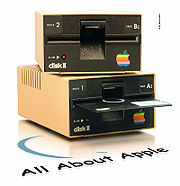
Floppy disk
A floppy disk is a disk storage medium composed of a disk of thin and flexible magnetic storage medium, sealed in a rectangular plastic carrier lined with fabric that removes dust particles...
designed by Steve Wozniak
Steve Wozniak
Stephen Gary "Woz" Wozniak is an American computer engineer and programmer who founded Apple Computer, Co. with Steve Jobs and Ronald Wayne...
and manufactured by Apple Computer
Apple Computer
Apple Inc. is an American multinational corporation that designs and markets consumer electronics, computer software, and personal computers. The company's best-known hardware products include the Macintosh line of computers, the iPod, the iPhone and the iPad...
. It was first introduced in 1978 at a retail price of US$495 for pre-order; it was later sold for $595 including the controller card
Disk controller
The disk controller is the circuit which enables the CPU to communicate with a hard disk, floppy disk or other kind of disk drive.Early disk controllers were identified by their storage methods and data encoding. They were typically implemented on a separate controller card...
and cable. The Disk II was designed specifically for use with the Apple II
Apple II
The Apple II is an 8-bit home computer, one of the first highly successful mass-produced microcomputer products, designed primarily by Steve Wozniak, manufactured by Apple Computer and introduced in 1977...
personal computer
Personal computer
A personal computer is any general-purpose computer whose size, capabilities, and original sales price make it useful for individuals, and which is intended to be operated directly by an end-user with no intervening computer operator...
family to replace the slower cassette tape storage and cannot be used with any Macintosh computer without an Apple IIe Card
Apple IIe Card
The Apple IIe Card is a compatibility card which allows compatible Macs to run software designed for Apple II computers...
.
History
Apple did not originally offer a disk drive for the Apple II, which used data cassette storage like other microcomputers of the time. Mike MarkkulaMike Markkula
Armas Clifford "Mike" Markkula, Jr. is an American entrepreneur who was an angel investor and second CEO of Apple Computer, Inc., providing early critical funding and managerial support...
asked fellow cofounder Steve Wozniak
Steve Wozniak
Stephen Gary "Woz" Wozniak is an American computer engineer and programmer who founded Apple Computer, Co. with Steve Jobs and Ronald Wayne...
to design a drive system for the computer after finding that a checkbook-balancing program Markkula had written took too long to load from tape. The first Disk II drives (A2M0003) sold were built using parts from Shugart Drives
Shugart Associates
Shugart Associates was a computer peripheral manufacturer that dominated the floppy disk drive market in the late 1970s and is famous for introducing the 5¼-inch minifloppy disk drive....
, but to reduce costs Apple switched to Alps Electric Co.
Alps Electric Co.
produces electronic devices, including potentiometers and touchpads. Alps is a multinational corporation, headquartered in Tokyo, Japan. The company was established in 1948. As of August of 2010, the CEO is Masataka Kataoka...
of Japan
Japan
Japan is an island nation in East Asia. Located in the Pacific Ocean, it lies to the east of the Sea of Japan, China, North Korea, South Korea and Russia, stretching from the Sea of Okhotsk in the north to the East China Sea and Taiwan in the south...
who built them for half the cost. Early production at Apple was handled by two people, and they produced about thirty drives a day.
Normal storage capacity per disk side was 113.75kiB with DOS 3.2.1 and earlier (13 256-byte sectors per track, 35 tracks per side), or 140kiB with DOS 3.3 and the accompanying ROM update for the controller card (16 sectors per track). The drive mechanism only contained one read/write head on the bottom, making it single sided, however it was common for users to manually flip the disk to utilize the opposite side (after cutting a second notch on the diskette's protective shell to allow write-access). Only one side could be accessed at once, but it did essentially double the capacity of each floppy diskette. The full-height drive shipped inside a beige painted metal case and connected via a 20-pin ribbon cable
Ribbon cable
A ribbon cable is a cable with many conducting wires running parallel to each other on the same flat plane. As a result the cable is wide and flat. Its name comes from the resemblance of the cable to a piece of ribbon.Ribbon cables are usually seen for internal peripherals in computers, such as...
(DB-19
DB-19
The DB-19 is a D-subminiature connector found on the Apple Macintosh, NeXT and some Atari computers, and is generally used to connect external floppy disk drives or hard drives to the computer....
adapters were eventually available for use with Apple's later connector standard). Up to 14 drives could be attached to the Apple, using 7 interface cards (2 per card). A Bell & Howell version of the Disk II was also manufactured by Apple in a black painted case which matched the color of the Bell & Howell version of the Apple II Plus which Apple was already manufacturing.
Disk III
In 1978, Apple intended to develop its own FileWareApple FileWare
FileWare floppy disk drives and diskettes were designed by Apple Computer as a higher-performance alternative to the Disk II and Disk III floppy systems used on the Apple II and Apple /// personal computers...
drive mechanism for use in the new Apple /// and Lisa
Apple Lisa
The Apple Lisa—also known as the Lisa—is a :personal computer designed by Apple Computer, Inc. during the early 1980s....
business computers being developed. They quickly ran into difficulties which precluded them from being incorporated in the Apple ///, which continued to use the earlier Shugart design.
The first variation of the Disk II introduced for the Apple ///, called the Disk /// (A3M0004), used the identical drive mechanism inside a modified plastic case with a proprietary connector. With some modification both drives are interchangeable. Though Apple sought to force the purchase of new drives with the Apple ///, many former Apple II users quickly devised a way to adapt their existing and cheaper Disk II drives, however only one external Disk II was supported in this manner. The Disk /// was the first to allow daisy chaining of up to three additional drives to the single 26 pin ribbon cable
Ribbon cable
A ribbon cable is a cable with many conducting wires running parallel to each other on the same flat plane. As a result the cable is wide and flat. Its name comes from the resemblance of the cable to a piece of ribbon.Ribbon cables are usually seen for internal peripherals in computers, such as...
connector on the Apple ///, for a total of 4 floppy disk drives – the Apple /// was the first Apple to contain a built-in drive mechanism. The Apple III Plus changed its 26-pin connector to a DB-25 connector, which required an adapter for use with the Disk III.
FileWare
In 1983 Apple announced the 860ki FileWareApple FileWare
FileWare floppy disk drives and diskettes were designed by Apple Computer as a higher-performance alternative to the Disk II and Disk III floppy systems used on the Apple II and Apple /// personal computers...
drives (UniFile and DuoFile) as a replacement for the Disk II & III, but due to the notorious unreliability of the Apple-built so-called "Twiggy" drives first used in the Lisa, the products never shipped.
3.5"
In 1985, Apple attempted to introduce a new 3.5" 800ki floppy disk format to eventually replace the Disk II format. However, the external UniDisk 3.5 drive required a ROM upgrade or a new disk controller card to be used. Many original Apple IIs could not use the new controller without further upgrades as well and therefore the 3.5" format was not widely accepted. Though Apple eventually offered a 1.44MiB SuperdriveSuperDrive
SuperDrive is a trademark used by Apple Inc. for two different storage drives: from 1988–99 to refer to a high-density floppy disk drive capable of reading all major 3.5" disk formats; and from 2001 onwards to refer to a combined CD/DVD reader/writer....
as well, the 5.25" Disk II format continued to be offered in preference alongside the newer 3.5" drives until the platform was discontinued in 1993.
DuoDisk
In 1983, along with the introduction of the Apple IIeApple IIe
The Apple IIe is the third model in the Apple II series of personal computers produced by Apple Computer. The e in the name stands for enhanced, referring to the fact that several popular features were now built-in that were only available as upgrades and add-ons in earlier models...
, Apple initially offered a combination of two, two third-height
Drive bay
A drive bay is a standard-sized area for adding hardware to a computer. Most drive bays are fixed to the inside of a case, but some can be removed....
, 143K Disk II drive mechanisms side-by-side in a single plastic case, called the DuoDisk 5.25 (A9M0108), which could not be daisy chained. The unit was designed to be stacked on top of the computer, and beneath the monitor. Each unit required its own disk controller card and the number of units was limited to the number of available slots. Originally released with a DB-25 connector, to match that of the Apple III Plus, it was the first to adopt Apple's standard DB-19 floppy drive connector.
UniDisk
Apple later introduced the UniDisk 5.25 (A9M0104) in a plastic case, which modernized the appearance of the Disk II to better match the Apple IIeApple IIe
The Apple IIe is the third model in the Apple II series of personal computers produced by Apple Computer. The e in the name stands for enhanced, referring to the fact that several popular features were now built-in that were only available as upgrades and add-ons in earlier models...
, followed by a matching Platinum-gray version which was renamed Apple 5.25 Drive (A9M0107), companion to the 800K Apple 3.5 Drive, and introduced alongside the first Platinum-colored computer the Apple IIGS
Apple IIGS
The Apple , the fifth and most powerful model in the Apple II series of personal computers produced by Apple Computer. The "GS" in the name stands for Graphics and Sound, referring to its enhanced graphics and sound capabilities, both of which greatly surpassed previous models of the line...
. Essentially it was a single half-height Disk II mechanism inside an individual drive enclosure. All of these drives introduced a daisy chain
Daisy chain
Daisy chain may refer to a daisy garland created from daisy flowers, the original meaning and the one from which the following derive by analogy:*Daisy chain *Daisy chain *Daisy chain...
pass-through port. While the drives are essentially interchangeable among Apple II computers, only the Apple 5.25 Drive can be used with the Apple IIe Card
Apple IIe Card
The Apple IIe Card is a compatibility card which allows compatible Macs to run software designed for Apple II computers...
on a Macintosh LC
Macintosh LC
The Macintosh LC was Apple Computer's product family of low-end consumer Macintosh personal computers in the early 1990s. The original Macintosh LC was released in 1990 and was the first affordable color-capable Macintosh. Due to its affordability and Apple II compatibility the LC was adopted...
.

Disk IIc
The Disk IIc (A2M4050) was a half-height 5.25-inch floppy disk driveFloppy disk
A floppy disk is a disk storage medium composed of a disk of thin and flexible magnetic storage medium, sealed in a rectangular plastic carrier lined with fabric that removes dust particles...
introduced by Apple Computer
Apple Computer
Apple Inc. is an American multinational corporation that designs and markets consumer electronics, computer software, and personal computers. The company's best-known hardware products include the Macintosh line of computers, the iPod, the iPhone and the iPad...
in 1984 styled for use alongside the Apple IIc
Apple IIc
The Apple IIc, the fourth model in the Apple II series of personal computers, was Apple Computer’s first endeavor to produce a portable computer. The end result was a notebook-sized version of the Apple II that could be transported from place to place...
personal computer, the only other Apple II to contain a built-in drive mechanism as well. The disk port on the original IIc was only designed to control an external 5.25 disk drive, and as such, this particular drive omitted a daisy-chain port in back. It was possible to use on other Apple II models, so long as it came last in the chain of drive devices (due to lacking a daisy-chain port). Essentially the same as the full-height DIsk II, it offered slightly faster access time. Apple sold the Disk IIc for US$329, and other companies later sold similar drives for less.
Apple PC 5.25" Drive
Not to be confused with the Apple 5.25 Drive (A9M0110), in 1987 Apple sought to better compete in the IBMIBM
International Business Machines Corporation or IBM is an American multinational technology and consulting corporation headquartered in Armonk, New York, United States. IBM manufactures and sells computer hardware and software, and it offers infrastructure, hosting and consulting services in areas...
dominated business market by offering a means of cross-compatibility. Alongside the release of the Macintosh SE
Macintosh SE
The Macintosh SE was a personal computer manufactured by Apple between March 1987 and October 1990. This computer marked a significant improvement on the Macintosh Plus design and was introduced by Apple at the same time as the Macintosh II....
& Macintosh II
Macintosh II
The Apple Macintosh II was the first personal computer model of the Macintosh II series in the Apple Macintosh line and the first Macintosh to support a color display.- History :...
, Apple released the Apple PC 5.25" Drive which required a separate custom PC 5.25 Floppy Disk Controller Card for each Mac, for use with industry standard 5.25" 360K formatted flexible disks. It was similar in appearance to the Disk IIc. Through the use of special Macintosh Apple File Exchange
Apple File Exchange
Apple File Exchange is a utility program for Apple Macintosh computers. It was included on the Apple "Tidbits" or "Install 2" disk in system versions 7.0 through 7.1...
utility, the drive could read and write files between Mac and MS-DOS
MS-DOS
MS-DOS is an operating system for x86-based personal computers. It was the most commonly used member of the DOS family of operating systems, and was the main operating system for IBM PC compatible personal computers during the 1980s to the mid 1990s, until it was gradually superseded by operating...
formats. Translators could convert documents between WordStar
WordStar
WordStar is a word processor application, published by MicroPro International, originally written for the CP/M operating system but later ported to DOS, that enjoyed a dominant market share during the early to mid-1980s. Although Seymour I...
and MacWrite
MacWrite
MacWrite was a word processor application released along with the first Apple Macintosh systems in 1984. It was the first such program that was widely available to the public to offer WYSIWYG operation, with multiple fonts and styles...
, among others.
Unfortunately, this drive is not compatible with any Apple II computer or the Apple IIe Card
Apple IIe Card
The Apple IIe Card is a compatibility card which allows compatible Macs to run software designed for Apple II computers...
for the Macintosh LC
Macintosh LC
The Macintosh LC was Apple Computer's product family of low-end consumer Macintosh personal computers in the early 1990s. The original Macintosh LC was released in 1990 and was the first affordable color-capable Macintosh. Due to its affordability and Apple II compatibility the LC was adopted...
, nor will it allow a Macintosh to read or write to 5.25" Apple II formatted disks. This drive was made obsolete by the industry-wide wide adoption of 3.5" disks and was replaced by the Apple FDHD Drive which could not only read and write DOS
MS-DOS
MS-DOS is an operating system for x86-based personal computers. It was the most commonly used member of the DOS family of operating systems, and was the main operating system for IBM PC compatible personal computers during the 1980s to the mid 1990s, until it was gradually superseded by operating...
and Windows
Microsoft Windows
Microsoft Windows is a series of operating systems produced by Microsoft.Microsoft introduced an operating environment named Windows on November 20, 1985 as an add-on to MS-DOS in response to the growing interest in graphical user interfaces . Microsoft Windows came to dominate the world's personal...
formats, but the Apple II ProDOS format as well. It is the only 5.25" drive manufactured by Apple exclusively for, and that can be used by the Macintosh.
Disk II Cable Pinout
This table shows the pinout of the original 1979 Disk II controller and newer 1983 Uni/Duo Disk I/O controller (655-0101).The circuitry of these two controllers are identical. The Disk II header pin numbering is per the Disk II controller card silkscreen and the circuit schematic given in the DOS 3.3 manual. The Uni/Duo Disk D-19 pinout is taken from the Apple //c Reference Manual, Volume 1.
| Disk II Header Pin | Uni/Duo Disk D-19 Pin | Uni/Duo Controller Card Cable Color | Signal Name | Description |
|---|---|---|---|---|
| 1,3,5,7 | 1,2,3,4 | Brown,Orange,Green,Violet | GND | Ground reference and supply |
| 2 | 11 | Red | SEEKPH0 | Phase 0 stepper motor signal |
| 4 | 12 | Yellow | SEEKPH1 | Phase 1 stepper motor signal |
| 6 | 13 | Blue | SEEKPH2 | Phase 2 stepper motor signal |
| 8 | 14 | Grey | SEEKPH3 | Phase 3 stepper motor signal |
| 9 | 5 | White | ||
| 10 | 15 | Black | WRREQ* | Write request signal |
| 11,12 | 6,16 | Brown,Red | ||
| 13,15,17,19 | 7,8 | Orange,Green | ||
| 14 | 17 | Yellow | DR2* (ENABLE*) | Drive 2 select/Drive enable signal |
| 16 | 18 | Blue | RDDATA | Read data signal |
| 18 | 19 | Grey | WRDATA | Write data signal |
| 20 | 10 | White | WRPROT | Write protect signal |
| x | 9 | Violet | EXINT* | External interrupt |
NOTES:
- Active low signals are suffixed with a "*"
- Since most signals are shared with both drive 1 and drive 2, the logic in each drive uses the ENABLE* signal to activate appropriately.
- Pin 14 for Disk II drive 1 and drive 2 have separate enable signals (14a and 14b)
- Pin 17 for Uni/Duo Disk is chained to first drive (drive 1) and second drive (drive 2) is enabled via other logic in the first drive.
- The EXTINT* signal is not present on the Disk II controller card. In the Apple //c computer, it is routed to the DSR* signal of the internal 6551 ACIA (UART) chip.
See also
- Macintosh External Disk DriveMacintosh External Disk DriveThe Macintosh External Disk Drive was the original of a series of external 3.5" floppy disk drives manufactured and sold by Apple Computer exclusively for the Macintosh series of computers introduced in January, 1984. Later, Apple would unify their external drives to work cross-platform between the...
- Apple ProFileApple ProFileThe ProFile was the first hard drive produced by Apple Computer, initially for use with the Apple III personal computer. The original model had a formatted capacity of 5 MB and connected to a special interface card that plugged into an Apple III slot...
External hard disk - List of Apple drives
- List of products discontinued by Apple Computer