

Apple III

Encyclopedia
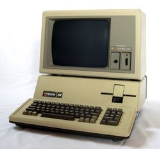
The Apple III is a business-oriented personal computer produced and released by Apple Computer that was intended as the successor to the Apple II series
, but largely considered a failure in the market. Development work on the Apple III started in late 1978 under the guidance of Dr. Wendell Sander. It had the internal code name of "Sara", named after Sander's daughter.
The machine was first announced and released on May 19, 1980, but due to serious stability issues that required a design overhaul and a recall of existing machines, it was formally reintroduced the following autumn. Development stopped and the Apple III was discontinued on April 24, 1984, and the III Plus was dropped from the Apple product line in September 1985.
The Apple III could be viewed as an enhanced Apple II – then the newest heir to a line of 8-bit
machines dating back to 1976. Officially, however, the Apple III was not part of the Apple II line, but rather a close cousin. In 1981, International Business Machines unveiled the IBM Personal Computer (IBM PC) – a completely new 16-bit
design soon available in a wide range of inexpensive clones. The business market moved rapidly towards the PC-DOS
/MS-DOS
platform, eventually pulling away from the Apple 8-bit computer line. Despite numerous stability issues and recalls, Apple was eventually able to produce a reliable and dependable version of the machine. However, damage to the computer's reputation had already been done and it failed to do well commercially as a direct result. In the end, an estimated 65,000–75,000 Apple III computers were sold. The Apple III Plus brought this up to ~120,000. Apple co-founder Steve Wozniak
stated that the primary reason for the Apple III's failure was that the system was designed by Apple's marketing department, unlike Apple's previous engineering-driven projects. The Apple III's failure led to Apple reevaluating their plan to phase out the Apple II and eventually continued on with its development. As a result, later Apple II models incorporated some hardware and software technologies of the Apple III.
Apple III design
The Apple III was designed to be a business computer and an eventual successor for the Apple II. While the Apple II contributed to the inspirations of several important business products, such as VisiCalc
, Multiplan
and Apple Writer
, the computer's hardware architecture, operating system
and developer environment were limited. The Apple III addressed these weaknesses.
The Apple III was powered by a 1.8 MHz SynerTek 6502A or B 8-bit
CPU
and, like some of the more advanced machines in the Apple II family, used bank switching
techniques to address up to 256 KB of memory. Third-party vendors also produced memory upgrade kits that allowed the Apple III to reach up to 512 KB. Other Apple III built-in features included an 80-column display with upper and lowercase characters, a numeric keypad, dual-speed (pressure sensitive) cursor control keys, 6-bit (DAC) audio, 16-color high-resolution graphics, and a built-in 140 KB 5.25" floppy disk
drive. Unlike the Apple II, the Disk III controller was built into the logic board.
The Apple III was the first Apple product that allowed the user to choose both a screen font and a keyboard layout: either QWERTY
or Dvorak
. These choices could not be changed while programs were running, unlike the Apple IIc
, which had a keyboard switch directly above the keyboard, allowing switching on the fly.
Software
A major limitation of the Apple II and DOS 3.3 was the way it addressed resources, which forced peripherals to be installed in pre-determined locations (slot 5 and 6 reserved for storage devices, slot 2 reserved for serial communication interfaces, etc.) This forced the user to identify a peripheral by its physical location, such as PR#6, CATALOG,D1, and so on. The Apple III introduced an advanced operating system called Apple SOS, pronounced "apple sauce". Its ability to address resources by name instead of a physical location allowed the Apple III to be more scalable. Apple SOS also allowed the full capacity of a storage device to be used as a single volume, such as the Apple ProFile
hard disk drive. Also, Apple SOS supported a hierarchical file system (HFS). Some of the features and code base of Apple SOS made their way into the Apple II's ProDOS
and GS/OS
operating systems, as well as Lisa 7/7
and Macintosh system software.
The Apple III also introduced a new BASIC interpreter
called Apple III Business BASIC
, and later an implementation of UCSD Pascal
for more structured programming
.
Originally intended as a direct replacement to the Apple II series, it was designed for backwards-compatibility of Apple II software in order to migrate users over. However, since Apple did not want to encourage continued development of the II platform, Apple II compatibility on the Apple III existed only in a special "Apple II Mode" which was limited in its capabilities to the emulation of a basic 48 KB Apple II+ configuration, with no access to the III's advanced features such as its larger memory, a restriction which actually required custom chips to enforce. Since many business-oriented Apple II programs started requiring at least 64 KB of RAM (i.e. an 48 KB Apple II with an added 16 KB "language card") around the time the III was released, they were incompatible with the III, preventing some users from switching over.
The Apple III had a System Utilities program, which allowed system reconfiguration and file manipulation. Another program, Selector III, was designed to integrate with the System Utilities program and launch various applications. The program was developed by ON THREE, a large Apple III user group. Another company, Quark Software
, developed a competing product, Catalyst, the cruder interface of which was offset by program-switching capabilities and support for copy-protection, which enabled companies to license users to run programs from a hard disk without worrying that their software might be backed up or copied without permission. When Apple decided to bundle Catalyst with its new ProFile
hard disk, Quark celebrated, but ON THREE continued to market and sell Selector III through their monthly magazine. Selector III remained commercially available and supported long after Quark discontinued its Apple III product line.
Peripherals
Several new Apple-produced peripherals were developed for the Apple III. The original Apple III came with a built-in real-time clock, which was recognized by Apple SOS. The clock was later removed from the "revised" and "Plus" models, and instead was made available as an add-on.
Along with the built-in floppy drive, the Apple III could also handle up to three additional external Disk III floppy disk drives. The Disk III was only officially compatible with the Apple III, although the Apple III was able to use the Apple II's modified Disk II
disk drive and vice-versa.
With the introduction of the revised Apple III a year after launch Apple began offering the ProFile
external hard disk system. Costing US$3499 for 5MB, it also required a peripheral slot for the ProFile controller card.
Revisions
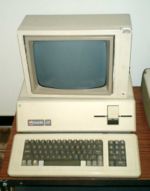 Once the logic board design flaws were discovered, a newer logic board design was produced – which included a lower power requirement, wider traces and better designed chip sockets. The $3,495 revised model also included 256 KB RAM as a standard configuration. The 14,000 units of the original Apple III sold were returned and replaced with the entirely new revised model.
.
Owners of the earlier Apple III could obtain the newer logic board as a service replacement. A keyboard upgrade kit, dubbed "Apple III Plus upgrade kit" was also made available – which included the keyboard, cover, keyboard encoder ROM and logo replacements. This upgrade had to be installed by an authorized service technician.
Design flaws
Steve Jobs
insisted on the idea of no fan or air vents – in order to make the computer run quietly. Jobs would later push this same ideology onto almost all Apple models he had control of – from the Apple Lisa
and Macintosh 128K
to the iMac
. To allow the computer to dissipate heat, the base of the Apple III was made of heavy cast aluminum, which supposedly acted as a heat sink. And, unlike the Apple II series, the power supply was stored – without its own shell – in a compartment separate from the logic board.
However, many Apple III's experienced heating issues, allegedly caused by insufficient cooling and inability to dissipate the heat efficiently. To address the heat problem, later Apple III's were fitted with heat sinks. But still, the case design made it impossible for enough heat to escape. Some users stated that their Apple III became so hot that the chips started dislodging from the board, the screen would display garbled data, or their disk
would come out of the slot "melted". In a technical bulletin, customers who were experiencing certain problems were instructed to lift the machine 3 inches (76.2 mm) and drop it in order to re-seat the chips on the logic board. Jerry Manock
, the case designer, refuted these case design flaw charges and maintained that the unit adequately dissipated the internal heat, which he proved with various tests.
In the end, Manock was vindicated, as the primary culprit turned out to be a major logic board design problem. The logic board used "fineline" technology that was not fully mature at the time, with narrow, closely spaced traces. When chips were "stuffed" into the board and wave-soldered
, solder bridges would form between traces that were not supposed to be connected. This caused numerous short circuits, which required hours of costly diagnosis and hand rework to fix. Apple designed a new circuit board – with more layers and normal-width traces. The new logic board was designed by one designer on a huge drafting board, rather than a costly CAD
-CAM
system used for the previous board, and it worked.
Earlier Apple III units came with a built-in real time clock, manufactured by National Semiconductor
. The hardware, however, would fail after prolonged use. While it was assumed that a vendor would test parts before shipping them, Apple did not perform this level of testing. Apple was soldering chips directly to boards and could not easily change out a bad chip if one was found. Eventually, Apple solved this problem by removing the real-time clock from the Apple III's specification, rather than shipping the Apple III with the clock pre-installed, and sold the peripheral as a level 1 technician add-on.
Commercial failure
For a variety of reasons, the Apple III was a commercial failure. With a starting price between $4,340 to $7,800 US, it was more expensive than many of the CP/M
-based business computers that were available at the time. The Apple III's software library was very limited, and while sold as Apple II compatible, the emulation that made this possible was intentionally hobbled; thus it could not make use of the advanced III features (specifically 64 KB RAM or higher, required by a large number of Apple II software titles based on PASCAL), which limited its usefulness.
Influence
The filesystem and some design ideas from Apple SOS, the Apple III's operating system, were part of Apple ProDOS and Apple GS/OS, the major operating systems for the Apple II series
following the demise of the Apple III. This hierarchical file system influenced the evolution of the Macintosh: while the original Macintosh File System (MFS) was a flat file system without subdirectories, subsequent file systems were hierarchical. Curiously, The IBM PC
's first file system (designed for floppy disks) was flat; later versions (designed for hard disks) were hierarchical.
External links
Apple II series
The Apple II series is a set of 8-bit home computers, one of the first highly successful mass-produced microcomputer products, designed primarily by Steve Wozniak, manufactured by Apple Computer and introduced in 1977 with the original Apple II...
, but largely considered a failure in the market. Development work on the Apple III started in late 1978 under the guidance of Dr. Wendell Sander. It had the internal code name of "Sara", named after Sander's daughter.
The machine was first announced and released on May 19, 1980, but due to serious stability issues that required a design overhaul and a recall of existing machines, it was formally reintroduced the following autumn. Development stopped and the Apple III was discontinued on April 24, 1984, and the III Plus was dropped from the Apple product line in September 1985.
The Apple III could be viewed as an enhanced Apple II – then the newest heir to a line of 8-bit
8-bit
The first widely adopted 8-bit microprocessor was the Intel 8080, being used in many hobbyist computers of the late 1970s and early 1980s, often running the CP/M operating system. The Zilog Z80 and the Motorola 6800 were also used in similar computers...
machines dating back to 1976. Officially, however, the Apple III was not part of the Apple II line, but rather a close cousin. In 1981, International Business Machines unveiled the IBM Personal Computer (IBM PC) – a completely new 16-bit
16-bit
-16-bit architecture:The HP BPC, introduced in 1975, was the world's first 16-bit microprocessor. Prominent 16-bit processors include the PDP-11, Intel 8086, Intel 80286 and the WDC 65C816. The Intel 8088 was program-compatible with the Intel 8086, and was 16-bit in that its registers were 16...
design soon available in a wide range of inexpensive clones. The business market moved rapidly towards the PC-DOS
PC-DOS
IBM PC DOS is a DOS system for the IBM Personal Computer and compatibles, manufactured and sold by IBM from the 1980s to the 2000s....
/MS-DOS
MS-DOS
MS-DOS is an operating system for x86-based personal computers. It was the most commonly used member of the DOS family of operating systems, and was the main operating system for IBM PC compatible personal computers during the 1980s to the mid 1990s, until it was gradually superseded by operating...
platform, eventually pulling away from the Apple 8-bit computer line. Despite numerous stability issues and recalls, Apple was eventually able to produce a reliable and dependable version of the machine. However, damage to the computer's reputation had already been done and it failed to do well commercially as a direct result. In the end, an estimated 65,000–75,000 Apple III computers were sold. The Apple III Plus brought this up to ~120,000. Apple co-founder Steve Wozniak
Steve Wozniak
Stephen Gary "Woz" Wozniak is an American computer engineer and programmer who founded Apple Computer, Co. with Steve Jobs and Ronald Wayne...
stated that the primary reason for the Apple III's failure was that the system was designed by Apple's marketing department, unlike Apple's previous engineering-driven projects. The Apple III's failure led to Apple reevaluating their plan to phase out the Apple II and eventually continued on with its development. As a result, later Apple II models incorporated some hardware and software technologies of the Apple III.
Apple III design
The Apple III was designed to be a business computer and an eventual successor for the Apple II. While the Apple II contributed to the inspirations of several important business products, such as VisiCalc
VisiCalc
VisiCalc was the first spreadsheet program available for personal computers. It is often considered the application that turned the microcomputer from a hobby for computer enthusiasts into a serious business tool...
, Multiplan
MultiPlan
Multiplan was an early spreadsheet program developed by Microsoft. Known initially by the code name "EP" , it was introduced in 1982 as a competitor for VisiCalc....
and Apple Writer
Apple Writer
Apple Writer is a word processor for the Apple II family of personal computers. It was created by programmer and former NASA engineer Paul Lutus and published in 1979 by Apple Computer.-Apple Writer 1.0:...
, the computer's hardware architecture, operating system
Operating system
An operating system is a set of programs that manage computer hardware resources and provide common services for application software. The operating system is the most important type of system software in a computer system...
and developer environment were limited. The Apple III addressed these weaknesses.
The Apple III was powered by a 1.8 MHz SynerTek 6502A or B 8-bit
8-bit
The first widely adopted 8-bit microprocessor was the Intel 8080, being used in many hobbyist computers of the late 1970s and early 1980s, often running the CP/M operating system. The Zilog Z80 and the Motorola 6800 were also used in similar computers...
CPU
Central processing unit
The central processing unit is the portion of a computer system that carries out the instructions of a computer program, to perform the basic arithmetical, logical, and input/output operations of the system. The CPU plays a role somewhat analogous to the brain in the computer. The term has been in...
and, like some of the more advanced machines in the Apple II family, used bank switching
Bank switching
Bank switching is a technique to increase the amount of usable memory beyond the amount directly addressable by the processor. It can be used to configure a system differently at different times; for example, a ROM required to start a system from diskette could be switched out when no longer...
techniques to address up to 256 KB of memory. Third-party vendors also produced memory upgrade kits that allowed the Apple III to reach up to 512 KB. Other Apple III built-in features included an 80-column display with upper and lowercase characters, a numeric keypad, dual-speed (pressure sensitive) cursor control keys, 6-bit (DAC) audio, 16-color high-resolution graphics, and a built-in 140 KB 5.25" floppy disk
Floppy disk
A floppy disk is a disk storage medium composed of a disk of thin and flexible magnetic storage medium, sealed in a rectangular plastic carrier lined with fabric that removes dust particles...
drive. Unlike the Apple II, the Disk III controller was built into the logic board.
The Apple III was the first Apple product that allowed the user to choose both a screen font and a keyboard layout: either QWERTY
QWERTY
QWERTY is the most common modern-day keyboard layout. The name comes from the first six letters appearing in the topleft letter row of the keyboard, read left to right: Q-W-E-R-T-Y. The QWERTY design is based on a layout created for the Sholes and Glidden typewriter and sold to Remington in the...
or Dvorak
Dvorak Simplified Keyboard
The Dvorak Simplified Keyboard is a keyboard layout patented in 1936 by Dr. August Dvorak and his brother-in-law, Dr. William Dealey. Over the years several slight variations were designed by the team led by Dvorak or by ANSI...
. These choices could not be changed while programs were running, unlike the Apple IIc
Apple IIc
The Apple IIc, the fourth model in the Apple II series of personal computers, was Apple Computer’s first endeavor to produce a portable computer. The end result was a notebook-sized version of the Apple II that could be transported from place to place...
, which had a keyboard switch directly above the keyboard, allowing switching on the fly.
Software
A major limitation of the Apple II and DOS 3.3 was the way it addressed resources, which forced peripherals to be installed in pre-determined locations (slot 5 and 6 reserved for storage devices, slot 2 reserved for serial communication interfaces, etc.) This forced the user to identify a peripheral by its physical location, such as PR#6, CATALOG,D1, and so on. The Apple III introduced an advanced operating system called Apple SOS, pronounced "apple sauce". Its ability to address resources by name instead of a physical location allowed the Apple III to be more scalable. Apple SOS also allowed the full capacity of a storage device to be used as a single volume, such as the Apple ProFile
Apple ProFile
The ProFile was the first hard drive produced by Apple Computer, initially for use with the Apple III personal computer. The original model had a formatted capacity of 5 MB and connected to a special interface card that plugged into an Apple III slot...
hard disk drive. Also, Apple SOS supported a hierarchical file system (HFS). Some of the features and code base of Apple SOS made their way into the Apple II's ProDOS
ProDOS
ProDOS was the name of two similar operating systems for the Apple II series of personal computers. The original ProDOS, renamed ProDOS 8 in version 1.2, was the last official operating system usable by all Apple II series computers, and was distributed from 1983 to 1993...
and GS/OS
GS/OS
GS/OS is an operating environment developed by Apple Computer for its Apple IIGS personal computer that uses the ProDOS filing system. It provides facilities for accessing the file system, controlling input/output devices, loading and running program files, and a system allowing programs to handle...
operating systems, as well as Lisa 7/7
Apple Lisa
The Apple Lisa—also known as the Lisa—is a :personal computer designed by Apple Computer, Inc. during the early 1980s....
and Macintosh system software.
The Apple III also introduced a new BASIC interpreter
Interpreter (computing)
In computer science, an interpreter normally means a computer program that executes, i.e. performs, instructions written in a programming language...
called Apple III Business BASIC
Business Basic
Business Basic is the name given collectively to variants of the BASIC computer programming language which were specialised for business use on minicomputers in the 1970s and 1980s...
, and later an implementation of UCSD Pascal
UCSD Pascal
UCSD Pascal was a Pascal programming language system that ran on the UCSD p-System, a portable, highly machine-independent operating system. UCSD Pascal was first released in 1978...
for more structured programming
Structured programming
Structured programming is a programming paradigm aimed on improving the clarity, quality, and development time of a computer program by making extensive use of subroutines, block structures and for and while loops - in contrast to using simple tests and jumps such as the goto statement which could...
.
Originally intended as a direct replacement to the Apple II series, it was designed for backwards-compatibility of Apple II software in order to migrate users over. However, since Apple did not want to encourage continued development of the II platform, Apple II compatibility on the Apple III existed only in a special "Apple II Mode" which was limited in its capabilities to the emulation of a basic 48 KB Apple II+ configuration, with no access to the III's advanced features such as its larger memory, a restriction which actually required custom chips to enforce. Since many business-oriented Apple II programs started requiring at least 64 KB of RAM (i.e. an 48 KB Apple II with an added 16 KB "language card") around the time the III was released, they were incompatible with the III, preventing some users from switching over.
The Apple III had a System Utilities program, which allowed system reconfiguration and file manipulation. Another program, Selector III, was designed to integrate with the System Utilities program and launch various applications. The program was developed by ON THREE, a large Apple III user group. Another company, Quark Software
Quark, Inc.
Quark, Inc. is a privately owned software company best known for QuarkXPress. It is called Quark because the company's goal is to "create software that would be the platform for publishing", just as quarks are the basis for all matter.As of August 2011, Quark's offerings include:* QuarkXPress -...
, developed a competing product, Catalyst, the cruder interface of which was offset by program-switching capabilities and support for copy-protection, which enabled companies to license users to run programs from a hard disk without worrying that their software might be backed up or copied without permission. When Apple decided to bundle Catalyst with its new ProFile
Profile
- Computing and technology :* Profile , a concept in Unified Modeling Language* Apple ProFile, a hard drive* User profile refers to the computer representation of user information...
hard disk, Quark celebrated, but ON THREE continued to market and sell Selector III through their monthly magazine. Selector III remained commercially available and supported long after Quark discontinued its Apple III product line.
Peripherals
Several new Apple-produced peripherals were developed for the Apple III. The original Apple III came with a built-in real-time clock, which was recognized by Apple SOS. The clock was later removed from the "revised" and "Plus" models, and instead was made available as an add-on.
Along with the built-in floppy drive, the Apple III could also handle up to three additional external Disk III floppy disk drives. The Disk III was only officially compatible with the Apple III, although the Apple III was able to use the Apple II's modified Disk II
Disk II
The Disk II Floppy Disk Subsystem was a 5¼-inch floppy disk drive designed by Steve Wozniak and manufactured by Apple Computer. It was first introduced in 1978 at a retail price of US$495 for pre-order; it was later sold for $595 including the controller card and cable...
disk drive and vice-versa.
With the introduction of the revised Apple III a year after launch Apple began offering the ProFile
Profile
- Computing and technology :* Profile , a concept in Unified Modeling Language* Apple ProFile, a hard drive* User profile refers to the computer representation of user information...
external hard disk system. Costing US$3499 for 5MB, it also required a peripheral slot for the ProFile controller card.
Revisions
Apple III Plus
The Apple III Plus was introduced in December 1983, while discontinuing the revised III model, at a price of US$2995. This newer version included a built-in clock, video interlacing, standardized rear port connectors, 256K RAM as standard, and a re-designed keyboard. The keyboard was designed in the style of the earlier beige Apple IIeApple IIe
The Apple IIe is the third model in the Apple II series of personal computers produced by Apple Computer. The e in the name stands for enhanced, referring to the fact that several popular features were now built-in that were only available as upgrades and add-ons in earlier models...
.
Owners of the earlier Apple III could obtain the newer logic board as a service replacement. A keyboard upgrade kit, dubbed "Apple III Plus upgrade kit" was also made available – which included the keyboard, cover, keyboard encoder ROM and logo replacements. This upgrade had to be installed by an authorized service technician.
Design flaws
Steve Jobs
Steve Jobs
Steven Paul Jobs was an American businessman and inventor widely recognized as a charismatic pioneer of the personal computer revolution. He was co-founder, chairman, and chief executive officer of Apple Inc...
insisted on the idea of no fan or air vents – in order to make the computer run quietly. Jobs would later push this same ideology onto almost all Apple models he had control of – from the Apple Lisa
Apple Lisa
The Apple Lisa—also known as the Lisa—is a :personal computer designed by Apple Computer, Inc. during the early 1980s....
and Macintosh 128K
Macintosh 128K
The Macintosh 128K machine, released as the "Apple Macintosh", was the original Apple Macintosh personal computer. Its beige case contained a monitor and came with a keyboard and mouse. An indentation in the top of the case made it easier for the computer to be lifted and carried. It had a selling...
to the iMac
IMac
The iMac is a range of all-in-one Macintosh desktop computers built by Apple. It has been the primary part of Apple's consumer desktop offerings since its introduction in 1998, and has evolved through five distinct forms....
. To allow the computer to dissipate heat, the base of the Apple III was made of heavy cast aluminum, which supposedly acted as a heat sink. And, unlike the Apple II series, the power supply was stored – without its own shell – in a compartment separate from the logic board.
However, many Apple III's experienced heating issues, allegedly caused by insufficient cooling and inability to dissipate the heat efficiently. To address the heat problem, later Apple III's were fitted with heat sinks. But still, the case design made it impossible for enough heat to escape. Some users stated that their Apple III became so hot that the chips started dislodging from the board, the screen would display garbled data, or their disk
Floppy disk
A floppy disk is a disk storage medium composed of a disk of thin and flexible magnetic storage medium, sealed in a rectangular plastic carrier lined with fabric that removes dust particles...
would come out of the slot "melted". In a technical bulletin, customers who were experiencing certain problems were instructed to lift the machine 3 inches (76.2 mm) and drop it in order to re-seat the chips on the logic board. Jerry Manock
Jerry Manock
Jerrold C. Manock is an American industrial designer. He worked for Apple Computer from 1977 to 1984, contributing to housing designs for the Apple II, Apple III, and earlier compact Apple Macintosh computers. Manock is widely regarded as the "father" of the Apple Industrial Design Group...
, the case designer, refuted these case design flaw charges and maintained that the unit adequately dissipated the internal heat, which he proved with various tests.
In the end, Manock was vindicated, as the primary culprit turned out to be a major logic board design problem. The logic board used "fineline" technology that was not fully mature at the time, with narrow, closely spaced traces. When chips were "stuffed" into the board and wave-soldered
Wave soldering
Wave soldering is a large-scale soldering process by which electronic components are soldered to a printed circuit board to form an electronic assembly. The name is derived from the use of waves of molten solder to attach metal components to the PCB...
, solder bridges would form between traces that were not supposed to be connected. This caused numerous short circuits, which required hours of costly diagnosis and hand rework to fix. Apple designed a new circuit board – with more layers and normal-width traces. The new logic board was designed by one designer on a huge drafting board, rather than a costly CAD
Computer-aided design
Computer-aided design , also known as computer-aided design and drafting , is the use of computer technology for the process of design and design-documentation. Computer Aided Drafting describes the process of drafting with a computer...
-CAM
Computer-aided manufacturing
Computer-aided manufacturing is the use of computer software to control machine tools and related machinery in the manufacturing of workpieces. This is not the only definition for CAM, but it is the most common; CAM may also refer to the use of a computer to assist in all operations of a...
system used for the previous board, and it worked.
Earlier Apple III units came with a built-in real time clock, manufactured by National Semiconductor
National Semiconductor
National Semiconductor was an American semiconductor manufacturer, that specialized in analog devices and subsystems,formerly headquartered in Santa Clara, California, USA. The products of National Semiconductor included power management circuits, display drivers, audio and operational amplifiers,...
. The hardware, however, would fail after prolonged use. While it was assumed that a vendor would test parts before shipping them, Apple did not perform this level of testing. Apple was soldering chips directly to boards and could not easily change out a bad chip if one was found. Eventually, Apple solved this problem by removing the real-time clock from the Apple III's specification, rather than shipping the Apple III with the clock pre-installed, and sold the peripheral as a level 1 technician add-on.
Commercial failure
For a variety of reasons, the Apple III was a commercial failure. With a starting price between $4,340 to $7,800 US, it was more expensive than many of the CP/M
CP/M
CP/M was a mass-market operating system created for Intel 8080/85 based microcomputers by Gary Kildall of Digital Research, Inc...
-based business computers that were available at the time. The Apple III's software library was very limited, and while sold as Apple II compatible, the emulation that made this possible was intentionally hobbled; thus it could not make use of the advanced III features (specifically 64 KB RAM or higher, required by a large number of Apple II software titles based on PASCAL), which limited its usefulness.
Influence
The filesystem and some design ideas from Apple SOS, the Apple III's operating system, were part of Apple ProDOS and Apple GS/OS, the major operating systems for the Apple II series
Apple II series
The Apple II series is a set of 8-bit home computers, one of the first highly successful mass-produced microcomputer products, designed primarily by Steve Wozniak, manufactured by Apple Computer and introduced in 1977 with the original Apple II...
following the demise of the Apple III. This hierarchical file system influenced the evolution of the Macintosh: while the original Macintosh File System (MFS) was a flat file system without subdirectories, subsequent file systems were hierarchical. Curiously, The IBM PC
IBM PC
The IBM Personal Computer, commonly known as the IBM PC, is the original version and progenitor of the IBM PC compatible hardware platform. It is IBM model number 5150, and was introduced on August 12, 1981...
's first file system (designed for floppy disks) was flat; later versions (designed for hard disks) were hierarchical.
External links