
All Topics  
Usenet


   Email Print
   Bookmark   Link


Usenet


Usenet, a portmanteau of "user" and "network", is a worldwide distributed Internet
Internet

The Internet is a global network of interconnected computers, enabling users to share information along multiple channels. Typically, a computer that connects to the Internet can access information from a vast array of available server and other computers by moving information from them to the computer's local memory....
 discussion system. It evolved from the general purpose UUCP
UUCP

UUCP is an abbreviation for Unix to Unix Copy Program. The term generally refers to a suite of computer programs and communications protocols allowing remote execution of commands and transfer of Computer files, email and netnews between computers....
 architecture of the same name.

It was conceived by Duke University
Duke University

Duke University is a private university research university located in Durham, North Carolina, North Carolina, United States. Founded by Methodism and Religious Society of Friends in the present-day town of Trinity, North Carolina in 1838, the school moved to Durham in 1892....
 graduate students Tom Truscott
Tom Truscott

Tom Truscott is a computer scientist best known for creating Usenet with Jim Ellis , when both were graduate students at Duke University. He is also a member of Association for Computing Machinery, IEEE, and Sigma Xi....
 and Jim Ellis
Jim Ellis (computing)

James Tice Ellis was a computer scientist best known as the co-creator of Usenet, along with Tom Truscott.Born in Nashville, Tennessee, Ellis grew up in Orlando, Florida....
 in 1979. Users read and post public messages (called articles or posts, and collectively termed news) to one or more categories, known as newsgroup
Newsgroup

A newsgroup is a repository usually within the Usenet system, for messages Posting style from many users in different locations. The term may be confusing to some, because it is usually a discussion group....
s
.


Discussion
Ask a question about 'Usenet'
Start a new discussion about 'Usenet'
Answer questions from other users
Full Discussion Forum


Recent Posts


Encyclopedia


Usenet, a portmanteau of "user" and "network", is a worldwide distributed Internet
Internet

The Internet is a global network of interconnected computers, enabling users to share information along multiple channels. Typically, a computer that connects to the Internet can access information from a vast array of available server and other computers by moving information from them to the computer's local memory....
 discussion system. It evolved from the general purpose UUCP
UUCP

UUCP is an abbreviation for Unix to Unix Copy Program. The term generally refers to a suite of computer programs and communications protocols allowing remote execution of commands and transfer of Computer files, email and netnews between computers....
 architecture of the same name.

It was conceived by Duke University
Duke University

Duke University is a private university research university located in Durham, North Carolina, North Carolina, United States. Founded by Methodism and Religious Society of Friends in the present-day town of Trinity, North Carolina in 1838, the school moved to Durham in 1892....
 graduate students Tom Truscott
Tom Truscott

Tom Truscott is a computer scientist best known for creating Usenet with Jim Ellis , when both were graduate students at Duke University. He is also a member of Association for Computing Machinery, IEEE, and Sigma Xi....
 and Jim Ellis
Jim Ellis (computing)

James Tice Ellis was a computer scientist best known as the co-creator of Usenet, along with Tom Truscott.Born in Nashville, Tennessee, Ellis grew up in Orlando, Florida....
 in 1979. Users read and post public messages (called articles or posts, and collectively termed news) to one or more categories, known as newsgroup
Newsgroup

A newsgroup is a repository usually within the Usenet system, for messages Posting style from many users in different locations. The term may be confusing to some, because it is usually a discussion group....
s
. Usenet resembles bulletin board system
Bulletin board system

File:Monochrome-bbs.pngA Bulletin Board System, or BBS, is a computer system running list of BBS software that allows User to Telecommunication circuit and Logging to the system using a terminal program....
s (BBS) in most respects, and is the precursor to the various web forums which are widely used today; and can be superficially regarded as a hybrid between Email and web forums. Discussions are threaded
Threaded discussion

A threaded discussion is an electronic discussion in which the software aids the user by visually grouping messages. Messages are usually grouped visually in a hierarchy by topic....
, with modern news reader software, as with web forums and BBSes, though posts are stored on the server sequentially.

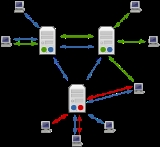
One notable difference from a BBS or web forum is that there is no central server, nor central system owner. Usenet is distributed among a large, constantly changing conglomeration of servers which store and forward messages to one another. These servers are loosely connected in a variable mesh
Mesh networking

Mesh networking is a way to route data, voice and instructions between node . It allows for continuous connections and reconfiguration around broken or blocked paths by ?hopping? from node to node until the destination is reached....
. Individual users usually read from and post messages to a local server operated by their ISP
Internet service provider

An Internet service provider is a company that offers its customers access to the Internet. The ISP connects to its customers using a data transmission technology appropriate for delivering Internet Protocol datagrams, such as dial-up, DSL, cable modem or dedicated high-speed interconnects....
, university or employer. The servers then exchange the messages between one another, so that they are available to readers beyond the original server.

Introduction

Usenet is one of the oldest computer network
Computer network

A computer network is a group of interconnected computers. Networks may be classified according to a wide variety of characteristics. This article provides a general overview of some types and categories and also presents the basic components of a network....
 communications systems still in widespread use. It was established in 1980, following experiments from the previous year, over a decade before the World Wide Web
World Wide Web

The World Wide Web is a very large set of interlinked hypertext documents accessed via the Internet. With a Web browser, one can view Web pages that may contain writing, s, videos, and other multimedia and navigate between them using hyperlinks....
 was introduced and the general public got access to the Internet. It was originally conceived as a "poor man's ARPANET
ARPANET

The ARPANET developed by Defense Advanced Research Projects Agency of the United States Department of Defense during the Cold War, was the world's first operational packet switching network, and the predecessor of the global Internet....
," employing UUCP
UUCP

UUCP is an abbreviation for Unix to Unix Copy Program. The term generally refers to a suite of computer programs and communications protocols allowing remote execution of commands and transfer of Computer files, email and netnews between computers....
 to offer mail and file transfers, as well as announcements through the newly developed news software
A News

A News, originally known simply as "news," was the first widely distributed program for serving and reading Usenet newsgroups. The program, written at Duke University by Steve Daniel and Tom Truscott, was released on a tape given out at the June 1980 USENIX conference held at the University of Delaware....
. This system, developed at University of North Carolina at Chapel Hill
University of North Carolina at Chapel Hill

The University of North Carolina at Chapel Hill is a public university research university located in Chapel Hill, North Carolina, North Carolina, United States....
 and Duke University
Duke University

Duke University is a private university research university located in Durham, North Carolina, North Carolina, United States. Founded by Methodism and Religious Society of Friends in the present-day town of Trinity, North Carolina in 1838, the school moved to Durham in 1892....
, was called USENET to emphasize its creators' hope that the USENIX
USENIX

The USENIX Association is the Advanced Computing Technical Association. It was founded in 1975 under the name "Unix Users Group," focusing primarily on the study and development of Unix and similar systems....
 organization would take an active role in its operation (Daniel et al., 1980).

The articles that users post to Usenet are organized into topical categories called newsgroup
Newsgroup

A newsgroup is a repository usually within the Usenet system, for messages Posting style from many users in different locations. The term may be confusing to some, because it is usually a discussion group....
s, which are themselves logically organized into hierarchies of subjects. For instance, [news:sci.math sci.math] and [news:sci.physics sci.physics] are within the sci hierarchy, for science. When a user subscribes to a newsgroup, the news client
News client

A newsreader is an application software that reads articles on Usenet , either directly from the news server's disks or via the Network News Transfer Protocol ....
 software keeps track of which articles that user has read.

In most newsgroups, the majority of the articles are responses to some other article. The set of articles which can be traced to one single non-reply article is called a thread
Threaded discussion

A threaded discussion is an electronic discussion in which the software aids the user by visually grouping messages. Messages are usually grouped visually in a hierarchy by topic....
. Most modern newsreaders display the articles arranged into threads and subthreads, making it easy to follow a single discussion in a high-volume newsgroup.

When a user posts an article, it is initially only available on that user's news server. Each news server, however, talks to one or more other servers (its "newsfeeds") and exchanges articles with them. In this fashion, the article is copied from server to server
Inter-server

In computing, inter-server is a technical term used in network protocol design to refer to the extension of the client-server model by having parts of a protocol which are only exchanged between the Server s....
 and (if all goes well) eventually reaches every server in the network. The later peer-to-peer
Peer-to-peer

A peer-to-peer computer network uses diverse connectivity between participants in a network and the cumulative bandwidth of network participants rather than conventional centralized resources where a relatively low number of Server s provide the core value to a service or application....
 networks operate on a similar principle; but for Usenet it is normally the sender, rather than the receiver, who initiates transfers. Some have noted that this seems an inefficient protocol in the era of abundant high-speed network access. Usenet was designed for a time when networks were much slower, and not always available. Many sites on the original Usenet network would connect only once or twice a day to batch-transfer messages in and out.

Usenet has significant cultural importance in the networked world, having given rise to, or popularized, many widely recognized concepts and terms such as "FAQ
FAQ

Frequently Asked Questions, or FAQs are listed questions and answers, all supposed to be frequently asked in some context, and pertaining to a particular topic....
" and "spam
Spam (electronic)

Spam is the abuse of electronic messaging systems to send unsolicited bulk messages indiscriminately. While the most widely recognized form of spam is e-mail spam, the term is applied to similar abuses in other media: Messaging spam, Newsgroup spam, spamdexing, spam in blogs, wiki spam, Classified advertising spam, mobile phone spam, Forum...
."

Today, almost all Usenet traffic is carried over the Internet. The format and transmission of Usenet articles is very similar to that of Internet email messages. However, Usenet articles are posted for general consumption; any Usenet user has access to all newsgroups, unlike email, which requires a list of known recipients.

Today, Usenet has diminished in importance with respect to Internet forum
Internet forum

An , or 'message board', is an online discussion site. It is the modern equivalent of a traditional bulletin board, and a technological evolution of the dialup bulletin board system....
s, blogs and mailing list
Mailing list

A mailing list is a collection of names and addresses used by an individual or an organization to send material to multiple recipients. The term is often extended to include the people subscribed to such a list, so the group of subscribers is referred to as "the mailing list", or simply "the list"....
s. The difference, though, is that Usenet requires no personal registration with the group concerned, that information need not be stored on a remote server, that archives are always available, and that reading the messages requires not a mail or web client, but a news client (included in many modern e-mail clients).

ISPs, news servers, and newsfeeds

Many Internet service provider
Internet service provider

An Internet service provider is a company that offers its customers access to the Internet. The ISP connects to its customers using a data transmission technology appropriate for delivering Internet Protocol datagrams, such as dial-up, DSL, cable modem or dedicated high-speed interconnects....
s, and many other Internet sites, operate news server
News server

A news server is a set of computer software used to handle Usenet articles. It may also refer to a computer itself which is primarily or solely used for handling Usenet....
s for their users to access. ISPs that do not operate their own servers directly will often offer their users an account from another provider that specifically operates newsfeeds. Most commonly, these accounts are through UsenetServer.com, Supernews, Giganews
Giganews

Giganews, Inc is a Usenet/newsgroup service provider. Founded in 1998, Giganews service is available to individual users through a Subscription business model and as an outsourced service to internet service providers....
 and Usenet.com. Usually the ISP will get a kickback for referring the customer to the Usenet provider. In early news implementations, the server and newsreader were a single program suite, running on the same system. Today, one uses separate newsreader client software, a program that resembles an email client but accesses Usenet servers instead.

Not all ISPs run news servers. A news server is one of the most difficult Internet services to administer well because of the large amount of data involved, small customer base (compared to mainstream Internet services such as email and web access), and a disproportionately high volume of customer support incidents (frequently complaining of missing news articles that are not the ISP's fault). Some ISPs outsource news operation to specialist sites, which will usually appear to a user as though the ISP ran the server itself. Many sites carry a restricted newsfeed, with a limited number of newsgroups. Commonly omitted from such a newsfeed are foreign-language newsgroups and the alt.binaries
Alt.* hierarchy

The alt.* hierarchy is a major class of newsgroups in Usenet, containing all newsgroups whose name begins with "alt.", organized hierarchically....
hierarchy which largely carries software, music, videos and images, and accounts for over 99 percent of article data.

For those who have access to the Internet, but do not have access to a news server, Google Groups
Google Groups

Google Groups is a free service from Google where groups of people have discussions about common interests. Internet users can find discussion groups related to their interests and participate in Threaded discussioned conversations, either through the Google Groups WorldWideWeb interface, or by e-mail....
 () allows reading and posting of text news groups via the World Wide Web
World Wide Web

The World Wide Web is a very large set of interlinked hypertext documents accessed via the Internet. With a Web browser, one can view Web pages that may contain writing, s, videos, and other multimedia and navigate between them using hyperlinks....
. Though this or other "news-to-Web gateways" are not always as easy to use as specialized newsreader software, especially when threads get long, they are often much easier to search. Users who lack access to an ISP news server can use Google Groups to access the newsgroup, which has information about open news servers.

There are also Usenet providers that specialize in offering service to users whose ISPs do not carry news, or that carry a restricted feed.

See also news server operation
News server operation

Among the operators and users of commercial Usenet news servers, common concerns are the continually increasing storage and network capacity requirements and their effects....
 for an overview of how news systems are implemented.

Newsreader clients


Newsreader clients
News client

A newsreader is an application software that reads articles on Usenet , either directly from the news server's disks or via the Network News Transfer Protocol ....
 are available for all major operating systems and come in all shapes and sizes. Mail clients or "communication suites" also now commonly have an integrated newsreader. Often, however, these integrated clients are of low quality, e.g. incorrectly implementing Usenet protocols, standards and conventions. Many of these integrated clients, for example the one in Microsoft
Microsoft

Microsoft Corporation is a multinational corporation computer technology corporation that develops, manufactures, licenses, and supports a wide range of computer software products for computing devices....
's Outlook Express
Outlook Express

Outlook Express is an e-mail client/news client that was included with Internet Explorer versions Internet Explorer 4.0 through Internet Explorer 6.0....
, are disliked by purists because of their misbehavior.

Newsgroups are typically accessed with special client software that connects to a news server. With the rise of the world wide web
World Wide Web

The World Wide Web is a very large set of interlinked hypertext documents accessed via the Internet. With a Web browser, one can view Web pages that may contain writing, s, videos, and other multimedia and navigate between them using hyperlinks....
, web front-ends have become more common. Web front ends have made Usenet more accessible by lowering the technical entry barrier requirements to one application and no Usenet server account requirement. Google Groups is one of the most popular web based front ends and browsers such as Firefox can access Google Groups via news: protocol links directly. There are numerous other websites now offering web based gateways to Usenet groups, although some people have begun filtering messages made by some of the web interfaces for one reason or another.

Moderated and unmoderated newsgroups

A minority of newsgroups are moderated. That means that messages submitted by readers are not distributed to Usenet, but instead are emailed to the moderators of the newsgroup, for approval. Moderated newsgroups have rules called charters. Moderators are persons whose job is to ensure that messages that the readers see in newsgroups conform to the charter of the newsgroup. Typically, moderators are appointed in the proposal for the newsgroup, and changes of moderators follow a succession plan.

The job of the moderator is to receive submitted articles, review them, and inject approved articles so that they can be properly propagated worldwide. Such articles must bear the Approved: header line.

Unmoderated newsgroups form the majority of Usenet newsgroups, and messages submitted by readers for unmoderated newsgroups are immediately propagated for everyone to see.

Creation of moderated newsgroups often becomes a hot subject of controversy, raising issues regarding censorship and the desire of a subset of users to form an intentional community
Intentional community

An intentional community is a planned residential community designed to have a much higher degree of teamwork than other communities. The members of an intentional community typically hold a common social, political, religious, or Spirituality vision and are often part of the alternative society....
.

Technical details

Usenet is a set of protocols for generating, storing and retrieving news "articles" (which resemble Internet mail messages) and for exchanging them among a readership which is potentially widely distributed. These protocols most commonly use a flooding algorithm
Flooding algorithm

A flooding algorithm is an algorithm for distributing material to every part of a connected computer network. The name derives from the concept of inundation by a flood....
 which propagates copies throughout a network of participating servers. Whenever a message reaches a server, that server forwards the message to all its network neighbors that haven't yet seen the article. Only one copy of a message is stored per server, and each server makes it available on demand to the (typically local) readers able to access that server. Usenet was thus one of the first peer-to-peer
Peer-to-peer

A peer-to-peer computer network uses diverse connectivity between participants in a network and the cumulative bandwidth of network participants rather than conventional centralized resources where a relatively low number of Server s provide the core value to a service or application....
 applications, although in this case the "peers" are themselves servers that the users then access, rather than the users themselves being peers on the network. However, the end users connect to the server of the service provider and are therefore not interacting with each other, as opposed to the common meaning of a peer-to-peer network.

RFC 850 was the first formal specification of the messages exchanged by Usenet servers. It was superseded by RFC 1036.

In cases where unsuitable content has been posted, Usenet has support for automated removal of a posting from the whole network by creating a cancel message, although due to a lack of authentication and resultant abuse, this capability is frequently disabled. Copyright holders may still request the manual deletion of infringing material using the provisions of World Intellectual Property Organization
World Intellectual Property Organization

The World Intellectual Property Organization is one of the 16 specialized agencies of the United Nations. WIPO was created in 1967 "to encourage creative activity, to promote the protection of intellectual property throughout the world"....
 treaty implementations, such as the U.S.
United States

The United States of America is a Federal government constitutional republic comprising U.S. state and a federal district. The country is situated mostly in central North America, where its Contiguous United States and Washington, D.C., the Capital districts and territories, lie between the Pacific Ocean and Atlantic Oceans, Borders of the U...
 Online Copyright Infringement Liability Limitation Act
Online Copyright Infringement Liability Limitation Act

The Online Copyright Infringement Liability Limitation Act , a portion of the Digital Millennium Copyright Act known as DMCA 512 or the DMCA takedown provisions, is a 1998 United States federal law that provides a safe harbor to online service providers that promptly take down content if someone alleges it infringes their copyrig...
.

On the Internet, Usenet is typically served via NNTP on TCP Port
Computer port (software)

In computer programming, port has a wide range of meanings. A software port is a virtual/logical data connection that can be used by programs to exchange data directly, instead of going through a file or other temporary storage location....
 119 for plain text connections and on TCP port 563 for SSL encrypted connections which is offered only by a few sites.

Organization

The major set of worldwide newsgroups is contained within nine hierarchies, eight of which are operated under consensual guidelines that govern their administration and naming. The current "Big Eight
Big 8 (Usenet)

The Big 8 are a group of newsgroup hierarchies established after the Great Renaming, a restructuring of Usenet that took place in 1987. These hierarchies are managed by the ....
" are:

  • comp.*: computer-related discussions (comp.software, comp.sys.amiga)
  • humanities.*: Fine arts, literature
    Literature

    Literature is the art of written works. Literally translated, the word means "acquaintance with letters" . In Western culture the most basic written literary types include fiction and non-fiction....
    , and philosophy
    Philosophy

    Philosophy is the study of general problems concerning matters such as existence, knowledge, truth, beauty, justice, validity, mind, and language....
     (humanities.classics, humanities.design.misc)
  • misc.*: Miscellaneous topics (misc.education, misc.forsale, misc.kids)
  • news.*: Discussions and announcements about news (meaning Usenet, not current events) (news.groups, news.admin)
  • rec.*: Recreation and entertainment (rec.music, rec.arts.movies)
  • sci.*: Science related discussions (sci.psychology, sci.research)
  • soc.*: Social discussions (soc.college.org, soc.culture.)
  • talk.*: Talk about various controversial topics (talk.religion, talk.politics, talk.origins
    Talk.origins

    talk.origins is a Usenet#Moderated and unmoderated newsgroups Usenet discussion Internet forum concerning the origins of life, and evolution. It remains a major venue for debate in the creation-evolution controversy, and its official purpose is to draw such debates out of the science newsgroups, such as sci.bio.evolution....
    )
(Note: the asterisks are used as wildmat
Wildmat

wildmat is a pattern matching library developed by Rich Salz. Based on the wildcard character already used in the Bourne shell, wildmat provides a uniform mechanism for matching patterns across applications with simpler syntax than that typically offered by regular expressions....
 patterns, examples follow in parentheses)

See also the Great Renaming
Great Renaming

The Great Renaming was a restructuring of Usenet newsgroups that took place in 1987. B News maintainer and UUNET founder Rick Adams is generally considered to be the initiator of the Renaming....
.

The alt.* hierarchy
Alt.* hierarchy

The alt.* hierarchy is a major class of newsgroups in Usenet, containing all newsgroups whose name begins with "alt.", organized hierarchically....
 is not subject to the procedures controlling groups in the Big Eight, and it is as a result less organized. However, groups in the alt.* hierarchy tend to be more specialized or specific—for example, there might be a newsgroup under the Big Eight which contains discussions about children's books, but a group in the alt hierarchy may be dedicated to one specific author of children's books. Binaries are posted in alt.binaries.*, making it the largest of all the hierarchies.

Many other hierarchies of newsgroups are distributed alongside these. Regional and language-specific hierarchies such as .*, .* and ne.* serve specific regions such as Japan
Japan

Japan is an island country in East Asia. Located in the Pacific Ocean, it lies to the east of the Sea of Japan, People's Republic of China, North Korea, South Korea and Russia, stretching from the Sea of Okhotsk in the north to the East China Sea and Taiwan in the south....
, Malta
Malta

Malta , officially the Republic of Malta , is a densely populated developed country European microstates microstate in the European Union....
 and New England
New England

New England is a region of the United States located in the northeastern corner of the country, bounded by the Atlantic Ocean, Canada and New York State, and consisting of the modern U.S....
. Companies such as Microsoft
Microsoft

Microsoft Corporation is a multinational corporation computer technology corporation that develops, manufactures, licenses, and supports a wide range of computer software products for computing devices....
 administer their own hierarchies to discuss their products and offer community technical support. Some users prefer to use the term "Usenet" to refer only to the Big Eight hierarchies; others include alt as well. The more general term "netnews" incorporates the entire medium, including private organizational news systems.

Binary content

Usenet was originally created to distribute text content encoded in the 7-bit
Bit

A bit is a binary numeral system numerical digit, taking a value of either 0 or 1. Binary digits are a basic unit of information Computer data storage and transmission in digital computing and digital information theory....
 ASCII
ASCII

American Standard Code for Information Interchange , is a coding standard that can be used for interchanging information, if the information is expressed mainly by the written form of English words....
 character set. With the help of programs that encode 8-bit values into ASCII, it became practical to distribute binary files as content. Binary posts, due to their size and often-dubious copyright status, were in time restricted to specific newsgroups, making it easier for administrators to allow or disallow the traffic.

The oldest widely used encoding method is uuencode
Uuencode

Uuencoding is a form of binary-to-text encoding that originated in the Unix program uuencode, for code Binary numeral system data for transmission over the uucp mail system....
, from the Unix
Unix

Unix is a computer operating system originally developed in 1969 by a group of American Telephone & Telegraph employees at Bell Labs, including Ken Thompson , Dennis Ritchie, Douglas McIlroy, and Joe Ossanna....
 uucp
UUCP

UUCP is an abbreviation for Unix to Unix Copy Program. The term generally refers to a suite of computer programs and communications protocols allowing remote execution of commands and transfer of Computer files, email and netnews between computers....
 package. In the late 1980s Usenet articles were often limited to 60,000 characters, and larger hard limits exist today. Files are therefore commonly split into sections that require reassembly by the reader.

With the header extensions and the Base64
Base64

The term Base64 refers to a specific MIME#Content-Transfer-Encoding. It is also used as a generic term for any similar encoding scheme that encodes binary data by treating it numerically and translating it into a base 64 representation....
 and Quoted-Printable MIME
MIME

Multipurpose Internet Mail Extensions is an Internet standard that extends the format of electronic mail to support:* Text in character sets other than ASCII...
 encodings, there was a new generation of binary transport. In practice, MIME has seen increased adoption in text messages, but it is avoided for most binary attachments. Some operating systems with metadata attached to files use specialized encoding formats. For Mac OS, both Binhex
BinHex

BinHex, short for "binary-to-hexadecimal", is a binary-to-text encoding system that was used on the Mac OS for sending binary files through e-mail....
 and special MIME types are used.

Other lesser known encoding systems that may have been used at one time were BTOA, XX encoding
Xxencode

Xxencode is an obsolete binary-to-text encoding similar to Uuencode which uses only the alphanumeric characters, and the plus and minus signs. It was invented as a means to transfer files in a format which would survive character set translation, particularly that between ASCII and the EBCDIC encoding used on IBM mainframes....
, BOO
Boo

Boo is an expression of dislike for a performance.Boo may also refer to:In film and television:*Boo *Boo! *Boo! *Boo! In fictional characters:...
, and USR encoding.

In an attempt to reduce file transfer times, an informal file encoding known as yEnc
YEnc

yEnc is a binary-to-text encoding scheme for transferring binary files in messages on Usenet or via e-mail. It reduces the computational overhead over previous ASCII-based encoding methods by using an 8-bit Extended ASCII encoding method....
 was introduced in 2001. It achieves about a 30% reduction in data transferred by assuming that most 8-bit characters can safely be transferred across the network without first encoding into the 7-bit ASCII space.

The standard method of uploading binary content to Usenet is to first archive the files into RAR archives (for large files usually in 20 MB or 50 MB parts) then create Parchive
Parchive

Parchive is an open source software project that emerged in 2001 to develop a parity file format, as conceived by Tobias Rieper and Stefan Wehlus:....
 files. Parity files are used to recreate missing data. This is needed often, as not every part of the files reaches a server. These are all then encoded into yEnc and uploaded to the selected binary groups.

Binary retention time
Each newsgroup is generally allocated a certain amount of storage space for post content. When this storage has been filled, each time a new post arrives, old posts are deleted to make room for the new content. If the network bandwidth available to a server is high but the storage allocation is small, it is possible for a huge flood of incoming content to overflow the allocation and push out everything that was in the group before it. If the flood is large enough, the beginning of the flood will begin to be deleted even before the last part of the flood has been posted.

Binary newsgroups are only able to function reliably if there is sufficient storage allocated to a group to allow readers enough time to download all parts of a binary posting before it is flushed out of the group's storage allocation. This was at one time how posting of undesired content was countered; the newsgroup would be flooded with random garbage data posts, of sufficient quantity to push out all the content to be suppressed. This has been compensated by service providers allocating enough storage to retain everything posted each day, including such spam floods, without deleting anything.

The average length of time that posts are able to stay in the group before being deleted is commonly called the retention time. Generally the larger usenet servers have enough capacity to archive several weeks of binary content even when flooded with new data at the maximum daily speed available. A good binaries service provider must not only accommodate users of fast connections (3 megabit) but also users of slow connections (256 kilobit or less) who need more time to download content over a period of several days or weeks.

Legal issues

While binary newsgroups can be used to distribute completely legal user-created works, open-source software, and public domain material, some binary groups are used to illegally distribute vast quantities of commercial software, copyrighted media, and pornography, the last of which has its own legal implications in some countries.

For example, some binary groups such as alt.binaries.warez.*
Warez

File:Pro piracy demonstration.jpg"Warez" refers primarily to copyrighted works traded in violation of copyright law. The term generally refers to illegal releases by organized groups, as opposed to peer-to-peer file sharing between friends or large groups of people with similar interest using a darknet ....
 exist solely for the illegal distribution of commercial software.

ISP-operated usenet servers frequently block access to all alt.binaries.* groups to both reduce their network traffic and to avoid all the related legal issues. Commercial usenet service providers claim to operate as a telecommunications service, and assert that they are not responsible for the user-posted binary content transferred via their equipment. In the United States, usenet providers can qualify for protection under the DMCA Safe Harbor regulations
Online Copyright Infringement Liability Limitation Act

The Online Copyright Infringement Liability Limitation Act , a portion of the Digital Millennium Copyright Act known as DMCA 512 or the DMCA takedown provisions, is a 1998 United States federal law that provides a safe harbor to online service providers that promptly take down content if someone alleges it infringes their copyrig...
, provided that they establish a mechanism to comply with and respond to takedown notices from copyright holders.

Removal of copyrighted content from the entire usenet network is a nearly impossible task, due to the rapid propagation between servers and the retention done by each server. Petitioning a usenet provider for removal only removes it from that one server's retention cache, but not any others. It is possible for a special post cancellation message to be distributed to remove it from all servers, but many providers ignore cancel messages by standard policy, because they can be easily falsified and submitted by anyone. For a takedown petition to be most effective across the whole network, it would have to be issued to the origin server to which the content has been posted, but has not yet been propagated to other servers. Removal of the content at this early stage would prevent further propagation, but with modern high speed links, content can be propagated as fast as it arrives, allowing no time for content review and takedown issuance by copyright holders.

Establishing the identity of the person posting illegal content is equally difficult due to the trust-based design of the network. Like SMTP email, servers generally assume the header and origin information in a post is true and accurate. However, as in SMTP email, usenet post headers are easily falsified so as to obscure the true identity and location of the message source. In this manner, usenet is significantly different from modern P2P services; most P2P users distributing content are typically immediately identifiable to all other users by their network address, but the origin information for a usenet posting can be completely obscured and unobtainable once it has propagated past the origin server.

Also unlike modern P2P services, the identity of the downloaders is hidden from view. On P2P services a downloader is identifiable to all others by their network address. On usenet, the downloader connects directly to a server, and only the server knows the address of who is connecting to it. Usenet providers do keep usage logs, but this logging information is not casually available to outside parties like the RIAA.

History


Newsgroup experiments first occurred in 1979. Tom Truscott
Tom Truscott

Tom Truscott is a computer scientist best known for creating Usenet with Jim Ellis , when both were graduate students at Duke University. He is also a member of Association for Computing Machinery, IEEE, and Sigma Xi....
 and Jim Ellis
Jim Ellis (computing)

James Tice Ellis was a computer scientist best known as the co-creator of Usenet, along with Tom Truscott.Born in Nashville, Tennessee, Ellis grew up in Orlando, Florida....
 of Duke University
Duke University

Duke University is a private university research university located in Durham, North Carolina, North Carolina, United States. Founded by Methodism and Religious Society of Friends in the present-day town of Trinity, North Carolina in 1838, the school moved to Durham in 1892....
 came up with the idea as a replacement for a local announcement program, and established a link with nearby University of North Carolina
University of North Carolina at Chapel Hill

The University of North Carolina at Chapel Hill is a public university research university located in Chapel Hill, North Carolina, North Carolina, United States....
 using Bourne shell
Bourne shell

The Bourne shell, or sh, was the default Unix shell of Version 7 Unix, and replaced the Thompson shell, whose executable file had the same name, sh....
 scripts written by Steve Bellovin. The public release of news
A News

A News, originally known simply as "news," was the first widely distributed program for serving and reading Usenet newsgroups. The program, written at Duke University by Steve Daniel and Tom Truscott, was released on a tape given out at the June 1980 USENIX conference held at the University of Delaware....
 was in the form of conventional compiled software, written by Steve Daniel and Truscott.

UUCP networks spread quickly due to the lower costs involved, and the ability to use existing leased lines, X.25
X.25

X.25 is an ITU-T standard network layer protocol for Packet switched network wide area network communication. An X.25 WAN consists of Packet switching nodes as the networking hardware, and leased lines, Plain old telephone service connections or ISDN connections as physical links....
 links or even ARPANET
ARPANET

The ARPANET developed by Defense Advanced Research Projects Agency of the United States Department of Defense during the Cold War, was the world's first operational packet switching network, and the predecessor of the global Internet....
 connections. By 1983 the number of UUCP hosts had grown to 550, nearly doubling to 940 in 1984.

As the mesh of UUCP hosts rapidly expanded, it became desirable to distinguish the Usenet subset from the overall network. A vote was taken at the 1982 USENIX conference to choose a new name. The name Usenet was retained, but it was established that it only applied to news. The name UUCPNET became the common name for the overall network.

In addition to UUCP, early Usenet traffic was also exchanged with Fidonet
FidoNet

FidoNet is a worldwide computer network that is used for communication between bulletin board systems. It was most popular in the early 1990s, prior to the introduction of easy and affordable access to the Internet....
 and other dial-up BBS
Bulletin board system

File:Monochrome-bbs.pngA Bulletin Board System, or BBS, is a computer system running list of BBS software that allows User to Telecommunication circuit and Logging to the system using a terminal program....
 networks. Widespread use of Usenet by the BBS community was facilitated by the introduction of UUCP
UUCP

UUCP is an abbreviation for Unix to Unix Copy Program. The term generally refers to a suite of computer programs and communications protocols allowing remote execution of commands and transfer of Computer files, email and netnews between computers....
 feeds made possible by MS-DOS implementations of UUCP such as UFGATE (UUCP to FidoNet Gateway), FSUUCP and UUPC. The Network News Transfer Protocol
Network News Transfer Protocol

The Network News Transfer Protocol or NNTP is an Internet application Protocol used primarily for reading and posting Usenet articles , as well as transferring news among news servers....
, or NNTP, was introduced in 1985 to distribute Usenet articles over TCP/IP
Internet protocol suite

The Internet Protocol Suite is the set of communications protocols used for the Internet and other similar networks. It is named from two of the most important protocols in it: the Transmission Control Protocol and the Internet Protocol , which were the first two networking protocols defined in this standard....
 as a more flexible alternative to informal Internet transfers of UUCP traffic. Since the Internet boom of the 1990s, almost all Usenet distribution is over NNTP.

Early versions of Usenet used Duke's A News
A News

A News, originally known simply as "news," was the first widely distributed program for serving and reading Usenet newsgroups. The program, written at Duke University by Steve Daniel and Tom Truscott, was released on a tape given out at the June 1980 USENIX conference held at the University of Delaware....
 software. At Berkeley
University of California, Berkeley

The University of California, Berkeley is a public university research university located in Berkeley, California, California, United States. The oldest of the ten major campuses affiliated with the University of California, Berkeley offers some 300 undergraduate and graduate degree programs in a wide range of disciplines....
 an improved version called B News
B News

B News was a Usenet news server developed at the University of California, Berkeley by Matt Glickman and Mark Horton as a replacement for A News....
 was produced by Matt Glickman and Mark Horton. With a message format that offered compatibility with Internet mail and improved performance, it became the dominant server software. C News
C News

C News is a news server package, written by Geoff Collyer, assisted by Henry Spencer, at the University of Toronto as a replacement for B News. It was presented at the Winter 1987 USENIX conference in Washington, D.C....
, developed by Geoff Collyer
Geoff Collyer

Geoff Collyer is a Canada computer scientist. He is the senior author of C News, a protocol-neutral news transport, and the designer of NOV , the News Overview database used by all modern News clients....
 and Henry Spencer
Henry Spencer

Henry Spencer is a Canada computer programmer and space enthusiast. He wrote 'regex', a widely-used Library for regular expressions, and co-wrote C News, a Usenet server program....
 at the University of Toronto
University of Toronto

The University of Toronto is a public university research university in Toronto, Ontario, Canada, situated a mile north of the city's Financial District, Toronto on grounds that surround Queen's Park ....
, was comparable to B News in features but offered considerably faster processing. In the early 1990s, InterNetNews by Rich Salz
Rich Salz

Rich Salz is currently Chief Security Officer of , which was recently acquired by IBM.He has made numerous contributions to recent work on XML and SOAP specifications, particularly involving security....
 was developed to take advantage of the continuous message flow made possible by NNTP versus the batched store-and-forward design of UUCP. Since that time INN development has continued, and other news server software has also been developed.

Usenet was the initial Internet community and the place for many of the most important public developments in the commercial Internet. It was the place where Tim Berners-Lee
Tim Berners-Lee

Sir Timothy John Berners-Lee, Order of Merit, Order of the British Empire, Royal Society, Royal Academy of Engineering, Royal Society of Arts is an English people computer scientist and MIT professor credited with inventing the World Wide Web....
 announced the launch of the World Wide Web
World Wide Web

The World Wide Web is a very large set of interlinked hypertext documents accessed via the Internet. With a Web browser, one can view Web pages that may contain writing, s, videos, and other multimedia and navigate between them using hyperlinks....
, where Linus Torvalds
Linus Torvalds

Linus Benedict Torvalds is a Finland software engineering best known for having initiated the development of the Linux kernel. He later became the chief architect of the Linux kernel, and now acts as the project's coordinator....
 announced the Linux
Linux

Linux is a generic term referring to Unix-like computer operating systems based on the Linux kernel. Their development is one of the most prominent examples of free and open source software collaboration; typically all the underlying source code can be used, freely modified, and redistributed by anyone under the terms of the GNU GPL license...
 project, and where Marc Andreesen announced the creation of the Mosaic browser and the introduction of the image tag, which revolutionized the World Wide Web by turning it into a graphical medium.

Web-based archiving of Usenet posts began in 1995 at Deja News
Deja News

The Deja News Research Service was an archive of messages posted to Usenet discussion groups, started in 1995 by Steve Madere in Austin, Texas....
 with a very large, searchable database. In 2001, this database was acquired by Google
Google

Google Inc. is an United States public company, earning revenue from AdWords related to its Google search, Gmail, Google Maps, Google Apps, Orkut, and YouTube services as well as selling advertising-free versions of the Google Search Appliance....
.

AOL
AOL

AOL LLC is an United States global Internet services and media company operated by Time Warner and was headquartered in Loudoun County, Virginia until late April 2008 when it was moved to new offices at 770 Broadway in New York City....
 announced that it would discontinue its integrated Usenet service in early 2005, citing the growing popularity of weblogs, chat forums and on-line conferencing. The AOL community had a tremendous role in popularizing Usenet some 11 years earlier, with all of its positive and negative aspects. This change marked the end of the legendary Eternal September. Others, however, feel that Google Groups, especially with its new user interface, has picked up the torch that AOL has dropped—and that the so-called Eternal September has yet to end.

Over time, the amount of Usenet traffic has steadily increased. It is important to note, however, that much of this traffic increase reflects not an increase in discrete users or newsgroup discussions, but instead the combination of massive automated spamming and an increase in the use of .binaries newsgroups in which large files (frequently pornography or pirated media) are often posted publicly. A small sampling of the change (measured in feed size per day) follows:
Daily VolumeDateSource
4.5 GB
Gigabyte

Gigabyte is an SI prefix-multiple of the unit byte for Computer data storage. Since the giga- prefix means 109, gigabyte means 1,000,000,000 bytes ....
1996-12Altopia.com
9 GB1997-07Altopia.com
12 GB1998-01Altopia.com
26 GB1999-01Altopia.com
82 GB2000-01Altopia.com
181 GB2001-01Altopia.com
257 GB2002-01Altopia.com
492 GB2003-01Altopia.com
969 GB2004-01Altopia.com
1.30 TB
Terabyte

A terabyte is a measurement term for computer storage. The value of a terabyte based upon a decimal radix is defined as one 1000000000000 bytes, or 1000 gigabytes....
2004-09-30Octanews.net
1.27 TB2004-11-30Octanews.net
1.38 TB2004-12-31Octanews.net
1.52 TB2005-01Altopia.com
1.34 TB2005-01-01Octanews.net
1.30 TB2005-01-01Newsreader.com
1.67 TB2005-01-31Octanews.net
1.63 TB2005-02-01Newsreader.com
1.81 TB2005-02-28Octanews.net
1.87 TB2005-03-08Newsreader.com
2.00 TB2005-03-11Various sources
2.27 TB2006-01Altopia.com
2.95 TB2007-01Altopia.com
3.12 TB2007-04-21Usenetserver.com
3.07 TB2008-01Altopia.com
3.80 TB2008-04-16Newsdemon.com
4.60 TB2008-11-01Giganews.com
4.65 TB2009-01Altopia.com

Internet jargon and history

Many terms now in common use on the Internet—so-called "jargon
Jargon

Jargon is terminology which has been especially defined in relationship to a specific activity, profession, or group. In other words, the term covers the language used by people who work in a particular area or who have a common interest....
"—originated or were popularized on Usenet. Likewise, many conflicts which later spread to the rest of the Internet, such as the ongoing difficulties over spam
Spam (electronic)

Spam is the abuse of electronic messaging systems to send unsolicited bulk messages indiscriminately. While the most widely recognized form of spam is e-mail spam, the term is applied to similar abuses in other media: Messaging spam, Newsgroup spam, spamdexing, spam in blogs, wiki spam, Classified advertising spam, mobile phone spam, Forum...
ming, began on Usenet.

Archives and Web interfaces


Google Groups / DejaNews
Google Groups hosts an archive of Usenet posts dating back to May 1981. The archive was originally started by the company DejaNews (later Deja), which was purchased by Google in February 2001. Already during the DejaNews era the archive had become a popular constant in Usenet culture, and remains so today.

The archiving of Usenet led to a fear of loss of privacy . An archive simplifies ways to profile people. This has partly been countered with the introduction of the X-No-Archive
X-No-Archive

X-No-Archive, also known colloquially as xna, is a newsgroup message header field used to prevent a Usenet message from being archived in various servers....
: Yes
header, which is itself seen as controversial.

Google Groups also allows users to create groups that can only be accessed from Google's own interface, but which look like Usenet groups in search results.

See also


Usenet terms

  • Breidbart Index
    Breidbart Index

    The Breidbart Index, developed by Seth Breidbart, provides a measure of severity of newsgroup spam. The Breidbart Index is calculated over a 45-day window, and takes into account the number of newsgroups to which a message is posted....
  • Cross-post
  • FAQ
    FAQ

    Frequently Asked Questions, or FAQs are listed questions and answers, all supposed to be frequently asked in some context, and pertaining to a particular topic....
  • Flaming and flame war
  • Flood
    Usenet flood

    A flood is a Usenet term referring to a massive amount of posts to a single newsgroup in a short period of time. A flood can be either good or bad....
     aka flooders and flooding
  • FWAK
    FWAK

    A FWAKfalse wisdom and knowledge — is a bogus FAQ, generally written on the subject of a particular video game for the purpose of humor but sometimes also to deliberately mislead ....
  • Godwin's Law
    Godwin's Law

    File:Adolf Hitler-1933.jpgGodwin's Law is an adage formulated by Mike Godwin in 1990. The law states: "As a Usenet discussion grows longer, the probability of a comparison involving Nazis or Hitler approaches one."....
  • It's always September
  • kill file
    Kill file

    A kill file is a per-user file used by some Usenet reading programs to discard summarily articles matching some particularly uninteresting patterns of subject, author, or other header lines....
  • list of newsgroups
    List of newsgroups

    This is a list of newsgroups that are significant for their popularity or their position in Usenet history.As of October , there are about 100,000 Usenet newsgroups, of which approximately a fifth are active....
  • MSTing
    MSTing

    MSTing or MiSTing is a method of mocking a show in the style of the television series Mystery Science Theater 3000 and, in particular, is a form of fan fiction in which writers mock other works by inserting humorous comments, called "riffs", into the flow of dialogue and events....
  • scorefile
    Scorefile

    Some Usenet News client, especially in the Unix world, have tried to make it easier to find interesting postings and mail filter useless ones. To accomplish this, these newsreaders provide so-called scorefiles, which are sets of rules that, when triggered, alter the rating, or score, of a post....
  • sock puppet
  • sporgery
    Sporgery

    Sporgery is the disruptive act of posting a flood of articles to a Usenet newsgroup, with the article headers falsified so that they appear to have been posted by others....
  • Trolling
  • Usenet Death Penalty
    Usenet Death Penalty

    On Usenet, the Usenet Death Penalty is a final penalty that may be issued against Internet service providers or single users who produce too much Spamming or fail to adhere to Usenet standards....
  • Usenet cabal
  • Wackyparsing
  • X-No-Archive
    X-No-Archive

    X-No-Archive, also known colloquially as xna, is a newsgroup message header field used to prevent a Usenet message from being archived in various servers....

Usenet history

  • Eternal September
  • Great Renaming
    Great Renaming

    The Great Renaming was a restructuring of Usenet newsgroups that took place in 1987. B News maintainer and UUNET founder Rick Adams is generally considered to be the initiator of the Renaming....
  • The Legion of Net. Heroes
  • Scientology versus the Internet
  • Serdar Argic
    Serdar Argic

    Serdar Argi? was the alias used in one of the first automated newsgroup spam incidents on Usenet, with the objective of Denial of the Armenian Genocide....


Usenet administrators

There are no Usenet "administrators" per se; each server administrator is free to do whatever pleases him or her as long as the end users and peer servers tolerate and accept it. Nevertheless, there are a few famous administrators:

  • Chris Lewis
    Chris Lewis (Usenet)

    Chris Lewis is a Canada expert on Usenet and Spam . He is perhaps best known for his work in writing and running auto-cancelers for newsgroup spam, and his help in implementing Usenet Death Penalty....
  • Gene (Spaf) Spafford
    Gene Spafford

    Eugene H. Spafford is a professor of computer science at Purdue University and a leading computer security expert.A historically significant Internet figure, he is renowned for first analyzing the Morris Worm, one of the earliest computer worms, and his participation in the Usenet backbone cabal....
  • Henry Spencer
    Henry Spencer

    Henry Spencer is a Canada computer programmer and space enthusiast. He wrote 'regex', a widely-used Library for regular expressions, and co-wrote C News, a Usenet server program....
  • Mark Horton
  • Kai Puolamäki
    Kai Puolamäki

    Kai Puolam?ki is a Finnish physicist and Internet activist. He has been a vocal spokesman of the Finnish anti-copyright movement....


Usenet personalities


Further reading

  • Stephen Daniel, James Ellis, and Tom Truscott (1980). . (inside archive as usenet/uprop.n)
  • Bruce Jones, archiver (1997). covering 1990–1997.


External links

  • (USEnet article FORmat)
  • (287 KB, historical RFC 1036 bis draft)
  • Social Accounting Reporting Tool
  • A comprehensive history of the internet, including Usenet.
  • Annotated list of Usenet newsgroups with descriptions.
  • Group creation and maintenance in the Big 8 hierarchies.
  • Daily list of Public News Servers
  • - Beginner's Usenet Newsgroup Guide
  • - Indexed list of publicly available USENET sites
  • Guide to newsgroup file-sharing
  • Compare Usenet services


Public USENET Servers

Public USENET servers are those NNTP hosts which deliberately accept for free incoming connections from every IP address
IP address

An Internet Protocol address is a numerical identification that is assigned to devices participating in a computer network utilizing the Internet Protocol for communication between its nodes....
 without requiring any kind of authentication
Authentication

Authentication is the act of establishing or confirming something as authentic, that is, that claims made by or about the subject are true....
. All these sites impose on their users several access limits in order to keep low their spam ratio but they also strictly protect their clients' privacy.
  • - [news://nntp.aioe.org/ nntp.aioe.org]
  • Mixmin.net - [news://drooper.mixmin.net/ drooper.mixmin.net] (Posting allowed only through TLS
    Transport Layer Security

    Transport Layer Security and its predecessor, Secure Sockets Layer , are cryptographic protocols that provide security and data integrity for communications over Internet Protocol Suite networks such as the Internet....
      or SSL encrypted connections)
  • - [news://news.bananasplit.info/ news.bananasplit.info] (Only privacy related groups)