


Commodore VIC-20

Encyclopedia
The VIC-20 is an 8-bit
home computer
which was sold by Commodore Business Machines
. The VIC-20 was announced in 1980, roughly three years after Commodore's first personal computer, the PET
. The VIC-20 was the first computer of any description to sell one million units.
of RAM (of this, only 3583 Bytes were available to the BASIC programmer) and used the same MOS 6502
CPU
as the PET. The VIC-20's video chip, the MOS Technology VIC
, was a general-purpose color video chip designed by Al Charpentier in 1977 and intended for use in inexpensive display terminals and game consoles, but Commodore couldn't find a market for the chip. As the Apple II
gained momentum with the advent of VisiCalc
in 1979, Jack Tramiel
wanted a product that would compete in the same segment, to be presented at the January 1980 CES
. For this reason Chuck Peddle
and Bill Seiler started to design a computer named TOI (The Other Intellect).
The TOI computer failed to materialize, mostly due to the fact that it required an 80-column character display which in turn required the MOS Technology 6564 chip. However, the chip could not be used in the TOI since it required very expensive static RAM to operate fast enough. In the meantime, freshman engineer Robert Yannes at MOS Technology (then a part of Commodore) had designed a computer in his home dubbed the MicroPET and finished a prototype with some help from Al Charpentier and Charles Winterble. With the TOI unfinished, when Jack Tramiel was confronted with the MicroPET prototype, he immediately said he wanted it to be finished and ordered it to be mass-produced following a limited demonstration at the CES.
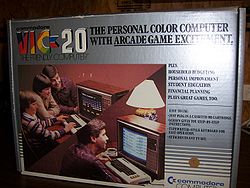 The prototype produced by Yannes had very few of the features required for a real computer, so Robert Russell at Commodore headquarters had to coordinate and finish large parts of the design under the codename Vixen. The parts contributed by Russell included a port of the operating system (kernel and BASIC interpreter) taken from John Feagans design for the Commodore PET
, a character set with the characteristic PETSCII
, an Atari 2600
-compatible joystick
interface, and a ROM cartridge
port. The serial IEEE 488-derivative interface (which could use far cheaper cabling than a real IEEE-488 as was used on the PET) was designed by Glen Stark. Some features, like the memory add-in board, were designed by Bill Seiler. At the time, Commodore had an oversupply of 1 Kbit
×4 SRAM
chips, so Tramiel decided that these should be used in the new computer. The end result was arguably closer to the PET or TOI computers than to Yannes' prototype, albeit with a 22-column VIC chip instead of the custom chips designed for the more ambitious computers.
In April 1980 at a meeting of general managers outside London, Jack Tramiel declared that he wanted a low-cost color computer. When most of the GMs argued against it, he said: "The Japanese are coming, so we will become the Japanese." This was in keeping with Tramiel's philosophy which was to make "computers for the masses, not the classes". The concept was championed at the meeting by Michael Tomczyk
, newly hired marketing strategist and assistant to the president, Tony Tokai, General Manager of Commodore-Japan, and Kit Spencer, the UK's top marketing executive. Then, the project was given to Commodore Japan. Engineering team led by Yash Terakura created VIC-1001 for Japanese market. The VIC-20 was marketed in Japan as VIC-1001 before VIC-20 was introduced to the US.
When they returned to California from that meeting, Tomczyk wrote a 30-page memo detailing recommendations for the new computer, and presented it to Tramiel. Recommendations included programmable function keys, full-size typewriter-style keys, and built-in RS-232
. Tomczyk insisted on "user-friendliness" as the prime directive for the new computer, and proposed a retail price of US$ 299.95. He recruited a marketing team and a small group of computer enthusiasts, and worked closely with colleagues in the UK and Japan to create colorful packaging, user manuals, and the first wave of software programs (mostly games and home applications).
Scott Adams
was contracted to provide a series of text adventure games. With help from a Commodore engineer who came to Longwood, Florida
to assist in the effort, five of Adams's Adventure International
game series were ported to the VIC. They got around the limited memory of VIC-20 by having the 16 KB games reside in a ROM cartridge instead of being loaded into main memory via cassette as they were on the TRS-80
and other machines. The first production run of the five cartridges generated over US$
1,500,000 in sales for Commodore.
While the PET was sold through authorized dealers, the VIC-20 primarily sold at retail—especially discount and toy stores, where it could compete more directly with game consoles. It was the first computer to be sold in K-Mart. Commodore took out advertisements featuring actor William Shatner
(of Star Trek
fame) as its spokesman, asking: "Why buy just a video game?" Television personality Henry Morgan
(best known as a panelest on the TV game show I've Got a Secret
) became the iconic voice on a series of clever Commodore product ads.
The VIC-20 had 5 KB of RAM (netted down to 3.5 KB on startup, exactly 3583 bytes), which is roughly equivalent to the words and spaces on one sheet of typing paper, meeting a design goal of the machine. The computer was expandable up to 40 KB with an add-on memory cartridge (a maximum of 27.5 KB was usable for BASIC). Although the VIC-20 was criticized in print as being underpowered, the strategy worked.
In 1981, Tomczyk contracted with an outside engineering group to develop a direct-connect modem-on-a-cartridge (the VICModem), which at US$ 99 became the first modem priced under US$ 100. The VICModem was also the first modem to sell over 1 million units. VICModem was packaged with US$ 197.50 worth of free telecomputing services from The Source, CompuServe
and Dow Jones. Tomczyk also created an entity called the Commodore Information Network to enable users to exchange information and take some of the pressure off of Customer Support inquiries, which were straining Commodore's lean organization. In 1982, this network accounted for the largest traffic on CompuServe.
in that same year. The Commodore 64 used the same housing and almost the same operating system and BASIC interpreter as the VIC-20, but was a much more powerful machine with higher resolution graphics, a more capable sound generator and 64 kilobytes of RAM (38911 bytes free of RAM compared to the VIC-20's 3583 bytes). In January 1983, the VIC-20 became the first computer in history to pass the 1 million unit mark. At its peak, over 9000 units per day were produced, and a total of 2.5 million units were sold before it was discontinued in January 1985.
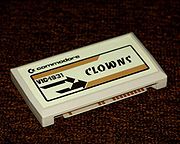 Because of its small memory and low-resolution display compared to some other computers of the time, the VIC-20 was primarily used for educational software and games. However, productivity applications such as home finance programs, spreadsheets, and communication terminal programs were also made for the machine. Its high accessibility to the general public meant that quite a few software developers-to-be cut their teeth on the VIC-20, being introduced to BASIC programming, and in some cases going further to learn assembly
or machine language. A young Linus Torvalds
, the eventual creator of Linux
, was given a VIC-20 as his first computer. Another notable software developer who began his computing career with a VIC-20 was the OpenBSD
creator Theo de Raadt
.
Several computer magazines sold on newsstands, such as Compute!
and CBM-produced publications such as Commodore Power Play
, offered programming tips and type-in program
s for the VIC-20. Many VIC users learned to program by entering, studying, running, and modifying these type-ins.
The ease of programming the VIC and availability of an inexpensive modem combined to give the VIC a sizable library of public domain
and freeware
software, although much smaller than that of the C64. This software was distributed via online services such as CompuServe, BBS
s, as well as offline by mail order and by user groups.
As for commercial software offerings, an estimated 300 titles were available on cartridge
, and another 500+ titles were available on tape. By comparison, the Atari 2600
—the most popular of the video game console
s at the time—had a library of about 900 titles near the end of its production life (although many titles were extremely similar). Most cartridge games were ready to play as soon as the VIC-20 was turned on, as opposed to games on tape which required a time-consuming loading process. Titles on cartridge included Gorf
, Cosmic Cruncher, Sargon II Chess
, and many others.
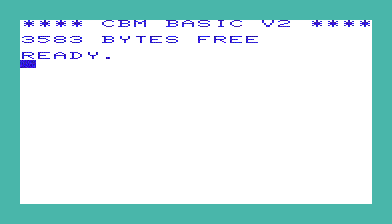 The VIC-20 had proprietary connectors for program/expansion cartridges and a tape drive (PET-standard Datassette
). It came with 5 KB RAM
, but 1.5 KB was used by the system for various things, like the video display (which had a rather unusual 22×23 char/line screen layout), and other dynamic aspects of the ROM
-resident BASIC interpreter
and KERNAL
(a low-level operating system). Thus, 3583 bytes of BASIC program memory for code and variables was available to the user of an unexpanded machine.
The computer also had a serial bus (a serial version of the PET's IEEE-488
bus) for daisy chain
ing disk drives
and printers; a TTL
-level "user port" with both RS-232
and Centronics
signals (most frequently used as RS-232, for connecting a modem
); and a single DE-9
game controller
port, compatible with the digital joystick
s and paddles
used with Atari 2600
videogame consoles and, later, the C64 (the use of a standard port ensured ample supply of Atari-manufactured and other third-party joysticks; Commodore itself offered an Atari-protocol joystick under the Commodore brand).
Importantly, like most video game consoles and many computers at the time the VIC had a cartridge port to allow for plug-in cartridges with games and other software as well as for adding memory to the machine. Port expander boxes were available from Commodore and other vendors to allow more than one cartridge to be attached at a time.
The graphics capabilities of the VIC chip
(6560/6561) were limited but flexible. At startup the screen showed 176 x 184 pixels, with a fixed-colour border to the edges of the screen; since an NTSC or PAL screen has a 4:3 width-to-height ratio, each VIC pixel was much wider than it was high. The screen normally showed 22 columns and 23 rows of 8-by-8-pixel characters; it was possible to increase these dimensions but the characters would soon run out the sides of the monitor
. Like on the PET, 256 different characters could be displayed at a time, normally taken from one of the two character generators in ROM (one for upper-case letters and simple graphics, the other for mixed-case—non-English characters were not provided). In the usual display mode, each character position could have its foreground colour chosen individually, and the background and screen border colours were set globally. A character could be made to appear in another mode where each pixel was chosen from 4 different colours: the character's foreground colour, the screen background, the screen border and an "auxiliary" colour; but this mode was rarely used since it made the pixels twice as wide as they normally were.
The VIC chip did not provide for a direct full-screen, high-resolution graphics mode. It did, however, allow the pixel-by-pixel depictions of the on-screen characters to be redefined (by using a character generator in RAM), and it allowed for double-height characters (8 pixels wide, 16 pixels high). It was possible to get a fully addressable screen, although slightly smaller than normal, by filling the screen with a sequence of different double-height characters, then turning on the pixels selectively inside the RAM-based character definitions. The Super Expander cartridge added BASIC commands supporting such a graphics mode using a resolution of 160 by 160 pixels. It was also possible to fill a larger area of the screen with addressable graphics using a more dynamic allocation scheme, if the contents were sparse or repetitive enough. This was used, for instance, by the game Omega Race
. The VIC chip did not support sprites
.
The VIC chip had readable scan-line counters but could not generate interrupts based on the scan position (as the VIC-II chip could). However, the two VIA timer chips could be tricked into generating interrupts at specific screen locations, by setting up the timers after a position has been established by repetitive reading of the scan-line counter, and letting them run the exact number of cycles that pass by during one full screen update. Thus it was possible, but difficult, to e.g. mix graphics with text above or below it, or to have two different background and border colors, or to use more than 200 characters for the pseudo-high-resolution mode. The VIC chip could also process a light pen
signal (a light pen input was provided on the DE-9
joystick connector) but few of those ever appeared on the market.
The VIC chip had three rectangular
-wave sound generators. Each had a range of three octave
s, and the generators were located on the scale about an octave apart, giving a total range of about five octaves. In addition, there was a white noise
generator. There was only one volume control, and the output was in mono.
The most visible part of memory that was reorganised with differing expansion memory configurations was the video memory (with text and/or graphics display data). This was because the video chip could only use the built-in memory for its display data, and at the same time free memory had to remain contiguous for the BASIC interpreter to be able to use it. An unexpanded VIC had 1 KB of system memory, followed by a 3 KB "hole", then 4 KB of contiguous user memory up to address 8191. The 3 KB cartridge would fill the "hole", so on unexpanded and +3K VICs the video area was placed at the top of user memory (8 KB - 512 Bytes). If an 8 KB or 16 KB cartridge was added instead, this memory appeared at addresses above 8 KB; the video memory was then placed at the start of user memory at 4 KB, just above the "hole", to provide the maximum amount of contiguous user memory.
The 32 KB cartridges allowed adding up to 24 KB to the BASIC user memory; together with the 3.5 KB built-in user memory, this gave a maximum of 27.5 KB for BASIC programs and variables. The extra 8 KB could usually be used in one of two ways, set by switches:
Some 64 KB expansion cartridges allowed the user to copy ROM image
s to RAM. The more advanced versions even contained an 80-character video chip and a patched BASIC interpreter which gave access to 48 KB of the memory and to the 80-column video mode. As the latter type of cartridges, marketed primarily in Germany, were not released until late 1984—two years after the appearance of the more capable C64—they went by mostly unnoticed.
8-bit
The first widely adopted 8-bit microprocessor was the Intel 8080, being used in many hobbyist computers of the late 1970s and early 1980s, often running the CP/M operating system. The Zilog Z80 and the Motorola 6800 were also used in similar computers...
home computer
Home computer
Home computers were a class of microcomputers entering the market in 1977, and becoming increasingly common during the 1980s. They were marketed to consumers as affordable and accessible computers that, for the first time, were intended for the use of a single nontechnical user...
which was sold by Commodore Business Machines
Commodore International
Commodore is the commonly used name for Commodore Business Machines , the U.S.-based home computer manufacturer and electronics manufacturer headquartered in West Chester, Pennsylvania, which also housed Commodore's corporate parent company, Commodore International Limited...
. The VIC-20 was announced in 1980, roughly three years after Commodore's first personal computer, the PET
Commodore PET
The Commodore PET was a home/personal computer produced from 1977 by Commodore International...
. The VIC-20 was the first computer of any description to sell one million units.
Origin, marketing
The VIC-20 was intended to be more economical than the PET computer. It was equipped with only 5 KBKilobyte
The kilobyte is a multiple of the unit byte for digital information. Although the prefix kilo- means 1000, the term kilobyte and symbol KB have historically been used to refer to either 1024 bytes or 1000 bytes, dependent upon context, in the fields of computer science and information...
of RAM (of this, only 3583 Bytes were available to the BASIC programmer) and used the same MOS 6502
MOS Technology 6502
The MOS Technology 6502 is an 8-bit microprocessor that was designed by Chuck Peddle and Bill Mensch for MOS Technology in 1975. When it was introduced, it was the least expensive full-featured microprocessor on the market by a considerable margin, costing less than one-sixth the price of...
CPU
Central processing unit
The central processing unit is the portion of a computer system that carries out the instructions of a computer program, to perform the basic arithmetical, logical, and input/output operations of the system. The CPU plays a role somewhat analogous to the brain in the computer. The term has been in...
as the PET. The VIC-20's video chip, the MOS Technology VIC
MOS Technology VIC
The VIC , specifically known as the MOS Technology 6560 / 6561 , is the integrated circuit chip responsible for generating video graphics and sound in the Commodore VIC-20 home computer...
, was a general-purpose color video chip designed by Al Charpentier in 1977 and intended for use in inexpensive display terminals and game consoles, but Commodore couldn't find a market for the chip. As the Apple II
Apple II
The Apple II is an 8-bit home computer, one of the first highly successful mass-produced microcomputer products, designed primarily by Steve Wozniak, manufactured by Apple Computer and introduced in 1977...
gained momentum with the advent of VisiCalc
VisiCalc
VisiCalc was the first spreadsheet program available for personal computers. It is often considered the application that turned the microcomputer from a hobby for computer enthusiasts into a serious business tool...
in 1979, Jack Tramiel
Jack Tramiel
Jack Tramiel is an American businessman, best known for founding Commodore International - manufacturer of the Commodore PET, Commodore 64, Commodore 128, Commodore Amiga, and other Commodore models of home computers.-Biography:...
wanted a product that would compete in the same segment, to be presented at the January 1980 CES
Consumer Electronics Show
The International Consumer Electronics Show is a major technology-related trade show held each January in the Las Vegas Convention Center, Las Vegas, Nevada, United States. Not open to the public, the Consumer Electronics Association-sponsored show typically hosts previews of products and new...
. For this reason Chuck Peddle
Chuck Peddle
Charles Ingerham Peddle is an American electrical engineer best known as the main designer of the MOS Technology 6502 microprocessor; the KIM-1 SBC; and its successor the Commodore PET personal computer, both based on the 6502....
and Bill Seiler started to design a computer named TOI (The Other Intellect).
The TOI computer failed to materialize, mostly due to the fact that it required an 80-column character display which in turn required the MOS Technology 6564 chip. However, the chip could not be used in the TOI since it required very expensive static RAM to operate fast enough. In the meantime, freshman engineer Robert Yannes at MOS Technology (then a part of Commodore) had designed a computer in his home dubbed the MicroPET and finished a prototype with some help from Al Charpentier and Charles Winterble. With the TOI unfinished, when Jack Tramiel was confronted with the MicroPET prototype, he immediately said he wanted it to be finished and ordered it to be mass-produced following a limited demonstration at the CES.
Commodore PET
The Commodore PET was a home/personal computer produced from 1977 by Commodore International...
, a character set with the characteristic PETSCII
PETSCII
PETSCII , also known as CBM ASCII, is the variation of the ASCII character set used in Commodore Business Machines 's 8-bit home computers, starting with the PET from 1977 and including the VIC-20, C64, CBM-II, Plus/4, C16, C116 and C128...
, an Atari 2600
Atari 2600
The Atari 2600 is a video game console released in October 1977 by Atari, Inc. It is credited with popularizing the use of microprocessor-based hardware and cartridges containing game code, instead of having non-microprocessor dedicated hardware with all games built in...
-compatible joystick
Joystick
A joystick is an input device consisting of a stick that pivots on a base and reports its angle or direction to the device it is controlling. Joysticks, also known as 'control columns', are the principal control in the cockpit of many civilian and military aircraft, either as a center stick or...
interface, and a ROM cartridge
ROM cartridge
A ROM cartridge, sometimes referred to as a cart, is a removable enclosure containing read-only memory devices designed to be connected to a computer or games console....
port. The serial IEEE 488-derivative interface (which could use far cheaper cabling than a real IEEE-488 as was used on the PET) was designed by Glen Stark. Some features, like the memory add-in board, were designed by Bill Seiler. At the time, Commodore had an oversupply of 1 Kbit
Kilobit
The kilobit is a multiple of the unit bit for digital information or computer storage. The prefix kilo is defined in the International System of Units as a multiplier of 103 , and therefore,...
×4 SRAM
Static random access memory
Static random-access memory is a type of semiconductor memory where the word static indicates that, unlike dynamic RAM , it does not need to be periodically refreshed, as SRAM uses bistable latching circuitry to store each bit...
chips, so Tramiel decided that these should be used in the new computer. The end result was arguably closer to the PET or TOI computers than to Yannes' prototype, albeit with a 22-column VIC chip instead of the custom chips designed for the more ambitious computers.
In April 1980 at a meeting of general managers outside London, Jack Tramiel declared that he wanted a low-cost color computer. When most of the GMs argued against it, he said: "The Japanese are coming, so we will become the Japanese." This was in keeping with Tramiel's philosophy which was to make "computers for the masses, not the classes". The concept was championed at the meeting by Michael Tomczyk
Michael Tomczyk
Michael S. Tomczyk is best known for his role in the development and marketing of the Commodore VIC-20, the first microcomputer to sell one million units; and for his early role as a pioneer in telecomputing....
, newly hired marketing strategist and assistant to the president, Tony Tokai, General Manager of Commodore-Japan, and Kit Spencer, the UK's top marketing executive. Then, the project was given to Commodore Japan. Engineering team led by Yash Terakura created VIC-1001 for Japanese market. The VIC-20 was marketed in Japan as VIC-1001 before VIC-20 was introduced to the US.
When they returned to California from that meeting, Tomczyk wrote a 30-page memo detailing recommendations for the new computer, and presented it to Tramiel. Recommendations included programmable function keys, full-size typewriter-style keys, and built-in RS-232
RS-232
In telecommunications, RS-232 is the traditional name for a series of standards for serial binary single-ended data and control signals connecting between a DTE and a DCE . It is commonly used in computer serial ports...
. Tomczyk insisted on "user-friendliness" as the prime directive for the new computer, and proposed a retail price of US$ 299.95. He recruited a marketing team and a small group of computer enthusiasts, and worked closely with colleagues in the UK and Japan to create colorful packaging, user manuals, and the first wave of software programs (mostly games and home applications).
Scott Adams
Scott Adams (game designer)
Scott Adams is the co-founder, with ex-wife Alexis, of Adventure International, an early publisher of games for home computers....
was contracted to provide a series of text adventure games. With help from a Commodore engineer who came to Longwood, Florida
Longwood, Florida
Longwood is a city in Seminole County, Florida, USA. The population was 13,745 at the 2000 census. As of 2006, the population recorded by the U.S. Census Bureau is 13,491. It is part of the Orlando–Kissimmee-Sanford Metropolitan Statistical Area....
to assist in the effort, five of Adams's Adventure International
Adventure International
Adventure International was a computer game publishing company that existed from 1978 until 1985, started by Scott and Alexis Adams. Their games were notable for being the first implementation of the adventure genre to run on a microcomputer system...
game series were ported to the VIC. They got around the limited memory of VIC-20 by having the 16 KB games reside in a ROM cartridge instead of being loaded into main memory via cassette as they were on the TRS-80
TRS-80
TRS-80 was Tandy Corporation's desktop microcomputer model line, sold through Tandy's Radio Shack stores in the late 1970s and early 1980s. The first units, ordered unseen, were delivered in November 1977, and rolled out to the stores the third week of December. The line won popularity with...
and other machines. The first production run of the five cartridges generated over US$
United States dollar
The United States dollar , also referred to as the American dollar, is the official currency of the United States of America. It is divided into 100 smaller units called cents or pennies....
1,500,000 in sales for Commodore.
While the PET was sold through authorized dealers, the VIC-20 primarily sold at retail—especially discount and toy stores, where it could compete more directly with game consoles. It was the first computer to be sold in K-Mart. Commodore took out advertisements featuring actor William Shatner
William Shatner
William Alan Shatner is a Canadian actor, musician, recording artist, and author. He gained worldwide fame and became a cultural icon for his portrayal of James T...
(of Star Trek
Star Trek: The Original Series
Star Trek is an American science fiction television series created by Gene Roddenberry, produced by Desilu Productions . Star Trek was telecast on NBC from September 8, 1966, through June 3, 1969...
fame) as its spokesman, asking: "Why buy just a video game?" Television personality Henry Morgan
Henry Morgan (comedian)
Henry Morgan was an American humorist. He is remembered best in two modern media: radio, on which he first became familiar as a barbed but often self-deprecating satirist, and on television, where he was a regular and cantankerous panelist for the game show I've Got a Secret...
(best known as a panelest on the TV game show I've Got a Secret
I've Got a Secret
I've Got a Secret is a panel game show produced by Mark Goodson and Bill Todman for CBS television. Created by comedy writers Allan Sherman and Howard Merrill, it was a derivative of Goodson-Todman's own panel show What's My Line?...
) became the iconic voice on a series of clever Commodore product ads.
The VIC-20 had 5 KB of RAM (netted down to 3.5 KB on startup, exactly 3583 bytes), which is roughly equivalent to the words and spaces on one sheet of typing paper, meeting a design goal of the machine. The computer was expandable up to 40 KB with an add-on memory cartridge (a maximum of 27.5 KB was usable for BASIC). Although the VIC-20 was criticized in print as being underpowered, the strategy worked.
In 1981, Tomczyk contracted with an outside engineering group to develop a direct-connect modem-on-a-cartridge (the VICModem), which at US$ 99 became the first modem priced under US$ 100. The VICModem was also the first modem to sell over 1 million units. VICModem was packaged with US$ 197.50 worth of free telecomputing services from The Source, CompuServe
CompuServe
CompuServe was the first major commercial online service in the United States. It dominated the field during the 1980s and remained a major player through the mid-1990s, when it was sidelined by the rise of services such as AOL with monthly subscriptions rather than hourly rates...
and Dow Jones. Tomczyk also created an entity called the Commodore Information Network to enable users to exchange information and take some of the pressure off of Customer Support inquiries, which were straining Commodore's lean organization. In 1982, this network accounted for the largest traffic on CompuServe.
Retirement
In 1982 the VIC-20 was the best-selling computer of the year, with 800,000 machines sold. Sales of the VIC-20 started declining after the launch of the Commodore 64Commodore 64
The Commodore 64 is an 8-bit home computer introduced by Commodore International in January 1982.Volume production started in the spring of 1982, with machines being released on to the market in August at a price of US$595...
in that same year. The Commodore 64 used the same housing and almost the same operating system and BASIC interpreter as the VIC-20, but was a much more powerful machine with higher resolution graphics, a more capable sound generator and 64 kilobytes of RAM (38911 bytes free of RAM compared to the VIC-20's 3583 bytes). In January 1983, the VIC-20 became the first computer in history to pass the 1 million unit mark. At its peak, over 9000 units per day were produced, and a total of 2.5 million units were sold before it was discontinued in January 1985.
Applications
Assembly language
An assembly language is a low-level programming language for computers, microprocessors, microcontrollers, and other programmable devices. It implements a symbolic representation of the machine codes and other constants needed to program a given CPU architecture...
or machine language. A young Linus Torvalds
Linus Torvalds
Linus Benedict Torvalds is a Finnish software engineer and hacker, best known for having initiated the development of the open source Linux kernel. He later became the chief architect of the Linux kernel, and now acts as the project's coordinator...
, the eventual creator of Linux
Linux
Linux is a Unix-like computer operating system assembled under the model of free and open source software development and distribution. The defining component of any Linux system is the Linux kernel, an operating system kernel first released October 5, 1991 by Linus Torvalds...
, was given a VIC-20 as his first computer. Another notable software developer who began his computing career with a VIC-20 was the OpenBSD
OpenBSD
OpenBSD is a Unix-like computer operating system descended from Berkeley Software Distribution , a Unix derivative developed at the University of California, Berkeley. It was forked from NetBSD by project leader Theo de Raadt in late 1995...
creator Theo de Raadt
Theo de Raadt
Theo de Raadt , born May 19, 1968 in Pretoria, South Africa, is a software engineer who lives in Calgary, Alberta, Canada. He is the founder and leader of the OpenBSD and OpenSSH projects, and was a founding member of the NetBSD project.- Childhood :...
.
Several computer magazines sold on newsstands, such as Compute!
COMPUTE!
Compute! was an American computer magazine that was published from 1979 to 1994, though it can trace its origin to 1978 in Len Lindsay's PET Gazette, one of the first magazines for the Commodore PET computer. In its 1980s heyday Compute! covered all major platforms, and several single-platform...
and CBM-produced publications such as Commodore Power Play
Commodore Power Play
Commodore Power/Play was a one of a pair of computer magazines published by Commodore Business Machines in the United States in support of their 8-bit home computer lines of the 1980s. The other was called Commodore Microcomputers...
, offered programming tips and type-in program
Type-in program
A type-in program, or just type-in, is a computer program listing printed in a computer magazine or book, meant to be typed in by the reader in order to run the program on a computer....
s for the VIC-20. Many VIC users learned to program by entering, studying, running, and modifying these type-ins.
The ease of programming the VIC and availability of an inexpensive modem combined to give the VIC a sizable library of public domain
Public domain
Works are in the public domain if the intellectual property rights have expired, if the intellectual property rights are forfeited, or if they are not covered by intellectual property rights at all...
and freeware
Freeware
Freeware is computer software that is available for use at no cost or for an optional fee, but usually with one or more restricted usage rights. Freeware is in contrast to commercial software, which is typically sold for profit, but might be distributed for a business or commercial purpose in the...
software, although much smaller than that of the C64. This software was distributed via online services such as CompuServe, BBS
Bulletin board system
A Bulletin Board System, or BBS, is a computer system running software that allows users to connect and log in to the system using a terminal program. Once logged in, a user can perform functions such as uploading and downloading software and data, reading news and bulletins, and exchanging...
s, as well as offline by mail order and by user groups.
As for commercial software offerings, an estimated 300 titles were available on cartridge
ROM cartridge
A ROM cartridge, sometimes referred to as a cart, is a removable enclosure containing read-only memory devices designed to be connected to a computer or games console....
, and another 500+ titles were available on tape. By comparison, the Atari 2600
Atari 2600
The Atari 2600 is a video game console released in October 1977 by Atari, Inc. It is credited with popularizing the use of microprocessor-based hardware and cartridges containing game code, instead of having non-microprocessor dedicated hardware with all games built in...
—the most popular of the video game console
Video game console
A video game console is an interactive entertainment computer or customized computer system that produces a video display signal which can be used with a display device to display a video game...
s at the time—had a library of about 900 titles near the end of its production life (although many titles were extremely similar). Most cartridge games were ready to play as soon as the VIC-20 was turned on, as opposed to games on tape which required a time-consuming loading process. Titles on cartridge included Gorf
Gorf
Gorf is an arcade game released in 1981 by Midway Mfg., whose name was advertised as an acronym for "Galactic Orbiting Robot Force". It is a multiple-mission fixed shooter with five distinct modes of play, essentially making it five games in one...
, Cosmic Cruncher, Sargon II Chess
Sargon (chess)
Sargon is a line of chess-playing software for personal computers.-Origin:The original SARGON was written by Dan and Kathleen 'Kathe' Spracklen in a Z80-based computer called Wavemate Jupiter III...
, and many others.
Basic features
Datassette
The Commodore 1530 Datasette , was Commodore's dedicated computer tape drive.It provided access to an inexpensive storage medium for Commodore's 8-bit home/personal computers, notably the PET, VIC-20, and C64...
). It came with 5 KB RAM
Random-access memory
Random access memory is a form of computer data storage. Today, it takes the form of integrated circuits that allow stored data to be accessed in any order with a worst case performance of constant time. Strictly speaking, modern types of DRAM are therefore not random access, as data is read in...
, but 1.5 KB was used by the system for various things, like the video display (which had a rather unusual 22×23 char/line screen layout), and other dynamic aspects of the ROM
Read-only memory
Read-only memory is a class of storage medium used in computers and other electronic devices. Data stored in ROM cannot be modified, or can be modified only slowly or with difficulty, so it is mainly used to distribute firmware .In its strictest sense, ROM refers only...
-resident BASIC interpreter
Commodore BASIC
Commodore BASIC, also known as PET BASIC, is the dialect of the BASIC programming language used in Commodore International's 8-bit home computer line, stretching from the PET of 1977 to the C128 of 1985...
and KERNAL
KERNAL
The KERNAL is Commodore's name for the ROM-resident operating system core in its 8-bit home computers; from the original PET of 1977, followed by the extended but strongly related versions used in its successors; the VIC-20, Commodore 64, Plus/4, C16, and C128...
(a low-level operating system). Thus, 3583 bytes of BASIC program memory for code and variables was available to the user of an unexpanded machine.
The computer also had a serial bus (a serial version of the PET's IEEE-488
IEEE-488
IEEE-488 is a short-range digital communications bus specification. It was created for use with automated test equipment in the late 1960s, and is still in use for that purpose. IEEE-488 was created as HP-IB , and is commonly called GPIB...
bus) for daisy chain
Daisy chain (electrical engineering)
In electrical and electronic engineering a daisy chain is a wiring scheme in which multiple devices are wired together in sequence or in a ring...
ing disk drives
Commodore 1540
The Commodore 1540 was the companion floppy disk drive for the Commodore VIC-20 home computer. It used single-sided 5¼" floppy disks, on which it stored roughly 170 KB of data utilizing Commodore's GCR data encoding scheme.Because of the low price of both the VIC-20 and the 1540, this...
and printers; a TTL
Transistor-transistor logic
Transistor–transistor logic is a class of digital circuits built from bipolar junction transistors and resistors. It is called transistor–transistor logic because both the logic gating function and the amplifying function are performed by transistors .TTL is notable for being a widespread...
-level "user port" with both RS-232
RS-232
In telecommunications, RS-232 is the traditional name for a series of standards for serial binary single-ended data and control signals connecting between a DTE and a DCE . It is commonly used in computer serial ports...
and Centronics
Centronics
Centronics Data Computer Corporation was a pioneering American manufacturer of computer printers, now remembered primarily for the parallel interface that bears its name.-The beginning:Centronics began as a division of Wang Laboratories...
signals (most frequently used as RS-232, for connecting a modem
Modem
A modem is a device that modulates an analog carrier signal to encode digital information, and also demodulates such a carrier signal to decode the transmitted information. The goal is to produce a signal that can be transmitted easily and decoded to reproduce the original digital data...
); and a single DE-9
D-subminiature
The D-subminiature or D-sub is a common type of electrical connector. They are named for their characteristic D-shaped metal shield. When they were introduced, D-subs were among the smaller connectors used on computer systems....
game controller
Game controller
A game controller is a device used with games or entertainment systems used to control a playable character or object, or otherwise provide input in a computer game. A controller is typically connected to a game console or computer by means of a wire, cord or nowadays, by means of wireless connection...
port, compatible with the digital joystick
Joystick
A joystick is an input device consisting of a stick that pivots on a base and reports its angle or direction to the device it is controlling. Joysticks, also known as 'control columns', are the principal control in the cockpit of many civilian and military aircraft, either as a center stick or...
s and paddles
Paddle (game controller)
A paddle is a game controller with a round wheel and one or more fire buttons, where the wheel is typically used to control movement of the player object along one axis of the video screen...
used with Atari 2600
Atari 2600
The Atari 2600 is a video game console released in October 1977 by Atari, Inc. It is credited with popularizing the use of microprocessor-based hardware and cartridges containing game code, instead of having non-microprocessor dedicated hardware with all games built in...
videogame consoles and, later, the C64 (the use of a standard port ensured ample supply of Atari-manufactured and other third-party joysticks; Commodore itself offered an Atari-protocol joystick under the Commodore brand).
Importantly, like most video game consoles and many computers at the time the VIC had a cartridge port to allow for plug-in cartridges with games and other software as well as for adding memory to the machine. Port expander boxes were available from Commodore and other vendors to allow more than one cartridge to be attached at a time.
The graphics capabilities of the VIC chip
MOS Technology VIC
The VIC , specifically known as the MOS Technology 6560 / 6561 , is the integrated circuit chip responsible for generating video graphics and sound in the Commodore VIC-20 home computer...
(6560/6561) were limited but flexible. At startup the screen showed 176 x 184 pixels, with a fixed-colour border to the edges of the screen; since an NTSC or PAL screen has a 4:3 width-to-height ratio, each VIC pixel was much wider than it was high. The screen normally showed 22 columns and 23 rows of 8-by-8-pixel characters; it was possible to increase these dimensions but the characters would soon run out the sides of the monitor
Overscan
Overscan is extra image area around the four edges of a video image that may not be seen reliably by the viewer. It exists because television sets in the 1930s through 1970s were highly variable in how the video image was framed within the cathode ray tube .-Origins of overscan:Early televisions...
. Like on the PET, 256 different characters could be displayed at a time, normally taken from one of the two character generators in ROM (one for upper-case letters and simple graphics, the other for mixed-case—non-English characters were not provided). In the usual display mode, each character position could have its foreground colour chosen individually, and the background and screen border colours were set globally. A character could be made to appear in another mode where each pixel was chosen from 4 different colours: the character's foreground colour, the screen background, the screen border and an "auxiliary" colour; but this mode was rarely used since it made the pixels twice as wide as they normally were.
The VIC chip did not provide for a direct full-screen, high-resolution graphics mode. It did, however, allow the pixel-by-pixel depictions of the on-screen characters to be redefined (by using a character generator in RAM), and it allowed for double-height characters (8 pixels wide, 16 pixels high). It was possible to get a fully addressable screen, although slightly smaller than normal, by filling the screen with a sequence of different double-height characters, then turning on the pixels selectively inside the RAM-based character definitions. The Super Expander cartridge added BASIC commands supporting such a graphics mode using a resolution of 160 by 160 pixels. It was also possible to fill a larger area of the screen with addressable graphics using a more dynamic allocation scheme, if the contents were sparse or repetitive enough. This was used, for instance, by the game Omega Race
Omega Race
Omega Race is an arcade game programmed by Ron Haliburton and released in 1981 by Midway. It was the only arcade game with vector graphics Midway created.-Description:...
. The VIC chip did not support sprites
Sprite (computer graphics)
In computer graphics, a sprite is a two-dimensional image or animation that is integrated into a larger scene...
.
The VIC chip had readable scan-line counters but could not generate interrupts based on the scan position (as the VIC-II chip could). However, the two VIA timer chips could be tricked into generating interrupts at specific screen locations, by setting up the timers after a position has been established by repetitive reading of the scan-line counter, and letting them run the exact number of cycles that pass by during one full screen update. Thus it was possible, but difficult, to e.g. mix graphics with text above or below it, or to have two different background and border colors, or to use more than 200 characters for the pseudo-high-resolution mode. The VIC chip could also process a light pen
Light pen
A light pen is a computer input device in the form of a light-sensitive wand used in conjunction with a computer's CRT TV set or monitor. It allows the user to point to displayed objects, or draw on the screen, in a similar way to a touch screen but with greater positional accuracy...
signal (a light pen input was provided on the DE-9
D-subminiature
The D-subminiature or D-sub is a common type of electrical connector. They are named for their characteristic D-shaped metal shield. When they were introduced, D-subs were among the smaller connectors used on computer systems....
joystick connector) but few of those ever appeared on the market.
The VIC chip had three rectangular
Rectangle
In Euclidean plane geometry, a rectangle is any quadrilateral with four right angles. The term "oblong" is occasionally used to refer to a non-square rectangle...
-wave sound generators. Each had a range of three octave
Octave
In music, an octave is the interval between one musical pitch and another with half or double its frequency. The octave relationship is a natural phenomenon that has been referred to as the "basic miracle of music", the use of which is "common in most musical systems"...
s, and the generators were located on the scale about an octave apart, giving a total range of about five octaves. In addition, there was a white noise
Noise
In common use, the word noise means any unwanted sound. In both analog and digital electronics, noise is random unwanted perturbation to a wanted signal; it is called noise as a generalisation of the acoustic noise heard when listening to a weak radio transmission with significant electrical noise...
generator. There was only one volume control, and the output was in mono.
Memory expansion
The VIC-20's RAM was expandable through the cartridge port. RAM cartridges were available in several sizes: 3 KB (with or without an included BASIC extension ROM), , , and , the latter two only from third-party vendors. The internal memory map was dramatically reorganized with the addition of each size cartridge, leading to the situation that some programs would only work if the right amount of memory was present (to cater for this, the 32 KB cartridges had switches, and the 64 KB cartridges had software setups, allowing the RAM to be enabled in user-selected sections).The most visible part of memory that was reorganised with differing expansion memory configurations was the video memory (with text and/or graphics display data). This was because the video chip could only use the built-in memory for its display data, and at the same time free memory had to remain contiguous for the BASIC interpreter to be able to use it. An unexpanded VIC had 1 KB of system memory, followed by a 3 KB "hole", then 4 KB of contiguous user memory up to address 8191. The 3 KB cartridge would fill the "hole", so on unexpanded and +3K VICs the video area was placed at the top of user memory (8 KB - 512 Bytes). If an 8 KB or 16 KB cartridge was added instead, this memory appeared at addresses above 8 KB; the video memory was then placed at the start of user memory at 4 KB, just above the "hole", to provide the maximum amount of contiguous user memory.
The 32 KB cartridges allowed adding up to 24 KB to the BASIC user memory; together with the 3.5 KB built-in user memory, this gave a maximum of 27.5 KB for BASIC programs and variables. The extra 8 KB could usually be used in one of two ways, set by switches:
- Either it could be mapped into the address space reserved for ROM cartridges, which sat "behind" the I/O register space and thus was not contiguous with the rest of the RAM. This allowed running many cartridge-based games from disk or tape and was thus very useful for software pirates; especially if the RAM expansion allowed switching off writing to its memory after the game was loaded, so that the memory behaved exactly like ROM.
- Or, 3 KB of the 8 KB could be mapped into the same memory "hole" that the 3 KB cartridge used, letting 5 KB lie fallow. These 3 KB were contiguous with the rest of RAM, but couldn't be used to expand BASIC space to more than 27.5 KB, because the display data would have had to be moved to cartridge RAM, which was not possible.
Some 64 KB expansion cartridges allowed the user to copy ROM image
ROM image
A ROM image, or ROM file, is a computer file which contains a copy of the data from a read-only memory chip, often from a video game cartridge, a computer's firmware, or from an arcade game's main board...
s to RAM. The more advanced versions even contained an 80-character video chip and a patched BASIC interpreter which gave access to 48 KB of the memory and to the 80-column video mode. As the latter type of cartridges, marketed primarily in Germany, were not released until late 1984—two years after the appearance of the more capable C64—they went by mostly unnoticed.
See also
- VICEVICEThe software program VICE, standing for VersatIle Commodore Emulator, is an emulator for Commodore's 8-bit computers, running on Amiga, Unix, MS-DOS, Win32, Mac OS X, OS/2, Acorn RISC OS, and BeOS host machines...
(Vic20 emulator) - List of Commodore VIC-20 games
- B1FFB1ffB1ff is type of internet slang that was created in the early days of the Internet by groups who felt they were being watched by government officials or corporations. This was a major step towards full 1337 ; however, they originally had different purposes...
- Commodore 64Commodore 64The Commodore 64 is an 8-bit home computer introduced by Commodore International in January 1982.Volume production started in the spring of 1982, with machines being released on to the market in August at a price of US$595...