


Anabaptist

Encyclopedia
Anabaptists are Protestant
Christians
of the Radical Reformation
of 16th-century Europe
, and their direct descendants, particularly the Amish
, Brethren
, Hutterites, and Mennonites.
Anabaptists rejected conventional Christian practices such as wearing wedding rings, taking oaths, and participating in civil government. They adhered to a literal interpretation of the Sermon on the Mount and believer's baptism
.
The name Anabaptist is derived from the Latin term anabaptista, or "one who baptizes over again", in reference to practicing adult baptism, because, as a new faith, they baptized converts who already had been baptized (as infants) in the older Christian churches.
Anabaptists require that candidates be able to make their own confessions of faith and so refused baptism to infants. As a result, Anabaptists were heavily persecuted during the 16th century and into the 17th by both other Protestants and Roman Catholics.
, 15th century Bohemia
n Reformer, taught most of the beliefs considered integral to Anabaptist theology. Medieval antecedents may include the Brethren of the Common Life
, the Hussite
s, Dutch Sacramentists, and some forms of monasticism
. The Waldensians also represent a faith similar to the Anabaptists.
In the following points Anabaptists resembled the medieval dissenters:
, Jan Matthys
, John of Leiden
(also Jan Bockelson van Leiden, Jan of Leyden), and Thomas Müntzer. Those desiring to correct this error tended to over-correct and deny all connections between the larger Anabaptist movement and this most radical element.
The modern era of Anabaptist historiography arose with the work of Roman Catholic scholar Carl Adolf Cornelius' publication of Die Geschichte des Münsterischen Aufruhrs in 1855 (The history of the Münster riot). Baptist historian Albert Henry Newman (1852–1933), who Bender said occupied "first position in the field of American Anabaptist historiography," made a major contribution with his A History of Anti-Pedobaptism. Though a number of theories exist concerning origins, the three main ideas are:
movement of Conrad Grebel
, Felix Manz
, George Blaurock
, et al. The older view among Mennonite historians generally held that Anabaptism had its origins in Zürich
, and that the Anabaptism of the Swiss Brethren was transmitted to southern Germany, Austria, the Netherlands, and northern Germany, where it developed into its various branches. The monogenesis theory usually rejects the Münsterites and other radicals from the category of true Anabaptists. In this view the time of origin is January 21, 1525, when Grebel baptized George Blaurock, and Blaurock baptized other followers. This remains the most popular single time posited for the establishment of Anabaptism. But in the last quarter of the 20th century, Deppermann, Packull, and others suggested that February 24, 1527 at Schleitheim is the proper date of the origin of Anabaptism. That day the Anabaptists made a declaration of belief called the Schleitheim Confession
. This correlates with the following polygenesis theory.
, Werner O. Packull, and Klaus Deppermann disputed the idea of a single origin of Anabaptists in a 1975 essay entitled "From Monogenesis to Polygenesis". That article, emphasizing distinctive characteristics and distinct sources, has become a widely accepted treatment of the plural origins of Anabaptism. The authors noted the agreement among previous Anabaptist historians on polygenesis even when disputing the date for a single starting point: "Hillerbrand and Bender (like Holl and Troeltsch) were in agreement that there was a single dispersion of Anabaptism-..., which certainly ran through Zurich. The only question was whether or not it went back further to Saxony." After criticizing the standard polygenetic history, the authors found six groups in early Anabaptism which could be collapsed into three originating "points of departure": "South German Anabaptism, the Swiss Brethren and the Melchiorites." South German–Austrian Anabaptism "was a diluted form of Rhineland mysticism," Swiss Anabaptism "arose out of Reformed congregationalism
", and Dutch Anabaptism was formed by "Social unrest and the apocalyptic visions of Melchior Hoffman
". Pilgram Marpeck's
Vermanung of 1542 was deeply influenced by the Bekenntnisse of 1533 by Münster theologian Bernhard Rothmann
. The Hutterites used Melchior Hoffman's commentary on the Apocalypse shortly after he wrote it. David Joris
, a disciple of Hoffman, was the most important Anabaptist leader in the Netherlands before 1540. Grete Mecenseffy and Walter Klaassen established links between Thomas Müntzer and Hans Hut, and the work of Gottfried Seebaß and Werner Packull clearly showed the influence of Thomas Müntzer on the formation of South German Anabaptism. Steven Ozment's work linked Hans Denck
and Hans Hut
with Thomas Müntzer, Sebastian Franck
, and others. Calvin Pater has shown that Andreas Karlstadt
influenced Swiss Anabaptism in areas including his view of Scripture, doctrine of the church, and views on baptism.
have, at times, pointed to 16th century Anabaptists as part of an apostolic succession
of churches ("church perpetuity") from the time of Christ.
The opponents of this theory emphasize that these non-Catholic groups clearly differed from each other, that they held some heretical views (that is, heretical even by baptist standards, such as the Adoptionism of the Paulicianists; some of the other groups often cited were in fact little different from the Catholics and not at all similar to the Baptists), are not successors of the Apostles, or that they had no connection with one another with origins that are separate both in time and place. This view is held by some Baptists, some Mennonites, and a number of "true church" movements. Somewhat related to this is the theory that the Anabaptists are of Waldensian origin. Some hold the idea that the Waldenses are part of the apostolic succession, while others simply believe they were an independent group out of whom the Anabaptists arose. Estep asserts "the Waldenses disappeared in Switzerland a century before the rise of the Anabaptist movement." Ludwig Keller, Thomas M. Lindsay, H. C. Vedder, Delbert Grätz, John T. Christian
and Thieleman J. van Braght
all held, in varying degrees, the position that the Anabaptists were of Waldensian origin.
, Manz, Marpeck, and Simons as Anabaptists. He groups Müntzer, Storch, et al. as inspirationists, and anti-trinitarians such as Michael Servetus
, Juan de Valdés
, Sebastian Castellio
, and Faustus Socinus as rationalists
. Mark S. Ritchie follows this line of thought, saying, "The Anabaptists were one of several branches of 'Radical' reformers (i.e. reformers that went further than the mainstream Reformers) to arise out of the Renaissance and Reformation. Two other branches were Spirituals or Inspirationists, who believed that they had received direct revelation from the Spirit, and rationalists or anti-Trinitarians, who rebelled against traditional Christian doctrine, like Michael Servetus."
Those of the polygenesis viewpoint use Anabaptist to define the larger movement, and include the inspirationists and rationalists as true Anabaptists. James M. Stayer used the term Anabaptist for those who rebaptized persons already baptized in infancy. Walter Klaassen was perhaps the first Mennonite scholar to define Anabaptists that way in his 1960 Oxford dissertation. This represents a rejection of the previous standard held by Mennonite scholars such as Bender and Friedmann.
Another method of categorization acknowledges regional variations, such as Swiss Brethren (Grebel, Manz), Dutch and Frisia
n Anabaptism (Menno Simons, Dirk Philips
), and South German Anabaptism (Hübmaier, Marpeck).
Historians and sociologists have made further distinctions between radical Anabaptists, who were prepared to use violence in their attempts to build a New Jerusalem
, and their pacifist brethren, later broadly known as Mennonites. Radical Anabaptist groups included the Münsterites, who occupied and held the German city of Münster
in 1534–5, and the Batenburgers
, who persisted in various guises as late as the 1570s.

, for example, wrote against the exclusion of miracles: "Nor does Scripture assert this exclusion...God has a free hand even in these last days." Referring to some who had been raised from the dead, he wrote: "Many of them have remained constant, enduring tortures inflicted by sword, rope, fire and water and suffering terrible, tyrannical, unheard-of deaths and martyrdoms, all of which they could easily have avoided by recantation. Moreover one also marvels when he sees how the faithful God (who, after all, overflows with goodness) raises from the dead several such brothers and sisters of Christ after they were hanged, drowned, or killed in other ways. Even today, they are found alive and we can hear their own testimony...Cannot everyone who sees, even the blind, say with a good conscience that such things are a powerful, unusual, and miraculous act of God? Those who would deny it must be hardened men". The Hutterite
Chronicle and The Martyr's Mirror record several accounts of miraculous events, such as when a man named Martin prophesied while being led across a bridge to his execution in 1531: "...this once yet the pious are led over this bridge, but no more hereafter." Just "a short time afterwards such a violent storm and flood came that the bridge was demolished".
, influenced by and in turn influencing Thomas Müntzer, appeared in Wittenberg
from Zwickau
: Thomas Dreschel, Nicolas Storch and Mark Thomas Stübner. The crisis came in the Peasants' War in southern Germany
in 1525. In its origin a revolt against feudal oppression, it became, under the leadership of Müntzer, a war against all constituted authorities, and an attempt to establish by revolution an ideal Christian commonwealth, with absolute equality and the community of goods. There were some common points between the Zwickau prophets and the later-developed Anabaptists. Although Anabaptist were executed during this time in history, there is no known evidence that the Anabaptist practiced this on other Christian groups.
(1532–5), led by Bernhard Rothmann
, Bernhard Knipperdolling
, Jan Matthys
and John of Leiden
.
 Much of the historic Roman Catholic and Protestant literature has represented the Anabaptists as groups who preached false doctrine and led people into apostasy. That negative historiography remained popular for about four centuries. The Roman Catholics and other Protestants alike persecuted the Anabaptists, resorted to torture and other types of physical abuse, in attempts to curb the growth of the movement. The Protestants under Zwingli
were the first to persecute the Anabaptists. Felix Manz became the first martyr in 1527. The Anabaptists were the most persecuted sect throughout the Catholic Reformation, mainly because they broke away from the Catholic Church and questioned many of the main Catholic beliefs.
On May 20, 1527, Roman Catholic authorities executed Michael Sattler
. King Ferdinand declared drowning (called the third baptism) "the best antidote to Anabaptism". The Tudor regime, even those that were Protestant (Edward VI of England
and Elizabeth I of England
) persecuted Anabaptists as they were deemed too radical and therefore a danger to religious stability. The persecution of Anabaptists was condoned by ancient laws of Theodosius I
and Justinian I
that were passed against the Donatists which decreed the death penalty for any who practiced rebaptism.
Thieleman J. van Braght's Martyrs Mirror
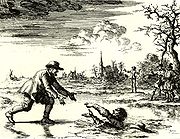
describes the persecution and execution of thousands of Anabaptists, such as Dirk Willems
, in Austria, Belgium, Germany, the Netherlands, Switzerland, and other parts of Europe between 1525 and 1660. Continuing persecution in Europe
was largely responsible for the mass immigrations to North America by Amish, Hutterites, and Mennonites.
Similarly, when the Münster Anabaptists held power they harshly persecuted other Christians, for example murdering men for apostasy and sexually enslaving their wives during the Münster Rebellion
(Source: ). In contrast to the Münster Anabaptists the Swiss Brethren/Mennonites, and the Hutterians follow a pacifist path.
, Brethren
, Hutterite
s, Mennonite
s and to some extent the Bruderhof Communities
. Some historical connections have been demonstrated for all of these spiritual descendants, though perhaps not as clearly as the noted institutionally lineal descendants. Although many see the more well-known Anabaptist groups (Amish, Hutterites and Mennonites) as ethnic groups, the Anabaptist bodies of today are no longer composed mostly of descendants of the continental Anabaptists. Total worldwide membership of the Mennonite, Brethren in Christ and related churches totals 1,616,126 (as of 2009) with about 60 percent in Africa, Asia and Latin America.
were founded in Germany by Eberhard Arnold
in 1920, establishing and organisationally joining the Hutterites in 1930. The group moved to England after Gestapo confiscated their property in 1933, and subsequently to Paraguay to avoid military conscription, and by settlements moved to USA after the World War II
. They are not recognized by more conservative Hutterites.
Groups deriving from the Schwarzenau Brethren
, often called German Baptist
s, while not directly descended from the 16th-century Anabaptists, are usually considered Anabaptist because of an almost identical doctrine and practice. The modern-day Brethren movement is a combination of Anabaptism and Radical Pietism
.
Puritan
s of England and their Baptist
branch arose independently, but were influenced by the Anabaptist movement.
Anabaptist characters exist in popular culture, most notably Chaplain Tappman
in Joseph Heller
's novel Catch-22
, James in Voltaire
's novella Candide
, Giacomo Meyerbeer
’s opera Le prophète
(1849), and the central character in the novel Q
, by the collective known as "Luther Blissett".
The Anabaptists were early promoters of a free church and freedom of religion (sometimes associated with separation of church and state). When it was introduced by the Anabaptists in the 15th and 16th centuries, religious freedom independent of the state was unthinkable to both clerical and governmental leaders. Religious liberty was equated with anarchy; Kropotkin traces the birth of anarchist thought in Europe to these early Anabaptist communities.
According to Estep:
Protestantism
Protestantism is one of the three major groupings within Christianity. It is a movement that began in Germany in the early 16th century as a reaction against medieval Roman Catholic doctrines and practices, especially in regards to salvation, justification, and ecclesiology.The doctrines of the...
Christians
Christianity
Christianity is a monotheistic religion based on the life and teachings of Jesus as presented in canonical gospels and other New Testament writings...
of the Radical Reformation
Radical Reformation
The Radical Reformation was a 16th century response to what was believed to be both the corruption in the Roman Catholic Church and the expanding Magisterial Protestant movement led by Martin Luther and many others. Beginning in Germany and Switzerland, the Radical Reformation birthed many radical...
of 16th-century Europe
Europe
Europe is, by convention, one of the world's seven continents. Comprising the westernmost peninsula of Eurasia, Europe is generally 'divided' from Asia to its east by the watershed divides of the Ural and Caucasus Mountains, the Ural River, the Caspian and Black Seas, and the waterways connecting...
, and their direct descendants, particularly the Amish
Amish
The Amish , sometimes referred to as Amish Mennonites, are a group of Christian church fellowships that form a subgroup of the Mennonite churches...
, Brethren
Schwarzenau Brethren
The Schwarzenau Brethren, originated in Germany, the outcome of the Radical Pietist ferment of the late 17th and early 18th century. Hopeful of the imminent return of Christ, the founding Brethren abandoned the established Reformed and Lutheran churches, forming a new church in 1708 when their...
, Hutterites, and Mennonites.
Anabaptists rejected conventional Christian practices such as wearing wedding rings, taking oaths, and participating in civil government. They adhered to a literal interpretation of the Sermon on the Mount and believer's baptism
Believer's baptism
Believer's baptism is the Christian practice of baptism as this is understood by many Protestant churches, particularly those that descend from the Anabaptist tradition...
.
The name Anabaptist is derived from the Latin term anabaptista, or "one who baptizes over again", in reference to practicing adult baptism, because, as a new faith, they baptized converts who already had been baptized (as infants) in the older Christian churches.
Anabaptists require that candidates be able to make their own confessions of faith and so refused baptism to infants. As a result, Anabaptists were heavily persecuted during the 16th century and into the 17th by both other Protestants and Roman Catholics.
Origins
Forerunners
Though opinion is that Anabaptists, by name, began with the Radical Reformers in the 16th century, certain people and groups may still legitimately be considered their forerunners. Petr ChelčickýPetr Chelcický
Petr Chelčický was a Christian and political leader and author in 15th century Bohemia .-Chelčický's background:...
, 15th century Bohemia
Bohemia
Bohemia is a historical region in central Europe, occupying the western two-thirds of the traditional Czech Lands. It is located in the contemporary Czech Republic with its capital in Prague...
n Reformer, taught most of the beliefs considered integral to Anabaptist theology. Medieval antecedents may include the Brethren of the Common Life
Brethren of the Common Life
The Brethren of the Common Life was a Roman Catholic pietist religious community founded in the 14th century by Gerard Groote, formerly a successful and worldly educator who had had a religious experience and preached a life of simple devotion to Jesus Christ...
, the Hussite
Hussite
The Hussites were a Christian movement following the teachings of Czech reformer Jan Hus , who became one of the forerunners of the Protestant Reformation...
s, Dutch Sacramentists, and some forms of monasticism
Monasticism
Monasticism is a religious way of life characterized by the practice of renouncing worldly pursuits to fully devote one's self to spiritual work...
. The Waldensians also represent a faith similar to the Anabaptists.
In the following points Anabaptists resembled the medieval dissenters:
- They condemned oaths, and also the reference of disputes between believers to law-courts in accordance with .
- The believer must not bear arms or offer forcible resistance to wrongdoers, nor wield the sword. No Christian has the jus gladii (the right of the sword).
- Civil government (i.e., "CaesarCaesar (title)Caesar is a title of imperial character. It derives from the cognomen of Julius Caesar, the Roman dictator...
") belongs to the world. The believer, who belongs to God's kingdom, must not fill any office, nor hold any rank under government, which is to be passively obeyed. - Sinners or unfaithful ones are to be excommunicated, and excluded from the sacraments and from intercourse with believers unless they repent, according to and But no force is to be used towards them.
- Only some Anabaptists followed Menno SimonsMenno SimonsMenno Simons was an Anabaptist religious leader from the Friesland region of the Low Countries. Simons was a contemporary of the Protestant Reformers and his followers became known as Mennonites...
in teaching that Jesus did not take the flesh from his mother, but either brought his body from heaven or had one made for him by the Lord. Some even said that he passed through his mother, as water through a pipe, into the world. We often find this idea, originated by Marcion in the 2nd century, represented in pictures and sculptures of the 15th century and earlier. The Anabaptists were accused of denying the IncarnationIncarnation (Christianity)The Incarnation in traditional Christianity is the belief that Jesus Christ the second person of the Trinity, also known as God the Son or the Logos , "became flesh" by being conceived in the womb of a woman, the Virgin Mary, also known as the Theotokos .The Incarnation is a fundamental theological...
of Christ, a charge that Menno Simons repeatedly rejected.
Views
Research on the origins of the Anabaptists has been tainted both by the attempts of their enemies to slander them and the attempts of their supporters to vindicate them. It was long popular to simply lump all Anabaptists as Munsterites and radicals associated with the Zwickau ProphetsZwickau prophets
The Zwickau Prophets were three men from Zwickau of the Radical Reformation who were possibly involved in a disturbance in nearby Wittenberg and its reformation in early 1522....
, Jan Matthys
Jan Matthys
Jan Matthys was a charismatic Anabaptist leader, regarded by his followers as a prophet....
, John of Leiden
John of Leiden
John of Leiden , was an Anabaptist leader from the Dutch city of Leiden. He was the illegitimate son of a Dutch mayor, and a tailor's apprentice by trade.-Life:...
(also Jan Bockelson van Leiden, Jan of Leyden), and Thomas Müntzer. Those desiring to correct this error tended to over-correct and deny all connections between the larger Anabaptist movement and this most radical element.
The modern era of Anabaptist historiography arose with the work of Roman Catholic scholar Carl Adolf Cornelius' publication of Die Geschichte des Münsterischen Aufruhrs in 1855 (The history of the Münster riot). Baptist historian Albert Henry Newman (1852–1933), who Bender said occupied "first position in the field of American Anabaptist historiography," made a major contribution with his A History of Anti-Pedobaptism. Though a number of theories exist concerning origins, the three main ideas are:
- that Anabaptists began in a single expression in ZürichZürichZurich is the largest city in Switzerland and the capital of the canton of Zurich. It is located in central Switzerland at the northwestern tip of Lake Zurich...
and spread from there (Monogenesis); - that Anabaptists began through several independent movements (polygenesisPolygenismPolygenism is a theory of human origins positing that the human races are of different lineages . This is opposite to the idea of monogenism, which posits a single origin of humanity.- Origins :...
); and - that Anabaptists are a continuation of New Testament Christianity (apostolic successionApostolic SuccessionApostolic succession is a doctrine, held by some Christian denominations, which asserts that the chosen successors of the Twelve Apostles, from the first century to the present day, have inherited the spiritual, ecclesiastical and sacramental authority, power, and responsibility that were...
or church perpetuity).
Monogenesis
A number of scholars (e.g., Bender, Estep, Friedmann ) have seen all the Anabaptists as rising out of the Swiss BrethrenSwiss Brethren
The Swiss Brethren are a branch of Anabaptism that started in Zürich, spread to nearby cities and towns, and then was exported to neighboring countries...
movement of Conrad Grebel
Conrad Grebel
Conrad Grebel , son of a prominent Swiss merchant and councilman, was a co-founder of the Swiss Brethren movement and is often called the "Father of Anabaptists".-Early life:...
, Felix Manz
Felix Manz
Felix Manz was a co-founder of the original Swiss Brethren Anabaptist congregation in Zürich, Switzerland, and the first martyr of the Radical Reformation.-Birth and life:...
, George Blaurock
George Blaurock
Jörg vom Haus Jacob , commonly known as George Blaurock , with Conrad Grebel and Felix Manz, was co-founder of the Swiss Brethren in Zürich, and thereby one of the founders of Anabaptism.George Blaurock was born in 1491 in Bonaduz in the Grisons, Switzerland...
, et al. The older view among Mennonite historians generally held that Anabaptism had its origins in Zürich
Zürich
Zurich is the largest city in Switzerland and the capital of the canton of Zurich. It is located in central Switzerland at the northwestern tip of Lake Zurich...
, and that the Anabaptism of the Swiss Brethren was transmitted to southern Germany, Austria, the Netherlands, and northern Germany, where it developed into its various branches. The monogenesis theory usually rejects the Münsterites and other radicals from the category of true Anabaptists. In this view the time of origin is January 21, 1525, when Grebel baptized George Blaurock, and Blaurock baptized other followers. This remains the most popular single time posited for the establishment of Anabaptism. But in the last quarter of the 20th century, Deppermann, Packull, and others suggested that February 24, 1527 at Schleitheim is the proper date of the origin of Anabaptism. That day the Anabaptists made a declaration of belief called the Schleitheim Confession
Schleitheim Confession
The Schleitheim Confession was the most representative statement of Anabaptist principles, endorsed unanimously by a meeting of Swiss Anabaptists in 1527 in Schleitheim . The meeting was chaired by Michael Sattler. Michael Sattler was the leader of the Swiss and southern German Anabaptist movement...
. This correlates with the following polygenesis theory.
Polygenesis
James M. StayerJames M. Stayer
James M. Stayer is a historian specializing in the German Reformation, particularly the anabaptist movement. He is also a Professor Emeritus at Queen's University in Kingston, Ontario, Canada....
, Werner O. Packull, and Klaus Deppermann disputed the idea of a single origin of Anabaptists in a 1975 essay entitled "From Monogenesis to Polygenesis". That article, emphasizing distinctive characteristics and distinct sources, has become a widely accepted treatment of the plural origins of Anabaptism. The authors noted the agreement among previous Anabaptist historians on polygenesis even when disputing the date for a single starting point: "Hillerbrand and Bender (like Holl and Troeltsch) were in agreement that there was a single dispersion of Anabaptism-..., which certainly ran through Zurich. The only question was whether or not it went back further to Saxony." After criticizing the standard polygenetic history, the authors found six groups in early Anabaptism which could be collapsed into three originating "points of departure": "South German Anabaptism, the Swiss Brethren and the Melchiorites." South German–Austrian Anabaptism "was a diluted form of Rhineland mysticism," Swiss Anabaptism "arose out of Reformed congregationalism
Congregationalist polity
Congregationalist polity, often known as congregationalism, is a system of church governance in which every local church congregation is independent, ecclesiastically sovereign, or "autonomous"...
", and Dutch Anabaptism was formed by "Social unrest and the apocalyptic visions of Melchior Hoffman
Melchior Hoffman
Melchior Hoffman was an Anabaptist prophet and a visionary leader in northern Germany and the Netherlands.-Life:Hoffman was born at Schwäbisch Hall in Franconia before 1500...
". Pilgram Marpeck's
Pilgram Marpeck
Pilgram Marpeck , also Pilgram Marbeck or Pilgrim Marpeck, was an important South German Anabaptist leader in the 16th century.-Biography:...
Vermanung of 1542 was deeply influenced by the Bekenntnisse of 1533 by Münster theologian Bernhard Rothmann
Bernhard Rothmann
Bernhard Rothmann was a 16th century Reformer and an Anabaptist leader in the city of Münster . He was born in Stadtlohn around 1495.-Overview:...
. The Hutterites used Melchior Hoffman's commentary on the Apocalypse shortly after he wrote it. David Joris
David Joris
David Joris was an important Anabaptist leader in the Netherlands before 1540.-Life:Joris was probably born in Flanders, the son of Marytje and Georgius Joris de Koman, an amateur actor and shopkeeper...
, a disciple of Hoffman, was the most important Anabaptist leader in the Netherlands before 1540. Grete Mecenseffy and Walter Klaassen established links between Thomas Müntzer and Hans Hut, and the work of Gottfried Seebaß and Werner Packull clearly showed the influence of Thomas Müntzer on the formation of South German Anabaptism. Steven Ozment's work linked Hans Denck
Hans Denck
Hans Denck was a German theologian and Anabaptist leader during the Reformation.Denck was born in 1495 in the Bavarian town of Habach. After a classical education, he became headmaster at the St. Sebaldus school in Nuremberg in 1523...
and Hans Hut
Hans Hut
Hans Hut was a very active Anabaptist in Southern Germany and Austria.-Life:Hut was born in Haina near Römhild, south Thuringia and became a travelling bookseller. Hut was for some years sacristan in Bibra to the knight Hans von Bibra...
with Thomas Müntzer, Sebastian Franck
Sebastian Franck
Sebastian Franck was a 16th century German freethinker, humanist, and radical reformer.Franck was born about 1499 at Donauwörth, Bavaria. Because of this he styled himself Franck von Word...
, and others. Calvin Pater has shown that Andreas Karlstadt
Andreas Karlstadt
Andreas Rudolph Bodenstein von Karlstadt , better known as Andreas Karlstadt or Andreas Carlstadt or Karolostadt, was a German Christian theologian during the Protestant Reformation. He was born in Karlstadt, Franconia.-Education:Karlstadt received his doctorate of theology in 1510 from the...
influenced Swiss Anabaptism in areas including his view of Scripture, doctrine of the church, and views on baptism.
Apostolic succession
Baptist successionistsBaptist successionism
Baptist successionism is one of several theories on the origin and continuation of Baptist churches – also known as "Baptist perpetuity" or "The Trail of Blood". It is the theory that there has been an unbroken chain of churches since the days of Christ which have held similar beliefs of the...
have, at times, pointed to 16th century Anabaptists as part of an apostolic succession
Apostolic Succession
Apostolic succession is a doctrine, held by some Christian denominations, which asserts that the chosen successors of the Twelve Apostles, from the first century to the present day, have inherited the spiritual, ecclesiastical and sacramental authority, power, and responsibility that were...
of churches ("church perpetuity") from the time of Christ.
The opponents of this theory emphasize that these non-Catholic groups clearly differed from each other, that they held some heretical views (that is, heretical even by baptist standards, such as the Adoptionism of the Paulicianists; some of the other groups often cited were in fact little different from the Catholics and not at all similar to the Baptists), are not successors of the Apostles, or that they had no connection with one another with origins that are separate both in time and place. This view is held by some Baptists, some Mennonites, and a number of "true church" movements. Somewhat related to this is the theory that the Anabaptists are of Waldensian origin. Some hold the idea that the Waldenses are part of the apostolic succession, while others simply believe they were an independent group out of whom the Anabaptists arose. Estep asserts "the Waldenses disappeared in Switzerland a century before the rise of the Anabaptist movement." Ludwig Keller, Thomas M. Lindsay, H. C. Vedder, Delbert Grätz, John T. Christian
John T. Christian
John Tyler Christian was a Baptist preacher, author and educator. He was born December 14, 1854, near Lexington, Kentucky. His family moved to Henry County, Kentucky, when he was six years old...
and Thieleman J. van Braght
Thieleman J. van Braght
Thieleman J. van Braght was the Anabaptist author of the Martyrs Mirror or The Bloody Theater, first published in 1660 in Dutch. This work claimed to document the stories and testimonies of various early Protestants and opponents of the Roman Catholic Church who died as martyrs...
all held, in varying degrees, the position that the Anabaptists were of Waldensian origin.
Types
Different types exist among the Anabaptists, although the categorizations tend to vary with the scholar's viewpoint on origins. Estep claims that in order to understand Anabaptism, one must "distinguish between the Anabaptists, inspirationists, and rationalists." He classes the likes of Blaurock, Grebel, Balthasar HubmaierBalthasar Hubmaier
Balthasar Hubmaier was an influential German/Moravian Anabaptist leader. He was one of the most well-known and respected Anabaptist theologians of the Reformation.- Early life and education:...
, Manz, Marpeck, and Simons as Anabaptists. He groups Müntzer, Storch, et al. as inspirationists, and anti-trinitarians such as Michael Servetus
Michael Servetus
Michael Servetus was a Spanish theologian, physician, cartographer, and humanist. He was the first European to correctly describe the function of pulmonary circulation...
, Juan de Valdés
Juan de Valdés
Juan de Valdés was a Spanish religious writer.He was the younger of twin sons of Fernando de Valdés, hereditary regidor of Cuenca in Castile, where Valdés was born. He has been confused with his twin brother Alfonso...
, Sebastian Castellio
Sebastian Castellio
Sebastian Castellio was a French preacher and theologian; and one of the first Reformed Christian proponents of religious toleration, freedom of conscience and thought....
, and Faustus Socinus as rationalists
Rationalism
In epistemology and in its modern sense, rationalism is "any view appealing to reason as a source of knowledge or justification" . In more technical terms, it is a method or a theory "in which the criterion of the truth is not sensory but intellectual and deductive"...
. Mark S. Ritchie follows this line of thought, saying, "The Anabaptists were one of several branches of 'Radical' reformers (i.e. reformers that went further than the mainstream Reformers) to arise out of the Renaissance and Reformation. Two other branches were Spirituals or Inspirationists, who believed that they had received direct revelation from the Spirit, and rationalists or anti-Trinitarians, who rebelled against traditional Christian doctrine, like Michael Servetus."
Those of the polygenesis viewpoint use Anabaptist to define the larger movement, and include the inspirationists and rationalists as true Anabaptists. James M. Stayer used the term Anabaptist for those who rebaptized persons already baptized in infancy. Walter Klaassen was perhaps the first Mennonite scholar to define Anabaptists that way in his 1960 Oxford dissertation. This represents a rejection of the previous standard held by Mennonite scholars such as Bender and Friedmann.
Another method of categorization acknowledges regional variations, such as Swiss Brethren (Grebel, Manz), Dutch and Frisia
Frisia
Frisia is a coastal region along the southeastern corner of the North Sea, i.e. the German Bight. Frisia is the traditional homeland of the Frisians, a Germanic people who speak Frisian, a language group closely related to the English language...
n Anabaptism (Menno Simons, Dirk Philips
Dirk Philips
Dirk Philips was an early Anabaptist writer and theologian. He was one of the peaceful disciples of Melchior Hoffman and later joined Menno Simons in laying out practical doctrines for what would become the Mennonite church.- Biography :...
), and South German Anabaptism (Hübmaier, Marpeck).
Historians and sociologists have made further distinctions between radical Anabaptists, who were prepared to use violence in their attempts to build a New Jerusalem
New Jerusalem
In the book of Ezekiel, the Prophecy of New Jerusalem is Ezekiel's prophetic vision of a city to be established to the south of the Temple Mount that will be inhabited by the twelve tribes of Israel in the...
, and their pacifist brethren, later broadly known as Mennonites. Radical Anabaptist groups included the Münsterites, who occupied and held the German city of Münster
Münster
Münster is an independent city in North Rhine-Westphalia, Germany. It is located in the northern part of the state and is considered to be the cultural centre of the Westphalia region. It is also capital of the local government region Münsterland...
in 1534–5, and the Batenburgers
Batenburgers
The Batenburgers were members of a radical Anabaptist sect led by Jan van Batenburg, that flourished briefly in the 1530s in the aftermath of the Münster Rebellion.-Jan van Batenburg:...
, who persisted in various guises as late as the 1570s.
Spirituality
Charismatic manifestations
Within the inspirationist wing of the Anabaptist movement, it was not unusual for charismatic manifestations to appear, such as dancing, falling under the power of the Holy Spirit, "prophetic processions" (at Zurich in 1525, at Munster in 1534 and at Amsterdam in 1535), and speaking in tongues. In Germany some Anabaptists, "excited by mass hysteria, experienced healings, glossolalia, contortions and other manifestations of a camp-meeting revival". The Anabaptist congregations that later developed into the Mennonite and Hutterite churches tended not to promote these manifestations, but did not totally reject the miraculous. Pilgram MarpeckPilgram Marpeck
Pilgram Marpeck , also Pilgram Marbeck or Pilgrim Marpeck, was an important South German Anabaptist leader in the 16th century.-Biography:...
, for example, wrote against the exclusion of miracles: "Nor does Scripture assert this exclusion...God has a free hand even in these last days." Referring to some who had been raised from the dead, he wrote: "Many of them have remained constant, enduring tortures inflicted by sword, rope, fire and water and suffering terrible, tyrannical, unheard-of deaths and martyrdoms, all of which they could easily have avoided by recantation. Moreover one also marvels when he sees how the faithful God (who, after all, overflows with goodness) raises from the dead several such brothers and sisters of Christ after they were hanged, drowned, or killed in other ways. Even today, they are found alive and we can hear their own testimony...Cannot everyone who sees, even the blind, say with a good conscience that such things are a powerful, unusual, and miraculous act of God? Those who would deny it must be hardened men". The Hutterite
Hutterite
Hutterites are a communal branch of Anabaptists who, like the Amish and Mennonites, trace their roots to the Radical Reformation of the 16th century. Since the death of their founder Jakob Hutter in 1536, the beliefs of the Hutterites, especially living in a community of goods and absolute...
Chronicle and The Martyr's Mirror record several accounts of miraculous events, such as when a man named Martin prophesied while being led across a bridge to his execution in 1531: "...this once yet the pious are led over this bridge, but no more hereafter." Just "a short time afterwards such a violent storm and flood came that the bridge was demolished".
Holy Spirit leadership
The Anabaptists insisted upon the "free course" of the Holy Spirit in worship, yet still maintained it all must be judged according to the Scriptures. The Swiss Anabaptist document titled "Answer of Some Who Are Called (Ana-)Baptists – Why They Do Not Attend the Churches". One reason given for not attending the state churches was that these institutions forbade the congregation to exercise spiritual gifts according to "the Christian order as taught in the gospel or the Word of God in 1 Corinthians 14." "When such believers come together, "Everyone of you (note every one) hath a psalm, hath a doctrine, hath a revelation, hath an interpretation," and so on..When someone comes to church and constantly hears only one person speaking, and all the listeners are silent, neither speaking nor prophesying, who can or will regard or confess the same to be a spiritual congregation, or confess according to 1 Corinthians 14 that God is dwelling and operating in them through His Holy Spirit with His gifts, impelling them one after another in the above-mentioned order of speaking and prophesying".1520s and 1530s
In the 1520s and 1530s Anabaptist preachers spread the movement throughout central Europe, and authorities, either from a lack of knowledge about the new sect, desire to maintain orthodox doctrine, or a variety of other nuanced reasons, usually responded with executions and banishment although a few leaders did exercise moderation in dealing with the Anabaptists.Zwickau prophets and the Peasants' War
On December 27, 1521, three "prophets"Zwickau prophets
The Zwickau Prophets were three men from Zwickau of the Radical Reformation who were possibly involved in a disturbance in nearby Wittenberg and its reformation in early 1522....
, influenced by and in turn influencing Thomas Müntzer, appeared in Wittenberg
Wittenberg
Wittenberg, officially Lutherstadt Wittenberg, is a city in Germany in the Bundesland Saxony-Anhalt, on the river Elbe. It has a population of about 50,000....
from Zwickau
Zwickau
Zwickau in Germany, former seat of the government of the south-western region of the Free State of Saxony, belongs to an industrial and economical core region. Nowadays it is the capital city of the district of Zwickau...
: Thomas Dreschel, Nicolas Storch and Mark Thomas Stübner. The crisis came in the Peasants' War in southern Germany
Germany
Germany , officially the Federal Republic of Germany , is a federal parliamentary republic in Europe. The country consists of 16 states while the capital and largest city is Berlin. Germany covers an area of 357,021 km2 and has a largely temperate seasonal climate...
in 1525. In its origin a revolt against feudal oppression, it became, under the leadership of Müntzer, a war against all constituted authorities, and an attempt to establish by revolution an ideal Christian commonwealth, with absolute equality and the community of goods. There were some common points between the Zwickau prophets and the later-developed Anabaptists. Although Anabaptist were executed during this time in history, there is no known evidence that the Anabaptist practiced this on other Christian groups.
Münster Rebellion
A second and more determined attempt to establish a theocracy was made at Münster in WestphaliaWestphalia
Westphalia is a region in Germany, centred on the cities of Arnsberg, Bielefeld, Dortmund, Minden and Münster.Westphalia is roughly the region between the rivers Rhine and Weser, located north and south of the Ruhr River. No exact definition of borders can be given, because the name "Westphalia"...
(1532–5), led by Bernhard Rothmann
Bernhard Rothmann
Bernhard Rothmann was a 16th century Reformer and an Anabaptist leader in the city of Münster . He was born in Stadtlohn around 1495.-Overview:...
, Bernhard Knipperdolling
Bernhard Knipperdolling
Bernhard Knipperdolling was a German leader of the Münster Anabaptists. He was also known as Bernd or Berndt Knipperdollinck or Knypperdollynck; his birth name was van Stockem.-Early life:...
, Jan Matthys
Jan Matthys
Jan Matthys was a charismatic Anabaptist leader, regarded by his followers as a prophet....
and John of Leiden
John of Leiden
John of Leiden , was an Anabaptist leader from the Dutch city of Leiden. He was the illegitimate son of a Dutch mayor, and a tailor's apprentice by trade.-Life:...
.
Persecutions and migrations
Huldrych Zwingli
Ulrich Zwingli was a leader of the Reformation in Switzerland. Born during a time of emerging Swiss patriotism and increasing criticism of the Swiss mercenary system, he attended the University of Vienna and the University of Basel, a scholarly centre of humanism...
were the first to persecute the Anabaptists. Felix Manz became the first martyr in 1527. The Anabaptists were the most persecuted sect throughout the Catholic Reformation, mainly because they broke away from the Catholic Church and questioned many of the main Catholic beliefs.
On May 20, 1527, Roman Catholic authorities executed Michael Sattler
Michael Sattler
Michael Sattler was a monk who left the Roman Catholic Church during the Protestant Reformation to become one of the early leaders of the Anabaptist movement. He was particularly influential for his role in developing the Schleitheim Confession.Born in approximately 1490 in Staufen, Germany....
. King Ferdinand declared drowning (called the third baptism) "the best antidote to Anabaptism". The Tudor regime, even those that were Protestant (Edward VI of England
Edward VI of England
Edward VI was the King of England and Ireland from 28 January 1547 until his death. He was crowned on 20 February at the age of nine. The son of Henry VIII and Jane Seymour, Edward was the third monarch of the Tudor dynasty and England's first monarch who was raised as a Protestant...
and Elizabeth I of England
Elizabeth I of England
Elizabeth I was queen regnant of England and Ireland from 17 November 1558 until her death. Sometimes called The Virgin Queen, Gloriana, or Good Queen Bess, Elizabeth was the fifth and last monarch of the Tudor dynasty...
) persecuted Anabaptists as they were deemed too radical and therefore a danger to religious stability. The persecution of Anabaptists was condoned by ancient laws of Theodosius I
Theodosius I
Theodosius I , also known as Theodosius the Great, was Roman Emperor from 379 to 395. Theodosius was the last emperor to rule over both the eastern and the western halves of the Roman Empire. During his reign, the Goths secured control of Illyricum after the Gothic War, establishing their homeland...
and Justinian I
Justinian I
Justinian I ; , ; 483– 13 or 14 November 565), commonly known as Justinian the Great, was Byzantine Emperor from 527 to 565. During his reign, Justinian sought to revive the Empire's greatness and reconquer the lost western half of the classical Roman Empire.One of the most important figures of...
that were passed against the Donatists which decreed the death penalty for any who practiced rebaptism.
Thieleman J. van Braght's Martyrs Mirror
Martyrs Mirror
The Martyrs Mirror or The Bloody Theater, first published in 1660 in Dutch by Thieleman J. van Braght, documents the stories and testimonies of Christian martyrs, especially Anabaptists...
describes the persecution and execution of thousands of Anabaptists, such as Dirk Willems
Dirk Willems
Dirk Willems was a martyred Anabaptist who is most famous for turning around to rescue his pursuer, who had fallen through thin ice while chasing Willems after his escape from prison, to then be tortured and killed for his faith.-Life:...
, in Austria, Belgium, Germany, the Netherlands, Switzerland, and other parts of Europe between 1525 and 1660. Continuing persecution in Europe
Europe
Europe is, by convention, one of the world's seven continents. Comprising the westernmost peninsula of Eurasia, Europe is generally 'divided' from Asia to its east by the watershed divides of the Ural and Caucasus Mountains, the Ural River, the Caspian and Black Seas, and the waterways connecting...
was largely responsible for the mass immigrations to North America by Amish, Hutterites, and Mennonites.
Similarly, when the Münster Anabaptists held power they harshly persecuted other Christians, for example murdering men for apostasy and sexually enslaving their wives during the Münster Rebellion
Münster Rebellion
The Münster Rebellion was an attempt by radical Anabaptists to establish a communal sectarian government in the German city of Münster. The city became an Anabaptist center from 1534 to 1535, and fell under Anabaptist rule for 18 months — from February 1534, when the city hall was seized and...
(Source: ). In contrast to the Münster Anabaptists the Swiss Brethren/Mennonites, and the Hutterians follow a pacifist path.
Anabaptists
Several existing denominational bodies may be regarded as the successors of the continental Anabaptists: AmishAmish
The Amish , sometimes referred to as Amish Mennonites, are a group of Christian church fellowships that form a subgroup of the Mennonite churches...
, Brethren
Schwarzenau Brethren
The Schwarzenau Brethren, originated in Germany, the outcome of the Radical Pietist ferment of the late 17th and early 18th century. Hopeful of the imminent return of Christ, the founding Brethren abandoned the established Reformed and Lutheran churches, forming a new church in 1708 when their...
, Hutterite
Hutterite
Hutterites are a communal branch of Anabaptists who, like the Amish and Mennonites, trace their roots to the Radical Reformation of the 16th century. Since the death of their founder Jakob Hutter in 1536, the beliefs of the Hutterites, especially living in a community of goods and absolute...
s, Mennonite
Mennonite
The Mennonites are a group of Christian Anabaptist denominations named after the Frisian Menno Simons , who, through his writings, articulated and thereby formalized the teachings of earlier Swiss founders...
s and to some extent the Bruderhof Communities
Bruderhof Communities
The Bruderhof Communities are Christian religious communities with branches in New York, Florida and Pennsylvania in the US, the United Kingdom, Germany, and Australia. They have previously been called The Society of Brothers and were loosely affiliated with the Hutterian Brethren...
. Some historical connections have been demonstrated for all of these spiritual descendants, though perhaps not as clearly as the noted institutionally lineal descendants. Although many see the more well-known Anabaptist groups (Amish, Hutterites and Mennonites) as ethnic groups, the Anabaptist bodies of today are no longer composed mostly of descendants of the continental Anabaptists. Total worldwide membership of the Mennonite, Brethren in Christ and related churches totals 1,616,126 (as of 2009) with about 60 percent in Africa, Asia and Latin America.
Similar Groups
The Bruderhof CommunitiesBruderhof Communities
The Bruderhof Communities are Christian religious communities with branches in New York, Florida and Pennsylvania in the US, the United Kingdom, Germany, and Australia. They have previously been called The Society of Brothers and were loosely affiliated with the Hutterian Brethren...
were founded in Germany by Eberhard Arnold
Eberhard Arnold
Eberhard Arnold was a Christian German writer, philosopher, and theologian. He was the founder of the Bruderhof in 1920....
in 1920, establishing and organisationally joining the Hutterites in 1930. The group moved to England after Gestapo confiscated their property in 1933, and subsequently to Paraguay to avoid military conscription, and by settlements moved to USA after the World War II
World War II
World War II, or the Second World War , was a global conflict lasting from 1939 to 1945, involving most of the world's nations—including all of the great powers—eventually forming two opposing military alliances: the Allies and the Axis...
. They are not recognized by more conservative Hutterites.
Groups deriving from the Schwarzenau Brethren
Schwarzenau Brethren
The Schwarzenau Brethren, originated in Germany, the outcome of the Radical Pietist ferment of the late 17th and early 18th century. Hopeful of the imminent return of Christ, the founding Brethren abandoned the established Reformed and Lutheran churches, forming a new church in 1708 when their...
, often called German Baptist
German Baptist
The German Baptists movement was founded as a fusion of the Anabaptist and Radical Pietist movements. German Baptists are not to be confused with Primitive, Separate, Southern, Particular, and all other mainline Baptist denominations who, although generally unified on rudimentary doctrines such as...
s, while not directly descended from the 16th-century Anabaptists, are usually considered Anabaptist because of an almost identical doctrine and practice. The modern-day Brethren movement is a combination of Anabaptism and Radical Pietism
Radical Pietism
Radical Pietism refers to a movement within Protestantism, lasting from the late 17th century to the mid 18th century and later, which emphasized the need for a "religion of the heart" instead of the head, and was characterized by ethical purity, inward devotion, charity, asceticism, and even...
.
Puritan
Puritan
The Puritans were a significant grouping of English Protestants in the 16th and 17th centuries. Puritanism in this sense was founded by some Marian exiles from the clergy shortly after the accession of Elizabeth I of England in 1558, as an activist movement within the Church of England...
s of England and their Baptist
Baptist
Baptists comprise a group of Christian denominations and churches that subscribe to a doctrine that baptism should be performed only for professing believers , and that it must be done by immersion...
branch arose independently, but were influenced by the Anabaptist movement.
Anabaptist characters exist in popular culture, most notably Chaplain Tappman
Chaplain Tappman
Chaplain Captain Albert Taylor Tappman is a fictional character in Joseph Heller's novel Catch-22...
in Joseph Heller
Joseph Heller
Joseph Heller was a US satirical novelist, short story writer, and playwright. His best known work is Catch-22, a novel about US servicemen during World War II...
's novel Catch-22
Catch-22
Catch-22 is a satirical, historical novel by the American author Joseph Heller. He began writing it in 1953, and the novel was first published in 1961. It is set during World War II in 1943 and is frequently cited as one of the great literary works of the twentieth century...
, James in Voltaire
Voltaire
François-Marie Arouet , better known by the pen name Voltaire , was a French Enlightenment writer, historian and philosopher famous for his wit and for his advocacy of civil liberties, including freedom of religion, free trade and separation of church and state...
's novella Candide
Candide
Candide, ou l'Optimisme is a French satire first published in 1759 by Voltaire, a philosopher of the Age of Enlightenment. The novella has been widely translated, with English versions titled Candide: or, All for the Best ; Candide: or, The Optimist ; and Candide: or, Optimism...
, Giacomo Meyerbeer
Giacomo Meyerbeer
Giacomo Meyerbeer was a noted German opera composer, and the first great exponent of "grand opera." At his peak in the 1830s and 1840s, he was the most famous and successful composer of opera in Europe, yet he is rarely performed today.-Early years:He was born to a Jewish family in Tasdorf , near...
’s opera Le prophète
Le prophète
Le prophète is an opera in five acts by Giacomo Meyerbeer. The French-language libretto was by Eugène Scribe.-Performance history:...
(1849), and the central character in the novel Q
Q (novel)
Q is a novel by Luther Blissett first published in Italian in 1999. The novel is set in Europe during the 16th century, and deals with Protestant reformation movements....
, by the collective known as "Luther Blissett".
Legacy
Common Anabaptist beliefs and practices of the 16th century continue to influence modern Christianity and Western society.- BibleBibleThe Bible refers to any one of the collections of the primary religious texts of Judaism and Christianity. There is no common version of the Bible, as the individual books , their contents and their order vary among denominations...
as the sole rule of faith and practiceSola scripturaSola scriptura is the doctrine that the Bible contains all knowledge necessary for salvation and holiness. Consequently, sola scriptura demands that only those doctrines are to be admitted or confessed that are found directly within or indirectly by using valid logical deduction or valid...
– the authority of the Scriptures - Freedom of religionFreedom of religionFreedom of religion is a principle that supports the freedom of an individual or community, in public or private, to manifest religion or belief in teaching, practice, worship, and observance; the concept is generally recognized also to include the freedom to change religion or not to follow any...
– liberty of conscience - Separation of church and stateSeparation of church and stateThe concept of the separation of church and state refers to the distance in the relationship between organized religion and the nation state....
- PacifismPacifismPacifism is the opposition to war and violence. The term "pacifism" was coined by the French peace campaignerÉmile Arnaud and adopted by other peace activists at the tenth Universal Peace Congress inGlasgow in 1901.- Definition :...
or nonresistanceNonresistanceNonresistance is generally defined as "the practice or principle of not resisting authority, even when it is unjustly exercised". At its core is discouragement of, even opposition to, physical resistance to an enemy... - Separation or nonconformity to the world
- Voluntary church membership and believer's baptism
- Evangelistic zeal
- Priesthood of all believersPriesthood of all believersThe universal priesthood or the priesthood of all believers, as it would come to be known in the present day, is a Christian doctrine believed to be derived from several passages of the New Testament...
The Anabaptists were early promoters of a free church and freedom of religion (sometimes associated with separation of church and state). When it was introduced by the Anabaptists in the 15th and 16th centuries, religious freedom independent of the state was unthinkable to both clerical and governmental leaders. Religious liberty was equated with anarchy; Kropotkin traces the birth of anarchist thought in Europe to these early Anabaptist communities.
According to Estep:
See also
- AbecedarianAbecedarianAbecedarians were a 16th century German sect of Anabaptists who affected an absolute disdain for all human knowledge, contending that God would enlighten his elect from within themselves, giving them knowledge of necessary truths by visions and ecstasies, with which human learning would...
s - AmishAmishThe Amish , sometimes referred to as Amish Mennonites, are a group of Christian church fellowships that form a subgroup of the Mennonite churches...
- Apostolic Christian ChurchApostolic Christian ChurchThe Apostolic Christian Church is a religious body in the United States, Canada, Mexico, Paraguay, and Japan that originates from the Anabaptist movement....
- Brethren in Christ
- Christian anarchismChristian anarchismChristian anarchism is a movement in political theology that combines anarchism and Christianity. It is the belief that there is only one source of authority to which Christians are ultimately answerable, the authority of God as embodied in the teachings of Jesus...
- HutteriteHutteriteHutterites are a communal branch of Anabaptists who, like the Amish and Mennonites, trace their roots to the Radical Reformation of the 16th century. Since the death of their founder Jakob Hutter in 1536, the beliefs of the Hutterites, especially living in a community of goods and absolute...
- MennoniteMennoniteThe Mennonites are a group of Christian Anabaptist denominations named after the Frisian Menno Simons , who, through his writings, articulated and thereby formalized the teachings of earlier Swiss founders...
- Peace churchesPeace churchesPeace churches are Christian churches, groups or communities advocating Christian pacifism. The term historic peace churches refers specifically only to three church groups among pacifist churches: Church of the Brethren, Mennonites including the Amish, and Religious Society of Friends and has...
- Protestant ReformationProtestant ReformationThe Protestant Reformation was a 16th-century split within Western Christianity initiated by Martin Luther, John Calvin and other early Protestants. The efforts of the self-described "reformers", who objected to the doctrines, rituals and ecclesiastical structure of the Roman Catholic Church, led...
- Radical ReformationRadical ReformationThe Radical Reformation was a 16th century response to what was believed to be both the corruption in the Roman Catholic Church and the expanding Magisterial Protestant movement led by Martin Luther and many others. Beginning in Germany and Switzerland, the Radical Reformation birthed many radical...
- Schleitheim ConfessionSchleitheim ConfessionThe Schleitheim Confession was the most representative statement of Anabaptist principles, endorsed unanimously by a meeting of Swiss Anabaptists in 1527 in Schleitheim . The meeting was chaired by Michael Sattler. Michael Sattler was the leader of the Swiss and southern German Anabaptist movement...
- ShunningShunningShunning can be the act of social rejection, or mental rejection. Social rejection is when a person or group deliberately avoids association with, and habitually keeps away from an individual or group. This can be a formal decision by a group, or a less formal group action which will spread to all...
- Simple livingSimple livingSimple living encompasses a number of different voluntary practices to simplify one's lifestyle. These may include reducing one's possessions or increasing self-sufficiency, for example. Simple living may be characterized by individuals being satisfied with what they need rather than want...
- The Upside-Down KingdomThe Upside-Down KingdomThe Upside-Down Kingdom is a book written by Donald B. Kraybill, a Mennonite sociologist, educator, and Senior Fellow of Young Center for Anabaptist and Pietist Studies at Elizabethtown College in Elizabethtown, Pennsylvania. First published in 1978, the book was revised and released again in 1990...
- Theology of AnabaptismTheology of AnabaptismAnabaptists are Christians of the Radical Reformation.-Overview:The leading elements of Anabaptist theology are:...
Further reading
- A History of Anti-Pedobaptism, From the Rise of Pedobaptism to A. D. 1609, by Albert H. Newman, (Google Books, ISBN 1579785360)
- An Introduction to Mennonite History, by Cornelius J. Dyck, (Google Books, ISBN 0836136209)
- Anabaptist Bibliography 1520–1630, by Hans Hillerbrand, (Google Books, ISBN 0910345031)
- Anabaptists and the Sword, by James M. StayerJames M. StayerJames M. Stayer is a historian specializing in the German Reformation, particularly the anabaptist movement. He is also a Professor Emeritus at Queen's University in Kingston, Ontario, Canada....
, (Google Books, ISBN 0872910814) - Covenant and Community: The Life, Writings, and Hermeneutics of Pilgram Marpeck, by William Klassen, (Google Books)
- Hutterite Beginnings: Communitarian Experiments During the Reformation, by Werner O. Packull, (Google Books, ISBN 0801850487)
- In Editha's Days. A Tale of Religious Liberty, by Mary E. BamfordMary Ellen BamfordMary Ellen Bamford was an American author from Healdsburg, California.-Bibliography:Her books included:*Up and Down the Brooks. Houghton, Mifflin & Co. *Her Twenty Heathen. Pilgrim Press....
LCCN 06006296 (republished as The Bible Makes Us Baptists, Larry Harrison, ed.), (Google Books) - Mennonite Encyclopedia, Harold S. Bender, Cornelius J. Dyck, Dennis D. Martin, Henry C. Smith, et al., editors, (Google Books, ISBN 0836110188)
- Revelation & Revolution: Basic Writings of Thomas Muntzer, by Michael G. Baylor, (Google Books, ISBN 0934223165)
- The Anabaptist Story, by William R. Estep, (Google Books, ISBN 0802815944)
- The Anabaptist Vision, by Harold S. Bender, (Google Books, ISBN 0836113055)
- The Anatomy of a Hybrid : a Study in Church-State Relationships by Leonard Verduin, (Google Books, ISBN 0802816150)
- The Bloody Theater or Martyrs Mirror, by Thieleman J. van Braght, (Google Books, ISBN 083611390X)
- The Encyclopedia of American Religions, by J. Gordon MeltonJ. Gordon MeltonJohn Gordon Melton is an American religious scholar who was the founding director of the Institute for the Study of American Religion and is currently a research specialist in religion and New Religious Movements with the Department of Religious Studies at the University of California, Santa Barbara...
, (Google Books, ISBN 0810369044) - The German Peasants' War & Anabaptist Community of Goods, by James M. StayerJames M. StayerJames M. Stayer is a historian specializing in the German Reformation, particularly the anabaptist movement. He is also a Professor Emeritus at Queen's University in Kingston, Ontario, Canada....
, (Google Books, ISBN 0773508422) - The Pursuit of the Millennium, by Norman Cohn, (Google Books, ISBN 0195004566)
- The Radical Reformation, by George Hunston Williams, Third Edition. 16 Century Journal Publishers, 1992.
- The Reformers and their Stepchildren, by Leonard Verduin, (Google Books, ISBN 0801092841)
- The Secret of the Strength, by Peter Hoover, (Google Books)
- The Tailor King: The Rise and Fall of the Anabaptist Kingdom of Munster, by Anthony Arthur, (Google Books, ISBN 0312205155)
External links
- What is an Anabaptist Christian?, 2nd ed., Palmer Becker, Missio Dei no. 18, 2010.
- The Rise and Fall of the Anabaptists, by E. Belfort Bax 1903