

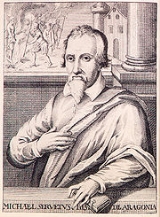
Michael Servetus

Encyclopedia
Michael Servetus was a Spanish
theologian
, physician
, cartographer, and humanist
. He was the first European to correctly describe the function of pulmonary circulation
. His interests included many sciences: mathematics
, astronomy
and meteorology
, geography
, human anatomy
, medicine
and pharmacology
, as well as jurisprudence
, and the scholarly study of the Bible
in its original languages. He is renowned in the history of several of these fields, particularly medicine and theology. He participated in the Protestant Reformation
, and later developed a nontrinitarian Christology
. Condemned by Catholics and Protestants
alike, he was arrested in Geneva
and burnt at the stake as a heretic
by order of the Protestant Geneva
governing council.
, Aragon
, Spain
, in 1511, probably on 29 September, the feast day of Saint Michael
, although no specific record exists. Some sources give an earlier date based on Servetus' own occasional claim of having been born in 1509. His paternal ancestors came from the hamlet of Serveto, in the Aragon
ese Pyrenees
, which gave the family their surname. The maternal line descended from Jewish converso
s of the Monzón
area. His father Antonio Serveto (alias Revés, i.e. "Reverse
") was a notary
. Servetus had two brothers: one who later became a notary like their father, and another who was a Catholic priest
.
Servetus was gifted in languages and could have studied Latin
, Greek
and Hebrew
under the instruction of Dominican friars
. There is no official document that supports the contention that Servetus learned Hebrew at the Castle of Montearagón
. In fact, according to expert Hebraists from Jerusalem, Servetus' Hebrew was "a Mediterranean Hebrew", one that would have been impossible to learn only from studying the Bible. It is more likely Servetus' knowledge of Hebrew results from the influence of his Jewish converso
family. At the age of fifteen, Servetus entered the service of a Franciscan
friar by the name of Juan de Quintana
, an Erasmian. He read the entire Bible
in its original languages from the manuscripts available at that time. Servetus later attended the University of Toulouse
in 1526 where he studied law. There he became suspected of participating in secret meetings and activities of Protestant students.
and Italy
with Quintana, who was then Charles V
's confessor in the imperial retinue. In October 1530 he visited Johannes Oecolampadius
in Basel
, staying there for about ten months, and probably supporting himself as a proofreader for a local printer. By this time, he was already spreading his beliefs. In May 1531 he met Martin Bucer
and Wolfgang Fabricius Capito in Strasbourg
.
Then two months later, in July 1531, Servetus published De trinitatis erroribus ("On the Errors of the Trinity"). The next year he published Dialogorum de Trinitate ("Dialogues on the Trinity") and De Iustitia Regni Christi ("On the Justice of Christ
's Reign"). He took on the pseudonym Michel de Villeneuve (i.e., "Michael from Villanueva"), to avoid persecution by the ecclesiastical authorities in power at the time because of these religious works. He studied at the Collège de Calvi in Paris
in 1533. After an interval, Servetus returned to Paris to study medicine in 1536. In Paris, his teachers included Sylvius, Fernel, and Johannes Guinter, who hailed him with Vesalius
as his most able assistant in dissections.
In these books, Servetus rejected the classical conception of the Trinity
, stating that it was not based on the Bible
. He argued that it arose from teachings of (Greek) philosophers
, and he advocated a return to the simplicity of the Gospels and the teachings of the early Church Fathers
that he believed pre-dated the development of Nicene trinitarianism. Servetus hoped that the dismissal of the trinitarian dogma would make Christianity more appealing to believers in Judaism
and Islam
, which had preserved the unity of God in their teachings. According to Servetus, trinitarians had turned Christianity into a form of "tritheism", or belief in three gods. Servetus affirmed that the divine Logos
, the manifestation of God and not a separate divine Person, was incarnated in a human being, Jesus, when God's spirit came into the womb of the Virgin Mary. Only from the moment of conception, was the Son actually generated. Therefore the Son was not eternal, but only the Logos from which He was formed. For this reason, Servetus always rejected calling Christ the "eternal
Son of God
" but rather called him "the Son of the eternal God." In describing Servetus' view of the Logos, Andrew Dibb explained: "In 'Genesis' God reveals himself as the creator. In 'John' he reveals that he created by means of the Word, or Logos. Finally, also in 'John', he shows that this Logos became flesh and 'dwelt among us'. Creation took place by the spoken word, for God said "Let there be ..." The spoken word of Genesis, the Logos of John, and the Christ, are all one and the same."
Unitarian scholar Earl Morse Wilbur
states, "Servetus' Errors of the Trinity is hardly heretical in intent, rather is suffused with passionate earnestness, warm piety, an ardent reverence for Scripture, and a love for Christ so mystical and overpowering that [he] can hardly find words to express it... Servetus asserted that the Father, Son and Holy Spirit were dispositions of God, and not separate and distinct beings. Wilbur promotes the idea that Servetus was a modalist.
Servetus states his view clearly in the preamble to Restoration of Christianity (1553): "There is nothing greater, reader, than to recognize that God has been manifested as substance, and that His divine nature has been truly communicated. We shall clearly apprehend the manifestation of God through the Word and his communication through the Spirit, both of them substantially in Christ alone." This theology, though original in some respects, has often been compared to Adoptionism
, Arianism
, and Sabellianism
, all of which Trinitarian scholars rejected as heresies in their attempts to defend their belief that God exists eternally in three separate persons. Nevertheless, Servetus rejected these theologies in his books: Adoptionism, because it denied Jesus's divinity; Arianism, because it multiplied the hypostases and established a rank; and Sabellianism, because, at first glance, it seemingly confused the Father with the Son.
Under severe pressure from Catholics and Protestants alike, Servetus clarified this explanation in his second book, Dialogues (1532), to show the Logos coterminous with Christ. He was nevertheless accused of heresy
because of his insistence on denying the dogma of the Trinity and the individuality of three divine Persons in one God.
After his studies in medicine, Servetus started a medical practice. He became personal physician to Pierre Palmier, Archbishop of Vienne, and was also physician to Guy de Maugiron, the lieutenant governor of Dauphiné
. While he practiced medicine near Lyon
for about fifteen years, he also published two other works dealing with Ptolemy
's Geography. Servetus dedicated his first edition of Ptolemy and his edition of the Bible to his patron Hugues de la Porte. He dedicated his second edition of Ptolemy's Geography to his other patron, Archbishop Palmier. While in Lyon, Symphorien Champier
, a medical humanist
, had been Servetus' patron. Servetus wrote pharmacological tracts in defense of Champier against Leonhart Fuchs
. Working also as a proof reader, he published several more books which dealt with medicine and pharmacology. Years earlier he had sent a copy to John Calvin
, initiating a correspondence between the two. Initially in the correspondence Servetus used the pseudonym "Michel de Villeneuve".
In 1553 Servetus published yet another religious work with further anti-trinitarian views. It was entitled Christianismi Restitutio, a work that sharply rejected the idea of predestination
and the idea that God condemned souls to Hell regardless of worth or merit. God, insisted Servetus, condemns no one who does not condemn himself through thought, word or deed.
To Calvin, who had written his summary of Christian doctrine Institutes of the Christian Religion
, Servetus' latest book was an attack on his personally held theories regarding Christian belief, theories that he was attempting to put forth as "established Christian doctrine". Calvin sent a copy of his own book as his reply. Servetus promptly returned it, thoroughly annotated with critical observations. Calvin wrote to Servetus, "I neither hate you nor despise you; nor do I wish to persecute you; but I would be as hard as iron when I behold you insulting sound doctrine with so great audacity."
In time their correspondences grew more heated until Calvin ended it. Servetus sent Calvin several more letters, to which Calvin took offense. Thus, Calvin's antagonism against Servetus seems to have been based not simply on his views but also on Servetus's tone, which he considered inappropriate. Calvin revealed the intentions of his offended heart when he stated of Servetus, when writing to his friend William Farel
on 13 February 1546:
, was denounced as a heretic by Guillaume Trie, a rich merchant who had taken refuge in Geneva
— a very good friend of Calvin,—in a letter sent to a cousin, Antoine Arneys, who was living in Lyon. On behalf of the French inquisitor
Matthieu Ory
, Servetus as well as Arnollet, the printer of Christianismi Restitutio, were questioned, but they denied all charges and were released for lack of evidence. Arneys was asked by Ory to write back to Trie, demanding proof. On 26 March 1553, the letters sent by Servetus to Calvin and some manuscript pages of Christianismi Restitutio were forwarded to Lyon by Trie. On 4 April 1553 Servetus was arrested by Roman Catholic authorities, and imprisoned in Vienne. He escaped from prison three days later. On 17 June, he was convicted of heresy by the French Inquisition, "thanks to the 17 letters sent by Jehan Calvin, preacher in Geneva" and sentenced to be burned with his books. An effigy and his books were burned in his absence.
Meaning to flee to Italy, Servetus inexplicably stopped in at Geneva, where Calvin and his Reformers had denounced him. On 13 August, he attended a sermon by Calvin at Geneva. He was immediately recognized and arrested after the service and was again imprisoned. All his property was confiscated. French Inquisitors asked that Servetus be extradited to them for execution. Calvin wanted to show himself as firm in defense of Christian orthodoxy as his usual opponents. "He was forced to push the condemnation of Servetus with all the means at his command." Calvin's delicate health meant he did not personally appear against Servetus. Nicholas de la Fontaine
played the more active role in Servetus's prosecution and the listing of points that condemned him.
At his trial, Servetus was condemned on two counts, for spreading and preaching Nontrinitarianism
and anti-paedobaptism (anti-infant baptism). Of paedobaptism Servetus had said, "It is an invention of the devil, an infernal falsity for the destruction of all Christianity." In the case the procureur général (chief public prosecutor) added some curious sounding accusations in the form of inquiries—the most odd sounding perhaps being, "whether he has married, and if he answers that he has not, he shall be asked why, in consideration of his age, he could refrain so long from marriage." To this oblique imputation of unchastity (or perhaps homosexuality
), Servetus replied that rupture (hernia?) had long since made him incapable of that particular sin. More offensive to modern ears might be the question "whether he did not know that his doctrine was pernicious, considering that he favours Jews and Turks
, by making excuses for them, and if he has not studied the Koran in order to disprove and controvert the doctrine and religion that the Christian churches hold, together with other profane books, from which people ought to abstain in matters of religion, according to the doctrine of St. Paul
."
Calvin believed Servetus deserving of death on account of what he termed as his "execrable blasphemies". Calvin expressed these sentiments in a letter to Farel
, written about a week after Servetus’ arrest, in which he also mentioned an exchange with Servetus. Calvin wrote:
As Servetus was not a citizen of Geneva, and legally could at worst be banished, the government, in an attempt to find some plausible excuse to disregard this legal reality, had consulted with other Swiss Reformed cantons
(Zürich
, Bern, Basel
, Schaffhausen
.) They universally favored his condemnation and suppression of his doctrine, but without saying how that should be accomplished. Martin Luther
had condemned his writing in strong terms. Servetus and Philip Melanchthon had strongly hostile views of each other. The party called the "Libertine
s", who were generally opposed to anything and everything John Calvin supported, were in this case strongly in favor of the execution of Servetus at the stake (while Calvin argued for something more humane). In fact, the council that condemned Servetus was presided over by Perrin (a Libertine) who ultimately on 24 October sentenced Servetus to death by burning
for denying the Trinity
and infant baptism. When Calvin requested that Servetus be executed by decapitation
rather than fire, Farel, in a letter of 8 September, chided him for undue lenience. The Geneva Council refused his request. On 27 October 1553 Servetus was burned at the stake
just outside Geneva with what was believed to be the last copy of his book chained to his leg. Historians record his last words as: "Jesus, Son of the Eternal God, have mercy on me."
Calvin agreed that those whom the ruling religious authorities determined to be heretics should be punished:
and countless others denounced this execution and became harsh critics of Calvin because of the whole affair.
Some other antitrinitarian thinkers began to be more cautious in expressing their views: Martin Cellarius
, Lelio Sozzini and others either ceased writing or wrote only in private. The fact that Servetus was dead meant that his writings could be distributed more liberally, though others such as Giorgio Biandrata
developed them in their own names.
The writings of Servetus had some influence on the beginnings of the Unitarian movement in Poland and Transylvania. Piotr z Goniądza
's advocacy of Servetus' views led to the separation of the Polish brethren
from the Calvinist Reformed Church in Poland, and laid the foundations for the Socinian movement which fostered the early Unitarians
in England like John Biddle
.
and eventual execution by burning
for heresy
, Unitarians
often regard Servetus as the first (modern) Unitarian martyr – though he was not a Unitarian either in the 17thC sense nor the modern one. Other non-trinitarian groups, such as Jehovah's Witnesses
, and Oneness Pentecostalism
, also claim Servetus as a spiritual ancestor. Oneness Pentecostalism particularly identifies with Servetus' teaching on the divinity of Jesus Christ and his insistence on the oneness of God, rather than a Trinity of three distinct persons: "And because His Spirit was wholly God He is called God, just as from His flesh He is called man."
Swedenborg wrote a systematic theology that had many similarities to the theology of Servetus.
More recently Servetus' name has been given prominence by the originally anonymous author "Servetus the Evangelical
".
and to Thomas Jefferson
and the American Declaration of Independence. According to Hillar: "Historically speaking, Servetus died so that freedom of conscience could become a civil right in modern society."
, although his achievement was not widely recognized at the time, for a few reasons. One was that the description appeared in a theological treatise, Christianismi Restitutio, not in a book on medicine. Most copies of the book were burned shortly after its publication in 1553 because of persecution of Servetus by religious authorities. Three copies survived, but these remained hidden for decades.
It was not until William Harvey
's publication of findings from his dissections in 1616 that the function of pulmonary circulation was widely accepted by physicians. Western historians of science have since learned that a separate discovery of pulmonary circulation was made in the 13th century by Ibn al-Nafis, who was born in 1213 A.D. in Damascus
. Because of limitations of culture and language, his discovery was not transmitted to Europe.
In 1984, a Zaragoza
public hospital changed its name from José Antonio
to Miguel Servet. It is now a university hospital. Most Spanish cities also include at least a street, square or park named after Servetus. Geneva
, Switzerland
, named a street after him: la rue Michel Servet.
Increasing numbers of Servet Scholars agree that previously unknown works have been found by Dr Francisco Javier González Echeverría, a Spanish pediatrician and historian of the modern age. These works include a noted "Dioscorides" found at Sesma, a village of Navarra, and several bibles.
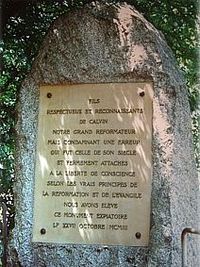
in memory of Servetus in 1903, the main text of which served more as an apologetic for Calvin, reading:
The city council then rejected the request of the committee to erect the completed statue, on the grounds that there was already a monument to Servetus. The committee then offered the statue to the French town of Annemasse, which in 1908 placed it in front of the city hall, with the following inscriptions:
In 1942, the Vichy Government took down the statue, as it was a celebration of freedom of conscience, and melted it. In 1960, having found the original molds, Annemasse had it recast and returned the statue to its previous place.
Finally, on the 3rd of October 2011, Geneva erected a copy of the statue which it had rejected over 100 years before. It was cast in Aragon from the molds of Clothilde Roch's original statue. Rémy Pagani, former mayor of Geneva, inaugurated the statue. He previously had described Servetus as "the dissident of dissidents."Tribune de Geneve Representatives from the Roman Catholic Church in Geneva and the Director of Geneva's International Museum of the Reformation attended the ceremony. A Geneva newspaper noted the absence of officials from the National Protestant Church of Geneva, the church of John Calvin.
public hospital changed its name from José Antonio
to Miguel Servet. It is now a university hospital.
Most Spanish cities also include at least a street, square or park named after Servetus.
Spain
Spain , officially the Kingdom of Spain languages]] under the European Charter for Regional or Minority Languages. In each of these, Spain's official name is as follows:;;;;;;), is a country and member state of the European Union located in southwestern Europe on the Iberian Peninsula...
theologian
Theology
Theology is the systematic and rational study of religion and its influences and of the nature of religious truths, or the learned profession acquired by completing specialized training in religious studies, usually at a university or school of divinity or seminary.-Definition:Augustine of Hippo...
, physician
Physician
A physician is a health care provider who practices the profession of medicine, which is concerned with promoting, maintaining or restoring human health through the study, diagnosis, and treatment of disease, injury and other physical and mental impairments...
, cartographer, and humanist
Renaissance humanism
Renaissance humanism was an activity of cultural and educational reform engaged by scholars, writers, and civic leaders who are today known as Renaissance humanists. It developed during the fourteenth and the beginning of the fifteenth centuries, and was a response to the challenge of Mediæval...
. He was the first European to correctly describe the function of pulmonary circulation
Pulmonary circulation
Pulmonary circulation is the half portion of the cardiovascular system which carries Oxygen-depleted Blood away from the heart, to the Lungs, and returns oxygenated blood back to the heart. Encyclopedic description and discovery of the pulmonary circulation is widely attributed to Doctor Ibn...
. His interests included many sciences: mathematics
Mathematics
Mathematics is the study of quantity, space, structure, and change. Mathematicians seek out patterns and formulate new conjectures. Mathematicians resolve the truth or falsity of conjectures by mathematical proofs, which are arguments sufficient to convince other mathematicians of their validity...
, astronomy
Astronomy
Astronomy is a natural science that deals with the study of celestial objects and phenomena that originate outside the atmosphere of Earth...
and meteorology
Meteorology
Meteorology is the interdisciplinary scientific study of the atmosphere. Studies in the field stretch back millennia, though significant progress in meteorology did not occur until the 18th century. The 19th century saw breakthroughs occur after observing networks developed across several countries...
, geography
Geography
Geography is the science that studies the lands, features, inhabitants, and phenomena of Earth. A literal translation would be "to describe or write about the Earth". The first person to use the word "geography" was Eratosthenes...
, human anatomy
Anatomy
Anatomy is a branch of biology and medicine that is the consideration of the structure of living things. It is a general term that includes human anatomy, animal anatomy , and plant anatomy...
, medicine
Medicine
Medicine is the science and art of healing. It encompasses a variety of health care practices evolved to maintain and restore health by the prevention and treatment of illness....
and pharmacology
Pharmacology
Pharmacology is the branch of medicine and biology concerned with the study of drug action. More specifically, it is the study of the interactions that occur between a living organism and chemicals that affect normal or abnormal biochemical function...
, as well as jurisprudence
Jurisprudence
Jurisprudence is the theory and philosophy of law. Scholars of jurisprudence, or legal theorists , hope to obtain a deeper understanding of the nature of law, of legal reasoning, legal systems and of legal institutions...
, and the scholarly study of the Bible
Bible
The Bible refers to any one of the collections of the primary religious texts of Judaism and Christianity. There is no common version of the Bible, as the individual books , their contents and their order vary among denominations...
in its original languages. He is renowned in the history of several of these fields, particularly medicine and theology. He participated in the Protestant Reformation
Protestant Reformation
The Protestant Reformation was a 16th-century split within Western Christianity initiated by Martin Luther, John Calvin and other early Protestants. The efforts of the self-described "reformers", who objected to the doctrines, rituals and ecclesiastical structure of the Roman Catholic Church, led...
, and later developed a nontrinitarian Christology
Christology
Christology is the field of study within Christian theology which is primarily concerned with the nature and person of Jesus Christ as recorded in the Canonical gospels and the letters of the New Testament. Primary considerations include the relationship of Jesus' nature and person with the nature...
. Condemned by Catholics and Protestants
Protestantism
Protestantism is one of the three major groupings within Christianity. It is a movement that began in Germany in the early 16th century as a reaction against medieval Roman Catholic doctrines and practices, especially in regards to salvation, justification, and ecclesiology.The doctrines of the...
alike, he was arrested in Geneva
Geneva
Geneva In the national languages of Switzerland the city is known as Genf , Ginevra and Genevra is the second-most-populous city in Switzerland and is the most populous city of Romandie, the French-speaking part of Switzerland...
and burnt at the stake as a heretic
Heresy
Heresy is a controversial or novel change to a system of beliefs, especially a religion, that conflicts with established dogma. It is distinct from apostasy, which is the formal denunciation of one's religion, principles or cause, and blasphemy, which is irreverence toward religion...
by order of the Protestant Geneva
Geneva
Geneva In the national languages of Switzerland the city is known as Genf , Ginevra and Genevra is the second-most-populous city in Switzerland and is the most populous city of Romandie, the French-speaking part of Switzerland...
governing council.
Early life and education
Servetus was born as Miguel Serveto Conesa (family nickname "Revés") at Villanueva de Sijena, HuescaHuesca (province)
Huesca , officially Huesca/Uesca, is a province of northeastern Spain, in northern Aragon. The capital is Huesca.Positioned just south of the central Pyrenees, Huesca borders France and the French Departments of Pyrénées-Atlantiques and Hautes-Pyrénées...
, Aragon
Aragon
Aragon is a modern autonomous community in Spain, coextensive with the medieval Kingdom of Aragon. Located in northeastern Spain, the Aragonese autonomous community comprises three provinces : Huesca, Zaragoza, and Teruel. Its capital is Zaragoza...
, Spain
Spain
Spain , officially the Kingdom of Spain languages]] under the European Charter for Regional or Minority Languages. In each of these, Spain's official name is as follows:;;;;;;), is a country and member state of the European Union located in southwestern Europe on the Iberian Peninsula...
, in 1511, probably on 29 September, the feast day of Saint Michael
Michael (archangel)
Michael , Micha'el or Mîkhā'ēl; , Mikhaḗl; or Míchaël; , Mīkhā'īl) is an archangel in Jewish, Christian, and Islamic teachings. Roman Catholics, Anglicans, and Lutherans refer to him as Saint Michael the Archangel and also simply as Saint Michael...
, although no specific record exists. Some sources give an earlier date based on Servetus' own occasional claim of having been born in 1509. His paternal ancestors came from the hamlet of Serveto, in the Aragon
Aragon
Aragon is a modern autonomous community in Spain, coextensive with the medieval Kingdom of Aragon. Located in northeastern Spain, the Aragonese autonomous community comprises three provinces : Huesca, Zaragoza, and Teruel. Its capital is Zaragoza...
ese Pyrenees
Pyrenees
The Pyrenees is a range of mountains in southwest Europe that forms a natural border between France and Spain...
, which gave the family their surname. The maternal line descended from Jewish converso
Converso
A converso and its feminine form conversa was a Jew or Muslim—or a descendant of Jews or Muslims—who converted to Catholicism in Spain or Portugal, particularly during the 14th and 15th centuries. Mass conversions once took place under significant government pressure...
s of the Monzón
Monzón
Monzón is a small town in the autonomous community of Aragon, Spain. It has a population of 17,050. It is located in the northeast and adjoins the rivers Cinca and Sosa.-Historical overview:...
area. His father Antonio Serveto (alias Revés, i.e. "Reverse
Anagram
An anagram is a type of word play, the result of rearranging the letters of a word or phrase to produce a new word or phrase, using all the original letters exactly once; e.g., orchestra = carthorse, A decimal point = I'm a dot in place, Tom Marvolo Riddle = I am Lord Voldemort. Someone who...
") was a notary
Notary public
A notary public in the common law world is a public officer constituted by law to serve the public in non-contentious matters usually concerned with estates, deeds, powers-of-attorney, and foreign and international business...
. Servetus had two brothers: one who later became a notary like their father, and another who was a Catholic priest
Priesthood (Catholic Church)
The ministerial orders of the Catholic Church include the orders of bishops, deacons and presbyters, which in Latin is sacerdos. The ordained priesthood and common priesthood are different in function and essence....
.
Servetus was gifted in languages and could have studied Latin
Latin
Latin is an Italic language originally spoken in Latium and Ancient Rome. It, along with most European languages, is a descendant of the ancient Proto-Indo-European language. Although it is considered a dead language, a number of scholars and members of the Christian clergy speak it fluently, and...
, Greek
Greek language
Greek is an independent branch of the Indo-European family of languages. Native to the southern Balkans, it has the longest documented history of any Indo-European language, spanning 34 centuries of written records. Its writing system has been the Greek alphabet for the majority of its history;...
and Hebrew
Hebrew language
Hebrew is a Semitic language of the Afroasiatic language family. Culturally, is it considered by Jews and other religious groups as the language of the Jewish people, though other Jewish languages had originated among diaspora Jews, and the Hebrew language is also used by non-Jewish groups, such...
under the instruction of Dominican friars
Dominican Order
The Order of Preachers , after the 15th century more commonly known as the Dominican Order or Dominicans, is a Catholic religious order founded by Saint Dominic and approved by Pope Honorius III on 22 December 1216 in France...
. There is no official document that supports the contention that Servetus learned Hebrew at the Castle of Montearagón
Castle of Montearagón
The Castle of Montearagón is a former fortress-monastery in Quicena, near Huesca, Aragon, Spain, built in the Romanesque style. It is presently in ruins....
. In fact, according to expert Hebraists from Jerusalem, Servetus' Hebrew was "a Mediterranean Hebrew", one that would have been impossible to learn only from studying the Bible. It is more likely Servetus' knowledge of Hebrew results from the influence of his Jewish converso
Converso
A converso and its feminine form conversa was a Jew or Muslim—or a descendant of Jews or Muslims—who converted to Catholicism in Spain or Portugal, particularly during the 14th and 15th centuries. Mass conversions once took place under significant government pressure...
family. At the age of fifteen, Servetus entered the service of a Franciscan
Franciscan
Most Franciscans are members of Roman Catholic religious orders founded by Saint Francis of Assisi. Besides Roman Catholic communities, there are also Old Catholic, Anglican, Lutheran, ecumenical and Non-denominational Franciscan communities....
friar by the name of Juan de Quintana
Juan de Quintana
Juan de Quintana was a Franciscan friar and confessor to the Habsburg emperor Charles V.Juan de Quintana was a student of Eramus and a student at the Sorbonne receiving his doctorate there...
, an Erasmian. He read the entire Bible
Bible
The Bible refers to any one of the collections of the primary religious texts of Judaism and Christianity. There is no common version of the Bible, as the individual books , their contents and their order vary among denominations...
in its original languages from the manuscripts available at that time. Servetus later attended the University of Toulouse
University of Toulouse
The Université de Toulouse is a consortium of French universities, grandes écoles and other institutions of higher education and research, named after one of the earliest universities established in Europe in 1229, and including the successor universities to that earlier university...
in 1526 where he studied law. There he became suspected of participating in secret meetings and activities of Protestant students.
Career
Servetus' wide readings informed his thinking. In 1528, Servetus traveled through GermanyGermany
Germany , officially the Federal Republic of Germany , is a federal parliamentary republic in Europe. The country consists of 16 states while the capital and largest city is Berlin. Germany covers an area of 357,021 km2 and has a largely temperate seasonal climate...
and Italy
Italy
Italy , officially the Italian Republic languages]] under the European Charter for Regional or Minority Languages. In each of these, Italy's official name is as follows:;;;;;;;;), is a unitary parliamentary republic in South-Central Europe. To the north it borders France, Switzerland, Austria and...
with Quintana, who was then Charles V
Charles V, Holy Roman Emperor
Charles V was ruler of the Holy Roman Empire from 1519 and, as Charles I, of the Spanish Empire from 1516 until his voluntary retirement and abdication in favor of his younger brother Ferdinand I and his son Philip II in 1556.As...
's confessor in the imperial retinue. In October 1530 he visited Johannes Oecolampadius
Johannes Oecolampadius
Johannes Œcolampadius was a German religious reformer. His real name was Hussgen or Heussgen .-Life:He was born in Weinsberg, then part of the Electoral Palatinate...
in Basel
Basel
Basel or Basle In the national languages of Switzerland the city is also known as Bâle , Basilea and Basilea is Switzerland's third most populous city with about 166,000 inhabitants. Located where the Swiss, French and German borders meet, Basel also has suburbs in France and Germany...
, staying there for about ten months, and probably supporting himself as a proofreader for a local printer. By this time, he was already spreading his beliefs. In May 1531 he met Martin Bucer
Martin Bucer
Martin Bucer was a Protestant reformer based in Strasbourg who influenced Lutheran, Calvinist, and Anglican doctrines and practices. Bucer was originally a member of the Dominican Order, but after meeting and being influenced by Martin Luther in 1518 he arranged for his monastic vows to be annulled...
and Wolfgang Fabricius Capito in Strasbourg
Strasbourg
Strasbourg is the capital and principal city of the Alsace region in eastern France and is the official seat of the European Parliament. Located close to the border with Germany, it is the capital of the Bas-Rhin département. The city and the region of Alsace are historically German-speaking,...
.
Then two months later, in July 1531, Servetus published De trinitatis erroribus ("On the Errors of the Trinity"). The next year he published Dialogorum de Trinitate ("Dialogues on the Trinity") and De Iustitia Regni Christi ("On the Justice of Christ
Christ
Christ is the English term for the Greek meaning "the anointed one". It is a translation of the Hebrew , usually transliterated into English as Messiah or Mashiach...
's Reign"). He took on the pseudonym Michel de Villeneuve (i.e., "Michael from Villanueva"), to avoid persecution by the ecclesiastical authorities in power at the time because of these religious works. He studied at the Collège de Calvi in Paris
Paris
Paris is the capital and largest city in France, situated on the river Seine, in northern France, at the heart of the Île-de-France region...
in 1533. After an interval, Servetus returned to Paris to study medicine in 1536. In Paris, his teachers included Sylvius, Fernel, and Johannes Guinter, who hailed him with Vesalius
Vesalius
Andreas Vesalius was a Flemish anatomist, physician, and author of one of the most influential books on human anatomy, De humani corporis fabrica . Vesalius is often referred to as the founder of modern human anatomy. Vesalius is the Latinized form of Andries van Wesel...
as his most able assistant in dissections.
Theology
In these books, Servetus rejected the classical conception of the Trinity
Trinity
The Christian doctrine of the Trinity defines God as three divine persons : the Father, the Son , and the Holy Spirit. The three persons are distinct yet coexist in unity, and are co-equal, co-eternal and consubstantial . Put another way, the three persons of the Trinity are of one being...
, stating that it was not based on the Bible
Bible
The Bible refers to any one of the collections of the primary religious texts of Judaism and Christianity. There is no common version of the Bible, as the individual books , their contents and their order vary among denominations...
. He argued that it arose from teachings of (Greek) philosophers
Western philosophy
Western philosophy is the philosophical thought and work of the Western or Occidental world, as distinct from Eastern or Oriental philosophies and the varieties of indigenous philosophies....
, and he advocated a return to the simplicity of the Gospels and the teachings of the early Church Fathers
Church Fathers
The Church Fathers, Early Church Fathers, Christian Fathers, or Fathers of the Church were early and influential theologians, eminent Christian teachers and great bishops. Their scholarly works were used as a precedent for centuries to come...
that he believed pre-dated the development of Nicene trinitarianism. Servetus hoped that the dismissal of the trinitarian dogma would make Christianity more appealing to believers in Judaism
Judaism
Judaism ) is the "religion, philosophy, and way of life" of the Jewish people...
and Islam
Islam
Islam . The most common are and . : Arabic pronunciation varies regionally. The first vowel ranges from ~~. The second vowel ranges from ~~~...
, which had preserved the unity of God in their teachings. According to Servetus, trinitarians had turned Christianity into a form of "tritheism", or belief in three gods. Servetus affirmed that the divine Logos
Logos
' is an important term in philosophy, psychology, rhetoric and religion. Originally a word meaning "a ground", "a plea", "an opinion", "an expectation", "word," "speech," "account," "reason," it became a technical term in philosophy, beginning with Heraclitus ' is an important term in...
, the manifestation of God and not a separate divine Person, was incarnated in a human being, Jesus, when God's spirit came into the womb of the Virgin Mary. Only from the moment of conception, was the Son actually generated. Therefore the Son was not eternal, but only the Logos from which He was formed. For this reason, Servetus always rejected calling Christ the "eternal
Eternity
While in the popular mind, eternity often simply means existence for a limitless amount of time, many have used it to refer to a timeless existence altogether outside time. By contrast, infinite temporal existence is then called sempiternity. Something eternal exists outside time; by contrast,...
Son of God
Son of God
"Son of God" is a phrase which according to most Christian denominations, Trinitarian in belief, refers to the relationship between Jesus and God, specifically as "God the Son"...
" but rather called him "the Son of the eternal God." In describing Servetus' view of the Logos, Andrew Dibb explained: "In 'Genesis' God reveals himself as the creator. In 'John' he reveals that he created by means of the Word, or Logos. Finally, also in 'John', he shows that this Logos became flesh and 'dwelt among us'. Creation took place by the spoken word, for God said "Let there be ..." The spoken word of Genesis, the Logos of John, and the Christ, are all one and the same."
Unitarian scholar Earl Morse Wilbur
Earl Morse Wilbur
Earl Morse Wilbur was an American Unitarian historian.Wilbur was the first dean 1904-1910; then president 1911-1931; and until 1934, professor of homiletics and practical theology at the Pacific Unitarian School for Ministry, Berkeley, California of the American Unitarian Association .-Works:* * *...
states, "Servetus' Errors of the Trinity is hardly heretical in intent, rather is suffused with passionate earnestness, warm piety, an ardent reverence for Scripture, and a love for Christ so mystical and overpowering that [he] can hardly find words to express it... Servetus asserted that the Father, Son and Holy Spirit were dispositions of God, and not separate and distinct beings. Wilbur promotes the idea that Servetus was a modalist.
Servetus states his view clearly in the preamble to Restoration of Christianity (1553): "There is nothing greater, reader, than to recognize that God has been manifested as substance, and that His divine nature has been truly communicated. We shall clearly apprehend the manifestation of God through the Word and his communication through the Spirit, both of them substantially in Christ alone." This theology, though original in some respects, has often been compared to Adoptionism
Adoptionism
Adoptionism, sometimes called dynamic monarchianism, is a minority Christian belief that Jesus was adopted as God's son at his baptism...
, Arianism
Arianism
Arianism is the theological teaching attributed to Arius , a Christian presbyter from Alexandria, Egypt, concerning the relationship of the entities of the Trinity and the precise nature of the Son of God as being a subordinate entity to God the Father...
, and Sabellianism
Sabellianism
In Christianity, Sabellianism, is the nontrinitarian belief that the Heavenly Father, Resurrected Son and Holy Spirit are different modes or aspects of one God, as perceived by the believer, rather than three distinct persons in God Himself.The term Sabellianism comes from...
, all of which Trinitarian scholars rejected as heresies in their attempts to defend their belief that God exists eternally in three separate persons. Nevertheless, Servetus rejected these theologies in his books: Adoptionism, because it denied Jesus's divinity; Arianism, because it multiplied the hypostases and established a rank; and Sabellianism, because, at first glance, it seemingly confused the Father with the Son.
The incomprehensible God is known through Christ, by faith, rather than by philosophical speculations. He manifests God to us, being the expression of His very being, and through him alone, God can be known. The scriptures reveal Him to those who have faith; and thus we come to know the Holy Spirit as the Divine impulse within us.
Under severe pressure from Catholics and Protestants alike, Servetus clarified this explanation in his second book, Dialogues (1532), to show the Logos coterminous with Christ. He was nevertheless accused of heresy
Heresy
Heresy is a controversial or novel change to a system of beliefs, especially a religion, that conflicts with established dogma. It is distinct from apostasy, which is the formal denunciation of one's religion, principles or cause, and blasphemy, which is irreverence toward religion...
because of his insistence on denying the dogma of the Trinity and the individuality of three divine Persons in one God.
After his studies in medicine, Servetus started a medical practice. He became personal physician to Pierre Palmier, Archbishop of Vienne, and was also physician to Guy de Maugiron, the lieutenant governor of Dauphiné
Dauphiné
The Dauphiné or Dauphiné Viennois is a former province in southeastern France, whose area roughly corresponded to that of the present departments of :Isère, :Drôme, and :Hautes-Alpes....
. While he practiced medicine near Lyon
Lyon
Lyon , is a city in east-central France in the Rhône-Alpes region, situated between Paris and Marseille. Lyon is located at from Paris, from Marseille, from Geneva, from Turin, and from Barcelona. The residents of the city are called Lyonnais....
for about fifteen years, he also published two other works dealing with Ptolemy
Ptolemy
Claudius Ptolemy , was a Roman citizen of Egypt who wrote in Greek. He was a mathematician, astronomer, geographer, astrologer, and poet of a single epigram in the Greek Anthology. He lived in Egypt under Roman rule, and is believed to have been born in the town of Ptolemais Hermiou in the...
's Geography. Servetus dedicated his first edition of Ptolemy and his edition of the Bible to his patron Hugues de la Porte. He dedicated his second edition of Ptolemy's Geography to his other patron, Archbishop Palmier. While in Lyon, Symphorien Champier
Symphorien Champier
Symphorien Champier , a Lyonnese doctor born in Saint-Symphorien, France, was a relation of the Chevalier de Bayard through his wife, Marguerite Terrail.-Life:...
, a medical humanist
Humanism
Humanism is an approach in study, philosophy, world view or practice that focuses on human values and concerns. In philosophy and social science, humanism is a perspective which affirms some notion of human nature, and is contrasted with anti-humanism....
, had been Servetus' patron. Servetus wrote pharmacological tracts in defense of Champier against Leonhart Fuchs
Leonhart Fuchs
Leonhart Fuchs , sometimes spelled Leonhard Fuchs, was a German physician and one of the three founding fathers of botany, along with Otto Brunfels and Hieronymus Bock .-Biography:...
. Working also as a proof reader, he published several more books which dealt with medicine and pharmacology. Years earlier he had sent a copy to John Calvin
John Calvin
John Calvin was an influential French theologian and pastor during the Protestant Reformation. He was a principal figure in the development of the system of Christian theology later called Calvinism. Originally trained as a humanist lawyer, he broke from the Roman Catholic Church around 1530...
, initiating a correspondence between the two. Initially in the correspondence Servetus used the pseudonym "Michel de Villeneuve".
In 1553 Servetus published yet another religious work with further anti-trinitarian views. It was entitled Christianismi Restitutio, a work that sharply rejected the idea of predestination
Predestination
Predestination, in theology is the doctrine that all events have been willed by God. John Calvin interpreted biblical predestination to mean that God willed eternal damnation for some people and salvation for others...
and the idea that God condemned souls to Hell regardless of worth or merit. God, insisted Servetus, condemns no one who does not condemn himself through thought, word or deed.
To Calvin, who had written his summary of Christian doctrine Institutes of the Christian Religion
Institutes of the Christian Religion
The Institutes of the Christian Religion is John Calvin's seminal work on Protestant systematic theology...
, Servetus' latest book was an attack on his personally held theories regarding Christian belief, theories that he was attempting to put forth as "established Christian doctrine". Calvin sent a copy of his own book as his reply. Servetus promptly returned it, thoroughly annotated with critical observations. Calvin wrote to Servetus, "I neither hate you nor despise you; nor do I wish to persecute you; but I would be as hard as iron when I behold you insulting sound doctrine with so great audacity."
In time their correspondences grew more heated until Calvin ended it. Servetus sent Calvin several more letters, to which Calvin took offense. Thus, Calvin's antagonism against Servetus seems to have been based not simply on his views but also on Servetus's tone, which he considered inappropriate. Calvin revealed the intentions of his offended heart when he stated of Servetus, when writing to his friend William Farel
William Farel
William Farel , né Guilhem Farel, 1489 in Gap, Dauphiné, in south-eastern France, was a French evangelist, and a founder of the Reformed Church in the cantons of Neuchâtel, Berne, Geneva, and Vaud in Switzerland...
on 13 February 1546:
Imprisonment and execution
On 16 February 1553, Servetus, while in VienneVienne, Isère
Vienne is a commune in south-eastern France, located south of Lyon, on the Rhône River. It is the second largest city after Grenoble in the Isère department, of which it is a subprefecture. The city's population was of 29,400 as of the 2001 census....
, was denounced as a heretic by Guillaume Trie, a rich merchant who had taken refuge in Geneva
Geneva
Geneva In the national languages of Switzerland the city is known as Genf , Ginevra and Genevra is the second-most-populous city in Switzerland and is the most populous city of Romandie, the French-speaking part of Switzerland...
— a very good friend of Calvin,—in a letter sent to a cousin, Antoine Arneys, who was living in Lyon. On behalf of the French inquisitor
Inquisitor
An inquisitor was an official in an Inquisition, an organisation or program intended to eliminate heresy and other things frowned on by the Roman Catholic Church...
Matthieu Ory
Matthieu Ory
Matthieu Ory was a French Dominican theologian and Inquisitor.He is born at Caulnes, not at La Caune.-Life:...
, Servetus as well as Arnollet, the printer of Christianismi Restitutio, were questioned, but they denied all charges and were released for lack of evidence. Arneys was asked by Ory to write back to Trie, demanding proof. On 26 March 1553, the letters sent by Servetus to Calvin and some manuscript pages of Christianismi Restitutio were forwarded to Lyon by Trie. On 4 April 1553 Servetus was arrested by Roman Catholic authorities, and imprisoned in Vienne. He escaped from prison three days later. On 17 June, he was convicted of heresy by the French Inquisition, "thanks to the 17 letters sent by Jehan Calvin, preacher in Geneva" and sentenced to be burned with his books. An effigy and his books were burned in his absence.
Meaning to flee to Italy, Servetus inexplicably stopped in at Geneva, where Calvin and his Reformers had denounced him. On 13 August, he attended a sermon by Calvin at Geneva. He was immediately recognized and arrested after the service and was again imprisoned. All his property was confiscated. French Inquisitors asked that Servetus be extradited to them for execution. Calvin wanted to show himself as firm in defense of Christian orthodoxy as his usual opponents. "He was forced to push the condemnation of Servetus with all the means at his command." Calvin's delicate health meant he did not personally appear against Servetus. Nicholas de la Fontaine
Nicholas de la Fontaine
Nicholas de la Fontaine was a Protestant refugee in Geneva and entered the service of John Calvin, by whom he was employed a secretary. De la Fontaine brought Michael Servetus to trial on August 14, 1553 on the charges of heresy against Calvinism, as Calvin himself at this point was too...
played the more active role in Servetus's prosecution and the listing of points that condemned him.
At his trial, Servetus was condemned on two counts, for spreading and preaching Nontrinitarianism
Nontrinitarianism
Nontrinitarianism includes all Christian belief systems that disagree with the doctrine of the Trinity, namely, the teaching that God is three distinct hypostases and yet co-eternal, co-equal, and indivisibly united in one essence or ousia...
and anti-paedobaptism (anti-infant baptism). Of paedobaptism Servetus had said, "It is an invention of the devil, an infernal falsity for the destruction of all Christianity." In the case the procureur général (chief public prosecutor) added some curious sounding accusations in the form of inquiries—the most odd sounding perhaps being, "whether he has married, and if he answers that he has not, he shall be asked why, in consideration of his age, he could refrain so long from marriage." To this oblique imputation of unchastity (or perhaps homosexuality
Homosexuality
Homosexuality is romantic or sexual attraction or behavior between members of the same sex or gender. As a sexual orientation, homosexuality refers to "an enduring pattern of or disposition to experience sexual, affectional, or romantic attractions" primarily or exclusively to people of the same...
), Servetus replied that rupture (hernia?) had long since made him incapable of that particular sin. More offensive to modern ears might be the question "whether he did not know that his doctrine was pernicious, considering that he favours Jews and Turks
Turkic peoples
The Turkic peoples are peoples residing in northern, central and western Asia, southern Siberia and northwestern China and parts of eastern Europe. They speak languages belonging to the Turkic language family. They share, to varying degrees, certain cultural traits and historical backgrounds...
, by making excuses for them, and if he has not studied the Koran in order to disprove and controvert the doctrine and religion that the Christian churches hold, together with other profane books, from which people ought to abstain in matters of religion, according to the doctrine of St. Paul
Paul of Tarsus
Paul the Apostle , also known as Saul of Tarsus, is described in the Christian New Testament as one of the most influential early Christian missionaries, with the writings ascribed to him by the church forming a considerable portion of the New Testament...
."
Calvin believed Servetus deserving of death on account of what he termed as his "execrable blasphemies". Calvin expressed these sentiments in a letter to Farel
William Farel
William Farel , né Guilhem Farel, 1489 in Gap, Dauphiné, in south-eastern France, was a French evangelist, and a founder of the Reformed Church in the cantons of Neuchâtel, Berne, Geneva, and Vaud in Switzerland...
, written about a week after Servetus’ arrest, in which he also mentioned an exchange with Servetus. Calvin wrote:
As Servetus was not a citizen of Geneva, and legally could at worst be banished, the government, in an attempt to find some plausible excuse to disregard this legal reality, had consulted with other Swiss Reformed cantons
Cantons of Switzerland
The 26 cantons of Switzerland are the member states of the federal state of Switzerland. Each canton was a fully sovereign state with its own borders, army and currency from the Treaty of Westphalia until the establishment of the Swiss federal state in 1848...
(Zürich
Zürich
Zurich is the largest city in Switzerland and the capital of the canton of Zurich. It is located in central Switzerland at the northwestern tip of Lake Zurich...
, Bern, Basel
Basel
Basel or Basle In the national languages of Switzerland the city is also known as Bâle , Basilea and Basilea is Switzerland's third most populous city with about 166,000 inhabitants. Located where the Swiss, French and German borders meet, Basel also has suburbs in France and Germany...
, Schaffhausen
Schaffhausen
Schaffhausen is a city in northern Switzerland and the capital of the canton of the same name; it has an estimated population of 34,587 ....
.) They universally favored his condemnation and suppression of his doctrine, but without saying how that should be accomplished. Martin Luther
Martin Luther
Martin Luther was a German priest, professor of theology and iconic figure of the Protestant Reformation. He strongly disputed the claim that freedom from God's punishment for sin could be purchased with money. He confronted indulgence salesman Johann Tetzel with his Ninety-Five Theses in 1517...
had condemned his writing in strong terms. Servetus and Philip Melanchthon had strongly hostile views of each other. The party called the "Libertine
Libertine
A libertine is one devoid of most moral restraints, which are seen as unnecessary or undesirable, especially one who ignores or even spurns accepted morals and forms of behavior sanctified by the larger society. Libertines, also known as rakes, placed value on physical pleasures, meaning those...
s", who were generally opposed to anything and everything John Calvin supported, were in this case strongly in favor of the execution of Servetus at the stake (while Calvin argued for something more humane). In fact, the council that condemned Servetus was presided over by Perrin (a Libertine) who ultimately on 24 October sentenced Servetus to death by burning
Execution by burning
Death by burning is death brought about by combustion. As a form of capital punishment, burning has a long history as a method in crimes such as treason, heresy, and witchcraft....
for denying the Trinity
Trinity
The Christian doctrine of the Trinity defines God as three divine persons : the Father, the Son , and the Holy Spirit. The three persons are distinct yet coexist in unity, and are co-equal, co-eternal and consubstantial . Put another way, the three persons of the Trinity are of one being...
and infant baptism. When Calvin requested that Servetus be executed by decapitation
Decapitation
Decapitation is the separation of the head from the body. Beheading typically refers to the act of intentional decapitation, e.g., as a means of murder or execution; it may be accomplished, for example, with an axe, sword, knife, wire, or by other more sophisticated means such as a guillotine...
rather than fire, Farel, in a letter of 8 September, chided him for undue lenience. The Geneva Council refused his request. On 27 October 1553 Servetus was burned at the stake
Burned at the Stake
Burned at the Stake is a 1981 film directed by Bert I. Gordon. It stars Susan Swift and Albert Salmi.-Cast:*Susan Swift as Loreen Graham / Ann Putnam*Albert Salmi as Captaiin Billingham*Guy Stockwell as Dr. Grossinger*Tisha Sterling as Karen Graham...
just outside Geneva with what was believed to be the last copy of his book chained to his leg. Historians record his last words as: "Jesus, Son of the Eternal God, have mercy on me."
Calvin agreed that those whom the ruling religious authorities determined to be heretics should be punished:
Aftermath
Sebastian CastellioSebastian Castellio
Sebastian Castellio was a French preacher and theologian; and one of the first Reformed Christian proponents of religious toleration, freedom of conscience and thought....
and countless others denounced this execution and became harsh critics of Calvin because of the whole affair.
Some other antitrinitarian thinkers began to be more cautious in expressing their views: Martin Cellarius
Martin Cellarius
Martin Borrhaus was a German Protestant theologian and reformer.-Life:Borrhaus was born in Stuttgart and raised as an adopted child of a Simon Keller.. He enrolled at the University of Tübingen, where in 1515 he graduated and came to know Philipp Melanchthon...
, Lelio Sozzini and others either ceased writing or wrote only in private. The fact that Servetus was dead meant that his writings could be distributed more liberally, though others such as Giorgio Biandrata
Giorgio Biandrata
Giorgio Biandrata or Blandrata , was an Italian physician and polemicist, who came of the De Biandrate family, powerful from the early part of the 13th century, was born at Saluzzo, the youngest son of Bernardino Biandrata.He graduated in arts and medicine at Montpellier in 1533, and specialized in...
developed them in their own names.
The writings of Servetus had some influence on the beginnings of the Unitarian movement in Poland and Transylvania. Piotr z Goniądza
Piotr z Goniadza
Piotr of Goniądz was a Polish political and religious writer, thinker and one of the spiritual leaders of the Polish Brethren.-Life:Little is known of his early life. He was born to a peasant family some time between 1525 and 1530 in the town of Goniądz...
's advocacy of Servetus' views led to the separation of the Polish brethren
Polish Brethren
The Polish Brethren were members of the Minor Reformed Church of Poland, a Nontrinitarian Protestant church that existed in Poland from 1565 to 1658...
from the Calvinist Reformed Church in Poland, and laid the foundations for the Socinian movement which fostered the early Unitarians
Unitarianism
Unitarianism is a Christian theological movement, named for its understanding of God as one person, in direct contrast to Trinitarianism which defines God as three persons coexisting consubstantially as one in being....
in England like John Biddle
John Biddle (Unitarian)
John Biddle or Bidle was an influential English nontrinitarian, and Unitarian. He is often called "the Father of English Unitarianism".- Life :...
.
Theological influence
Because of his rejection of the TrinityTrinity
The Christian doctrine of the Trinity defines God as three divine persons : the Father, the Son , and the Holy Spirit. The three persons are distinct yet coexist in unity, and are co-equal, co-eternal and consubstantial . Put another way, the three persons of the Trinity are of one being...
and eventual execution by burning
Execution by burning
Death by burning is death brought about by combustion. As a form of capital punishment, burning has a long history as a method in crimes such as treason, heresy, and witchcraft....
for heresy
Heresy
Heresy is a controversial or novel change to a system of beliefs, especially a religion, that conflicts with established dogma. It is distinct from apostasy, which is the formal denunciation of one's religion, principles or cause, and blasphemy, which is irreverence toward religion...
, Unitarians
Unitarianism
Unitarianism is a Christian theological movement, named for its understanding of God as one person, in direct contrast to Trinitarianism which defines God as three persons coexisting consubstantially as one in being....
often regard Servetus as the first (modern) Unitarian martyr – though he was not a Unitarian either in the 17thC sense nor the modern one. Other non-trinitarian groups, such as Jehovah's Witnesses
Jehovah's Witnesses
Jehovah's Witnesses is a millenarian restorationist Christian denomination with nontrinitarian beliefs distinct from mainstream Christianity. The religion reports worldwide membership of over 7 million adherents involved in evangelism, convention attendance of over 12 million, and annual...
, and Oneness Pentecostalism
Oneness Pentecostalism
Oneness Pentecostalism refers to a grouping of denominations and believers within Pentecostal Christianity, all of whom subscribe to the nontrinitarian theological doctrine of Oneness...
, also claim Servetus as a spiritual ancestor. Oneness Pentecostalism particularly identifies with Servetus' teaching on the divinity of Jesus Christ and his insistence on the oneness of God, rather than a Trinity of three distinct persons: "And because His Spirit was wholly God He is called God, just as from His flesh He is called man."
Swedenborg wrote a systematic theology that had many similarities to the theology of Servetus.
More recently Servetus' name has been given prominence by the originally anonymous author "Servetus the Evangelical
Kermit Zarley
Kermit Millard Zarley, Jr. is an American professional golfer who played on the PGA Tour and the Champions Tour. He is also an author of several books.-Biography:...
".
Freedom of conscience
In recent years Michael Servetus has also been credited with being one of the modern forerunners of freedom of religion and freedom of conscience in the Western world. A renowned Spanish scholar on Servetus' work, Ángel Alcalá, identified the radical search for truth and the right for freedom of conscience as Servetus' main legacies, rather than his theology. The Polish-American scholar, Marian Hillar, has studied the evolution of freedom of conscience, from Servetus and the Polish Socinians, to John LockeJohn Locke
John Locke FRS , widely known as the Father of Liberalism, was an English philosopher and physician regarded as one of the most influential of Enlightenment thinkers. Considered one of the first of the British empiricists, following the tradition of Francis Bacon, he is equally important to social...
and to Thomas Jefferson
Thomas Jefferson
Thomas Jefferson was the principal author of the United States Declaration of Independence and the Statute of Virginia for Religious Freedom , the third President of the United States and founder of the University of Virginia...
and the American Declaration of Independence. According to Hillar: "Historically speaking, Servetus died so that freedom of conscience could become a civil right in modern society."
Scientific legacy
Servetus was the first European to describe the function of pulmonary circulationPulmonary circulation
Pulmonary circulation is the half portion of the cardiovascular system which carries Oxygen-depleted Blood away from the heart, to the Lungs, and returns oxygenated blood back to the heart. Encyclopedic description and discovery of the pulmonary circulation is widely attributed to Doctor Ibn...
, although his achievement was not widely recognized at the time, for a few reasons. One was that the description appeared in a theological treatise, Christianismi Restitutio, not in a book on medicine. Most copies of the book were burned shortly after its publication in 1553 because of persecution of Servetus by religious authorities. Three copies survived, but these remained hidden for decades.
It was not until William Harvey
William Harvey
William Harvey was an English physician who was the first person to describe completely and in detail the systemic circulation and properties of blood being pumped to the body by the heart...
's publication of findings from his dissections in 1616 that the function of pulmonary circulation was widely accepted by physicians. Western historians of science have since learned that a separate discovery of pulmonary circulation was made in the 13th century by Ibn al-Nafis, who was born in 1213 A.D. in Damascus
Damascus
Damascus , commonly known in Syria as Al Sham , and as the City of Jasmine , is the capital and the second largest city of Syria after Aleppo, both are part of the country's 14 governorates. In addition to being one of the oldest continuously inhabited cities in the world, Damascus is a major...
. Because of limitations of culture and language, his discovery was not transmitted to Europe.
In 1984, a Zaragoza
Zaragoza
Zaragoza , also called Saragossa in English, is the capital city of the Zaragoza Province and of the autonomous community of Aragon, Spain...
public hospital changed its name from José Antonio
José Antonio Primo de Rivera
José Antonio Primo de Rivera y Sáenz de Heredia, 1st Duke of Primo de Rivera, 3rd Marquis of Estella , was a Spanish lawyer, nobleman, politician, and founder of the Falange Española...
to Miguel Servet. It is now a university hospital. Most Spanish cities also include at least a street, square or park named after Servetus. Geneva
Geneva
Geneva In the national languages of Switzerland the city is known as Genf , Ginevra and Genevra is the second-most-populous city in Switzerland and is the most populous city of Romandie, the French-speaking part of Switzerland...
, Switzerland
Switzerland
Switzerland name of one of the Swiss cantons. ; ; ; or ), in its full name the Swiss Confederation , is a federal republic consisting of 26 cantons, with Bern as the seat of the federal authorities. The country is situated in Western Europe,Or Central Europe depending on the definition....
, named a street after him: la rue Michel Servet.
Increasing numbers of Servet Scholars agree that previously unknown works have been found by Dr Francisco Javier González Echeverría, a Spanish pediatrician and historian of the modern age. These works include a noted "Dioscorides" found at Sesma, a village of Navarra, and several bibles.
Geneva
In Geneva, 350 years after the execution, remembering Servetus was still a controversial issue. In 1903 a committee was formed by supporters of Servetus to erect a monument in his honor. The group was led by a French Senator, Auguste Dide, an author of a book on heretics and revolutionaries which was published in 1887. The committee commissioned a local sculptor, Clothilde Roch, to do a statue showing a suffering Servetus. The work was three years in the making and was finished in 1907. However by then, supporters of Calvin in Geneva, having heard about the project, had already erected a simple steleStele
A stele , also stela , is a stone or wooden slab, generally taller than it is wide, erected for funerals or commemorative purposes, most usually decorated with the names and titles of the deceased or living — inscribed, carved in relief , or painted onto the slab...
in memory of Servetus in 1903, the main text of which served more as an apologetic for Calvin, reading:
Duteous and grateful followers of Calvin our great Reformer, yet condemning an error which was that of his age, and strongly attached to liberty of conscience according to the true principles of his Reformation and gospel, we have erected this expiatory monument. Oct. 27, 1903About the same time, a short street close by the stele was named after him.
The city council then rejected the request of the committee to erect the completed statue, on the grounds that there was already a monument to Servetus. The committee then offered the statue to the French town of Annemasse, which in 1908 placed it in front of the city hall, with the following inscriptions:
“The arrest of Servetus in Geneva, where he did neither publish nor dogmatize, hence he was not subject to its laws, has to be considered as a barbaric act and an insult to the Right of Nations”. Voltaire
I beg you, shorten please these deliberations. It is clear that Calvin for his pleasure wishes to make me rot in this prison. The lice eat me alive. My clothes are torn and I have nothing for a change, nor shirt, only a worn out vest.”
Servetus, 1553
In 1942, the Vichy Government took down the statue, as it was a celebration of freedom of conscience, and melted it. In 1960, having found the original molds, Annemasse had it recast and returned the statue to its previous place.
Finally, on the 3rd of October 2011, Geneva erected a copy of the statue which it had rejected over 100 years before. It was cast in Aragon from the molds of Clothilde Roch's original statue. Rémy Pagani, former mayor of Geneva, inaugurated the statue. He previously had described Servetus as "the dissident of dissidents."Tribune de Geneve Representatives from the Roman Catholic Church in Geneva and the Director of Geneva's International Museum of the Reformation attended the ceremony. A Geneva newspaper noted the absence of officials from the National Protestant Church of Geneva, the church of John Calvin.
Elsewhere
In 1984, a ZaragozaZaragoza
Zaragoza , also called Saragossa in English, is the capital city of the Zaragoza Province and of the autonomous community of Aragon, Spain...
public hospital changed its name from José Antonio
José Antonio Primo de Rivera
José Antonio Primo de Rivera y Sáenz de Heredia, 1st Duke of Primo de Rivera, 3rd Marquis of Estella , was a Spanish lawyer, nobleman, politician, and founder of the Falange Española...
to Miguel Servet. It is now a university hospital.
Most Spanish cities also include at least a street, square or park named after Servetus.
In literature
- Austrian author Stefan ZweigStefan ZweigStefan Zweig was an Austrian novelist, playwright, journalist and biographer. At the height of his literary career, in the 1920s and 1930s, he was one of the most famous writers in the world.- Biography :...
features Servetus in Castellio gegen Calvin oder Ein Gewissen gegen die Gewalt. - Canadian dramatist Robert Lalonde wrote Vesalius and Servetus, a 2008 play on Servetus.
Works
Only the dates of the first editions are included.- 1531 “On the Errors of the Trinity. De Trinitatis Erroribus” (Hageunau, Setzer). Signed as Michael Servetus
- 1532 “ Dialogs on the Trinity. Diaologorum de Trinitaty” (Hageunau, Setzer). Signed as Michael Servetus
- 1535 “Geography of Claudius Ptolemy. Claudii Ptolemaeii Alexandrinii Geographicae.” Lyon, Trechsel. Signed as Michel De Villeneuve
- 1536 “The Apology against Leonard Fuchs. In Leonardum Fucsium Apologia.“ Lyon, printed by Gilles Hugetan, with Parisian prologue. Signed as Michel De Villeneuve
- 1537 “Universal explanation of the syrups. Syruporum universia ratio”. Paris, edited by Simon des Colines. Signed as Michael De Villeneuve
- 1538 “Apologetic discourse of Michel De Villeneuve in favour of astrology and against a certain physician. Michaelis Villanovani in quedam medicum apologetica disceptatio pro Astrologia.” Which brought about his first death sentence by the University of Paris. The sentence was commuted to the withdrawal of this edition. From this year the name of Michel De Villeneuve will never appear on the cover of a first edition.
- 1542 “Sacred Bible according to the translation of Santes Pagnini. Biblia sacra ex Santes Pagnini tralation, hebraist.” Lyon, edited by Delaporte and printed by Trechsel. The name Michel De Villeneuve appears in the prologue, the last time this name would appear in any of his works.
- 1542 "Biblia sacra ex postremis doctorum". Vienne in Dauphiné, edited by Delaporte and printed by Trechsel. Anonymous. Generally accepted attributed work to Michael Servetus.
- 1545 "Sacred Bible with commentaries. Biblia Sacra cum Glossis.". Lyon, printed by Trechsel and Vincent. Called "Ghost Bible" by scholars who denied its existence. There is an anonymous work from this year that was edited in accordance with the contract that Miguel De Villeneuve made with the Company of Booksellers in 1540. The work consists of 7 volumes (6 volumes and an index) illustrated by Hans HolbeinHans Holbein the YoungerHans Holbein the Younger was a German artist and printmaker who worked in a Northern Renaissance style. He is best known as one of the greatest portraitists of the 16th century. He also produced religious art, satire and Reformation propaganda, and made a significant contribution to the history...
. This research was carried out by the scholar Julien Bodriel in the sixties. Recently the scholar Francisco Javier González Echeverría has graphically proved the existence of this work the International Society for the History of MedicineInternational Society for the History of MedicineThe International Society for the History of Medicine is a non profit international society devoted to the academic study of the History of Medicine, including the sponsorship of conferences in international congresses....
from a copy of the Bible he located in the archives of the city council of TudelaTudelaTudela may refer to:*Tudela, Navarre, a town and municipality in northern Spain.** Benjamin of Tudela Medieval Jewish traveller** William of Tudela Medieval troubadour who wrote the first part of the Song of the Albigensian Crusade...
of NavarreNavarreNavarre , officially the Chartered Community of Navarre is an autonomous community in northern Spain, bordering the Basque Country, La Rioja, and Aragon in Spain and Aquitaine in France...
. Anonymous - 1553 "The Restoration of Christianity. Cristianismi Restitutio". Vienne in Dauphiné, printed by Baltasar Arnoullet. Signed as Michael Servetus
See also
- ServetismServetismServetism refers to the theology of Michael Servetus, which affirms that Christ was God manifested in the flesh, yet not as part of a tri-personal God, and that he did not exist previously as the Son, but as the divine Logos that became the Son after incarnation.Servetus believed strongly in the...
- Sebastian CastellioSebastian CastellioSebastian Castellio was a French preacher and theologian; and one of the first Reformed Christian proponents of religious toleration, freedom of conscience and thought....
- Justus Velsius
- Physician writer
- List of multiple discoveries
Further reading
- Jean Calvin, Defensio orthodoxae fidei de sacra Trinitate contra prodigiosos errores Michaelis Serveti..., (Defense of Orthodox Faith against the Prodigious Errors of the Spaniard Michael Servetus...), Geneva, 1554. Calvin's Opere in the Corpus ReformatorumCorpus ReformatorumThe Corpus Reformatorum , is the general Latin title given to a large collection of Reformation writings. This collection, which runs to 101 volumes, contains reprints of the collected works of John Calvin, Philip Melanchthon, and Huldrych Zwingli, three of the leading Protestant reformers...
, vol. viii, 453–644. Ursus Books and Prints. Catalogue of Scarce Books, Americana, Etc. Bangs & Co, p. 41. - Hunted Heretic: The Life and Death of Michael Servetus 1511–1553 by Roland H. Bainton. Revised Edition edited by Peter Hughes with an introduction by Ángel Alcalá. Blackstone Editions. ISBN 0-9725017-3-8.
- Out of the Flames: The Remarkable Story of a Fearless Scholar, a Fatal Heresy, and One of the Rarest Books in the World by Lawrence Goldstone and Nancy Goldstone. ISBN 0-7679-0837-6.
- The Heretics: Heresy Through the Ages by Walter Nigg. Alfred A. Knopf, Inc., 1962. (Republished by Dorset Press, 1990. ISBN 0-88029-455-8)
- The History and Character of Calvinism by John T. McNeill, New York: Oxford University Press, 1954. ISBN 0-19-500743-3.
- Bonnet, Jules (1820–1892) Letters of John Calvin, Carlisle, Penn: The Banner of Truth Trust, 1980. ISBN 0-85151-323-9.
- Find in a Library with WorldCatWorldCatWorldCat is a union catalog which itemizes the collections of 72,000 libraries in 170 countries and territories which participate in the Online Computer Library Center global cooperative...
. Contains seventy letters of Calvin, several of which discuss his plans for, and dealings with, Servetus. Also includes his final discourses and his last will and testament (April 25, 1564). - Jules Bonnet, Letters of John Calvin, 2 vols., 1855, 1857, Edinburgh, Thomas Constable and Co.: Little, Brown, and Co., Boston—The Internet Archive
- The Man from Mars: His Morals, Politics and Religion by William Simpson, San Francisco: E.D. Beattle, 1900. Excerpts from letters of Servetus, written from his prison cell in Geneva (1553), pp. 30–31. Google Books.
- A complete translation of Christianismi Restitutio into English (the first ever) by Christopher Hoffman and Marian Hillar was published on April 30, 2007.http://www.miguelservet.org/servetus/noticias.php http://www.amazon.com/dp/0773455205
- Michael Servetus, Heretic or Saint? by Radovan Lovci, Prague: Prague House, 2008. ISBN 143825959X.
External links
- Michael Servetus Institute - reference center for Servetian studies (English and Spanish)
- Servetus International Society
- Michael Servetus , from the Dictionary of Unitarian and Universalist Biography
- Reformed Apologetic for Calvin's actions against Servetus
- Three Christianities: Calvin, Servetus, Swedenborg
- Hanover text on the complaints against Servetus
- Information on Calvin in Geneva which mentions Servetus
- PDF from a source relatively positive on Calvin
- SERVETUS: HIS LIFE. OPINIONS, TRIAL, AND EXECUTION.http://www.ccel.org/ccel/schaff/hcc8.toc.htmlPhilip SchaffPhilip SchaffPhilip Schaff , was a Swiss-born, German-educated Protestant theologian and a historian of the Christian church, who, after his education, lived and taught in the United States.-Biography:...
. History of the Christian Church, Vol. 8, chapter 16. - Thomas Jefferson: letter to William Short, April 13, 1820 - mention of Calvin and Servetus.
- Michael Servetus Park, Huesca (Spain)
- Hospital Miguel Servet, Zaragoza (Spain)
- Reviews of the English translation of Christianismi Restitutio, published by Edwin Mellen, April 2007
- Michael Servetus Institute: Christianismi Restitutio. Comments and quotes.
- New opera 'Le procès de Michel Servet'