


Radical Reformation

Encyclopedia
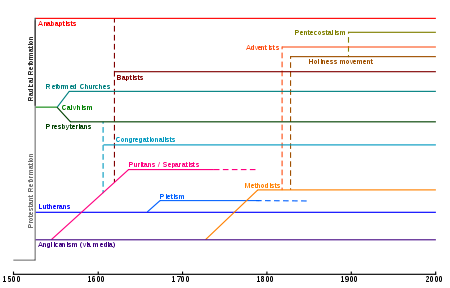
The Radical Reformation was a 16th century response to what was believed to be both the corruption in the Roman Catholic Church
and the expanding Magisterial
Protestant movement
led by Martin Luther
and many others. Beginning in Germany and Switzerland, the Radical Reformation birthed many radical Protestant groups throughout Europe
. The term covers both radical reformers like Thomas Müntzer, Andreas Karlstadt
, groups like the Zwickau prophets
and anabaptist groups
like the Hutterite
s and the Mennonite
s.
Although the proportion of the European population rebelling against Catholic, Lutheran and Zwinglian churches was tiny, the literature on the Radical Reformation is vast, partly as a result of the proliferation of the Radical Reformation teachings in the United States
.
Lutheran and Reformed (Zwinglian
and Calvinist) Protestant movements, the Radical Reformation generally abandoned the idea of the "Church visible
" as distinct from the "Church invisible." Thus, the Church only consisted of the tiny community of believers, who accepted Jesus Christ and demonstrated this by adult baptism, called "believer's baptism".
While the magisterial reformers wanted to substitute their own learned elite for the learned elite of the Catholic Church, the radical Protestant groups rejected the authority of the institutional "church" organization, almost entirely, as being unBiblical. It was unavoidable that as the search for original Christianity
was carried further, some would claim that the tension between the church and the Roman Empire
in the first centuries of Christianity
was somehow normative, that the church is not to be allied with government, that a true church is always subject to be persecuted, and that the conversion of Constantine I
was therefore the Great apostasy
that marked a deviation from pure Christianity
.
. Others like Andreas Karlstadt were non-violent and had some theological interferences with Huldrych Zwingli. Kaspar Schwenkfeld and Sebastian Franck were influenced by German mysticism
and spiritualism
.
, focusing on the imminent end of the world. This was particularly notable in the rule of John of Leiden
over the city of Münster
in 1535, which was ultimately crushed by the forces of the Catholic Bishop of Münster and the Lutheran Landgrave of Hesse. After the fall of Münster
the small group of the Batenburgers
continued to adhere to militant Anabaptist beliefs. Also non-violent anabaptist groups had millenarian conceptions.
The early Anabaptists believed that the Reformation
must purify not only theology but also the actual lives of Christians, especially in what had to do with political and social relationships. Therefore, the church should not be supported by the state, neither by tithes and taxes, nor by the use of the sword; Christianity
was a matter of individual conviction, which could not be forced on anyone, but rather required a personal decision for it.
Many groups were influenced by biblicism (like the Swiss Brethren
), spiritualism
(like the South German Anabaptists) and mainly absolute pacifism (like the Swiss Brethren, the Hutterite
s and the Mennonite
s from Northern Germany and the Netherlands). The Hutterites contended also the community of goods. In the beginning most of them were strongly missionary
.
, and Hutterite
s. Typical among the new leaders of the later Anabaptist movement, and certainly the most influential of them, was Menno Simons
(1496–1561), a Dutch Catholic priest who early in 1536 decided to join the Anabaptists.
Menno Simons
had no use for the violence advocated and practiced by the Münster movement, which seemed to him to pervert the very heart of Christianity. Thus, Mennonite
pacifism is not merely a peripheral characteristic of the movement, but rather belongs to the very essence of Menno's understanding of the gospel; this is one of the reasons that it has been a constant characteristic of all Mennonite
bodies through the centuries.
, the great categorizer of the Radical Reformation, considered early forms of Unitarianism
(such as that of the Socinians, and exemplified by Michael Servetus
), and other trends that disregarded the Nicene
christology
still accepted by most Christians, as part of the Radical Reformation. With Michael Servetus
(1511–1553) and Faustus Socinus (1539–1604) anti-Trinitarianism came to the foreground.
Roman Catholic Church
The Catholic Church, also known as the Roman Catholic Church, is the world's largest Christian church, with over a billion members. Led by the Pope, it defines its mission as spreading the gospel of Jesus Christ, administering the sacraments and exercising charity...
and the expanding Magisterial
Magisterial Reformation
The Magisterial Reformation is a phrase that "draws attention to the manner in which the Lutheran and Calvinist reformers related to secular authorities, such as princes, magistrates, or city councils", i.e. "the magistracy"...
Protestant movement
Protestantism
Protestantism is one of the three major groupings within Christianity. It is a movement that began in Germany in the early 16th century as a reaction against medieval Roman Catholic doctrines and practices, especially in regards to salvation, justification, and ecclesiology.The doctrines of the...
led by Martin Luther
Martin Luther
Martin Luther was a German priest, professor of theology and iconic figure of the Protestant Reformation. He strongly disputed the claim that freedom from God's punishment for sin could be purchased with money. He confronted indulgence salesman Johann Tetzel with his Ninety-Five Theses in 1517...
and many others. Beginning in Germany and Switzerland, the Radical Reformation birthed many radical Protestant groups throughout Europe
Europe
Europe is, by convention, one of the world's seven continents. Comprising the westernmost peninsula of Eurasia, Europe is generally 'divided' from Asia to its east by the watershed divides of the Ural and Caucasus Mountains, the Ural River, the Caspian and Black Seas, and the waterways connecting...
. The term covers both radical reformers like Thomas Müntzer, Andreas Karlstadt
Andreas Karlstadt
Andreas Rudolph Bodenstein von Karlstadt , better known as Andreas Karlstadt or Andreas Carlstadt or Karolostadt, was a German Christian theologian during the Protestant Reformation. He was born in Karlstadt, Franconia.-Education:Karlstadt received his doctorate of theology in 1510 from the...
, groups like the Zwickau prophets
Zwickau prophets
The Zwickau Prophets were three men from Zwickau of the Radical Reformation who were possibly involved in a disturbance in nearby Wittenberg and its reformation in early 1522....
and anabaptist groups
Anabaptist
Anabaptists are Protestant Christians of the Radical Reformation of 16th-century Europe, and their direct descendants, particularly the Amish, Brethren, Hutterites, and Mennonites....
like the Hutterite
Hutterite
Hutterites are a communal branch of Anabaptists who, like the Amish and Mennonites, trace their roots to the Radical Reformation of the 16th century. Since the death of their founder Jakob Hutter in 1536, the beliefs of the Hutterites, especially living in a community of goods and absolute...
s and the Mennonite
Mennonite
The Mennonites are a group of Christian Anabaptist denominations named after the Frisian Menno Simons , who, through his writings, articulated and thereby formalized the teachings of earlier Swiss founders...
s.
Although the proportion of the European population rebelling against Catholic, Lutheran and Zwinglian churches was tiny, the literature on the Radical Reformation is vast, partly as a result of the proliferation of the Radical Reformation teachings in the United States
United States
The United States of America is a federal constitutional republic comprising fifty states and a federal district...
.
Characteristics
Unlike the Catholics and the more MagisterialMagisterial Reformation
The Magisterial Reformation is a phrase that "draws attention to the manner in which the Lutheran and Calvinist reformers related to secular authorities, such as princes, magistrates, or city councils", i.e. "the magistracy"...
Lutheran and Reformed (Zwinglian
Huldrych Zwingli
Ulrich Zwingli was a leader of the Reformation in Switzerland. Born during a time of emerging Swiss patriotism and increasing criticism of the Swiss mercenary system, he attended the University of Vienna and the University of Basel, a scholarly centre of humanism...
and Calvinist) Protestant movements, the Radical Reformation generally abandoned the idea of the "Church visible
Church visible
Church visible is a term of Christian theology and ecclesiology referring to the visible community of Christian believers on Earth, as opposed to the Church invisible or Church triumphant, constituted by the fellowship of saints and the company of the elect.In ecclesiology, the Church visible has...
" as distinct from the "Church invisible." Thus, the Church only consisted of the tiny community of believers, who accepted Jesus Christ and demonstrated this by adult baptism, called "believer's baptism".
While the magisterial reformers wanted to substitute their own learned elite for the learned elite of the Catholic Church, the radical Protestant groups rejected the authority of the institutional "church" organization, almost entirely, as being unBiblical. It was unavoidable that as the search for original Christianity
Christianity
Christianity is a monotheistic religion based on the life and teachings of Jesus as presented in canonical gospels and other New Testament writings...
was carried further, some would claim that the tension between the church and the Roman Empire
Roman Empire
The Roman Empire was the post-Republican period of the ancient Roman civilization, characterised by an autocratic form of government and large territorial holdings in Europe and around the Mediterranean....
in the first centuries of Christianity
Early Christianity
Early Christianity is generally considered as Christianity before 325. The New Testament's Book of Acts and Epistle to the Galatians records that the first Christian community was centered in Jerusalem and its leaders included James, Peter and John....
was somehow normative, that the church is not to be allied with government, that a true church is always subject to be persecuted, and that the conversion of Constantine I
Constantine I and Christianity
During the reign of the Emperor Constantine the Great, Christianity became the dominant religion of the Roman Empire. Constantine, also known as Constantine I, had a significant religious experience following his victory at the Battle of Milvian Bridge in 312...
was therefore the Great apostasy
Great Apostasy
The Great Apostasy is a term used by some religious groups to describe a general fallen state of traditional Christianity, especially the Papacy, because it allowed the traditional Roman mysteries and deities of solar monism such as Mithras and Sol Invictus and idol worship back into the church,...
that marked a deviation from pure Christianity
Christianity
Christianity is a monotheistic religion based on the life and teachings of Jesus as presented in canonical gospels and other New Testament writings...
.
Radical reformers
There were a number of radical reformers in the reformation time, who had more radical claims than Luther or Zwingli. Some of them like Thomas Müntzer were involved in the German Peasants' WarGerman Peasants' War
The German Peasants' War or Great Peasants' Revolt was a widespread popular revolt in the German-speaking areas of Central Europe, 1524–1526. At its height in the spring and summer of 1525, the conflict involved an estimated 300,000 peasants: contemporary estimates put the dead at 100,000...
. Others like Andreas Karlstadt were non-violent and had some theological interferences with Huldrych Zwingli. Kaspar Schwenkfeld and Sebastian Franck were influenced by German mysticism
German mysticism
German mysticism, sometimes called Dominican mysticism or Rhineland mysticism, was a late medieval Christian mystical movement, that was especially prominent within the Dominican order and in Germany. Although its origins can be traced back to Hildegard of Bingen, it is mostly represented by...
and spiritualism
Spiritualism
Spiritualism is a belief system or religion, postulating the belief that spirits of the dead residing in the spirit world have both the ability and the inclination to communicate with the living...
.
- Thomas Müntzer
- Andreas KarlstadtAndreas KarlstadtAndreas Rudolph Bodenstein von Karlstadt , better known as Andreas Karlstadt or Andreas Carlstadt or Karolostadt, was a German Christian theologian during the Protestant Reformation. He was born in Karlstadt, Franconia.-Education:Karlstadt received his doctorate of theology in 1510 from the...
- Kaspar SchwenkfeldKaspar Schwenkfeld von OssigCaspar Schwenkfeld von Ossig was a German theologian, writer, and preacher who became a Protestant Reformer and spiritualist, one of the earliest promoters of the Protestant Reformation in Silesia....
- Sebastian FranckSebastian FranckSebastian Franck was a 16th century German freethinker, humanist, and radical reformer.Franck was born about 1499 at Donauwörth, Bavaria. Because of this he styled himself Franck von Word...
Early forms of Anabaptism
Some early forms of the Radical Reformation were millenarianMillennialism
Millennialism , or chiliasm in Greek, is a belief held by some Christian denominations that there will be a Golden Age or Paradise on Earth in which "Christ will reign" for 1000 years prior to the final judgment and future eternal state...
, focusing on the imminent end of the world. This was particularly notable in the rule of John of Leiden
John of Leiden
John of Leiden , was an Anabaptist leader from the Dutch city of Leiden. He was the illegitimate son of a Dutch mayor, and a tailor's apprentice by trade.-Life:...
over the city of Münster
Münster
Münster is an independent city in North Rhine-Westphalia, Germany. It is located in the northern part of the state and is considered to be the cultural centre of the Westphalia region. It is also capital of the local government region Münsterland...
in 1535, which was ultimately crushed by the forces of the Catholic Bishop of Münster and the Lutheran Landgrave of Hesse. After the fall of Münster
Münster Rebellion
The Münster Rebellion was an attempt by radical Anabaptists to establish a communal sectarian government in the German city of Münster. The city became an Anabaptist center from 1534 to 1535, and fell under Anabaptist rule for 18 months — from February 1534, when the city hall was seized and...
the small group of the Batenburgers
Batenburgers
The Batenburgers were members of a radical Anabaptist sect led by Jan van Batenburg, that flourished briefly in the 1530s in the aftermath of the Münster Rebellion.-Jan van Batenburg:...
continued to adhere to militant Anabaptist beliefs. Also non-violent anabaptist groups had millenarian conceptions.
The early Anabaptists believed that the Reformation
Protestant Reformation
The Protestant Reformation was a 16th-century split within Western Christianity initiated by Martin Luther, John Calvin and other early Protestants. The efforts of the self-described "reformers", who objected to the doctrines, rituals and ecclesiastical structure of the Roman Catholic Church, led...
must purify not only theology but also the actual lives of Christians, especially in what had to do with political and social relationships. Therefore, the church should not be supported by the state, neither by tithes and taxes, nor by the use of the sword; Christianity
Christianity
Christianity is a monotheistic religion based on the life and teachings of Jesus as presented in canonical gospels and other New Testament writings...
was a matter of individual conviction, which could not be forced on anyone, but rather required a personal decision for it.
Many groups were influenced by biblicism (like the Swiss Brethren
Swiss Brethren
The Swiss Brethren are a branch of Anabaptism that started in Zürich, spread to nearby cities and towns, and then was exported to neighboring countries...
), spiritualism
Spiritualism
Spiritualism is a belief system or religion, postulating the belief that spirits of the dead residing in the spirit world have both the ability and the inclination to communicate with the living...
(like the South German Anabaptists) and mainly absolute pacifism (like the Swiss Brethren, the Hutterite
Hutterite
Hutterites are a communal branch of Anabaptists who, like the Amish and Mennonites, trace their roots to the Radical Reformation of the 16th century. Since the death of their founder Jakob Hutter in 1536, the beliefs of the Hutterites, especially living in a community of goods and absolute...
s and the Mennonite
Mennonite
The Mennonites are a group of Christian Anabaptist denominations named after the Frisian Menno Simons , who, through his writings, articulated and thereby formalized the teachings of earlier Swiss founders...
s from Northern Germany and the Netherlands). The Hutterites contended also the community of goods. In the beginning most of them were strongly missionary
Mission (Christian)
Christian missionary activities often involve sending individuals and groups , to foreign countries and to places in their own homeland. This has frequently involved not only evangelization , but also humanitarian work, especially among the poor and disadvantaged...
.
Later forms of Anabaptism
Later forms of Anabaptism were much smaller, and focused on the formation of small, separatist communities. Among the many varieties to develop were Mennonites, AmishAmish
The Amish , sometimes referred to as Amish Mennonites, are a group of Christian church fellowships that form a subgroup of the Mennonite churches...
, and Hutterite
Hutterite
Hutterites are a communal branch of Anabaptists who, like the Amish and Mennonites, trace their roots to the Radical Reformation of the 16th century. Since the death of their founder Jakob Hutter in 1536, the beliefs of the Hutterites, especially living in a community of goods and absolute...
s. Typical among the new leaders of the later Anabaptist movement, and certainly the most influential of them, was Menno Simons
Menno Simons
Menno Simons was an Anabaptist religious leader from the Friesland region of the Low Countries. Simons was a contemporary of the Protestant Reformers and his followers became known as Mennonites...
(1496–1561), a Dutch Catholic priest who early in 1536 decided to join the Anabaptists.
Menno Simons
Menno Simons
Menno Simons was an Anabaptist religious leader from the Friesland region of the Low Countries. Simons was a contemporary of the Protestant Reformers and his followers became known as Mennonites...
had no use for the violence advocated and practiced by the Münster movement, which seemed to him to pervert the very heart of Christianity. Thus, Mennonite
Mennonite
The Mennonites are a group of Christian Anabaptist denominations named after the Frisian Menno Simons , who, through his writings, articulated and thereby formalized the teachings of earlier Swiss founders...
pacifism is not merely a peripheral characteristic of the movement, but rather belongs to the very essence of Menno's understanding of the gospel; this is one of the reasons that it has been a constant characteristic of all Mennonite
Mennonite
The Mennonites are a group of Christian Anabaptist denominations named after the Frisian Menno Simons , who, through his writings, articulated and thereby formalized the teachings of earlier Swiss founders...
bodies through the centuries.
Other movements
In addition to the Anabaptists, other Radical Reformation movements have been identified. Notably, George Huntston WilliamsGeorge Huntston Williams
George Huntston Williams American professor of Unitarian theology and historian of the Socinian movement. He was among the original Editorial Advisors of the scholarly journal Dionysius.-Works:...
, the great categorizer of the Radical Reformation, considered early forms of Unitarianism
Unitarianism
Unitarianism is a Christian theological movement, named for its understanding of God as one person, in direct contrast to Trinitarianism which defines God as three persons coexisting consubstantially as one in being....
(such as that of the Socinians, and exemplified by Michael Servetus
Michael Servetus
Michael Servetus was a Spanish theologian, physician, cartographer, and humanist. He was the first European to correctly describe the function of pulmonary circulation...
), and other trends that disregarded the Nicene
Nicene Creed
The Nicene Creed is the creed or profession of faith that is most widely used in Christian liturgy. It is called Nicene because, in its original form, it was adopted in the city of Nicaea by the first ecumenical council, which met there in the year 325.The Nicene Creed has been normative to the...
christology
Christology
Christology is the field of study within Christian theology which is primarily concerned with the nature and person of Jesus Christ as recorded in the Canonical gospels and the letters of the New Testament. Primary considerations include the relationship of Jesus' nature and person with the nature...
still accepted by most Christians, as part of the Radical Reformation. With Michael Servetus
Michael Servetus
Michael Servetus was a Spanish theologian, physician, cartographer, and humanist. He was the first European to correctly describe the function of pulmonary circulation...
(1511–1553) and Faustus Socinus (1539–1604) anti-Trinitarianism came to the foreground.
See also
- Protestant ReformationProtestant ReformationThe Protestant Reformation was a 16th-century split within Western Christianity initiated by Martin Luther, John Calvin and other early Protestants. The efforts of the self-described "reformers", who objected to the doctrines, rituals and ecclesiastical structure of the Roman Catholic Church, led...
- AnabaptistAnabaptistAnabaptists are Protestant Christians of the Radical Reformation of 16th-century Europe, and their direct descendants, particularly the Amish, Brethren, Hutterites, and Mennonites....
- Persecution of Anabaptists
- The Peasants' War
- Martyrs MirrorMartyrs MirrorThe Martyrs Mirror or The Bloody Theater, first published in 1660 in Dutch by Thieleman J. van Braght, documents the stories and testimonies of Christian martyrs, especially Anabaptists...
- Christian anarchismChristian anarchismChristian anarchism is a movement in political theology that combines anarchism and Christianity. It is the belief that there is only one source of authority to which Christians are ultimately answerable, the authority of God as embodied in the teachings of Jesus...
- Restorationism (Christian primitivism)
- Radical Christianity
- Justus VelsiusJustus VelsiusJustus Velsius, Haganus, or Joost Welsens in Dutch was a Dutch humanist, physician, and mathematician....
External links
- Radical Reformation at Global Anabaptist Mennonite Encyclopedia OnlineGlobal Anabaptist Mennonite Encyclopedia OnlineThe Global Anabaptist Mennonite Encyclopedia Online is an online encyclopedia of topics relating to Mennonites and Anabaptism. The mission of the project is to provide free, reliable, English-language information on anabaptist-related topics....
- 16th Century Reformation Reading Room, Tyndale Seminary