

Rib

Encyclopedia
In vertebrate
anatomy
, ribs are the long curved bone
s which form the rib cage. In most vertebrate
s, ribs surround the chest
, enabling the lungs to expand and thus facilitate breathing
by expanding the chest cavity. They serve to protect the lung
s, heart
, and other internal organ
s of the thorax. In some animals, especially snake
s, ribs may provide support and protection for the entire body.
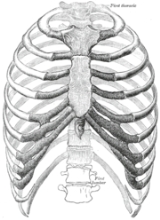
", are directly attached to the sternum through the costal cartilage. Rib 1 is unique and harder to distinguish from other ribs. It is a short, flat, C-shaped bone. The vertebral attachment can be found just below the neck
and the majority of this bone can be found above the level of the clavicle
. Ribs 2 through 7 have a more traditional appearance. The following five sets are known as "false ribs
", three of these sharing a common cartilaginous connection to the sternum, while the last two (eleventh and twelfth ribs) are termed floating rib
s (costae fluitantes) or vertebral ribs. They are attached to the vertebrae only, and not to the sternum or cartilage coming off of the sternum. Some people are missing one of the two pairs of floating ribs, while others have a third pair. Rib removal
is the surgical excision of ribs for therapeutic or cosmetic reasons.
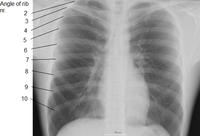
In general, human ribs increase in length from ribs 1 through 7 and decrease in length again through rib 12. Along with this change in size, the ribs become progressively oblique (slanted) from ribs 1 through 9, then less slanted through rib 12.
The ribcage is separated from the lower abdomen by the thoracic diaphragm
which controls breathing. When the diaphragm contracts, the thoracic cavity is expanded, reducing intra-thoracic pressure and drawing air into the lungs. This happens through one of two actions (or a mix of the two): when the lower ribs the diaphragm connects to are stabilized by muscles and the central tendon is mobile, when the muscle contracts the central tendon is drawn down, compressing the cavity underneath and expanding the thoracic cavity downward. When the central tendon is stabilized and the lower ribs are mobile, a contraction of the diaphragm elevates the ribs, which works in conjunction with other muscles to expand the thoracic cavity upward.
 In fish
, there are often two sets of ribs attached to the vertebral column. One set, the dorsal ribs, are found in the dividing septum between the upper and lower parts of the main muscle segments, projecting roughly sideways from the vertebral column. The second set, of ventral ribs arise from the vertebral column just below the dorsal ribs, and enclose the lower body, often joining at the tips. Not all species possess both types of rib, with the dorsal ribs being most commonly absent. Shark
s, for example, have no dorsal ribs, and only very short ventral ribs, while lamprey
s have no ribs at all. In some teleosts, there may be additional rib-like bones within the muscle mass.
Tetrapod
s, however, only ever have a single set of ribs which are probably homologous
with the dorsal ribs of fishes. In the early tetrapods, every vertebra bore a pair of ribs, although those on the thoracic vertebrae are typically the longest. The sacral ribs were stout and short, since they formed part of the pelvis
, connecting the backbone to the hip bone
s.
In most subsequent forms, many of these early ribs have been lost, and in living amphibian
s and reptile
s, there is great variation in rib structure and number. For example, turtle
s have only eight pairs of ribs, which are developed into a bony or cartilagenous carapace
and plastron, while snakes have numerous ribs running along the full length of their trunk. Frog
s typically have no ribs, aside from a sacral pair, which form part of the pelvis.
In birds, ribs are present as distinct bones only on the thoracic region, although small fused ribs are present on the cervical vertebrae. The thoracic ribs of birds possess a wide projection to the rear; this uncinate process is an attachment for the shoulder muscles.
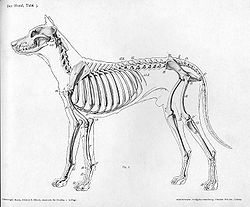
Mammals usually also only have distinct ribs on the thoracic vertebra, although fixed cervical ribs are also present in monotreme
s. In marsupial
s and placental mammals, the cervical and lumbar ribs are found only as tiny remnants fused to the vertebrae, where they are referred to as transverse processes. In general, the structure and number of the true ribs in humans is similar to that in other mammals. Unlike reptiles, caudal ribs are never found in mammals.
Vertebrate
Vertebrates are animals that are members of the subphylum Vertebrata . Vertebrates are the largest group of chordates, with currently about 58,000 species described. Vertebrates include the jawless fishes, bony fishes, sharks and rays, amphibians, reptiles, mammals, and birds...
anatomy
Anatomy
Anatomy is a branch of biology and medicine that is the consideration of the structure of living things. It is a general term that includes human anatomy, animal anatomy , and plant anatomy...
, ribs are the long curved bone
Bone
Bones are rigid organs that constitute part of the endoskeleton of vertebrates. They support, and protect the various organs of the body, produce red and white blood cells and store minerals. Bone tissue is a type of dense connective tissue...
s which form the rib cage. In most vertebrate
Vertebrate
Vertebrates are animals that are members of the subphylum Vertebrata . Vertebrates are the largest group of chordates, with currently about 58,000 species described. Vertebrates include the jawless fishes, bony fishes, sharks and rays, amphibians, reptiles, mammals, and birds...
s, ribs surround the chest
Chest
The chest is a part of the anatomy of humans and various other animals. It is sometimes referred to as the thorax or the bosom.-Chest anatomy - Humans and other hominids:...
, enabling the lungs to expand and thus facilitate breathing
Breathing
Breathing is the process that moves air in and out of the lungs. Aerobic organisms require oxygen to release energy via respiration, in the form of the metabolism of energy-rich molecules such as glucose. Breathing is only one process that delivers oxygen to where it is needed in the body and...
by expanding the chest cavity. They serve to protect the lung
Lung
The lung is the essential respiration organ in many air-breathing animals, including most tetrapods, a few fish and a few snails. In mammals and the more complex life forms, the two lungs are located near the backbone on either side of the heart...
s, heart
Heart
The heart is a myogenic muscular organ found in all animals with a circulatory system , that is responsible for pumping blood throughout the blood vessels by repeated, rhythmic contractions...
, and other internal organ
Organ (anatomy)
In biology, an organ is a collection of tissues joined in structural unit to serve a common function. Usually there is a main tissue and sporadic tissues . The main tissue is the one that is unique for the specific organ. For example, main tissue in the heart is the myocardium, while sporadic are...
s of the thorax. In some animals, especially snake
Snake
Snakes are elongate, legless, carnivorous reptiles of the suborder Serpentes that can be distinguished from legless lizards by their lack of eyelids and external ears. Like all squamates, snakes are ectothermic, amniote vertebrates covered in overlapping scales...
s, ribs may provide support and protection for the entire body.
Human anatomy
Humans have 24 ribs (12 pairs). The first seven sets of ribs, known as "true ribsTrue ribs
The first seven ribs are connected posteriorly with the vertebral column, and anteriorly, through the intervention of the costal cartilages, with the sternum; they are called true ribs or vertebro-sternal ribs....
", are directly attached to the sternum through the costal cartilage. Rib 1 is unique and harder to distinguish from other ribs. It is a short, flat, C-shaped bone. The vertebral attachment can be found just below the neck
Neck
The neck is the part of the body, on many terrestrial or secondarily aquatic vertebrates, that distinguishes the head from the torso or trunk. The adjective signifying "of the neck" is cervical .-Boner anatomy: The cervical spine:The cervical portion of the human spine comprises seven boney...
and the majority of this bone can be found above the level of the clavicle
Clavicle
In human anatomy, the clavicle or collar bone is a long bone of short length that serves as a strut between the scapula and the sternum. It is the only long bone in body that lies horizontally...
. Ribs 2 through 7 have a more traditional appearance. The following five sets are known as "false ribs
False ribs
The false ribs, are the five sets of ribs below the top seven true ribs. A rib is considered to be "false" if it has no direct attachment to the sternum, also known as the breast bone...
", three of these sharing a common cartilaginous connection to the sternum, while the last two (eleventh and twelfth ribs) are termed floating rib
Floating rib
Floating ribs are four atypical ribs in the human ribcage. They are called so because they are attached to the vertebrae only, and not to the sternum or cartilage coming off of the sternum. Some people are missing one of the two pairs. Others have a third pair. Most, however, possess only two...
s (costae fluitantes) or vertebral ribs. They are attached to the vertebrae only, and not to the sternum or cartilage coming off of the sternum. Some people are missing one of the two pairs of floating ribs, while others have a third pair. Rib removal
Rib removal
Rib Removal is a surgical operation, usually performed on the lowest ribs to make the waist thinner. This is considered 'extreme' and is rarely formally documented...
is the surgical excision of ribs for therapeutic or cosmetic reasons.
In general, human ribs increase in length from ribs 1 through 7 and decrease in length again through rib 12. Along with this change in size, the ribs become progressively oblique (slanted) from ribs 1 through 9, then less slanted through rib 12.
The ribcage is separated from the lower abdomen by the thoracic diaphragm
Thoracic diaphragm
In the anatomy of mammals, the thoracic diaphragm, or simply the diaphragm , is a sheet of internal skeletal muscle that extends across the bottom of the rib cage. The diaphragm separates the thoracic cavity from the abdominal cavity and performs an important function in respiration...
which controls breathing. When the diaphragm contracts, the thoracic cavity is expanded, reducing intra-thoracic pressure and drawing air into the lungs. This happens through one of two actions (or a mix of the two): when the lower ribs the diaphragm connects to are stabilized by muscles and the central tendon is mobile, when the muscle contracts the central tendon is drawn down, compressing the cavity underneath and expanding the thoracic cavity downward. When the central tendon is stabilized and the lower ribs are mobile, a contraction of the diaphragm elevates the ribs, which works in conjunction with other muscles to expand the thoracic cavity upward.
In animals
Fish
Fish are a paraphyletic group of organisms that consist of all gill-bearing aquatic vertebrate animals that lack limbs with digits. Included in this definition are the living hagfish, lampreys, and cartilaginous and bony fish, as well as various extinct related groups...
, there are often two sets of ribs attached to the vertebral column. One set, the dorsal ribs, are found in the dividing septum between the upper and lower parts of the main muscle segments, projecting roughly sideways from the vertebral column. The second set, of ventral ribs arise from the vertebral column just below the dorsal ribs, and enclose the lower body, often joining at the tips. Not all species possess both types of rib, with the dorsal ribs being most commonly absent. Shark
Shark
Sharks are a type of fish with a full cartilaginous skeleton and a highly streamlined body. The earliest known sharks date from more than 420 million years ago....
s, for example, have no dorsal ribs, and only very short ventral ribs, while lamprey
Lamprey
Lampreys are a family of jawless fish, whose adults are characterized by a toothed, funnel-like sucking mouth. Translated from an admixture of Latin and Greek, lamprey means stone lickers...
s have no ribs at all. In some teleosts, there may be additional rib-like bones within the muscle mass.
Tetrapod
Tetrapod
Tetrapods are vertebrate animals having four limbs. Amphibians, reptiles, birds and mammals are all tetrapods; even snakes and other limbless reptiles and amphibians are tetrapods by descent. The earliest tetrapods evolved from the lobe-finned fishes in the Devonian...
s, however, only ever have a single set of ribs which are probably homologous
Homology (biology)
Homology forms the basis of organization for comparative biology. In 1843, Richard Owen defined homology as "the same organ in different animals under every variety of form and function". Organs as different as a bat's wing, a seal's flipper, a cat's paw and a human hand have a common underlying...
with the dorsal ribs of fishes. In the early tetrapods, every vertebra bore a pair of ribs, although those on the thoracic vertebrae are typically the longest. The sacral ribs were stout and short, since they formed part of the pelvis
Pelvis
In human anatomy, the pelvis is the lower part of the trunk, between the abdomen and the lower limbs .The pelvis includes several structures:...
, connecting the backbone to the hip bone
Hip bone
The hip bone, innominate bone or coxal bone is a large, flattened, irregularly shaped bone, constricted in the center and expanded above and below...
s.
In most subsequent forms, many of these early ribs have been lost, and in living amphibian
Amphibian
Amphibians , are a class of vertebrate animals including animals such as toads, frogs, caecilians, and salamanders. They are characterized as non-amniote ectothermic tetrapods...
s and reptile
Reptile
Reptiles are members of a class of air-breathing, ectothermic vertebrates which are characterized by laying shelled eggs , and having skin covered in scales and/or scutes. They are tetrapods, either having four limbs or being descended from four-limbed ancestors...
s, there is great variation in rib structure and number. For example, turtle
Turtle
Turtles are reptiles of the order Testudines , characterised by a special bony or cartilaginous shell developed from their ribs that acts as a shield...
s have only eight pairs of ribs, which are developed into a bony or cartilagenous carapace
Carapace
A carapace is a dorsal section of the exoskeleton or shell in a number of animal groups, including arthropods such as crustaceans and arachnids, as well as vertebrates such as turtles and tortoises. In turtles and tortoises, the underside is called the plastron.-Crustaceans:In crustaceans, the...
and plastron, while snakes have numerous ribs running along the full length of their trunk. Frog
Frog
Frogs are amphibians in the order Anura , formerly referred to as Salientia . Most frogs are characterized by a short body, webbed digits , protruding eyes and the absence of a tail...
s typically have no ribs, aside from a sacral pair, which form part of the pelvis.
In birds, ribs are present as distinct bones only on the thoracic region, although small fused ribs are present on the cervical vertebrae. The thoracic ribs of birds possess a wide projection to the rear; this uncinate process is an attachment for the shoulder muscles.
Mammals usually also only have distinct ribs on the thoracic vertebra, although fixed cervical ribs are also present in monotreme
Monotreme
Monotremes are mammals that lay eggs instead of giving birth to live young like marsupials and placental mammals...
s. In marsupial
Marsupial
Marsupials are an infraclass of mammals, characterized by giving birth to relatively undeveloped young. Close to 70% of the 334 extant species occur in Australia, New Guinea, and nearby islands, with the remaining 100 found in the Americas, primarily in South America, but with thirteen in Central...
s and placental mammals, the cervical and lumbar ribs are found only as tiny remnants fused to the vertebrae, where they are referred to as transverse processes. In general, the structure and number of the true ribs in humans is similar to that in other mammals. Unlike reptiles, caudal ribs are never found in mammals.
See also
- Bone terminology
- Human rib cageHuman rib cage-See also:*Terms for bones*Terms for anatomical location*Articulation of head of rib-References:* Clinically Oriented Anatomy, 4th ed. Keith L. Moore and Robert F. Dalley. pp. 62–64...
- Rib fractureRib fractureA rib fracture is a break or fracture in one or more of the bones making up the rib cage.The first rib is rarely fractured because of its protected position behind the clavicle . However, if it is broken serious damage can occur to the brachial plexus of nerves and the subclavian vessels...
- Terms for anatomical location
- Ribs (food)Ribs (food)Ribs of beef, lamb, venison, and pork are a cut of meat. The term ribs usually refers to the less meaty part of the chops, often cooked as a slab .They can be roasted, grilled, baked, braised, or smoked....