


Plesiosauria

Encyclopedia
Plesiosauria is an order
of Mesozoic
marine reptile
s. Plesiosaurs first appeared in the Early Jurassic
(and possibly Rhaetian
, latest Triassic
) Period and became especially common during the Jurassic
Period, thriving until the K-T extinction
at the end of the Cretaceous
Period.
The name "plesiosaur" is used to refer to the order Plesiosauria as a whole, but not to the long-necked forms (suborder Plesiosauroidea) only. These latter constitute the plesiosaurs in the popular imagination ("Nessie
").
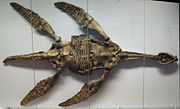 The typical plesiosaur had a broad body and a short tail
. They retained their ancestral two pairs of limbs, which evolved into large flipper
s. Plesiosaurs evolved from the earlier nothosaur
s, who had a more crocodile-like body; major types of plesiosaur are primarily distinguished by head and neck
size. Members of Plesiosauroidea such as Cryptoclididae
, Elasmosauridae
and Plesiosauridae
had long necks and may have been 'bottom-feeders', in shallow waters. Most pliosaurs
and rhomaleosaurs
, however, had shorter necks with a large, elongated head and may have been at home in deeper waters.
All plesiosaurs had four paddle-shaped 'flipper' limbs. This is an unusual arrangement in aquatic animals and it is thought that they were used to propel the animal through the water by a combination of rowing movements and up-and-down movements. There appears to have been no tail fin and the tail was most likely used for helping in directional control. This arrangement is in contrast to that of the later mosasaur
s and the earlier ichthyosaurs. There may be similarities with the method of swimming used by penguins and turtles, which respectively have two and four flipper-like limbs.
In general, the plesiosaurians are among the largest marine predators of all time, with the smallest about 2 m (6.5 ft) long. The largest pliosaurs were up to 15 m long. Plesiosaurs grew even longer; Mauisaurus
was 20 meters long. However, the late Triassic ichthyosaur
s, such as shastasaurids are known to have reached 21 m in length. Modern large marine animals such as the sperm whale
(20 m), and especially the blue whale
(~30 m) all grew larger than currently known plesiosaurians.
The anteriorly placed internal nostrils have palatal grooves to channel water, the flow of which would be maintained by hydrodynamic pressure over the posteriorly placed external nares during locomotion. During its passage through the nasal ducts, the water would have been 'tasted' by olfactory epithelia .
(1799–1847) was famous for her plesiosaur discoveries at Lyme Regis
in Dorset, UK. She is credited with the first plesiosaur find (Plesiosaurus dolichodeirus), which has become the 'type fossil' (genoholotype). This region of Britain
is now a World Heritage Site
, dubbed the Jurassic Coast
.
, it was originally classified as a dinosaur. The specimen is actually a very large plesiosaur
, possibly reaching 15 m (50 ft) in length. The media published exaggerated reports claiming it was 25 m (80 ft) long, and weighed up to 150,000 kg, which would have made it the largest predator of all time. This error was dramatically perpetuated in BBC
's documentary
series Walking with Dinosaurs
, which also prematurely classified it as a Liopleurodon
ferox.
In 2004, what appears to be a completely intact juvenile plesiosaur was discovered, by a local fisherman at Bridgwater Bay
National Nature Reserve in Somerset, UK. The fossil, dated 180 My by the ammonite
s associated with it, measures 1.5 m (5 ft) in length, and may be related to Rhomaleosaurus
. It is probably the best preserved specimen of a plesiosaur yet discovered .
 Plesiosaurs have been discovered with fossil
s of belemnites (squid
-like animals), and ammonite
s (giant nautilus
-like molluscs) associated with their stomachs . They had powerful jaw
s, probably strong enough to bite through the hard shells of their prey. The bony fish (Osteichthyes), started to spread in the Jurassic, and were likely prey as well. Recent evidence seems to indicate that some plesiosaurs may have, in fact, been bottom feeders.
It had been theorised that smaller plesiosaurs may have crawled up on a beach to lay their eggs, like the modern leatherback turtle
, but it is now clear plesiosaurs gave birth to live young : The fossil of a pregnant plesiosaur Polycotylus latippinus shows that these animals gave birth to one large juvenile and probably invested parental care in their offspring, similar to modern whales.
Another curiosity is their four-flippered design. No modern animals have this swimming adaptation (sea turtles only swim with their front flippers), so there is considerable speculation about what kind of stroke they used. While the short-necked pliosauroids (e.g. Liopleurodon
) may have been fast swimmers, the long-necked varieties were built more for maneuverability than for speed. Skeletons have also been discovered with gastrolith
s in their stomachs, though whether to help break down food in a muscular gizzard, or to help with buoyancy
has not been established.

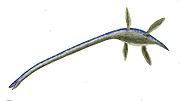
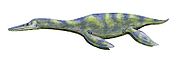 The taxonomy presented here is mainly based on the plesiosaur cladistic analysis proposed by Hilary F. Ketchum and Roger B. J. Benson, 2011 unless otherwise noted.
follows an analysis by Ketchum & Benson, 2011:
Order (biology)
In scientific classification used in biology, the order is# a taxonomic rank used in the classification of organisms. Other well-known ranks are life, domain, kingdom, phylum, class, family, genus, and species, with order fitting in between class and family...
of Mesozoic
Mesozoic
The Mesozoic era is an interval of geological time from about 250 million years ago to about 65 million years ago. It is often referred to as the age of reptiles because reptiles, namely dinosaurs, were the dominant terrestrial and marine vertebrates of the time...
marine reptile
Marine reptile
Marine reptiles are reptiles which have become secondarily adapted for an aquatic or semi-aquatic life in a marine environment.The earliest marine reptiles arose in the Permian period during the Paleozoic era...
s. Plesiosaurs first appeared in the Early Jurassic
Early Jurassic
The Early Jurassic epoch is the earliest of three epochs of the Jurassic period...
(and possibly Rhaetian
Rhaetian
The Rhaetian is in geochronology the latest age of the Triassic period or in chronostratigraphy the uppermost stage of the Triassic system. It lasted from 203.6 ± 1.5 to 199.6 ± 0.6 million years ago...
, latest Triassic
Triassic
The Triassic is a geologic period and system that extends from about 250 to 200 Mya . As the first period of the Mesozoic Era, the Triassic follows the Permian and is followed by the Jurassic. Both the start and end of the Triassic are marked by major extinction events...
) Period and became especially common during the Jurassic
Jurassic
The Jurassic is a geologic period and system that extends from about Mya to Mya, that is, from the end of the Triassic to the beginning of the Cretaceous. The Jurassic constitutes the middle period of the Mesozoic era, also known as the age of reptiles. The start of the period is marked by...
Period, thriving until the K-T extinction
Cretaceous-Tertiary extinction event
The Cretaceous–Paleogene extinction event, formerly named and still commonly referred to as the Cretaceous-Tertiary extinction event, occurred approximately 65.5 million years ago at the end of the Maastrichtian age of the Cretaceous period. It was a large-scale mass extinction of animal and plant...
at the end of the Cretaceous
Cretaceous
The Cretaceous , derived from the Latin "creta" , usually abbreviated K for its German translation Kreide , is a geologic period and system from circa to million years ago. In the geologic timescale, the Cretaceous follows the Jurassic period and is followed by the Paleogene period of the...
Period.
The name "plesiosaur" is used to refer to the order Plesiosauria as a whole, but not to the long-necked forms (suborder Plesiosauroidea) only. These latter constitute the plesiosaurs in the popular imagination ("Nessie
NESSIE
NESSIE was a European research project funded from 2000–2003 to identify secure cryptographic primitives. The project was comparable to the NIST AES process and the Japanese Government-sponsored CRYPTREC project, but with notable differences from both...
").
Description
Tail
The tail is the section at the rear end of an animal's body; in general, the term refers to a distinct, flexible appendage to the torso. It is the part of the body that corresponds roughly to the sacrum and coccyx in mammals, reptiles, and birds...
. They retained their ancestral two pairs of limbs, which evolved into large flipper
Flipper (anatomy)
A flipper is a typically flat limb evolved for movement through water. Various creatures have evolved flippers, for example penguins , cetaceans A flipper is a typically flat limb evolved for movement through water. Various creatures have evolved flippers, for example penguins (also called...
s. Plesiosaurs evolved from the earlier nothosaur
Nothosaur
Nothosaurs were Triassic marine sauropterygian reptiles that may have lived like seals of today, catching food in water but coming ashore on rocks and beaches. They averaged about in length, with a long body and tail. The feet were paddle-like, and are known to have been webbed in life, to help...
s, who had a more crocodile-like body; major types of plesiosaur are primarily distinguished by head and neck
Neck
The neck is the part of the body, on many terrestrial or secondarily aquatic vertebrates, that distinguishes the head from the torso or trunk. The adjective signifying "of the neck" is cervical .-Boner anatomy: The cervical spine:The cervical portion of the human spine comprises seven boney...
size. Members of Plesiosauroidea such as Cryptoclididae
Cryptoclididae
Cryptoclididae is a family of medium-sized plesiosaurs that lived from the Middle Jurassic to the Late Cretaceous. In 2010, Kaiwhekea was transferred to Leptocleididae and Aristonectes was transferred to Elasmosauridae.-Appearance:...
, Elasmosauridae
Elasmosauridae
Elasmosauridae was the family of plesiosaurs. They had the longest necks of the plesiosaurs and survived from the Late Triassic to the end of the Cretaceous. They had a diet of fish and shelless cephalopods.-Size:...
and Plesiosauridae
Plesiosauridae
Plesiosauridae was a monophyletic family of plesiosaurs.-References:...
had long necks and may have been 'bottom-feeders', in shallow waters. Most pliosaurs
Pliosauridae
Pliosauridae is a family of pliosauroid plesiosaurs from the Earliest Jurassic to the early Late Cretaceous of Australia, Europe, North America and South America. It was formally named by Harry G...
and rhomaleosaurs
Rhomaleosauridae
Rhomaleosauridae is a family of extinct reptiles in the Plesiosauria order. It includes the Macroplata, Maresaurus, Rhomaleosaurus, Yuzhoupliosaurus and Meyerasaurus genera....
, however, had shorter necks with a large, elongated head and may have been at home in deeper waters.
All plesiosaurs had four paddle-shaped 'flipper' limbs. This is an unusual arrangement in aquatic animals and it is thought that they were used to propel the animal through the water by a combination of rowing movements and up-and-down movements. There appears to have been no tail fin and the tail was most likely used for helping in directional control. This arrangement is in contrast to that of the later mosasaur
Mosasaur
Mosasaurs are large extinct marine lizards. The first fossil remains were discovered in a limestone quarry at Maastricht on the Meuse in 1764...
s and the earlier ichthyosaurs. There may be similarities with the method of swimming used by penguins and turtles, which respectively have two and four flipper-like limbs.
In general, the plesiosaurians are among the largest marine predators of all time, with the smallest about 2 m (6.5 ft) long. The largest pliosaurs were up to 15 m long. Plesiosaurs grew even longer; Mauisaurus
Mauisaurus
Mauisaurus is a genus of plesiosaur that lived during the Late Cretaceous period around 80 to 69 million years ago in what is now New Zealand. It was the largest plesiosaur, and perhaps the largest marine reptile in New Zealand waters at the time. Mauisaurus haasti is the only known species of the...
was 20 meters long. However, the late Triassic ichthyosaur
Ichthyosaur
Ichthyosaurs were giant marine reptiles that resembled fish and dolphins...
s, such as shastasaurids are known to have reached 21 m in length. Modern large marine animals such as the sperm whale
Sperm Whale
The sperm whale, Physeter macrocephalus, is a marine mammal species, order Cetacea, a toothed whale having the largest brain of any animal. The name comes from the milky-white waxy substance, spermaceti, found in the animal's head. The sperm whale is the only living member of genus Physeter...
(20 m), and especially the blue whale
Blue Whale
The blue whale is a marine mammal belonging to the suborder of baleen whales . At in length and or more in weight, it is the largest known animal to have ever existed....
(~30 m) all grew larger than currently known plesiosaurians.
The anteriorly placed internal nostrils have palatal grooves to channel water, the flow of which would be maintained by hydrodynamic pressure over the posteriorly placed external nares during locomotion. During its passage through the nasal ducts, the water would have been 'tasted' by olfactory epithelia .
History of discovery
Mary AnningMary Anning
Mary Anning was a British fossil collector, dealer and palaeontologist who became known around the world for a number of important finds she made in the Jurassic age marine fossil beds at Lyme Regis where she lived...
(1799–1847) was famous for her plesiosaur discoveries at Lyme Regis
Lyme Regis
Lyme Regis is a coastal town in West Dorset, England, situated 25 miles west of Dorchester and east of Exeter. The town lies in Lyme Bay, on the English Channel coast at the Dorset-Devon border...
in Dorset, UK. She is credited with the first plesiosaur find (Plesiosaurus dolichodeirus), which has become the 'type fossil' (genoholotype). This region of Britain
Great Britain
Great Britain or Britain is an island situated to the northwest of Continental Europe. It is the ninth largest island in the world, and the largest European island, as well as the largest of the British Isles...
is now a World Heritage Site
World Heritage Site
A UNESCO World Heritage Site is a place that is listed by the UNESCO as of special cultural or physical significance...
, dubbed the Jurassic Coast
Jurassic Coast
The Jurassic Coast is a World Heritage Site on the English Channel coast of southern England. The site stretches from Orcombe Point near Exmouth in East Devon to Old Harry Rocks near Swanage in East Dorset, a distance of ....
.
Recent discoveries
In 2002, the "Monster of Aramberri" was announced to the press. Discovered in 1982 at the village of Aramberri, in the northern Mexican state of Nuevo LeónNuevo León
Nuevo León It is located in Northeastern Mexico. It is bordered by the states of Tamaulipas to the north and east, San Luis Potosí to the south, and Coahuila to the west. To the north, Nuevo León has a 15 kilometer stretch of the U.S.-Mexico border adjacent to the U.S...
, it was originally classified as a dinosaur. The specimen is actually a very large plesiosaur
Plesiosaur
Plesiosauroidea is an extinct clade of carnivorous plesiosaur marine reptiles. Plesiosauroids, are known from the Jurassic and Cretaceous Periods...
, possibly reaching 15 m (50 ft) in length. The media published exaggerated reports claiming it was 25 m (80 ft) long, and weighed up to 150,000 kg, which would have made it the largest predator of all time. This error was dramatically perpetuated in BBC
BBC
The British Broadcasting Corporation is a British public service broadcaster. Its headquarters is at Broadcasting House in the City of Westminster, London. It is the largest broadcaster in the world, with about 23,000 staff...
's documentary
Documentary film
Documentary films constitute a broad category of nonfictional motion pictures intended to document some aspect of reality, primarily for the purposes of instruction or maintaining a historical record...
series Walking with Dinosaurs
Walking with Dinosaurs
Walking with Dinosaurs is a six-part documentary television miniseries that was produced by BBC, narrated by Kenneth Branagh, and first aired in the United Kingdom, in 1999. The series was subsequently aired in North America on the Discovery Channel in 2000, with Branagh's voice replaced with that...
, which also prematurely classified it as a Liopleurodon
Liopleurodon
Liopleurodon is a genus of large, carnivorous marine reptile belonging to the Pliosauroidea, a clade of short-necked plesiosaurs. Two species of Liopleurodon lived during the Callovian stage of the Middle Jurassic Period , while the third, L. rossicus, lived during the Late Jurassic...
ferox.
In 2004, what appears to be a completely intact juvenile plesiosaur was discovered, by a local fisherman at Bridgwater Bay
Bridgwater Bay
Bridgwater Bay is on the Bristol Channel, north of Bridgwater in Somerset, England at the mouth of the River Parrett and the end of the River Parrett Trail. It consists of large areas of mud flats, saltmarsh, sandflats and shingle ridges, some of which are vegetated...
National Nature Reserve in Somerset, UK. The fossil, dated 180 My by the ammonite
Ammonite
Ammonite, as a zoological or paleontological term, refers to any member of the Ammonoidea an extinct subclass within the Molluscan class Cephalopoda which are more closely related to living coleoids Ammonite, as a zoological or paleontological term, refers to any member of the Ammonoidea an extinct...
s associated with it, measures 1.5 m (5 ft) in length, and may be related to Rhomaleosaurus
Rhomaleosaurus
Rhomaleosaurus is an extinct genus of Early Jurassic rhomaleosaurid pliosauroid known from Northamptonshire and from Yorkshire of the United Kingdom. It was first named by Harry Seeley in 1874 and the type species is Rhomaleosaurus cramptoni...
. It is probably the best preserved specimen of a plesiosaur yet discovered .
Behavior
Fossil
Fossils are the preserved remains or traces of animals , plants, and other organisms from the remote past...
s of belemnites (squid
Squid
Squid are cephalopods of the order Teuthida, which comprises around 300 species. Like all other cephalopods, squid have a distinct head, bilateral symmetry, a mantle, and arms. Squid, like cuttlefish, have eight arms arranged in pairs and two, usually longer, tentacles...
-like animals), and ammonite
Ammonite
Ammonite, as a zoological or paleontological term, refers to any member of the Ammonoidea an extinct subclass within the Molluscan class Cephalopoda which are more closely related to living coleoids Ammonite, as a zoological or paleontological term, refers to any member of the Ammonoidea an extinct...
s (giant nautilus
Nautilus
Nautilus is the common name of marine creatures of cephalopod family Nautilidae, the sole extant family of the superfamily Nautilaceae and of its smaller but near equal suborder, Nautilina. It comprises six living species in two genera, the type of which is the genus Nautilus...
-like molluscs) associated with their stomachs . They had powerful jaw
Jaw
The jaw is any opposable articulated structure at the entrance of the mouth, typically used for grasping and manipulating food. The term jaws is also broadly applied to the whole of the structures constituting the vault of the mouth and serving to open and close it and is part of the body plan of...
s, probably strong enough to bite through the hard shells of their prey. The bony fish (Osteichthyes), started to spread in the Jurassic, and were likely prey as well. Recent evidence seems to indicate that some plesiosaurs may have, in fact, been bottom feeders.
It had been theorised that smaller plesiosaurs may have crawled up on a beach to lay their eggs, like the modern leatherback turtle
Leatherback Sea Turtle
The leatherback sea turtle is the largest of all living sea turtles and the fourth largest modern reptile behind three crocodilians. It is the only living species in the genus Dermochelys. It can easily be differentiated from other modern sea turtles by its lack of a bony shell. Instead, its...
, but it is now clear plesiosaurs gave birth to live young : The fossil of a pregnant plesiosaur Polycotylus latippinus shows that these animals gave birth to one large juvenile and probably invested parental care in their offspring, similar to modern whales.
Another curiosity is their four-flippered design. No modern animals have this swimming adaptation (sea turtles only swim with their front flippers), so there is considerable speculation about what kind of stroke they used. While the short-necked pliosauroids (e.g. Liopleurodon
Liopleurodon
Liopleurodon is a genus of large, carnivorous marine reptile belonging to the Pliosauroidea, a clade of short-necked plesiosaurs. Two species of Liopleurodon lived during the Callovian stage of the Middle Jurassic Period , while the third, L. rossicus, lived during the Late Jurassic...
) may have been fast swimmers, the long-necked varieties were built more for maneuverability than for speed. Skeletons have also been discovered with gastrolith
Gastrolith
A gastrolith, also called a stomach stone or gizzard stones, is a rock held inside a gastrointestinal tract. Gastroliths are retained in the muscular gizzard and used to grind food in animals lacking suitable grinding teeth. The grain size depends upon the size of the animal and the gastrolith's...
s in their stomachs, though whether to help break down food in a muscular gizzard, or to help with buoyancy
Buoyancy
In physics, buoyancy is a force exerted by a fluid that opposes an object's weight. In a column of fluid, pressure increases with depth as a result of the weight of the overlying fluid. Thus a column of fluid, or an object submerged in the fluid, experiences greater pressure at the bottom of the...
has not been established.
Taxonomy
- Node Pistosauria
- AugustasaurusAugustasaurusAugustasaurus is a genus of aquatic sauropterygian reptile belonging to the Pistosauria, a clade containing plesiosaurs and their close relatives. Pistosaurus and Augustasaurus were thougth to be the only known members of the family Pistosauridae...
- BobosaurusBobosaurusBobosaurus is an extinct genus of sauropterygian reptile related to plesiosaurs. It is based on the holotype MFSN 27285, a partial skeleton found in Early Carnian-age rocks of the Rio del Lago Formation, northeastern Italy. Bobosaurus was named in 2006 by Fabio M. Dalla Vecchia and the type...
- PistosaurusPistosaurusPistosaurus longaevus is an extinct genus of aquatic sauropterygian reptile closely related to plesiosaurs. Fossils have been found in France and Germany, and date to the Middle Triassic.- Appearance :...
- YunguisaurusYunguisaurusYunguisaurus is an extinct genus of pistosaur known from the Guizhou Province of China.-Description:Yunguisaurus is known from the holotype NMNS 004529/F003862, an articulated and almost complete skeleton missing only the distal tail. The preserved skeleton has a length of about . It was...
- Order Plesiosauria
- Suborder Plesiosauroidea
- Family ElasmosauridaeElasmosauridaeElasmosauridae was the family of plesiosaurs. They had the longest necks of the plesiosaurs and survived from the Late Triassic to the end of the Cretaceous. They had a diet of fish and shelless cephalopods.-Size:...
- Family PlesiosauridaePlesiosauridaePlesiosauridae was a monophyletic family of plesiosaurs.-References:...
- Node Cryptoclidia
- ? Family AristonectidaeAristonectidaeThe Aristonectidae is a taxonomic family of poorly known plesiosaurs from the Jurassic and Cretaceous periods. They are closely related to polycotylid plesiosaurs. The family is made up of Tatenectes, Kimmerosaurus, Aristonectes, and Kaiwhekea...
- Family CryptoclididaeCryptoclididaeCryptoclididae is a family of medium-sized plesiosaurs that lived from the Middle Jurassic to the Late Cretaceous. In 2010, Kaiwhekea was transferred to Leptocleididae and Aristonectes was transferred to Elasmosauridae.-Appearance:...
- Node Leptocleidia
- Family LeptocleididaeLeptocleididaeLeptocleididae is a family of small-sized plesiosaurs that lived during the Early Cretaceous period . Leptocleidus and Umoonasaurus had round bodies and triangle shaped heads. Hilary F. Ketchum and Roger B. J. Benson , transferred Brancasaurus, Kaiwhekea, Nichollssaura and Thililua to this family...
- Family PolycotylidaePolycotylidaePolycotylidae is a family of plesiosaurs from the Cretaceous, a sister group to the Leptocleididae.With their short necks and large elongated heads, they resemble the pliosaurs, but closer phylogenetical studies indicate that they share many common features with the plesiosauridae and elasmosauridae...
- Family Leptocleididae
- ? Family Aristonectidae
- Family Elasmosauridae
- Suborder Pliosauroidea
- Family RhomaleosauridaeRhomaleosauridaeRhomaleosauridae is a family of extinct reptiles in the Plesiosauria order. It includes the Macroplata, Maresaurus, Rhomaleosaurus, Yuzhoupliosaurus and Meyerasaurus genera....
- Family PliosauridaePliosauridaePliosauridae is a family of pliosauroid plesiosaurs from the Earliest Jurassic to the early Late Cretaceous of Australia, Europe, North America and South America. It was formally named by Harry G...
- Family Rhomaleosauridae
- Suborder Plesiosauroidea
- Augustasaurus
Phylogeny
Plesiosauria is a stem-based taxon which was defined as "all taxa more closely related to Plesiosaurus dolichodeirus and Pliosaurus brachydeirus than to Augustasaurus hagdorni". Neoplesiosauria is a node-based taxon which was defined by Ketchum and Benson (2011) as "Plesiosaurus dolichodeirus, Pliosaurus brachydeirus, their most recent common ancestor and all of its descendants". Therefore, Neoplesiosauria is currently a junior synonym of Plesiosauria, as a non-pliosauroid, non-plesiosauroid plesiosaur is yet to be discovered. The following cladogramCladogram
A cladogram is a diagram used in cladistics which shows ancestral relations between organisms, to represent the evolutionary tree of life. Although traditionally such cladograms were generated largely on the basis of morphological characters, DNA and RNA sequencing data and computational...
follows an analysis by Ketchum & Benson, 2011:
Stratigraphic distribution
The following is a list of geologic formations that have produced plesiosaur fossils.| Name | Age | Location | Notes |
|---|---|---|---|
Allen Formation Allen Formation The Allen Formation is a geological formation in Argentina whose strata date back to the Late Cretaceous The Allen Formation is a geological formation in Argentina whose strata date back to the Late Cretaceous The Allen Formation is a geological formation in Argentina whose strata date back to the... |
|||
Mata Amarilla Formation |
|||
Jagüel Formation |
|||
Bearpaw Formation Bearpaw Formation The Bearpaw Formation, also called the Bearpaw Shale, is a sedimentary rock formation found in northwestern North America. It is exposed in the U.S. state of Montana, as well as the Canadian provinces of Alberta and Saskatchewan, east of the Rocky Mountains... |
|||
Blue Lias Formation |
|||
Britton Formation Britton Formation The Britton Formation is a Mesozoic geologic formation. Plesiosaur remains are among the fossils that have been recovered from its strata.... |
|||
Carlile Formation Carlile Formation The Carlile Formation is a Mesozoic geologic formation. Plesiosaur remains are among the fossils that have been recovered from its strata.... |
|||
Chichali Formation Chichali Formation The Chichali Formation is a Mesozoic geologic formation. Plesiosaur remains are among the fossils that have been recovered from its strata.... |
|||
Conway Formation Conway Formation The Conway Formation is a Mesozoic geologic formation. Plesiosaur remains are among the fossils that have been recovered from its strata.... |
|||
Favret Formation Favret Formation The Favret Formation is a Mesozoic geologic formation. Plesiosaur remains are among the fossils that have been recovered from its strata.... |
|||
Franciscan Formation |
|||
Guanling Formation Guanling Formation The Guanling Formation is a Mesozoic geologic formation. Plesiosaur remains are among the fossils that have been recovered from its strata.... |
|||
Hiccles Cove Formation Hiccles Cove Formation The Hiccles Cove Formation is a Mesozoic geologic formation. Plesiosaur remains are among the fossils that have been recovered from its strata.... |
|||
Horseshoe Canyon Formation Horseshoe Canyon Formation The Horseshoe Canyon Formation is part of the Edmonton Group and is up to 230m in thickness. It is Late Campanian to Early Maastrichtian in age and is composed of mudstone, sandstone, and carbonaceous shales... |
|||
Jagua Formation Jagua Formation The Jagua Formation is a Late Jurassic geologic formation in Pinar del Rio Province, western Cuba. Plesiosaur, pliosaur, pterosaur, metriorhynchid, and turtle remains are among the fossils that have been recovered from its strata.... |
|||
Katiki Formation Katiki Formation The Katiki Formation is a Mesozoic geologic formation. Plesiosaur remains are among the fossils that have been recovered from its strata.... |
|||
Kimmeridge Clay Kimmeridge Clay The Kimmeridge Clay Formation is a sedimentary deposit of fossiliferous marine clay which is of Jurassic age. It occurs in Europe.Kimmeridge Clay is arguably the most economically important unit of rocks in the whole of Europe, being the major source rock for oil fields in the North Sea hydrocarbon... |
|||
Kiowa Shale Kiowa Shale The Kiowa Shale is a Mesozoic geologic formation. Plesiosaur remains are among the fossils that have been recovered from its strata.... |
|||
Lake Waco Formation Lake Waco Formation The Lake Waco Formation is a Mesozoic geologic formation. Plesiosaur remains are among the fossils that have been recovered from its strata.... |
|||
Maree Formation Maree Formation The Maree Formation is a geological formation in South Australia whose strata date back to the Early Cretaceous. Dinosaur remains are among the fossils that have been recovered from the formation.-Vertebrate paleofauna:... |
|||
Mooreville Chalk Formation Mooreville Chalk Formation The Mooreville Chalk Formation is a geological formation in North America, within the U.S. states of Alabama and Mississippi. The strata date back to the early Santonian to the early Campanian stage of the Late Cretaceous. The chalk was formed by pelagic sediments deposited along the eastern edge... |
|||
Moreno Formation Moreno Formation The Moreno Formation is a Mesozoic geologic formation. Dinosaur remains diagnostic to the genus level are among the fossils that have been recovered from the formation.-Dinosaurs:-Mosasaurs:-Plesiosaurs:-Turtles:-See also:... |
|||
Muschelkalk Muschelkalk The Muschelkalk is a sequence of sedimentary rock strata in the geology of central and western Europe. It has a Middle Triassic age and forms the middle part of the Germanic Trias, that further consists of the Buntsandstein and Keuper... |
|||
Naknek Formation Naknek Formation The Naknek Formation is a Mesozoic geologic formation. Plesiosaur remains are among the fossils that have been recovered from its strata.... |
|||
Niobrara Formation Niobrara Formation The Niobrara Formation, also called the Niobrara Chalk , is a geologic formation in North America that was laid down between 87 and 82 million years ago during the Coniacian, Santonian, and Campanian ages of the Late Cretaceous. It is composed of two structural units, the Smoky Hill Chalk Member... |
The following genera have been reported from the formation: Brimosaurus Brimosaurus Brimosaurus is an extinct genus of plesiosaur from the Late Cretaceous of what is now Arkansas. The type species is Brancasaurus brancai, first named by Joseph Leidy in 1854... , Dolichorhynchops Dolichorhynchops Dolichorhynchops is an extinct genus of polycotylid plesiosaur from the Late Cretaceous of North America, containing three species, D. osborni, D. herschelensis and D. tropicensis. Dolichorhynchops was an oceangoing prehistoric reptile... , Elasmosaurus Elasmosaurus Elasmosaurus + σαυρος sauros 'lizard') is a genus of plesiosaur with an extremely long neck that lived in the Late Cretaceous period , 80.5 million years ago.-Description:... , Polycotylus Polycotylus Polycotylus is a genus of plesiosaur within the family Polycotylidae. The type species is P. latippinis and was named by American paleontologist Edward Drinker Cope in 1869. Eleven other species have been identified. The name means 'much-cupped vertebrae', referring to the shape of the vertebrae... , Styxosaurus Styxosaurus Styxosaurus is a genus of plesiosaur of the family Elasmosauridae. Styxosaurus lived during the Santonian and Campanian age of the Cretaceous period.-Etymology:... , and Thalassonomosaurus. |
||
Oxford Clay Oxford Clay The Oxford Clay Formation is a Jurassic marine sedimentary rock formation underlying much of southeast England, from as far west as Dorset and as far north as Yorkshire. The Oxford Clay is of middle Callovian to lower Oxfordian age and comprises 2 main facies. The lower facies comprises the... |
|||
Paja Formation Paja Formation The Paja Formation is a Mesozoic geologic formation. Plesiosaur remains are among the fossils that have been recovered from its strata.... |
|||
Paso del Sapo Formation Paso del Sapo Formation The Paso del Sapo Formation is a Mesozoic geologic formation. Plesiosaur remains are among the fossils that have been recovered from its strata.-See also:* Plesiosaur stratigraphic distribution... |
|||
Pierre Formation Pierre Formation The Pierre Formation is a Mesozoic geologic formation. Plesiosaur remains are among the fossils that have been recovered from its strata.-See also:Pierre Shale* Plesiosaur stratigraphic distribution... |
|||
Sundance Formation Sundance Formation The Sundance Formation is a western North American sequence of Upper Jurassic age marine shales, sandy shales, and sandstones.The Sundance Formation underlies the western North American Morrison Formation, the most fertile source of dinosaur fossils in the Americas, and is separated by a... |
|||
Tahora Formation Tahora Formation The Tahora Formation is a Late Cretaceous geologic formation. Indeterminate Dinosaur remains have been recovered from the formation, including indeterminate Joan Wiffen's Theropod, Titanosaur, Nodosaurid, and Hypsilophodont Dinosaurs of New Zealand remains... |
|||
Tamayama Formation Tamayama Formation The Tamayama Formation is a Mesozoic geologic formation. Dinosaur remains diagnostic to the genus level are among the fossils that have been recovered from the formation.-See also:* List of dinosaur-bearing rock formations... |
|||
Toolebuc Formation Toolebuc Formation The Toolebuc Formation is a geological formation in Queensland, Australia whose strata date back to the Early Cretaceous. Dinosaur remains are among the fossils that have been recovered from the formation.-Vertebrate paleofauna:... |
|||
Vectis Formation Vectis Formation The Vectis Formation is a geological formation on the Isle of Wight, England whose strata date back to the Early Cretaceous . The Vectis Formation is composed of three geological members: the Shepherds Chine member, the Barnes High Sandstone member, and the Cowleaze Chine member... |
|||
Wallumbilla Formation Wallumbilla Formation The Wallumbilla Formation is a Lower Cretaceous geologic formation found in Australia. Plesiosaur remains are among the fossils that have been recovered from its strata.... |
|||
Weald Clay Weald Clay Weald Clay is a Lower Cretaceous sedimentary rock underlying areas of South East England. It is part of the Wealden Group of rocks. The clay is named after the Weald, an area of Sussex. It varies from orange and grey in colour and is used in brickmaking.... |
|||
Zhenzhuchong Formation Zhenzhuchong Formation The Zhenzhuchong Formation is a Mesozoic geologic formation. Plesiosaur remains are among the fossils that have been recovered from its strata.... |
|||
Ziliujing Formation |
|||
External links
- The Plesiosaur Site. Richard Forrest.
- The Plesiosaur Directory. Adam Stuart Smith.
- Plesiosauria technical definition at the Plesiosaur Directory
- Plesiosaur FAQ's. Raymond Thaddeus C. Ancog.
- Oceans of Kansas Paleontology. Mike Everhart.
- "Plesiosaur fossil found in Bridgwater Bay". Somersert Museums County Service. (best known fossil)
- "Fossil hunters turn up 50-ton monster of prehistoric deep". Allan Hall and Mark Henderson. Times Online, December 30, 2002. (Monster of Aramberri)
- Triassic reptiles had live young.
- Bridgwater Bay juvenile plesiosaur