


Adult animation

Encyclopedia
Adult animation is a term used to describe animation
that is targeted at adult
s. Animated films and television shows may be considered adult for a number of reasons. Some productions are noted for experimental storytelling and animation techniques, or sophisticated storytelling. Others may be noted for a use of risqué themes, portrayal of violence, or sexuality (sometimes pornographic
) in a manner that is unsuitable for younger viewers. Many adult animations contain multiple aspects defining the work as adult.
Before the enforcement of the Hays Code, some cartoon shorts contained humor that was aimed at adult audience members rather than children. Following the introduction of the Motion Picture Association of America film rating system, independent animation
producers attempted to establish an alternative to mainstream animation. The most successful animated features produced in the United States primarily for adult audiences were directed by Ralph Bakshi
, including Fritz the Cat
, Heavy Traffic
and Coonskin
. Initially, few animation studios in the United States attempted to produce animation for adult audiences, but later examples of animation produced for adults would gain mainstream attention and success.
 The earliest cartoon series were based upon popular comic strip
s, and were directed at family audiences. Most animation produced during the silent film
era was not intended to be shown to any specific age group, but occasionally contained humor that was directed at adult audience members, including risqué jokes. The earliest known instance of censorship in animation occurred when the censorship board of Pennsylvania requested that references to bootlegging
be removed from Walt Disney
's 1925 short Alice Solves a Puzzle
. One of the earliest animated pornographic films was Eveready Harton in Buried Treasure
, produced circa 1928. It has often been suggested that the film was produced for a private party in honor of Winsor McCay
. Rumors suggest that the film was developed in Cuba
years after it was completed, because no lab in New York City
would process the film. When a print was screened in San Francisco in the late 1970s, the program notes attributed the animation to George Stallings
, George Canata, Rudy Zamora, Sr. and Walter Lantz
.
The Motion Picture Association of America
, then known as the Motion Pictures Producers and Distributors Association, was established in 1922 as the result of public objection to adult content in films, and a series of guidelines were established, suggesting content that should not be portrayed in films. Until the Hays Code was enforced, many animated shorts featured suggestive content, including sexual innuendo, references to alcohol and drug use, and mild profanity
. In the 1933 short Bosko's Picture Show
, Bosko
appears to use the word "fuck
", although it has also been suggested that the character is saying "fox", or even "mug".
The Betty Boop
series was known for its use of jokes that would eventually be considered taboo following the enforcement of the Hays Code, including the use of nudity. Betty Boop was initially drawn as a dog, and cast as the girlfriend of another Fleischer character, Bimbo
. Betty was redesigned as a human, but the series continued to suggest a love relationship between the two that went farther than the normal relationship between a human and their pets. The short Is My Palm Read
contains a scene in which Betty is shown as a child between the ages of four and five, bathing in the nude. In the 1970s, this scene was shown out of context in performances by The Mystic Knights of the Oingo Boingo
. Concert audiences were not aware that Betty was supposed to be a baby in the sequence.
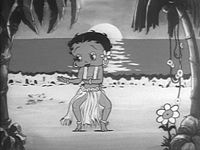
Another short, Bamboo Isle, contains a sequence in which an adult Betty dances the hula
topless, wearing only a lei and a grass skirt. According to animator Shamus Culhane, Fleischer Studios
and Paramount Pictures
were shocked by the sequence, but because it was a major sequence, it could not be cut out of the film. Culhane also states that he does not remember any instance in which the film was censored.
Following the enforcement of the Hays Code, Betty's clothing was redesigned, and all future shorts portrayed her with a longer dress which did not portray her physique and sexuality. Shorts produced following the enforcement of the Hays Code were also less surreal in nature, and Betty was portrayed as a rational adult.
titled Thank You Mask Man
, in which The Lone Ranger
shocks the residents of the town he saves when he tells them that he wants to have sex with Tonto
. The short was made by San Francisco-based company Imagination, Inc. and directed by Jeff Hale, a former member of the National Film Board of Canada. The film was scheduled to premiere on the opening night of Z
, as a supplement preceding the main feature, but was not shown. According to a former staff member of the festival, Magnuson ran up the aisle and shouted "They crucified Lenny when he was alive and now that he is dead they are screwing him again!" The festival's director told Magnuson that the producer of Z did not want any short shown that night. Rumors suggested that the wife of one of the festival's financiers hated Bruce, and threatened to withdraw her husband's money if the short was screened. Thank You Mask Man was later shown in art house screenings, and gained a following, but screenings did not perform well enough financially for Magnuson to profit from the film.
 By the late-1960s, animator Ralph Bakshi
felt that he could not continue to produce the same kind of animation as he had in the past. Bakshi was quoted in a 1971 article for the Los Angeles Times
as saying that the idea of "grown men sitting in cubicles drawing butterflies floating over a field of flowers, while American planes are dropping bombs in Vietnam
and kids are marching in the streets, is ludicrous." With producer Steve Krantz
, Bakshi founded his own studio, Bakshi Productions, establishing the studio as an alternative to mainstream animation by producing animation his own way and accelerating the advancement of female and minority animators. He also paid his employees a higher salary than any other studio at that time.
In 1969, Ralph's Spot was founded as a division of Bakshi Productions to produce commercials for Coca-Cola
and Max, the 2000-Year-Old Mouse
, a series of educational shorts paid for by Encyclopædia Britannica
. However, Bakshi was uninterested in the kind of animation he was producing, and wanted to produce something personal. Bakshi soon developed Heavy Traffic
, a tale of inner-city street life. However, Krantz told Bakshi that studio executives would be unwilling to fund the film because of its content and Bakshi's lack of film experience. While browsing the East Side Book Store on St. Mark's Place
, Bakshi came across a copy of R. Crumb
's Fritz the Cat
. Impressed by Crumb's sharp satire, Bakshi purchased the book and suggested to Krantz that it would work as a film.
Fritz the Cat
was the first animated film to receive an X rating
from the MPAA, and the highest grossing independent animated film of all time. While the film is widely noted in its innovation for featuring content that had not been portrayed in American animation before, such as explicit sexuality and violence, the film also offered commercial potential for alternative and independent animated films in the United States, as the film offered a mature, satirical portrayal of the 1960s, including portrayal of drug use, political tension and race relations. Bakshi has been credited for playing an important role in establishing animation as a medium where any story can be told, rather than a medium for children. As a result of the acceptance of Bakshi's features, the director suggested that War and Peace
could be produced as an animated film.
Because of the perception that Fritz the Cat was pornographic, Krantz attempted to appeal the film's rating, but the MPAA refused to hear the appeal. Praise from Rolling Stone
and The New York Times
, and the film's acceptance into the 1972 Cannes Film Festival
cleared up previous misconceptions. Bakshi then simultaneously directed a number of animated films, starting with Heavy Traffic
. Krantz was nervous about showing too much nudity and sexual content, and had several versions of some scenes animated. Thanks to Heavy Traffic, Ralph Bakshi became the first person in the animation industry since Walt Disney to have two financially successful films released back-to-back. Although the film received critical praise, it was banned by the film censorship board in the province of Alberta, Canada when it was originally released.
Bakshi's next film, Coonskin
was produced by Albert S. Ruddy. The film, culled from Bakshi's interest in African-American history in America, was an attack on racism
and racist stereotypes. Bakshi hired several African-American animators to work on Coonskin and another feature, Hey Good Lookin', including Brenda Banks, the first African-American female animator. After the release was stalled by protests from the Congress of Racial Equality
, which accused both the film and Bakshi himself of being racist, the film was given limited distribution, advertised as an exploitation film
, and soon disappeared from theaters.
Bakshi avoided controversy by producing fantasy film
s, including Wizards
, The Lord of the Rings
and Fire and Ice
. Bakshi did not produce another animated feature film after the 1992 release of Cool World
.
without Bakshi's involvement, and it was released in June 1974 to negative reviews. Charles Swenson developed Down and Dirty Duck as a project for former Mothers of Invention
band members Howard Kaylan
and Mark Volman
under the title Cheap! The film, produced by Roger Corman
, was released in July 1974 under the title Dirty Duck, and received negative reviews.
The film Who Framed Roger Rabbit
, distributed by Disney-owned Touchstone Pictures
, contains a number of risqué jokes that could barely be seen by audiences, but could be viewed by slowing down laserdisc
copies of the film. In one scene, Baby Herman walks under a woman's dress, raising his hand up her thighs as he passes, and emerging with an extended finger as he brings his hand down. An animator who worked on the film stated that director Robert Zemeckis
never intended to censor the scene, as it was one of his favorite moments from the film. Part of the film was animated in England, and one of the film's British animators drew a sequence in which Jessica Rabbit's crotch was exposed without Disney's knowledge. While the image cannot be clearly seen on the VHS
version of the film, it appeared more clearly on the film's laserdisc.
writer Mick LaSalle hated almost everything screened at the festival, with the exception of Bill Plympton
's One of Those Days. In The San Francisco Examiner
, David Armstrong gave the show a three-star review and described the films screened as having "some of the rude vitality of the great old Warner Bros.
cartoons —and a good deal of the sexual explicitness denied those old favorites from a more cautious age."
In 1990, Mellow Manor Productions began screening films under the title "Spike and Mike's Sick and Twisted Festival of Animation". Founders Craig "Spike" Decker and Mike Gribble promoted their festival by handing out flyers on the streets rather than with traditional promotional techniques. In 1991, Decker and Gribble screened their first "All Sick and Twisted Festival of Animation", promising "wild and zany films that could never be shown to our 'normal audience'". The festival screened newer independent shorts, as well as older shorts such as Bambi Meets Godzilla
and Thank You Mask Man. Although the festival promoted works by animators who would later gain mainstream success, such as Plympton, Mike Judge
, Trey Parker
, and Don Hertzfeldt
, many reviewers dismissed the bulk of the programming as shock value
.
In 2003, Mike Judge
and Don Hertzfeldt
created a new touring festival of animation marketed towards adults and college students. The Animation Show
brought animated shorts into more North American theaters than any previous commercial festival. Though intended for adult audiences, the programming skewed more towards Academy Award nominated animated shorts and foreign films than it did explicit material.
produced Wait till Your Father Gets Home
, an adult-oriented sitcom in the style of All in the Family
. The series dealt with subjects such as feminism
and the generation gap
. In the 1990s, a number of animated television programs appeared which challenged the Standards & Practices
guidelines, including The Simpsons
, Beavis and Butt-head
, The Critic
, The Brothers Grunt
and Duckman
. The Simpsons originated from a series of shorts appearing on The Tracey Ullman Show
. Because the shorts and television series aired in prime time, the show was not censored as much as programs intended to air on Saturday mornings. In addition to the show's portrayal of brief nudity and mild language, the series has dealt with mature themes, subjects such as death, gambling addiction, religion and suicide.
As the result of the success of The Simpsons, ABC
, CBS
and NBC
each developed animated series to air in prime time, but none of the shows were successful. One series, Capitol Critters
, focused on subjects such as gun control, interracial violence and political corruption. In his review of the series, Variety
critic Brian Lowry wrote that he felt that the series' approach was "muddled", and that "the bland central character and cartoonish elements [...] will likely be off-putting to many adults, who won't find the political satire biting enough to merit their continued attention. Similarly, kids probably won't be as smitten with the cartoon aspects or look". The series was cancelled after one month. The Critic was somewhat more successful, but achieved low ratings because of ABC's sporadic scheduling, and was cancelled by the network. The Fox Broadcasting Company
picked up the series, but cancelled it four months later. While Fox allowed The Simpsons to portray animated depictions of the human buttocks, ABC would not allow similar scenes to appear on The Critic.
Much of the humor of The Ren and Stimpy Show was not really TV-MA after what it was. Four episodes were subjected to censorship by Nickelodeon. The first, "Powdered Toast Man", contained a sequence in which Powdered Toast Man burns the United States Constitution
and the Bill of Rights
to keep warm. Although some viewed the sequence as satirical, Nickelodeon censored the scene in reruns following complaints. Another episode, "Man's Best Friend", was completed, but Nickelodeon refused to air the episode due to its violence, including a parody of a slow motion sequence from Raging Bull. According to series creator John Kricfalusi
, if it was always cartoon violence from Road Runner. Standards & Practices and Nickelodeon administrators approved the storyboards, but the network's executives shelved the episode after it had been completed, claiming it was "too strong". In the episode "Dog Show", Nickelodeon removed all uses of the character name George Liquor
. Rumors suggested that a female executive at Nickelodeon believed that the name sounded like "lick her" and referred to a sexual act. Nickelodeon executives denied the rumor, but issued no official explanation for the censorship. The fourth episode, "Sven Hoek", originally contained a sequence which suggested that Stimpy performed fellatio on Sven, but this sequence never aired.
Later in 2003, Spike TV
(at the time "TNN") Kricfalusi made a comeback with Ren and Stimpy Adult Party Cartoon
which, as the title suggested, included more adult themes such as homosexuality
between the two title characters.
Beavis and Butt-head was controversial for its portrayal of brief nudity, profanity and violence. Although the series was intended for adult audiences, it was shown in the afternoons, and multiple parents claimed that their children had imitated the show's characters. The first instance of such an accusation occurred when animal lovers in Santa Cruz, California
claimed that someone had blown up a cat after seeing Beavis and Butt-head perform this act on television. In actuality, no such scene had ever been portrayed. When a five-year-old boy in Ohio set his bed on fire, killing his two-year-old sister, critics claimed that the incident was the result of an episode involving fire, although it has never been proven that the boy had ever watched the series. MTV
responded by moving the series to a later airtime and adding disclaimers to future episodes stating explicitly not to imitate the actions of the characters, as well as removing all references to fire from the episodes.
Discussions involving a series based upon Trey Parker
and Matt Stone
's video Christmas card, The Spirit of Christmas
, led HBO to contact Ralph Bakshi in order to produce the first animated series targeted specifically toward adults. Bakshi enlisted a team of writers, including his son, Preston, to develop Spicy Detective, later renamed Spicy City, an anthology series set in a noir-ish
, technology-driven future. Each episode featuring a different story narrated by a female host named Raven, voiced by Michelle Phillips
. The series premiered in July 1997, beating South Park
to television by over a month and becoming the first "adults only" cartoon series. Although critical reaction was mixed and largely unfavorable, Spicy City received acceptable ratings. A second season was approved, but the network wanted to fire Bakshi's writing team and hire professional Los Angeles screenwriters. When Bakshi refused to cooperate with the network, the series was canceled.
Another notable show that paved the future of adult animation is Space Ghost Coast To Coast
which is an animated parody talk show hosted by the 60s Hanna-Barbera cartoon character Space Ghost. It was Cartoon Network's first original program and also the first television show to mix live action and animation. Though it aired at a 11:00pm timeslot, apart from the mild profanity, sexual references and violence it was not particularly risque like other mature shows at the time. However it did set the path for a new sister channel Adult Swim
to be created by the new millennium, and as of such more original programs were made and later would be the home of many popular adult cartoons including Robot Chicken
and Aqua Teen Hunger Force
.
, Germany
, Italy
, and Japan
. For many years, it had been problematic to import films that did not meet the approval of the United States Customs Service
. In 1972, the Customs Service refused entry of a short film titled Sinderella, depicting scenes of sexual intercourse
between characters based upon Cinderella
, Little Red Riding Hood
, Puss in Boots, Goldilocks and the Three Bears, and Prince Charming
. The film was seized as obscene material, and its distributor filed a court case and an appeal in 1974, but lost both. In 1973 an Italian animated movie King Dick
appeared, which became a cult cartoon in the UK.
The first foreign animated film to receive both an X rating and wide distribution in the United States was Tarzoon: Shame of the Jungle
. A dubbed version, which featured new dialogue performed by American actors and comedians such as John Belushi
, Adolph Caesar
, Brian Doyle-Murray
, Judy Graubart
, Bill Murray
and Johnny Weissmuller Jr.
, received an R rating. According to distributor Stuart S. Shapiro, the X rating hurt the film's distribution, but the dubbed version "took the bite out of the film. It lost its outrageousness." Tarzoon was banned by the New Zealand
Board of Censors in 1980.
Although animation had long been considered an art form in Japan, it did not become known outside the country for its adult-oriented animation until the late 1990s, because anime
fans emphasized that anime and Ghost in the Shell Series
is "not children's cartoons". The earliest association between anime and adult animation occurred preceding the release of Fritz the Cat when American distributors attempted to cash in on the publicity garnered from the rating by rushing out dubbed versions of two other adult animations from Japan, both of which featured an X rating in their advertising material: Senya ichiya monogatari and Kureopatora, retitled One Thousand and One Arabian Nights
and Cleopatra: Queen of Sex, respectively. However, neither film was actually submitted to the MPAA, and it is not likely that either feature would have received an X rating.
Pornographic anime is known in the west as hentai
and in Japan as Ero Anime (エロアニメ). Although some associate all anime with sexual content, hentai only makes up a very small portion of the Japanese animation industry. As the result of the misconceptions about Japanese animation, the country's animation has been the subject of censorship in the United States by American video stores who have classified all anime as being for "adults only", even family-oriented and children's programs. Many video stores have also categorized all adult-oriented animation as anime, including the works of Ralph Bakshi, the French
animated film Fantastic Planet
, the Canadian
animated film Heavy Metal
and the HBO television series Todd McFarlane's Spawn
.
, Family Guy
, Futurama
and South Park
, in addition to dramatic television programs directed at teen audiences, such as Batman: The Animated Series
, X-Men
and Invasion America
. In 2001, Time Warner
established Adult Swim
as a programming block on Cartoon Network
. Its schedule currently includes original programs such as Aqua Teen Hunger Force
and Robot Chicken
and reruns of syndicated programs such as Family Guy
, American Dad!
and King of the Hill
(all of which had their original run on Fox). While Adult Swim has been known to air a majority of high impact adult material, there have been some cases where some episodes from certain shows were pulled out of airing schedule for going overboard, one famous example is the animated series Moral Orel
where episodes involving depictions of children drinking alcohol and violence against homosexuals to the notorious "God's Chef" where the main character 11 year old Orel inexplicably impregnates women with a pastry bag with his sperm.
Animated films portraying serious stories began to regain notice from mainstream audiences in the beginning of the 21st century. Persepolis
, a 2007 adaptation of Marjane Satrapi
's autobiographical graphic novel, won the Jury Prize
at the 2007 Cannes Film Festival
and was later nominated for an Academy Award for Best Animated Feature
. The Iran
ian government protested the film's inclusion in the Festival, but later allowed the film to be screened in a censored version, which altered the film's sexual content. The 2008 Israel
i film Waltz with Bashir
, an animated documentary
involving the 1982 Lebanon War
, was nominated for an Academy Award for Best Foreign Language Film
.
Independent animators such as Bill Plympton
, Don Hertzfeldt
, and Nina Paley
have also found audiences and commercial success with animated shorts and feature films that are primarily intended for adults.
The trend towards using animation to illustrate adult themes and documentary
subject-matter has also been applied in partially-animated films such as Chicago 10
(2007) and Marx Reloaded
(2011).
Animation
Animation is the rapid display of a sequence of images of 2-D or 3-D artwork or model positions in order to create an illusion of movement. The effect is an optical illusion of motion due to the phenomenon of persistence of vision, and can be created and demonstrated in several ways...
that is targeted at adult
Adult
An adult is a human being or living organism that is of relatively mature age, typically associated with sexual maturity and the attainment of reproductive age....
s. Animated films and television shows may be considered adult for a number of reasons. Some productions are noted for experimental storytelling and animation techniques, or sophisticated storytelling. Others may be noted for a use of risqué themes, portrayal of violence, or sexuality (sometimes pornographic
Cartoon pornography
Cartoon pornography is the portrayal of illustrated or animated fictional characters in erotic or sexual situations. Cartoon pornography includes but is not limited to parody renditions of famous cartoons and comics.-Non-parody artists:...
) in a manner that is unsuitable for younger viewers. Many adult animations contain multiple aspects defining the work as adult.
Before the enforcement of the Hays Code, some cartoon shorts contained humor that was aimed at adult audience members rather than children. Following the introduction of the Motion Picture Association of America film rating system, independent animation
Independent animation
Independent animation is a term used to describe animated short cartoons and feature films produced outside the professional Hollywood animation industry.- Early independent animation :The history of animation is as old as the film industry itself...
producers attempted to establish an alternative to mainstream animation. The most successful animated features produced in the United States primarily for adult audiences were directed by Ralph Bakshi
Ralph Bakshi
Ralph Bakshi is an Israeli-American director of animated and live-action films. In the 1970s, he established an alternative to mainstream animation through independent and adult-oriented productions. Between 1972 and 1992, he directed nine theatrically released feature films, five of which he wrote...
, including Fritz the Cat
Fritz the Cat (film)
Fritz the Cat is a 1972 American animated comedy film written and directed by Ralph Bakshi as his feature film debut. Based on the comic strip of the same name by Robert Crumb, the film was the first animated feature film to receive an X rating in the United States...
, Heavy Traffic
Heavy Traffic
Heavy Traffic is a 1973 American animated film written and directed by Ralph Bakshi. The film, which begins, ends, and occasionally combines with live-action, explores the often surreal fantasies of a young New York cartoonist named Michael Corleone, using pinball imagery as a metaphor for...
and Coonskin
Coonskin (film)
Coonskin is a 1975 American animated film written and directed by Ralph Bakshi, about an African American rabbit, fox, and bear who rise to the top of the organized crime racket in Harlem, encountering corrupt law enforcement, con artists and the Mafia...
. Initially, few animation studios in the United States attempted to produce animation for adult audiences, but later examples of animation produced for adults would gain mainstream attention and success.
Pre-code animation
Comic strip
A comic strip is a sequence of drawings arranged in interrelated panels to display brief humor or form a narrative, often serialized, with text in balloons and captions....
s, and were directed at family audiences. Most animation produced during the silent film
Silent film
A silent film is a film with no synchronized recorded sound, especially with no spoken dialogue. In silent films for entertainment the dialogue is transmitted through muted gestures, pantomime and title cards...
era was not intended to be shown to any specific age group, but occasionally contained humor that was directed at adult audience members, including risqué jokes. The earliest known instance of censorship in animation occurred when the censorship board of Pennsylvania requested that references to bootlegging
Rum-running
Rum-running, also known as bootlegging, is the illegal business of transporting alcoholic beverages where such transportation is forbidden by law...
be removed from Walt Disney
Walt Disney
Walter Elias "Walt" Disney was an American film producer, director, screenwriter, voice actor, animator, entrepreneur, entertainer, international icon, and philanthropist, well-known for his influence in the field of entertainment during the 20th century. Along with his brother Roy O...
's 1925 short Alice Solves a Puzzle
Alice Comedies
The "Alice Comedies" are a series of animated cartoonscreated by Walt Disney in the 1920s, in which a live action little girl named Alice and an animated cat named Julius have adventures in an animated landscape....
. One of the earliest animated pornographic films was Eveready Harton in Buried Treasure
Eveready Harton in Buried Treasure
Eveready Harton in Buried Treasure, also known as Eveready Harton, Eveready, Buried Treasure, or Pecker Island is a pornographic animated cartoon made in the United States circa 1928 , depicting the unlikely adventures of the perpetually aroused title character with a woman, a man, a donkey and a...
, produced circa 1928. It has often been suggested that the film was produced for a private party in honor of Winsor McCay
Winsor McCay
Winsor McCay was an American cartoonist and animator.A prolific artist, McCay's pioneering early animated films far outshone the work of his contemporaries, and set a standard followed by Walt Disney and others in later decades...
. Rumors suggest that the film was developed in Cuba
Cuba
The Republic of Cuba is an island nation in the Caribbean. The nation of Cuba consists of the main island of Cuba, the Isla de la Juventud, and several archipelagos. Havana is the largest city in Cuba and the country's capital. Santiago de Cuba is the second largest city...
years after it was completed, because no lab in New York City
New York City
New York is the most populous city in the United States and the center of the New York Metropolitan Area, one of the most populous metropolitan areas in the world. New York exerts a significant impact upon global commerce, finance, media, art, fashion, research, technology, education, and...
would process the film. When a print was screened in San Francisco in the late 1970s, the program notes attributed the animation to George Stallings
George Stallings
George Tweedy Stallings was an American manager and player in Major League Baseball. His most famous achievement – leading the Boston Braves from last place in mid-July to the National League championship and a World Series sweep of the powerful Philadelphia Athletics – resulted in a nickname he...
, George Canata, Rudy Zamora, Sr. and Walter Lantz
Walter Lantz
Walter Benjamin Lantz was an American cartoonist, animator, film producer, and director, best known for founding Walter Lantz Productions and creating Woody Woodpecker.-Early years and start in animation:...
.
The Motion Picture Association of America
Motion Picture Association of America
The Motion Picture Association of America, Inc. , originally the Motion Picture Producers and Distributors of America , was founded in 1922 and is designed to advance the business interests of its members...
, then known as the Motion Pictures Producers and Distributors Association, was established in 1922 as the result of public objection to adult content in films, and a series of guidelines were established, suggesting content that should not be portrayed in films. Until the Hays Code was enforced, many animated shorts featured suggestive content, including sexual innuendo, references to alcohol and drug use, and mild profanity
Profanity
Profanity is a show of disrespect, or a desecration or debasement of someone or something. Profanity can take the form of words, expressions, gestures, or other social behaviors that are socially constructed or interpreted as insulting, rude, vulgar, obscene, desecrating, or other forms.The...
. In the 1933 short Bosko's Picture Show
Bosko's Picture Show
Bosko's Picture Show, released in 1933, was the last Looney Tunes Bosko cartoon produced by Hugh Harman and Rudolf Ising for Leon Schlesinger and Warner Bros...
, Bosko
Bosko
Bosko is an animated cartoon character created by animators Hugh Harman and Rudolf Ising. Bosko is the first recurring character in Leon Schlesinger's cartoon series, and is the star of over three dozen Looney Tunes shorts released by Warner Bros...
appears to use the word "fuck
Fuck
"Fuck" is an English word that is generally considered obscene which, in its most literal meaning, refers to the act of sexual intercourse. By extension it may be used to negatively characterize anything that can be dismissed, disdained, defiled, or destroyed."Fuck" can be used as a verb, adverb,...
", although it has also been suggested that the character is saying "fox", or even "mug".
The Betty Boop
Betty Boop
Betty Boop is an animated cartoon character created by Max Fleischer, with help from animators including Grim Natwick. She originally appeared in the Talkartoon and Betty Boop film series, which were produced by Fleischer Studios and released by Paramount Pictures. She has also been featured in...
series was known for its use of jokes that would eventually be considered taboo following the enforcement of the Hays Code, including the use of nudity. Betty Boop was initially drawn as a dog, and cast as the girlfriend of another Fleischer character, Bimbo
Bimbo (Fleischer)
Bimbo is a fictional character, a cartoon dog created by Fleischer Studios. He first appeared in the Out of the Inkwell series and was originally named Fitz....
. Betty was redesigned as a human, but the series continued to suggest a love relationship between the two that went farther than the normal relationship between a human and their pets. The short Is My Palm Read
Is My Palm Read
Is My Palm Read is a 1933 Fleischer Studios animated short film starring Betty Boop, and featuring Koko the Clown and Bimbo.-Synopsis:Betty visits Bimbo the fortune teller for some advice, but Bimbo is only interested in making time with Betty. Bimbo's crystal ball predicts that Betty will be...
contains a scene in which Betty is shown as a child between the ages of four and five, bathing in the nude. In the 1970s, this scene was shown out of context in performances by The Mystic Knights of the Oingo Boingo
Oingo Boingo
Oingo Boingo was an American new wave band. They are best known for their influence on other musicians, their soundtrack contributions and their high energy Halloween concerts. The band was founded in 1972 as The Mystic Knights of the Oingo Boingo, a performance art group...
. Concert audiences were not aware that Betty was supposed to be a baby in the sequence.
Another short, Bamboo Isle, contains a sequence in which an adult Betty dances the hula
Hula
Hula is a dance form accompanied by chant or song . It was developed in the Hawaiian Islands by the Polynesians who originally settled there. The hula dramatizes or portrays the words of the oli or mele in a visual dance form....
topless, wearing only a lei and a grass skirt. According to animator Shamus Culhane, Fleischer Studios
Fleischer Studios
Fleischer Studios, Inc., was an American corporation which originated as an Animation studio located at 1600 Broadway, New York City, New York...
and Paramount Pictures
Paramount Pictures
Paramount Pictures Corporation is an American film production and distribution company, located at 5555 Melrose Avenue in Hollywood. Founded in 1912 and currently owned by media conglomerate Viacom, it is America's oldest existing film studio; it is also the last major film studio still...
were shocked by the sequence, but because it was a major sequence, it could not be cut out of the film. Culhane also states that he does not remember any instance in which the film was censored.
Following the enforcement of the Hays Code, Betty's clothing was redesigned, and all future shorts portrayed her with a longer dress which did not portray her physique and sexuality. Shorts produced following the enforcement of the Hays Code were also less surreal in nature, and Betty was portrayed as a rational adult.
Adult animation in the United States after the Hays Code
By 1968, the Hays Office had been eliminated, and the former guidelines were replaced by the Motion Picture Association of America film rating system. The lifting of the Code meant that animated features from other countries could be distributed without censorship, and that censorship would not be required for American productions. Film producer John Magnuson completed an animated short based upon an audio recording of a comedy routine by Lenny BruceLenny Bruce
Leonard Alfred Schneider , better known by the stage name Lenny Bruce, was a Jewish-American comedian, social critic and satirist...
titled Thank You Mask Man
Thank You Mask Man
Thank You Mask Man is an animated short film based upon a comedy routine by Lenny Bruce involving The Lone Ranger and Tonto. The film was produced by John Magnuson, and directed by Jeff Hale.-Plot:...
, in which The Lone Ranger
The Lone Ranger
The Lone Ranger is a fictional masked Texas Ranger who, with his Native American companion Tonto, fights injustice in the American Old West. The character has become an enduring icon of American culture....
shocks the residents of the town he saves when he tells them that he wants to have sex with Tonto
Tonto
Tonto may mean:* Tonto, a band of Apache native Americans.* Tonto, the fictional sidekick to the Lone Ranger.* "Tonto", a song by the American math rock band Battles, from their album Mirrored.** "Tonto+", the EP centered around said song....
. The short was made by San Francisco-based company Imagination, Inc. and directed by Jeff Hale, a former member of the National Film Board of Canada. The film was scheduled to premiere on the opening night of Z
Z (film)
Z is a 1969 French language political thriller directed by Costa Gavras, with a screenplay by Gavras and Jorge Semprún, based on the 1966 novel of the same name by Vassilis Vassilikos. The film presents a thinly fictionalized account of the events surrounding the assassination of democratic Greek...
, as a supplement preceding the main feature, but was not shown. According to a former staff member of the festival, Magnuson ran up the aisle and shouted "They crucified Lenny when he was alive and now that he is dead they are screwing him again!" The festival's director told Magnuson that the producer of Z did not want any short shown that night. Rumors suggested that the wife of one of the festival's financiers hated Bruce, and threatened to withdraw her husband's money if the short was screened. Thank You Mask Man was later shown in art house screenings, and gained a following, but screenings did not perform well enough financially for Magnuson to profit from the film.
Adult animation of Ralph Bakshi
Ralph Bakshi
Ralph Bakshi is an Israeli-American director of animated and live-action films. In the 1970s, he established an alternative to mainstream animation through independent and adult-oriented productions. Between 1972 and 1992, he directed nine theatrically released feature films, five of which he wrote...
felt that he could not continue to produce the same kind of animation as he had in the past. Bakshi was quoted in a 1971 article for the Los Angeles Times
Los Angeles Times
The Los Angeles Times is a daily newspaper published in Los Angeles, California, since 1881. It was the second-largest metropolitan newspaper in circulation in the United States in 2008 and the fourth most widely distributed newspaper in the country....
as saying that the idea of "grown men sitting in cubicles drawing butterflies floating over a field of flowers, while American planes are dropping bombs in Vietnam
Vietnam
Vietnam – sometimes spelled Viet Nam , officially the Socialist Republic of Vietnam – is the easternmost country on the Indochina Peninsula in Southeast Asia. It is bordered by China to the north, Laos to the northwest, Cambodia to the southwest, and the South China Sea –...
and kids are marching in the streets, is ludicrous." With producer Steve Krantz
Steve Krantz
Stephen Falk Krantz was a film producer and writer who was most active from 1966 to 1996.- Career :Born in Brooklyn, New York, Steve Krantz graduated from Columbia University and went on to serve in the U.S. Army Air Forces in the Pacific during World War II as a second lieutenant.He worked as a...
, Bakshi founded his own studio, Bakshi Productions, establishing the studio as an alternative to mainstream animation by producing animation his own way and accelerating the advancement of female and minority animators. He also paid his employees a higher salary than any other studio at that time.
In 1969, Ralph's Spot was founded as a division of Bakshi Productions to produce commercials for Coca-Cola
Coca-Cola
Coca-Cola is a carbonated soft drink sold in stores, restaurants, and vending machines in more than 200 countries. It is produced by The Coca-Cola Company of Atlanta, Georgia, and is often referred to simply as Coke...
and Max, the 2000-Year-Old Mouse
Max, the 2000-Year-Old Mouse
Max, the 2000-Year-Old Mouse was a Canadian animated television series produced by the late Steve Krantz, which originally aired in Canada in 1967 and became popular in several parts of the world, most notably the United States, where it was syndicated on both local and PBS stations between 1970...
, a series of educational shorts paid for by Encyclopædia Britannica
Encyclopædia Britannica
The Encyclopædia Britannica , published by Encyclopædia Britannica, Inc., is a general knowledge English-language encyclopaedia that is available in print, as a DVD, and on the Internet. It is written and continuously updated by about 100 full-time editors and more than 4,000 expert...
. However, Bakshi was uninterested in the kind of animation he was producing, and wanted to produce something personal. Bakshi soon developed Heavy Traffic
Heavy Traffic
Heavy Traffic is a 1973 American animated film written and directed by Ralph Bakshi. The film, which begins, ends, and occasionally combines with live-action, explores the often surreal fantasies of a young New York cartoonist named Michael Corleone, using pinball imagery as a metaphor for...
, a tale of inner-city street life. However, Krantz told Bakshi that studio executives would be unwilling to fund the film because of its content and Bakshi's lack of film experience. While browsing the East Side Book Store on St. Mark's Place
St. Mark's Place (Manhattan)
Saint Mark's Place is a street in the East Village neighborhood of the New York City borough of Manhattan. It is named after St. Mark's Church in-the-Bowery on 10th Street at Second Avenue. St. Mark's Place, which is a section of 8th Street, runs from Third Avenue to Avenue A...
, Bakshi came across a copy of R. Crumb
Robert Crumb
Robert Dennis Crumb —known as Robert Crumb and R. Crumb—is an American artist, illustrator, and musician recognized for the distinctive style of his drawings and his critical, satirical, subversive view of the American mainstream.Crumb was a founder of the underground comix movement and is regarded...
's Fritz the Cat
Fritz the Cat
Fritz the Cat is a comic strip created by Robert Crumb. Set in a "supercity" of anthropomorphic animals, the strip focuses on Fritz, a feline con artist who frequently goes on wild adventures that sometimes involve sexcapades. Crumb began drawing this character in homemade comic books when he was a...
. Impressed by Crumb's sharp satire, Bakshi purchased the book and suggested to Krantz that it would work as a film.
Fritz the Cat
Fritz the Cat (film)
Fritz the Cat is a 1972 American animated comedy film written and directed by Ralph Bakshi as his feature film debut. Based on the comic strip of the same name by Robert Crumb, the film was the first animated feature film to receive an X rating in the United States...
was the first animated film to receive an X rating
X-rated
In some countries, X is or has been a motion picture rating reserved for the most explicit films. Films rated X are intended only for viewing by adults, usually legally defined as people over the age of 17.-United Kingdom:...
from the MPAA, and the highest grossing independent animated film of all time. While the film is widely noted in its innovation for featuring content that had not been portrayed in American animation before, such as explicit sexuality and violence, the film also offered commercial potential for alternative and independent animated films in the United States, as the film offered a mature, satirical portrayal of the 1960s, including portrayal of drug use, political tension and race relations. Bakshi has been credited for playing an important role in establishing animation as a medium where any story can be told, rather than a medium for children. As a result of the acceptance of Bakshi's features, the director suggested that War and Peace
War and Peace
War and Peace is a novel by the Russian author Leo Tolstoy, first published in 1869. The work is epic in scale and is regarded as one of the most important works of world literature...
could be produced as an animated film.
Because of the perception that Fritz the Cat was pornographic, Krantz attempted to appeal the film's rating, but the MPAA refused to hear the appeal. Praise from Rolling Stone
Rolling Stone
Rolling Stone is a US-based magazine devoted to music, liberal politics, and popular culture that is published every two weeks. Rolling Stone was founded in San Francisco in 1967 by Jann Wenner and music critic Ralph J...
and The New York Times
The New York Times
The New York Times is an American daily newspaper founded and continuously published in New York City since 1851. The New York Times has won 106 Pulitzer Prizes, the most of any news organization...
, and the film's acceptance into the 1972 Cannes Film Festival
1972 Cannes Film Festival
- Jury :*Joseph Losey *Bibi Andersson *Georges Auric *Erskine Caldwell *Mark Donskoi *Miloš Forman *Giorgio Papi *Jean Rochereau *Alain Tanner...
cleared up previous misconceptions. Bakshi then simultaneously directed a number of animated films, starting with Heavy Traffic
Heavy Traffic
Heavy Traffic is a 1973 American animated film written and directed by Ralph Bakshi. The film, which begins, ends, and occasionally combines with live-action, explores the often surreal fantasies of a young New York cartoonist named Michael Corleone, using pinball imagery as a metaphor for...
. Krantz was nervous about showing too much nudity and sexual content, and had several versions of some scenes animated. Thanks to Heavy Traffic, Ralph Bakshi became the first person in the animation industry since Walt Disney to have two financially successful films released back-to-back. Although the film received critical praise, it was banned by the film censorship board in the province of Alberta, Canada when it was originally released.
Bakshi's next film, Coonskin
Coonskin (film)
Coonskin is a 1975 American animated film written and directed by Ralph Bakshi, about an African American rabbit, fox, and bear who rise to the top of the organized crime racket in Harlem, encountering corrupt law enforcement, con artists and the Mafia...
was produced by Albert S. Ruddy. The film, culled from Bakshi's interest in African-American history in America, was an attack on racism
Racism
Racism is the belief that inherent different traits in human racial groups justify discrimination. In the modern English language, the term "racism" is used predominantly as a pejorative epithet. It is applied especially to the practice or advocacy of racial discrimination of a pernicious nature...
and racist stereotypes. Bakshi hired several African-American animators to work on Coonskin and another feature, Hey Good Lookin', including Brenda Banks, the first African-American female animator. After the release was stalled by protests from the Congress of Racial Equality
Congress of Racial Equality
The Congress of Racial Equality or CORE was a U.S. civil rights organization that originally played a pivotal role for African-Americans in the Civil Rights Movement...
, which accused both the film and Bakshi himself of being racist, the film was given limited distribution, advertised as an exploitation film
Exploitation film
Exploitation film is a type of film that is promoted by "exploiting" often lurid subject matter. The term "exploitation" is common in film marketing, used for all types of films to mean promotion or advertising. These films then need something to exploit, such as a big star, special effects, sex,...
, and soon disappeared from theaters.
Bakshi avoided controversy by producing fantasy film
Fantasy film
Fantasy films are films with fantastic themes, usually involving magic, supernatural events, make-believe creatures, or exotic fantasy worlds. The genre is considered to be distinct from science fiction film and horror film, although the genres do overlap...
s, including Wizards
Wizards (film)
Wizards is a 1977 American animated post-apocalyptic science fantasy film about the battle between two wizards, one representing the forces of magic and one representing the forces of industrial technology. It was written, produced, and directed by Ralph Bakshi...
, The Lord of the Rings
The Lord of the Rings (1978 film)
J.R.R. Tolkien's The Lord of the Rings is a 1978 American fantasy film directed by Ralph Bakshi. It contains both animation and live action footage which is rotoscoped to give it a more consistent look throughout the length of the movie. It is an adaptation of the first half of the high fantasy...
and Fire and Ice
Fire and Ice (1983 film)
Fire and Ice is a 1983 animated film, a collaboration between Ralph Bakshi and Frank Frazetta, distributed by 20th Century Fox, which also distributed Bakshi's 1977 release, Wizards...
. Bakshi did not produce another animated feature film after the 1992 release of Cool World
Cool World
Cool World is a 1992 American live-action/animated film directed by Ralph Bakshi, and starring Kim Basinger, Gabriel Byrne, and Brad Pitt. It tells the story of a cartoonist who finds himself in the animated world he created, and is seduced by one of his characters, a comic strip vamp who wants to...
.
Other adult animated features in the United States
Although some adult-oriented animated films achieved success, very few animation studios in the United States produced explicitly adult animation during the 1970s, and much of the adult-oriented animation produced in the 1980s and 1990s was critically and commercially unsuccessful. Krantz produced The Nine Lives of Fritz the CatThe Nine Lives of Fritz the Cat
The Nine Lives of Fritz the Cat is a 1974 animated film directed by Robert Taylor. It is an adult animation featuring a series of drug-induced vignettes both related and unrelated to life in the 1970s. Starring Skip Hinnant as the voice of the titular feline protagonist, the film is a sequel to...
without Bakshi's involvement, and it was released in June 1974 to negative reviews. Charles Swenson developed Down and Dirty Duck as a project for former Mothers of Invention
The Mothers of Invention
The Mothers of Invention were an American band active from 1964 to 1969, and again from 1970 to 1975.They mainly performed works by, and were the original recording group of, US composer and guitarist Frank Zappa , although other members have had the occasional writing credit...
band members Howard Kaylan
Howard Kaylan
Howard Kaylan is an American rock and roll musician, best known as a founding member and lead singer of the 1960s band, The Turtles, and "Eddie" of 1970's rock band Flo & Eddie.-Early days:...
and Mark Volman
Mark Volman
Mark Volman is an American rock and roll singer, best known as a founding member of the 1960s band The Turtles. At times during his career he has used the pseudonym "The Phlorescent Leech"...
under the title Cheap! The film, produced by Roger Corman
Roger Corman
Roger William Corman is an American film producer, director and actor. He has mostly worked on low-budget B movies. Some of Corman's work has an established critical reputation, such as his cycle of films adapted from the tales of Edgar Allan Poe, and in 2009 he won an Honorary Academy Award for...
, was released in July 1974 under the title Dirty Duck, and received negative reviews.
The film Who Framed Roger Rabbit
Who Framed Roger Rabbit
Who Framed Roger Rabbit is a 1988 American fantasy-comedy-noir film directed by Robert Zemeckis and released by Touchstone Pictures. The film combines live action and animation, and is based on Gary K. Wolf's novel Who Censored Roger Rabbit?, which depicts a world in which cartoon characters...
, distributed by Disney-owned Touchstone Pictures
Touchstone Pictures
Touchstone Pictures is an American film production label and is one of several film labels of the Walt Disney Motion Pictures Group. Established in 1984, its releases typically feature more mature themes and darker tones than those that are released under the Walt Disney Pictures banner.Touchstone...
, contains a number of risqué jokes that could barely be seen by audiences, but could be viewed by slowing down laserdisc
Laserdisc
LaserDisc was a home video format and the first commercial optical disc storage medium. Initially licensed, sold, and marketed as MCA DiscoVision in North America in 1978, the technology was previously referred to interally as Optical Videodisc System, Reflective Optical Videodisc, Laser Optical...
copies of the film. In one scene, Baby Herman walks under a woman's dress, raising his hand up her thighs as he passes, and emerging with an extended finger as he brings his hand down. An animator who worked on the film stated that director Robert Zemeckis
Robert Zemeckis
Robert Lee Zemeckis is an American film director, producer and screenwriter. Zemeckis first came to public attention in the 1980s as the director of the comedic time-travel Back to the Future film series, as well as the Academy Award-winning live-action/animation epic Who Framed Roger Rabbit ,...
never intended to censor the scene, as it was one of his favorite moments from the film. Part of the film was animated in England, and one of the film's British animators drew a sequence in which Jessica Rabbit's crotch was exposed without Disney's knowledge. While the image cannot be clearly seen on the VHS
VHS
The Video Home System is a consumer-level analog recording videocassette standard developed by Victor Company of Japan ....
version of the film, it appeared more clearly on the film's laserdisc.
Adult animation festivals in the United States
In 1988, San Francisco exhibitor Expanded Cinema screened a compilation of adult-oriented animated shorts under the title "Outrageous Animation". Advertising the package as containing "the wildest cartoons ever", the screenings contained shorts produced outside the United States, as well as independently-produced American shorts. Reviews of the festival were mixed. San Francisco ChronicleSan Francisco Chronicle
thumb|right|upright|The Chronicle Building following the [[1906 San Francisco earthquake|1906 earthquake]] and fireThe San Francisco Chronicle is a newspaper serving primarily the San Francisco Bay Area of the U.S. state of California, but distributed throughout Northern and Central California,...
writer Mick LaSalle hated almost everything screened at the festival, with the exception of Bill Plympton
Bill Plympton
William "Bill" Calvin Plympton is an American animator, former cartoonist, director, screenwriter and producer best known for his 1987 Academy Award-nominated animated short Your Face. and his series of shorts Guard Dog, Guide Dog, Hot Dog and Horn Dog.- Biography :Bill Plympton was born in...
's One of Those Days. In The San Francisco Examiner
The San Francisco Examiner
The San Francisco Examiner is a U.S. daily newspaper. It has been published continuously in San Francisco, California, since the late 19th century.-19th century:...
, David Armstrong gave the show a three-star review and described the films screened as having "some of the rude vitality of the great old Warner Bros.
Warner Bros.
Warner Bros. Entertainment, Inc., also known as Warner Bros. Pictures or simply Warner Bros. , is an American producer of film and television entertainment.One of the major film studios, it is a subsidiary of Time Warner, with its headquarters in Burbank,...
cartoons —and a good deal of the sexual explicitness denied those old favorites from a more cautious age."
In 1990, Mellow Manor Productions began screening films under the title "Spike and Mike's Sick and Twisted Festival of Animation". Founders Craig "Spike" Decker and Mike Gribble promoted their festival by handing out flyers on the streets rather than with traditional promotional techniques. In 1991, Decker and Gribble screened their first "All Sick and Twisted Festival of Animation", promising "wild and zany films that could never be shown to our 'normal audience'". The festival screened newer independent shorts, as well as older shorts such as Bambi Meets Godzilla
Bambi Meets Godzilla
Bambi Meets Godzilla is the title of the cartoon created entirely by Marv Newland. Less than two minutes long, the film is a classic of animation—#38 in the book The 50 Greatest Cartoons ....
and Thank You Mask Man. Although the festival promoted works by animators who would later gain mainstream success, such as Plympton, Mike Judge
Mike Judge
Michael Craig Judge is an American animator, film director, writer and voice actor, best known as the creator and star of the animated television series Beavis and Butt-head , King of the Hill , and The Goode Family .He also wrote, directed and in some instances produced the films Beavis and...
, Trey Parker
Trey Parker
Trey Parker is an American animator, screenwriter, director, producer, voice artist, musician and actor, best known for being the co-creator of the television series South Park along with his creative partner and best friend Matt Stone.Parker started his film career in 1992, making a holiday short...
, and Don Hertzfeldt
Don Hertzfeldt
Don Hertzfeldt is the creator of many short animated films, including the Academy-Award nominated Rejected and Everything Will Be OK. His animated films have received over 150 awards and have been presented around the world. Before the age of thirty, his films were already the subject of several...
, many reviewers dismissed the bulk of the programming as shock value
Shock value
Shock value is the potential of an action , image, text, or other form of communication to provoke a reaction of disgust, shock, anger, fear, or similar negative emotions.-Shock value as humor:...
.
In 2003, Mike Judge
Mike Judge
Michael Craig Judge is an American animator, film director, writer and voice actor, best known as the creator and star of the animated television series Beavis and Butt-head , King of the Hill , and The Goode Family .He also wrote, directed and in some instances produced the films Beavis and...
and Don Hertzfeldt
Don Hertzfeldt
Don Hertzfeldt is the creator of many short animated films, including the Academy-Award nominated Rejected and Everything Will Be OK. His animated films have received over 150 awards and have been presented around the world. Before the age of thirty, his films were already the subject of several...
created a new touring festival of animation marketed towards adults and college students. The Animation Show
The Animation Show
The Animation Show is a touring festival of animated short films that was first held in fall 2003. It was created by award-winning animators Mike Judge and Don Hertzfeldt....
brought animated shorts into more North American theaters than any previous commercial festival. Though intended for adult audiences, the programming skewed more towards Academy Award nominated animated shorts and foreign films than it did explicit material.
Adult television animation in the United States
From 1972 to 1974, Hanna-BarberaHanna-Barbera
Hanna-Barbera Productions, Inc. was an American animation studio that dominated North American television animation during the second half of the 20th century...
produced Wait till Your Father Gets Home
Wait Till Your Father Gets Home
Wait Till Your Father Gets Home was an animated sitcom produced by Hanna-Barbera that aired in first-run syndication in the United States from 1972 to 1974...
, an adult-oriented sitcom in the style of All in the Family
All in the Family
All in the Family is an American sitcom that was originally broadcast on the CBS television network from January 12, 1971, to April 8, 1979. In September 1979, a new show, Archie Bunker's Place, picked up where All in the Family had ended...
. The series dealt with subjects such as feminism
Feminism
Feminism is a collection of movements aimed at defining, establishing, and defending equal political, economic, and social rights and equal opportunities for women. Its concepts overlap with those of women's rights...
and the generation gap
Generation gap
The generational gap is and was a term popularized in Western countries during the 1960s referring to differences between people of a younger generation and their elders, especially between children and parents....
. In the 1990s, a number of animated television programs appeared which challenged the Standards & Practices
Standards & Practices
In the United States, Standards and Practices is the name traditionally given to the department at a television network which is responsible for the moral, ethical, and legal implications of the program that network airs...
guidelines, including The Simpsons
The Simpsons
The Simpsons is an American animated sitcom created by Matt Groening for the Fox Broadcasting Company. The series is a satirical parody of a middle class American lifestyle epitomized by its family of the same name, which consists of Homer, Marge, Bart, Lisa and Maggie...
, Beavis and Butt-head
Beavis and Butt-Head
Beavis and Butt-head is an American animated television series created by Mike Judge. The series originated from Frog Baseball, a 1992 short film by Judge. After seeing the short, MTV signed Judge to develop the concept. Beavis and Butt-head originally aired from March 8, 1993 to November 28, 1997...
, The Critic
The Critic
The Critic is an American prime time animated series revolving around the life of film critic Jay Sherman, voiced by actor Jon Lovitz. It was created by Al Jean and Mike Reiss, both of whom had worked as writers on The Simpsons. The Critic had 23 episodes produced, first broadcast on ABC in 1994,...
, The Brothers Grunt
The Brothers Grunt
The Brothers Grunt is an animated TV series that aired from August 15, 1994 to February 20, 1995 on MTV. The series was created by Danny Antonucci .-Premise:...
and Duckman
Duckman
Duckman: Private Dick/Family Man is an American animated sitcom that aired from 1994–1997, created by Everett Peck and developed by Peck. The sitcom is based on characters created by Peck in his Dark Horse comic...
. The Simpsons originated from a series of shorts appearing on The Tracey Ullman Show
The Tracey Ullman Show
The Tracey Ullman Show was an American television variety show, hosted by British comedian and onetime pop singer Tracey Ullman. It debuted on April 5, 1987 as the Fox network's second primetime series after Married... with Children, and ran until May 26, 1990. The show blended sketch comedy shorts...
. Because the shorts and television series aired in prime time, the show was not censored as much as programs intended to air on Saturday mornings. In addition to the show's portrayal of brief nudity and mild language, the series has dealt with mature themes, subjects such as death, gambling addiction, religion and suicide.
As the result of the success of The Simpsons, ABC
American Broadcasting Company
The American Broadcasting Company is an American commercial broadcasting television network. Created in 1943 from the former NBC Blue radio network, ABC is owned by The Walt Disney Company and is part of Disney-ABC Television Group. Its first broadcast on television was in 1948...
, CBS
CBS
CBS Broadcasting Inc. is a major US commercial broadcasting television network, which started as a radio network. The name is derived from the initials of the network's former name, Columbia Broadcasting System. The network is sometimes referred to as the "Eye Network" in reference to the shape of...
and NBC
NBC
The National Broadcasting Company is an American commercial broadcasting television network and former radio network headquartered in the GE Building in New York City's Rockefeller Center with additional major offices near Los Angeles and in Chicago...
each developed animated series to air in prime time, but none of the shows were successful. One series, Capitol Critters
Capitol Critters
Capitol Critters is an animated television series about the lives of mice, rats, and roaches who reside in the basement and walls of the White House in Washington, D.C...
, focused on subjects such as gun control, interracial violence and political corruption. In his review of the series, Variety
Variety (magazine)
Variety is an American weekly entertainment-trade magazine founded in New York City, New York, in 1905 by Sime Silverman. With the rise of the importance of the motion-picture industry, Daily Variety, a daily edition based in Los Angeles, California, was founded by Silverman in 1933. In 1998, the...
critic Brian Lowry wrote that he felt that the series' approach was "muddled", and that "the bland central character and cartoonish elements [...] will likely be off-putting to many adults, who won't find the political satire biting enough to merit their continued attention. Similarly, kids probably won't be as smitten with the cartoon aspects or look". The series was cancelled after one month. The Critic was somewhat more successful, but achieved low ratings because of ABC's sporadic scheduling, and was cancelled by the network. The Fox Broadcasting Company
Fox Broadcasting Company
Fox Broadcasting Company, commonly referred to as Fox Network or simply Fox , is an American commercial broadcasting television network owned by Fox Entertainment Group, part of Rupert Murdoch's News Corporation. Launched on October 9, 1986, Fox was the highest-rated broadcast network in the...
picked up the series, but cancelled it four months later. While Fox allowed The Simpsons to portray animated depictions of the human buttocks, ABC would not allow similar scenes to appear on The Critic.
Much of the humor of The Ren and Stimpy Show was not really TV-MA after what it was. Four episodes were subjected to censorship by Nickelodeon. The first, "Powdered Toast Man", contained a sequence in which Powdered Toast Man burns the United States Constitution
United States Constitution
The Constitution of the United States is the supreme law of the United States of America. It is the framework for the organization of the United States government and for the relationship of the federal government with the states, citizens, and all people within the United States.The first three...
and the Bill of Rights
United States Bill of Rights
The Bill of Rights is the collective name for the first ten amendments to the United States Constitution. These limitations serve to protect the natural rights of liberty and property. They guarantee a number of personal freedoms, limit the government's power in judicial and other proceedings, and...
to keep warm. Although some viewed the sequence as satirical, Nickelodeon censored the scene in reruns following complaints. Another episode, "Man's Best Friend", was completed, but Nickelodeon refused to air the episode due to its violence, including a parody of a slow motion sequence from Raging Bull. According to series creator John Kricfalusi
John Kricfalusi
Michael John Kricfalusi , better known as John K., is a Canadian animator. He is creator of The Ren & Stimpy Show, its adults-only spin-off Ren & Stimpy "Adult Party Cartoon", The Ripping Friends animated series, and Weekend Pussy Hunt, which was billed as "the world's first interactive web-based...
, if it was always cartoon violence from Road Runner. Standards & Practices and Nickelodeon administrators approved the storyboards, but the network's executives shelved the episode after it had been completed, claiming it was "too strong". In the episode "Dog Show", Nickelodeon removed all uses of the character name George Liquor
George Liquor
George Liquor , most famous for his appearances on The Ren and Stimpy Show, is a cartoon character created by John Kricfalusi and is a mascot for Kricfalusi's defunct animation studio, Spümcø. Kricfalusi portrayed George Liquor as a patriotic, outspoken, politically conservative blowhard...
. Rumors suggested that a female executive at Nickelodeon believed that the name sounded like "lick her" and referred to a sexual act. Nickelodeon executives denied the rumor, but issued no official explanation for the censorship. The fourth episode, "Sven Hoek", originally contained a sequence which suggested that Stimpy performed fellatio on Sven, but this sequence never aired.
Later in 2003, Spike TV
Spike TV
Spike is an American cable television channel. It launched on March 7, 1983 as The Nashville Network , a joint venture of WSM, Inc...
(at the time "TNN") Kricfalusi made a comeback with Ren and Stimpy Adult Party Cartoon
Ren and Stimpy Adult Party Cartoon
Ren & Stimpy "Adult Party Cartoon" is an animated television series created by an american animator John Kricfalusi for the cable network Spike . The series was an adults-only-revival and spin-off of the original animated series, The Ren & Stimpy Show, which had previously aired on the American...
which, as the title suggested, included more adult themes such as homosexuality
Homosexuality
Homosexuality is romantic or sexual attraction or behavior between members of the same sex or gender. As a sexual orientation, homosexuality refers to "an enduring pattern of or disposition to experience sexual, affectional, or romantic attractions" primarily or exclusively to people of the same...
between the two title characters.
Beavis and Butt-head was controversial for its portrayal of brief nudity, profanity and violence. Although the series was intended for adult audiences, it was shown in the afternoons, and multiple parents claimed that their children had imitated the show's characters. The first instance of such an accusation occurred when animal lovers in Santa Cruz, California
Santa Cruz, California
Santa Cruz is the county seat and largest city of Santa Cruz County, California in the US. As of the 2010 U.S. Census, Santa Cruz had a total population of 59,946...
claimed that someone had blown up a cat after seeing Beavis and Butt-head perform this act on television. In actuality, no such scene had ever been portrayed. When a five-year-old boy in Ohio set his bed on fire, killing his two-year-old sister, critics claimed that the incident was the result of an episode involving fire, although it has never been proven that the boy had ever watched the series. MTV
MTV
MTV, formerly an initialism of Music Television, is an American network based in New York City that launched on August 1, 1981. The original purpose of the channel was to play music videos guided by on-air hosts known as VJs....
responded by moving the series to a later airtime and adding disclaimers to future episodes stating explicitly not to imitate the actions of the characters, as well as removing all references to fire from the episodes.
Discussions involving a series based upon Trey Parker
Trey Parker
Trey Parker is an American animator, screenwriter, director, producer, voice artist, musician and actor, best known for being the co-creator of the television series South Park along with his creative partner and best friend Matt Stone.Parker started his film career in 1992, making a holiday short...
and Matt Stone
Matt Stone
Matthew Richard "Matt" Stone is an American screenwriter, producer, voice artist, musician and actor, best known for being the co-creator of South Park along with creative partner and best friend, Trey Parker....
's video Christmas card, The Spirit of Christmas
The Spirit of Christmas (short film)
The Spirit of Christmas is the name of two different animated short films made by Trey Parker and Matt Stone. They are notable for being precursors to the animated series South Park. To differentiate the two, they are often referred to as Jesus vs. Frosty and Jesus vs. Santa .- Jesus vs. Frosty...
, led HBO to contact Ralph Bakshi in order to produce the first animated series targeted specifically toward adults. Bakshi enlisted a team of writers, including his son, Preston, to develop Spicy Detective, later renamed Spicy City, an anthology series set in a noir-ish
Film noir
Film noir is a cinematic term used primarily to describe stylish Hollywood crime dramas, particularly those that emphasize cynical attitudes and sexual motivations. Hollywood's classic film noir period is generally regarded as extending from the early 1940s to the late 1950s...
, technology-driven future. Each episode featuring a different story narrated by a female host named Raven, voiced by Michelle Phillips
Michelle Phillips
Michelle Phillips is an American singer, songwriter, and actress. She gained fame as a member of the 1960s group The Mamas & the Papas, and is the last surviving original member of the group.-Early life:...
. The series premiered in July 1997, beating South Park
South Park
South Park is an American animated television series created by Trey Parker and Matt Stone for the Comedy Central television network. Intended for mature audiences, the show has become famous for its crude language, surreal, satirical, and dark humor that lampoons a wide range of topics...
to television by over a month and becoming the first "adults only" cartoon series. Although critical reaction was mixed and largely unfavorable, Spicy City received acceptable ratings. A second season was approved, but the network wanted to fire Bakshi's writing team and hire professional Los Angeles screenwriters. When Bakshi refused to cooperate with the network, the series was canceled.
Another notable show that paved the future of adult animation is Space Ghost Coast To Coast
Space Ghost Coast to Coast
Space Ghost Coast to Coast is an American animated parody talk show hosted by the 60s Hanna-Barbera cartoon character Space Ghost. The show premiered on April 15, 1994 on Cartoon Network...
which is an animated parody talk show hosted by the 60s Hanna-Barbera cartoon character Space Ghost. It was Cartoon Network's first original program and also the first television show to mix live action and animation. Though it aired at a 11:00pm timeslot, apart from the mild profanity, sexual references and violence it was not particularly risque like other mature shows at the time. However it did set the path for a new sister channel Adult Swim
Adult Swim
Adult Swim is an adult-oriented Cable network that shares channel space with Cartoon Network from 9:00 pm until 6:00 am ET/PT in the United States, and broadcasts in countries such as Australia and New Zealand...
to be created by the new millennium, and as of such more original programs were made and later would be the home of many popular adult cartoons including Robot Chicken
Robot Chicken
Robot Chicken is an American stop motion animated television series created and executive produced by Seth Green and Matthew Senreich along with co-head writers Douglas Goldstein and Tom Root. Green provides many voices for the show...
and Aqua Teen Hunger Force
Aqua Teen Hunger Force
Aqua Teen Hunger Force , retitled Aqua Unit Patrol Squad 1 in 2011, is an American animated television series on Cartoon Network late night programing block, Adult Swim, as well as Teletoon's Teletoon at Night block and later G4 Canada's ADd block in Canada...
.
Adult animation outside the United States
Although animation has long been perceived as a children's medium in the United States, this perception does not extend to other countries. Animation has been taken seriously as a medium by foreign industries, including those in FranceFrance
The French Republic , The French Republic , The French Republic , (commonly known as France , is a unitary semi-presidential republic in Western Europe with several overseas territories and islands located on other continents and in the Indian, Pacific, and Atlantic oceans. Metropolitan France...
, Germany
Germany
Germany , officially the Federal Republic of Germany , is a federal parliamentary republic in Europe. The country consists of 16 states while the capital and largest city is Berlin. Germany covers an area of 357,021 km2 and has a largely temperate seasonal climate...
, Italy
Italy
Italy , officially the Italian Republic languages]] under the European Charter for Regional or Minority Languages. In each of these, Italy's official name is as follows:;;;;;;;;), is a unitary parliamentary republic in South-Central Europe. To the north it borders France, Switzerland, Austria and...
, and Japan
Japan
Japan is an island nation in East Asia. Located in the Pacific Ocean, it lies to the east of the Sea of Japan, China, North Korea, South Korea and Russia, stretching from the Sea of Okhotsk in the north to the East China Sea and Taiwan in the south...
. For many years, it had been problematic to import films that did not meet the approval of the United States Customs Service
United States Customs Service
Until March 2003, the United States Customs Service was an agency of the U.S. federal government that collected import tariffs and performed other selected border security duties.Before it was rolled into form part of the U.S...
. In 1972, the Customs Service refused entry of a short film titled Sinderella, depicting scenes of sexual intercourse
Sexual intercourse
Sexual intercourse, also known as copulation or coitus, commonly refers to the act in which a male's penis enters a female's vagina for the purposes of sexual pleasure or reproduction. The entities may be of opposite sexes, or they may be hermaphroditic, as is the case with snails...
between characters based upon Cinderella
Cinderella
"Cinderella; or, The Little Glass Slipper" is a folk tale embodying a myth-element of unjust oppression/triumphant reward. Thousands of variants are known throughout the world. The title character is a young woman living in unfortunate circumstances that are suddenly changed to remarkable fortune...
, Little Red Riding Hood
Little Red Riding Hood
Little Red Riding Hood, also known as Little Red Cap, is a French fairy tale about a young girl and a Big Bad Wolf. The story has been changed considerably in its history and subject to numerous modern adaptations and readings....
, Puss in Boots, Goldilocks and the Three Bears, and Prince Charming
Prince Charming
Prince Charming is a stock character who appears in a number of fairy tales. He is the prince who comes to rescue of the damsel in distress, and stereotypically, must engage in a quest to liberate her from an evil spell...
. The film was seized as obscene material, and its distributor filed a court case and an appeal in 1974, but lost both. In 1973 an Italian animated movie King Dick
Il nano e la Strega
is a 1973 Italian animated film.- Languages :The film was released in three forms in English, one version of the film was a direct dub of the Italian version, with a few quick cuts, this version was released in theatres and on VHS in the UK in the 80s, the second version was on the VHS 'Dirty...
appeared, which became a cult cartoon in the UK.
The first foreign animated film to receive both an X rating and wide distribution in the United States was Tarzoon: Shame of the Jungle
Tarzoon: Shame of the Jungle
Tarzoon: Shame of the Jungle is a 1975 adult-oriented French/Belgian animated film directed by cartoonist Picha and Boris Szulzinger. The film was the first foreign-animated film to receive both an X rating and wide distribution in the United States....
. A dubbed version, which featured new dialogue performed by American actors and comedians such as John Belushi
John Belushi
John Adam Belushi was an American comedian, actor, and musician, best known as one of the original cast members of the NBC sketch comedy show Saturday Night Live, The Star of the Films National Lampoon's Animal House and the The Blues Brothers and for fronting the American blues and soul...
, Adolph Caesar
Adolph Caesar
Adolph Caesar was an American actor.-Biography:Born in Harlem, Manhattan, New York City, New York, he is best remembered for his role in director Norman Jewison's film, A Soldier's Story for which he received a nomination for "Best Actor in a Supporting Role" from both the Academy Awards and the...
, Brian Doyle-Murray
Brian Doyle-Murray
Brian Doyle-Murray is an American comedian, screenwriter, actor and voice artist. He is the older brother of actor/comedian Bill Murray and has acted together with him in several films, including Caddyshack, Scrooged, Ghostbusters II, The Razor's Edge and Groundhog Day...
, Judy Graubart
Judy Graubart
Esther Judith "Judy" Graubart is an American actress and comedienne. She is best remembered for being a regular cast member of The Electric Company, the revolutionary children's show from the 1970s produced by the Children's Television Workshop...
, Bill Murray
Bill Murray
William James "Bill" Murray is an American actor and comedian. He first gained national exposure on Saturday Night Live in which he earned an Emmy Award and later went on to star in a number of critically and commercially successful comedic films, including Caddyshack , Ghostbusters , and...
and Johnny Weissmuller Jr.
Johnny Weissmuller Jr.
Johnny Weissmuller, Jr. was an American actor and longshoreman. He also authored a book about his father, the five-time Olympic Games gold medalist Johnny Weissmuller, who achieved additional fame playing the title role in the Tarzan movies of the 1930s and 1940s.Weissmuller's mother was Beryl...
, received an R rating. According to distributor Stuart S. Shapiro, the X rating hurt the film's distribution, but the dubbed version "took the bite out of the film. It lost its outrageousness." Tarzoon was banned by the New Zealand
New Zealand
New Zealand is an island country in the south-western Pacific Ocean comprising two main landmasses and numerous smaller islands. The country is situated some east of Australia across the Tasman Sea, and roughly south of the Pacific island nations of New Caledonia, Fiji, and Tonga...
Board of Censors in 1980.
Although animation had long been considered an art form in Japan, it did not become known outside the country for its adult-oriented animation until the late 1990s, because anime
Anime
is the Japanese abbreviated pronunciation of "animation". The definition sometimes changes depending on the context. In English-speaking countries, the term most commonly refers to Japanese animated cartoons....
fans emphasized that anime and Ghost in the Shell Series
Ghost in the Shell
is a Japanese multimedia franchise composed of manga, animated films, anime series, video games and novels. It focuses on the activities of the counter-terrorist organization Public Security Section 9 in a futuristic, cyberpunk Japan ....
is "not children's cartoons". The earliest association between anime and adult animation occurred preceding the release of Fritz the Cat when American distributors attempted to cash in on the publicity garnered from the rating by rushing out dubbed versions of two other adult animations from Japan, both of which featured an X rating in their advertising material: Senya ichiya monogatari and Kureopatora, retitled One Thousand and One Arabian Nights
One Thousand and One Arabian Nights (film)
is a 1969 anime feature film directed by Eiichi Yamamoto, conceived by Osamu Tezuka. The film is part of Mushi Production's Animerama, a series of films aimed at an adult audience....
and Cleopatra: Queen of Sex, respectively. However, neither film was actually submitted to the MPAA, and it is not likely that either feature would have received an X rating.
Pornographic anime is known in the west as hentai
Hentai
is a Japanese word that, in the West, is used when referring to sexually explicit or pornographic comics and animation, particularly those of Japanese origin such as anime, manga, and computer games. The word hentai is a kanji compound of 変 and 態...
and in Japan as Ero Anime (エロアニメ). Although some associate all anime with sexual content, hentai only makes up a very small portion of the Japanese animation industry. As the result of the misconceptions about Japanese animation, the country's animation has been the subject of censorship in the United States by American video stores who have classified all anime as being for "adults only", even family-oriented and children's programs. Many video stores have also categorized all adult-oriented animation as anime, including the works of Ralph Bakshi, the French
France
The French Republic , The French Republic , The French Republic , (commonly known as France , is a unitary semi-presidential republic in Western Europe with several overseas territories and islands located on other continents and in the Indian, Pacific, and Atlantic oceans. Metropolitan France...
animated film Fantastic Planet
Fantastic Planet
Fantastic Planet is a 1973 animated science fiction film directed by René Laloux, production designed by Roland Topor, written by both of them and animated at Jiří Trnka Studio. The film was an international production between France and Czechoslovakia and was distributed in the United States by...
, the Canadian
Canada
Canada is a North American country consisting of ten provinces and three territories. Located in the northern part of the continent, it extends from the Atlantic Ocean in the east to the Pacific Ocean in the west, and northward into the Arctic Ocean...
animated film Heavy Metal
Heavy Metal (film)
Heavy Metal is a 1981 Canadian fantasy-animated film directed by Gerald Potterton and produced by Ivan Reitman and Leonard Mogel, who also was the publisher of Heavy Metal magazine....
and the HBO television series Todd McFarlane's Spawn
Todd McFarlane's Spawn
Todd McFarlane's Spawn was an animated television series which aired on HBO from 1997 through 1999. It was based on the Spawn comic series from Image Comics, and was nominated for and won an Emmy in 1999 for Outstanding Animation Program...
.
Contemporary adult animation
Since the late 1990s, American audiences became more accepting to adult-oriented animation, through the popularity of American-produced comedic television shows such as The SimpsonsThe Simpsons
The Simpsons is an American animated sitcom created by Matt Groening for the Fox Broadcasting Company. The series is a satirical parody of a middle class American lifestyle epitomized by its family of the same name, which consists of Homer, Marge, Bart, Lisa and Maggie...
, Family Guy
Family Guy
Family Guy is an American animated television series created by Seth MacFarlane for the Fox Broadcasting Company. The series centers on the Griffins, a dysfunctional family consisting of parents Peter and Lois; their children Meg, Chris, and Stewie; and their anthropomorphic pet dog Brian...
, Futurama
Futurama
Futurama is an American animated science fiction sitcom created by Matt Groening and developed by Groening and David X. Cohen for the Fox Broadcasting Company. The series follows the adventures of a late 20th-century New York City pizza delivery boy, Philip J...
and South Park
South Park
South Park is an American animated television series created by Trey Parker and Matt Stone for the Comedy Central television network. Intended for mature audiences, the show has become famous for its crude language, surreal, satirical, and dark humor that lampoons a wide range of topics...
, in addition to dramatic television programs directed at teen audiences, such as Batman: The Animated Series
Batman: The Animated Series
Batman: The Animated Series is an American animated series based on the DC Comics character Batman. The series featured an ensemble cast of many voice-actors including Kevin Conroy, Mark Hamill, Efrem Zimbalist, Jr., Arleen Sorkin, and Loren Lester. The series won four Emmy Awards and was nominated...
, X-Men
X-Men (TV series)
X-Men, also known as X-Men: The Animated Series, is an American animated television series which debuted on October 31, 1992, in the United States on the Fox Network as part of its Fox Kids Saturday morning lineup...
and Invasion America
Invasion America
Invasion America is an animated science fiction miniseries that aired in the prime time lineup on The WB Television Network and later as a part of the Kids' WB programming block...
. In 2001, Time Warner
Time Warner
Time Warner is one of the world's largest media companies, headquartered in the Time Warner Center in New York City. Formerly two separate companies, Warner Communications, Inc...
established Adult Swim
Adult Swim
Adult Swim is an adult-oriented Cable network that shares channel space with Cartoon Network from 9:00 pm until 6:00 am ET/PT in the United States, and broadcasts in countries such as Australia and New Zealand...
as a programming block on Cartoon Network
Cartoon Network
Cartoon Network is a name of television channels worldwide created by Turner Broadcasting which used to primarily show animated programming. The channel began broadcasting on October 1, 1992 in the United States....
. Its schedule currently includes original programs such as Aqua Teen Hunger Force
Aqua Teen Hunger Force
Aqua Teen Hunger Force , retitled Aqua Unit Patrol Squad 1 in 2011, is an American animated television series on Cartoon Network late night programing block, Adult Swim, as well as Teletoon's Teletoon at Night block and later G4 Canada's ADd block in Canada...
and Robot Chicken
Robot Chicken
Robot Chicken is an American stop motion animated television series created and executive produced by Seth Green and Matthew Senreich along with co-head writers Douglas Goldstein and Tom Root. Green provides many voices for the show...
and reruns of syndicated programs such as Family Guy
Family Guy
Family Guy is an American animated television series created by Seth MacFarlane for the Fox Broadcasting Company. The series centers on the Griffins, a dysfunctional family consisting of parents Peter and Lois; their children Meg, Chris, and Stewie; and their anthropomorphic pet dog Brian...
, American Dad!
American Dad!
American Dad! is an American animated television series created by Seth MacFarlane and owned by Underdog Productions and Fuzzy Door Productions. It is produced in association with 20th Century Fox Television...
and King of the Hill
King of the Hill
King of the Hill is an American animated dramedy series created by Mike Judge and Greg Daniels, that ran from January 12, 1997, to May 6, 2010, on Fox network. It centers on the Hills, a working-class Methodist family in the fictional small town of Arlen, Texas...
(all of which had their original run on Fox). While Adult Swim has been known to air a majority of high impact adult material, there have been some cases where some episodes from certain shows were pulled out of airing schedule for going overboard, one famous example is the animated series Moral Orel
Moral Orel
Moral Orel is an American stop-motion animated television show, which originally aired on Adult Swim from December 13, 2005 to December 18, 2008...
where episodes involving depictions of children drinking alcohol and violence against homosexuals to the notorious "God's Chef" where the main character 11 year old Orel inexplicably impregnates women with a pastry bag with his sperm.
Animated films portraying serious stories began to regain notice from mainstream audiences in the beginning of the 21st century. Persepolis
Persepolis (film)
Persepolis is a 2007 French animated film based on Marjane Satrapi's autobiographical graphic novel of the same name. The film was written and directed by Satrapi with Vincent Paronnaud. The story follows a young girl as she comes of age against the backdrop of the Iranian Revolution. The story...
, a 2007 adaptation of Marjane Satrapi
Marjane Satrapi
Marjane Satrapi is an Iranian-born French contemporary graphic novelist, illustrator, animated film director, and children's book author...
's autobiographical graphic novel, won the Jury Prize
Jury Prize (Cannes Film Festival)
The Jury Prize is an award presented at the Cannes Film Festival. It is chosen by the jury from the 'official section' of movies at the festival. It is considered the third most prestigious prize at the film festival, after the Palme d'Or and the Grand Prix....
at the 2007 Cannes Film Festival
2007 Cannes Film Festival
The 2007 Cannes Film Festival, the sixtieth, ran from 16 to 27 May 2007. Wong Kar-wai's My Blueberry Nights opened the festival, and Denys Arcand's The Age of Ignorance closed...
and was later nominated for an Academy Award for Best Animated Feature
Academy Award for Best Animated Feature
The Academy Award for Best Animated Feature is one of the annual awards given by the Los Angeles-based professional organization, the Academy of Motion Picture Arts and Sciences...
. The Iran
Iran
Iran , officially the Islamic Republic of Iran , is a country in Southern and Western Asia. The name "Iran" has been in use natively since the Sassanian era and came into use internationally in 1935, before which the country was known to the Western world as Persia...
ian government protested the film's inclusion in the Festival, but later allowed the film to be screened in a censored version, which altered the film's sexual content. The 2008 Israel
Israel
The State of Israel is a parliamentary republic located in the Middle East, along the eastern shore of the Mediterranean Sea...
i film Waltz with Bashir
Waltz with Bashir
Waltz with Bashir is a 2008 Israeli animated documentary film written and directed by Ari Folman. It depicts Folman in search of his lost memories from the 1982 Lebanon War....
, an animated documentary
Documentary film
Documentary films constitute a broad category of nonfictional motion pictures intended to document some aspect of reality, primarily for the purposes of instruction or maintaining a historical record...
involving the 1982 Lebanon War
1982 Lebanon War
The 1982 Lebanon War , , called Operation Peace for Galilee by Israel, and later known in Israel as the Lebanon War and First Lebanon War, began on 6 June 1982, when the Israel Defense Forces invaded southern Lebanon...
, was nominated for an Academy Award for Best Foreign Language Film
Academy Award for Best Foreign Language Film
The Academy Award for Best Foreign Language Film is one of the Academy Awards of Merit, popularly known as the Oscars, handed out annually by the U.S.-based Academy of Motion Picture Arts and Sciences...
.
Independent animators such as Bill Plympton
Bill Plympton
William "Bill" Calvin Plympton is an American animator, former cartoonist, director, screenwriter and producer best known for his 1987 Academy Award-nominated animated short Your Face. and his series of shorts Guard Dog, Guide Dog, Hot Dog and Horn Dog.- Biography :Bill Plympton was born in...
, Don Hertzfeldt
Don Hertzfeldt
Don Hertzfeldt is the creator of many short animated films, including the Academy-Award nominated Rejected and Everything Will Be OK. His animated films have received over 150 awards and have been presented around the world. Before the age of thirty, his films were already the subject of several...
, and Nina Paley
Nina Paley
Nina Paley is an Americancartoonist, animator and free culture activist.She directed the animated feature film Sita Sings the Blues. She was the artist and often the writer of comic strips Nina's Adventures and Fluff, but most of her recent work has been in animation...
have also found audiences and commercial success with animated shorts and feature films that are primarily intended for adults.
The trend towards using animation to illustrate adult themes and documentary
Documentary
A documentary is a creative work of non-fiction, including:* Documentary film, including television* Radio documentary* Documentary photographyRelated terms include:...
subject-matter has also been applied in partially-animated films such as Chicago 10
Chicago 10 (film)
Chicago 10: Speak Your Peace is a partially animated film written and directed by Brett Morgen that tells the story of the Chicago Eight...
(2007) and Marx Reloaded
Marx Reloaded
Marx Reloaded is a 2011 German documentary film written and directed by the British writer and theorist Jason Barker. Featuring interviews with several well-known philosophers, the film aims to examine the relevance of Karl Marx's ideas in relation to the global economic and financial crisis of...
(2011).