

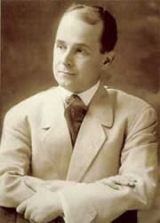
Winsor McCay

Encyclopedia
Winsor McCay was an American cartoonist
and animator
.
A prolific artist, McCay's pioneering early animated films far outshone the work of his contemporaries, and set a standard followed by Walt Disney
and others in later decades. His two best-known creations are the newspaper comic strip Little Nemo in Slumberland
, which ran from 1905–1914 and 1924–1927, and the animated cartoon Gertie the Dinosaur
, which he created in 1914.
His comic strip work has influenced generations of artists, including creators such as William Joyce
, André LeBlanc
, Moebius
, Maurice Sendak
, Chris Ware
and Bill Watterson
.
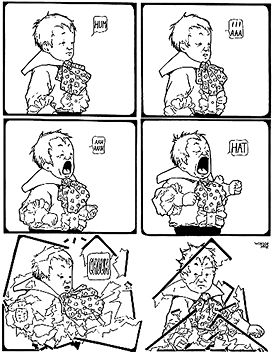 McCay was the son of Robert McKay (later changed to McCay) and Janet Murray McKay; Robert at various times worked as a teamster
, a grocer, and a real estate agent. Winsor's exact place and year of birth are uncertain — he claimed to have been born in Spring Lake, Michigan
in 1871, but his gravestone says 1869, and census reports state that he was born in Canada
in 1867. He was originally named Zenas Winsor McKay, in honor of his father's employer, Zenas G. Winsor. He later dropped the name Zenas.
In 1886, McCay's parents sent him to Cleary's Business College
in Ypsilanti, Michigan
to learn to be a businessman. While in Ypsilanti, he also received his only formal art training, from John Goodison of Michigan State Normal College (now known as Eastern Michigan University
). Goodison taught him the strict application of the fundamentals of perspective
, which he put to significant use later in his career. Goodison, formerly a glass stainer
, also influenced McCay's bold use of color.
, intending to study at the Art Institute of Chicago, but due to lack of money had to find employment instead. He worked for the National Printing and Engraving Company, producing woodcuts for circus and theatrical posters. Two years later, he moved to Cincinnati, Ohio
and went to work as an artist for Kohl and Middleton's Vine Street Dime Museum
. While in Cincinnati he married Maude Leonore Dufour. McCay began doing vaudeville chalk talk
s in 1906. In his The Seven Ages of Man vaudeville act, he drew two faces and progressively aged them.
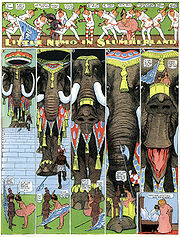 McCay's first major comic strip series was Tales of the Jungle Imps by Felix Fiddle. Forty-three installments were published from January to November 1903, in the Cincinnati Enquirer. The strip was based on poems by George Randolph Chester
, then a reporter and editor at the Enquirer. The stories concerned jungle creatures and the ways that they adapted to a hostile world, with individual titles such as How the Elephant Got His Trunk and How the Ostrich Got So Tall.
His strips Little Nemo
and Dreams of a Rarebit Fiend
were both set in the dreams of their characters and featured fantasy art that attempted to capture the look and feel of dreams. McCay's cartoons were never overwhelmingly popular, but always had a strong following because of his expressive graphic style. Newspaper pages were physically much larger in that time and McCay usually had a half a page to work with. For fantasy art
in comics, his only rival was Lyonel Feininger
, who went on to have a career in the fine arts after his comics days were over.
McCay also created a number of animated short films, in which every single frame of each cartoon (with each film requiring thousands of frames) was hand-drawn by McCay and occasionally his assistants. McCay went on vaudeville
tours with his films. He presented lectures and did drawings; then he interacted with his animated films, performing such tricks as holding his hand out to "pet" his animated creations.
The star of McCay's groundbreaking animated film Gertie the Dinosaur
is classified by film and animation historians as the first cartoon character created especially for film to display a unique, realistic personality. In the film, Gertie causes trouble and cries when she is scolded, and finally she gives McCay himself a ride on her back as he steps into the movie picture.
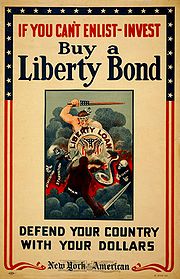
In addition to a series of cartoons based on his popular "rarebit" gags, McCay also created The Sinking of the Lusitania
, a depiction of the attack on the maritime ship. The cartoon contained a message that was meant to inspire America into joining World War I
.
.
Woody Gelman
discovered many of the original Little Nemo strips at a cartoon studio where Bob McCay
, Winsor's son, had worked in 1966. Many of the original drawings that Gelman recovered were displayed at the Metropolitan Museum of Art
under the direction of curator A. Hyatt Mayor
. In 1973, Gelman would publish a collection of Little Nemo strips in Italy.
Cartoonist
A cartoonist is a person who specializes in drawing cartoons. This work is usually humorous, mainly created for entertainment, political commentary or advertising...
and animator
Animator
An animator is an artist who creates multiple images that give an illusion of movement called animation when displayed in rapid sequence; the images are called frames and key frames. Animators can work in a variety of fields including film, television, video games, and the internet. Usually, an...
.
A prolific artist, McCay's pioneering early animated films far outshone the work of his contemporaries, and set a standard followed by Walt Disney
Walt Disney
Walter Elias "Walt" Disney was an American film producer, director, screenwriter, voice actor, animator, entrepreneur, entertainer, international icon, and philanthropist, well-known for his influence in the field of entertainment during the 20th century. Along with his brother Roy O...
and others in later decades. His two best-known creations are the newspaper comic strip Little Nemo in Slumberland
Little Nemo
Little Nemo is the main fictional character in a series of weekly comic strips by Winsor McCay that appeared in the New York Herald and William Randolph Hearst's New York American newspapers from October 15, 1905 – April 23, 1911 and April 30, 1911 – July 26, 1914; respectively.The...
, which ran from 1905–1914 and 1924–1927, and the animated cartoon Gertie the Dinosaur
Gertie the Dinosaur
Gertie the Dinosaur is a 1914 American animated short film by Winsor McCay. Although not the first feature-length animated film, as is sometimes thought, it was the first cartoon to feature a character with an appealing personality...
, which he created in 1914.
His comic strip work has influenced generations of artists, including creators such as William Joyce
William Joyce (writer)
William Joyce is an American author, illustrator, and filmmaker. Newsweek has called him one of the top 100 people to watch in the new millennium. His illustrations have appeared on numerous New Yorker covers and his paintings are displayed at national museums and art galleries. He lives with his...
, André LeBlanc
André LeBlanc (artist)
André LeBlanc was an American artist who worked on comic strips and comic books of the 1940s and 1950s. He was an instructor at New York's School of Visual Arts....
, Moebius
Jean Giraud
Jean Henri Gaston Giraud is a French comics artist. Giraud has earned worldwide fame, not only under his own name but also under the pseudonym Moebius, and to a lesser extent Gir, the latter appearing mostly in the form of a boxed signature at the bottom of the artist's paintings, for instance the...
, Maurice Sendak
Maurice Sendak
Maurice Bernard Sendak is an American writer and illustrator of children's literature. He is best known for his book Where the Wild Things Are, published in 1963.-Early life:...
, Chris Ware
Chris Ware
Franklin Christenson Ware , is an American comic book artist and cartoonist, widely known for his Acme Novelty Library series and the graphic novel Jimmy Corrigan, the Smartest Kid on Earth. Born in Omaha, Nebraska, he resides in the Chicago area, Illinois...
and Bill Watterson
Bill Watterson
William Boyd Watterson II , known as Bill Watterson, is an American cartoonist and the author of the comic strip Calvin and Hobbes...
.
Early life
Teamster
A teamster, in modern American English, is a truck driver. The trade union named after them is the International Brotherhood of Teamsters , one of the largest unions in the United States....
, a grocer, and a real estate agent. Winsor's exact place and year of birth are uncertain — he claimed to have been born in Spring Lake, Michigan
Spring Lake, Michigan
Spring Lake is a village in Ottawa County in the U.S. state of Michigan. The population was 2,514 at the 2000 census. The village is located within Spring Lake Township....
in 1871, but his gravestone says 1869, and census reports state that he was born in Canada
Canada
Canada is a North American country consisting of ten provinces and three territories. Located in the northern part of the continent, it extends from the Atlantic Ocean in the east to the Pacific Ocean in the west, and northward into the Arctic Ocean...
in 1867. He was originally named Zenas Winsor McKay, in honor of his father's employer, Zenas G. Winsor. He later dropped the name Zenas.
In 1886, McCay's parents sent him to Cleary's Business College
Cleary University
Cleary University is a Michigan based business university with two campuses; the Washtenaw Campus is located in Ann Arbor and the Livingston Campus is located near Howell. Both campus offer certificate, ABA, BBA, and MBA programs.- History :...
in Ypsilanti, Michigan
Ypsilanti, Michigan
Ypsilanti is a city in Washtenaw County in the U.S. state of Michigan. As of the 2000 census, the city population was 22,362. The city is bounded to the north by the Charter Township of Superior and on the west, south, and east by the Charter Township of Ypsilanti...
to learn to be a businessman. While in Ypsilanti, he also received his only formal art training, from John Goodison of Michigan State Normal College (now known as Eastern Michigan University
Eastern Michigan University
Eastern Michigan University is a comprehensive, co-educational public university located in Ypsilanti, Michigan. Ypsilanti is west of Detroit and eight miles east of Ann Arbor. The university was founded in 1849 as Michigan State Normal School...
). Goodison taught him the strict application of the fundamentals of perspective
Perspective (graphical)
Perspective in the graphic arts, such as drawing, is an approximate representation, on a flat surface , of an image as it is seen by the eye...
, which he put to significant use later in his career. Goodison, formerly a glass stainer
Stained glass
The term stained glass can refer to coloured glass as a material or to works produced from it. Throughout its thousand-year history, the term has been applied almost exclusively to the windows of churches and other significant buildings...
, also influenced McCay's bold use of color.
Career
In 1889, McCay moved to ChicagoChicago
Chicago is the largest city in the US state of Illinois. With nearly 2.7 million residents, it is the most populous city in the Midwestern United States and the third most populous in the US, after New York City and Los Angeles...
, intending to study at the Art Institute of Chicago, but due to lack of money had to find employment instead. He worked for the National Printing and Engraving Company, producing woodcuts for circus and theatrical posters. Two years later, he moved to Cincinnati, Ohio
Cincinnati, Ohio
Cincinnati is a city in the U.S. state of Ohio. Cincinnati is the county seat of Hamilton County. Settled in 1788, the city is located to north of the Ohio River at the Ohio-Kentucky border, near Indiana. The population within city limits is 296,943 according to the 2010 census, making it Ohio's...
and went to work as an artist for Kohl and Middleton's Vine Street Dime Museum
Dime museum
Dime museums were institutions that were briefly popular at the end of the 19th century in the United States. Designed as centers for entertainment and moral education for the working class , the museums were distinctly different from upper-middle class' cultural events...
. While in Cincinnati he married Maude Leonore Dufour. McCay began doing vaudeville chalk talk
Chalk talk
A chalk talk was a popular act in vaudeville. A performer used chalk on a blackboard to make changes in a drawing while delivering a monologue. Some performers would do caricatures of audience members. The term also was used to describe an act done with crayons...
s in 1906. In his The Seven Ages of Man vaudeville act, he drew two faces and progressively aged them.
George Randolph Chester
George Randolph Chester was an American writer. He was the author of such popular works such as Get-Rich-Quick Wallingford and "Five Thousand an Hour: How Johnny Gamble won the heiress" that were made into silent films within his lifetime.-Biography:He was born in Cincinnati, Ohio on January 27,...
, then a reporter and editor at the Enquirer. The stories concerned jungle creatures and the ways that they adapted to a hostile world, with individual titles such as How the Elephant Got His Trunk and How the Ostrich Got So Tall.
His strips Little Nemo
Little Nemo
Little Nemo is the main fictional character in a series of weekly comic strips by Winsor McCay that appeared in the New York Herald and William Randolph Hearst's New York American newspapers from October 15, 1905 – April 23, 1911 and April 30, 1911 – July 26, 1914; respectively.The...
and Dreams of a Rarebit Fiend
Dreams of a Rarebit Fiend
Dream of the Rarebit Fiend was a newspaper comic strip written and drawn by Winsor McCay beginning September 10, 1904. It was McCay's second successful newspaper strip, after Little Sammy Sneeze secured him a position on the cartoon staff of the New York Herald newspaper...
were both set in the dreams of their characters and featured fantasy art that attempted to capture the look and feel of dreams. McCay's cartoons were never overwhelmingly popular, but always had a strong following because of his expressive graphic style. Newspaper pages were physically much larger in that time and McCay usually had a half a page to work with. For fantasy art
Fantasy art
Fantasy art is a genre of art that depicts magical or other supernatural themes, ideas, creatures or settings. While there is some overlap with science fiction, horror and other speculative fiction art, there are unique elements not generally found in other forms of speculative fiction art...
in comics, his only rival was Lyonel Feininger
Lyonel Feininger
Lyonel Charles Feininger was a German-American painter, and a leading exponent of Expressionism. He also worked as a caricaturist and comic strip artist.-Life and work:...
, who went on to have a career in the fine arts after his comics days were over.
McCay also created a number of animated short films, in which every single frame of each cartoon (with each film requiring thousands of frames) was hand-drawn by McCay and occasionally his assistants. McCay went on vaudeville
Vaudeville
Vaudeville was a theatrical genre of variety entertainment in the United States and Canada from the early 1880s until the early 1930s. Each performance was made up of a series of separate, unrelated acts grouped together on a common bill...
tours with his films. He presented lectures and did drawings; then he interacted with his animated films, performing such tricks as holding his hand out to "pet" his animated creations.
The star of McCay's groundbreaking animated film Gertie the Dinosaur
Gertie the Dinosaur
Gertie the Dinosaur is a 1914 American animated short film by Winsor McCay. Although not the first feature-length animated film, as is sometimes thought, it was the first cartoon to feature a character with an appealing personality...
is classified by film and animation historians as the first cartoon character created especially for film to display a unique, realistic personality. In the film, Gertie causes trouble and cries when she is scolded, and finally she gives McCay himself a ride on her back as he steps into the movie picture.
In addition to a series of cartoons based on his popular "rarebit" gags, McCay also created The Sinking of the Lusitania
The Sinking of the Lusitania
The Sinking of the Lusitania is an animated short film by American artist Winsor McCay. It features a short 12-minute explanation of the sinking of the RMS Lusitania after it was struck by two torpedoes* fired from a German U-boat. The film was one of many animated silent films published to create...
, a depiction of the attack on the maritime ship. The cartoon contained a message that was meant to inspire America into joining World War I
World War I
World War I , which was predominantly called the World War or the Great War from its occurrence until 1939, and the First World War or World War I thereafter, was a major war centred in Europe that began on 28 July 1914 and lasted until 11 November 1918...
.
Death and legacy
McCay died in 1934 and was buried at the Cemetery of the Evergreens in BrooklynBrooklyn
Brooklyn is the most populous of New York City's five boroughs, with nearly 2.6 million residents, and the second-largest in area. Since 1896, Brooklyn has had the same boundaries as Kings County, which is now the most populous county in New York State and the second-most densely populated...
.
Woody Gelman
Woody Gelman
Woodrow Gelman , better known as Woody Gelman, was a publisher, a cartoonist, a novelist and an artist-writer for animation and comic books. As the publisher of Nostalgia Press, he pioneered the reprinting of vintage comic strips in quality hardcovers and trade paperbacks...
discovered many of the original Little Nemo strips at a cartoon studio where Bob McCay
Bob McCay
Robert Winsor McCay was an American cartoonist during the golden age of comic books. He worked professionally under the names R. Winsor McCay, Winsor McCay Jr., and Bob McCay...
, Winsor's son, had worked in 1966. Many of the original drawings that Gelman recovered were displayed at the Metropolitan Museum of Art
Metropolitan Museum of Art
The Metropolitan Museum of Art is a renowned art museum in New York City. Its permanent collection contains more than two million works, divided into nineteen curatorial departments. The main building, located on the eastern edge of Central Park along Manhattan's Museum Mile, is one of the...
under the direction of curator A. Hyatt Mayor
A. Hyatt Mayor
A. Hyatt Mayor was an American art historian and curator at the Metropolitan Museum of Art, a leading figure in the study of prints, both old master prints and popular prints....
. In 1973, Gelman would publish a collection of Little Nemo strips in Italy.
Comic strips
- Tales of the Jungle Imps by Felix Fiddle (1903)
- Little Sammy Sneeze (1904 to 1906)
- Dream of the Rarebit Fiend (1904–13)
- The Story of Hungry Henrietta (1905)
- A Pilgrim's Progress (1905 to 1910)
- Little Nemo in Slumberland (1905 to 1914, 1924-1927) (1911-1914 under the title In the Land of Wonderful Dreams)
- Poor Jake (1909 to 1911)
Filmography
- Little NemoLittle NemoLittle Nemo is the main fictional character in a series of weekly comic strips by Winsor McCay that appeared in the New York Herald and William Randolph Hearst's New York American newspapers from October 15, 1905 – April 23, 1911 and April 30, 1911 – July 26, 1914; respectively.The...
(1911) also titled Winsor McCay, the Famous Cartoonist of the N.Y. Herald and His Moving Comics - How a Mosquito OperatesHow a Mosquito OperatesHow a Mosquito Operates is a 1912 animated short film, animated by Winsor McCay. An incomplete print of the film survives.A mosquito with a suitcase spots a man walking to his apartment . As the man enters, the mostuito slips through the top window over the door. The man lays down to rest while...
(1912) also titled The Story Of A Mosquito - Gertie the DinosaurGertie the DinosaurGertie the Dinosaur is a 1914 American animated short film by Winsor McCay. Although not the first feature-length animated film, as is sometimes thought, it was the first cartoon to feature a character with an appealing personality...
(1914) - The Sinking of the LusitaniaThe Sinking of the LusitaniaThe Sinking of the Lusitania is an animated short film by American artist Winsor McCay. It features a short 12-minute explanation of the sinking of the RMS Lusitania after it was struck by two torpedoes* fired from a German U-boat. The film was one of many animated silent films published to create...
(1918) - Dreams of the Rarebit Fiend: Bug Vaudeville (1921)
- Dreams of the Rarebit Fiend: The Pet (1921)
- Dreams of the Rarebit Fiend: The Flying House (1921)
- The CentaursThe CentaursThe Centaurs was an animated film produced by Winsor McCay between 1918 and 1921. There is no record that the film was completed or publicly screened. The film was destroyed by negligent storage that allowed the sole surviving nitrate film print to deteriorate into dust. All that remains are...
(1921) - Gertie on Tour (1921)
- Flip's Circus (1921)
- The Barnyard Performance (1922-27?) also called Performing Animals and The Midsummer's Nightmare
Books and collections
- Dreams of a Rarebit Fiend Dover, ISBN 0-486-21347-1
- Little Nemo in the Palace of Ice and Further Adventures Dover, ISBN 0-486-23234-4
- The Complete Little Nemo in Slumberland, Vol. I: 1905-1907 Fantagraphics ISBN 0-930193-63-6
- The Complete Little Nemo in Slumberland, Vol. II: 1907-1908 Fantagraphics ISBN 0-930193-64-4
- The Complete Little Nemo in Slumberland, Vol. III: 1908-1910 Fantagraphics ISBN 1-56097-025-1
- The Complete Little Nemo in Slumberland, Vol. IV: 1910-1911 Fantagraphics ISBN 1-56097-045-6
- The Complete Little Nemo in Slumberland, Vol. V: In the Land of Wonderful Dreams, Part 1: 1911-12 Fantagraphics ISBN 0-924359-35-8
- The Complete Little Nemo in Slumberland, Vol. VI: In the Land of Wonderful Dreams, Part 2: 1913-14 Fantagraphics ISBN 1-56097-130-4
- Little Nemo 1905-1914 Taschen, ISBN 3-8228-6300-9
- The Best of Little Nemo in Slumberland Stewart, Tabori, & Chang, ISBN 1-55670-647-2
- Little Nemo in Slumberland: So Many Splendid Sundays Sunday Press ISBN 0-9768885-0-5
- Little Nemo in Slumberland: Many More Splendid Sundays Sunday Press ISBN 0-9768885-5-6
- Winsor McCay: Early Works, Vol. 1 Checker, ISBN 0-9741664-0-5 (“Tales of the Rarebit Fiend” and “Little Sammy Sneeze”)
- Winsor McCay: Early Works, Vol. 2 Checker, ISBN 0-9741664-7-2 (More “Tales of the Rarebit Fiend” and “Little Sammy Sneeze,” “Centaurs,” “Hungry Henrietta,” and editorial illustrations.)
- Winsor McCay: Early Works, Vol. 3 Checker, ISBN 0-9741664-9-9 (More “Tales of the Rarebit Fiend” (1907), “Little Sammy Sneeze,” “A Pilgrim’s Progress,” (1907) and editorial illustrations from New York period.)
- Winsor McCay: Early Works, Vol. 4 Checker, ISBN 0-9753808-1-8 (more Dream of the Rarebit Fiend (early 1908), A Pilgrim’s Progress (early 1908), various Little Sammy Sneezes, and New York American editorial cartoons.)
- Winsor McCay: Early Works, Vol. 5 Checker, ISBN 0-9753808-2-6 (Dream of the Rarebit Fiend (late 1908), A Pilgrim’s Progress (late 1908), Phoolish Phillip (all), Hungry Henrietta (all), and New York American editorial cartoons.)
- Winsor McCay: Early Works, Vol. 6 Checker, ISBN 1-933160-05-5 (“Mr Goodenough”, Dream of the Rarebit Fiend (late 1908), A Pilgrim’s Progress (late 1908), and New York American editorial cartoons.)
- Winsor McCay: Early Works, Vol. 7 Checker, ISBN 1-933160-05-5 (illustrations from New York editorial period, and collection of comic strips.)
- Winsor McCay: Early Works, Vol. 8 Checker, ISBN 1-933160-06-3
- Winsor McCay: Early Works, Vol. 9 Checker, ISBN 978-1-933160-07-8
- Daydreams and Nightmares Fantagraphics, ISBN 1-56097-569-5
- Little Sammy Sneeze Sunday Press ISBN 0-97688-854-8
External links
- Spring Lake District Library "The Talented Winsor McCay"
- The Fales Library of NYU's guide to the David C. Bohnett Collection of Winsor McCay Drawings
- Meeting McCay on Internet Movie DatabaseInternet Movie DatabaseInternet Movie Database is an online database of information related to movies, television shows, actors, production crew personnel, video games and fictional characters featured in visual entertainment media. It is one of the most popular online entertainment destinations, with over 100 million...
Little Nemo in Slumberland Anniversary Special - Winsor McCay's The Centaurs.
- Comic Strip Library has a complete collection of out-of-copyright Little Nemo pages