

Hula

Encyclopedia

Hawaiian Islands
The Hawaiian Islands are an archipelago of eight major islands, several atolls, numerous smaller islets, and undersea seamounts in the North Pacific Ocean, extending some 1,500 miles from the island of Hawaii in the south to northernmost Kure Atoll...
by the Polynesia
Polynesia
Polynesia is a subregion of Oceania, made up of over 1,000 islands scattered over the central and southern Pacific Ocean. The indigenous people who inhabit the islands of Polynesia are termed Polynesians and they share many similar traits including language, culture and beliefs...
ns who originally settled there. The hula dramatizes or portrays the words of the oli or mele in a visual dance form.
There are many sub-styles of hula, with the main two categories being Hula 'Auana and Hula Kahiko. Ancient hula, as performed before Western encounters with Hawaii, is called kahiko. It is accompanied by chant and traditional instruments. Hula as it evolved under Western influence, in the 19th and 20th centuries, is called auana (a word that means "to wander or drift"). It is accompanied by song and Western-influenced musical instrument
Musical instrument
A musical instrument is a device created or adapted for the purpose of making musical sounds. In principle, any object that produces sound can serve as a musical instrument—it is through purpose that the object becomes a musical instrument. The history of musical instruments dates back to the...
s such as the guitar
Guitar
The guitar is a plucked string instrument, usually played with fingers or a pick. The guitar consists of a body with a rigid neck to which the strings, generally six in number, are attached. Guitars are traditionally constructed of various woods and strung with animal gut or, more recently, with...
, the ukulele
Ukulele
The ukulele, ; from ; it is a subset of the guitar family of instruments, generally with four nylon or gut strings or four courses of strings....
, and the double bass
Double bass
The double bass, also called the string bass, upright bass, standup bass or contrabass, is the largest and lowest-pitched bowed string instrument in the modern symphony orchestra, with strings usually tuned to E1, A1, D2 and G2...
.
Terminology for two main additional categories is beginning to enter the hula lexicon: "Monarchy" includes many hula which were composed and choreographed during the 19th century. During that time the influx of Western culture
Western culture
Western culture, sometimes equated with Western civilization or European civilization, refers to cultures of European origin and is used very broadly to refer to a heritage of social norms, ethical values, traditional customs, religious beliefs, political systems, and specific artifacts and...
created significant changes in the formal Hawaiian arts, including hula. "Ai Kahiko", meaning "in the ancient style" are those hula written in the 20th and 21st centuries that follow the stylistic protocols of the ancient hula kahiko.
There are also two main positions of a hula dance - either sitting (noho dance) or standing (luna dance). Some dances utilize both forms.
Hula is taught in schools or groups called hālau
Halau
A hālau is Hawaiian word meaning a school, academy, or group. Literally, the word means "a branch from which many leaves grow." Today a hālau usually describes a hula school ....
. The teacher of hula is the kumu hula, where kumu means source of knowledge, or literally just teacher. Often you will find that there is a hierarchy in hula schools - starting with the kumu (teacher), alaka'i (leader), kokua (helpers), and then the 'olapa (dancers) or haumana (students). This is not for every hālau
Halau
A hālau is Hawaiian word meaning a school, academy, or group. Literally, the word means "a branch from which many leaves grow." Today a hālau usually describes a hula school ....
, but it does occur often. Most, if not all, hula halau(s) have a permission chant in order to enter wherever they may practice. They will collectively chant their entrance chant, then wait for the kumu to respond with the entrance chant, once he or she is finished, the students may enter. One well known and often used entrance or permission chant is Kunihi Ka Mauna/Tunihi Ta Mauna.
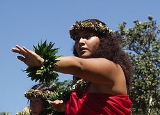
Hula dancing is a complex art form, and there are many hand motions used to represent the words in a song or chant. For example, hand movements can signify aspects of nature, such as the swaying of a tree in the breeze or a wave in the ocean, or a feeling or emotion, such as fondness or yearning. Foot and hip movements often pull from a basic library of steps including the kaholo, ka'o, kawelu, hela, 'uwehe, and 'ami.
There are other related dances (tamure
Tamure
The tāmūrē, or Tamouré as popularized in many 1960s recordings, is a dance from Tahiti and the Cook Islands and although denied by the local purists, for the rest of the world it is the most popular dance and the mark of Tahiti...
, hura, 'aparima
'aparima
The aparima or Kaparima is a dance from Tahiti and the Cook Islands where the mimicks with the hands are central, and as such it is close to the hula or Tongan tauolunga...
, 'ote'a
'ote'a
The ōtea is a traditional dance from Tahiti characterized by a rapid hip-shaking motion to percussion accompaniment. The dancers, standing in several rows, may be further choreographed to execute different figures while maintaining the hip-shaking...
, haka
Haka
Haka is a traditional ancestral war cry, dance or challenge from the Māori people of New Zealand. It is a posture dance performed by a group, with vigorous movements and stamping of the feet with rhythmically shouted accompaniment...
, kapa haka
Kapa haka
The term Kapa haka is commonly known in Aotearoa as 'Maori Performing Arts' or the 'cultural dance' of Maori people...
, poi
Poi
Poi may refer to:* Poi , a 2006 Tamil film* Poi , the Polynesian staple food* Poi , a Māori dance from New Zealand* Poi, Pakistan, a town in the Balochistan province of Pakistan* Poi, the Tibetan name for Tibet...
, Fa'ataupati
Fa'ataupati
The Fa'ataupati is a dance indigenous to the Samoans. In English it is simply the "Samoan Slap Dance". It was developed in Samoa in the 19th century and is only performed by males.- History :...
, Tau'olunga
Tau'olunga
The tauolunga is a traditional Tongan dance. The type of dance is comparable with Hawaiian hula, or the Tahitian aparima.-Performance:...
, and Lakalaka
Lakalaka
The lakalaka is a Tongan group dance where the performers are largely standing still and make gestures with their arms only. It is considered as the national dance of Tonga and part of the intangible human heritage...
) that come from other Polynesian islands such as Tahiti
Tahiti
Tahiti is the largest island in the Windward group of French Polynesia, located in the archipelago of the Society Islands in the southern Pacific Ocean. It is the economic, cultural and political centre of French Polynesia. The island was formed from volcanic activity and is high and mountainous...
, The Cook Islands, Samoa
Samoa
Samoa , officially the Independent State of Samoa, formerly known as Western Samoa is a country encompassing the western part of the Samoan Islands in the South Pacific Ocean. It became independent from New Zealand in 1962. The two main islands of Samoa are Upolu and one of the biggest islands in...
, Tonga
Tonga
Tonga, officially the Kingdom of Tonga , is a state and an archipelago in the South Pacific Ocean, comprising 176 islands scattered over of ocean in the South Pacific...
and Aotearoa
Aotearoa
Aotearoa is the most widely known and accepted Māori name for New Zealand. It is used by both Māori and non-Māori, and is becoming increasingly widespread in the bilingual names of national organisations, such as the National Library of New Zealand / Te Puna Mātauranga o Aotearoa.-Translation:The...
(New Zealand
New Zealand
New Zealand is an island country in the south-western Pacific Ocean comprising two main landmasses and numerous smaller islands. The country is situated some east of Australia across the Tasman Sea, and roughly south of the Pacific island nations of New Caledonia, Fiji, and Tonga...
); however, the hula is unique to the Hawaiian Islands.
Hula Kahiko

Many hula dances are considered to be a religious performance, as they are dedicated to or honoring a Hawaiian goddess or god. As was true of ceremonies at the heiau
Heiau
A heiau is a Hawaiian temple. Many types of heiau existed, including heiau to treat the sick , offer first fruits, offer first catch, start rain, stop rain, increase the population, ensure health of the nation, achieve success in distant voyaging, reach peace, and achieve success in war . Only the...
, the platform temple, even a minor error was considered to invalidate the performance. It might even be a presage of bad luck
Luck
Luck or fortuity is good fortune which occurs beyond one's control, without regard to one's will, intention, or desired result. There are at least two senses people usually mean when they use the term, the prescriptive sense and the descriptive sense...
or have dire consequences. Dancers who were learning to do such hula necessarily made many mistakes. Hence they were ritually secluded and put under the protection of the goddess Laka
Laka
In Hawaiian mythology, Laka is the name of a popular hero from Polynesian mythology....
during the learning period. Ceremonies marked the successful learning of the hula and the emergence from seclusion.
Hula kahiko is performed today by dancing to the historical chants. Many hula kahiko are characterized by traditional costuming, by an austere look, and a reverence for their spiritual roots.
Chants
Hawaiian historyHistory of Hawaii
The human history of Hawaii includes phases of early Polynesian settlement, British arrival, unification, Euro-American and Asian immigrators, the overthrow of the Hawaiian monarchy, a brief period as the Republic of Hawaii, and admission to the United States as Hawaii Territory and then as the...
was oral history
Oral history
Oral history is the collection and study of historical information about individuals, families, important events, or everyday life using audiotapes, videotapes, or transcriptions of planned interviews...
. It was codified in genealogies and chants, which were memorized and passed down. In the absence of a written language
Written language
A written language is the representation of a language by means of a writing system. Written language is an invention in that it must be taught to children, who will instinctively learn or create spoken or gestural languages....
, this was the only available method of ensuring accuracy. Chants told the stories of creation, mythology, royalty, and other significant events and people.
Instruments and implements
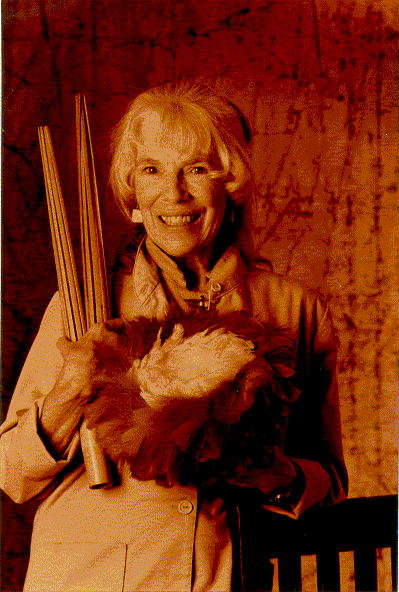
- IpuIpuIpu is a percussion instrument made from gourds that is often used to provide a beat for hula dancing.There are two types of ipu, the ipu heke and the ipu heke ole . Both are made from gourds that have been cut off at the neck and hollowed. The ipu heke is two such gourds joined together with a...
—single gourdGourdA gourd is a plant of the family Cucurbitaceae. Gourd is occasionally used to describe crops like cucumbers, squash, luffas, and melons. The term 'gourd' however, can more specifically, refer to the plants of the two Cucurbitaceae genera Lagenaria and Cucurbita or also to their hollow dried out shell...
drum - Ipu heke—double gourd drum
- Pahu—sharkskin covered drum; considered sacred
- Pūniu—small knee drum made of a coconut shell with fish skin (kala) coverIliili—water-worn lava stone used as castanetsUlīulī—feathered gourd rattles (also ulili)
- Pūili—split bamboo sticks
- Kālaau—rhythm sticks
The dog's-tooth anklets sometimes worn by male dancers could also be considered instruments, as they underlined the sounds of stamping feet.
Costumes
Traditional female dancers wore the everyday pāū, or wrapped skirt, but were topless. Today this form of dress has been altered. As a sign of lavish display, the pāū might be much longer than the usual length of tapaTapa cloth
Tapa cloth is a bark cloth made in the islands of the Pacific Ocean, primarily in Tonga, Samoa and Fiji, but as far afield as Niue, Cook Islands, Futuna, Solomon Islands, Java, New Zealand, Vanuatu, Papua New Guinea and Hawaii...
, or barkcloth, which was just long enough to go around the waist. Visitors report seeing dancers swathed in many yards of tapa, enough to increase their circumference substantially. Dancers might also wear decorations such as necklaces, bracelets, and anklets, as well as many lei
Lei (Hawaii)
Lei is a Hawaiian word for a garland or wreath. More loosely defined, a lei is any series of objects strung together with the intent to be worn. The most popular concept of a lei in Hawaiian culture is a wreath of flowers draped around the neck presented upon arriving or leaving as a symbol of...
(in the form of headpieces (leipo'o), necklaces, bracelets, and anklets (kupe'e)).
Traditional male dancers wore the everyday malo, or loincloth. Again, they might wear bulky malo made of many yards of tapa. They also wore necklaces, bracelets, anklets, and lei.
The materials for the lei worn in performance were gathered in the forest, after prayers to Laka and the forest gods had been chanted.
The lei and tapa worn for sacred hula were considered imbued with the sacredness of the dance, and were not to be worn after the performance. Lei were typically left on the small altar to Laka found in every hālau, as offerings.
Performances
Hula performed for spontaneous daily amusement or family feasts were attended with no particular ceremony. However, hula performed as entertainment for chiefs were anxious affairs. High chiefs typically traveled from one place to another within their domains. Each locality had to house, feed, and amuse the chief and his or her entourage. Hula performances were a form of fealty, and often of flattery to the chief. During the performances the males would start off and the females would come later to close the show off. There were hula celebrating his lineage, his name, and even his genitals (hula mai). Sacred hula, celebrating Hawaiian gods, were also danced. All these performances must be completed without error (which would be both unlucky and disrespectful).Visiting chiefs from other domains would also be honored with hula performances. This courtesy was often extended to important Western visitors.
Hula auana

Songs
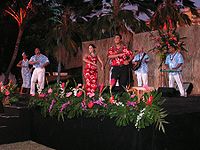
The mele of hula auana are generally sung as if they were popular musicPopular music
Popular music belongs to any of a number of musical genres "having wide appeal" and is typically distributed to large audiences through the music industry. It stands in contrast to both art music and traditional music, which are typically disseminated academically or orally to smaller, local...
. A lead voice sings in a major scale, with occasional harmony parts.
The subject of the songs is as broad as the range of human experience. People write mele hula auana to comment on significant people, places or events or simply to express an emotion or idea.
Instruments
The musicians performing hula auana will typically use portable acoustic stringed instrumentsString instrument
A string instrument is a musical instrument that produces sound by means of vibrating strings. In the Hornbostel-Sachs scheme of musical instrument classification, used in organology, they are called chordophones...
.
- UkuleleUkuleleThe ukulele, ; from ; it is a subset of the guitar family of instruments, generally with four nylon or gut strings or four courses of strings....
—four-, six- or eight-stringed, used to maintain the rhythm if there are no other instruments - Guitar—used as part of the rhythm sectionRhythm sectionA rhythm section is a collection of musicians who make up a section of instruments which provides the accompaniment section of the music, giving the music its rhythmic texture and pulse, also serving as a rhythmic reference for the rest of the band...
, or as a lead instrumentLead instrumentLead instrument is the name given to someone who is the most advanced player of their instrument in their ensemble. This is also referred to as the first chair, principal, first position, or first .... - Steel guitar—accents the vocalist
- Bass—maintains the rhythm
Occasional hula auana call for the dancers to use implements, in which case they will use the same instruments as for hula kahiko. You will often see a hula 'auana with the dancers using Ulīulī (feathered gourd rattle).
Costumes
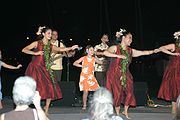
Formal wear
Formal wear and formal dress are the general terms for clothing suitable for formal social events, such as a wedding, formal garden party or dinner, débutante cotillion, dance, or race...
such as a muumuu for women and a sash for men. A fast, lively, "rascal" song will be performed by dancers in more revealing or festive attire. The hula kahiko is always performed with bare feet
Barefoot
Barefoot is the state of not wearing any footwear. Being barefoot is regarded as a human's natural state, though for functional, fashion and social reasons footwear is worn, at least on some occasions...
, but the hula auana can be performed with bare feet or shoes.
Legendary origins
There are various legends surrounding the origins of hula.According to one Hawaiian legend, Laka
Laka
In Hawaiian mythology, Laka is the name of a popular hero from Polynesian mythology....
, goddess of the hula, gave birth to the dance on the island of Molokai
Molokai
Molokai or Molokai is an island in the Hawaiian archipelago. It is 38 by 10 miles in size with a land area of , making it the fifth largest of the main Hawaiian Islands and the 27th largest island in the United States. It lies east of Oahu across the 25-mile wide Kaiwi Channel and north of...
, at a sacred place in Kaana. After Laka died, her remains were hidden beneath the hill Puu Nana.
Another story tells of Hiiaka, who danced to appease her fiery sister, the volcano goddess Pele. This story locates the source of the hula on Hawaii, in the Puna district at the Hāena shoreline. The ancient hula Ke Haa Ala Puna describes this event.
Another story is when Pele, the goddess of fire was trying to find a home for herself running away from her sister Namakaokaha'i (the goddess of the oceans) when she finally found an island where she couldn't be touched by the waves. There at chain of craters on the island of Hawai'i she danced the first dance of hula signifying that she finally won.
One story is that Pele asked Laka to amuse her because Pele was bored. So right away Laka got up and began to move gracefully, acting out silently events they both knew. Pele enjoyed this and was fascinated thus Hula was born.
During the 19th century

Protestantism
Protestantism is one of the three major groupings within Christianity. It is a movement that began in Germany in the early 16th century as a reaction against medieval Roman Catholic doctrines and practices, especially in regards to salvation, justification, and ecclesiology.The doctrines of the...
missionaries, who arrived in 1820, denounced the hula as a heathen dance. The newly Christianized alii (royalty and nobility) were urged to ban the hula—which they did. However, many of them continued to privately patronize the hula. By the 1850s, public hula was regulated by a system of licensing.
The Hawaiian performing arts
Performing arts
The performing arts are those forms art which differ from the plastic arts insofar as the former uses the artist's own body, face, and presence as a medium, and the latter uses materials such as clay, metal or paint which can be molded or transformed to create some physical art object...
had a resurgence during the reign of King David Kalākaua
Kalakaua
Kalākaua, born David Laamea Kamanakapuu Mahinulani Nalaiaehuokalani Lumialani Kalākaua and sometimes called The Merrie Monarch , was the last reigning king of the Kingdom of Hawaii...
(1874–1891), who encouraged the traditional arts. With the Princess Liliokolani who devoted herself to the old ways, as the patron of the ancients chants (mele, hula), she stressed the importance to revive the diminishing culture of their ancestors within the damaging influence of foreigners and modernism
Modernism
Modernism, in its broadest definition, is modern thought, character, or practice. More specifically, the term describes the modernist movement, its set of cultural tendencies and array of associated cultural movements, originally arising from wide-scale and far-reaching changes to Western society...
that was forever changing Hawaii.
Practitioners merged Hawaiian poetry
Poetry
Poetry is a form of literary art in which language is used for its aesthetic and evocative qualities in addition to, or in lieu of, its apparent meaning...
, chanted vocal performance
Singing
Singing is the act of producing musical sounds with the voice, and augments regular speech by the use of both tonality and rhythm. One who sings is called a singer or vocalist. Singers perform music known as songs that can be sung either with or without accompaniment by musical instruments...
, dance movements
Dance
Dance is an art form that generally refers to movement of the body, usually rhythmic and to music, used as a form of expression, social interaction or presented in a spiritual or performance setting....
and costume
Costume
The term costume can refer to wardrobe and dress in general, or to the distinctive style of dress of a particular people, class, or period. Costume may also refer to the artistic arrangement of accessories in a picture, statue, poem, or play, appropriate to the time, place, or other circumstances...
s to create the new form, the hula kui (kui means "to combine old and new"). The pahu appears not to have been used in hula kui, evidently because its sacredness was respected by practitioners; the ipu gourd (Lagenaria sicenaria) was the indigenous instrument most closely associated with hula kui.
Ritual
Ritual
A ritual is a set of actions, performed mainly for their symbolic value. It may be prescribed by a religion or by the traditions of a community. The term usually excludes actions which are arbitrarily chosen by the performers....
and prayer
Prayer
Prayer is a form of religious practice that seeks to activate a volitional rapport to a deity through deliberate practice. Prayer may be either individual or communal and take place in public or in private. It may involve the use of words or song. When language is used, prayer may take the form of...
surrounded all aspects of hula training and practice, even as late as the early 20th century. Teachers and students were dedicated to the goddess of the hula, Laka.
20th century hula dancing

Tourism
Tourism is travel for recreational, leisure or business purposes. The World Tourism Organization defines tourists as people "traveling to and staying in places outside their usual environment for not more than one consecutive year for leisure, business and other purposes".Tourism has become a...
spectacles, such as the Kodak Hula Show, and in Hollywood films. However, a more traditional hula was maintained in small circles by older practitioners. There has been a renewed interest in hula, both traditional and modern, since the 1970s and the Hawaiian Renaissance
Hawaiian Renaissance
The First and Second Hawaiian Renaissance was the Hawaiian resurgence of a distinct cultural identity that draws upon traditional kānaka maoli culture, with a significant divergence from the tourism-based "culture" which Hawaii was previously known for worldwide .-First Hawaiian...
.
Contemporary hula festivals
- Moku O Keawe International Festival is a 4-day celebration of hula and the arts of hula held annually in November at Waikoloa Beach Resort, Island of Hawaii. http://www.Mokuokeawe.org The Festival includes authentic workshops taught by noted kumu, with focus on hula and Hawaiian musical instruments.
- Ka Hula Piko, held every May on Molokai.
- Merrie Monarch FestivalMerrie Monarch FestivalThe Merrie Monarch Festival is a week-long cultural festival that takes place annually in Hilo, Hawaii. It honors King David Kalākaua, who was called the "Merrie Monarch" for his patronage of the arts. He is credited with restoring many Hawaiian cultural traditions during his reign, including the...
is a week-long cultural festivalFestivalA festival or gala is an event, usually and ordinarily staged by a local community, which centers on and celebrates some unique aspect of that community and the Festival....
and hula competition in Hilo on the Big Island of HawaiiHawaii (island)The Island of Hawaii, also called the Big Island or Hawaii Island , is a volcanic island in the North Pacific Ocean...
. Where the noted Miss Aloha Hula competition occurs. - Hula Workshop, Hoike and Hawaiian Festival, held every July in Vancouver, WA.
- E Hula Mau, held every Labor Day Weekend (September) in Long Beach, CALong Beach, CaliforniaLong Beach is a city situated in Los Angeles County in Southern California, on the Pacific coast of the United States. The city is the 36th-largest city in the nation and the seventh-largest in California. As of 2010, its population was 462,257...
. - World Invitational Hula FestivalWorld Invitational Hula FestivalThe World Invitational Hula Festival or WIHF is a 3 day event that perpetuates Hawaiian culture as a celebration of the artistic rendering of the Hawaiian hula dance...
, a 3 day art and culture contest held every November on OahuOahuOahu or Oahu , known as "The Gathering Place", is the third largest of the Hawaiian Islands and most populous of the islands in the U.S. state of Hawaii. The state capital Honolulu is located on the southeast coast...
, HawaiiHawaiiHawaii is the newest of the 50 U.S. states , and is the only U.S. state made up entirely of islands. It is the northernmost island group in Polynesia, occupying most of an archipelago in the central Pacific Ocean, southwest of the continental United States, southeast of Japan, and northeast of...
in the Waikiki ShellWaikiki ShellThe Waikiki Shell is a venue for outdoor concerts and other large gatherings in Waikiki area of Honolulu, Hawaii. The Waikiki Shell seats 2,400 persons and the lawn area has capacity for an additional 6,000 persons. It is under the management of the Neal S. Blaisdell Center...
. - "Share da Aloha", held in February at Saddleback ChurchSaddleback ChurchSaddleback Church is an evangelical Christian megachurch located in Lake Forest, California, situated in southern Orange County, affiliated with the Southern Baptist Convention. The church was founded in 1980 by pastor Rick Warren...
in Lake ForestLake ForestLake Forest is the name of some places in the United States:*Lake Forest, California, in Orange County*Lake Forest, Placer County, California*Lake Forest - A lake in the North End section of Bridgeport, Connecticut*Lake Forest, Florida...
, CA. http://www.ohanapraise.com/ - The Iā 'Oe E Ka Lā Hula Competition and Festival is held annually at the Alameda County FairgroundsAlameda County FairgroundsThe Alameda County Fairgrounds is a facility located in Pleasanton, California. It is home to the annual Alameda County Fair as well as numerous trade shows and community events. Its racetrack was built in 1858, making it the oldest one-mile horse racing track in America...
in Pleasanton, CaliforniaPleasanton, CaliforniaPleasanton is a city in Alameda County, California, incorporated in 1894. It is a suburb in the San Francisco Bay Area located about east of Oakland, and west of Livermore. The population was 70,285 at the 2010 census. In 2005 and 2007, Pleasanton was ranked the wealthiest middle-sized city in...
. Friday thru Sunday, traditionally the first weekend in November. http://www.kumuhulaassociation.com - The May DayMay DayMay Day on May 1 is an ancient northern hemisphere spring festival and usually a public holiday; it is also a traditional spring holiday in many cultures....
Festival is held annually at the Alameda County Fairgrounds in Pleasanton, California. Traditionally the second Saturday in May, as of 2006 held both Saturday and Sunday remaining the second weekend in May. http://www.kumuhulaassociation.com - "Tahiti Fete" held during the summer in July, San Jose, CA http://www.tahitifete.com/
Films
- Kumu Hula: Keepers of a Culture (1999) Directed by Robert MuggeRobert MuggeRobert Mugge is an American documentary film maker. He specializes in films about music and musicians.Mugge was born in Chicago and grew up primarily in the Washington, D.C. area. He received a B.A...
. - Holo Mai Pele - Hālau ō Kekuhi (2000) Directed by Catherine Tatge
- Lilo & StitchLilo & StitchThis article is about the movie. For the television series, see Lilo & Stitch: The Series.Lilo & Stitch is a 2002 American animated feature produced by Walt Disney Feature Animation and released on June 21, 2002...
(2002) By Walt Disney PicturesWalt Disney PicturesWalt Disney Pictures is an American film studio owned by The Walt Disney Company. Walt Disney Pictures and Television, a subsidiary of the Walt Disney Studios and the main production company for live-action feature films within the Walt Disney Motion Pictures Group, based at the Walt Disney...
and Lilo & Stitch 2 by Walt Disney Pictures - American Aloha : Hula Beyond Hawaii (2003) By Lisette Marie Flannery & Evann Siebens
- Hula GirlsHula Girlsis an award-winning Japanese film, directed by Sang-il Lee and co-written by Lee and Daisuke Habara, and first released across Japanese theaters on September 23, 2006...
(2006)
Books
- Nathaniel EmersonNathaniel Bright EmersonNathaniel Bright Emerson was a medical physician and author of Hawaiian mythology.He attended Williams College in Williamstown, Massachusetts and served in the First Regiment of the Massachusetts Volunteer Infantry during the Civil War, during which he was wounded three times...
, 'The Myth of Pele and Hi'iaka'. This book includes the original Hawaiian of the Pele and Hi'iaka myth and as such provides an invaluable resource for language students and others.
- Nathaniel EmersonNathaniel Bright EmersonNathaniel Bright Emerson was a medical physician and author of Hawaiian mythology.He attended Williams College in Williamstown, Massachusetts and served in the First Regiment of the Massachusetts Volunteer Infantry during the Civil War, during which he was wounded three times...
, 'The Unwritten Literature of Hawaii'. Many of the original Hawaiian hula chants, together with Mr. Emerson's descriptions of how they were danced in the nineteenth century.
- Amy Stillman, "Hula `Ala`apapa". An analysis of the `Ala`apapa style of sacred hula.
- Ishmael W. Stagner: Kumu hula : roots and branches. Honolulu : Island Heritage Pub., 2011. ISBN 9781597006217
External links
- Everything Related To Hula Dancing, Hula History & Hula Theory
- Hawaiian Music and Hula Archives
- Hula Preservation Society
- European Hula Festival
- Ka`ahele Hawai`i
- "Where Tradition Holds Sway" Article about "Ka Hula Piko" on Molokai, by Jill Engledow. Maui No Ka 'Oi MagazineMaui No Ka 'Oi MagazineMaui Nō Ka Oi Magazine is a bi-monthly regional magazine published by the Haynes Publishing Group in Wailuku, Hawaii.The phrase Maui nō ka ʻoi means "Maui is unparallel" in the Hawaiian language. Maui Nō Ka Oi Magazine features stories relating to the culture, art, dining, environmental issues,...
Vol. 11 No.2 (March 2007).