

Congress of Racial Equality

Encyclopedia
The Congress of Racial Equality or CORE was a U.S.
civil rights
organization that originally played a pivotal role for African-Americans in the Civil Rights Movement. Membership in CORE is still stated to be open to "anyone who believes that 'all people are created equal' and is willing to work towards the ultimate goal of true equality throughout the world.” Today, CORE advocates for controversial, conservative causes.
, George Houser
, James R. Robinson, and Bernice Fisher
. Bayard Rustin
, while not a father of the organization, was, Farmer and Houser later said, "an uncle to CORE" and supported it greatly. The group had evolved out of the pacifist
Fellowship of Reconciliation
, and sought to apply the principles of nonviolence
as a tactic against segregation
. The group's inspiration was Krishnalal Shridharani's book War Without Violence (1939, Harcourt Brace), which outlined Gandhi's step-by-step procedures for organizing people and mounting a nonviolent campaign. Shridharani, a popular writer and journalist as well as a vibrant and theatrical speaker, had been a protege of Gandhi and had been jailed in the Salt March
. Gandhi had, in turn, been influenced by the writings of Henry David Thoreau
. At the time of CORE's founding Gandhi was still engaged in non-violent resistance against British
rule in India
; CORE believed that nonviolent civil disobedience
could also be used by African-Americans to challenge racial segregation in the United States
.
In accordance with CORE's constitution and bylaws, in the early and mid-1960s, chapters were organized on a model similar to that of a democratic trade union
, with monthly membership meetings, elected and usually unpaid officers, and numerous committees of volunteers. In the South, CORE's nonviolent direct action
campaigns opposed "Jim Crow
" segregation and job discrimination, and fought for voting rights. Outside the South, CORE focused on discrimination in employment and housing, and also in de facto
school segregation.
Some CORE main leadership had strong disagreements with the Deacons for Defense and Justice
over the Deacons' public threat to racist Southerners that they would use armed self-defense to protect CORE workers from racist
organizations, such as the Ku Klux Klan
, in Louisiana
during the 1960s. By the mid-1960s, Farmer was growing disenchanted with the emerging black nationalist
sentiments within CORE — sentiments that, among other things, would quickly lead to the Black Panther Party
— and he resigned in 1966, to be replaced by Floyd McKissick
.
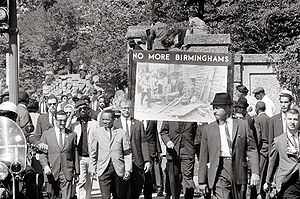 By 1961 CORE had 53 chapters throughout the United States. By 1963, most of the major urban centers of the Northeast, Midwest, and West Coast had one or more CORE chapters, including a growing number of chapters on college campuses. In the South, CORE had active chapters and projects in Louisiana
, Mississippi
, Florida
, South Carolina
, and Kentucky
.
, their publicity officer) and eight black men on what was to be a two-week Journey of Reconciliation
through Virginia
, North Carolina
, Tennessee
, and Kentucky
in an effort to end segregation in interstate travel. The members of this group were arrested and jailed several times, but they received a great deal of publicity, and this marked the beginning of a long series of similar campaigns.
By the early 1960s, Farmer, who had taken a hiatus from leading the group, returned as its executive secretary and sought to repeat the 1947 journey, coining a new name for it: the Freedom Ride
.
On May 4, 1961, participants journeyed to the deep South
, this time including women as well as men and testing segregated bus terminals as well. The riders were met with severe violence
. In Anniston, Alabama
, one of the buses was fire-bombed and passengers were beaten by a white mob. White mobs also attacked Freedom Riders in Birmingham
and Montgomery
. The violence garnered national attention, sparking a summer of similar rides by CORE, SNCC
and other Civil Rights
organizations and thousands of ordinary citizens.
chapter of CORE began to challenge racial segregation in the Chicago Public Schools
(CPS). By the late 1950s, the Board of Education's maintenance of the neighborhood school policy resulted in a pattern of racial segregation in the CPS. Predominantly black schools were situated in predominantly black neighborhoods on the south and west sides of the city, while predominantly white schools were located in predominantly white areas in the north, northwest and southwest sides of Chicago.
Many segregated schools were overcrowded, and in order to ease overcrowding, the Board instated double-shifts at some schools. Double-shifts meant that students in affected schools attended less than a full day of class. In another measure to alleviate overcrowding at some schools, the Board sanctioned the construction of mobile classroom units. Moreover, a significant proportion of students dropped out before finishing high school. Faculty was segregated, and many teachers in predominantly black schools lacked full-time teaching experience compared to teachers in white schools. In addition, the history curriculum did not mention African Americans. According to CORE, “school segregation [was] a damaging bacteria, a psychological handicap, which [festered] a disease generating widespread unemployment and crime in Chicago.”
Between 1960 and 1963, CORE wrote letters about the conditions of schools to the Board of Education (headed by Superintendent Benjamin Willis), Mayor Richard J. Daley
, the Illinois State House of Representatives and the U.S. Department of Health, Education and Welfare. In addition, CORE attended the Board's school budget hearings, speaking against segregation and asking for the Board to implement transfer plans to desegregate the schools. In July 1963, CORE staged a week-long sit-in and protest at the Board office in downtown Chicago in response to the Board's inaction. Finally, Board President Claire Roddewig and Willis agreed to meet with CORE to negotiate integration, but no significant changes came to the schools.
During the mid-1960s, CORE turned towards community involvement, seeking to equip Chicagoans with ways to challenge segregation. Freedom Houses, transfer petitions, community rallies and meetings served to educate Chicagoans about segregation and provide them with tools to circumnavigate the neighborhood school policy.
By 1966, the Chicago Freedom Movement
, led by Dr. Martin Luther King, Jr., the Southern Christian Leadership Conference
(SCLC) and Chicago's Coordinating Council of Community Organizations (CCCO), had assumed control over civil rights demonstrations and negotiations. While CORE was a member organization of the CCCO, it increasingly lost influence over desegregation efforts. And when the Chicago Freedom Movement met with representatives of the City to negotiate in the summer of 1966, they agreed on ten fair housing reforms but did not discuss reforms to desegregate the schools. While CORE played no role in the housing summit, it had shifted towards promoting and developing Black power in Chicago. By fall of 1966, CORE was no longer a civil rights organization, but a Black power organization. Changes in CORE's national leadership and continued inaction on behalf of the Board to desegregate the schools pushed CORE towards separatism and away from desegregation efforts. The chapter collapsed in October 1968.
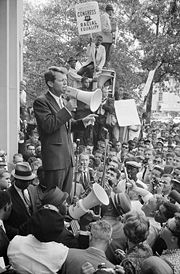 In 1963, the organization helped organize the famous March on Washington. On 28 August 1963, more than 250,000 people marched peacefully to the Lincoln Memorial
to demand equal justice for all citizens under the law. At the end of the march Martin Luther King Jr. made his famous "I Have a Dream
" speech.
. Over 80,000 people joined the party and 68 delegates attended the Democratic Party Convention in Atlantic City and challenged the attendance of the all-white Mississippi representation.
CORE, SNCC and NAACP also established 30 Freedom Schools in towns throughout Mississippi. Volunteers taught in the schools and the curriculum now included black history, the philosophy of the civil rights movement. During the summer of 1964 over 3,000 students attended these schools and the experiment provided a model for future educational programs such as Head Start.
Freedom Schools
were often targets of white mobs. So also were the homes of local African Americans involved in the campaign. That summer 30 black homes and 37 black churches were firebombed. Over 80 volunteers were beaten by white mobs or racist police officers. Three CORE activists, James Chaney
, Andrew Goodman
and Michael Schwerner
, were murdered by the Ku Klux Klan
on 21 June 1964 (see Mississippi civil rights workers murders). These deaths created nation-wide publicity for the campaign.
, who initially led the organization to strongly support Black Nationalism
. Subsequent political developments within the organization led it turn more towards the right. CORE supported the presidential candidacy of Richard Nixon
in 1968 and 1972. In 1970, CORE voiced its support for racially-separate, segregated schools. An article in Mother Jones
magazine said of the modern organization that it "is better known among real civil rights groups for renting out its historic name to any corporation in need of a black front person. The group has taken money from the payday-lending
industry, chemical giant (and original DDT manufacturer) Monsanto
, and ExxonMobil
." In his book, Not A Conspiracy Theory: How Business Propaganda Hijacks Democracy, Donald Gutstein wrote that "In recent years CORE used its African-American facade to work with conservative groups to attack organizations like Greenpeace
and undermine environmental regulation. It’s fair to say that CORE was for sale to anyone with a need for visible black cheerleaders in its campaign."
Recently, on same sex marriage and black health in the U.S.: "When you say to society at large that you have to accept, not only accept our lifestyle, but promote it and put it on the same plane and equate it with traditional marriage, that's where we draw the line and we say 'no.' That's not something that is a civil right. That is not something that is a human right," said Niger Innis
, national spokesman for CORE, and son of Roy Innis.
n branch based in Uganda, with Fiona Kobusingye as is its director. Bringing attention to the malaria
crisis is one of the organization's main activities, and it has championed the use of DDT
to fight the disease, and it has partnered with a variety of conservative and libertarian think tanks in this effort. In 2007, CORE organized a 300-mile walk across Uganda to promote DDT-based interventions against malaria.
United States
The United States of America is a federal constitutional republic comprising fifty states and a federal district...
civil rights
Civil rights
Civil and political rights are a class of rights that protect individuals' freedom from unwarranted infringement by governments and private organizations, and ensure one's ability to participate in the civil and political life of the state without discrimination or repression.Civil rights include...
organization that originally played a pivotal role for African-Americans in the Civil Rights Movement. Membership in CORE is still stated to be open to "anyone who believes that 'all people are created equal' and is willing to work towards the ultimate goal of true equality throughout the world.” Today, CORE advocates for controversial, conservative causes.
Founding
CORE was founded in Chicago in 1941 by James L. Farmer, Jr.James L. Farmer, Jr.
James Leonard Farmer, Jr. was a civil rights activist and leader in the American Civil Rights Movement. He was the initiator and organizer of the 1961 Freedom Ride, which eventually led to the desegregation of inter-state transportation in the United States.In 1942, Farmer co-founded the Committee...
, George Houser
George Houser
George M. Houser is a Methodist minister, civil rights activist, and activist for the independence of African nations. He served on the staff of the Fellowship of Reconciliation . With James Farmer, and Bernice Fisher, he co-founded the Congress of Racial Equality in 1942 in Chicago...
, James R. Robinson, and Bernice Fisher
Bernice Fisher
Bernice Fisher was a civil rights activist and union organizer. She was one of the original founders of the Congress of Racial Equality...
. Bayard Rustin
Bayard Rustin
Bayard Rustin was an American leader in social movements for civil rights, socialism, pacifism and non-violence, and gay rights.In the pacifist Fellowship of Reconciliation , Rustin practiced nonviolence...
, while not a father of the organization, was, Farmer and Houser later said, "an uncle to CORE" and supported it greatly. The group had evolved out of the pacifist
Pacifism
Pacifism is the opposition to war and violence. The term "pacifism" was coined by the French peace campaignerÉmile Arnaud and adopted by other peace activists at the tenth Universal Peace Congress inGlasgow in 1901.- Definition :...
Fellowship of Reconciliation
Fellowship of Reconciliation
The Fellowship of Reconciliation is the name used by a number of religious nonviolent organizations, particularly in English-speaking countries...
, and sought to apply the principles of nonviolence
Nonviolence
Nonviolence has two meanings. It can refer, first, to a general philosophy of abstention from violence because of moral or religious principle It can refer to the behaviour of people using nonviolent action Nonviolence has two (closely related) meanings. (1) It can refer, first, to a general...
as a tactic against segregation
Racial segregation
Racial segregation is the separation of humans into racial groups in daily life. It may apply to activities such as eating in a restaurant, drinking from a water fountain, using a public toilet, attending school, going to the movies, or in the rental or purchase of a home...
. The group's inspiration was Krishnalal Shridharani's book War Without Violence (1939, Harcourt Brace), which outlined Gandhi's step-by-step procedures for organizing people and mounting a nonviolent campaign. Shridharani, a popular writer and journalist as well as a vibrant and theatrical speaker, had been a protege of Gandhi and had been jailed in the Salt March
Salt Satyagraha
The Salt March, also known as the Salt Satyagrahah began with the Dandi March on March 12, 1930, and was an important part of the Indian independence movement. It was a campaign of tax resistance and nonviolent protest against the British salt monopoly in colonial India, and triggered the wider...
. Gandhi had, in turn, been influenced by the writings of Henry David Thoreau
Henry David Thoreau
Henry David Thoreau was an American author, poet, philosopher, abolitionist, naturalist, tax resister, development critic, surveyor, historian, and leading transcendentalist...
. At the time of CORE's founding Gandhi was still engaged in non-violent resistance against British
British Empire
The British Empire comprised the dominions, colonies, protectorates, mandates and other territories ruled or administered by the United Kingdom. It originated with the overseas colonies and trading posts established by England in the late 16th and early 17th centuries. At its height, it was the...
rule in India
India
India , officially the Republic of India , is a country in South Asia. It is the seventh-largest country by geographical area, the second-most populous country with over 1.2 billion people, and the most populous democracy in the world...
; CORE believed that nonviolent civil disobedience
Civil disobedience
Civil disobedience is the active, professed refusal to obey certain laws, demands, and commands of a government, or of an occupying international power. Civil disobedience is commonly, though not always, defined as being nonviolent resistance. It is one form of civil resistance...
could also be used by African-Americans to challenge racial segregation in the United States
Racial segregation in the United States
Racial segregation in the United States, as a general term, included the racial segregation or hypersegregation of facilities, services, and opportunities such as housing, medical care, education, employment, and transportation along racial lines...
.
In accordance with CORE's constitution and bylaws, in the early and mid-1960s, chapters were organized on a model similar to that of a democratic trade union
Trade union
A trade union, trades union or labor union is an organization of workers that have banded together to achieve common goals such as better working conditions. The trade union, through its leadership, bargains with the employer on behalf of union members and negotiates labour contracts with...
, with monthly membership meetings, elected and usually unpaid officers, and numerous committees of volunteers. In the South, CORE's nonviolent direct action
Direct action
Direct action is activity undertaken by individuals, groups, or governments to achieve political, economic, or social goals outside of normal social/political channels. This can include nonviolent and violent activities which target persons, groups, or property deemed offensive to the direct action...
campaigns opposed "Jim Crow
Jim Crow laws
The Jim Crow laws were state and local laws in the United States enacted between 1876 and 1965. They mandated de jure racial segregation in all public facilities, with a supposedly "separate but equal" status for black Americans...
" segregation and job discrimination, and fought for voting rights. Outside the South, CORE focused on discrimination in employment and housing, and also in de facto
De facto
De facto is a Latin expression that means "concerning fact." In law, it often means "in practice but not necessarily ordained by law" or "in practice or actuality, but not officially established." It is commonly used in contrast to de jure when referring to matters of law, governance, or...
school segregation.
Some CORE main leadership had strong disagreements with the Deacons for Defense and Justice
Deacons for Defense and Justice
The Deacons for Defense and Justice is an armed self defense African American civil rights organization in the U.S. Southern states during the 1960s. Historically, the organization practiced self-defense methods in the face of racist oppression that was carried out by Jim Crow Laws; local and state...
over the Deacons' public threat to racist Southerners that they would use armed self-defense to protect CORE workers from racist
Racism
Racism is the belief that inherent different traits in human racial groups justify discrimination. In the modern English language, the term "racism" is used predominantly as a pejorative epithet. It is applied especially to the practice or advocacy of racial discrimination of a pernicious nature...
organizations, such as the Ku Klux Klan
Ku Klux Klan
Ku Klux Klan, often abbreviated KKK and informally known as the Klan, is the name of three distinct past and present far-right organizations in the United States, which have advocated extremist reactionary currents such as white supremacy, white nationalism, and anti-immigration, historically...
, in Louisiana
Louisiana
Louisiana is a state located in the southern region of the United States of America. Its capital is Baton Rouge and largest city is New Orleans. Louisiana is the only state in the U.S. with political subdivisions termed parishes, which are local governments equivalent to counties...
during the 1960s. By the mid-1960s, Farmer was growing disenchanted with the emerging black nationalist
Black nationalism
Black nationalism advocates a racial definition of indigenous national identity, as opposed to multiculturalism. There are different indigenous nationalist philosophies but the principles of all African nationalist ideologies are unity, and self-determination or independence from European society...
sentiments within CORE — sentiments that, among other things, would quickly lead to the Black Panther Party
Black Panther Party
The Black Panther Party wasan African-American revolutionary leftist organization. It was active in the United States from 1966 until 1982....
— and he resigned in 1966, to be replaced by Floyd McKissick
Floyd McKissick
Floyd Bixler McKissick was born in Asheville, North Carolina on March 9, 1922. He became the first African American student at the University of North Carolina at Chapel Hill's Law School. In 1966 he became leader of CORE, the Congress of Racial Equality, taking over from James L. Farmer, Jr. A...
.
Civil rights campaigns
Louisiana
Louisiana is a state located in the southern region of the United States of America. Its capital is Baton Rouge and largest city is New Orleans. Louisiana is the only state in the U.S. with political subdivisions termed parishes, which are local governments equivalent to counties...
, Mississippi
Mississippi
Mississippi is a U.S. state located in the Southern United States. Jackson is the state capital and largest city. The name of the state derives from the Mississippi River, which flows along its western boundary, whose name comes from the Ojibwe word misi-ziibi...
, Florida
Florida
Florida is a state in the southeastern United States, located on the nation's Atlantic and Gulf coasts. It is bordered to the west by the Gulf of Mexico, to the north by Alabama and Georgia and to the east by the Atlantic Ocean. With a population of 18,801,310 as measured by the 2010 census, it...
, South Carolina
South Carolina
South Carolina is a state in the Deep South of the United States that borders Georgia to the south, North Carolina to the north, and the Atlantic Ocean to the east. Originally part of the Province of Carolina, the Province of South Carolina was one of the 13 colonies that declared independence...
, and Kentucky
Kentucky
The Commonwealth of Kentucky is a state located in the East Central United States of America. As classified by the United States Census Bureau, Kentucky is a Southern state, more specifically in the East South Central region. Kentucky is one of four U.S. states constituted as a commonwealth...
.
Freedom Rides
On April 10, 1947, CORE sent a group of eight white (including James PeckJames Peck (pacifist)
James Peck was an American activist who practiced nonviolent resistance during World War II and in the Civil Rights movement...
, their publicity officer) and eight black men on what was to be a two-week Journey of Reconciliation
Journey of Reconciliation
The Journey of Reconciliation was a form of non-violent direct action to challenge segregation laws on interstate buses in the Southern United States....
through Virginia
Virginia
The Commonwealth of Virginia , is a U.S. state on the Atlantic Coast of the Southern United States. Virginia is nicknamed the "Old Dominion" and sometimes the "Mother of Presidents" after the eight U.S. presidents born there...
, North Carolina
North Carolina
North Carolina is a state located in the southeastern United States. The state borders South Carolina and Georgia to the south, Tennessee to the west and Virginia to the north. North Carolina contains 100 counties. Its capital is Raleigh, and its largest city is Charlotte...
, Tennessee
Tennessee
Tennessee is a U.S. state located in the Southeastern United States. It has a population of 6,346,105, making it the nation's 17th-largest state by population, and covers , making it the 36th-largest by total land area...
, and Kentucky
Kentucky
The Commonwealth of Kentucky is a state located in the East Central United States of America. As classified by the United States Census Bureau, Kentucky is a Southern state, more specifically in the East South Central region. Kentucky is one of four U.S. states constituted as a commonwealth...
in an effort to end segregation in interstate travel. The members of this group were arrested and jailed several times, but they received a great deal of publicity, and this marked the beginning of a long series of similar campaigns.
By the early 1960s, Farmer, who had taken a hiatus from leading the group, returned as its executive secretary and sought to repeat the 1947 journey, coining a new name for it: the Freedom Ride
Freedom ride
Freedom Riders were civil rights activists who rode interstate buses into the segregated southern United States to test the United States Supreme Court decisions Boynton v. Virginia and Morgan v. Virginia...
.
On May 4, 1961, participants journeyed to the deep South
Southern United States
The Southern United States—commonly referred to as the American South, Dixie, or simply the South—constitutes a large distinctive area in the southeastern and south-central United States...
, this time including women as well as men and testing segregated bus terminals as well. The riders were met with severe violence
Violence
Violence is the use of physical force to apply a state to others contrary to their wishes. violence, while often a stand-alone issue, is often the culmination of other kinds of conflict, e.g...
. In Anniston, Alabama
Anniston, Alabama
Anniston is a city in Calhoun County in the state of Alabama, United States.As of the 2000 census, the population of the city is 24,276. According to the 2005 U.S. Census estimates, the city had a population of 23,741...
, one of the buses was fire-bombed and passengers were beaten by a white mob. White mobs also attacked Freedom Riders in Birmingham
Birmingham, Alabama
Birmingham is the largest city in Alabama. The city is the county seat of Jefferson County. According to the 2010 United States Census, Birmingham had a population of 212,237. The Birmingham-Hoover Metropolitan Area, in estimate by the U.S...
and Montgomery
Montgomery, Alabama
Montgomery is the capital of the U.S. state of Alabama, and is the county seat of Montgomery County. It is located on the Alabama River southeast of the center of the state, in the Gulf Coastal Plain. As of the 2010 census, Montgomery had a population of 205,764 making it the second-largest city...
. The violence garnered national attention, sparking a summer of similar rides by CORE, SNCC
Student Nonviolent Coordinating Committee
The Student Nonviolent Coordinating Committee ' was one of the principal organizations of the American Civil Rights Movement in the 1960s. It emerged from a series of student meetings led by Ella Baker held at Shaw University in Raleigh, North Carolina in April 1960...
and other Civil Rights
Civil rights
Civil and political rights are a class of rights that protect individuals' freedom from unwarranted infringement by governments and private organizations, and ensure one's ability to participate in the civil and political life of the state without discrimination or repression.Civil rights include...
organizations and thousands of ordinary citizens.
Desegregating Chicago's Schools
In 1960, the ChicagoChicago
Chicago is the largest city in the US state of Illinois. With nearly 2.7 million residents, it is the most populous city in the Midwestern United States and the third most populous in the US, after New York City and Los Angeles...
chapter of CORE began to challenge racial segregation in the Chicago Public Schools
Chicago Public Schools
Chicago Public Schools, commonly abbreviated as CPS by local residents and politicians and officially classified as City of Chicago School District #299 for funding and districting reasons, is a large school district that manages over 600 public elementary and high schools in Chicago, Illinois...
(CPS). By the late 1950s, the Board of Education's maintenance of the neighborhood school policy resulted in a pattern of racial segregation in the CPS. Predominantly black schools were situated in predominantly black neighborhoods on the south and west sides of the city, while predominantly white schools were located in predominantly white areas in the north, northwest and southwest sides of Chicago.
Many segregated schools were overcrowded, and in order to ease overcrowding, the Board instated double-shifts at some schools. Double-shifts meant that students in affected schools attended less than a full day of class. In another measure to alleviate overcrowding at some schools, the Board sanctioned the construction of mobile classroom units. Moreover, a significant proportion of students dropped out before finishing high school. Faculty was segregated, and many teachers in predominantly black schools lacked full-time teaching experience compared to teachers in white schools. In addition, the history curriculum did not mention African Americans. According to CORE, “school segregation [was] a damaging bacteria, a psychological handicap, which [festered] a disease generating widespread unemployment and crime in Chicago.”
Between 1960 and 1963, CORE wrote letters about the conditions of schools to the Board of Education (headed by Superintendent Benjamin Willis), Mayor Richard J. Daley
Richard J. Daley
Richard Joseph Daley served for 21 years as the mayor and undisputed Democratic boss of Chicago and is considered by historians to be the "last of the big city bosses." He played a major role in the history of the Democratic Party, especially with his support of John F...
, the Illinois State House of Representatives and the U.S. Department of Health, Education and Welfare. In addition, CORE attended the Board's school budget hearings, speaking against segregation and asking for the Board to implement transfer plans to desegregate the schools. In July 1963, CORE staged a week-long sit-in and protest at the Board office in downtown Chicago in response to the Board's inaction. Finally, Board President Claire Roddewig and Willis agreed to meet with CORE to negotiate integration, but no significant changes came to the schools.
During the mid-1960s, CORE turned towards community involvement, seeking to equip Chicagoans with ways to challenge segregation. Freedom Houses, transfer petitions, community rallies and meetings served to educate Chicagoans about segregation and provide them with tools to circumnavigate the neighborhood school policy.
By 1966, the Chicago Freedom Movement
Chicago Freedom Movement
The Chicago Freedom Movement, also known as the Chicago Open Housing Movement, was led by Reverend Martin Luther King, Jr. and Al Raby. The movement included a large rally, marches, and demands to the City of Chicago...
, led by Dr. Martin Luther King, Jr., the Southern Christian Leadership Conference
Southern Christian Leadership Conference
The Southern Christian Leadership Conference is an African-American civil rights organization. SCLC was closely associated with its first president, Dr. Martin Luther King, Jr...
(SCLC) and Chicago's Coordinating Council of Community Organizations (CCCO), had assumed control over civil rights demonstrations and negotiations. While CORE was a member organization of the CCCO, it increasingly lost influence over desegregation efforts. And when the Chicago Freedom Movement met with representatives of the City to negotiate in the summer of 1966, they agreed on ten fair housing reforms but did not discuss reforms to desegregate the schools. While CORE played no role in the housing summit, it had shifted towards promoting and developing Black power in Chicago. By fall of 1966, CORE was no longer a civil rights organization, but a Black power organization. Changes in CORE's national leadership and continued inaction on behalf of the Board to desegregate the schools pushed CORE towards separatism and away from desegregation efforts. The chapter collapsed in October 1968.
March on Washington
Lincoln Memorial
The Lincoln Memorial is an American memorial built to honor the 16th President of the United States, Abraham Lincoln. It is located on the National Mall in Washington, D.C. The architect was Henry Bacon, the sculptor of the main statue was Daniel Chester French, and the painter of the interior...
to demand equal justice for all citizens under the law. At the end of the march Martin Luther King Jr. made his famous "I Have a Dream
I Have a Dream
"I Have a Dream" is a 17-minute public speech by Martin Luther King, Jr. delivered on August 28, 1963, in which he called for racial equality and an end to discrimination...
" speech.
Freedom Summer
The following year, CORE, the Student Nonviolent Coordinating Committee (SNCC) and the National Association for the Advancement of Colored People (NAACP) organized their Freedom Summer campaign - aimed principally ending the political disenfranchisement of African Americans in the Deep South. Volunteers from the three organizations decided to concentrate their efforts in Mississippi. In 1962 only 6.7 percent of African Americans in the state were registered to vote, the lowest percentage in the country. This involved the formation of the Mississippi Freedom Democratic Party (MFDP)Mississippi Freedom Democratic Party
The Mississippi Freedom Democratic Party was an American political party created in the state of Mississippi in 1964, during the civil rights movement...
. Over 80,000 people joined the party and 68 delegates attended the Democratic Party Convention in Atlantic City and challenged the attendance of the all-white Mississippi representation.
CORE, SNCC and NAACP also established 30 Freedom Schools in towns throughout Mississippi. Volunteers taught in the schools and the curriculum now included black history, the philosophy of the civil rights movement. During the summer of 1964 over 3,000 students attended these schools and the experiment provided a model for future educational programs such as Head Start.
Freedom Schools
Freedom Schools
Freedom Schools were temporary, alternative free schools for African Americans mostly in the South. They were originally part of a nationwide effort during the Civil Rights Movement to organize African Americans to achieve social, political and economic equality in the United States...
were often targets of white mobs. So also were the homes of local African Americans involved in the campaign. That summer 30 black homes and 37 black churches were firebombed. Over 80 volunteers were beaten by white mobs or racist police officers. Three CORE activists, James Chaney
James Chaney
James Earl "J.E." Chaney , from Meridian, Mississippi, was one of three American civil rights workers who were murdered during Freedom Summer by members of the Ku Klux Klan near Philadelphia...
, Andrew Goodman
Andrew Goodman
Andrew Goodman was one of three American civil rights activists murdered near Philadelphia, Mississippi, during Freedom Summer in 1964 by members of the Ku Klux Klan.-Early life and education:...
and Michael Schwerner
Michael Schwerner
Michael Henry Schwerner , was one of three Congress of Racial Equality field workers killed in Philadelphia, Mississippi, by the Ku Klux Klan in response to their civil rights work, which included promoting voting registration among Mississippi African Americans...
, were murdered by the Ku Klux Klan
Ku Klux Klan
Ku Klux Klan, often abbreviated KKK and informally known as the Klan, is the name of three distinct past and present far-right organizations in the United States, which have advocated extremist reactionary currents such as white supremacy, white nationalism, and anti-immigration, historically...
on 21 June 1964 (see Mississippi civil rights workers murders). These deaths created nation-wide publicity for the campaign.
CORE since 1968
Since 1968, CORE has been led by National Chairman Roy InnisRoy Innis
Roy Emile Alfredo Innis is an African American civil rights activist. He has been National Chairman of the Congress of Racial Equality since his election to the position in 1968....
, who initially led the organization to strongly support Black Nationalism
Black nationalism
Black nationalism advocates a racial definition of indigenous national identity, as opposed to multiculturalism. There are different indigenous nationalist philosophies but the principles of all African nationalist ideologies are unity, and self-determination or independence from European society...
. Subsequent political developments within the organization led it turn more towards the right. CORE supported the presidential candidacy of Richard Nixon
Richard Nixon
Richard Milhous Nixon was the 37th President of the United States, serving from 1969 to 1974. The only president to resign the office, Nixon had previously served as a US representative and senator from California and as the 36th Vice President of the United States from 1953 to 1961 under...
in 1968 and 1972. In 1970, CORE voiced its support for racially-separate, segregated schools. An article in Mother Jones
Mother Jones (magazine)
Mother Jones is an American independent news organization, featuring investigative and breaking news reporting on politics, the environment, human rights, and culture. Mother Jones has been nominated for 23 National Magazine Awards and has won six times, including for General Excellence in 2001,...
magazine said of the modern organization that it "is better known among real civil rights groups for renting out its historic name to any corporation in need of a black front person. The group has taken money from the payday-lending
Payday loan
A payday loan is a small, short-term loan that is intended to cover a borrower's expenses until his or her next payday. The loans are also sometimes referred to as cash advances, though that term can also refer to cash provided against a prearranged line of credit such as a credit card...
industry, chemical giant (and original DDT manufacturer) Monsanto
Monsanto
The Monsanto Company is a US-based multinational agricultural biotechnology corporation. It is the world's leading producer of the herbicide glyphosate, marketed in the "Roundup" brand of herbicides, and in other brands...
, and ExxonMobil
ExxonMobil
Exxon Mobil Corporation or ExxonMobil, is an American multinational oil and gas corporation. It is a direct descendant of John D. Rockefeller's Standard Oil company, and was formed on November 30, 1999, by the merger of Exxon and Mobil. Its headquarters are in Irving, Texas...
." In his book, Not A Conspiracy Theory: How Business Propaganda Hijacks Democracy, Donald Gutstein wrote that "In recent years CORE used its African-American facade to work with conservative groups to attack organizations like Greenpeace
Greenpeace
Greenpeace is a non-governmental environmental organization with offices in over forty countries and with an international coordinating body in Amsterdam, The Netherlands...
and undermine environmental regulation. It’s fair to say that CORE was for sale to anyone with a need for visible black cheerleaders in its campaign."
Recently, on same sex marriage and black health in the U.S.: "When you say to society at large that you have to accept, not only accept our lifestyle, but promote it and put it on the same plane and equate it with traditional marriage, that's where we draw the line and we say 'no.' That's not something that is a civil right. That is not something that is a human right," said Niger Innis
Niger Innis
Niger Innis is the National Spokesperson for the Congress of Racial Equality , MSNBC commentator, and political consultant. He was born in Harlem, New York, and currently lives in Westchester, New York...
, national spokesman for CORE, and son of Roy Innis.
CORE in Africa
CORE has an AfricaAfrica
Africa is the world's second largest and second most populous continent, after Asia. At about 30.2 million km² including adjacent islands, it covers 6% of the Earth's total surface area and 20.4% of the total land area...
n branch based in Uganda, with Fiona Kobusingye as is its director. Bringing attention to the malaria
Malaria
Malaria is a mosquito-borne infectious disease of humans and other animals caused by eukaryotic protists of the genus Plasmodium. The disease results from the multiplication of Plasmodium parasites within red blood cells, causing symptoms that typically include fever and headache, in severe cases...
crisis is one of the organization's main activities, and it has championed the use of DDT
DDT
DDT is one of the most well-known synthetic insecticides. It is a chemical with a long, unique, and controversial history....
to fight the disease, and it has partnered with a variety of conservative and libertarian think tanks in this effort. In 2007, CORE organized a 300-mile walk across Uganda to promote DDT-based interventions against malaria.
See also
- DePorres ClubDePorres ClubThe DePorres Club was an early pioneer organization in the Civil Rights Movement in Omaha, Nebraska, whose "goals and tactics foreshadowed the efforts of civil rights activists throughout the nation in the 1960s." The club was an affiliate of CORE.-History:...
, an affiliate at Creighton UniversityCreighton UniversityCreighton University is a private, coeducational, Jesuit, Roman Catholic university located in Omaha, Nebraska, United States. Founded by the Society of Jesus in 1878, the school is one of 28 member institutions of the Association of Jesuit Colleges and Universities. The university is accredited by...
in OmahaOmahaOmaha may refer to:*Omaha , a Native American tribe that currently resides in the northeastern part of the U.S. state of Nebraska-Places:United States* Omaha, Nebraska* Omaha, Arkansas* Omaha, Georgia* Omaha, Illinois* Omaha, Texas... - The New York Foundation
External links
- Civil Rights Greensboro
- Congress of Racial Equality
- Civil Rights Movement Veterans
- "You Don't Have to Ride Jim Crow!" Web site for documentary of Journey of Reconciliation.
- Chris Mooney, Mother JonesMother Jones (magazine)Mother Jones is an American independent news organization, featuring investigative and breaking news reporting on politics, the environment, human rights, and culture. Mother Jones has been nominated for 23 National Magazine Awards and has won six times, including for General Excellence in 2001,...
, May/June 2005, "Black Gold?" - CORE, ExxonMobilExxonMobilExxon Mobil Corporation or ExxonMobil, is an American multinational oil and gas corporation. It is a direct descendant of John D. Rockefeller's Standard Oil company, and was formed on November 30, 1999, by the merger of Exxon and Mobil. Its headquarters are in Irving, Texas...
, and "eco-imperialismEco-imperialismEco-imperialism is a term coined by Paul Driessen to refer to the forceful imposition of Western environmentalist views on developing countries. The degree to which this occurs is a topic of debate, as is whether such imposition would be ethically justifiable....
" - The Frank J. Miranda Papers document Miranda's activities as CORE activist and one-time chair of the Boston CORE chapter. Located in the Archives and Special Collections of the Northeastern University Libraries in Boston, MA.
- A History of Harlem CORE
Archives
- Congress of Racial Equality, Seattle Chapter, records. 1961-1970. 5 cubic feet (12 boxes). Labor Archives of Washington State, University of Washington Libraries Special Collections.