


The Lone Ranger

Encyclopedia
The Lone Ranger is a fictional masked Texas Ranger
who, with his Native American
companion Tonto
, fights injustice in the American Old West
. The character has become an enduring icon of American culture.
He first appeared in 1933 in a radio show conceived either by WXYZ radio station owner George W. Trendle
or by Fran Striker
, the show's writer. The show proved to be a huge hit, and spawned an equally popular television show
that ran from 1949 to 1957, as well as comic books and movies. The title character was played on radio by George Seaton
, Earle Graser
, and most memorably Brace Beemer
. To television viewers, Clayton Moore
was the Lone Ranger. Tonto was played by, among others, John Todd
, Roland Parker, and in the television series, Jay Silverheels
.
Departing on his white stallion, Silver, the Lone Ranger would shout, "Hi-yo, Silver! Away!" As they galloped off, someone would ask, "Who was that masked man anyway?" Tonto usually referred to the Lone Ranger as "Ke-mo sah-bee
", meaning "trusty scout" or "trusted friend." These catchphrases, his trademark silver bullets, and the theme music from the William Tell overture
are indelibly stamped in the memories of millions who came of age during the decades of the show's initial popularity or viewed the television series. Reruns of The Lone Ranger starring Clayton Moore were still being transmitted as of August 2010, sixty-one years after their initial broadcast.
and Jay Silverheels
both took their positions as role models to children very seriously and tried their best to live by this creed. It reads as follows:
In addition, Fran Striker and George W. Trendle drew up guidelines which embody who and what the Lone Ranger is:
Reid decides to use only silver bullets, to remind himself that life, too, is precious and, like his silver bullets, not to be wasted or thrown away.
(1964) retelling of the origin both stated that "Dan" was the Lone Ranger's first name, not his brother's.
It appears that the first use of the name "John Reid" was in a scene in the 1981 big-screen film The Legend of the Lone Ranger in which the surviving Reid digs an extra grave for himself. This gave the use of the first name John a degree of official standing, although the name "Luke Hartman" was used in the 2003 TV-movie/unsold series pilot. The name of Captain Reid's son, the Lone Ranger's nephew, a later character who became a sort of juvenile sidekick to the Masked Man, is also Dan Reid. (When Trendle and Striker later created The Green Hornet
, they made this Dan Reid the father of Britt Reid, alias the Green Hornet, thereby making the Lone Ranger the Green Hornet's great-uncle.)
tribe, though some books say he was probably supposed to be an Apache
.
The character has been criticized for speaking in broken pidgin English.
Because Tonto means "stupid" or "dumb" in Spanish, the character is renamed "Toro" (Spanish for "bull") or "Ponto" in Spanish-speaking countries.
The origin of Tonto's horse, Scout, is less clear. For a long time, Tonto rides a white horse called White Feller. In "Four Day Ride" (August 5, 1938), Tonto is given a paint horse by his friend Chief Thundercloud, who then takes White Feller. Tonto rides this horse and refers to him simply as "Paint Horse" for several episodes. The horse is finally named Scout in "Border Dope Smuggling" (September 2, 1938). In another episode, however, the Lone Ranger, in a surge of conscience, releases Silver back to the wild. The episode ends with Silver returning, bringing along a companion who becomes Tonto's horse, Scout.
Whenever the Lone Ranger mounts Silver, he shouts, "Hi-yo, Silver! Away!" Besides sounding dramatic, this shout originally served to tell the radio audience that a riding sequence was about to start. Bill Cosby
complained in his book Cosbyology that, when the TV version came around, the Lone Ranger still used the line for reasons he could not figure out. In an echo of the Lone Ranger's line, Tonto frequently says, "Git-um up, Scout!" (The phrase became so well embedded in the Lone Ranger mythos that International Harvester
used it as an advertising line to promote their Scout utility vehicle in the 1970s.)
. Sources disagree on whether station and show owner George W. Trendle or main writer Fran Striker should receive credit for the concept. Elements of the Lone Ranger story had been used in an earlier series Fran Striker wrote for a station in Buffalo, New York
.
In any case, the show was an immediate success. Though it was aimed at children, adults made up at least half the audience. It became so popular, it was picked up by the Mutual Broadcasting System
radio network, and finally by NBC's "Blue Network
", which in time became ABC
. The last new episode was broadcast September 3, 1954. Transcribed repeats of the 1952–53 episodes continued to be aired on ABC until June 24, 1955. Then selected repeats appeared on NBC's late-afternoon weekday schedule (5:30–5:55 pm Eastern time) from September 1955 to May 25, 1956.
Each episode was introduced by the announcer as follows:
By the time it was on ABC at 7:30 pm Eastern Time, the introduction, voiced by Fred Foy
, had become "From out of the west with the speed of light and a hearty hi-yo Silver" following "Return with us now to those thrilling days of yesteryear," later changed to:
followed by Brace Beemer's voice: "Come on, Silver! Let's go, big fellow! Hi-yo Silver! Away!"
The Lone Ranger was played by several actors:
Tonto was played throughout the run by actor John Todd
(although there were a few isolated occasions when he was replaced by Roland Parker, better known as Kato for much of the run of sister series The Green Hornet). Other supporting players were selected from Detroit area actors and studio staff. These included Jay Michael (who also played the lead on Challenge of the Yukon
aka Sgt. Preston of the Yukon), Bill Saunders
(as various villains, including Butch Cavendish), Paul Hughes
(as the Ranger's friend Thunder Martin and as various army colonels and badmen), future movie star John Hodiak
, Janka Fasciszewska (under the name Jane Fae), Rube Weiss and Elizabeth Weiss (a married couple, both actors in several radio and television programs in Detroit), and others. The part of nephew Dan Reid was played by various child actors, including Bob Martin
, James Lipton
and Dick Beals
.
, now inseparably associated with the series. The theme was conducted by Daniel Perez Castaneda.
Many other classical selections were used as incidental music, including Bizet
Symphony Number 1, Mendelssohn
Fingal's Cave Overture, Liszt
Les Preludes, and Schubert
. Classical music was originally used because it was in the public domain
, thus allowing production costs to be kept down while providing a wide range of music as needed without the cost of a composer.
In the late 1930s, Trendle acquired the rights to use incidental music from Republic Pictures
motion picture serials as part of a deal for Republic to produce a serial based (loosely) on the Lone Ranger. This music was then modified by NBC radio arranger Ben Bonnell and recorded in Mexico to avoid American union rules. This music was used in both the radio and later television shows.
s, including the Lone Ranger Six-Shooter Ring and the Lone Ranger Deputy Badge. Some used a silver bullet motif. One ring had a miniature of one of his six-guns atop it, with a flint and striking wheel, as used in cigarette lighters, so that "fanning" the miniature pistol would produce a shower of sparks. During World War II
, the premiums adapted to the times. In 1942, the program offered the Kix Blackout Kit.
Some premiums were rather anachronistic
for a 19th-century hero. In 1947, the program offered the Kix Atomic Bomb Ring, also known to collectors as the Lone Ranger Atom Bomb Ring. This ring was a miniature spinthariscope
that actually had a small amount of radioisotope in it to produce the scintillations caused by nuclear reactions. With its tailfin piece removed, though, the "bomb" body looked like a silver bullet.
The sponsor was General Mills
, with its breakfast-cereal
products: Cheerios
, Wheaties
, and Kix
. In 1947, Cheerios produced a line of Frontier Town cereal boxes with the Lone Ranger likeness on the front of the box. Different versions of the boxes would have Frontier Town buildings on their backs to cut out. One could also send in ten cents and a box-top to get each of the four map sections of the town. These, as well as nine different boxes, were needed to complete the cardboard Frontier Town.
, who in contemporary times fights crime with a similar secret identity and a sidekick
, Kato
. In the Green Hornet comic book series published by NOW Comics
, the Lone Ranger makes a cameo through a portrait in the Reid home. Contrary to most visual media depictions, and acknowledged by developer/original scripter Ron Fortier
to be the result of legal complications, his mask covers all of his face, as it did in the two serials from Republic Pictures
(see below). However, the properties have been acquired by separate owners and the familial link has been ignored in the Western character's various incarnations. The Lone Ranger-Green Hornet connection is part of Philip Jose Farmer
's Wold Newton Universe, which connects disparate fictional characters.
s from Republic Pictures
are enigmas to many serial and Lone Ranger fans because they are very rare and hard to find. Only late in 2009 was a complete version of the first serial, in English and with only minor omissions, made available on DVD through the Serial Squadron. Previously, the existing film material for the first serial, The Lone Ranger, was incomplete and either subtitled in Spanish or dubbed in French.
The hero's identity is unknown even to the audience in the original 1938 serial, with six men suspected of being behind the mask. As the chapters unreel, they are killed off one by one, but each actually appears in the costume in various scenes. (The plot device of the hero's identity being concealed from all and multiple candidates being killed off one by one was used again in the Columbia serial Flying G-Men
and Republic's The Masked Marvel
.) As the character played by Lee Powell
is ultimately revealed to be the Masked Man, that actor is often given sole credit for the part. Two other suspects were played by Bruce Bennett
and George Montgomery, then still billed under their respective birth names of Herman Brix and George Letz.
Prior to the serial's release in 1938, the radio Lone Ranger's origin had been unknown, and hints had been dropped that he might be a historical figure in disguise. An alternate origin for Tonto, with him being rescued in a mine accident, had also been provided on radio. The 1938 serial presented the first version of the canyon ambush, Tonto nursing the Lone Ranger back to health, and the Lone Ranger swearing vengeance for the first time; all these elements were adopted with minor modifications as the origin of the radio and television versions of the character. Much of the familiar transitional music used in the radio series after 1938 also originated in the first Republic serial.
The second serial, The Lone Ranger Rides Again, was released in 1939 and starred Robert Livingston
. It gave the Lone Ranger a second companion, a Mexican named Juan, played by Duncan Renaldo
(who later starred as The Cisco Kid
on television). Livingston wanted his face to be seen onscreen and consequently appears as rancher "Bill Andrews" in most dialogue scenes. Its standard Western plot concerned a battle over land between outlaws and ranchers. The only known copy of this serial was discovered in South America and was Spanish-subtitled. It had been cut together as a long feature and so is missing most opening titles and original cliffhanger ending resolutions.
George W. Trendle disliked the fact that the Lone Ranger appeared without his mask throughout the serial and consequently decided to terminate Republic's license to use the character. He then offered the character to Universal Pictures instead. A third Lone Ranger serial was announced in promotional advertising by Universal, but never produced.
Trendle had the prints of both serials destroyed to prevent their further exhibition after the license expired. Some have suggested that Trendle retained prints of the Lone Ranger serials, but made no effort to store them properly, and they deteriorated. However, Clayton Moore notes in his autobiography, I WAS That Masked Man, that he witnessed the master material for the serials being burned on the Republic Pictures back lot. In any case, only Spanish-subtitled foreign dupe prints of the two Lone Ranger serials survive. The Serial Squadron, an organization which restores classic movie serials, painstakingly reconstructed a subtitle-free English digital video version of the serial in 2007, re-creating the original opening titles and restoring the original cliffhangers.
Given all the differences between the two serials, it is perhaps surprising that Tonto was played in both by Victor Daniels, one of two actors known as Chief Thundercloud
.
as the Lone Ranger and Jay Silverheels
as Tonto. Only five of the eight seasons had new episodes. It was the ABC
television network's first big hit of the early 1950s. Moore's tenure as the Ranger is probably the best-known treatment of the franchise. For the show's third season, Moore sat out due to a contract dispute and was replaced by John Hart
. Moore returned for the final two seasons. The fifth and final season was the only one shot in color. A total of 221 episodes were made.
, then owner of the rights to the character, won a lawsuit against Moore. The actor began wearing oversize wraparound Foster Grant
sunglasses instead as a substitute for the mask. Moore later won a countersuit, allowing him to resume his costume.
s, books, and gramophone record
s.
caused much upset among fans when the movie studio filed a lawsuit and obtained a court injunction to prevent Clayton Moore from appearing as the Lone Ranger anywhere else, and then gave a cameo to his successful TV replacement, John Hart
. The film itself was a failure. It did not help that lead actor Klinton Spilsbury
's lines had to be overdubbed by James Keach
.
Moore, who never appeared publicly without his mask, was enjoined in the lawsuit from wearing it and, in protest, he began wearing oversized sunglasses that were the approximate size and shape of the mask. In an ironic sequence in the movie, John Reid, a newly graduated attorney, is traveling west in a stagecoach to meet his brother. Another passenger announces his intent to make his fortune from his invention of sunglasses. The stage is robbed and the inventor killed. As the man lies on the ground with the broken dark glasses, John Reid says, "So much for free enterprise."
network aired a two hour Lone Ranger TV movie, starring Chad Michael Murray
as The Lone Ranger. The TV movie served as the pilot for a possible series. However, the movie was greeted unenthusiastically; the name of the secret identity of The Lone Ranger was changed from "John Reid" to "Luke Hartman," and while there was still an empty grave alongside those of the five dead Rangers, its supposed occupant was unidentified, and the hero maintained his unmasked identity as well, becoming a cowboy version of Zorro
as in the second film serial. Ultimately, the project was shelved.
announced their intention to make a Lone Ranger film with Classic Media
, who owned the film rights at the time. Husband and wife producers Douglas Wick
and Lucy Fisher joined the project. The tone was to be similar to The Mask of Zorro
, and Columbia suggested that Tonto be re-written as a female love interest. The projected budget was set at $70 million. In May 2003, David
and Janet Peoples
were hired to write the script. By January 2005, the Peoples script was rewritten by Laeta Kalogridis
, with Jonathan Mostow
to direct.
The Lone Ranger languished in development hell
. In January 2007, The Weinstein Company
was interested in purchasing the film rights from Classic Media. However, the deal fell through, and Entertainment Rights
eventually optioned the property. By May 2007, producer Jerry Bruckheimer
(alongside Entertainment Rights) set The Lone Ranger up at Walt Disney Pictures
. Ted Elliott
and Terry Rossio
, who had worked with Bruckheimer and Disney on the Pirates of the Caribbean film series
, were being considered to write the script. In late March 2008, Elliott and Rossio were in final negotiations. Disney then announced in September 2008 that Johnny Depp
would be portraying Tonto.
The Elliot/Rossio script had a supernatural tone, and has since been rewritten by Justin Haythe
. In May 2009, Mike Newell
, who was then directing Prince of Persia: The Sands of Time
for Bruckheimer and Disney, entered negotiations to direct The Lone Ranger. However, Bruckheimer explained the following June that he wanted to wait on hiring a director until Newell completed Prince of Persia, and until Depp finished filming Pirates of the Caribbean: On Stranger Tides
. "The priority is most definitely Pirates 4," Bruckheimer commented. "They are going to cast the title role once they get a director and Disney greenlights. We don't have a director yet." In September of 2010, Gore Verbinski
was hired to direct. Filming was slated to begin after Depp finished work in Dark Shadows
. Actor Armie Hammer
will play the role of The Lone Ranger. It was announced in July 2011 that British actress Ruth Wilson
has been cast as Rebecca, the female lead in the movie. Dwight Yoakam
, Helena Bonham Carter
and Barry Pepper
are all currently in negotiations for the movie.
On August 12, 2011, Disney announced that production on The Lone Ranger would be delayed due to budget concerns. However, on August 15, 2011, it was revealed that The Lone Ranger had been shelved
for the foreseeable future due to said budgetary concerns, as well as the under-performance of another Western-genre film, Cowboys & Aliens
.
On October 13th, 2011, Disney confirmed that Johnny Depp's 'The Lone Ranger' is back on track with a projected release date of May 31st, 2013.
ran from 1966 to 1968 on CBS. It was produced by Herbert Klynn
and Jules Engel
of Format Films
, Hollywood, and designed and animated at the Halas and Batchelor Cartoon Film
studios in London, England. The show lasted thirty episodes; however, these were invariably split into three separate shorts, with the middle segment being a solo adventure for Tonto, so that there were actually 90 installments in all. The last episode aired on March 9, 1968.
These Lone Ranger adventures were similar in tone and nature to CBS's science fiction Western
, The Wild Wild West
, in that plots were bizarre and had elements of science-fiction and steampunk
technology thrown in. Even the Lone Ranger's greatest enemy in the animated series was a dwarf, similar to James T. West's greatest enemy, Dr. Miguelito Loveless
. He was called Tiny Tom, and voiced by Dick Beals
. This animated cartoon was credited as being a Jack Wrather production, and it provided the first exposure many 1960s children had to the characters.
The Lone Ranger's voice was provided by Michael Rye {r.n. Rye Billsbury}, who had portrayed Jack Armstrong: The All-American Boy on radio. Shepard Menken
played Tonto. The narrator in the opening title was Marvin Miller
. Other "guest voices" were provided by Paul Winchell
, Agnes Moorehead
and Hans Conried
.
and Tarzan
, in Adventure Hour
cartoon shorts in the early 1980s, produced by Filmation
. These episodes featured William Conrad
as the voice of the Masked Man, though he was listed in the credits as "J. Darnoc" (Conrad spelled backwards). This series took a more realistic tone with a heavily historical context to include an educational element to the stories, even though there were several episodes that did feature elements of science fiction (much like the earlier cartoons from the 1960s). Conrad had starred in the original radio version of Gunsmoke
as Marshal Matt Dillon
and was the announcer/narrator for the cartoon escapades of Rocky & Bullwinkle. There were 14 episodes, split into two adventures at a time, for a total of 28 stories. Though Conrad was the main voice featured, other noted voice actors in the Filmation series include an uncredited Lou Scheimer
, Frank Welker
, and Michael Bell
.
released a videotape called The Lone Ranger: The Lost Episodes. Along with clips from the first serial, trailers for the two post-TV series features, commercials with Moore and sometimes Silverheels in character, and two complete television episodes, there was a cartoon short, said to date from the late 1930s. With on-screen dialog balloons instead of recorded voices, it seems to be a throwback from the silent era.
for the Nintendo Entertainment System
in North America in . It is an action adventure game featuring three different perspectives: side-scrolling, overhead, and first-person exploration. The game loosely follows the plot of the 1981 film The Legend of the Lone Ranger, with the ultimate goal being the rescue of the U.S. President, who has been kidnapped by the Lone Ranger's nemesis, Butch Cavendish.
appeared in 1936, and eventually 18 volumes were published, as listed below. The first book was written by Gaylord Dubois
, but the others were written by the character's primary developer, Fran Striker. Striker also re-edited and rewrote parts of later editions of the first novel. First published between 1936 and 1956 in hardback by Grosset and Dunlap
, these stories were reprinted in 1978 by Pinnacle Books.
distributed a newspaper strip of the Lone Ranger from September 1938 to December 1971. Fran Striker himself initially scripted the feature, but time constraints soon required him to quit, replaced by Bob Green, later followed by Paul S. Newman
and others. The original artist was Ed Kressy, but he was replaced in 1939 by Charles Flanders who drew the strip until its conclusion.
In 1981, the New York Times Syndicate launched a second Lone Ranger strip, written by Cary Bates
with art by Russ Heath
. It ran until 1984. Two of the storylines were collected in a comic book by Pure Imagination Publishing
in 1993.
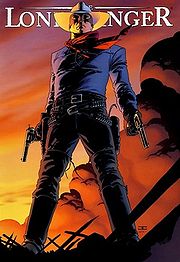 In 1948, Western Publishing
, with its publishing partner Dell Comics
, launched a comic book series which lasted 145 issues. This originally consisted of reprints from the newspaper strips (as had all previous comic book appearances of the character in various titles from David McKay Publications
and from Dell). However, new stories by writer Paul S. Newman
and artist Tom Gill
began with issue #38 (August 1951). Some original content was presented as early as #7 (January 1949), but these were non-Lone Ranger fillers. Newman and Gill produced the series until its the final issue, #145 (July 1962).
Tonto got his own spin-off title in 1951, which lasted 31 issues. Such was the Ranger's popularity at the time that even his horse Silver had a comic book, The Lone Ranger's Famous Horse Hi-Ho Silver, starting in 1952 and running 34 issues; writer Gaylord DuBois
wrote and developed Silver as a hero in his own right. In addition, Dell also published three big Lone Ranger annuals, as well as an adaptation of the 1956 theatrical film.
The Dell series came to an end in 1962. Later that same year, Western Publishing ended its publishing partnership with Dell Comics and started up its own comic book imprint, Gold Key Comics
. The new imprint launched its own Lone Ranger title in 1964. Initially reprinting material from the Dell run, original content did not begin until issue #22 in 1975, and the magazine itself folded with #28 in 1977. Additionally, Hemmets Journal
AB published a three-part Swedish Lone Ranger story the same year.
In 1994, Topps Comics
produced a four issue miniseries
, The Lone Ranger and Tonto, written by Joe R. Lansdale
and drawn by Timothy Truman
. One of the major changes in this series was the characterization of Tonto, who was now shown to be a very witty, outspoken and sarcastic character even willing to punch the Lone Ranger during a heated argument and commenting on his past pop-culture depictions with the words, "Of course, quimo sabe. Maybe when we talked I should use that 'me Tonto' stuff, way they write about me in the dime novels. You'd like that, wouldn't you?".
The first issue of a new Lone Ranger series from Dynamite Entertainment
by Brett Matthews
and Sergio Cariello
shipped September 6, 2006. It has started as a six issue miniseries, but due to its success, it has become an ongoing series by the same team. On September 15, 2006, Dynamite Entertainment announced that The Lone Ranger #1 had sold out of its first printing. A second printing of the first issue was announced, a first for the company. While overall considered a critical success, the new series has received some backlash from classic Lone Ranger fans for its graphic depictions of violence. The series has received an Eisner Awards nomination for best new series in 2007. True West
magazine awarded the publication the "Best Western Comic Book of the Year" in their 2009 Best of The West Source Book! And in 2010 Dynamite released "The lone Ranger avenges The Death of Zorro".
Dynamite Entertainment:
charted twice in the UK. It was banned from the air on its first release but then sold over 500,000 copies when re-released.
Texas Ranger Division
The Texas Ranger Division, commonly called the Texas Rangers, is a law enforcement agency with statewide jurisdiction in Texas, and is based in Austin, Texas...
who, with his Native American
Native Americans in the United States
Native Americans in the United States are the indigenous peoples in North America within the boundaries of the present-day continental United States, parts of Alaska, and the island state of Hawaii. They are composed of numerous, distinct tribes, states, and ethnic groups, many of which survive as...
companion Tonto
Tonto
Tonto may mean:* Tonto, a band of Apache native Americans.* Tonto, the fictional sidekick to the Lone Ranger.* "Tonto", a song by the American math rock band Battles, from their album Mirrored.** "Tonto+", the EP centered around said song....
, fights injustice in the American Old West
American Old West
The American Old West, or the Wild West, comprises the history, geography, people, lore, and cultural expression of life in the Western United States, most often referring to the latter half of the 19th century, between the American Civil War and the end of the century...
. The character has become an enduring icon of American culture.
He first appeared in 1933 in a radio show conceived either by WXYZ radio station owner George W. Trendle
George W. Trendle
George Washington Trendle was a Detroit lawyer and businessman, best known as the producer of the Lone Ranger radio and television programs along with The Green Hornet. He is entombed in Detroit's Woodlawn Cemetery.-Movie theaters:...
or by Fran Striker
Fran Striker
Fran Striker was an American writer for radio and comics, best known for creating The Lone Ranger, The Green Hornet, and Sgt...
, the show's writer. The show proved to be a huge hit, and spawned an equally popular television show
The Lone Ranger (TV Series)
The Lone Ranger is an American western television series starring Clayton Moore and Jay Silverheels as Tonto. The live-action series initially featured Gerald Mohr as the episode narrator...
that ran from 1949 to 1957, as well as comic books and movies. The title character was played on radio by George Seaton
George Seaton
George Seaton was an American screenwriter, playwright, film director and producer, and theatre director.Born George Stenius in South Bend, Indiana, Seaton moved to Detroit after graduating from college to work as an actor on radio station WXYZ. John L...
, Earle Graser
Earle Graser
Earle Graser was an American radio actor at radio station WXYZ, Detroit, Michigan.-Early life:Graser was born in Kitchener, Ontario. He was a child when his family moved to Detroit, Michigan. Graser graduated from a Detroit high school and attended Wayne University in Michigan, where he earned an...
, and most memorably Brace Beemer
Brace Beemer
Brace Beemer was an American radio actor and announcer at radio station WXYZ, Detroit, Michigan.Born in Mount Carmel, Illinois, Beemer was six foot, three inches tall and was an expert horse rider. He served as the deep-voiced announcer for The Lone Ranger soon after its first broadcast in 1933...
. To television viewers, Clayton Moore
Clayton Moore
Clayton Moore was an American actor best known for playing the fictional western character The Lone Ranger from 1949–1951 and 1954-1957 on the television series of the same name.-Early years:...
was the Lone Ranger. Tonto was played by, among others, John Todd
John Todd (actor)
John Todd , born Fred McCarthy was an American radio actor.A former stage actor known for Shakespearean roles, Todd soon gained work at Detroit radio station WXYZ, as part of director James Jewell's repertory company, with roles on the various series produced by the station.His most famous work was...
, Roland Parker, and in the television series, Jay Silverheels
Jay Silverheels
Jay Silverheels was a Canadian Mohawk First Nations actor. He was well known for his role as Tonto, the faithful American Indian companion of the Lone Ranger in a long-running American television series. -Early life:...
.
Departing on his white stallion, Silver, the Lone Ranger would shout, "Hi-yo, Silver! Away!" As they galloped off, someone would ask, "Who was that masked man anyway?" Tonto usually referred to the Lone Ranger as "Ke-mo sah-bee
Ke-mo sah-bee
Ke-mo sah-bee is the term of endearment and catchphrase used by the intrepid and ever-faithful fictional Native American sidekick, Tonto, in the very successful American radio and television program The Lone Ranger. It is sometimes translated as "trusty scout" or "faithful friend" in Potawatomi...
", meaning "trusty scout" or "trusted friend." These catchphrases, his trademark silver bullets, and the theme music from the William Tell overture
William Tell Overture
The William Tell Overture is the instrumental introduction to the opera Guillaume Tell by Gioachino Rossini. William Tell premiered in 1829 and was the last of Rossini's 39 operas, after which he went into semi-retirement, although he continued to compose cantatas, sacred music and secular vocal...
are indelibly stamped in the memories of millions who came of age during the decades of the show's initial popularity or viewed the television series. Reruns of The Lone Ranger starring Clayton Moore were still being transmitted as of August 2010, sixty-one years after their initial broadcast.
Premise
While details differ, the basic story of the origin of the Lone Ranger is the same in most versions of the franchise. Six Texas Rangers are ambushed by a band of outlaws led by Barthalamo "Butch" Cavendish. Later, a Native American named Tonto stumbles on the scene and recognizes the lone survivor, John Francis Reid, as the man who had saved his life some time in the past. He nurses Reid back to health. The two men dig six graves for Reid's comrades, among them Reid's brother, Captain Daniel Steven Reid who is the Captain of the Texas Rangers. John Reid fashions a black mask using material from his brother's vest to conceal his identity, so that Cavendish will think there were no survivors. Even after the Cavendish gang is brought to justice, Reid continues to fight evil under the guise of the Lone Ranger.The Lone Ranger
In every incarnation of the character to date, the Lone Ranger conducts himself by a strict moral code put in place by Striker at the inception of the character. Actors Clayton MooreClayton Moore
Clayton Moore was an American actor best known for playing the fictional western character The Lone Ranger from 1949–1951 and 1954-1957 on the television series of the same name.-Early years:...
and Jay Silverheels
Jay Silverheels
Jay Silverheels was a Canadian Mohawk First Nations actor. He was well known for his role as Tonto, the faithful American Indian companion of the Lone Ranger in a long-running American television series. -Early life:...
both took their positions as role models to children very seriously and tried their best to live by this creed. It reads as follows:
I believe...
- that to have a friend, a man must be one.
- that all men are created equal and that everyone has within himself the power to make this a better world.
- that God put the firewood there, but that every man must gather and light it himself.
- in being prepared physically, mentally, and morally to fight when necessary for that which is right.
- that a man should make the most of what equipment he has.
- that 'this government of the people, by the people, and for the people' shall live always.
- that men should live by the rule of what is best for the greatest number.
- that sooner or later...somewhere...somehow...we must settle with the world and make payment for what we have taken.
- that all things change but truth, and that truth alone, lives on forever.
- in my Creator, my country, my fellow man.
In addition, Fran Striker and George W. Trendle drew up guidelines which embody who and what the Lone Ranger is:
- The Lone Ranger is never seen without his mask or a disguise.
- With emphasis on logic, The Lone Ranger is never captured or held for any length of time by lawmen, avoiding his being unmasked.
- The Lone Ranger never uses slang or colloquial phrases, but instead uses perfect grammar and precise speech, completely devoid of such slang and such colloquial phrases, at all times.
- When he has to use guns, The Lone Ranger never shoots to kill, but rather only to disarm his opponent as painlessly as possible.
- Logically, too, The Lone Ranger never wins against hopeless odds; i.e., he is never seen escaping from a barrage of bullets merely by riding into the horizon.
- Even though The Lone Ranger offers his aid to individuals or small groups, the ultimate objective of his story never fails to imply that their benefit is only a by-product of a greater achievement—the development of the west or our country. His adversaries are usually groups whose power is such that large areas are at stake.
- Adversaries are never other than American to avoid criticism from minority groups.
- Names of unsympathetic characters are carefully chosen, never consisting of two names if it can be avoided, to avoid even further vicarious association—more often than not, a single nickname is selected.
- The Lone Ranger never drinks or smokes, and saloon scenes are usually interpreted as cafes, with waiters and food instead of bartenders and liquor.
- Criminals are never shown in enviable positions of wealth or power, and they never appear as successful or glamorous.
Reid decides to use only silver bullets, to remind himself that life, too, is precious and, like his silver bullets, not to be wasted or thrown away.
The Lone Ranger's first name
Although the Lone Ranger's last name is given as Reid, his first name is not definitely specified. According to the story told in the radio series, the group of six ambushed Rangers was headed by Reid's brother, Captain Dan Reid. Some later radio reference books, beginning with Radio's Golden Age in the 1960s, claimed that the Lone Ranger's first name was John; however, both the radio and television programs avoided mentioning his first name. Fran Striker's obituary (1962) and a Gold Key ComicsGold Key Comics
Gold Key Comics was an imprint of Western Publishing created for comic books distributed to newsstands. Also known as Whitman Comics, Gold Key operated from 1962 to 1984.-History:...
(1964) retelling of the origin both stated that "Dan" was the Lone Ranger's first name, not his brother's.
It appears that the first use of the name "John Reid" was in a scene in the 1981 big-screen film The Legend of the Lone Ranger in which the surviving Reid digs an extra grave for himself. This gave the use of the first name John a degree of official standing, although the name "Luke Hartman" was used in the 2003 TV-movie/unsold series pilot. The name of Captain Reid's son, the Lone Ranger's nephew, a later character who became a sort of juvenile sidekick to the Masked Man, is also Dan Reid. (When Trendle and Striker later created The Green Hornet
The Green Hornet
The Green Hornet is an American radio and television masked vigilante created by George W. Trendle and Fran Striker, with input from radio director James Jewell, in 1936. Since his radio debut in the 1930s, the Green Hornet has appeared in numerous serialized dramas in a wide variety of media...
, they made this Dan Reid the father of Britt Reid, alias the Green Hornet, thereby making the Lone Ranger the Green Hornet's great-uncle.)
Tonto
The character did not make his appearance until the eleventh episode of the radio show. Fran Striker told his son that Tonto was added so that the Lone Ranger would have someone to talk to. The radio program identified him as a member of the PotawatomiPotawatomi
The Potawatomi are a Native American people of the upper Mississippi River region. They traditionally speak the Potawatomi language, a member of the Algonquian family. In the Potawatomi language, they generally call themselves Bodéwadmi, a name that means "keepers of the fire" and that was applied...
tribe, though some books say he was probably supposed to be an Apache
Apache
Apache is the collective term for several culturally related groups of Native Americans in the United States originally from the Southwest United States. These indigenous peoples of North America speak a Southern Athabaskan language, which is related linguistically to the languages of Athabaskan...
.
The character has been criticized for speaking in broken pidgin English.
Because Tonto means "stupid" or "dumb" in Spanish, the character is renamed "Toro" (Spanish for "bull") or "Ponto" in Spanish-speaking countries.
Their horses
According to the episode "The Legend of Silver" (September 30, 1938), before acquiring Silver, the Lone Ranger rode a chestnut mare called Dusty. After Dusty is killed by a criminal the Lone Ranger and Tonto are tracking, the Lone Ranger saves Silver's life from an enraged buffalo and, in gratitude, Silver chooses to give up his wild life to carry him.The origin of Tonto's horse, Scout, is less clear. For a long time, Tonto rides a white horse called White Feller. In "Four Day Ride" (August 5, 1938), Tonto is given a paint horse by his friend Chief Thundercloud, who then takes White Feller. Tonto rides this horse and refers to him simply as "Paint Horse" for several episodes. The horse is finally named Scout in "Border Dope Smuggling" (September 2, 1938). In another episode, however, the Lone Ranger, in a surge of conscience, releases Silver back to the wild. The episode ends with Silver returning, bringing along a companion who becomes Tonto's horse, Scout.
Whenever the Lone Ranger mounts Silver, he shouts, "Hi-yo, Silver! Away!" Besides sounding dramatic, this shout originally served to tell the radio audience that a riding sequence was about to start. Bill Cosby
Bill Cosby
William Henry "Bill" Cosby, Jr. is an American comedian, actor, author, television producer, educator, musician and activist. A veteran stand-up performer, he got his start at various clubs, then landed a starring role in the 1960s action show, I Spy. He later starred in his own series, the...
complained in his book Cosbyology that, when the TV version came around, the Lone Ranger still used the line for reasons he could not figure out. In an echo of the Lone Ranger's line, Tonto frequently says, "Git-um up, Scout!" (The phrase became so well embedded in the Lone Ranger mythos that International Harvester
International Harvester
International Harvester Company was a United States agricultural machinery, construction equipment, vehicle, commercial truck, and household and commercial products manufacturer. In 1902, J.P...
used it as an advertising line to promote their Scout utility vehicle in the 1970s.)
Original radio series
The first of 2,956 radio episodes of The Lone Ranger premiered on January 30, 1933 on WXYZ, a radio station serving Detroit, MichiganDetroit, Michigan
Detroit is the major city among the primary cultural, financial, and transportation centers in the Metro Detroit area, a region of 5.2 million people. As the seat of Wayne County, the city of Detroit is the largest city in the U.S. state of Michigan and serves as a major port on the Detroit River...
. Sources disagree on whether station and show owner George W. Trendle or main writer Fran Striker should receive credit for the concept. Elements of the Lone Ranger story had been used in an earlier series Fran Striker wrote for a station in Buffalo, New York
Buffalo, New York
Buffalo is the second most populous city in the state of New York, after New York City. Located in Western New York on the eastern shores of Lake Erie and at the head of the Niagara River across from Fort Erie, Ontario, Buffalo is the seat of Erie County and the principal city of the...
.
In any case, the show was an immediate success. Though it was aimed at children, adults made up at least half the audience. It became so popular, it was picked up by the Mutual Broadcasting System
Mutual Broadcasting System
The Mutual Broadcasting System was an American radio network, in operation from 1934 to 1999. In the golden age of U.S. radio drama, MBS was best known as the original network home of The Lone Ranger and The Adventures of Superman and as the long-time radio residence of The Shadow...
radio network, and finally by NBC's "Blue Network
Blue Network
The Blue Network, and its immediate predecessor, the NBC Blue Network, were the on-air names of an American radio production and distribution service from 1927 to 1945...
", which in time became ABC
American Broadcasting Company
The American Broadcasting Company is an American commercial broadcasting television network. Created in 1943 from the former NBC Blue radio network, ABC is owned by The Walt Disney Company and is part of Disney-ABC Television Group. Its first broadcast on television was in 1948...
. The last new episode was broadcast September 3, 1954. Transcribed repeats of the 1952–53 episodes continued to be aired on ABC until June 24, 1955. Then selected repeats appeared on NBC's late-afternoon weekday schedule (5:30–5:55 pm Eastern time) from September 1955 to May 25, 1956.
Each episode was introduced by the announcer as follows:
In the early days of the western United States, a masked man and an Indian rode the plains, searching for truth and justice. Return with us now to those thrilling days of yesteryear, when from out of the past come the thundering hoofbeats of the great horse Silver! The Lone Ranger rides again!
By the time it was on ABC at 7:30 pm Eastern Time, the introduction, voiced by Fred Foy
Fred Foy
Frederick William Foy was an American radio and television announcer, who used Fred Foy as his professional name. He is best known for his narration of The Lone Ranger...
, had become "From out of the west with the speed of light and a hearty hi-yo Silver" following "Return with us now to those thrilling days of yesteryear," later changed to:
A fiery horse with the speed of light, a cloud of dust and a hearty Hi-Yo Silver! The Lone Ranger! ... With his faithful Indian companion Tonto, the daring and resourceful masked rider of the plains led the fight for law and order in the early western United States! Nowhere in the pages of History can one find a greater champion of justice! Return with us now to those thrilling days of yesteryear! From out of the past come the thunderimng hoofbeats of the great horse Silver! The Lone Ranger rides again!
followed by Brace Beemer's voice: "Come on, Silver! Let's go, big fellow! Hi-yo Silver! Away!"
The Lone Ranger was played by several actors:
- John L. Barrett, on test broadcasts on WEBR in January 1933
- George SeatonGeorge SeatonGeorge Seaton was an American screenwriter, playwright, film director and producer, and theatre director.Born George Stenius in South Bend, Indiana, Seaton moved to Detroit after graduating from college to work as an actor on radio station WXYZ. John L...
(under the name George Stenius) (January 31–May 9, 1933) - series director James JewellJames JewellJames Jewell was an American radio actor, producer and director at radio station WXYZ, Detroit, Michigan.-WXYZ:In June 1932, George Trendle, the owner of radio station WXYZ, decided to drop network affiliation and produce his own radio programs. Jim Jewell was hired as the dramatic director for...
, for one episode - an actor known only by the pseudonym "Jack Deeds", for one episode
- Earle GraserEarle GraserEarle Graser was an American radio actor at radio station WXYZ, Detroit, Michigan.-Early life:Graser was born in Kitchener, Ontario. He was a child when his family moved to Detroit, Michigan. Graser graduated from a Detroit high school and attended Wayne University in Michigan, where he earned an...
(May 16, 1933–April 7, 1941). On April 8, Graser died in a car accident; and, for five episodes, the Lone Ranger was unable to speak beyond a whisper, with Tonto carrying the action. - Brace BeemerBrace BeemerBrace Beemer was an American radio actor and announcer at radio station WXYZ, Detroit, Michigan.Born in Mount Carmel, Illinois, Beemer was six foot, three inches tall and was an expert horse rider. He served as the deep-voiced announcer for The Lone Ranger soon after its first broadcast in 1933...
(April 18, 1941 to the end), who had been the show's deep-voiced announcer for several years - Fred FoyFred FoyFrederick William Foy was an American radio and television announcer, who used Fred Foy as his professional name. He is best known for his narration of The Lone Ranger...
(March 29, 1954), also an announcer on the show, took over the role for one broadcast when Beemer had laryngitisLaryngitisLaryngitis is an inflammation of the larynx. It causes hoarse voice or the complete loss of the voice because of irritation to the vocal folds . Dysphonia is the medical term for a vocal disorder, of which laryngitis is one cause....
.
Tonto was played throughout the run by actor John Todd
John Todd (actor)
John Todd , born Fred McCarthy was an American radio actor.A former stage actor known for Shakespearean roles, Todd soon gained work at Detroit radio station WXYZ, as part of director James Jewell's repertory company, with roles on the various series produced by the station.His most famous work was...
(although there were a few isolated occasions when he was replaced by Roland Parker, better known as Kato for much of the run of sister series The Green Hornet). Other supporting players were selected from Detroit area actors and studio staff. These included Jay Michael (who also played the lead on Challenge of the Yukon
Challenge of the Yukon
Challenge of the Yukon was a radio series that began on Detroit's station WXYZ , and an example of a Northern genre story. The series was first heard on February 3, 1938...
aka Sgt. Preston of the Yukon), Bill Saunders
Bill Saunders
William H. "Navy Bill" Saunders was an American football player and coach. He served as the head coach at Colorado State Teachers College, now the University of Northern Colorado, from 1928 to 1931, at the University of Colorado at Boulder from 1932 to 1934, and at the University of Denver from...
(as various villains, including Butch Cavendish), Paul Hughes
Paul Hughes
Paul Hughes is a retired English footballer who played in midfield.Hughes began his career with his local side, Chelsea, and started well, scoring on his debut against Derby County with an impressive solo effort...
(as the Ranger's friend Thunder Martin and as various army colonels and badmen), future movie star John Hodiak
John Hodiak
John Hodiak was an American actor who worked in radio and film.-Early life:He was born in Pittsburgh, Pennsylvania, the son of Walter Hodiak and Anna Pogorzelec . He was of Ukrainian and Polish descent...
, Janka Fasciszewska (under the name Jane Fae), Rube Weiss and Elizabeth Weiss (a married couple, both actors in several radio and television programs in Detroit), and others. The part of nephew Dan Reid was played by various child actors, including Bob Martin
Bob Martin
Bob Martin may refer to:People:* Bob Martin , Member of the New South Wales Legislative Assembly* Bob Martin American basketball player* Bob Martin...
, James Lipton
James Lipton
James Lipton is an American writer, poet, composer, actor and dean emeritus of the Actors Studio Drama School at Pace University in New York City. He is the executive producer, writer and host of the Bravo cable television series Inside the Actors Studio, which debuted in 1994...
and Dick Beals
Dick Beals
Richard "Dick" Beals is an American voice actor. He has performed many voices in his career, which spans from the early 1950s into the 21st century...
.
Music
The theme music was the "March of the Swiss Soldiers" finale of Gioachino Rossini's William Tell overtureWilliam Tell Overture
The William Tell Overture is the instrumental introduction to the opera Guillaume Tell by Gioachino Rossini. William Tell premiered in 1829 and was the last of Rossini's 39 operas, after which he went into semi-retirement, although he continued to compose cantatas, sacred music and secular vocal...
, now inseparably associated with the series. The theme was conducted by Daniel Perez Castaneda.
Many other classical selections were used as incidental music, including Bizet
Georges Bizet
Georges Bizet formally Alexandre César Léopold Bizet, was a French composer, mainly of operas. In a career cut short by his early death, he achieved few successes before his final work, Carmen, became one of the most popular and frequently performed works in the entire opera repertory.During a...
Symphony Number 1, Mendelssohn
Felix Mendelssohn
Jakob Ludwig Felix Mendelssohn Barthóldy , use the form 'Mendelssohn' and not 'Mendelssohn Bartholdy'. The Grove Dictionary of Music and Musicians gives ' Felix Mendelssohn' as the entry, with 'Mendelssohn' used in the body text...
Fingal's Cave Overture, Liszt
Franz Liszt
Franz Liszt ; ), was a 19th-century Hungarian composer, pianist, conductor, and teacher.Liszt became renowned in Europe during the nineteenth century for his virtuosic skill as a pianist. He was said by his contemporaries to have been the most technically advanced pianist of his age...
Les Preludes, and Schubert
Franz Schubert
Franz Peter Schubert was an Austrian composer.Although he died at an early age, Schubert was tremendously prolific. He wrote some 600 Lieder, nine symphonies , liturgical music, operas, some incidental music, and a large body of chamber and solo piano music...
. Classical music was originally used because it was in the public domain
Public domain
Works are in the public domain if the intellectual property rights have expired, if the intellectual property rights are forfeited, or if they are not covered by intellectual property rights at all...
, thus allowing production costs to be kept down while providing a wide range of music as needed without the cost of a composer.
In the late 1930s, Trendle acquired the rights to use incidental music from Republic Pictures
Republic Pictures
Republic Pictures was an independent film production-distribution corporation with studio facilities, operating from 1934 through 1959, and was best known for specializing in westerns, movie serials and B films emphasizing mystery and action....
motion picture serials as part of a deal for Republic to produce a serial based (loosely) on the Lone Ranger. This music was then modified by NBC radio arranger Ben Bonnell and recorded in Mexico to avoid American union rules. This music was used in both the radio and later television shows.
Premiums
The Lone Ranger program offered many radio premiumRadio premium
During the time that radio programs were the dominant medium in the United States, some programs advertised "souvenirs" of the various shows, which were sometimes called radio premiums...
s, including the Lone Ranger Six-Shooter Ring and the Lone Ranger Deputy Badge. Some used a silver bullet motif. One ring had a miniature of one of his six-guns atop it, with a flint and striking wheel, as used in cigarette lighters, so that "fanning" the miniature pistol would produce a shower of sparks. During World War II
World War II
World War II, or the Second World War , was a global conflict lasting from 1939 to 1945, involving most of the world's nations—including all of the great powers—eventually forming two opposing military alliances: the Allies and the Axis...
, the premiums adapted to the times. In 1942, the program offered the Kix Blackout Kit.
Some premiums were rather anachronistic
Anachronism
An anachronism—from the Greek ανά and χρόνος — is an inconsistency in some chronological arrangement, especially a chronological misplacing of persons, events, objects, or customs in regard to each other...
for a 19th-century hero. In 1947, the program offered the Kix Atomic Bomb Ring, also known to collectors as the Lone Ranger Atom Bomb Ring. This ring was a miniature spinthariscope
Spinthariscope
A Spinthariscope is a device for observing individual nuclear disintegrations caused by the interaction of ionizing radiation with a phosphor or scintillator.The spinthariscope was invented by William Crookes in 1903...
that actually had a small amount of radioisotope in it to produce the scintillations caused by nuclear reactions. With its tailfin piece removed, though, the "bomb" body looked like a silver bullet.
The sponsor was General Mills
General Mills
General Mills, Inc. is an American Fortune 500 corporation, primarily concerned with food products, which is headquartered in Golden Valley, Minnesota, a suburb of Minneapolis. The company markets many well-known brands, such as Betty Crocker, Yoplait, Colombo, Totinos, Jeno's, Pillsbury, Green...
, with its breakfast-cereal
Breakfast cereal
A breakfast cereal is a food made from processed grains that is often, but not always, eaten with the first meal of the day. It is often eaten cold, usually mixed with milk , water, or yogurt, and sometimes fruit but sometimes eaten dry. Some cereals, such as oatmeal, may be served hot as porridge...
products: Cheerios
Cheerios
Cheerios is a brand of breakfast cereal by General Mills introduced on May 1, 1941 as the first oat-based, ready-to-eat cold cereal. Originally named CheeriOats, the name was changed to Cheerios in 1945 because of a trade name dispute with Quaker Oats. The name fit the "O" shape of the cereal pieces...
, Wheaties
Wheaties
Wheaties is a brand of General Mills breakfast cereal. It is well known for featuring prominent athletes on the exterior of the package, and has become a major cultural icon...
, and Kix
Kix (cereal)
Kix is a cereal introduced in 1937 by the General Mills cereal company of Golden Valley, Minnesota.Kix is an extruded expanded puffed grain product made with whole grain corn. The grain is processed and expanded...
. In 1947, Cheerios produced a line of Frontier Town cereal boxes with the Lone Ranger likeness on the front of the box. Different versions of the boxes would have Frontier Town buildings on their backs to cut out. One could also send in ten cents and a box-top to get each of the four map sections of the town. These, as well as nine different boxes, were needed to complete the cardboard Frontier Town.
The Green Hornet
The radio series inspired a spin-off called The Green Hornet, which depicts the son of the Lone Ranger's nephew Dan, Britt Reid, originally played by Al HodgeAl Hodge
For "Big" Al Hodge, the Cornish rock musician, see Al Hodge Albert E. Hodge was an American actor best known for playing space adventurer Captain Video on the DuMont Television Network from December 15, 1950 to April 1, 1955...
, who in contemporary times fights crime with a similar secret identity and a sidekick
Sidekick
A sidekick is a close companion who is generally regarded as subordinate to the one he accompanies. Some well-known fictional sidekicks are Don Quixote's Sancho Panza, Sherlock Holmes' Doctor Watson, The Lone Ranger's Tonto, The Green Hornet's Kato and Batman's Robin.-Origins:The origin of the...
, Kato
Kato (The Green Hornet)
Kato is a fictional character from The Green Hornet series. This character has also appeared with the Green Hornet in film, television, book and comic book versions. Kato was the Hornet's assistant and has been played by a number of actors...
. In the Green Hornet comic book series published by NOW Comics
NOW Comics
NOW Comics was a comic book publisher founded in late 1985 by Tony C. Caputo as a sole-proprietorship. During the four years after its founding, NOW grew from a one-man operation to operating in 12 countries, and published almost 1,000 comics books....
, the Lone Ranger makes a cameo through a portrait in the Reid home. Contrary to most visual media depictions, and acknowledged by developer/original scripter Ron Fortier
Ron Fortier
Ron Fortier is an American author, primarily known for his Green Hornet and The Terminator comic books and his revival of the pulp hero, Captain Hazzard. Early in his career he also wrote short stories and co-authored two novels for TSR....
to be the result of legal complications, his mask covers all of his face, as it did in the two serials from Republic Pictures
Republic Pictures
Republic Pictures was an independent film production-distribution corporation with studio facilities, operating from 1934 through 1959, and was best known for specializing in westerns, movie serials and B films emphasizing mystery and action....
(see below). However, the properties have been acquired by separate owners and the familial link has been ignored in the Western character's various incarnations. The Lone Ranger-Green Hornet connection is part of Philip Jose Farmer
Philip José Farmer
Philip José Farmer was an American author, principally known for his award-winning science fiction and fantasy novels and short stories....
's Wold Newton Universe, which connects disparate fictional characters.
Film serials
The Lone Ranger serialSerial (film)
Serials, more specifically known as Movie serials, Film serials or Chapter plays, were short subjects originally shown in theaters in conjunction with a feature film. They were related to pulp magazine serialized fiction...
s from Republic Pictures
Republic Pictures
Republic Pictures was an independent film production-distribution corporation with studio facilities, operating from 1934 through 1959, and was best known for specializing in westerns, movie serials and B films emphasizing mystery and action....
are enigmas to many serial and Lone Ranger fans because they are very rare and hard to find. Only late in 2009 was a complete version of the first serial, in English and with only minor omissions, made available on DVD through the Serial Squadron. Previously, the existing film material for the first serial, The Lone Ranger, was incomplete and either subtitled in Spanish or dubbed in French.
The hero's identity is unknown even to the audience in the original 1938 serial, with six men suspected of being behind the mask. As the chapters unreel, they are killed off one by one, but each actually appears in the costume in various scenes. (The plot device of the hero's identity being concealed from all and multiple candidates being killed off one by one was used again in the Columbia serial Flying G-Men
Flying G-Men
Flying G-Men is a Columbia Film serial. It was the sixth of the fifty seven serials released by Columbia.-Plot:Three government aviators, the "Flying G-Men" of the title - one of whom is disguised as The Black Falcon, fight to protect America from an enemy spy ring and to avenge the death of the...
and Republic's The Masked Marvel
The Masked Marvel
The Masked Marvel was a 12-chapter film serial created by Republic Pictures, who produced many of the best known of the serials. It was Republic's thirty-first serial, of the sixty-six they produced.-Plot:...
.) As the character played by Lee Powell
Lee Powell (actor)
Lee Powell was a film actor famed for the leading roles in several serials. During World War II he enlisted in the U.S...
is ultimately revealed to be the Masked Man, that actor is often given sole credit for the part. Two other suspects were played by Bruce Bennett
Bruce Bennett
Bruce Bennett was an American actor and Olympic silver medalist shot putter. During the 1930s, he went by his real name, Herman Brix .-Early life and Olympics:...
and George Montgomery, then still billed under their respective birth names of Herman Brix and George Letz.
Prior to the serial's release in 1938, the radio Lone Ranger's origin had been unknown, and hints had been dropped that he might be a historical figure in disguise. An alternate origin for Tonto, with him being rescued in a mine accident, had also been provided on radio. The 1938 serial presented the first version of the canyon ambush, Tonto nursing the Lone Ranger back to health, and the Lone Ranger swearing vengeance for the first time; all these elements were adopted with minor modifications as the origin of the radio and television versions of the character. Much of the familiar transitional music used in the radio series after 1938 also originated in the first Republic serial.
The second serial, The Lone Ranger Rides Again, was released in 1939 and starred Robert Livingston
Robert Livingston (actor)
Robert Livingston was an American film actor. He appeared in 135 films between 1921 and 1975.Often billed as "Bob Livingston," he was the original "Stony Brooke" in the "Three Mesquiteers" Western B-movie series, a role later played by John Wayne for eight films...
. It gave the Lone Ranger a second companion, a Mexican named Juan, played by Duncan Renaldo
Duncan Renaldo
Renault Renaldo Duncan , better known as Duncan Renaldo, was an American actor who portrayed The Cisco Kid in films and on the 1950-1956 American TV series, The Cisco Kid.-Early years:...
(who later starred as The Cisco Kid
The Cisco Kid
The Cisco Kid refers to a character found in numerous film, radio, television and comic book series based on the fictional Western character created by O. Henry in his 1907 short story "The Caballero's Way", published in the collection Heart of the West...
on television). Livingston wanted his face to be seen onscreen and consequently appears as rancher "Bill Andrews" in most dialogue scenes. Its standard Western plot concerned a battle over land between outlaws and ranchers. The only known copy of this serial was discovered in South America and was Spanish-subtitled. It had been cut together as a long feature and so is missing most opening titles and original cliffhanger ending resolutions.
George W. Trendle disliked the fact that the Lone Ranger appeared without his mask throughout the serial and consequently decided to terminate Republic's license to use the character. He then offered the character to Universal Pictures instead. A third Lone Ranger serial was announced in promotional advertising by Universal, but never produced.
Trendle had the prints of both serials destroyed to prevent their further exhibition after the license expired. Some have suggested that Trendle retained prints of the Lone Ranger serials, but made no effort to store them properly, and they deteriorated. However, Clayton Moore notes in his autobiography, I WAS That Masked Man, that he witnessed the master material for the serials being burned on the Republic Pictures back lot. In any case, only Spanish-subtitled foreign dupe prints of the two Lone Ranger serials survive. The Serial Squadron, an organization which restores classic movie serials, painstakingly reconstructed a subtitle-free English digital video version of the serial in 2007, re-creating the original opening titles and restoring the original cliffhangers.
Given all the differences between the two serials, it is perhaps surprising that Tonto was played in both by Victor Daniels, one of two actors known as Chief Thundercloud
Chief Thundercloud
Chief Thundercloud, was an American character actor in westerns.Information about Thundercloud is vague...
.
Television series
The Lone Ranger was a TV show that aired for eight seasons, from 1949 to 1957, and starred Clayton MooreClayton Moore
Clayton Moore was an American actor best known for playing the fictional western character The Lone Ranger from 1949–1951 and 1954-1957 on the television series of the same name.-Early years:...
as the Lone Ranger and Jay Silverheels
Jay Silverheels
Jay Silverheels was a Canadian Mohawk First Nations actor. He was well known for his role as Tonto, the faithful American Indian companion of the Lone Ranger in a long-running American television series. -Early life:...
as Tonto. Only five of the eight seasons had new episodes. It was the ABC
American Broadcasting Company
The American Broadcasting Company is an American commercial broadcasting television network. Created in 1943 from the former NBC Blue radio network, ABC is owned by The Walt Disney Company and is part of Disney-ABC Television Group. Its first broadcast on television was in 1948...
television network's first big hit of the early 1950s. Moore's tenure as the Ranger is probably the best-known treatment of the franchise. For the show's third season, Moore sat out due to a contract dispute and was replaced by John Hart
John Hart (actor)
John Hart was an American motion picture and television actor, born in Los Angeles, California. In his early career, he appeared mostly in Westerns...
. Moore returned for the final two seasons. The fifth and final season was the only one shot in color. A total of 221 episodes were made.
Moore lawsuits
After the series ended, Moore continued to make public appearances as the Lone Ranger. In 1979, Jack WratherJack Wrather
John Devereaux "Jack" Wrather, Jr. , was a petroleum millionaire who became a television producer and later diversified by investing in broadcast stations and resort properties...
, then owner of the rights to the character, won a lawsuit against Moore. The actor began wearing oversize wraparound Foster Grant
Foster Grant
Foster Grant, or FosterGrant, is a brand of eyewear founded by Sam Foster in 1919. The FosterGrant brand is a subsidiary company of FGX International, a consumer goods wholesaler with headquarters in Smithfield, Rhode Island, USA....
sunglasses instead as a substitute for the mask. Moore later won a countersuit, allowing him to resume his costume.
Other media
The series also inspired numerous comic bookComic book
A comic book or comicbook is a magazine made up of comics, narrative artwork in the form of separate panels that represent individual scenes, often accompanied by dialog as well as including...
s, books, and gramophone record
Gramophone record
A gramophone record, commonly known as a phonograph record , vinyl record , or colloquially, a record, is an analog sound storage medium consisting of a flat disc with an inscribed, modulated spiral groove...
s.
The Return of the Lone Ranger
An attempt by CBS to revive the series in 1961, Return of the Lone Ranger, did not get past the pilot stage. The Lone Ranger was played by Tex Hill in this production.The Legend of the Lone Ranger
The 1981 film The Legend of the Lone RangerThe Legend of the Lone Ranger
The Legend of the Lone Ranger is a 1981 British-American western film directed by William A. Fraker and starring Klinton Spilsbury, Michael Horse and Christopher Lloyd....
caused much upset among fans when the movie studio filed a lawsuit and obtained a court injunction to prevent Clayton Moore from appearing as the Lone Ranger anywhere else, and then gave a cameo to his successful TV replacement, John Hart
John Hart (actor)
John Hart was an American motion picture and television actor, born in Los Angeles, California. In his early career, he appeared mostly in Westerns...
. The film itself was a failure. It did not help that lead actor Klinton Spilsbury
Klinton Spilsbury
Klinton Spilsbury is an American actor, born in Chihuahua, Mexico. His lone known acting credit is the film The Legend of the Lone Ranger , in which he played the title role....
's lines had to be overdubbed by James Keach
James Keach
James Keach is an American actor, producer, and director. He is the younger brother of actor Stacy Keach, Jr., and son of actor Stacy Keach, Sr.-Background:...
.
Moore, who never appeared publicly without his mask, was enjoined in the lawsuit from wearing it and, in protest, he began wearing oversized sunglasses that were the approximate size and shape of the mask. In an ironic sequence in the movie, John Reid, a newly graduated attorney, is traveling west in a stagecoach to meet his brother. Another passenger announces his intent to make his fortune from his invention of sunglasses. The stage is robbed and the inventor killed. As the man lies on the ground with the broken dark glasses, John Reid says, "So much for free enterprise."
The Lone Ranger (2003)
In 2003 the WBThe WB Television Network
The WB Television Network is a former television network in the United States that was launched on January 11, 1995 as a joint venture between Warner Bros. and Tribune Broadcasting. On January 24, 2006, CBS Corporation and Warner Bros...
network aired a two hour Lone Ranger TV movie, starring Chad Michael Murray
Chad Michael Murray
Chad Michael Murray is an American actor, former fashion model and spokesperson. Murray is well known for portraying Lucas Scott in The CW young adult drama series One Tree Hill, in addition to the commercially successful films A Cinderella Story, Freaky Friday and House of Wax...
as The Lone Ranger. The TV movie served as the pilot for a possible series. However, the movie was greeted unenthusiastically; the name of the secret identity of The Lone Ranger was changed from "John Reid" to "Luke Hartman," and while there was still an empty grave alongside those of the five dead Rangers, its supposed occupant was unidentified, and the hero maintained his unmasked identity as well, becoming a cowboy version of Zorro
Zorro
Zorro is a fictional character created in 1919 by New York-based pulp writer Johnston McCulley. The character has been featured in numerous books, films, television series, and other media....
as in the second film serial. Ultimately, the project was shelved.
Planned Lone Ranger film
In March 2002, Columbia PicturesColumbia Pictures
Columbia Pictures Industries, Inc. is an American film production and distribution company. Columbia Pictures now forms part of the Columbia TriStar Motion Picture Group, owned by Sony Pictures Entertainment, a subsidiary of the Japanese conglomerate Sony. It is one of the leading film companies...
announced their intention to make a Lone Ranger film with Classic Media
Classic Media
Classic Media, LLC, is an American production company and distributor of family programming. It was founded in 2000 by former Marvel Entertainment CEO Eric Ellenbogen and former Broadway Video executive John Engelman in hopes of acquiring mismanaged classic properties and giving exposure to...
, who owned the film rights at the time. Husband and wife producers Douglas Wick
Douglas Wick
Douglas Wick is an American movie producer whose work includes producing the Academy Award-winning 2000 film Gladiator, Stuart Little, and the Academy Award-winning Memoirs of a Geisha.- Career :...
and Lucy Fisher joined the project. The tone was to be similar to The Mask of Zorro
The Mask of Zorro
The Mask of Zorro is a 1998 American swashbuckler film based on the Zorro character created by Johnston McCulley. It was directed by Martin Campbell and stars Antonio Banderas, Anthony Hopkins, Catherine Zeta-Jones, and Stuart Wilson...
, and Columbia suggested that Tonto be re-written as a female love interest. The projected budget was set at $70 million. In May 2003, David
David Peoples
David Webb Peoples is an American screenwriter.-Life and career:Peoples was born in Middletown, Connecticut, the son of Ruth and Joe Webb Peoples, a geologist. He studied English at the University of California, Berkeley...
and Janet Peoples
Janet Peoples
Janet Peoples is an American screenwriter.She co-wrote the script for the 1995 Academy Award nominated film Twelve Monkeys with her husband David Peoples who has written a number of films, mostly science fiction or fantasy. She and her husband also co-wrote the 1980 documentary The Day After...
were hired to write the script. By January 2005, the Peoples script was rewritten by Laeta Kalogridis
Laeta Kalogridis
Laeta Elizabeth Kalogridis is a screenwriter and an executive producer. She is a graduate of Davidson College in Davidson, NC and University of Texas at Austin and attended UCLA's prestigious film school. She has written scripts for Alexander , Night Watch , Pathfinder and Shutter Island...
, with Jonathan Mostow
Jonathan Mostow
Jonathan Mostow is an American film director, writer and producer.-Biography:A graduate of Hopkins School in New Haven, Connecticut and Harvard, Mostow also trained at the American Repertory Company and New York City's Lee Strasberg Institute...
to direct.
The Lone Ranger languished in development hell
Development hell
In the jargon of the media-industry, "development hell" is a period during which a film or other project is trapped in development...
. In January 2007, The Weinstein Company
The Weinstein Company
The Weinstein Company is an American film studio founded by Bob and Harvey Weinstein in 2005 after the brothers left the then-Disney-owned Miramax Films, which they had co-founded in 1979...
was interested in purchasing the film rights from Classic Media. However, the deal fell through, and Entertainment Rights
Entertainment Rights
Entertainment Rights Plc was a global media company. Its main role was in children and family television programming.The group was established in 1989 as Sleepykids. In 1999 it become entertainment rights and was focused on the creation and exploitation of major children's characters and brands...
eventually optioned the property. By May 2007, producer Jerry Bruckheimer
Jerry Bruckheimer
Jerome Leon "Jerry" Bruckheimer is an American film and television producer. He has achieved great success in the genres of action, drama, and science fiction. His best known television series are CSI: Crime Scene Investigation, CSI: Miami, CSI: NY, Eleventh Hour, Without a Trace, Cold Case, The...
(alongside Entertainment Rights) set The Lone Ranger up at Walt Disney Pictures
Walt Disney Pictures
Walt Disney Pictures is an American film studio owned by The Walt Disney Company. Walt Disney Pictures and Television, a subsidiary of the Walt Disney Studios and the main production company for live-action feature films within the Walt Disney Motion Pictures Group, based at the Walt Disney...
. Ted Elliott
Ted Elliott
Ted Elliott is an American screenwriter. Along with his writing partner Terry Rossio, Elliott has written some of the most successful American films of the past 15 years, including Aladdin, Shrek and Pirates of the Caribbean. In 2004, he was elected to the Board of Directors of the Writers Guild...
and Terry Rossio
Terry Rossio
Terry Rossio is an American screenwriter.Rossio was born in Kalamazoo, Michigan. After graduating from Saddleback High School in Santa Ana, California, he went on to study at California State University, Fullerton where he received his Bachelor of Arts in Communications, with an emphasis in radio,...
, who had worked with Bruckheimer and Disney on the Pirates of the Caribbean film series
Pirates of the Caribbean (film series)
Pirates of the Caribbean is a series of fantasy-adventure films directed by Gore Verbinski and Rob Marshall , written by Ted Elliott and Terry Rossio and produced by Jerry Bruckheimer...
, were being considered to write the script. In late March 2008, Elliott and Rossio were in final negotiations. Disney then announced in September 2008 that Johnny Depp
Johnny Depp
John Christopher "Johnny" Depp II is an American actor, producer and musician. He has won the Golden Globe Award and Screen Actors Guild award for Best Actor. Depp rose to prominence on the 1980s television series 21 Jump Street, becoming a teen idol...
would be portraying Tonto.
The Elliot/Rossio script had a supernatural tone, and has since been rewritten by Justin Haythe
Justin Haythe
Justin Haythe is an American novelist, short story writer, and screenwriter.Born in London, Haythe is a graduate of The American School in London and Middlebury College. He earned his MFA from Sarah Lawrence College. His debut novel, The Honeymoon, was nominated for the 2004 Man Booker Prize...
. In May 2009, Mike Newell
Mike Newell (director)
Michael Cormac "Mike" Newell is an English director and producer of motion pictures for the screen and for television. After the release of Harry Potter and the Goblet of Fire in 2005, Newell became the third most commercially successful British director in recent years, behind Christopher Nolan...
, who was then directing Prince of Persia: The Sands of Time
Prince of Persia: The Sands of Time (film)
Prince of Persia: The Sands of Time is a 2010 sword-and-sorcery action film written by Jordan Mechner, Boaz Yakin, Doug Miro, and Carlo Bernard; directed by Mike Newell; produced by Jerry Bruckheimer; and distributed by Walt Disney Pictures...
for Bruckheimer and Disney, entered negotiations to direct The Lone Ranger. However, Bruckheimer explained the following June that he wanted to wait on hiring a director until Newell completed Prince of Persia, and until Depp finished filming Pirates of the Caribbean: On Stranger Tides
Pirates of the Caribbean: On Stranger Tides
Pirates of the Caribbean: On Stranger Tides is a 2011 adventure fantasy film and the fourth installment in the Pirates of the Caribbean series...
. "The priority is most definitely Pirates 4," Bruckheimer commented. "They are going to cast the title role once they get a director and Disney greenlights. We don't have a director yet." In September of 2010, Gore Verbinski
Gore Verbinski
Gregor "Gore" Verbinski is an American film director, writer and musician. He is best known for directing the films The Ring, Pirates of the Caribbean, and Rango.-Early life:...
was hired to direct. Filming was slated to begin after Depp finished work in Dark Shadows
Dark Shadows (film)
Dark Shadows is an upcoming supernatural drama film based on the 1966-1971 gothic soap opera of the same name. The film is directed by Tim Burton and stars Johnny Depp as the vampire Barnabas Collins. It is scheduled to be released on , 2012 in both conventional and IMAX theaters.-Synopsis:In 1752,...
. Actor Armie Hammer
Armie Hammer
Armand Douglas "Armie" Hammer is an American actor. After appearing on television and playing the title role in 2008's Billy: The Early Years, he became known for his portrayal of the Winklevoss twins in the 2010 film The Social Network, and Clyde Tolson in J. Edgar...
will play the role of The Lone Ranger. It was announced in July 2011 that British actress Ruth Wilson
Ruth Wilson (actress)
Ruth Wilson is an English actress, perhaps best known for her performance in the title role of Jane Eyre.-Early life and education:...
has been cast as Rebecca, the female lead in the movie. Dwight Yoakam
Dwight Yoakam
Dwight David Yoakam is an American singer-songwriter, actor and film director, most famous for his pioneering country music...
, Helena Bonham Carter
Helena Bonham Carter
Helena Bonham Carter is an English actress of film, stage, and television. She made her acting debut in a television adaptation of K. M. Peyton's A Pattern of Roses before winning her first film role as the titular character in Lady Jane...
and Barry Pepper
Barry Pepper
Barry Robert Pepper is a Canadian actor. He is best known for playing roles like Sergeant Michael Strank in the Clint Eastwood film, Flags of Our Fathers, Private Daniel Jackson in Saving Private Ryan, Roger Maris in 61*, Ned Pepper in True Grit and for his recent role as Robert F...
are all currently in negotiations for the movie.
On August 12, 2011, Disney announced that production on The Lone Ranger would be delayed due to budget concerns. However, on August 15, 2011, it was revealed that The Lone Ranger had been shelved
Shelved
In politics, the term can be used for policy drafts, that have never been officially brought into legislation.In the film industry, a film is considered shelved if it is not released for public viewing after filming has started, or even completed....
for the foreseeable future due to said budgetary concerns, as well as the under-performance of another Western-genre film, Cowboys & Aliens
Cowboys & Aliens (film)
Cowboys & Aliens is a 2011 American science fiction Western film directed by Jon Favreau and starring Daniel Craig, Harrison Ford, and Olivia Wilde. The film is based on the 2006 graphic novel of the same name created by Scott Mitchell Rosenberg...
.
On October 13th, 2011, Disney confirmed that Johnny Depp's 'The Lone Ranger' is back on track with a projected release date of May 31st, 2013.
The Format Films animated cartoon, 1966 to 1968
An animated series of the The Lone RangerThe Lone Ranger (animated TV series)
The Lone Ranger is the central character of an American animated television series that ran 26 episodes on CBS from September 10, 1966, to September 6, 1969...
ran from 1966 to 1968 on CBS. It was produced by Herbert Klynn
Herbert Klynn
Herbert Klynn was an American animator who worked with UPA Studios.In 1959 he founded the television animation studio Format Films, best-known for producing The Alvin Show, The Lone Ranger, and other films and series in animation mostly during the 1960s.Format Productions also provided several...
and Jules Engel
Jules Engel
Jules Engel was a Jewish-Hungarian American filmmaker, painter, sculptor, graphic artist, set designer, animator, film director, and teacher...
of Format Films
Format Films
Format Films was a television animation studio which was founded by Herbert Klynn in 1959 with Jules Engel as vice president, Herb McIntosh and Joseph Mugnaini. It was most active during the 1960s, producing episodes of The Alvin Show, Popeye, and The Lone Ranger...
, Hollywood, and designed and animated at the Halas and Batchelor Cartoon Film
Halas and Batchelor
Halas and Batchelor was an animation company founded by John Halas and his wife, Joy Batchelor. The company started as a small animation unit that created commercials for theatrical distribution...
studios in London, England. The show lasted thirty episodes; however, these were invariably split into three separate shorts, with the middle segment being a solo adventure for Tonto, so that there were actually 90 installments in all. The last episode aired on March 9, 1968.
These Lone Ranger adventures were similar in tone and nature to CBS's science fiction Western
Science fiction Western
A science fiction Western is a work of fiction which has elements of science fiction in a Western setting. It is different from a Space Western, which is a frontier story indicative of American Westerns, except transposed to a backdrop of space exploration and settlement.A science fiction Western...
, The Wild Wild West
The Wild Wild West
The Wild Wild West is an American television series that ran on CBS for four seasons from September 17, 1965 to April 4, 1969....
, in that plots were bizarre and had elements of science-fiction and steampunk
Steampunk
Steampunk is a sub-genre of science fiction, fantasy, alternate history, and speculative fiction that came into prominence during the 1980s and early 1990s. Steampunk involves a setting where steam power is still widely used—usually Victorian era Britain or "Wild West"-era United...
technology thrown in. Even the Lone Ranger's greatest enemy in the animated series was a dwarf, similar to James T. West's greatest enemy, Dr. Miguelito Loveless
Dr. Loveless
Dr. Miguelito Quixote Loveless is a fictional character, a villain on the 1960s television series The Wild Wild West. He is a brilliant dwarf portrayed by Michael Dunn. As a mad scientist, and the arch-enemy of Secret Service agents James West and Artemus Gordon, Dr. Loveless was involved in...
. He was called Tiny Tom, and voiced by Dick Beals
Dick Beals
Richard "Dick" Beals is an American voice actor. He has performed many voices in his career, which spans from the early 1950s into the 21st century...
. This animated cartoon was credited as being a Jack Wrather production, and it provided the first exposure many 1960s children had to the characters.
The Lone Ranger's voice was provided by Michael Rye {r.n. Rye Billsbury}, who had portrayed Jack Armstrong: The All-American Boy on radio. Shepard Menken
Shepard Menken
Shepard Menken was an American voice actor and character actor.Menken began his career at the age of 11, when he started appearing on children's radio programs...
played Tonto. The narrator in the opening title was Marvin Miller
Marvin Miller (actor)
Marvin Elliott Miller was an American film and voice-over actor. Possessing a deep, baritone voice, he began his career in radio in St. Louis, Missouri before becoming a Hollywood actor...
. Other "guest voices" were provided by Paul Winchell
Paul Winchell
Paul Winchell was an American ventriloquist, voice actor and comedian, whose career flourished in the 1950s and 1960s...
, Agnes Moorehead
Agnes Moorehead
Agnes Robertson Moorehead was an American actress. Although she began with the Mercury Theatre, appeared in more than seventy films beginning with Citizen Kane and on dozens of television shows during a career that spanned more than thirty years, Moorehead is most widely known to modern audiences...
and Hans Conried
Hans Conried
Hans Georg Conried, Jr. was an American comedian, character actor and voice actor.-Early years:He was born on April 15, 1917 in Baltimore, Maryland to Hans Georg Conried, Sr. and Edith Beyr Gildersleeve. His mother was a descendant of Pilgrims, and his father was a Jewish immigrant from Vienna,...
.
The Tarzan/Lone Ranger Adventure Hour, early 1980s
The Lone Ranger was featured, along with ZorroZorro
Zorro is a fictional character created in 1919 by New York-based pulp writer Johnston McCulley. The character has been featured in numerous books, films, television series, and other media....
and Tarzan
Tarzan
Tarzan is a fictional character, an archetypal feral child raised in the African jungles by the Mangani "great apes"; he later experiences civilization only to largely reject it and return to the wild as a heroic adventurer...
, in Adventure Hour
The Tarzan/Lone Ranger Adventure Hour
The Tarzan / Lone Ranger adventure hour is an animated television series produced by Filmation that aired on CBS during the early 1980s....
cartoon shorts in the early 1980s, produced by Filmation
Filmation
Filmation Associates was an American production company that produced animation and live action programming for television during the latter half of the 20th century. Located in Reseda, California, the animation studio was founded in 1963...
. These episodes featured William Conrad
William Conrad
William Conrad was an American actor, producer and director whose career spanned five decades in radio, film and television....
as the voice of the Masked Man, though he was listed in the credits as "J. Darnoc" (Conrad spelled backwards). This series took a more realistic tone with a heavily historical context to include an educational element to the stories, even though there were several episodes that did feature elements of science fiction (much like the earlier cartoons from the 1960s). Conrad had starred in the original radio version of Gunsmoke
Gunsmoke
Gunsmoke is an American radio and television Western drama series created by director Norman MacDonnell and writer John Meston. The stories take place in and around Dodge City, Kansas, during the settlement of the American West....
as Marshal Matt Dillon
Marshal Matt Dillon
Marshal Matt Dillon is a fictional character featured on both the radio and television versions of Gunsmoke. He serves as the U.S. Marshal of Dodge City, Kansas who works to preserve law and order in the western frontier of the 1870s. The character was created by writer John Meston, who...
and was the announcer/narrator for the cartoon escapades of Rocky & Bullwinkle. There were 14 episodes, split into two adventures at a time, for a total of 28 stories. Though Conrad was the main voice featured, other noted voice actors in the Filmation series include an uncredited Lou Scheimer
Lou Scheimer
Louis Scheimer is an Emmy and Grammy Award–winning American producer, one of the original founders of Filmation, an animation company, and also an executive producer of many of its cartoons .-Career:Early in Filmation's history, Scheimer also contributed...
, Frank Welker
Frank Welker
Franklin Wendell "Frank" Welker is an American actor who specializes in voice acting and has contributed character voices and other vocal effects to American television and motion pictures.-Acting career:...
, and Michael Bell
Michael Bell
Michael Patrick Bell is an American actor and voice actor. He is most commonly credited in video games, animated movies, and television series.-1970s and 1980s voice work:Bell is a mainstay of 1970s and 1980s animation...
.
The Lone Ranger: The Lost Episodes, 2001
In 2001, GoodTimes Home VideoGoodTimes Entertainment
GoodTimes Entertainment, Ltd. was a home video company that originated in 1984 under the name of GoodTimes Home Video. Though it produced its own titles, the company was well-known due to its distribution of media from third parties and classics...
released a videotape called The Lone Ranger: The Lost Episodes. Along with clips from the first serial, trailers for the two post-TV series features, commercials with Moore and sometimes Silverheels in character, and two complete television episodes, there was a cartoon short, said to date from the late 1930s. With on-screen dialog balloons instead of recorded voices, it seems to be a throwback from the silent era.
Toys
Besides the premiums offered in connection with the radio series, there have been many Lone Ranger commercial toys released over the years. One of the most successful was a line of 10-inch action figures and accessories released by Gabriel Toys in 1973.Video game
A video game version of The Lone Ranger was released by KonamiKonami
is a Japanese leading developer and publisher of numerous popular and strong-selling toys, trading cards, anime, tokusatsu, slot machines, arcade cabinets and video games...
for the Nintendo Entertainment System
Nintendo Entertainment System
The Nintendo Entertainment System is an 8-bit video game console that was released by Nintendo in North America during 1985, in Europe during 1986 and Australia in 1987...
in North America in . It is an action adventure game featuring three different perspectives: side-scrolling, overhead, and first-person exploration. The game loosely follows the plot of the 1981 film The Legend of the Lone Ranger, with the ultimate goal being the rescue of the U.S. President, who has been kidnapped by the Lone Ranger's nemesis, Butch Cavendish.
Novels
The first Lone Ranger novelNovel
A novel is a book of long narrative in literary prose. The genre has historical roots both in the fields of the medieval and early modern romance and in the tradition of the novella. The latter supplied the present generic term in the late 18th century....
appeared in 1936, and eventually 18 volumes were published, as listed below. The first book was written by Gaylord Dubois
Gaylord DuBois
Gaylord McIlvaine Du Bois , or DuBois In his lifetime he wrote well over 3000 comic book stories and comic strips as well as Big Little Books and juvenile adventure...
, but the others were written by the character's primary developer, Fran Striker. Striker also re-edited and rewrote parts of later editions of the first novel. First published between 1936 and 1956 in hardback by Grosset and Dunlap
Grosset & Dunlap
Grosset & Dunlap is a United States book publisher founded in 1898.The company was purchased by G. P. Putnam's Sons in 1982 and today is part of the British publishing conglomerate, Pearson PLC through its American subsidiary Penguin Group....
, these stories were reprinted in 1978 by Pinnacle Books.
- The Lone Ranger (1936)
- The Lone Ranger and the Mystery Ranch (1938)
- The Lone Ranger and the Gold Robbery (1939)
- The Lone Ranger and the Outlaw Stronghold (1939)
- The Lone Ranger and Tonto (1940)
- The Lone Ranger at the Haunted Gulch (1941)
- The Lone Ranger Traps the Smugglers (1941)
- The Lone Ranger Rides Again (1943)
- The Lone Ranger Rides North (1943)
- The Lone Ranger and the Silver Bullet (1948)
- The Lone Ranger on Powderhorn Trail (1949)
- The Lone Ranger in Wild Horse Canyon (1950)
- The Lone Ranger West of Maverick Pass (1951)
- The Lone Ranger on Gunsight Mesa (1952)
- The Lone Ranger and the Bitter Spring Feud (1953)
- The Lone Ranger and the Code of the West (1954)
- The Lone Ranger and Trouble on the Santa Fe (1955)
- The Lone Ranger on Red Butte Trail (1956)
Comic strip
King Features SyndicateKing Features Syndicate
King Features Syndicate, a print syndication company owned by The Hearst Corporation, distributes about 150 comic strips, newspaper columns, editorial cartoons, puzzles and games to nearly 5000 newspapers worldwide...
distributed a newspaper strip of the Lone Ranger from September 1938 to December 1971. Fran Striker himself initially scripted the feature, but time constraints soon required him to quit, replaced by Bob Green, later followed by Paul S. Newman
Paul S. Newman
Paul S. Newman was an American writer of comic books, comic strips, and books, whose career spanned the 1940s to the 1990s...
and others. The original artist was Ed Kressy, but he was replaced in 1939 by Charles Flanders who drew the strip until its conclusion.
In 1981, the New York Times Syndicate launched a second Lone Ranger strip, written by Cary Bates
Cary Bates
Cary Bates is an American comic book, animation television and film writer.-Biography:Bates began submitting ideas for comic book covers to DC Comics at the age of 13, and a number of them were bought and published, the first as the cover to Superman #167...
with art by Russ Heath
Russ Heath
Russell Heath, Jr. is an American artist best known for his comic book work — particularly his DC Comics war stories for several decades and his 1960s art for Playboy magazine's Little Annie Fanny featurettes — and for his commercial art, two pieces of which, depicting Roman and...
. It ran until 1984. Two of the storylines were collected in a comic book by Pure Imagination Publishing
Pure Imagination (comics)
Pure Imagination is a comic book, magazine, and comics-related book publisher run by Greg Theakston since 1975.While briefly doing some original comics in the 1990s, as well a publishing a few "girlie" magazines, its main focus has been in publishing books to preserve the great works of several...
in 1993.
Comic books
Western Publishing
Western Publishing, also known as Western Printing and Lithographing Company was a Racine, Wisconsin firm responsible for publishing the Little Golden Books. Western Publishing also produced children's books and family-related entertainment products as Golden Books Family Entertainment...
, with its publishing partner Dell Comics
Dell Comics
Dell Comics was the comic book publishing arm of Dell Publishing, which got its start in pulp magazines. It published comics from 1929 to 1973. At its peak, it was the most prominent and successful American company in the medium...
, launched a comic book series which lasted 145 issues. This originally consisted of reprints from the newspaper strips (as had all previous comic book appearances of the character in various titles from David McKay Publications
David McKay Publications
David McKay Publications was an American book publisher which also published some of the first comic books, including the long-running titles Ace Comics, King Comics, and Magic Comics; as well as collections of such popular comic strips as Blondie, Dick Tracy, and Mandrake the Magician...
and from Dell). However, new stories by writer Paul S. Newman
Paul S. Newman
Paul S. Newman was an American writer of comic books, comic strips, and books, whose career spanned the 1940s to the 1990s...
and artist Tom Gill
Tom Gill (comics)
Thomas P. Gill is an American comic book artist best known for his nearly 11-year run drawing The Lone Ranger.-Early life and career:...
began with issue #38 (August 1951). Some original content was presented as early as #7 (January 1949), but these were non-Lone Ranger fillers. Newman and Gill produced the series until its the final issue, #145 (July 1962).
Tonto got his own spin-off title in 1951, which lasted 31 issues. Such was the Ranger's popularity at the time that even his horse Silver had a comic book, The Lone Ranger's Famous Horse Hi-Ho Silver, starting in 1952 and running 34 issues; writer Gaylord DuBois
Gaylord DuBois
Gaylord McIlvaine Du Bois , or DuBois In his lifetime he wrote well over 3000 comic book stories and comic strips as well as Big Little Books and juvenile adventure...
wrote and developed Silver as a hero in his own right. In addition, Dell also published three big Lone Ranger annuals, as well as an adaptation of the 1956 theatrical film.
The Dell series came to an end in 1962. Later that same year, Western Publishing ended its publishing partnership with Dell Comics and started up its own comic book imprint, Gold Key Comics
Gold Key Comics
Gold Key Comics was an imprint of Western Publishing created for comic books distributed to newsstands. Also known as Whitman Comics, Gold Key operated from 1962 to 1984.-History:...
. The new imprint launched its own Lone Ranger title in 1964. Initially reprinting material from the Dell run, original content did not begin until issue #22 in 1975, and the magazine itself folded with #28 in 1977. Additionally, Hemmets Journal
Hemmets Journal
Hemmets Journal is a Swedish magazine published by Egmont. It is the second largest weekly magazine in Sweden. The editor-in-chief is Janne Walles, who has held that position since 1990. As of 2008, there are approximately 40 employees working on Hemmets Journal...
AB published a three-part Swedish Lone Ranger story the same year.
In 1994, Topps Comics
Topps Comics
Topps Comics is a division of the American trading card publisher and gum/candy distributor the Topps Company, Inc. that published comic books from 1993–1998, beginning its existence during a short comics-industry boom that attracted many investors and new companies...
produced a four issue miniseries
Miniseries
A miniseries , in a serial storytelling medium, is a television show production which tells a story in a limited number of episodes. The exact number is open to interpretation; however, they are usually limited to fewer than a whole season. The term "miniseries" is generally a North American term...
, The Lone Ranger and Tonto, written by Joe R. Lansdale
Joe R. Lansdale
Joe R. Lansdale is an American author and martial-arts expert. He has written novels and stories in many genres, including Western, horror, science fiction, mystery, and suspense...
and drawn by Timothy Truman
Timothy Truman
Timothy Truman is an American writer, artist and musician. He is best known for his stories and Wild West-style comic book art, and in particular, for his work on Grimjack , Scout, and the reinvention of Jonah Hex, with Joe R. Lansdale...
. One of the major changes in this series was the characterization of Tonto, who was now shown to be a very witty, outspoken and sarcastic character even willing to punch the Lone Ranger during a heated argument and commenting on his past pop-culture depictions with the words, "Of course, quimo sabe. Maybe when we talked I should use that 'me Tonto' stuff, way they write about me in the dime novels. You'd like that, wouldn't you?".
The first issue of a new Lone Ranger series from Dynamite Entertainment
Dynamite Entertainment
Dynamite Entertainment is an American comic book company that primarily publishes licensed franchises of adaptations of other media. These include adaptations of film properties such as Army of Darkness, Terminator and RoboCop, literary properties such as Zorro, Dracula, Sherlock Holmes, Alice in...
by Brett Matthews
Brett Matthews
Brett Matthews is an American writer of comics and TV shows. He was assistant to Joss Whedon on TV shows Buffy the Vampire Slayer, Angel and Firefly. He scripted the Firefly episode Heart of Gold...
and Sergio Cariello
Sergio Cariello
Sergio Cariello is a Brazilian-American comic book artist. He has done work for many major comic publishers through his career, including Marvel Comics and DC Comics, as well as popular independent companies like CrossGen Comics and Dynamite Entertainment.-Career:Sergio Cariello knew he wanted to...
shipped September 6, 2006. It has started as a six issue miniseries, but due to its success, it has become an ongoing series by the same team. On September 15, 2006, Dynamite Entertainment announced that The Lone Ranger #1 had sold out of its first printing. A second printing of the first issue was announced, a first for the company. While overall considered a critical success, the new series has received some backlash from classic Lone Ranger fans for its graphic depictions of violence. The series has received an Eisner Awards nomination for best new series in 2007. True West
True West Magazine
True West Magazine is an American magazine that contains glossy articles and covers; reporting about events that happened in the "Old West" era.-History:True West began publication in 1953...
magazine awarded the publication the "Best Western Comic Book of the Year" in their 2009 Best of The West Source Book! And in 2010 Dynamite released "The lone Ranger avenges The Death of Zorro".
Dynamite Entertainment:
- The Lone Ranger Vol. 1 (160 pages, Collects The Lone Ranger #1-6)
- The Lone Ranger Vol. 2 Lines Not Crossed (128 pages, Collects The Lone Ranger #7-11)
- The Lone Ranger Vol. 3 Scorched Earth (144 pages, Collects The Lone Ranger #12-16)
- The Lone Ranger Vol. 4 Resolve (Collects The Lone Ranger #17-24)
- The Lone Ranger & Tonto (128 pages)
Singles
A popular record The Lone Ranger by Quantum JumpQuantum Jump
Quantum Jump was a 1970s British band, consisting of keyboard player and singer Rupert Hine, guitarist Mark Warner, bass player John G. Perry and drummer Trevor Morais .-Career:...
charted twice in the UK. It was banned from the air on its first release but then sold over 500,000 copies when re-released.
Further reading
- Bisco, Jim, "Buffalo's Lone Ranger: The Prolific Fran Striker Wrote the Book on Early Radio," Western New York Heritage, Volume 7, Number 4, Winter 2005.
- Grams, Martin, The Green Hornet: A History of Radio, Motion Pictures, Comics and Television, OTR Publishing, 2010.
- Harmon, JimJim HarmonJames Judson Harmon , better known as Jim Harmon, was an American short story author and popular culture historian who wrote extensively about the Golden Age of Radio. He sometimes used the pseudonym Judson Grey, and occasionally he was labeled Mr...
, The Great Radio Heroes, Doubleday, 1967. - Jones, Reginald, The Mystery of the Masked Man's Music: A Search for the Music Used on the Lone Ranger Radio Program, 1933-1954, Scarecrow PressRowman & LittlefieldRowman & Littlefield Publishing Group is an independent publishing house founded in 1949. Under several imprints, the company offers scholarly books and journals for the academic market, as well as trade books. The company also owns a book distributor, National Book Network...
, 1987 (ISBN 0-8108-3974-1). - Osgood, Dick. Wyxie Wonderland: An Unauthorized 50-Year Diary of WXYZ Detroit. Ohio: Bowling Green University Press, 1981.
- Holland, Dave "From Out Of The Past: A Pictorial History Of The Lone Ranger" (Holland House, 1988)
External links
}- The Lone Ranger Radio Series 1938 - 1956 (downloadable mp3 files)
- National Public Radio's Lone Ranger feature
- Death of the Lone Ranger at Snopes.com
- I Love Comix Archive: The Lone Ranger
- The Lone Ranger at YouTube
- Old Time Radio Podcast Rebroadcasting the show in the order it was placed.