

Comic strip

Encyclopedia
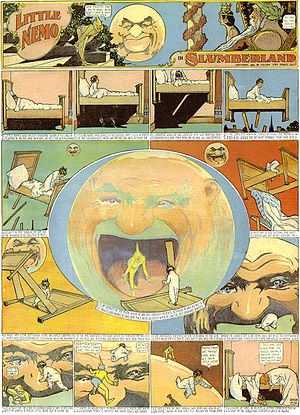
Traditionally, throughout the 20th century and into the 21st, these were published in newspaper
Newspaper
A newspaper is a scheduled publication containing news of current events, informative articles, diverse features and advertising. It usually is printed on relatively inexpensive, low-grade paper such as newsprint. By 2007, there were 6580 daily newspapers in the world selling 395 million copies a...
s, with horizontal strips
Daily strip
A daily strip is a newspaper comic strip format, appearing on weekdays, Monday through Saturday, as contrasted with a Sunday strip, which typically only appears on Sundays....
printed in black-and-white in daily newspapers, while Sunday newspapers offered longer sequences in special color comics sections
Sunday comics
Sunday comics is the commonly accepted term for the full-color comic strip section carried in most American newspapers. Many newspaper readers called this section the Sunday funnies, the funny papers or simply the funnies....
. There were more than 200 different comic strips and daily cartoon panels in American newspapers alone each day for most of the 20th century, for a total of at least 7,300,000 episodes.
Strips are written and drawn by a comics artist
Comics artist
A comics artist is an artist working within the comics medium on comic strips, comic books or graphic novels. The term may refer to any number of artists who contribute to produce a work in the comics form, from those who oversee all aspects of the work to those who contribute only a part.-Comic...
or cartoonist
Cartoonist
A cartoonist is a person who specializes in drawing cartoons. This work is usually humorous, mainly created for entertainment, political commentary or advertising...
. As the name implies, comic strips can be humorous (for example, "gag-a-day" strips such as Blondie
Blondie (comic strip)
Blondie is an American comic strip created by cartoonist Chic Young. Distributed by King Features Syndicate, the strip has been published in newspapers since September 8, 1930...
, Bringing Up Father
Bringing up Father
Bringing Up Father was an influential American comic strip created by cartoonist George McManus . Distributed by King Features Syndicate, it ran for 87 years, from January 12, 1913 to May 28, 2000....
, Marmaduke
Marmaduke
Marmaduke is a newspaper comic strip drawn by Brad Anderson from 1954 to the present day. The strip was created by Anderson, with help from Phil Leeming and later Dorothy Leeming , and Paul Anderson. The strip revolves around the Winslow family and their Great Dane, Marmaduke...
and Pearls Before Swine
Pearls Before Swine (comic strip)
Pearls Before Swine is an American comic strip written and illustrated by Stephan Pastis, who was formerly a lawyer in San Francisco, California. It chronicles the daily lives of four anthropomorphic animals, Pig, Rat, Zebra, and Goat, as well as a number of supporting characters...
).
Starting in the early 1930s, comic strips expanded from their mirthful origins to feature adventure stories, as seen in Popeye
Popeye
Popeye the Sailor is a cartoon fictional character created by Elzie Crisler Segar, who has appeared in comic strips and animated cartoons in the cinema as well as on television. He first appeared in the daily King Features comic strip Thimble Theatre on January 17, 1929...
, Captain Easy
Captain Easy
Captain Easy, Soldier of Fortune was an action/adventure comic strip created by Roy Crane that was syndicated by Newspaper Enterprise Association beginning on Sunday, July 30, 1933...
, Buck Rogers
Buck Rogers
Anthony Rogers is a fictional character that first appeared in Armageddon 2419 A.D. by Philip Francis Nowlan in the August 1928 issue of the pulp magazine Amazing Stories. A sequel, The Airlords of Han, was published in the March 1929 issue....
, Tarzan
Tarzan
Tarzan is a fictional character, an archetypal feral child raised in the African jungles by the Mangani "great apes"; he later experiences civilization only to largely reject it and return to the wild as a heroic adventurer...
and The Adventures of Tintin
The Adventures of Tintin
The Adventures of Tintin is a series of classic comic books created by Belgian artist , who wrote under the pen name of Hergé...
. Soap-opera continuity strips such as Judge Parker
Judge Parker
Judge Parker is a soap opera-style comic strip created by Nicholas P. Dallis that first appeared on November 24, 1952. The strip's look and content were influenced by the work of Allen Saunders and Ken Ernst on Mary Worth.-Characters and story:...
and Mary Worth gained popularity in the 1940s. All are called, generically, comic strips, though cartoonist Will Eisner
Will Eisner
William Erwin "Will" Eisner was an American comics writer, artist and entrepreneur. He is considered one of the most important contributors to the development of the medium and is known for the cartooning studio he founded; for his highly influential series The Spirit; for his use of comics as an...
has suggested that "sequential art" would be a better name.
In the UK
History of the British comic
A British comic is a periodical published in the United Kingdom that contains comic strips. It is generally referred to as a comic or a comic magazine, and historically as a comic paper....
and the rest of Europe
Europe
Europe is, by convention, one of the world's seven continents. Comprising the westernmost peninsula of Eurasia, Europe is generally 'divided' from Asia to its east by the watershed divides of the Ural and Caucasus Mountains, the Ural River, the Caspian and Black Seas, and the waterways connecting...
, comic strips are also serialized in comic book magazines, with a strip's story sometimes continuing over three pages or more. Comic strips have appeared in American magazines such as Liberty and Boys' Life
Boys' Life
Boys' Life is the monthly magazine of the Boy Scouts of America . Its targeted readership is young American males between the ages of 6 and 18.Boys' Life is published in two demographic editions...
and also on the front covers of magazines, such as the Flossy Frills series on The American Weekly
The American Weekly
The American Weekly was a United States magazine published by the Hearst Corporation from November 1, 1896, until 1966.A Sunday newspaper supplement which published many sensationalist stories, it was initially named The American Magazine but soon changed to The American Weekly. The name was...
Sunday newspaper supplement
Sunday magazine
A Sunday magazine is a publication inserted into a Sunday newspaper. It also has been known as a Sunday supplement, Sunday newspaper magazine or Sunday magazine section...
.
History
StorytellingStorytelling
Storytelling is the conveying of events in words, images and sounds, often by improvisation or embellishment. Stories or narratives have been shared in every culture as a means of entertainment, education, cultural preservation and in order to instill moral values...
using a sequence of pictures has existed through history. One medieval European example in textile form is the Bayeux Tapestry
Bayeux Tapestry
The Bayeux Tapestry is an embroidered cloth—not an actual tapestry—nearly long, which depicts the events leading up to the Norman conquest of England concerning William, Duke of Normandy and Harold, Earl of Wessex, later King of England, and culminating in the Battle of Hastings...
. Printed examples emerged in 19th-century Germany and in 18th-century England, where some of the first satirical or humorous sequential narrative drawings were produced. William Hogarth
William Hogarth
William Hogarth was an English painter, printmaker, pictorial satirist, social critic and editorial cartoonist who has been credited with pioneering western sequential art. His work ranged from realistic portraiture to comic strip-like series of pictures called "modern moral subjects"...
's 18th century English cartoons include both narrative sequences, such as A Rake's Progress
A Rake's Progress
A Rake's Progress is a series of eight paintings by 18th century English artist William Hogarth. The canvases were produced in 1732–33 then engraved and published in print form in 1735...
, and single panels.
The Biblia pauperum
Biblia pauperum
The Biblia pauperum was a tradition of picture Bibles beginning in the later Middle Ages. They sought to portray the historical books of the Bible visually. Unlike a simple "illustrated Bible", where the pictures are subordinated to the text, these Bibles placed the illustration in the centre,...
("Paupers' Bible"), a tradition of picture Bible
Bible
The Bible refers to any one of the collections of the primary religious texts of Judaism and Christianity. There is no common version of the Bible, as the individual books , their contents and their order vary among denominations...
s beginning in the later Middle Ages
Middle Ages
The Middle Ages is a periodization of European history from the 5th century to the 15th century. The Middle Ages follows the fall of the Western Roman Empire in 476 and precedes the Early Modern Era. It is the middle period of a three-period division of Western history: Classic, Medieval and Modern...
, sometimes depicted Biblical events with words spoken by the figures in the miniatures
Miniature (illuminated manuscript)
The word miniature, derived from the Latin minium, red lead, is a picture in an ancient or medieval illuminated manuscript; the simple decoration of the early codices having been miniated or delineated with that pigment...
written on scrolls coming out of their mouths—which makes them to some extent ancestors of the modern cartoon strips.
In China, with its traditions of block printing and of the incorporation of text with image, experiments with what became lianhuanhua
Lianhuanhua
Lianhuanhua is a palm-size picture book of sequential drawings found in China in the early 20th century....
date back to 1884.
Newspapers
The first newspaper comic strips appeared in North America in the late 19th century. The Yellow KidThe Yellow Kid
The Yellow Kid emerged as the lead character in Hogan's Alley, drawn by Richard F. Outcault, which became one of the first Sunday supplement comic strips in an American newspaper, although its graphical layout had already been thoroughly established in political and other, purely-for-entertainment...
is usually credited as the first. However, the art form combining words and pictures evolved gradually, and there are many examples of proto-comic strips.
The Swiss teacher, author and caricature artist Rodolphe Toepffer (Geneva, 1799–1846) is considered the father of the modern comic strips. His illustrated stories such as Histoire de M. Vieux Bois
Histoire de M. Vieux Bois
Histoire de M. Vieux Bois, published in English as The Adventures of Obadiah Oldbuck, and also known as Les amours de Mr. Vieux Bois or simply Monsieur Vieuxbois, is a 19th-century publication written and illustrated by the Swiss caricaturist Rodolphe Töpffer. Published first in Europe as Histoire...
(1827), first published in the USA in 1842 as The Adventures of Obadiah Oldbuck or Histoire de Monsieur Jabot (1831), inspired subsequent generations of German and American comic artists. In 1865, the German
Germany
Germany , officially the Federal Republic of Germany , is a federal parliamentary republic in Europe. The country consists of 16 states while the capital and largest city is Berlin. Germany covers an area of 357,021 km2 and has a largely temperate seasonal climate...
painter, author and caricaturist Wilhelm Busch
Wilhelm Busch
Wilhelm Busch was an influential German caricaturist, painter, and poet who is famed for his satirical picture stories with rhymed texts....
created the strip Max and Moritz
Max and Moritz
Max and Moritz is a German language illustrated story in verse. This highly inventive, blackly humorous tale, told entirely in rhymed couplets, was written and illustrated by Wilhelm Busch and published in 1865...
, about two trouble-making boys, which had a direct influence on the American comic strip. Max and Moritz was a series of severely moralistic tales in the vein of German children's stories such as Struwwelpeter
Struwwelpeter
Der Struwwelpeter is a popular German children's book by Heinrich Hoffmann. It comprises ten illustrated and rhymed stories, mostly about children. Each has a clear moral that demonstrates the disastrous consequences of misbehavior in an exaggerated way. The title of the first story provides the...
("Shockheaded Peter"); in one, the boys, after perpetrating some mischief, are tossed into a sack of grain, run through a mill and consumed by a flock of geese. Max and Moritz provided an inspiration for German immigrant Rudolph Dirks
Rudolph Dirks
Rudolph Dirks was one of the earliest and most noted comic strip artists....
, who created the Katzenjammer Kids
Katzenjammer Kids
The Katzenjammer Kids is an American comic strip created by the German immigrant Rudolph Dirks and drawn by Harold H. Knerr for 37 years...
in 1897. Familiar comic-strip iconography such as stars for pain, sawing logs for snoring, speech balloons and thought balloons originated in Dirks' strip.
Hugely popular, Katzenjammer Kids occasioned one of the first comic-strip copyright ownership suits in the history of the medium. When Dirks left William Randolph Hearst
William Randolph Hearst
William Randolph Hearst was an American business magnate and leading newspaper publisher. Hearst entered the publishing business in 1887, after taking control of The San Francisco Examiner from his father...
for the promise of a better salary under Joseph Pulitzer
Joseph Pulitzer
Joseph Pulitzer April 10, 1847 – October 29, 1911), born Politzer József, was a Hungarian-American newspaper publisher of the St. Louis Post Dispatch and the New York World. Pulitzer introduced the techniques of "new journalism" to the newspapers he acquired in the 1880s and became a leading...
, it was an unusual move, since cartoonists regularly deserted Pulitzer for Hearst. In a highly unusual court decision, Hearst retained the rights to the name "Katzenjammer Kids", while creator Dirks retained the rights to the characters. Hearst promptly hired Harold Knerr
Harold Knerr
Harold Hering Knerr was an American comic strip creator, who signed his work H. H. Knerr. He was best known as the writer-artist of The Katzenjammer Kids for 35 years....
to draw his own version of the strip. Dirks renamed his version Hans and Fritz (later, The Captain and the Kids). Thus, two versions distributed by rival syndicates graced the comics pages for decades. Dirks' version, eventually distributed by United Feature Syndicate, ran until 1979.
In America, the great popularity of comics
Comics
Comics denotes a hybrid medium having verbal side of its vocabulary tightly tied to its visual side in order to convey narrative or information only, the latter in case of non-fiction comics, seeking synergy by using both visual and verbal side in...
sprang from the newspaper war (1887 onwards) between Pulitzer and Hearst. The Little Bears
The Little Bears
The Little Bears may have been the first American comic strip. Drawn by Jimmy Swinnerton, it began its run in 1893 in the San Francisco Examiner, one of William Randolph Hearst's newspapers....
(1893–96) was the first American
United States
The United States of America is a federal constitutional republic comprising fifty states and a federal district...
comic with recurring characters, while the first color comic supplement was published by the Chicago Inter-Ocean sometime in the latter half of 1892, followed by the New York Journal
New York Journal American
The New York Journal American was a newspaper published from 1937 to 1966. The Journal American was the product of a merger between two New York newspapers owned by William Randolph Hearst: The New York American , a morning paper, and the New York Evening Journal, an afternoon paper...
s first color Sunday comic pages in 1897. On January 31, 1912, Hearst introduced the nation's first full daily comic page in his New York Evening Journal
New York Journal American
The New York Journal American was a newspaper published from 1937 to 1966. The Journal American was the product of a merger between two New York newspapers owned by William Randolph Hearst: The New York American , a morning paper, and the New York Evening Journal, an afternoon paper...
. The history of this newspaper rivalrly and the raid appearance of comic strips in most major American newspapers is discussed by Ian Gordon
Ian Gordon
Ian Gordon is a German ice hockey goaltender who currently plays for ERC Ingolstadt of the Deutsche Eishockey Liga. After spells in the American Hockey League and the International Hockey League, Gordon moved to Germany in 2000 when he signed with the Schwenningen Wild Wings; after three seasons...
.
The longest running American comic strips are:
- 1. Katzenjammer KidsKatzenjammer KidsThe Katzenjammer Kids is an American comic strip created by the German immigrant Rudolph Dirks and drawn by Harold H. Knerr for 37 years...
(1897-present) - 2. Gasoline AlleyGasoline AlleyGasoline Alley is a comic strip created by Frank King and currently distributed by Tribune Media Services. First published November 24, 1918, it is the second longest running comic strip in the US and has received critical accolades for its influential innovations...
(1918-present) - 3. Barney Google and Snuffy SmithBarney Google and Snuffy SmithBarney Google and Snuffy Smith, originally Barney Google, is a long-running American comic strip created by cartoonist Billy DeBeck . Since its debut on June 17, 1919, the strip has gained a huge international readership, appearing in 900 newspapers in 21 countries...
(1919-present) - 4. Thimble Theater/Popeye (1919-present)
- 5. Little Orphan AnnieLittle Orphan AnnieLittle Orphan Annie was a daily American comic strip created by Harold Gray and syndicated by Tribune Media Services. The strip took its name from the 1885 poem "Little Orphant Annie" by James Whitcomb Riley, and made its debut on August 5, 1924 in the New York Daily News...
(1924-2010)
Newspaper comic strips come in two different types: daily strip
Daily strip
A daily strip is a newspaper comic strip format, appearing on weekdays, Monday through Saturday, as contrasted with a Sunday strip, which typically only appears on Sundays....
s and Sunday strip
Sunday strip
A Sunday strip is a newspaper comic strip format, where comic strips are printed in the Sunday newspaper, usually in a special section called the Sunday comics, and virtually always in color. Some readers called these sections the Sunday funnies...
s. Most newspaper comic strips are syndicated; a syndicate
Syndicate
A syndicate is a self-organizing group of individuals, companies or entities formed to transact some specific business, or to promote a common interest or in the case of criminals, to engage in organized crime...
hires people to write and draw a strip and then distributes it to many newspapers for a fee. A few newspaper strips are exclusive to one newspaper. For example, the Pogo comic strip by Walt Kelly
Walt Kelly
Walter Crawford Kelly, Jr. , or Walt Kelly, was an American animator and cartoonist, best known for the comic strip, Pogo. He began his animation career in 1936 at Walt Disney Studios, contributing to Pinocchio and Fantasia. Kelly resigned in 1941 at the age of 28 to work at Post-Hall Syndicate,...
originally appeared only in the New York Star
PM (newspaper)
PM was a leftist New York City daily newspaper published by Ralph Ingersoll from June 1940 to June 1948 and bankrolled by the eccentric Chicago millionaire Marshall Field III....
in 1948 and was not picked up for syndication until the following year.
In the United States, a daily strip appears in newspapers on weekdays, Monday through Saturday, as contrasted with a Sunday strip, which typically only appears on Sundays. Daily strips usually are printed in black and white, and Sunday strips are usually in color. However, a few newspapers have published daily strips in color, and some newspapers have published Sunday strips in black and white. The two conventional formats for newspaper comics are strips and single gag panels. The strips are usually displayed horizontally, wider than they are tall. Single panels are square, circular or taller than they are wide. Strips usually, but not always, are broken up into several smaller panels with continuity from panel to panel. A horizontal strip can also be used for a single panel with a single gag, as seen occasionally in Mike Peters' Mother Goose and Grimm
Mother Goose and Grimm
Mother Goose and Grimm is an internationally syndicated comic strip by Pulitzer Prize-winning cartoonist Mike Peters. It was first syndicated in 1984 and is distributed by King Features Syndicate to more than 800 newspapers...
.
During the 1930s, the original art for a daily strip could be drawn as large as 25 inches wide by six inches high. As strips have become smaller, the number of panels have been reduced.
The popularity and accessibility of strips meant they were often clipped and saved; authors including John Updike
John Updike
John Hoyer Updike was an American novelist, poet, short story writer, art critic, and literary critic....
and Ray Bradbury
Ray Bradbury
Ray Douglas Bradbury is an American fantasy, horror, science fiction, and mystery writer. Best known for his dystopian novel Fahrenheit 451 and for the science fiction stories gathered together as The Martian Chronicles and The Illustrated Man , Bradbury is one of the most celebrated among 20th...
have written about their childhood collections of clipped strips. Often posted on bulletin board
Bulletin board
A bulletin board is a surface intended for the posting of public messages, for example, to advertise things to buy or sell, announce events, or provide information...
s, clipped strips had an ancillary form of distribution when they were faxed, photocopied or mailed. The Baltimore Suns Linda White recalled, "I followed the adventures of Winnie Winkle
Winnie Winkle
Winnie Winkle was an American comic strip which appeared over a 76-year span . Created by Martin Branner, who wrote the strip for over 40 years, Winnie Winkle was one of the first comic strips about working women. It was titled Winnie Winkle the Breadwinner until 1943...
, Moon Mullins
Moon Mullins
Moon Mullins, created by cartoonist Frank Willard , was a popular American comic strip which had a long run as both a daily and Sunday feature from June 19, 1923 to June 2, 1991. Syndicated by the Chicago Tribune/New York News Syndicate, the strip depicts the lives of diverse lowbrow characters who...
and Dondi
Dondi
Dondi was a daily comic strip about a large-eyed war orphan of the same name. Created by Gus Edson and Irwin Hasen, it ran in more than 100 newspapers for three decades .-Interview:...
, and waited each fall to see how Lucy would manage to trick Charlie Brown into trying to kick that football. (After I left for college, my father would clip out that strip each year and send it to me just to make sure I didn’t miss it.)"
Proof sheets were the means by which syndicates provided newspapers with black-and-white line art for the reproduction of strips (which they arranged to have colored in the case of Sunday strips). Michigan State University Comic Art Collection librarian Randy Scott describes these as "large sheets of paper on which newspaper comics have traditionally been distributed to subscribing newspapers. Typically each sheet will have either six daily strips of a given title or one Sunday strip. Thus, a week of Beetle Bailey
Beetle Bailey
Beetle Bailey is an American comic strip set in a fictional United States Army military post, created by cartoonist Mort Walker. It is among the oldest comic strips still being produced by the original creator...
would arrive at the Lansing State Journal
Lansing State Journal
The Lansing State Journal is a daily newspaper published in Lansing, Michigan owned by Gannett.-Overview:The Lansing State Journal is the sole daily newspaper published in metropolitan Lansing...
in two sheets, printed much larger than the final version and ready to be cut apart and fitted into the local comics page." Comic strip historian Allan Holtz
Allan Holtz
Allan Holtz is a comic strip historian who researches and writes about newspaper comics for his Stripper's Guide, launched in 2005. His research encompasses some 7,000 American comic strips and newspaper panels...
described how strips were provided as mats
Matrix (printing)
In hot metal typesetting, a matrix is a mold for casting a letter, known as a sort, used in letterpress printing....
(the plastic or cardboard trays in which molten metal is poured to make plates) or even plates ready to be put directly on the printing press. He also notes that with electronic means of distribution becoming more prevalent printed sheets "are definitely on their way out."
Cartoon panels
Single panels usually, but not always, are not broken up and lack continuity. The daily PeanutsPeanuts
Peanuts is a syndicated daily and Sunday American comic strip written and illustrated by Charles M. Schulz, which ran from October 2, 1950, to February 13, 2000, continuing in reruns afterward...
is a strip, and the daily Dennis the Menace
Dennis the Menace (U.S.)
Dennis the Menace is a daily syndicated newspaper comic strip originally created, written and illustrated by Hank Ketcham. It debuted on March 12, 1951 in 16 newspapers and was originally distributed by Post-Hall Syndicate...
is a single panel. J. R. Williams
J. R. Williams (cartoonist)
James Robert Williams was a cartoonist who signed his work J. R. Williams. He was best known for his long-run daily syndicated panel, Out Our Way. As noted by Coulton Waugh in his 1947 book, The Comics, anecdotal evidence indicated that more Williams' cartoons were clipped and saved than were...
' long-run Out Our Way
Out Our Way
Out Our Way was a single-panel cartoon by J. R. Williams which was syndicated for decades after it first appeared in a half-dozen small-market newspapers on March 20, 1922.-Characters and story:...
continued as a daily panel even after it expanded into a Sunday strip, Out Our Way with the Willets
Out Our Way
Out Our Way was a single-panel cartoon by J. R. Williams which was syndicated for decades after it first appeared in a half-dozen small-market newspapers on March 20, 1922.-Characters and story:...
. Jimmy Hatlo
Jimmy Hatlo
James Cecil Hatlo , better known as Jimmy Hatlo, was an American cartoonist who created in 1929 the long-running comic strip and gag panel They'll Do It Every Time, which he wrote and drew until his death in 1963...
's They'll Do It Every Time
They'll Do It Every Time
They'll Do It Every Time was a single-panel newspaper comic strip, created by Jimmy Hatlo, which had a long run over eight decades. It first appeared on February 5, 1929 and continued until February 2, 2008. The title of the strip became a popular catchphrase, still used today by many people who...
was often displayed in a two-panel format with the first panel showing some deceptive, pretentious, unwitting or scheming human behavior and the second panel revealing the truth of the situation.
Early daily strips were large, often running the entire width of the newspaper, and were sometimes three or more inches high. Initially, a newspaper page included only a single daily strip, usually either at the top or the bottom of the page. By the 1920s, many newspapers had a comics page on which many strips were collected together. Over decades, the size of daily strips became smaller and smaller, until by the year 2000, four standard daily strips could fit in an area once occupied by a single daily strip.
NEA Syndicate experimented briefly with a two-tier daily strip, Star Hawks
Star Hawks
Star Hawks is a comic strip written first by Ron Goulart and later by Archie Goodwin, with artwork by Gil Kane. It began on October 3, 1977 and ran through 1981....
, but after a few years, Star Hawks dropped down to a single tier.
In Flanders
Flanders
Flanders is the community of the Flemings but also one of the institutions in Belgium, and a geographical region located in parts of present-day Belgium, France and the Netherlands. "Flanders" can also refer to the northern part of Belgium that contains Brussels, Bruges, Ghent and Antwerp...
, the two-tier strip is the standard publication style of most daily strips like Spike and Suzy
Spike and Suzy
Spike and Suzy, the British title for Suske en Wiske in Dutch, is a comics series created by the Belgian comics author Willy Vandersteen. The strip is known as Bob et Bobette in French and Willy and Wanda in the U.S. It was first published in De Nieuwe Standaard in 1945 and soon became popular...
and Nero. They appear Monday through Saturday; until 2003 there were no Sunday papers in Flanders. In the last decades, they have switched from black and white to color.
Sunday comics
Sunday newspapers traditionally included a special color section. Early Sunday strips, such as Thimble Theatre and Little Orphan AnnieLittle Orphan Annie
Little Orphan Annie was a daily American comic strip created by Harold Gray and syndicated by Tribune Media Services. The strip took its name from the 1885 poem "Little Orphant Annie" by James Whitcomb Riley, and made its debut on August 5, 1924 in the New York Daily News...
, filled an entire newspaper page, a format known to collectors as full page
Comic strip formats
Comic strip formats vary widely from publication to publication, so that the same newspaper comic strip may appear in a half-dozen different formats with different numbers of panels, different sizes of panels and different arrangement of panels.-Daily strip:...
. Sunday pages during the 1930s and into the 1940s often carried a secondary strip by the same artist as the main strip. No matter whether it appeared above or below a main strip, the extra strip was known as the topper
Topper (comic strip)
A topper in comic strip parlance is a small secondary strip seen along with a larger Sunday strip. In the 1920s and 1930s, leading cartoonists were given full pages in the Sunday comics sections, allowing them to add smaller strips and single-panel cartoons to their page.Toppers usually were drawn...
, such as The Squirrel Cage which ran along with Room and Board
Room and Board (comic strip)
Room and Board was a comic strip by Gene Ahern which was syndicated from 1936 to 1953, following Ahern's memorable Our Boarding House which he drew from 1921 to 1936.-Related strips:...
, both drawn by Gene Ahern
Gene Ahern
Eugene Leslie Ahern was a cartoonist best known for his bombastic Major Hoople, a pompous character who appeared in the long-run syndicated gag panel Our Boarding House...
.
During the 1930s, the original art for a Sunday strip was usually drawn quite large. For example, in 1930, Russ Westover
Russ Westover
Russell Channing Westover was a cartoonist best known for his long-run comic strip Tillie the Toiler....
drew his Tillie the Toiler
Tillie the Toiler
Tillie the Toiler was a newspaper comic strip created by cartoonist Russ Westover who initially worked on his concept of a flapper character in a strip he titled Rose of the Office...
Sunday page at a size of 17" × 37". In 1937, the cartoonist Dudley Fisher
Dudley Fisher
Dudley Fisher was a syndicated newspaper cartoonist, best known for his character Myrtle who was introduced in his Sunday page, Right Around Home, distributed by King Features Syndicate under various titles from 1937 to 1964....
launched the innovative Right Around Home
Right Around Home
Right Around Home was an innovative comic strip by Dudley Fisher which was distributed by King Features Syndicate from 1937 to 1964.Fisher drew a suburban setting with a focus on one family in that neighborhood, but what made his Sunday strip unique was the format...
, drawn as a huge single panel filling an entire Sunday page.
Full-page strips were eventually replaced by strips half that size. Strips such as The Phantom
The Phantom
The Phantom is an American adventure comic strip created by Lee Falk, also creator of Mandrake the Magician. A popular feature adapted into many media, including television, film and video games, it stars a costumed crimefighter operating from the fictional African country Bengalla.The Phantom is...
and Terry and the Pirates
Terry and the Pirates (comic strip)
Terry and the Pirates was an action-adventure comic strip created by cartoonist Milton Caniff. Captain Joseph Patterson, editor for the Chicago Tribune New York News Syndicate, had admired Caniff’s work on the children's adventure strip Dickie Dare and hired him to create the new adventure strip,...
began appearing in a format of two strips to a page in full-size newspapers, such as the New Orleans Times Picayune, or with one strip on a tabloid page, as in the Chicago Daily News
Chicago Daily News
The Chicago Daily News was an afternoon daily newspaper published between 1876 and 1978 in Chicago, Illinois.-History:The Daily News was founded by Melville E. Stone, Percy Meggy, and William Dougherty in 1875 and began publishing early the next year...
. When Sunday strips began to appear in more than one format, it became necessary for the cartoonist to allow for rearranged, cropped or dropped panels. During World War II
World War II
World War II, or the Second World War , was a global conflict lasting from 1939 to 1945, involving most of the world's nations—including all of the great powers—eventually forming two opposing military alliances: the Allies and the Axis...
, because of paper shortages, the size of Sunday strips began to shrink. After the war, strips continued to get smaller and smaller because of increased paper and printing costs. The last full-page comic strip was the Prince Valiant
Prince Valiant
Prince Valiant in the Days of King Arthur, or simply Prince Valiant, is a long-run comic strip created by Hal Foster in 1937. It is an epic adventure that has told a continuous story during its entire history, and the full stretch of that story now totals more than 3700 Sunday strips...
strip for 11 April 1971.
Comic strips have also been published in Sunday newspaper magazines. Russell Patterson
Russell Patterson
Russell Patterson was a celebrated and prolific American cartoonist, illustrator and scenic designer. Patterson’s art deco magazine illustrations helped promote the idea of the 1920s and 1930s fashion style known as the flapper.Patterson was born in Omaha, Nebraska...
and Carolyn Wells' New Adventures of Flossy Frills was a continuing strip series seen on Sunday magazine covers. Beginning January 26, 1941, it ran on the front covers of Hearst's American Weekly
The American Weekly
The American Weekly was a United States magazine published by the Hearst Corporation from November 1, 1896, until 1966.A Sunday newspaper supplement which published many sensationalist stories, it was initially named The American Magazine but soon changed to The American Weekly. The name was...
newspaper magazine supplement, continuing until March 30 of that year. Between 1939 and 1943, four different stories featuring Flossy appeared on American Weekly covers.
Sunday comics sections employed offset color printing with multiple print runs imitating a wide range of colors. Printing plates were created with four or more colors—traditionally, the CMYK color model
CMYK color model
The CMYK color model is a subtractive color model, used in color printing, and is also used to describe the printing process itself. CMYK refers to the four inks used in some color printing: cyan, magenta, yellow, and key...
: cyan, magenta, yellow and "K" for black. With a screen of tiny dots on each printing plate, the dots allowed an image to be printed in a halftone
Halftone
Halftone is the reprographic technique that simulates continuous tone imagery through the use of dots, varying either in size, in shape or in spacing...
that appears to the eye in different gradations. The semi-opaque property of ink
Ink
Ink is a liquid or paste that contains pigments and/or dyes and is used to color a surface to produce an image, text, or design. Ink is used for drawing and/or writing with a pen, brush, or quill...
allows halftone dots of different colors to create an optical effect of full-color imagery.
Underground comic strips
The decade of the 1960s saw the rise of underground newspapers, which often carried comic strips, such as Fritz the CatFritz the Cat
Fritz the Cat is a comic strip created by Robert Crumb. Set in a "supercity" of anthropomorphic animals, the strip focuses on Fritz, a feline con artist who frequently goes on wild adventures that sometimes involve sexcapades. Crumb began drawing this character in homemade comic books when he was a...
and The Fabulous Furry Freak Brothers
Fabulous Furry Freak Brothers
The Fabulous Furry Freak Brothers are a trio of underground comic strip characters created by the U.S. artist Gilbert Shelton. The Freak Brothers first appeared in The Rag, an underground newspaper published in Austin, Texas, beginning in May 1968; and were regularly reprinted in underground papers...
. Zippy the Pinhead
Zippy the Pinhead
Zippy is an American comic strip created by Bill Griffith. The character of Zippy the Pinhead initially appeared in underground publications during the 1970s...
initially appeared in underground publications in the 1970s before being syndicated. Bloom County
Bloom County
Bloom County is an American comic strip by Berkeley Breathed which ran from December 8, 1980, until August 6, 1989. It examined events in politics and culture through the viewpoint of a fanciful small town in Middle America, where children often have adult personalities and vocabularies and where...
and Doonesbury
Doonesbury
Doonesbury is a comic strip by American cartoonist Garry Trudeau, that chronicles the adventures and lives of an array of characters of various ages, professions, and backgrounds, from the President of the United States to the title character, Michael Doonesbury, who has progressed from a college...
began as strips in college newspapers under different titles, and later moved to national syndication. Underground comic strips
Underground comix
Underground comix are small press or self-published comic books which are often socially relevant or satirical in nature. They differ from mainstream comics in depicting content forbidden to mainstream publications by the Comics Code Authority, including explicit drug use, sexuality and violence...
covered subjects that are usually taboo in newspaper strips, such as sex and drugs. Many underground artists, notably Vaughn Bode
Vaughn Bodé
Vaughn Bodē was an artist involved in underground comics, graphic design and graffiti. He is perhaps best known for his comic strip character Cheech Wizard and artwork depicting voluptuous women. His works are noted for their psychedelic look and feel...
, Dan O'Neill
Dan O'Neill
Dan O'Neill is an American underground cartoonist, creator of the syndicated comic strip Odd Bodkins and founder of the underground comics collective the Air Pirates.-Odd Bodkins:...
, Gilbert Shelton
Gilbert Shelton
Gilbert Shelton is an American cartoonist and underground comix artist. He is the creator of The Fabulous Furry Freak Brothers, Fat Freddy's Cat, Wonder Wart-Hog, Philbert Desanex, Not Quite Dead, and the cover art to The Grateful Dead's 1978 album Shakedown Street.He graduated from Lamar High...
and Art Spiegelman
Art Spiegelman
Art Spiegelman is an American comics artist, editor, and advocate for the medium of comics, best known for his Pulitzer Prize-winning comic book memoir, Maus. His works are published with his name in lowercase: art spiegelman.-Biography:Spiegelman was born in Stockholm, Sweden, to Polish Jews...
went on to draw comic strips for magazines such as Playboy
Playboy
Playboy is an American men's magazine that features photographs of nude women as well as journalism and fiction. It was founded in Chicago in 1953 by Hugh Hefner and his associates, and funded in part by a $1,000 loan from Hefner's mother. The magazine has grown into Playboy Enterprises, Inc., with...
, National Lampoon and Pete Millar's CARtoons
CARtoons Magazine
CARtoons magazine was an American publication that focused on automotive humor and hot rod artwork. Originated by Carl Kohler and drag-racing artist Pete Millar, it was published by Petersen Publication Company as a quarterly starting in 1959. Editors over the years included Dick Day, Jack...
. Jay Lynch
Jay Lynch
Jay Lynch is an American cartoonist who played a key role in the underground comix movement with his Bijou Funnies and other titles. His work is sometimes signed Jayzey Lynch. He has contributed to Mad, and in 2008, he expanded into the children's book field.-Early life and career:Born in Orange,...
graduated from undergrounds to alternative weekly newspapers to Mad
Mad (magazine)
Mad is an American humor magazine founded by editor Harvey Kurtzman and publisher William Gaines in 1952. Launched as a comic book before it became a magazine, it was widely imitated and influential, impacting not only satirical media but the entire cultural landscape of the 20th century.The last...
and children's books.
Webcomic
Webcomics, also known as online comics and internet comics, are comicsComics
Comics denotes a hybrid medium having verbal side of its vocabulary tightly tied to its visual side in order to convey narrative or information only, the latter in case of non-fiction comics, seeking synergy by using both visual and verbal side in...
that are available to read on the Internet
World Wide Web
The World Wide Web is a system of interlinked hypertext documents accessed via the Internet...
. Many are exclusively published
Publishing
Publishing is the process of production and dissemination of literature or information—the activity of making information available to the general public...
online
ONLINE
ONLINE is a magazine for information systems first published in 1977. The publisher Online, Inc. was founded the year before. In May 2002, Information Today, Inc. acquired the assets of Online Inc....
, while some are published in print but maintain a web archive
Archive
An archive is a collection of historical records, or the physical place they are located. Archives contain primary source documents that have accumulated over the course of an individual or organization's lifetime, and are kept to show the function of an organization...
for either commercial or artistic reasons. Two of the most popular are Penny Arcade
Penny Arcade (webcomic)
Penny Arcade is a webcomic focused on video games and video game culture, written by Jerry Holkins and illustrated by Mike Krahulik. The comic debuted in 1998 on the website loonygames.com. Since then, Holkins and Krahulik have established their own site, which is typically updated with a new comic...
, focused primarily on video gaming, and User Friendly
User Friendly
User Friendly is a discontinued daily webcomic about the staff of a small, fictional Internet service provider, Columbia Internet. The strip's humor tends to be centered around technology jokes and geek humour....
, which bases its humor on the Internet and other computer-user issues. The majority of traditional newspaper comic strips have some Internet presence. King Features Syndicate and other syndicates often provide archives of recent strips on their websites. Some, such as Scott Adams
Scott Adams
Scott Raymond Adams is the American creator of the Dilbert comic strip and the author of several nonfiction works of satire, commentary, business, and general speculation....
, creator of Dilbert
Dilbert
Dilbert is an American comic strip written and drawn by Scott Adams. First published on April 16, 1989, Dilbert is known for its satirical office humor about a white-collar, micromanaged office featuring the engineer Dilbert as the title character...
, include an email address in each strip.
Conventions and genres
Most comic strip characters do not age throughout the strip's life, but in some strips, like Lynn JohnstonLynn Johnston
Lynn Johnston, CM, OM is a Canadian cartoonist, well known for her comic strip For Better or For Worse, and was the first woman and first Canadian to win the National Cartoonist Society's Reuben Award.-Early life:...
's award-winning For Better or For Worse
For Better or For Worse
For Better or For Worse is a comic strip by Lynn Johnston that ran for 30 years, chronicling the lives of a Canadian family, The Pattersons, and their friends. The story is set in the fictitious Toronto-area suburban town of Milborough, Ontario. Johnston's strip began in September 1979, and ended...
, the characters age as the years pass. The first strip to feature aging characters was Gasoline Alley
Gasoline Alley
Gasoline Alley is a comic strip created by Frank King and currently distributed by Tribune Media Services. First published November 24, 1918, it is the second longest running comic strip in the US and has received critical accolades for its influential innovations...
.
The history of comic strips also includes series that are not humorous, but tell an ongoing drama
Drama
Drama is the specific mode of fiction represented in performance. The term comes from a Greek word meaning "action" , which is derived from "to do","to act" . The enactment of drama in theatre, performed by actors on a stage before an audience, presupposes collaborative modes of production and a...
tic story. Examples include The Phantom
The Phantom
The Phantom is an American adventure comic strip created by Lee Falk, also creator of Mandrake the Magician. A popular feature adapted into many media, including television, film and video games, it stars a costumed crimefighter operating from the fictional African country Bengalla.The Phantom is...
, Prince Valiant
Prince Valiant
Prince Valiant in the Days of King Arthur, or simply Prince Valiant, is a long-run comic strip created by Hal Foster in 1937. It is an epic adventure that has told a continuous story during its entire history, and the full stretch of that story now totals more than 3700 Sunday strips...
, Dick Tracy
Dick Tracy
Dick Tracy is a comic strip featuring Dick Tracy, a hard-hitting, fast-shooting and intelligent police detective. Created by Chester Gould, the strip made its debut on October 4, 1931, in the Detroit Mirror. It was distributed by the Chicago Tribune New York News Syndicate...
, Mary Worth
Mary Worth (comic)
Mary Worth is a newspaper comic strip, which has had a seven-decade run since it began in 1938 under the title Mary Worth's Family. Distributed by King Features Syndicate, this pioneering soap opera-style strip had an influence on several realistically drawn continuity strips that followed.Mary...
, Modesty Blaise
Modesty Blaise
Modesty Blaise is a British comic strip featuring a fictional character of the same name, created by Peter O'Donnell and Jim Holdaway in 1963. The strip follows the adventures of Modesty Blaise, an exceptional young woman with many talents and a criminal past, and her trusty sidekick Willie Garvin...
and Tarzan
Tarzan
Tarzan is a fictional character, an archetypal feral child raised in the African jungles by the Mangani "great apes"; he later experiences civilization only to largely reject it and return to the wild as a heroic adventurer...
. Sometimes these are spin-offs from comic book
Comic book
A comic book or comicbook is a magazine made up of comics, narrative artwork in the form of separate panels that represent individual scenes, often accompanied by dialog as well as including...
s, for example Superman
Superman (comic strip)
Superman was a daily newspaper comic strip which began on January 16, 1939, and a separate Sunday strip was added on November 5, 1939. These strips ran continuously until May 1966. In 1941, the McClure Syndicate had placed the strip in hundreds of newspapers...
, Batman
Batman
Batman is a fictional character created by the artist Bob Kane and writer Bill Finger. A comic book superhero, Batman first appeared in Detective Comics #27 , and since then has appeared primarily in publications by DC Comics...
and The Amazing Spider-Man
The Amazing Spider-Man
The Amazing Spider-Man is an American comic book series published by Marvel Comics, featuring the adventures of the fictional superhero Spider-Man. Being the mainstream continuity of the franchise, it began publication in 1963 as a monthly periodical and was published continuously until it was...
.
A number of strips have featured animals ('funny animals') as main characters. Some are non-verbal (Marmaduke
Marmaduke
Marmaduke is a newspaper comic strip drawn by Brad Anderson from 1954 to the present day. The strip was created by Anderson, with help from Phil Leeming and later Dorothy Leeming , and Paul Anderson. The strip revolves around the Winslow family and their Great Dane, Marmaduke...
, The Angriest Dog in the World
The Angriest Dog in the World
The Angriest Dog in the World is a comic strip created by film director David Lynch. The strip was conceived by Lynch in 1973 during a period when he was experiencing feelings of great anger. First published in the LA Reader, the strip ran from 1983 until 1992.The strip is introduced with a small...
), some have verbal thoughts but are not understood by humans, (Garfield
Garfield
Garfield is a comic strip created by Jim Davis. Published since June 19, 1978, it chronicles the life of the title character, the cat Garfield ; his owner, Jon Arbuckle; and Arbuckle's dog, Odie...
, Snoopy
Snoopy
Snoopy is an fictional character in the long-running comic strip Peanuts, by Charles M. Schulz. He is Charlie Brown's pet beagle. Snoopy began his life in the strip as a fairly conventional dog, but eventually evolved into perhaps the strip's most dynamic character—and among the most recognizable...
in Peanuts
Peanuts
Peanuts is a syndicated daily and Sunday American comic strip written and illustrated by Charles M. Schulz, which ran from October 2, 1950, to February 13, 2000, continuing in reruns afterward...
), and some can converse with humans (Bloom County
Bloom County
Bloom County is an American comic strip by Berkeley Breathed which ran from December 8, 1980, until August 6, 1989. It examined events in politics and culture through the viewpoint of a fanciful small town in Middle America, where children often have adult personalities and vocabularies and where...
, Calvin and Hobbes
Calvin and Hobbes
Calvin and Hobbes is a syndicated daily comic strip that was written and illustrated by American cartoonist Bill Watterson, and syndicated from November 18, 1985, to December 31, 1995. It follows the humorous antics of Calvin, a precocious and adventurous six-year-old boy, and Hobbes, his...
, Mutts
Mutts
Mutts is a daily comic strip created by Patrick McDonnell in 1994 based on the day-to-day adventures of two house pets: a dog named Earl and a cat named Mooch. Earl and Mooch interact with each other, their human owners and a large cast of neighborhood animals.Charles M...
, Citizen Dog
Citizen Dog (comic)
Citizen Dog was a newspaper comic strip by Mark O'Hare, distributed by Universal Press Syndicate.The strip is focused on the antics of a human male, Mel, and his male canine companion, Fergus...
, Buckles
Buckles
Buckles is a comic strip by David Gilbert about the misadventures of a anthropomorphic naïve dog. Buckles debuted on March 25, 1996.King Feature's Syndicate: "More of an only child with canine instincts than he is the family pet...
, Get Fuzzy
Get Fuzzy
Get Fuzzy is an American daily comic strip written and drawn by Darby Conley. The strip features the adventures of Boston advertising executive Rob Wilco and his two anthropomorphic pets: dog Satchel Pooch and cat Bucky Katt. Get Fuzzy has been published by United Feature Syndicate since September...
, Pearls Before Swine
Pearls Before Swine (comic strip)
Pearls Before Swine is an American comic strip written and illustrated by Stephan Pastis, who was formerly a lawyer in San Francisco, California. It chronicles the daily lives of four anthropomorphic animals, Pig, Rat, Zebra, and Goat, as well as a number of supporting characters...
and Pooch Cafe
Pooch Café
Pooch Café is a Canadian and American comic strip written and illustrated by Paul Gilligan.- Overview :Pooch Café is a comic strip that follows the humorous antics of a self-serving, squirrel-fearing, food-obsessed, toilet-drinking mutt named Poncho....
). Other strips are centered entirely on animals, as in Pogo and Donald Duck
Donald Duck
Donald Fauntleroy Duck is a cartoon character created in 1934 at Walt Disney Productions and licensed by The Walt Disney Company. Donald is an anthropomorphic white duck with a yellow-orange bill, legs, and feet. He typically wears a sailor suit with a cap and a black or red bow tie. Donald is most...
. Gary Larson
Gary Larson
Gary Larson is the creator of The Far Side, a single-panel cartoon series that was syndicated internationally to newspapers for 15 years. The series ended with Larson's retirement on January 1, 1995. His 23 books of collected cartoons have combined sales of more than 45 million...
's The Far Side
The Far Side
The Far Side is a popular single-panel comic created by Gary Larson and syndicated by Universal Press Syndicate, which ran from January 1, 1980, to January 1, 1995. Its surrealistic humor is often based on uncomfortable social situations, improbable events, an anthropomorphic view of the world,...
was unusual, as there were no central characters. Instead The Far Side used a wide variety of characters including humans, monsters, aliens
Extraterrestrial life
Extraterrestrial life is defined as life that does not originate from Earth...
, chickens, cows, worm
Worm
The term worm refers to an obsolete taxon used by Carolus Linnaeus and Jean-Baptiste Lamarck for all non-arthropod invertebrate animals, and stems from the Old English word wyrm. Currently it is used to describe many different distantly-related animals that typically have a long cylindrical...
s, amoebas and more. John McPherson's Close to Home
Close to Home (comic strip)
Close to Home is a daily, one-panel comic strip by John McPherson that debuted in 1992. The comic strip features no ongoing plot, but is instead a collection of one-shot jokes covering a number of subjects that are "close to home," such as marriage, children, school, work, sports, health and home...
also uses this theme, though the characters are mostly restricted to humans and real-life situations. Wiley Miller
Wiley Miller
David Wiley Miller , an American cartoonist whose work is characterized by wry wit and trenchant social satire, is best known for his comic strip Non Sequitur, which he signs Wiley...
not only mixes human, animal and fantasy characters, he does several different comic strip continuities under one umbrella title, Non Sequitur
Non Sequitur (comic strip)
Non Sequitur is a comic strip created by Wiley Miller in 1992 and syndicated by Universal Press Syndicate to over 700 newspapers...
. Bob Thaves
Bob Thaves
Robert Thaves was the creator of the comic strip Frank and Ernest, which began in 1972.Thaves' desire to become a cartoonist began in his childhood. He had no formal training; instead, he practised by studying and drawing the works of other cartoonists...
's Frank & Ernest
Frank and Ernest (comic strip)
Frank and Ernest is a comic strip created and illustrated by Bob Thaves and later Tom Thaves. It debuted on November 6, 1972, and has since been published daily in over 1,200 newspapers...
began in 1972 and paved the way for some of these strips as its human characters were manifest in diverse forms — as animals, vegetables, and minerals.
Social and political influence
The comics have long held a distorted mirror to contemporary society, and almost from the beginning have been used for political or social commentary. This ranged from the conservative slant of Little Orphan AnnieLittle Orphan Annie
Little Orphan Annie was a daily American comic strip created by Harold Gray and syndicated by Tribune Media Services. The strip took its name from the 1885 poem "Little Orphant Annie" by James Whitcomb Riley, and made its debut on August 5, 1924 in the New York Daily News...
to the unabashed liberalism
Liberalism in the United States
Liberalism in the United States is a broad political philosophy centered on the unalienable rights of the individual. The fundamental liberal ideals of freedom of speech, freedom of the press, freedom of religion for all belief systems, and the separation of church and state, right to due process...
of Doonesbury
Doonesbury
Doonesbury is a comic strip by American cartoonist Garry Trudeau, that chronicles the adventures and lives of an array of characters of various ages, professions, and backgrounds, from the President of the United States to the title character, Michael Doonesbury, who has progressed from a college...
. Pogo used animals to particularly devastating effect, caricaturing many prominent politicians of the day as animal denizens of Pogo's Okeefenokee Swamp. In a fearless move, Pogo's creator Walt Kelly took on Joseph McCarthy
Joseph McCarthy
Joseph Raymond "Joe" McCarthy was an American politician who served as a Republican U.S. Senator from the state of Wisconsin from 1947 until his death in 1957...
in the 1950s, caricaturing him as a bobcat named Simple J. Malarkey, a megalomaniac who was bent on taking over the characters' birdwatching club and rooting out all undesirables. Kelly also defended the medium against possible government regulation in the McCarthy era
McCarthyism
McCarthyism is the practice of making accusations of disloyalty, subversion, or treason without proper regard for evidence. The term has its origins in the period in the United States known as the Second Red Scare, lasting roughly from the late 1940s to the late 1950s and characterized by...
. At a time when comic books were coming under fire for supposed sexual, violent and subversive content, Kelly feared the same would happen to comic strips. Going before the Congressional subcommittee, he proceeded to charm the members with his drawings and the force of his personality. The comic strip was safe for satire.
During the early 20th century, comic strips were widely associated with publisher William Randolph Hearst
William Randolph Hearst
William Randolph Hearst was an American business magnate and leading newspaper publisher. Hearst entered the publishing business in 1887, after taking control of The San Francisco Examiner from his father...
, whose papers had the largest circulation of strips in the United States. Hearst was notorious for his practice of yellow journalism
Yellow journalism
Yellow journalism or the yellow press is a type of journalism that presents little or no legitimate well-researched news and instead uses eye-catching headlines to sell more newspapers. Techniques may include exaggerations of news events, scandal-mongering, or sensationalism...
, and he was frowned on by readers of The New York Times
The New York Times
The New York Times is an American daily newspaper founded and continuously published in New York City since 1851. The New York Times has won 106 Pulitzer Prizes, the most of any news organization...
and other newspapers which featured few or no comic strips. Hearst's critics often assumed that all the strips in his papers were fronts for his own political and social views. Hearst did occasionally work with or pitch ideas to cartoonists, most notably his continued support of George Herriman
George Herriman
George Joseph Herriman was an American cartoonist, best known for his classic comic strip Krazy Kat.-Early life:...
's Krazy Kat
Krazy Kat
Krazy Kat is an American comic strip created by cartoonist George Herriman, published daily in newspapers between 1913 and 1944. It first appeared in the New York Evening Journal, whose owner, William Randolph Hearst, was a major booster for the strip throughout its run...
. An inspiration for Bill Watterson
Bill Watterson
William Boyd Watterson II , known as Bill Watterson, is an American cartoonist and the author of the comic strip Calvin and Hobbes...
and other cartoonists, Krazy Kat gained a considerable following among intellectuals during the 1920s and 1930s.
Some comic strips, such as Doonesbury and The Boondocks, may be printed on the editorial or op-ed page rather than the comics page because of their regular political commentary. For example, the August 12, 1974 Doonesbury
Doonesbury
Doonesbury is a comic strip by American cartoonist Garry Trudeau, that chronicles the adventures and lives of an array of characters of various ages, professions, and backgrounds, from the President of the United States to the title character, Michael Doonesbury, who has progressed from a college...
strip awarded a 1975 Pulitzer Prize
1975 Pulitzer Prize
The Pulitzer Prizes for 1975, the 59th annual prizes, were ratified by the Pulitzer Prize advisory board on April 11, 1975 and by the trustees of Columbia University on May 5. For the first time, the role of accepting or rejecting recommendations of the advisory board was delegated by the trustees...
for its depiction of the Watergate scandal
Watergate scandal
The Watergate scandal was a political scandal during the 1970s in the United States resulting from the break-in of the Democratic National Committee headquarters at the Watergate office complex in Washington, D.C., and the Nixon administration's attempted cover-up of its involvement...
. Dilbert
Dilbert
Dilbert is an American comic strip written and drawn by Scott Adams. First published on April 16, 1989, Dilbert is known for its satirical office humor about a white-collar, micromanaged office featuring the engineer Dilbert as the title character...
is sometimes found in the business section of a newspaper instead of the comics page because of the strip's commentary about office politics
Office politics
Workplace politics, sometimes referred to as Office politics is "the use of one's individual or assigned power within an employing organization for the purpose of obtaining advantages beyond one's legitimate authority...
, and Tank McNamara
Tank McNamara
Tank McNamara is a daily syndicated comic strip written by Jeff Millar and illustrated by Bill Hinds. The strip debuted in 1974.The title character is a local sports television reporter who used to be a defensive lineman in the National Football League, hence his name...
often appears on the sports page because of its subject matter.
Publicity and recognition
The world's longest comic strip is 88.9 metres (291.7 ft) long and on display at Trafalgar SquareTrafalgar Square
Trafalgar Square is a public space and tourist attraction in central London, England, United Kingdom. At its centre is Nelson's Column, which is guarded by four lion statues at its base. There are a number of statues and sculptures in the square, with one plinth displaying changing pieces of...
as part of the London Comedy Festival. The London Cartoon Strip was created by 15 of Britain's
United Kingdom
The United Kingdom of Great Britain and Northern IrelandIn the United Kingdom and Dependencies, other languages have been officially recognised as legitimate autochthonous languages under the European Charter for Regional or Minority Languages...
best known cartoonists and depicts the history of London.
The Reuben, named for cartoonist Rube Goldberg
Rube Goldberg
Reuben Garrett Lucius Goldberg was an American cartoonist, sculptor, author, engineer and inventor.He is best known for a series of popular cartoons depicting complex gadgets that perform simple tasks in indirect, convoluted ways. These devices, now known as Rube Goldberg machines, are similar to...
, is the most prestigious award for U.S. comic strip artists. Reuben awards are presented annually by the National Cartoonists Society
National Cartoonists Society
The National Cartoonists Society is an organization of professional cartoonists in the United States. It presents the National Cartoonists Society Awards. The Society was born in 1946 when groups of cartoonists got together to entertain the troops...
(NCS).
Today's strip artists, with the help of the NCS, enthusiastically promote the medium, which is considered to be in decline due to fewer markets and ever-shrinking newspaper space. One particularly humorous example of such promotional efforts is the Great Comic Strip Switcheroonie
Comic strip switcheroo
The Comic strip switcheroo was a series of jokes played out between comic strip writers and artists, without the foreknowledge of their editors, on April Fool's Day 1997...
, held in 1997 on April Fool's Day, an event in which dozens of prominent artists took over each other's strips. Garfield’s Jim Davis, for example, switched with Blondie
Blondie (comic strip)
Blondie is an American comic strip created by cartoonist Chic Young. Distributed by King Features Syndicate, the strip has been published in newspapers since September 8, 1930...
’s Stan Drake, while Scott Adams (Dilbert) traded strips with Bil Keane (The Family Circus
The Family Circus
The Family Circus is a syndicated comic strip created by cartoonist Bil Keane and currently written, inked, and colored by his son, Jeff Keane. The strip generally uses a single captioned panel with a round border, hence the original name of the series, which was changed following objections from...
). Even the United States Postal Service got into the act, issuing a series of commemorative stamps marking the comic-strip centennial in 1996.
While the Switcheroonie was a one-time publicity stunt, for one artist to take over a feature from its originator is an old tradition in newspaper cartooning (as it is in the comic book industry). In fact, the practice has made possible the longevity of the genre's more popular strips. Examples include Little Orphan Annie (drawn and plotted by Harold Gray from 1924 to 1944 and thereafter by a succession of artists including Leonard Starr
Leonard Starr
Leonard Starr is a Golden Age comic book artist, an advertising artist and award-winning cartoonist, notable for creating the newspaper strip On Stage and reviving Little Orphan Annie.-Early life:...
and Andrew Pepoy
Andrew Pepoy
Andrew Pepoy is an American comic book artist writer and artist.-Early life:Andrew Pepoy was born on May 13, 1969 in Holland, Michigan.-Career:Pepoy began working as a professional artist while still in college at Loyola University Chicago....
), and Terry and The Pirates, started by Milton Caniff in 1934 and picked up by George Wunder
George Wunder
George S. Wunder was a cartoonist best known for his 26 years illustrating the Terry and the Pirates comic strip....
.
A business-driven variation has sometimes led to the same feature continuing under a different name. In one case, in the early 1940s, Don Flowers
Don Flowers
Don Flowers was an American cartoonist best known for his syndicated panel Glamor Girls. Flowers was noted for his fluid ink work, prompting Coulton Waugh to write that Flowers displayed "about the finest line ever bequeathed to a cartoonist...
' Modest Maidens was so admired by William Randolph Hearst that he lured Flowers away from the Associated Press and to King Features Syndicate by doubling the cartoonist's salary, and renamed the feature Glamor Girls to avoid legal action by the AP. The latter continued to publish Modest Maidens, drawn by Jay Allen in Flowers' style.
Issues in U.S. newspaper comic strips
As newspapers changeFuture of newspapers
The future of newspapers has been widely debated as the industry has faced down soaring newsprint prices, slumping ad sales, the loss of much classified advertising and precipitous drops in circulation...
, the changes have affected comic strips.
Size
In the early decades of the 20th century, all Sunday comics received a full page, and daily strips were generally the width of the page. Calvin and HobbesCalvin and Hobbes
Calvin and Hobbes is a syndicated daily comic strip that was written and illustrated by American cartoonist Bill Watterson, and syndicated from November 18, 1985, to December 31, 1995. It follows the humorous antics of Calvin, a precocious and adventurous six-year-old boy, and Hobbes, his...
creator Bill Watterson
Bill Watterson
William Boyd Watterson II , known as Bill Watterson, is an American cartoonist and the author of the comic strip Calvin and Hobbes...
has written extensively on the issue, arguing that size reduction and dropped panels reduce both the potential and freedom of a cartoonist. After a lengthy battle with his syndicator, Watterson won the privilege of making half page-sized Sunday strips where he could arrange the panels any way he liked. Many newspaper publishers and a few cartoonists objected to this, and some papers continued to print Calvin and Hobbes at small sizes. One newspaper, the Reading Eagle
Reading Eagle
The Reading Eagle is the major daily newspaper in Reading, Pennsylvania, in the United States. This family-owned newspaper has a daily circulation of 64,000 and a Sunday circulation of 100,000...
, still displays many strips in the largest available size.
Format
In an issue related to size limitations, Sunday comics are often bound to rigid formatsComic strip formats
Comic strip formats vary widely from publication to publication, so that the same newspaper comic strip may appear in a half-dozen different formats with different numbers of panels, different sizes of panels and different arrangement of panels.-Daily strip:...
that allow their panels to be rearranged in several different ways while remaining readable. Such formats usually include throwaway panels at the beginning, which some newspapers will omit for space. As a result, cartoonists have less incentive to put great efforts into these panels.
In the early 20th century, it was commonplace for strips to have lengthy adventure stories spanning weeks or months. The "Monarch of Medioka" story in Floyd Gottfredson
Floyd Gottfredson
Arthur Floyd Gottfredson was an American cartoonist best known for his defining work on the Mickey Mouse comic strip. He has probably had the same impact on the Mickey Mouse comics as Carl Barks had on the Donald Duck comics...
's Mickey Mouse
Mickey Mouse
Mickey Mouse is a cartoon character created in 1928 by Walt Disney and Ub Iwerks at The Walt Disney Studio. Mickey is an anthropomorphic black mouse and typically wears red shorts, large yellow shoes, and white gloves...
comic strip ran from September 8, 1937 to May 2, 1938. By the 1950s, syndicators were abandoning adventure stories and urging cartoonists to switch to simple daily gags.
The writing style of comic strips changed as well after the war. With an increase in the number of college-educated readers, there was a shift away from slapstick comedy and towards more cerebral humor. Slapstick and visual gags became more confined to Sunday strips, because as Garfield
Garfield
Garfield is a comic strip created by Jim Davis. Published since June 19, 1978, it chronicles the life of the title character, the cat Garfield ; his owner, Jon Arbuckle; and Arbuckle's dog, Odie...
creator Jim Davis
Jim Davis (cartoonist)
James Robert Davis is an American cartoonist, best known as the creator of the comic strip Garfield, which he signs as Jim Davis. He has also worked on other strips: Tumbleweeds, Gnorm Gnat, U.S. Acres and a strip about Mr...
put it, "Children are more likely to read Sunday strips than dailies."
Second author
Many older strips are no longer drawn by the original cartoonist, who has either died or retired. A cartoonist, paid by the syndicate, or sometimes a relative of the original cartoonist continues writing the strip, a tradition that became commonplace in the early half of the 20th century. Hägar the HorribleHägar the Horrible
Hägar the Horrible is the title and main character of an American comic strip created by cartoonist Dik Browne , and syndicated by King Features Syndicate. It first appeared in February 1973, and was an immediate success. Since Browne's retirement in 1988 , his son Chris Browne has continued the...
and Frank and Ernest
Frank and Ernest (comic strip)
Frank and Ernest is a comic strip created and illustrated by Bob Thaves and later Tom Thaves. It debuted on November 6, 1972, and has since been published daily in over 1,200 newspapers...
are both drawn by the sons of the creators. Some strips which are still in affiliation with the original creator are produced by small teams or entire companies, such as Jim Davis' Garfield and Lynn Johnston
Lynn Johnston
Lynn Johnston, CM, OM is a Canadian cartoonist, well known for her comic strip For Better or For Worse, and was the first woman and first Canadian to win the National Cartoonist Society's Reuben Award.-Early life:...
's For Better or for Worse
For Better or For Worse
For Better or For Worse is a comic strip by Lynn Johnston that ran for 30 years, chronicling the lives of a Canadian family, The Pattersons, and their friends. The story is set in the fictitious Toronto-area suburban town of Milborough, Ontario. Johnston's strip began in September 1979, and ended...
.
This act is commonly criticized by, primarily modern, cartoonists including Watterson and Pearls Before Swines Stephan Pastis
Stephan Pastis
Stephan Thomas Pastis is an American cartoonist and the creator of the comic strip Pearls Before Swine.-Background:...
. The issue was in fact addressed in six consecutive Pearls strips in 2005. Charles Schulz, of Peanuts
Peanuts
Peanuts is a syndicated daily and Sunday American comic strip written and illustrated by Charles M. Schulz, which ran from October 2, 1950, to February 13, 2000, continuing in reruns afterward...
fame, requested that his strip not be continued by another cartoonist after his death. He also rejected the idea of hiring an inker or letterer, comparing it to a golfer hiring a man to make his putts. Schulz's family has honored his wishes and refused numerous proposals by syndicators to continue Peanuts with a new author.
The problems cited with attaining a second cartoonist state that the second cartoonist is generally less funny or compelling than the creator, and that the new cartoonist does not have the same style of writing or understand the characters as well. Also, some claim that continuing such strips stops newer cartoonists from breaking through.
Censorship
Starting in the late 1940s, the national syndicates which distributed newspaper comic strips subjected them to very strict censorship. Li'l AbnerLi'l Abner
Li'l Abner is a satirical American comic strip that appeared in many newspapers in the United States, Canada and Europe, featuring a fictional clan of hillbillies in the impoverished town of Dogpatch, Kentucky. Written and drawn by Al Capp , the strip ran for 43 years, from August 13, 1934 through...
was censored in September 1947 and was pulled from papers by Scripps-Howard. The controversy, as reported in Time
Time (magazine)
Time is an American news magazine. A European edition is published from London. Time Europe covers the Middle East, Africa and, since 2003, Latin America. An Asian edition is based in Hong Kong...
, centered on Capp's portrayal of the U.S. Senate. Said Edward Leech of Scripps, "We don't think it is good editing or sound citizenship to picture the Senate as an assemblage of freaks and crooks... boobs and undesirables."
Because historically comics have been considered mostly for children, they have a significantly more rigid censorship code than other media. Stephan Pastis has lamented that the "unwritten" censorship code is still "stuck somewhere in the 1950s." Generally, comics are not allowed to include such words as "damn", "sucks", "screwed" and "hell", although there have been exceptions such as the September 22, 2010 Mother Goose and Grimm
Mother Goose and Grimm
Mother Goose and Grimm is an internationally syndicated comic strip by Pulitzer Prize-winning cartoonist Mike Peters. It was first syndicated in 1984 and is distributed by King Features Syndicate to more than 800 newspapers...
in which an elderly man says, "This nursing home food sucks," and a pair of Pearls Before Swine comics from January, 2011 with a character named Ned using the word "crappy". Naked backsides and shooting guns cannot be shown, according to Dilbert
Dilbert
Dilbert is an American comic strip written and drawn by Scott Adams. First published on April 16, 1989, Dilbert is known for its satirical office humor about a white-collar, micromanaged office featuring the engineer Dilbert as the title character...
cartoonist Scott Adams
Scott Adams
Scott Raymond Adams is the American creator of the Dilbert comic strip and the author of several nonfiction works of satire, commentary, business, and general speculation....
. Such comic strip taboos were detailed in Dave Breger's book But That's Unprintable (Bantam, 1955).
Many issues such as sex
Sex
In biology, sex is a process of combining and mixing genetic traits, often resulting in the specialization of organisms into a male or female variety . Sexual reproduction involves combining specialized cells to form offspring that inherit traits from both parents...
, narcotics and terrorism
Terrorism
Terrorism is the systematic use of terror, especially as a means of coercion. In the international community, however, terrorism has no universally agreed, legally binding, criminal law definition...
cannot or can very rarely be openly discussed in strips, although there are exceptions, usually for satire
Satire
Satire is primarily a literary genre or form, although in practice it can also be found in the graphic and performing arts. In satire, vices, follies, abuses, and shortcomings are held up to ridicule, ideally with the intent of shaming individuals, and society itself, into improvement...
, as in Bloom County. This led some cartoonists to resort to double entendre
Double entendre
A double entendre or adianoeta is a figure of speech in which a spoken phrase is devised to be understood in either of two ways. Often the first meaning is straightforward, while the second meaning is less so: often risqué or ironic....
or dialogue children do not understand, as in Greg Evans' Luann
Luann (comic strip)
Luann is a syndicated newspaper comic strip distributed by United Features Syndicate since 17 March 1985. Luann is written and drawn by Greg Evans, who won the 2003 Reuben Award as Cartoonist of the Year....
. Young cartoonists have claimed commonplace words, images and issues should be allowed in the comics. Some of the taboo words and topics are mentioned daily on television and other forms of visual media. Web comics and comics distributed primarily to college newspapers are much freer in this respect.
See also
- Biblia pauperumBiblia pauperumThe Biblia pauperum was a tradition of picture Bibles beginning in the later Middle Ages. They sought to portray the historical books of the Bible visually. Unlike a simple "illustrated Bible", where the pictures are subordinated to the text, these Bibles placed the illustration in the centre,...
- Billy Ireland Cartoon Library & MuseumBilly Ireland Cartoon Library & MuseumThe Billy Ireland Cartoon Library & Museum, a research library of American comic art, is affiliated with the Ohio State University library system in Columbus, Ohio...
- Comics StudiesComics studiesComics studies is an academic field that focuses on comics and graphic novels. Although comics and graphic novels have been generally dismissed as less relevant pop culture texts, scholars in fields such as Semiotics and Composition Studies are now re-considering comics and graphic novels as...
- List of cartoonists
- List of newspaper comic strips
- Military humor comic strips
Further reading
- Blackbeard, Bill, ed. The Smithsonian Collection of Newspaper Comics. (1977) Smithsonian Institution Press/Harry N. Abrams
- Castelli, Alfredo. Here We Are Again
- Gordon, Ian. Comic Strips and Consumer Culture (1998) Smithsonian Institution Press
- Goulart, Ron. Encyclopedia of American Comics
- Goulart, Ron. The Funnies
- Goulart, Ron. The Adventurous Decade
- Horn, Maurice. The World Encyclopedia of Comics. (1976) Chelsea House, (1982) AvonAvon (publishers)Avon Publications was an American paperback book and comic book publisher. As of 2010, it is an imprint of HarperCollins, publishing primarily romance novels.-History:...
. - Horn, Maurice. The World Encyclopedia of Cartoons
- Horn, Maurice. 100 Years of American Newspaper Comics
- Koenigsberg, Moses. King News, Moses Koenigsberg
- Mott, Frank Luther. American Journalism
- Robbins, Trina. A Century of Women Cartoonists
- Robbins, Trina and Yronwode, Cat. Women and the Comics
- Robinson, Jerry. The Comics
- Sheridan, Martin. Comics And Their Creators
- Tebbell. The Compact History of the American Newspaper
- Strickler, Dave. Syndicated Comic Strips and Artists
- Watson, Elmo ScottElmo Scott WatsonElmo Scott Watson was an American journalist and college professor, whose longest educational stint was at Northwestern University in Evanston, Illinois...
. A History of Newspaper Syndicates in the United States, Elmo Scott Watson - Waugh, Coulton. The Comics
External links
- National Cartoonists Society
- Leiffer, Paul, and Hames Ware, eds. The Comic Strip Project. WebCitation archive.
- Comic Art Collection at the University of MissouriUniversity of MissouriThe University of Missouri System is a state university system providing centralized administration for four universities, a health care system, an extension program, five research and technology parks, and a publishing press. More than 64,000 students are currently enrolled at its four campuses...
- Billy Ireland Cartoon Library and Museum at The Ohio State University