
All Topics  
Little Red Riding Hood

 
Little Red Riding Hood

   Email Print
   Bookmark   Link


Little Red Riding Hood


Little Red Riding Hood is a famous fairy tale
Fairy tale

A fairy tale is a fictional story that may feature folklore characters such as Fairy, goblins, Elf, trolls, giant , and talking animals, and usually enchanted, often involving a far-fetched sequence of events....
 about a young girl's encounter with a wolf. The story has changed considerably in its history, and been subject to numerous modern adaptations and readings.

This story is number 333 in the Aarne-Thompson classification system
Aarne-Thompson classification system

The Aarne-Thompson classification system is a system for Morphology ....
 for folktales.

The tale
The version most widely known today is based on the Brothers Grimm
Brothers Grimm

The Brothers Grimm , Jakob Grimm and Wilhelm Grimm , were Germans academics who were best known for publishing collections of folk tales and fairy tales and for their work in linguistics, relating to how the sounds in words shift over time ....
 variant.


Discussion
Ask a question about 'Little Red Riding Hood'
Start a new discussion about 'Little Red Riding Hood'
Answer questions from other users
Full Discussion Forum


Recent Posts


Encyclopedia


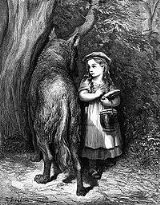
Dore Ridinghood
Little Red Riding Hood is a famous fairy tale
Fairy tale

A fairy tale is a fictional story that may feature folklore characters such as Fairy, goblins, Elf, trolls, giant , and talking animals, and usually enchanted, often involving a far-fetched sequence of events....
 about a young girl's encounter with a wolf. The story has changed considerably in its history, and been subject to numerous modern adaptations and readings.

This story is number 333 in the Aarne-Thompson classification system
Aarne-Thompson classification system

The Aarne-Thompson classification system is a system for Morphology ....
 for folktales.

The tale


The version most widely known today is based on the Brothers Grimm
Brothers Grimm

The Brothers Grimm , Jakob Grimm and Wilhelm Grimm , were Germans academics who were best known for publishing collections of folk tales and fairy tales and for their work in linguistics, relating to how the sounds in words shift over time ....
 variant. It is about a girl called Little Red Riding Hood, after the red hood
Hood (headgear)

A hood is a kind of headgear that covers most of the head and neck and sometimes the face. They may be worn for protection from the environment, for fashion, as a form of traditional Clothing or uniform, to prevent the wearer seeing or to prevent the wearer being identified....
ed cape
Cape

A cape is a type of clothing, and can be used to describe any sleeveless outer garment, such as a poncho, but usually it is a long garment that covers only the back half of the wearer, fastening about the neck....
 or cloak
Cloak

A cloak is a type of loose garment that is worn over indoor clothing and serves the same purpose as an overcoat—it protects the wearer from the cold, rain or wind for example, or it may form part of a fashionable outfit or uniform....
 she wears. The girl walks through the woods to deliver food to her sick grandmother. A wolf wants to eat the girl but is afraid to do so in public. He approaches the girl, and she naïvely tells him where she is going. He suggests the girl pick some flowers, which she does. In the meantime, he goes to the grandmother's house and gains entry by pretending to be the girl. He swallows the grandmother whole, and waits for the girl, disguised as the grandmother. When the girl arrives, he swallows her whole too. A hunter, however, comes to the rescue and cuts the wolf open. Little Red Riding Hood and her grandmother emerge unharmed. They fill the wolf's body with heavy stones, which kill him. Other versions of the story have had the grandmother shut in the closet instead of eaten, and some have Little Red Riding Hood saved by the hunter as the wolf advances on her rather than after she is eaten.

The tale makes the clearest contrast between the safe world of the village and the dangers of the forest
Enchanted Forest

An enchanted forest is a forest under, or containing, Incantations, whether alleged to be real or occurring in magic .There are at least three theme parks in the United States called the Enchanted Forest:...
, conventional antitheses that are essentially medieval, though no versions are as old as that.

Relationship to other tales

The theme of the ravening wolf and of the creature released unharmed from its belly
Stomach

In most mammals, the stomach is a hollow muscular organ of the gastrointestinal tract involved in the second phase of digestion, following mastication....
 is reflected in the Russian tale Peter and the Wolf
Peter and the Wolf

Peter and the Wolf is a composition by Sergei Prokofiev written in 1936 after his return to the Soviet Union. It is a children's story , spoken by a narrator accompanied by the orchestra....
, and the other Grimm tale The Wolf and the Seven Young Kids
The Wolf and the Seven Young Kids

The Wolf and the Seven Young Kids is a German fairy tale collected by the Brothers Grimm, tale number 5....
, but its general theme of restoration is at least as old as Jonah and the whale
Book of Jonah

In the Hebrew Bible, the Book of Jonah is the fifth book in a series of books called the Minor Prophets. Unlike other prophetic books however, this book is not a record of a prophet?s words toward Israel....
. The Theme also appears in the story of the life of Saint Margaret
Margaret the Virgin

Margaret the Virgin, also known as Margaret of Antioch , virgin and martyr, is celebrated by the Roman Catholic Church and Anglican Church Churches on July 20 and July 17 in the Eastern Church....
, where the saint emerges unharmed from the belly of a dragon.

The dialog between the wolf and Little Red Riding Hood has its analogies to the Norse Þrymskviða
Þrymskviða

?rymskvi?a is one of the best known poems from the Poetic Edda. The Norse myth had enduring popularity in Scandinavia and continued to be told and sung in several forms until the 19th century....
 from the Elder Edda; the giant Þrymr had stolen Mjölner, Thor
Thor

Thor is the red-haired and bearded god of thunder in Germanic mythology and Germanic paganism, and its subsets: Norse paganism, Anglo-Saxon paganism and Continental Germanic mythology....
's hammer, and demanded Freyja as his bride for its return. Instead, the gods dressed Thor as a bride and sent him. When the giants note Thor's unladylike eyes, eating, and drinking, Loki
Loki

File:Loke og Sigyn by Eckersberg.jpgIn Norse mythology, Loki is a ?ss or j?tunn . Loki's relation with the gods varies by source. Loki assists the gods, and sometimes causes problems for them....
 explains them as Freyja not having slept, or eaten, or drunk, out of longing for the wedding.

The tale's history


Pre-Perrault

Although no written forms of the tale predate Perrault
Charles Perrault

File:ChPerrault.jpg'Charles Perrault' was a France author who laid foundations for a new literary genre, the fairy tale, and whose best known tales include Le Petit Chaperon rouge , La Belle au bois dormant , Le Ma?tre chat ou le Chat bott? , Cendrillon ou la petite pantoufle de verre , La Barbe bleue , Le Petit Pouce...
, the origins of the Little Red Riding Hood story can be traced to oral versions from various European countries and more than likely preceding the 17th century, of which several exist, some significantly different from the currently-known, Grimms-inspired version. It was told by French
France

France , officially the French Republic , is a country whose Metropolitan France is located in Western Europe and that also comprises various Overseas departments and territories of France....
 peasants in the 14th century as well as in Italy, where a number of versions exist, including La finta nonna (The False Grandmother). It is also possible that this early tale has roots in very similar Oriental tales (e.g. "Grandaunt Tiger").

These early variations of the tale differ from the currently known version in several ways. The antagonist is not always a wolf, but sometimes an ogre or a ‘bzou’ (werewolf
Werewolf

Werewolves, also known as lycanthropes from the Greek ????????p??, ????? and ?????p?? , are Mythology or folklore humans with the ability to shape shifting into Gray Wolf or anthropomorphism wolf-like creatures, either purposely, by being bitten by another werewolf, or after being placed under a curse....
), making these tales relevant to the werewolf-trials (similar to witch trials) of the time (e.g. the trial of Peter Stumpp
Peter Stumpp

Peter Stumpp was a Germany farmer, and alleged serial killer and cannibalism, also known as the "Werewolf of Bedburg"....
). The wolf usually leaves the grandmother’s blood and meat for the girl to eat, who then unwittingly cannibalises her own grandmother. Furthermore, the wolf was also known to ask her to remove her clothing and toss it into the fire. In some versions, the wolf eats the girl after she gets into bed with him, and the story ends there. In others, she sees through his disguise and tries to escape, complaining to her "grandmother" that she needs to defecate and would not wish to do so in the bed. The wolf reluctantly lets her go, tied to a piece of string so she does not get away. However, the girl slips the string over something else and runs off.

In these stories she escapes with no help from any male or older female figure, instead using her own cunning. Sometimes, the red hood is even non-existent.

Charles Perrault

The earliest known printed version was known as Le Petit Chaperon
Chaperon (headgear)

Chaperon was a form of hood or, later, highly versatile hat worn in all parts of Western Europe in the Middle Ages. Initially a utilitarian garment, it first grew a long partly decorative tail behind, and then developed into a complex, versatile and expensive headgear after what was originally the vertical opening for the face began to be u...
 Rouge
and had its origins in 17th century French folklore
Folklore

Folklore is the body of expressive culture, including tales, music, dance, legends, oral history, proverbs, jokes, superstitions, customs, and so forth within a particular population comprising the traditions of that culture, subculture, or group ....
. It was included in the collection Tales and Stories of the Past with Morals. Tales of Mother Goose (Histoires et contes du temps passé, avec des moralités. Contes de ma mère l'Oye), in 1697, by Charles Perrault
Charles Perrault

File:ChPerrault.jpg'Charles Perrault' was a France author who laid foundations for a new literary genre, the fairy tale, and whose best known tales include Le Petit Chaperon rouge , La Belle au bois dormant , Le Ma?tre chat ou le Chat bott? , Cendrillon ou la petite pantoufle de verre , La Barbe bleue , Le Petit Pouce...
. As the title implies, this version is both more sinister and more overtly moralized than the later ones. The redness of the hood, which has been given symbolic significance in many interpretations of the tale, was a detail introduced by Perrault.

The story had as its subject an "attractive, well-bred young lady", a village girl of the country being deceived into giving a wolf she encountered the information he needed to find her grandmother's house successfully and eat the old woman while at the same time avoiding being noticed by woodcutters working in the nearby forest. Then he proceeded to lay a trap for the Red Riding Hood. The latter ends up eaten by the wolf and there the story ends. The wolf emerges the victor of the encounter and there is no happy ending.

Charles Perrault explained the 'moral' at the end so that no doubt is left to his intended meaning:

From this story one learns that children, especially young lasses, pretty, courteous and well-bred, do very wrong to listen to strangers, And it is not an unheard thing if the Wolf is thereby provided with his dinner. I say Wolf, for all wolves are not of the same sort; there is one kind with an amenable disposition — neither noisy, nor hateful, nor angry, but tame, obliging and gentle, following the young maids in the streets, even into their homes. Alas! Who does not know that these gentle wolves are of all such creatures the most dangerous!


In this version the tale has been adapted for late 17th century French salon culture, an entirely different audience from what it had before, and has become a harsh morality tale warning women of the advances of men.

The Brothers Grimm

Grimm
In the 19th century two separate German
Germany

Germany , officially the Federal Republic of Germany , is a country in Central Europe. It is bordered to the north by the North Sea, Denmark, and the Baltic Sea; to the east by Poland and the Czech Republic; to the south by Austria and Switzerland; and to the west by France, Luxembourg, Belgium, and the Netherlands....
 versions were retold to Jacob Grimm
Jacob Grimm

Jacob Ludwig Carl Grimm , German Confederation philologist, jurist and mythology, was born at Hanau, in Hesse-Kassel . He is best known as the discoverer of Grimm's Law, the author of the monumental German Dictionary, his Deutsche Mythologie and more popularly, as one of the Brothers Grimm, as the editor of Grimm's Fairy Tales....
 and his younger brother Wilhelm Grimm
Wilhelm Grimm

Wilhelm Carl Grimm was a German Confederation author, the younger of the Brothers Grimm.He was born in Hanau, Germany and in 1803 he started studying law at the University of Marburg, one year after his brother Jacob Grimm started there....
, known as the Brothers Grimm
Brothers Grimm

The Brothers Grimm , Jakob Grimm and Wilhelm Grimm , were Germans academics who were best known for publishing collections of folk tales and fairy tales and for their work in linguistics, relating to how the sounds in words shift over time ....
, the first by Jeanette Hassenpflug (1791–1860) and the second by Marie Hassenpflug (1788–1856). The brothers turned the first version to the main body of the story and the second into a sequel of it. The story as Rotkäppchen was included in the first edition of their collection Kinder- und Hausmärchen (Children's and Household Tales (1812)).

The earlier parts of the tale agree so closely with Perrault's variant that it is almost certainly the source of the tale. However, they modified the ending; this version had the little girl and her grandmother saved by a huntsman who was after the wolf's skin; this ending is identical to that in the tale The Wolf and the Seven Young Kids
The Wolf and the Seven Young Kids

The Wolf and the Seven Young Kids is a German fairy tale collected by the Brothers Grimm, tale number 5....
, which appears to be the source.

The second part featured the girl and her grandmother trapping and killing another wolf, this time anticipating his moves based on their experience with the previous one. The girl did not leave the path when the wolf spoke to her, her grandmother locked the door to keep it out, and when the wolf lurked, the grandmother had Little Red Riding Hood put a trough under the chimney and fill it with water that sausages had been cooked in; the smell lured the wolf down, and it drowned.

The Brothers further revised the story in later editions and it reached the above mentioned final and better known version in the 1857 edition of their work. It is notably tamer than the older stories which contained darker themes.

After the Grimms


Numerous authors have rewritten or adapted this tale. Andrew Lang
Andrew Lang

Andrew Lang was a prolific Scotland man of letters. He was a poet, novelist, and literary critic, and contributor to anthropology. He now is best known as the folkloristics of folklore and fairy tales....
 included a variant as "The True History of Little Goldenhood" in The Red Fairy Book; he derived it from the works of Charles Marelles, in Contes of Charles Marelles. This variant explicitly said that the story had been mistold. The girl was saved, but not by the huntsman; when the wolf tried to eat her, its mouth was burned by the golden hood she wore, which was enchanted.

James N. Barker wrote a variation of Little Red Riding Hood in 1827 as an approximately 1000-word story. It was later reprinted in 1858 in a book of collected stories edited by William E Burton, called the Cyclopedia of Wit and Humor. The reprint also features a wood engraving of a clothed wolf on bended knee holding Little Red Riding Hood's hand.

In the twentieth century, the popularity of the tale appeared to snowball, with many new versions being written and produced, especially in the wake of Freudian analysis, deconstruction
Deconstruction

Deconstruction is a term used in philosophy, literary criticism, and the social sciences, popularised through its usage by Jacques Derrida in the 1960s....
 and feminist critical theory
Feminist literary criticism

Feminist literary criticism is literary criticism informed by feminist theory, or by the politics of feminism more broadly. Its history has been broad and varied, from classic works of nineteenth-century women authors such as George Eliot and Margaret Fuller to cutting-edge theoretical work in women's studies and gender studies by "third-wa...
. See "Modern uses and adaptations of Little Red Riding Hood" for a number of modern adaptations. This trend has also led to a number of academic texts being written that focus on Little Red Riding Hood, including works by Alan Dundes
Alan Dundes

Alan Dundes, was a folklorist at the University of California, Berkeley. His work was said to have been central to establishing the study of folklore as an academic discipline....
 and Jack Zipes
Jack Zipes

Jack David Zipes is a retired Professor of German at the University of Minnesota whose publications and lectures on fairy tales have transformed research on fairy tales and their linguistics roots and socialization function....
.

Interpretations

George Frederic Watts   Red Riding Hood   Project Gutenberg Etext 17395
Besides the overt warning about talking to strangers, there are many interpretations of the classic fairy tale, many of them sexual. Some are listed below.

Wolf attacks: Ethologist Dr. Valerius Geist of the University of Calgary
University of Calgary

The University of Calgary is a research-intensive public university in Calgary, Alberta, Canada. The University is composed of 24,000 undergraduate and 5,500 graduate students....
, Alberta
Alberta

Alberta is one of Canada Canadian Prairies Provinces and territories of Canada. It became a province on September 1, 1905.Alberta is located in western Canada, bounded by the provinces of British Columbia to the west and Saskatchewan to the east, the Northwest Territories to the north, and the U.S....
 wrote that the fable was likely based on very real events and was not a case of ignorant superstition, contrary to what is claimed by some wolf advocates. The story, he argues, served as a valid warning to parents and children not to enter wolf infested forests and to be on the look out for such. Wolves were an occasional, but widespread threat at the time of the story's genesis, and the society of the day did what they could to minimize the danger, even though controlling wolves was very costly and rarely successful. Even then it was known that wolves did thrive in wilderness settings, and, consequently, that destroying wilderness by turning it into meadows, cultivated fields, orchards, villages and towns robbed the wolf of living space. Wolves and wilderness were treated both as enemies of humanity in that area and time span.

Natural cycles:Folklorists
Folkloristics

Folkloristics is the formal academic study of folklore. What actually constitutes folklore is disputed even within the discipline, but generally folklore focuses on the forms of artistic expression communicated within groups....
 and cultural anthropologists
Cultural anthropology

Cultural anthropology is one of four fields of anthropology as it developed in the United States. It is the branch of anthropology that has developed and promoted "culture" as a meaningful scientific concept, studied cultural variation among humans, and examined the impact of global economic and political processes on local cultural realiti...
 such as P. Saintyves and Edward Burnett Tylor
Edward Burnett Tylor

Sir Edward Burnett Tylor , was an England anthropologist.Tylor is considered representative of cultural evolutionism. In his works Primitive culture and Anthropology, he defined the context of scientific study of anthropology, based on the evolutionary theories of Charles Darwin....
 saw Little Red Riding Hood in terms of solar myths and other naturally-occurring cycles. Her red hood could represent the bright sun which is ultimately swallowed by the terrible night (the wolf), and the variations in which she is cut out of the wolf's belly represent by it the dawn. In this interpretation, there is a connection between the wolf of this tale and Skoll
Skoll

In Norse mythology, Sk?ll is a wolf that chases the horses Arvak and Alsvid, that drag the chariot which contains the sun through the sky every day, trying to eat her....
, the wolf in Norse myth that will swallow the sun at Ragnarök
Ragnarök

In Norse mythology, Ragnar?k is a series of major events, including a great battle foretold to ultimately result in the death of a number of major figures , the occurrence of various natural disasters, and the subsequent submersion of the world in water....
, or Fenris. Alternatively, the tale could be about the season of spring, or the month of May, escaping the winter. This may be as detailed as describing it as the May Queen ritual that represents the coming of Spring, with the crown of flowers replaced by the red hood.

Ritual:The tale has been interpreted as a puberty ritual, stemming from a prehistorical origin (sometimes an origin stemming from a previous matriarchal era.) The girl, leaving home, enters a liminal state and by going through the acts of the tale, is transformed into an adult woman by the act of coming out of the wolf's belly.

Rebirth:Bruno Bettelheim
Bruno Bettelheim

Bruno Bettelheim , a Jewish native of Austria, became known as a child psychology and writer after immigrating as a refugee to the United States in 1939....
, in The Uses of Enchantment, recast the Little Red Riding Hood motif in terms of classic Freudian
Sigmund Freud

Sigmund Freud , born Sigismund Schlomo Freud , was an Austrian psychiatrist who founded the psychoanalysis of psychology. Freud is best known for his theories of the unconscious mind and the defense mechanism of Psychological repression and for creating the clinical practice of psychoanalysis for curing psychopathology through dialogue...
 analysis, that shows how fairy tales educate, support, and liberate the emotions of children. The motif of the huntsman cutting open the wolf, he interpreted as a "rebirth"; the girl who foolishly listened to the wolf has been reborn as a new person.

Prostitution:One of the more common interpretations refers to a classic warning against becoming a "working girl".. This builds off the fundamental "young girl in the woods" stereotype. The red cloak was also a classic signal of a prostitute in 17th century France. A Colombian charity recently used this theme in a poster campaign that showed various fairy tale characters reduced to child labour, including Red Riding Hood as a child prostitute.

Sexual awakening:Red Riding Hood has also been seen as a parable of sexual maturity. In this interpretation, the red cloak symbolizes the blood of the menstrual cycle, braving the "dark forest" of womanhood. Or the cloak could symbolize the hymen (earlier versions of the tale generally do not state that the cloak is red—the word "red" in the title may refer to the girl's hair color or a nickname). In this case, the wolf threatens the girl's virginity. The anthropomorphic wolf symbolizes a man, who could be a lover, seducer or sexual predator. This differs from the ritual explanation in that the entry into adulthood is biologically, not socially, determined.

Spectral Black dog:The tale could be a cultural reference to the black dog
Black dog (ghost)

A black dog is the name given to a spectral being found primarily in the British folklore. The black dog is essentially a nocturnal spectre, often said to be associated with the Devil, and its appearance was regarded as a portent of death....
 phenomenon and be a genuine warning to the children (and adults) of the time. The cloak would be an allusion to the wrapping of the thin wings around the creature's small body.

Norse myth:The story Þrymskviða from the Poetic Edda mirrors some elements of Red Riding Hood. Loki's explanations for "Freya's" (actually Thor's) strange behavior mirror the wolf's explanations for his strange appearance.

The red hood has often been given great importance in many interpretations, with a significance from the dawn to blood. However, the oral version prior to Perrault did not include such a red hood; Perrault introduced it.

Modern uses and adaptations

Lrrh
There have been many modern uses and adaptations of Little Red Riding Hood, generally with a mock-serious reversal of Red Riding Hood's naïveté or some twist of social satire; they range across a number of different media and styles. Multiple variations have been written in the past century, in which authors adapt the Grimms' tale to their own interests.

The tale can be told in terms of Little Red Riding Hood's sexual attractiveness. The song "How Could Red Riding Hood (Have Been So Very Good)?" by A.P. Randolph in 1925 was the first song known to be banned from radio due to its sexual suggestiveness. The 1966 hit song "Lil' Red Riding Hood" by Sam the Sham & the Pharaohs takes the Wolf's point of view, implying that he wants love rather than blood. In the short animated cartoon
Animated cartoon

An animated cartoon is a short, hand-drawn film for the Movie theater, television or computer screen, featuring some kind of story or plot . This is distinct from the term "animation" or "animated film", as not all follow the definition....
 Red Hot Riding Hood
Red Hot Riding Hood

Red Hot Riding Hood is an animated cartoon short subject, directed by Tex Avery and released on May 8, 1943 by Metro-Goldwyn-Mayer. In 1994 it was voted #7 of The 50 Greatest Cartoons of all time by members of the animation field....
 by Tex Avery
Tex Avery

Frederick Bean "Fred/Tex" Avery was an United States animator, cartoonist, voice Actor and film director, famous for producing animated cartoons during The Golden Age of Hollywood animation....
, the story is recast in an adult-oriented urban setting, with the suave, sharp-dressed Wolf howling after the nightclub singer Red. Avery used the same cast and themes in a subsequent series of cartoons. Allusions to the tale can be more or less overtly sexual, as when the color of a lipstick is advertised as "Riding Hood Red".

This sexual analysis may take the form of rape. In Against Our Will, Susan Brownmiller
Susan Brownmiller

Susan Brownmiller is a radical feminism, journalist, and activist. She is best known for her pioneering work on the politics of rape in her 1975 book Against Our Will: Men, Women, and Rape Brownmiller argues that rape had been hitherto defined by men rather than women; and that men use, and all men benefit from the use of, rape as a mea...
 described the fairy tale as a description of rape. Many revisionist retellings depict Little Red Riding Hood or the grandmother successfully defending herself against the wolf.

The story may also serve as a metaphor for a sexual awakening, as in Angela Carter's
Angela Carter

Angela Carter was an England novelist and journalist, known for her feminist, magical realism and science fiction works....
 story "The Company of Wolves", published in her collection The Bloody Chamber
The Bloody Chamber

The Bloody Chamber is an anthology of Short story by Angela Carter. It was first published in the United Kingdom in 1979 in literature by Vintage and won the Cheltenham Festival Literary Prize....
 (1979). (Carter's story was adapted into a film
The Company of Wolves

The Company of Wolves is a 1984 in film gothic fantasy film-horror film directed by Neil Jordan, and starring Sarah Patterson and Angela Lansbury....
 by Neil Jordan
Neil Jordan

Neil Jordan is an Academy Award-winning Ireland filmmaker and novelist. He received the Academy Award for The Crying Game....
 in 1984.) In the story, the wolf is in fact a werewolf
Werewolf

Werewolves, also known as lycanthropes from the Greek ????????p??, ????? and ?????p?? , are Mythology or folklore humans with the ability to shape shifting into Gray Wolf or anthropomorphism wolf-like creatures, either purposely, by being bitten by another werewolf, or after being placed under a curse....
, and comes to newly-menstruating Red Riding Hood in the forest in the form of a charming hunter. He turns into a wolf and eats her grandmother, and is about to devour her as well, when she is equally seductive and ends up lying with the wolf man, her sexual awakening. Such tellings bear some similarity to the "animal bridegroom" tales, such as Beauty and the Beast
Beauty and the Beast

Beauty and the Beast is a traditional fairy tale . The first published version of the fairy tale was a rendition by Madame Gabrielle-Suzanne Barbot de Villeneuve, published in La jeune am?ricaine, et les contes marins in 1740....
 or The Frog Prince
The Frog Prince (story)

The Frog King or Iron Heinrich , also known as The Frog Prince, is a fairy tale, best known through the Brothers Grimm's written version; traditionally it is the first story in their collection....
, but where the heroines of those tales transform the hero into a prince, these tellings of Little Red Riding Hood reveal to the heroine that she has a wild nature like the hero's.

Other cultures' names for Little Red Riding Hood


  • Afrikaans: Rooikappie, meaning Little Red Cap
  • Albanian
    Albanian language

    Albanian is an Indo-European languages spoken by nearly 6 million people, primarily in Albania and Kosovo but also in other areas of the Balkans in which there is an Albanian population, including the west of the Republic of Macedonia, Montenegro, and southern Serbia....
    : Kesulkuqja, meaning 'Red Cap'
  • Arabic
    Arabic language

    Arabic is a Central Semitic language, thus related to and classified alongside other Semitic languages languages such as Hebrew language and Aramaic language....
    : ???? ? ?????, meaning 'Layla and the Wolf'
  • Armenian
    Armenian language

    The 'Armenian language' is an Indo-European language spoken by the Armenians. It is the official language of the Armenia as well as in the region of Nagorno-Karabakh....
    :?????? ??????? ("Karmir glkharky")
  • Basque
    Basque language

    Basque is the language spoken by the Basque people who inhabit the Pyrenees in North-Central Spain and the adjoining region of South-Western France....
    : Txano Gorritxo
  • Bulgarian
    Bulgarian language

    Bulgarian is an Indo-European languages, a member of the Slavic languages linguistic group.Bulgarian demonstrates several linguistic innovations that set it apart from all other Slavic languages except Macedonian language, such as the elimination of grammatical case, the development of a suffixed definite article , the lack of a verb infin...
    : ????????? ??????? (Chervenata shapchitsa), meaning 'The (Little) Red Hat'
  • Catalan
    Catalan language

    Catalan is a Romance languages, the national language and official language of Andorra, and a official language in the Autonomous Communities of Spain of the Balearic Islands, Catalonia and Valencian Community and in the city of Alghero in the Italy List of islands in the Mediterranean of Sardinia....
    : La Caputxeta Vermella
  • Czech
    Czech language

    Czech is a West Slavic language with about 12 million native speakers; it is the majority language in the Czech Republic and spoken by Czech people worldwide....
    : Cervená karkulka
  • Chinese
    Chinese language

    Chinese or the Sinitic language is a language family consisting of language mutually unintelligible to varying degrees. Originally the indigenous languages spoken by the Han Chinese in China, it forms one of the two branches of Sino-Tibetan languages of languages....
    : ???, meaning 'Little Red Hat'
  • Croatian
    Croatian language

    Croatian language is a South Slavic languages which is used primarily in Croatia, by Croats in Bosnia and Herzegovina, in neighbouring countries where Croats are Indigenous peoples, in Italian region of Molise, and parts of the Croats diaspora....
     and Bosnian
    Bosnian language

    Bosnian , sometimes referred as Bosniak/Bosniac language , is a South Slavic languages native to the Bosniaks and all other citizens of Bosnia and Herzegovina who consider it to be their mother tongue....
    : Crvenkapica, meaning 'Little Red Hat'
  • Danish
    Danish language

    Danish is one of the North Germanic languages , a sub-group of the Germanic languages branch of the Indo-European languages. It is spoken by around 6 million people, mainly in Denmark; the language is also used by the 50,000 Danes in the northern parts of Schleswig-Holstein in Germany where it holds the status of minority language....
    : Den lille Rødhætte, meaning 'the Little Redhood'
  • Dutch
    Dutch language

    Dutch is a West Germanic languages spoken by over 22 million people as a first language, and about 5 million people as a second language."1% of the EU population claims to speak Dutch well enough in order to have a conversation." Outside the European Union the number of second language speakers of Dutch is very small. Most native...
    : Roodkapje, meaning 'Little Red Cap'
  • Esperanto
    Esperanto

    is the most widely spoken constructed language international auxiliary language in the world. Its name derives from Doktoro Esperanto, the pseudonym under which L....
    : Rugkufulino
  • Estonian
    Estonian language

    Estonian is the official language of Estonia, spoken by about 1.1 million people in Estonia and tens of thousands in various ?migr? communities....
    : Punamütsike, meaning 'Little Red Hat'
  • Finnish
    Finnish language

    Finnish is the language spoken by the majority of the population in Finland and by Finnish people outside of Finland. It is one of the official languages of Finland and an official minority language in Sweden....
    : Punahilkka, meaning 'Red Hood'
  • French
    French language

    French is a Romance language spoken around the world by around 80 million people as first language, by 190 million as second language, and by about another 200 million people as an acquired tongue, with significant speakers in 54 countries....
    : Le Petit Chaperon rouge, meaning 'the Little Red Hood'
  • Galician
    Galician language

    Galician is a language of the Iberian Romance languages branch, spoken in Galicia , an Autonomous communities of Spain located in northwestern Spain, as well as in small bordering zones in the neighbouring autonomous communities of Asturias and Castile and Le?n and in Northern Portugal....
    : Carapuchiña Vermella
  • Georgian
    Georgian language

    Georgian is the official language of Georgia , a country in the Caucasus .Georgian is the primary language of about 3.9 million people in Georgia itself, and of another 500,000 abroad ....
    : ????????? (tsitel quda), meaning 'Little Red Hat'
  • German
    German language

    German is a West Germanic languages, thus related to and classified alongside English language and Dutch language. It is one of the world's world language and the most widely spoken mother tongue in the European Union....
    : Rotkäppchen, meaning 'Little Red Cap'
  • Greek
    Greek language

    Greek is an Indo-European languages native to the southern Balkan peninsula, the language of the Greek people. It forms an independent branch within Indo-European....
    : ???????s???f?tsa (Kokkinoskoufitsa), meaning 'Little Red Cap'
  • Hebrew
    Hebrew language

    Hebrew is a Semitic languages of the Afro-Asiatic languages. Modern Hebrew is spoken by more than seven million people in Israel and Classical Hebrew is used for prayer or study in Jews communities around the world....
    : ???? ????? (Kippah Addumah), meaning 'Red Cap'
  • Hindi: ????? ?? ?????? (Nanhi Lal Chunni), meaning 'Little Red Cape'
  • Hungarian
    Hungarian language

    Hungarian is a Uralic languages unrelated to most other languages in Europe. It is mainly spoken in Hungary and by the Hungarian minorities in the seven neighbouring countries....
    : Piroska, meaning 'Little Red' also a proper feminine first name
  • Icelandic
    Icelandic language

    Icelandic is a North Germanic languages, the language of Iceland. Its closest relative is Faroese language and Norwegian dialects such as Telemark dialect and Sognam?l....
    : Rauðhetta, meaning 'Red Hood'
  • Indonesian
    Indonesian language

    Indonesian is the official national language of Indonesia. It is based on a version of Malay language from the Riau islands in western Indonesia, today called Riau Indonesian....
    : Gadis Berkerudung Merah, meaning 'Red Hooded Girl'
  • Italian
    Italian language

    Italian is a Romance languages spoken by about 63 million people as a first language, primarily in Italy. In Switzerland, Italian is one of four Linguistic geography of Switzerlands....
    : Cappuccetto Rosso, meaning 'Little Red Hood'
  • Japanese
    Japanese language

    IPA: [n?iho?go] is a language spoken by over 130 million people in Japan and in Japanese emigrant communities. It is related to the Ryukyuan languages....
    : ??? (Aka Zukin), meaning 'Red Hood'
  • Korean
    Korean language

    Korean is the official language of North Korea and South Korea. It is also one of the two official languages in the Yanbian Korean Autonomous Prefecture in People's Republic of China....
    : ?? ?? (Ppalgan moja), meaning 'Red Hat'
  • kurdish
    Kurdish language

    The Kurdish language is a term used for the language spoken by Kurdish people. It is mainly concentrated in the parts of Iran, Iraq, Syria and Turkey....
    : ???? ?????? ???? ??????
  • Latin: Lacernella Rubra, meaning 'Little Red Hood'
  • Latvian
    Latvian language

    Latvian is the official state language of Latvia. Alternative names include Lettish and Lettisch. There are about 1.5 million native Latvian speakers in Latvia and about 150,000 abroad....
    : Sarkangalvite, meaning 'Little Red Head'
  • Lithuanian
    Lithuanian language

    Lithuanian is the official state language of Lithuania and is recognised as one of the official languages of the European Union. There are about 2.96 million native Lithuanian speakers in Lithuania and about 170,000 abroad....
    : Raudonkepuraite, meaning 'Little Red Cap'
  • Norwegian
    Norwegian language

    Norwegian is a North Germanic languages language spoken primarily in Norway, where it is an official language. It is also spoken as a second language among Norwegian-Americans in the United States of America, especially in the central northern states....
    : Rødhette, meaning 'Red Hood'
  • Persian
    Persian language

    name=Persian|nativename=|pronunciation=[f??r'si]|image=|caption=Farsi in Perso-Arabic script |states= Iran, Afghanistan, Tajikistan, Uzbekistan, and Bahrain....
    : ??? ?????, meaning 'Red-caped'
  • Polish
    Polish language

    Polish , an official language of Poland, has the largest number of speakers of any West Slavic languages. Polish-speakers use the language in a uniform manner through most of Poland, and it has a regular orthography....
    : Czerwony kapturek
  • Portuguese
    Portuguese language

    Portuguese is a Romance language that originated in what is now Galicia and Portugal. It is derived from the Latin language spoken by the Romanization Pre-Roman peoples of the Iberian Peninsula around 2000 years ago....
    : Capuchinho Vermelho, meaning 'Little Red Hood'.
  • Portuguese (Brazilian)
    Brazilian Portuguese

    Brazilian Portuguese is a group of Portuguese dialects written and spoken by virtually all the 189 million inhabitants of Brazil and by a few million Brazilian emigrants, mainly in the United States, United Kingdom, Portugal, Canada, Japan and Paraguay....
    : Chapeuzinho Vermelho, meaning 'Little Red Hat'.
  • Romanian
    Romanian language

    Romanian or Daco-Romanian ; self-designation: limba rom?na, ) is a Romance languages spoken by around 24 to 28 million people, primarily in Romania and Moldova....
    : Scufita Rosie meaning 'Little Red Cap'
  • Russian
    Russian language

    Russian is the most geographically widespread language of Eurasia, the most widely spoken of the Slavic languages, and the largest native language in Europe....
    : ??????? ??????? (Krasnaya shapochka), meaning 'Little Red Hat'
  • Serbian
    Serbian language

    name=Serbian|nativename=|pronunciation=['sr?pski?]|familycolor=Indo-European|map=|states=See below under "Official status", besides that in Croatia and as an immigrant's language spread over Central Europe and Western Europe, as well as Northern America...
     and Macedonian
    Macedonian language

    Macedonian is the official language of the Republic of Macedonia and is a part of the Eastern group of South Slavic languages. Macedonian is closely related to and shares a high degree of mutual intelligibility with the Bulgarian language, Serbian language, Bosnian language, and Croatian language languages....
    : ????????? (Crvenkapa), meaning 'Red Hat'
  • Slovak
    Slovak language

    The Slovak language , sometimes incorrectly called ?Slovakian?, is an Indo-European languages that belongs to the West Slavic languages .The Czech and Slovak languages are Mutual intelligibility which means that even after the dissolution of Czechoslovakia Czech may be used in all official proceedings and documents in Slovakia, and vice ver...
    : Cervená ciapocka
  • Slovenian
    Slovenian language

    Slovene or Slovenian is a South Slavic languages spoken by approximately 2.4 million speakers worldwide, the majority of whom live in Slovenia....
    : Rdeca kapica, meaning 'Red (little) Cap'
  • Spanish
    Spanish language

    Spanish or Castilian is a Romance languages that originated in northern Spain, and gradually spread in the Kingdom of Castile and evolved into the principal language of government and trade....
    : Caperucita Roja, meaning 'Little Red Hood'
  • Swedish
    Swedish language

    Swedish is a North Germanic languages language, spoken by around 10 million people, predominantly in Sweden and parts of Finland, especially along the coast and on the ?land islands....
    : Rödluvan, meaning 'The Red Hood'
  • Thai
    Thai language

    Thai , is the national language and official language language of Thailand and the mother tongue of the Thai people, Thailand's dominant ethnic group....
    : ??????????????, meaning 'little girl with red cap'
  • Turkish
    Turkish language

    Turkish is a language spoken by over 63 million people worldwide, making it the most commonly spoken of the Turkic languages. Its speakers are located predominantly in Turkey and Cyprus, with smaller groups in Iraq, Greece, Bulgaria, the Republic of Macedonia, Kosovo, Albania and other parts of Eastern Europe....
    : Kirmizi Baslikli Kiz, meaning 'girl with red cap'
  • Vietnamese
    Vietnamese language

    Vietnamese , formerly known under French colonization as Annamese , is the national language and official language language of Vietnam. It is the mother tongue of the Vietnamese people , who constitute 86% of Demographics of Vietnam, and of about three million overseas Vietnamese, most of whom live in the United States....
    : Cô bé quàng khan d?
  • Welsh
    Welsh language

    Welsh ]], is a member of the Brythonic branch of Celtic languages spoken natively in Wales, in England by some along the Welsh Marches and in the Welsh settlement in Argentina in the Chubut Valley in Argentina Patagonia....
    : Hugan Fach Goch


See also

  • Charles Perrault
    Charles Perrault

    File:ChPerrault.jpg'Charles Perrault' was a France author who laid foundations for a new literary genre, the fairy tale, and whose best known tales include Le Petit Chaperon rouge , La Belle au bois dormant , Le Ma?tre chat ou le Chat bott? , Cendrillon ou la petite pantoufle de verre , La Barbe bleue , Le Petit Pouce...
  • Brothers Grimm
    Brothers Grimm

    The Brothers Grimm , Jakob Grimm and Wilhelm Grimm , were Germans academics who were best known for publishing collections of folk tales and fairy tales and for their work in linguistics, relating to how the sounds in words shift over time ....
  • Big Bad Wolf
    Big Bad Wolf

    The Big Bad Wolf is a term used to describe a fictional wolf who appears in several precautionary folkloric stories, including some of Aesop's Fables and Grimm's Fairy Tales....


External links

  • - created by Jan Hogan and held by the Australian Library of Art, State Library of Queensland
  • - a thorough article on the history of LRRH.
  • - a shorter article on the history of LRRH (by the author of a book on subject).
  • - an article concerning different stories and images of LRRH.
  • The Disney version of at