
Encyclopedia
The Simpsons is an
Emmy and Peabody-winning
American animated sitcom created by
Matt Groening for the
Fox Network, becoming one of the first hits for the network, and is one of the most successful television shows ever produced. The television series is a spin-off of a series of
animated shorts originally aired on
The Tracey Ullman Show was a weekly American [i] television [i] variety show [i], host ...
. The series is a
satirical parody of the "Middle American" lifestyle epitomized by its
title family. It lampoons many aspects of the human condition, as well as
American culture,
society as a whole and even
television itself, being famous for its frequent use of self-referential humor, and meta-references.
The Simpsons has also had a significant influence on post-Cold War popular culture. Many of its catchphrases have become famous, and the show has also been cited as an influence on many adult-oriented animated series in the late 1990s, such as
South Park is a Peabody [i] and Emmy Award [i]-winning American [i] animated television series [i]...
and
Family Guy is an American [i] animated comedy [i] created b ...
.
The Simpsons is the longest-running American
sitcom, and the longest-running American animated program, to date. The eighteenth-season finale will be the 400
th episode, and the 20
th anniversary of
The Simpsons franchise will be celebrated in 2007. Although a number of fans accuse it of declining in quality, it has still remained a highly-rated show. A
feature-length movie is now being produced, to be released on July 27, 2007.
Production
Origins
Groening first conceived of the Simpsons in the lobby of
James L. Brooks' office. He had been called in to pitch a series of animated shorts, and had intended to pitch his
Life in Hell is a weekly comic strip [i] by Matt Groening [i]. ...
series. When he realized that animating
Life in Hell would require him to rescind publication rights for his life's work, Groening decided to go in another direction. He hurriedly sketched out his version of a dysfunctional family. He named the characters after his own family, choosing "Bart" since it is an anagram of "brat."
The
Simpson family first appeared in animated form as shorts on
The Tracey Ullman Show, with the first short, "Good Night," airing on April 19, 1987. The family was crudely drawn, because Groening only handed over sketches to the animators, believing that they would clean them up, but instead they just traced over his drawings. Some of the shorts, including "Good Night," were later included in the "
The Simpsons 138th Episode Spectacular" episode.
In 1989,
The Simpsons was adapted into a half-hour series for the
Fox network by a team of production companies that included what is now the
Klasky Csupo animation house. Due to the fledgling position of the Fox network, Jim Brooks obtained an unusual contractual provision that the network could not interfere by providing show notes.Groening has been quoted as saying that his goal in creating the show was to "offer an alternative to the audience, and show them there's something else out there than the mainstream trash that they are presented as the only thing." The first full length episode shown was "
Simpsons Roasting on an Open Fire," in place of the intended first episode, "Some Enchanted Evening." The latter was rejected after the creators saw the poor quality of the final animation that was returned to them. They had the episode reanimated, and Fox aired "
Simpsons Roasting on an Open Fire" first.
The Simpsons was one of the first true hit TV series for the Fox network; it was the first Fox show to appear in the top thirty highest-rated shows of the season. The show had several episodes watched by over 20 million people and on occasion over 30 million people. Ullman filed a lawsuit, claiming that her show was the source of the
The Simpsons success and therefore should receive a share of the show's profit. Eventually the courts ruled in favor of the network.
It also sparked controversy, as
Bart Simpson was portrayed as a rebel who caused trouble and got away with it. Parents' groups and conservative spokespersons felt that a character like Bart provided a poor role model for children.
George H. W. Bush railed, "We're going to keep trying to strengthen the American family. To make them more like
The Waltons and less like The Simpsons."
The Simpsons t-shirts, among others, one featuring Bart with the legend "Underachiever " and other merchandise were banned from some public schools in several areas of the
United States. As the revenue generated by the show continued to increase through syndication and DVD sales, the main cast stopped showing up for script readings in April 2004 after weeks of unsuccessful negotiations with Fox. They asked for $360,000 per episode, or $8 million for a 22-episode season. On May 2, 2004, the actors resolved their dispute with Fox after reaching an agreement.
Writing
The writing team divides seasons into two parts. For each half season there will be developed and pitched approximately 16 story ideas. These are mostly written by one or two writers. The 16 story ideas get developed into 12 scripts. Since it takes six to eight months to produce an episode of
The Simpsons, it is not possible to comment on current events.
The final scripts are developed during group rewriting sessions. In those sessions they can add and delete jokes, insert scenes, and call for rereadings of lines by the show’s company of vocal performers. The leader of those sessions is
George Meyer, who has been with the show since the beginning. Long time writer Jon Vitti explains that even though he will get the script credit for an episode the best quotes are usually made by George Meyer.
John Swartzwelder is the most prolific writer on
The Simpsons staff, personally writing 59 episodes. Another notable writer was Conan O’Brien, who wrote four scripts before he became the host of
Late Night with Conan O'Brien is an American [i] late night [i] ...
. English comedian
Ricky Gervais is the only celebrity ever to have guest written an episode, although there have been other guest writers, such as Spike Feresten, a
Seinfeld is an American [i] television [i] situation comedy [i] set in New York City [i] ...
writer famous for "
The Soup Nazi" episode.
The writing staff has included a significant number of Harvard University alumni, and the school is often referenced in the series. Conan O'Brien once served as the president of the Harvard Lampoon and Bill Oakley once served as vice president.
Animation
The Simpsons has been animated by many different studios over the past 18 years, both domestic and overseas. Throughout the run of the animated shorts on
The Tracey Ullman Show, the animation was solely produced domestically at
Klasky Csupo. Klasky Csupo was also the animation studio during the first three seasons of the half-hour series. However, due to the increased workload, production was being subcontracted to overseas studios, usually in
South Korea. While character and background layout is done by the domestic studio, inbetweening, coloring and filming is done by the overseas studios. Throughout the years, different overseas studios have animated different episodes, even episodes within the same season.
During season four,
Gracie Films made a decision to switch domestic production to
Film Roman, which continues to animate the show to this day. The last episode to be animated by Klasky Csupo was "
Kamp Krusty", in production order.
After season 13, production was switched from traditional
cel animation to
digital ink and paint. The first episode to experiment with digital coloring was "Radioactive Man" in 1995, and again during season 12 with the episode "
Tennis the Menace", but after seeing the results, Gracie Films decided to hold off for two more seasons. "Tennis the Menace," being already completed, was broadcast this way.
Broadcasting
Original episodes of
The Simpsons are shown on the Fox network in the United States, and are widely distributed internationally. Past seasons have also been widely
syndicated since 1994. In foreign countries, it is sometimes necessary to adjust the material to suit local culture or humor.
Arabic-speaking countries are an example of this, in which they cut out or modify references to
alcohol,
pork and non-
Muslim religions. The
animation in The Simpsons makes the show more frequently dubbed in foreign countries rather than
subtitled.
Characters
The title family
The main characters were originally created by Groening as part of a series of original animated segments for
the Tracey Ullman Show was a weekly American [i] television [i] variety show [i], host ...
. Lisa, Maggie, Marge and Homer share names with Matt Groening's sisters, mother and father respectively. Bart, however, is an anagram for brat, with Groening having stated that he thought naming the boy "Matt" would be too obvious.
Homer Simpson is a safety inspector at the
Springfield Nuclear Power Plant and a generally well-meaning
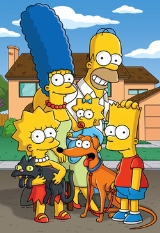
buffoon whose short attention span often draws him into outrageous schemes and adventures. Marge Simpson is for the most part a stereotypical housewife and mother. Bart Simpson is a ten-year-old troublemaker who thinks of himself as a rebel. Lisa Simpson is an extremely intelligent, often-activistic middle child who is eight years old. Maggie Simpson is a baby who, for the most part, simply sucks on a
pacifier and doesn't speak except in the episode
Lisa's First Word. Despite the fact that numerous yearly milestones, such as holidays and birthdays, clearly pass, the Simpsons do not physically age, indicating some form of a floating timeline. Nevertheless, their rich body of experiences has formed significant character growth.
The Simpson lifestyle was initially fairly consistent with a one-income, middle class family. For example, in the first season episode "
There's No Disgrace Like Home", Homer must pawn the family’s rabbit-eared television for $250 to afford a family therapy session. In other early episodes, Homer can only afford a very low-quality used RV, can't afford cable television, and must scrimp and save to get the family dog a $750 life-saving operation. As the seasons have progressed, however, the lifestyle has been shown to be more flexible to the needs of any given episode or comedic situation. In one sixth season episode, Homer pulls $1,100 out of his wallet to exchange for
Itchy & Scratchy Money, and in a seventh season episode, "
The Day the Violence Died", he pulls out $750 to give to Bart. The family now often makes extravagant purchases or vacations with little or no regard to cost, while at other times they still have financial problems. The Simpsons go several years into the Internet age before acquiring a computer, perhaps reflecting the reluctance to modernize the show's floating timeline. They almost always wear the same clothes.
Throughout the series, the Simpson family's religion has been a form of Protestant
Christianity. The most important deviation from this came when Lisa became
Buddhist in the episode
She of Little Faith and when Bart and Homer became Catholic in the episode
The Father, the Son, and the Holy Guest Star, which did not "revert" at the end of those episodes.
Secondary characters
The show also has a vast array of quirky supporting characters, including co-workers, teachers, family friends, extended relatives, and local celebrities. Originally, many of these characters were planned as one-shot jokes, or to fill a function in the town; a number of them gained expanded roles, and some have subsequently been the subject of their own episodes. Many have developed a vast cult following of their own and serve to represent facets of the American society that the show scathingly critiques.
Setting
The Simpsons is set in a fictional American city of Springfield. The state in which it is located has never been made clear, and it is not actually intended to exist in any specific state. Nevertheless, throughout the show's history, fans have tried to determine where Springfield is by taking the town's characteristics, surrounding
geography and nearby landmarks as clues. As a response, in more recent episodes, the show has been intentionally deceptive about the state, and nearly every state and region in the U.S. has been both suggested and ruled out by conflicting "evidence". Groening has stated that Springfield has much in common with
Portland, Oregon, the city he grew up in, and the name "Springfield" was chosen because it is a common city name, appearing in more than thirty states. The geography of Springfield and its surrounding areas are seen to be "flexible" and have been shown to contain coastlines, deserts, vast farmland, and tall mountains, or whatever a story or joke requires.
Storylines
Themes
The show routinely mocks and satirizes show business conventions and personalities. Krusty the Klown has an enthusiastic following among Springfield's kids, but offstage he is a jaded, cynical hack, in poor health from a long history of overindulgence, gambling and substance abuse. He will endorse any product for a price.
Kent Brockman is a self-important, spoiled TV news anchorman with little regard for journalistic ethics. Even
Rupert Murdoch, whose corporate empire includes The Simpsons broadcasting network, has been spoofed in a couple of episodes. In fact, ridiculing the Fox network has become a running joke.
The show has been rife with political
satire over the years, often lampooning current and former U.S. presidents as well as other world leaders. Some examples include:
George H. W. Bush was portrayed as a cantankerous nemesis to Homer in
Two Bad Neighbors;
Al Gore's seemingly banal personality being ridiculed;
Bill Clinton claiming to have engaged in
bestiality in
Homer to the Max; and the
United Nations frequently shown to be an incompetent and bickering organization.
Some social conservatives have come to embrace the show. One of the main explanations is that
The Simpsons portrays a traditional nuclear family among a lineup of television sitcoms that portray less traditional ones. The show has toyed with the possibility of extramarital affairs, such as when Homer falls for a female nuclear technician who shares his love of donuts, or when Marge's ex-boyfriend
Artie Ziff tries to rekindle their old romance. Nevertheless, these affairs are never consummated, and by the end of every episode, Homer and Marge's marriage is strongly affirmed. Social conservatives and some evangelical Christians have also pointed to the positive role model of devout Christian Ned Flanders, whose fretfulness is occasionally ridiculed but whose decency never wavers despite constant provocation from Homer. In several episodes, God actually intervenes to protect the Flanders family, invoking such Protestant concepts as Predestination. As compared with the Simpson family, the Flanders family is relatively well-off and less dysfunctional, although they are quirky in their own way, with over-the-top devotion and their fundamentalist interpretations of the Bible.
Plots
The format of the plot of an episode of
The Simpsons has changed somewhat over the years. A character or group of characters or sometimes the whole town is usually placed in a problematic situation which they must solve or learn to accept. Initially, these situations were usually simple, realistic moral or social situations with realistic resolutions, similar to standard sit-com plots. For example, in an episode from season one, Bart is being beaten up by a bully and must stand up for himself. Subsequent plots have tended to be much less ordinary, and increasingly often, less realistic.
Besides decreasing realism, as the show progressed, it became increasingly common to have the main plot issue result from a relatively unrelated first act scenario. For example, in "
Hurricane Neddy", the entire first act revolves around a hurricane hitting Springfield in a scenario reminiscent of the movie
Twister; only at the first act break do we learn that Ned Flanders’ house has been destroyed, leading to the episode's main plot of Flanders having a mental breakdown. The description of the 2003 episode "
Dude, Where's My Ranch?" offered to
Shaw Cable subscribers reads: "After David Byrne turns Homer's anti-Ned Flanders song into a monster hit, the family vacations at a dude ranch, where Lisa falls in love". This is commonly termed “plot drift”.
It also became increasingly common for the resolution of the episode to be secondary to the humor of the situation itself, often leading to a convenient deus ex machina ending. Episodes "
Homer vs. the Eighteenth Amendment" and "
The Principal and the Pauper" are two examples of this.
Originally, major changes in
The Simpsons universe would generally be undone by the end of an episode. Occasionally, more in recent episodes, the writers have allowed some plot points to become permanent, including certain
deaths, births, and marriages.
There is also another plot structure that is sometimes used. This structure is comprised of three short stories, often with an overarching story that “bookends” the segments. It is mostly used in the
The Simpsons Halloween episodes, but is also sometimes used for regular episodes; typically when redoing classic stories with the Simpsons characters.
The plots of many episodes focus on one particular character, or the relationship between two characters. Common plots have involved: Homer getting a
new job or attempting a get-rich-quick scheme; Marge attempting to escape the monotony of keeping house by finding employment or taking up a hobby; Bart causing a large problem and attempting to fix it, cover it up, or ignore it entirely; Lisa embracing or advocating the merits of a particular cause or group. Episodes have also focused on the problems of secondary or tertiary characters, which is usually solved with the help of a member of the Simpson family.
When the whole family is part of the plot, they will often go on vacation. This has recurred often enough that it is self-parodied with Homer saying, "The Simpsons are going to !" whenever they go on a trip. With all the vacations the Simpsons have been on, they have visited every
continent on
Earth except
Antarctica.
Hallmarks
Opening sequence
The Simpsons opening sequence is one of the show's most memorable hallmarks. Almost every episode opens with the camera zooming through the show's title towards the town of Springfield. Then we follow the members of the family on their way home. Upon entering their house, they settle down on their
couch to watch television. The series' distinctive theme song was composed by musician
Danny Elfman in 1989, after Groening approached him requesting a "retro" style piece. Elfman recognizes this piece, which took two days to create, as the most popular of his career, and every time the Simpsons theme is broadcast on television he receives a sum of money which has been alleged to be as much as $11.
One of the most unique aspects of the opening is that there are several segments that are changed from episode to episode. Bart writes something different on the chalkboard. Lisa sometimes plays a different solo on her baritone
saxophone and something different happens when the family enters the living room to sit on the couch. The latter is often the only one of the three gags to survive the process of shortening the opening for some syndicated episodes and for later episodes which needed extra time.
Halloween episodes
An annual tradition is a special
Halloween episode consisting of three separate, self-contained pieces. These pieces usually involve the family in some
horror,
science fiction, or supernatural setting and often parodies or pays homage to a famous piece of work in those genres; they always take place outside the normal continuity of the show. Although the
Treehouse series is meant to be seen on Halloween, in recent years new installments have premiered
after Halloween. This is due to Fox's current contract with
Major League Baseball's
World Series.
Recurring jokes and catch phrases
There are many running gags on
The Simpsons, many of which have been retired during the series. The Simpsons has perhaps most entered the public consciousness in the form of the numerous catch phrases of its characters.
Such catch phrases include Homer's famous annoyed grunt "
D'oh!", Mr. Burns' "Excellent..." and Nelson Muntz's "
Ha-ha!". An interesting phenomenon occurred with Bart's catchphrases. His now trademark "¡Ay, caramba!", "Don't have a cow, man!" and "Eat my shorts!" were featured on t-shirts in the early days of the show's run; however, the latter two phrases were rarely actually spoken on the show itself until after they became popular through merchandise. However, the use of many of these catchphrases has declined in recent seasons.
Recurring jokes were more prominent in the early seasons of the show. In one infamous example, Bart often made prank calls to Moe's Tavern asking for someone with a suggestive name such as "Amanda Huggankiss", "Al Coholic", "Seymore Butts" or "Mike Rotch". Another is the Krusty Brand - a line of often poorly made and potentially dangerous products endorsed by Krusty the Clown, who will apparently endorse almost anything.
The show has been known for both sign gags and so-called
VCR gags. A sign gag is a text sign on the show that has amusing content. The names of commercial establishments, and the message signs in front of the school or church are common forums for sign gags. Writers on the DVD commentaries have indicated that they often spent more time trying to come up with these sign gags than anything else in the episodes. The show premiered in the prime of the popularity of VCRs, and being animated, the writers made frequent use of what they termed VCR gags or freeze frame gags. These are images that are on the screen too briefly to be identified normally, but would be visible if a viewer recorded the show and paused at the appropriate frame. Freeze frame gags often included sign gags.
Guest stars
Many episodes feature celebrity guests contributing their voices to the show, as either themselves or as fictional characters. Guests playing themselves were especially used during seasons 7-13; often as a cameo without a significant plot connection. Guests playing fictional characters were mostly used for other seasons. In the early seasons some celebrities, such as
Michael Jackson and
Dustin Hoffman, would guest star using a pseudonym.
Cultural impact
Impact on language
Many of the characters, concepts and catchphrases from
The Simpsons have become common knowledge in modern society. A number of neologisms originated on
The Simpsons have become a part of the universal lexicon, the most famous of which is Homer's saying: "D'oh!," which is referred to in scripts, as well as four episode names, as "annoyed grunt". So ubiquitous is the catchphrase that it is now listed in the
Oxford English Dictionary, but without the apostrophe. "D'oh" is the accepted spelling, and is certainly the most common; the
closed captions for the program , however, spell it "D-OHH". A much earlier use of the same expression, often similarly used to denote expectation, was established in the long-running
BBC radio series The Archers, where it was used, almost as a catch-phrase, by the character 'Walter Gabriel' . Dan Castellaneta has explained that he borrowed the phrase from
James Finlayson, an actor in early
Laurel and Hardy comedies, who pronounced it more stretched-out and whiny. Castellaneta was told by the show's director to shorten the noise, leading to the famous grunt in the TV series.
Other
Simpsons expressions that have entered into popular use include the word "excellent" — drawn out as a sinister and nasal "eeeexcelllent…" in the style of Montgomery Burns — Homer's triumphant "Woohoo!" and Nelson Muntz's mocking "HA-ha!".
Groundskeeper Willie's description of the
French as "cheese-eating surrender monkeys" was used by conservative
National Review is a biweekly magazine [i] of political opinion, founded by author William F. Buckley Jr. [i] ...
columnist Jonah Goldberg, a fan of the show, in 2003, after France's opposition to the proposed
invasion of Iraq, and quickly spread to other journalists. .
The character Waylon Smithers is another example of cultural impact. Since the debut of the show, the term "Smithers" has become a common eponym for a spineless underling. The show's creators also take pride in having passed on schoolyard rhymes to a new generation of children who otherwise may not have heard them.
Impact on television
The Simpsons was the first animated program in prime time since the
The Flintstones, an American [i] animated television series [i] produced by Hanna-Barbera Productions [i] ...
era. During most of the 1980s, animated shows were seen as being for kids and the animation was too expensive to get quality suitable for prime time television.
The Simpsons changed this perception. The use of
Korean animation studios doing inbetweening, coloring and filming made the episodes cheaper. The success of
The Simpsons and the lower production cost made television networks take chances on other animated series. This led to a boom in new animated shows for prime time in the 1990s, such as
South Park is a Peabody [i] and Emmy Award [i]-winning American [i] animated television series [i]...
,
Family Guy is an American [i] animated comedy [i] created b ...
,
King of the Hill is a satirical American [i] animated television series [i] created by ...
,
Futurama is an American [i] animated television series [i] that follows Philip J. Fry [i] ...
and
The Critic was an American [i] animated series [i] that was originally broadcast on ABC [i] ...
- the latter three all having former or then-current Simpsons writers/producers as their creators, and the latter four all appearing on Fox .
The Simpsons also had an impact on live-action shows.
Malcolm in the Middle was an American situation comedy [i] created by Linwood Boomer [i] for the Fox Network [i] ...
, which debuted January 9, 2000 in the time slot right after
The Simpsons, was largely inspired by this show. The actors acted like they were cartoon characters. It featured some of the same editing, the use of sight gags and it did not use a laugh track like most
sitcoms.
Impact on music
Several bands have names referencing themes, characters, or places from
The Simpsons. Some examples are Noiseland Arcade,
I Voted For Kodos, Evergreen Terrace, Daddy's Soul Donut,
Jebediah, The Canyoneros, Pinmonkey,
Fall Out Boy, Vote Quimby, Stupid Sexy Flanders,
Hot Rod Circuit, Poindexter, Maggie Speaks, Malibu Stacy, Worker & Parasite, and Laszlo Panaflex. The Bloodhound Gang made an entire song using only Ralph Wiggum quotes. On the album
Bite Back: Live At The Crocodile Cafe the
Built to Spill song
Big Dipper is credited as
Allen the Cowboy.
Critical reactions and achievements
Awards
The Simpsons has won dozens of awards since it debuted as a series, including 23
Emmy Awards, 22 Annie Awards and a Peabody. On January 14, 2000 the Simpsons were awarded a star on the
Hollywood Walk of Fame.
In its 1998 issue celebrating the greatest achievements in arts and entertainment of the 20th century,
Time magazine named
The Simpsons the century's best television series. In that same issue, Bart Simpson was named to the
Time 100, the publication's list of the century's 100 most influential people. He was the only fictional character on the list. In 2002, it made the top 10 on
TV Guide's list of the greatest shows of all time. In 2000,
Entertainment Weekly is a magazine [i] published by Time Inc. [i] in the United States [i] which foc ...
magazine TV critic Ken Tucker named
The Simpsons the greatest television show of the 1990s. Furthermore, UK Television channel 4's internet viewers voted the "The Simpsons" the greatest kids cartoon series, beating Tom and Jerry.
Run length achievements
On February 9, 1997
The Simpsons surpassed
The Flintstones, an American [i] animated television series [i] produced by Hanna-Barbera Productions [i] ...
with the episode, "
The Itchy & Scratchy & Poochie Show" as the longest-running prime time animated series in America. In 2004 it replaced
The Adventures of Ozzie and Harriet, an American [i] radio [i] and television series [i] ...
as the longest-running sitcom, animated or live action, ever in the United States. In April 2005,
Scooby-Doo was cancelled again, finishing with 371 episodes, while
The Simpsons reclaimed the title with 378 episodes as of the end of their seventeenth season.
Scooby-Doo has been renewed again under a new name, airing on
Kids WB in 2006, giving it another chance to catch up to
The Simpsons. It must be noted, however, that
Scooby-Doo has experienced several incarnations, each one arguably a separate show; while The Simpsons record comes as a continuous production.
2007 will mark the 20th anniversary of the Simpsons franchise, since the show originally began as skits on the
Tracy Ullman Show in 1987.
With its nineteenth season , through which the show was renewed in 2006, the series will be one season behind
Gunsmoke was a long-running American [i] old-time radio [i] and television [i] Western [i] ...
's US entertainment record of 20 produced seasons; however,
Gunsmoke's episode count of 635 episodes far surpasses
The Simpsons, which would not reach that mark until its twenty-ninth season, under normal season lengths.
The Simpsons holds three other records. As it is technically a spin-off of
The Tracey Ullman Show that makes it the longest-running American TV spinoff. It also features the longest-running unaltered television series opening credit sequence . It is also the longest-running series to have never experienced either a major change in cast members or the addition/removal of major characters .
While
The Simpsons has a record number of episodes for an
American animated show, some foreign animated shows, especially
Japanese anime series like
Dragon Ball and
Pokémon, have hundreds or even thousands of episodes –
Doraemon has over 2,000 episodes. Another anime series,
Case Closed, also known as in Japan [i] and other countries, is a detective [i] manga [i] ...
has slightly more episodes than
The Simpsons despite premiering seven years later.
Criticism of declining quality
For many years, most critics' reviews of new
Simpsons episodes praised the show for its wit, realism, and intelligence.
In 2003, to celebrate the show's 300th episode "
Barting Over,"
USA Today is a national American [i] newspaper [i] published by the Gannett Corporation [i] ...
published a pair of Simpsons related articles: a top-10 episodes list chosen by webmaster of The Simpsons Archive fansite, and a top-15 list by The Simpsons own writers. The most recent episode listed on the fan list was 1997's "
Homer's Phobia"; the Simpsons' writers most recent choice was 2000's "
Behind the Laughter." In 2004,
Harry Shearer criticized the show's sliding quality in an interview: "I rate the last three seasons as among the worst, so Season 4 looks very good to me now." In April 2006,
The Onion A/V Club is an entertainment newspaper and website published by
The Onion [i]. ...
published a feature article on the best quotes from
The Simpsons; the most recent entry on the list was from 1999's "
Mom and Pop Art."
In recent seasons, several characters have radically transformed, leaving many fans incredulous—Barney became sober, Homer acted more unintelligent and aloof than ever , and Bart became fanatically religious. Consistency has suffered for these changes—for instance, Bart did not stay devout after "
The Father, the Son, and the Holy Guest Star," and Barney oscillates between sobriety and his once-former alcoholism.
Despite this criticism,
The Simpsons has managed to maintain an audience and attract new fans, although the first season had an average of 13.4 million viewers, However, despite all that, Matt Groening has recently decided that there is no end in sight for
The Simpsons: "As long as we have fun doing the show, I don't see the show ending any time soon."
Publications
There have been made numerous Simpson-related publications over the years. Several comic book series have been published by
Bongo Comics since 1993.
The Simpsons,
Futurama is an American [i] animated television series [i] that follows Philip J. Fry [i] ...
, and
Bart Simpson comics are also reprinted in the
UK, under the same titles, with various stories from the other Bongo series reprinted in the main Simpsons comic. The comics have also been collected in book form; many other
Simpsons books such as episode guides have also been published.
Music is prominently featured in
The Simpsons, with virtually all members of the cast breaking into song at least once during the course of the series. Perhaps the best known song is "Do The Bartman," which was released as a single and became an international success.
The Simpsons Sing the Blues is the 1990 [i] album released as an offshoot of
The Simpsons [i].
...
and
The Yellow Album is the 1998
Simpsons [i] album released as a follow up to the 1990 ...
contained cover versions of songs, as well as some originals .
Songs in the Key of Springfield and
Go Simpsonic with The Simpsons are
CD collections of original music featured in the TV series.
The Simpsons has also been used to make special editions of well known games, including
Clue,
Scrabble,
Monopoly