


Vestal Virgin

Encyclopedia
Religion in ancient Rome
Religion in ancient Rome encompassed the religious beliefs and cult practices regarded by the Romans as indigenous and central to their identity as a people, as well as the various and many cults imported from other peoples brought under Roman rule. Romans thus offered cult to innumerable deities...
, the Vestals or Vestal Virgins (Vestales, singular Vestalis), were priestesses of Vesta, goddess
Goddess
A goddess is a female deity. In some cultures goddesses are associated with Earth, motherhood, love, and the household. In other cultures, goddesses also rule over war, death, and destruction as well as healing....
of the hearth
Sacred fire of Vesta
The sacred fire of Vesta was a holy fire in Ancient Rome. The Vestal Virgins were selected by lot and served for thirty years, tending the holy fire and performing other rituals connected to domestic life—among them were the ritual sweeping of the temple on June 15 and the preparation of...
. The College
Collegium (ancient Rome)
In Ancient Rome, a collegium was any association with a legal personality. Such associations had various functions.-Functioning:...
of the Vestals and its well-being was regarded as fundamental to the continuance and security of Rome
Ancient Rome
Ancient Rome was a thriving civilization that grew on the Italian Peninsula as early as the 8th century BC. Located along the Mediterranean Sea and centered on the city of Rome, it expanded to one of the largest empires in the ancient world....
, as embodied by their cultivation of the sacred fire that could not be allowed to go out. The Vestals were freed of the usual social obligations to marry and bear children, and took a vow of chastity
Chastity
Chastity refers to the sexual behavior of a man or woman acceptable to the moral standards and guidelines of a culture, civilization, or religion....
in order to devote themselves to the study and correct observance of state rituals that were off-limits to the male colleges of priests.
History
LivyLivy
Titus Livius — known as Livy in English — was a Roman historian who wrote a monumental history of Rome and the Roman people. Ab Urbe Condita Libri, "Chapters from the Foundation of the City," covering the period from the earliest legends of Rome well before the traditional foundation in 753 BC...
, Plutarch
Plutarch
Plutarch then named, on his becoming a Roman citizen, Lucius Mestrius Plutarchus , c. 46 – 120 AD, was a Greek historian, biographer, essayist, and Middle Platonist known primarily for his Parallel Lives and Moralia...
and Aulus Gellius
Aulus Gellius
Aulus Gellius , was a Latin author and grammarian, who was probably born and certainly brought up in Rome. He was educated in Athens, after which he returned to Rome, where he held a judicial office...
attribute the creation of the Vestals as a state-supported priesthood
Collegium (ancient Rome)
In Ancient Rome, a collegium was any association with a legal personality. Such associations had various functions.-Functioning:...
to king Numa Pompilius
Numa Pompilius
Numa Pompilius was the legendary second king of Rome, succeeding Romulus. What tales are descended to us about him come from Valerius Antias, an author from the early part of the 1st century BC known through limited mentions of later authors , Dionysius of Halicarnassus circa 60BC-...
, who traditionally reigned circa 717–673 BC. Livy says that Numa introduced the Vestals and assigned them salaries from the public treasury
Aerarium
Aerarium was the name given in Ancient Rome to the public treasury, and in a secondary sense to the public finances....
. Livy also says that the priesthood of Vesta had its origins at Alba Longa
Alba Longa
Alba Longa – in Italian sources occasionally written Albalonga – was an ancient city of Latium in central Italy southeast of Rome in the Alban Hills. Founder and head of the Latin League, it was destroyed by Rome around the middle of the 7th century BC. In legend, Romulus and Remus, founders of...
. The 2nd- century antiquarian
Antiquarian
An antiquarian or antiquary is an aficionado or student of antiquities or things of the past. More specifically, the term is used for those who study history with particular attention to ancient objects of art or science, archaeological and historic sites, or historic archives and manuscripts...
Aulus Gellius writes that the first Vestal taken from her parents was led away in hand by Numa. Plutarch attributes the founding of the Temple of Vesta
Temple of Vesta
The Temple of Vesta is an ancient edifice in Rome, Italy, located in the Roman Forum near the Regia and the House of the Vestal Virgins. The temple's most recognizable feature is its circular footprint. Since the worship of Vesta began in private homes, the architecture seems to be a reminder of...
to Numa, who appointed at first two priestesses; Servius Tullius
Servius Tullius
Servius Tullius was the legendary sixth king of ancient Rome, and the second of its Etruscan dynasty. He reigned 578-535 BC. Roman and Greek sources describe his servile origins and later marriage to a daughter of Lucius Tarquinius Priscus, Rome's first Etruscan king, who was assassinated in 579 BC...
increased the number to four. Ambrose
Ambrose
Aurelius Ambrosius, better known in English as Saint Ambrose , was a bishop of Milan who became one of the most influential ecclesiastical figures of the 4th century. He was one of the four original doctors of the Church.-Political career:Ambrose was born into a Roman Christian family between about...
alludes to a seventh in late antiquity
Late Antiquity
Late Antiquity is a periodization used by historians to describe the time of transition from Classical Antiquity to the Middle Ages, in both mainland Europe and the Mediterranean world. Precise boundaries for the period are a matter of debate, but noted historian of the period Peter Brown proposed...
. Numa also appointed the pontifex maximus
Pontifex Maximus
The Pontifex Maximus was the high priest of the College of Pontiffs in ancient Rome. This was the most important position in the ancient Roman religion, open only to patricians until 254 BC, when a plebeian first occupied this post...
to watch over the Vestals. The first Vestals, according to Varro
Marcus Terentius Varro
Marcus Terentius Varro was an ancient Roman scholar and writer. He is sometimes called Varro Reatinus to distinguish him from his younger contemporary Varro Atacinus.-Biography:...
, were named Gegania, Veneneia, Canuleia, and Tarpeia
Tarpeia
In Roman mythology, Tarpeia was a Roman maiden who betrayed the city of Rome to the Sabines in exchange for what she thought would be a reward of jewellery...
. In myth
Roman mythology
Roman mythology is the body of traditional stories pertaining to ancient Rome's legendary origins and religious system, as represented in the literature and visual arts of the Romans...
, Tarpeia, daughter of Spurius Tarpeius
Spurius Tarpeius
Spurius Tarpeius is a mythological character. He was the commander of the Roman citadel under King Romulus. His daughter Tarpeia betrayed the city to the fathers of the kidnapped Sabine women and asked for everything the sabine warriors had on their left arms...
, was portrayed as traitorous.
The Vestals became a powerful and influential force in the Roman state. When Sulla included the young Julius Caesar
Julius Caesar
Gaius Julius Caesar was a Roman general and statesman and a distinguished writer of Latin prose. He played a critical role in the gradual transformation of the Roman Republic into the Roman Empire....
in his proscription
Proscription
Proscription is a term used for the public identification and official condemnation of enemies of the state. It is defined by the Oxford English Dictionary as a "decree of condemnation to death or banishment" and is a heavily politically charged word, frequently used to refer to state-approved...
s, the Vestals interceded on Caesar's behalf and gained him pardon. Augustus
Augustus
Augustus ;23 September 63 BC – 19 August AD 14) is considered the first emperor of the Roman Empire, which he ruled alone from 27 BC until his death in 14 AD.The dates of his rule are contemporary dates; Augustus lived under two calendars, the Roman Republican until 45 BC, and the Julian...
included the Vestals in all major dedications and ceremonies. The urban prefect
Praefectus urbi
The praefectus urbanus or praefectus urbi, in English the urban prefect, was prefect of the city of Rome, and later also of Constantinople. The office originated under the Roman kings, continued during the Republic and Empire, and held high importance in late Antiquity...
Symmachus
Quintus Aurelius Symmachus
Quintus Aurelius Symmachus was a Roman statesman, orator, and man of letters. He held the offices of governor of Africa in 373, urban prefect of Rome in 384 and 385, and consul in 391...
, who sought to maintain traditional Roman religion during the rise of Christianity, wrote:
The College of the Vestals was disbanded and the sacred fire extinguished in 394, by order of the Christian emperor Theodosius I
Theodosius I
Theodosius I , also known as Theodosius the Great, was Roman Emperor from 379 to 395. Theodosius was the last emperor to rule over both the eastern and the western halves of the Roman Empire. During his reign, the Goths secured control of Illyricum after the Gothic War, establishing their homeland...
. Zosimus
Zosimus
Zosimus was a Byzantine historian, who lived in Constantinople during the reign of the Byzantine Emperor Anastasius I . According to Photius, he was a comes, and held the office of "advocate" of the imperial treasury.- Historia Nova :...
records how the Christian noblewoman Serena
Serena (Roman)
Serena was a noblewoman of the late Western Roman Empire.She was the adopted daughter of Theodosius. Theodosius adopted her as his daughter, and in 384 arranged her marriage to a rising military officer, Stilicho...
, niece of Theodosius, entered the temple and took from the statue of the goddess a necklace and placed it on her own neck. An old woman appeared, the last of the Vestals, who proceeded to rebuke Serena and called down upon her all just punishment for her act of impiety. According to Zosimus, Serena was then subject to dreadful dreams predicting her own untimely death. Augustine
Augustine of Hippo
Augustine of Hippo , also known as Augustine, St. Augustine, St. Austin, St. Augoustinos, Blessed Augustine, or St. Augustine the Blessed, was Bishop of Hippo Regius . He was a Latin-speaking philosopher and theologian who lived in the Roman Africa Province...
would be inspired to write The City of God in response to murmurings that the capture of Rome and the disintegration of its empire was due to the advent of the Christian era and its intolerance of the old gods who had defended the city for over a thousand years.
The discovery of a "House of the Vestals" in Pompeii
Pompeii
The city of Pompeii is a partially buried Roman town-city near modern Naples in the Italian region of Campania, in the territory of the comune of Pompei. Along with Herculaneum, Pompeii was destroyed and completely buried during a long catastrophic eruption of the volcano Mount Vesuvius spanning...
made the Vestals a popular subject in the 18th century and the 19th century.
Vestalis Maxima
The chief Vestal (Virgo Vestalis Maxima or Vestalium Maxima, "greatest of the Vestals") oversaw the efforts of the Vestals, and was present in the College of PontiffsCollege of Pontiffs
The College of Pontiffs or Collegium Pontificum was a body of the ancient Roman state whose members were the highest-ranking priests of the polytheistic state religion. The college consisted of the Pontifex Maximus, the Vestal Virgins, the Rex Sacrorum, and the flamines...
. The Vestalis Maxima Occia presided over the Vestals for 57 years, according to Tacitus
Tacitus
Publius Cornelius Tacitus was a senator and a historian of the Roman Empire. The surviving portions of his two major works—the Annals and the Histories—examine the reigns of the Roman Emperors Tiberius, Claudius, Nero and those who reigned in the Year of the Four Emperors...
. The last known chief vestal was Coelia Concordia
Coelia Concordia
Coelia Concordia was the last vestal virgin in history and the last Vestalis Maxima or Chief Vestal. The Temple of Vesta was closed in 391 by the Roman emperor Theodosius I, and Coelia stepped down from her post in 394. She converted to Christianity later in her life, and died twelve years...
in 380.
The Vestalium Maxima was the most important of Rome's high priestesses. The Flaminica Dialis
Flamen Dialis
In ancient Roman religion, the Flamen Dialis was the high priest of Jupiter. There were 15 flamines, of which three were flamines maiores, serving the three gods of the Archaic Triad...
and the regina sacrorum
Rex Sacrorum
In ancient Roman religion, the rex sacrorum was a senatorial priesthood reserved for patricians. Although in the historical era the pontifex maximus was the head of Roman state religion, Festus says that in the ranking of priests, the rex sacrorum was of highest prestige, followed by the flamines...
each held unique responsibility for certain religious rites, but came into her office as part of a couple.
Terms of service
The Vestals were committed to the priesthood at a young age (before puberty) and were sworn to celibacyCelibacy
Celibacy is a personal commitment to avoiding sexual relations, in particular a vow from marriage. Typically celibacy involves avoiding all romantic relationships of any kind. An individual may choose celibacy for religious reasons, such as is the case for priests in some religions, for reasons of...
for a period of 30 years. These 30 years were, in turn, divided into three periods of a decade each: ten as students, ten in service, and ten as teachers. Afterwards, they could marry if they chose to do so.
However, few took the opportunity to leave their respected role in very luxurious surroundings. This would have required them to submit to the authority of a man, with all the restrictions placed on women by Roman law
Roman law
Roman law is the legal system of ancient Rome, and the legal developments which occurred before the 7th century AD — when the Roman–Byzantine state adopted Greek as the language of government. The development of Roman law comprises more than a thousand years of jurisprudence — from the Twelve...
. On the other hand, a marriage to a former Vestal was highly honoured.
Selection
To obtain entry into the order, a girl must be free of physical and mental defects, have two living parents and be a daughter of a free-born resident in Rome. From at least the mid-Republican era, the pontifex maximusPontifex Maximus
The Pontifex Maximus was the high priest of the College of Pontiffs in ancient Rome. This was the most important position in the ancient Roman religion, open only to patricians until 254 BC, when a plebeian first occupied this post...
chose each Vestal by lot from a group of twenty high-born candidates between their sixth and tenth year, at a gathering of their families and other Roman citizens. Later, as it became more difficult to recruit Vestals, plebeian
Plebs
The plebs was the general body of free land-owning Roman citizens in Ancient Rome. They were distinct from the higher order of the patricians. A member of the plebs was known as a plebeian...
girls were admitted to the order, then daughters of freed men.
The choosing ceremony was known as a captio (capture). Once a girl was chosen to be a Vestal, the pontifex pointed to her and led her away from her parents with the words, "I take you, Amata, to be a Vestal priestess, who will carry out sacred rites which it is the law for a Vestal priestess to perform on behalf of the Roman people, on the same terms as her who was a Vestal 'on the best terms'" (thus, with all the entitlements of a Vestal). As soon as she entered the atrium of Vesta's temple, she was under the goddess' service and protection.
To replace a Vestal who had died, candidates would be presented in the quarters of the chief Vestal for the selection of the most virtuous. Tacitus (Annals ii.30,86) recounts how Gaius Fonteius Agrippa and Domitius Pollio offered their daughters as Vestal candidates in AD 19 to fill such a vacant position. Equally matched, Pollio's daughter was chosen only because Agrippa had been recently divorced. The pontifex maximus (Tiberius
Tiberius
Tiberius , was Roman Emperor from 14 AD to 37 AD. Tiberius was by birth a Claudian, son of Tiberius Claudius Nero and Livia Drusilla. His mother divorced Nero and married Augustus in 39 BC, making him a step-son of Octavian...
) "consoled" the failed candidate with a dowry of 1 million sesterces.
Tasks
Vesta (mythology)
Vesta was the virgin goddess of the hearth, home, and family in Roman religion. Vesta's presence was symbolized by the sacred fire that burned at her hearth and temples...
, the goddess of the hearth and home, collecting water from a sacred spring, preparation of food used in rituals and caring for sacred objects in the temple's sanctuary. By maintaining Vesta's sacred fire, from which anyone could receive fire for household use, they functioned as "surrogate housekeepers", in a religious sense, for all of Rome. Their sacred fire was treated, in Imperial times, as the emperor's household fire.
The Vestals were put in charge of keeping safe the wills and testaments of various people such as Caesar
Julius Caesar
Gaius Julius Caesar was a Roman general and statesman and a distinguished writer of Latin prose. He played a critical role in the gradual transformation of the Roman Republic into the Roman Empire....
and Mark Antony
Mark Antony
Marcus Antonius , known in English as Mark Antony, was a Roman politician and general. As a military commander and administrator, he was an important supporter and loyal friend of his mother's cousin Julius Caesar...
. In addition, the Vestals also guarded some sacred objects, including the Palladium
Palladium (mythology)
In Greek and Roman mythology, a palladium or palladion was an image of great antiquity on which the safety of a city was said to depend. "Palladium" especially signified the wooden statue of Pallas Athena that Odysseus and Diomedes stole from the citadel of Troy and which was later taken to the...
, and made a special kind of flour called mola salsa
Mola salsa
In ancient Roman religion, mola salsa was a mixture of coarse-ground, toasted emmer flour and salt prepared by the Vestal Virgins and used in every official sacrifice. It was sprinkled on the forehead and between the horns of animal victims before they were sacrificed, as well as on the altar and...
which was sprinkled on all public offerings to a god.
Privileges
The dignities accorded to the Vestals were significant.- in an era when religion was rich in pageantry, the presence of the College of Vestal Virgins was required in numerous public ceremonies and wherever they went, they were transported in a carpentum, a covered two-wheeled carriage, preceded by a lictorLictorThe lictor was a member of a special class of Roman civil servant, with special tasks of attending and guarding magistrates of the Roman Republic and Empire who held imperium, the right and power to command; essentially, a bodyguard...
, and had the right-of-way; - at public games and performances they had a reserved place of honor;
- unlike most Roman women, they were not subject to the patria potestas and so were free to own property, make a will, and vote;
- they gave evidence without the customary oath, their word being trusted without question;
- they were, on account of their incorruptible character, entrusted with important wills and state documents, like public treaties;
- their person was sacrosanct: death was the penalty for injuring their person and their escorts protected anyone from assault;
- they could free condemned prisoners and slaves by touching them – if a person who was sentenced to death saw a Vestal on his way to the execution, he was automatically pardoned.
- they participated in throwing the ritual straw figures called ArgeiArgeiArgei may refer to:* Argei , ritual figures in ancient Roman religion, and also their shrines* Argei - olive oil manufacturer...
into the TiberTiberThe Tiber is the third-longest river in Italy, rising in the Apennine Mountains in Emilia-Romagna and flowing through Umbria and Lazio to the Tyrrhenian Sea. It drains a basin estimated at...
on May 15.
Punishments
Allowing the sacred fire of Vesta to die out, suggesting that the goddess had withdrawn her protection from the city, was a serious offense and was punishable by scourging. The chastity of the Vestals was considered to have a direct bearing on the health of the Roman state. When they entered the collegiumCollegium (ancient Rome)
In Ancient Rome, a collegium was any association with a legal personality. Such associations had various functions.-Functioning:...
, they left behind the authority of their fathers and became daughters of the state. Any sexual relationship with a citizen was therefore considered to be incest and an act of treason. The punishment for violating the oath of celibacy was to be buried alive
Premature burial
Premature burial, also known as live burial, burial alive, or vivisepulture, means to be buried while still alive. Animals or humans may be buried alive accidentally or intentionally...
in the Campus Sceleratus or "Evil Field" (an underground chamber near the Colline Gate
Porta Collina
The Colline Gate was a landmark in ancient Rome, supposed to have been built by Servius Tullius, semi-legendary king of Rome 578–535 BC. The gate stood at the north end of the Servian Wall, and past it were two important streets, the Via Salaria and Via Nomentana. Within this area the Alta Semita...
) with a few days of food and water.
Ancient tradition required that a disobedient Vestal be buried within the city, that being the only way to kill her without spilling her blood, which was forbidden. However, this practice contradicted the Roman law
Roman law
Roman law is the legal system of ancient Rome, and the legal developments which occurred before the 7th century AD — when the Roman–Byzantine state adopted Greek as the language of government. The development of Roman law comprises more than a thousand years of jurisprudence — from the Twelve...
that no person might be buried within the city. To solve this problem, the Romans buried the offending priestess with a nominal quantity of food and other provisions, not to prolong her punishment, but so that the Vestal would not technically die in the city, but instead descend into a "habitable room". Moreover, she would die willingly. Cases of unchastity and its punishment were rare. The Vestal Tuccia
Tuccia
Tuccia was an ancient Roman Vestal Virgin whose chastity was questioned by a spurious accusation. When the piety of holy men and women was doubted by sceptics, the gods could perform miracles to vindicate them...
was accused of fornication
Fornication
Fornication typically refers to consensual sexual intercourse between two people not married to each other. For many people, the term carries a moral or religious association, but the significance of sexual acts to which the term is applied varies between religions, societies and cultures. The...
, but she carried water in a sieve to prove her chastity.
Because a Vestal's virginity was thought to be directly correlated to the sacred burning of the fire, if the fire were extinguished it might be assumed that either the Vestal had acted wrongly or that the vestal had simply neglected her duties. The final decision was the responsibility of the Pontifex Maximus
Pontifex Maximus
The Pontifex Maximus was the high priest of the College of Pontiffs in ancient Rome. This was the most important position in the ancient Roman religion, open only to patricians until 254 BC, when a plebeian first occupied this post...
, or the head of the pontifical college, as opposed to a judicial body. While the Order of the Vestals was in existence for over one thousand years there are only ten recorded convictions for unchastity and these trials all took place at times of political crisis for the Roman state. It has been suggested that Vestals were used as scapegoats in times of great crisis.
The earliest Vestals at Alba Longa
Alba Longa
Alba Longa – in Italian sources occasionally written Albalonga – was an ancient city of Latium in central Italy southeast of Rome in the Alban Hills. Founder and head of the Latin League, it was destroyed by Rome around the middle of the 7th century BC. In legend, Romulus and Remus, founders of...
were said to have been whipped to death for having sex. The Roman king Tarquinius Priscus
Tarquinius Priscus
Lucius Tarquinius Priscus, also called Tarquin the Elder or Tarquin I, was the legendary fifth King of Rome from 616 BC to 579 BC. His wife was Tanaquil.-Early life:According to Livy, Tarquinius Priscus came from the Etruria...
instituted the punishment of live burial, which he inflicted on the priestess Pinaria. But whipping with rods sometimes preceded the immuration
Immurement
Immurement is a form of execution where a person is walled up within a building and left to die from starvation or dehydration. This is distinct from being buried alive, in which the victim typically dies of asphyxiation.-In legend and folklore:...
as was done to Urbinia in 471 BC.
Suspicions first arose against Minucia through an improper love of dress and the evidence of a slave. She was found guilty of unchastity and buried alive. Similarly Postumia, who though innocent according to Livy was tried for unchastity with suspicions being aroused through her immodest attire and less than maidenly manner. Postumia was sternly warned "to leave her sports, taunts and merry conceits." Aemilia, Licinia, and Martia were executed after being denounced by the servant of a barbarian horseman. A few Vestals were acquitted. Some cleared themselves through ordeals. The paramour of a guilty Vestal was whipped to death in the Forum Boarium
Forum Boarium
The Forum Boarium was the cattle forum venalium of Ancient Rome and the oldest forum that Rome possessed. It was located on a level piece of land near the Tiber between the Capitoline, the Palatine and Aventine hills. Here, too, is where the first bridges were built...
or on the Comitium
Comitium
The Comitium in Rome is the location of the original founding of the city. The area is marked by a number of shrines, temples, altars and churches today from throughout its history. The location was lost due to the cities growth and development over a thousand years, but was excavated at the turn...
.
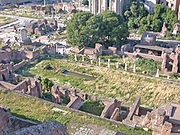
House of the Vestals

The House of the Vestals was the residence of the vestal priestesses in Rome. Behind the Temple of Vesta (which housed the sacred fire), the Atrium Vestiae was a three-story building at the foot of the Palatine Hill
Palatine Hill
The Palatine Hill is the centermost of the Seven Hills of Rome and is one of the most ancient parts of the city...
.
Vestal festivals
The chief festivals of Vesta were the Vestalia celebrated June 7 until June 15. On June 7 only, her sanctuary (which normally no one except her priestesses the Vestals entered) was accessible to mothers of families who brought plates of food. The simple ceremonies were officiated by the Vestals and they gathered grain and fashioned salty cakes for the festival. This was the only time when they themselves made the mola salsaMola salsa
In ancient Roman religion, mola salsa was a mixture of coarse-ground, toasted emmer flour and salt prepared by the Vestal Virgins and used in every official sacrifice. It was sprinkled on the forehead and between the horns of animal victims before they were sacrificed, as well as on the altar and...
, for this was the holiest time for Vesta, and it had to be made perfectly and correctly, as it was used in all public sacrifices.
Clothing
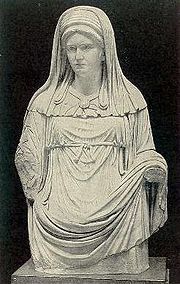
The main articles of their clothing consisted of an infula, a suffibulum and a pallaPalla (garment)
Palla is a traditional ancient Roman mantle worn by women, fastened by brooches. It was similar to the pallium that a man would wear. The shape was rectangular instead of semi-circular as with the traditional toga.The Palla was similar to a shawl that a woman of today would wear.The palla would...
. The infula was a fillet, which was worn by priests and other religious figures in Rome. A vestal's infula was white and made from wool. The suffibulum was the white woolen veil which was worn during rituals and sacrifices. Usually found underneath were red and white woolen ribbons, symbolizing the Vestal's commitment to keeping the fire of Vesta and to her vow of purity, respectively. The palla was the long, simple shawl, a typical article of clothing for Roman women. The palla, and its pin, were draped over the left shoulder.
Legendary Vestals
- Rhea SilviaRhea SilviaRhea Silvia , and also known as Ilia, was the mythical mother of the twins Romulus and Remus, who founded the city of Rome...
, a mythical mother of Rome's founders, Romulus and RemusRomulus and RemusRomulus and Remus are Rome's twin founders in its traditional foundation myth, although the former is sometimes said to be the sole founder...
. - Aemilia, who, when the sacred fireSacred fire of VestaThe sacred fire of Vesta was a holy fire in Ancient Rome. The Vestal Virgins were selected by lot and served for thirty years, tending the holy fire and performing other rituals connected to domestic life—among them were the ritual sweeping of the temple on June 15 and the preparation of...
was extinguished on one occasion, prayed to Vesta for assistance, and miraculously rekindled it by throwing a piece of her garment upon the extinct embers.
Vestals in the Republic
- Aemilia (d. 114 BC), Marcia (d. 114 BC), and Licinia (d. 114 - 113 BC), accused of multiple acts of incestum (violations of their vows of chastity). Aemilia, who had supposedly led the two others to follow her example, was condemned outright. Marcia, who was accused of only one offence, and Licinia, who was accused of many, were at first acquitted by the pontificesPontifexPONTIFEX was a mid-1980s project that introduced a novel approach to complex aircraft fleet scheduling, partially funded by the European Commission’s Strategic Programme for R&D in Information Technology.Since the mathematical problems stemming from non trivial fleet scheduling easily become...
, but were retried by the praetorPraetorPraetor was a title granted by the government of Ancient Rome to men acting in one of two official capacities: the commander of an army, usually in the field, or the named commander before mustering the army; and an elected magistratus assigned varied duties...
and jurist Lucius Cassius Longinus RavillaLucius Cassius Longinus RavillaLucius Cassius Longinus Ravilla was a Roman consul in 127 BC.As a tribune of Concilium Plebis in 137 BC he put forward and passed the Lex Cassia Tabellaria . In 127 BC he was consul with Lucius Cornelius Cinna and in 125 BC he was elected censor...
(consul 127 BC), and condemned to death. The prosecution offered two Sibylline propheciesSibylline BooksThe Sibylline Books or Libri Sibyllini were a collection of oracular utterances, set out in Greek hexameters, purchased from a sibyl by the last king of Rome, Tarquinius Superbus, and consulted at momentous crises through the history of the Republic and the Empire...
in support of the final verdicts. The charges were almost certainly trumped up, and may have been politically motivated. - Fonteia, served ca. 91–69 BC, recorded as a Vestal during the trial of her brother in 69 BC, but she would have begun her service before her father's death in 91.
- Fabia, chief Vestal (b ca 98–97 BC; fl. 50 BC), admitted to the order in 80 BC, half-sister of Terentia (Cicero's first wife), and a wife of DolabellaPublius Cornelius DolabellaPublius Cornelius Dolabella was a Roman general, by far the most important of the Dolabellae. He arranged for himself to be adopted by a plebeian so that he could become a Tribune.. He married Cicero's daughter Tullia Ciceronis...
who later married her niece TulliaTullia CiceronisTullia Ciceronis, also Tulliola was the only daughter and first child to Roman orator and politician Marcus Tullius Cicero from his first marriage to Terentia...
; she was probably mother of the later consulRoman consulA consul served in the highest elected political office of the Roman Republic.Each year, two consuls were elected together, to serve for a one-year term. Each consul was given veto power over his colleague and the officials would alternate each month...
of that name. In 73BC she was acquitted of incestum with Lucius Sergius Catilina. - Licinia (flourished 1st century BC), who was supposedly courted by her kinsman, the so-called "triumvirFirst TriumvirateThe First Triumvirate was the political alliance of Gaius Julius Caesar, Marcus Licinius Crassus, and Gnaeus Pompeius Magnus. Unlike the Second Triumvirate, the First Triumvirate had no official status whatsoever; its overwhelming power in the Roman Republic was strictly unofficial influence, and...
" Marcus Licinius CrassusMarcus Licinius CrassusMarcus Licinius Crassus was a Roman general and politician who commanded the right wing of Sulla's army at the Battle of the Colline Gate, suppressed the slave revolt led by Spartacus, provided political and financial support to Julius Caesar and entered into the political alliance known as the...
, who in fact wanted her property. This relationship gave rise to rumors. Plutarch says: "And yet when he was further on in years, he was accused of criminal intimacy with Licinia, one of the Vestal virgins and Licinia was formally prosecuted by a certain Plotius. Now Licinia was the owner of a pleasant villa in the suburbs which Crassus wished to get at a low price, and it was for this reason that he was forever hovering about the woman and paying his court to her, until he fell under the abominable suspicion. And in a way it was his avarice that absolved him from the charge of corrupting the Vestal, and he was acquitted by the judges. But he did not let Licinia go until he had acquired her property." Licinia became a Vestal in 85 BC and remained a Vestal until 61 BC.
Imperial Vestals
- Rubria, said by SuetoniusSuetoniusGaius Suetonius Tranquillus, commonly known as Suetonius , was a Roman historian belonging to the equestrian order in the early Imperial era....
to have been married to the Emperor NeroNeroNero , was Roman Emperor from 54 to 68, and the last in the Julio-Claudian dynasty. Nero was adopted by his great-uncle Claudius to become his heir and successor, and succeeded to the throne in 54 following Claudius' death.... - Aquilia SeveraAquilia SeveraIulia Aquilia Severa was the second and fourth wife of Emperor Elagabalus. She was the daughter of Quintus Aquilius, twice consul under Caracalla. The praenomen of Julia was given to her after becoming an empress.Severa was a Vestal Virgin...
, whom Emperor ElagabalusElagabalusElagabalus , also known as Heliogabalus, was Roman Emperor from 218 to 222. A member of the Severan Dynasty, he was Syrian on his mother's side, the son of Julia Soaemias and Sextus Varius Marcellus. Early in his youth he served as a priest of the god El-Gabal at his hometown, Emesa...
married amid considerable scandal. - Coelia ConcordiaCoelia ConcordiaCoelia Concordia was the last vestal virgin in history and the last Vestalis Maxima or Chief Vestal. The Temple of Vesta was closed in 391 by the Roman emperor Theodosius I, and Coelia stepped down from her post in 394. She converted to Christianity later in her life, and died twelve years...
, the last head of the order.
Further reading
- Kroppenberg, Inge, "Law, Religion and Constitution of the Vestal Virgins," Law and Literature, 22, 3, 2010, pp. 418 – 439. http://www.uni-r.de/Fakultaeten/Jura/kroppenberg/pdf/CV%20und%20Schriftenverzeichnis%20Kroppenberg/LAL2203_03-Vestal_Virgins.pdf
- Peck, Harry Thurston, Harpers Dictionary of Classical Antiquities (1898)
- Parker, Holt N. "Why Were the Vestals Virgins? Or the Chastity of Women and the Safety of the Roman State", American Journal of Philology, Vol. 125, No. 4. (2004), pp. 563–601.
- Samuel Ball Platner and Thomas Ashby, A Topographical Dictionary of Ancient Rome
- Wildfang, Robin Lorsch. Rome's Vestal Virgins. Oxford: Routledge, 2006 (hardcover, ISBN 0-415-39795-2; paperback, ISBN 0-415-39796-0).
External links
- Rodolfo Lanciani (1898) "The Fall of a Vestal" Chapter 6, in Ancient Rome in the Light of Recent Discoveries. Houghton, Mifflin and Company, Boston and New York, 1898.
- article Vestales in Smith's Dictionary of Greek and Roman Antiquities
- House of the Vestal Virgins