


Iron meteorite

Encyclopedia
Nickel
Nickel is a chemical element with the chemical symbol Ni and atomic number 28. It is a silvery-white lustrous metal with a slight golden tinge. Nickel belongs to the transition metals and is hard and ductile...
-iron
Iron
Iron is a chemical element with the symbol Fe and atomic number 26. It is a metal in the first transition series. It is the most common element forming the planet Earth as a whole, forming much of Earth's outer and inner core. It is the fourth most common element in the Earth's crust...
alloy
Alloy
An alloy is a mixture or metallic solid solution composed of two or more elements. Complete solid solution alloys give single solid phase microstructure, while partial solutions give two or more phases that may or may not be homogeneous in distribution, depending on thermal history...
s. The metal taken from these meteorite
Meteorite
A meteorite is a natural object originating in outer space that survives impact with the Earth's surface. Meteorites can be big or small. Most meteorites derive from small astronomical objects called meteoroids, but they are also sometimes produced by impacts of asteroids...
s is known as meteoric iron and was one of the earliest sources of usable iron available to human
Human
Humans are the only living species in the Homo genus...
s.
Occurrence
While they are fairly rare compared to the stony meteorites, comprising about 5.7% of witnessed falls, they have historically been heavily over-represented in meteoriteMeteorite
A meteorite is a natural object originating in outer space that survives impact with the Earth's surface. Meteorites can be big or small. Most meteorites derive from small astronomical objects called meteoroids, but they are also sometimes produced by impacts of asteroids...
collections.
This is due to several factors:
- They are easily recognized as unusual even by laymen, as opposed to stony meteorites. Modern-day searches for meteorites in deserts and Antarctica yield a much more representative sample of meteorites overall.
- They are much more resistant to weathering.
- They are much more likely to survive atmospheric entry, and are more resistant to the resulting ablationAblationAblation is removal of material from the surface of an object by vaporization, chipping, or other erosive processes. This occurs in spaceflight during ascent and atmospheric reentry, glaciology, medicine, and passive fire protection.-Spaceflight:...
. Hence they are more likely to be found as large pieces.
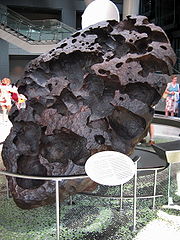
In fact, iron meteorites account for almost 90% of the mass of all known meteorites, about 500 tons. All the largest known meteorites are of this type, including the largest—the Hoba meteorite
Hoba meteorite
Hoba is a meteorite that lies on the farm "Hoba West", not far from Grootfontein, in the Otjozondjupa Region of Namibia. It has been uncovered but, because of its large mass, has never been moved from where it fell...
.
Origin
Iron meteorites have been linked to M-type asteroidM-type asteroid
M-type asteroids are asteroids of partially known composition; they are moderately bright . Some, but not all, are made of nickel-iron, either pure or mixed with small amounts of stone. These are thought to be pieces of the metallic core of differentiated asteroids that were fragmented by impacts,...
s since both types of objects have similar spectral characteristics in the visible and near-infrared wavelength regions. Iron meteorites are thought to be the fragments of the cores of larger ancient asteroid
Asteroid
Asteroids are a class of small Solar System bodies in orbit around the Sun. They have also been called planetoids, especially the larger ones...
s that have been shattered by impacts. The heat released from the radioactive decay of the short-lived nuclides 26Al and 60Fe is considered as a plausible cause for the melting and differentiation of their parent bodies in the early solar system. The IIE chemical class
IIE iron meteorite
The iron meteorites of the IIE chemical type are octahedrites of various coarseness, most of which contain numerous inclusions of recrystallized stony silicates....
may be a notable exception, in that they probably originate from the crust of S-type asteroid
S-type asteroid
S-type asteroids are of a stony composition, hence the name. Approximately 17% of asteroids are of this type, making it the second most common after the C-type.-Characteristics:...
6 Hebe
6 Hebe
6 Hebe is a large main-belt asteroid, containing around half a percent of the mass of the belt. Its apparently high bulk density , however, means that by volume it does not rank among the top twenty asteroids...
.
Chemical and isotope analysis indicates that at least about 50 distinct parent bodies were involved. This implies that there were once at least this many large, differentiated
Planetary differentiation
In planetary science, planetary differentiation is the process of separating out different constituents of a planetary body as a consequence of their physical or chemical behaviour, where the body develops into compositionally distinct layers; the denser materials of a planet sink to the center,...
, asteroids in the asteroid belt – many more than today.
Composition
The overwhelming bulk of these meteorites consists of the Fe,Ni-alloys kamaciteKamacite
Kamacite is a mineral. It is an alloy of iron and nickel, usually in the proportions of 90:10 to 95:5 although impurities such as cobalt or carbon may be present. On the surface of Earth, it occurs naturally only in meteorites. It has a metallic luster, is gray and has no clear cleavage although...
and taenite
Taenite
Taenite is a mineral found naturally on Earth mostly in iron meteorites. It is an alloy of iron and nickel, with nickel proportions of 20% up to 65%.The name is derived from the Greek for "band". Taenite is a major constituent of iron meteorites...
. Minor minerals, when occurring, often form rounded nodules of troilite
Troilite
Troilite is a rare iron sulfide mineral with the simple formula of FeS. It is the iron rich endmember of the pyrrhotite group. Pyrrhotite has the formula FeS which is iron deficient...
or graphite
Graphite
The mineral graphite is one of the allotropes of carbon. It was named by Abraham Gottlob Werner in 1789 from the Ancient Greek γράφω , "to draw/write", for its use in pencils, where it is commonly called lead . Unlike diamond , graphite is an electrical conductor, a semimetal...
, surrounded by schreibersite
Schreibersite
Schreibersite is generally a rare iron nickel phosphide mineral, 3P, though common in iron-nickel meteorites. It is rarely reported from Earth . Another name used for the mineral is rhabdite. It forms tetragonal crystals with perfect 001 cleavage. Its color ranges from bronze to brass yellow to...
and cohenite
Cohenite
Cohenite is a naturally occurring iron mineral with the chemical structure 3C. This forms a hard, shiny, silver mineral which was named by E. Weinschenk in 1889 after the German mineralogist Emil Cohen, who first described and analysed it. Cohenite is found in rod-like crystals in iron meteorites...
.
Schreibersite
Schreibersite
Schreibersite is generally a rare iron nickel phosphide mineral, 3P, though common in iron-nickel meteorites. It is rarely reported from Earth . Another name used for the mineral is rhabdite. It forms tetragonal crystals with perfect 001 cleavage. Its color ranges from bronze to brass yellow to...
and troilite
Troilite
Troilite is a rare iron sulfide mineral with the simple formula of FeS. It is the iron rich endmember of the pyrrhotite group. Pyrrhotite has the formula FeS which is iron deficient...
also occur as plate shaped inclusions, which show up on cut surfaces as cm-long and mm-thick lamellae. The troilite
Troilite
Troilite is a rare iron sulfide mineral with the simple formula of FeS. It is the iron rich endmember of the pyrrhotite group. Pyrrhotite has the formula FeS which is iron deficient...
plates are called Reichenbach lamellae.
The chemical composition is dominated by the elements Fe
Iron
Iron is a chemical element with the symbol Fe and atomic number 26. It is a metal in the first transition series. It is the most common element forming the planet Earth as a whole, forming much of Earth's outer and inner core. It is the fourth most common element in the Earth's crust...
, Ni
Nickel
Nickel is a chemical element with the chemical symbol Ni and atomic number 28. It is a silvery-white lustrous metal with a slight golden tinge. Nickel belongs to the transition metals and is hard and ductile...
and Co
Cobalt
Cobalt is a chemical element with symbol Co and atomic number 27. It is found naturally only in chemically combined form. The free element, produced by reductive smelting, is a hard, lustrous, silver-gray metal....
, which make up more than 95%. Ni
Nickel
Nickel is a chemical element with the chemical symbol Ni and atomic number 28. It is a silvery-white lustrous metal with a slight golden tinge. Nickel belongs to the transition metals and is hard and ductile...
is always present; the concentration is nearly always higher than 5% and may be as high as about 25%. A significant percentage of nickel can be used in the field to distinguish meteoritic irons from man-made products, which usually contain lower amounts of Ni, but it is not enough to prove the meteoritic origin (e.g. some US coins).
Use
The iron nickel alloy was used by several cultures for the manufacturing of tools and weapons. For example the InuitInuit
The Inuit are a group of culturally similar indigenous peoples inhabiting the Arctic regions of Canada , Denmark , Russia and the United States . Inuit means “the people” in the Inuktitut language...
used parts of the Cape York meteorite
Cape York meteorite
The Cape York meteorite is named for Cape York, the location of its discovery in Savissivik, Greenland, and is one of the largest iron meteorites in the world.-History:The meteorite collided with Earth nearly 10,000 years ago...
.
Fragments from Gibeon
Gibeon (meteorite)
Gibeon is a meteorite that fell in prehistoric times in Namibia. It was named after the nearest town: Gibeon, Namibia.-History:The meteorite was discovered by the Nama people and used by them to make tools and weapons....
were used for centuries by Nama people.
There are also reports of their use for manufacture of various items in Tibet (see Thokcha
Thokcha
'Thokcha' "sky-iron" are tektites and meteorites which are often high in iron content, refer Iron meteorite. The usage of meteoric iron is common in the history of ferrous metallurgy. Historically, thokchas were held in esteem for sacred metallurgical fabrication of weapons, musical instruments...
).
Today meteoritic iron is used in niche jewellery and knife production, but most of it is used for research, educational or collecting
Collecting
The hobby of collecting includes seeking, locating, acquiring, organizing, cataloging, displaying, storing, and maintaining whatever items are of interest to the individual collector. Some collectors are generalists, accumulating merchandise, or stamps from all countries of the world...
purposes.
Classification
Two classifications are in use: the classic structural classification and the newer chemical classification.Structural classification
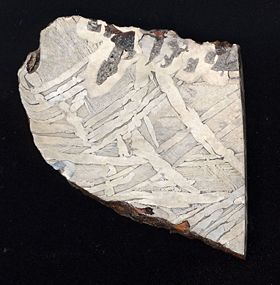
The older structural classification is based on the presence or absence of the Widmanstätten patternWidmanstätten pattern
Widmanstätten patterns, also called Thomson structures, are unique figures of long nickel-iron crystals, found in the octahedrite iron meteorites and some pallasites. They consist of a fine interleaving of kamacite and taenite bands or ribbons called lamellæ...
, which can be assessed from the appearance of polished cross-sections that have been etched with acid. This is connected with the relative abundance of nickel to iron. The categories are:
- HexahedriteHexahedriteHexahedrites are a type of iron meteorite.They are composed almost exclusively of the nickel-iron alloy kamacite and are lower in nickel content than the octahedrites. The nickel concentration in hexahedrites is always below 5.8% and only rarely below 5.3%....
s (H): low nickel, no Widmanstätten patternWidmanstätten patternWidmanstätten patterns, also called Thomson structures, are unique figures of long nickel-iron crystals, found in the octahedrite iron meteorites and some pallasites. They consist of a fine interleaving of kamacite and taenite bands or ribbons called lamellæ...
, may present Neumann lines; - OctahedriteOctahedriteOctahedrites are a class of iron meteorites within the structural classification. They are the most common class of iron meteorites.They are composed primarily of the nickel-iron alloys: taenite - high nickel content, and kamacite - low nickel content....
s (O): average to high nickel, Widmanstätten patternWidmanstätten patternWidmanstätten patterns, also called Thomson structures, are unique figures of long nickel-iron crystals, found in the octahedrite iron meteorites and some pallasites. They consist of a fine interleaving of kamacite and taenite bands or ribbons called lamellæ...
s, most common class. They can be further divided up on the basis of the width of the kamacite lamellae from coarsest to finest.- Coarsest (Ogg): lamellae width > 3.3 mm
- Coarse (Og): lamellae width 1.3-3.3 mm
- Medium (Om): lamellae width 0.5-1.3 mm
- Fine (Of): lamellae width 0.2-0.5 mm
- Finest (Off): lamellae width < 0.2 mm
- Plessitic (Opl): a transitional structure between octahedrites and ataxites
- AtaxiteAtaxiteAtaxites are a class of iron meteorites. They are composed mainly of the alloy taenite, and also contain plessite, troilite, and microscopic lamellae of kamacite. They have no visible Widmanstätten pattern. Ataxites are the most nickel-rich meteorites known; they usually contain over 18% nickel...
s (D): very high nickel, no Widmanstätten patternWidmanstätten patternWidmanstätten patterns, also called Thomson structures, are unique figures of long nickel-iron crystals, found in the octahedrite iron meteorites and some pallasites. They consist of a fine interleaving of kamacite and taenite bands or ribbons called lamellæ...
, rare.
Chemical classification
A newer chemical classification based on the proportions of the trace elements GaGallium
Gallium is a chemical element that has the symbol Ga and atomic number 31. Elemental gallium does not occur in nature, but as the gallium salt in trace amounts in bauxite and zinc ores. A soft silvery metallic poor metal, elemental gallium is a brittle solid at low temperatures. As it liquefies...
, Ge
Germanium
Germanium is a chemical element with the symbol Ge and atomic number 32. It is a lustrous, hard, grayish-white metalloid in the carbon group, chemically similar to its group neighbors tin and silicon. The isolated element is a semiconductor, with an appearance most similar to elemental silicon....
and Ir
Iridium
Iridium is the chemical element with atomic number 77, and is represented by the symbol Ir. A very hard, brittle, silvery-white transition metal of the platinum family, iridium is the second-densest element and is the most corrosion-resistant metal, even at temperatures as high as 2000 °C...
separates the iron meteorites into classes corresponding to distinct asteroid
Asteroid
Asteroids are a class of small Solar System bodies in orbit around the Sun. They have also been called planetoids, especially the larger ones...
parent bodies:
- IA: Medium and coarse octahedrites, 6.4-8.7% Ni, 55-100 ppm Ga, 190-520 ppm Ge, 0.6-5.5 ppm Ir, Ge-Ni correlation negativ.
- IB: Ataxites and medium octahedrites, 8.7-25% Ni, 11-55 ppm Ga, 25-190 ppm Ge, 0.3-2 ppm Ir, Ge-Ni correlation negativ.
- IC:
- IIA: Hexahedrites, 5.3-5.7% Ni, 57-62 ppm Ga, 170-185 ppm Ge, 2-60ppm Ir.
- IIB: Coarsest octahedrites, 5.7-6.4% Ni, 446-59 pm Ga, 107-183 ppm Ge, 0.01-0.5 ppm Ir, Ge-Ni correlation negativ.
- IIC: Plessitic octahedrites, 9.3-11.5% Ni, 37-39 ppm Ga, 88-114 ppm Ge, 4-11 ppm Ir, Ge-Ni correlation positiv
- IID: Fine to medium octahedrites, 9.8-11.3%Ni, 70-83 ppm Ga, 82-98 ppm Ge, 3.5-18 ppm Ir, Ge-Ni correlation positiv
- IIEIIE iron meteoriteThe iron meteorites of the IIE chemical type are octahedrites of various coarseness, most of which contain numerous inclusions of recrystallized stony silicates....
: octahedrites of various coarseness, 7.5-9.7% Ni, 21-28 ppm Ga, 60-75 ppm Ge, 1-8 ppm Ir, Ge-Ni correlation absent - IIG:
- IIF:
- IIIAB: Medium octahedrites, 7.1-10.5% Ni, 16-23 ppm Ga, 27-47 ppm Ge, 0.01-19 ppm Ir
- IIICD: Ataxites to fine octahedrites, 10-23% Ni, 1.5-27 ppm Ga, 1.4-70 ppm Ge, 0.02-0.55 ppm Ir
- IIIE: Coarse octahedrites, 8.2-9.0% Ni, 17-19 ppm Ga, 3-37 ppm Ge, 0.05-6 ppm Ir, Ge-Ni correlation absent
- IIIF: Medium to coarse octahedrites, 6.8-7.8% Ni,6.3-7.2 ppm Ga, 0.7-1.1 ppm Ge, 1.3-7.9 ppm Ir, Ge-Ni correlation absent
- IVA: Fine octahedrites, 7.4-9.4% Ni, 1.6-2.4 ppm Ga, 0.09-0.14 ppm Ge, 0.4-4 ppm Ir, Ge-Ni correlation positiv
- IVB: Ataxites, 16-26% Ni, 0.17-0.27 ppm Ga, 0,03-0,07 ppm Ge, 13-38 ppm Ir, Ge-Ni correlation positiv
- Ungrouped meteorites. This is actually quite a large collection (about 15% of the total) of over 100 meteorites which do not fit into any of the larger classes above, and come from about 50 distinct parent bodies.
Magmatic and primitive irons
The iron meteorites can be divided into two classes: magmatic irons and non magmatic or primitive irons.| Iron class | Groups |
| Primitive iron meteorites | IAB, IIE IIE iron meteorite The iron meteorites of the IIE chemical type are octahedrites of various coarseness, most of which contain numerous inclusions of recrystallized stony silicates.... , Udei Station grouplet, Pitts grouplet, sLL, sLM, sLH, sHL, sHH |
| Magmatic iron meteorites | IC, IIAB, IIC, IID, IIF, IIG, IIIAB, IIIE, IIIF, IVA, IVB |