


Di Renjie

Encyclopedia
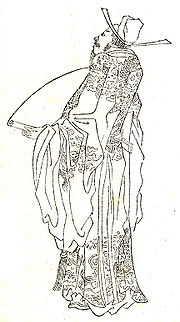
Dí Rénjié (630
630
Year 630 was a common year starting on Monday of the Julian calendar. The denomination 630 for this year has been used since the early medieval period, when the Anno Domini calendar era became the prevalent method in Europe for naming years.- Byzantine Empire :* Croats and Serbs settle in the...
– August 15, 700), courtesy name Huaiying (懷英), formally Duke Wenhui of Liang (梁文惠公), was an official of the Chinese
History of China
Chinese civilization originated in various regional centers along both the Yellow River and the Yangtze River valleys in the Neolithic era, but the Yellow River is said to be the Cradle of Chinese Civilization. With thousands of years of continuous history, China is one of the world's oldest...
Tang Dynasty
Tang Dynasty
The Tang Dynasty was an imperial dynasty of China preceded by the Sui Dynasty and followed by the Five Dynasties and Ten Kingdoms Period. It was founded by the Li family, who seized power during the decline and collapse of the Sui Empire...
and Wu Zetian
Wu Zetian
Wu Zetian , personal name Wu Zhao , often referred to as Tian Hou during the Tang Dynasty and Empress Consort Wu in later times, was the only woman in the history of China to assume the title of Empress Regnant...
's Zhou Dynasty, twice serving as chancellor during her reign. He was one of the most celebrated officials of Wu Zetian's reign and was credited with moderating her reign from being considered one of terror to one of greater efficiency and honesty.
Background
Di Renjie was born in 630, during the reign of Emperor TaizongEmperor Taizong of Tang
Emperor Taizong of Tang , personal name Lǐ Shìmín , was the second emperor of the Tang Dynasty of China, ruling from 626 to 649...
. His family, from Taiyuan
Taiyuan
Taiyuan is the capital and largest city of Shanxi province in North China. At the 2010 census, it had a total population of 4,201,591 inhabitants on 6959 km² whom 3,212,500 are urban on 1,460 km². The name of the city literally means "Great Plains", referring to the location where the Fen River...
, was one that had produced many officials. His grandfather Di Xiaoxu (狄孝緒) served as Shangshu Zuo Cheng (尚書左丞), a secretary general of the executive bureau of government (尚書省, Shangshu Sheng), and his father Di Zhixun (狄知遜) served as the prefect of Kui Prefecture (夔州, modern eastern Chongqing
Chongqing
Chongqing is a major city in Southwest China and one of the five national central cities of China. Administratively, it is one of the PRC's four direct-controlled municipalities , and the only such municipality in inland China.The municipality was created on 14 March 1997, succeeding the...
). Di Renjie was known for studiousness in his youth, and after passing the imperial examination
Imperial examination
The Imperial examination was an examination system in Imperial China designed to select the best administrative officials for the state's bureaucracy. This system had a huge influence on both society and culture in Imperial China and was directly responsible for the creation of a class of...
served as a secretary at the prefectural government of Bian Prefecture (汴州, roughly modern Kaifeng
Kaifeng
Kaifeng , known previously by several names , is a prefecture-level city in east-central Henan province, Central China. Nearly 5 million people live in the metropolitan area...
, Henan
Henan
Henan , is a province of the People's Republic of China, located in the central part of the country. Its one-character abbreviation is "豫" , named after Yuzhou , a Han Dynasty state that included parts of Henan...
). While serving there, he was falsely accused of improprieties by colleagues, and when the minister of public works, Yan Liben
Yan Liben
Yan Liben , formally Baron Wenzhen of Boling , was a Chinese painter and government official of the early Tang Dynasty. His most renowned work is the Thirteen Emperors Scroll...
, was touring the Henan Circuit (河南道, the region immediately south of the Yellow River
Yellow River
The Yellow River or Huang He, formerly known as the Hwang Ho, is the second-longest river in China and the sixth-longest in the world at the estimated length of . Originating in the Bayan Har Mountains in Qinghai Province in western China, it flows through nine provinces of China and empties into...
), which Bian Prefecture belonged to, he was asked to judge the case. After seeing Di, he was impressed by him, and commented, "Confucius
Confucius
Confucius , literally "Master Kong", was a Chinese thinker and social philosopher of the Spring and Autumn Period....
had said, 'You can tell a man's kindness by his failure.' You are a pearl from the coast and a lost treasure of the southeast." He recommended Di to become a bailiff for the commandant at Bing Prefecture (并州, roughly modern Taiyuan, Shanxi
Shanxi
' is a province in Northern China. Its one-character abbreviation is "晋" , after the state of Jin that existed here during the Spring and Autumn Period....
). While at Bing Prefecture, he was said to be caring of others. On one occasion, his colleague Zhang Chongzhi (鄭崇質) was ordered to go on an official trip to a place far away. Di, noting that Zheng's mother was old and ill, went to the secretary general Lin Renji (藺仁基) and offered to go in Zheng's stead. It was said that Lin was so touched by the concern that Di showed Zheng as a colleague that he relayed the episode to the military advisor to the prefect, Li Xiaolian (李孝廉), with whom Lin had a running dispute, and offered peaceful relations to Li.
By 676, during the reign of Emperor Taizong's son Emperor Gaozong
Emperor Gaozong of Tang
Emperor Gaozong of Tang , personal name Li Zhi , was the third emperor of the Tang Dynasty in China, ruling from 649 to 683...
, Di was serving as the secretary general at the supreme court (大理丞), and it was said that he was an efficient and fair judge, judging some 17,000 cases within a year without anyone complaining about the results. In 676, there was an event in which the general Quan Shancai (權善才) and the military officer Fan Huaiyi (范懷義) accidentally cut cypress
Cypress
Cypress is the name applied to many plants in the cypress family Cupressaceae, which is a conifer of northern temperate regions. Most cypress species are trees, while a few are shrubs...
es on Emperor Taizong's tomb -- an offense punishable by removal from office, but Emperor Gaozong ordered that the two be executed. Di pointed out that, by law, the two should not be executed. This initially offended Emperor Gaozong, who ordered Di to leave his presence. Di continued to object, and eventually, Emperor Gaozong relented and exiled them. Several days later, he made Di a censor.
In or around 679, the minister of agriculture Wei Hongji (韋弘機) built three magnificent palaces around the eastern capital Luoyang
Luoyang
Luoyang is a prefecture-level city in western Henan province of Central China. It borders the provincial capital of Zhengzhou to the east, Pingdingshan to the southeast, Nanyang to the south, Sanmenxia to the west, Jiyuan to the north, and Jiaozuo to the northeast.Situated on the central plain of...
-- Suyu Palace (宿羽宮), Gaoshan Palace (高山宮), and Shangyang Palace (上陽宮). Di submitted an accusation against Wei, arguing that he was leading Emperor Gaozong into being wasteful, and Wei was removed from his office. Meanwhile, around the same time, the official Wang Benli
Wang Benli
Wang Benli was an official of the Chinese dynasty Tang Dynasty, serving as chancellor during the first reign of Emperor Ruizong.- Background :...
was said to be favored by Emperor Gaozong and, on account of that favor, was committing many illegal deeds and intimidating other officials. Di accused Wang of crimes; initially, Emperor Gaozong was set to pardon him. At Di's insistence -- pointing out that the empire did not lack people with Wang's talent -- Emperor Gaozong relented and allowed Wang to be punished.
During Emperor Ruizong's first reign
As of 686, during the reign of Emperor Gaozong's son Emperor RuizongEmperor Ruizong of Tang
Emperor Ruizong of Tang , personal name Lǐ Dàn , known at times during his life as Li Xulun , Li Lun , Wu Lun , and Wu Dan , was the fifth and ninth emperor of Tang Dynasty...
, Di Renjie was serving as the prefect of Ning Prefecture (寧州, roughly modern Qingyang
Qingyang
Qingyang is a prefecture-level city in China's Gansu province.-Geography and climate:Qingyang is in eastern Gansu province and is sometimes referred to in Chinese as "Longdong" . Ningxia province is to the north west and Shaanxi is to the east. It is in the lower middle part of the Yellow River on...
, Gansu
Gansu
' is a province located in the northwest of the People's Republic of China.It lies between the Tibetan and Huangtu plateaus, and borders Mongolia, Inner Mongolia, and Ningxia to the north, Xinjiang and Qinghai to the west, Sichuan to the south, and Shaanxi to the east...
). At that time, the censor Guo Han (郭翰) was commissioned to tour the prefectures in the area, and wherever he went, he found faults with the prefects and corrected them, but when he arrived at NIng Prefecture, it was said that the people had no complaints about Di and praised him greatly. Guo recommended Di to Emperor Ruizong's mother and regent
Regent
A regent, from the Latin regens "one who reigns", is a person selected to act as head of state because the ruler is a minor, not present, or debilitated. Currently there are only two ruling Regencies in the world, sovereign Liechtenstein and the Malaysian constitutive state of Terengganu...
Empress Dowager Wu
Wu Zetian
Wu Zetian , personal name Wu Zhao , often referred to as Tian Hou during the Tang Dynasty and Empress Consort Wu in later times, was the only woman in the history of China to assume the title of Empress Regnant...
(later known as Wu Zetian), and Di was recalled to Luoyang to serve as deputy minister of public works (冬官侍郎, Dongguan Shilang).
In 688, Di was touring the Jiangnan Circuit (江南道, the region south of the Yangtze River
Yangtze River
The Yangtze, Yangzi or Cháng Jiāng is the longest river in Asia, and the third-longest in the world. It flows for from the glaciers on the Tibetan Plateau in Qinghai eastward across southwest, central and eastern China before emptying into the East China Sea at Shanghai. It is also one of the...
). He believed that the region had too many temples dedicated to unusual deities, and at his request, some 1,700 temples were destroyed; only four kinds of temples were allowed to remain -- those dedicated to Yu the Great
Yu the Great
Yu the Great , was a legendary ruler of Ancient China famed for his introduction of flood control, inaugurating dynastic rule in China by founding the Xia Dynasty, and for his upright moral character....
, Wu Taibo
Wu Taibo
Wu Taibo is the name of eldest son of King Tai of the Zhou dynasty and the ancestor of King Wu of Zhou. His birth and death dates are still unknown due to lack of historical records.-Biography:...
(吳太伯, the legendary founder of the Spring and Autumn Period kingdom Wu
Wu (state)
The State of Wu , also known as Gou Wu or Gong Wu , was one of the vassal states during the Western Zhou Dynasty and the Spring and Autumn Period. The State of Wu was located at the mouth of the Yangtze River east of the State of Chu. Considered a semi-barbarian state by ancient Chinese...
), Wu Jizha (吳季札, a well-regarded Wu prince and son of King Shoumeng of Wu), and Wu Zixu
Wu Zixu
Wu Yun , better known by his style name Zixu , is the most famous ancestor of people with the surname of Wu . All branches of the Wu clans claim him as their "first ancestor"...
.
Later in 688, in the aftermath of a failed rebellion by Emperor Gaozong's brother Li Zhen
Li Zhen (Tang Dynasty)
Li Zhen , formally Prince Jing of Yue , posthumously known during Wu Zetian's reign as Hui Zhen , was an imperial prince of the Chinese dynasty Tang Dynasty who, along with his son Li Chong rose against Wu Zetian, then empress dowager and regent, as they feared that she was about to slaughter the...
the Prince of Yue, then the prefect of Yu Prefecture (豫州, roughly modern Zhumadian
Zhumadian
Zhumadian is a prefecture-level city in southern Henan province, People's Republic of China. It borders Xinyang to the south, Nanyang to the west, Pingdingshan to the northwest, Luohe to the north, Zhoukou to the northeast, and the province of Anhui to the east.Its population is 7,230,744 at the...
, Henan
Henan
Henan , is a province of the People's Republic of China, located in the central part of the country. Its one-character abbreviation is "豫" , named after Yuzhou , a Han Dynasty state that included parts of Henan...
), against Empress Dowager Wu, she made Di, who was at that time Wenchang Zuo Cheng (文昌左丞), a secretary general at the executive bureau (which by that point had been renamed Wenchang Tai (文昌臺)), the prefect of Yu Prefecture to succeed Li Zhen. At that time, some 600 to 700 households were accused of being complicit in Li Zhen's rebellion and were forced to serve as servants. At Di's request, they were relieved from those obligations, but were exiled to Feng Prefecture (豐州, roughly modern Bayan Nur
Bayan Nur
Bayannur is a prefecture-level city in western Inner Mongolia. Until December 1, 2003, the area was called the Bayannur league.Bayannur city has an area of 65,788 km². It borders Mongolia to the north, Alxa to the west, Ordos to the south and Baotou to the east...
, Inner Mongolia
Inner Mongolia
Inner Mongolia is an autonomous region of the People's Republic of China, located in the northern region of the country. Inner Mongolia shares an international border with the countries of Mongolia and the Russian Federation...
). Meanwhile, the general that Empress Dowager Wu sent to suppress Li Zhen's rebellion, the chancellor Zhang Guangfu
Zhang Guangfu
Zhang Guangfu was an official and general of the Chinese dynasty Tang Dynasty, serving as chancellor during the first reign of Emperor Ruizong....
, was still in Yu Prefecture, and his officers and soldiers were demanding all kinds of supplies from the Yu prefectural government, requests that Di mostly turned down. This led to an argument with Zhang, and Zhang accused him of showing contempt; in turn, Di angrily stated that Zhang was killing alleged coconspirators of Li Zhen excessively and that if he had the authority to do so, he would have beheaded Zhang even if it meant his own death. Zhang was greatly offended and, upon return to Luoyang, accused Di of contempt, and Empress Dowager Wu demoted Di to be the prefect of Fu Prefecture (復州, in modern Hanzhong
Hanzhong
Hanzhong is a municipality in southwest Shaanxi Province, China, occupying a historically significant valley in the mountains between the Xi'an area, home to many Chinese capitals, and the fertile but isolated Sichuan Basin...
, Shaanxi
Shaanxi
' is a province in the central part of Mainland China, and it includes portions of the Loess Plateau on the middle reaches of the Yellow River in addition to the Qinling Mountains across the southern part of this province...
). (This was considered a demotion as, while Di remained a prefect, Fu Prefecture was smaller and less important than Yu Prefecture.)
During Wu Zetian's reign
Wu Zetian was impressed by the response and praised him. Later that year, when the imperial university's student Wang Xunzhi (王循之) submitted a petition to Wu Zetian asking her to permit him to go on vacation, she was poised to issue an edict to approve of the request, when Di opposed the edict -- not on the merits, but on the basis that university students' vacations were such minor events that she should not bother herself with them, but rather should order that such petitions be directed to the university secretaries. She agreed.
In 692, Wu Zetian's secret police official Lai Junchen
Lai Junchen
Lai Junchen was a secret police official during the Chinese dynasty Tang Dynasty and Wu Zetian's Zhou Dynasty, whose ability to interrogate and falsely implicate officials of crimes made him a subject of fear and hatred...
falsely accused Di, along with other chancellors Ren Zhigu
Ren Zhigu
Ren Zhigu was an official of Wu Zetian's Zhou Dynasty, serving briefly as chancellor.Despite Ren's high status, little is firmly established about his background or career except for the time that he served as chancellor—as, unusual for a chancellor, he did not have a biography in either the Book...
, and Pei Xingben
Pei Xingben
Pei Xingben was an official of Wu Zetian's Zhou Dynasty, serving briefly as chancellor.Despite Pei's high status, little is firmly established about his background or career except for the time that he served as chancellor—as, unusual for a chancellor, he did not have a biography in either the...
, along with other officials Cui Xuanli (崔宣禮), Lu Xian (盧獻), Wei Yuanzhong
Wei Yuanzhong
Wei Yuanzhong , né Wei Zhenzai , formally Duke Zhen of Qi , was an official of the Chinese dynasty Tang Dynasty and Wu Zetian's Zhou Dynasty, serving as chancellor during the reigns of Wu Zetian and her son Emperor Zhongzong.- Background :It is not known which year Wei Yuanzhong was born, but it...
, and Li Sizhen (李嗣真), of treason. Lai tried to induce them to confess by citing an imperial edict that stated that those who confessed would be spared their lives, and Di confessed and was not tortured -- but when Lai's subordinate Wang Deshou (王德壽) tried to induce him to implicate another chancellor, Yang Zhirou
Yang Zhirou
Yang Zhirou was an official of Wu Zetian's Zhou Dynasty, serving briefly as chancellor.It is not known when Yang Zhirou was born. What is known is that his grandfather Yang Xu , a member of Tang Dynasty's predecessor Sui Dynasty's imperial clan, was a brother of the early Tang chancellors Yang...
, refused. Di then wrote a petition on his blanket and hid it inside cotton clothes, and then had his family members take the clothes home to be changed into summer clothes. Wu Zetian thereafter became suspicious and inquired with Lai, who responded by forging, in the names of Di and the other officials, submissions thanking Wu Zetian for preparing to execute them. However, the young son of another chancellor who had been executed, Le Sihui
Le Sihui
Le Sihui was an official during Wu Zetian's Zhou Dynasty, briefly serving as chancellor.It is not known when Le Sihui was born. His father Le Yanwei served as chancellor during the reign of Wu Zetian's husband Emperor Gaozong of Tang...
, who was seized to be a servant at the ministry of agriculture, made a petition to Wu Zetian and told her that Lai was so skillful at manufacturing charges that even the most honest and faithful individuals would be forced into confessions by Lai. Wu Zetian thereafter summoned the seven accused officials and personally interrogated them, and after they disavowed the forged confessions, released but exiled them -- in Di's case, to be the magistrate of Pengze County (彭澤, in modern Jiujiang
Jiujiang
Jiujiang , formerly transliterated Kiukiang, is a prefecture-level city located on the southern shores of the Yangtze River in northwest Jiangxi Province, China. It is the second-largest prefecture-level city in Jiangxi province, the largest one being Nanchang...
, Jiangxi
Jiangxi
' is a southern province in the People's Republic of China. Spanning from the banks of the Yangtze River in the north into hillier areas in the south, it shares a border with Anhui to the north, Zhejiang to the northeast, Fujian to the east, Guangdong to the south, Hunan to the west, and Hubei to...
).
In 696, during the middle of an attack by the Khitan
Khitan people
thumb|250px|Khitans [[Eagle hunting|using eagles to hunt]], painted during the Chinese [[Song Dynasty]].The Khitan people , or Khitai, Kitan, or Kidan, were a nomadic Mongolic people, originally located at Mongolia and Manchuria from the 4th century...
khan Sun Wanrong
Sun Wanrong
Sun Wanrong was a khan of the Khitan people who, along with his brother-in-law Li Jinzhong, rose against Chinese hegemony in 696, with Li Jinzhong as khan, and they further invaded Chinese territory then under the rule of Wu Zetian's Zhou Dynasty...
against Zhou prefectures north of the Yellow River, Wu Zetian promoted Di to be the prefect of Wei Prefecture (魏州, roughly modern Handan
Handan
Handan is a prefecture-level city located in the southwestern part of Hebei Province of China.- History :Handan was the capital of the State of Zhao during the Warring States period , after the capital moved from Zhongmu. The city was conquered by the State of Qin after the virtual annexation of...
, Hebei
Hebei
' is a province of the People's Republic of China in the North China region. Its one-character abbreviation is "" , named after Ji Province, a Han Dynasty province that included what is now southern Hebei...
). It was said that Di's predecessor Dugu Sizhuang (獨孤思莊), in fear of a Khitan attack, had ordered the people of the prefecture to all move within the prefectural capital's walls, drawing much fear and resentment from the people. When Di arrived, he, judging the Khitan forces to be still far away, ordered that the people be allowed to return to their homes and farms, gaining much gratitude from the people. After Sun's forces collapsed in 697 after a surprise attack by the Eastern Tujue khan Ashina Mochuo against his home base, Wu Zetian had Di, the chancellor Lou Shide
Lou Shide
Lou Shide , courtesy name Zongren , formally Viscount Zhen of Qiao , was an official and general of the Chinese dynasty Tang Dynasty and Wu Zetian's Zhou Dynasty, twice serving as chancellor during Wu Zetian's reign....
, and Wu Yizong (武懿宗) the Prince of Henan (a grandson of her uncle Wu Shiyi (武士逸)) to tour the region north of the Yellow River to try to pacify the people.
Later in 697, Di was serving as the commandant at You Prefecture (幽州, roughly modern Beijing
Beijing
Beijing , also known as Peking , is the capital of the People's Republic of China and one of the most populous cities in the world, with a population of 19,612,368 as of 2010. The city is the country's political, cultural, and educational center, and home to the headquarters for most of China's...
), when, at Lou's recommendation, Wu Zetian recalled him to Luoyang to serve as Luantai Shilang (鸞臺侍郎), the deputy head of the examination bureau of government (鸞臺, Luantai), and again gave him the chancellor designation of Tong Fengge Luantai Pingzhangshi. He submitted a petition advocating that descendants of Western Tujue and Goguryeo
Goguryeo
Goguryeo or Koguryŏ was an ancient Korean kingdom located in present day northern and central parts of the Korean Peninsula, southern Manchuria, and southern Russian Maritime province....
rulers be found and be given their ancient lands, to help defend against Eastern Tujue and Tufan attacks -- a petition that was not accepted but was said to be well regarded by other officials.
At that time, Wu Zetian's son Li Dan (the former Emperor Ruizong) was crown prince
Crown Prince
A crown prince or crown princess is the heir or heiress apparent to the throne in a royal or imperial monarchy. The wife of a crown prince is also titled crown princess....
, but Wu Zetian's nephews Wu Chengsi
Wu Chengsi
Wu Chengsi , formally Prince Xuan of Wei , was a nephew of Chinese sovereign Wu Zetian and an imperial prince during her Zhou Dynasty...
the Prince of Wei and Wu Sansi
Wu Sansi
Wu Sansi , formally Prince Xuan of Liang , was an official of the Chinese dynasty Tang Dynasty and his aunt Wu Zetian's Zhou Dynasty, becoming an imperial prince and chancellor during the reign of Wu Zetian and subsequently, while only briefly chancellor during the second reign of Wu Zetian's son...
the Prince of Liang both had designs on the position, and repeatedly had their associates reason with Wu Zetian that there had never been an emperor who made someone of a different family name his heir. Di, on the other hand, repeatedly argued to her that it is more proper for her to make her son her heir, and that Li Dan's brother Li Zhe
Emperor Zhongzong of Tang
Emperor Zhongzong of Tang , personal name Lǐ Xiǎn , at times during his life Li Zhe and Wu Xian , was the fourth Emperor of the Tang Dynasty of China, ruling briefly in 684 and again from 705 to 710.Emperor Zhongzong was the son of Emperor Gaozong of Tang and Empress Wu...
the Prince of Luling, himself a former emperor that Wu Zetian removed in 684, be recalled to the capital, a suggestion echoed by fellow chancellors Wang Fangqing
Wang Fangqing
Wang Fangqing , formal name Wang Lin but went by the courtesy name of Fangqing, formally Duke Zhen of Shiquan , was an official of the Chinese dynasty Tang Dynasty and Wu Zetian's Zhou Dynasty, serving as a chancellor during Wu Zetian's reign.- Background :It is not known when Wang Fangqing was...
and Wang Jishan
Wang Jishan
Wang Jishan , formally Duke Zhen of Xing , was an official of the Chinese dynasty Tang Dynasty and Wu Zetian's Zhou Dynasty, serving as a chancellor during Wu Zetian's reign.- Background :...
, and Wu Zetian began to agree. On one occasion, Wu Zetian asked him, "Last night I dreamed of a large parrot that had two broken wings. What do you think it means?" Di responded:
It was said that thereafter, Wu Zetian stopped considering Wu Chengsi or Wu Sansi as heir. Meanwhile, another close advisor of Wu Zetian's, Ji Xu
Ji Xu
Ji Xu was an official of Wu Zetian's Zhou Dynasty, serving briefly as chancellor.- Background :It is not known when Ji Xu was born, but it is known that he was from the Zhou capital Luoyang. He was said to be tall, good at hiding his emotions, but daring to speak...
, also persuaded Wu Zetian's lovers Zhang Yizhi
Zhang Yizhi
Zhang Yizhi , formally the Duke of Heng , nickname Wulang , was an official of Wu Zetian's Zhou Dynasty who, along with his brother Zhang Changzong, became a lover of Wu Zetian and became very powerful late in her reign...
and Zhang Changzong
Zhang Changzong
Zhang Changzong , formally the Duke of Ye , nickname Liulang , was an official of Wu Zetian's Zhou Dynasty who, along with his brother Zhang Yizhi, became a lover of Wu Zetian and became very powerful late in her reign...
the merits of the proposal -- pointing out that as things stood, after Wu Zetian's death, they would be hated and would suffer terrible fates. Wu Zetian finally agreed, and in spring 698 recalled Li Zhe to the capital. Li Dan subsequently offered to yield the crown prince position to Li Zhe, and Wu Zetian agreed and created Li Zhe crown prince, changing his name to Li Xian and then Wu Xian. She soon made Di Nayan (納言), the head of the examination bureau and a post considered one for a chancellor.
Also in 698, Ashina Mochuo turned against Zhou and attacked Zhou's northern prefectures. Wu Zetian made Li Xian the nominal commanding general of the army against Eastern Tujue, but made Di the deputy commanding general and actually in charge of the army. Before Di's army could arrive, however, Ashina Mochuo completed his pillaging of the northern prefectures and withdrew; Di's army never engaged him. Wu Zetian subsequently commissioned Di to tour the prefectures to pacify the people, and he was said to have done so well, helping refugees to return to their home, transporting food supplies to places needing them, repairing the roads, and helping the poor. Fearful that other officials would trouble the people with demands for luxury items, he made a good example of eating unrefined foods and prohibiting harassment of the citizens. Meanwhile, though, he was said to have looked down on Lou, not realizing that Lou had been the one that had recommended that he be made chancellor, until Wu Zetian revealed to him that fact, causing him to be embarrassed.
In 700, Wu Zetian made Di Neishi (內史), the head of the legislative bureau (鳳閣, Fengge) and a post also considered one for a chancellor. By this point, she was said to have respected him so greatly that she often just referred to him as Guolao (國老, "the State Elder") without referring to him by name. It was said that, on account of his old age, he often offered to retire, and she repeatedly declined. Further, she stopped him from kneeling and bowing to her, stating, "When I see you kneeling, I feel the pain." She also ordered that he not be required to rotate with other chancellors for night duty, warning the other chancellors not to bother Di unless there was something important. Di died in fall 700, and it was said that she wept bitterly, stating, "The Southern Palace [(i.e., the imperial administration)] is now empty."
Prior to his death, Di had recommended many capable officials, including Zhang Jianzhi
Zhang Jianzhi
Zhang Jianzhi , courtesy name Mengjiang , formally Prince Wenzhen of Hanyang , was an official of the Chinese dynasty Tang Dynasty and Wu Zetian's Zhou Dynasty, serving as chancellor during the reigns of Wu Zetian and her son Emperor Zhongzong...
, Yao Yuanchong
Yao Chong
Yao Chong , né Yao Yuanchong , known 700s-713 by the courtesy name of Yuanzhi , formally Duke Wenxian of Liang , was an official of the Chinese dynasty Tang Dynasty and Wu Zetian's Zhou Dynasty, serving as chancellor under four sovereigns—Wu Zetian, her sons Emperor Zhongzong and Emperor Ruizong,...
, Huan Yanfan
Huan Yanfan
Huan Yanfan , courtesy name Shize , formally Prince Zhonglie of Fuyang , briefly known during the reign of Emperor Zhongzong of Tang as Wei Yanfan , was an official of the Chinese dynasty Tang Dynasty and Wu Zetian's Zhou Dynasty, serving as chancellor during the reign of Emperor Zhongzong...
, and Jing Hui
Jing Hui
JIng Hui , courtesy name Zhongye , formally Prince Sumin of Pingyang , was an official of the Chinese dynasty Tang Dynasty and Wu Zetian's Zhou Dynasty, serving as chancellor during the reign of Emperor Zhongzong...
. As these officials were later instrumental in overthrowing Wu Zetian in 705 and returning Li Xian to the throne (as Emperor Zhongzong), Di was often credited as having restored Tang by proxy.
Di Renjie's tomb is located at the east end of the White Horse Temple
White Horse Temple
White Horse Temple is, according to tradition, the first Buddhist temple in China, established in 68 AD under the patronage of Emperor Ming in the Eastern Han capital Luoyang. Today the site is located just outside the walls of the ancient Eastern Han capital, some east of Luoyang in Henan...
in Luoyang, near the Qiyun Pagoda, on the tombstone engraved the inscription "The tomb of Lord Di Renjie, famous chancellor of the Great Tang dynasty".
In fiction
Di Gong An or Dee Goong An (Chinese:狄公案) is an 18th century Chinese detective novel written by the pseudonymous author 不题撰人, loosely based on Di Renjie.Robert van Gulik
Robert van Gulik
Robert Hans van Gulik was a highly educated orientalist, diplomat, musician , and writer, best known for the Judge Dee mysteries, the protagonist of which he borrowed from the 18th-century Chinese detective novel Dee Goong An.-Life:Robert van Gulik was the son of a medical officer in the Dutch...
translated the novel in the 1940s as Celebrated Cases of Judge Dee
Celebrated Cases of Judge Dee
Celebrated Cases of Judge Dee is an 18th century Chinese detective novel by an anonymous author...
. He later wrote a series of detective novels featuring Judge Dee
Judge Dee
Judge Dee is a semi-fictional character based on the historical figure Di Renjie , magistrate and statesman of the Tang court. The character first appeared in the 18th century Chinese detective novel Di Gong An...
as the main protagonist.
From 2004 to 2007, CCTV Network of China aired three consecutive drama series based on Di Renjie's detective works, under the title "Amazing Detective Di Renjie (神探狄仁杰)". The characters are slightly fictionalized versions of true historical figures, including Empress Wu
Empress Wu
Empress Wu may mean or refer to:* Empress Wu , the wife of Liu Bei, the first emperor of Shu Han* Empress Wu, a title name for Wu Zetian* Consort Wu , Wu Zetian's grandniece, who was posthumously honored as an empress...
and Di Renjie himself. Each series is divided into sub-plots. Each single case seems small at the beginning, but gradually leads to a huge evil plot usually threatening the empire. These series are first aired on CCTV-8
CCTV-8
CCTV-8 is the television drama channel of the CCTV Network in the People's Republic of China.-External links:*...
, the "Television Drama Channel".
Kent Cheng
Kent Cheng
Kent Cheng Jak-si is a Hong Kong film and television actor. He has won twice the best actor award in the Hong Kong Film Awards.-Biography:...
portrays Di Renjie in the 2009 TVB drama The Greatness of a Hero
The Greatness of a Hero
The Greatness of a Hero is a Hong Kong television series produced by TVB. The series aired on Malaysia's Astro On Demand in February 2009.-Synopsis:...
, and Andy Lau
Andy Lau
Andy Lau MH, JP is a Hong Kong Cantopop singer, actor, and film producer. Lau has been one of Hong Kong's most commercially successful film actors since the mid-1980s, performing in more than 160 films while maintaining a successful singing career at the same time...
portrays him in the 2010 Tsui Hark
Tsui Hark
Tsui Hark , born Tsui Man-kong, is a Hong Kong New Wave film director and producer. He is viewed as a major figure in the Golden Age of Hong Kong cinema .-Early life:...
film Detective Dee and the Mystery of the Phantom Flame.