
|
|
|
|
Protest
|
| |
|
| |
Protest expresses relatively overt reaction to events or situations: sometimes in favor, though more often opposed. Protesters may organize a protest as a way of publicly and forcefully making their opinions heard in an attempt to influence public opinion or government policy, or may undertake direct action to attempt to directly enact desired changes themselves.
Self-expression can, in theory, in practice or in appearance, be restricted by governmental policy, economic circumstances, religious orthodoxy, social structures, or media monopoly.

Discussion
Ask a question about 'Protest'
Start a new discussion about 'Protest'
Answer questions from other users
|
Encyclopedia
Protest expresses relatively overt reaction to events or situations: sometimes in favor, though more often opposed. Protesters may organize a protest as a way of publicly and forcefully making their opinions heard in an attempt to influence public opinion or government policy, or may undertake direct action to attempt to directly enact desired changes themselves.
Self-expression can, in theory, in practice or in appearance, be restricted by governmental policy, economic circumstances, religious orthodoxy, social structures, or media monopoly. When such restrictions occur, opposition may spill over into other areas such as culture, the streets or emigration.
A protest can itself sometimes be the subject of a counter-protest. In such a case, counter-protesters demonstrate their support for the person, policy, action, etc. that is the subject of the original protest.
Historical notions
Unaddressed protest may grow and widen into dissent, activism, riots, insurgency, revolts, and political and/or social revolution, as in:
Forms of protest
Commonly recognized forms of protest include:
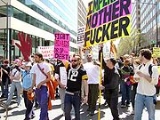
Public demonstration or political rally
Some forms of direct action listed in this article are also public demonstrations or rallies.
- Protest march, a historically and geographically common form of nonviolent action by groups of people.
- Picketing, a form of protest in which people congregate outside a place of work or location where an event is taking place. Often, this is done in an attempt to dissuade others from going in ("crossing the picket line"), but it can also be done to draw public attention to a cause.
- Street protesters, characteristically, work alone, gravitating towards areas of high foot traffic, and employing handmade placards such as sandwich boards or picket signs in order to maximize exposure and interaction with the public.
- Lock-downs are a way to stop movement of an object, like a structure or tree and to thwart movement of actual protestors from the location. Users employ various chains, locks and even the sleeping dragon for impairment of those trying to remove them with a matrix of composited materials.
- Die-ins are a form of protest where participants simulate being dead (with varying degrees of realism). In the simplest form of a die-in, protesters simply lie down on the ground and pretend to be dead, sometimes covering themselves with signs or banners. Much of the effectiveness depends on the posture of the protesters, for when not properly executed, the protest might look more like a "sleep-in". For added realism, simulated wounds are sometimes painted on the bodies, or (usually "bloody") bandages are used.
- Protest song is a song which protests perceived problems in society. Every major movement in Western history has been accompanied by its own collection of protest songs, from slave emancipation to women's suffrage, the labor movement, civil rights, the anti-war movement, the feminist movement, the environmental movement. Over time, the songs have come to protest more abstract, moral issues, such as injustice, racial discrimination, the morality of war in general (as opposed to purely protesting individual wars), globalization, inflation, social inequalities, and incarceration.
- Radical cheerleading The idea is to ironically reappropriate the aesthetics of cheerleading, for example by changing the chants to promote feminism and left-wing causes. Many radical cheerleaders (some of whom are male, transgender or non-gender identified) are in appearance far from the stereotypical image of a cheerleader.
- Experimental art is a form of protest in the sense that some of these works of art are censored or deemed inappropriate and are inherently protesting societal norms in one way or another. Experimental Art not censored or deemed inappropriate can still be considered protest because experimental concepts are not the societal norms, and challenge these norms inherently. These works of art, specifically those censored, make the statement “broader social change is needed in order to create an atmosphere accepting of this piece or style of art.”
Written demonstration
Written evidence of political or economic power, or democratic justification may also be a way of protesting.
- Petitions
- Letters (to show political power by the volume of letters): For example, some letter writing campaigns especially with signed form letter
Civil disobedience demonstrations
Any protest could be civil disobedience if a “ruling authority” says so, but the following are usually civil disobedience demonstrations:
As a residence
Destructive
Direct action
Protesting a government
Protesting a military shipment
By government employees
Job action
In sports
During a sporting event, under certain circumstances, one side may choose to play a game "under protest", usually when they feel the rules are not being correctly applied. The event continues as normal, and the events causing the protest are reviewed after the fact. If the protest is held to be valid, then the results of the event are changed. Each sport has different rules for protests.
By management
By tenants
By consumers
Information
Civil disobedience to censorship
Literature, art, culture
“Imagination is the chief instrument of the good…art is more moral than moralities. For the latter either are, or tend to become, consecrations of the status quo, reflections of custom, reinforcements of the established order. The moral prophets of humanity have always been poets even though they spoke in free verse or by parable…Art has been the means of keeping alive the sense of purposes that outrun evidence and of meanings that transcend indurated habit."-John Dewey
John Dewey in this quote explains protest in its artistic form, but also expresses how transcending certain habits of different periods is of central necessity when undertaking protest in its various forms. Artistic protest can range from protest in literature, movies, music, painting, sculpture etc.
The broad forms of artistic protest vary, as in music it can range from a backlash against a popular form of music, or musical minimalism that could be used to portray apathy towards a music type or music as an art form as a whole. For example, much of Sonic Youth’s music can be cited as a form of protest in that they use alternatives to the normative ways of making music that go directly against popular music and incorporate noise and guitar feedback in the writing process, and write songs relying heavily on personal innovation rather than personal interpretation and innovation that relies on pop artists, songs and styles.
The importance of Art as protest can be summed up by Josh Lunkin from the book Invisible Suburbs:Recovering Protest Fiction in the 1950s United States. In this he states “The domestic containment era, sometimes defined as contiguous with the ‘long 1950s,’ was over by 1962. In that year, John Henry Faulk successfully sued the Red Hunters who had blacklisted him; Michael Harrington revealed the existence of poverty (The Other America); Stan Lee and Steve Ditko redefined the superhero as an impoverished wisecracking rebel (The Amazing Spider-Man); Old Left icon John Hammond signed Bob Dylan to Columbia Records…”
The effects of such protest can be measured in the change continued from the liberal growth in the 1950s…liberalism remained the dominant paradigm in U.S. politics, peaking with the landslide victory of Lyndon B. Johnson over Barry Goldwater in the 1964 presidential election. Lyndon Johnson had been a New Deal Democrat in the 1930s and by the 1950s had decided that the Democratic Party had to break from its segregationist past and endorse racial liberalism as well as economic liberalism.
Religious
Economic effects of protests against companies
A study of 342 US protests covered by the New York Times newspaper in the period 1962 and 1990 showed that such public activities usually had an impact on the company's publicly-traded stock price. The most intriguing aspect of the study's findings is that what mattered most was not the number of protest participants, but the amount of media coverage the event received. Stock prices fell an average of one-tenth of a percent for every paragraph printed about the event.
Protest and New Social Movements
One feature of new social movements is their concern with democracy from below or ’direct democracy’, which differs from ‘representative democracy’. Whereas the ‘old’ labour movement made its demands and aired its grievances via the apparatus of the state, new social movements question this mode of political organization and interest intermediation, aiming at ‘the creation of a new conception of democracy’ or a new model of democracy.
New social movements are then protest that has gathered support and ingrained itself in a rather significant proportion of society. One such example of these new social movements then is the “Anti-Capitalist Campaigns in Global Civil Society.”
This movement is a result of the modern globalization and because the “nation-states are losing their authority as, towards the top of the system, planetary interdependence and the emergence of transnational political and economic forces shift the locus of real decision making elsewhere, while, towards the bottom, the proliferation of autonomous decision-making centres endows the ‘societal’ level of present-day societies with a power they never knew during the development of the modern state.”
See also
External links
|
| |
|
|