

Army of the Republic of Vietnam

Encyclopedia
The Army of the Republic of Viet Nam (ARVN, from alternate spelling of Vietnam), sometimes parsimoniously referred to as the South Vietnamese Army (SVA), was the land-based military
forces of the Republic of Vietnam (South Vietnam), which existed from October 26, 1955 until the fall of Saigon
on April 30, 1975. The ARVN is often erroneously used as a collective term to refer to all South Vietnamese military forces, including the Vietnam Air Force
and Republic of Vietnam Navy
. They are estimated to have suffered 1,394,000 casualties (killed and wounded) during the Vietnam War
.
After the fall of Saigon to the invading North Vietnamese Army (NVA), the ARVN was dissolved. While some high-ranking officers had fled the country to the United States
or elsewhere, thousands of former ARVN officers were sent to reeducation camp
s by the communist government
of the new, unified Socialist Republic of Vietnam.
On March 8, 1949, after the Elysee accords
the State of Vietnam
was recognized by France as an independent country ruled by the Vietnamese Emperor Bảo Đại
, and the Vietnamese National Army
(VNA) was soon created. The VNA fought in joint operations with the French Union
's French Far East Expeditionary Corps
against the communist Viet Minh
forces led by Ho Chi Minh
. The VNA fought in a wide range of campaigns including but not limited to the Battle of Na San
(1952), Operation Atlas (1953) and the Battle of Dien Bien Phu
(1954).
Benefiting with French assistance the VNA quickly became a modern army modelled after the Expeditionary Corps. It included infantry, artillery, transmission, armored cavalry, airborne, airforce, navy and a national military academy. By 1953 troopers as well as officers were all Vietnamese, the latter having been trained in Ecoles des Cadres such as Da Lat, including Chief of Staff General Nguyen Van Hinh
who was a French Union airforce veteran.
After the 1954 Geneva agreements
, French Indochina
ceased to exist and by 1956 all French Union troops had withdrawn from Vietnam
, Laos
, and Cambodia
. In 1955, by the order of Prime Minister Diem
, the VNA crushed the armed forces of the Binh Xuyen
.
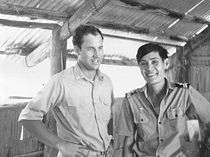
On October 26, 1955, the military was reorganized by the administration of President Ngo Dinh Diem
who then established the Army of the Republic of Vietnam (ARVN). The air force was known as the Vietnamese Air Force (VNAF). Early on, the focus of the army was the guerrilla
fighters of the Vietnam National Liberation Front (NLF, also known as the Viet Cong (VC)), formed to oppose the Diem administration. The United States, under President John F. Kennedy
sent advisors and a great deal of financial support to aid the ARVN in combating the insurgents. A major campaign, developed by Ngo Dinh Nhu
and later resurrected under another name was the "Strategic Hamlet Program
" which was regarded as unsuccessful by Western media because it was "inhumane" to move villagers from the countryside to fortified villages. ARVN leaders and President Diem were criticized by the foreign press when the troops were used to crush armed anti-government religious groups like the Cao Dai
and Hoa Hao
as well as to raid Buddhist temples, which according to Diem, were harboring NLF guerrillas. This most notably occurred on the night of August 21, 1963, during the Xa Loi Pagoda raids
conducted by the Special Forces, which caused a death toll estimated to range into the hundreds.
In 1963 Ngo Dinh Diem
was killed in a coup d'état carried out by ARVN officers
and encouraged by US officials such as Henry Cabot Lodge, Jr.
In the confusion that followed, General Duong Van Minh
took control, but he was only the first in a succession of ARVN generals to assume the presidency of South Vietnam. During these years, the United States began taking more control of the war against the NLF and the role of the ARVN became less and less significant. They were also plagued by continuing problems of severe corruption amongst the officer corps. Although the U.S. was highly critical, the ARVN continued to be entirely U.S. armed and funded.
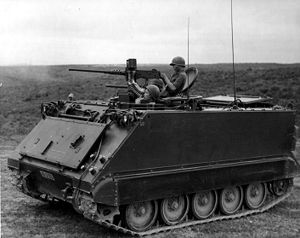 Although the US media has often portrayed the Vietnam War as an exclusively American vs. Vietnamese conflict, the ARVN carried the brunt of the fight before and after large-scale US involvement, and participated in many major operations with American troops. ARVN troops pioneered the use of the M113
armored personnel carrier as an infantry fighting vehicle by fighting mounted rather than as a "battle taxi" as originally designed, and the armored cavalry (ACAV) modifications were adopted based on ARVN experience. One notable ARVN unit equipped with M113 armored personnel carriers (APCs), the 3d Armored Cavalry Squadron
, used the new tactic so proficiently and with such extraordinary heroism against hostile forces that they earned the United States Presidential Unit Citation. An estimated 224,000 South Vietnamese troops died, while more than 58,000 U.S. troops died during the war.
started the process of "Vietnamization
", pulling out American forces and rendering the ARVN capable of fighting an effective war against the People's Army of Vietnam (PAVN) of the North (Also called NVA for North Vietnamese Army) and the ally, the National Liberation Front (NLF or Viet Cong). Slowly, ARVN began to expand from its counter-insurgency
role to become the primary ground defense against the NLF and PAVN. From 1969 to 1971 there were about 22,000 ARVN combat deaths per year. Starting in 1968, South Vietnam began calling up every available man for service in the ARVN, reaching a strength of one million soldiers by 1972. In 1970 they performed well in the Cambodian Incursion
and were executing three times as many operations as they had during the American war period. However, the ARVN equipment continued to be of lower standards than their American and South Korea
n allies, even as the U.S. tried to upgrade ARVN technology. However, the officer corps was still the biggest problem. Leaders were too often poorly trained, corrupt, lacking morale and inept.
However, forced to carry the burden left by the Americans, the South Vietnamese Army actually started to perform rather well, though with continued American air support.
In 1972, General Vo Nguyen Giap
launched the "Easter Offensive", an all-out attack against South Vietnam from the DMZ. The assault combined infantry wave assaults, artillery and the first massive use of armored forces by the PAVN. Although T-54 tanks proved vulnerable to LAW rockets, the ARVN took heavy losses. The PAVN and NLF forces took Quảng Trị Province
and some areas along the Lao
and Cambodian
borders.
 President Richard Nixon
dispatched more bombers in Operation Linebacker
to provide air support for the ARVN when it seemed that South Vietnam was about to be lost. In desperation, President Nguyễn Văn Thiệu
fired the incompetent General Hoang Xuan Lam
and replaced him with General Ngo Quang Truong
. He gave the order that all deserters would be executed and pulled enough forces together in order to prevent the PAVN to take Huế
. Finally, with considerable U.S. air and naval support, as well as hard fighting by the ARVN soldiers, the Easter Offensive was halted. ARVN forces counter-attacked and succeeded in driving part of the PAVN out of South Vietnam, though they did retain control of northern Quảng Trị province near the DMZ
.
At the end of 1972, the failed of Operation Linebacker II
brought US to a negotiated end to Hanoi government. By 1974, the United States had completely pulled its troops out of Vietnam. The ARVN was left to fight alone, but with all the weapons and technologies that their allies left behind. With massive technological support they had roughly four times as many heavy weapons as their enemies. The U.S. left for the ARVN with thousands of aircraft, only brought back the tactical bomber B52s, making the South Vietnam Airforce the fourth largest airforce in the world. These figures are deceptive, however, as the U.S. began to curtail military aid. The same situation happened to the Democratic Republic of Vietnam, since their allies, the Soviet Union
, and China
has also cut down military support, forcing them to using the obsolete T-34
tanks and SU-100
tank destroyers into battle.
In the fall of 1974, Nixon resigned under the pressure of the Watergate scandal
and was succeeded by Gerald Ford
. With the war growing incredibly unpopular at home, combined with a severe economic recession and mounting budget deficits, Congress cut funding to South Vietnam for the upcoming fiscal year from 1 billion to 700 million dollars. Historians have attributed the fall of Saigon in 1975 to the cessation of American aid along with the growing disenchantment of the South Vietnamese people and the rampant corruption and incompetence of South Vietnam political leaders and ARVN general staff.
Without the necessary funds and facing a collapse in South Vietnamese troop and civilian morale, it was becoming increasingly difficult for the ARVN to achieve a victory against the NLF. Moreover, the withdrawal of U.S. aid encouraged North Vietnam to begin a new military offensive against South Vietnam. This resolve was strengthened when the new American administration did not think itself bound to this promise Nixon made to Thieu of a "severe retaliation" if Hanoi broke the 1973 Paris Peace Accords
.
The fall of Huế to NLF forces on March 26 began an organized rout of the ARVN that culminated in the complete disintegration of the South Vietnamese government. Withdrawing ARVN forces found the roads choked with refugees making troop movement almost impossible. North Vietnamese forces took advantage of the growing instability, and with the abandoned equipment of the routing ARVN, they mounted heavy attacks on all fronts. With collapse all but inevitable, many ARVN generals abandoned their troops to fend for themselves and ARVN soldiers deserted en masse. Except for one battle by the 18th Division at Xuan Loc and the perimeters around Saigon, ARVN resistance all but ceased. Less than a month after Huế, Saigon fell and South Vietnam ceased to exist as a political entity. The sudden and complete destruction of the ARVN shocked the world. Even their opponents were surprised at how quickly South Vietnam collapsed.
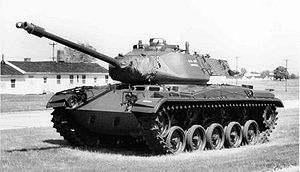
The U.S. had provided the ARVN with 793,994 M1 carbines 640,000 M-16 rifle
s, 34,000 M79 grenade launcher
s, 40,000 radios, 20,000 quarter-ton trucks, 214 M41 Walker Bulldog
light tanks, 77 M577 Command tracks (command version of the M113 APC), 930 M113s (APC/ACAVs), 120 V-100s (wheeled armored cars), and 190 M48
tanks; however on the eleventh hour, a US effort in November 1972 managed to transfer 59 more M48A3 Patton tanks, 100 additional M-113A1 ACAVs (Armored Cavalry Assault Vehicles), and over 500 extra aircraft to South Vietnam. Despite such impressive figures, the Vietnamese were not as well equipped as the American G.I.s they replaced. The 1972 offensive had been driven back only with a massive US bombing campaign against North Vietnam. The VNAF air force had 200 A1
, A-37 Ground Attack Aircraft
and F-5
fighters, 30 AC-47
gunships and 600 transport, training and reconnaissance aircraft
, and 500 helicopters. But their lightweight attack fighters lacked the punch of offensive bombers and fighters such as the B-52 and F-4 Phantom. Many aircraft were shot down due to superior NVA surface-to-air missiles and anti-air batteries. ARVN's massive ground forces consisted of over 1 million troops, but were quickly thrown into chaos and taken down by the less in number, but more experience and disciplined, PAVN.
Military
A military is an organization authorized by its greater society to use lethal force, usually including use of weapons, in defending its country by combating actual or perceived threats. The military may have additional functions of use to its greater society, such as advancing a political agenda e.g...
forces of the Republic of Vietnam (South Vietnam), which existed from October 26, 1955 until the fall of Saigon
Fall of Saigon
The Fall of Saigon was the capture of Saigon, the capital of South Vietnam, by the People's Army of Vietnam and the National Liberation Front on April 30, 1975...
on April 30, 1975. The ARVN is often erroneously used as a collective term to refer to all South Vietnamese military forces, including the Vietnam Air Force
Vietnam Air Force
The Vietnam Air Force began with a few hand-picked men chosen to fly alongside French pilots during the State of Vietnam era. It eventually grew into the world’s sixth largest air force at the height of its power, in 1974...
and Republic of Vietnam Navy
Republic of Vietnam Navy
The Republic of Vietnam Navy was the naval force of the former Republic of Vietnam from 1955 to 1975. The early fleet consisted of boats from France. After 1955 and the transfer of the armed forces to Vietnamese control, the fleet was supplied from the United States...
. They are estimated to have suffered 1,394,000 casualties (killed and wounded) during the Vietnam War
Vietnam War
The Vietnam War was a Cold War-era military conflict that occurred in Vietnam, Laos, and Cambodia from 1 November 1955 to the fall of Saigon on 30 April 1975. This war followed the First Indochina War and was fought between North Vietnam, supported by its communist allies, and the government of...
.
After the fall of Saigon to the invading North Vietnamese Army (NVA), the ARVN was dissolved. While some high-ranking officers had fled the country to the United States
United States
The United States of America is a federal constitutional republic comprising fifty states and a federal district...
or elsewhere, thousands of former ARVN officers were sent to reeducation camp
Reeducation camp
Reeducation camp is the official title given to the prison camps operated by the government of Vietnam following the end of the Vietnam War. In such "reeducation camps", the government imprisoned several hundred thousand former military officers and government workers from the former regime of...
s by the communist government
Communist Party of Vietnam
The Communist Party of Vietnam , formally established in 1930, is the governing party of the nation of Vietnam. It is today the only legal political party in that country. Describing itself as Marxist-Leninist, the CPV is the directing component of a broader group of organizations known as the...
of the new, unified Socialist Republic of Vietnam.
Vietnamese National Army (VNA) 1949–1955
On March 8, 1949, after the Elysee accords
Elysee Accords
The Élysée Accords were an agreement made in 1949 which would give Vietnam greater independence from France. The agreement was intended to increase U.S. support for France’s actions in Indochina as well as to convince ex-emperor Bảo Đại that France would give Vietnam greater independence...
the State of Vietnam
State of Vietnam
The State of Vietnam was a state that claimed authority over all of Vietnam during the First Indochina War, and replaced the Provisional Central Government of Vietnam . The provisional government was a brief transitional administration between colonial Cochinchina and an independent state...
was recognized by France as an independent country ruled by the Vietnamese Emperor Bảo Đại
Bảo Đài
Bảo Đài is a commune and village in Lục Nam District, Bac Giang Province, in northeastern Vietnam.-References:...
, and the Vietnamese National Army
Vietnamese National Army
On March 8, 1949, after the Elysee accords, the State of Vietnam was recognized by France as an independent country ruled by Vietnamese Emperor Bảo Đại. The Vietnamese National Army or Vietnam National Army was the State of Vietnam's military force created shortly after that. It was commanded by...
(VNA) was soon created. The VNA fought in joint operations with the French Union
French Union
The French Union was a political entity created by the French Fourth Republic to replace the old French colonial system, the "French Empire" and to abolish its "indigenous" status.-History:...
's French Far East Expeditionary Corps
French Far East Expeditionary Corps
The French Far East Expeditionary Corps was a colonial expeditionary force of the French Union Army sent in French Indochina in 1945 during the Pacific War.-Pacific War :...
against the communist Viet Minh
Viet Minh
Việt Minh was a national independence coalition formed at Pac Bo on May 19, 1941. The Việt Minh initially formed to seek independence for Vietnam from the French Empire. When the Japanese occupation began, the Việt Minh opposed Japan with support from the United States and the Republic of China...
forces led by Ho Chi Minh
Ho Chi Minh
Hồ Chí Minh , born Nguyễn Sinh Cung and also known as Nguyễn Ái Quốc, was a Vietnamese Marxist-Leninist revolutionary leader who was prime minister and president of the Democratic Republic of Vietnam...
. The VNA fought in a wide range of campaigns including but not limited to the Battle of Na San
Battle of Na San
The Battle of Nà Sản was fought between French Union forces and the communist forces of the Việt Minh at Nà Sản, Sơn La Province, during the First Indochina War for control of the T’ai region ....
(1952), Operation Atlas (1953) and the Battle of Dien Bien Phu
Battle of Dien Bien Phu
The Battle of Dien Bien Phu was the climactic confrontation of the First Indochina War between the French Union's French Far East Expeditionary Corps and Viet Minh communist revolutionaries. The battle occurred between March and May 1954 and culminated in a comprehensive French defeat that...
(1954).
Benefiting with French assistance the VNA quickly became a modern army modelled after the Expeditionary Corps. It included infantry, artillery, transmission, armored cavalry, airborne, airforce, navy and a national military academy. By 1953 troopers as well as officers were all Vietnamese, the latter having been trained in Ecoles des Cadres such as Da Lat, including Chief of Staff General Nguyen Van Hinh
Nguyen Van Hinh
Nguyễn Văn Hinh , was appointed the Vietnamese National Army Chief of Staff by Emperor Bảo Đại. On November 8, 1954, after the First Indochina War he left South Vietnam in exile for France....
who was a French Union airforce veteran.
After the 1954 Geneva agreements
Geneva Conference (1954)
The Geneva Conference was a conference which took place in Geneva, Switzerland, whose purpose was to attempt to find a way to unify Korea and discuss the possibility of restoring peace in Indochina...
, French Indochina
French Indochina
French Indochina was part of the French colonial empire in southeast Asia. A federation of the three Vietnamese regions, Tonkin , Annam , and Cochinchina , as well as Cambodia, was formed in 1887....
ceased to exist and by 1956 all French Union troops had withdrawn from Vietnam
Vietnam
Vietnam – sometimes spelled Viet Nam , officially the Socialist Republic of Vietnam – is the easternmost country on the Indochina Peninsula in Southeast Asia. It is bordered by China to the north, Laos to the northwest, Cambodia to the southwest, and the South China Sea –...
, Laos
Laos
Laos Lao: ສາທາລະນະລັດ ປະຊາທິປະໄຕ ປະຊາຊົນລາວ Sathalanalat Paxathipatai Paxaxon Lao, officially the Lao People's Democratic Republic, is a landlocked country in Southeast Asia, bordered by Burma and China to the northwest, Vietnam to the east, Cambodia to the south and Thailand to the west...
, and Cambodia
Cambodia
Cambodia , officially known as the Kingdom of Cambodia, is a country located in the southern portion of the Indochina Peninsula in Southeast Asia...
. In 1955, by the order of Prime Minister Diem
Ngo Dinh Diem
Ngô Đình Diệm was the first president of South Vietnam . In the wake of the French withdrawal from Indochina as a result of the 1954 Geneva Accords, Diệm led the effort to create the Republic of Vietnam. Accruing considerable U.S. support due to his staunch anti-Communism, he achieved victory in a...
, the VNA crushed the armed forces of the Binh Xuyen
Binh Xuyen
Bình Xuyên, often linked to its infamous leader, General Le van "Bay" Vien, was an independent military force within the Vietnamese National Army whose leaders once had lived outside the law and had sided with the Viet Minh...
.
Army of the Republic of Vietnam (ARVN) 1955–1975
On October 26, 1955, the military was reorganized by the administration of President Ngo Dinh Diem
Ngo Dinh Diem
Ngô Đình Diệm was the first president of South Vietnam . In the wake of the French withdrawal from Indochina as a result of the 1954 Geneva Accords, Diệm led the effort to create the Republic of Vietnam. Accruing considerable U.S. support due to his staunch anti-Communism, he achieved victory in a...
who then established the Army of the Republic of Vietnam (ARVN). The air force was known as the Vietnamese Air Force (VNAF). Early on, the focus of the army was the guerrilla
Guerrilla warfare
Guerrilla warfare is a form of irregular warfare and refers to conflicts in which a small group of combatants including, but not limited to, armed civilians use military tactics, such as ambushes, sabotage, raids, the element of surprise, and extraordinary mobility to harass a larger and...
fighters of the Vietnam National Liberation Front (NLF, also known as the Viet Cong (VC)), formed to oppose the Diem administration. The United States, under President John F. Kennedy
John F. Kennedy
John Fitzgerald "Jack" Kennedy , often referred to by his initials JFK, was the 35th President of the United States, serving from 1961 until his assassination in 1963....
sent advisors and a great deal of financial support to aid the ARVN in combating the insurgents. A major campaign, developed by Ngo Dinh Nhu
Ngo Dinh Nhu
Ngô Ðình Nhu was the younger brother and chief political advisor of South Vietnam's first president, Ngô Ðình Diệm. Nhu was widely regarded as the architect of the Ngô family's nepotistic and autocratic rule over South Vietnam from 1955 to 1963...
and later resurrected under another name was the "Strategic Hamlet Program
Strategic Hamlet Program
The Strategic Hamlet Program was a plan by the governments of South Vietnam and the United States during the Vietnam War to combat the Communist insurgency by means of population transfer.In 1961, U.S...
" which was regarded as unsuccessful by Western media because it was "inhumane" to move villagers from the countryside to fortified villages. ARVN leaders and President Diem were criticized by the foreign press when the troops were used to crush armed anti-government religious groups like the Cao Dai
Cao Dai
Cao Đài is a syncretistic, monotheistic religion, officially established in the city of Tay Ninh, southern Vietnam, in 1926. Đạo Cao Đài is the religion's shortened name, the full name is Đại Đạo Tam Kỳ Phổ Độ...
and Hoa Hao
Hoa Hao
Hòa Hảo is a religious tradition, based on Buddhism, founded in 1939 by Huỳnh Phú Sổ, a native of the Mekong River Delta region of southern Vietnam. Adherents consider Sổ to be a prophet, and Hòa Hảo a continuation of a 19th-century Buddhist ministry known as Bửu Sơn Kỳ Hương...
as well as to raid Buddhist temples, which according to Diem, were harboring NLF guerrillas. This most notably occurred on the night of August 21, 1963, during the Xa Loi Pagoda raids
Xa Loi Pagoda raids
The Xa Loi Pagoda raids were a series of synchronized attacks on various Buddhist pagodas in the major cities of South Vietnam shortly after midnight on August 21, 1963...
conducted by the Special Forces, which caused a death toll estimated to range into the hundreds.
In 1963 Ngo Dinh Diem
Ngo Dinh Diem
Ngô Đình Diệm was the first president of South Vietnam . In the wake of the French withdrawal from Indochina as a result of the 1954 Geneva Accords, Diệm led the effort to create the Republic of Vietnam. Accruing considerable U.S. support due to his staunch anti-Communism, he achieved victory in a...
was killed in a coup d'état carried out by ARVN officers
1963 South Vietnamese coup
In November 1963, President Ngô Đình Diệm of South Vietnam was deposed by a group of Army of the Republic of Vietnam officers who disagreed with his handling of the Buddhist crisis and, in general, his increasing oppression of national groups in the name of fighting the communist Vietcong.The...
and encouraged by US officials such as Henry Cabot Lodge, Jr.
Henry Cabot Lodge, Jr.
Henry Cabot Lodge, Jr. was a Republican United States Senator from Massachusetts and a U.S. ambassador to the United Nations, South Vietnam, West Germany, and the Holy See . He was the Republican nominee for Vice President in the 1960 Presidential election.-Early life:Lodge was born in Nahant,...
In the confusion that followed, General Duong Van Minh
Duong Van Minh
Minh was born on 16 February 1916 in Mỹ Tho Province in the Mekong Delta, the son of a wealthy landowner who served in a prominent position in the Finance Ministry of the French colonial administration...
took control, but he was only the first in a succession of ARVN generals to assume the presidency of South Vietnam. During these years, the United States began taking more control of the war against the NLF and the role of the ARVN became less and less significant. They were also plagued by continuing problems of severe corruption amongst the officer corps. Although the U.S. was highly critical, the ARVN continued to be entirely U.S. armed and funded.
M113 armored personnel carrier
The M113 is a fully tracked armored personnel carrier that has formed the backbone of the United States Army's mechanized infantry units from the time of its first fielding in Vietnam in April 1962. The M113 was the most widely used armored vehicle of the U.S...
armored personnel carrier as an infantry fighting vehicle by fighting mounted rather than as a "battle taxi" as originally designed, and the armored cavalry (ACAV) modifications were adopted based on ARVN experience. One notable ARVN unit equipped with M113 armored personnel carriers (APCs), the 3d Armored Cavalry Squadron
3d Armored Cavalry Squadron (South Vietnam)
The 3d Armored Cavalry Squadron of the Army of the Republic of Vietnam — the army of the nation state of South Vietnam that existed from 1955 to 1975 — was part of II Corps that oversaw the twelve provinces of the central highlands; corps headquarters being in the mountain town of Pleiku...
, used the new tactic so proficiently and with such extraordinary heroism against hostile forces that they earned the United States Presidential Unit Citation. An estimated 224,000 South Vietnamese troops died, while more than 58,000 U.S. troops died during the war.
Final campaigns
Starting in 1969 President Richard NixonRichard Nixon
Richard Milhous Nixon was the 37th President of the United States, serving from 1969 to 1974. The only president to resign the office, Nixon had previously served as a US representative and senator from California and as the 36th Vice President of the United States from 1953 to 1961 under...
started the process of "Vietnamization
Vietnamization
Vietnamization was a policy of the Richard M. Nixon administration during the Vietnam War, as a result of the Viet Cong's Tet Offensive, to "expand, equip, and train South Vietnam's forces and assign to them an ever-increasing combat role, at the same time steadily reducing the number of U.S....
", pulling out American forces and rendering the ARVN capable of fighting an effective war against the People's Army of Vietnam (PAVN) of the North (Also called NVA for North Vietnamese Army) and the ally, the National Liberation Front (NLF or Viet Cong). Slowly, ARVN began to expand from its counter-insurgency
Counter-insurgency
A counter-insurgency or counterinsurgency involves actions taken by the recognized government of a nation to contain or quell an insurgency taken up against it...
role to become the primary ground defense against the NLF and PAVN. From 1969 to 1971 there were about 22,000 ARVN combat deaths per year. Starting in 1968, South Vietnam began calling up every available man for service in the ARVN, reaching a strength of one million soldiers by 1972. In 1970 they performed well in the Cambodian Incursion
Cambodian Incursion
The Cambodian Campaign was a series of military operations conducted in eastern Cambodia during mid-1970 by the United States and the Republic of Vietnam during the Vietnam War. These invasions were a result of policy of President Richard Nixon whose decision it was to invade...
and were executing three times as many operations as they had during the American war period. However, the ARVN equipment continued to be of lower standards than their American and South Korea
South Korea
The Republic of Korea , , is a sovereign state in East Asia, located on the southern portion of the Korean Peninsula. It is neighbored by the People's Republic of China to the west, Japan to the east, North Korea to the north, and the East China Sea and Republic of China to the south...
n allies, even as the U.S. tried to upgrade ARVN technology. However, the officer corps was still the biggest problem. Leaders were too often poorly trained, corrupt, lacking morale and inept.
However, forced to carry the burden left by the Americans, the South Vietnamese Army actually started to perform rather well, though with continued American air support.
In 1972, General Vo Nguyen Giap
Vo Nguyen Giap
Võ Nguyên Giáp is a retired Vietnamese officer in the Vietnam People’s Army and a politician. He was a principal commander in two wars: the First Indochina War and the Vietnam War...
launched the "Easter Offensive", an all-out attack against South Vietnam from the DMZ. The assault combined infantry wave assaults, artillery and the first massive use of armored forces by the PAVN. Although T-54 tanks proved vulnerable to LAW rockets, the ARVN took heavy losses. The PAVN and NLF forces took Quảng Trị Province
Quang Tri Province
Quảng Trị is a province on the North Central Coast of Vietnam, north of the former imperial capital of Huế.-Geography:Located in North Central Vietnam, Quang Tri Province is surrounded by Quang Binh Province on the north, Thua Thien-Hue Province on the south, Savannakhet Province of Laos on the...
and some areas along the Lao
Laos
Laos Lao: ສາທາລະນະລັດ ປະຊາທິປະໄຕ ປະຊາຊົນລາວ Sathalanalat Paxathipatai Paxaxon Lao, officially the Lao People's Democratic Republic, is a landlocked country in Southeast Asia, bordered by Burma and China to the northwest, Vietnam to the east, Cambodia to the south and Thailand to the west...
and Cambodian
Cambodian
Cambodian may refer to:* Something of, from, or related to the country of Cambodia. For information about the Cambodian people, see:** Demographics of Cambodia** Culture of Cambodia** List of Cambodians* Khmer people, the majority ethnic group of Cambodia...
borders.
Richard Nixon
Richard Milhous Nixon was the 37th President of the United States, serving from 1969 to 1974. The only president to resign the office, Nixon had previously served as a US representative and senator from California and as the 36th Vice President of the United States from 1953 to 1961 under...
dispatched more bombers in Operation Linebacker
Operation Linebacker
Operation Linebacker was the title of a U.S. Seventh Air Force and U.S. Navy Task Force 77 aerial interdiction campaign conducted against the Democratic Republic of Vietnam from 9 May to 23 October 1972, during the Vietnam War....
to provide air support for the ARVN when it seemed that South Vietnam was about to be lost. In desperation, President Nguyễn Văn Thiệu
Nguyen Van Thieu
Nguyễn Văn Thiệu was president of South Vietnam from 1965 to 1975. He was a general in the Army of the Republic of Vietnam , became head of a military junta, and then president after winning a fraudulent election...
fired the incompetent General Hoang Xuan Lam
Hoang Xuan Lam
Hoàng Xuân Lãm was a general in the Army of the Republic of Vietnam and a native of the city of Huế. Given responsibility for the I Corps Tactical Zone in 1967, Lãm coordinated the South Vietnamese offensive known as Operation Lam Sơn 719 which aimed at striking the North Vietnamese logistical...
and replaced him with General Ngo Quang Truong
Ngo Quang Truong
Lieutenant General Ngô Quang Trưởng was an officer in the Army of the Republic of Vietnam . He was widely regarded as South Vietnam’s best officer and well-known for his uncompromising integrity and incorruptibility...
. He gave the order that all deserters would be executed and pulled enough forces together in order to prevent the PAVN to take Huế
Hue
Hue is one of the main properties of a color, defined technically , as "the degree to which a stimulus can be describedas similar to or different from stimuli that are described as red, green, blue, and yellow,"...
. Finally, with considerable U.S. air and naval support, as well as hard fighting by the ARVN soldiers, the Easter Offensive was halted. ARVN forces counter-attacked and succeeded in driving part of the PAVN out of South Vietnam, though they did retain control of northern Quảng Trị province near the DMZ
Vietnamese Demilitarized Zone
The Vietnamese Demilitarized Zone was established as a dividing line between North and South Vietnam as a result of the First Indochina War.During the Second Indochina War , it became important as the battleground demarcation separating North Vietnamese territory from South Vietnamese territory.-...
.
At the end of 1972, the failed of Operation Linebacker II
Operation Linebacker II
Operation Linebacker II was a US Seventh Air Force and US Navy Task Force 77 aerial bombing campaign, conducted against targets in the Democratic Republic of Vietnam during the final period of US involvement in the Vietnam War...
brought US to a negotiated end to Hanoi government. By 1974, the United States had completely pulled its troops out of Vietnam. The ARVN was left to fight alone, but with all the weapons and technologies that their allies left behind. With massive technological support they had roughly four times as many heavy weapons as their enemies. The U.S. left for the ARVN with thousands of aircraft, only brought back the tactical bomber B52s, making the South Vietnam Airforce the fourth largest airforce in the world. These figures are deceptive, however, as the U.S. began to curtail military aid. The same situation happened to the Democratic Republic of Vietnam, since their allies, the Soviet Union
Soviet Union
The Soviet Union , officially the Union of Soviet Socialist Republics , was a constitutionally socialist state that existed in Eurasia between 1922 and 1991....
, and China
China
Chinese civilization may refer to:* China for more general discussion of the country.* Chinese culture* Greater China, the transnational community of ethnic Chinese.* History of China* Sinosphere, the area historically affected by Chinese culture...
has also cut down military support, forcing them to using the obsolete T-34
T-34
The T-34 was a Soviet medium tank produced from 1940 to 1958. Although its armour and armament were surpassed by later tanks of the era, it has been often credited as the most effective, efficient and influential design of World War II...
tanks and SU-100
SU-100
The SU-100 was a Soviet tank destroyer. It was used extensively during the last year of World War II and saw service for many years afterwards with the armies of Soviet allies around the world.- Development :...
tank destroyers into battle.
In the fall of 1974, Nixon resigned under the pressure of the Watergate scandal
Watergate scandal
The Watergate scandal was a political scandal during the 1970s in the United States resulting from the break-in of the Democratic National Committee headquarters at the Watergate office complex in Washington, D.C., and the Nixon administration's attempted cover-up of its involvement...
and was succeeded by Gerald Ford
Gerald Ford
Gerald Rudolph "Jerry" Ford, Jr. was the 38th President of the United States, serving from 1974 to 1977, and the 40th Vice President of the United States serving from 1973 to 1974...
. With the war growing incredibly unpopular at home, combined with a severe economic recession and mounting budget deficits, Congress cut funding to South Vietnam for the upcoming fiscal year from 1 billion to 700 million dollars. Historians have attributed the fall of Saigon in 1975 to the cessation of American aid along with the growing disenchantment of the South Vietnamese people and the rampant corruption and incompetence of South Vietnam political leaders and ARVN general staff.
Without the necessary funds and facing a collapse in South Vietnamese troop and civilian morale, it was becoming increasingly difficult for the ARVN to achieve a victory against the NLF. Moreover, the withdrawal of U.S. aid encouraged North Vietnam to begin a new military offensive against South Vietnam. This resolve was strengthened when the new American administration did not think itself bound to this promise Nixon made to Thieu of a "severe retaliation" if Hanoi broke the 1973 Paris Peace Accords
Paris Peace Accords
The Paris Peace Accords of 1973 intended to establish peace in Vietnam and an end to the Vietnam War, ended direct U.S. military involvement, and temporarily stopped the fighting between North and South Vietnam...
.
The fall of Huế to NLF forces on March 26 began an organized rout of the ARVN that culminated in the complete disintegration of the South Vietnamese government. Withdrawing ARVN forces found the roads choked with refugees making troop movement almost impossible. North Vietnamese forces took advantage of the growing instability, and with the abandoned equipment of the routing ARVN, they mounted heavy attacks on all fronts. With collapse all but inevitable, many ARVN generals abandoned their troops to fend for themselves and ARVN soldiers deserted en masse. Except for one battle by the 18th Division at Xuan Loc and the perimeters around Saigon, ARVN resistance all but ceased. Less than a month after Huế, Saigon fell and South Vietnam ceased to exist as a political entity. The sudden and complete destruction of the ARVN shocked the world. Even their opponents were surprised at how quickly South Vietnam collapsed.
The U.S. had provided the ARVN with 793,994 M1 carbines 640,000 M-16 rifle
M16 rifle
The M16 is the United States military designation for the AR-15 rifle adapted for both semi-automatic and full-automatic fire. Colt purchased the rights to the AR-15 from ArmaLite, and currently uses that designation only for semi-automatic versions of the rifle. The M16 fires the 5.56×45mm NATO...
s, 34,000 M79 grenade launcher
M79 grenade launcher
The M79 grenade launcher is a single-shot, shoulder-fired, break-action grenade launcher that fires a 40x46mm grenade which used what the US Army called the High-Low Propulsion System to keep recoil forces low, and first appeared during the Vietnam War...
s, 40,000 radios, 20,000 quarter-ton trucks, 214 M41 Walker Bulldog
M41 Walker Bulldog
The M41 Walker Bulldog was a U.S. light tank developed to replace the M24 Chaffee. It was named for General Walton Walker who died in a jeep accident in Korea...
light tanks, 77 M577 Command tracks (command version of the M113 APC), 930 M113s (APC/ACAVs), 120 V-100s (wheeled armored cars), and 190 M48
M48 Patton
The M48 Patton is a medium tank that was designed in the United States. It was the third and final tank to be officially named after General George S. Patton, commander of the U.S. Third Army during World War II and one of the earliest American advocates for the use of tanks in battle It was a...
tanks; however on the eleventh hour, a US effort in November 1972 managed to transfer 59 more M48A3 Patton tanks, 100 additional M-113A1 ACAVs (Armored Cavalry Assault Vehicles), and over 500 extra aircraft to South Vietnam. Despite such impressive figures, the Vietnamese were not as well equipped as the American G.I.s they replaced. The 1972 offensive had been driven back only with a massive US bombing campaign against North Vietnam. The VNAF air force had 200 A1
A-1 Skyraider
The Douglas A-1 Skyraider was an American single-seat attack aircraft that saw service between the late 1940s and early 1980s. It became a piston-powered, propeller-driven anachronism in the jet age, and was nicknamed "Spad", after a French World War I fighter...
, A-37 Ground Attack Aircraft
A-37 Dragonfly
The Cessna A-37 Dragonfly, or Super Tweet, is a United States light attack aircraft developed from the T-37 Tweet basic trainer in the 1960s and 1970s...
and F-5
F-5 Freedom Fighter
The Northrop F-5A/B Freedom Fighter and the F-5E/F Tiger II are part of a family of widely-used light supersonic fighter aircraft, designed and built by Northrop...
fighters, 30 AC-47
AC-47 Spooky
The Douglas AC-47 Spooky was the first in a series of gunships developed by the United States Air Force during the Vietnam War...
gunships and 600 transport, training and reconnaissance aircraft
Reconnaissance aircraft
A reconnaissance aircraft is a manned military aircraft designed, or adapted, to carry out aerial reconnaissance.-History:The majority of World War I aircraft were reconnaissance designs...
, and 500 helicopters. But their lightweight attack fighters lacked the punch of offensive bombers and fighters such as the B-52 and F-4 Phantom. Many aircraft were shot down due to superior NVA surface-to-air missiles and anti-air batteries. ARVN's massive ground forces consisted of over 1 million troops, but were quickly thrown into chaos and taken down by the less in number, but more experience and disciplined, PAVN.
Corps
- I CorpsI Corps (South Vietnam)The I Corps Tactical Zone was a corps of the Army of the Republic of Vietnam , the army of the nation state of South Vietnam that existed from 1955 to 1975. It was one of four corps which the ARVN oversaw. This was the northernmost region of South Vietnam, bordering North Vietnam...
/ CTZ - II CorpsII Corps (South Vietnam)The II Corps was a corps of the Army of the Republic of Vietnam , the army of the nation state of South Vietnam that existed from 1955 to 1975. It was one of four corps in the ARVN, and it oversaw the region of the central highlands region, north of the capital Saigon...
/CTZ - III CorpsIII Corps (South Vietnam)III Corps was a corps of the Army of the Republic of Vietnam , the army of the nation state of South Vietnam that existed from 1955 to 1975...
/CTZ - IV CorpsIV Corps (South Vietnam)The IV Corps was a corps of the Army of the Republic of Vietnam , the army of the nation state of South Vietnam that existed from 1955 to 1975...
/CTZ - 44th Tactical Zone
Divisions
- 1st Infantry Division1st Division (South Vietnam)The 1st Division of the Army of the Republic of Vietnam —the army of the nation state of South Vietnam that existed from 1955 to 1975—was part of the I Corps that oversaw the northernmost region of South Vietnam, the centre of Vietnam....
– The French formed the 21st Mobile Group in 1953, renamed 21st Division in January 1955, the 1st Division later that year. Considered "one of the best South Vietnamese combat units". Based in Huế it had four rather three regiments. - 2nd Infantry Division2nd Division (South Vietnam)The 2nd Division of the Army of the Republic of Vietnam —the army of the nation state of South Vietnam that existed from 1955 to 1975—was part of the I Corps that oversaw the northernmost region of South Vietnam, the centre of Vietnam....
– The French formed the 32nd Mobile Group in 1953, renamed 32nd Division in January 1955, the 2nd Division later that year. Based in Quang Ngai. A "fairly good" division. - 3rd Infantry Division3rd Division (South Vietnam)The 3rd Division of the Army of the Republic of Vietnam —the army of the nation state of South Vietnam that existed from 1955 to 1975—was part of the I Corps that oversaw the northernmost region of South Vietnam, the centre of Vietnam....
– Raised in October 1971 in Quảng Trị. One regiment was from the 1st Division (the 2nd Inf Regt). Composed of 2nd Inf Regt, 56th Inf Regt, and 57th Inf Regt. Based at Da Nang. Collapsed in the 1972 Easter Offensive and was reconstituted and destroyed at Da Nang in 1975. - 5th Infantry Division5th Division (South Vietnam)The Fifth Division of the Army of the Republic of Vietnam —the army of the nation state of South Vietnam that existed from 1955 to 1975—was part of the III Corps that oversaw the region of the country surrounding the capital, Saigon....
– Originally formed in North Vietnam as the 6th Division (more commonly known as the "Nung" division), renamed 3rd Field Division after its move to Song Mao then to the 5th Division in 1959. Many Nungs originally were in its ranks. At Bien Hoa in 1963 and involved in overthrow of Diem. Then operated north of Saigon. Entered Cambodia in 1970. Defended An Loc in 1972. - 7th Infantry Division – Formed as the 7th Mobile Group by the French, becoming the 7th Division in 1959. Served in Mekong Delta 1961–1975.
- 9th Infantry Division9th Division (South Vietnam)The 9th Division of the Army of the Republic of Vietnam —the army of the nation state of South Vietnam that existed from 1955 to 1975—was part of the IV Corps that oversaw the southernmost region of South Vietnam, the Mekong Delta....
– Formed in 1962, northern Mekong Delta. - 18th Infantry Division18th Division (South Vietnam)The 18th Division was an infantry division in the III Corps of the Army of the Republic of Vietnam . The U.S. Military Assistance Command Vietnam considered the 18th as undisciplined and was well known throughout the ARVN for its "cowboy" reputation...
– Formed as the 10th Division in 1965. Renamed the 18th Division in 1967 (number ten meant the worst in GI slang). Based at Xuan Loc. Made famous for its defence of that town for a month in March–April 1975. - 21st Infantry Division21st Division (South Vietnam)The 21st Division of the Army of the Republic of Vietnam —the army of the nation state of South Vietnam that existed from 1955 to 1975, was part of the IV Corps that oversaw the southernmost region of South Vietnam, the Mekong Delta....
– The ARVN 1st and 3rd Light Divisions were formed in 1955, renamed the 11th and 13th Light Divisions in 1956. Combined together to form the 21st Division in 1959. Served mainly near Saigon, Mekong Delta. - 22nd Infantry Division22nd Division (South Vietnam)The 22nd Division of the Army of the Republic of Vietnam —the army of the nation state of South Vietnam that existed from 1955 to 1975—was part of the II Corps that oversaw the region of the central highlands north of the capital Saigon....
– Initially raised as the 4th Infantry Division which existed briefly in the 1950s but renamed 22nd Division as four is an unlucky number in Vietnam. The ARVN 2nd and 4th Light Divisions were formed in 1955: 4th renamed the 14th Light Division in 1956. Combined to form the 22nd Division in 1959. Served near Kon Tum and Central Highlands. Collapsed in 1972. In 1975 was in Binh Dinh province; evacuated to south of Saigon as Central Highlands front fell. One of the last ARVN units to surrender. - 23rd Infantry Division23rd Division (South Vietnam)The 23rd Division of the Army of the Republic of Vietnam —the army of the nation state of South Vietnam that existed from 1955 to 1975—was part of the II Corps that oversaw the region of the central highlands north of the capital Saigon....
– Originally 5th Light Division, renamed 23rd in 1959. Operated in central Vietnam. Entered Cambodia in 1970. Fought well in 1972 defending Kon Tum, shattered in 1975 defending Ban Me Thout. - 25th Infantry Division25th Division (South Vietnam)The 25th Division of the Army of the Republic of Vietnam —the army of the nation state of South Vietnam that existed from 1955 to 1975—was part of the III Corps that oversaw the region of the country surrounding the capital, Saigon. It was based at Cu Chi to the west of the city centre....
– Formed in Quang Ngai in 1962. Moved to south west of Saigon in 1964. Entered Parrot's Break, Cambodia in 1970. Defended western approaches of Saigon 1972, 1975. - Airborne DivisionVietnamese Airborne DivisionThe Vietnamese Airborne Division was one of the earliest components of the State of Vietnam's military forces . The Vietnamese Airborne Division began as companies organised in 1948, prior to any agreement over armed forces in Vietnam...
– A branch of the VNAF which was formed by the French as the Airborne Group in 1955. Brigade strength by 1959, formed as division in 1965. Based at Tan Son Nhut airbase but used as a fire brigade throughout SVN. Included 9 Airborne Battalions, 3 Airborne Ranger Battalions. Fought in Cambodia 1970, Laos 1971. Used as brigade Groups in 1975, 1st at Xuan Loc, 2nd at Phan Rang, 3rd at Nha Trang.
Other
- Republic of Vietnam Marine CorpsRepublic of Vietnam Marine CorpsThe Republic of Vietnam Marine Corps ) was part of the armed forces of the Republic of Vietnam . It was established by Ngo Dinh Diem in 1954 when he was Prime Minister of the State of Vietnam, which became the Republic of Vietnam in 1955. The longest-serving commander was Lieutenant General Le...
(Thủy Quân Lục Chiến) - Vietnamese Airborne DivisionVietnamese Airborne DivisionThe Vietnamese Airborne Division was one of the earliest components of the State of Vietnam's military forces . The Vietnamese Airborne Division began as companies organised in 1948, prior to any agreement over armed forces in Vietnam...
(Nhẩy Dù) - ARVN Rangers (Biệt Động Quân)
- ARVN Special Forces (Lực Lượng Đặc Biệt or LLDB)
- 3d Armored Cavalry Squadron3d Armored Cavalry Squadron (South Vietnam)The 3d Armored Cavalry Squadron of the Army of the Republic of Vietnam — the army of the nation state of South Vietnam that existed from 1955 to 1975 — was part of II Corps that oversaw the twelve provinces of the central highlands; corps headquarters being in the mountain town of Pleiku...
, II Corps
Notable ARVN generals
- Cao Van VienCao Van VienCao Văn Viên was a Vietnamese soldier who served in the Army of the Republic of Vietnam and rose to the position of Chairman of the South Vietnamese Joint General Staff...
, Chairman of the South Vietnamese Joint Chiefs of Staff - Dang Van Quang, National Security Adviser to President Nguyễn Văn Thiệu
- Do Cao TriDo Cao TriLieutenant General Đỗ Cao Trí was a general in the Army of the Republic of Vietnam known for his fighting prowess and flamboyant style. Tri started out in the French Army before transferring to the Vietnamese National Army and the ARVN...
, Commander of III Corps 1968–1971, known for his fighting prowess, but also his flamboyant lifestyle and allegations to corruption. - Duong Van MinhDuong Van MinhMinh was born on 16 February 1916 in Mỹ Tho Province in the Mekong Delta, the son of a wealthy landowner who served in a prominent position in the Finance Ministry of the French colonial administration...
, Last President of South Vietnam - Le Minh Dao, Commander of 18th Division that momentarily stopped the PAVN invading forces at Xuan Loc in 1975
- Le Nguyen VyLe Nguyen VyBrigadier General Lê Nguyên Vỹ was an officer in the Army of the Republic of Vietnam.-Education:In 1951, he graduated from the officers candidate course in the Regional Military School, Military Region II at Phu Bai near Huế.-Military service:He was the commander of 5th Infantry Division at Lai Khe...
, last commander of 5th Division, one of the 5 generals who committed suicide on April 30, 1975 - Le Van HungLe Van HungLê Văn Hưng was born in Hóc Môn, in the Mekong Delta of Vietnam, and graduated from Thủ Đức Military Academy, 5th class, in 1955. He held many commands from company to battalion level...
, Defender on An Loc during the Easter Offensive in 1972, one of the 5 generals who committed suicide on April 30, 1975 - Ly Tong Ba
- Ngo Quang TruongNgo Quang TruongLieutenant General Ngô Quang Trưởng was an officer in the Army of the Republic of Vietnam . He was widely regarded as South Vietnam’s best officer and well-known for his uncompromising integrity and incorruptibility...
, the "Archibald" of South Vietnam - Nguyễn Văn HiếuNguyen Van HieuGeneral Nguyễn Văn Hiếu was a general in the South Vietnamese army. There is a book about him entitled General Hieu, ARVN: A Hidden Military Gem by Tin Tin Nguyen and Raymond R. Battreall. As a youngster he lived in Shanghai...
- Nguyen KhanhNguyen KhanhNguyễn Khánh is a former general in the Army of the Republic of Vietnam who variously served as Head of State and Prime minister of South Vietnam while at the head of a military junta from January 1964 until February 1965. He was involved in or against many coup attempts, failed and successful,...
, Head-of-State 1964–1965 - Nguyen Ngoc LoanNguyen Ngoc LoanGeneral Nguyễn Ngọc Loan was the Republic of Vietnam's Chief of National Police. Nguyễn gained international attention when he executed handcuffed prisoner Nguyễn Văn Lém, a Viet Cong soldier, on February 1, 1968 in front of Vo Suu, an NBC cameraman, and Eddie Adams, an Associated Press photographer...
, Chief of the Republic of Vietnam National Police who successfully defended Saigon during the 1968 Tet Offensive - Nguyen Khoa NamNguyen Khoa NamMajor General Nguyễn Khoa Nam , was a native of Đà Nẵng and served in the Army of the Republic of Vietnam .-Education:He received his primary education at the École des Garçons in Đà Nẵng and graduated in 1939...
, last Commander of IV Corps, one of the 5 generals who committed suicide on April 30, 1975 - Nguyen Duc Thang
- Nguyen Viet ThanhNguyen Viet ThanhLieutenant General Nguyễn Viết Thanh was born in Da Lat, Vietnam.General Thanh served in the Army of the Republic of Vietnam and was assigned as Commander of IV Corps, 7th Division....
- Nguyen Chanh ThiNguyen Chanh ThiLieutenant General Nguyễn Chánh Thi was an officer in the Army of the Republic of Vietnam . He is best known for frequently being involved in coups in the 1960s and wielding substantial influence as a key member of various juntas that ruled South Vietnam from 1964 until 1966, when he was...
, "Coup Specialist", Commander of I Corps 1964–1966 - Nguyễn Văn ThiệuNguyen Van ThieuNguyễn Văn Thiệu was president of South Vietnam from 1965 to 1975. He was a general in the Army of the Republic of Vietnam , became head of a military junta, and then president after winning a fraudulent election...
, President 1967–1975 - Phạm Văn ĐồngPham Van Dong (ARVN general)Phạm Văn Đồng was a Vietnamese general known for his bravery. In 1965, as military governor of Saigon, he had successfully repressed Buddhist mobs instigated by Thích Trí Quang of the Ấn Quang group and Thích Tâm Châu of Việt Nam Quốc Tự. With his commanding skills and knowledge, Đồng was regarded...
, Military Governor of Saigon 1965–1966 who suppressed the violent, anti-government, communist-infested Buddhist movement - Pham Van PhuPham Van PhuMajor General Pham Van Phu was an officer in the Army of the Republic of Vietnam. He was born in Ha Dong, North Vietnam.-Military service:Phu was a company officer in the 5th Battalion of Vietnamese Paratroopers of the Army of the State of Vietnam at the Battle of Dien Bien Phu...
, last Commander of II Corps, one of the 5 generals who committed suicide on April 30, 1975 - Phan Trong Chinh
- Tran Van MinhTran Van MinhLieutenant General Sylvain Trần Văn Minh is a Vietnamese diplomat and a general of the Army of the Republic of Vietnam. He was sometimes known as “Little Minh” to distinguish him from the huge Dương Văn Minh.In 1942, he passed the entry exam for the St Cyr/St Maxient Military Academy organized...
, Ambassador of the Republic of Vietnam to Tunis, Tunisia 1969–1975 - Tran Van HaiTran Van HaiBrigadier General Trần Văn Hai was an officer in the Army of the Republic of Vietnam. He was born in Can Tho.-Military service:In 1951, Hai graduated from the Dalat Military Academy, Class 7....
, Last Commander of 7th Division 1974–1975, one of the 5 generals who committed suicide on April 30, 1975