

Uto-Aztecan languages

Encyclopedia
Uto-Aztecan or Uto-Aztekan ˈ is a Native American
language family
consisting of over 30 languages. Uto-Aztecan languages are found from the Great Basin
of the Western United States
(Oregon
, Idaho
, Montana
, Utah
, California
, Nevada
, Arizona
), through western, central and southern Mexico
(incl. Sonora
, Chihuahua, Nayarit
, Durango
, Zacatecas
, Jalisco
, Michoacán
, Guerrero
, San Luis Potosí
, Hidalgo, Puebla
, Veracruz
, Morelos
, Estado de México, and the Federal District), and one dialect of Nahuatl is nearly extinct in western El Salvador
and has gone extinct in Guatemala
and Honduras
. Utah
is named after the indigenous Uto-Aztecan Ute
people. Classical Nahuatl
, the language of the Aztec
s, and its modern relatives
are part of the Uto-Aztecan family.
(which encompasses Arizona
, New Mexico
and northern Mexico
). The homeland of the Numic branch has been placed near Death Valley
, California
and the origin of the putative Southern Uto-Aztecan branch is thought to have been in northwestern Mexico, in today's southern Sonora
state or northern Sinaloa
state.


.
The similarities between the Uto-Aztecan languages were noted as early as 1859 by J.C.E. Buschmann, who however failed to recognize the genetic affiliation between the Aztecan branch and the rest, instead ascribing the similarities between the two groups to diffusion. Brinton
added the Aztecan languages to the family in 1891 and coined the term Uto-Aztecan. John Wesley Powell
, however, rejected the claim in his own classification of North American indigenous languages (also published in 1891). Powell recognized two language families: "Shoshonean" (encompassing Takic, Numic, Hopi, and Tübatulabal) and "Sonoran" (encompassing Pimic, Taracahitan, and Corachol). In the early 1900s Alfred L. Kroeber
filled in the picture of the Shoshonean group, while Edward Sapir
proved the unity between Aztecan, "Sonoran", and "Shoshonean". Sapir's applications of the comparative method
to unwritten Native American languages are regarded as groundbreaking.
As of about 2000, the most widely accepted view divides the family into "Northern Uto-Aztecan" and "Southern Uto-Aztecan". The former is Powell's "Shoshonean", while the latter is all the rest, i.e., Powell's "Sonoran" plus Aztecan. But since about 1980, there have been dissenters. They reject either both nodes or the Northern node alone. Although Kaufman
recognizes similarities between Corachol and Aztecan, he explains them by diffusion instead of genetic evolution. Most scholars view the breakup of Proto-Uto-Aztecan as a case of the gradual disintegration of a dialect continuum.
)
Tübatulabal
Numic
Takic
(Tepiman)
Taracahitic
Corachol
Aztecan
In addition to the above languages for which linguistic evidence exists, there were several dozen extinct languages with little or no documentation in Northern Mexico, many of which were probably Uto-Aztecan.
Indigenous languages of the Americas
Indigenous languages of the Americas are spoken by indigenous peoples from Alaska and Greenland to the southern tip of South America, encompassing the land masses which constitute the Americas. These indigenous languages consist of dozens of distinct language families as well as many language...
language family
Language family
A language family is a group of languages related through descent from a common ancestor, called the proto-language of that family. The term 'family' comes from the tree model of language origination in historical linguistics, which makes use of a metaphor comparing languages to people in a...
consisting of over 30 languages. Uto-Aztecan languages are found from the Great Basin
Great Basin
The Great Basin is the largest area of contiguous endorheic watersheds in North America and is noted for its arid conditions and Basin and Range topography that varies from the North American low point at Badwater Basin to the highest point of the contiguous United States, less than away at the...
of the Western United States
Western United States
.The Western United States, commonly referred to as the American West or simply "the West," traditionally refers to the region comprising the westernmost states of the United States. Because the U.S. expanded westward after its founding, the meaning of the West has evolved over time...
(Oregon
Oregon
Oregon is a state in the Pacific Northwest region of the United States. It is located on the Pacific coast, with Washington to the north, California to the south, Nevada on the southeast and Idaho to the east. The Columbia and Snake rivers delineate much of Oregon's northern and eastern...
, Idaho
Idaho
Idaho is a state in the Rocky Mountain area of the United States. The state's largest city and capital is Boise. Residents are called "Idahoans". Idaho was admitted to the Union on July 3, 1890, as the 43rd state....
, Montana
Montana
Montana is a state in the Western United States. The western third of Montana contains numerous mountain ranges. Smaller, "island ranges" are found in the central third of the state, for a total of 77 named ranges of the Rocky Mountains. This geographical fact is reflected in the state's name,...
, Utah
Utah
Utah is a state in the Western United States. It was the 45th state to join the Union, on January 4, 1896. Approximately 80% of Utah's 2,763,885 people live along the Wasatch Front, centering on Salt Lake City. This leaves vast expanses of the state nearly uninhabited, making the population the...
, California
California
California is a state located on the West Coast of the United States. It is by far the most populous U.S. state, and the third-largest by land area...
, Nevada
Nevada
Nevada is a state in the western, mountain west, and southwestern regions of the United States. With an area of and a population of about 2.7 million, it is the 7th-largest and 35th-most populous state. Over two-thirds of Nevada's people live in the Las Vegas metropolitan area, which contains its...
, Arizona
Arizona
Arizona ; is a state located in the southwestern region of the United States. It is also part of the western United States and the mountain west. The capital and largest city is Phoenix...
), through western, central and southern Mexico
Mexico
The United Mexican States , commonly known as Mexico , is a federal constitutional republic in North America. It is bordered on the north by the United States; on the south and west by the Pacific Ocean; on the southeast by Guatemala, Belize, and the Caribbean Sea; and on the east by the Gulf of...
(incl. Sonora
Sonora
Sonora officially Estado Libre y Soberano de Sonora is one of the 31 states which, with the Federal District, comprise the 32 Federal Entities of Mexico. It is divided into 72 municipalities; the capital city is Hermosillo....
, Chihuahua, Nayarit
Nayarit
Nayarit officially Estado Libre y Soberano de Nayarit is one of the 31 states which, with the Federal District, comprise the 32 Federal Entities of Mexico. It is divided in 20 municipalities and its capital city is Tepic.It is located in Western Mexico...
, Durango
Durango
Durango officially Estado Libre y Soberano de Durango is one of the 31 states which, with the Federal District, comprise the 32 Federal Entities of Mexico. The state is located in Northwest Mexico. With a population of 1,632,934, it has Mexico's second-lowest population density, after Baja...
, Zacatecas
Zacatecas
Zacatecas officially Estado Libre y Soberano de Zacatecas is one of the 31 states which, with the Federal District, comprise the 32 Federal Entities of Mexico. It is divided in 58 municipalities and its capital city is Zacatecas....
, Jalisco
Jalisco
Jalisco officially Estado Libre y Soberano de Jalisco is one of the 31 states which, with the Federal District, comprise the 32 Federal Entities of Mexico. It is located in Western Mexico and divided in 125 municipalities and its capital city is Guadalajara.It is one of the more important states...
, Michoacán
Michoacán
Michoacán officially Estado Libre y Soberano de Michoacán de Ocampo is one of the 31 states which, with the Federal District, comprise the 32 Federal Entities of Mexico. It is divided in 113 municipalities and its capital city is Morelia...
, Guerrero
Guerrero
Guerrero officially Estado Libre y Soberano de Guerrero is one of the 31 states which, with the Federal District, comprise the 32 Federal Entities of Mexico. It is divided in 81 municipalities and its capital city is Chilpancingo....
, San Luis Potosí
San Luis Potosí
San Luis Potosí officially Estado Libre y Soberano de San Luis Potosí is one of the 31 states which, with the Federal District, comprise the 32 Federal Entities of Mexico. It is divided in 58 municipalities and its capital city is San Luis Potosí....
, Hidalgo, Puebla
Puebla
Puebla officially Estado Libre y Soberano de Puebla is one of the 31 states which, with the Federal District, comprise the 32 Federal Entities of Mexico. It is divided in 217 municipalities and its capital city is Puebla....
, Veracruz
Veracruz
Veracruz, formally Veracruz de Ignacio de la Llave officially Estado Libre y Soberano de Veracruz de Ignacio de la Llave , is one of the 31 states that, along with the Federal District, comprise the 32 federative entities of Mexico. It is divided in 212 municipalities and its capital city is...
, Morelos
Morelos
Morelos officially Estado Libre y Soberano de Morelos is one of the 31 states which, with the Federal District, comprise the 32 Federal Entities of Mexico. It is divided in 33 municipalities and its capital city is Cuernavaca....
, Estado de México, and the Federal District), and one dialect of Nahuatl is nearly extinct in western El Salvador
El Salvador
El Salvador or simply Salvador is the smallest and the most densely populated country in Central America. The country's capital city and largest city is San Salvador; Santa Ana and San Miguel are also important cultural and commercial centers in the country and in all of Central America...
and has gone extinct in Guatemala
Guatemala
Guatemala is a country in Central America bordered by Mexico to the north and west, the Pacific Ocean to the southwest, Belize to the northeast, the Caribbean to the east, and Honduras and El Salvador to the southeast...
and Honduras
Honduras
Honduras is a republic in Central America. It was previously known as Spanish Honduras to differentiate it from British Honduras, which became the modern-day state of Belize...
. Utah
Utah
Utah is a state in the Western United States. It was the 45th state to join the Union, on January 4, 1896. Approximately 80% of Utah's 2,763,885 people live along the Wasatch Front, centering on Salt Lake City. This leaves vast expanses of the state nearly uninhabited, making the population the...
is named after the indigenous Uto-Aztecan Ute
Ute Tribe
The Ute are an American Indian people now living primarily in Utah and Colorado. There are three Ute tribal reservations: Uintah-Ouray in northeastern Utah ; Southern Ute in Colorado ; and Ute Mountain which primarily lies in Colorado, but extends to Utah and New Mexico . The name of the state of...
people. Classical Nahuatl
Nahuatl
Nahuatl is thought to mean "a good, clear sound" This language name has several spellings, among them náhuatl , Naoatl, Nauatl, Nahuatl, Nawatl. In a back formation from the name of the language, the ethnic group of Nahuatl speakers are called Nahua...
, the language of the Aztec
Aztec
The Aztec people were certain ethnic groups of central Mexico, particularly those groups who spoke the Nahuatl language and who dominated large parts of Mesoamerica in the 14th, 15th and 16th centuries, a period referred to as the late post-classic period in Mesoamerican chronology.Aztec is the...
s, and its modern relatives
Nahuatl dialects
The many dialects of the Nahuatl language belong to the Nahuan branch of the Uto-Aztecan language family, and form a group of linguistic varieties spoken in central Mexico...
are part of the Uto-Aztecan family.
Proposals as to the homeland
The Uto-Aztecan homeland is generally thought to have been somewhere in the Sonoran DesertSonoran Desert
The Sonoran Desert is a North American desert which straddles part of the United States-Mexico border and covers large parts of the U.S. states of Arizona and California and the northwest Mexican states of Sonora, Baja California, and Baja California Sur. It is one of the largest and hottest...
(which encompasses Arizona
Arizona
Arizona ; is a state located in the southwestern region of the United States. It is also part of the western United States and the mountain west. The capital and largest city is Phoenix...
, New Mexico
New Mexico
New Mexico is a state located in the southwest and western regions of the United States. New Mexico is also usually considered one of the Mountain States. With a population density of 16 per square mile, New Mexico is the sixth-most sparsely inhabited U.S...
and northern Mexico
Mexico
The United Mexican States , commonly known as Mexico , is a federal constitutional republic in North America. It is bordered on the north by the United States; on the south and west by the Pacific Ocean; on the southeast by Guatemala, Belize, and the Caribbean Sea; and on the east by the Gulf of...
). The homeland of the Numic branch has been placed near Death Valley
Death Valley
Death Valley is a desert valley located in Eastern California. Situated within the Mojave Desert, it features the lowest, driest, and hottest locations in North America. Badwater, a basin located in Death Valley, is the specific location of the lowest elevation in North America at 282 feet below...
, California
California
California is a state located on the West Coast of the United States. It is by far the most populous U.S. state, and the third-largest by land area...
and the origin of the putative Southern Uto-Aztecan branch is thought to have been in northwestern Mexico, in today's southern Sonora
Sonora
Sonora officially Estado Libre y Soberano de Sonora is one of the 31 states which, with the Federal District, comprise the 32 Federal Entities of Mexico. It is divided into 72 municipalities; the capital city is Hermosillo....
state or northern Sinaloa
Sinaloa
Sinaloa officially Estado Libre y Soberano de Sinaloa is one of the 31 states which, with the Federal District, comprise the 32 Federal Entities of Mexico. It is divided in 18 municipalities and its capital city is Culiacán Rosales....
state.
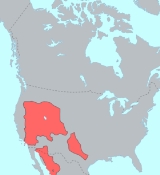
Historic locations of living and extinct Uto-Aztecan languages in the USA and northern Mexico
Present day Locations of living Uto-Aztecan languages in Mexico and Mesoamerica
History of classification
Uto-Aztecan has been accepted by linguists as a language family since the early 1900s, and six subgroups are universally accepted as valid: Numic, Takic, Pimic, Taracahitic, Corachol, and Aztecan. This leaves two ungrouped languages—Tübatulabal and Hopi (sometimes termed "isolates within the family"). As to higher level groupings, disagreement has persisted since the 19th century. Presently there is also disagreement as to where to draw language boundaries within dialect continuaDialect continuum
A dialect continuum, or dialect area, was defined by Leonard Bloomfield as a range of dialects spoken across some geographical area that differ only slightly between neighboring areas, but as one travels in any direction, these differences accumulate such that speakers from opposite ends of the...
.
The similarities between the Uto-Aztecan languages were noted as early as 1859 by J.C.E. Buschmann, who however failed to recognize the genetic affiliation between the Aztecan branch and the rest, instead ascribing the similarities between the two groups to diffusion. Brinton
Daniel Garrison Brinton
Daniel Garrison Brinton was an American archaeologist and ethnologist.-Biography:Brinton was born in Thornbury Township, Chester County, Pennsylvania. After graduating from Yale University in 1858, Brinton studied at Jefferson Medical College for two years and spent the next travelling in Europe....
added the Aztecan languages to the family in 1891 and coined the term Uto-Aztecan. John Wesley Powell
John Wesley Powell
John Wesley Powell was a U.S. soldier, geologist, explorer of the American West, and director of major scientific and cultural institutions...
, however, rejected the claim in his own classification of North American indigenous languages (also published in 1891). Powell recognized two language families: "Shoshonean" (encompassing Takic, Numic, Hopi, and Tübatulabal) and "Sonoran" (encompassing Pimic, Taracahitan, and Corachol). In the early 1900s Alfred L. Kroeber
Alfred L. Kroeber
Alfred Louis Kroeber was an American anthropologist. He was the first professor appointed to the Department of Anthropology at the University of California, Berkeley, and played an integral role in the early days of its Museum of Anthropology, where he served as director from 1909 through...
filled in the picture of the Shoshonean group, while Edward Sapir
Edward Sapir
Edward Sapir was an American anthropologist-linguist, widely considered to be one of the most important figures in the early development of the discipline of linguistics....
proved the unity between Aztecan, "Sonoran", and "Shoshonean". Sapir's applications of the comparative method
Historical linguistics
Historical linguistics is the study of language change. It has five main concerns:* to describe and account for observed changes in particular languages...
to unwritten Native American languages are regarded as groundbreaking.
As of about 2000, the most widely accepted view divides the family into "Northern Uto-Aztecan" and "Southern Uto-Aztecan". The former is Powell's "Shoshonean", while the latter is all the rest, i.e., Powell's "Sonoran" plus Aztecan. But since about 1980, there have been dissenters. They reject either both nodes or the Northern node alone. Although Kaufman
Terrence Kaufman
Terrence Kaufman is an American linguist specializing in documentation of unwritten languages, Mesoamerican historical linguistics and language contact phenomena. He is currently a professor at the department of anthropology at the University of Pittsburgh....
recognizes similarities between Corachol and Aztecan, he explains them by diffusion instead of genetic evolution. Most scholars view the breakup of Proto-Uto-Aztecan as a case of the gradual disintegration of a dialect continuum.
Present scheme
Below is the current most prevalent classification as synthesized from Campbell (1997), Mithun (1999), and Goddard (1999). For most of the individual languages and proposed nodes, links are provided to a selected bibliography of grammars, dictionaries, and linguistic researches. ( † = extinctExtinct language
An extinct language is a language that no longer has any speakers., or that is no longer in current use. Extinct languages are sometimes contrasted with dead languages, which are still known and used in special contexts in written form, but not as ordinary spoken languages for everyday communication...
)
Northern Uto-Aztecan
HopiHopi language
Hopi is a Uto-Aztecan language spoken by the Hopi people of northeastern Arizona, USA, although today some Hopi are monolingual English speakers.The use of the language has gradually declined over the course of the 20th century...
Tübatulabal
Tubatulabal language
Tübatulabal is a Uto-Aztecan language, traditionally spoken in Kern County, California. It is the traditional language of the Tübatulabal people, who have now largely shifted to English. The language is currently considered moribund....
Numic
Numic languages
Numic is a branch of the Uto-Aztecan language family. It includes seven languages spoken by Native American peoples traditionally living in the Great Basin, Colorado River basin, and southern Great Plains. The word Numic comes from the cognate word in all Numic languages for "person." For...
- Central Numic languages
- ComancheComanche languageComanche is a Uto-Aztecan language spoken by the Comanche people, who split off from the Shoshone soon after they acquired horses in around 1705...
- TimbishaTimbisha languageThe Timbisha language is the language of the Native American people who have inhabited the region in and around Death Valley, California and the southern Owens Valley since late prehistoric times...
(a dialect chain with main regional varieties being Western, Central, and Eastern) - ShoshoneShoshone languageShoshoni or Shoshone is a Native American language spoken by the Shoshone people. Principal dialects of Shoshoni include Western Shoshoni in Nevada, Gosiute in western Utah, Northern Shoshoni in southern Idaho and northern Utah, and Eastern Shoshoni in Wyoming.Shoshoni-speaking Native Americans...
(a dialect chain with main regional varieties being Western, Gosiute, Northern, and Eastern)
- Comanche
- Southern Numic languages
- KawaiisuKawaiisu languageThe Kawaiisu language is an Uto-Aztecan language spoken by the Kawaiisu people of California.-Classification:Kawaiisu is a member of the Southern Numic division of the Uto-Aztecan language family.-Linguistic Environment:...
- Colorado RiverUte languageColorado River Numic , of the Numic branch of the Uto-Aztecan language family, is a dialect chain that stretches from southeastern California to Colorado...
(a dialect chain with main regional varieties being Chemehuevi, Southern Paiute, and Ute)
- Kawaiisu
- Western Numic languages
- MonoMono language (Native American)Mono is a Native American language of the Numic group of Uto-Aztecan languages, the ancestral language of the Mono people. Mono consists of two dialects, Eastern and Western. The name "Monachi" is commonly used in reference to Western Mono and "Owens Valley Paiute" in reference to Eastern Mono....
(two main dialects: Eastern and Western) - Northern PaiuteNorthern Paiute languageNorthern Paiute is a Western Numic language of the Uto-Aztecan family, which according to Marianne Mithun had around 500 fluent speakers in 1994. Ethnologue reported the number of speakers in 1999 as 1,631...
(a dialect chain with main regional varieties being Southern Nevada, Northern Nevada, Oregon, and Bannock)
- Mono
Takic
Takic languages
The Takic languages are a group of Uto-Aztecan languages spoken by Californian Native Americans in southern California.-List of Takic languages:*Cahuilla language*Cupeño language*Luiseño language*Serrano language*Tongva language*?Tataviam language...
- Serrano–Gabrielino
- Serran
- SerranoSerrano languageThe Serrano language is a language in the Takic branch of the Uto-Aztecan family spoken by the Serrano people of Southern California. The language is closely related to Tongva and Kitanemuk....
- KitanemukKitanemuk languageKitanemuk was a Northern Uto-Aztecan language of the Takic branch. It was very closely related to Serrano, and may have been a dialect of Serrano people, in the San Gabriel Mountains and foothill environs of Southern California. The last speakers lived some time in the 1940s, though the last...
†
- Serrano
- Gabrielino–FernandeñoTongva language-Collected by C. Hart Merriam :Numbers# Po-koo /bo'kʰøː/# Wěh-hā /ʋɛj'χɒː/# Pah-hā /pa'χɒː/# Wah-chah /ʋa'ʃɒχ/# Mah-har /ma'χɒʁ/# Pah-vah-hā /pa'va'χɒː/# Wah-chah-kav-e-ah /ʋa'ʃa'kʰav̥eʲa/...
†
- Serran
- Cupan
- Cahuilla–Cupeño
- CahuillaCahuilla languageCahuilla is an endangered Uto-Aztecan language, spoken by the Cahuilla tribe, living in the Coachella Valley, San Gorgonio Pass and San Jacinto Mountain region of Southern California. Cahuilla call themselves Iviatam, speakers of 'Ivia' - the 'original' language. A 1990 census revealed 35 speakers...
- CupeñoCupeño languageCupeño is an extinct Uto-Aztecan language, formerly spoken by the Cupeño people of Southern California, USA, who now speak English. Roscinda Nolasquez was the last native speaker of Cupeño.-Morphology:...
†
- Cahuilla
- Luiseño–JuaneñoLuiseño languageThe Luiseño language is an Uto-Aztecan language of California spoken by the Luiseño, a Native American people who at the time of the first contacts with the Spanish in the 16th century inhabited the coastal area of southern California, ranging 50 miles from the southern part of Los Angeles County,...
- Cahuilla–Cupeño
Southern Uto-Aztecan
PimicPiman languages
Piman refers a group of languages within the Uto-Aztecan family that are spoken by ethnic groups spanning from Arizona in the north to Durango, Mexico in the south.The Piman languages are as follows :...
(Tepiman)
- Pima–PapagoO'odham languageO'odham is an Uto-Aztecan language of southern Arizona and northern Sonora where the Tohono O'odham and Pima reside. As of the year 2000, there were estimated to be approximately 9750 speakers in the United States and Mexico combined, although there may be more due to underreporting...
(Upper Piman) - Pima BajoPima BajoPima Bajo is a Mexican indigenous language of the Piman branch of the Uto-Aztecan language family, spoken by around 1000 speakers in northern Mexico. The language is called O'ob No'ok by its speakers...
(Lower Piman) - Tepehuán languageTepehuán languageTepehuán is the name of two closely related languages of the Piman branch of the Uto-Aztecan language family, both spoken in northern Mexico...
s (Northern and Southern) - TepecanoTepecanoThe Tepecano language is an extinct indigenous language of Mexico belonging to the Uto-Aztecan language-family. It was formerly spoken by a small group of people in Azqueltán , Jalisco, a small village on the Río Bolaños in the far northern part of the state, just east of the territory of the...
†
Taracahitic
Taracahitic languages
The Taracahitic or Taracahita languages are a branch of the Uto-Aztecan language family of Mexico. The best known is Tarahumara.-Languages:*Tarahumaran*Cahita *Ópata †?...
- Tarahumaran
- TarahumaraTarahumara languageThe Tarahumara language is a Mexican indigenous language of the Uto-Aztecan language family spoken by around 70,000 Tarahumara people in the state of Chihuahua, according to an estimate by the government of Mexico.-Genetic affiliation:Tarahumara belongs to the Taracahitic group of the Uto-Aztecan...
- GuarijíoGuarijio languageHuarijio is an Uto-Aztecan language of the states of Chihuahua and Sonora in northwestern Mexico...
(Varihio)
- Tarahumara
- Tubar †
- CahitaCáhitaCáhita is a group of Indigenous peoples of Mexico, which includes the Yaqui and Mayo people. Numbering approximately 40,000, they live in west coast of the states of Sonora and Sinaloa.-Language:...
(YaquiYaqui languageYaqui , locally known as Yoeme or Yoem Noki, is a Native American language of the Uto-Aztecan family. It is spoken by about 15,000 people, mostly of the border Yaqui people, in the region around the Mexican state of Sonora, and Arizona in the United States.-Phonology:The remarks below use the...
–MayoMayo languageMayo is an Uto-Aztecan language. It is spoken by about 40,000 people, the Mexican Mayo or Yoreme Indians, who live in the South of the Mexican state of Sonora and in the North of the neighboring state of Sinaloa...
–Cahita) - Opatan
- ÓpataOpata languageÓpata is the name of the Uto-Aztecan language spoken by the Opata people of northern central Sonora in Mexico...
† - Eudeve †? (Heve, Dohema)
- Ópata
Corachol
- CoraCora languageThe Cora language is an indigenous language of Mexico of the Uto-Aztecan language family. It is spoken by the ethnic group that is widely known as the Cora but who refer to themselves as Naáyarite. The Cora inhabit the northern sierra of the Mexican state Nayarit which is named after its indigenous...
- HuicholHuichol languageThe Huichol language is an indigenous language of Mexico which belongs to the Uto-Aztecan language family. It is spoken by the ethnic group widely known as the Huichol , whose mountainous territory extends over portions of the Mexican states of Jalisco, Nayarit, and Durango, mostly in Jalisco...
Aztecan
- PochutecPochutecPochutec is an extinct Uto-Aztecan language of the Nahuan branch which was spoken in and around the town of Pochutla on the Pacific coast of Oaxaca, Mexico. In 1917 it was documented in a monograph by Franz Boas, who considered the language nearly extinct...
† - NahuanNahuan languagesThe Nahuan or Aztecan languages are those languages of the Uto-Aztecan language family that have undergone the sound change known as Whorf's Law changing the original /*t/ to before */a/...
(Aztecan, Nahua, Nahuatlan)- Core NahuaNahuatl dialectsThe many dialects of the Nahuatl language belong to the Nahuan branch of the Uto-Aztecan language family, and form a group of linguistic varieties spoken in central Mexico...
- PipilPipil languagePipil is a Uto-Aztecan language descended from Nahuatl which was spoken in several parts of present day Central America before the Spanish conquest. It is on the verge of extinction in western El Salvador and has already gone extinct elsewhere in Central America...
(Nahuate, Nawat) - Nahuatl (Mexicano, Aztec)
- Pipil
- Core Nahua
In addition to the above languages for which linguistic evidence exists, there were several dozen extinct languages with little or no documentation in Northern Mexico, many of which were probably Uto-Aztecan.
Vowels
Proto-Uto-Aztecan is reconstructed as having an unusual five-vowel system: *i *a *u *o *ɨ. Langacker (1970) demonstrated that the fifth vowel should be reconstructed as *ɨ as opposed to *e—there had been a long-running dispute over the proper reconstruction.Consonants
| Bilabial Bilabial consonant In phonetics, a bilabial consonant is a consonant articulated with both lips. The bilabial consonants identified by the International Phonetic Alphabet are:... | Coronal Coronal consonant Coronal consonants are consonants articulated with the flexible front part of the tongue. Only the coronal consonants can be divided into apical , laminal , domed , or subapical , as well as a few rarer orientations, because only the front of the tongue has such... | Palatal Palatal consonant Palatal consonants are consonants articulated with the body of the tongue raised against the hard palate... | Velar Velar consonant Velars are consonants articulated with the back part of the tongue against the soft palate, the back part of the roof of the mouth, known also as the velum).... | Labialized velar | Glottal Glottal consonant Glottal consonants, also called laryngeal consonants, are consonants articulated with the glottis. Many phoneticians consider them, or at least the so-called fricative, to be transitional states of the glottis without a point of articulation as other consonants have; in fact, some do not consider... |
|
|---|---|---|---|---|---|---|
| Stop Stop consonant In phonetics, a plosive, also known as an occlusive or an oral stop, is a stop consonant in which the vocal tract is blocked so that all airflow ceases. The occlusion may be done with the tongue , lips , and &... |
*p | *t | *k | *kʷ | *ʔ | |
| Affricate Affricate consonant Affricates are consonants that begin as stops but release as a fricative rather than directly into the following vowel.- Samples :... |
*t͡s | |||||
| Fricative Fricative consonant Fricatives are consonants produced by forcing air through a narrow channel made by placing two articulators close together. These may be the lower lip against the upper teeth, in the case of ; the back of the tongue against the soft palate, in the case of German , the final consonant of Bach; or... |
*s | *h | ||||
| Nasal Nasal consonant A nasal consonant is a type of consonant produced with a lowered velum in the mouth, allowing air to escape freely through the nose. Examples of nasal consonants in English are and , in words such as nose and mouth.- Definition :... |
*m | *n | *ŋ | |||
| Rhotic Rhotic consonant In phonetics, rhotic consonants, also called tremulants or "R-like" sounds, are liquid consonants that are traditionally represented orthographically by symbols derived from the Greek letter rho, including "R, r" from the Roman alphabet and "Р, p" from the Cyrillic alphabet... |
*r | |||||
| Semivowel Semivowel In phonetics and phonology, a semivowel is a sound, such as English or , that is phonetically similar to a vowel sound but functions as the syllable boundary rather than as the nucleus of a syllable.-Classification:... |
*j | *w |
- n and *ŋ may have actually been *l and *n, respectively.