

Torlakian

Encyclopedia
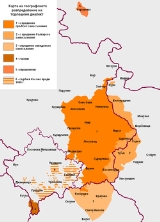
Torlakian or Torlak is a name given to the group of South Slavic dialects
of southeastern Serbia
(southern Kosovo
- Prizren
), northeastern Macedonia
(Kratovo
-Kumanovo
), western Bulgaria
(Belogradchik
-Godech
-Tran
-Breznik
), which is intermediate between Serbian
, Bulgarian
and Macedonian
.
Some linguists classify it as an Old-Shtokavian dialect of Serbian or a fourth dialect of Serbo-Croatian
(along with Shtokavian
, Chakavian
, and Kajkavian
). Other linguists classify it as a western Bulgarian
dialect, in which case it is called Transitional
. Torlakian is not standardized, and its subdialects significantly vary in some features.
Speakers of the dialectal group are primarily ethnic Serbs
, Bulgarians
, and Macedonians
. There are also smaller ethnic communities of Krashovani
in Romania
(who mostly identify as Croats
), and Gorani in southern Kosovo.
Most Serbian (like Pavle Ivić
, Asim Peco) and Croatian linguists (like Milan Rešetar
and Dalibor Brozović
) classify Torlakian as an Old-Shtokavian dialect, referring to it as Prizren-Timok dialect. Serbian linguist Pavle Ivić argues that some Bulgarian dialects have more similarities to Serbian rather than vice versa, maintaining that the Prizren-Timok dialect is a fully Serbian vernacular, also stressing that the so-called Transitional Bulgarian dialects
and the Shopi
idiom have in some cases more Western South Slavic elements than Eastern. All old Bulgarian scientists as Krste Misirkov
, Benyo Tsonev and Gavril Zanetov classified Torlakian as dialect of Bulgarian language. They noted the manner of the articles, the lack of most of the cases, etc. Today Bulgarian linguists (Stoyko Stoykov
, Rangel Bozhkov) also classify Torlakian as a "Belogradchik
-Tran
" dialect of Bulgarian, and claim that it should be classified outside the Shtokavian area.
Torlakian dialects appear where Macedonian/Bulgarian blend into Serbian.
a number of words from Aromanian
, Greek
, Turkish
, and Albanian
in the Gora
region of the Šar mountains. Also, it preserved many words which in the "major" languages became archaism
s or changed meaning. Like other features, vocabulary is inconsistent across subdialects: for example, a Krashovan
need not necessarily understand a Goranac.
The varieties spoken in the Slavic countries has been heavily influenced by the standardized national language, particularly when a new word or concept was introduced. The only exception is a form of Torlakian spoken in Romania
, which escaped the influence of a standardized language which has existed in Serbia since a state was created after the defeat of the Ottoman Empire
. The Slavs indigenous to the region are called Krašovani
(Krashovans), and are a mixture of original settler Slavs and later settlers from Timočka Krajina
(eastern Serbia).
merges into the genitive case
, and the locative
and genitive
cases merge into the nominative case
. Further south, all inflections disappear and meaning is determined solely by prepositions.
In other Slavic languages, x or ɦ (from Proto-Slavic *g in "H-Slavic languages") is common.
The appearance of the letter h in the alphabet is reserved mostly for loanwords, and toponyms within the Republic of Macedonia but outside of the standard language region. In Macedonian, this is the case with eastern towns such as Pehčevo. In fact, the Macedonian language is based in Prilep, Pelagonia
and words such as thousand and urgent are iljada and itno in standard Macedonian but hiljada and hitno in Serbian (also, Macedonian oro, ubav vs Bulgarian horo, hubav (folk dance, beautiful)). This is actually a part of an isogloss
, a dividing line separating Prilep from Pehčevo in the Republic of Macedonia at the southern extreme, and reaching central Serbia (Šumadija
) at a northern extreme. In Šumadija, local folk songs may still use the traditional form of I want being oću (оћу) compared with hoću (хоћу) as spoken in standard Serbian.
. In Shtokavian dialects, the syllabic /l/ eventually became /u/ or /o/. In Bulgarian, it became preceded by the vowel represented by ъ (ɤ or ə), to separate consonant clusters. Not all Torlakian subdialects preserved the syllabic /l/ to the full extent, but it is reflected either as full syllabic or in various combinations with [ə], [u], [ɔ] or [a]. Naturally, the /l/ becomes velarized in most such positions, giving ɫ.
In some Torlakian dialects:
clergy, which chiefly used Old Church Slavonic
in writing. The first known literary monument, influenced by Torlakian dialects is the Manuscript from Temska Monastery
from 1762, in which its author, the Monk Kiril Zhivkovich from Pirot
, considered his language as: "simple Bulgarian".
word "tor" ("sheepfold" in English
), referring to the fact that Torlaks in the past were mainly shepherd
s by occupation. Some scientists describe the Torlaks as a distinct ethnographic group. The Torlaks are also sometimes classified to be a part of the Shopi
population and vice versa. In the 19th century, there were no exact border between Torlak and Shopi settlements. According to some authors during the Ottoman rule, the majority of native Torlakian Slavic population did not have national consciousness in ethnic sense. Therefore, both, Serbs and Bulgarians, considered local Slavs as part of their own people, while local population was also divided between sympathy for Bulgarians and Serbs. Other authors from the epoch, take a different view and maintain that the inhabitants of Torlakian area had begun to develop predominantly Bulgarian
national consciousness. With Ottoman influence ever weakening, the increase of nationalist sentiment in the Balkans in late 19th and early 20th century, and the redrawing of national boundaries after the Treaty of Berlin (1878), the Balkan wars
and World War I
, the borders in the Torlakian-speaking region changed several times between Serbia and Bulgaria, and later Republic of Macedonia.
South Slavic languages
The South Slavic languages comprise one of three branches of the Slavic languages. There are approximately 30 million speakers, mainly in the Balkans. These are separated geographically from speakers of the other two Slavic branches by a belt of German, Hungarian and Romanian speakers...
of southeastern Serbia
Serbia
Serbia , officially the Republic of Serbia , is a landlocked country located at the crossroads of Central and Southeast Europe, covering the southern part of the Carpathian basin and the central part of the Balkans...
(southern Kosovo
Kosovo
Kosovo is a region in southeastern Europe. Part of the Ottoman Empire for more than five centuries, later the Autonomous Province of Kosovo and Metohija within Serbia...
- Prizren
Prizren
Prizren is a historical city located in southern Kosovo. It is the administrative center of the eponymous municipality and district.The city has a population of around 131,247 , mostly Albanians...
), northeastern Macedonia
Republic of Macedonia
Macedonia , officially the Republic of Macedonia , is a country located in the central Balkan peninsula in Southeast Europe. It is one of the successor states of the former Yugoslavia, from which it declared independence in 1991...
(Kratovo
Kratovo
Kratovo may refer to:*Kratovo, Macedonia, a town in the Republic of Macedonia*Kratovo, Russia, an urban-type settlement in Moscow Oblast, Russia*Kratovo, Serbia, a settlement situated in the Priboj municipality of southwestern Serbia...
-Kumanovo
Kumanovo
Kumanovo is a city in the Republic of Macedonia and is the seat of Kumanovo Municipality which is the largest municipality in the country. Municipal institutions include a city council, mayor and other administrative bodies.-Name:...
), western Bulgaria
Bulgaria
Bulgaria , officially the Republic of Bulgaria , is a parliamentary democracy within a unitary constitutional republic in Southeast Europe. The country borders Romania to the north, Serbia and Macedonia to the west, Greece and Turkey to the south, as well as the Black Sea to the east...
(Belogradchik
Belogradchik
Belogradchik is a town in Vidin Province, Northwestern Bulgaria, the administrative centre of the homonymous Belogradchik Municipality. The town, whose name literally means "small white town," is situated in the foothills of the Balkan Mountains just east of the Serbian border and about 50 km...
-Godech
Godech
Godech is a small town located in the Sofia Province, of Bulgaria. The town is founded in a valley on the far west of Stara Planina, where the Nishava River passes. The settllment is about 20 km east of the Serbian border and has its highest peak Kom to the north. Godech is officially a...
-Tran
Tran, Bulgaria
Tran |thorn]]") is a small town in Pernik Province, western Bulgaria. It is 27 kilometres away from the town of Breznik and 15 km from the border with Serbia....
-Breznik
Breznik
Breznik is a town in western Bulgaria, 50 km away from Sofia. It is located in Pernik Province and is close to the towns of Bankya and Pernik. It has 4,500 inhabitants. Villages in the municipality include Dushintsi....
), which is intermediate between Serbian
Serbian language
Serbian is a form of Serbo-Croatian, a South Slavic language, spoken by Serbs in Serbia, Bosnia and Herzegovina, Montenegro, Croatia and neighbouring countries....
, Bulgarian
Bulgarian language
Bulgarian is an Indo-European language, a member of the Slavic linguistic group.Bulgarian, along with the closely related Macedonian language, demonstrates several linguistic characteristics that set it apart from all other Slavic languages such as the elimination of case declension, the...
and Macedonian
Macedonian language
Macedonian is a South Slavic language spoken as a first language by approximately 2–3 million people principally in the region of Macedonia but also in the Macedonian diaspora...
.
Some linguists classify it as an Old-Shtokavian dialect of Serbian or a fourth dialect of Serbo-Croatian
Serbo-Croatian
Serbo-Croatian or Serbo-Croat, less commonly Bosnian/Croatian/Serbian , is a South Slavic language with multiple standards and the primary language of Serbia, Croatia, Bosnia and Herzegovina, and Montenegro...
(along with Shtokavian
Shtokavian dialect
Shtokavian or Štokavian is the prestige dialect of the Serbo-Croatian language, and the basis of its Bosnian, Croatian, Serbian, and Montenegrin standards...
, Chakavian
Chakavian dialect
Chakavian or Čakavian is a dialect of the Croatian language. The name stems from the word for "what?", which is "ča" in Čakavian...
, and Kajkavian
Kajkavian dialect
The Kajkavian dialect is one of the three main dialects of Croatian. It has low mutual intelligibility with the other two dialects, Štokavian and Čakavian. All three are named after their word for "what?", which in Kajkavian is kaj....
). Other linguists classify it as a western Bulgarian
Bulgarian language
Bulgarian is an Indo-European language, a member of the Slavic linguistic group.Bulgarian, along with the closely related Macedonian language, demonstrates several linguistic characteristics that set it apart from all other Slavic languages such as the elimination of case declension, the...
dialect, in which case it is called Transitional
Transitional Bulgarian dialects
The Transitional Bulgarian dialects are a group of Bulgarian dialects, which are located west of the yat boundary and are part of the Western Bulgarian dialects. On Bulgarian territory, the Transitional dialects occupy a narrow strip of land along the Bulgarian border with Serbia, including the...
. Torlakian is not standardized, and its subdialects significantly vary in some features.
Speakers of the dialectal group are primarily ethnic Serbs
Serbs
The Serbs are a South Slavic ethnic group of the Balkans and southern Central Europe. Serbs are located mainly in Serbia, Montenegro and Bosnia and Herzegovina, and form a sizable minority in Croatia, the Republic of Macedonia and Slovenia. Likewise, Serbs are an officially recognized minority in...
, Bulgarians
Bulgarians
The Bulgarians are a South Slavic nation and ethnic group native to Bulgaria and neighbouring regions. Emigration has resulted in immigrant communities in a number of other countries.-History and ethnogenesis:...
, and Macedonians
Macedonians (ethnic group)
The Macedonians also referred to as Macedonian Slavs: "... the term Slavomacedonian was introduced and was accepted by the community itself, which at the time had a much more widespread non-Greek Macedonian ethnic consciousness...
. There are also smaller ethnic communities of Krashovani
Krashovani
The Krashovani are a South Slavic people indigenous to Caraşova and other nearby locations in...
in Romania
Romania
Romania is a country located at the crossroads of Central and Southeastern Europe, on the Lower Danube, within and outside the Carpathian arch, bordering on the Black Sea...
(who mostly identify as Croats
Croats
Croats are a South Slavic ethnic group mostly living in Croatia, Bosnia and Herzegovina and nearby countries. There are around 4 million Croats living inside Croatia and up to 4.5 million throughout the rest of the world. Responding to political, social and economic pressure, many Croats have...
), and Gorani in southern Kosovo.
Classification
During the 19th century Torlakian and Macedonian dialects were often called Bulgarian, and Bulgarian and Serbian linguists and armies fought to draw the border between the both languages during the end of 19th and the first half of 20th centuries.Most Serbian (like Pavle Ivić
Pavle Ivic
-Biography:Professor Pavle Ivić was a leading South Slavic and general dialectologist and phonologist. Both his field work and his synthesizing studies were extensive and authoritative...
, Asim Peco) and Croatian linguists (like Milan Rešetar
Milan Rešetar
Milan Rešetar was a Serb-Catholic, linguist, Ragusologist, historian and literary critic.After the gymnasium in Dubrovnik, he attained studies of classic Philology and Slavistics in Vienna...
and Dalibor Brozović
Dalibor Brozovic
Dalibor Brozović was a Croatian linguist, Slavist, dialectologist and politician. He studied the history of standard Slavic languages, especially Croatian. He was an active Esperantist since 1946, and wrote Esperanto poetry as well as translated works into the language. -Life and career:He was...
) classify Torlakian as an Old-Shtokavian dialect, referring to it as Prizren-Timok dialect. Serbian linguist Pavle Ivić argues that some Bulgarian dialects have more similarities to Serbian rather than vice versa, maintaining that the Prizren-Timok dialect is a fully Serbian vernacular, also stressing that the so-called Transitional Bulgarian dialects
Transitional Bulgarian dialects
The Transitional Bulgarian dialects are a group of Bulgarian dialects, which are located west of the yat boundary and are part of the Western Bulgarian dialects. On Bulgarian territory, the Transitional dialects occupy a narrow strip of land along the Bulgarian border with Serbia, including the...
and the Shopi
Shopi
Shopi is a regional term referring to people that speak a transitional dialect group of South Slavic, self-identifying as Bulgarians, Macedonians and Serbs. The areas traditionally inhabited by the Shopi is called Shopluk Shopi (scientific transliteration of Bulgarian, Macedonian, ; Serbian latin...
idiom have in some cases more Western South Slavic elements than Eastern. All old Bulgarian scientists as Krste Misirkov
Krste Misirkov
Krste Petkov Misirkov was a philologist, slavist, historian, ethnographer, publicist author of the first book and scientific magazine in Macedonian, where he for the first time outlined the principles of the literary Macedonian language...
, Benyo Tsonev and Gavril Zanetov classified Torlakian as dialect of Bulgarian language. They noted the manner of the articles, the lack of most of the cases, etc. Today Bulgarian linguists (Stoyko Stoykov
Stoyko Stoykov
Stoyko Ivanov Stoykov was a Bulgarian linguist.- Biography :Graduated Slavic Philology at Sofia University "St. Kliment Ohridski", . Specialized phonetics, dialectology and Slavic linguistics in Prague, Czech Republic . Was granted Ph.D. by the Univerzita Karlova...
, Rangel Bozhkov) also classify Torlakian as a "Belogradchik
Belogradchik
Belogradchik is a town in Vidin Province, Northwestern Bulgaria, the administrative centre of the homonymous Belogradchik Municipality. The town, whose name literally means "small white town," is situated in the foothills of the Balkan Mountains just east of the Serbian border and about 50 km...
-Tran
Tran, Bulgaria
Tran |thorn]]") is a small town in Pernik Province, western Bulgaria. It is 27 kilometres away from the town of Breznik and 15 km from the border with Serbia....
" dialect of Bulgarian, and claim that it should be classified outside the Shtokavian area.
Torlakian dialects appear where Macedonian/Bulgarian blend into Serbian.
Vocabulary
Basic Torlakian vocabulary shares most of its Slavic roots with Serbian, Bulgarian, and Macedonian, but also over time borrowedLoanword
A loanword is a word borrowed from a donor language and incorporated into a recipient language. By contrast, a calque or loan translation is a related concept where the meaning or idiom is borrowed rather than the lexical item itself. The word loanword is itself a calque of the German Lehnwort,...
a number of words from Aromanian
Aromanian language
Aromanian , also known as Macedo-Romanian, Arumanian or Vlach is an Eastern Romance language spoken in Southeastern Europe...
, Greek
Greek language
Greek is an independent branch of the Indo-European family of languages. Native to the southern Balkans, it has the longest documented history of any Indo-European language, spanning 34 centuries of written records. Its writing system has been the Greek alphabet for the majority of its history;...
, Turkish
Turkish language
Turkish is a language spoken as a native language by over 83 million people worldwide, making it the most commonly spoken of the Turkic languages. Its speakers are located predominantly in Turkey and Northern Cyprus with smaller groups in Iraq, Greece, Bulgaria, the Republic of Macedonia, Kosovo,...
, and Albanian
Albanian language
Albanian is an Indo-European language spoken by approximately 7.6 million people, primarily in Albania and Kosovo but also in other areas of the Balkans in which there is an Albanian population, including western Macedonia, southern Montenegro, southern Serbia and northwestern Greece...
in the Gora
Gora (region)
Gora is a geographical region in southern Serbia and northeastern Albania, inhabited by Albanians and a Gorani minority. The name "Gora" is a Slavic word for "mountain" or "forest"....
region of the Šar mountains. Also, it preserved many words which in the "major" languages became archaism
Archaism
In language, an archaism is the use of a form of speech or writing that is no longer current. This can either be done deliberately or as part of a specific jargon or formula...
s or changed meaning. Like other features, vocabulary is inconsistent across subdialects: for example, a Krashovan
Krashovani
The Krashovani are a South Slavic people indigenous to Caraşova and other nearby locations in...
need not necessarily understand a Goranac.
The varieties spoken in the Slavic countries has been heavily influenced by the standardized national language, particularly when a new word or concept was introduced. The only exception is a form of Torlakian spoken in Romania
Romania
Romania is a country located at the crossroads of Central and Southeastern Europe, on the Lower Danube, within and outside the Carpathian arch, bordering on the Black Sea...
, which escaped the influence of a standardized language which has existed in Serbia since a state was created after the defeat of the Ottoman Empire
Ottoman Empire
The Ottoman EmpireIt was usually referred to as the "Ottoman Empire", the "Turkish Empire", the "Ottoman Caliphate" or more commonly "Turkey" by its contemporaries...
. The Slavs indigenous to the region are called Krašovani
Carasova
Carașova is a commune in Caraș-Severin County, Romania. It is known especially for its geographical placement and for the origin of its Croatian inhabitants, the Krashovani. The population of the commune numbered 3,260 people at the 2002 census...
(Krashovans), and are a mixture of original settler Slavs and later settlers from Timočka Krajina
Timočka Krajina
Timočka Krajina is a geographical region located in Serbia. It is situated in eastern Serbia around the Timok River. The population of Timočka Krajina is 284,112 .-Name:...
(eastern Serbia).
Cases lacking inflections
Macedonian and Bulgarian are the only two modern Slavic languages that lost virtually the entire noun case system, with nearly all nouns spoken in the surviving nominative case. This is also true of the Torlakian dialect. In the northwest, the instrumental caseInstrumental case
The instrumental case is a grammatical case used to indicate that a noun is the instrument or means by or with which the subject achieves or accomplishes an action...
merges into the genitive case
Genitive case
In grammar, genitive is the grammatical case that marks a noun as modifying another noun...
, and the locative
Locative case
Locative is a grammatical case which indicates a location. It corresponds vaguely to the English prepositions "in", "on", "at", and "by"...
and genitive
Genitive case
In grammar, genitive is the grammatical case that marks a noun as modifying another noun...
cases merge into the nominative case
Nominative case
The nominative case is one of the grammatical cases of a noun or other part of speech, which generally marks the subject of a verb or the predicate noun or predicate adjective, as opposed to its object or other verb arguments...
. Further south, all inflections disappear and meaning is determined solely by prepositions.
Lack of phoneme /x/
Macedonian, Torlakian and a number of Serbian and Bulgarian dialects, unlike all other Slavic languages, technically have no phoneme like x, ɦ or h.In other Slavic languages, x or ɦ (from Proto-Slavic *g in "H-Slavic languages") is common.
The appearance of the letter h in the alphabet is reserved mostly for loanwords, and toponyms within the Republic of Macedonia but outside of the standard language region. In Macedonian, this is the case with eastern towns such as Pehčevo. In fact, the Macedonian language is based in Prilep, Pelagonia
Pelagonia
This is about the geographical plain between Greece and the Republic of Macedonia. For the political unit in Macedonia, go to Pelagonia Statistical Region....
and words such as thousand and urgent are iljada and itno in standard Macedonian but hiljada and hitno in Serbian (also, Macedonian oro, ubav vs Bulgarian horo, hubav (folk dance, beautiful)). This is actually a part of an isogloss
Isogloss
An isogloss—also called a heterogloss —is the geographical boundary of a certain linguistic feature, such as the pronunciation of a vowel, the meaning of a word, or use of some syntactic feature...
, a dividing line separating Prilep from Pehčevo in the Republic of Macedonia at the southern extreme, and reaching central Serbia (Šumadija
Šumadija
Šumadija is a geographical region in Serbia. The area is heavily covered with forests, hence the name...
) at a northern extreme. In Šumadija, local folk songs may still use the traditional form of I want being oću (оћу) compared with hoću (хоћу) as spoken in standard Serbian.
Syllabic /l/
Torlakian has preserved much of the ancient syllabic /l/, which, like /r/, can serve the nucleus of a syllable. This is still the case in some West Slavic languagesWest Slavic languages
The West Slavic languages are a subdivision of the Slavic language group that includes Czech, Polish, Slovak, Kashubian and Sorbian.Classification:* Indo-European** Balto-Slavic*** Slavic**** West Slavic***** Czech-Slovak languages****** Czech...
. In Shtokavian dialects, the syllabic /l/ eventually became /u/ or /o/. In Bulgarian, it became preceded by the vowel represented by ъ (ɤ or ə), to separate consonant clusters. Not all Torlakian subdialects preserved the syllabic /l/ to the full extent, but it is reflected either as full syllabic or in various combinations with [ə], [u], [ɔ] or [a]. Naturally, the /l/ becomes velarized in most such positions, giving ɫ.
| Torlakian | Krašovan (Karas) | влк /vɫk/ | пекъл /pɛkəl/ | сълза /səɫza/ | жлт /ʒɫt/ |
|---|---|---|---|---|---|
| Northern (Svrljig) | вук /vuk/ | пекал /pɛkəɫ/ | суза /suza/ | жлът /ʒlət/ | |
| Central (Lužnica) | вук /vuk/ | пекъл /pɛkəɫ/ | слъза /sləza/ | жлът /ʒlət/ | |
| Southern (Vranje) | вълк /vəlk/ | пекал /pɛkal/ | солза /sɔɫza/ | жълт /ʒəɫt/ | |
| Western (Prizren) | вук /vuk/ | пекл /pɛkɫ/ | слуза /sluza/ | жлт /ʒlt/ | |
| Eastern (Tran) | вук /vuk/ | пекл /pɛkɫ/ | слза /slza/ | жлт /ʒlt/ | |
| North-Eastern (Belogradchik) | влк /vlk/ | пекл /pɛkɫ/ | слза /slza/ | жлт /ʒlt/ | |
| South-Eastern (Kumanovo) | влк /vlk/ | пекъл /pɛkəɫ/ | слъза /sləza/ | жут /ʒut/ | |
| Serbian standard | вук /vuk/ | пекао /pɛkaɔ/ | суза /suza/ | жут /ʒut/ | |
| Bulgarian standard | вълк /vəlk/ | пекъл /pɛkəl/ | сълза /səlza/ | жълт /ʒəlt/ | |
| Macedonian standard | волк /vɔlk/ | пекол /pɛkol/ | солза /sɔlza/ | жолт /ʒɔlt/ | |
| English | wolf | (have) baked | tear | yellow | |
Features shared with Eastern South Slavic
- Loss of grammatical caseGrammatical caseIn grammar, the case of a noun or pronoun is an inflectional form that indicates its grammatical function in a phrase, clause, or sentence. For example, a pronoun may play the role of subject , of direct object , or of possessor...
as in Bulgarian and Macedonian - Loss of infinitiveInfinitiveIn grammar, infinitive is the name for certain verb forms that exist in many languages. In the usual description of English, the infinitive of a verb is its basic form with or without the particle to: therefore, do and to do, be and to be, and so on are infinitives...
as in Bulgarian and Macedonian, present in Serbian - Full retention of the aorist and the imperfect, as in Bulgarian
- Use of a definite articleDefinite ArticleDefinite Article is the title of British comedian Eddie Izzard's 1996 performance released on VHS. It was recorded on different nights at the Shaftesbury Theatre...
as in Bulgarian and Macedonian, lacking in Serbian - ə for Old Slavic ь and ъ in all positions (Bulgarian sən, Serbian san)
- Lack of phonetic pitch and length as in Bulgarian, present in Serbian
- Frequent stress on the final syllable in polysyllabilic words, impossible in Serbian (Bulgarian že'na, Serbian žena)
- Preservation of final l, which in Serbian developed to o (Bulgarian bil, Serbian bio)
- Comparative degree of adjectives formed with the particle po as in Eastern South Slavic,ubav, po-ubav, Serbian lep, lepše.
- Lack of epenthetic l, as in Eastern South Slavic zdravje/zdrave, Serbian zdravlje
Features shared with Western South Slavic
In all Torlakian dialects: gave labials u like Shtokavian Serbian, unlike unlabialized ъ in literary Bulgarian and a in Macedonian)- vь- gave u in Western, v- in Eastern
- *čr gave cr in Western, but was preserved in Eastern
- Distinction between Proto-Slavic /ɲ/ and /n/ is lost in Eastern (S.-C. njega, Bulgarian nego).
- Consonants in final position preserve their leniency (S.-C. grad, Bulgarian/Macedonian grat)
- *vs stays preserved without metathesisMetathesis (linguistics)Metathesis is the re-arranging of sounds or syllables in a word, or of words in a sentence. Most commonly it refers to the switching of two or more contiguous sounds, known as adjacent metathesis or local metathesis:...
in Eastern (S.-C. sve, Bulgarian vse) - Genitive njega as in Serbian, unlike old genitive on O in Eastern (nego)
- Nominative plural of nomina on -a is on -e in Western, -i in Eastern
- Ja 'I, ego' in Western, as in Eastern
- Mi 'we' in Western, nie in Eastern
- First person singular of verbs is -m in Western, and the old reflex of } in Eastern
- suffixes *-itjь (-ić) and *-atja (-ača) are common in Western, not known in Eastern
In some Torlakian dialects:
- Distinction between the plural of masculine, feminine and neuter adjectives is preserved only in Western (S.C. beli, bele, bela), not in Eastern (beli for masc., fem. and neutr.), does not occur in Belogradchik area, in some eastern regions there is just a masculine and feminine form
- The proto-Slavic *tj, *dj which gave respectively ć, đ in Serbian , št, žd in Bulgarian and ќ, ѓ in Macedonian, is represented by the Serbian form in the west and northwest and by the hybrid č, dž in the east: Belogradchik and Tran, as well as Pirot, Gora, northern Macedonia. The Macedonian form occurs around Kumanovo.
Literature
Literature written in Torlakian is rather sparse, as the dialect has never been an official state language, and for the most part of the history literacy in the region was limited to Eastern OrthodoxEastern Orthodox Church
The Orthodox Church, officially called the Orthodox Catholic Church and commonly referred to as the Eastern Orthodox Church, is the second largest Christian denomination in the world, with an estimated 300 million adherents mainly in the countries of Belarus, Bulgaria, Cyprus, Georgia, Greece,...
clergy, which chiefly used Old Church Slavonic
Old Church Slavonic
Old Church Slavonic or Old Church Slavic was the first literary Slavic language, first developed by the 9th century Byzantine Greek missionaries Saints Cyril and Methodius who were credited with standardizing the language and using it for translating the Bible and other Ancient Greek...
in writing. The first known literary monument, influenced by Torlakian dialects is the Manuscript from Temska Monastery
Manuscript from Temska Monastery
The Manuscript from Temska Monastery is a collection of writings from 1764. The manuscript is composed of the monk of Pirot Cyril Zhivkovich in the Temska Monastery near the village of Temska, in Pirot district. The title of the manuscript is "Из душевного обреда в’ неделных днех слова избрана...
from 1762, in which its author, the Monk Kiril Zhivkovich from Pirot
Pirot
Pirot is a town and municipality located in south-eastern Serbia. According to 2011 census, the town has a total population of 38,432, while the population of the municipality is 57,911...
, considered his language as: "simple Bulgarian".
Ethnography
According to one theory, the name Torlak derived from the South SlavicSouth Slavic languages
The South Slavic languages comprise one of three branches of the Slavic languages. There are approximately 30 million speakers, mainly in the Balkans. These are separated geographically from speakers of the other two Slavic branches by a belt of German, Hungarian and Romanian speakers...
word "tor" ("sheepfold" in English
English language
English is a West Germanic language that arose in the Anglo-Saxon kingdoms of England and spread into what was to become south-east Scotland under the influence of the Anglian medieval kingdom of Northumbria...
), referring to the fact that Torlaks in the past were mainly shepherd
Shepherd
A shepherd is a person who tends, feeds or guards flocks of sheep.- Origins :Shepherding is one of the oldest occupations, beginning some 6,000 years ago in Asia Minor. Sheep were kept for their milk, meat and especially their wool...
s by occupation. Some scientists describe the Torlaks as a distinct ethnographic group. The Torlaks are also sometimes classified to be a part of the Shopi
Shopi
Shopi is a regional term referring to people that speak a transitional dialect group of South Slavic, self-identifying as Bulgarians, Macedonians and Serbs. The areas traditionally inhabited by the Shopi is called Shopluk Shopi (scientific transliteration of Bulgarian, Macedonian, ; Serbian latin...
population and vice versa. In the 19th century, there were no exact border between Torlak and Shopi settlements. According to some authors during the Ottoman rule, the majority of native Torlakian Slavic population did not have national consciousness in ethnic sense. Therefore, both, Serbs and Bulgarians, considered local Slavs as part of their own people, while local population was also divided between sympathy for Bulgarians and Serbs. Other authors from the epoch, take a different view and maintain that the inhabitants of Torlakian area had begun to develop predominantly Bulgarian
Bulgarians
The Bulgarians are a South Slavic nation and ethnic group native to Bulgaria and neighbouring regions. Emigration has resulted in immigrant communities in a number of other countries.-History and ethnogenesis:...
national consciousness. With Ottoman influence ever weakening, the increase of nationalist sentiment in the Balkans in late 19th and early 20th century, and the redrawing of national boundaries after the Treaty of Berlin (1878), the Balkan wars
Balkan Wars
The Balkan Wars were two conflicts that took place in the Balkans in south-eastern Europe in 1912 and 1913.By the early 20th century, Montenegro, Bulgaria, Greece and Serbia, the countries of the Balkan League, had achieved their independence from the Ottoman Empire, but large parts of their ethnic...
and World War I
World War I
World War I , which was predominantly called the World War or the Great War from its occurrence until 1939, and the First World War or World War I thereafter, was a major war centred in Europe that began on 28 July 1914 and lasted until 11 November 1918...
, the borders in the Torlakian-speaking region changed several times between Serbia and Bulgaria, and later Republic of Macedonia.
See also
- Balkan linguistic unionBalkan linguistic unionThe Balkan sprachbund or linguistic area is the ensemble of areal features—similarity in grammar, syntax, vocabulary and phonology—among the languages of the Balkans. Several features are found across these languages though not all need apply to every single language...
- Shtokavian dialectShtokavian dialectShtokavian or Štokavian is the prestige dialect of the Serbo-Croatian language, and the basis of its Bosnian, Croatian, Serbian, and Montenegrin standards...
- ShopiShopiShopi is a regional term referring to people that speak a transitional dialect group of South Slavic, self-identifying as Bulgarians, Macedonians and Serbs. The areas traditionally inhabited by the Shopi is called Shopluk Shopi (scientific transliteration of Bulgarian, Macedonian, ; Serbian latin...
- GoraniGorani (Kosovo)The Gorani or Goranci are a South Slavic ethnic group inhabiting the Gora region of the Balkans, located at the triangle between Albania, Kosovo and Macedonia. Another autonym of this people is "Našinci" with literally meaning "our people"...
- KrashovaniKrashovaniThe Krashovani are a South Slavic people indigenous to Caraşova and other nearby locations in...
Sources
- A Handbook of Bosnian, Serbian, and Croatian (by Wayles Brown and Theresa Alt)
- Стойков, Стойко: Българска диалектология, Акад. изд. "Проф. Марин Дринов", 2006.
- Dijalekti istočne i južne Srbije, Aleksandar Belić, Srpski dijalektološki zbornik, 1, 1905.
- Sprachatlas Ostserbiens und Westbulgariens, Andrej N. Sobolev. Vol. I-III. Biblion Verlag, Marburg, 1998.
- Encyclopedia of the Languages of Europe, Glanville Price, Blackwell Publishing, p. 423.
- Language and Conflict: A Neglected Relationship, Dan Smith, Paul A Chilton - Language Arts & Disciplines, 1998, Page 59
- South Slavic and Balkan Linguistics, A. Barentsen, Rodopi, 1982
- Hrvatska dijalektologija 1, Josip Lisac, Golden marketing – Tehnička knjiga, Zagreb, 2003.
- The Slavonic Languages, Bernard Comrie, Greville G Corbett - Foreign Language Study, 2002, pp 382–384.