


Krashovani

Encyclopedia
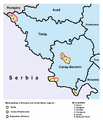
The Krashovani
The Krashovani (Croatian
Croatian language
Croatian is the collective name for the standard language and dialects spoken by Croats, principally in Croatia, Bosnia and Herzegovina, the Serbian province of Vojvodina and other neighbouring countries...
: Krašovani, Karašovani or Krašovanje, Karaševci and Koroševci, Karaševski Hrvati; Bulgarian
Bulgarian language
Bulgarian is an Indo-European language, a member of the Slavic linguistic group.Bulgarian, along with the closely related Macedonian language, demonstrates several linguistic characteristics that set it apart from all other Slavic languages such as the elimination of case declension, the...
: Крашовени, transliterated: Krashoveni; Romanian
Romanian language
Romanian Romanian Romanian (or Daco-Romanian; obsolete spellings Rumanian, Roumanian; self-designation: română, limba română ("the Romanian language") or românește (lit. "in Romanian") is a Romance language spoken by around 24 to 28 million people, primarily in Romania and Moldova...
: Caraşoveni, Cârşoveni, Cotcoreţi or Cocoşi, also known in English
English language
English is a West Germanic language that arose in the Anglo-Saxon kingdoms of England and spread into what was to become south-east Scotland under the influence of the Anglian medieval kingdom of Northumbria...
as Krashovans) are a South Slavic
Slavic peoples
The Slavic people are an Indo-European panethnicity living in Eastern Europe, Southeast Europe, North Asia and Central Asia. The term Slavic represents a broad ethno-linguistic group of people, who speak languages belonging to the Slavic language family and share, to varying degrees, certain...
people indigenous to Caraşova
Carasova
Carașova is a commune in Caraș-Severin County, Romania. It is known especially for its geographical placement and for the origin of its Croatian inhabitants, the Krashovani. The population of the commune numbered 3,260 people at the 2002 census...
and other nearby locations in Caraş-Severin County
Caras-Severin County
Caraș-Severin is a county of Romania, in the historical region of Banat and few villages in Transylvania, with the county seat at Reșița.-Demographics:The county is part of the Danube-Kris-Mureș-Tisza euroregion....
within the Romania
Romania
Romania is a country located at the crossroads of Central and Southeastern Europe, on the Lower Danube, within and outside the Carpathian arch, bordering on the Black Sea...
n Banat
Banat
The Banat is a geographical and historical region in Central Europe currently divided between three countries: the eastern part lies in western Romania , the western part in northeastern Serbia , and a small...
.
It is estimated that around 5,000 people compose the Krashovani community in Romania. At the 2002 census, only 207 persons identified as Krashovans at a national level.
Geography
Krashovani form a majority in two communes of Caraş-Severin County: CaraşovaCarasova
Carașova is a commune in Caraș-Severin County, Romania. It is known especially for its geographical placement and for the origin of its Croatian inhabitants, the Krashovani. The population of the commune numbered 3,260 people at the 2002 census...
and Lupac.
According to the 2002 census in Romania, the population of the Caraşova commune comprised 84.60% Croats, 4.96% others (presumably Krashovan), 4.47% Roma
Roma minority in Romania
The Roma constitute one of the major minorities in Romania. According to the 2002 census, they number 535,140 people or 2.5% of the total population, being the second-largest ethnic minority in Romania after Hungarians...
, 4.41% Romanians
Romanians
The Romanians are an ethnic group native to Romania, who speak Romanian; they are the majority inhabitants of Romania....
, etc. The population of Lupac commune comprises 93.38% Croats, 5.32% Romanians, etc. 79.75% of the population of Caraşova municipality and 93.45% of the population of Lupac municipality declared Croatian
Croatian language
Croatian is the collective name for the standard language and dialects spoken by Croats, principally in Croatia, Bosnia and Herzegovina, the Serbian province of Vojvodina and other neighbouring countries...
as their mother tongue in the 2002 census.
Origin and history
Original Slavic settlements had existed in these regions before the Krashovan migration. Krashovani themselves are mostly descendants of the specific inhabitants of what is today eastern SerbiaSerbia
Serbia , officially the Republic of Serbia , is a landlocked country located at the crossroads of Central and Southeast Europe, covering the southern part of the Carpathian basin and the central part of the Balkans...
or western Bulgaria
Bulgaria
Bulgaria , officially the Republic of Bulgaria , is a parliamentary democracy within a unitary constitutional republic in Southeast Europe. The country borders Romania to the north, Serbia and Macedonia to the west, Greece and Turkey to the south, as well as the Black Sea to the east...
, namely the region around the Caras-Severin.
Some of the Krashovani allegedly originate from Turopolje
Turopolje
Turopolje is a region in Croatia situated between the capital city Zagreb and Sisak. The administrative center of the region Turopolje is the town of Velika Gorica.-Overview:...
region of present-day Croatia
Croatia
Croatia , officially the Republic of Croatia , is a unitary democratic parliamentary republic in Europe at the crossroads of the Mitteleuropa, the Balkans, and the Mediterranean. Its capital and largest city is Zagreb. The country is divided into 20 counties and the city of Zagreb. Croatia covers ...
(they are being referred as Turopoljci). Because of the long-time influence of other Krashovani, who speak the variant Torlakian dialect, the supposed original (Kajkavian
Kajkavian dialect
The Kajkavian dialect is one of the three main dialects of Croatian. It has low mutual intelligibility with the other two dialects, Štokavian and Čakavian. All three are named after their word for "what?", which in Kajkavian is kaj....
) dialect of this group also became Torlakian. Other groups are supposedly Croats from the Franciscan Province of Bosna Srebrena.
The Krashovani are also considered Bulgarians
Bulgarians
The Bulgarians are a South Slavic nation and ethnic group native to Bulgaria and neighbouring regions. Emigration has resulted in immigrant communities in a number of other countries.-History and ethnogenesis:...
by some scientists from the first half of the 20th century (such as G. Cibrus, M. Mladenov, K. Telbizov, and T. Balkanski). These claims are partially based on the fact that these and some other scientists consider the entire Torlakian-speaking Slavic population ethnically Bulgarian, just as others consider it ethnically Serbian. The question of whether the Torlakian dialect belongs to the eastern or western branches of South Slavic languages
South Slavic languages
The South Slavic languages comprise one of three branches of the Slavic languages. There are approximately 30 million speakers, mainly in the Balkans. These are separated geographically from speakers of the other two Slavic branches by a belt of German, Hungarian and Romanian speakers...
is disputed, and it is often classified as a transitional dialect between the two.
In Austria-Hungary
Austria-Hungary
Austria-Hungary , more formally known as the Kingdoms and Lands Represented in the Imperial Council and the Lands of the Holy Hungarian Crown of Saint Stephen, was a constitutional monarchic union between the crowns of the Austrian Empire and the Kingdom of Hungary in...
, the Krashovani were regarded officially as Bulgarians.
Krashovani migration to Banat can be traced to the 1370s, when fleeing the Ottoman
Ottoman Empire
The Ottoman EmpireIt was usually referred to as the "Ottoman Empire", the "Turkish Empire", the "Ottoman Caliphate" or more commonly "Turkey" by its contemporaries...
onslaught, they moved there from Timok region (at that time ruled by Bulgaria
Bulgaria
Bulgaria , officially the Republic of Bulgaria , is a parliamentary democracy within a unitary constitutional republic in Southeast Europe. The country borders Romania to the north, Serbia and Macedonia to the west, Greece and Turkey to the south, as well as the Black Sea to the east...
). The Catholic supremacy inside the Kingdom of Hungary
Kingdom of Hungary
The Kingdom of Hungary comprised present-day Hungary, Slovakia and Croatia , Transylvania , Carpatho Ruthenia , Vojvodina , Burgenland , and other smaller territories surrounding present-day Hungary's borders...
(to which the Banat region belonged at the time) may account for their distinctiveness from the rest of the Torlakian-speaking population in present-day eastern Serbia.
According to the Austrian
Austrian Empire
The Austrian Empire was a modern era successor empire, which was centered on what is today's Austria and which officially lasted from 1804 to 1867. It was followed by the Empire of Austria-Hungary, whose proclamation was a diplomatic move that elevated Hungary's status within the Austrian Empire...
population census there were over 10,000 Krashovans in Banat. In the 1847 census over 10,000 people declared as Carasovans. In 1896 the Austro-Hungarian
Austria-Hungary
Austria-Hungary , more formally known as the Kingdoms and Lands Represented in the Imperial Council and the Lands of the Holy Hungarian Crown of Saint Stephen, was a constitutional monarchic union between the crowns of the Austrian Empire and the Kingdom of Hungary in...
census around 7,500 Krashovans were listed. The same was stated by the authorities of the Kingdom of Romania
Kingdom of Romania
The Kingdom of Romania was the Romanian state based on a form of parliamentary monarchy between 13 March 1881 and 30 December 1947, specified by the first three Constitutions of Romania...
in 1940. Their number dropped to 2,775 in 1992.
Ever since the Romanian Revolution
Romanian Revolution of 1989
The Romanian Revolution of 1989 was a series of riots and clashes in December 1989. These were part of the Revolutions of 1989 that occurred in several Warsaw Pact countries...
, the government of Romania has awarded special minority status and privileges to its ethnic Serb
Serbs in Romania
The Romanian Serbs are an ethnic minority in Romania. According to the 2002 census, there were 22,518 Serbs in Romania or 0.1% of the population...
citizens. The Democratic Union of Serbs and Krashovani of Romania
Romanian ethnic minorities parties
The Romanian Constitution , under the contitions imposed by the Electoral Law, reserves a seat in the Chamber of Deputies for the party and cultural association of each ethnic minority in Romania...
(Uniunea Democratică a Sârbilor si Caraşovenilor din România) was founded in 1989.
Language and religion
The dialect of the Krashovani is based on the specific variant dialect as traditionally spoken in the area of eastern and southern Serbia and in the Republic of MacedoniaRepublic of Macedonia
Macedonia , officially the Republic of Macedonia , is a country located in the central Balkan peninsula in Southeast Europe. It is one of the successor states of the former Yugoslavia, from which it declared independence in 1991...
and Bulgaria
Bulgaria
Bulgaria , officially the Republic of Bulgaria , is a parliamentary democracy within a unitary constitutional republic in Southeast Europe. The country borders Romania to the north, Serbia and Macedonia to the west, Greece and Turkey to the south, as well as the Black Sea to the east...
, the Torlakian dialect
Torlakian dialect
Torlakian or Torlak is a name given to the group of South Slavic dialects of southeastern Serbia , northeastern Macedonia , western Bulgaria , which is intermediate between Serbian, Bulgarian and Macedonian.Some linguists classify it as an Old-Shtokavian dialect of Serbian or a fourth dialect of...
of the Timok valley around Zaječar
Zajecar
Zaječar is a city and municipality in the eastern part of Serbia. According to the 2011 census the town has a population of 36,830, and its coordinates are 43.91° North, 22.30° East...
. Torlakian as a linguistic entity forms a part of the Balkan Linguistic Union
Balkan linguistic union
The Balkan sprachbund or linguistic area is the ensemble of areal features—similarity in grammar, syntax, vocabulary and phonology—among the languages of the Balkans. Several features are found across these languages though not all need apply to every single language...
; the Krashovani are the only speakers of a language - belonging to this union for having developed many shared features with the adjacent languages - which is detached from the main section. The population however, declare their language as Croatian
Croatian language
Croatian is the collective name for the standard language and dialects spoken by Croats, principally in Croatia, Bosnia and Herzegovina, the Serbian province of Vojvodina and other neighbouring countries...
, probably along religious lines.
However, their Roman Catholic religion has more recently set them apart from Eastern Orthodox Serbs in the Banat, despite the common language and a long history of solidarity (partly continued to this day through joint Serb-Krashovan organizations).
See also
- Minorities of RomaniaMinorities of RomaniaOfficially, 10.5% of Romania's population is represented by minorities . The principal minorities in Romania are Hungarians and Roma people, with a declining German population and smaller numbers of Poles in Bucovina...
- Torlakian dialectTorlakian dialectTorlakian or Torlak is a name given to the group of South Slavic dialects of southeastern Serbia , northeastern Macedonia , western Bulgaria , which is intermediate between Serbian, Bulgarian and Macedonian.Some linguists classify it as an Old-Shtokavian dialect of Serbian or a fourth dialect of...
- Torlaks
- JanjevciJanjevciJanjevci are Croatian inhabitants of the Kosovo town of Janjevo and surrounding villages, located near Pristina as well as villages centered on Letnica near Vitina ....
- Gorani
- Janjevci
- Croats of RomaniaCroats of RomaniaThe Croats are an ethnic minority in Romania, numbering 6,786 people according to the 2002 census. Croats mainly live in the southwest of the country, particularly in Caraş-Severin County. Declared Croatians form a majority in two Romanian localities: the communes of Caraşova and Lupac...
- Banat BulgariansBanat BulgariansThe Banat Bulgarians are a distinct Bulgarian minority group which settled in the 18th century in the region of the Banat, which was then ruled by the Habsburgs and after World War I was divided between Romania, Serbia, and Hungary...
- CaraşovaCarasovaCarașova is a commune in Caraș-Severin County, Romania. It is known especially for its geographical placement and for the origin of its Croatian inhabitants, the Krashovani. The population of the commune numbered 3,260 people at the 2002 census...
- Lupac