

Kajkavian dialect

Encyclopedia
The Kajkavian dialect is one of the three main dialects of Croatian
. It has low mutual intelligibility
with the other two dialects, Štokavian
and Čakavian
. All three are named after their word for "what?", which in Kajkavian is kaj.
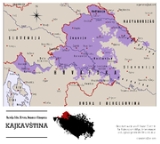
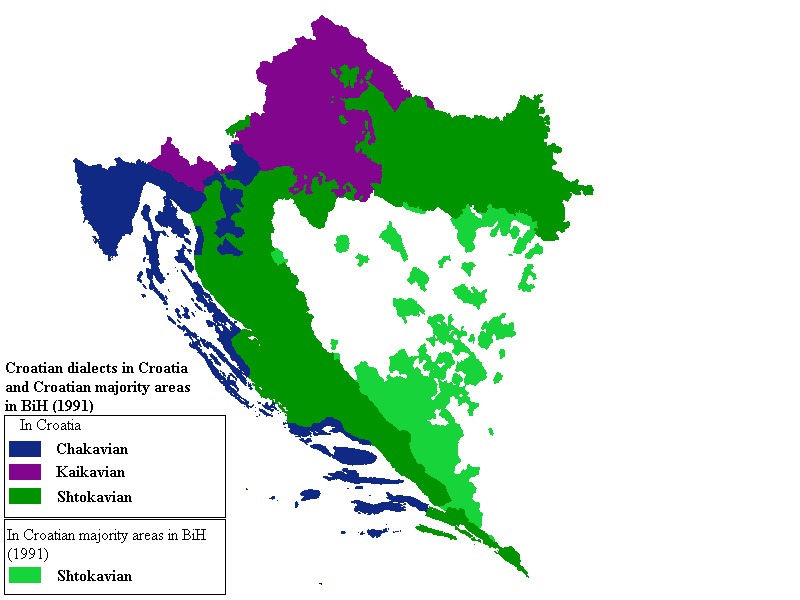
Kajkavian is spoken in the north-central part of Croatia
, including the capital Zagreb
, as well as in a few enclaves in Austria
, Hungary
, and Romania
. Though its speakers are ethnic Croats and Kajkavian is thus considered a dialect of Croatian, it is closer to neighboring Slovene than it is to Chakavian or Shtokavian.
and the Habsburg
Military Frontier
; in southwest along Kupa and Dobra rivers, it persisted in ancient (medieval) contact with Čakavian dialects.
Near relation exists with the Prekmurian language (variant of Slovene in Prekmurje
and Hungary
). The speakers of Prekmurian are Slovenes and Hungarian Slovenes
who belonged to to the Archdiocese of Zagreb during the Habsburg era. Higher amounts of correspondences between the two exist in inflection and vocabulary.
Some Kajkavian words bear a closer resemblance to other Slavic languages (such as Russian
) than they do to Štokavian or Čakavian. For instance gda seems (at first glance) to be unrelated to kada, however, when compared to the Russian когда, the relationship becomes more apparent, at the same time in Slovene: kdaj, in Prekmurian gda, kda. Kajkavian kak (how) and tak (so) are exactly like their Russian cognates, as compared to Štokavian and Čakavian kako and tako, in Prekmurian in turn tak, kak (in Slovene like Chakavian: tako, kako). (This vowel loss occurred in most other Slavic languages; Štokavian is a notable exception, whereas the same feature of Macedonian is probably not a Serbian influence, as the word is preserved in the same form in Bulgarian, to which Macedonian is much closer related than to Serbian.)
Another distinctive feature of Kajkavian is the preference for the future tense
. Instead of Štokavian and Čakavian "ću", "ćeš", and "će", Kajkavian speakers say "bum", "buš" and "bu". The near-future tense is far more often used than in standard Croatian. For example, the phrase "I'll show you" is "Ti bum pokazal" in Kajkavian whereas in standard Croatian it is "Pokazat ću ti". This is a feature shared with Slovene, and also the Prekmurian language, Slovenian: bom, boš, bo; Prekmurian: Bom, boš, bou.
However, later investigations have not corroborated Belić's division. Contemporary Kajkavian dialectology originates mainly from Croatian philologist Stjepan Ivšić
's work "Jezik Hrvata kajkavaca"/The Language of Kajkavian Croats, 1936, which is based on accentuation characteristics. Due to great diversity of Kajkavian speech, primarily in phonetics, phonology and morphology the Kajkavian dialectological atlas is notable for its bewildering proliferation of subdialects: from four identified by Ivšić, up to six proposed by Croatian linguist Brozović
(formerly accepted division) and even as many as fifteen, according to a monograph authored by Croatian linguist Mijo Lončarić (1995).
, Čazma
, Popovača
, Sunja
, Petrinja
, Martinska Ves
, Ozalj
, Ogulin
, Fužine
, and Čabar
, with included newer Štokavian enclaves of Bjelovar
, Sisak
, Glina
, Dubrava, Zagreb
and Novi Zagreb
. The southernmost Kajkavian villages are Krapje
at Jasenovac
; and Pavušek, Dvorišče and Hrvatsko selo in Zrinska Gora (R. Fureš & A. Jembrih: Kajkavski u povijesnom i sadašnjem obzorju p. 548, Zabok 2006). All three Croatian dialects collide between Karlovac and Ogulin.
The major cities in northern Croatia with prevailing urban Kajkavians are chiefly Zagreb (old central city, Sesvete and V. Gorica), Koprivnica, Križevci, Varaždin, Čakovec, etc. The typical and archaic Kajkavian is today spoken chiefly in Zagorje
hills and Medjimurje plain, and in adjacent areas of northwestern Croatia where other immigrants and Štokavian standard had much less influence. The most peculiar Kajkavian archidiom (Baegnunski) is spoken at Bednja
in northernmost Croatia.
Most other Croatian speakers know of Kajkavian as the metropolitan dialect of Zagreb city, where a half of citizens (nearly 300.000 ones) now widely use the "zagrebečki" speech (a half-Kajkavian koine) for their private communication at home and on street (using a Štokavian speech in official sites only).
Moreover, in the central city of old Zagreb and in satellite towns Sesvete and V. Gorica, up today persist at least 7,000 Kajkavian elders speaking old "Agramer" archidiom who understand the official standard but can hardly speak it. Also the coastal Čakavian immigrants in Zagreb or elsewhere in northwestern Croatia quickly transform to Kajkavians in one generation: their non-standard accentuation is subequal to Kajkavian, with many connecting archaisms in vocabulary. The best adaptable are the transitional northern Čakavians from northeastern Istria, Cres, Vinodol, and Pokupje accepting well Kajkavian in few years.
Other southeastern people who immigrate to Zagreb from Štokavian territories often pick up rare elements of Kajkavian in order to assimilate, notably the pronoun "kaj" instead of "što" and the extended use of future anterior (futur drugi), but they never adapt well because of alien eastern accents and ignoring Kajkavian-Čakavian archaisms and syntax.
After that, numerous works appeared in Croatian Kajkavian literary language: chronicles by Vramec, liturgical works by Ratkaj
, Habdelić
, Mulih; poetry of Ana Katarina Zrinska, dramatic opus of Tituš Brezovački
. Kajkavian-based are important lexicographic works like Jambrešić's "Dictionar", 1670, and monumental (2,000 pages and 50,000 words) inter-dialectal (Čakavian-Štokavian-Kajkavian, but based on Kajkavian idiom) dictionary "Gazophylacium" by Ivan Belostenec
(posthumously, 1740). Interestingly enough, Miroslav Krleža
's visionary poetic masterpiece, "Balade Petrice Kerempuha", 1936, drew heavily on Belostenec's dictionary. Croatian Kajkavian grammars include Kornig's, 1795, Matijević's, 1810 and Đurkovečki's, 1837.
Kajkavian literary language gradually fell into disuse since Croatian National Revival, ca. 1830-1850, when leaders of Croatian National Unification Movement (the majority of them being Kajkavian native speakers themselves) adopted the most widespread and developed Croatian Štokavian literary language as the idiom for Croatian standard language.
However, after a period of lethargy, the 20th century has witnessed new flourishing of literature in Kajkavian dialect - this time as Croatian dialectal poetry, main authors being Antun Gustav Matoš
, Miroslav Krleža
, Ivan Goran Kovačić
, Dragutin Domjanić
, Nikola Pavić etc.
Kajkavian lexical treasure is being published by the Croatian Academy of Sciences and Arts
in "Rječnik hrvatskoga kajkavskoga književnoga jezika"/Dictionary of the Croatian Kajkavian Literary Language, 8 volumes (1999).
Latterly Dario Vid Balog, actor, linguist and writer translate the New Testament in Kajkavian.
Below are examples of the Lord's Prayer
in the Croatian variant of Shtokavian, literary Kajkavian and a Međimurje variant of the Kajkavian dialect.
Croatian language
Croatian is the collective name for the standard language and dialects spoken by Croats, principally in Croatia, Bosnia and Herzegovina, the Serbian province of Vojvodina and other neighbouring countries...
. It has low mutual intelligibility
Mutual intelligibility
In linguistics, mutual intelligibility is recognized as a relationship between languages or dialects in which speakers of different but related languages can readily understand each other without intentional study or extraordinary effort...
with the other two dialects, Štokavian
Shtokavian dialect
Shtokavian or Štokavian is the prestige dialect of the Serbo-Croatian language, and the basis of its Bosnian, Croatian, Serbian, and Montenegrin standards...
and Čakavian
Chakavian dialect
Chakavian or Čakavian is a dialect of the Croatian language. The name stems from the word for "what?", which is "ča" in Čakavian...
. All three are named after their word for "what?", which in Kajkavian is kaj.
Kajkavian is spoken in the north-central part of Croatia
Croatia
Croatia , officially the Republic of Croatia , is a unitary democratic parliamentary republic in Europe at the crossroads of the Mitteleuropa, the Balkans, and the Mediterranean. Its capital and largest city is Zagreb. The country is divided into 20 counties and the city of Zagreb. Croatia covers ...
, including the capital Zagreb
Zagreb
Zagreb is the capital and the largest city of the Republic of Croatia. It is in the northwest of the country, along the Sava river, at the southern slopes of the Medvednica mountain. Zagreb lies at an elevation of approximately above sea level. According to the last official census, Zagreb's city...
, as well as in a few enclaves in Austria
Austria
Austria , officially the Republic of Austria , is a landlocked country of roughly 8.4 million people in Central Europe. It is bordered by the Czech Republic and Germany to the north, Slovakia and Hungary to the east, Slovenia and Italy to the south, and Switzerland and Liechtenstein to the...
, Hungary
Hungary
Hungary , officially the Republic of Hungary , is a landlocked country in Central Europe. It is situated in the Carpathian Basin and is bordered by Slovakia to the north, Ukraine and Romania to the east, Serbia and Croatia to the south, Slovenia to the southwest and Austria to the west. The...
, and Romania
Romania
Romania is a country located at the crossroads of Central and Southeastern Europe, on the Lower Danube, within and outside the Carpathian arch, bordering on the Black Sea...
. Though its speakers are ethnic Croats and Kajkavian is thus considered a dialect of Croatian, it is closer to neighboring Slovene than it is to Chakavian or Shtokavian.
Characteristics
The Kajkavian area of Croatia is bordered on the northwest by Slovene language territory. It is bordered on the east and southeast by Štokavian dialects roughly along a line that was the former division between Civil CroatiaCivil Croatia
Civil Croatia was a designation for the areas of Central Croatia that were not part of the Habsburg Military Frontier. Like the Military Frontier, it ceased to exist as a political entity in the late 19th century....
and the Habsburg
Habsburg
The House of Habsburg , also found as Hapsburg, and also known as House of Austria is one of the most important royal houses of Europe and is best known for being an origin of all of the formally elected Holy Roman Emperors between 1438 and 1740, as well as rulers of the Austrian Empire and...
Military Frontier
Military Frontier
The Military Frontier was a borderland of Habsburg Austria and later the Austro-Hungarian Monarchy, which acted as the cordon sanitaire against incursions from the Ottoman Empire...
; in southwest along Kupa and Dobra rivers, it persisted in ancient (medieval) contact with Čakavian dialects.
Near relation exists with the Prekmurian language (variant of Slovene in Prekmurje
Prekmurje
Prekmurje is a geographically, linguistically, culturally and ethnically defined region settled by Slovenes and lying between the Mur River in Slovenia and the Rába Valley in the most western part of Hungary...
and Hungary
Hungary
Hungary , officially the Republic of Hungary , is a landlocked country in Central Europe. It is situated in the Carpathian Basin and is bordered by Slovakia to the north, Ukraine and Romania to the east, Serbia and Croatia to the south, Slovenia to the southwest and Austria to the west. The...
). The speakers of Prekmurian are Slovenes and Hungarian Slovenes
Hungarian Slovenes
Hungarian Slovenes are an autochthonous ethnic and linguistic Slovene minority living in Hungary. The largest groups are the Rába Slovenes in the Rába Valley in western Hungary between the town of Szentgotthárd and the borders with Slovenia and Austria. They speak the Prekmurje dialect of Slovene...
who belonged to to the Archdiocese of Zagreb during the Habsburg era. Higher amounts of correspondences between the two exist in inflection and vocabulary.
Some Kajkavian words bear a closer resemblance to other Slavic languages (such as Russian
Russian language
Russian is a Slavic language used primarily in Russia, Belarus, Uzbekistan, Kazakhstan, Tajikistan and Kyrgyzstan. It is an unofficial but widely spoken language in Ukraine, Moldova, Latvia, Turkmenistan and Estonia and, to a lesser extent, the other countries that were once constituent republics...
) than they do to Štokavian or Čakavian. For instance gda seems (at first glance) to be unrelated to kada, however, when compared to the Russian когда, the relationship becomes more apparent, at the same time in Slovene: kdaj, in Prekmurian gda, kda. Kajkavian kak (how) and tak (so) are exactly like their Russian cognates, as compared to Štokavian and Čakavian kako and tako, in Prekmurian in turn tak, kak (in Slovene like Chakavian: tako, kako). (This vowel loss occurred in most other Slavic languages; Štokavian is a notable exception, whereas the same feature of Macedonian is probably not a Serbian influence, as the word is preserved in the same form in Bulgarian, to which Macedonian is much closer related than to Serbian.)
Another distinctive feature of Kajkavian is the preference for the future tense
Future tense
In grammar, a future tense is a verb form that marks the event described by the verb as not having happened yet, but expected to happen in the future , or to happen subsequent to some other event, whether that is past, present, or future .-Expressions of future tense:The concept of the future,...
. Instead of Štokavian and Čakavian "ću", "ćeš", and "će", Kajkavian speakers say "bum", "buš" and "bu". The near-future tense is far more often used than in standard Croatian. For example, the phrase "I'll show you" is "Ti bum pokazal" in Kajkavian whereas in standard Croatian it is "Pokazat ću ti". This is a feature shared with Slovene, and also the Prekmurian language, Slovenian: bom, boš, bo; Prekmurian: Bom, boš, bou.
History
Dialectogical investigations of the Kajkavian dialect had begun at the end of the 19th century: the first comprehensive monograph was written in Russian by Ukrainian philologist A.M.Lukjanenko in 1905 (Kajkavskoe narečie). Kajkavian dialects have been classified along various criteria: Serbian philologist Aleksandar Belić had divided (1927) the Kajkavian dialect according to the reflexes of Proto-Slavic phonemes /tj/ and /DJ/ into three subdialects: eastern, northwestern and southwestern.However, later investigations have not corroborated Belić's division. Contemporary Kajkavian dialectology originates mainly from Croatian philologist Stjepan Ivšić
Stjepan Ivšic
Stjepan Ivšić , Croatian linguist, Slavist and accentologist.After finishing primary school in Orahovica, he attended secondary school in Osijek and Požega. At the Faculty of Philosophy at the University of Zagreb he studied Croatian and classical philology, and later specialized at the...
's work "Jezik Hrvata kajkavaca"/The Language of Kajkavian Croats, 1936, which is based on accentuation characteristics. Due to great diversity of Kajkavian speech, primarily in phonetics, phonology and morphology the Kajkavian dialectological atlas is notable for its bewildering proliferation of subdialects: from four identified by Ivšić, up to six proposed by Croatian linguist Brozović
Dalibor Brozovic
Dalibor Brozović was a Croatian linguist, Slavist, dialectologist and politician. He studied the history of standard Slavic languages, especially Croatian. He was an active Esperantist since 1946, and wrote Esperanto poetry as well as translated works into the language. -Life and career:He was...
(formerly accepted division) and even as many as fifteen, according to a monograph authored by Croatian linguist Mijo Lončarić (1995).
Area of use
Kajkavians now include 31%, i.e. 1,300,000 of Croatia's inhabitants, chiefly in northern and northwestern Croatia. The mixed half-Kajkavian towns along the eastern and southern edge of Kajkavian speaking area are PitomačaPitomaca
Pitomača is a municipality in Croatia in the Virovitica–Podravina County. It has a population of 10,465 , 98% which are Croats....
, Čazma
Cazma
Čazma is a town and municipality in Bjelovar-Bilogora County, Croatia. It is part of Moslavina.-Geography:Čazma is situated 60 kilometers east of Zagreb and only 30 kilometres from the center of the region - Bjelovar....
, Popovača
Popovaca
Popovača is a municipality in Croatia in the Sisak-Moslavina County. It is part of Moslavina. The municipality has a population of 12,701 , 95% of which are Croats.-External links:**...
, Sunja
Sunja
Sunja is a municipality in Croatia in the Sisak-Moslavina County.-Population:According to the 2001 census, the municipality has a population of 7,376, 79.53% which are Croats and 17.46% which are Serbs....
, Petrinja
Petrinja
Petrinja is a city in central Croatia near Sisak in the historic region of Banovina. The city belongs to Sisak-Moslavina County .- History :The name of Petrinja has its roots in Latin petrus, meaning "stone"...
, Martinska Ves
Martinska Ves
Martinska Ves is a municipality in Croatia in the Sisak-Moslavina county. It has a population of 4,026 , 98% which are Croats.The settlements in the municipality are:* Bok Palanječki, population 160* Desna Martinska Ves, pop. 381...
, Ozalj
Ozalj
Ozalj is a town in central Croatia, located north of Karlovac and southwest of Jastrebarsko, on the Kupa river. It is close to Žumberak in the north and the border with Slovenia in the northwest, with Metlika being the closest Slovenian town.-Population:...
, Ogulin
Ogulin
Ogulin is a town in north-western Croatia, in Karlovac County. It has a population of 8,712 , and a total municipal population of 15,054...
, Fužine
Fužine
Fužine is a village and a municipality in the Primorje-Gorski Kotar County in western Croatia.-Demographics:The total population of Fužine is 1,595, in the following settlements:* Belo Selo, population 52* Benkovac Fužinski, population 33...
, and Čabar
Cabar
Čabar is a town in the Primorje-Gorski Kotar county in western Croatia. There are 4,387 inhabitants, with 95% Croats.-Twin towns:Čabar is twinned with: Pula, Croatia ...
, with included newer Štokavian enclaves of Bjelovar
Bjelovar
Bjelovar is a city in central Croatia. It is the administrative centre of Bjelovar-Bilogora County. During the 2001 census, there were 41,869 inhabitants, 90.51% which are Croats....
, Sisak
Sisak
Sisak is a city in central Croatia. The city's population in 2011 was 33,049, with a total of 49,699 in the administrative region and it is also the administrative centre of the Sisak-Moslavina county...
, Glina
Glina, Croatia
Glina is a small town in central Croatia, located southwest of Petrinja and Sisak in the Sisak-Moslavina county. It lies on the eponymous river of Glina.-History:...
, Dubrava, Zagreb
Dubrava, Zagreb
Dubrava is one of the largest parts of Zagreb, Croatia. It is located in the northeastern part of the city and divided by the Dubrava Avenue into two administrative areas:* Gornja Dubrava * Donja Dubrava...
and Novi Zagreb
Novi Zagreb
Novi Zagreb is the part of the city of Zagreb located south of the Sava river, on the way from the Pleso airport to the city center...
. The southernmost Kajkavian villages are Krapje
Krapje
Krapje is a settlement on the right bank of the river Mura in the Ljutomer Municipality in northeastern Slovenia. It is divided into two distinct villages, Zgornje Krapje and Spodnje Krapje...
at Jasenovac
Jasenovac
Jasenovac is a village and a municipality in Croatian Slavonia, in the southern part of the Sisak-Moslavina county at the confluence of the river Una into Sava.The name means "ash tree" or "ash forest" in Croatian, the area being ringed by such a forest....
; and Pavušek, Dvorišče and Hrvatsko selo in Zrinska Gora (R. Fureš & A. Jembrih: Kajkavski u povijesnom i sadašnjem obzorju p. 548, Zabok 2006). All three Croatian dialects collide between Karlovac and Ogulin.
The major cities in northern Croatia with prevailing urban Kajkavians are chiefly Zagreb (old central city, Sesvete and V. Gorica), Koprivnica, Križevci, Varaždin, Čakovec, etc. The typical and archaic Kajkavian is today spoken chiefly in Zagorje
Zagorje
Hrvatsko Zagorje is a region in northern Croatia.Zagorje may also refer to:*Zagorje ob Savi, a town and a municipality in Slovenia*NK Zagorje, a Slovenian football club-See also:...
hills and Medjimurje plain, and in adjacent areas of northwestern Croatia where other immigrants and Štokavian standard had much less influence. The most peculiar Kajkavian archidiom (Baegnunski) is spoken at Bednja
Bednja
Bednja is a village and municipality in Croatia in the Varaždin county , and also a river in northern Croatia. According to the 2001 census, there are 4,765 inhabitants, the majority of Croat descent....
in northernmost Croatia.
Most other Croatian speakers know of Kajkavian as the metropolitan dialect of Zagreb city, where a half of citizens (nearly 300.000 ones) now widely use the "zagrebečki" speech (a half-Kajkavian koine) for their private communication at home and on street (using a Štokavian speech in official sites only).
Moreover, in the central city of old Zagreb and in satellite towns Sesvete and V. Gorica, up today persist at least 7,000 Kajkavian elders speaking old "Agramer" archidiom who understand the official standard but can hardly speak it. Also the coastal Čakavian immigrants in Zagreb or elsewhere in northwestern Croatia quickly transform to Kajkavians in one generation: their non-standard accentuation is subequal to Kajkavian, with many connecting archaisms in vocabulary. The best adaptable are the transitional northern Čakavians from northeastern Istria, Cres, Vinodol, and Pokupje accepting well Kajkavian in few years.
Other southeastern people who immigrate to Zagreb from Štokavian territories often pick up rare elements of Kajkavian in order to assimilate, notably the pronoun "kaj" instead of "što" and the extended use of future anterior (futur drugi), but they never adapt well because of alien eastern accents and ignoring Kajkavian-Čakavian archaisms and syntax.
Kajkavian literary language
Kajkavian is not only a folk dialect, but in the course of history of Croatian language, has been the written public language (along with the corpus written in Čakavian and Štokavian). Kajkavian was the last to appear on the scene, mainly due to economic and political reasons. While first Croatian truly vernacular Čakavian texts (i.e. not mixed with Church Slavonic) go back to the 13th century, Štokavian to 14th century, the first Kajkavian published work was Pergošićs "Decretum", 1574.After that, numerous works appeared in Croatian Kajkavian literary language: chronicles by Vramec, liturgical works by Ratkaj
Juraj Ratkaj
Juraj Ratkaj was a Croatian historian. He was a member of the Society of Jesus. Later on he became a priest and the canon of Zagreb. He took part in the Thirty Years' War in 1647 and he fought the Ottomans...
, Habdelić
Juraj Habdelic
Juraj Habdelić was a Jesuit and a Croatian writer.His parents was Boldižar Habdelić and Margarita Kraljić. He went to gymnasium in Zagreb, studied philosophy in Graz and theology in Trnava. He worked as a teacher in Rijeka, Varaždin and Zagreb where he became the rector of Jesuit Collegium and...
, Mulih; poetry of Ana Katarina Zrinska, dramatic opus of Tituš Brezovački
Tituš Brezovacki
Tituš Brezovački was a Croatian writer.Brezovački, as the great comedian of the period, wrote all of his dramatic works in Kajkavian dialect...
. Kajkavian-based are important lexicographic works like Jambrešić's "Dictionar", 1670, and monumental (2,000 pages and 50,000 words) inter-dialectal (Čakavian-Štokavian-Kajkavian, but based on Kajkavian idiom) dictionary "Gazophylacium" by Ivan Belostenec
Ivan Belostenec
Ivan Belostenec was a Croatian linguist and lexicographer.-Life:In 1616. he joined the Paulists. He studied philosophy in Vienna and theology in Rome...
(posthumously, 1740). Interestingly enough, Miroslav Krleža
Miroslav Krleža
Miroslav Krleža was a leading Croatian and Yugoslav writer and the dominant figure in cultural life of both Yugoslav states, the Kingdom and the Republic . He has often been proclaimed the greatest Croatian writer of the 20th century.-Biography:Miroslav Krleža was born in Zagreb, modern-day...
's visionary poetic masterpiece, "Balade Petrice Kerempuha", 1936, drew heavily on Belostenec's dictionary. Croatian Kajkavian grammars include Kornig's, 1795, Matijević's, 1810 and Đurkovečki's, 1837.
Kajkavian literary language gradually fell into disuse since Croatian National Revival, ca. 1830-1850, when leaders of Croatian National Unification Movement (the majority of them being Kajkavian native speakers themselves) adopted the most widespread and developed Croatian Štokavian literary language as the idiom for Croatian standard language.
However, after a period of lethargy, the 20th century has witnessed new flourishing of literature in Kajkavian dialect - this time as Croatian dialectal poetry, main authors being Antun Gustav Matoš
Antun Gustav Matoš
Antun Gustav Matoš was a Croatian poet, short story writer, journalist, essayist and travelogue writer. He is considered the champion of Croatian modernist literature, opening Croatia to the currents of European modernism, and one of the greatest Croatian literary figures of all time.-Life:Matoš...
, Miroslav Krleža
Miroslav Krleža
Miroslav Krleža was a leading Croatian and Yugoslav writer and the dominant figure in cultural life of both Yugoslav states, the Kingdom and the Republic . He has often been proclaimed the greatest Croatian writer of the 20th century.-Biography:Miroslav Krleža was born in Zagreb, modern-day...
, Ivan Goran Kovačić
Ivan Goran Kovacic
Ivan Goran Kovačić was a prominent Croatian poet and writer of the 20th century.-Early life and background:He was born in Lukovdol , a town in Gorski Kotar, to Croatian father Ivan and Jewish mother Ruža . His middle name Goran stems from that...
, Dragutin Domjanić
Dragutin Domjanic
Dragutin Domjanić was a Croatian Kajkavian poet.Domjanić was born in Zelina. He became the first writer in Croatian literature to achieve complete and artistically mature melodiousness and rhythmicity of the Croatian Kajkavian expression. Having graduated law, he served as a judge in Zagreb and...
, Nikola Pavić etc.
Kajkavian lexical treasure is being published by the Croatian Academy of Sciences and Arts
Croatian Academy of Sciences and Arts
The Croatian Academy of Sciences and Arts is the national academy of Croatia. It was founded in 1866 as the Yugoslav Academy of Sciences and Arts , and was known by that name for most of its existence.- History :...
in "Rječnik hrvatskoga kajkavskoga književnoga jezika"/Dictionary of the Croatian Kajkavian Literary Language, 8 volumes (1999).
Latterly Dario Vid Balog, actor, linguist and writer translate the New Testament in Kajkavian.
Below are examples of the Lord's Prayer
Lord's Prayer
The Lord's Prayer is a central prayer in Christianity. In the New Testament of the Christian Bible, it appears in two forms: in the Gospel of Matthew as part of the discourse on ostentation in the Sermon on the Mount, and in the Gospel of Luke, which records Jesus being approached by "one of his...
in the Croatian variant of Shtokavian, literary Kajkavian and a Međimurje variant of the Kajkavian dialect.
| Standard Croatian | Standard Kajkavian | Međimurje-Kajkavian |
|---|---|---|
Oče naš, koji jesi na nebesima, sveti se ime tvoje, dođi kraljevstvo tvoje, budi volja tvoja, kako na nebu tako i na zemlji. Kruh naš svagdanji daj nam danas i otpusti nam duge naše, kako i mi otpuštamo dužnicima našim, i ne uvedi nas u napast, nego izbavi nas od zla. Amen. |
Otec naš, koji jesi v nebesih, sveti se ime tvoje, dojdi kralevstvo tvoje, budi volja tvoja, kak na nebu tak i na zemli. Kruh naš svakdašni daj nam denes i otpusti nam duge naše, kak i mi otpuščamo dužnikom našim, i ne uvedi nas v napast, nek izbavi nas od zla. Amen. |
Japa naš kteri si f 'nebesih, nek sesvete ime Tvoje, nek prihaja cesarstvo Tvoje, nek bu volja Tvoja, kakti na nebe tak pa na zemle. Kruhek naš sakdajni nam daj denes ter odpuščaj nam dugi naše, kakti mi odpuščamo dužnikom našim, ter naj nas fpelati vu skušnje, nek nas zbavi od sekih hudobah. Amen. |
 |
Kajkavian media
During Yugoslavia in 20th century, the exotic Kajkavian was mostly restricted in private communication, poetry and folklore. By the recent regional democratizing and cultural revival from 1990s, Kajkavians partly regained their former half-public positions chiefly in Zagorje County and Varaždin County and local towns, being now presented there in some modern public media e.g.:- Quarterly periodical "Kaj", with 35 annual volumes in nearly a hundred fascicles, published since 1967 by the Kajkavian Association ('Kajkavsko Spravišče') in Zagreb city.
- Autumnal Weeks of Kajkavian culture in Krapina since 1997, with iterative professional symposia on Kajkavians resulting by five published proceedings.
- Annual periodical Hrvatski sjever ('Croatian North'), with dozen volumes partly in Kajkavian, published by Matica Hrvatska in Čakovec.
- A new internet portal: Kaykavian Zohowiki, a minor wiki-lexicon on the Kajkavian culture and dialect in northwestern Croatia, starting in autumn 2009.
- A permanent program in Kajkavian of the Kajkavian radio in Krapina township. Other minor half-Kajkavian media with temporary Kajkavian contents include also the local television of Varaždin city, local radio program Sljeme in Zagreb, and some local newspapers in northwestern Croatia, e.g. in Varaždin, Čakovec, Samobor, etc.
Examples
- kaj bum? - in Kajkavian: What should I do?
- Kak je, tak je; tak je navek bilo, kak bu tak bu, a bu vre nekak kak bu!
- "Nigdar ni tak bilo da ni nekak bilo, pak ni vezda ne bu da nam nekak ne bu." - Miroslav Krleža (quotation from poem "Khevenhiller")
- Kaj buš ti, bum i ja! (Whatever you do, I'll do it too!)
- Ne bu išlo! (standard Croatian: Ne može tako, Neće ići, Slovene: Ne bo šlo, "It won't work!")
- "Bumo vidli!" (štokavski: "Vidjet ćemo!", Slovene: Bomo videli, English: "We will see!")
- "Dej muči!" or "Muči daj!" (štokavski: "Daj šuti!", Slovene: Daj molči, English: "Shut up!")
- "Buš pukel?" - "Bum!" (jokingly: "Will you explode?" - "I will!")
- Numerous supplementary examples see also by A. Negro: "Agramerski štikleci"
- Another major example - traditional Kajkavian "Paternoster" (bold = site of stress): Japa naš kteri si f 'nebesih nek sesvete ime Tvoje, nek prihaja cesarstvo Tvoje, nek bu volya Tvoja kakti na nebe tak pa na zemle. Kruhek naš sakdajni nam daj denes ter odpuščaj nam dugi naše, kakti mi odpuščamo dužnikom našim ter naj nas fpelati vu skušnje, nek nas zbavi od sekih hudobah. F'se veke vekof, Amen.
Further reading
- Jedvaj, Josip 1956: Bednjanski govor, Hrvatski dijalektološki zbornik, Yugoslav Academy of Sciences and Arts
External links
- "Agramerski štikleci": Kajkavian phrases and proverbs
- Kaykavian Zohowiki: a new lexicon of Kajkavian culture and speech