

The Last Man

Encyclopedia
The Last Man is an apocalyptic
science fiction
novel by Mary Shelley
, which was first published in 1826. The book tells of a future world that has been ravaged by a plague
. The novel was harshly reviewed at the time, and was virtually unknown until a scholarly revival beginning in the 1960s. It is notable in part for its semi-biographical portraits of Romantic
figures in Shelley's circle, particularly Shelley's late husband Percy Bysshe Shelley
and Lord Byron
.
figure for Mary Shelley
.
Adrian, Earl of Windsor Son of the last King of England, Adrian embraces republican principles
. He is motivated by philosophy and philanthropy
, rather than ambition. He is based on Percy Bysshe Shelley
.
Lord Raymond An ambitious young nobleman, Raymond becomes famous for his military efforts on behalf of Greece
against the Turks
, but eventually chooses love over his ambition to become King of England. He instead becomes Lord Protector
of England before returning to Greece
. Raymond is motivated by passion and ambition rather than principle. He is based on Lord Byron.
Perdita Lionel's sister, and Raymond's wife. Growing up an orphan, Perdita was independent, distrustful, and proud, but she is softened by love for Raymond, to whom she is fiercely loyal.
Idris Adrian's sister, and Verney's wife. She is loving, maternal, and self-sacrificing.
Countess of Windsor Mother of Adrian and Idris, an Austria
n princess and former Queen of England. She is haughty and ambitious, scheming to restore the monarchy
through her children.
Evadne A Greek princess with whom Adrian falls in love, but who loves Raymond. She is devoted and proud, even when she becomes impoverished.
Clara Daughter of Raymond and Perdita.
Alfred and Evelyn Sons of Verney and Idris.
Ryland Leader of the popular Democratic party, Ryland has grand plans for the abolition of nobility before the plague, but is unwilling to govern England during the plague.
Merrival An astronomer
who is oblivious to the plague, instead speculating about the condition of earth in six thousand years, until his family dies.
Lucy Martin A young woman who chose to marry a repulsive suitor rather than wait for her true love, in order to provide for her aging mother. Her devotion to her mother almost leads to her being left behind in England after the exile.
The Imposter Unnamed - a false prophet (from ambition, rather than fanaticism
) who creates a radical religious sect in opposition to Adrian while in France
.
Juliet A young noblewoman who joins the Imposter's party in order to support her baby, but is later killed revealing his imposture.
states in the introduction that in 1818 she discovered, in the Sibyl's cave near Naples
, a collection of prophetic writings
painted on leaves by the Cumaean Sibyl
. She has edited these writings into the current narrative, the first-person narrative of a man living at the end of the 21st century.
When the king left the throne, the monarchy came to an end and a republic
is created. When the king dies the Countess attempts to raise their son, Adrian, to reclaim the throne, but Adrian opposes his mother and refuses to take the throne. Adrian moves to Cumberland
where Lionel, who bears a grudge against Adrian and his family for the neglect of the Verney family, intends to terrorize and confront Adrian. He is mollified by Adrian's good nature and his explanation that he only recently discovered the letter. Lionel and Adrian become close friends, and Lionel becomes civilized and philosophical under Adrian's influence.
Lionel returns to England to face the personal turmoil amongst his acquaintances. Lord Raymond, who came to renown for his exploits in the war between Greece and Turkey
, has returned to England in search of political position, and soon Perdita and Evadne both fall in love with him. On discovering that his beloved, Evadne, is in love with Raymond, Adrian goes into exile, presumably mad. Raymond intends to marry Idris (with whom Lionel is in love) as a first step towards becoming king, with the help of the Countess. However, he ultimately chooses his love for Perdita over his ambition, and the two marry. Under Lionel's care Adrian recovers, although he remains physically weak. On learning of the love between Idris and Lionel, the Countess schemes to drug Idris, bring her to Austria
, and force her to make a politically motivated marriage. Idris discovers the plot and flees to Lionel, who marries her soon after. The Countess leaves for Austria
, resentful of her children and of Lionel.
Adrian and the others live happily together until Raymond runs for Lord Protector and wins. Perdita soon adjusts to her newfound social position, while Raymond becomes well-beloved as a benevolent administrator. He discovers, however, that Evadne, after the political and financial ruin of her husband (on account of her own political schemes) is living in poverty and obscurity in London
, unwilling to plead for assistance. Raymond attempts to support Evadne by employing her artistic skills in secrecy, and later nursing her in illness, but Perdita learns of the relationship and suspects infidelity
. Her suspicions arouse Raymond's proud and passionate nature, and the two separate. Raymond resigns his position and leaves to rejoin the war in Greece
, accompanied for a time by Adrian. Shortly after the wounded Adrian returns to England, rumors arise that Raymond has been killed. Perdita, loyal in spite of everything, convinces Lionel to bring her and Clara to Greece to find him.
causes dissension and desertion amongst the army because of reports of the plague
. Raymond enters the city alone, and soon dies in a fire. He is taken to Athens
for burial.
In 2092, while Lionel and Adrian attempt to return their lives to normality, the plague continues to spread across Europe
and the Americas
, and reports of a black sun cause panic throughout the world. At first England is thought to be safe, but soon the plague reaches even there. Ryland, recently elected Lord Protector
, is unprepared for the plague, and flees northward, later dying alone amidst a stockpile of provisions. Adrian takes command and is largely effective at maintaining order and humanity in England, although the plague rages on summer after summer. Ships arrive in Ireland
carrying survivors from America
, who lawlessly plunder Ireland
and Scotland
before invading England. Adrian raises a military force against them, but ultimately is able to resolve the situation peacefully.
in search of an easier climate. On the eve of their departure Alfred before reaching Dover
Lionel receives a letter from Lucy Martin, who was unable to join the exiles because of her mother's illness. Lionel and Idris travel through a snowstorm to assist Lucy, but Idris, weak from years of stress and maternal fears, dies along the way. Lionel and the Countess, who had shunned Idris and her family out of resentment towards Lionel, are reconciled at Idris' tomb. Lionel recovers Lucy (whose mother has died), and the party reaches Dover
en route to France
.
In France, Adrian discovers that the earlier emigrants have divided into factions, amongst them a fanatical religious sect led by a false messiah
who claims that his followers will be saved from disease. Adrian unites most of the factions, but this latter group declares violent opposition to Adrian. Lionel sneaks into Paris
, where the cult has settled, to try to rescue Juliet. She refuses to leave because the imposter has her baby, but she helps Lionel to escape. Later, when Juliet's baby sickens, Juliet discovers that the imposter has been hiding the effects of the plague from his followers. She is killed warning the other followers, after which the imposter commits suicide, and his followers return to the main body of exiles at Versailles
.
The exiles travel towards Switzerland
, hoping to spend the summer in a colder climate less favorable to the plague. By the time they reach Switzerland, however, all but four (Lionel, Adrian, Clara, and Evelyn) have died. The four spend a few relatively happy seasons at Switzerland
, Milan
, and Como
before Evelyn dies of typhus
. The survivors attempt to sail across the Adriatic Sea
to Greece
, but a sudden storm drowns Clara and Adrian. Lionel, the last man, swims to shore. The story ends in the year 2100.
, from publishing a biography of her husband, so she memorialized him, amongst others, in The Last Man. The utopia
n Adrian, Earl of Windsor, who leads his followers in search of a natural paradise and dies when his boat sinks in a storm, is a fictional portrait of Percy Bysshe Shelley
, although other minor characters such as Merrival bear traces of Percy as well.
Lord Raymond, who leaves England to fight for the Greeks and dies in Constantinople
, is based on Lord Byron. The novel expresses Mary Shelley's pain at the loss of her community of the "Elect", as she called them, and Lionel Verney has been seen as an outlet for her feelings of loss and boredom following their deaths and the deaths of her children.
It appears that Shelley found inspiration for the title of her novel in Jean-Baptiste Cousin de Grainville
's Le Dernier Homme (1805), translated into English in 1806 as Omegarus and Syderia.
political ideals they stood for. In a sense, the plague is metaphorical, since the revolutionary idyll of the élite group is corroded from within by flaws of human nature. As literary scholar Kari Lokke writes, "in its refusal to place humanity at the center of the universe, its questioning of our privileged position in relation to nature, then, The Last Man constitutes a profound and prophetic challenge to Western humanism." Specifically, Mary Shelley, in making references to the failure of the French Revolution
and the Godwinian
, Wollstonecraftian
, and Burkean
responses to it, "attacks Enlightenment faith in the inevitability of progress through collective efforts".
" (xvii). Shelley shares this theme of tragic isolation with the poetry of Lord Byron and William Wordsworth
.
in London
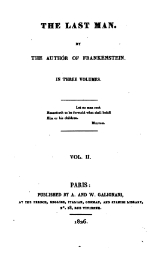
in 1826, and one edition in Paris
in 1826 by Galignani
. A pirated edition was printed in America
in 1833. The Last Man received the worst reviews of all of Mary Shelley's novels: most reviewers derided the very theme of lastness, which had become a common one in the previous two decades. Individual reviewers labeled the book "sickening", criticised its "stupid cruelties", and called the author's imagination "diseased". The reaction startled Mary Shelley, who promised her publisher a more popular book next time. Nonetheless, she later spoke of The Last Man as one of her favourite works. The novel was not republished until 1965. In the 20th century it received new critical attention, perhaps because the notion of lastness had become more relevant.
Apocalyptic and post-apocalyptic fiction
Apocalyptic fiction is a sub-genre of science fiction that is concerned with the end of civilization due to a potentially existential catastrophe such as nuclear warfare, pandemic, extraterrestrial attack, impact event, cybernetic revolt, technological singularity, dysgenics, supernatural...
science fiction
Science fiction
Science fiction is a genre of fiction dealing with imaginary but more or less plausible content such as future settings, futuristic science and technology, space travel, aliens, and paranormal abilities...
novel by Mary Shelley
Mary Shelley
Mary Shelley was a British novelist, short story writer, dramatist, essayist, biographer, and travel writer, best known for her Gothic novel Frankenstein: or, The Modern Prometheus . She also edited and promoted the works of her husband, the Romantic poet and philosopher Percy Bysshe Shelley...
, which was first published in 1826. The book tells of a future world that has been ravaged by a plague
Pandemic
A pandemic is an epidemic of infectious disease that is spreading through human populations across a large region; for instance multiple continents, or even worldwide. A widespread endemic disease that is stable in terms of how many people are getting sick from it is not a pandemic...
. The novel was harshly reviewed at the time, and was virtually unknown until a scholarly revival beginning in the 1960s. It is notable in part for its semi-biographical portraits of Romantic
Romanticism
Romanticism was an artistic, literary and intellectual movement that originated in the second half of the 18th century in Europe, and gained strength in reaction to the Industrial Revolution...
figures in Shelley's circle, particularly Shelley's late husband Percy Bysshe Shelley
Percy Bysshe Shelley
Percy Bysshe Shelley was one of the major English Romantic poets and is critically regarded as among the finest lyric poets in the English language. Shelley was famous for his association with John Keats and Lord Byron...
and Lord Byron
George Gordon Byron, 6th Baron Byron
George Gordon Byron, 6th Baron Byron, later George Gordon Noel, 6th Baron Byron, FRS , commonly known simply as Lord Byron, was a British poet and a leading figure in the Romantic movement...
.
Characters
Lionel Verney The Last Man. The orphan son of an impoverished nobleman, Lionel is originally lawless, self-willed, and resentful of the nobility for casting aside his father. When he is befriended by Adrian, however, he embraces civilization and particularly scholarship. Verney is largely an autobiographicalAutobiography
An autobiography is a book about the life of a person, written by that person.-Origin of the term:...
figure for Mary Shelley
Mary Shelley
Mary Shelley was a British novelist, short story writer, dramatist, essayist, biographer, and travel writer, best known for her Gothic novel Frankenstein: or, The Modern Prometheus . She also edited and promoted the works of her husband, the Romantic poet and philosopher Percy Bysshe Shelley...
.
Adrian, Earl of Windsor Son of the last King of England, Adrian embraces republican principles
Republicanism
Republicanism is the ideology of governing a nation as a republic, where the head of state is appointed by means other than heredity, often elections. The exact meaning of republicanism varies depending on the cultural and historical context...
. He is motivated by philosophy and philanthropy
Philanthropy
Philanthropy etymologically means "the love of humanity"—love in the sense of caring for, nourishing, developing, or enhancing; humanity in the sense of "what it is to be human," or "human potential." In modern practical terms, it is "private initiatives for public good, focusing on quality of...
, rather than ambition. He is based on Percy Bysshe Shelley
Percy Bysshe Shelley
Percy Bysshe Shelley was one of the major English Romantic poets and is critically regarded as among the finest lyric poets in the English language. Shelley was famous for his association with John Keats and Lord Byron...
.
Lord Raymond An ambitious young nobleman, Raymond becomes famous for his military efforts on behalf of Greece
Greece
Greece , officially the Hellenic Republic , and historically Hellas or the Republic of Greece in English, is a country in southeastern Europe....
against the Turks
Ottoman Empire
The Ottoman EmpireIt was usually referred to as the "Ottoman Empire", the "Turkish Empire", the "Ottoman Caliphate" or more commonly "Turkey" by its contemporaries...
, but eventually chooses love over his ambition to become King of England. He instead becomes Lord Protector
Lord Protector
Lord Protector is a title used in British constitutional law for certain heads of state at different periods of history. It is also a particular title for the British Heads of State in respect to the established church...
of England before returning to Greece
Greece
Greece , officially the Hellenic Republic , and historically Hellas or the Republic of Greece in English, is a country in southeastern Europe....
. Raymond is motivated by passion and ambition rather than principle. He is based on Lord Byron.
Perdita Lionel's sister, and Raymond's wife. Growing up an orphan, Perdita was independent, distrustful, and proud, but she is softened by love for Raymond, to whom she is fiercely loyal.
Idris Adrian's sister, and Verney's wife. She is loving, maternal, and self-sacrificing.
Countess of Windsor Mother of Adrian and Idris, an Austria
Austria
Austria , officially the Republic of Austria , is a landlocked country of roughly 8.4 million people in Central Europe. It is bordered by the Czech Republic and Germany to the north, Slovakia and Hungary to the east, Slovenia and Italy to the south, and Switzerland and Liechtenstein to the...
n princess and former Queen of England. She is haughty and ambitious, scheming to restore the monarchy
Monarchy
A monarchy is a form of government in which the office of head of state is usually held until death or abdication and is often hereditary and includes a royal house. In some cases, the monarch is elected...
through her children.
Evadne A Greek princess with whom Adrian falls in love, but who loves Raymond. She is devoted and proud, even when she becomes impoverished.
Clara Daughter of Raymond and Perdita.
Alfred and Evelyn Sons of Verney and Idris.
Ryland Leader of the popular Democratic party, Ryland has grand plans for the abolition of nobility before the plague, but is unwilling to govern England during the plague.
Merrival An astronomer
Astronomy
Astronomy is a natural science that deals with the study of celestial objects and phenomena that originate outside the atmosphere of Earth...
who is oblivious to the plague, instead speculating about the condition of earth in six thousand years, until his family dies.
Lucy Martin A young woman who chose to marry a repulsive suitor rather than wait for her true love, in order to provide for her aging mother. Her devotion to her mother almost leads to her being left behind in England after the exile.
The Imposter Unnamed - a false prophet (from ambition, rather than fanaticism
Fanaticism
Fanaticism is a belief or behavior involving uncritical zeal, particularly for an extreme religious or political cause or in some cases sports, or with an obsessive enthusiasm for a pastime or hobby...
) who creates a radical religious sect in opposition to Adrian while in France
France
The French Republic , The French Republic , The French Republic , (commonly known as France , is a unitary semi-presidential republic in Western Europe with several overseas territories and islands located on other continents and in the Indian, Pacific, and Atlantic oceans. Metropolitan France...
.
Juliet A young noblewoman who joins the Imposter's party in order to support her baby, but is later killed revealing his imposture.
Introduction
Mary ShelleyMary Shelley
Mary Shelley was a British novelist, short story writer, dramatist, essayist, biographer, and travel writer, best known for her Gothic novel Frankenstein: or, The Modern Prometheus . She also edited and promoted the works of her husband, the Romantic poet and philosopher Percy Bysshe Shelley...
states in the introduction that in 1818 she discovered, in the Sibyl's cave near Naples
Naples
Naples is a city in Southern Italy, situated on the country's west coast by the Gulf of Naples. Lying between two notable volcanic regions, Mount Vesuvius and the Phlegraean Fields, it is the capital of the region of Campania and of the province of Naples...
, a collection of prophetic writings
Prophecy
Prophecy is a process in which one or more messages that have been communicated to a prophet are then communicated to others. Such messages typically involve divine inspiration, interpretation, or revelation of conditioned events to come as well as testimonies or repeated revelations that the...
painted on leaves by the Cumaean Sibyl
Cumaean Sibyl
The ageless Cumaean Sibyl was the priestess presiding over the Apollonian oracle at Cumae, a Greek colony located near Naples, Italy.The word sibyl comes from the ancient Greek word sibylla, meaning prophetess. There were many Sibyls in different locations throughout the ancient world...
. She has edited these writings into the current narrative, the first-person narrative of a man living at the end of the 21st century.
Volume 1
Lionel's father was a friend of the king before he was cast away because of his gambling. Lionel's father left to take his life, but before he did, he left a letter for the king to take care of his family after his death. After Lionel's father died the letter was never delivered. Lionel and his sister grew up with no support and because of it grew to be uncivilized. Lionel grew to hate the royal family, and Perdita grew to enjoy her isolation from society.When the king left the throne, the monarchy came to an end and a republic
Republic
A republic is a form of government in which the people, or some significant portion of them, have supreme control over the government and where offices of state are elected or chosen by elected people. In modern times, a common simplified definition of a republic is a government where the head of...
is created. When the king dies the Countess attempts to raise their son, Adrian, to reclaim the throne, but Adrian opposes his mother and refuses to take the throne. Adrian moves to Cumberland
Cumberland
Cumberland is a historic county of North West England, on the border with Scotland, from the 12th century until 1974. It formed an administrative county from 1889 to 1974 and now forms part of Cumbria....
where Lionel, who bears a grudge against Adrian and his family for the neglect of the Verney family, intends to terrorize and confront Adrian. He is mollified by Adrian's good nature and his explanation that he only recently discovered the letter. Lionel and Adrian become close friends, and Lionel becomes civilized and philosophical under Adrian's influence.
Lionel returns to England to face the personal turmoil amongst his acquaintances. Lord Raymond, who came to renown for his exploits in the war between Greece and Turkey
Greek War of Independence
The Greek War of Independence, also known as the Greek Revolution was a successful war of independence waged by the Greek revolutionaries between...
, has returned to England in search of political position, and soon Perdita and Evadne both fall in love with him. On discovering that his beloved, Evadne, is in love with Raymond, Adrian goes into exile, presumably mad. Raymond intends to marry Idris (with whom Lionel is in love) as a first step towards becoming king, with the help of the Countess. However, he ultimately chooses his love for Perdita over his ambition, and the two marry. Under Lionel's care Adrian recovers, although he remains physically weak. On learning of the love between Idris and Lionel, the Countess schemes to drug Idris, bring her to Austria
Austria
Austria , officially the Republic of Austria , is a landlocked country of roughly 8.4 million people in Central Europe. It is bordered by the Czech Republic and Germany to the north, Slovakia and Hungary to the east, Slovenia and Italy to the south, and Switzerland and Liechtenstein to the...
, and force her to make a politically motivated marriage. Idris discovers the plot and flees to Lionel, who marries her soon after. The Countess leaves for Austria
Austria
Austria , officially the Republic of Austria , is a landlocked country of roughly 8.4 million people in Central Europe. It is bordered by the Czech Republic and Germany to the north, Slovakia and Hungary to the east, Slovenia and Italy to the south, and Switzerland and Liechtenstein to the...
, resentful of her children and of Lionel.
Adrian and the others live happily together until Raymond runs for Lord Protector and wins. Perdita soon adjusts to her newfound social position, while Raymond becomes well-beloved as a benevolent administrator. He discovers, however, that Evadne, after the political and financial ruin of her husband (on account of her own political schemes) is living in poverty and obscurity in London
London
London is the capital city of :England and the :United Kingdom, the largest metropolitan area in the United Kingdom, and the largest urban zone in the European Union by most measures. Located on the River Thames, London has been a major settlement for two millennia, its history going back to its...
, unwilling to plead for assistance. Raymond attempts to support Evadne by employing her artistic skills in secrecy, and later nursing her in illness, but Perdita learns of the relationship and suspects infidelity
Infidelity
In many intimate relationships in many cultures there is usually an express or implied expectation of exclusivity, especially in sexual matters. Infidelity most commonly refers to a breach of the expectation of sexual exclusivity.Infidelity can occur in relation to physical intimacy and/or...
. Her suspicions arouse Raymond's proud and passionate nature, and the two separate. Raymond resigns his position and leaves to rejoin the war in Greece
Greece
Greece , officially the Hellenic Republic , and historically Hellas or the Republic of Greece in English, is a country in southeastern Europe....
, accompanied for a time by Adrian. Shortly after the wounded Adrian returns to England, rumors arise that Raymond has been killed. Perdita, loyal in spite of everything, convinces Lionel to bring her and Clara to Greece to find him.
Volume 2
Lionel finds Raymond and brings him back to Greece. Lionel and Raymond then go back to fighting and go to Constantinople. Lionel discovers Evadne, dying of wounds received fighting in the war. Before she dies, Evadne prophesies Raymond's death, a prophecy which confirms Raymond's own suspicions. Raymond's intention to enter ConstantinopleConstantinople
Constantinople was the capital of the Roman, Eastern Roman, Byzantine, Latin, and Ottoman Empires. Throughout most of the Middle Ages, Constantinople was Europe's largest and wealthiest city.-Names:...
causes dissension and desertion amongst the army because of reports of the plague
Bubonic plague
Plague is a deadly infectious disease that is caused by the enterobacteria Yersinia pestis, named after the French-Swiss bacteriologist Alexandre Yersin. Primarily carried by rodents and spread to humans via fleas, the disease is notorious throughout history, due to the unrivaled scale of death...
. Raymond enters the city alone, and soon dies in a fire. He is taken to Athens
Athens
Athens , is the capital and largest city of Greece. Athens dominates the Attica region and is one of the world's oldest cities, as its recorded history spans around 3,400 years. Classical Athens was a powerful city-state...
for burial.
In 2092, while Lionel and Adrian attempt to return their lives to normality, the plague continues to spread across Europe
Europe
Europe is, by convention, one of the world's seven continents. Comprising the westernmost peninsula of Eurasia, Europe is generally 'divided' from Asia to its east by the watershed divides of the Ural and Caucasus Mountains, the Ural River, the Caspian and Black Seas, and the waterways connecting...
and the Americas
Americas
The Americas, or America , are lands in the Western hemisphere, also known as the New World. In English, the plural form the Americas is often used to refer to the landmasses of North America and South America with their associated islands and regions, while the singular form America is primarily...
, and reports of a black sun cause panic throughout the world. At first England is thought to be safe, but soon the plague reaches even there. Ryland, recently elected Lord Protector
Lord Protector
Lord Protector is a title used in British constitutional law for certain heads of state at different periods of history. It is also a particular title for the British Heads of State in respect to the established church...
, is unprepared for the plague, and flees northward, later dying alone amidst a stockpile of provisions. Adrian takes command and is largely effective at maintaining order and humanity in England, although the plague rages on summer after summer. Ships arrive in Ireland
Ireland
Ireland is an island to the northwest of continental Europe. It is the third-largest island in Europe and the twentieth-largest island on Earth...
carrying survivors from America
United States
The United States of America is a federal constitutional republic comprising fifty states and a federal district...
, who lawlessly plunder Ireland
Ireland
Ireland is an island to the northwest of continental Europe. It is the third-largest island in Europe and the twentieth-largest island on Earth...
and Scotland
Scotland
Scotland is a country that is part of the United Kingdom. Occupying the northern third of the island of Great Britain, it shares a border with England to the south and is bounded by the North Sea to the east, the Atlantic Ocean to the north and west, and the North Channel and Irish Sea to the...
before invading England. Adrian raises a military force against them, but ultimately is able to resolve the situation peacefully.
Volume 3
The few remaining survivors decide to abandon EnglandEngland
England is a country that is part of the United Kingdom. It shares land borders with Scotland to the north and Wales to the west; the Irish Sea is to the north west, the Celtic Sea to the south west, with the North Sea to the east and the English Channel to the south separating it from continental...
in search of an easier climate. On the eve of their departure Alfred before reaching Dover
Dover
Dover is a town and major ferry port in the home county of Kent, in South East England. It faces France across the narrowest part of the English Channel, and lies south-east of Canterbury; east of Kent's administrative capital Maidstone; and north-east along the coastline from Dungeness and Hastings...
Lionel receives a letter from Lucy Martin, who was unable to join the exiles because of her mother's illness. Lionel and Idris travel through a snowstorm to assist Lucy, but Idris, weak from years of stress and maternal fears, dies along the way. Lionel and the Countess, who had shunned Idris and her family out of resentment towards Lionel, are reconciled at Idris' tomb. Lionel recovers Lucy (whose mother has died), and the party reaches Dover
Dover
Dover is a town and major ferry port in the home county of Kent, in South East England. It faces France across the narrowest part of the English Channel, and lies south-east of Canterbury; east of Kent's administrative capital Maidstone; and north-east along the coastline from Dungeness and Hastings...
en route to France
France
The French Republic , The French Republic , The French Republic , (commonly known as France , is a unitary semi-presidential republic in Western Europe with several overseas territories and islands located on other continents and in the Indian, Pacific, and Atlantic oceans. Metropolitan France...
.
In France, Adrian discovers that the earlier emigrants have divided into factions, amongst them a fanatical religious sect led by a false messiah
Messiah
A messiah is a redeemer figure expected or foretold in one form or another by a religion. Slightly more widely, a messiah is any redeemer figure. Messianic beliefs or theories generally relate to eschatological improvement of the state of humanity or the world, in other words the World to...
who claims that his followers will be saved from disease. Adrian unites most of the factions, but this latter group declares violent opposition to Adrian. Lionel sneaks into Paris
Paris
Paris is the capital and largest city in France, situated on the river Seine, in northern France, at the heart of the Île-de-France region...
, where the cult has settled, to try to rescue Juliet. She refuses to leave because the imposter has her baby, but she helps Lionel to escape. Later, when Juliet's baby sickens, Juliet discovers that the imposter has been hiding the effects of the plague from his followers. She is killed warning the other followers, after which the imposter commits suicide, and his followers return to the main body of exiles at Versailles
Versailles
Versailles , a city renowned for its château, the Palace of Versailles, was the de facto capital of the kingdom of France for over a century, from 1682 to 1789. It is now a wealthy suburb of Paris and remains an important administrative and judicial centre...
.
The exiles travel towards Switzerland
Switzerland
Switzerland name of one of the Swiss cantons. ; ; ; or ), in its full name the Swiss Confederation , is a federal republic consisting of 26 cantons, with Bern as the seat of the federal authorities. The country is situated in Western Europe,Or Central Europe depending on the definition....
, hoping to spend the summer in a colder climate less favorable to the plague. By the time they reach Switzerland, however, all but four (Lionel, Adrian, Clara, and Evelyn) have died. The four spend a few relatively happy seasons at Switzerland
Switzerland
Switzerland name of one of the Swiss cantons. ; ; ; or ), in its full name the Swiss Confederation , is a federal republic consisting of 26 cantons, with Bern as the seat of the federal authorities. The country is situated in Western Europe,Or Central Europe depending on the definition....
, Milan
Milan
Milan is the second-largest city in Italy and the capital city of the region of Lombardy and of the province of Milan. The city proper has a population of about 1.3 million, while its urban area, roughly coinciding with its administrative province and the bordering Province of Monza and Brianza ,...
, and Como
Como
Como is a city and comune in Lombardy, Italy.It is the administrative capital of the Province of Como....
before Evelyn dies of typhus
Typhus
Epidemic typhus is a form of typhus so named because the disease often causes epidemics following wars and natural disasters...
. The survivors attempt to sail across the Adriatic Sea
Adriatic Sea
The Adriatic Sea is a body of water separating the Italian Peninsula from the Balkan peninsula, and the system of the Apennine Mountains from that of the Dinaric Alps and adjacent ranges...
to Greece
Greece
Greece , officially the Hellenic Republic , and historically Hellas or the Republic of Greece in English, is a country in southeastern Europe....
, but a sudden storm drowns Clara and Adrian. Lionel, the last man, swims to shore. The story ends in the year 2100.
Biographical elements
Many of the central characters are wholly or partially based upon Shelley's acquaintances (Peck, 1923). Shelley had been forbidden by her father-in-law, Sir Timothy ShelleyTimothy Shelley
Sir Timothy Shelley, 2nd Baronet of Castle Goring MA was the son of Sir Bysshe Shelley, 1st Baronet of Castle Goring and the father of Romantic poet and dramatist Percy Bysshe Shelley.-Early life and education:...
, from publishing a biography of her husband, so she memorialized him, amongst others, in The Last Man. The utopia
Utopia
Utopia is an ideal community or society possessing a perfect socio-politico-legal system. The word was imported from Greek by Sir Thomas More for his 1516 book Utopia, describing a fictional island in the Atlantic Ocean. The term has been used to describe both intentional communities that attempt...
n Adrian, Earl of Windsor, who leads his followers in search of a natural paradise and dies when his boat sinks in a storm, is a fictional portrait of Percy Bysshe Shelley
Percy Bysshe Shelley
Percy Bysshe Shelley was one of the major English Romantic poets and is critically regarded as among the finest lyric poets in the English language. Shelley was famous for his association with John Keats and Lord Byron...
, although other minor characters such as Merrival bear traces of Percy as well.
Lord Raymond, who leaves England to fight for the Greeks and dies in Constantinople
Constantinople
Constantinople was the capital of the Roman, Eastern Roman, Byzantine, Latin, and Ottoman Empires. Throughout most of the Middle Ages, Constantinople was Europe's largest and wealthiest city.-Names:...
, is based on Lord Byron. The novel expresses Mary Shelley's pain at the loss of her community of the "Elect", as she called them, and Lionel Verney has been seen as an outlet for her feelings of loss and boredom following their deaths and the deaths of her children.
It appears that Shelley found inspiration for the title of her novel in Jean-Baptiste Cousin de Grainville
Jean-Baptiste Cousin de Grainville
Jean-Baptiste François Xavier Cousin De Grainville was a French writer who wrote a seminal work of fantasy literature: Le Dernier Homme...
's Le Dernier Homme (1805), translated into English in 1806 as Omegarus and Syderia.
Failure of romantic political ideals
The Last Man not only laments the loss of Shelley's friends, but also questions the RomanticRomanticism
Romanticism was an artistic, literary and intellectual movement that originated in the second half of the 18th century in Europe, and gained strength in reaction to the Industrial Revolution...
political ideals they stood for. In a sense, the plague is metaphorical, since the revolutionary idyll of the élite group is corroded from within by flaws of human nature. As literary scholar Kari Lokke writes, "in its refusal to place humanity at the center of the universe, its questioning of our privileged position in relation to nature, then, The Last Man constitutes a profound and prophetic challenge to Western humanism." Specifically, Mary Shelley, in making references to the failure of the French Revolution
French Revolution
The French Revolution , sometimes distinguished as the 'Great French Revolution' , was a period of radical social and political upheaval in France and Europe. The absolute monarchy that had ruled France for centuries collapsed in three years...
and the Godwinian
William Godwin
William Godwin was an English journalist, political philosopher and novelist. He is considered one of the first exponents of utilitarianism, and the first modern proponent of anarchism...
, Wollstonecraftian
Mary Wollstonecraft
Mary Wollstonecraft was an eighteenth-century British writer, philosopher, and advocate of women's rights. During her brief career, she wrote novels, treatises, a travel narrative, a history of the French Revolution, a conduct book, and a children's book...
, and Burkean
Edmund Burke
Edmund Burke PC was an Irish statesman, author, orator, political theorist and philosopher who, after moving to England, served for many years in the House of Commons of Great Britain as a member of the Whig party....
responses to it, "attacks Enlightenment faith in the inevitability of progress through collective efforts".
Isolation
Hugh Luke argues that "By ending her story with the picture of the Earth's solitary inhabitant, she has brought nearly the whole weight of the novel to bear upon the idea that the condition of the individual being is essentially isolated and therefore ultimately tragicTragedy
Tragedy is a form of art based on human suffering that offers its audience pleasure. While most cultures have developed forms that provoke this paradoxical response, tragedy refers to a specific tradition of drama that has played a unique and important role historically in the self-definition of...
" (xvii). Shelley shares this theme of tragic isolation with the poetry of Lord Byron and William Wordsworth
William Wordsworth
William Wordsworth was a major English Romantic poet who, with Samuel Taylor Coleridge, helped to launch the Romantic Age in English literature with the 1798 joint publication Lyrical Ballads....
.
Publication history and reception
Two editions of The Last Man were published by Henry ColburnHenry Colburn
Henry Colburn , British publisher, obtained his earliest experience of book-selling in London at the establishment of W...
in London
London
London is the capital city of :England and the :United Kingdom, the largest metropolitan area in the United Kingdom, and the largest urban zone in the European Union by most measures. Located on the River Thames, London has been a major settlement for two millennia, its history going back to its...
in 1826, and one edition in Paris
Paris
Paris is the capital and largest city in France, situated on the river Seine, in northern France, at the heart of the Île-de-France region...
in 1826 by Galignani
Giovanni Antonio Galignani
Giovanni Antonio Galignani was an Italian newspaper publisher born at Brescia.After living some time in London, he went to Paris, where he started in 1800 an English library, and in 1808 a monthly publication, the Repertory of English Literature...
. A pirated edition was printed in America
United States
The United States of America is a federal constitutional republic comprising fifty states and a federal district...
in 1833. The Last Man received the worst reviews of all of Mary Shelley's novels: most reviewers derided the very theme of lastness, which had become a common one in the previous two decades. Individual reviewers labeled the book "sickening", criticised its "stupid cruelties", and called the author's imagination "diseased". The reaction startled Mary Shelley, who promised her publisher a more popular book next time. Nonetheless, she later spoke of The Last Man as one of her favourite works. The novel was not republished until 1965. In the 20th century it received new critical attention, perhaps because the notion of lastness had become more relevant.
External links
- The Last Man (1826) from Google Books
- The Last Man at Project GutenbergProject GutenbergProject Gutenberg is a volunteer effort to digitize and archive cultural works, to "encourage the creation and distribution of eBooks". Founded in 1971 by Michael S. Hart, it is the oldest digital library. Most of the items in its collection are the full texts of public domain books...
- Audio recording of this work at LibriVoxLibriVoxLibriVox is an online digital library of free public domain audiobooks, read by volunteers and is probably, since 2007, the world's most prolific audiobook publisher...
.